BUSINESS CYCLE
INTRODUCTION
 Economic activity is not linear, it is cyclical. Economic or business cycles are periodic
expansions and contractions of economic activity. Thus, there will be periods of expansion of
output, employment and prices followed by periods of contraction of output, employment
and price level.
 The cycles of expansions are characterised by business optimism and expanding business
profitability.
 Conversely, cycles of contraction are characterised by business pessimism and declining or
stagnating business profitability. Markets anticipate these fluctuations and move ahead.
 Markets start moving up ahead of a boom phase and continue to expand during the boom
phase finally declining sharply or crashing anticipating a sharp slowdown or recession.
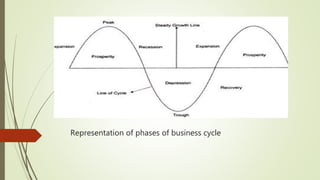
PHASES OF THE BUSINESS CYCLE
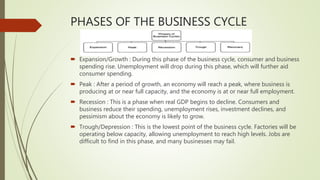
 Expansion/Growth : During this phase of the business cycle, consumer and business
spending rise. Unemployment will drop during this phase, which will further aid
consumer spending.
 Peak : After a period of growth, an economy will reach a peak, where business is
producing at or near full capacity, and the economy is at or near full employment.
 Recession : This is a phase when real GDP begins to decline. Consumers and
business reduce their spending, unemployment rises, investment declines, and
pessimism about the economy is likely to grow.
 Trough/Depression : This is the lowest point of the business cycle. Factories will be
operating below capacity, allowing unemployment to reach high levels. Jobs are
difficult to find in this phase, and many businesses may fail.
GOVERNMENT AND THE BUSINESS CYCLE
 In order to prevent the economy from running too hot (inflation) or too cold
(recession/depression), the government often becomes involved in efforts to try
and stabilize the economy.
 The government has two major tools to try and stabilize the economy and achieve
its goals:monetary policy and fiscal policy.
Representation of phases of business cycle
MONETRY POLICY
 MONETARY POLICY There is a relationship between the amount of money in the
economy (the money supply) and the level of business activity. If the money supply
increases, consumer spending will increase, promoting growth. If the money supply
decreases, the economy is likely to contract.
 The government, through the Federal Reserve , can regulate the money supply to
attempt to promote or inhibit economic activity.
 Money Designed to stop/slow inflation Reduce money supply Raise interest rates
Loose money recession Increase money supply Lower interest
FISCAL POLICY
 Fiscal policy is the taxing and spending decisions that are made by the President
and Congress.
 Fiscal policy actions of the government fall into two general categories
• Raise or Lower Taxes
• Increase or Decrease Government Spending.
THE BOOM AND BEAR PHASES
 Within these long cycles, the markets went through short periods of sharp
upswings and downswings, particularly since 1991.
 Since 1991 we had seven bull markets and six bear markets of varying time periods
and intensity. The bull market of 1991-92 witnessed 260 per cent appreciation in
one year.
 During the long bull market of 2003-07 the index rose impressively from around
2,500 to 2,1000 giving a return of 600 per cent in around 55 months.
 The bull phase from 2012 to 2015 also gave impressive returns.
 Since 1991 India’s GDP rose 10 times and the market (Sensex) multiplied 32 times
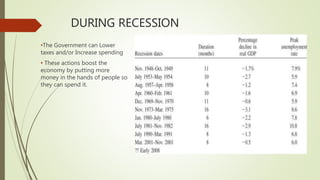
DURING RECESSION
•The Government can Lower
taxes and/or Increase spending
• These actions boost the
economy by putting more
money in the hands of people so
they can spend it.
REAL BUSINESS CYCLE
 Business cycle are driven entirely by technology shocks rather than by monetary or
changes in expectations.
 If there is an invention, productivity will increase and business people invest more
on that. It leads to boom
 If there is lack of invention, the productivity will decrease.
WHO IS AFFECTED BY THIS?
 Often, in a business cycle, multiple countries which share major relations (in terms
of trade, assistance) with a superpower (such as the United States, China) often are
hardest hit
 As these countries experience the 4 phases, other countries follow suit –
 During the 1930s, as American stocks plummeted, our stocks dropped
immediately; when their employment rose, our employment rose as well.
HOW DID THE BUSINESS CYCLE IMPACT
CANADA?
 Due to the various stages of the cycle, Canada’s economy became very unstable
between 1920 to 1940
 During the Prosperity period (1920-October 1929), the American GDP rose from
$570 billion to $820 billion at its peak; Canada, undoubtedly, experienced similar
changes but at a smaller scale
 When the Recession period hit (1929-1933), unemployment rates dramatically
increased, profits from corporations plunged from $396 million into $98 million in
debt and the average yearly income in Ontario dropped from $549 to $310
INDIAN BUSINESS CYCLE
 Business cycles in the conventional sense involving an interplay of investment and
inventory did not exist.
 The impact of agriculture on the supply of raw material and food price on the one
hand, and demand for non-agricultural products on the other was much stronger
when the economy was a closed economy with a large agriculture sector.
 In addition, the high share of public sector in investments meant a high degree of
stability in investment demand.
 After 1991, India has seen a sharp increase in private corporate sector investment
as a share of GDP.
THE BUSINESS CYCLE IS DIFFERENT THIS
TIME
 Commodities and stocks have started 2018 with a bang.
 U.S. oil is trading over $60 a barrel for the first time since 2015, and the Dow has
breached 25000.
 Inflation, though, remains in check despite a U.S. expansion in its ninth year.
 Investors can be forgiven for being both pleased and befuddled: where exactly are
we in the business cycle?
CONCLUSION
 The conclusion is that no therapy can permanently obstruct the great economic
and social process by which businesses, individual positions, forms of life, cultural
values and ideals, sink in the social scale and finally disappear.
 In a society with private property and competition, this process is the necessary
complement of the continual emergence of new economic and social forms and of
continually rising real incomes of all social strata.
 These changes are theoretically and practically, economically and culturally, much
more important than the economic stability upon which all analytical attention has
been concentrated for so long.
 Technological unemployment is thus shown to be a component part of cyclical
unemployment, and should not be contrasted with it as if it had nothing to do with
the cycle.

Business cycle

  • 1.
  • 2.
    INTRODUCTION  Economic activityis not linear, it is cyclical. Economic or business cycles are periodic expansions and contractions of economic activity. Thus, there will be periods of expansion of output, employment and prices followed by periods of contraction of output, employment and price level.  The cycles of expansions are characterised by business optimism and expanding business profitability.  Conversely, cycles of contraction are characterised by business pessimism and declining or stagnating business profitability. Markets anticipate these fluctuations and move ahead.  Markets start moving up ahead of a boom phase and continue to expand during the boom phase finally declining sharply or crashing anticipating a sharp slowdown or recession.
  • 3.
    PHASES OF THEBUSINESS CYCLE  Expansion/Growth : During this phase of the business cycle, consumer and business spending rise. Unemployment will drop during this phase, which will further aid consumer spending.  Peak : After a period of growth, an economy will reach a peak, where business is producing at or near full capacity, and the economy is at or near full employment.  Recession : This is a phase when real GDP begins to decline. Consumers and business reduce their spending, unemployment rises, investment declines, and pessimism about the economy is likely to grow.  Trough/Depression : This is the lowest point of the business cycle. Factories will be operating below capacity, allowing unemployment to reach high levels. Jobs are difficult to find in this phase, and many businesses may fail.
  • 4.
    GOVERNMENT AND THEBUSINESS CYCLE  In order to prevent the economy from running too hot (inflation) or too cold (recession/depression), the government often becomes involved in efforts to try and stabilize the economy.  The government has two major tools to try and stabilize the economy and achieve its goals:monetary policy and fiscal policy.
  • 5.
    Representation of phasesof business cycle
  • 6.
    MONETRY POLICY  MONETARYPOLICY There is a relationship between the amount of money in the economy (the money supply) and the level of business activity. If the money supply increases, consumer spending will increase, promoting growth. If the money supply decreases, the economy is likely to contract.  The government, through the Federal Reserve , can regulate the money supply to attempt to promote or inhibit economic activity.  Money Designed to stop/slow inflation Reduce money supply Raise interest rates Loose money recession Increase money supply Lower interest
  • 7.
    FISCAL POLICY  Fiscalpolicy is the taxing and spending decisions that are made by the President and Congress.  Fiscal policy actions of the government fall into two general categories • Raise or Lower Taxes • Increase or Decrease Government Spending.
  • 8.
    THE BOOM ANDBEAR PHASES  Within these long cycles, the markets went through short periods of sharp upswings and downswings, particularly since 1991.  Since 1991 we had seven bull markets and six bear markets of varying time periods and intensity. The bull market of 1991-92 witnessed 260 per cent appreciation in one year.  During the long bull market of 2003-07 the index rose impressively from around 2,500 to 2,1000 giving a return of 600 per cent in around 55 months.  The bull phase from 2012 to 2015 also gave impressive returns.  Since 1991 India’s GDP rose 10 times and the market (Sensex) multiplied 32 times
  • 9.
    DURING RECESSION •The Governmentcan Lower taxes and/or Increase spending • These actions boost the economy by putting more money in the hands of people so they can spend it.
  • 10.
    REAL BUSINESS CYCLE Business cycle are driven entirely by technology shocks rather than by monetary or changes in expectations.  If there is an invention, productivity will increase and business people invest more on that. It leads to boom  If there is lack of invention, the productivity will decrease.
  • 11.
    WHO IS AFFECTEDBY THIS?  Often, in a business cycle, multiple countries which share major relations (in terms of trade, assistance) with a superpower (such as the United States, China) often are hardest hit  As these countries experience the 4 phases, other countries follow suit –  During the 1930s, as American stocks plummeted, our stocks dropped immediately; when their employment rose, our employment rose as well.
  • 12.
    HOW DID THEBUSINESS CYCLE IMPACT CANADA?  Due to the various stages of the cycle, Canada’s economy became very unstable between 1920 to 1940  During the Prosperity period (1920-October 1929), the American GDP rose from $570 billion to $820 billion at its peak; Canada, undoubtedly, experienced similar changes but at a smaller scale  When the Recession period hit (1929-1933), unemployment rates dramatically increased, profits from corporations plunged from $396 million into $98 million in debt and the average yearly income in Ontario dropped from $549 to $310
  • 13.
    INDIAN BUSINESS CYCLE Business cycles in the conventional sense involving an interplay of investment and inventory did not exist.  The impact of agriculture on the supply of raw material and food price on the one hand, and demand for non-agricultural products on the other was much stronger when the economy was a closed economy with a large agriculture sector.  In addition, the high share of public sector in investments meant a high degree of stability in investment demand.  After 1991, India has seen a sharp increase in private corporate sector investment as a share of GDP.
  • 14.
    THE BUSINESS CYCLEIS DIFFERENT THIS TIME  Commodities and stocks have started 2018 with a bang.  U.S. oil is trading over $60 a barrel for the first time since 2015, and the Dow has breached 25000.  Inflation, though, remains in check despite a U.S. expansion in its ninth year.  Investors can be forgiven for being both pleased and befuddled: where exactly are we in the business cycle?
  • 15.
    CONCLUSION  The conclusionis that no therapy can permanently obstruct the great economic and social process by which businesses, individual positions, forms of life, cultural values and ideals, sink in the social scale and finally disappear.  In a society with private property and competition, this process is the necessary complement of the continual emergence of new economic and social forms and of continually rising real incomes of all social strata.  These changes are theoretically and practically, economically and culturally, much more important than the economic stability upon which all analytical attention has been concentrated for so long.  Technological unemployment is thus shown to be a component part of cyclical unemployment, and should not be contrasted with it as if it had nothing to do with the cycle.