BUSINESS CYCLE
The business cycle refers to the rhythmic fluctuations in aggregate
economic activities in the country over a period of time.
The business cycle is the periodic but irregular up & downs movements in economic
activity, measured by fluctuations in real gross domestic product(GDP) & other
macroeconomic variables.
How do we measure “up & down” movement in business activity?
 These are generally measured using rise & fall in real GDP (which includes output
from the household & non profit sector and the govt. sector, as well as the business
output.
DEFINITION
Prof. Keynes says : " A business cycle is composed of periods of bad trade
characterized by falling prices and high unemployment percentages while a
period of good trade is characterized by rising prices and high employment,
percentages.”
In simple words, a business cycle refers to fluctuations in economic
activities specially in employment, output and income, prices, profits etc.
CAUSES OF BUSINESS CYCLE
 Forces of Demand and Supply
 Capital goods and consumer goods
 Purchasing power
 Population expansion
 Human psychology
 Cyclical changes in weather
TYPES OF CYCLES
 SHORT KITCHIN CYCLE: Also known as minor cycle which is approximately of
2 to 5 years duration. They were first mentioned by English economist
KITCHEN.
 LONG JUGLER CYCLE: They are of duration of 8 to 12 years. First explained
by French economist Juglar. These cycles are also known as major cycles.
 The VERY LONG KONDRATIEFF CYCLE: These are prolonged cycles with their
duration ranging from 50 to 60 years.
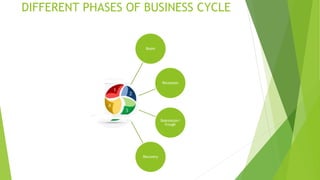
DIFFERENT PHASES OF BUSINESS CYCLE
Boom
Recession
Depression/
trough
Recovery
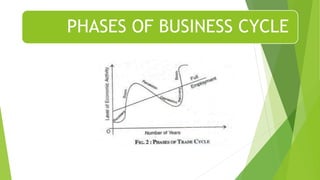
PHASES OF BUSINESS CYCLE
BOOM/ PEAK
This phase of business cycle represents the best stage of prosperity .
 Income or production is the maximum
 Traders and industrialists earn huge profits because at this stage production is the maximum.
 Reaches full employment & hence rise in prices and wages
 Price rise very high
 Expansion in bank credit
 All kinds of investments increase
 Rate of interest is high
 Optimistic behaviour in economy
RECESSION
Recession means a fall in the level of real national output i.e. a period when growth is negative,
leading to a contraction in employment, incomes and profits.
 Recession can be defined as : “significant decline in economic activity lasting more than a few
months, which is normally visible in real GDP, real income, employment, industrial production, and
wholesale-retail sales”.
 In Economics , the term recession generally describes the reduction of a country's Gross
Domestic Product (GDP) for at least two quarters.
 Fall in economic activities
 Fall in investment sets in reverse motion of multiplier
 Fall in income & output
 Workers are rendered unemployed
 Wages fall due to unemployment
 Prices begin to fall & fall in profits also
 Contraction of bank credit
 Demand of the consumers for various goods fall
 Feeling of fear & doubt
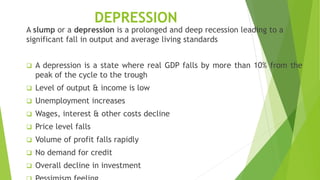
DEPRESSION
A slump or a depression is a prolonged and deep recession leading to a
significant fall in output and average living standards
 A depression is a state where real GDP falls by more than 10% from the
peak of the cycle to the trough
 Level of output & income is low
 Unemployment increases
 Wages, interest & other costs decline
 Price level falls
 Volume of profit falls rapidly
 No demand for credit
 Overall decline in investment
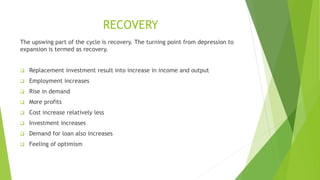
RECOVERY
The upswing part of the cycle is recovery. The turning point from depression to
expansion is termed as recovery.
 Replacement investment result into increase in income and output
 Employment increases
 Rise in demand
 More profits
 Cost increase relatively less
 Investment increases
 Demand for loan also increases
 Feeling of optimism
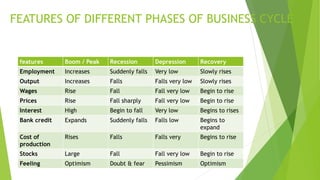
FEATURES OF DIFFERENT PHASES OF BUSINESS CYCLE
features Boom / Peak Recession Depression Recovery
Employment Increases Suddenly falls Very low Slowly rises
Output Increases Falls Falls very low Slowly rises
Wages Rise Fall Fall very low Begin to rise
Prices Rise Fall sharply Fall very low Begin to rise
Interest High Begin to fall Very low Begins to rises
Bank credit Expands Suddenly falls Falls low Begins to
expand
Cost of
production
Rises Falls Falls very Begins to rise
Stocks Large Fall Fall very low Begin to rise
Feeling Optimism Doubt & fear Pessimism Optimism
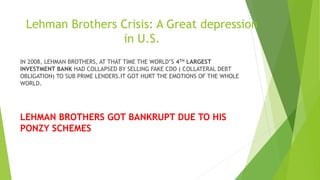
Lehman Brothers Crisis: A Great depression
in U.S.
IN 2008, LEHMAN BROTHERS, AT THAT TIME THE WORLD’S 4TH LARGEST
INVESTMENT BANK HAD COLLAPSED BY SELLING FAKE CDO ( COLLATERAL DEBT
OBLIGATION) TO SUB PRIME LENDERS.IT GOT HURT THE EMOTIONS OF THE WHOLE
WORLD.
LEHMAN BROTHERS GOT BANKRUPT DUE TO HIS
PONZY SCHEMES
KEYNES THEORY
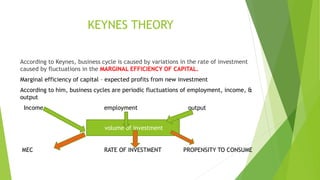
According to Keynes, business cycle is caused by variations in the rate of investment
caused by fluctuations in the MARGINAL EFFICIENCY OF CAPITAL.
Marginal efficiency of capital – expected profits from new investment
According to him, business cycles are periodic fluctuations of employment, income, &
output
Income employment output
MEC RATE OF INVESTMENT PROPENSITY TO CONSUME
volume of investment
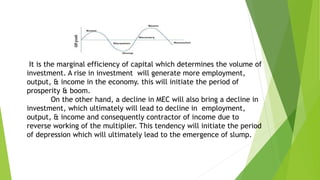
It is the marginal efficiency of capital which determines the volume of
investment. A rise in investment will generate more employment,
output, & income in the economy. this will initiate the period of
prosperity & boom.
On the other hand, a decline in MEC will also bring a decline in
investment, which ultimately will lead to decline in employment,
output, & income and consequently contractor of income due to
reverse working of the multiplier. This tendency will initiate the period
of depression which will ultimately lead to the emergence of slump.
METHODS TO CONTROL BUSINESS CYCLES
 Monetary policy
Regulation & control of flow of credit, supply of money & rate of interest in the
economy with a view to restore economic stability by adopting either DEAR MONETARY
POLICY or
 Fiscal policy
1. Built –in- stablizers
2. Discretionary measures
 Direct controls
1. Price controls
2. Quantity controls
3. Wage controls
Any Queries???
Business cycle/ Trade Cycle/Economic Cycle

Business cycle/ Trade Cycle/Economic Cycle

  • 1.
    BUSINESS CYCLE The businesscycle refers to the rhythmic fluctuations in aggregate economic activities in the country over a period of time. The business cycle is the periodic but irregular up & downs movements in economic activity, measured by fluctuations in real gross domestic product(GDP) & other macroeconomic variables. How do we measure “up & down” movement in business activity?  These are generally measured using rise & fall in real GDP (which includes output from the household & non profit sector and the govt. sector, as well as the business output.
  • 2.
    DEFINITION Prof. Keynes says: " A business cycle is composed of periods of bad trade characterized by falling prices and high unemployment percentages while a period of good trade is characterized by rising prices and high employment, percentages.” In simple words, a business cycle refers to fluctuations in economic activities specially in employment, output and income, prices, profits etc.
  • 3.
    CAUSES OF BUSINESSCYCLE  Forces of Demand and Supply  Capital goods and consumer goods  Purchasing power  Population expansion  Human psychology  Cyclical changes in weather
  • 4.
    TYPES OF CYCLES SHORT KITCHIN CYCLE: Also known as minor cycle which is approximately of 2 to 5 years duration. They were first mentioned by English economist KITCHEN.  LONG JUGLER CYCLE: They are of duration of 8 to 12 years. First explained by French economist Juglar. These cycles are also known as major cycles.  The VERY LONG KONDRATIEFF CYCLE: These are prolonged cycles with their duration ranging from 50 to 60 years.
  • 5.
    DIFFERENT PHASES OFBUSINESS CYCLE Boom Recession Depression/ trough Recovery
  • 6.
  • 7.
    BOOM/ PEAK This phaseof business cycle represents the best stage of prosperity .  Income or production is the maximum  Traders and industrialists earn huge profits because at this stage production is the maximum.  Reaches full employment & hence rise in prices and wages  Price rise very high  Expansion in bank credit  All kinds of investments increase  Rate of interest is high  Optimistic behaviour in economy
  • 8.
    RECESSION Recession means afall in the level of real national output i.e. a period when growth is negative, leading to a contraction in employment, incomes and profits.  Recession can be defined as : “significant decline in economic activity lasting more than a few months, which is normally visible in real GDP, real income, employment, industrial production, and wholesale-retail sales”.  In Economics , the term recession generally describes the reduction of a country's Gross Domestic Product (GDP) for at least two quarters.  Fall in economic activities  Fall in investment sets in reverse motion of multiplier  Fall in income & output  Workers are rendered unemployed  Wages fall due to unemployment  Prices begin to fall & fall in profits also  Contraction of bank credit  Demand of the consumers for various goods fall  Feeling of fear & doubt
  • 9.
    DEPRESSION A slump ora depression is a prolonged and deep recession leading to a significant fall in output and average living standards  A depression is a state where real GDP falls by more than 10% from the peak of the cycle to the trough  Level of output & income is low  Unemployment increases  Wages, interest & other costs decline  Price level falls  Volume of profit falls rapidly  No demand for credit  Overall decline in investment
  • 10.
    RECOVERY The upswing partof the cycle is recovery. The turning point from depression to expansion is termed as recovery.  Replacement investment result into increase in income and output  Employment increases  Rise in demand  More profits  Cost increase relatively less  Investment increases  Demand for loan also increases  Feeling of optimism
  • 11.
    FEATURES OF DIFFERENTPHASES OF BUSINESS CYCLE features Boom / Peak Recession Depression Recovery Employment Increases Suddenly falls Very low Slowly rises Output Increases Falls Falls very low Slowly rises Wages Rise Fall Fall very low Begin to rise Prices Rise Fall sharply Fall very low Begin to rise Interest High Begin to fall Very low Begins to rises Bank credit Expands Suddenly falls Falls low Begins to expand Cost of production Rises Falls Falls very Begins to rise Stocks Large Fall Fall very low Begin to rise Feeling Optimism Doubt & fear Pessimism Optimism
  • 12.
    Lehman Brothers Crisis:A Great depression in U.S. IN 2008, LEHMAN BROTHERS, AT THAT TIME THE WORLD’S 4TH LARGEST INVESTMENT BANK HAD COLLAPSED BY SELLING FAKE CDO ( COLLATERAL DEBT OBLIGATION) TO SUB PRIME LENDERS.IT GOT HURT THE EMOTIONS OF THE WHOLE WORLD. LEHMAN BROTHERS GOT BANKRUPT DUE TO HIS PONZY SCHEMES
  • 13.
    KEYNES THEORY According toKeynes, business cycle is caused by variations in the rate of investment caused by fluctuations in the MARGINAL EFFICIENCY OF CAPITAL. Marginal efficiency of capital – expected profits from new investment According to him, business cycles are periodic fluctuations of employment, income, & output Income employment output MEC RATE OF INVESTMENT PROPENSITY TO CONSUME volume of investment
  • 14.
    It is themarginal efficiency of capital which determines the volume of investment. A rise in investment will generate more employment, output, & income in the economy. this will initiate the period of prosperity & boom. On the other hand, a decline in MEC will also bring a decline in investment, which ultimately will lead to decline in employment, output, & income and consequently contractor of income due to reverse working of the multiplier. This tendency will initiate the period of depression which will ultimately lead to the emergence of slump.
  • 15.
    METHODS TO CONTROLBUSINESS CYCLES  Monetary policy Regulation & control of flow of credit, supply of money & rate of interest in the economy with a view to restore economic stability by adopting either DEAR MONETARY POLICY or  Fiscal policy 1. Built –in- stablizers 2. Discretionary measures  Direct controls 1. Price controls 2. Quantity controls 3. Wage controls
  • 16.