Effective Communications in
Business
1. Effective Business Communication by
Herta A Murphy
Herbert W Hilderbrandt
Jane P Thomas
2. Communication Concepts & Skills by
Robert Hopper
Jack L. Whitehead, Jr.
WHAT IS COMMUNICATION?
It is easy to send a message ; It is somewhat more
difficult to communicate.
Communication is a sort of sharing that takes
place when messages get received and
interpreted.
The author of, say this book is not sending
messages to you right now. He sent the messages
when he wrote this book. You are reading now
and interpreting those messages.
It is correct to say that Communication is
happening between you and the author now,
although the messages were sent long ago.
Communication happens when
messages are received and interpreted.
It is not communication when the
author writes a book.
It is communication when you read and
understand the book.
At least two kinds of things happen when people
communicate with each other.
One is message transportation. T.V. for instance allows
a message to be transported to millions of people from
one central location. If you think communication as
transportation, you focus on the source of message
and the message itself. This kind of thinking arises
certain questions. For example; What can a speaker do
to make a presentation more effective? What kind of
T.V. commercial is going to transport itself most
effectively to a large number of listener?
A second activity that happens during
communication is also very important.
As the transported message reaches you, a
change takes place inside your head. Nobody
exactly knows what the change is. But somehow
the message picks up a meaning. You interpret
the message. This interpretation process is
crucial to communication.
Communication can thus be defined as what
happens when a receiver of a message assigns a
meaning to it.
To emphasize the interpretation function of
communication is to emphasize the role of
receiver in communication.
If I am sending messages to you, then
effectiveness of the message depends upon your
receiving behavior as much as my sending
behavior.
You must be paying attention:
You must be interested to receive the message:
 You must have some means of understanding:
what I am saying.
If these things do not happen, my sending has
been a waste of time.
People often emphasize message transportation
when they think about communication. This
emphasis focus on the role of source of
message and effective message construction.
Such a perspective is useful, but there is also
value in viewing communication as
interpretation
of messages and assigning meanings to
messages.
Communication is message reception and
interpretation.
For each activity, describe amount of time you
remained engaged in say last three days.
ACTIVITY AMOUNT OF TIME
Watching T.V. / Movies
Listening to Radio / FM / CDs
Talking to friends, teachers & others etc.
Writing
Reading Newspapers, Course Books etc.
Receiving SMSs on your Mobiles.
Working on Computers
Most of the students found that they spend more
time in receiving behavior such as listening,
reading, and watching T.V. than in sending
messages.
Different studies conclude that nearly everyone
listens more than he or she talks; reads more than
he writes;
And in general spends more time in receiving
messages than sending messages. Effective
listening could resolve more communication
problems than effective talking could.
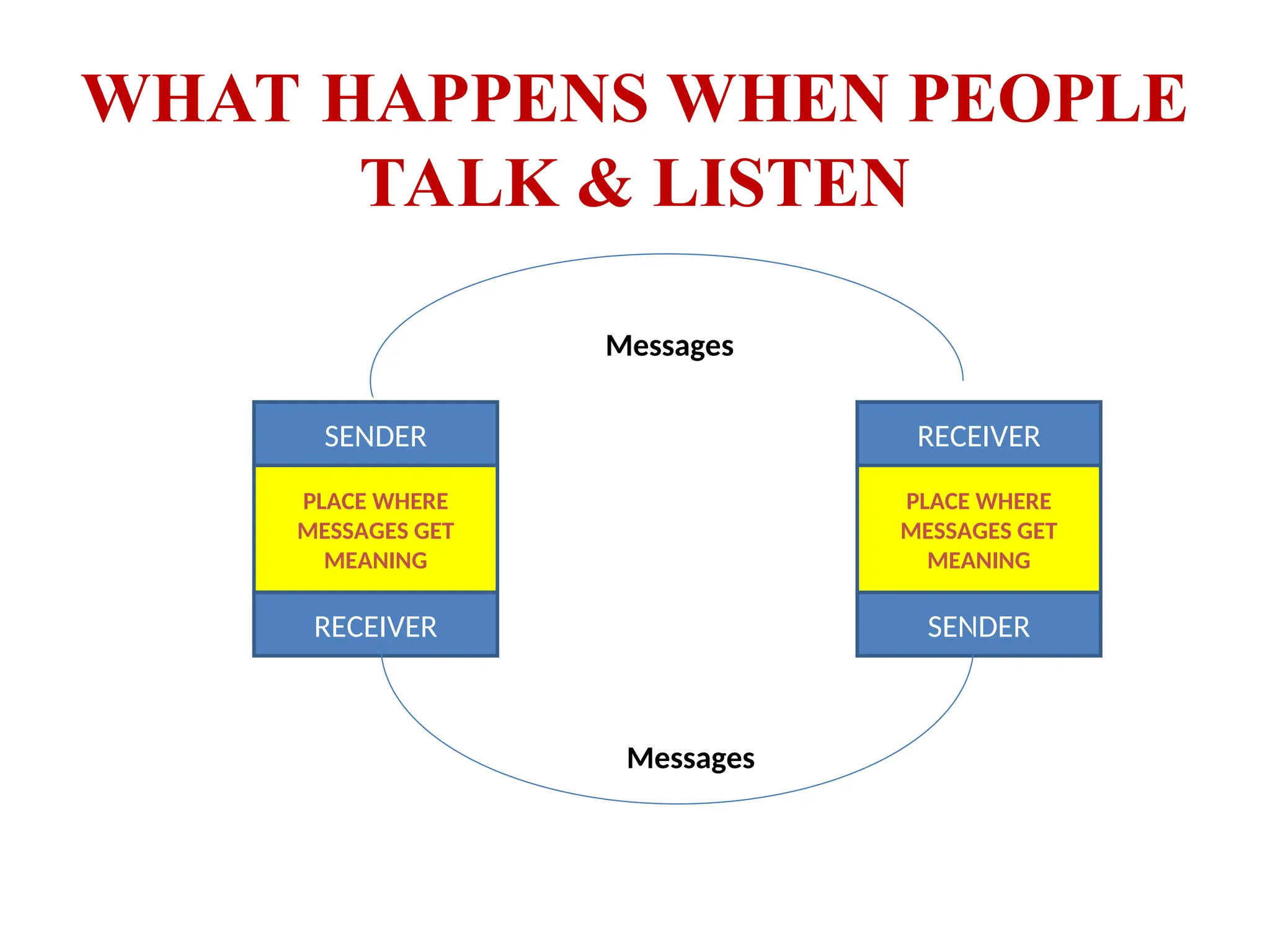
Figure-1 presents a model of what happens when
people talk and listen. The two squares in the
diagram represents two people sending messages
to each other and receiving messages from each
other (slide-24)
One person does not simply talk and then listens
to the other talk, the way you might be thinking it
works, rather both people send messages
constantly and just as constantly monitor
messages coming in.
Suppose you are talking to a friend. While you
are talking, your friend is responding you by
nodes, by smiles, by occasional chuckles by
looking at you.
Sometimes the other person interrupts you to
finish a sentence. So you see, it is not so simple
as you talking and your friend listening.
The model is elegant because it captures aspects
of both the transportation and the interpretation
views of communication. At the end of receiving
part of any message, the message is taken into
the receiver and interpreted as a set of meanings.
This is the moment of impact, the moment
in which a message creates an effect.
If you listen to any conversation between
friends, you will probably note that the most of
the people spend much of the conversation
paying maximum attention to what they are
going to say next. We do it too. As we listen to
others, we spend a lot of time thinking about the
next time we will be speaking.
People want to speak because they think that the
speaker is the most important part of any
communication event.
The most direct way of improving your
communication skills includes working on you;
what you think and on ways you listen, as well as
on how you speak. It is partly a matter of practice
and partly a matter of awareness and of
understanding the messages.
Training in communication skills is important but
that works only if your listeners receive the
messages and interpret these effectively.
That is because the receiver usually
holds most of the keys to effective
communication.
Importance and Benefits of
Effective Communication
If you can communicate effectively in speaking
and writing, you have a highly valued skill. In
numerous surveys, the executives rank the
ability to communicate first among the personal
factors necessary to excel in the profession.
Communicating effectively in speaking and
writing extends across all areas of business,
including management, technical, clerical and
social positions. And now in the twenties, the
phenomenal growth of internal trade creates the
need for you to understand intercultural
communication-the ability to speak and write in
ways that are sensitive to and cognizant of the
factors in different cultural contexts.
Internal Communication
A vital means of attending to company concerns
is through effective internal communication-
Downward, upward, and horizontal. It helps
increase job satisfaction, safety, productivity
and profits and decrease the absenteeism,
grievances and turnover.
When employees receive appropriate downward
communication from management, they can be
better motivated and more efficient. They need
not only clear job directions and safety rules but
also facts about organizational strategy, products,
and viewpoints on important controversial issues
Likewise, upward internal communication has
become increasingly more significant. Many
executives sincerely seek frank comments from
the employees, in addition to the usual periodic
reports. Successful managers listen closely to
opinions, complaints, problems and suggestions,
especially when they are clearly and effectively
stated. As a response to increasing global
competition, some companies are developing
new management styles, which make inputs from
employees an integral part of important decisions
affecting the company.
Effective horizontal communication between
peers is also essential in organizations in order to
solve problems, perform job duties, prepare for
meetings, and cooperate on important projects.
Among various ways of communicating within
companies are memos, reports, meetings, face to
face discussions, teleconferences, and email etc.
External Communication
Messages to persons outside the company can
have a far reaching effect on its reputation, and
ultimate success. The right letter, proposal,
report, telephone call, or personal conversation
can win back a disgruntled customer, create a
desire for a firm’s product or service, help
negotiate a profitable sale and in general, create
goodwill.
Overall Communication Cost
In multinational corporations, thousands of
hours are devoted daily to interviews,
conferences, memos, reports, employees
manuals, advertising, new articles, bulletins,
newsletters, and other messages. Time is the
chief element in the overall cost of all such
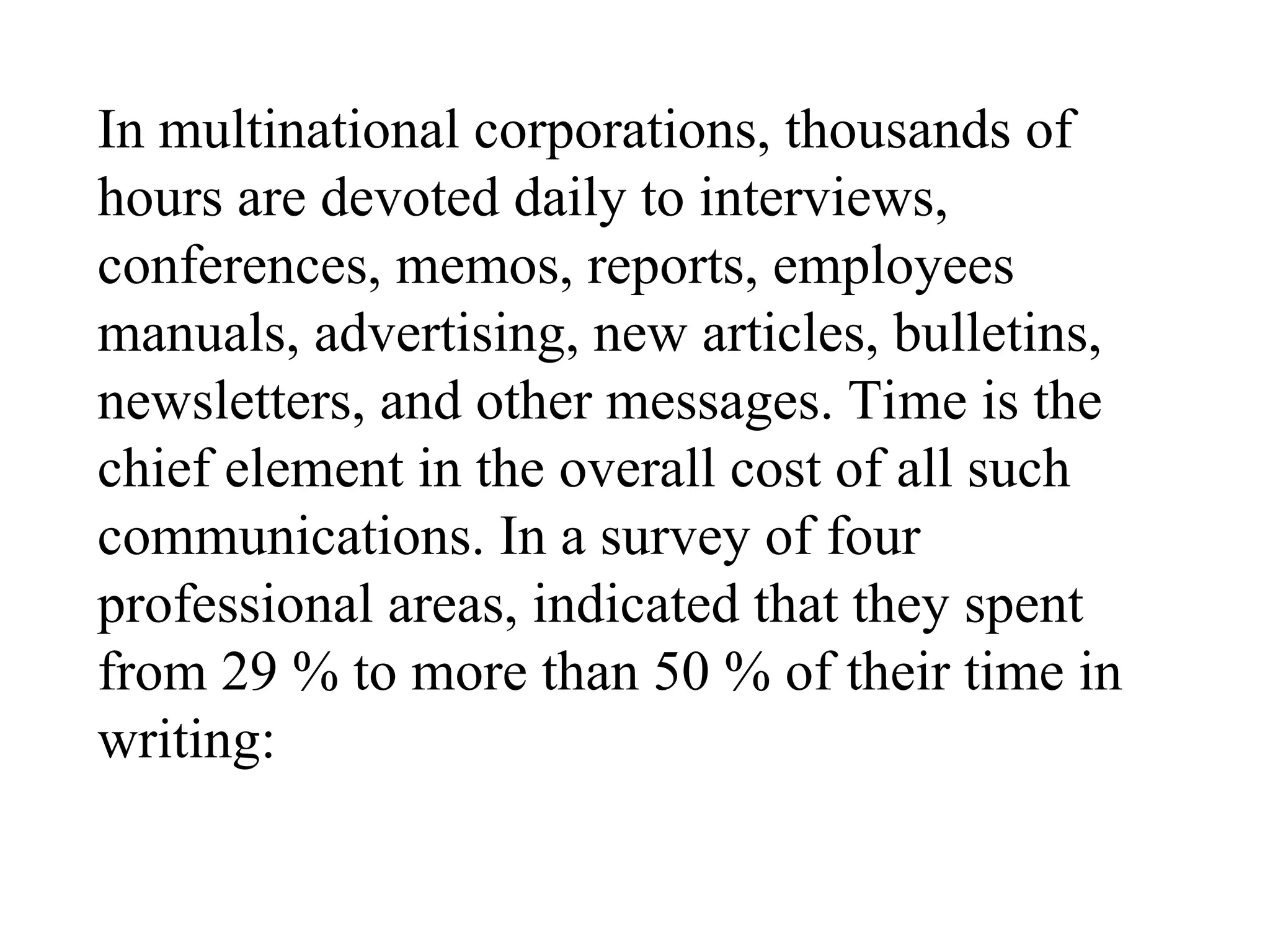
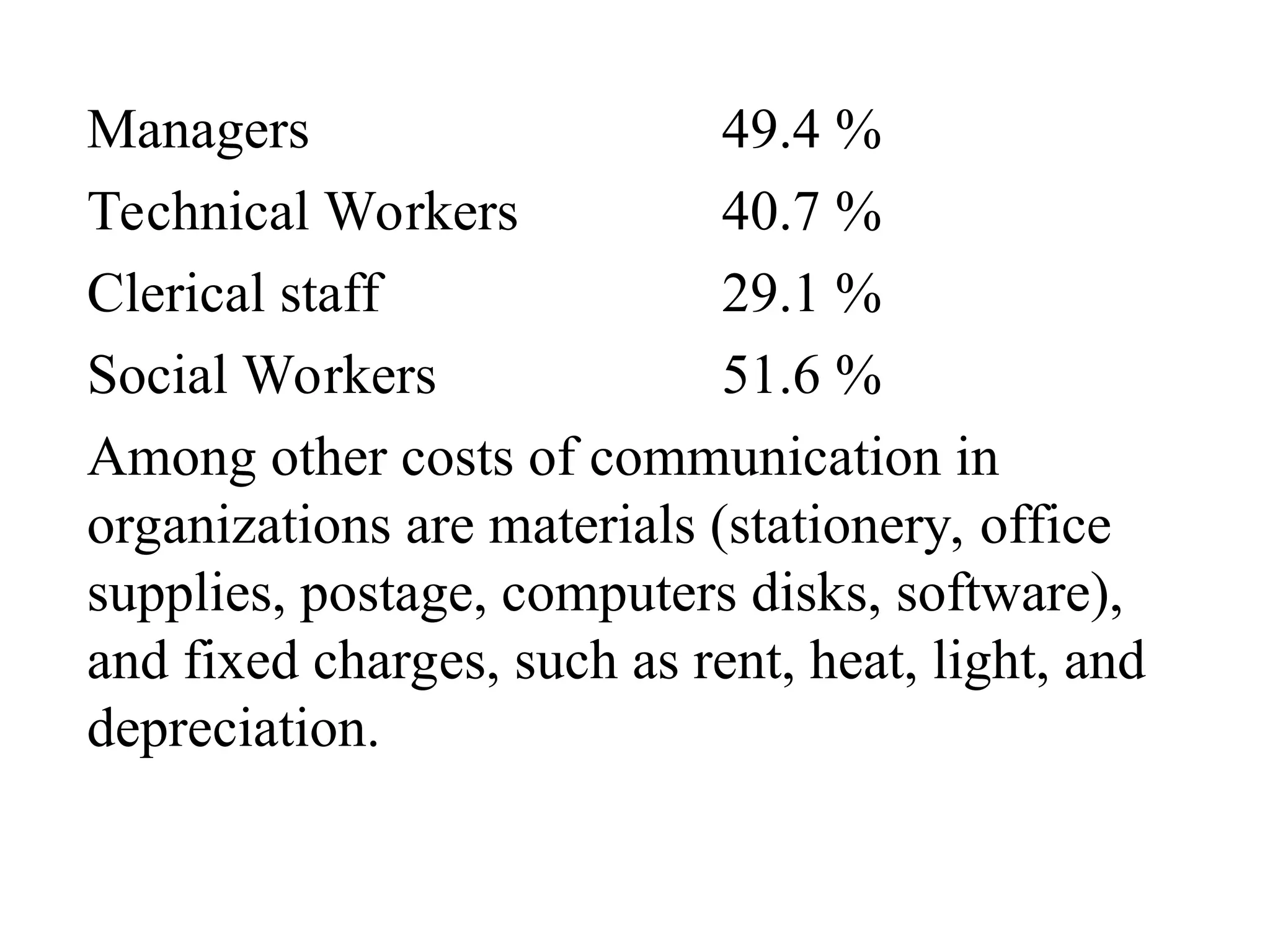
communications. In a survey of four
professional areas, indicated that they spent
from 29 % to more than 50 % of their time in
writing:
Managers 49.4 %
Technical Workers 40.7 %
Clerical staff 29.1 %
Social Workers 51.6 %
Among other costs of communication in
organizations are materials (stationery, office
supplies, postage, computers disks, software),
and fixed charges, such as rent, heat, light, and
depreciation.
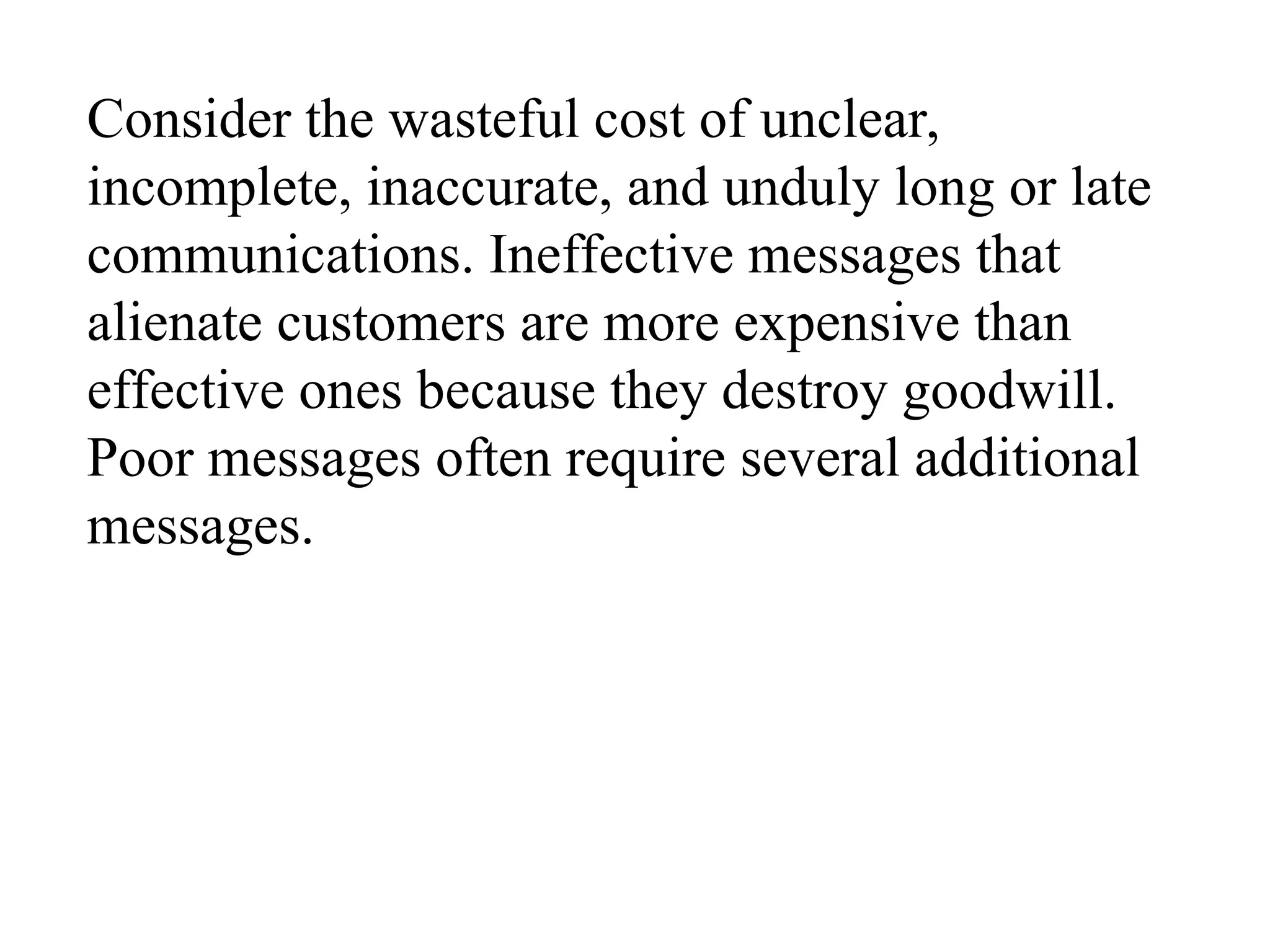
Consider the wasteful cost of unclear,
incomplete, inaccurate, and unduly long or late
communications. Ineffective messages that
alienate customers are more expensive than
effective ones because they destroy goodwill.
Poor messages often require several additional
messages.
WHAT HAPPENS WHEN PEOPLE
TALK & LISTEN
SENDER
RECEIVER
PLACE WHERE
MESSAGES GET
MEANING
SENDER
PLACE WHERE
MESSAGES GET
MEANING
RECEIVER
Messages
Messages
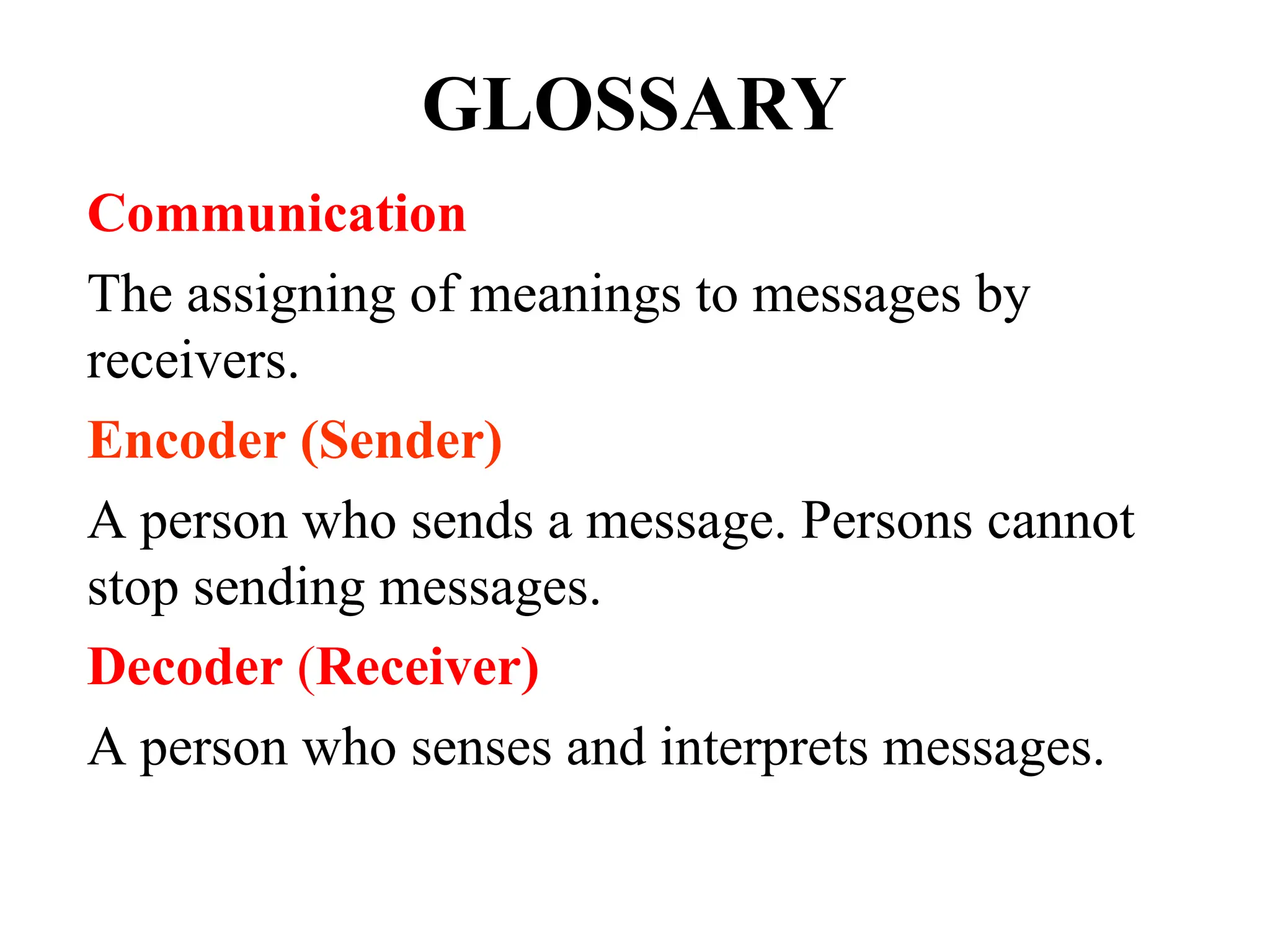
GLOSSARY
Communication
The assigning of meanings to messages by
receivers.
Encoder (Sender)
A person who sends a message. Persons cannot
stop sending messages.
Decoder (Receiver)
A person who senses and interprets messages.
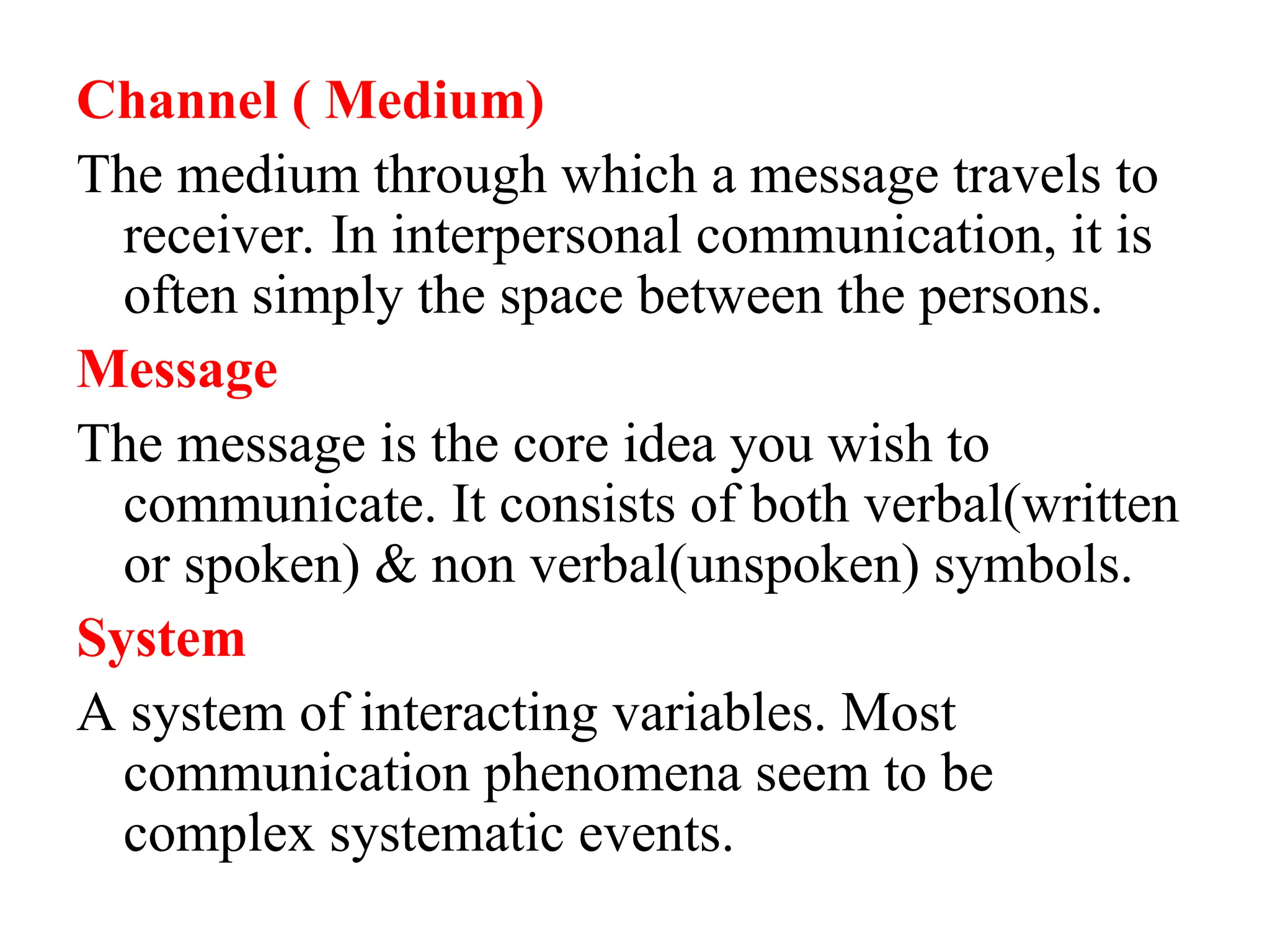
Channel ( Medium)
The medium through which a message travels to
receiver. In interpersonal communication, it is
often simply the space between the persons.
Message
The message is the core idea you wish to
communicate. It consists of both verbal(written
or spoken) & non verbal(unspoken) symbols.
System
A system of interacting variables. Most
communication phenomena seem to be
complex systematic events.
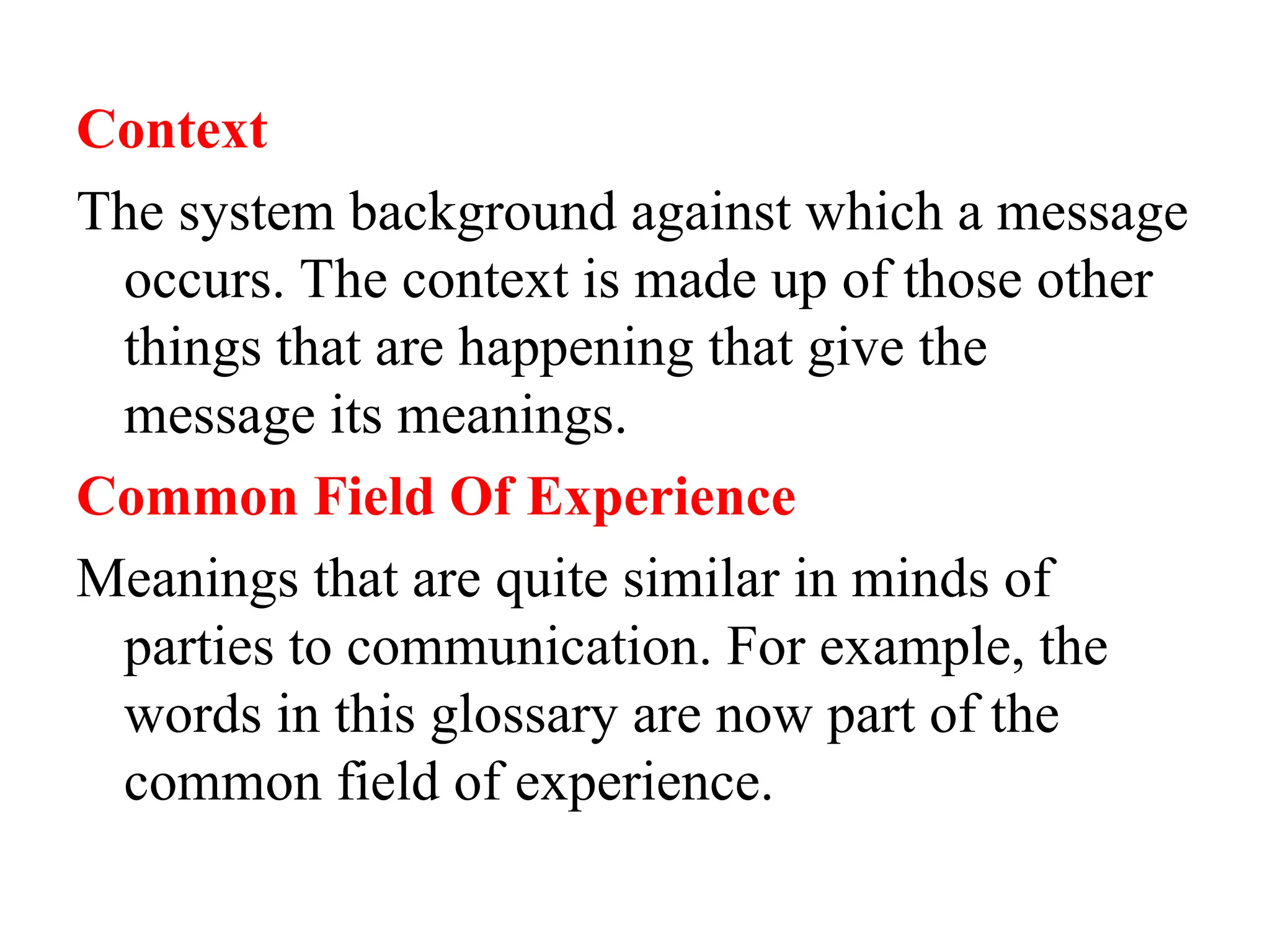
Context
The system background against which a message
occurs. The context is made up of those other
things that are happening that give the
message its meanings.
Common Field Of Experience
Meanings that are quite similar in minds of
parties to communication. For example, the
words in this glossary are now part of the
common field of experience.

How to have Effective Communication in Business

  • 1.
    Effective Communications in Business 1.Effective Business Communication by Herta A Murphy Herbert W Hilderbrandt Jane P Thomas 2. Communication Concepts & Skills by Robert Hopper Jack L. Whitehead, Jr.
  • 2.
    WHAT IS COMMUNICATION? Itis easy to send a message ; It is somewhat more difficult to communicate. Communication is a sort of sharing that takes place when messages get received and interpreted. The author of, say this book is not sending messages to you right now. He sent the messages when he wrote this book. You are reading now and interpreting those messages.
  • 3.
    It is correctto say that Communication is happening between you and the author now, although the messages were sent long ago. Communication happens when messages are received and interpreted. It is not communication when the author writes a book. It is communication when you read and understand the book.
  • 4.
    At least twokinds of things happen when people communicate with each other. One is message transportation. T.V. for instance allows a message to be transported to millions of people from one central location. If you think communication as transportation, you focus on the source of message and the message itself. This kind of thinking arises certain questions. For example; What can a speaker do to make a presentation more effective? What kind of T.V. commercial is going to transport itself most effectively to a large number of listener?
  • 5.
    A second activitythat happens during communication is also very important. As the transported message reaches you, a change takes place inside your head. Nobody exactly knows what the change is. But somehow the message picks up a meaning. You interpret the message. This interpretation process is crucial to communication. Communication can thus be defined as what happens when a receiver of a message assigns a meaning to it.
  • 6.
    To emphasize theinterpretation function of communication is to emphasize the role of receiver in communication. If I am sending messages to you, then effectiveness of the message depends upon your receiving behavior as much as my sending behavior. You must be paying attention: You must be interested to receive the message:
  • 7.
     You musthave some means of understanding: what I am saying. If these things do not happen, my sending has been a waste of time. People often emphasize message transportation when they think about communication. This emphasis focus on the role of source of message and effective message construction. Such a perspective is useful, but there is also value in viewing communication as interpretation
  • 8.
    of messages andassigning meanings to messages. Communication is message reception and interpretation.
  • 9.
    For each activity,describe amount of time you remained engaged in say last three days. ACTIVITY AMOUNT OF TIME Watching T.V. / Movies Listening to Radio / FM / CDs Talking to friends, teachers & others etc. Writing Reading Newspapers, Course Books etc. Receiving SMSs on your Mobiles. Working on Computers
  • 10.
    Most of thestudents found that they spend more time in receiving behavior such as listening, reading, and watching T.V. than in sending messages. Different studies conclude that nearly everyone listens more than he or she talks; reads more than he writes; And in general spends more time in receiving messages than sending messages. Effective listening could resolve more communication problems than effective talking could.
  • 11.
    Figure-1 presents amodel of what happens when people talk and listen. The two squares in the diagram represents two people sending messages to each other and receiving messages from each other (slide-24) One person does not simply talk and then listens to the other talk, the way you might be thinking it works, rather both people send messages constantly and just as constantly monitor messages coming in. Suppose you are talking to a friend. While you
  • 12.
    are talking, yourfriend is responding you by nodes, by smiles, by occasional chuckles by looking at you. Sometimes the other person interrupts you to finish a sentence. So you see, it is not so simple as you talking and your friend listening. The model is elegant because it captures aspects of both the transportation and the interpretation views of communication. At the end of receiving part of any message, the message is taken into the receiver and interpreted as a set of meanings.
  • 13.
    This is themoment of impact, the moment in which a message creates an effect. If you listen to any conversation between friends, you will probably note that the most of the people spend much of the conversation paying maximum attention to what they are going to say next. We do it too. As we listen to others, we spend a lot of time thinking about the next time we will be speaking. People want to speak because they think that the
  • 14.
    speaker is themost important part of any communication event. The most direct way of improving your communication skills includes working on you; what you think and on ways you listen, as well as on how you speak. It is partly a matter of practice and partly a matter of awareness and of understanding the messages. Training in communication skills is important but that works only if your listeners receive the messages and interpret these effectively.
  • 15.
    That is becausethe receiver usually holds most of the keys to effective communication. Importance and Benefits of Effective Communication If you can communicate effectively in speaking and writing, you have a highly valued skill. In numerous surveys, the executives rank the ability to communicate first among the personal
  • 16.
    factors necessary toexcel in the profession. Communicating effectively in speaking and writing extends across all areas of business, including management, technical, clerical and social positions. And now in the twenties, the phenomenal growth of internal trade creates the need for you to understand intercultural communication-the ability to speak and write in ways that are sensitive to and cognizant of the factors in different cultural contexts.
  • 17.
    Internal Communication A vitalmeans of attending to company concerns is through effective internal communication- Downward, upward, and horizontal. It helps increase job satisfaction, safety, productivity and profits and decrease the absenteeism, grievances and turnover. When employees receive appropriate downward communication from management, they can be better motivated and more efficient. They need
  • 18.
    not only clearjob directions and safety rules but also facts about organizational strategy, products, and viewpoints on important controversial issues Likewise, upward internal communication has become increasingly more significant. Many executives sincerely seek frank comments from the employees, in addition to the usual periodic reports. Successful managers listen closely to opinions, complaints, problems and suggestions, especially when they are clearly and effectively stated. As a response to increasing global
  • 19.
    competition, some companiesare developing new management styles, which make inputs from employees an integral part of important decisions affecting the company. Effective horizontal communication between peers is also essential in organizations in order to solve problems, perform job duties, prepare for meetings, and cooperate on important projects. Among various ways of communicating within companies are memos, reports, meetings, face to face discussions, teleconferences, and email etc.
  • 20.
    External Communication Messages topersons outside the company can have a far reaching effect on its reputation, and ultimate success. The right letter, proposal, report, telephone call, or personal conversation can win back a disgruntled customer, create a desire for a firm’s product or service, help negotiate a profitable sale and in general, create goodwill. Overall Communication Cost
  • 21.
    In multinational corporations,thousands of hours are devoted daily to interviews, conferences, memos, reports, employees manuals, advertising, new articles, bulletins, newsletters, and other messages. Time is the chief element in the overall cost of all such communications. In a survey of four professional areas, indicated that they spent from 29 % to more than 50 % of their time in writing:
  • 22.
    Managers 49.4 % TechnicalWorkers 40.7 % Clerical staff 29.1 % Social Workers 51.6 % Among other costs of communication in organizations are materials (stationery, office supplies, postage, computers disks, software), and fixed charges, such as rent, heat, light, and depreciation.
  • 23.
    Consider the wastefulcost of unclear, incomplete, inaccurate, and unduly long or late communications. Ineffective messages that alienate customers are more expensive than effective ones because they destroy goodwill. Poor messages often require several additional messages.
  • 24.
    WHAT HAPPENS WHENPEOPLE TALK & LISTEN SENDER RECEIVER PLACE WHERE MESSAGES GET MEANING SENDER PLACE WHERE MESSAGES GET MEANING RECEIVER Messages Messages
  • 25.
    GLOSSARY Communication The assigning ofmeanings to messages by receivers. Encoder (Sender) A person who sends a message. Persons cannot stop sending messages. Decoder (Receiver) A person who senses and interprets messages.
  • 26.
    Channel ( Medium) Themedium through which a message travels to receiver. In interpersonal communication, it is often simply the space between the persons. Message The message is the core idea you wish to communicate. It consists of both verbal(written or spoken) & non verbal(unspoken) symbols. System A system of interacting variables. Most communication phenomena seem to be complex systematic events.
  • 27.
    Context The system backgroundagainst which a message occurs. The context is made up of those other things that are happening that give the message its meanings. Common Field Of Experience Meanings that are quite similar in minds of parties to communication. For example, the words in this glossary are now part of the common field of experience.