MIS5101: Business Intelligence
    Key Slides Weeks 1-3

       PROF. STEVEN L. JOHNSON
            Twitter: @StevenLJohnson
                 http://stevenljohnson.org


       http://community.mis.temple.edu/mis5101fall10/
Week 1: Introduction

  Introduction to...
      Content
      Format
      Each   Other


  Expectations


                                             Photo by conorwithonen
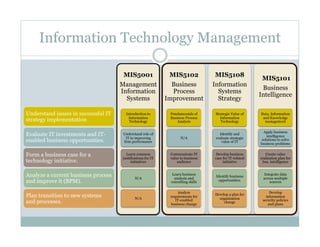
Information Technology Management

                                      MIS5001                 MIS5102             MIS5108
                                                                                                         MIS5101
                                     Management                Business           Information
                                                                                                         Business
                                     Information               Process              Systems
                                                                                                        Intelligence
                                       Systems               Improvement            Strategy

Understand issues in successful IT     Introduction to        Fundamentals of      Strategic Value of   Data, Information
                                        Information           Business Process        Information        and Knowledge
strategy implementation                  Technology               Analysis            Technology          management

                                                                                                          Apply business
Evaluate IT investments and IT-       Understand role of                             Identify and
                                                                                                            intelligence
                                       IT in improving              N/A            evaluate strategic
enabled business opportunities.       firm performance                                value of IT
                                                                                                         solutions to solve
                                                                                                        business problems


Form a business case for a             Learn common           Communicate IT      Develop business         Create value
                                     justifications for IT    value to business   case for IT-related   realization plan for
technology initiative.                    initiatives             audience             initiative        bus. intelligence


Analyze a current business process           N/A
                                                               Learn business
                                                                analysis and
                                                                                   Identify business
                                                                                                          Integrate data
                                                                                                         across multiple
and improve it (BPM).                                         consulting skills     opportunities.           sources

                                                                  Analyze                                    Develop
Plan transition to new systems               N/A
                                                              requirements for
                                                                                  Develop a plan for
                                                                                    organization
                                                                                                           information
                                                                 IT-enabled                              security policies
and processes.                                                business change
                                                                                       change
                                                                                                            and plans
In-Class Exercise #2

 “According to Russell Ackoff, a systems theorist and professor of organizational
change, the content of the human mind can be classified into five categories:

    •    Data: symbols
    •    Information: data that are processed to be useful; provides answers to
         "who", "what", "where", and "when" questions
    •    Knowledge: application of data and information; answers "how" questions
    •    Understanding: appreciation of "why”
    •    Wisdom: evaluated understanding.

Ackoff indicates that the first four categories relate to the past; they deal with what
has been or what is known. Only the fifth category, wisdom, deals with the future
because it incorporates vision and design.”

                                                       From: http://www.systems-thinking.org/dikw/dikw.htm
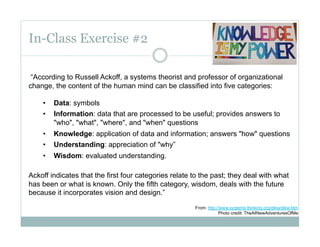
                                                                   Photo credit: TheAllNewAdventuresOfMe
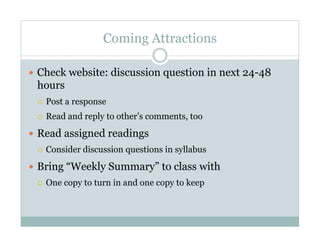
Coming Attractions

  Check website: discussion question in next 24-48
 hours
     Post a response
     Read and reply to other’s comments, too

  Read assigned readings
     Consider discussion questions in syllabus

  Bring “Weekly Summary” to class with
     One copy to turn in and one copy to keep
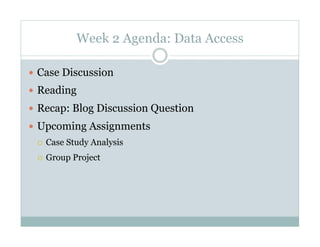
Week 2 Agenda: Data Access

  Case Discussion
  Reading
  Recap: Blog Discussion Question
  Upcoming Assignments
     Case Study Analysis
     Group Project
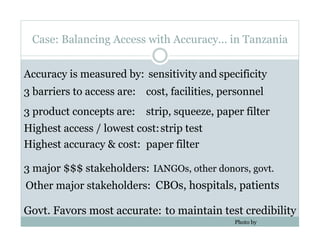
Case: Balancing Access with Accuracy... in Tanzania


Accuracy is measured by: sensitivity and specificity
3 barriers to access are: cost, facilities, personnel
3 product concepts are:    strip, squeeze, paper filter
Highest access / lowest cost: strip test
Highest accuracy & cost: paper filter

3 major $$$ stakeholders: IANGOs, other donors, govt.
Other major stakeholders: CBOs, hospitals, patients

Govt. Favors most accurate: to maintain test credibility
                                               Photo by
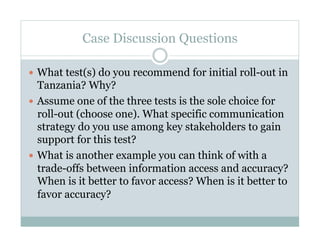
Case Discussion Questions

  What test(s) do you recommend for initial roll-out in
   Tanzania? Why?
  Assume one of the three tests is the sole choice for
   roll-out (choose one). What specific communication
   strategy do you use among key stakeholders to gain
   support for this test?
  What is another example you can think of with a
   trade-offs between information access and accuracy?
   When is it better to favor access? When is it better to
   favor accuracy?
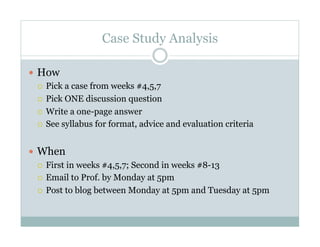
Case Study Analysis

  How
     Pick a case from weeks #4,5,7

     Pick ONE discussion question

     Write a one-page answer

     See syllabus for format, advice and evaluation criteria


  When
     First in weeks #4,5,7; Second in weeks #8-13

     Email to Prof. by Monday at 5pm

     Post to blog between Monday at 5pm and Tuesday at 5pm
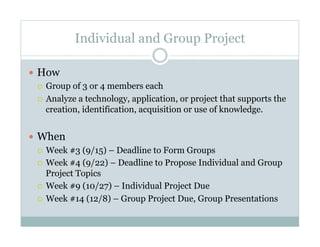
Individual and Group Project

  How
     Group of 3 or 4 members each

     Analyze a technology, application, or project that supports the
      creation, identification, acquisition or use of knowledge.


  When
     Week #3 (9/15) – Deadline to Form Groups

     Week #4 (9/22) – Deadline to Propose Individual and Group
      Project Topics
     Week #9 (10/27) – Individual Project Due

     Week #14 (12/8) – Group Project Due, Group Presentations
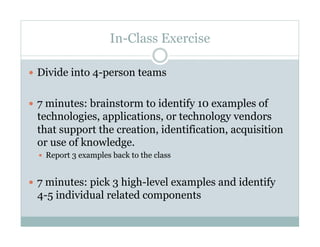
In-Class Exercise

  Divide into 4-person teams


  7 minutes: brainstorm to identify 10 examples of
 technologies, applications, or technology vendors
 that support the creation, identification, acquisition
 or use of knowledge.
    Report 3 examples back to the class


  7 minutes: pick 3 high-level examples and identify
 4-5 individual related components
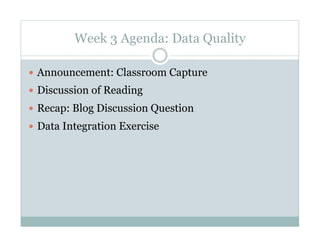
Week 3 Agenda: Data Quality

  Announcement: Classroom Capture
  Discussion of Reading
  Recap: Blog Discussion Question
  Data Integration Exercise
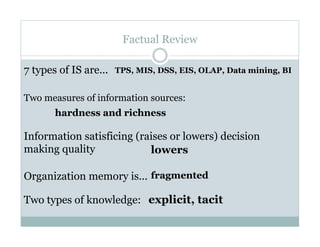
Factual Review

7 types of IS are...   TPS, MIS, DSS, EIS, OLAP, Data mining, BI


Two measures of information sources:
       hardness and richness

Information satisficing (raises or lowers) decision
making quality             lowers

Organization memory is... fragmented

Two types of knowledge: explicit, tacit
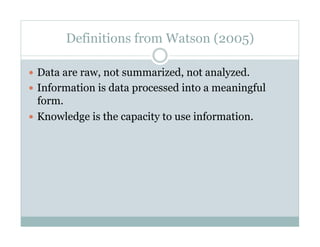
Definitions from Watson (2005)

  Data are raw, not summarized, not analyzed.
  Information is data processed into a meaningful
   form.
  Knowledge is the capacity to use information.
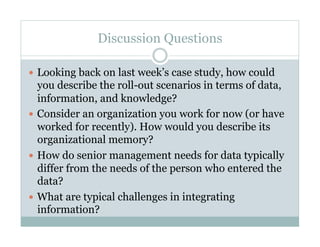
Discussion Questions

  Looking back on last week’s case study, how could
   you describe the roll-out scenarios in terms of data,
   information, and knowledge?
  Consider an organization you work for now (or have
   worked for recently). How would you describe its
   organizational memory?
  How do senior management needs for data typically
   differ from the needs of the person who entered the
   data?
  What are typical challenges in integrating
   information?
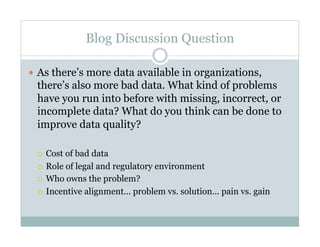
Blog Discussion Question

  As there’s more data available in organizations,
 there’s also more bad data. What kind of problems
 have you run into before with missing, incorrect, or
 incomplete data? What do you think can be done to
 improve data quality?

   Cost of bad data
   Role of legal and regulatory environment

   Who owns the problem?

   Incentive alignment... problem vs. solution... pain vs. gain
For More Information

  PROF. STEVEN L. JOHNSON
       EMAIL: STEVEN@TEMPLE.EDU
        Twitter: @StevenLJohnson
            http://stevenljohnson.org


  http://community.mis.temple.edu/mis5101fall10/

MIS5101 Key Slides from Weeks 1-3

  • 1.
    MIS5101: Business Intelligence Key Slides Weeks 1-3 PROF. STEVEN L. JOHNSON Twitter: @StevenLJohnson http://stevenljohnson.org http://community.mis.temple.edu/mis5101fall10/
  • 2.
    Week 1: Introduction  Introduction to...   Content   Format   Each Other   Expectations Photo by conorwithonen
  • 3.
    Information Technology Management MIS5001 MIS5102 MIS5108 MIS5101 Management Business Information Business Information Process Systems Intelligence Systems Improvement Strategy Understand issues in successful IT Introduction to Fundamentals of Strategic Value of Data, Information Information Business Process Information and Knowledge strategy implementation Technology Analysis Technology management Apply business Evaluate IT investments and IT- Understand role of Identify and intelligence IT in improving N/A evaluate strategic enabled business opportunities. firm performance value of IT solutions to solve business problems Form a business case for a Learn common Communicate IT Develop business Create value justifications for IT value to business case for IT-related realization plan for technology initiative. initiatives audience initiative bus. intelligence Analyze a current business process N/A Learn business analysis and Identify business Integrate data across multiple and improve it (BPM). consulting skills opportunities. sources Analyze Develop Plan transition to new systems N/A requirements for Develop a plan for organization information IT-enabled security policies and processes. business change change and plans
  • 4.
    In-Class Exercise #2 “According to Russell Ackoff, a systems theorist and professor of organizational change, the content of the human mind can be classified into five categories: •  Data: symbols •  Information: data that are processed to be useful; provides answers to "who", "what", "where", and "when" questions •  Knowledge: application of data and information; answers "how" questions •  Understanding: appreciation of "why” •  Wisdom: evaluated understanding. Ackoff indicates that the first four categories relate to the past; they deal with what has been or what is known. Only the fifth category, wisdom, deals with the future because it incorporates vision and design.” From: http://www.systems-thinking.org/dikw/dikw.htm Photo credit: TheAllNewAdventuresOfMe
  • 5.
    Coming Attractions   Checkwebsite: discussion question in next 24-48 hours   Post a response   Read and reply to other’s comments, too   Read assigned readings   Consider discussion questions in syllabus   Bring “Weekly Summary” to class with   One copy to turn in and one copy to keep
  • 6.
    Week 2 Agenda:Data Access   Case Discussion   Reading   Recap: Blog Discussion Question   Upcoming Assignments   Case Study Analysis   Group Project
  • 7.
    Case: Balancing Accesswith Accuracy... in Tanzania Accuracy is measured by: sensitivity and specificity 3 barriers to access are: cost, facilities, personnel 3 product concepts are: strip, squeeze, paper filter Highest access / lowest cost: strip test Highest accuracy & cost: paper filter 3 major $$$ stakeholders: IANGOs, other donors, govt. Other major stakeholders: CBOs, hospitals, patients Govt. Favors most accurate: to maintain test credibility Photo by
  • 8.
    Case Discussion Questions  What test(s) do you recommend for initial roll-out in Tanzania? Why?   Assume one of the three tests is the sole choice for roll-out (choose one). What specific communication strategy do you use among key stakeholders to gain support for this test?   What is another example you can think of with a trade-offs between information access and accuracy? When is it better to favor access? When is it better to favor accuracy?
  • 9.
    Case Study Analysis  How   Pick a case from weeks #4,5,7   Pick ONE discussion question   Write a one-page answer   See syllabus for format, advice and evaluation criteria   When   First in weeks #4,5,7; Second in weeks #8-13   Email to Prof. by Monday at 5pm   Post to blog between Monday at 5pm and Tuesday at 5pm
  • 10.
    Individual and GroupProject   How   Group of 3 or 4 members each   Analyze a technology, application, or project that supports the creation, identification, acquisition or use of knowledge.   When   Week #3 (9/15) – Deadline to Form Groups   Week #4 (9/22) – Deadline to Propose Individual and Group Project Topics   Week #9 (10/27) – Individual Project Due   Week #14 (12/8) – Group Project Due, Group Presentations
  • 11.
    In-Class Exercise   Divideinto 4-person teams   7 minutes: brainstorm to identify 10 examples of technologies, applications, or technology vendors that support the creation, identification, acquisition or use of knowledge.   Report 3 examples back to the class   7 minutes: pick 3 high-level examples and identify 4-5 individual related components
  • 12.
    Week 3 Agenda:Data Quality   Announcement: Classroom Capture   Discussion of Reading   Recap: Blog Discussion Question   Data Integration Exercise
  • 13.
    Factual Review 7 typesof IS are... TPS, MIS, DSS, EIS, OLAP, Data mining, BI Two measures of information sources: hardness and richness Information satisficing (raises or lowers) decision making quality lowers Organization memory is... fragmented Two types of knowledge: explicit, tacit
  • 14.
    Definitions from Watson(2005)   Data are raw, not summarized, not analyzed.   Information is data processed into a meaningful form.   Knowledge is the capacity to use information.
  • 15.
    Discussion Questions   Lookingback on last week’s case study, how could you describe the roll-out scenarios in terms of data, information, and knowledge?   Consider an organization you work for now (or have worked for recently). How would you describe its organizational memory?   How do senior management needs for data typically differ from the needs of the person who entered the data?   What are typical challenges in integrating information?
  • 16.
    Blog Discussion Question  As there’s more data available in organizations, there’s also more bad data. What kind of problems have you run into before with missing, incorrect, or incomplete data? What do you think can be done to improve data quality?   Cost of bad data   Role of legal and regulatory environment   Who owns the problem?   Incentive alignment... problem vs. solution... pain vs. gain
  • 17.
    For More Information PROF. STEVEN L. JOHNSON EMAIL: STEVEN@TEMPLE.EDU Twitter: @StevenLJohnson http://stevenljohnson.org http://community.mis.temple.edu/mis5101fall10/