05.04.2023 Business Analytics 1
Weiden Business School
International Business
Summer Semester 2023
SAEID MATINFAR
April 5th , 2023
Business
Analytics
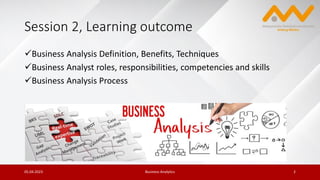
Session 2, Learning outcome
✓Business Analysis Definition, Benefits, Techniques
✓Business Analyst roles, responsibilities, competencies and skills
✓Business Analysis Process
05.04.2023 Business Analytics 2
What is Business Analysis?
• Business Analysis is a set of activities that involves identifying,
analyzing, and documenting business requirements and solutions to
business problems.
• It involves gathering, analyzing, and documenting data, processes,
and systems to improve the overall performance and achieve
organizational goals.
• Business analysts use a variety of techniques to identify issues, gather
requirements, and develop solutions to existing or potential
problems.
• They may conduct interviews, perform surveys, create diagrams and
models, and use analytical tools to analyze data and develop insights.
05.04.2023 Business Analytics 3
Business Analysis Definition
Business analysis is the practice of:
• Understanding the structures and policies of an organization
• Recommending solutions that enable the organization to achieve its
strategic goals
• Working as a connector between stakeholders and IT departments
05.04.2023 Business Analytics 4
Why Business Analysis is important in
organizations
• It helps improve their performance by identifying inefficiencies, reducing
costs, and improving business processes.
• Business analysts work with stakeholders across the organization to
understand their needs and how to achieve their business goals. This
helps to ensure that the organization's objectives are aligned with its
strategies.
• Business Analysis can help organizations find opportunities to streamline
their operations, reduce costs, and remove bottlenecks that slow
progress.
• Business Analysis can help identify potential risks and vulnerabilities to
the organization and develop mitigation strategies to prevent or mitigate
them.
05.04.2023 Business Analytics 5
The benefits of Business Analysis
• The benefits of Business Analysis are many. It can help organizations
improve efficiency and effectiveness and make better-informed decisions.
• By analyzing data and processes, Business Analysis can help organizations
identify ways to optimize business processes, reduce errors, and increase
customer satisfaction.
• Business Analysis also helps organizations reduce costs by identifying areas
where resources can be allocated more efficiently, removing redundant
processes, and eliminating waste.
• Another benefit of Business Analysis is that it can help organizations stay
competitive by identifying industry trends, new technologies, and best
practices. By staying up-to-date with the latest trends and tools,
organizations can adapt quickly to changes in the market or industry.
05.04.2023 Business Analytics 6
Common Business Analysis Techniques
Here are some business analysis techniques:
1. MOST (Mission, Objectives, Strategies, and Tactics)
Identifying the mission, objectives, strategies, and tactics helps
business analysts analyze internal structures of what an organization
aims to accomplish and how to formulate the solutions.
2. PESTLE (Political, Economic, Sociological, Technological, Legal, and
Environmental)
The PESTLE model evaluates external factors that would impact
business and determine how to address these factors if found.
05.04.2023 Business Analytics 7
Common Business Analysis Techniques
3. SWOT (Strengths, Weaknesses, Opportunities, and Threats)
In this particular technique, both strengths and weaknesses of the
organization are considered. It involves structuring and categorizing
processes into opportunities and threats. This helps to determine the
proper allocation of resources.
4. MoSCoW (Must or Should, Could or Would)
This technique allows for prioritizing requirements by presenting a
framework in which each condition can be evaluated relative to the
others. Is it a must-have? Something the project should have? Something
that could be improved?
05.04.2023 Business Analytics 8
Common Business Analysis Techniques
5. CATWOE (Customers, Actors, Transformation Process, World View, Owner,
and Environmental Constraints)
This technique helps business analysts understand different stakeholders’
perspectives and the impact that their views will have on the direction of the
project.
6. The 5 Whys: This technique is commonly found as often in Six Sigma as it is
in business analysis circles. While journalism uses the “Five W’s” (Who,
What, When, Where, and Why) in reporting, the 5 Whys technique just
operates “Why” in a series of leading questions, this approach helps
business analysts pinpoint a problem’s origin by first asking why the issue
exists, then following it up by asking another “why?” question relating to the
first answer, and so on.
05.04.2023 Business Analytics 9
Common Business Analysis Techniques
7. Six Thinking Hats: This business analysis process guides a group’s line of
thinking by encouraging them to consider different ideas and
perspectives. The ‘six hats’ are:
1. White: Focuses on your data and logic.
2. Red: Uses intuition, emotions, and gut feelings.
3. Black: Consider potential negative results, and what can go wrong.
4. Yellow: Focus on the positives; keep an optimistic point of view.
5. Green: Uses creativity.
6. Blue: Takes the big picture into account, process control.
• The six thinking hats technique is often used in conjunction with
brainstorming, serving as a means of directing the team’s mental
processes and causing them to consider different viewpoints.
05.04.2023 Business Analytics 10
Common Business Analysis Techniques
8. Business Process Modeling (BPM): BPM is often used during a
project’s analysis phase to understand and analyze the gaps between
the current business process and any future process that the business
is shooting for. This technique consists of four tasks:
1. Strategic planning
2. Business model analysis
3. Defining and designing the process
4. Technical analysis for complex business solutions
• Many industries, especially the IT industry, favor this technique
because it’s a simple, straightforward way to present the steps of the
execution process and show how it will operate in different roles.
05.04.2023 Business Analytics 11
Reasons to Become a Business Analyst
listed below are some reasons why you should consider a career in business
analysis.
• It’s a flexible job role. You get to work on technical and the business streams
• There is a great demand in this field, and you can expect essential career
growth
• Due to its enormous growth, the salary paid is also high
• You can become an expert in conducting surveys, workshops, and different
levels of tests such as functional tests, unit tests, etc.
• You can learn how to analyze and model data to deliver a great product,
formulate suggestions and strategic solutions, validate the results obtained
and discover appropriate trends in the system
05.04.2023 Business Analytics 12
How is Business Analysis Different From Other
Professions?
• Business analysis work includes communicating among stakeholders,
development teams, testing teams, and other departments. There are
many other job roles that have similar job descriptions as business
analyst such as IT business analysts, technical business analysts,
online business analysts, business systems analysts, or systems
analysts.
• But, depending on the organizational goals, a business analyst will act
in one of the roles mentioned above.
05.04.2023 Business Analytics 13
Difference Between a Business Analyst and a
System Analyst
• The business analyst profession requires an entirely different set of
necessary skills involving eliciting, analyzing, communicating, testing,
and verifying requirements, and identifying the path to solve business
problems and improve processes.
• On the other hand, system analysts mainly focus on creating and
implementing specific systems with a more technical approach to the
work.
05.04.2023 Business Analytics 14
Difference Between a Business Analyst and a
Data Analyst
• A business analyst’s responsibilities depend on the industry
standards, and the main objective includes analyzing and deriving
relevant solutions from data to meet business requirements.
• On the other side, data analysts help companies by analyzing data
and using that data to perform proper actions to present value to the
business stakeholders.
• Data analysts also indulge themselves in providing competitive
analysis or in identifying business or marketing trends
05.04.2023 Business Analytics 15
Roles and Responsibilities of a Business
Analyst
• Assessing and identifying areas for improvement in the company’s present
business processes
• Modernizing systems by investigating and evaluating new IT developments and
contemporary business practices
• Presenting concepts and results at meetings
• Coaching and training employees
• Developing ideas in accordance with the demands and needs of the business
• Creating projects and monitoring their development
• Cooperating with stakeholders and users
• Maintaining close communication with senior management, partners, clients,
and technicians
05.04.2023 Business Analytics 16
10 SKILLS ALL BUSINESS ANALYSTS SHOULD
POSSESS
Technical Skills
• Technology
• Research
• Data Review/Statistical Analysis
• Financial Planning
• Documentation/Organization
Personal Skills
• Critical Thinking
• Decision Making
• Managerial Skills
• Communication
• Negotiation
05.04.2023 Business Analytics 17
Communication skills
• Effective communication is essential for Business Analysts to perform
their duties well.
• Business Analysts work with stakeholders, including clients,
colleagues, and management.
• They must communicate effectively to obtain critical information,
provide advice, persuade others, collaborate, and report findings.
• Business Analysts should be able to take into account the
perspectives and needs of others, understand technical and non-
technical terminology, convey difficult concepts clearly, and present
their recommendations in a concise and accurate manner.
05.04.2023 Business Analytics 18
Problem-solving skills
• Problem-solving skills are crucial for any Business Analyst.
• Business Analysts must have the ability to dig deep and get to the
root cause of a problem.
• They should be able to ask critical questions, analyze complex data,
and find solutions to problems.
• They should also have a creative and innovative mind to develop a
range of solutions to a problem.
• In addition to analytical skills, Business Analysts should also have
decision-making skills, as they often need to choose the best solution
or make recommendations to their clients or management.
05.04.2023 Business Analytics 19
Business Analyst competencies
• Data analysis skills: the ability to collect, analyze, and interpret data from
multiple sources and present complex information clearly.
• Requirements gathering skills: the ability to elicit and document clear, concise,
and comprehensive requirements from stakeholders.
• Project management skills: Business Analysts should be familiar with project
management methodologies, practices, and tools to create project plans,
define project scope, and manage project risks.
• Industry knowledge and expertise: Business Analysts should have knowledge
of the industry they work in, including trends, regulations, and best practices.
• Teamwork and collaboration skills: the ability to work collaboratively with
stakeholders, project teams, and fellow business analysts to achieve team
objectives.
05.04.2023 Business Analytics 20
What is a requirement?
• Business requirements are the crucial activities that must be
performed to meet the goals. Elicitation, managing, communication,
verification of the requirements is the core of business analyst job.
There are a couple of types of requirements:
• Business Requirements–these are high-level requirements which
come mostly from the customer, management, or sales. They are
usually quite broad like a vision statement. It might arise from
contract, business case, and market demand.
• Stakeholder Requirements – these requirements usually connect
business need with particular stakeholder. They are a bridge between
business requirements and detailed solution requirements.
05.04.2023 Business Analytics 21
Types of requirements
• Solution Requirements – describes details of how the solution will meet
business and stakeholder requirements. There are 2 major types of
them:
1. Functional Requirements – they answer “What” question. For example, in a
software project, functional requirements describe the “What” kind of features
should be provided in order to achieve a useful solution.
2. Non-Functional Requirements – they answer “How” question. For example,
how a system should behave with the environment as performance, security,
stability, archiving etc.
• Transition Requirements –they are temporary requirements which exist
only during a transition from AS-IS state to TO-BE state.
05.04.2023 Business Analytics 22
BUSINESS ANALYSIS PROCESS 1/5
Business analysis process has some fundamental steps needed for a
successful execution.
1. Enterprise analysis
• The most important part here is domain knowledge in the enterprise
structure, internal processes, strategic goals, markets, competitors. In
short, the business analyst needs to know his/her company structure and
business.
• A good business analyst can work in the area without domain knowledge.
But in any case knowing the enterprise and its business is important.
• The crucial focus here is in feasibility studies, maintaining business
architecture, searching for new opportunities, creating business cases, and
identifying initial risks.
05.04.2023 Business Analytics 23
BUSINESS ANALYSIS PROCESS 2/5
2. Business analysis planning and monitoring
• While enterprise analysis can be an ongoing process, usually planning
and monitoring is related to a certain project.
• The business analyst should investigate the most important
stakeholder, select techniques which will be used, defining the
process of business analysis and change management.
• In short – this is the “homework” for the business analyst.
05.04.2023 Business Analytics 24
BUSINESS ANALYSIS PROCESS 3/5
3. Elicitation of Requirements
• In this step, the business analyst starts working with stakeholders.
• There are certain numbers of techniques for requirement elicitation.
But the most important is that you need to stay focused on your
stakeholders’ needs, not desires.
05.04.2023 Business Analytics 25
BUSINESS ANALYSIS PROCESS 4/5
4. Requirements management and communication
Having a set of requirements is a good thing. But it is something common,
the different stakeholders to have different needs. Or not have enough
resources for all requirements.
That’s why managing requirements is one of the most important activities.
So, the business analyst has some important tasks here:
• A proper way to document the requirements;
• An investigation for conflicting requirements;
• Expert judgments if requirements are applicable and achievable
• Requirement prioritization.
05.04.2023 Business Analytics 26
BUSINESS ANALYSIS PROCESS 5/5
5. Solution Assessment and Validation
• Once you have all the requirements analyzed, documented and confirmed,
it is time to propose solutions.
• The business analyst job is to provide a set of possible solutions with their
pros and cons. Some estimations (high-level or detailed) can be very useful.
Numbers are also welcomed.
• Due to the process of solution assessments, the business analyst should be
reasonable and impersonal. And should provide information about each
solution in a fair and open way.
• Usually, it is not a business analyst job to validate the selected solution. The
customers, managers, PMs, Architects are the ones responsible for
justifying the chosen solution.
05.04.2023 Business Analytics 27
An example of business analysis projects
A multinational retail organization wanted to improve its online sales
process and increase customer satisfaction.
05.04.2023 Business Analytics 28
An example of business analysis projects
Key Components:
1. Situational Analysis: The Business Analysts examined the existing
process and found several issues such as limited payment options, a
complex checkout process, and too many steps to complete an order.
2. Elicit and Define Requirements: The team gathered requirements by
conducting user interviews, analyzing sales data, and conducting
surveys to gather feedback from customers. They specified the pain
points of the customer and feedback on services and the overall online
shopping experience.
05.04.2023 Business Analytics 29
An example of business analysis projects
Key Components:
3. Solution Development: The Business Analyst team proposed several
solutions to improve online sales and customer satisfaction, including
providing multiple payment options such as PayPal, Google Pay, Apple
Pay, and Amazon Pay. Also, they reduced the checkout steps by deploying
an optimized checkout process, provided automated service features,
and an improved product search algorithm.
4. Implement and Monitor the Solution: After identifying and developing
the optimal solution, the organization implemented the proposed
features and monitored customer feedback, reviews, and product usage.
The team also continued monitoring key performance indicators such as
Sales, Customer Satisfaction, Order Fulfillment Cycle Time, and Repeat
business rate.
05.04.2023 Business Analytics 30
An example of business analysis projects
Tools and Techniques:
The Business Analyst team used several tools and techniques to gather
requirements and develop a solution that would make a significant
impact on the organization.
The examples of these tools are The 5 Whys, Brainstorming,
Requirements Documentation, User Stories, Process Mapping,
Milestone Planning, Balanced Scorecard, Metrics and KPIs
development.
05.04.2023 Business Analytics 31
An example of business analysis projects
Impact on the organization:
• The implementation of solutions recommended by Business Analysts
led the organization to streamline its online sales process and
improve customer satisfaction.
• The company observed an increase in online sales by 20% within
three months of deployment, which led the organization to expand its
online presence to additional countries.
• There was also an increase in repeat business, which led to a better
customer experience and brand loyalty.
05.04.2023 Business Analytics 32
An example of business analysis projects
Conclusion:
This Business Analysis project utilized various components, tools, and
techniques to help a multinational retail organization improve its online
sales process and increase customer satisfaction.
The implementation of recommended solutions has led to significant
business value for the organization, including increased sales, repeat
business, and customer satisfaction
05.04.2023 Business Analytics 33

Business Analysis Definition, Benefits, Techniques

  • 1.
    05.04.2023 Business Analytics1 Weiden Business School International Business Summer Semester 2023 SAEID MATINFAR April 5th , 2023 Business Analytics
  • 2.
    Session 2, Learningoutcome ✓Business Analysis Definition, Benefits, Techniques ✓Business Analyst roles, responsibilities, competencies and skills ✓Business Analysis Process 05.04.2023 Business Analytics 2
  • 3.
    What is BusinessAnalysis? • Business Analysis is a set of activities that involves identifying, analyzing, and documenting business requirements and solutions to business problems. • It involves gathering, analyzing, and documenting data, processes, and systems to improve the overall performance and achieve organizational goals. • Business analysts use a variety of techniques to identify issues, gather requirements, and develop solutions to existing or potential problems. • They may conduct interviews, perform surveys, create diagrams and models, and use analytical tools to analyze data and develop insights. 05.04.2023 Business Analytics 3
  • 4.
    Business Analysis Definition Businessanalysis is the practice of: • Understanding the structures and policies of an organization • Recommending solutions that enable the organization to achieve its strategic goals • Working as a connector between stakeholders and IT departments 05.04.2023 Business Analytics 4
  • 5.
    Why Business Analysisis important in organizations • It helps improve their performance by identifying inefficiencies, reducing costs, and improving business processes. • Business analysts work with stakeholders across the organization to understand their needs and how to achieve their business goals. This helps to ensure that the organization's objectives are aligned with its strategies. • Business Analysis can help organizations find opportunities to streamline their operations, reduce costs, and remove bottlenecks that slow progress. • Business Analysis can help identify potential risks and vulnerabilities to the organization and develop mitigation strategies to prevent or mitigate them. 05.04.2023 Business Analytics 5
  • 6.
    The benefits ofBusiness Analysis • The benefits of Business Analysis are many. It can help organizations improve efficiency and effectiveness and make better-informed decisions. • By analyzing data and processes, Business Analysis can help organizations identify ways to optimize business processes, reduce errors, and increase customer satisfaction. • Business Analysis also helps organizations reduce costs by identifying areas where resources can be allocated more efficiently, removing redundant processes, and eliminating waste. • Another benefit of Business Analysis is that it can help organizations stay competitive by identifying industry trends, new technologies, and best practices. By staying up-to-date with the latest trends and tools, organizations can adapt quickly to changes in the market or industry. 05.04.2023 Business Analytics 6
  • 7.
    Common Business AnalysisTechniques Here are some business analysis techniques: 1. MOST (Mission, Objectives, Strategies, and Tactics) Identifying the mission, objectives, strategies, and tactics helps business analysts analyze internal structures of what an organization aims to accomplish and how to formulate the solutions. 2. PESTLE (Political, Economic, Sociological, Technological, Legal, and Environmental) The PESTLE model evaluates external factors that would impact business and determine how to address these factors if found. 05.04.2023 Business Analytics 7
  • 8.
    Common Business AnalysisTechniques 3. SWOT (Strengths, Weaknesses, Opportunities, and Threats) In this particular technique, both strengths and weaknesses of the organization are considered. It involves structuring and categorizing processes into opportunities and threats. This helps to determine the proper allocation of resources. 4. MoSCoW (Must or Should, Could or Would) This technique allows for prioritizing requirements by presenting a framework in which each condition can be evaluated relative to the others. Is it a must-have? Something the project should have? Something that could be improved? 05.04.2023 Business Analytics 8
  • 9.
    Common Business AnalysisTechniques 5. CATWOE (Customers, Actors, Transformation Process, World View, Owner, and Environmental Constraints) This technique helps business analysts understand different stakeholders’ perspectives and the impact that their views will have on the direction of the project. 6. The 5 Whys: This technique is commonly found as often in Six Sigma as it is in business analysis circles. While journalism uses the “Five W’s” (Who, What, When, Where, and Why) in reporting, the 5 Whys technique just operates “Why” in a series of leading questions, this approach helps business analysts pinpoint a problem’s origin by first asking why the issue exists, then following it up by asking another “why?” question relating to the first answer, and so on. 05.04.2023 Business Analytics 9
  • 10.
    Common Business AnalysisTechniques 7. Six Thinking Hats: This business analysis process guides a group’s line of thinking by encouraging them to consider different ideas and perspectives. The ‘six hats’ are: 1. White: Focuses on your data and logic. 2. Red: Uses intuition, emotions, and gut feelings. 3. Black: Consider potential negative results, and what can go wrong. 4. Yellow: Focus on the positives; keep an optimistic point of view. 5. Green: Uses creativity. 6. Blue: Takes the big picture into account, process control. • The six thinking hats technique is often used in conjunction with brainstorming, serving as a means of directing the team’s mental processes and causing them to consider different viewpoints. 05.04.2023 Business Analytics 10
  • 11.
    Common Business AnalysisTechniques 8. Business Process Modeling (BPM): BPM is often used during a project’s analysis phase to understand and analyze the gaps between the current business process and any future process that the business is shooting for. This technique consists of four tasks: 1. Strategic planning 2. Business model analysis 3. Defining and designing the process 4. Technical analysis for complex business solutions • Many industries, especially the IT industry, favor this technique because it’s a simple, straightforward way to present the steps of the execution process and show how it will operate in different roles. 05.04.2023 Business Analytics 11
  • 12.
    Reasons to Becomea Business Analyst listed below are some reasons why you should consider a career in business analysis. • It’s a flexible job role. You get to work on technical and the business streams • There is a great demand in this field, and you can expect essential career growth • Due to its enormous growth, the salary paid is also high • You can become an expert in conducting surveys, workshops, and different levels of tests such as functional tests, unit tests, etc. • You can learn how to analyze and model data to deliver a great product, formulate suggestions and strategic solutions, validate the results obtained and discover appropriate trends in the system 05.04.2023 Business Analytics 12
  • 13.
    How is BusinessAnalysis Different From Other Professions? • Business analysis work includes communicating among stakeholders, development teams, testing teams, and other departments. There are many other job roles that have similar job descriptions as business analyst such as IT business analysts, technical business analysts, online business analysts, business systems analysts, or systems analysts. • But, depending on the organizational goals, a business analyst will act in one of the roles mentioned above. 05.04.2023 Business Analytics 13
  • 14.
    Difference Between aBusiness Analyst and a System Analyst • The business analyst profession requires an entirely different set of necessary skills involving eliciting, analyzing, communicating, testing, and verifying requirements, and identifying the path to solve business problems and improve processes. • On the other hand, system analysts mainly focus on creating and implementing specific systems with a more technical approach to the work. 05.04.2023 Business Analytics 14
  • 15.
    Difference Between aBusiness Analyst and a Data Analyst • A business analyst’s responsibilities depend on the industry standards, and the main objective includes analyzing and deriving relevant solutions from data to meet business requirements. • On the other side, data analysts help companies by analyzing data and using that data to perform proper actions to present value to the business stakeholders. • Data analysts also indulge themselves in providing competitive analysis or in identifying business or marketing trends 05.04.2023 Business Analytics 15
  • 16.
    Roles and Responsibilitiesof a Business Analyst • Assessing and identifying areas for improvement in the company’s present business processes • Modernizing systems by investigating and evaluating new IT developments and contemporary business practices • Presenting concepts and results at meetings • Coaching and training employees • Developing ideas in accordance with the demands and needs of the business • Creating projects and monitoring their development • Cooperating with stakeholders and users • Maintaining close communication with senior management, partners, clients, and technicians 05.04.2023 Business Analytics 16
  • 17.
    10 SKILLS ALLBUSINESS ANALYSTS SHOULD POSSESS Technical Skills • Technology • Research • Data Review/Statistical Analysis • Financial Planning • Documentation/Organization Personal Skills • Critical Thinking • Decision Making • Managerial Skills • Communication • Negotiation 05.04.2023 Business Analytics 17
  • 18.
    Communication skills • Effectivecommunication is essential for Business Analysts to perform their duties well. • Business Analysts work with stakeholders, including clients, colleagues, and management. • They must communicate effectively to obtain critical information, provide advice, persuade others, collaborate, and report findings. • Business Analysts should be able to take into account the perspectives and needs of others, understand technical and non- technical terminology, convey difficult concepts clearly, and present their recommendations in a concise and accurate manner. 05.04.2023 Business Analytics 18
  • 19.
    Problem-solving skills • Problem-solvingskills are crucial for any Business Analyst. • Business Analysts must have the ability to dig deep and get to the root cause of a problem. • They should be able to ask critical questions, analyze complex data, and find solutions to problems. • They should also have a creative and innovative mind to develop a range of solutions to a problem. • In addition to analytical skills, Business Analysts should also have decision-making skills, as they often need to choose the best solution or make recommendations to their clients or management. 05.04.2023 Business Analytics 19
  • 20.
    Business Analyst competencies •Data analysis skills: the ability to collect, analyze, and interpret data from multiple sources and present complex information clearly. • Requirements gathering skills: the ability to elicit and document clear, concise, and comprehensive requirements from stakeholders. • Project management skills: Business Analysts should be familiar with project management methodologies, practices, and tools to create project plans, define project scope, and manage project risks. • Industry knowledge and expertise: Business Analysts should have knowledge of the industry they work in, including trends, regulations, and best practices. • Teamwork and collaboration skills: the ability to work collaboratively with stakeholders, project teams, and fellow business analysts to achieve team objectives. 05.04.2023 Business Analytics 20
  • 21.
    What is arequirement? • Business requirements are the crucial activities that must be performed to meet the goals. Elicitation, managing, communication, verification of the requirements is the core of business analyst job. There are a couple of types of requirements: • Business Requirements–these are high-level requirements which come mostly from the customer, management, or sales. They are usually quite broad like a vision statement. It might arise from contract, business case, and market demand. • Stakeholder Requirements – these requirements usually connect business need with particular stakeholder. They are a bridge between business requirements and detailed solution requirements. 05.04.2023 Business Analytics 21
  • 22.
    Types of requirements •Solution Requirements – describes details of how the solution will meet business and stakeholder requirements. There are 2 major types of them: 1. Functional Requirements – they answer “What” question. For example, in a software project, functional requirements describe the “What” kind of features should be provided in order to achieve a useful solution. 2. Non-Functional Requirements – they answer “How” question. For example, how a system should behave with the environment as performance, security, stability, archiving etc. • Transition Requirements –they are temporary requirements which exist only during a transition from AS-IS state to TO-BE state. 05.04.2023 Business Analytics 22
  • 23.
    BUSINESS ANALYSIS PROCESS1/5 Business analysis process has some fundamental steps needed for a successful execution. 1. Enterprise analysis • The most important part here is domain knowledge in the enterprise structure, internal processes, strategic goals, markets, competitors. In short, the business analyst needs to know his/her company structure and business. • A good business analyst can work in the area without domain knowledge. But in any case knowing the enterprise and its business is important. • The crucial focus here is in feasibility studies, maintaining business architecture, searching for new opportunities, creating business cases, and identifying initial risks. 05.04.2023 Business Analytics 23
  • 24.
    BUSINESS ANALYSIS PROCESS2/5 2. Business analysis planning and monitoring • While enterprise analysis can be an ongoing process, usually planning and monitoring is related to a certain project. • The business analyst should investigate the most important stakeholder, select techniques which will be used, defining the process of business analysis and change management. • In short – this is the “homework” for the business analyst. 05.04.2023 Business Analytics 24
  • 25.
    BUSINESS ANALYSIS PROCESS3/5 3. Elicitation of Requirements • In this step, the business analyst starts working with stakeholders. • There are certain numbers of techniques for requirement elicitation. But the most important is that you need to stay focused on your stakeholders’ needs, not desires. 05.04.2023 Business Analytics 25
  • 26.
    BUSINESS ANALYSIS PROCESS4/5 4. Requirements management and communication Having a set of requirements is a good thing. But it is something common, the different stakeholders to have different needs. Or not have enough resources for all requirements. That’s why managing requirements is one of the most important activities. So, the business analyst has some important tasks here: • A proper way to document the requirements; • An investigation for conflicting requirements; • Expert judgments if requirements are applicable and achievable • Requirement prioritization. 05.04.2023 Business Analytics 26
  • 27.
    BUSINESS ANALYSIS PROCESS5/5 5. Solution Assessment and Validation • Once you have all the requirements analyzed, documented and confirmed, it is time to propose solutions. • The business analyst job is to provide a set of possible solutions with their pros and cons. Some estimations (high-level or detailed) can be very useful. Numbers are also welcomed. • Due to the process of solution assessments, the business analyst should be reasonable and impersonal. And should provide information about each solution in a fair and open way. • Usually, it is not a business analyst job to validate the selected solution. The customers, managers, PMs, Architects are the ones responsible for justifying the chosen solution. 05.04.2023 Business Analytics 27
  • 28.
    An example ofbusiness analysis projects A multinational retail organization wanted to improve its online sales process and increase customer satisfaction. 05.04.2023 Business Analytics 28
  • 29.
    An example ofbusiness analysis projects Key Components: 1. Situational Analysis: The Business Analysts examined the existing process and found several issues such as limited payment options, a complex checkout process, and too many steps to complete an order. 2. Elicit and Define Requirements: The team gathered requirements by conducting user interviews, analyzing sales data, and conducting surveys to gather feedback from customers. They specified the pain points of the customer and feedback on services and the overall online shopping experience. 05.04.2023 Business Analytics 29
  • 30.
    An example ofbusiness analysis projects Key Components: 3. Solution Development: The Business Analyst team proposed several solutions to improve online sales and customer satisfaction, including providing multiple payment options such as PayPal, Google Pay, Apple Pay, and Amazon Pay. Also, they reduced the checkout steps by deploying an optimized checkout process, provided automated service features, and an improved product search algorithm. 4. Implement and Monitor the Solution: After identifying and developing the optimal solution, the organization implemented the proposed features and monitored customer feedback, reviews, and product usage. The team also continued monitoring key performance indicators such as Sales, Customer Satisfaction, Order Fulfillment Cycle Time, and Repeat business rate. 05.04.2023 Business Analytics 30
  • 31.
    An example ofbusiness analysis projects Tools and Techniques: The Business Analyst team used several tools and techniques to gather requirements and develop a solution that would make a significant impact on the organization. The examples of these tools are The 5 Whys, Brainstorming, Requirements Documentation, User Stories, Process Mapping, Milestone Planning, Balanced Scorecard, Metrics and KPIs development. 05.04.2023 Business Analytics 31
  • 32.
    An example ofbusiness analysis projects Impact on the organization: • The implementation of solutions recommended by Business Analysts led the organization to streamline its online sales process and improve customer satisfaction. • The company observed an increase in online sales by 20% within three months of deployment, which led the organization to expand its online presence to additional countries. • There was also an increase in repeat business, which led to a better customer experience and brand loyalty. 05.04.2023 Business Analytics 32
  • 33.
    An example ofbusiness analysis projects Conclusion: This Business Analysis project utilized various components, tools, and techniques to help a multinational retail organization improve its online sales process and increase customer satisfaction. The implementation of recommended solutions has led to significant business value for the organization, including increased sales, repeat business, and customer satisfaction 05.04.2023 Business Analytics 33