1
Business Analysis
Fundamentals
2
Our Publications
3
”
Business analysis is the discipline of identifying business
needs and determining & Validating solutions to the
business problems.
4
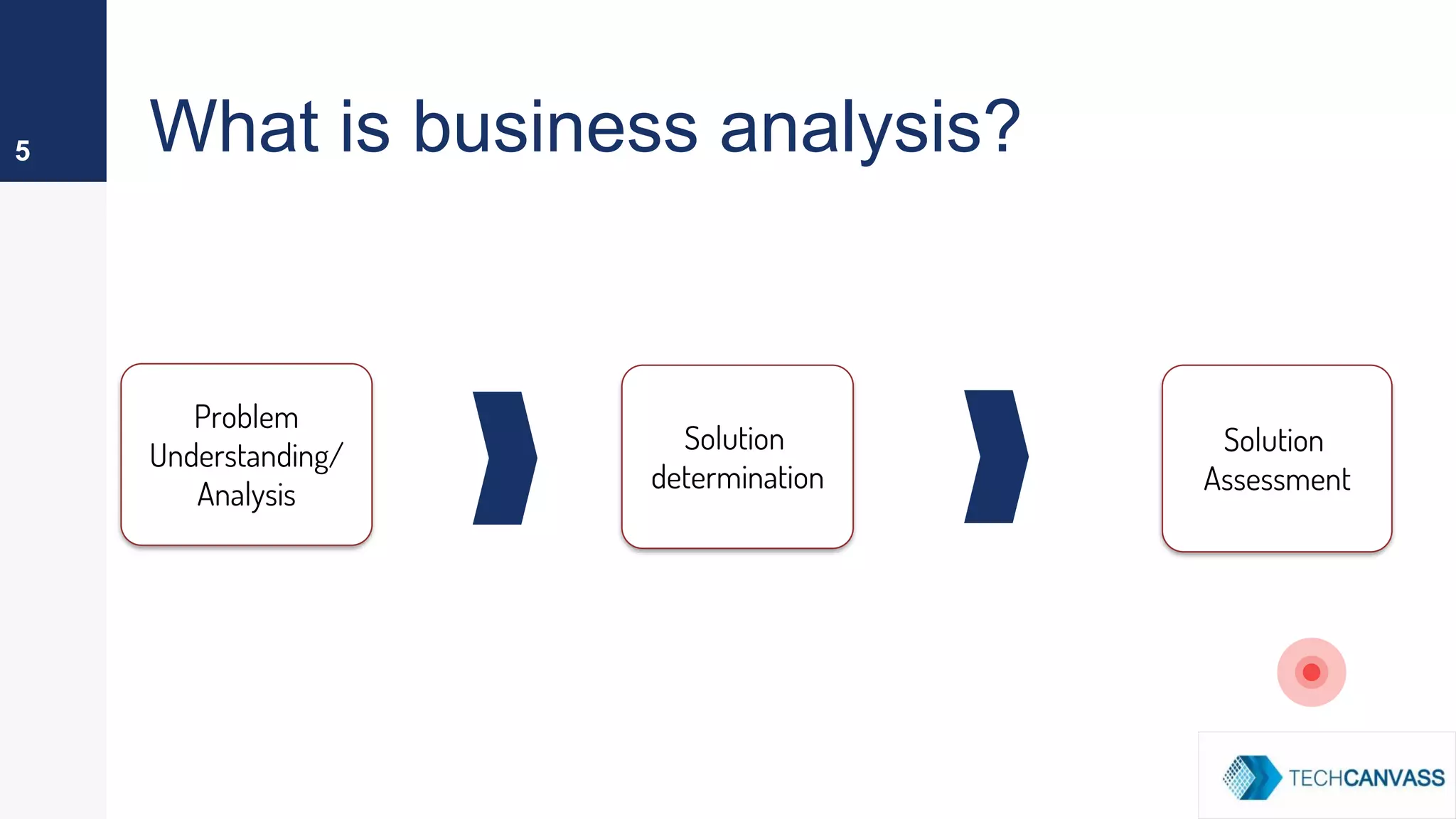
What is business analysis?5
Problem
Understanding/
Analysis
Solution
determination
Solution
Assessment
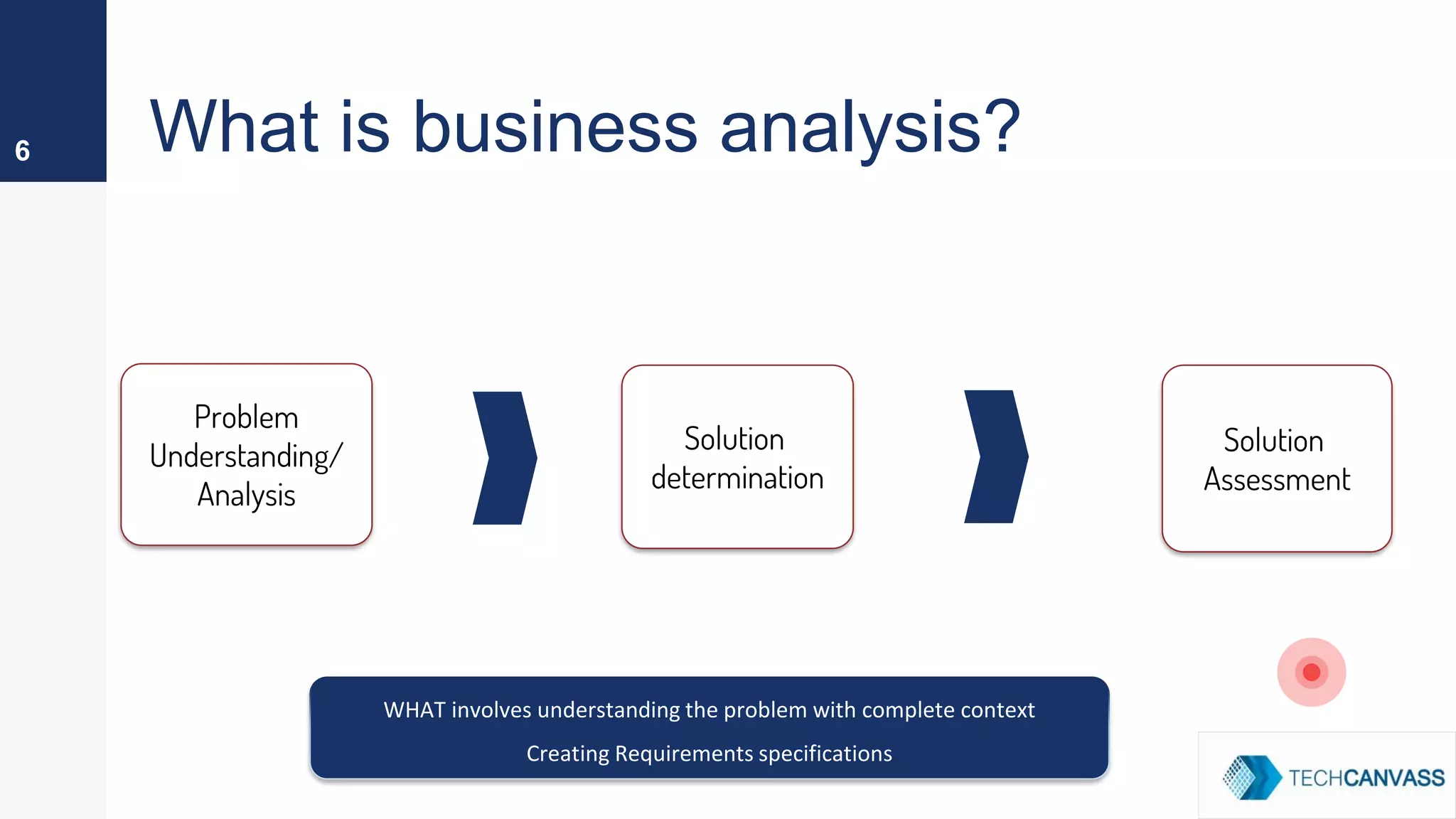
What is business analysis?6
Problem
Understanding/
Analysis
Solution
determination
Solution
Assessment
WHAT involves understanding the problem with complete context
Creating Requirements specifications
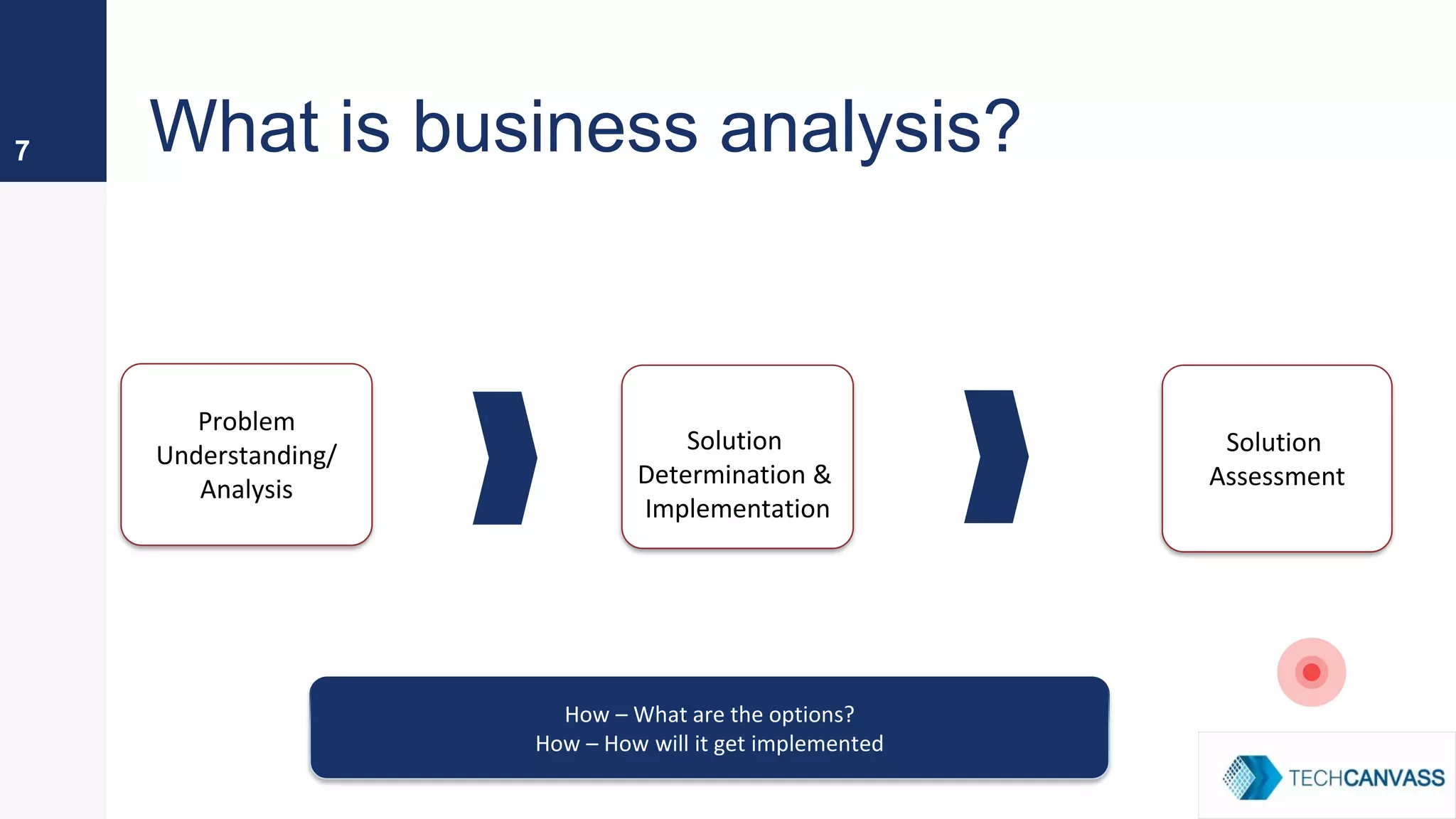
What is business analysis?7
Problem
Understanding/
Analysis
Solution
Determination &
Implementation
Solution
Assessment
How – What are the options?
How – How will it get implemented
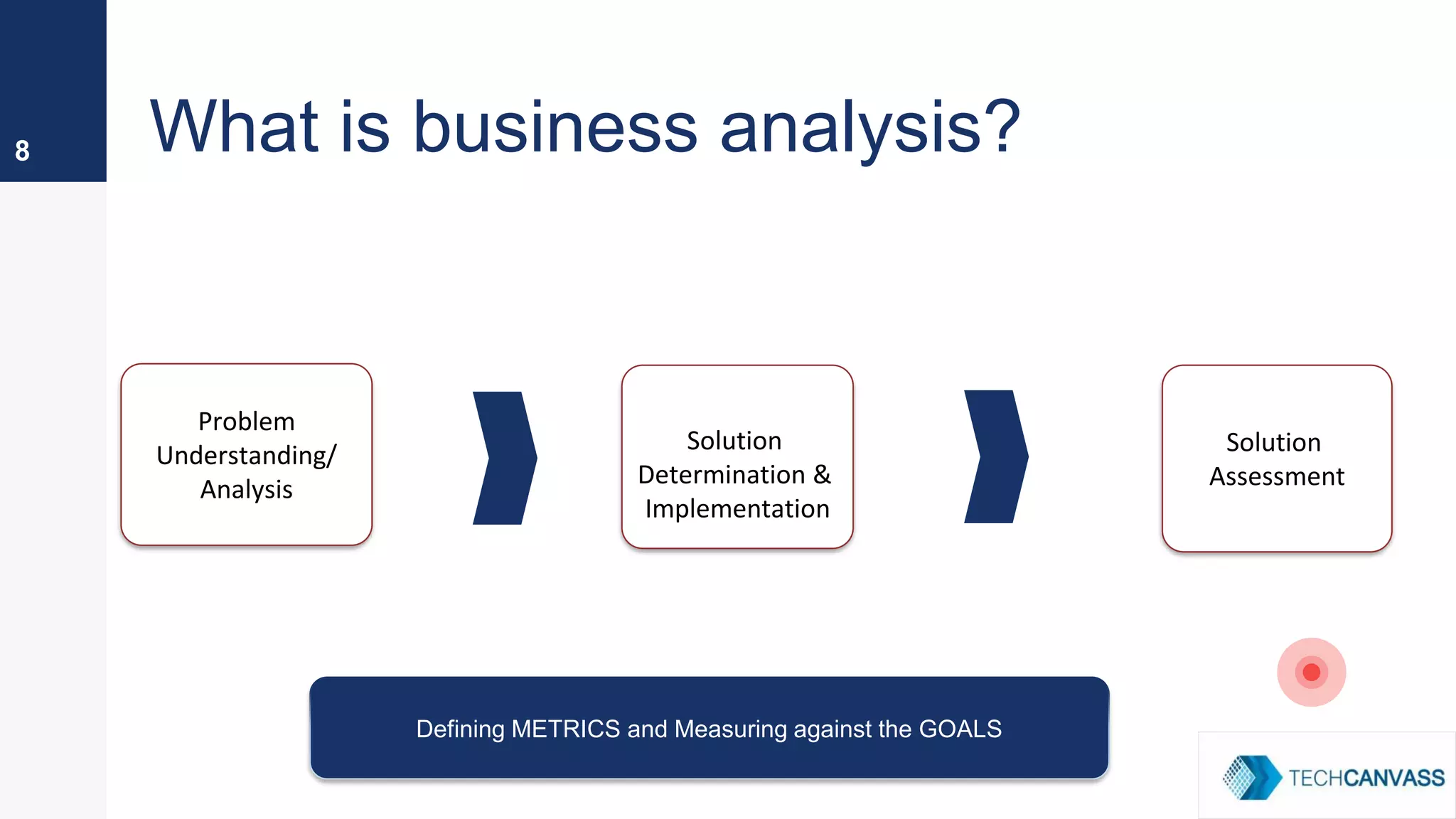
What is business analysis?8
Problem
Understanding/
Analysis
Solution
Determination &
Implementation
Solution
Assessment
Defining METRICS and Measuring against the GOALS
Business Analysis Vs Analytics
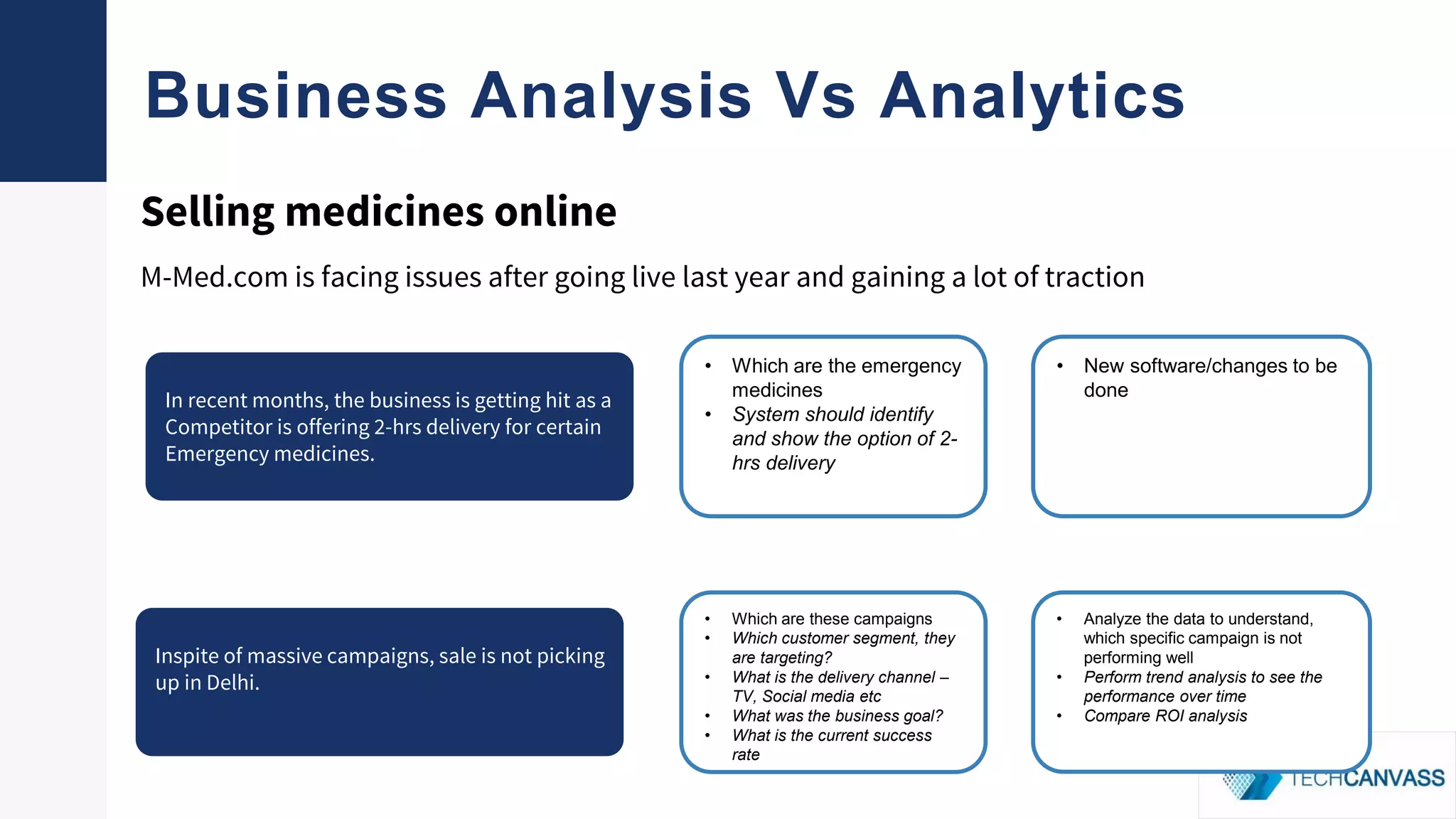
Selling medicines online
M-Med.com is facing issues after going live last year and gaining a lot of traction
In recent months, the business is getting hit as a
Competitor is offering 2-hrs delivery for certain
Emergency medicines.
Inspite of massive campaigns, sale is not picking
up in Delhi.
• Which are these campaigns
• Which customer segment, they
are targeting?
• What is the delivery channel –
TV, Social media etc
• What was the business goal?
• What is the current success
rate
• Analyze the data to understand,
which specific campaign is not
performing well
• Perform trend analysis to see the
performance over time
• Compare ROI analysis
• Which are the emergency
medicines
• System should identify
and show the option of 2-
hrs delivery
• New software/changes to be
done
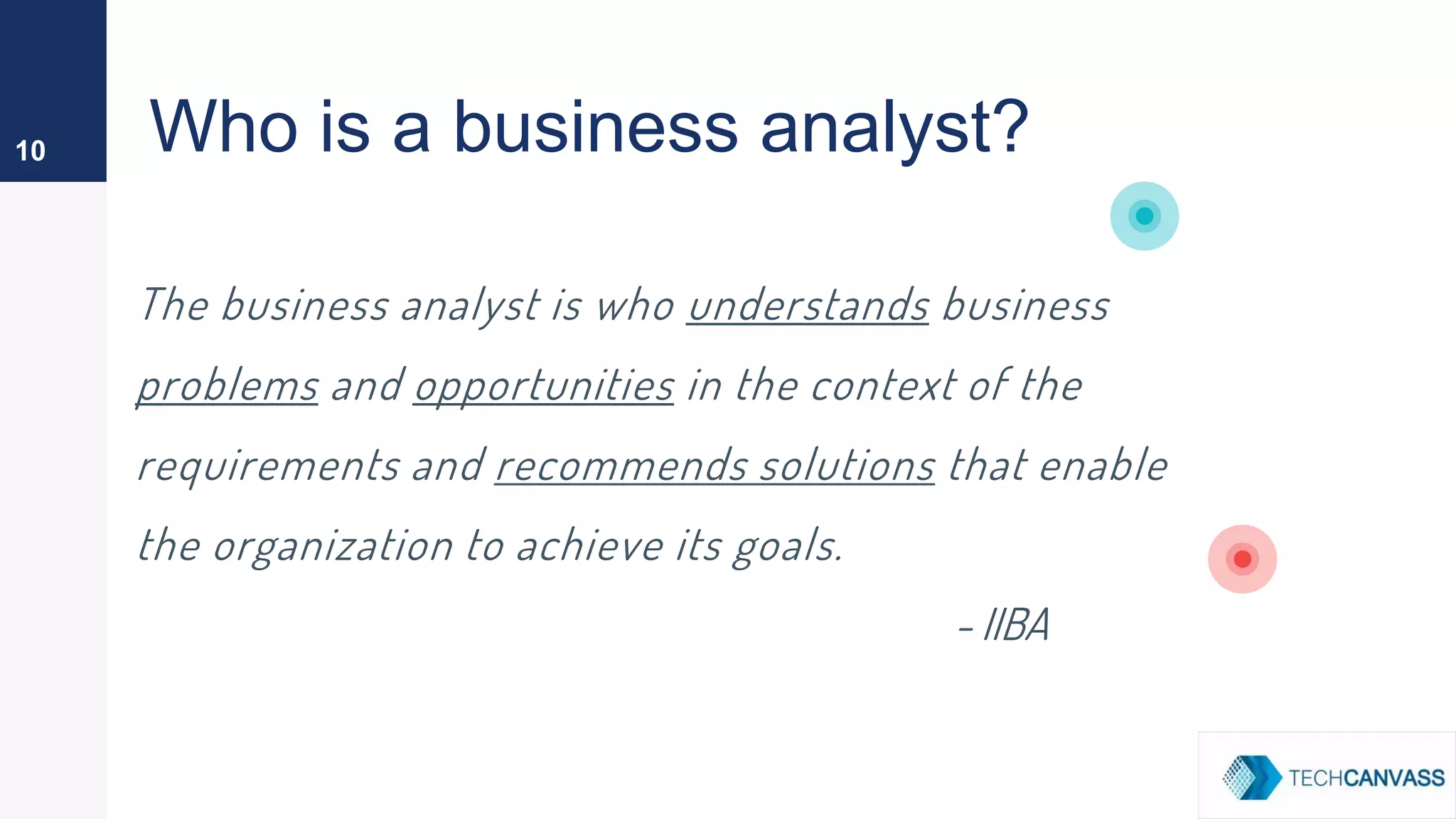
Who is a business analyst?
The business analyst is who understands business
problems and opportunities in the context of the
requirements and recommends solutions that enable
the organization to achieve its goals.
- IIBA
10
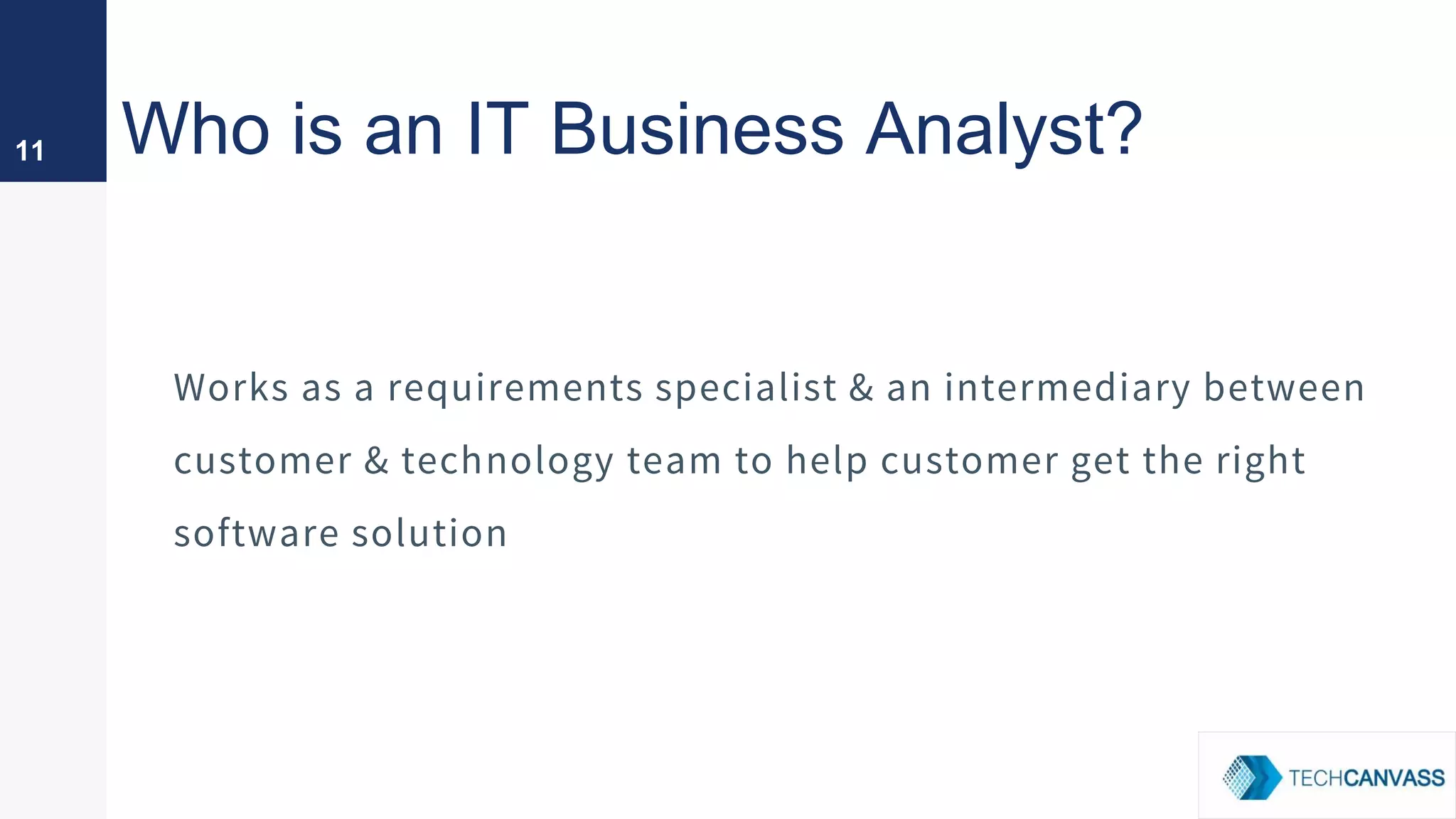
Who is an IT Business Analyst?
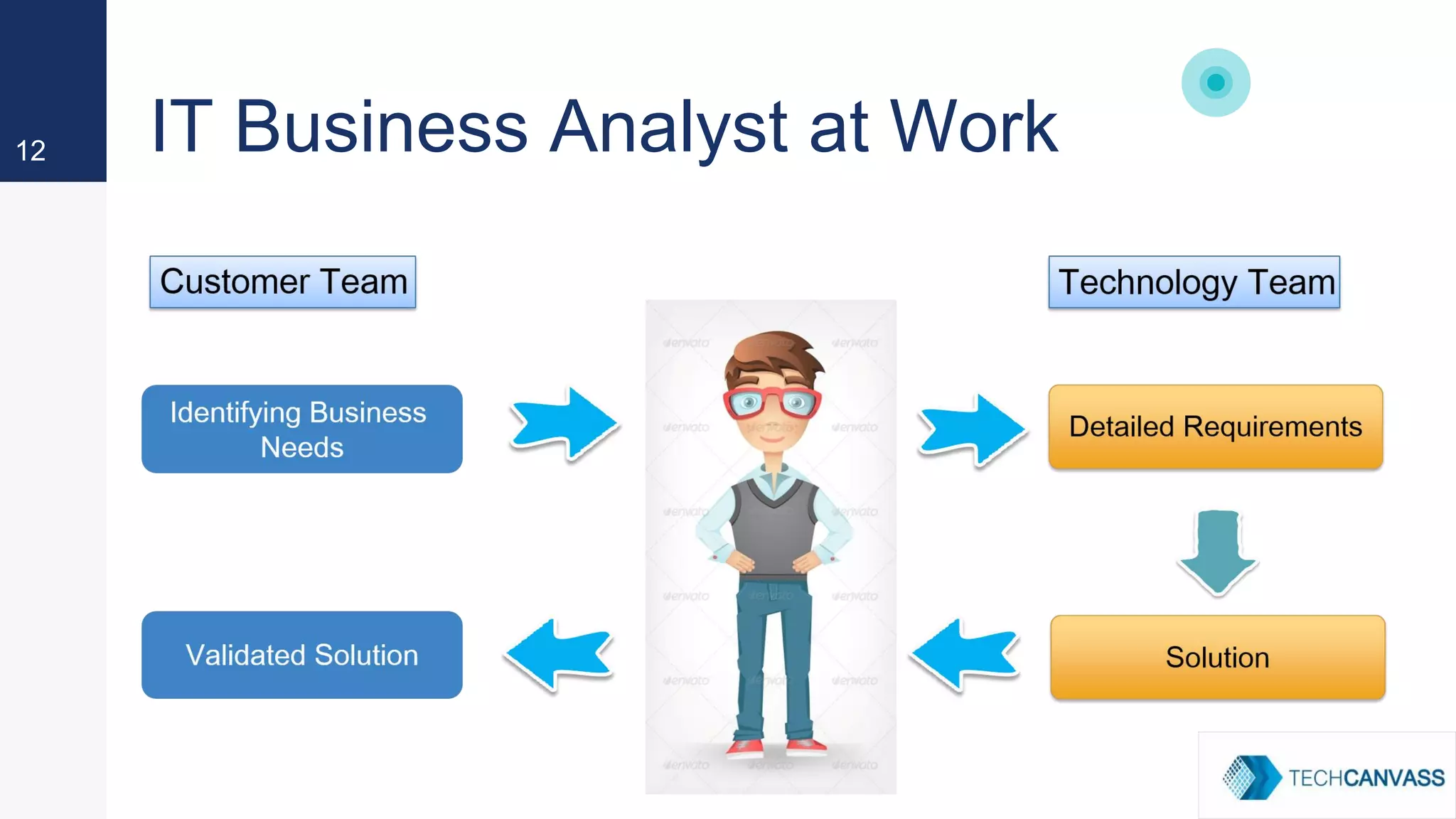
Works as a requirements specialist & an intermediary between
customer & technology team to help customer get the right
software solution
11
IT Business Analyst at Work12
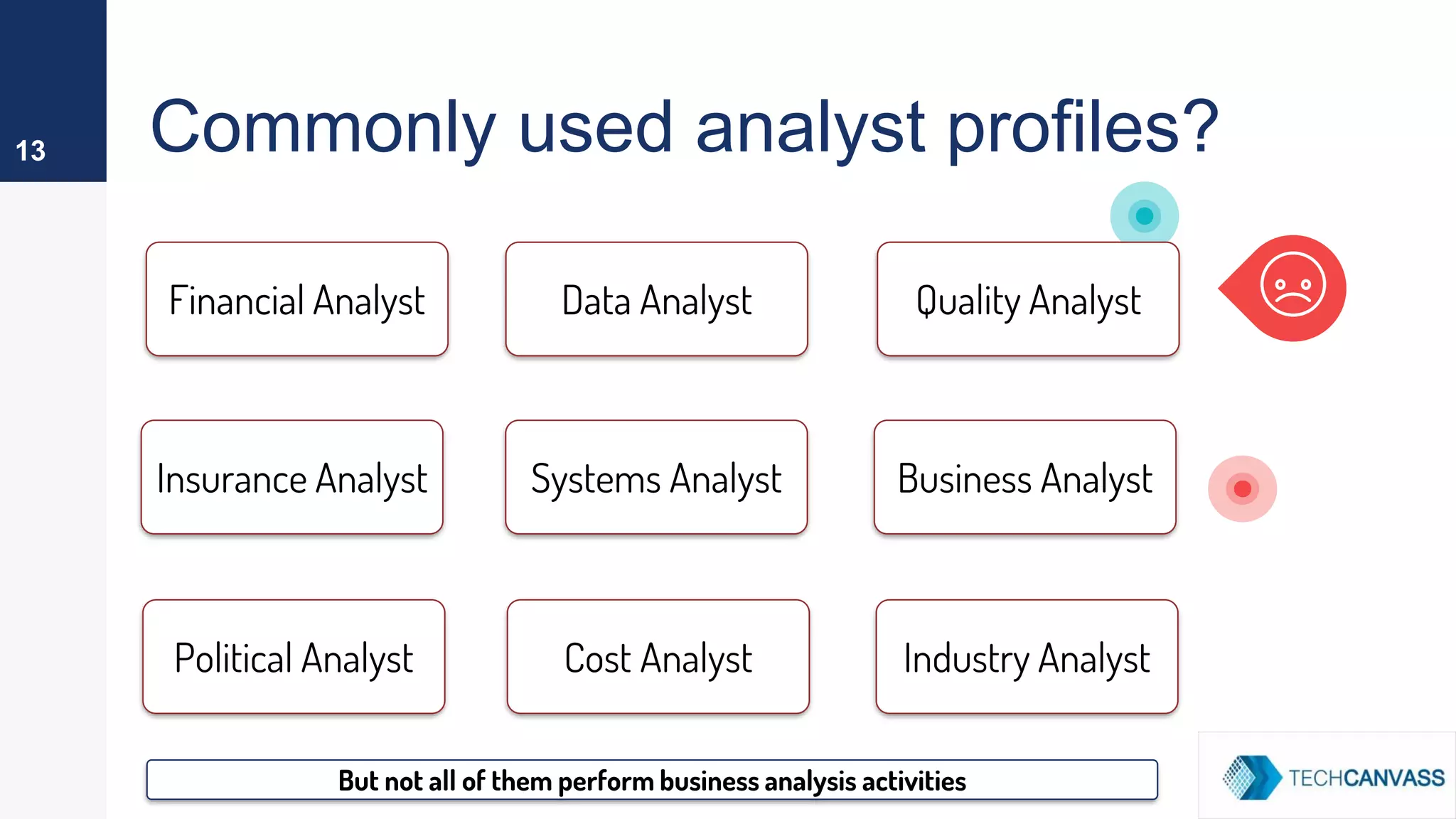
Commonly used analyst profiles?13
Financial Analyst
Insurance Analyst
Data Analyst Quality Analyst
Systems Analyst Business Analyst
Political Analyst Cost Analyst Industry Analyst
But not all of them perform business analysis activities
”
Business Analysis Practice
Understanding the work of a business analyst
14
Business
Analysis
15
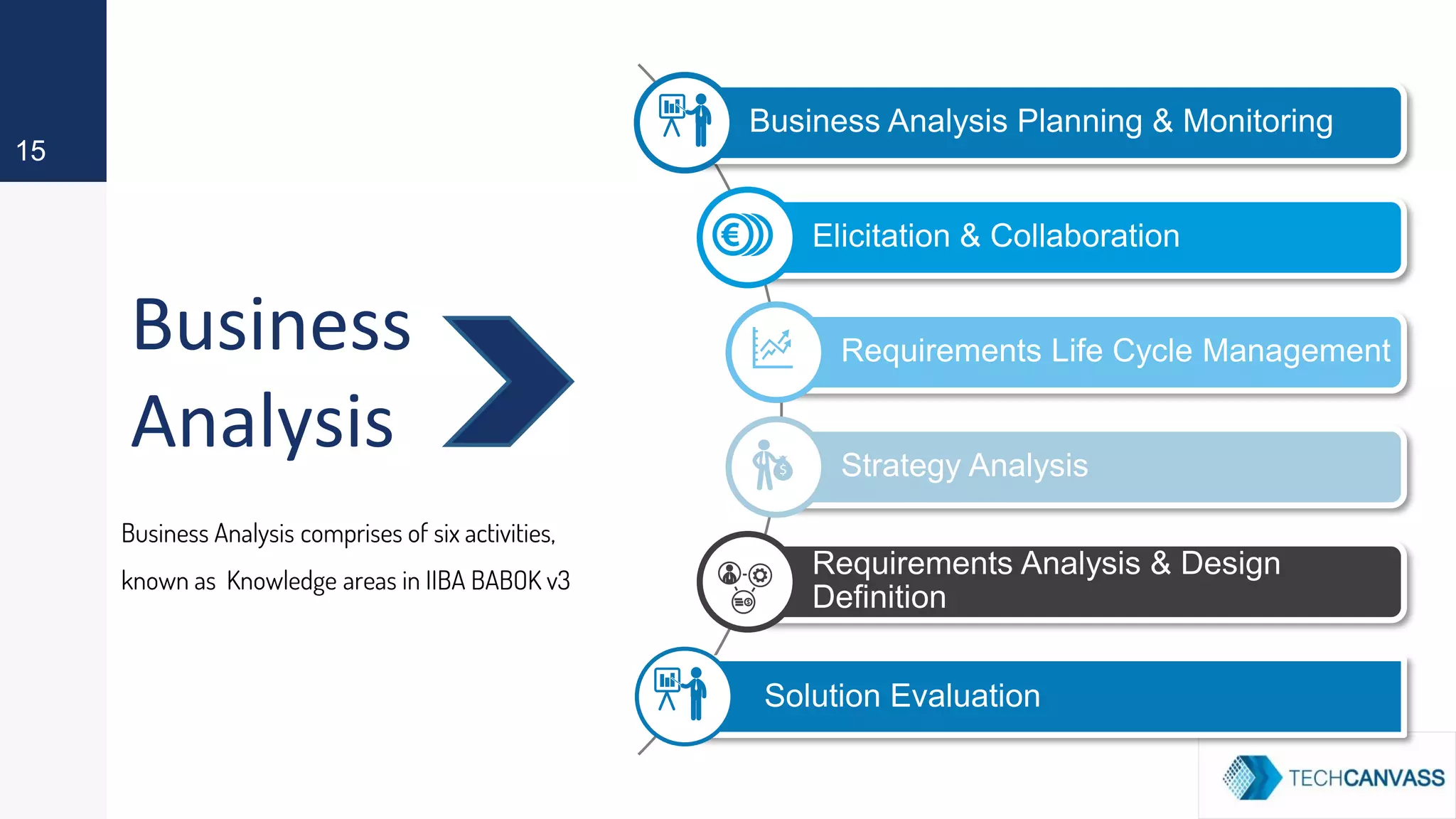
Business Analysis comprises of six activities,
known as Knowledge areas in IIBA BABOK v3
Business Analysis Planning & Monitoring
Elicitation & Collaboration
Requirements Life Cycle Management
Strategy Analysis
Requirements Analysis & Design
Definition
Solution Evaluation
Business Analysis planning and Monitoring
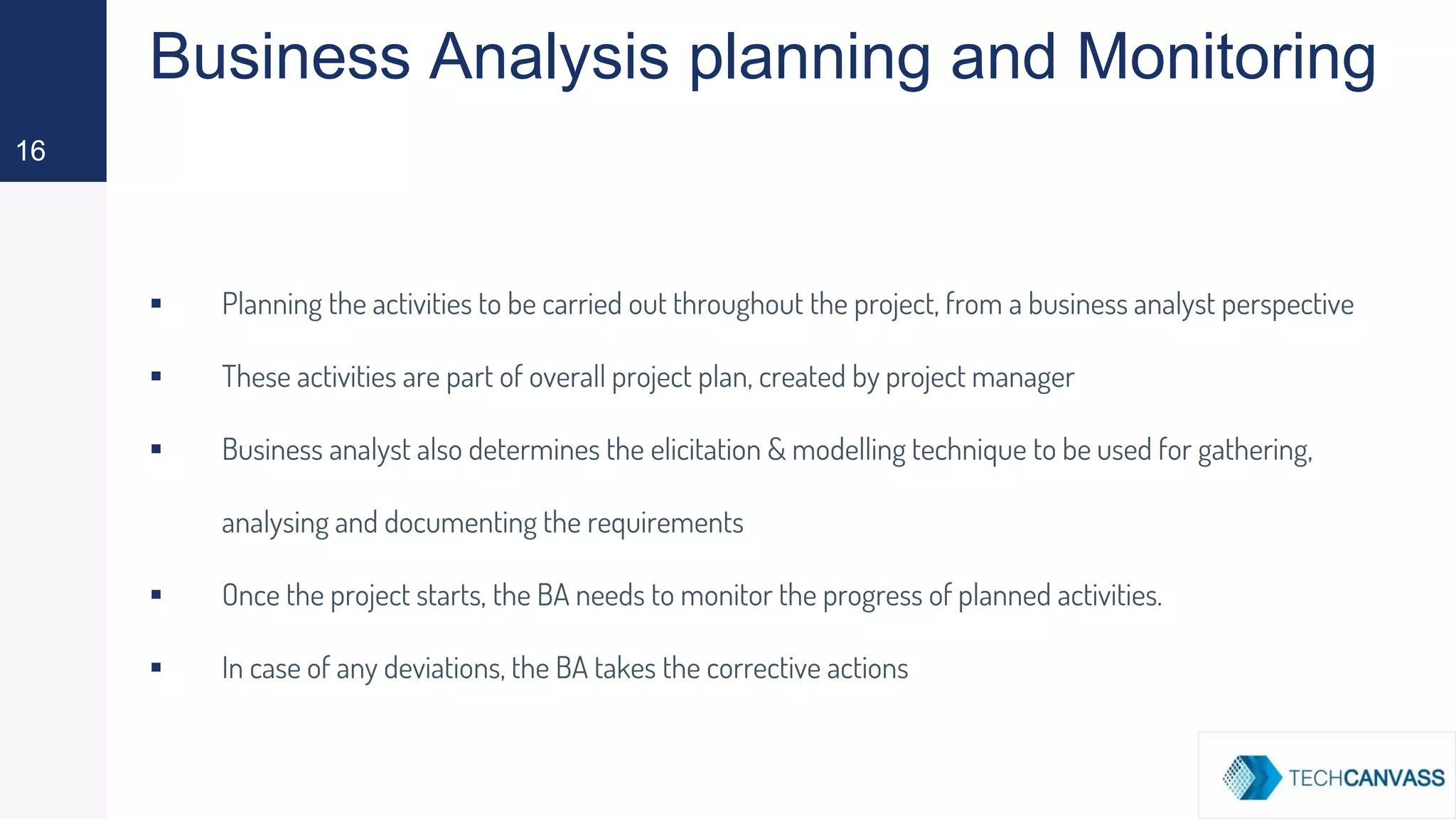
▪ Planning the activities to be carried out throughout the project, from a business analyst perspective
▪ These activities are part of overall project plan, created by project manager
▪ Business analyst also determines the elicitation & modelling technique to be used for gathering,
analysing and documenting the requirements
▪ Once the project starts, the BA needs to monitor the progress of planned activities.
▪ In case of any deviations, the BA takes the corrective actions
16
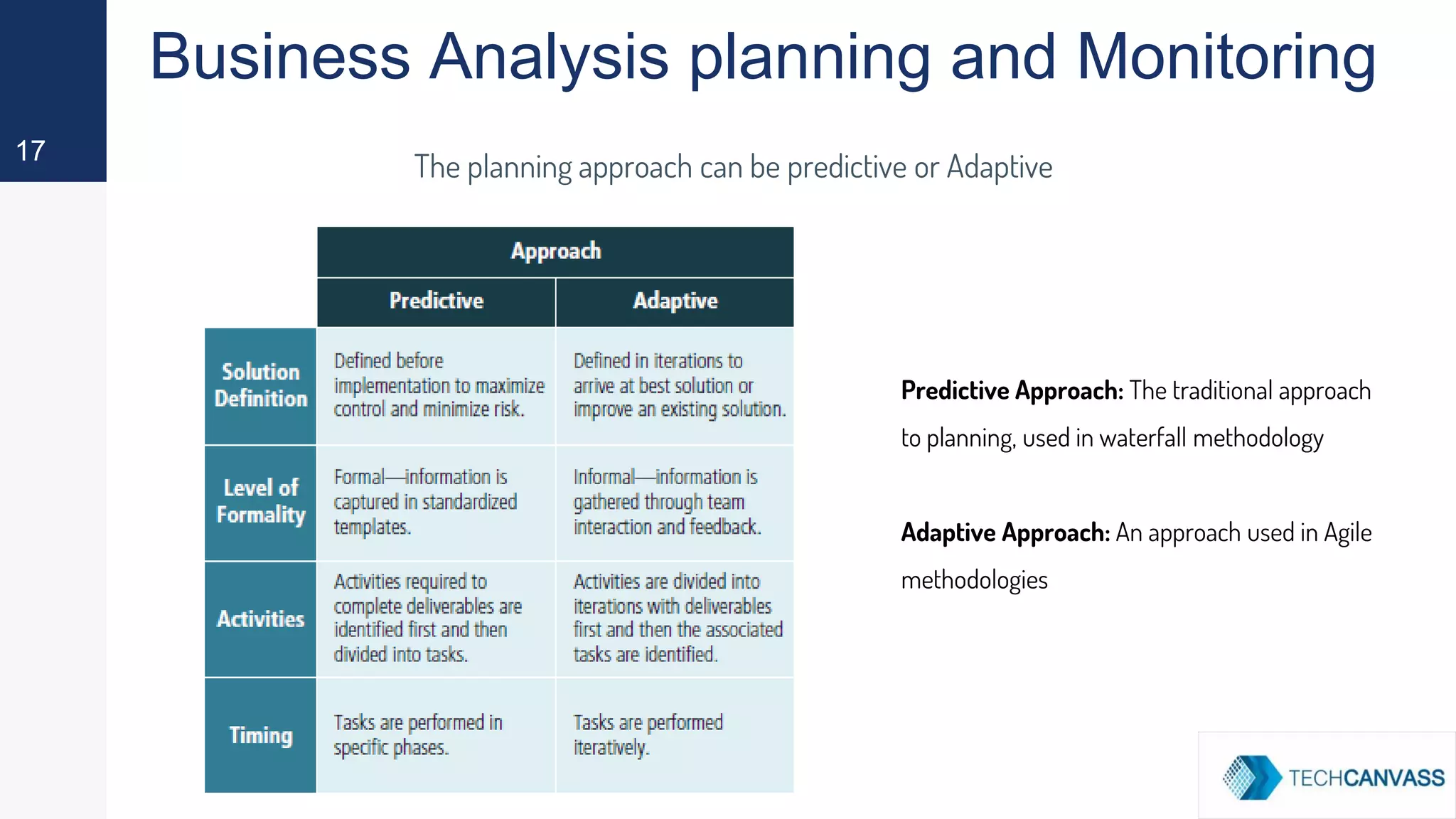
Business Analysis planning and Monitoring
The planning approach can be predictive or Adaptive
17
Predictive Approach: The traditional approach
to planning, used in waterfall methodology
Adaptive Approach: An approach used in Agile
methodologies
Elicitation & Collaboration
▪ Once the business analyst (& team) initiates the requirements gathering activities (more formal term
is elicitation activities), the BA uses one or more of elicitation techniques:
o Interviews
o Workshops
o Job shadowing etc….
▪ Requirements elicitation is a collaborative effort and the BA collaborates with customer
representatives known as stakeholders.
18
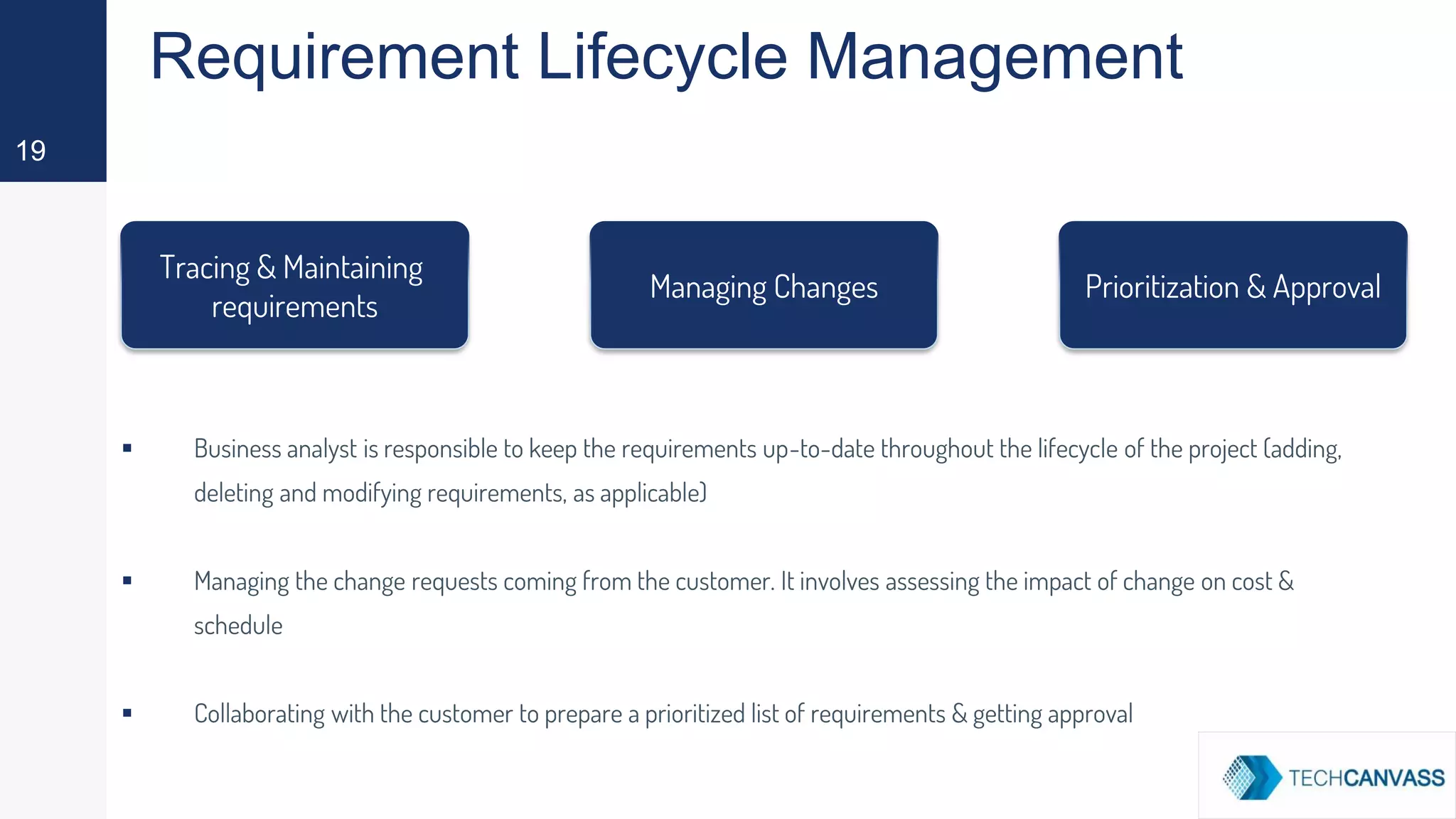
Requirement Lifecycle Management
▪ Business analyst is responsible to keep the requirements up-to-date throughout the lifecycle of the project (adding,
deleting and modifying requirements, as applicable)
▪ Managing the change requests coming from the customer. It involves assessing the impact of change on cost &
schedule
▪ Collaborating with the customer to prepare a prioritized list of requirements & getting approval
19
Tracing & Maintaining
requirements
Managing Changes Prioritization & Approval
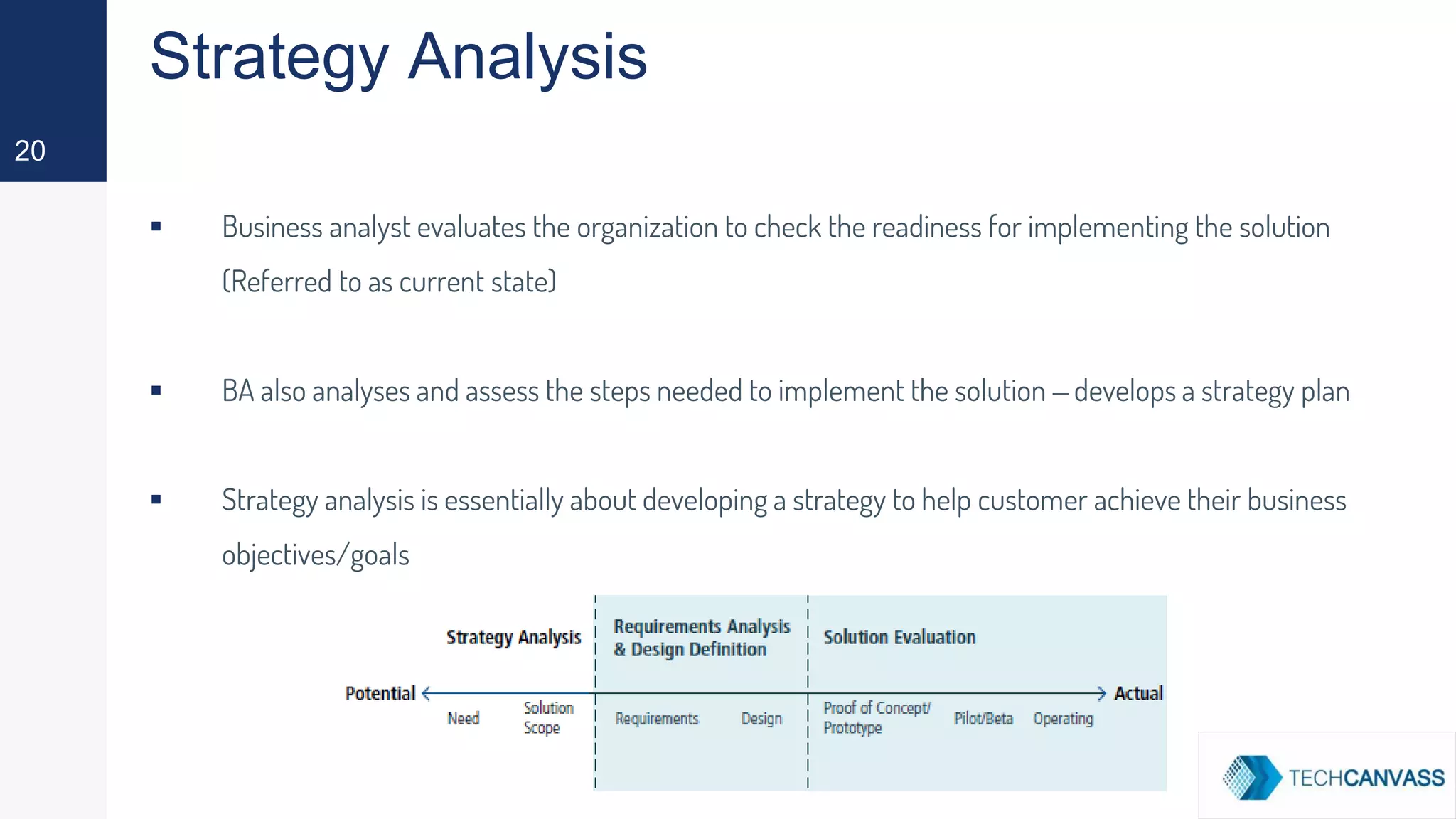
Strategy Analysis
▪ Business analyst evaluates the organization to check the readiness for implementing the solution
(Referred to as current state)
▪ BA also analyses and assess the steps needed to implement the solution – develops a strategy plan
▪ Strategy analysis is essentially about developing a strategy to help customer achieve their business
objectives/goals
20
Requirements Analysis & Design Definition
▪ This knowledge area is all about developing a detailed requirement specifications.
▪ Detailed requirements specifications are required for the technology team to design and develop
programs
▪ Business analyst uses visual models and analysis techniques to expand the requirements. UML
diagrams is one of the most commonly used modelling techniques
21
Solution Evaluation
▪ Once the software project (or a solution to a problem) is implemented successfully, it’s important to
evaluate its effectiveness
▪ The effectiveness needs to be measured against the business goals
▪ In order to do so, measurements have to be made using metrics
▪ For example, if the business goal of a solution was to increase the sales in south region by 12%
annually
▪ The sales data for every quarter/year needs to be measured to monitor – if the goal is achieved
22
Business
Analysis
23
An important skill in the current environment in helping
customer address their needs with an effective solution
To Conclude
It is not just the IT industry where business analysis skill in
needed. It’s a skill, which is relevant for other industries as well
24
THANKS!
Any questions?
You can find me at
▪ info@techcanvass.com
▪ 022-40155 175
▪ www.techcanvass.com

Business analysis Fundamentals | Fundamentals of business analysis

  • 1.
  • 2.
  • 3.
  • 4.
    ” Business analysis isthe discipline of identifying business needs and determining & Validating solutions to the business problems. 4
  • 5.
    What is businessanalysis?5 Problem Understanding/ Analysis Solution determination Solution Assessment
  • 6.
    What is businessanalysis?6 Problem Understanding/ Analysis Solution determination Solution Assessment WHAT involves understanding the problem with complete context Creating Requirements specifications
  • 7.
    What is businessanalysis?7 Problem Understanding/ Analysis Solution Determination & Implementation Solution Assessment How – What are the options? How – How will it get implemented
  • 8.
    What is businessanalysis?8 Problem Understanding/ Analysis Solution Determination & Implementation Solution Assessment Defining METRICS and Measuring against the GOALS
  • 9.
    Business Analysis VsAnalytics Selling medicines online M-Med.com is facing issues after going live last year and gaining a lot of traction In recent months, the business is getting hit as a Competitor is offering 2-hrs delivery for certain Emergency medicines. Inspite of massive campaigns, sale is not picking up in Delhi. • Which are these campaigns • Which customer segment, they are targeting? • What is the delivery channel – TV, Social media etc • What was the business goal? • What is the current success rate • Analyze the data to understand, which specific campaign is not performing well • Perform trend analysis to see the performance over time • Compare ROI analysis • Which are the emergency medicines • System should identify and show the option of 2- hrs delivery • New software/changes to be done
  • 10.
    Who is abusiness analyst? The business analyst is who understands business problems and opportunities in the context of the requirements and recommends solutions that enable the organization to achieve its goals. - IIBA 10
  • 11.
    Who is anIT Business Analyst? Works as a requirements specialist & an intermediary between customer & technology team to help customer get the right software solution 11
  • 12.
  • 13.
    Commonly used analystprofiles?13 Financial Analyst Insurance Analyst Data Analyst Quality Analyst Systems Analyst Business Analyst Political Analyst Cost Analyst Industry Analyst But not all of them perform business analysis activities
  • 14.
    ” Business Analysis Practice Understandingthe work of a business analyst 14
  • 15.
    Business Analysis 15 Business Analysis comprisesof six activities, known as Knowledge areas in IIBA BABOK v3 Business Analysis Planning & Monitoring Elicitation & Collaboration Requirements Life Cycle Management Strategy Analysis Requirements Analysis & Design Definition Solution Evaluation
  • 16.
    Business Analysis planningand Monitoring ▪ Planning the activities to be carried out throughout the project, from a business analyst perspective ▪ These activities are part of overall project plan, created by project manager ▪ Business analyst also determines the elicitation & modelling technique to be used for gathering, analysing and documenting the requirements ▪ Once the project starts, the BA needs to monitor the progress of planned activities. ▪ In case of any deviations, the BA takes the corrective actions 16
  • 17.
    Business Analysis planningand Monitoring The planning approach can be predictive or Adaptive 17 Predictive Approach: The traditional approach to planning, used in waterfall methodology Adaptive Approach: An approach used in Agile methodologies
  • 18.
    Elicitation & Collaboration ▪Once the business analyst (& team) initiates the requirements gathering activities (more formal term is elicitation activities), the BA uses one or more of elicitation techniques: o Interviews o Workshops o Job shadowing etc…. ▪ Requirements elicitation is a collaborative effort and the BA collaborates with customer representatives known as stakeholders. 18
  • 19.
    Requirement Lifecycle Management ▪Business analyst is responsible to keep the requirements up-to-date throughout the lifecycle of the project (adding, deleting and modifying requirements, as applicable) ▪ Managing the change requests coming from the customer. It involves assessing the impact of change on cost & schedule ▪ Collaborating with the customer to prepare a prioritized list of requirements & getting approval 19 Tracing & Maintaining requirements Managing Changes Prioritization & Approval
  • 20.
    Strategy Analysis ▪ Businessanalyst evaluates the organization to check the readiness for implementing the solution (Referred to as current state) ▪ BA also analyses and assess the steps needed to implement the solution – develops a strategy plan ▪ Strategy analysis is essentially about developing a strategy to help customer achieve their business objectives/goals 20
  • 21.
    Requirements Analysis &Design Definition ▪ This knowledge area is all about developing a detailed requirement specifications. ▪ Detailed requirements specifications are required for the technology team to design and develop programs ▪ Business analyst uses visual models and analysis techniques to expand the requirements. UML diagrams is one of the most commonly used modelling techniques 21
  • 22.
    Solution Evaluation ▪ Oncethe software project (or a solution to a problem) is implemented successfully, it’s important to evaluate its effectiveness ▪ The effectiveness needs to be measured against the business goals ▪ In order to do so, measurements have to be made using metrics ▪ For example, if the business goal of a solution was to increase the sales in south region by 12% annually ▪ The sales data for every quarter/year needs to be measured to monitor – if the goal is achieved 22
  • 23.
    Business Analysis 23 An important skillin the current environment in helping customer address their needs with an effective solution To Conclude It is not just the IT industry where business analysis skill in needed. It’s a skill, which is relevant for other industries as well
  • 24.
    24 THANKS! Any questions? You canfind me at ▪ info@techcanvass.com ▪ 022-40155 175 ▪ www.techcanvass.com