
Core Concepts Model
(BACCM)
Introduction to BABOK Guide
What is BABOK®
 Global standard for the practice of business analysis
 Current version is 3.0
 Effective from September 30, 2016
 Reference guide for all the 4 levels of BA Certifications
ECBA CCBA CBAP CBATL
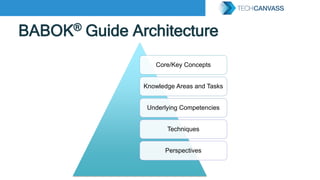
Core/Key Concepts
Knowledge Areas and Tasks
Underlying Competencies
Techniques
Perspectives
BABOK® Guide Architecture
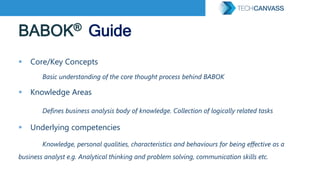
BABOK® Guide
 Core/Key Concepts
Basic understanding of the core thought process behind BABOK
 Knowledge Areas
Defines business analysis body of knowledge. Collection of logically related tasks
 Underlying competencies
Knowledge, personal qualities, characteristics and behaviours for being effective as a
business analyst e.g. Analytical thinking and problem solving, communication skills etc.
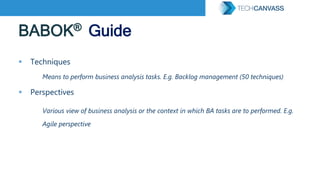
BABOK® Guide
 Techniques
Means to perform business analysis tasks. E.g. Backlog management (50 techniques)
 Perspectives
Various view of business analysis or the context in which BA tasks are to performed. E.g.
Agile perspective
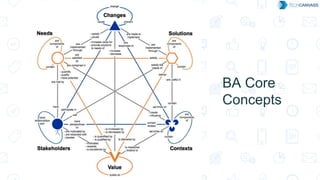
BA Core
Concepts
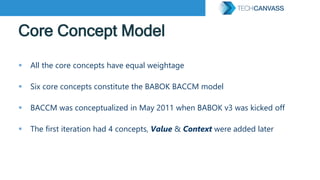
Core Concept Model
 All the core concepts have equal weightage
 Six core concepts constitute the BABOK BACCM model
 BACCM was conceptualized in May 2011 when BABOK v3 was kicked off
 The first iteration had 4 concepts, Value & Context were added later
Core Concept Model
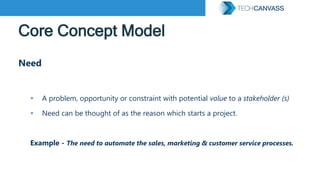
Need
 A problem, opportunity or constraint with potential value to a stakeholder (s)
 Need can be thought of as the reason which starts a project.
Example - The need to automate the sales, marketing & customer service processes.
Core Concept Model
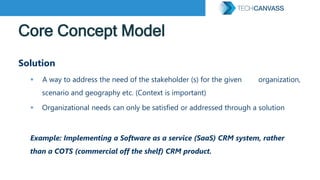
Solution
 A way to address the need of the stakeholder (s) for the given organization,
scenario and geography etc. (Context is important)
 Organizational needs can only be satisfied or addressed through a solution
Example: Implementing a Software as a service (SaaS) CRM system, rather
than a COTS (commercial off the shelf) CRM product.
Core Concept Model
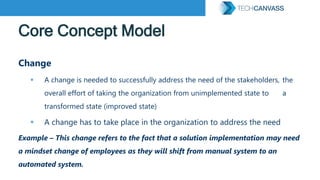
Change
 A change is needed to successfully address the need of the stakeholders, the
overall effort of taking the organization from unimplemented state to a
transformed state (improved state)
 A change has to take place in the organization to address the need
Example – This change refers to the fact that a solution implementation may need
a mindset change of employees as they will shift from manual system to an
automated system.
Core Concept Model
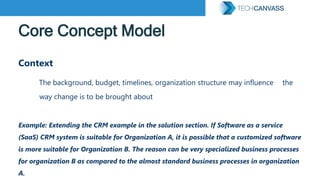
Context
The background, budget, timelines, organization structure may influence the
way change is to be brought about
Example: Extending the CRM example in the solution section. If Software as a service
(SaaS) CRM system is suitable for Organization A, it is possible that a customized software
is more suitable for Organization B. The reason can be very specialized business processes
for organization B as compared to the almost standard business processes in organization
A.
Core Concept Model
Value
 Value can be seen as potential or realized returns, gains, and
improvements.
 The value is an anticipated outcome of implementing a solution.
 Value can be tangible or intangible
Example – By implementing a CRM solution, a business can look forward to
increase its revenue or to improve customer service standards. This is what is
meant by “Value”.
Core Concept Model
Stakeholder
 A stakeholder is an individual or group who can influence the project or can
get influenced by the project as a user.
 The stakeholders can be from the customer organization, the solution provider
or an external organization.
Example – In our example of CRM solution, the stakeholders can be
marketing manager, Marketing head, you as a business analyst, the project
manager and so on.
BABOK and BACCM
 Each knowledge area in BABOK explains how will you be using core concepts to
complete the tasks
 As a business analyst, you will be using these core concepts during business
analysis activities. Consider these questions:
 Who are the stakeholders and what are their needs? What is the context?
 What are the kinds of changes, we are looking at or are working to bring about for
satisfying the stakeholders needs?
 What is the solution to address the needs of the stakeholders in the given context?
 What do stakeholders consider to be of value?
15
THANKS!
Any questions?
You can contact us at
▸ info@techcanvass.com
▸ 022-40155 175
▸ 7738 7731 08
www.techcanvass.com

Business Analysis Core Concepts Model (BACCM)

  • 1.
  • 2.
    What is BABOK® Global standard for the practice of business analysis  Current version is 3.0  Effective from September 30, 2016  Reference guide for all the 4 levels of BA Certifications ECBA CCBA CBAP CBATL
  • 3.
    Core/Key Concepts Knowledge Areasand Tasks Underlying Competencies Techniques Perspectives BABOK® Guide Architecture
  • 4.
    BABOK® Guide  Core/KeyConcepts Basic understanding of the core thought process behind BABOK  Knowledge Areas Defines business analysis body of knowledge. Collection of logically related tasks  Underlying competencies Knowledge, personal qualities, characteristics and behaviours for being effective as a business analyst e.g. Analytical thinking and problem solving, communication skills etc.
  • 5.
    BABOK® Guide  Techniques Meansto perform business analysis tasks. E.g. Backlog management (50 techniques)  Perspectives Various view of business analysis or the context in which BA tasks are to performed. E.g. Agile perspective
  • 6.
  • 7.
    Core Concept Model All the core concepts have equal weightage  Six core concepts constitute the BABOK BACCM model  BACCM was conceptualized in May 2011 when BABOK v3 was kicked off  The first iteration had 4 concepts, Value & Context were added later
  • 8.
    Core Concept Model Need A problem, opportunity or constraint with potential value to a stakeholder (s)  Need can be thought of as the reason which starts a project. Example - The need to automate the sales, marketing & customer service processes.
  • 9.
    Core Concept Model Solution A way to address the need of the stakeholder (s) for the given organization, scenario and geography etc. (Context is important)  Organizational needs can only be satisfied or addressed through a solution Example: Implementing a Software as a service (SaaS) CRM system, rather than a COTS (commercial off the shelf) CRM product.
  • 10.
    Core Concept Model Change A change is needed to successfully address the need of the stakeholders, the overall effort of taking the organization from unimplemented state to a transformed state (improved state)  A change has to take place in the organization to address the need Example – This change refers to the fact that a solution implementation may need a mindset change of employees as they will shift from manual system to an automated system.
  • 11.
    Core Concept Model Context Thebackground, budget, timelines, organization structure may influence the way change is to be brought about Example: Extending the CRM example in the solution section. If Software as a service (SaaS) CRM system is suitable for Organization A, it is possible that a customized software is more suitable for Organization B. The reason can be very specialized business processes for organization B as compared to the almost standard business processes in organization A.
  • 12.
    Core Concept Model Value Value can be seen as potential or realized returns, gains, and improvements.  The value is an anticipated outcome of implementing a solution.  Value can be tangible or intangible Example – By implementing a CRM solution, a business can look forward to increase its revenue or to improve customer service standards. This is what is meant by “Value”.
  • 13.
    Core Concept Model Stakeholder A stakeholder is an individual or group who can influence the project or can get influenced by the project as a user.  The stakeholders can be from the customer organization, the solution provider or an external organization. Example – In our example of CRM solution, the stakeholders can be marketing manager, Marketing head, you as a business analyst, the project manager and so on.
  • 14.
    BABOK and BACCM Each knowledge area in BABOK explains how will you be using core concepts to complete the tasks  As a business analyst, you will be using these core concepts during business analysis activities. Consider these questions:  Who are the stakeholders and what are their needs? What is the context?  What are the kinds of changes, we are looking at or are working to bring about for satisfying the stakeholders needs?  What is the solution to address the needs of the stakeholders in the given context?  What do stakeholders consider to be of value?
  • 15.
    15 THANKS! Any questions? You cancontact us at ▸ info@techcanvass.com ▸ 022-40155 175 ▸ 7738 7731 08 www.techcanvass.com

Editor's Notes

  • #4 E&C – too narrow of a focus RMCM – strange to put together EA - Enterprise Analysis confused people and led to a lot of misinterpretations, particularly when we started talking about Enterprise Business Analysis, Also, 'situation' made more sense than 'enterprise' because tasks are executed at the scope of the BA roll and context, not at the scope of the organization. RA – didn’t cover design that BAs do SAV – Solution Evaluation means essentially the same thing as "Assessment and Validation" if you look in the dictionary, is shorter, and translates directly into French, Spanish, and Portuguese