
Bathtub &
Nahani Trap
Building Services
Sem iii
Group Members
Archita
Bhavesh-59
Ganesh-16
Jayesh-43
Manigandan
Ninad-68
Pragati-69
Subhramaniam-33
Sushilkumar-18
Tejasee-15
Bathtub
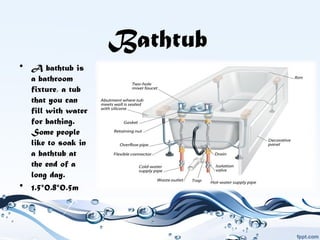
• A bathtub is
a bathroom
fixture, a tub
that you can
fill with water
for bathing.
Some people
like to soak in
a bathtub at
the end of a
long day.
• 1.5*0.8*0.5m
Types Of Bathtub
Recessed Or Alcove
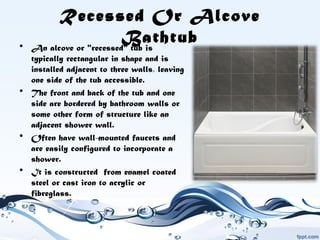
Bathtub• An alcove or "recessed" tub is
typically rectangular in shape and is
installed adjacent to three walls, leaving
one side of the tub accessible.
• The front and back of the tub and one
side are bordered by bathroom walls or
some other form of structure like an
adjacent shower wall.
• Often have wall-mounted faucets and
are easily configured to incorporate a
shower.
• It is constructed from enamel coated
steel or cast iron to acrylic or
fibreglass.  
Corner Bathtubs
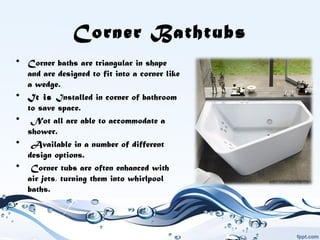
• Corner baths are triangular in shape
and are designed to fit into a corner like
a wedge.
• It is Installed in corner of bathroom
to save space.
• Not all are able to accommodate a
shower.
• Available in a number of different
design options.
• Corner tubs are often enhanced with
air jets, turning them into whirlpool
baths.
.
Freestanding Bathtubs
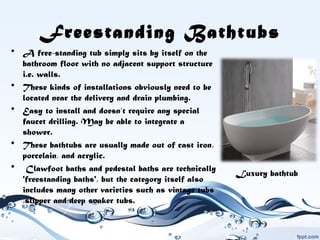
• A free-standing tub simply sits by itself on the
bathroom floor with no adjacent support structure
i.e. walls.
• These kinds of installations obviously need to be
located near the delivery and drain plumbing.
• Easy to install and doesn’t require any special
faucet drilling. May be able to integrate a
shower.
• These bathtubs are usually made out of cast iron,
porcelain, and acrylic.
• Clawfoot baths and pedestal baths are technically
'freestanding baths', but the category itself also
includes many other varieties such as vintage tubs
,slipper and deep soaker tubs.
Luxury bathtub
Clawfoot & Pedestal
Bathtub
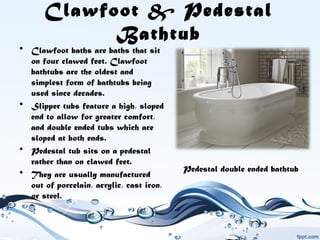
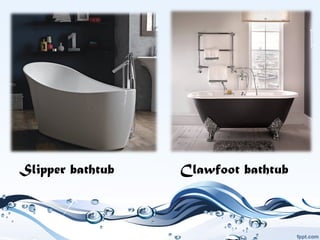
• Clawfoot baths are baths that sit
on four clawed feet. Clawfoot
bathtubs are the oldest and
simplest form of bathtubs being
used since decades. 
• Slipper tubs feature a high, sloped
end to allow for greater comfort,
and double ended tubs which are
sloped at both ends.
• Pedestal tub sits on a pedestal
rather than on clawed feet.
• They are usually manufactured
out of porcelain, acrylic, cast iron,
or steel.
Pedestal double ended bathtub
Slipper bathtub Clawfoot bathtub
Platform/Drop-In
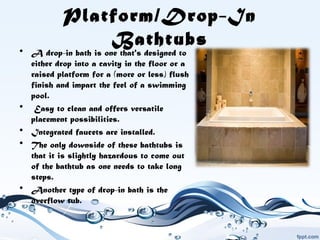
Bathtubs• A drop-in bath is one that's designed to
either drop into a cavity in the floor or a
raised platform for a (more or less) flush
finish and impart the feel of a swimming
pool.
•  Easy to clean and offers versatile
placement possibilities.
• Integrated faucets are installed.
• The only downside of these bathtubs is
that it is slightly hazardous to come out
of the bathtub as one needs to take long
steps.
• Another type of drop-in bath is the
overflow tub.
Whirlpool baths /
Jacuzzis
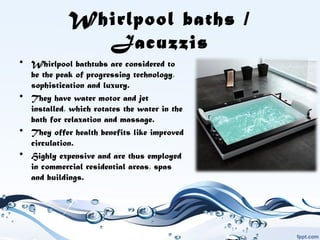
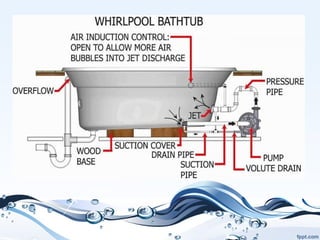
• Whirlpool bathtubs are considered to
be the peak of progressing technology,
sophistication and luxury.
• They have water motor and jet
installed, which rotates the water in the
bath for relaxation and massage. 
• They offer health benefits like improved
circulation.
• Highly expensive and are thus employed
in commercial residential areas, spas
and buildings.
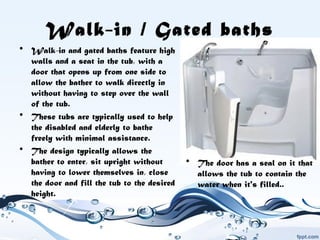
Walk-in / Gated baths
• Walk-in and gated baths feature high
walls and a seat in the tub, with a
door that opens up from one side to
allow the bather to walk directly in
without having to step over the wall
of the tub.
• These tubs are typically used to help
the disabled and elderly to bathe
freely with minimal assistance.
• The design typically allows the
bather to enter, sit upright without
having to lower themselves in, close
the door and fill the tub to the desired
height.
• The door has a seal on it that
allows the tub to contain the
water when it's filled..
Bathtub Materials
Acrylic:
• Acrylic sheets are heated,
formed into a mold and
reinforced with fiberglass, after
which wood or metal
reinforcement is usually added.
• Offer a wide choice of styles
and shapes.Resistant to
abrasion and fading
• Lightweight
• Hold heat well if insulated
• More expensive
• May scratch
Cast Polymer:
•Solid-color polymer-based
materials often made to resemble
onyx or granite. Finished with a
polyester gel coat.
•Mimic the look of stone while
offering the flexibility of synthetic
material.
•Thick
•Retain heat well
•Gel coating is somewhat less 
durable than acrylic
Bathtub Materials
Cultured Marble
• A manmade material composed
of crushed limestone and
polyester resin with a gel-coat
finish.
• Require more maintenance
• Offer many colors and patterns
• Provide a sleek, stylish look
• May be brittle and scratch easily
• More expensive
Enameled Cast Iron
• Cast iron molded into a
bathtub shape and finished
with enamel. Generally
thicker than other materials.
• Durable and solid
• Available in a range of
colors
• Retain heat well
• Excellent soundproofing
• Heavy may require−
structural reinforcement
Bathtub Materials
Enameled Steel
• Resembles cast iron and is
produced by spraying
enamel onto molded steel
and firing the tub at a high
temperature.
• Less expensive than cast
iron
• May chip somewhat easily
• Provide a smaller choice of
colors
• May be noisy when water
is 
running
Fiberglass
• A fiberglass backing material finished with a
layer of polyester gel coat. Wood or metal
reinforcement is often added.
• Economical
• Offer a wide choice of styles and shapes
• Lightweight
• Don't retain heat as well
• Solid Surface
• Made with acrylic and/or polyester resins and
baked into sheets. Resin provides flexibility
while polyester provides dramatic coloring.
• Color and texture remain intact despite wear
• Retain heat well
• Available in a wide range of colors
• Stain-resistant
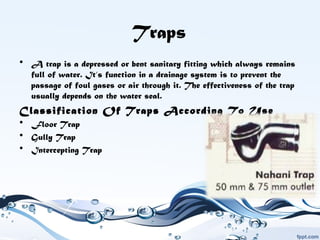
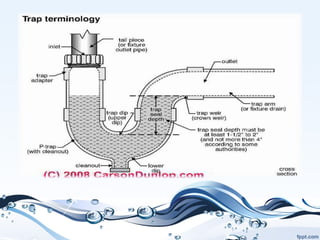
Traps
• A trap is a depressed or bent sanitary fitting which always remains
full of water. It‘s function in a drainage system is to prevent the
passage of foul gases or air through it. The effectiveness of the trap
usually depends on the water seal.
Classification Of Traps According To Use
• Floor Trap
• Gully Trap
• Intercepting Trap
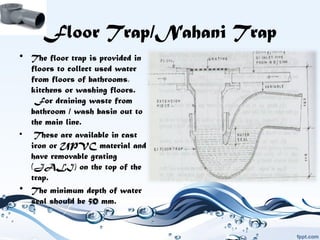
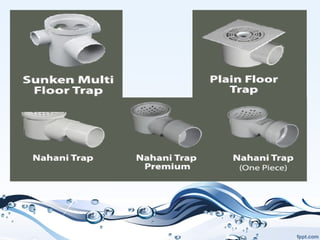
Floor Trap/Nahani Trap
• The floor trap is provided in
floors to collect used water
from floors of bathrooms,
kitchens or washing floors.
 For draining waste from
bathroom / wash basin out to
the main line.
• These are available in cast
iron or UPVC material and
have removable grating
(JALI) on the top of the
trap.
• The minimum depth of water
seal should be 50 mm.
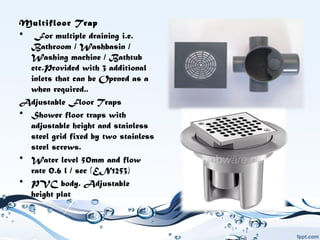
Multifloor Trap
•  For multiple draining i.e.
Bathroom / Washbasin /
Washing machine / Bathtub
etc.Provided with 3 additional
inlets that can be Opened as a
when required..
Adjustable Floor Traps
• Shower floor traps with
adjustable height and stainless
steel grid fixed by two stainless
steel screws.
• Water level 50mm and flow
rate 0.6 l / sec (EN1253)
• PVC body. Adjustable
height plat
Thank You
The website given below i.e. fppt.com
Is the site for downloading ppt template background.
This is my manufactured ppt.
Never doubt me.

BATHTUB AND NAHANI TRAP

  • 1.
  • 2.
  • 3.
    Bathtub • A bathtub is a bathroom fixture,a tub that you can fill with water for bathing. Some people like to soak in a bathtub at the end of a long day. • 1.5*0.8*0.5m
  • 4.
  • 5.
    Recessed Or Alcove Bathtub•An alcove or "recessed" tub is typically rectangular in shape and is installed adjacent to three walls, leaving one side of the tub accessible. • The front and back of the tub and one side are bordered by bathroom walls or some other form of structure like an adjacent shower wall. • Often have wall-mounted faucets and are easily configured to incorporate a shower. • It is constructed from enamel coated steel or cast iron to acrylic or fibreglass.  
  • 6.
    Corner Bathtubs • Cornerbaths are triangular in shape and are designed to fit into a corner like a wedge. • It is Installed in corner of bathroom to save space. • Not all are able to accommodate a shower. • Available in a number of different design options. • Corner tubs are often enhanced with air jets, turning them into whirlpool baths. .
  • 7.
    Freestanding Bathtubs • Afree-standing tub simply sits by itself on the bathroom floor with no adjacent support structure i.e. walls. • These kinds of installations obviously need to be located near the delivery and drain plumbing. • Easy to install and doesn’t require any special faucet drilling. May be able to integrate a shower. • These bathtubs are usually made out of cast iron, porcelain, and acrylic. • Clawfoot baths and pedestal baths are technically 'freestanding baths', but the category itself also includes many other varieties such as vintage tubs ,slipper and deep soaker tubs. Luxury bathtub
  • 8.
    Clawfoot & Pedestal Bathtub •Clawfoot baths are baths that sit on four clawed feet. Clawfoot bathtubs are the oldest and simplest form of bathtubs being used since decades.  • Slipper tubs feature a high, sloped end to allow for greater comfort, and double ended tubs which are sloped at both ends. • Pedestal tub sits on a pedestal rather than on clawed feet. • They are usually manufactured out of porcelain, acrylic, cast iron, or steel. Pedestal double ended bathtub
  • 9.
  • 10.
    Platform/Drop-In Bathtubs• A drop-inbath is one that's designed to either drop into a cavity in the floor or a raised platform for a (more or less) flush finish and impart the feel of a swimming pool. •  Easy to clean and offers versatile placement possibilities. • Integrated faucets are installed. • The only downside of these bathtubs is that it is slightly hazardous to come out of the bathtub as one needs to take long steps. • Another type of drop-in bath is the overflow tub.
  • 11.
    Whirlpool baths / Jacuzzis •Whirlpool bathtubs are considered to be the peak of progressing technology, sophistication and luxury. • They have water motor and jet installed, which rotates the water in the bath for relaxation and massage.  • They offer health benefits like improved circulation. • Highly expensive and are thus employed in commercial residential areas, spas and buildings.
  • 13.
    Walk-in / Gatedbaths • Walk-in and gated baths feature high walls and a seat in the tub, with a door that opens up from one side to allow the bather to walk directly in without having to step over the wall of the tub. • These tubs are typically used to help the disabled and elderly to bathe freely with minimal assistance. • The design typically allows the bather to enter, sit upright without having to lower themselves in, close the door and fill the tub to the desired height. • The door has a seal on it that allows the tub to contain the water when it's filled..
  • 14.
    Bathtub Materials Acrylic: • Acrylicsheets are heated, formed into a mold and reinforced with fiberglass, after which wood or metal reinforcement is usually added. • Offer a wide choice of styles and shapes.Resistant to abrasion and fading • Lightweight • Hold heat well if insulated • More expensive • May scratch Cast Polymer: •Solid-color polymer-based materials often made to resemble onyx or granite. Finished with a polyester gel coat. •Mimic the look of stone while offering the flexibility of synthetic material. •Thick •Retain heat well •Gel coating is somewhat less  durable than acrylic
  • 15.
    Bathtub Materials Cultured Marble •A manmade material composed of crushed limestone and polyester resin with a gel-coat finish. • Require more maintenance • Offer many colors and patterns • Provide a sleek, stylish look • May be brittle and scratch easily • More expensive Enameled Cast Iron • Cast iron molded into a bathtub shape and finished with enamel. Generally thicker than other materials. • Durable and solid • Available in a range of colors • Retain heat well • Excellent soundproofing • Heavy may require− structural reinforcement
  • 16.
    Bathtub Materials Enameled Steel •Resembles cast iron and is produced by spraying enamel onto molded steel and firing the tub at a high temperature. • Less expensive than cast iron • May chip somewhat easily • Provide a smaller choice of colors • May be noisy when water is  running Fiberglass • A fiberglass backing material finished with a layer of polyester gel coat. Wood or metal reinforcement is often added. • Economical • Offer a wide choice of styles and shapes • Lightweight • Don't retain heat as well • Solid Surface • Made with acrylic and/or polyester resins and baked into sheets. Resin provides flexibility while polyester provides dramatic coloring. • Color and texture remain intact despite wear • Retain heat well • Available in a wide range of colors • Stain-resistant
  • 17.
    Traps • A trapis a depressed or bent sanitary fitting which always remains full of water. It‘s function in a drainage system is to prevent the passage of foul gases or air through it. The effectiveness of the trap usually depends on the water seal. Classification Of Traps According To Use • Floor Trap • Gully Trap • Intercepting Trap
  • 18.
    Floor Trap/Nahani Trap •The floor trap is provided in floors to collect used water from floors of bathrooms, kitchens or washing floors.  For draining waste from bathroom / wash basin out to the main line. • These are available in cast iron or UPVC material and have removable grating (JALI) on the top of the trap. • The minimum depth of water seal should be 50 mm.
  • 19.
    Multifloor Trap •  Formultiple draining i.e. Bathroom / Washbasin / Washing machine / Bathtub etc.Provided with 3 additional inlets that can be Opened as a when required.. Adjustable Floor Traps • Shower floor traps with adjustable height and stainless steel grid fixed by two stainless steel screws. • Water level 50mm and flow rate 0.6 l / sec (EN1253) • PVC body. Adjustable height plat
  • 22.
    Thank You The websitegiven below i.e. fppt.com Is the site for downloading ppt template background. This is my manufactured ppt. Never doubt me.