What Is Prism?
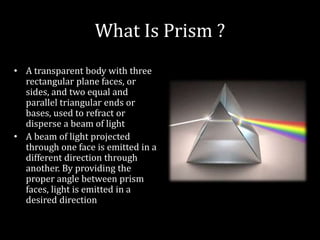
• A transparent body with three
rectangular plane faces, or
sides, and two equal and
parallel triangular ends or
bases, used to refract or
disperse a beam of light
• A beam of light projected
through one face is emitted in a
different direction through
another. By providing the
proper angle between prism
faces, light is emitted in a
desired direction
3.
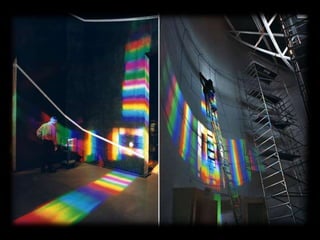
Refraction Of Light
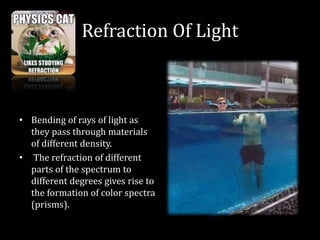
•Bending of rays of light as
they pass through materials
of different density.
• The refraction of different
parts of the spectrum to
different degrees gives rise to
the formation of color spectra
(prisms).
4.
Spectrum of light
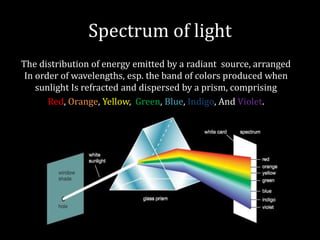
Thedistribution of energy emitted by a radiant source, arranged
In order of wavelengths, esp. the band of colors produced when
sunlight Is refracted and dispersed by a prism, comprising
Red, Orange, Yellow, Green, Blue, Indigo, And Violet.
History Of FresnelLens
• Invented by Augustin Jean
Fresnel.
• This applied in the first place to
street and stage lighting and also
been applied in numerous types
of projectors.
• Mostly it was used for
lighthouses, which had
previously been poorly lit by coal
fires or by using a large number
of oil lamps.
• In 1820 Augustin Jean Fresnel
developed a composite system of
stepped lens and prismatic rings
which could be made large
enough to concentrate the light
from lighthouses; this
construction was also first
installed in Cordouan In France.
8.
Fresnel Lens
• Alens having concentric, prismatic grooves i.e. lenses consist of concentrically
aligned ring-shaped lens segments to concentrate light from a small source.
• Fresnel lenses are, however,considerably flatter, lighter and less
expensive,which is why they are frequently used in luminaire construction in
place of converging lenses.
9.
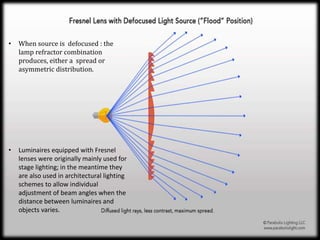
• When sourceis defocused : the
lamp refractor combination
produces, either a spread or
asymmetric distribution.
• Luminaires equipped with Fresnel
lenses were originally mainly used for
stage lighting; in the meantime they
are also used in architectural lighting
schemes to allow individual
adjustment of beam angles when the
distance between luminaires and
objects varies.
10.
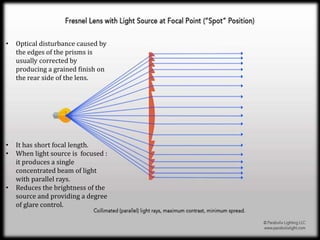
• It hasshort focal length.
• When light source is focused :
it produces a single
concentrated beam of light
with parallel rays.
• Reduces the brightness of the
source and providing a degree
of glare control.
• Optical disturbance caused by
the edges of the prisms is
usually corrected by
producing a grained finish on
the rear side of the lens.
12.
Prismatic Systems
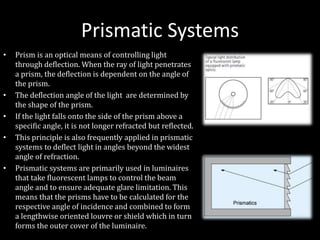
• Prismis an optical means of controlling light
through deflection. When the ray of light penetrates
a prism, the deflection is dependent on the angle of
the prism.
• The deflection angle of the light are determined by
the shape of the prism.
• If the light falls onto the side of the prism above a
specific angle, it is not longer refracted but reflected.
• This principle is also frequently applied in prismatic
systems to deflect light in angles beyond the widest
angle of refraction.
• Prismatic systems are primarily used in luminaires
that take fluorescent lamps to control the beam
angle and to ensure adequate glare limitation. This
means that the prisms have to be calculated for the
respective angle of incidence and combined to form
a lengthwise oriented louvre or shield which in turn
forms the outer cover of the luminaire.
13.
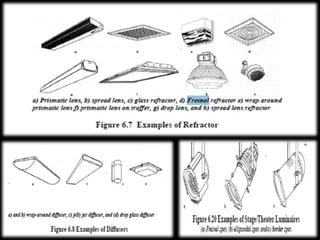
Prismatic lens
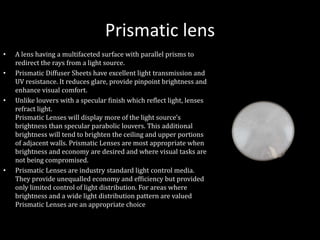
• Alens having a multifaceted surface with parallel prisms to
redirect the rays from a light source.
• Prismatic Diffuser Sheets have excellent light transmission and
UV resistance. It reduces glare, provide pinpoint brightness and
enhance visual comfort.
• Unlike louvers with a specular finish which reflect light, lenses
refract light.
Prismatic Lenses will display more of the light source's
brightness than specular parabolic louvers. This additional
brightness will tend to brighten the ceiling and upper portions
of adjacent walls. Prismatic Lenses are most appropriate when
brightness and economy are desired and where visual tasks are
not being compromised.
• Prismatic Lenses are industry standard light control media.
They provide unequalled economy and efficiency but provided
only limited control of light distribution. For areas where
brightness and a wide light distribution pattern are valued
Prismatic Lenses are an appropriate choice
14.
DIFFUSERS
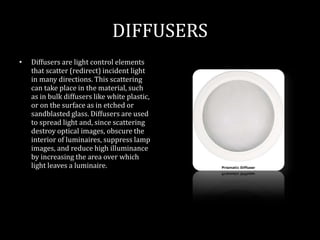
• Diffusers arelight control elements
that scatter (redirect) incident light
in many directions. This scattering
can take place in the material, such
as in bulk diffusers like white plastic,
or on the surface as in etched or
sandblasted glass. Diffusers are used
to spread light and, since scattering
destroy optical images, obscure the
interior of luminaires, suppress lamp
images, and reduce high illuminance
by increasing the area over which
light leaves a luminaire.
15.
Light Redirection: prismaticglass
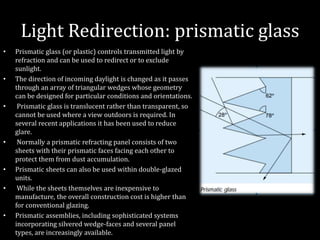
• Prismatic glass (or plastic) controls transmitted light by
refraction and can be used to redirect or to exclude
sunlight.
• The direction of incoming daylight is changed as it passes
through an array of triangular wedges whose geometry
can be designed for particular conditions and orientations.
• Prismatic glass is translucent rather than transparent, so
cannot be used where a view outdoors is required. In
several recent applications it has been used to reduce
glare.
• Normally a prismatic refracting panel consists of two
sheets with their prismatic faces facing each other to
protect them from dust accumulation.
• Prismatic sheets can also be used within double-glazed
units.
• While the sheets themselves are inexpensive to
manufacture, the overall construction cost is higher than
for conventional glazing.
• Prismatic assemblies, including sophisticated systems
incorporating silvered wedge-faces and several panel
types, are increasingly available.
16.
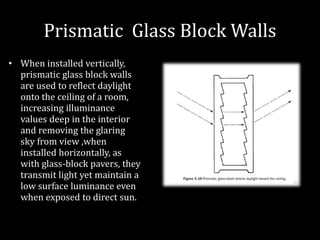
Prismatic Glass BlockWalls
• When installed vertically,
prismatic glass block walls
are used to reflect daylight
onto the ceiling of a room,
increasing illuminance
values deep in the interior
and removing the glaring
sky from view ,when
installed horizontally, as
with glass-block pavers, they
transmit light yet maintain a
low surface luminance even
when exposed to direct sun.
17.
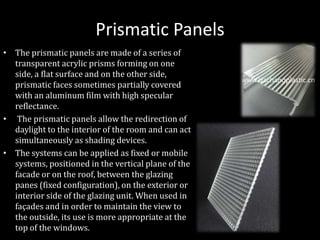
Prismatic Panels
• Theprismatic panels are made of a series of
transparent acrylic prisms forming on one
side, a flat surface and on the other side,
prismatic faces sometimes partially covered
with an aluminum film with high specular
reflectance.
• The prismatic panels allow the redirection of
daylight to the interior of the room and can act
simultaneously as shading devices.
• The systems can be applied as fixed or mobile
systems, positioned in the vertical plane of the
facade or on the roof, between the glazing
panes (fixed configuration), on the exterior or
interior side of the glazing unit. When used in
façades and in order to maintain the view to
the outside, its use is more appropriate at the
top of the windows.
18.
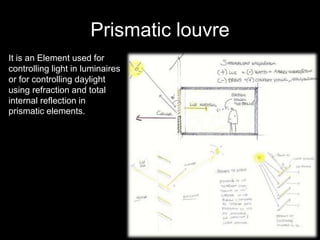
Prismatic louvre
It isan Element used for
controlling light in luminaires
or for controlling daylight
using refraction and total
internal reflection in
prismatic elements.
19.
Types Of Luminaire
Louvredluminaire
• Standard term used to describe rectangular luminaires designed
for linear fluorescent lamps (modular luminaires), frequently
equipped with specular, prismatic or antidazzle louvres.
Modular luminaires
• General term used to describe rectangular luminaires designed
to take tubular fluorescent lamps. Also louvred luminaires
frequently equipped with specular, prismatic or anti-dazzle
louvres.