TURNING TORSO
CONTENT
• INTRODUCTION
• CONCEPT
• FOUNDATION
• STRUCTURE
• CONSTRUCTION
• CORE
• SLAB
• SPINE
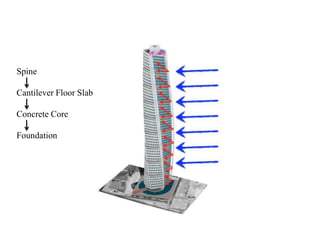
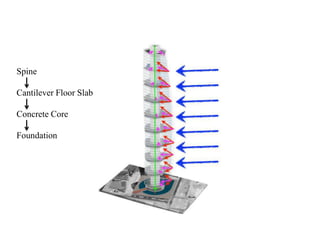
• LATERAL LOADS
• WIND LOADS
• BUILDING SERVICES
• FACADE
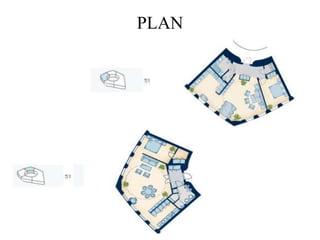
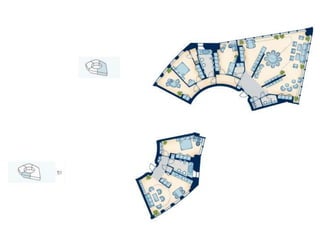
• PLAN
• COST ANALYSIS AND TIME
• CONSTRAIN OF RESOURCES
• GREEN ASPECTS
• SUSTAINABILITY
• SAFETY MEASURES
• SITE SURVEY
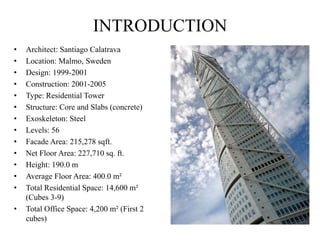
• Architect: Santiago Calatrava
• Location: Malmo, Sweden
• Design: 1999-2001
• Construction: 2001-2005
• Type: Residential Tower
• Structure: Core and Slabs (concrete)
• Exoskeleton: Steel
• Levels: 56
• Facade Area: 215,278 sqft.
• Net Floor Area: 227,710 sq. ft.
• Height: 190.0 m
• Average Floor Area: 400.0 m²
• Total Residential Space: 14,600 m²
(Cubes 3-9)
• Total Office Space: 4,200 m² (First 2
cubes)
INTRODUCTION
CONCEPT
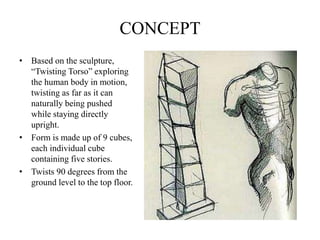
• Based on the sculpture,
“Twisting Torso” exploring
the human body in motion,
twisting as far as it can
naturally being pushed
while staying directly
upright.
• Form is made up of 9 cubes,
each individual cube
containing five stories.
• Twists 90 degrees from the
ground level to the top floor.
FOUNDATION
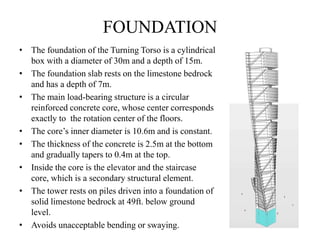
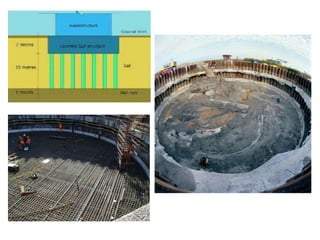
• The foundation of the Turning Torso is a cylindrical
box with a diameter of 30m and a depth of 15m.
• The foundation slab rests on the limestone bedrock
and has a depth of 7m.
• The main load-bearing structure is a circular
reinforced concrete core, whose center corresponds
exactly to the rotation center of the floors.
• The core’s inner diameter is 10.6m and is constant.
• The thickness of the concrete is 2.5m at the bottom
and gradually tapers to 0.4m at the top.
• Inside the core is the elevator and the staircase
core, which is a secondary structural element.
• The tower rests on piles driven into a foundation of
solid limestone bedrock at 49ft. below ground
level.
• Avoids unacceptable bending or swaying.
STRUCTURE
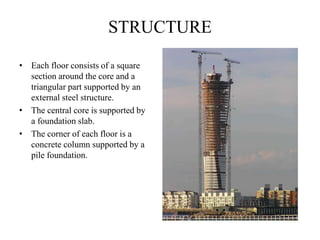
• Each floor consists of a square
section around the core and a
triangular part supported by an
external steel structure.
• The central core is supported by
a foundation slab.
• The corner of each floor is a
concrete column supported by a
pile foundation.
STRUCTURAL ELEMENT
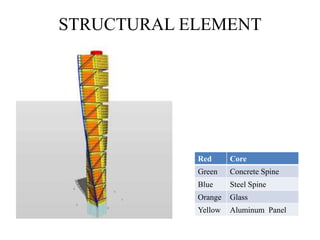
Red Core
Green Concrete Spine
Blue Steel Spine
Orange Glass
Yellow Aluminum Panel
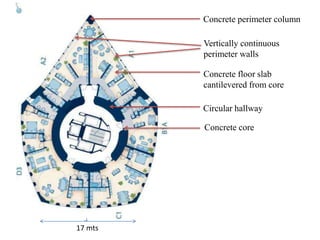
17 mts
Concrete perimeter column
Vertically continuous
perimeter walls
Concrete floor slab
cantilevered from core
Circular hallway
Concrete core
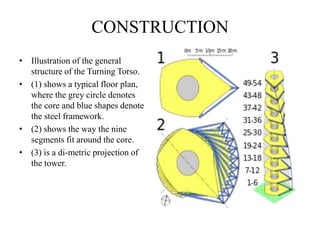
CONSTRUCTION
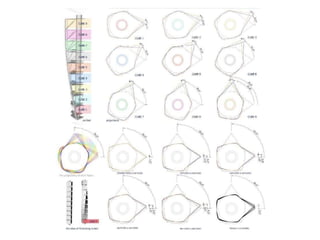
• Illustration of the general
structure of the Turning Torso.
• (1) shows a typical floor plan,
where the grey circle denotes
the core and blue shapes denote
the steel framework.
• (2) shows the way the nine
segments fit around the core.
• (3) is a di-metric projection of
the tower.
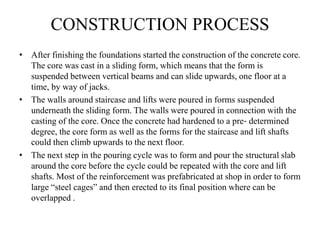
CONSTRUCTION PROCESS
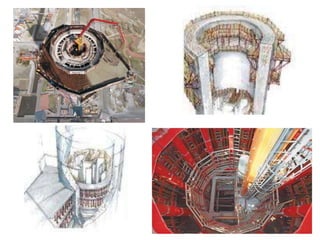
• After finishing the foundations started the construction of the concrete core.
The core was cast in a sliding form, which means that the form is
suspended between vertical beams and can slide upwards, one floor at a
time, by way of jacks.
• The walls around staircase and lifts were poured in forms suspended
underneath the sliding form. The walls were poured in connection with the
casting of the core. Once the concrete had hardened to a pre‐ determined
degree, the core form as well as the forms for the staircase and lift shafts
could then climb upwards to the next floor.
• The next step in the pouring cycle was to form and pour the structural slab
around the core before the cycle could be repeated with the core and lift
shafts. Most of the reinforcement was prefabricated at shop in order to form
large “steel cages” and then erected to its final position where can be
overlapped .
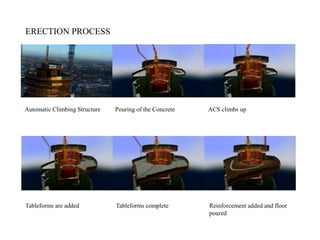
Automatic Climbing Structure Pouring of the Concrete ACS climbs up
Tableforms are added Tableforms complete Reinforcement added and floor
poured
ERECTION PROCESS
• During the pouring of each slab the temporary supports were kept at least 7
levels below.
• The core, lift shafts and structural slabs were poured with vibrated concrete
while the transversal bracing walls under each cube were made with
so‐called self‐compacting concrete. Because of its flow capacity, this type
of concrete does not need vibrating. This method was used because the
transversal walls were made after the structural slab above and below them
were finished, making it impossible to insert vibration rods down into the
concrete.
• The forms for the floors were rotated approx. 1.6 degrees for each floor in
order to create the characteristic twist of the building. The time table
dictated that a new floor tier was poured every 10th day on the average for
more than a year.
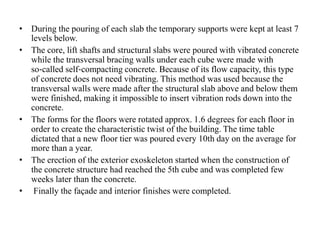
• The erection of the exterior exoskeleton started when the construction of
the concrete structure had reached the 5th cube and was completed few
weeks later than the concrete.
• Finally the façade and interior finishes were completed.
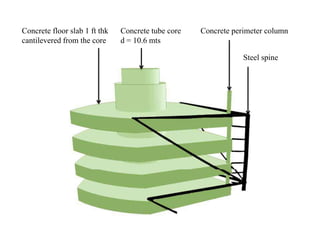
Concrete floor slab 1 ft thk
cantilevered from the core
Concrete tube core
d = 10.6 mts
Concrete perimeter column
Steel spine
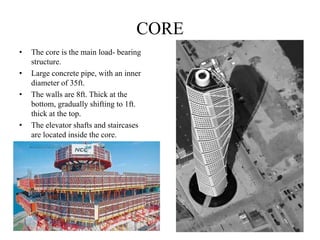
CORE
• The core is the main load- bearing
structure.
• Large concrete pipe, with an inner
diameter of 35ft.
• The walls are 8ft. Thick at the
bottom, gradually shifting to 1ft.
thick at the top.
• The elevator shafts and staircases
are located inside the core.
SLAB
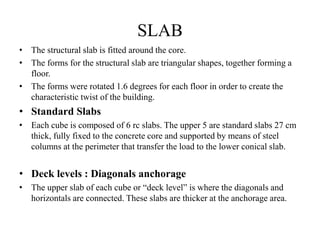
• The structural slab is fitted around the core.
• The forms for the structural slab are triangular shapes, together forming a
floor.
• The forms were rotated 1.6 degrees for each floor in order to create the
characteristic twist of the building.
• Standard Slabs
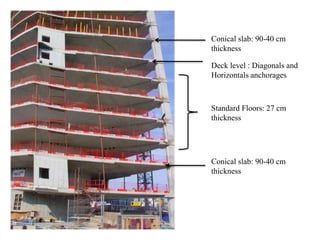
• Each cube is composed of 6 rc slabs. The upper 5 are standard slabs 27 cm
thick, fully fixed to the concrete core and supported by means of steel
columns at the perimeter that transfer the load to the lower conical slab.
• Deck levels : Diagonals anchorage
• The upper slab of each cube or “deck level” is where the diagonals and
horizontals are connected. These slabs are thicker at the anchorage area.
Conical slab: 90-40 cm
thickness
Deck level : Diagonals and
Horizontals anchorages
Standard Floors: 27 cm
thickness
Conical slab: 90-40 cm
thickness
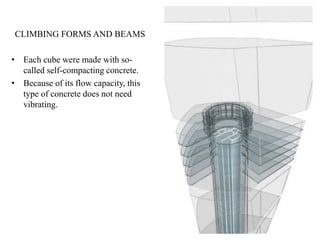
CLIMBING FORMS AND BEAMS
• Each cube were made with so-
called self-compacting concrete.
• Because of its flow capacity, this
type of concrete does not need
vibrating.
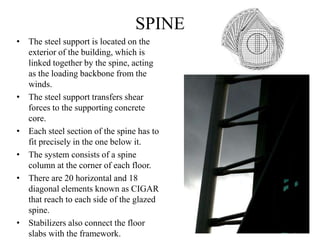
SPINE
• The steel support is located on the
exterior of the building, which is
linked together by the spine, acting
as the loading backbone from the
winds.
• The steel support transfers shear
forces to the supporting concrete
core.
• Each steel section of the spine has to
fit precisely in the one below it.
• The system consists of a spine
column at the corner of each floor.
• There are 20 horizontal and 18
diagonal elements known as CIGAR
that reach to each side of the glazed
spine.
• Stabilizers also connect the floor
slabs with the framework.
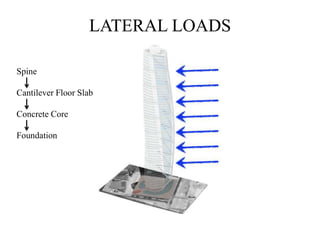
LATERAL LOADS
Spine
Cantilever Floor Slab
Concrete Core
Foundation
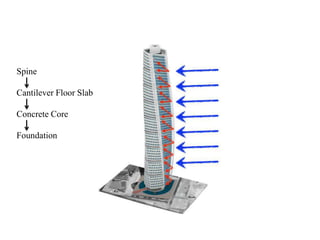
Spine
Cantilever Floor Slab
Concrete Core
Foundation
Spine
Cantilever Floor Slab
Concrete Core
Foundation
Spine
Cantilever Floor Slab
Concrete Core
Foundation
WIND LOADS
• The twisted form can be very
effective, alleviating the effects of
vortex-shedding induced by lateral
wind loads and minimizing the wind
loads from prevailing direction.
• When analyzing the structure under
wind loads, Calatrava found that the
Turning Torso could move up to 3ft.
at the top during the most severe
storm .
• Giant pins attached to the ground
were then implemented, decreasing
the movement to less than a foot
during the most severe storm, which
is nearly unnoticeable.
BUILDING SERVICES
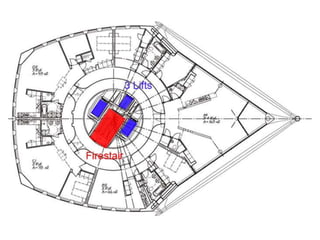
• The Turning Torso’s elevators, fire stairs and utilities are located in the
concrete core that runs vertically throughout the length of the building.
“There are three high-speed lifts in the core of the building servicing the
apartments. The commercial area has two separate lifts, also located in the
core.”
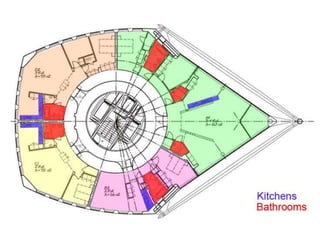
• The Turning Torso’s residential services are distributed threw out 4
dwellings on each of the 35 identical residential floor plates, which
duplicate and rotate around the core.
LIFTS
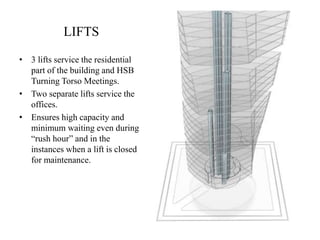
• 3 lifts service the residential
part of the building and HSB
Turning Torso Meetings.
• Two separate lifts service the
offices.
• Ensures high capacity and
minimum waiting even during
“rush hour” and in the
instances when a lift is closed
for maintenance.
FACADE
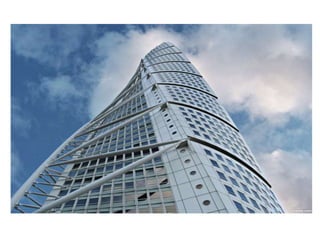
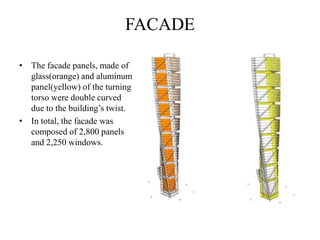
• The facade panels, made of
glass(orange) and aluminum
panel(yellow) of the turning
torso were double curved
due to the building’s twist.
• In total, the facade was
composed of 2,800 panels
and 2,250 windows.
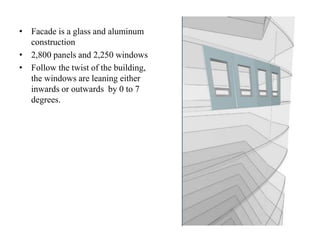
• Facade is a glass and aluminum
construction
• 2,800 panels and 2,250 windows
• Follow the twist of the building,
the windows are leaning either
inwards or outwards by 0 to 7
degrees.
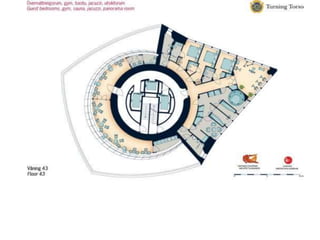
PLAN
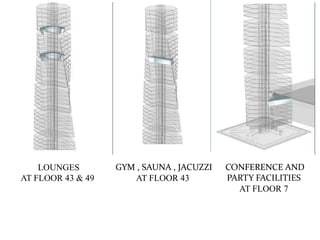
LOUNGES
AT FLOOR 43 & 49
GYM , SAUNA , JACUZZI
AT FLOOR 43
CONFERENCE AND
PARTY FACILITIES
AT FLOOR 7
COST ANALYSIS
Cost in real life
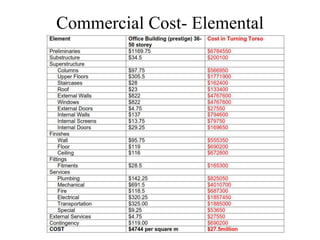
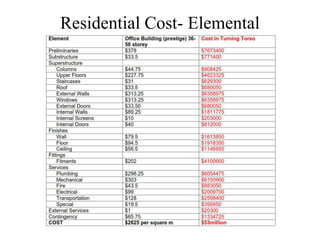
• The total cost of Turning Torso was 1600 million SEK.
• 1 SEK (Sweden Kronor) = 5.58760 AUD (Australian)
• 1600000000 x 5.58760 = $286348275.33; 286.5 million.
Cost in theory (Residential + Offices)
• 53million + 27.5million = 80.5 million.
Difference between ‘cost in theory’ + ‘cost in real life’.
• The cost for in real life was 286.5 million and in theory should have been
80.5 million. Clearly there were blowouts in the cost of construction.
Commercial Cost- Elemental
Residential Cost- Elemental
CONSTRAIN OF RESOURCES
• Architect Santiago Calatrava calculated the wrong amount of reinforcing
iron to use. Instead of 1850 tons of reinforcing iron, they now calculate
with using 4400 tons of reinforcing iron.
• This means a huge cost increase and an increased construction time (one
year extra).
• The outside steel frame has also had its cost increase. It has became 30
million SEK more expensive, due to the need to build a stronger and more
complicated frame than anticipated.
• The ongoing strike among the electricians makes the construction of
Turning Torso 10 million SEK more expensive every week.
TIME - KEY DATES
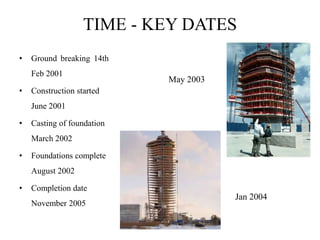
• Ground breaking 14th
Feb 2001
• Construction started
June 2001
• Casting of foundation
March 2002
• Foundations complete
August 2002
• Completion date
November 2005
May 2003
Jan 2004
GREEN ASPECTS
• There will be waste mills in every apartment.
• Other kind of waste can be sorted close to Turning Torso.
• Waste from the construction site had already sorted.
• Consumed electricity and heat will be measured individually for each
apartment.
• During the construction, they try to use environmental-friendly materials.
For instance, they avoid use of copper for tap water pipes.
• All inhabitants will be offered an environmental education especially
designed for Turning Torso.
SUSTAINABILITY
Energy Efficiency
• Electricity is supplied with 100% locally produced renewable energy
through the energy concept developed by sydkraft.
• Heat is supplied by solar cells and underground water reservoirs, aquifers.
• All installations are energy efficient.
• Rain water harvesting.
Waste management
• Kitchen waste disposal unit in every apartment for grinding organic waste.
• Waste transported through separate pipes for decomposition and biogas
production at Malmo's waste incinerator and heat plant.
• Recycling is done in building itself.
• None recyclable waste collected in a garbage chute at the basement level.
• The tower is made from concrete, steel, glass and recyclable
aluminum.
• In order to follow the building’s twisting structure, which was
inspired by a human body in movement, the glass facade
features complex double-curved shape.
• Each apartment monitors heat and water consumption,
allowing inhabitants to plan their energy and living costs.
• The flat’s kitchens have organic waste grinding and disposal
facilities that convert food waste into biogas energy.
• Thus building also features a high degree of energy and water
efficiency.
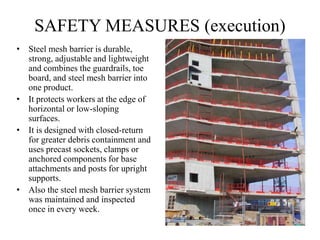
SAFETY MEASURES (execution)
• Steel mesh barrier is durable,
strong, adjustable and lightweight
and combines the guardrails, toe
board, and steel mesh barrier into
one product.
• It protects workers at the edge of
horizontal or low-sloping
surfaces.
• It is designed with closed-return
for greater debris containment and
uses precast sockets, clamps or
anchored components for base
attachments and posts for upright
supports.
• Also the steel mesh barrier system
was maintained and inspected
once in every week.
SAFETY MEASURES
• Sprinklers in all room
• Pressure increasing pumps
• Rising pipes
• Emergency elevator
• Fire gas ventilation
• Door shutters
• Fire alarm
• Smoke detectors
• Emergency electricity
• Emergency light
• Every floor and apartment is its own fire cell
SITE SURVEY
SITE CONTEXT
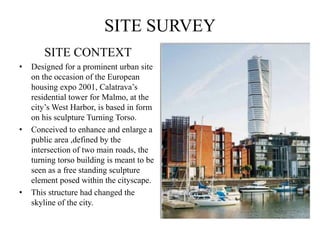
• Designed for a prominent urban site
on the occasion of the European
housing expo 2001, Calatrava’s
residential tower for Malmo, at the
city’s West Harbor, is based in form
on his sculpture Turning Torso.
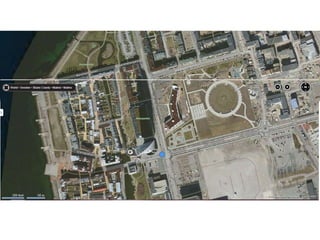
• Conceived to enhance and enlarge a
public area ,defined by the
intersection of two main roads, the
turning torso building is meant to be
seen as a free standing sculpture
element posed within the cityscape.
• This structure had changed the
skyline of the city.
• Plate load test
• Vane shear test
• California bearing ratio test
• Dry density/ moisture relationship
• SPT
• Lightweight dynamic
penetrometers
• Cone penetration tests
• Methane/ oxygen/ barometric
pressure test
ON-SITE TEST LAB TEST
• Tri-axial compression tests
• Liquid and plastic limit tests
• Sieve analysis- particle size and
distribution
• Moisture content
• pH value tests

Turning torso

  • 1.
  • 2.
    CONTENT • INTRODUCTION • CONCEPT •FOUNDATION • STRUCTURE • CONSTRUCTION • CORE • SLAB • SPINE • LATERAL LOADS • WIND LOADS • BUILDING SERVICES • FACADE • PLAN • COST ANALYSIS AND TIME • CONSTRAIN OF RESOURCES • GREEN ASPECTS • SUSTAINABILITY • SAFETY MEASURES • SITE SURVEY
  • 3.
    • Architect: SantiagoCalatrava • Location: Malmo, Sweden • Design: 1999-2001 • Construction: 2001-2005 • Type: Residential Tower • Structure: Core and Slabs (concrete) • Exoskeleton: Steel • Levels: 56 • Facade Area: 215,278 sqft. • Net Floor Area: 227,710 sq. ft. • Height: 190.0 m • Average Floor Area: 400.0 m² • Total Residential Space: 14,600 m² (Cubes 3-9) • Total Office Space: 4,200 m² (First 2 cubes) INTRODUCTION
  • 4.
    CONCEPT • Based onthe sculpture, “Twisting Torso” exploring the human body in motion, twisting as far as it can naturally being pushed while staying directly upright. • Form is made up of 9 cubes, each individual cube containing five stories. • Twists 90 degrees from the ground level to the top floor.
  • 6.
    FOUNDATION • The foundationof the Turning Torso is a cylindrical box with a diameter of 30m and a depth of 15m. • The foundation slab rests on the limestone bedrock and has a depth of 7m. • The main load-bearing structure is a circular reinforced concrete core, whose center corresponds exactly to the rotation center of the floors. • The core’s inner diameter is 10.6m and is constant. • The thickness of the concrete is 2.5m at the bottom and gradually tapers to 0.4m at the top. • Inside the core is the elevator and the staircase core, which is a secondary structural element. • The tower rests on piles driven into a foundation of solid limestone bedrock at 49ft. below ground level. • Avoids unacceptable bending or swaying.
  • 8.
    STRUCTURE • Each floorconsists of a square section around the core and a triangular part supported by an external steel structure. • The central core is supported by a foundation slab. • The corner of each floor is a concrete column supported by a pile foundation.
  • 9.
    STRUCTURAL ELEMENT Red Core GreenConcrete Spine Blue Steel Spine Orange Glass Yellow Aluminum Panel
  • 10.
    17 mts Concrete perimetercolumn Vertically continuous perimeter walls Concrete floor slab cantilevered from core Circular hallway Concrete core
  • 11.
    CONSTRUCTION • Illustration ofthe general structure of the Turning Torso. • (1) shows a typical floor plan, where the grey circle denotes the core and blue shapes denote the steel framework. • (2) shows the way the nine segments fit around the core. • (3) is a di-metric projection of the tower.
  • 12.
    CONSTRUCTION PROCESS • Afterfinishing the foundations started the construction of the concrete core. The core was cast in a sliding form, which means that the form is suspended between vertical beams and can slide upwards, one floor at a time, by way of jacks. • The walls around staircase and lifts were poured in forms suspended underneath the sliding form. The walls were poured in connection with the casting of the core. Once the concrete had hardened to a pre‐ determined degree, the core form as well as the forms for the staircase and lift shafts could then climb upwards to the next floor. • The next step in the pouring cycle was to form and pour the structural slab around the core before the cycle could be repeated with the core and lift shafts. Most of the reinforcement was prefabricated at shop in order to form large “steel cages” and then erected to its final position where can be overlapped .
  • 13.
    Automatic Climbing StructurePouring of the Concrete ACS climbs up Tableforms are added Tableforms complete Reinforcement added and floor poured ERECTION PROCESS
  • 15.
    • During thepouring of each slab the temporary supports were kept at least 7 levels below. • The core, lift shafts and structural slabs were poured with vibrated concrete while the transversal bracing walls under each cube were made with so‐called self‐compacting concrete. Because of its flow capacity, this type of concrete does not need vibrating. This method was used because the transversal walls were made after the structural slab above and below them were finished, making it impossible to insert vibration rods down into the concrete. • The forms for the floors were rotated approx. 1.6 degrees for each floor in order to create the characteristic twist of the building. The time table dictated that a new floor tier was poured every 10th day on the average for more than a year. • The erection of the exterior exoskeleton started when the construction of the concrete structure had reached the 5th cube and was completed few weeks later than the concrete. • Finally the façade and interior finishes were completed.
  • 16.
    Concrete floor slab1 ft thk cantilevered from the core Concrete tube core d = 10.6 mts Concrete perimeter column Steel spine
  • 17.
    CORE • The coreis the main load- bearing structure. • Large concrete pipe, with an inner diameter of 35ft. • The walls are 8ft. Thick at the bottom, gradually shifting to 1ft. thick at the top. • The elevator shafts and staircases are located inside the core.
  • 19.
    SLAB • The structuralslab is fitted around the core. • The forms for the structural slab are triangular shapes, together forming a floor. • The forms were rotated 1.6 degrees for each floor in order to create the characteristic twist of the building. • Standard Slabs • Each cube is composed of 6 rc slabs. The upper 5 are standard slabs 27 cm thick, fully fixed to the concrete core and supported by means of steel columns at the perimeter that transfer the load to the lower conical slab. • Deck levels : Diagonals anchorage • The upper slab of each cube or “deck level” is where the diagonals and horizontals are connected. These slabs are thicker at the anchorage area.
  • 20.
    Conical slab: 90-40cm thickness Deck level : Diagonals and Horizontals anchorages Standard Floors: 27 cm thickness Conical slab: 90-40 cm thickness
  • 21.
    CLIMBING FORMS ANDBEAMS • Each cube were made with so- called self-compacting concrete. • Because of its flow capacity, this type of concrete does not need vibrating.
  • 22.
    SPINE • The steelsupport is located on the exterior of the building, which is linked together by the spine, acting as the loading backbone from the winds. • The steel support transfers shear forces to the supporting concrete core. • Each steel section of the spine has to fit precisely in the one below it. • The system consists of a spine column at the corner of each floor. • There are 20 horizontal and 18 diagonal elements known as CIGAR that reach to each side of the glazed spine. • Stabilizers also connect the floor slabs with the framework.
  • 24.
    LATERAL LOADS Spine Cantilever FloorSlab Concrete Core Foundation
  • 25.
  • 26.
  • 27.
  • 28.
    WIND LOADS • Thetwisted form can be very effective, alleviating the effects of vortex-shedding induced by lateral wind loads and minimizing the wind loads from prevailing direction. • When analyzing the structure under wind loads, Calatrava found that the Turning Torso could move up to 3ft. at the top during the most severe storm . • Giant pins attached to the ground were then implemented, decreasing the movement to less than a foot during the most severe storm, which is nearly unnoticeable.
  • 30.
    BUILDING SERVICES • TheTurning Torso’s elevators, fire stairs and utilities are located in the concrete core that runs vertically throughout the length of the building. “There are three high-speed lifts in the core of the building servicing the apartments. The commercial area has two separate lifts, also located in the core.” • The Turning Torso’s residential services are distributed threw out 4 dwellings on each of the 35 identical residential floor plates, which duplicate and rotate around the core.
  • 33.
    LIFTS • 3 liftsservice the residential part of the building and HSB Turning Torso Meetings. • Two separate lifts service the offices. • Ensures high capacity and minimum waiting even during “rush hour” and in the instances when a lift is closed for maintenance.
  • 34.
    FACADE • The facadepanels, made of glass(orange) and aluminum panel(yellow) of the turning torso were double curved due to the building’s twist. • In total, the facade was composed of 2,800 panels and 2,250 windows.
  • 35.
    • Facade isa glass and aluminum construction • 2,800 panels and 2,250 windows • Follow the twist of the building, the windows are leaning either inwards or outwards by 0 to 7 degrees.
  • 36.
  • 39.
    LOUNGES AT FLOOR 43& 49 GYM , SAUNA , JACUZZI AT FLOOR 43 CONFERENCE AND PARTY FACILITIES AT FLOOR 7
  • 40.
    COST ANALYSIS Cost inreal life • The total cost of Turning Torso was 1600 million SEK. • 1 SEK (Sweden Kronor) = 5.58760 AUD (Australian) • 1600000000 x 5.58760 = $286348275.33; 286.5 million. Cost in theory (Residential + Offices) • 53million + 27.5million = 80.5 million. Difference between ‘cost in theory’ + ‘cost in real life’. • The cost for in real life was 286.5 million and in theory should have been 80.5 million. Clearly there were blowouts in the cost of construction.
  • 41.
  • 42.
  • 43.
    CONSTRAIN OF RESOURCES •Architect Santiago Calatrava calculated the wrong amount of reinforcing iron to use. Instead of 1850 tons of reinforcing iron, they now calculate with using 4400 tons of reinforcing iron. • This means a huge cost increase and an increased construction time (one year extra). • The outside steel frame has also had its cost increase. It has became 30 million SEK more expensive, due to the need to build a stronger and more complicated frame than anticipated. • The ongoing strike among the electricians makes the construction of Turning Torso 10 million SEK more expensive every week.
  • 44.
    TIME - KEYDATES • Ground breaking 14th Feb 2001 • Construction started June 2001 • Casting of foundation March 2002 • Foundations complete August 2002 • Completion date November 2005 May 2003 Jan 2004
  • 45.
    GREEN ASPECTS • Therewill be waste mills in every apartment. • Other kind of waste can be sorted close to Turning Torso. • Waste from the construction site had already sorted. • Consumed electricity and heat will be measured individually for each apartment. • During the construction, they try to use environmental-friendly materials. For instance, they avoid use of copper for tap water pipes. • All inhabitants will be offered an environmental education especially designed for Turning Torso.
  • 46.
    SUSTAINABILITY Energy Efficiency • Electricityis supplied with 100% locally produced renewable energy through the energy concept developed by sydkraft. • Heat is supplied by solar cells and underground water reservoirs, aquifers. • All installations are energy efficient. • Rain water harvesting. Waste management • Kitchen waste disposal unit in every apartment for grinding organic waste. • Waste transported through separate pipes for decomposition and biogas production at Malmo's waste incinerator and heat plant. • Recycling is done in building itself. • None recyclable waste collected in a garbage chute at the basement level.
  • 47.
    • The toweris made from concrete, steel, glass and recyclable aluminum. • In order to follow the building’s twisting structure, which was inspired by a human body in movement, the glass facade features complex double-curved shape. • Each apartment monitors heat and water consumption, allowing inhabitants to plan their energy and living costs. • The flat’s kitchens have organic waste grinding and disposal facilities that convert food waste into biogas energy. • Thus building also features a high degree of energy and water efficiency.
  • 48.
    SAFETY MEASURES (execution) •Steel mesh barrier is durable, strong, adjustable and lightweight and combines the guardrails, toe board, and steel mesh barrier into one product. • It protects workers at the edge of horizontal or low-sloping surfaces. • It is designed with closed-return for greater debris containment and uses precast sockets, clamps or anchored components for base attachments and posts for upright supports. • Also the steel mesh barrier system was maintained and inspected once in every week.
  • 49.
    SAFETY MEASURES • Sprinklersin all room • Pressure increasing pumps • Rising pipes • Emergency elevator • Fire gas ventilation • Door shutters • Fire alarm • Smoke detectors • Emergency electricity • Emergency light • Every floor and apartment is its own fire cell
  • 50.
    SITE SURVEY SITE CONTEXT •Designed for a prominent urban site on the occasion of the European housing expo 2001, Calatrava’s residential tower for Malmo, at the city’s West Harbor, is based in form on his sculpture Turning Torso. • Conceived to enhance and enlarge a public area ,defined by the intersection of two main roads, the turning torso building is meant to be seen as a free standing sculpture element posed within the cityscape. • This structure had changed the skyline of the city.
  • 52.
    • Plate loadtest • Vane shear test • California bearing ratio test • Dry density/ moisture relationship • SPT • Lightweight dynamic penetrometers • Cone penetration tests • Methane/ oxygen/ barometric pressure test ON-SITE TEST LAB TEST • Tri-axial compression tests • Liquid and plastic limit tests • Sieve analysis- particle size and distribution • Moisture content • pH value tests