1
BMS SCHOOL OF ARCHITECTURE
TITLE:
HIGH RISE BUILDINGS
AUTHORS:
SWATHI PRABHU
SHREELEKHA KULKARNI
SINDHU K
NAVYASHREE K
K N VANDANA
2
BMS SCHOOL OF ARCHITECTURE
ABSTRACT
This paper explores six famous High rise buildings, in which three of the building are from India
and three international buildings. Giving a brief understanding of history and structure of the
building.
The national buildings that have been explored in this are Hawa Mahal, Kanchenjunga
apartments and World one, Mumbai.
Likewise, the international buildings we have dwelled on are Empire state building, Sullivan
center and Eureka Towers.
KEYWORDS: Sustainability,high rise, development, services, façade, sewage, acoustics, load
transfer , high rise, structural systems construction methodology.
What is a high rise building?
A building is an enclosed structure that has walls, floors, a roof, and usually windows. “ A tall
building is a multi-story structure in which most occupants depend on elevators [lifts] to reach
their destinations. The most prominent tall buildings are called ‘high-rise buildings ’in most
countries and ‘tower blocks ’in Britain and some European countries.
(Or)
A high-rise building is a tall building, as opposed to a low-rise building and is defined by its
height differently in various jurisdictions. It is used as a residential, office building or other
functions including hotel, retail or with multiple purposes combined. A residential high-rise
building is also called tower block and may be referred to as an "MDU", standing for "Multi
Dwelling Unit”. A very tall high-rise building is referred to as a skyscraper.
3
BMS SCHOOL OF ARCHITECTURE
INTRODUCTION
The reasons for evolution of high rise buildings comprise of density problems, scarcity
of land both on a national and international scale with inclination towards architectural
features, structural details along with information on services. Historically, tall buildings
were more about a symbol of power and to represent prestige status and also for efficient
aesthetic development. High rise buildings are a phenomenon of high intensity
development with technical and structural sophistication.
The following features constitute the paradigms of the chosen high rise buildings which
help in providing a better understanding of the structures. Namely,
 Architectural features which include historical information, conceptual growth,
and façade perception.
 Structural details which include material specifications transfer of loads.
HIGH RISE BUILDINGS
4
BMS SCHOOL OF ARCHITECTURE
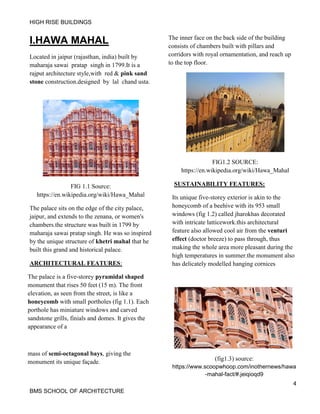
I.HAWA MAHAL
Located in jaipur (rajasthan, india) built by
maharaja sawai pratap singh in 1799.It is a
rajput architecture style,with red & pink sand
stone construction.designed by lal chand usta.
FIG 1.1 Source:
https://en.wikipedia.org/wiki/Hawa_Mahal
The palace sits on the edge of the city palace,
jaipur, and extends to the zenana, or women's
chambers.the structure was built in 1799 by
maharaja sawai pratap singh. He was so inspired
by the unique structure of khetri mahal that he
built this grand and historical palace.
ARCHITECTURAL FEATURES:
The palace is a five-storey pyramidal shaped
monument that rises 50 feet (15 m). The front
elevation, as seen from the street, is like a
honeycomb with small portholes (fig 1.1). Each
porthole has miniature windows and carved
sandstone grills, finials and domes. It gives the
appearance of a
mass of semi-octagonal bays, giving the
monument its unique façade.
The inner face on the back side of the building
consists of chambers built with pillars and
corridors with royal ornamentation, and reach up
to the top floor.
FIG1.2 SOURCE:
https://en.wikipedia.org/wiki/Hawa_Mahal
SUSTAINABILITY FEATURES:
Its unique five-storey exterior is akin to the
honeycomb of a beehive with its 953 small
windows (fig 1.2) called jharokhas decorated
with intricate latticework.this architectural
feature also allowed cool air from the venturi
effect (doctor breeze) to pass through, thus
making the whole area more pleasant during the
high temperatures in summer.the monument also
has delicately modelled hanging cornices
(fig1.3) source:
https://www.scoopwhoop.com/inothernews/hawa
-mahal-fact/#.jeiqioqd9
HIGH RISE BUILDINGS
5
BMS SCHOOL OF ARCHITECTURE
STRUCTURAL FEATURES:
The structure is of rock supported by pillars.
the use of lattice work reduces the dead load on
the structure.the ramps from the inside give access
to the top floor balconies that also act as
buttresses.
The structure is slightly curved and stands at an
angle of 87 degrees.(fig 1.4)
It is considered to be one of the marvelous
structure as it is known to be standing without a
foundation.
FIG 1.4 source :
https://www.scoopwhoop.com/inothernews/hawa-
mahal-fact/#.jeiqioqd9
The detail carving of the lattice work was done
by skilled craftsmans and the whole
construction was handmade including
quarring of stones and placing them on site.
There was no modern day services applied such
as electrical, sewage and fire safety systems.
This structure kept the building behind it cool
by acting as a filter panel.
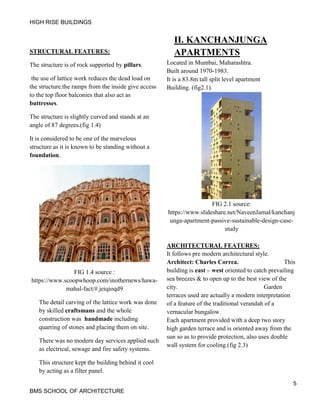
II. KANCHANJUNGA
APARTMENTS
Located in Mumbai, Maharashtra.
Built around 1970-1983.
It is a 83.8m tall split level apartment
Building. (fig2.1).
FIG 2.1 source:
https://www.slideshare.net/NaveenJamal/kanchanj
unga-apartment-passive-sustainable-design-case-
study
ARCHITECTURAL FEATURES:
It follows pre modern architectural style.
Architect: Charles Correa. This
building is east – west oriented to catch prevailing
sea breezes & to open up to the best view of the
city. Garden
terraces used are actually a modern interpretation
of a feature of the traditional verandah of a
vernacular bungalow.
Each apartment provided with a deep two story
high garden terrace and is oriented away from the
sun so as to provide protection, also uses double
wall system for cooling.(fig 2.3)
HIGH RISE BUILDINGS
6
BMS SCHOOL OF ARCHITECTURE
STRUCTURAL FEATURES:
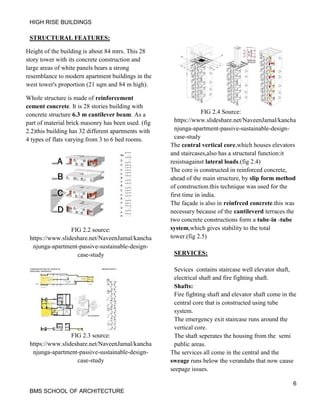
Height of the building is about 84 mtrs. This 28
story tower with its concrete construction and
large areas of white panels bears a strong
resemblance to modern apartment buildings in the
west tower's proportion (21 sqm and 84 m high).
Whole structure is made of reinforcement
cement concrete. It is 28 stories building with
concrete structure 6.3 m cantilever beam. As a
part of material brick masonry has been used. (fig
2.2)this building has 32 different apartments with
4 types of flats varying from 3 to 6 bed rooms.
FIG 2.2 source:
https://www.slideshare.net/NaveenJamal/kancha
njunga-apartment-passive-sustainable-design-
case-study
FIG 2.3 source:
https://www.slideshare.net/NaveenJamal/kancha
njunga-apartment-passive-sustainable-design-
case-study
FIG 2.4 Source:
https://www.slideshare.net/NaveenJamal/kancha
njunga-apartment-passive-sustainable-design-
case-study
The central vertical core,which houses elevators
and staircases,also has a structural function:it
resistsagainst lateral loads.(fig 2.4)
The core is constructed in reinforced concrete,
ahead of the main structure, by slip form method
of construction.this technique was used for the
first time in india.
The façade is also in reinfrced concrete.this was
necessary because of the cantileverd terraces.the
two concrete constructions form a tube-in -tube
system,which gives stability to the total
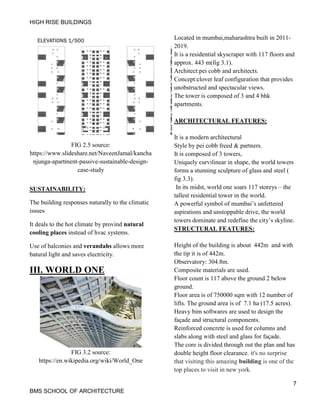
tower.(fig 2.5)
SERVICES:
Sevices contains staircase well elevator shaft,
electrical shaft and fire fighting shaft.
Shafts:
Fire fighting shaft and elevator shaft come in the
central core that is constructed using tube
system.
The emergency exit staircase runs around the
vertical core.
The shaft seperates the housing from the semi
public areas.
The services all come in the central and the
sweage runs below the verandahs that now cause
seepage issues.
HIGH RISE BUILDINGS
7
BMS SCHOOL OF ARCHITECTURE
FIG 2.5 source:
https://www.slideshare.net/NaveenJamal/kancha
njunga-apartment-passive-sustainable-design-
case-study
SUSTAINABILITY:
The building responses naturally to the climatic
issues
It deals to the hot climate by provind natural
cooling places instead of hvac systems.
Use of balconies and verandahs allows more
batural light and saves electricity.
III. WORLD ONE
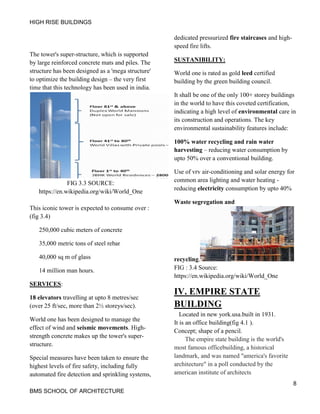
FIG 3.2 source:
https://en.wikipedia.org/wiki/World_One
Located in mumbai,maharashtra built in 2011-
2019.
It is a residential skyscraper with 117 floors and
approx. 443 m(fig 3.1).
Architect:pei cobb and architects.
Concept:clover leaf configuration that provides
unobstructed and spectacular views.
The tower is composed of 3 and 4 bhk
apartments.
ARCHITECTURAL FEATURES:
It is a modern architectural
Style by pei cobb freed & partners.
It is composed of 3 towers,
Uniquely curvilinear in shape, the world towers
forms a stunning sculpture of glass and steel (
fig 3.3).
In its midst, world one soars 117 storeys – the
tallest residential tower in the world.
A powerful symbol of mumbai’s unfettered
aspirations and unstoppable drive, the world
towers dominate and redefine the city’s skyline.
STRUCTURAL FEATURES:
Height of the building is about 442m and with
the tip it is of 442m.
Observatory: 304.8m.
Composite materials are used.
Floor count is 117 above the ground 2 below
ground.
Floor area is of 750000 sqm with 12 number of
lifts. The ground area is of 7.1 ha (17.5 acres).
Heavy bim softwares are used to design the
façade and structural components.
Reinforced concrete is used for columns and
slabs along with steel and glass for façade.
The core is divided through out the plan and has
double height floor clearance. it's no surprise
that visiting this amazing building is one of the
top places to visit in new york.
HIGH RISE BUILDINGS
8
BMS SCHOOL OF ARCHITECTURE
The tower's super-structure, which is supported
by large reinforced concrete mats and piles. The
structure has been designed as a 'mega structure'
to optimize the building design – the very first
time that this technology has been used in india.
FIG 3.3 SOURCE:
https://en.wikipedia.org/wiki/World_One
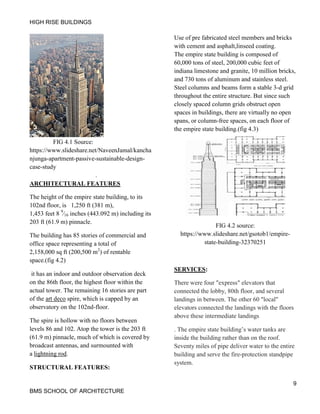
This iconic tower is expected to consume over :
(fig 3.4)
250,000 cubic meters of concrete
35,000 metric tons of steel rebar
40,000 sq m of glass
14 million man hours.
SERVICES:
18 elevators travelling at upto 8 metres/sec
(over 25 ft/sec, more than 2½ storeys/sec).
World one has been designed to manage the
effect of wind and seismic movements. High-
strength concrete makes up the tower's super-
structure.
Special measures have been taken to ensure the
highest levels of fire safety, including fully
automated fire detection and sprinkling systems,
dedicated pressurized fire staircases and high-
speed fire lifts.
SUSTANIBILITY:
World one is rated as gold leed certified
building by the green building council.
It shall be one of the only 100+ storey buildings
in the world to have this coveted certification,
indicating a high level of environmental care in
its construction and operations. The key
environmental sustainability features include:
100% water recycling and rain water
harvesting – reducing water consumption by
upto 50% over a conventional building.
Use of vrv air-conditioning and solar energy for
common area lighting and water heating -
reducing electricity consumption by upto 40%
Waste segregation and
recycling.
FIG : 3.4 Source:
https://en.wikipedia.org/wiki/World_One
IV. EMPIRE STATE
BUILDING
Located in new york.usa.built in 1931.
It is an office building(fig 4.1 ).
Concept; shape of a pencil.
The empire state building is the world's
most famous officebuilding, a historical
landmark, and was named "america's favorite
architecture" in a poll conducted by the
american institute of architects
HIGH RISE BUILDINGS
9
BMS SCHOOL OF ARCHITECTURE
FIG 4.1 Source:
https://www.slideshare.net/NaveenJamal/kancha
njunga-apartment-passive-sustainable-design-
case-study
.
ARCHITECTURAL FEATURES
The height of the empire state building, to its
102nd floor, is 1,250 ft (381 m),
1,453 feet 8 9
16 inches (443.092 m) including its
203 ft (61.9 m) pinnacle.
The building has 85 stories of commercial and
office space representing a total of
2,158,000 sq ft (200,500 m2
) of rentable
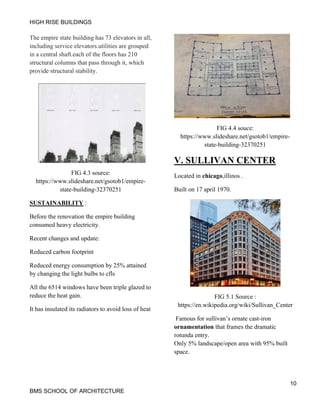
space.(fig 4.2)
it has an indoor and outdoor observation deck
on the 86th floor, the highest floor within the
actual tower. The remaining 16 stories are part
of the art deco spire, which is capped by an
observatory on the 102nd-floor.
The spire is hollow with no floors between
levels 86 and 102. Atop the tower is the 203 ft
(61.9 m) pinnacle, much of which is covered by
broadcast antennas, and surmounted with
a lightning rod.
STRUCTURAL FEATURES:
Use of pre fabricated steel members and bricks
with cement and asphalt,linseed coating.
The empire state building is composed of
60,000 tons of steel, 200,000 cubic feet of
indiana limestone and granite, 10 million bricks,
and 730 tons of aluminum and stainless steel.
Steel columns and beams form a stable 3-d grid
throughout the entire structure. But since such
closely spaced column grids obstruct open
spaces in buildings, there are virtually no open
spans, or column-free spaces, on each floor of
the empire state building.(fig 4.3)
FIG 4.2 source:
https://www.slideshare.net/gsotob1/empire-
state-building-32370251
SERVICES:
There were four "express" elevators that
connected the lobby, 80th floor, and several
landings in between. The other 60 "local"
elevators connected the landings with the floors
above these intermediate landings
. The empire state building’s water tanks are
inside the building rather than on the roof.
Seventy miles of pipe deliver water to the entire
building and serve the fire-protection standpipe
system.
HIGH RISE BUILDINGS
10
BMS SCHOOL OF ARCHITECTURE
The empire state building has 73 elevators in all,
including service elevators.utilities are grouped
in a central shaft.each of the floors has 210
structural columns that pass through it, which
provide structural stability.
FIG 4.3 source:
https://www.slideshare.net/gsotob1/empire-
state-building-32370251
SUSTAINABILITY :
Before the renovation the empire building
consumed heavy electricity.
Recent changes and update:
Reduced carbon footprint
Reduced energy consumption by 25% attained
by changing the light bulbs to cfls
All the 6514 windows have been triple glazed to
reduce the heat gain.
It has insulated its radiators to avoid loss of heat
FIG 4.4 souce:
https://www.slideshare.net/gsotob1/empire-
state-building-32370251
V. SULLIVAN CENTER
Located in chicago,illinos .
Built on 17 april 1970.
FIG 5.1 Source :
https://en.wikipedia.org/wiki/Sullivan_Center
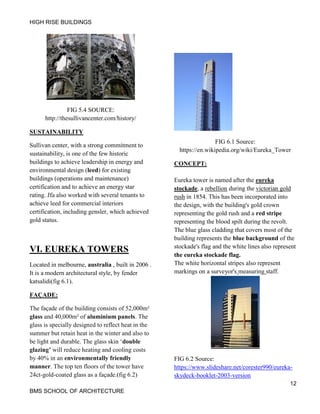
Famous for sullivan’s ornate cast-iron
ornamentation that frames the dramatic
rotunda entry.
Only 5% landscape/open area with 95% built
space.
HIGH RISE BUILDINGS
11
BMS SCHOOL OF ARCHITECTURE
ARCHITECTURAL FEATURES:
It is a pre modern architectural style,
By louis sullivan, daniel burnham.
The sullivan center was initially developed
because of the chicago great fire of 1871. In
1872.
The design allows great amount of daylight
inside the building (fig 5.1)
This building was also the result of invention of
steam elevators.
Windows were lavish bands of terra cotta that
replaced the earlier plan for white georgia
quarries because it was lightweight and
inexpensive.
The facades were added to match the bottom
stories of the building and the building was
painted white.
STRUCTURAL FEATURES:
FIG 5.2 Source:
https://en.wikipedia.org/wiki/Sullivan_Center
Use of steel for the skeletal system such as
columns and beams with glass and steel frames
for the façade instead of bricks.the building is
remarkable for its steel-framed structure.
The lavish bronze-plated cast-iron ornamental
work above the rounded tower was also meant
to be functional because it was to be as resilient
as a sheet of copper(fig 5.4)
Within the interior of the building are numerous
historic columns with decorative capitals,
especially on the lower floors; walls were built
around them for protection during construction.
The columns were restored on the lower floors,
and new plaster casts were made for some of the
missing capitals.
FIG 5.3 source:
https://www.tripadvisor.in/ShowUserReviews-
g35805-d107444-r419453598-Sullivan_Center-
Chicago_Illinois.html
SERVICES:
40 feet water tower put on the roof to supply
the sprinkler system with enough water was
provided to prevent fire.the ducts are exposed
without any false ceiling.
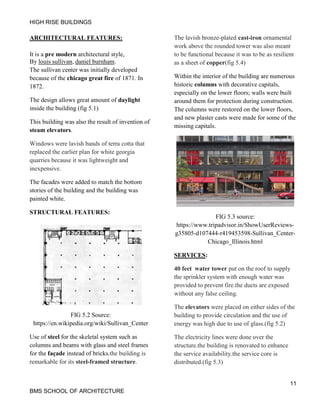
The elevators were placed on either sides of the
building to provide circulation and the use of
energy was high due to use of glass.(fig 5.2)
The electricity lines were done over the
structure.the building is renovated to enhance
the service availability.the service core is
distributed.(fig 5.3)
HIGH RISE BUILDINGS
12
BMS SCHOOL OF ARCHITECTURE
FIG 5.4 SOURCE:
http://thesullivancenter.com/history/
SUSTAINABILITY
Sullivan center, with a strong commitment to
sustainability, is one of the few historic
buildings to achieve leadership in energy and
environmental design (leed) for existing
buildings (operations and maintenance)
certification and to achieve an energy star
rating. Jfa also worked with several tenants to
achieve leed for commercial interiors
certification, including gensler, which achieved
gold status.
VI. EUREKA TOWERS
Located in melbourne, australia , built in 2006 .
It is a modern architectural style, by fender
katsalidi(fig 6.1).
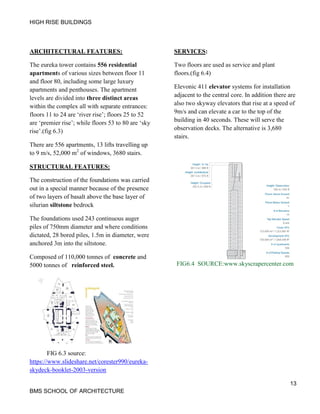
FAÇADE:
The façade of the building consists of 52,000m²
glass and 40,000m² of aluminium panels. The
glass is specially designed to reflect heat in the
summer but retain heat in the winter and also to
be light and durable. The glass skin ‘double
glazing’ will reduce heating and cooling costs
by 40% in an environmentally friendly
manner. The top ten floors of the tower have
24ct-gold-coated glass as a façade.(fig 6.2)
FIG 6.1 Source:
https://en.wikipedia.org/wiki/Eureka_Tower
CONCEPT:
Eureka tower is named after the eureka
stockade, a rebellion during the victorian gold
rush in 1854. This has been incorporated into
the design, with the building's gold crown
representing the gold rush and a red stripe
representing the blood spilt during the revolt.
The blue glass cladding that covers most of the
building represents the blue background of the
stockade's flag and the white lines also represent
the eureka stockade flag.
The white horizontal stripes also represent
markings on a surveyor's measuring staff.
FIG 6.2 Source:
https://www.slideshare.net/corester990/eureka-
skydeck-booklet-2003-version
HIGH RISE BUILDINGS
13
BMS SCHOOL OF ARCHITECTURE
ARCHITECTURAL FEATURES:
The eureka tower contains 556 residential
apartments of various sizes between floor 11
and floor 80, including some large luxury
apartments and penthouses. The apartment
levels are divided into three distinct areas
within the complex all with separate entrances:
floors 11 to 24 are ‘river rise’; floors 25 to 52
are ‘premier rise’; while floors 53 to 80 are ‘sky
rise’.(fig 6.3)
There are 556 apartments, 13 lifts travelling up
to 9 m/s, 52,000 m2
of windows, 3680 stairs.
STRUCTURAL FEATURES:
The construction of the foundations was carried
out in a special manner because of the presence
of two layers of basalt above the base layer of
silurian siltstone bedrock
The foundations used 243 continuous auger
piles of 750mm diameter and where conditions
dictated, 28 bored piles, 1.5m in diameter, were
anchored 3m into the siltstone.
Composed of 110,000 tonnes of concrete and
5000 tonnes of reinforced steel.
FIG 6.3 source:
https://www.slideshare.net/corester990/eureka-
skydeck-booklet-2003-version
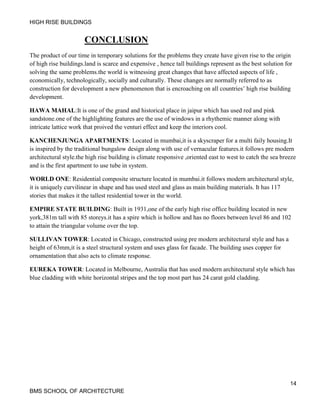
SERVICES:
Two floors are used as service and plant
floors.(fig 6.4)
Elevonic 411 elevator systems for installation
adjacent to the central core. In addition there are
also two skyway elevators that rise at a speed of
9m/s and can elevate a car to the top of the
building in 40 seconds. These will serve the
observation decks. The alternative is 3,680
stairs.
FIG6.4 SOURCE:www.skyscrapercenter.com
HIGH RISE BUILDINGS
14
BMS SCHOOL OF ARCHITECTURE
CONCLUSION
The product of our time in temporary solutions for the problems they create have given rise to the origin
of high rise buildings.land is scarce and expensive , hence tall buildings represent as the best solution for
solving the same problems.the world is witnessing great changes that have affected aspects of life ,
economically, technologically, socially and culturally. These changes are normally referred to as
construction for development a new phenomenon that is encroaching on all countries’ high rise building
development.
HAWA MAHAL:It is one of the grand and historical place in jaipur which has used red and pink
sandstone.one of the highlighting features are the use of windows in a rhythemic manner along with
intricate lattice work that proived the venturi effect and keep the interiors cool.
KANCHENJUNGA APARTMENTS: Located in mumbai,it is a skyscraper for a multi faily housing.It
is inspired by the traditional bungalow design along with use of vernacular features.it follows pre modern
architectural style.the high rise building is climate responsive ,oriented east to west to catch the sea breeze
and is the first apartment to use tube in system.
WORLD ONE: Residential composite structure located in mumbai.it follows modern architectural style,
it is uniquely curvilinear in shape and has used steel and glass as main building materials. It has 117
stories that makes it the tallest residential tower in the world.
EMPIRE STATE BUILDING: Built in 1931,one of the early high rise office building located in new
york,381m tall with 85 storeys.it has a spire which is hollow and has no floors between level 86 and 102
to attain the triangular volume over the top.
SULLIVAN TOWER: Located in Chicago, constructed using pre modern architectural style and has a
height of 63mm,it is a steel structural system and uses glass for facade. The building uses copper for
ornamentation that also acts to climate response.
EUREKA TOWER: Located in Melbourne, Australia that has used modern architectural style which has
blue cladding with white horizontal stripes and the top most part has 24 carat gold cladding.
HIGH RISE BUILDINGS
15
BMS SCHOOL OF ARCHITECTURE
REFERENCES
https://en.wikipedia.org/wiki/World_One
https://en.wikipedia.org/wiki/Hawa_Mahal
https://www.slideshare.net/NaveenJamal/kanchanjunga-apartment-passive-sustainable-design-case-study
https://www.slideshare.net/gsotob1/empire-state-building-32370251
https://en.wikipedia.org/wiki/Sullivan_Center
https://www.tripadvisor.in/ShowUserReviews-g35805-d107444-r419453598-Sullivan_Center-
Chicago_Illinois.html
http://thesullivancenter.com/history/
https://en.wikipedia.org/wiki/Eureka_Tower
https://www.slideshare.net/corester990/eureka-skydeck-booklet-2003-version

high rise buildings case study

  • 1.
    1 BMS SCHOOL OFARCHITECTURE TITLE: HIGH RISE BUILDINGS AUTHORS: SWATHI PRABHU SHREELEKHA KULKARNI SINDHU K NAVYASHREE K K N VANDANA
  • 2.
    2 BMS SCHOOL OFARCHITECTURE ABSTRACT This paper explores six famous High rise buildings, in which three of the building are from India and three international buildings. Giving a brief understanding of history and structure of the building. The national buildings that have been explored in this are Hawa Mahal, Kanchenjunga apartments and World one, Mumbai. Likewise, the international buildings we have dwelled on are Empire state building, Sullivan center and Eureka Towers. KEYWORDS: Sustainability,high rise, development, services, façade, sewage, acoustics, load transfer , high rise, structural systems construction methodology. What is a high rise building? A building is an enclosed structure that has walls, floors, a roof, and usually windows. “ A tall building is a multi-story structure in which most occupants depend on elevators [lifts] to reach their destinations. The most prominent tall buildings are called ‘high-rise buildings ’in most countries and ‘tower blocks ’in Britain and some European countries. (Or) A high-rise building is a tall building, as opposed to a low-rise building and is defined by its height differently in various jurisdictions. It is used as a residential, office building or other functions including hotel, retail or with multiple purposes combined. A residential high-rise building is also called tower block and may be referred to as an "MDU", standing for "Multi Dwelling Unit”. A very tall high-rise building is referred to as a skyscraper.
  • 3.
    3 BMS SCHOOL OFARCHITECTURE INTRODUCTION The reasons for evolution of high rise buildings comprise of density problems, scarcity of land both on a national and international scale with inclination towards architectural features, structural details along with information on services. Historically, tall buildings were more about a symbol of power and to represent prestige status and also for efficient aesthetic development. High rise buildings are a phenomenon of high intensity development with technical and structural sophistication. The following features constitute the paradigms of the chosen high rise buildings which help in providing a better understanding of the structures. Namely,  Architectural features which include historical information, conceptual growth, and façade perception.  Structural details which include material specifications transfer of loads.
  • 4.
    HIGH RISE BUILDINGS 4 BMSSCHOOL OF ARCHITECTURE I.HAWA MAHAL Located in jaipur (rajasthan, india) built by maharaja sawai pratap singh in 1799.It is a rajput architecture style,with red & pink sand stone construction.designed by lal chand usta. FIG 1.1 Source: https://en.wikipedia.org/wiki/Hawa_Mahal The palace sits on the edge of the city palace, jaipur, and extends to the zenana, or women's chambers.the structure was built in 1799 by maharaja sawai pratap singh. He was so inspired by the unique structure of khetri mahal that he built this grand and historical palace. ARCHITECTURAL FEATURES: The palace is a five-storey pyramidal shaped monument that rises 50 feet (15 m). The front elevation, as seen from the street, is like a honeycomb with small portholes (fig 1.1). Each porthole has miniature windows and carved sandstone grills, finials and domes. It gives the appearance of a mass of semi-octagonal bays, giving the monument its unique façade. The inner face on the back side of the building consists of chambers built with pillars and corridors with royal ornamentation, and reach up to the top floor. FIG1.2 SOURCE: https://en.wikipedia.org/wiki/Hawa_Mahal SUSTAINABILITY FEATURES: Its unique five-storey exterior is akin to the honeycomb of a beehive with its 953 small windows (fig 1.2) called jharokhas decorated with intricate latticework.this architectural feature also allowed cool air from the venturi effect (doctor breeze) to pass through, thus making the whole area more pleasant during the high temperatures in summer.the monument also has delicately modelled hanging cornices (fig1.3) source: https://www.scoopwhoop.com/inothernews/hawa -mahal-fact/#.jeiqioqd9
  • 5.
    HIGH RISE BUILDINGS 5 BMSSCHOOL OF ARCHITECTURE STRUCTURAL FEATURES: The structure is of rock supported by pillars. the use of lattice work reduces the dead load on the structure.the ramps from the inside give access to the top floor balconies that also act as buttresses. The structure is slightly curved and stands at an angle of 87 degrees.(fig 1.4) It is considered to be one of the marvelous structure as it is known to be standing without a foundation. FIG 1.4 source : https://www.scoopwhoop.com/inothernews/hawa- mahal-fact/#.jeiqioqd9 The detail carving of the lattice work was done by skilled craftsmans and the whole construction was handmade including quarring of stones and placing them on site. There was no modern day services applied such as electrical, sewage and fire safety systems. This structure kept the building behind it cool by acting as a filter panel. II. KANCHANJUNGA APARTMENTS Located in Mumbai, Maharashtra. Built around 1970-1983. It is a 83.8m tall split level apartment Building. (fig2.1). FIG 2.1 source: https://www.slideshare.net/NaveenJamal/kanchanj unga-apartment-passive-sustainable-design-case- study ARCHITECTURAL FEATURES: It follows pre modern architectural style. Architect: Charles Correa. This building is east – west oriented to catch prevailing sea breezes & to open up to the best view of the city. Garden terraces used are actually a modern interpretation of a feature of the traditional verandah of a vernacular bungalow. Each apartment provided with a deep two story high garden terrace and is oriented away from the sun so as to provide protection, also uses double wall system for cooling.(fig 2.3)
  • 6.
    HIGH RISE BUILDINGS 6 BMSSCHOOL OF ARCHITECTURE STRUCTURAL FEATURES: Height of the building is about 84 mtrs. This 28 story tower with its concrete construction and large areas of white panels bears a strong resemblance to modern apartment buildings in the west tower's proportion (21 sqm and 84 m high). Whole structure is made of reinforcement cement concrete. It is 28 stories building with concrete structure 6.3 m cantilever beam. As a part of material brick masonry has been used. (fig 2.2)this building has 32 different apartments with 4 types of flats varying from 3 to 6 bed rooms. FIG 2.2 source: https://www.slideshare.net/NaveenJamal/kancha njunga-apartment-passive-sustainable-design- case-study FIG 2.3 source: https://www.slideshare.net/NaveenJamal/kancha njunga-apartment-passive-sustainable-design- case-study FIG 2.4 Source: https://www.slideshare.net/NaveenJamal/kancha njunga-apartment-passive-sustainable-design- case-study The central vertical core,which houses elevators and staircases,also has a structural function:it resistsagainst lateral loads.(fig 2.4) The core is constructed in reinforced concrete, ahead of the main structure, by slip form method of construction.this technique was used for the first time in india. The façade is also in reinfrced concrete.this was necessary because of the cantileverd terraces.the two concrete constructions form a tube-in -tube system,which gives stability to the total tower.(fig 2.5) SERVICES: Sevices contains staircase well elevator shaft, electrical shaft and fire fighting shaft. Shafts: Fire fighting shaft and elevator shaft come in the central core that is constructed using tube system. The emergency exit staircase runs around the vertical core. The shaft seperates the housing from the semi public areas. The services all come in the central and the sweage runs below the verandahs that now cause seepage issues.
  • 7.
    HIGH RISE BUILDINGS 7 BMSSCHOOL OF ARCHITECTURE FIG 2.5 source: https://www.slideshare.net/NaveenJamal/kancha njunga-apartment-passive-sustainable-design- case-study SUSTAINABILITY: The building responses naturally to the climatic issues It deals to the hot climate by provind natural cooling places instead of hvac systems. Use of balconies and verandahs allows more batural light and saves electricity. III. WORLD ONE FIG 3.2 source: https://en.wikipedia.org/wiki/World_One Located in mumbai,maharashtra built in 2011- 2019. It is a residential skyscraper with 117 floors and approx. 443 m(fig 3.1). Architect:pei cobb and architects. Concept:clover leaf configuration that provides unobstructed and spectacular views. The tower is composed of 3 and 4 bhk apartments. ARCHITECTURAL FEATURES: It is a modern architectural Style by pei cobb freed & partners. It is composed of 3 towers, Uniquely curvilinear in shape, the world towers forms a stunning sculpture of glass and steel ( fig 3.3). In its midst, world one soars 117 storeys – the tallest residential tower in the world. A powerful symbol of mumbai’s unfettered aspirations and unstoppable drive, the world towers dominate and redefine the city’s skyline. STRUCTURAL FEATURES: Height of the building is about 442m and with the tip it is of 442m. Observatory: 304.8m. Composite materials are used. Floor count is 117 above the ground 2 below ground. Floor area is of 750000 sqm with 12 number of lifts. The ground area is of 7.1 ha (17.5 acres). Heavy bim softwares are used to design the façade and structural components. Reinforced concrete is used for columns and slabs along with steel and glass for façade. The core is divided through out the plan and has double height floor clearance. it's no surprise that visiting this amazing building is one of the top places to visit in new york.
  • 8.
    HIGH RISE BUILDINGS 8 BMSSCHOOL OF ARCHITECTURE The tower's super-structure, which is supported by large reinforced concrete mats and piles. The structure has been designed as a 'mega structure' to optimize the building design – the very first time that this technology has been used in india. FIG 3.3 SOURCE: https://en.wikipedia.org/wiki/World_One This iconic tower is expected to consume over : (fig 3.4) 250,000 cubic meters of concrete 35,000 metric tons of steel rebar 40,000 sq m of glass 14 million man hours. SERVICES: 18 elevators travelling at upto 8 metres/sec (over 25 ft/sec, more than 2½ storeys/sec). World one has been designed to manage the effect of wind and seismic movements. High- strength concrete makes up the tower's super- structure. Special measures have been taken to ensure the highest levels of fire safety, including fully automated fire detection and sprinkling systems, dedicated pressurized fire staircases and high- speed fire lifts. SUSTANIBILITY: World one is rated as gold leed certified building by the green building council. It shall be one of the only 100+ storey buildings in the world to have this coveted certification, indicating a high level of environmental care in its construction and operations. The key environmental sustainability features include: 100% water recycling and rain water harvesting – reducing water consumption by upto 50% over a conventional building. Use of vrv air-conditioning and solar energy for common area lighting and water heating - reducing electricity consumption by upto 40% Waste segregation and recycling. FIG : 3.4 Source: https://en.wikipedia.org/wiki/World_One IV. EMPIRE STATE BUILDING Located in new york.usa.built in 1931. It is an office building(fig 4.1 ). Concept; shape of a pencil. The empire state building is the world's most famous officebuilding, a historical landmark, and was named "america's favorite architecture" in a poll conducted by the american institute of architects
  • 9.
    HIGH RISE BUILDINGS 9 BMSSCHOOL OF ARCHITECTURE FIG 4.1 Source: https://www.slideshare.net/NaveenJamal/kancha njunga-apartment-passive-sustainable-design- case-study . ARCHITECTURAL FEATURES The height of the empire state building, to its 102nd floor, is 1,250 ft (381 m), 1,453 feet 8 9 16 inches (443.092 m) including its 203 ft (61.9 m) pinnacle. The building has 85 stories of commercial and office space representing a total of 2,158,000 sq ft (200,500 m2 ) of rentable space.(fig 4.2) it has an indoor and outdoor observation deck on the 86th floor, the highest floor within the actual tower. The remaining 16 stories are part of the art deco spire, which is capped by an observatory on the 102nd-floor. The spire is hollow with no floors between levels 86 and 102. Atop the tower is the 203 ft (61.9 m) pinnacle, much of which is covered by broadcast antennas, and surmounted with a lightning rod. STRUCTURAL FEATURES: Use of pre fabricated steel members and bricks with cement and asphalt,linseed coating. The empire state building is composed of 60,000 tons of steel, 200,000 cubic feet of indiana limestone and granite, 10 million bricks, and 730 tons of aluminum and stainless steel. Steel columns and beams form a stable 3-d grid throughout the entire structure. But since such closely spaced column grids obstruct open spaces in buildings, there are virtually no open spans, or column-free spaces, on each floor of the empire state building.(fig 4.3) FIG 4.2 source: https://www.slideshare.net/gsotob1/empire- state-building-32370251 SERVICES: There were four "express" elevators that connected the lobby, 80th floor, and several landings in between. The other 60 "local" elevators connected the landings with the floors above these intermediate landings . The empire state building’s water tanks are inside the building rather than on the roof. Seventy miles of pipe deliver water to the entire building and serve the fire-protection standpipe system.
  • 10.
    HIGH RISE BUILDINGS 10 BMSSCHOOL OF ARCHITECTURE The empire state building has 73 elevators in all, including service elevators.utilities are grouped in a central shaft.each of the floors has 210 structural columns that pass through it, which provide structural stability. FIG 4.3 source: https://www.slideshare.net/gsotob1/empire- state-building-32370251 SUSTAINABILITY : Before the renovation the empire building consumed heavy electricity. Recent changes and update: Reduced carbon footprint Reduced energy consumption by 25% attained by changing the light bulbs to cfls All the 6514 windows have been triple glazed to reduce the heat gain. It has insulated its radiators to avoid loss of heat FIG 4.4 souce: https://www.slideshare.net/gsotob1/empire- state-building-32370251 V. SULLIVAN CENTER Located in chicago,illinos . Built on 17 april 1970. FIG 5.1 Source : https://en.wikipedia.org/wiki/Sullivan_Center Famous for sullivan’s ornate cast-iron ornamentation that frames the dramatic rotunda entry. Only 5% landscape/open area with 95% built space.
  • 11.
    HIGH RISE BUILDINGS 11 BMSSCHOOL OF ARCHITECTURE ARCHITECTURAL FEATURES: It is a pre modern architectural style, By louis sullivan, daniel burnham. The sullivan center was initially developed because of the chicago great fire of 1871. In 1872. The design allows great amount of daylight inside the building (fig 5.1) This building was also the result of invention of steam elevators. Windows were lavish bands of terra cotta that replaced the earlier plan for white georgia quarries because it was lightweight and inexpensive. The facades were added to match the bottom stories of the building and the building was painted white. STRUCTURAL FEATURES: FIG 5.2 Source: https://en.wikipedia.org/wiki/Sullivan_Center Use of steel for the skeletal system such as columns and beams with glass and steel frames for the façade instead of bricks.the building is remarkable for its steel-framed structure. The lavish bronze-plated cast-iron ornamental work above the rounded tower was also meant to be functional because it was to be as resilient as a sheet of copper(fig 5.4) Within the interior of the building are numerous historic columns with decorative capitals, especially on the lower floors; walls were built around them for protection during construction. The columns were restored on the lower floors, and new plaster casts were made for some of the missing capitals. FIG 5.3 source: https://www.tripadvisor.in/ShowUserReviews- g35805-d107444-r419453598-Sullivan_Center- Chicago_Illinois.html SERVICES: 40 feet water tower put on the roof to supply the sprinkler system with enough water was provided to prevent fire.the ducts are exposed without any false ceiling. The elevators were placed on either sides of the building to provide circulation and the use of energy was high due to use of glass.(fig 5.2) The electricity lines were done over the structure.the building is renovated to enhance the service availability.the service core is distributed.(fig 5.3)
  • 12.
    HIGH RISE BUILDINGS 12 BMSSCHOOL OF ARCHITECTURE FIG 5.4 SOURCE: http://thesullivancenter.com/history/ SUSTAINABILITY Sullivan center, with a strong commitment to sustainability, is one of the few historic buildings to achieve leadership in energy and environmental design (leed) for existing buildings (operations and maintenance) certification and to achieve an energy star rating. Jfa also worked with several tenants to achieve leed for commercial interiors certification, including gensler, which achieved gold status. VI. EUREKA TOWERS Located in melbourne, australia , built in 2006 . It is a modern architectural style, by fender katsalidi(fig 6.1). FAÇADE: The façade of the building consists of 52,000m² glass and 40,000m² of aluminium panels. The glass is specially designed to reflect heat in the summer but retain heat in the winter and also to be light and durable. The glass skin ‘double glazing’ will reduce heating and cooling costs by 40% in an environmentally friendly manner. The top ten floors of the tower have 24ct-gold-coated glass as a façade.(fig 6.2) FIG 6.1 Source: https://en.wikipedia.org/wiki/Eureka_Tower CONCEPT: Eureka tower is named after the eureka stockade, a rebellion during the victorian gold rush in 1854. This has been incorporated into the design, with the building's gold crown representing the gold rush and a red stripe representing the blood spilt during the revolt. The blue glass cladding that covers most of the building represents the blue background of the stockade's flag and the white lines also represent the eureka stockade flag. The white horizontal stripes also represent markings on a surveyor's measuring staff. FIG 6.2 Source: https://www.slideshare.net/corester990/eureka- skydeck-booklet-2003-version
  • 13.
    HIGH RISE BUILDINGS 13 BMSSCHOOL OF ARCHITECTURE ARCHITECTURAL FEATURES: The eureka tower contains 556 residential apartments of various sizes between floor 11 and floor 80, including some large luxury apartments and penthouses. The apartment levels are divided into three distinct areas within the complex all with separate entrances: floors 11 to 24 are ‘river rise’; floors 25 to 52 are ‘premier rise’; while floors 53 to 80 are ‘sky rise’.(fig 6.3) There are 556 apartments, 13 lifts travelling up to 9 m/s, 52,000 m2 of windows, 3680 stairs. STRUCTURAL FEATURES: The construction of the foundations was carried out in a special manner because of the presence of two layers of basalt above the base layer of silurian siltstone bedrock The foundations used 243 continuous auger piles of 750mm diameter and where conditions dictated, 28 bored piles, 1.5m in diameter, were anchored 3m into the siltstone. Composed of 110,000 tonnes of concrete and 5000 tonnes of reinforced steel. FIG 6.3 source: https://www.slideshare.net/corester990/eureka- skydeck-booklet-2003-version SERVICES: Two floors are used as service and plant floors.(fig 6.4) Elevonic 411 elevator systems for installation adjacent to the central core. In addition there are also two skyway elevators that rise at a speed of 9m/s and can elevate a car to the top of the building in 40 seconds. These will serve the observation decks. The alternative is 3,680 stairs. FIG6.4 SOURCE:www.skyscrapercenter.com
  • 14.
    HIGH RISE BUILDINGS 14 BMSSCHOOL OF ARCHITECTURE CONCLUSION The product of our time in temporary solutions for the problems they create have given rise to the origin of high rise buildings.land is scarce and expensive , hence tall buildings represent as the best solution for solving the same problems.the world is witnessing great changes that have affected aspects of life , economically, technologically, socially and culturally. These changes are normally referred to as construction for development a new phenomenon that is encroaching on all countries’ high rise building development. HAWA MAHAL:It is one of the grand and historical place in jaipur which has used red and pink sandstone.one of the highlighting features are the use of windows in a rhythemic manner along with intricate lattice work that proived the venturi effect and keep the interiors cool. KANCHENJUNGA APARTMENTS: Located in mumbai,it is a skyscraper for a multi faily housing.It is inspired by the traditional bungalow design along with use of vernacular features.it follows pre modern architectural style.the high rise building is climate responsive ,oriented east to west to catch the sea breeze and is the first apartment to use tube in system. WORLD ONE: Residential composite structure located in mumbai.it follows modern architectural style, it is uniquely curvilinear in shape and has used steel and glass as main building materials. It has 117 stories that makes it the tallest residential tower in the world. EMPIRE STATE BUILDING: Built in 1931,one of the early high rise office building located in new york,381m tall with 85 storeys.it has a spire which is hollow and has no floors between level 86 and 102 to attain the triangular volume over the top. SULLIVAN TOWER: Located in Chicago, constructed using pre modern architectural style and has a height of 63mm,it is a steel structural system and uses glass for facade. The building uses copper for ornamentation that also acts to climate response. EUREKA TOWER: Located in Melbourne, Australia that has used modern architectural style which has blue cladding with white horizontal stripes and the top most part has 24 carat gold cladding.
  • 15.
    HIGH RISE BUILDINGS 15 BMSSCHOOL OF ARCHITECTURE REFERENCES https://en.wikipedia.org/wiki/World_One https://en.wikipedia.org/wiki/Hawa_Mahal https://www.slideshare.net/NaveenJamal/kanchanjunga-apartment-passive-sustainable-design-case-study https://www.slideshare.net/gsotob1/empire-state-building-32370251 https://en.wikipedia.org/wiki/Sullivan_Center https://www.tripadvisor.in/ShowUserReviews-g35805-d107444-r419453598-Sullivan_Center- Chicago_Illinois.html http://thesullivancenter.com/history/ https://en.wikipedia.org/wiki/Eureka_Tower https://www.slideshare.net/corester990/eureka-skydeck-booklet-2003-version