www.beamery.com
Private & Confidential – Do Not Share
© Beamery Inc. All rights reserved.
Agile Recruiting: Optimizing
your TA Operating Model
Mitzi Shafar
Lead Consulting Partner – Talent Collective
Hosted by: Nada Chaker
www.beamery.com
Private & Confidential – Do Not Share
© Beamery Inc. All rights reserved.
Agenda
● Intro
● Changing Workforce
● Technology Impacts
● Workforce Trends
● Agile TA Recruitment Model
● The Future of Work
● Q&A
www.beamery.com
Private & Confidential – Do Not Share
© Beamery Inc. All rights reserved.
CHANGING WORKFORCE
www.beamery.com
Private & Confidential – Do Not Share
© Beamery Inc. All rights reserved.
Opinion poll: What business challenge is most likely
to disturb your industry in the coming years?
www.beamery.com
Private & Confidential – Do Not Share
© Beamery Inc. All rights reserved.
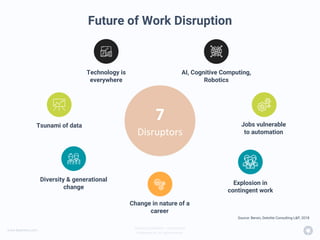
Future of Work Disruption
7
Disruptors
Technology is
everywhere
Tsunami of data
Diversity & generational
change
AI, Cognitive Computing,
Robotics
Explosion in
contingent work
Change in nature of a
career
Source: Bersin, Deloitte Consulting L&P, 2018
Jobs vulnerable
to automation
www.beamery.com
Private & Confidential – Do Not Share
© Beamery Inc. All rights reserved.
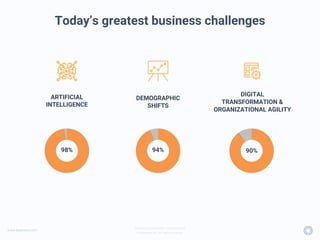
Today’s greatest business challenges
DEMOGRAPHIC
SHIFTS
DIGITAL
TRANSFORMATION &
ORGANIZATIONAL AGILITY
98% 94% 90%
ARTIFICIAL
INTELLIGENCE
www.beamery.com
Private & Confidential – Do Not Share
© Beamery Inc. All rights reserved.
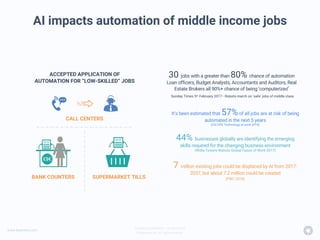
AI impacts automation of middle income jobs
ACCEPTED APPLICATION OF
AUTOMATION FOR “LOW-SKILLED” JOBS
CALL CENTERS
BANK COUNTERS SUPERMARKET TILLS
30 jobs with a greater than 80% chance of automation
Loan officers, Budget Analysts, Accountants and Auditors, Real
Estate Brokers all 90%+ chance of being ‘computerized’
Sunday Times 5th February 2017 - Robots march on ‘safe’ jobs of middle class
It’s been estimated that 57%of all jobs are at risk of being
automated in the next 5 years
(Citi GPS Technology at work 2016)
44% businesses globally are identifying the emerging
skills required for the changing business environment
(Willis Towers Watson Global Future of Work 2017)
7 million existing jobs could be displaced by AI from 2017-
2037, but about 7.2 million could be created
(PWC 2018)
www.beamery.com
Private & Confidential – Do Not Share
© Beamery Inc. All rights reserved.
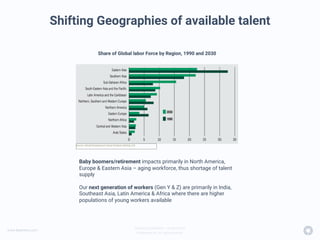
Shifting Geographies of available talent
Share of Global labor Force by Region, 1990 and 2030
Source: World Employment Social Outlook 2018 by ILO
Baby boomers/retirement impacts primarily in North America,
Europe & Eastern Asia – aging workforce, thus shortage of talent
supply
Our next generation of workers (Gen Y & Z) are primarily in India,
Southeast Asia, Latin America & Africa where there are higher
populations of young workers available
www.beamery.com
Private & Confidential – Do Not Share
© Beamery Inc. All rights reserved.
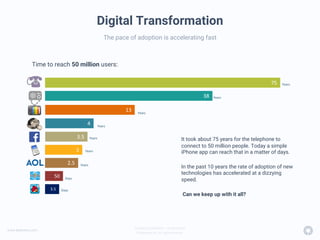
Digital Transformation
The pace of adoption is accelerating fast
75 Years
38 Years
13 Years
4 Years
3.5 Years
3 Years
2.5 Years
50 Days
3.5 Days
Time to reach 50 million users:
It took about 75 years for the telephone to
connect to 50 million people. Today a simple
iPhone app can reach that in a matter of days.
In the past 10 years the rate of adoption of new
technologies has accelerated at a dizzying
speed.
Can we keep up with it all?
www.beamery.com
Private & Confidential – Do Not Share
© Beamery Inc. All rights reserved.
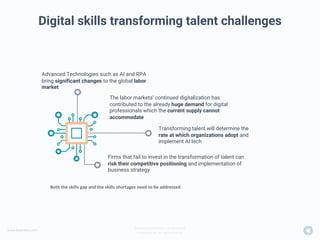
Digital skills transforming talent challenges
Firms that fail to invest in the transformation of talent can
risk their competitive positioning and implementation of
business strategy
Both the skills gap and the skills shortages need to be addressed
Advanced Technologies such as AI and RPA
bring significant changes to the global labor
market
The labor markets’ continued digitalization has
contributed to the already huge demand for digital
professionals which the current supply cannot
accommodate
Transforming talent will determine the
rate at which organizations adopt and
implement AI tech
www.beamery.com
Private & Confidential – Do Not Share
© Beamery Inc. All rights reserved.
TECHNOLOGY IMPACTS
www.beamery.com
Private & Confidential – Do Not Share
© Beamery Inc. All rights reserved.
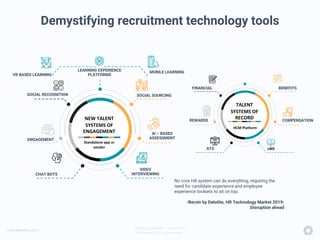
Demystifying recruitment technology tools
No core HR system can do everything, requiring the
need for candidate experience and employee
experience toolsets to sit on top.
-Bersin by Deloitte, HR Technology Market 2019:
Disruption ahead
SOCIAL SOURCING
AI – BASED
ASSESSMENT
LEARNING EXPERIENCE
PLATFORMS
SOCIAL RECOGNITION
ENGAGEMENT
NEW TALENT
SYSTEMS OF
ENGAGEMENT
Standalone app or
vendor
MOBILE LEARNING
VR BASED LEARNING
BENEFITS
COMPENSATION
LMS
FINANCIAL
REWARDS
ATS
TALENT
SYSTEMS OF
RECORD
HCM Platform
VIDEO
INTERVIEWINGCHAT BOTS
www.beamery.com
Private & Confidential – Do Not Share
© Beamery Inc. All rights reserved.
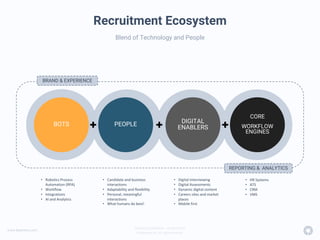
Recruitment Ecosystem
Blend of Technology and People
BOTS PEOPLE DIGITAL
ENABLERS
CORE
WORKFLOW
ENGINES
• Robotics Process
Automation (RPA)
• Workflow
• Integrations
• AI and Analytics
• Candidate and business
interactions
• Adaptability and flexibility
• Personal, meaningful
interactions
• What humans do best!
• Digital Interviewing
• Digital Assessments
• Dynamic digital content
• Careers sites and market
places
• Mobile first
• HR Systems
• ATS
• CRM
• VMS
BRAND & EXPERIENCE
REPORTING & ANALYTICS
www.beamery.com
Private & Confidential – Do Not Share
© Beamery Inc. All rights reserved.
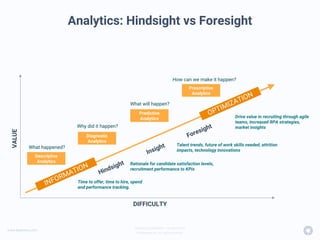
Analytics: Hindsight vs Foresight
INFORMATION
OPTIMIZATION
VALUE
DIFFICULTY
Hindsight
Insight
Foresight
Drive value in recruiting through agile
teams, increased RPA strategies,
market insights
Talent trends, future of work skills needed, attrition
impacts, technology innovations
Rationale for candidate satisfaction levels,
recruitment performance to KPIs
Time to offer, time to hire, spend
and performance tracking.
What happened?
Why did it happen?
What will happen?
How can we make it happen?
Prescriptive
Analytics
Predictive
Analytics
Diagnostic
Analytics
Descriptive
Analytics
www.beamery.com
Private & Confidential – Do Not Share
© Beamery Inc. All rights reserved.
WORKFORCE TRENDS
www.beamery.com
Private & Confidential – Do Not Share
© Beamery Inc. All rights reserved.
The Shifting Shape of Work
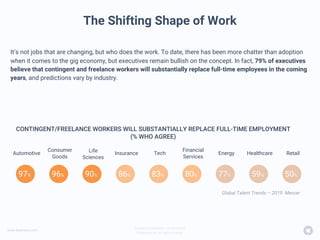
It’s not jobs that are changing, but who does the work. To date, there has been more chatter than adoption
when it comes to the gig economy, but executives remain bullish on the concept. In fact, 79% of executives
believe that contingent and freelance workers will substantially replace full-time employees in the coming
years, and predictions vary by industry.
Global Talent Trends – 2019 Mercer
97%
Automotive
96%
Consumer
Goods
90%
Life
Sciences
86%
Insurance
83%
Tech
80%
Financial
Services
77%
Energy
59%
Healthcare
50%
Retail
CONTINGENT/FREELANCE WORKERS WILL SUBSTANTIALLY REPLACE FULL-TIME EMPLOYMENT
(% WHO AGREE)
www.beamery.com
Private & Confidential – Do Not Share
© Beamery Inc. All rights reserved.
The Emerging Gig Economy
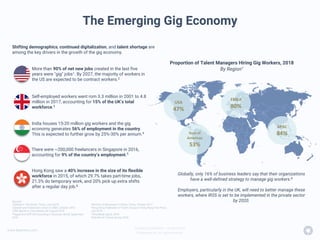
Proportion of Talent Managers Hiring Gig Workers, 2018
By Region7
USA
47%
Rest of
Americas
53%
EMEA
80%
APAC
84%
Shifting demographics, continued digitalization, and talent shortage are
among the key drivers in the growth of the gig economy.
Sources:
1Deloitte in The Straits Times, June 2018
2
Upwork and Freelancers Union in CNBC, October 2018
3
ONS figures in Consultancy UK, August 2018
4Paypal and GPR HR Consulting in Business World, September
2018
More than 90% of net new jobs created in the last five
years were "gig" jobs1. By 2027, the majority of workers in
the US are expected to be contract workers.2
Self-employed workers went rom 3.3 million in 2001 to 4.8
million in 2017, accounting for 15% of the UK’s total
workforce.3
India houses 15-20 million gig workers and the gig
economy generates 56% of employment in the country.
This is expected to further grow by 25%-30% per annum.4
There were ~200,000 freelancers in Singapore in 2016,
accounting for 9% of the country’s employment.5
Hong Kong saw a 40% increase in the size of its flexible
workforce in 2015, of which 29.7% takes part-time jobs,
21.3% do temporary work, and 20% pick up extra shifts
after a regular day job.6
Globally, only 16% of business leaders say that their organizations
have a well-defined strategy to manage gig workers.8
Employers, particularly in the UK, will need to better manage these
workers, where IR35 is set to be implemented in the private sector
by 2020.
5Ministry of Manpower in Straits Times, October 2017
6
Hong Kong Federation of Youth Groups in Hong Kong Free Press,
July 2018
7PersolKelly report, 2018
8Deloitte HC Trends Survey 2018
www.beamery.com
Private & Confidential – Do Not Share
© Beamery Inc. All rights reserved.
What does this mean for TA?
Evolving trends such as digitalization, talent
shortages, shifting demographics and the
emerging gig economy force organizations to
continuously change; they need their recruiting
organizations to be agile and adaptable to change.
www.beamery.com
Private & Confidential – Do Not Share
© Beamery Inc. All rights reserved.
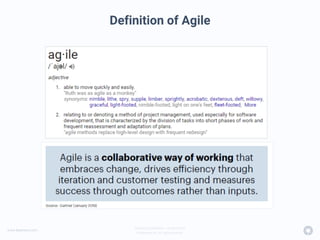
Definition of Agile
www.beamery.com
Private & Confidential – Do Not Share
© Beamery Inc. All rights reserved.
AGILE TA OPERATING MODEL
www.beamery.com
Private & Confidential – Do Not Share
© Beamery Inc. All rights reserved.
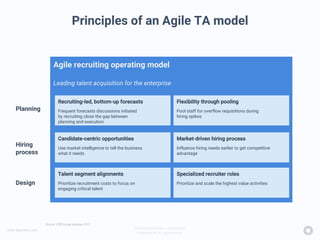
Principles of an Agile TA model
Source: CEB Survey analysis 2017
Planning
Hiring
process
Design
Agile recruiting operating model
Leading talent acquisition for the enterprise
Recruiting-led, bottom-up forecasts
Candidate-centric opportunities
Frequent forecasts discussions initiated
by recruiting close the gap between
planning and execution
Use market intelligence to tell the business
what it needs
Flexibility through pooling
Pool staff for overflow requisitions during
hiring spikes
Market-driven hiring process
Influence hiring needs earlier to get competitive
advantage
Talent segment alignments
Prioritize recruitment costs to focus on
engaging critical talent
Specialized recruiter roles
Prioritize and scale the highest value activities
www.beamery.com
Private & Confidential – Do Not Share
© Beamery Inc. All rights reserved.
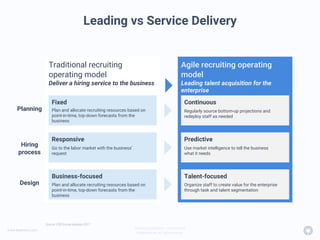
Leading vs Service Delivery
Source: CEB Survey analysis 2017
Traditional recruiting
operating model
Deliver a hiring service to the business
Planning
Hiring
process
Design
Fixed
Responsive
Business-focused
Agile recruiting operating
model
Leading talent acquisition for the
enterprise
Continuous
Predictive
Talent-focused
Plan and allocate recruiting resources based on
point-in-time, top-down forecasts from the
business
Go to the labor market with the business’
request
Plan and allocate recruiting resources based on
point-in-time, top-down forecasts from the
business
Regularly source bottom-up projections and
redeploy staff as needed
Use market intelligence to tell the business
what it needs
Organize staff to create value for the enterprise
through task and talent segmentation
www.beamery.com
Private & Confidential – Do Not Share
© Beamery Inc. All rights reserved.
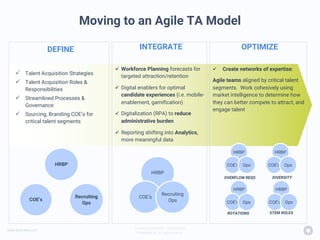
Moving to an Agile TA Model
DEFINE
ü Talent Acquisition Strategies
ü Talent Acquisition Roles &
Responsibilities
ü Streamlined Processes &
Governance
ü Sourcing, Branding COE’s for
critical talent segments
INTEGRATE
ü Workforce Planning forecasts for
targeted attraction/retention
ü Digital enablers for optimal
candidate experiences (i.e. mobile-
enablement, gamification)
ü Digitalization (RPA) to reduce
administrative burden
ü Reporting shifting into Analytics,
more meaningful data
OPTIMIZE
ü Create networks of expertise:
Agile teams aligned by critical talent
segments. Work cohesively using
market intelligence to determine how
they can better compete to attract, and
engage talent
STEM ROLES
DIVERSITYOVERFLOW REQS
ROTATIONS
HRBP
Recruiting
Ops
COE’s
HRBP
COE’s
Recruiting
Ops
HRBP
COE’s Ops
HRBP
COE’s Ops
HRBP
COE’s Ops
HRBP
COE’s Ops
www.beamery.com
Private & Confidential – Do Not Share
© Beamery Inc. All rights reserved.
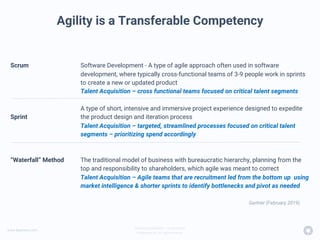
Agility is a Transferable Competency
Scrum
Sprint
“Waterfall” Method
Software Development - A type of agile approach often used in software
development, where typically cross-functional teams of 3-9 people work in sprints
to create a new or updated product
Talent Acquisition – cross functional teams focused on critical talent segments
A type of short, intensive and immersive project experience designed to expedite
the product design and iteration process
Talent Acquisition – targeted, streamlined processes focused on critical talent
segments – prioritizing spend accordingly
The traditional model of business with bureaucratic hierarchy, planning from the
top and responsibility to shareholders, which agile was meant to correct
Talent Acquisition – Agile teams that are recruitment led from the bottom up using
market intelligence & shorter sprints to identify bottlenecks and pivot as needed
Gartner (February 2019)
www.beamery.com
Private & Confidential – Do Not Share
© Beamery Inc. All rights reserved.
THE FUTURE OF WORK
www.beamery.com
Private & Confidential – Do Not Share
© Beamery Inc. All rights reserved.
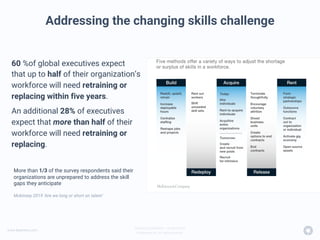
Addressing the changing skills challenge
60 %of global executives expect
that up to half of their organization’s
workforce will need retraining or
replacing within five years.
An additional 28% of executives
expect that more than half of their
workforce will need retraining or
replacing.
More than 1/3 of the survey respondents said their
organizations are unprepared to address the skill
gaps they anticipate
Mckinsey 2019 ‘Are we long or short on talent’
www.beamery.com
Private & Confidential – Do Not Share
© Beamery Inc. All rights reserved.
Opinion poll: Is your organization ready to adopt a
new recruitment operating model?
www.beamery.com
Private & Confidential – Do Not Share
© Beamery Inc. All rights reserved.
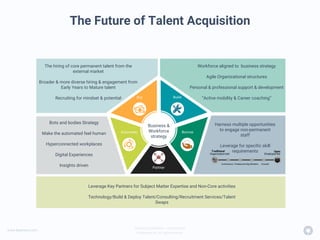
The Future of Talent Acquisition
Harness multiple opportunities
to engage non-permanent
staff
Leverage for specific skill
requirements
Workforce aligned to business strategy
Agile Organizational structures
Personal & professional support & development
“Active mobility & Career coaching”
Bots and bodies Strategy
Make the automated feel human
Hyperconnected workplaces
Digital Experiences
Insights driven
The hiring of core permanent talent from the
external market
Broader & more diverse hiring & engagement from
Early Years to Mature talent
Recruiting for mindset & potential Buy Build
Borrow
Partner
Automate
Leverage Key Partners for Subject Matter Expertise and Non-Core activities
Technology/Build & Deploy Talent/Consulting/Recruitment Services/Talent
Swaps
Traditional
Organization-led
Gig Workers CrowdsContractors Freelancers
Open
Employee-led
Business &
Workforce
strategy
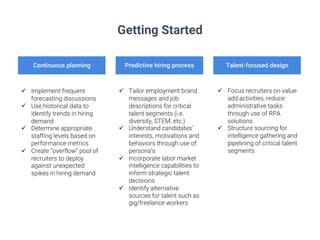
Getting Started
Continuous planning Predictive hiring process Talent-focused design
ü Implement frequent
forecasting discussions
ü Use historical data to
identify trends in hiring
demand
ü Determine appropriate
staffing levels based on
performance metrics
ü Create “overflow” pool of
recruiters to deploy
against unexpected
spikes in hiring demand
ü Tailor employment brand
messages and job
descriptions for critical
talent segments (i.e.
diversity, STEM, etc.)
ü Understand candidates’
interests, motivations and
behaviors through use of
persona’s
ü Incorporate labor market
intelligence capabilities to
inform strategic talent
decisions
ü Identify alternative
sources for talent such as
gig/freelance workers
ü Focus recruiters on value-
add activities, reduce
administrative tasks
through use of RPA
solutions
ü Structure sourcing for
intelligence gathering and
pipelining of critical talent
segments
www.beamery.com
Private & Confidential – Do Not Share
© Beamery Inc. All rights reserved.
ANNEX
Mitzi Shafar
Lead Partner Americas – Talent Collective
mitzi.shafar@talentcollective.com
Nada Chaker
Senior Content Marketing Manager
Nada.chaker@beamery.com

Agile recruiting: Optimizing your Talent Acquisition Operating Model

  • 1.
    www.beamery.com Private & Confidential– Do Not Share © Beamery Inc. All rights reserved. Agile Recruiting: Optimizing your TA Operating Model Mitzi Shafar Lead Consulting Partner – Talent Collective Hosted by: Nada Chaker
  • 2.
    www.beamery.com Private & Confidential– Do Not Share © Beamery Inc. All rights reserved. Agenda ● Intro ● Changing Workforce ● Technology Impacts ● Workforce Trends ● Agile TA Recruitment Model ● The Future of Work ● Q&A
  • 3.
    www.beamery.com Private & Confidential– Do Not Share © Beamery Inc. All rights reserved. CHANGING WORKFORCE
  • 4.
    www.beamery.com Private & Confidential– Do Not Share © Beamery Inc. All rights reserved. Opinion poll: What business challenge is most likely to disturb your industry in the coming years?
  • 5.
    www.beamery.com Private & Confidential– Do Not Share © Beamery Inc. All rights reserved. Future of Work Disruption 7 Disruptors Technology is everywhere Tsunami of data Diversity & generational change AI, Cognitive Computing, Robotics Explosion in contingent work Change in nature of a career Source: Bersin, Deloitte Consulting L&P, 2018 Jobs vulnerable to automation
  • 6.
    www.beamery.com Private & Confidential– Do Not Share © Beamery Inc. All rights reserved. Today’s greatest business challenges DEMOGRAPHIC SHIFTS DIGITAL TRANSFORMATION & ORGANIZATIONAL AGILITY 98% 94% 90% ARTIFICIAL INTELLIGENCE
  • 7.
    www.beamery.com Private & Confidential– Do Not Share © Beamery Inc. All rights reserved. AI impacts automation of middle income jobs ACCEPTED APPLICATION OF AUTOMATION FOR “LOW-SKILLED” JOBS CALL CENTERS BANK COUNTERS SUPERMARKET TILLS 30 jobs with a greater than 80% chance of automation Loan officers, Budget Analysts, Accountants and Auditors, Real Estate Brokers all 90%+ chance of being ‘computerized’ Sunday Times 5th February 2017 - Robots march on ‘safe’ jobs of middle class It’s been estimated that 57%of all jobs are at risk of being automated in the next 5 years (Citi GPS Technology at work 2016) 44% businesses globally are identifying the emerging skills required for the changing business environment (Willis Towers Watson Global Future of Work 2017) 7 million existing jobs could be displaced by AI from 2017- 2037, but about 7.2 million could be created (PWC 2018)
  • 8.
    www.beamery.com Private & Confidential– Do Not Share © Beamery Inc. All rights reserved. Shifting Geographies of available talent Share of Global labor Force by Region, 1990 and 2030 Source: World Employment Social Outlook 2018 by ILO Baby boomers/retirement impacts primarily in North America, Europe & Eastern Asia – aging workforce, thus shortage of talent supply Our next generation of workers (Gen Y & Z) are primarily in India, Southeast Asia, Latin America & Africa where there are higher populations of young workers available
  • 9.
    www.beamery.com Private & Confidential– Do Not Share © Beamery Inc. All rights reserved. Digital Transformation The pace of adoption is accelerating fast 75 Years 38 Years 13 Years 4 Years 3.5 Years 3 Years 2.5 Years 50 Days 3.5 Days Time to reach 50 million users: It took about 75 years for the telephone to connect to 50 million people. Today a simple iPhone app can reach that in a matter of days. In the past 10 years the rate of adoption of new technologies has accelerated at a dizzying speed. Can we keep up with it all?
  • 10.
    www.beamery.com Private & Confidential– Do Not Share © Beamery Inc. All rights reserved. Digital skills transforming talent challenges Firms that fail to invest in the transformation of talent can risk their competitive positioning and implementation of business strategy Both the skills gap and the skills shortages need to be addressed Advanced Technologies such as AI and RPA bring significant changes to the global labor market The labor markets’ continued digitalization has contributed to the already huge demand for digital professionals which the current supply cannot accommodate Transforming talent will determine the rate at which organizations adopt and implement AI tech
  • 11.
    www.beamery.com Private & Confidential– Do Not Share © Beamery Inc. All rights reserved. TECHNOLOGY IMPACTS
  • 12.
    www.beamery.com Private & Confidential– Do Not Share © Beamery Inc. All rights reserved. Demystifying recruitment technology tools No core HR system can do everything, requiring the need for candidate experience and employee experience toolsets to sit on top. -Bersin by Deloitte, HR Technology Market 2019: Disruption ahead SOCIAL SOURCING AI – BASED ASSESSMENT LEARNING EXPERIENCE PLATFORMS SOCIAL RECOGNITION ENGAGEMENT NEW TALENT SYSTEMS OF ENGAGEMENT Standalone app or vendor MOBILE LEARNING VR BASED LEARNING BENEFITS COMPENSATION LMS FINANCIAL REWARDS ATS TALENT SYSTEMS OF RECORD HCM Platform VIDEO INTERVIEWINGCHAT BOTS
  • 13.
    www.beamery.com Private & Confidential– Do Not Share © Beamery Inc. All rights reserved. Recruitment Ecosystem Blend of Technology and People BOTS PEOPLE DIGITAL ENABLERS CORE WORKFLOW ENGINES • Robotics Process Automation (RPA) • Workflow • Integrations • AI and Analytics • Candidate and business interactions • Adaptability and flexibility • Personal, meaningful interactions • What humans do best! • Digital Interviewing • Digital Assessments • Dynamic digital content • Careers sites and market places • Mobile first • HR Systems • ATS • CRM • VMS BRAND & EXPERIENCE REPORTING & ANALYTICS
  • 14.
    www.beamery.com Private & Confidential– Do Not Share © Beamery Inc. All rights reserved. Analytics: Hindsight vs Foresight INFORMATION OPTIMIZATION VALUE DIFFICULTY Hindsight Insight Foresight Drive value in recruiting through agile teams, increased RPA strategies, market insights Talent trends, future of work skills needed, attrition impacts, technology innovations Rationale for candidate satisfaction levels, recruitment performance to KPIs Time to offer, time to hire, spend and performance tracking. What happened? Why did it happen? What will happen? How can we make it happen? Prescriptive Analytics Predictive Analytics Diagnostic Analytics Descriptive Analytics
  • 15.
    www.beamery.com Private & Confidential– Do Not Share © Beamery Inc. All rights reserved. WORKFORCE TRENDS
  • 16.
    www.beamery.com Private & Confidential– Do Not Share © Beamery Inc. All rights reserved. The Shifting Shape of Work It’s not jobs that are changing, but who does the work. To date, there has been more chatter than adoption when it comes to the gig economy, but executives remain bullish on the concept. In fact, 79% of executives believe that contingent and freelance workers will substantially replace full-time employees in the coming years, and predictions vary by industry. Global Talent Trends – 2019 Mercer 97% Automotive 96% Consumer Goods 90% Life Sciences 86% Insurance 83% Tech 80% Financial Services 77% Energy 59% Healthcare 50% Retail CONTINGENT/FREELANCE WORKERS WILL SUBSTANTIALLY REPLACE FULL-TIME EMPLOYMENT (% WHO AGREE)
  • 17.
    www.beamery.com Private & Confidential– Do Not Share © Beamery Inc. All rights reserved. The Emerging Gig Economy Proportion of Talent Managers Hiring Gig Workers, 2018 By Region7 USA 47% Rest of Americas 53% EMEA 80% APAC 84% Shifting demographics, continued digitalization, and talent shortage are among the key drivers in the growth of the gig economy. Sources: 1Deloitte in The Straits Times, June 2018 2 Upwork and Freelancers Union in CNBC, October 2018 3 ONS figures in Consultancy UK, August 2018 4Paypal and GPR HR Consulting in Business World, September 2018 More than 90% of net new jobs created in the last five years were "gig" jobs1. By 2027, the majority of workers in the US are expected to be contract workers.2 Self-employed workers went rom 3.3 million in 2001 to 4.8 million in 2017, accounting for 15% of the UK’s total workforce.3 India houses 15-20 million gig workers and the gig economy generates 56% of employment in the country. This is expected to further grow by 25%-30% per annum.4 There were ~200,000 freelancers in Singapore in 2016, accounting for 9% of the country’s employment.5 Hong Kong saw a 40% increase in the size of its flexible workforce in 2015, of which 29.7% takes part-time jobs, 21.3% do temporary work, and 20% pick up extra shifts after a regular day job.6 Globally, only 16% of business leaders say that their organizations have a well-defined strategy to manage gig workers.8 Employers, particularly in the UK, will need to better manage these workers, where IR35 is set to be implemented in the private sector by 2020. 5Ministry of Manpower in Straits Times, October 2017 6 Hong Kong Federation of Youth Groups in Hong Kong Free Press, July 2018 7PersolKelly report, 2018 8Deloitte HC Trends Survey 2018
  • 18.
    www.beamery.com Private & Confidential– Do Not Share © Beamery Inc. All rights reserved. What does this mean for TA? Evolving trends such as digitalization, talent shortages, shifting demographics and the emerging gig economy force organizations to continuously change; they need their recruiting organizations to be agile and adaptable to change.
  • 19.
    www.beamery.com Private & Confidential– Do Not Share © Beamery Inc. All rights reserved. Definition of Agile
  • 20.
    www.beamery.com Private & Confidential– Do Not Share © Beamery Inc. All rights reserved. AGILE TA OPERATING MODEL
  • 21.
    www.beamery.com Private & Confidential– Do Not Share © Beamery Inc. All rights reserved. Principles of an Agile TA model Source: CEB Survey analysis 2017 Planning Hiring process Design Agile recruiting operating model Leading talent acquisition for the enterprise Recruiting-led, bottom-up forecasts Candidate-centric opportunities Frequent forecasts discussions initiated by recruiting close the gap between planning and execution Use market intelligence to tell the business what it needs Flexibility through pooling Pool staff for overflow requisitions during hiring spikes Market-driven hiring process Influence hiring needs earlier to get competitive advantage Talent segment alignments Prioritize recruitment costs to focus on engaging critical talent Specialized recruiter roles Prioritize and scale the highest value activities
  • 22.
    www.beamery.com Private & Confidential– Do Not Share © Beamery Inc. All rights reserved. Leading vs Service Delivery Source: CEB Survey analysis 2017 Traditional recruiting operating model Deliver a hiring service to the business Planning Hiring process Design Fixed Responsive Business-focused Agile recruiting operating model Leading talent acquisition for the enterprise Continuous Predictive Talent-focused Plan and allocate recruiting resources based on point-in-time, top-down forecasts from the business Go to the labor market with the business’ request Plan and allocate recruiting resources based on point-in-time, top-down forecasts from the business Regularly source bottom-up projections and redeploy staff as needed Use market intelligence to tell the business what it needs Organize staff to create value for the enterprise through task and talent segmentation
  • 23.
    www.beamery.com Private & Confidential– Do Not Share © Beamery Inc. All rights reserved. Moving to an Agile TA Model DEFINE ü Talent Acquisition Strategies ü Talent Acquisition Roles & Responsibilities ü Streamlined Processes & Governance ü Sourcing, Branding COE’s for critical talent segments INTEGRATE ü Workforce Planning forecasts for targeted attraction/retention ü Digital enablers for optimal candidate experiences (i.e. mobile- enablement, gamification) ü Digitalization (RPA) to reduce administrative burden ü Reporting shifting into Analytics, more meaningful data OPTIMIZE ü Create networks of expertise: Agile teams aligned by critical talent segments. Work cohesively using market intelligence to determine how they can better compete to attract, and engage talent STEM ROLES DIVERSITYOVERFLOW REQS ROTATIONS HRBP Recruiting Ops COE’s HRBP COE’s Recruiting Ops HRBP COE’s Ops HRBP COE’s Ops HRBP COE’s Ops HRBP COE’s Ops
  • 24.
    www.beamery.com Private & Confidential– Do Not Share © Beamery Inc. All rights reserved. Agility is a Transferable Competency Scrum Sprint “Waterfall” Method Software Development - A type of agile approach often used in software development, where typically cross-functional teams of 3-9 people work in sprints to create a new or updated product Talent Acquisition – cross functional teams focused on critical talent segments A type of short, intensive and immersive project experience designed to expedite the product design and iteration process Talent Acquisition – targeted, streamlined processes focused on critical talent segments – prioritizing spend accordingly The traditional model of business with bureaucratic hierarchy, planning from the top and responsibility to shareholders, which agile was meant to correct Talent Acquisition – Agile teams that are recruitment led from the bottom up using market intelligence & shorter sprints to identify bottlenecks and pivot as needed Gartner (February 2019)
  • 25.
    www.beamery.com Private & Confidential– Do Not Share © Beamery Inc. All rights reserved. THE FUTURE OF WORK
  • 26.
    www.beamery.com Private & Confidential– Do Not Share © Beamery Inc. All rights reserved. Addressing the changing skills challenge 60 %of global executives expect that up to half of their organization’s workforce will need retraining or replacing within five years. An additional 28% of executives expect that more than half of their workforce will need retraining or replacing. More than 1/3 of the survey respondents said their organizations are unprepared to address the skill gaps they anticipate Mckinsey 2019 ‘Are we long or short on talent’
  • 27.
    www.beamery.com Private & Confidential– Do Not Share © Beamery Inc. All rights reserved. Opinion poll: Is your organization ready to adopt a new recruitment operating model?
  • 28.
    www.beamery.com Private & Confidential– Do Not Share © Beamery Inc. All rights reserved. The Future of Talent Acquisition Harness multiple opportunities to engage non-permanent staff Leverage for specific skill requirements Workforce aligned to business strategy Agile Organizational structures Personal & professional support & development “Active mobility & Career coaching” Bots and bodies Strategy Make the automated feel human Hyperconnected workplaces Digital Experiences Insights driven The hiring of core permanent talent from the external market Broader & more diverse hiring & engagement from Early Years to Mature talent Recruiting for mindset & potential Buy Build Borrow Partner Automate Leverage Key Partners for Subject Matter Expertise and Non-Core activities Technology/Build & Deploy Talent/Consulting/Recruitment Services/Talent Swaps Traditional Organization-led Gig Workers CrowdsContractors Freelancers Open Employee-led Business & Workforce strategy
  • 29.
    Getting Started Continuous planningPredictive hiring process Talent-focused design ü Implement frequent forecasting discussions ü Use historical data to identify trends in hiring demand ü Determine appropriate staffing levels based on performance metrics ü Create “overflow” pool of recruiters to deploy against unexpected spikes in hiring demand ü Tailor employment brand messages and job descriptions for critical talent segments (i.e. diversity, STEM, etc.) ü Understand candidates’ interests, motivations and behaviors through use of persona’s ü Incorporate labor market intelligence capabilities to inform strategic talent decisions ü Identify alternative sources for talent such as gig/freelance workers ü Focus recruiters on value- add activities, reduce administrative tasks through use of RPA solutions ü Structure sourcing for intelligence gathering and pipelining of critical talent segments
  • 30.
    www.beamery.com Private & Confidential– Do Not Share © Beamery Inc. All rights reserved. ANNEX Mitzi Shafar Lead Partner Americas – Talent Collective mitzi.shafar@talentcollective.com Nada Chaker Senior Content Marketing Manager Nada.chaker@beamery.com