HR Analytics
Application of statistics, modelling, and analysis of
employee-related factors to improve business
outcomes.
Presented By:
Chandan Ray (D/15/EE/001)
Biswajit Changkakoty (D/15/EE/106)
Abhishek Kumar (D/15/EE/108)
Amit Jyoti Deka (D/16/EE/202)
HR Analytics?
Human Resource analytics is about analysing
an organizations’ people problems using data.
Datas are being used to answer questions
like: How High is your employee annual
turnover?
How much of your employee turnover
consists of regretted loss?
Do you know which employees will be the most
likely to leave your company within a year?
Need of HR Analytics
 Many organizations have high quality HR data (residing
with a multitude of systems, such as the HRMS,
performance management, learning, compensation,
survey, etc.) but still struggle to use it effectively to
predict workforce trends, minimize risks and maximize
returns.
 The costs of attrition, poor hiring, sub-optimal
compensation, keeping below par employees, bad
training & learning strategies are just too high
 Data-driven insights to make decisions are always better
than judgmental (subjective) HRpractices in
terms of
 how to recruit
 whom to hire
 how to onboard and train employees
 how they keep employees informed and engaged
through their tenure with the organization
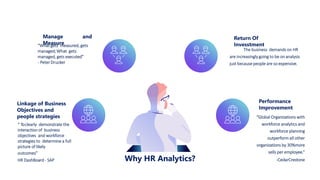
Why HR Analytics?
Performance
Improvement
“Global Organizations with
workforce analytics and
workforce planning
outperform all other
organizations by 30%more
sells per employee.”
-CedarCrestone
Return Of
Invesstment
The business demands on HR
are increasinglygoing to be onanalysis
just becausepeople are so expensive.
Manage and
Measure“What gets measured, gets
managed;What gets
managed, gets executed”
- PeterDrucker
Linkage of Business
Objectives and
people strategies
“ Toclearly demonstrate the
interaction of business
objectives and workforce
strategies to determine a full
picture of likely
outcomes”
HR DashBoard - SAP
Terminologies:
Business Intelligence
Business Analytics
Business Intelligence:
Technology-driven process for analyzing data
and presenting actionable information to help
executives, managers and other corporate
end users make informed business decisions.
Business analytics:
the skills, technologies, applications and practices
for continuous iterative exploration and
investigationof pastbusiness performanceto gain
insightanddrivebusinessplanning.
Analytics
Decision
Business Intelligence=
Core
Terminologie
s
Objectives of HR
Analytics
Drive skills
training
Track changes over timeBecoming Team
Focused
Tracking Company
Profitability
LEVELS of HR
Analytics
Descriptive Analytics : Insight into the past
 Predictive Analytics : Understanding the future
Prescriptive Analytics : Advise on possible outcomes
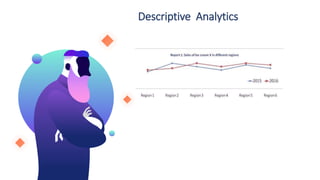
Descriptive Analytics
Diagnostic Analytics
Predictive Analytics
What could happen in the future ?
Regression equation for region 2
Sales = 5.6 +1.2* Advertisement Exp + 0.5*
Discount
Prescriptive Analytics
What should we do ?
1. Increase the Advertising Expense by 10%
2. Give a 5% discount for two months
Critical areas for
HR Predictive
analytics
Turnover modeling. Predicting future turnover in business units
in specific functions, geographies by looking at factors.
Targeted retention. Find out high risk of churn in the future and
focus retention activities on critical few people
Risk Management: profiling of candidates with higher risk of
leaving prematurely or those performing below standard.
Risk Management: profiling of candidates with higher risk of
leaving prematurely or those performing below standard.
HR
Analytics
Enhance
Employee
Morale
Anticipate
performance
Reduce
Attrition Benefits of
HR Analytics
Reduce Attrition
Anticipate Performance
Enhance employee morale
Finding the right talent to
run HR analytics.
A lack of confidence Currying executive support. Data quality.
Challenges to make Analytics Work
1 2 3 4 5
Data Deluge.
Conclusion
The model gives vision to HR leader to make right decision.
Understand the relationship between turnover and compensation.
Helps the organization to reach their goals.
Thank You
Lorem Ipsum is simply dummy text of the
printing and typesetting industry.

Hr analytics

  • 1.
    HR Analytics Application ofstatistics, modelling, and analysis of employee-related factors to improve business outcomes. Presented By: Chandan Ray (D/15/EE/001) Biswajit Changkakoty (D/15/EE/106) Abhishek Kumar (D/15/EE/108) Amit Jyoti Deka (D/16/EE/202)
  • 2.
    HR Analytics? Human Resourceanalytics is about analysing an organizations’ people problems using data. Datas are being used to answer questions like: How High is your employee annual turnover? How much of your employee turnover consists of regretted loss? Do you know which employees will be the most likely to leave your company within a year?
  • 3.
    Need of HRAnalytics  Many organizations have high quality HR data (residing with a multitude of systems, such as the HRMS, performance management, learning, compensation, survey, etc.) but still struggle to use it effectively to predict workforce trends, minimize risks and maximize returns.  The costs of attrition, poor hiring, sub-optimal compensation, keeping below par employees, bad training & learning strategies are just too high  Data-driven insights to make decisions are always better than judgmental (subjective) HRpractices in terms of  how to recruit  whom to hire  how to onboard and train employees  how they keep employees informed and engaged through their tenure with the organization
  • 4.
    Why HR Analytics? Performance Improvement “GlobalOrganizations with workforce analytics and workforce planning outperform all other organizations by 30%more sells per employee.” -CedarCrestone Return Of Invesstment The business demands on HR are increasinglygoing to be onanalysis just becausepeople are so expensive. Manage and Measure“What gets measured, gets managed;What gets managed, gets executed” - PeterDrucker Linkage of Business Objectives and people strategies “ Toclearly demonstrate the interaction of business objectives and workforce strategies to determine a full picture of likely outcomes” HR DashBoard - SAP
  • 5.
    Terminologies: Business Intelligence Business Analytics BusinessIntelligence: Technology-driven process for analyzing data and presenting actionable information to help executives, managers and other corporate end users make informed business decisions. Business analytics: the skills, technologies, applications and practices for continuous iterative exploration and investigationof pastbusiness performanceto gain insightanddrivebusinessplanning. Analytics Decision Business Intelligence= Core Terminologie s
  • 6.
    Objectives of HR Analytics Driveskills training Track changes over timeBecoming Team Focused Tracking Company Profitability
  • 7.
    LEVELS of HR Analytics DescriptiveAnalytics : Insight into the past Descriptive Analytics : Insight into the past  Predictive Analytics : Understanding the future Prescriptive Analytics : Advise on possible outcomes
  • 8.
  • 9.
  • 10.
    Predictive Analytics What couldhappen in the future ? Regression equation for region 2 Sales = 5.6 +1.2* Advertisement Exp + 0.5* Discount
  • 11.
    Prescriptive Analytics What shouldwe do ? 1. Increase the Advertising Expense by 10% 2. Give a 5% discount for two months
  • 12.
    Critical areas for HRPredictive analytics Turnover modeling. Predicting future turnover in business units in specific functions, geographies by looking at factors. Targeted retention. Find out high risk of churn in the future and focus retention activities on critical few people Risk Management: profiling of candidates with higher risk of leaving prematurely or those performing below standard. Risk Management: profiling of candidates with higher risk of leaving prematurely or those performing below standard.
  • 13.
    HR Analytics Enhance Employee Morale Anticipate performance Reduce Attrition Benefits of HRAnalytics Reduce Attrition Anticipate Performance Enhance employee morale
  • 14.
    Finding the righttalent to run HR analytics. A lack of confidence Currying executive support. Data quality. Challenges to make Analytics Work 1 2 3 4 5 Data Deluge.
  • 15.
    Conclusion The model givesvision to HR leader to make right decision. Understand the relationship between turnover and compensation. Helps the organization to reach their goals.
  • 16.
    Thank You Lorem Ipsumis simply dummy text of the printing and typesetting industry.