#WFwebinar 
The presentation will begin at the top of the hour. 
A dial in number will not be provided. 
Listen to today’s webinar using your computer’s speakers or headphones. 
The Next Big HR Transformation: How to Excel at Workforce Planning
#WFwebinar 
Speaker: Dino Zincarini Project Manager Workforce Planning Visier Moderator: Max Mihelich Associate Editor Workforce magazine 
The Next Big HR Transformation: How to Excel at Workforce Planning
#WFwebinar 
Tools You Can Use 
Audio Control 
–A dial in number will not be provided. 
–Adjust the volume by sliding the indicator in the Media Player box to the left. 
–Also check your computer’s volume for external speakers or headsets.
#WFwebinar 
Tools You Can Use 
Question & Answer 
–Type in your question in the “Q&A” box to the left. 
–These queries are visible by the presenter ONLY. 
–Type your question in the space at the bottom. 
–Click “Send.”
#WFwebinar 
Tools You Can Use 
Twitter 
-Click “Post” in the Twitter widget. 
#WFwebinar 
@WorkforceNews
#WFwebinar 
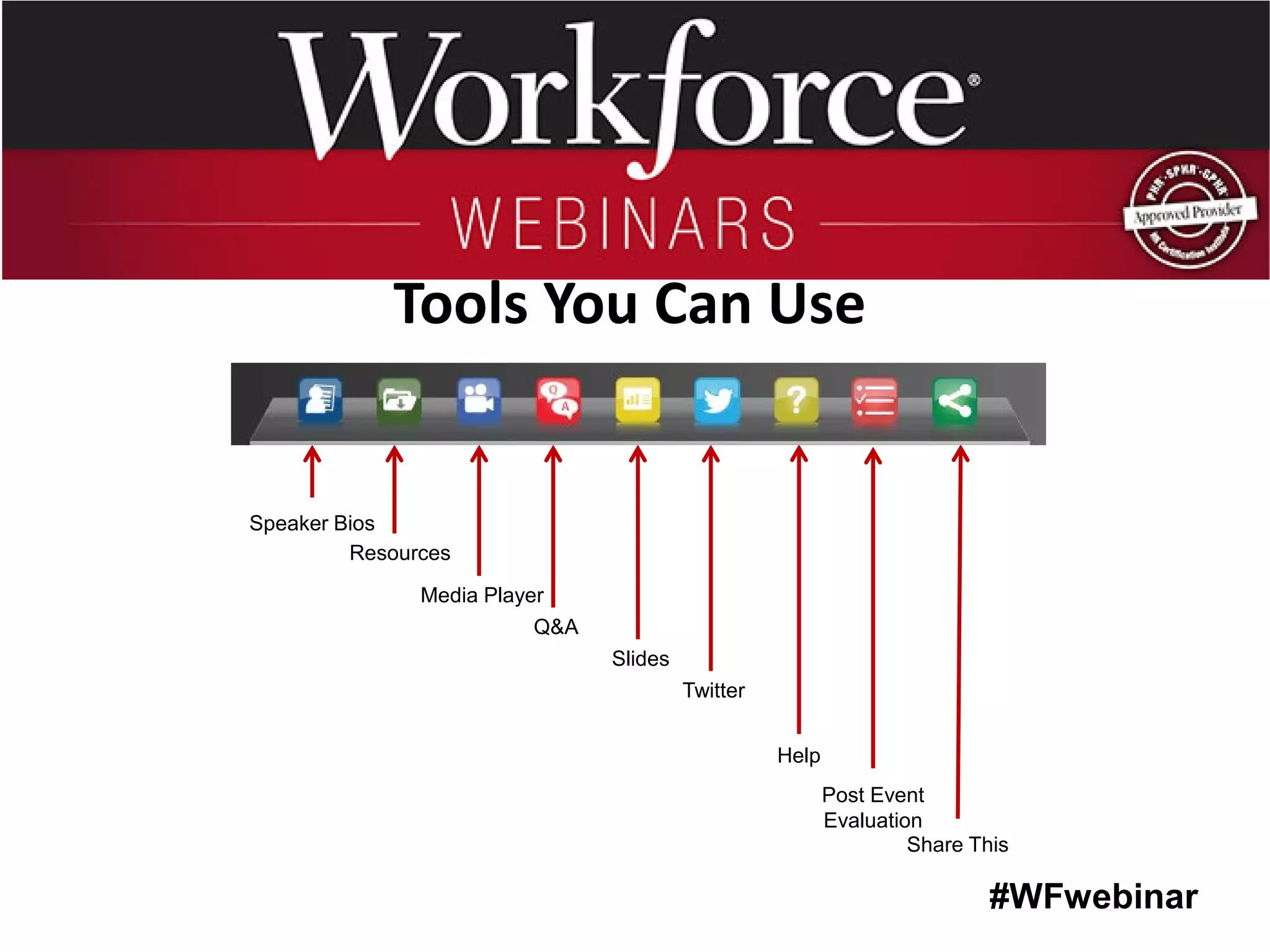
Tools You Can Use 
Speaker Bios 
Resources 
Media Player 
Q&A 
Slides 
Twitter 
Help 
Post Event 
Evaluation 
Share This
#WFwebinar 
1. May I receive a copy of the slides? 
YES! Click on the resource list located on the top left portion of your screen. 
2. May I review the webinar recording at a later date? 
YES! You may log in again using today’s link to review the presentation on-demand. 
Frequently Asked Questions
#WFwebinar 
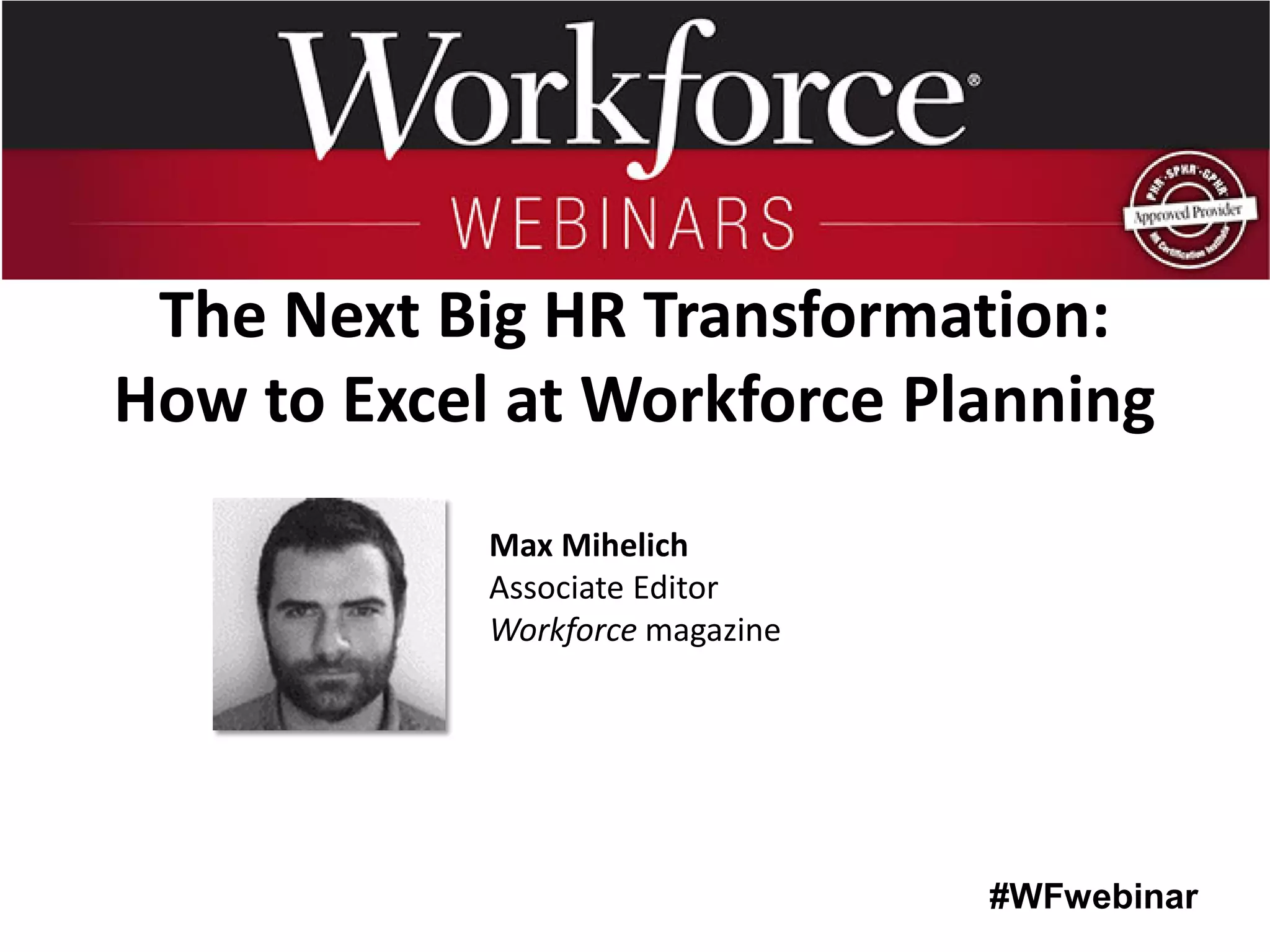
Max Mihelich 
Associate Editor 
Workforce magazine 
The Next Big HR Transformation: How to Excel at Workforce Planning
#WFwebinar 
Dino Zincarini Project Manager Workforce Planning Visier 
The Next Big HR Transformation: How to Excel at Workforce Planning
© 2014 Visier™ 
The Next Big HR Transformation: 
How to Excel at Workforce Planning 
Dino Zincarini 
December 2014
Page 11 
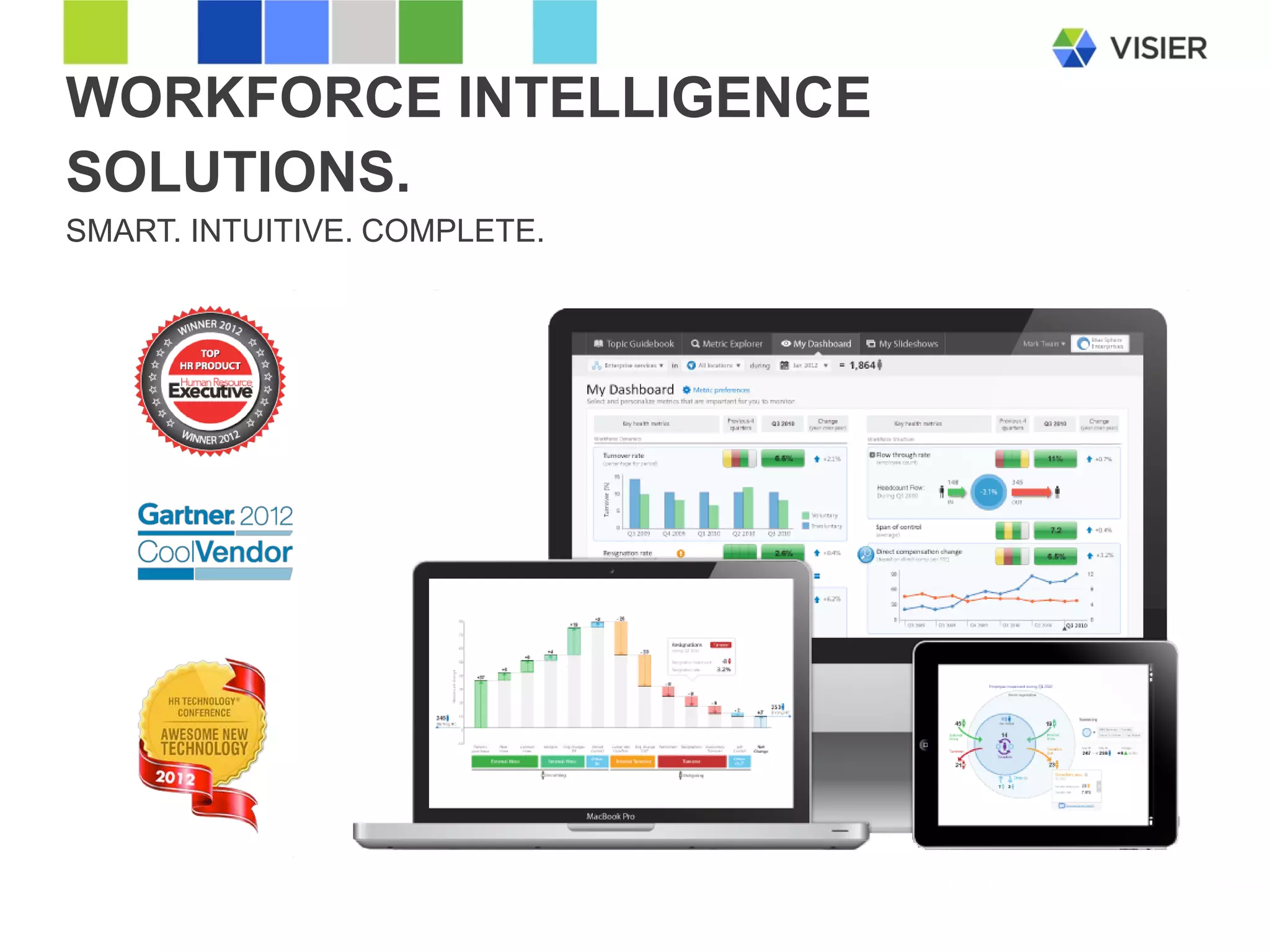
WORKFORCE INTELLIGENCE SOLUTIONS. SMART. INTUITIVE. COMPLETE.
Page 12 
SOME OF OUR AMAZING CUSTOMERS
Page 13 
TODAY’S TOPICS 
Context for the growing importance and value of workforce planning 
The BIG concepts that result in effective workforce planning 
How HR can be the catalyst for upgrading your company’s workforce planning
Page 14 
Setting the Stage: Trends Driving Workforce Planning
P1ag5e 15 
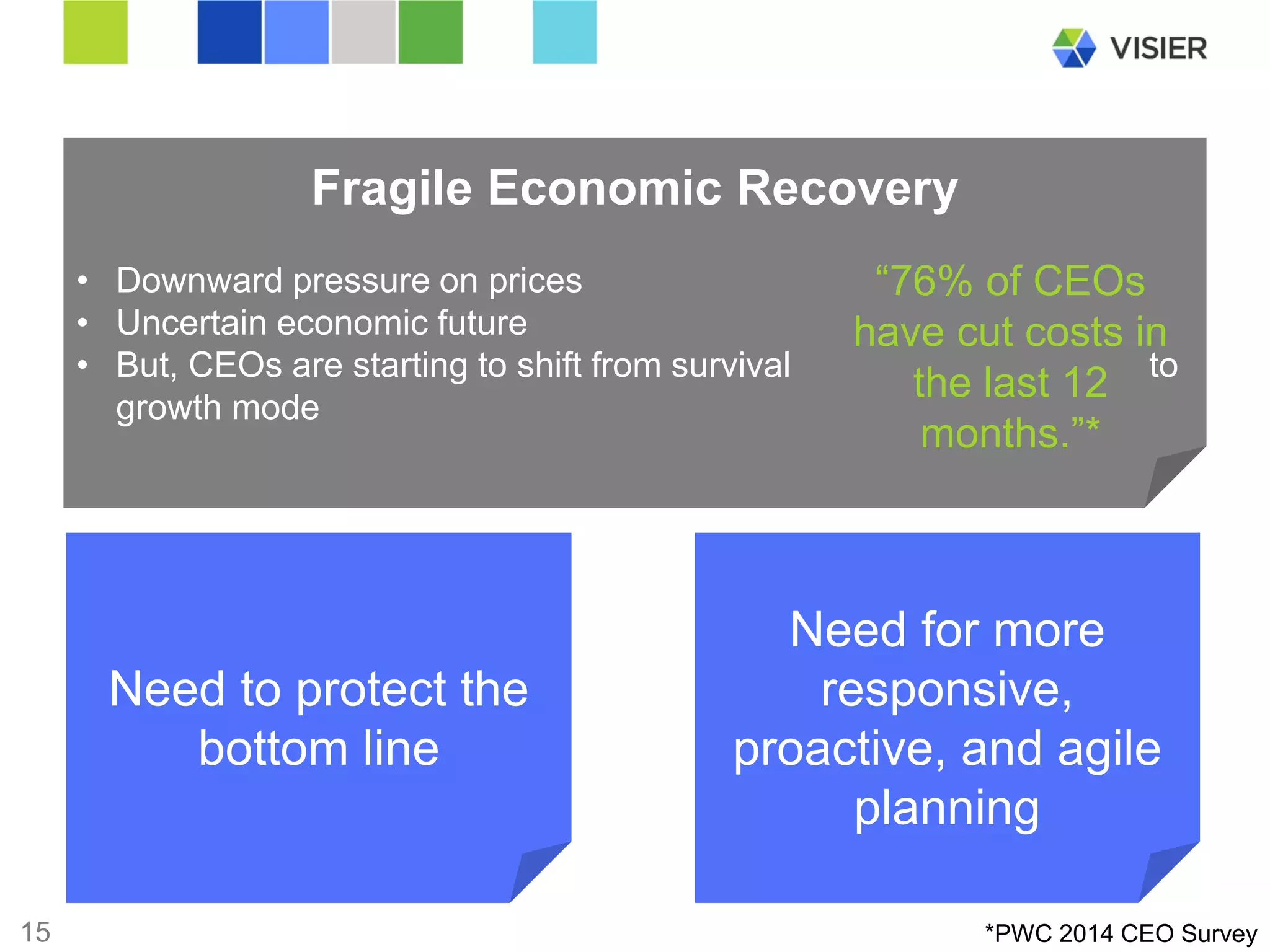
Fragile Economic Recovery 
• 
Downward pressure on prices 
• 
Uncertain economic future 
• 
But, CEOs are starting to shift from survival to growth mode 
“76% of CEOs have cut costs in the last 12 months.”* 
Need to protect the bottom line 
Need for more responsive, proactive, and agile planning 
*PWC 2014 CEO Survey
P1a6ge 16 
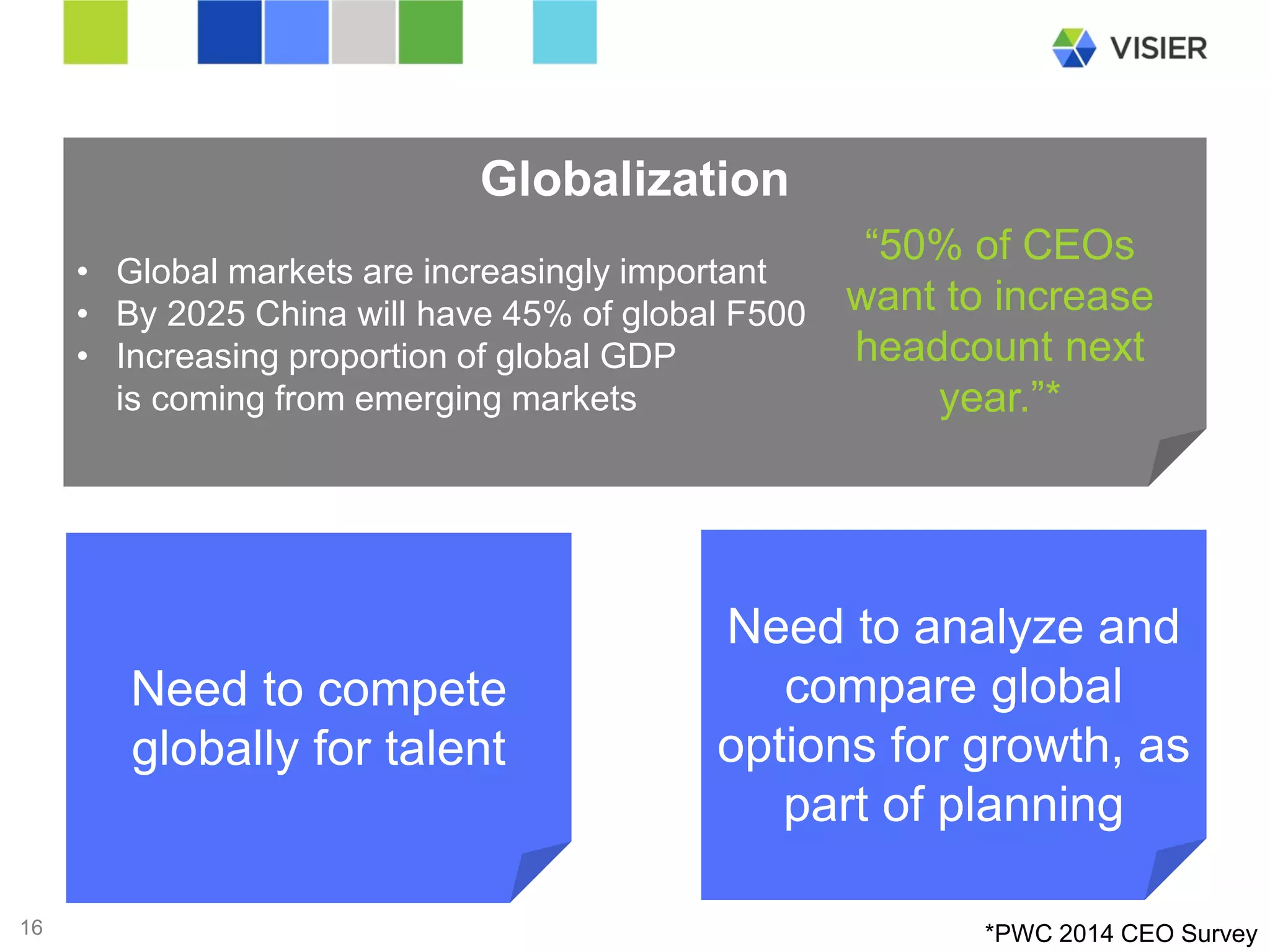
Globalization 
• 
Global markets are increasingly important 
• 
By 2025 China will have 45% of global F500 
• 
Increasing proportion of global GDP is coming from emerging markets 
Need to compete globally for talent 
Need to analyze and compare global options for growth, as part of planning 
“50% of CEOs want to increase headcount next year.”* 
*PWC 2014 CEO Survey
Page 17 
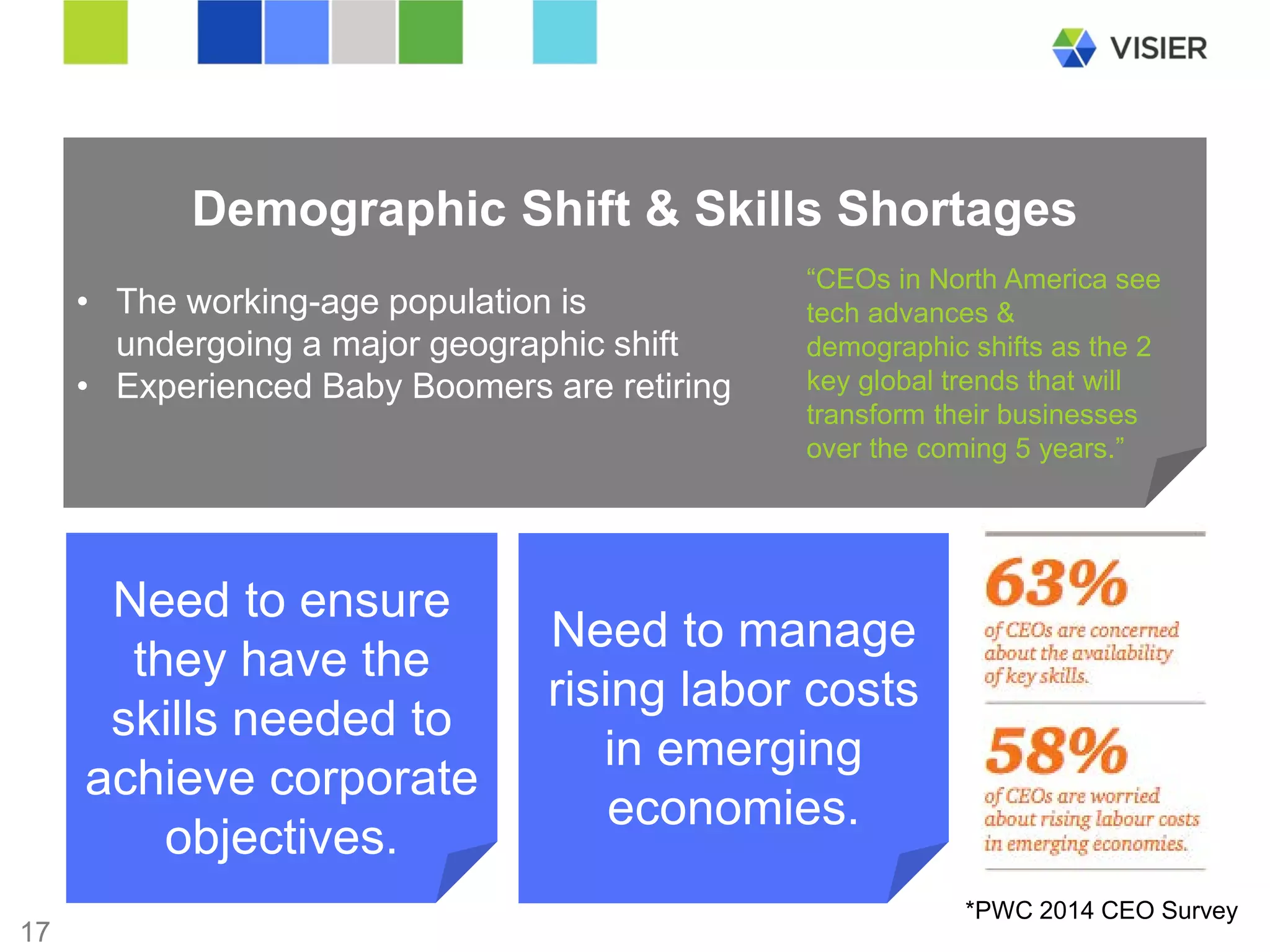
Demographic Shift & Skills Shortages 
• 
The working-age population is undergoing a major geographic shift 
• 
Experienced Baby Boomers are retiring 
“CEOs in North America see tech advances & demographic shifts as the 2 key global trends that will transform their businesses over the coming 5 years.” 
17 
Need to ensure they have the skills needed to achieve corporate objectives. 
Need to manage rising labor costs in emerging economies. 
*PWC 2014 CEO Survey
Page 18 
SUPER FUN AUDIENCE PARTICIPATION TIME! POLL: WHAT IS YOUR COMPANY’S TOP WORKFORCE CONCERN? 
18
Page 19 
1. 
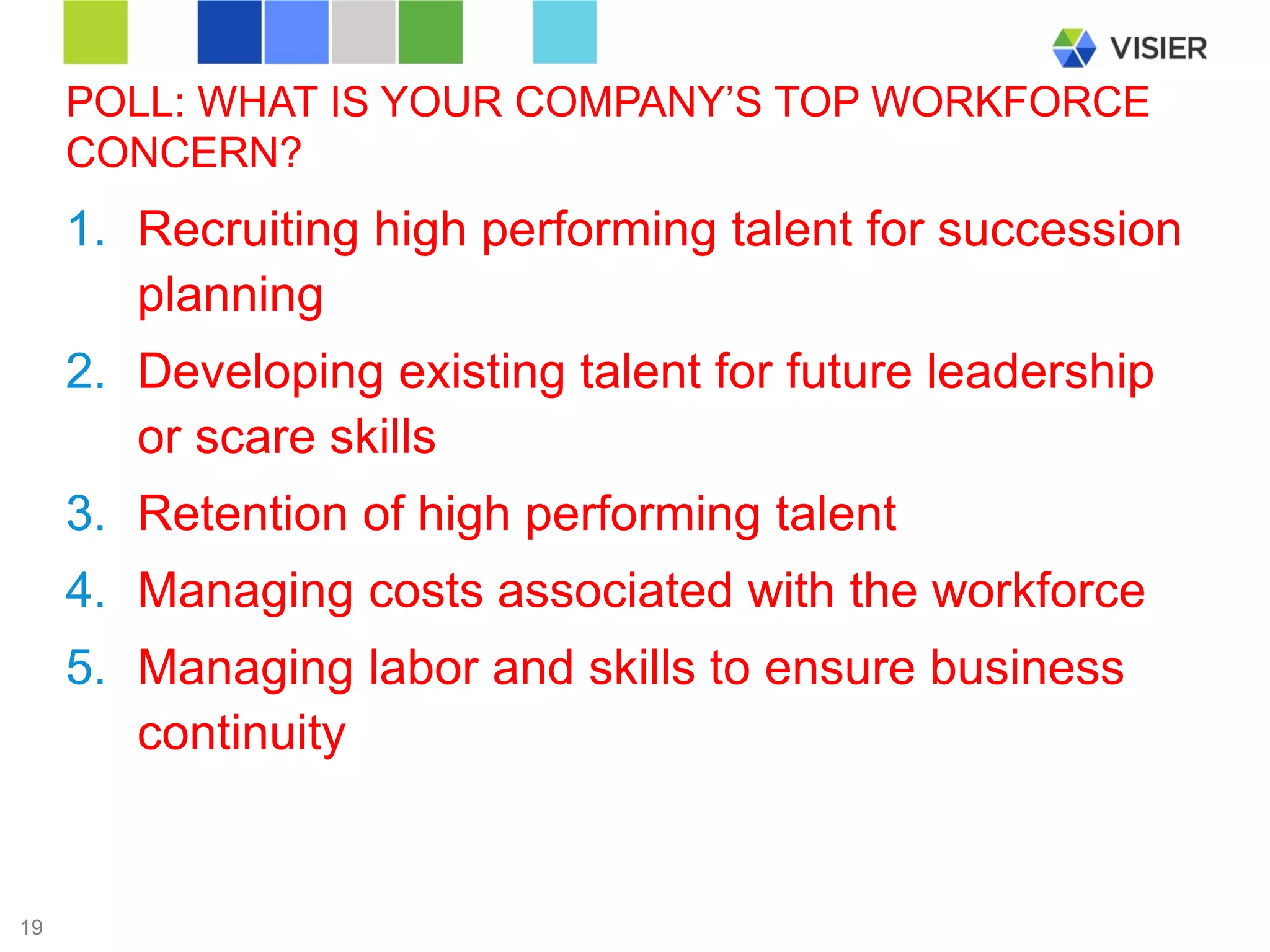
Recruiting high performing talent for succession planning 
2. 
Developing existing talent for future leadership or scare skills 
3. 
Retention of high performing talent 
4. 
Managing costs associated with the workforce 
5. 
Managing labor and skills to ensure business continuity 
POLL: WHAT IS YOUR COMPANY’S TOP WORKFORCE CONCERN? 
19
Page 20 
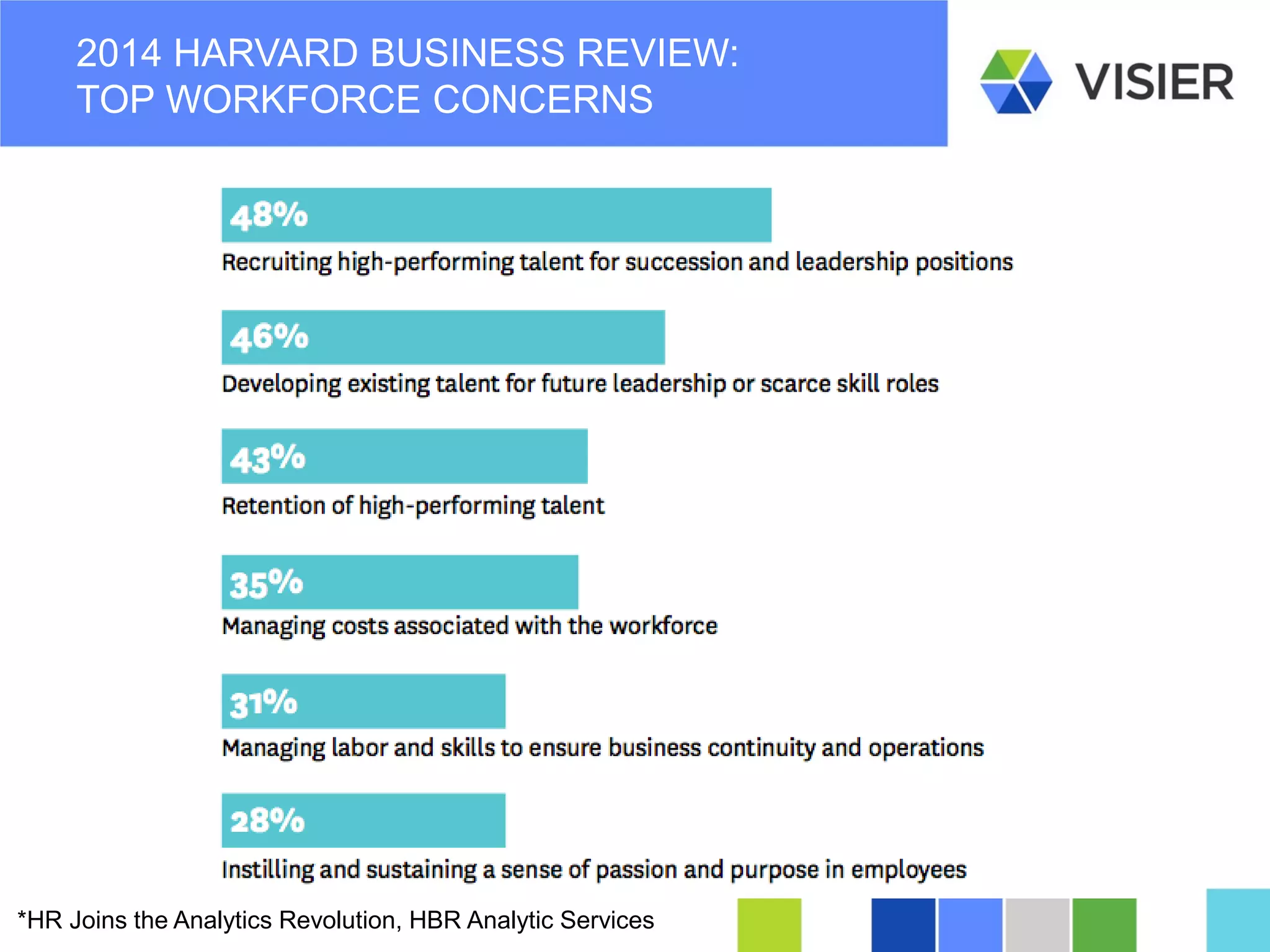
2014 HARVARD BUSINESS REVIEW: TOP WORKFORCE CONCERNS 
*HR Joins the Analytics Revolution, HBR Analytic Services
P2a1ge 21 
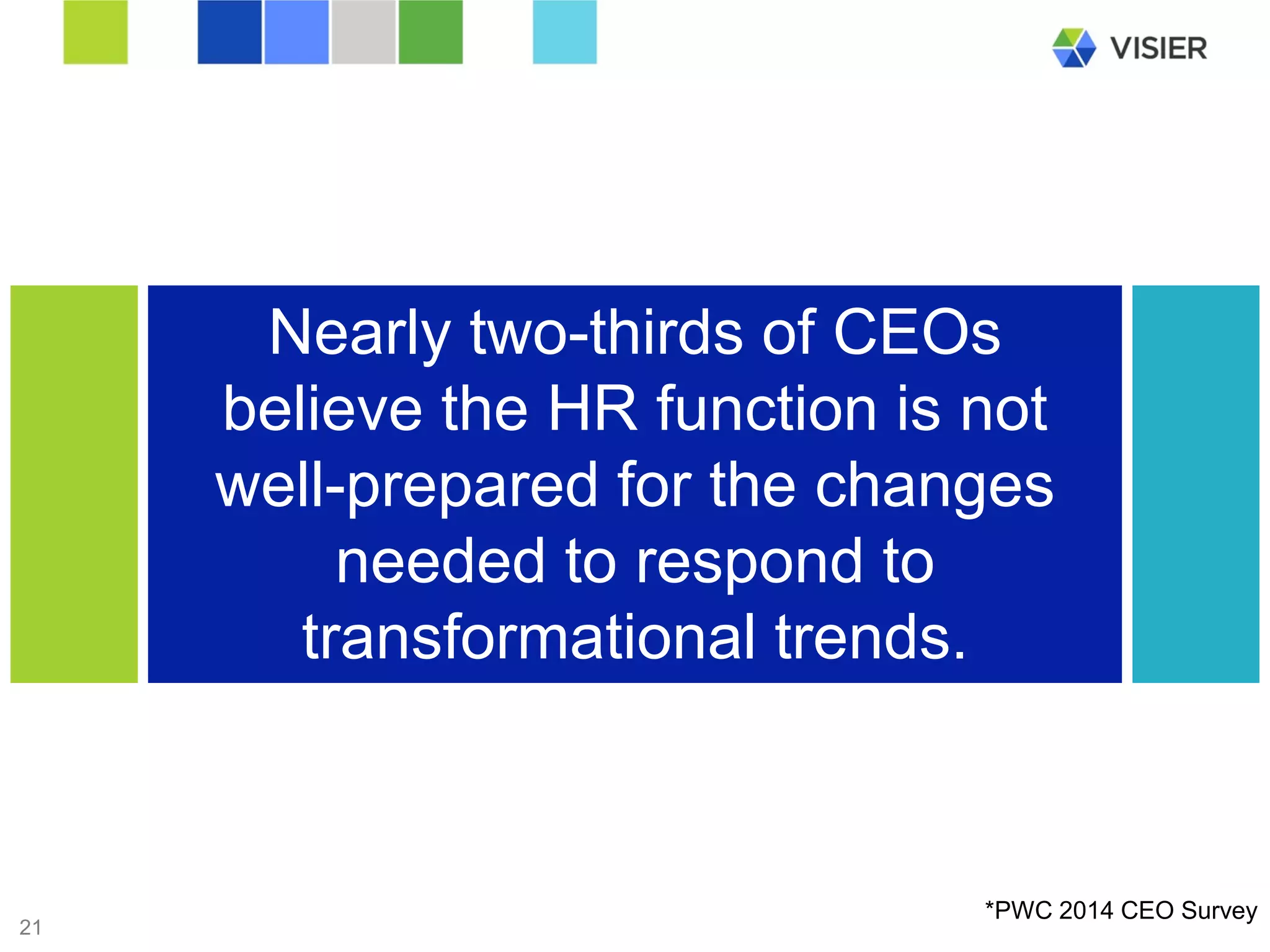
Nearly two-thirds of CEOs believe the HR function is not well-prepared for the changes needed to respond to transformational trends. 
*PWC 2014 CEO Survey
Page 22 
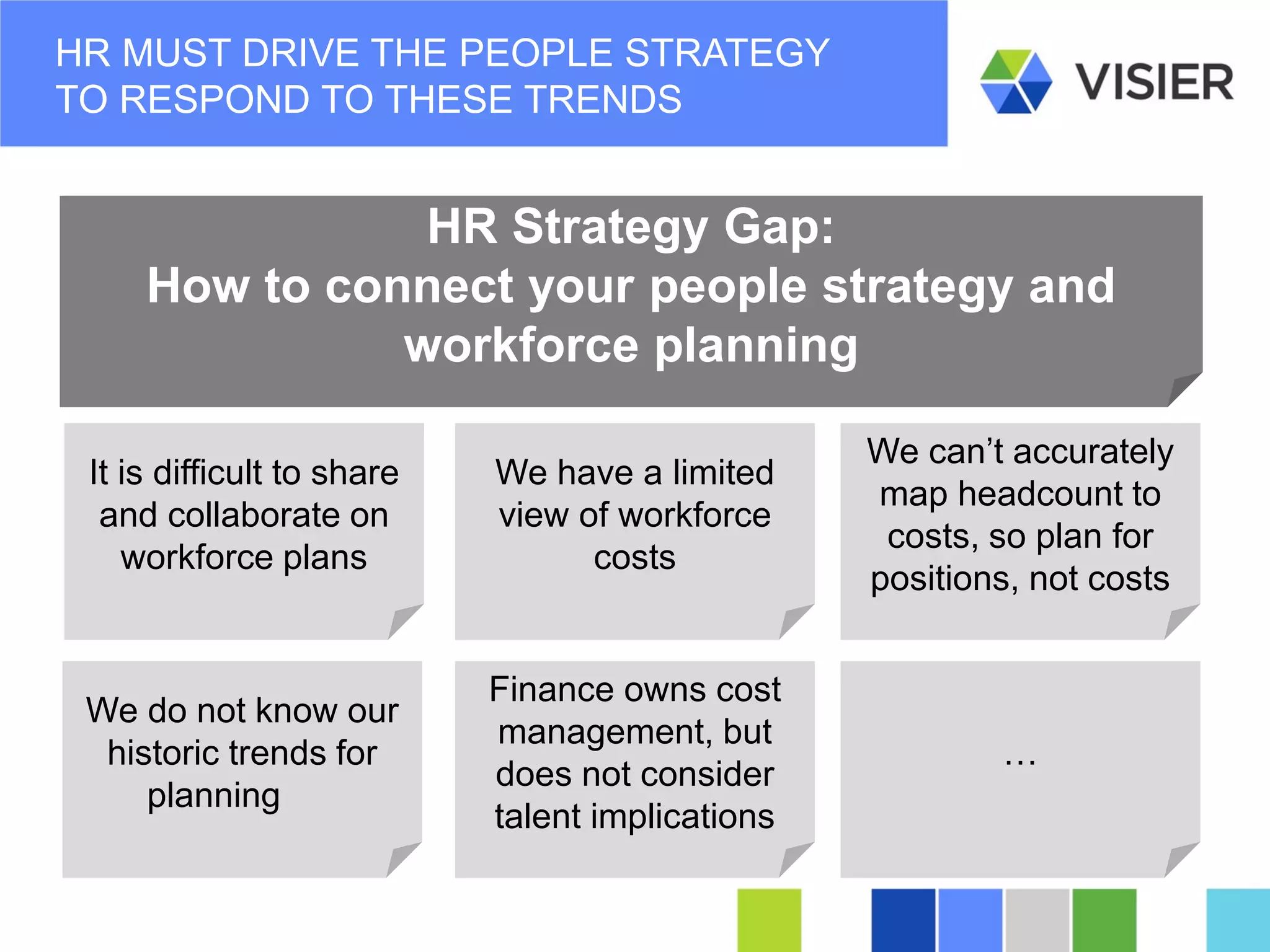
HR MUST DRIVE THE PEOPLE STRATEGY TO RESPOND TO THESE TRENDS 
It is difficult to share and collaborate on workforce plans 
We have a limited view of workforce costs 
We can’t accurately map headcount to costs, so plan for positions, not costs 
HR Strategy Gap: 
How to connect your people strategy and workforce planning 
We do not know our historic trends for planning 
Finance owns cost management, but does not consider talent implications 
…
Page 23 
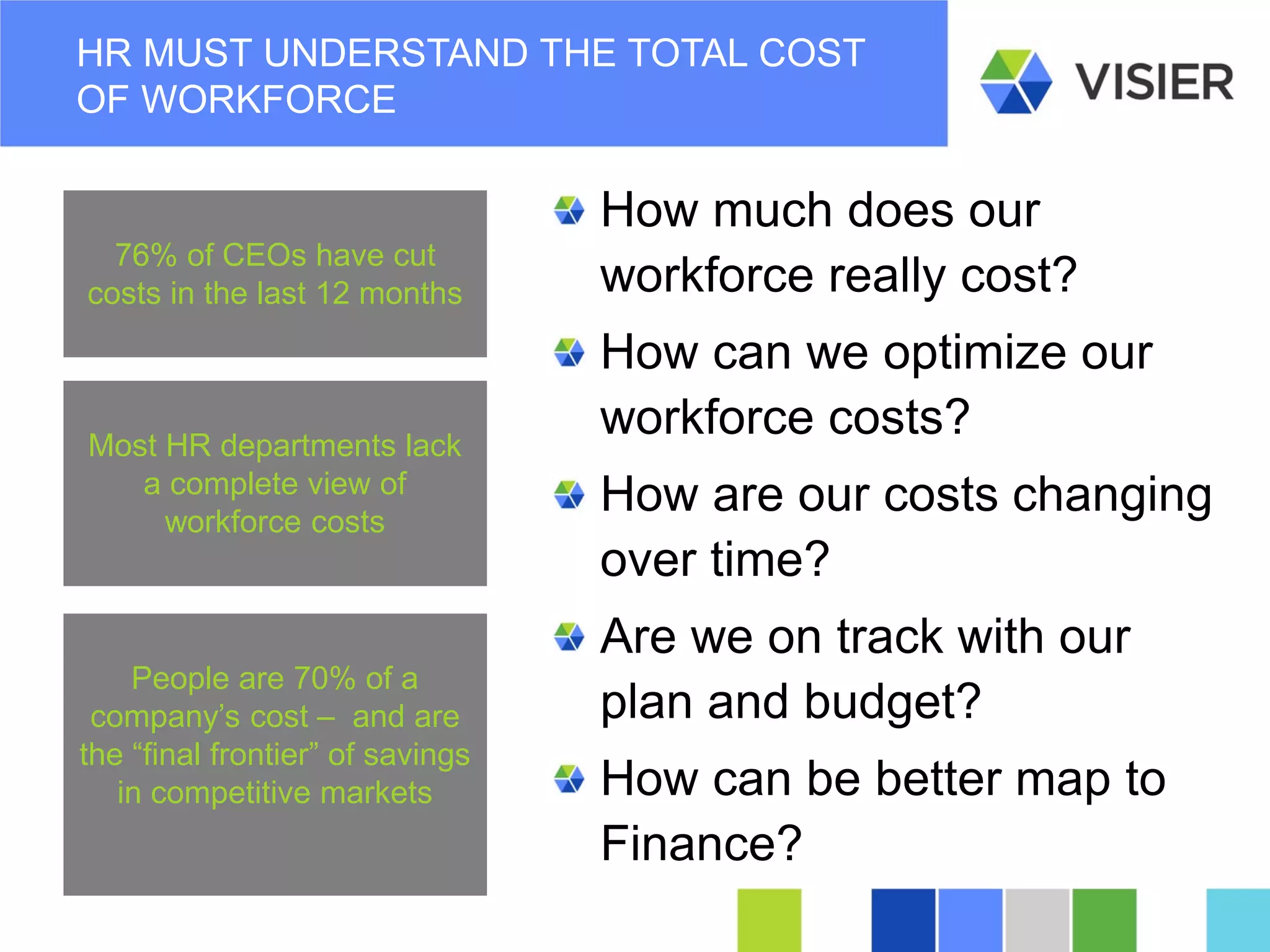
HR MUST UNDERSTAND THE TOTAL COST OF WORKFORCE 
How much does our workforce really cost? 
How can we optimize our workforce costs? 
How are our costs changing over time? 
Are we on track with our plan and budget? 
How can be better map to Finance? 
Most HR departments lack a complete view of workforce costs 
76% of CEOs have cut costs in the last 12 months 
People are 70% of a company’s cost – and are the “final frontier” of savings in competitive markets
Page 24 
Effective Workforce Planning: The BIG Concepts that Return Value
Page 25 
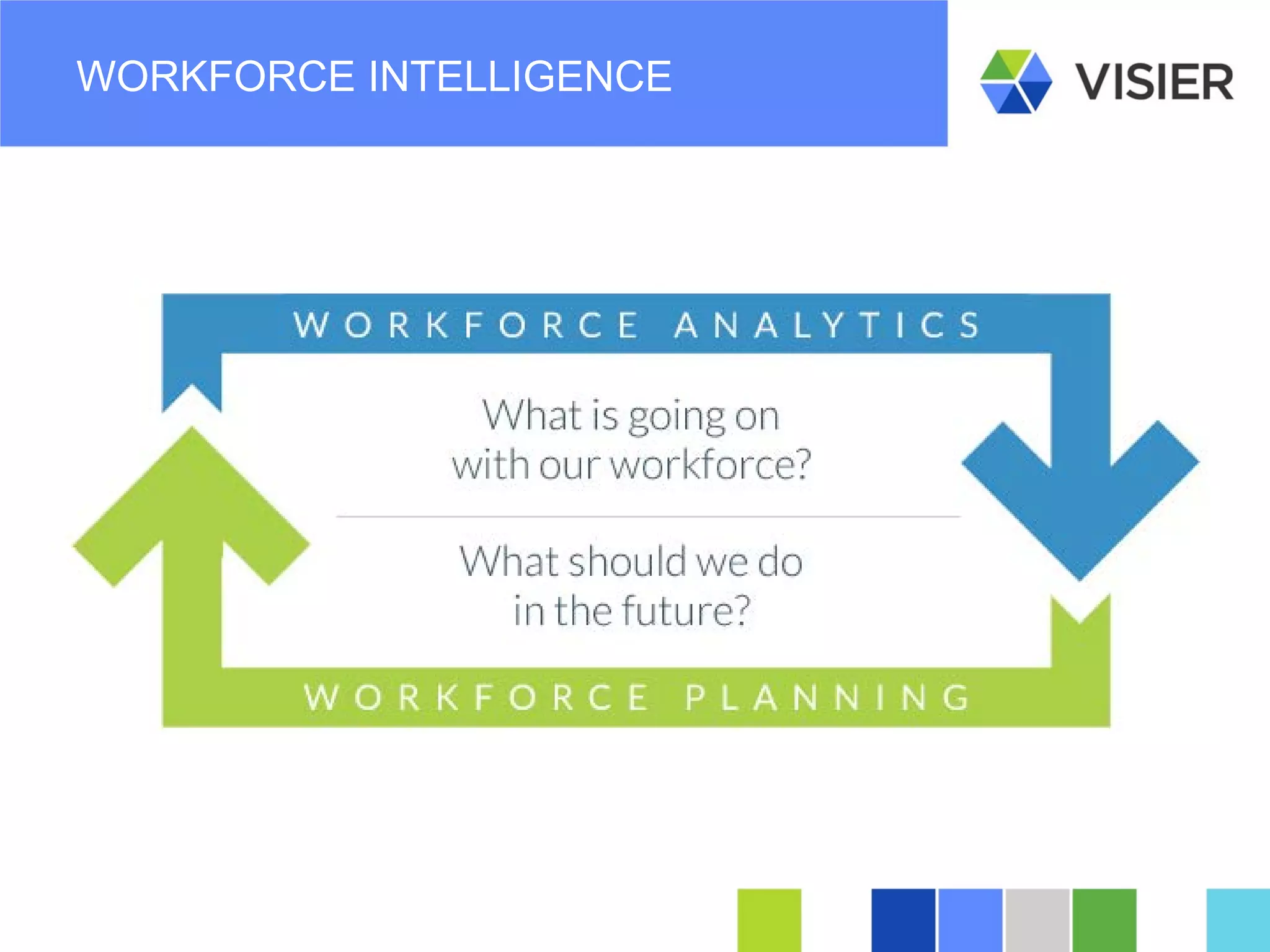
WORKFORCE INTELLIGENCE
Page 26 
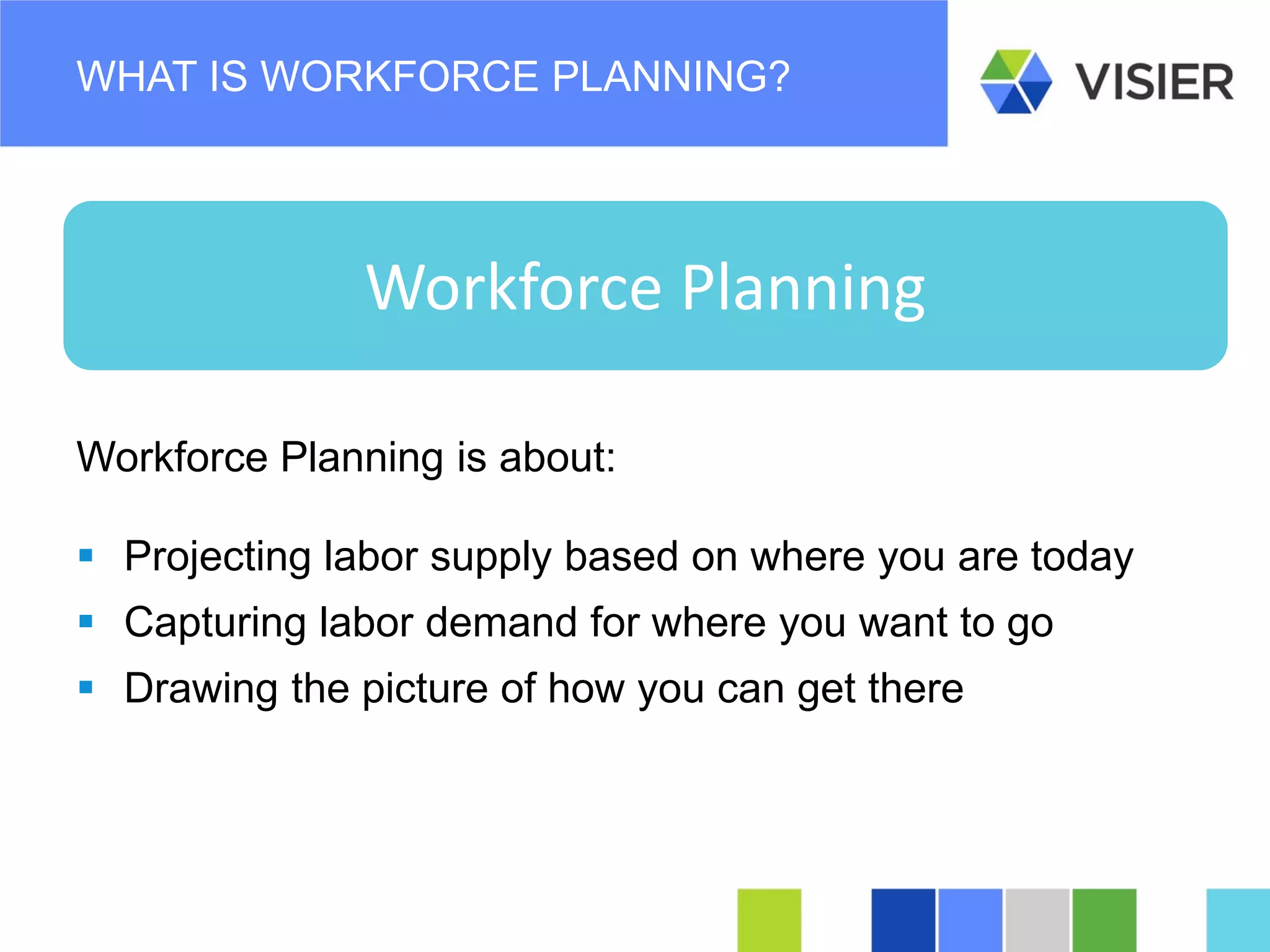
WHAT IS WORKFORCE PLANNING? 
Workforce Planning 
Workforce Planning is about: 
Projecting labor supply based on where you are today 
Capturing labor demand for where you want to go 
Drawing the picture of how you can get there
Page 27 
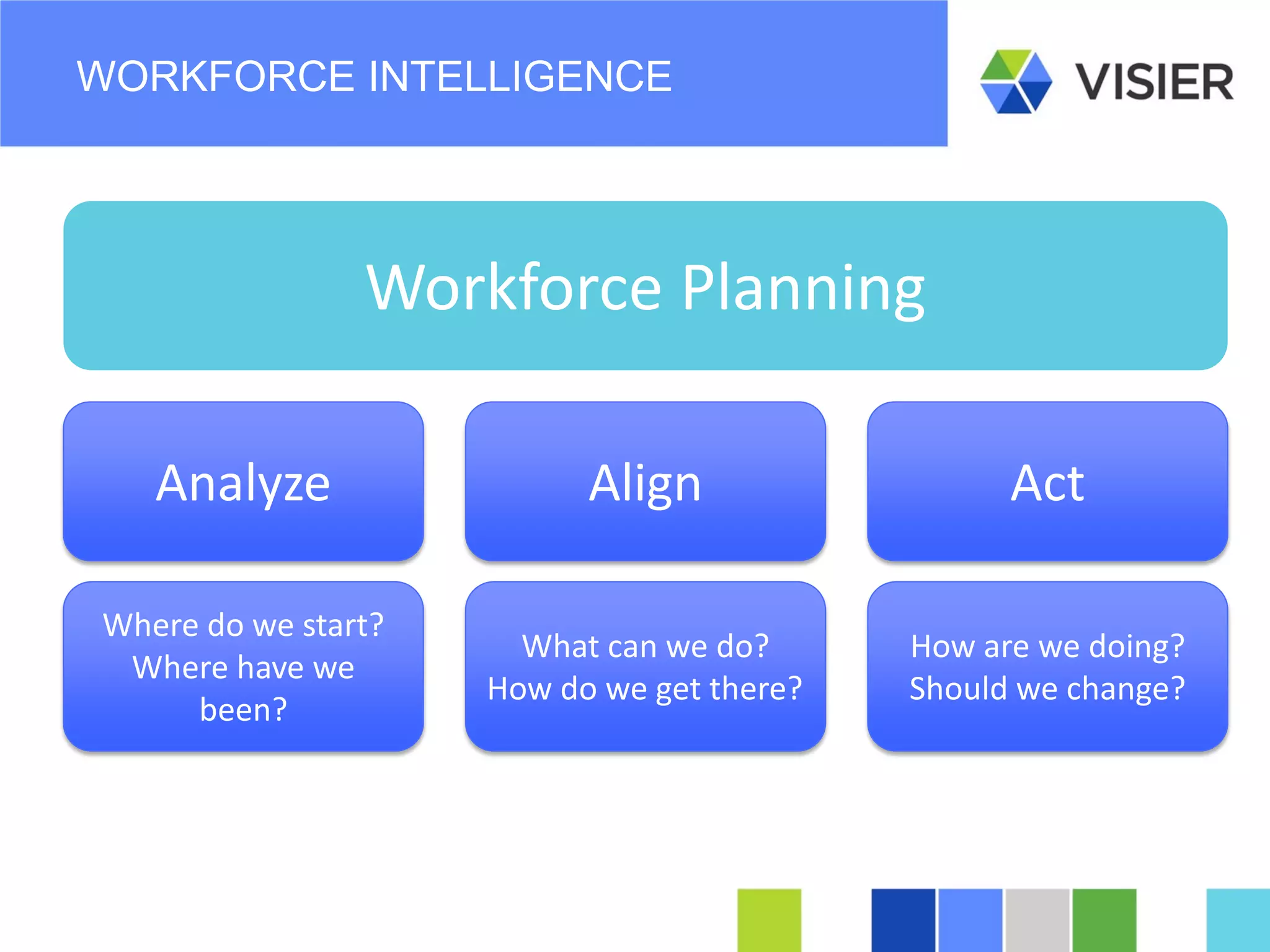
WORKFORCE INTELLIGENCE 
Analyze 
Align 
Act 
Where do we start? Where have we been? 
What can we do? How do we get there? 
How are we doing? Should we change? 
Workforce Planning
Page 28 
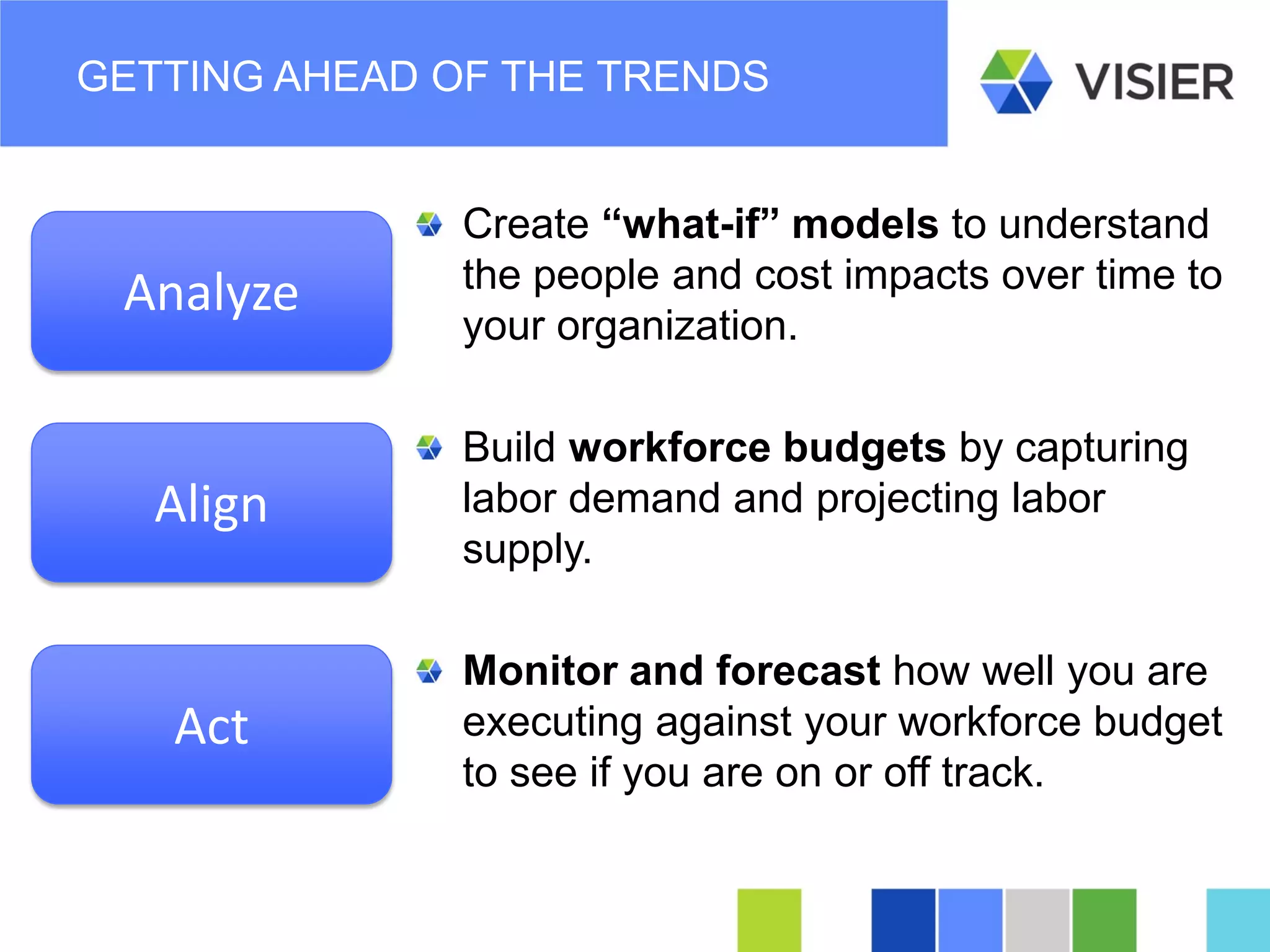
GETTING AHEAD OF THE TRENDS 
Create “what-if” models to understand the people and cost impacts over time to your organization. 
Build workforce budgets by capturing labor demand and projecting labor supply. 
Monitor and forecast how well you are executing against your workforce budget to see if you are on or off track. 
Analyze 
Align 
Act
Page 29 
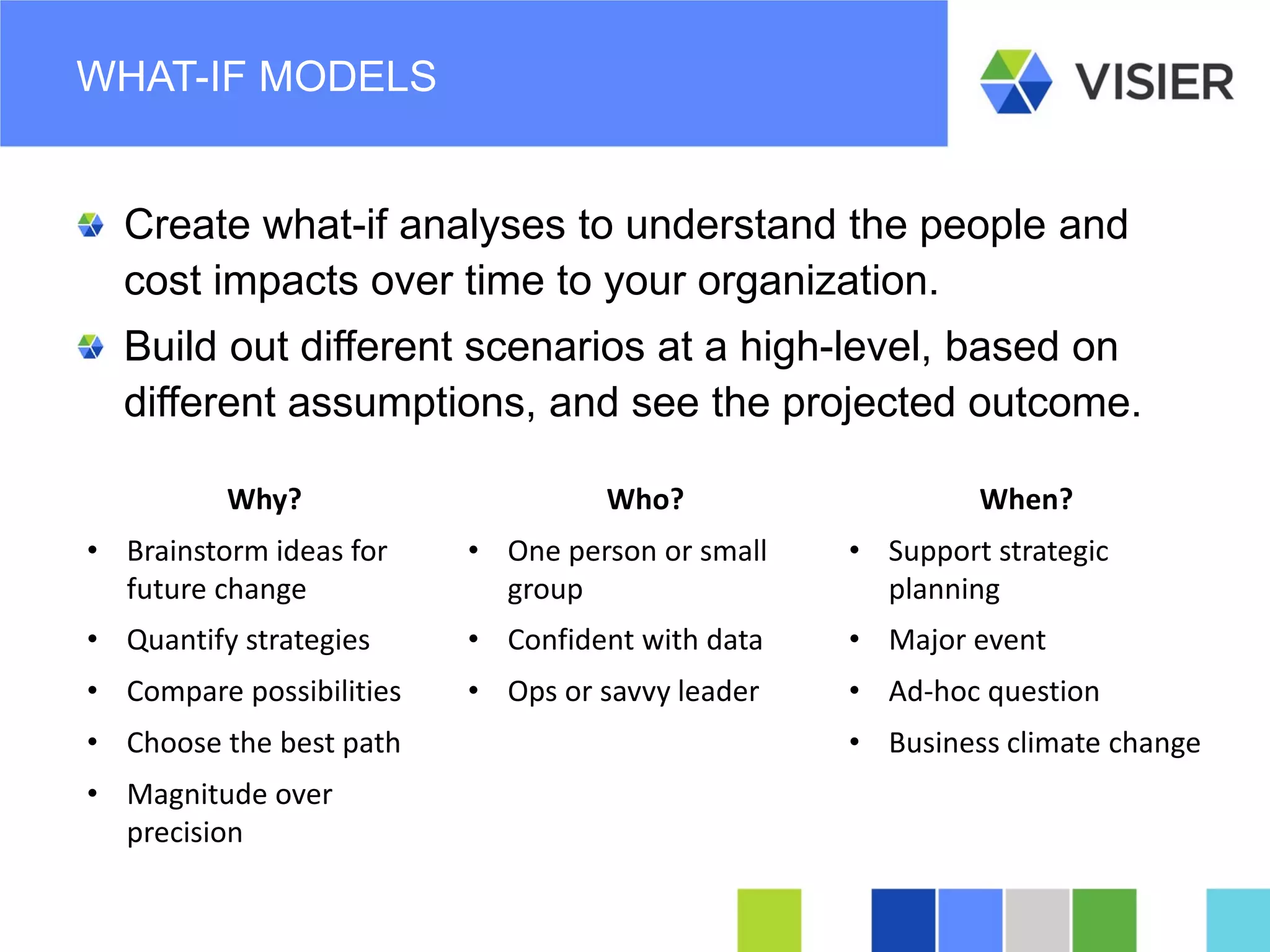
WHAT-IF MODELS 
Create what-if analyses to understand the people and cost impacts over time to your organization. 
Build out different scenarios at a high-level, based on different assumptions, and see the projected outcome. 
Why? 
Who? 
When? 
• 
Brainstorm ideas for future change 
• 
One person or small group 
• 
Support strategic planning 
• 
Quantify strategies 
• 
Confident with data 
• 
Major event 
• 
Compare possibilities 
• 
Ops or savvy leader 
• 
Ad-hoc question 
• 
Choose the best path 
•Business climate change 
• 
Magnitude over precision
Page 30 
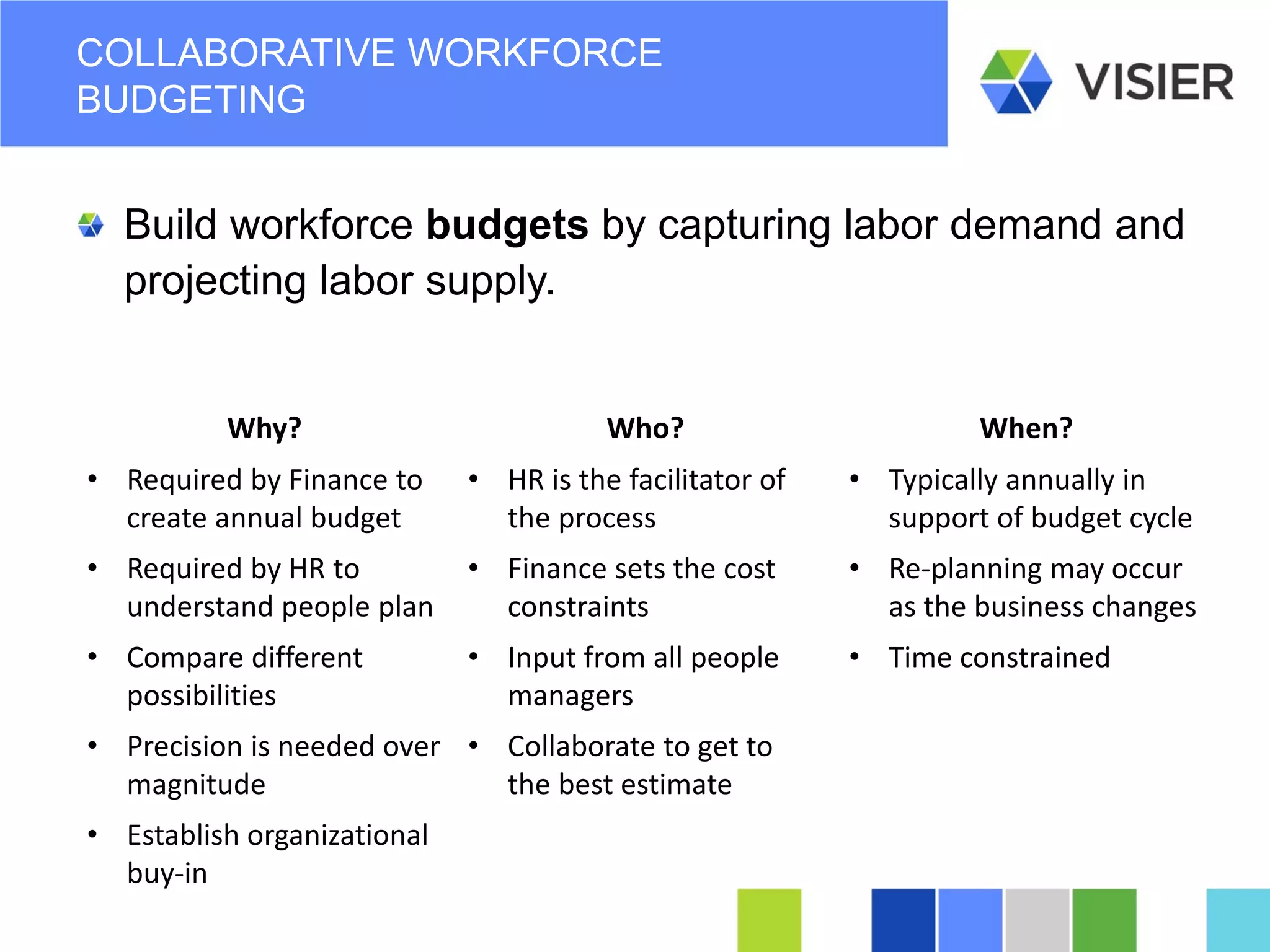
COLLABORATIVE WORKFORCE BUDGETING 
Build workforce budgets by capturing labor demand and projecting labor supply. 
Why? 
Who? 
When? 
• 
Required by Finance to create annual budget 
• 
HR is the facilitator of the process 
• 
Typically annually in support of budget cycle 
• 
Required by HR to understand people plan 
• 
Finance sets the cost constraints 
• 
Re-planning may occur as the business changes 
• 
Compare different possibilities 
• 
Input from all people managers 
• 
Time constrained 
• 
Precision is needed over magnitude 
• 
Collaborate to get to the best estimate 
• 
Establish organizational buy-in
Page 31 
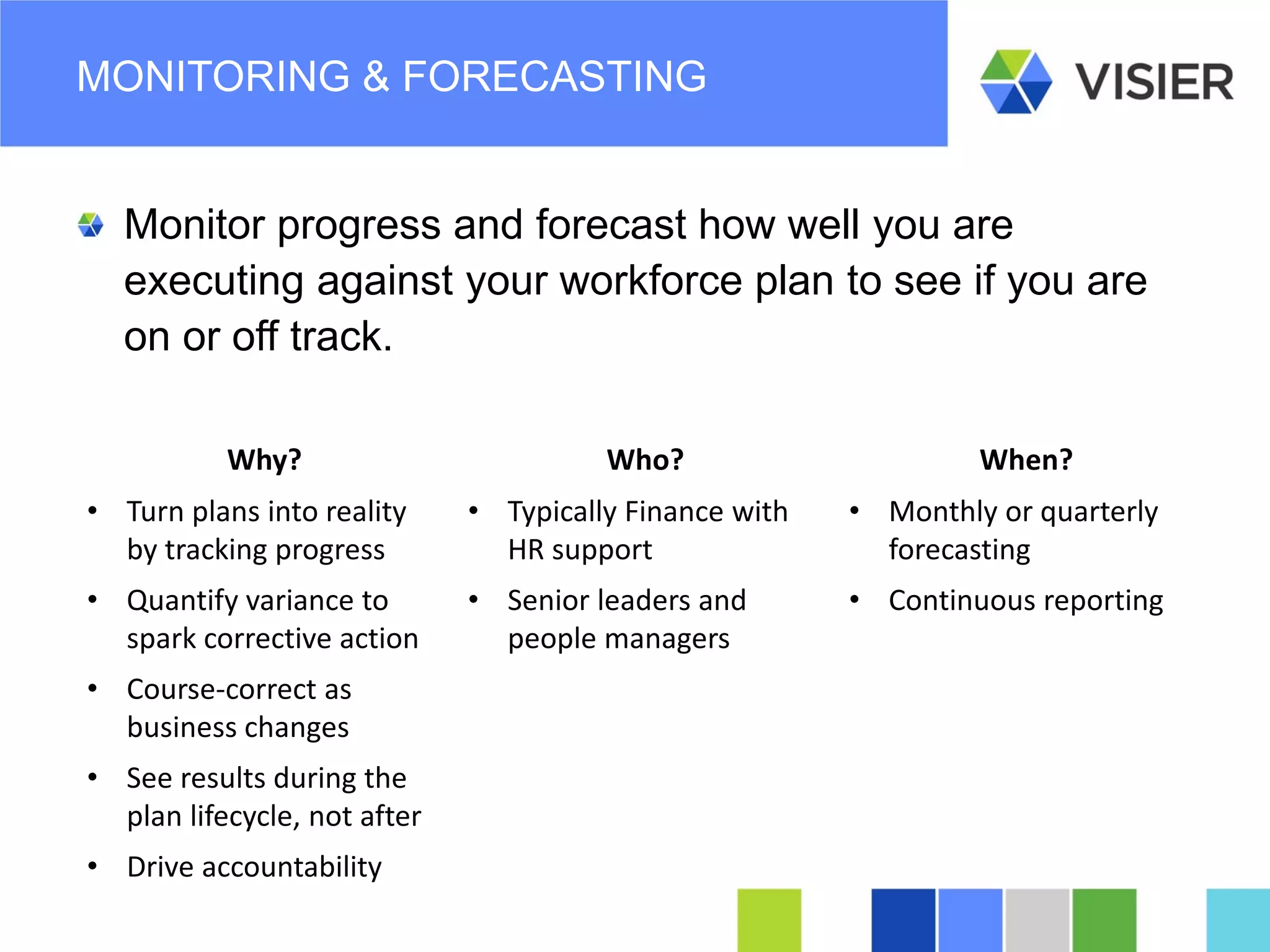
MONITORING & FORECASTING 
Monitor progress and forecast how well you are executing against your workforce plan to see if you are on or off track. 
Why? 
Who? 
When? 
• 
Turn plans into reality by tracking progress 
• 
Typically Finance with HR support 
• 
Monthly or quarterly forecasting 
• 
Quantify variance to spark corrective action 
• 
Senior leaders and people managers 
• 
Continuous reporting 
• 
Course-correct as business changes 
• 
See results during the plan lifecycle, not after 
• 
Drive accountability
Page 32 
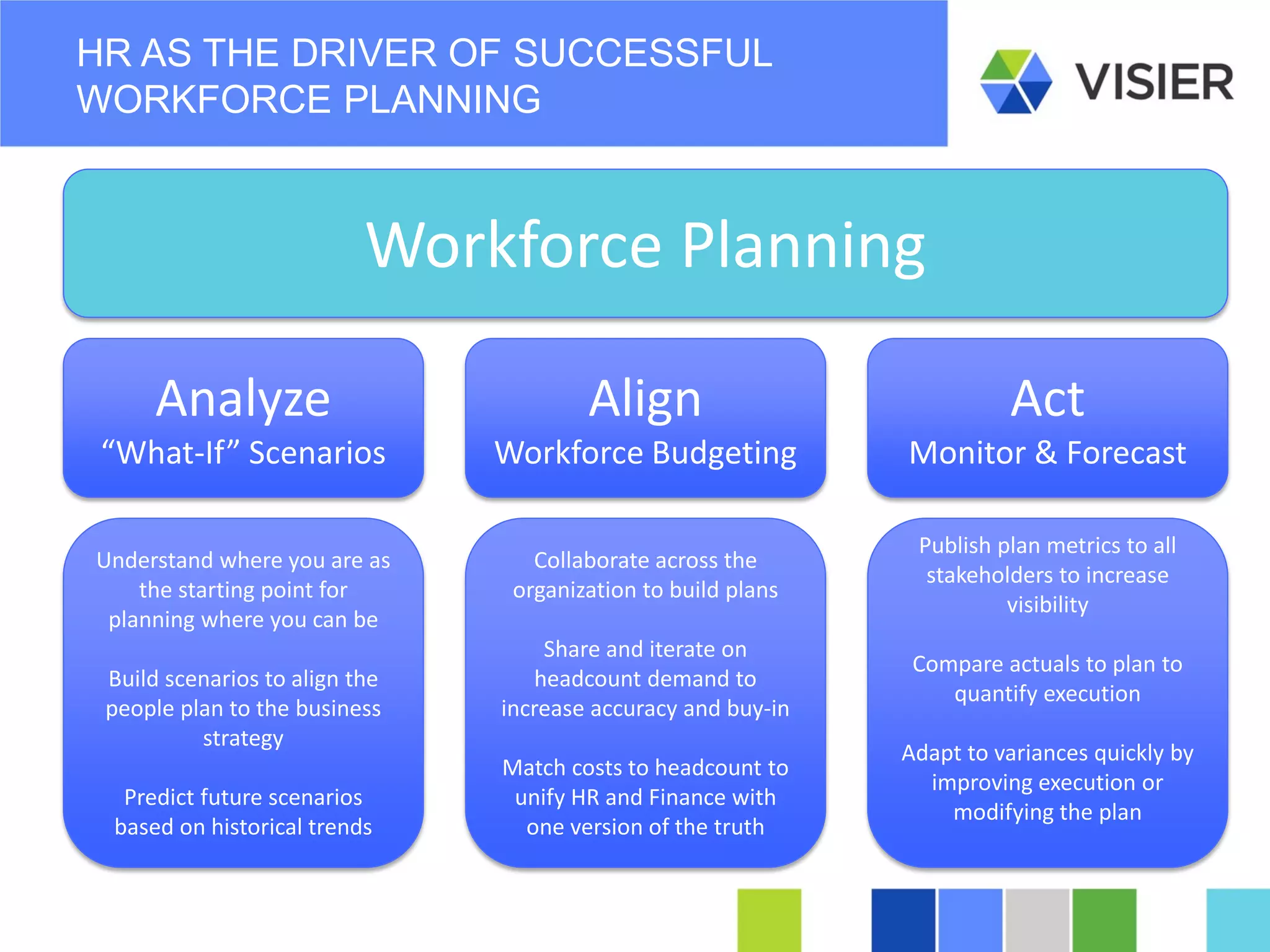
HR AS THE DRIVER OF SUCCESSFUL WORKFORCE PLANNING 
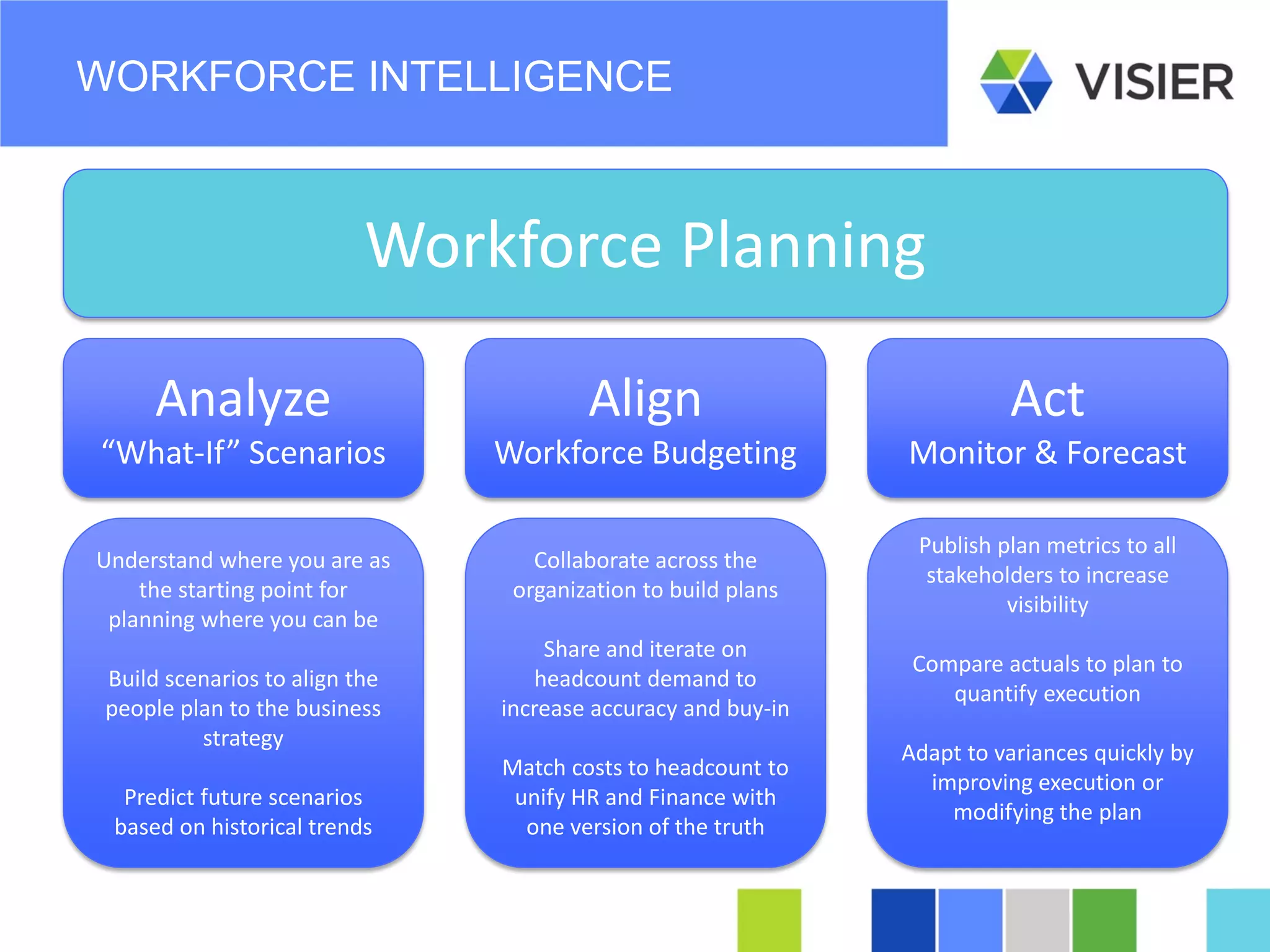
Workforce Planning 
Analyze “What-If” Scenarios 
Align Workforce Budgeting 
Act 
Monitor & Forecast 
Understand where you are as the starting point for planning where you can be Build scenarios to align the people plan to the business strategy Predict future scenarios based on historical trends 
Collaborate across the organization to build plans Share and iterate on headcount demand to increase accuracy and buy-in Match costs to headcount to unify HR and Finance with one version of the truth 
Publish plan metrics to all stakeholders to increase visibility 
Compare actuals to plan to quantify execution 
Adapt to variances quickly by improving execution or modifying the plan
Page 33 
Transforming Workforce Planning: Driven by HR
Page 34 
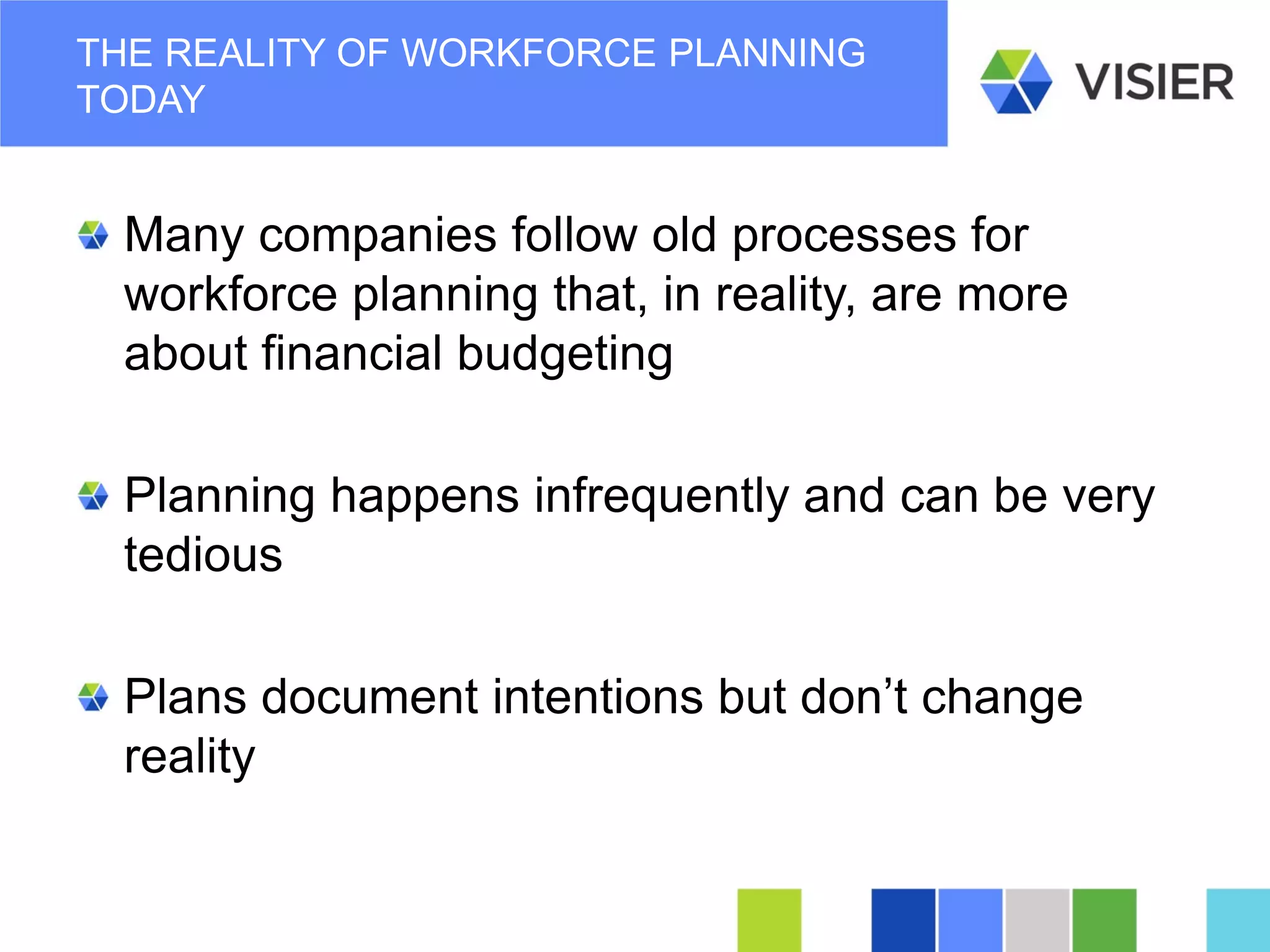
THE REALITY OF WORKFORCE PLANNING TODAY 
Many companies follow old processes for workforce planning that, in reality, are more about financial budgeting 
Planning happens infrequently and can be very tedious 
Plans document intentions but don’t change reality
Page 35 
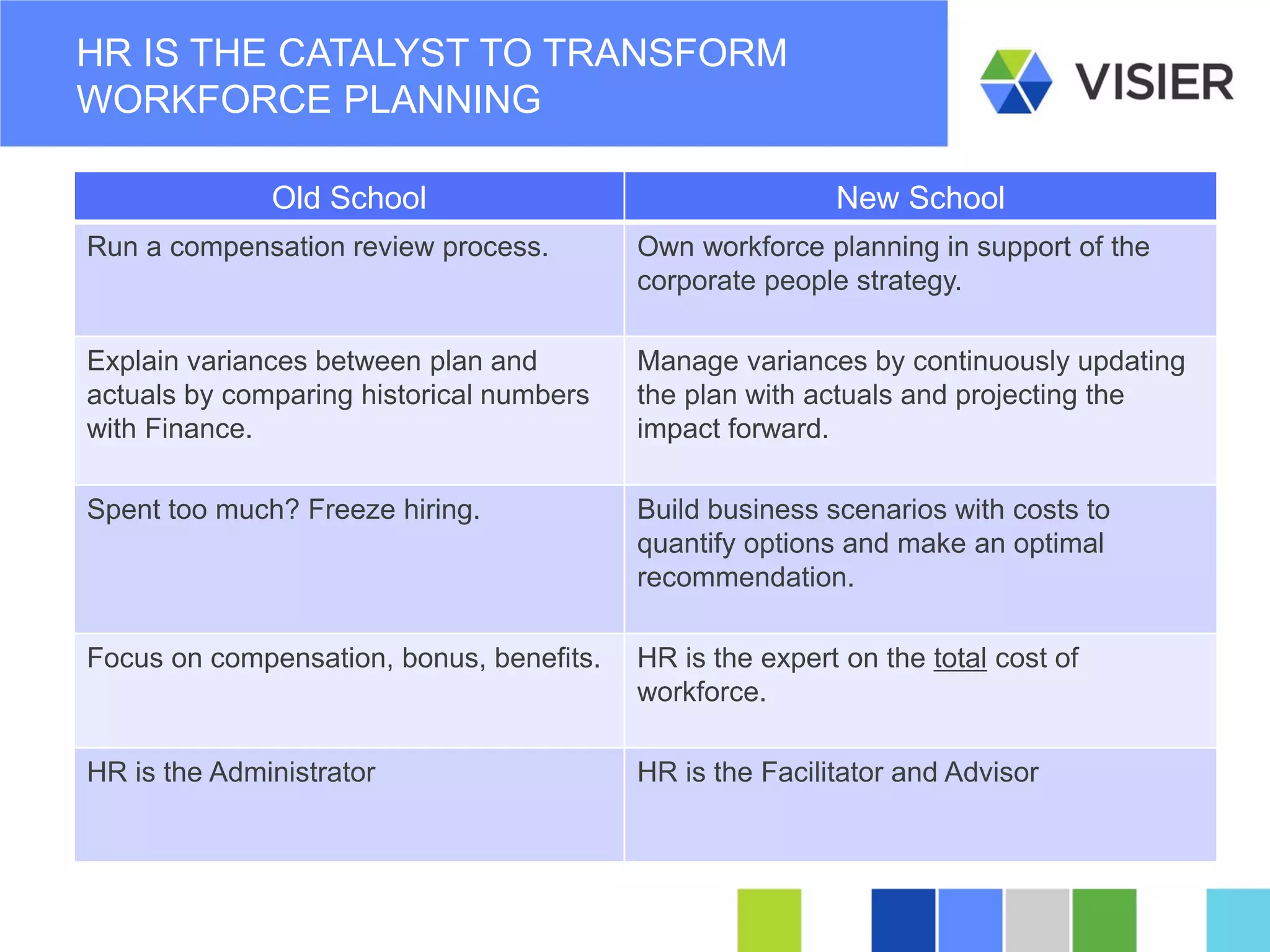
Old School 
New School 
Run a compensation review process. 
Own workforce planning in support of the corporate people strategy. 
Explain variances between plan and actuals by comparing historical numbers with Finance. 
Manage variances by continuously updating the plan with actuals and projecting the impact forward. 
Spent too much? Freeze hiring. 
Build business scenarios with costs to quantify options and make an optimal recommendation. 
Focus on compensation, bonus, benefits. 
HR is the expert on the total cost of workforce. 
HR is the Administrator 
HR is the Facilitator and Advisor 
HR IS THE CATALYST TO TRANSFORM WORKFORCE PLANNING
Page 36 
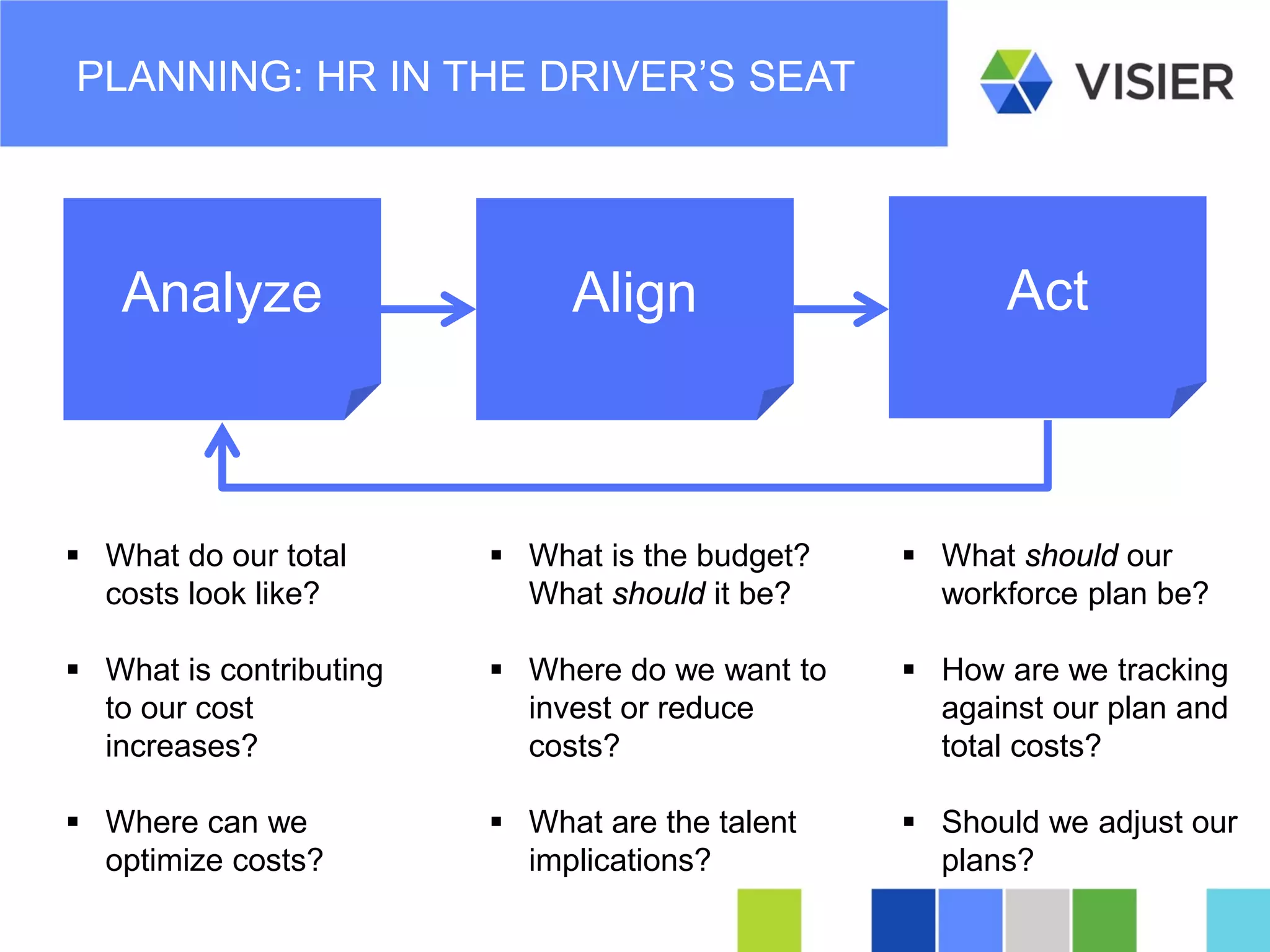
PLANNING: HR IN THE DRIVER’S SEAT 
Analyze 
Align 
Act 
 
What do our total costs look like? 
 
What is contributing to our cost increases? 
 
Where can we optimize costs? 
 
What is the budget? What should it be? 
 
Where do we want to invest or reduce costs? 
 
What are the talent implications? 
 
What should our workforce plan be? 
 
How are we tracking against our plan and total costs? 
 
Should we adjust our plans?
Page 37 
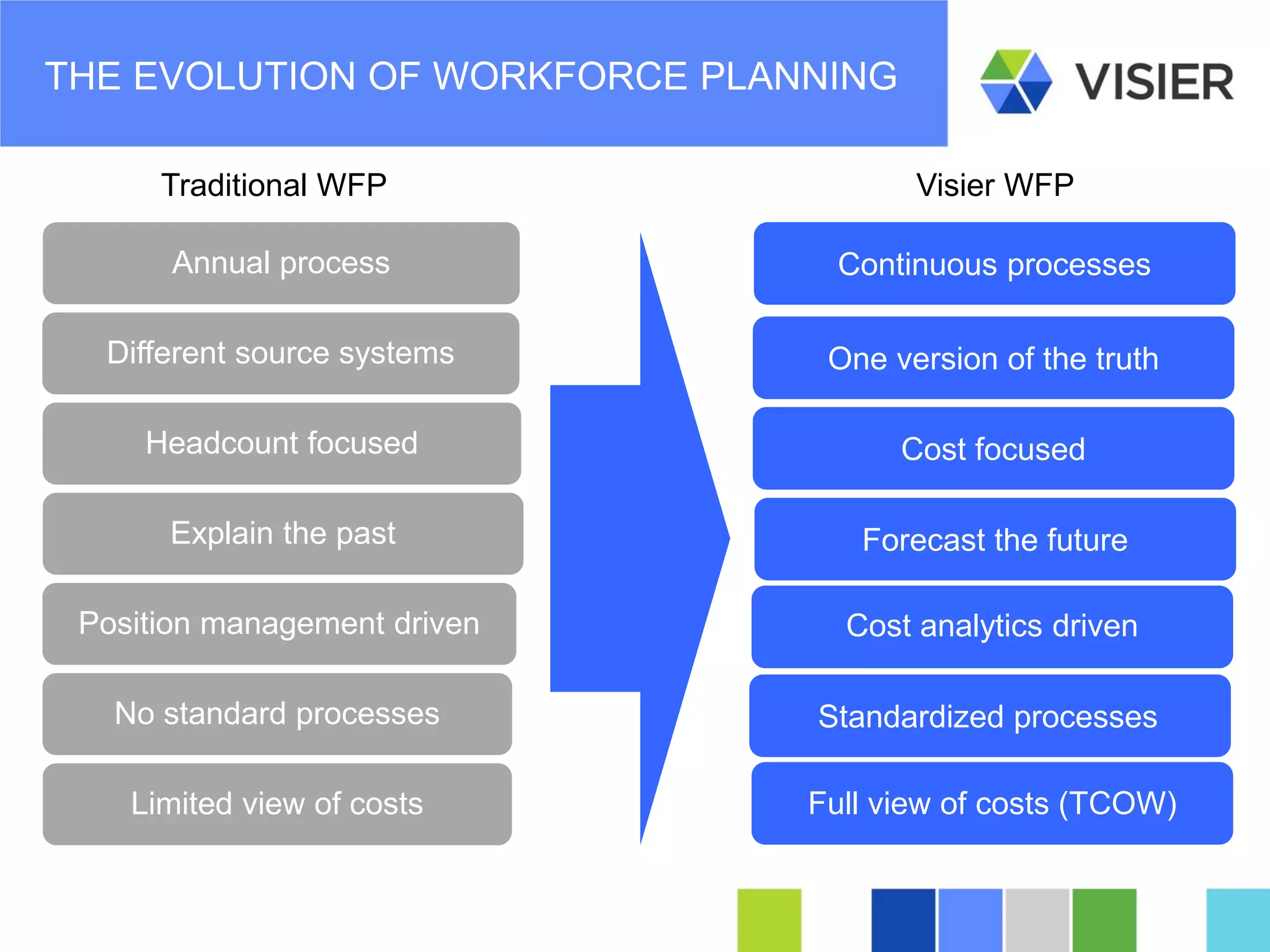
THE EVOLUTION OF WORKFORCE PLANNING 
Annual process 
Different source systems 
Headcount focused 
Explain the past 
Position management driven 
No standard processes 
Limited view of costs 
Continuous processes 
One version of the truth 
Cost focused 
Forecast the future 
Cost analytics driven 
Standardized processes 
Full view of costs (TCOW) 
Traditional WFP 
Visier WFP
Page 38 
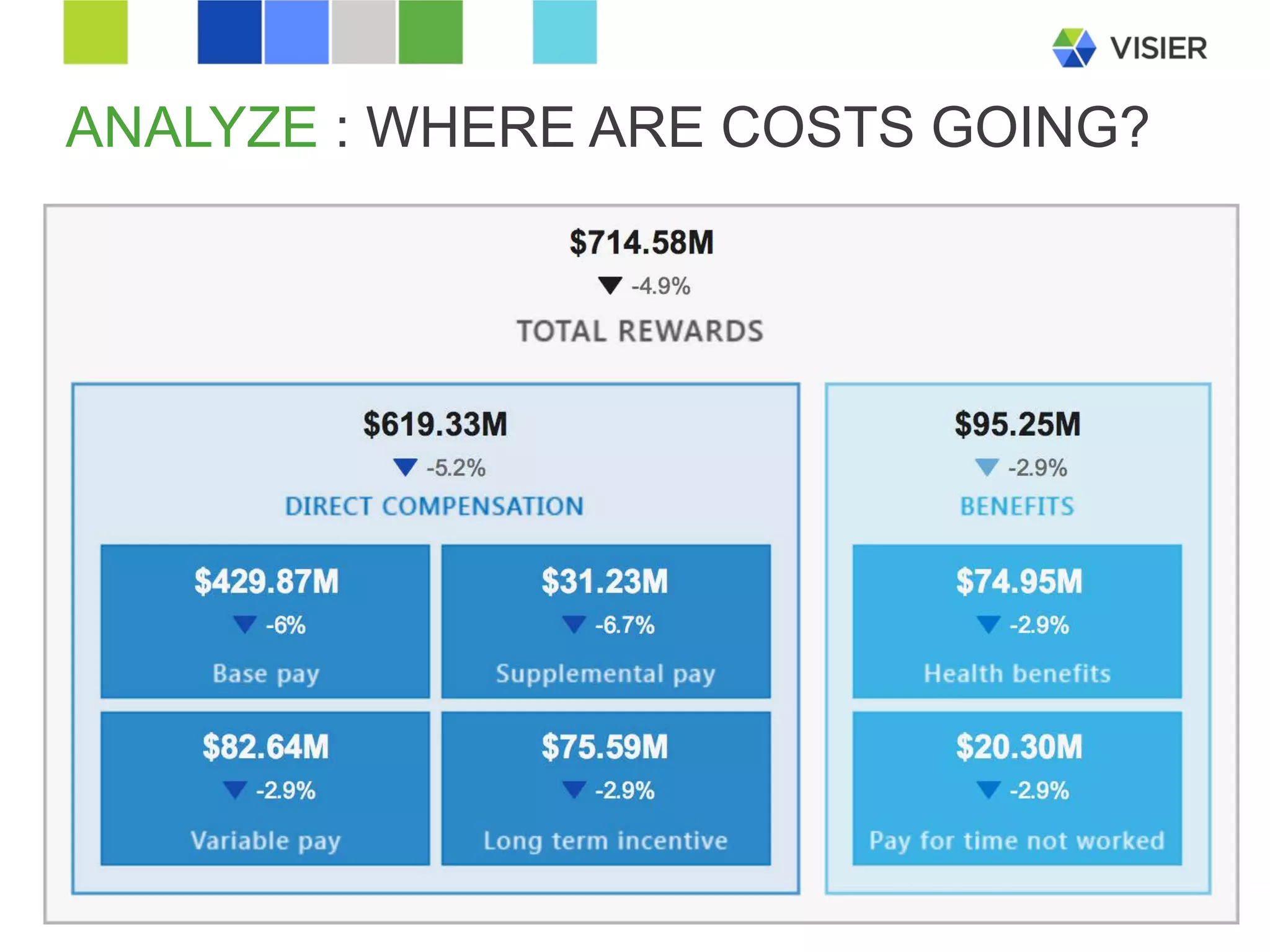
ANALYZE : WHERE ARE COSTS GOING?
P3a9ge 39 
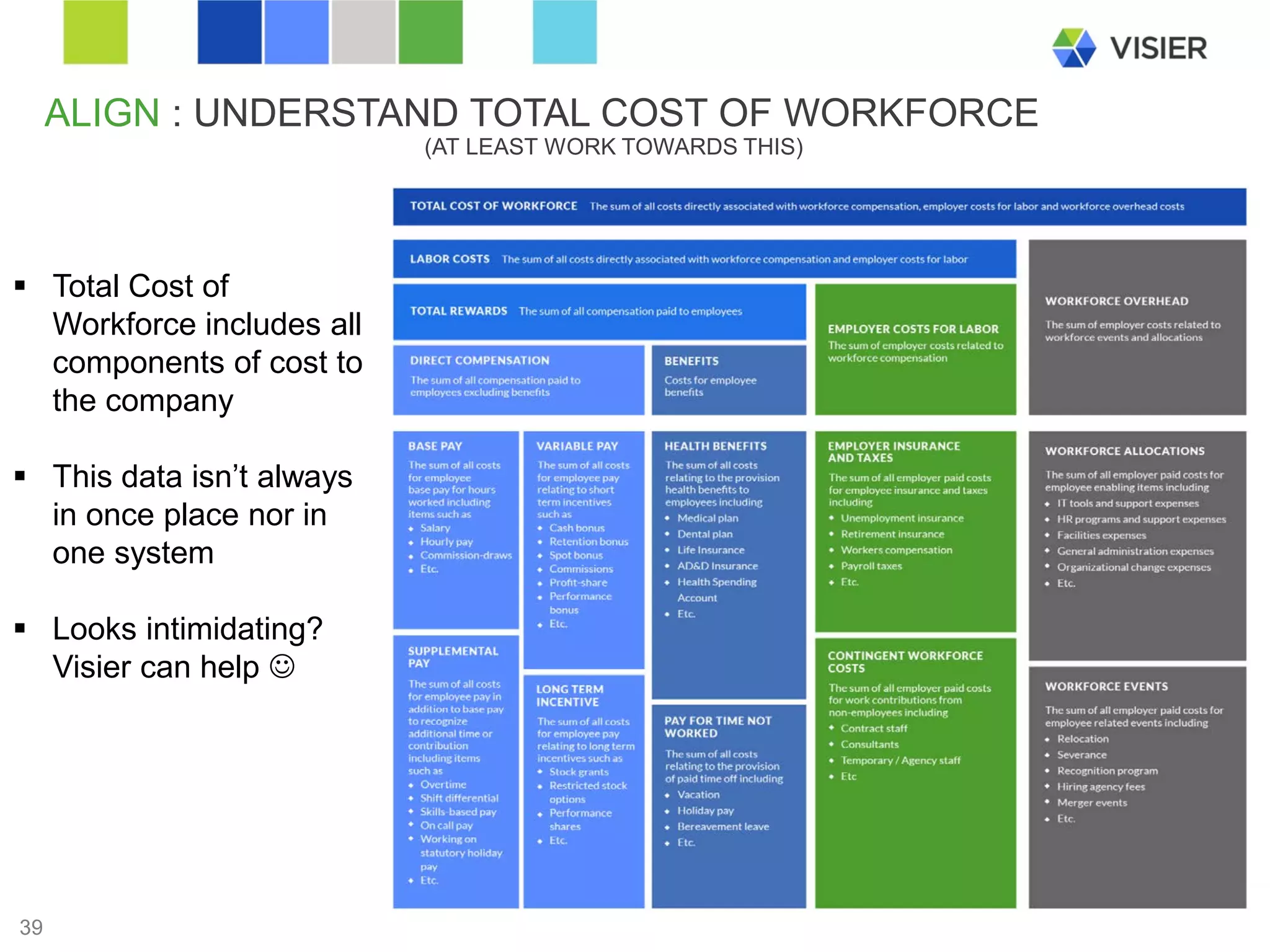
ALIGN : UNDERSTAND TOTAL COST OF WORKFORCE 
(AT LEAST WORK TOWARDS THIS) 
 
Total Cost of Workforce includes all components of cost to the company 
 
This data isn’t always in once place nor in one system 
 
Looks intimidating? Visier can help 
Page 40 
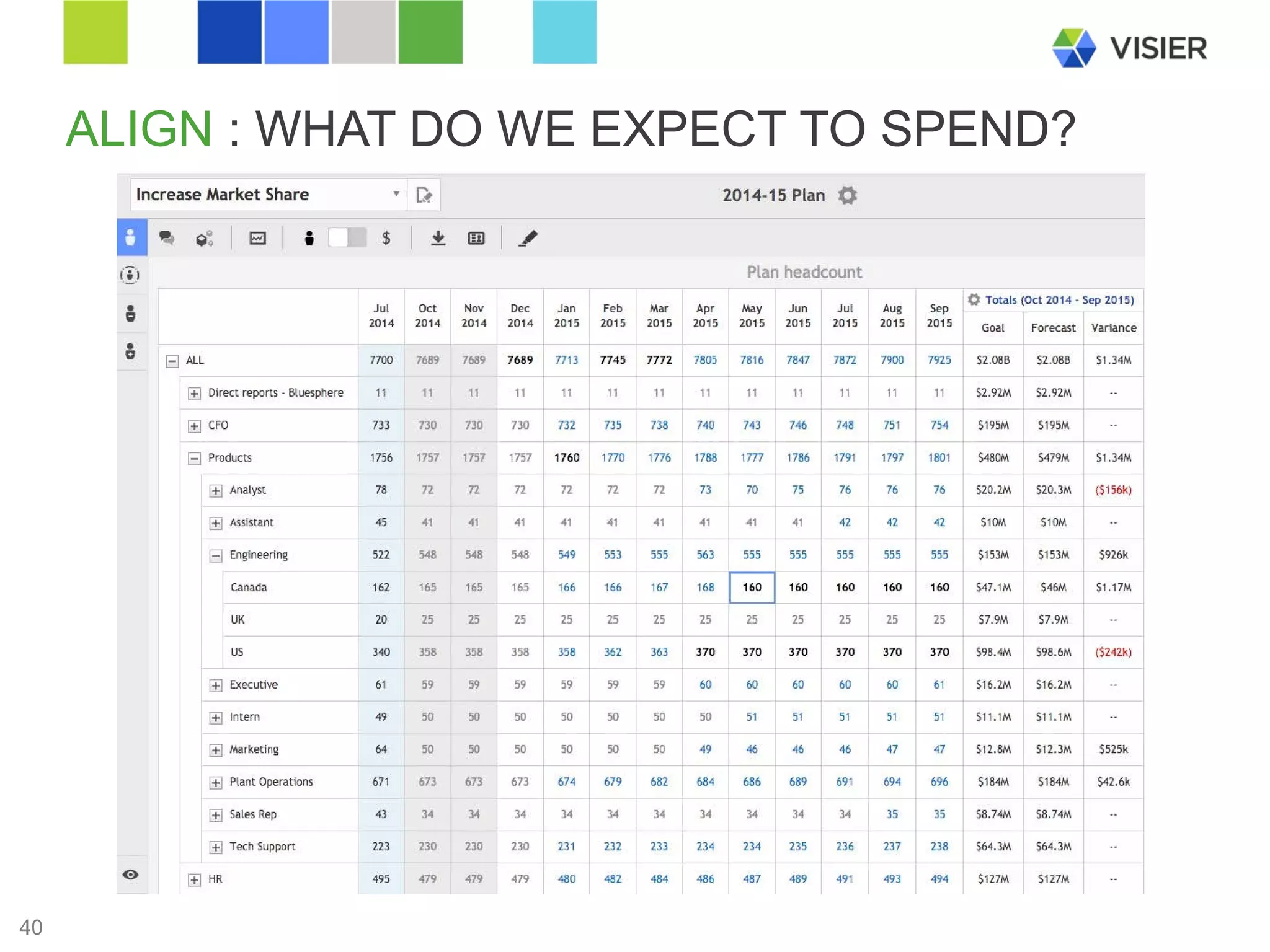
ALIGN : WHAT DO WE EXPECT TO SPEND? 
40
Page 41 
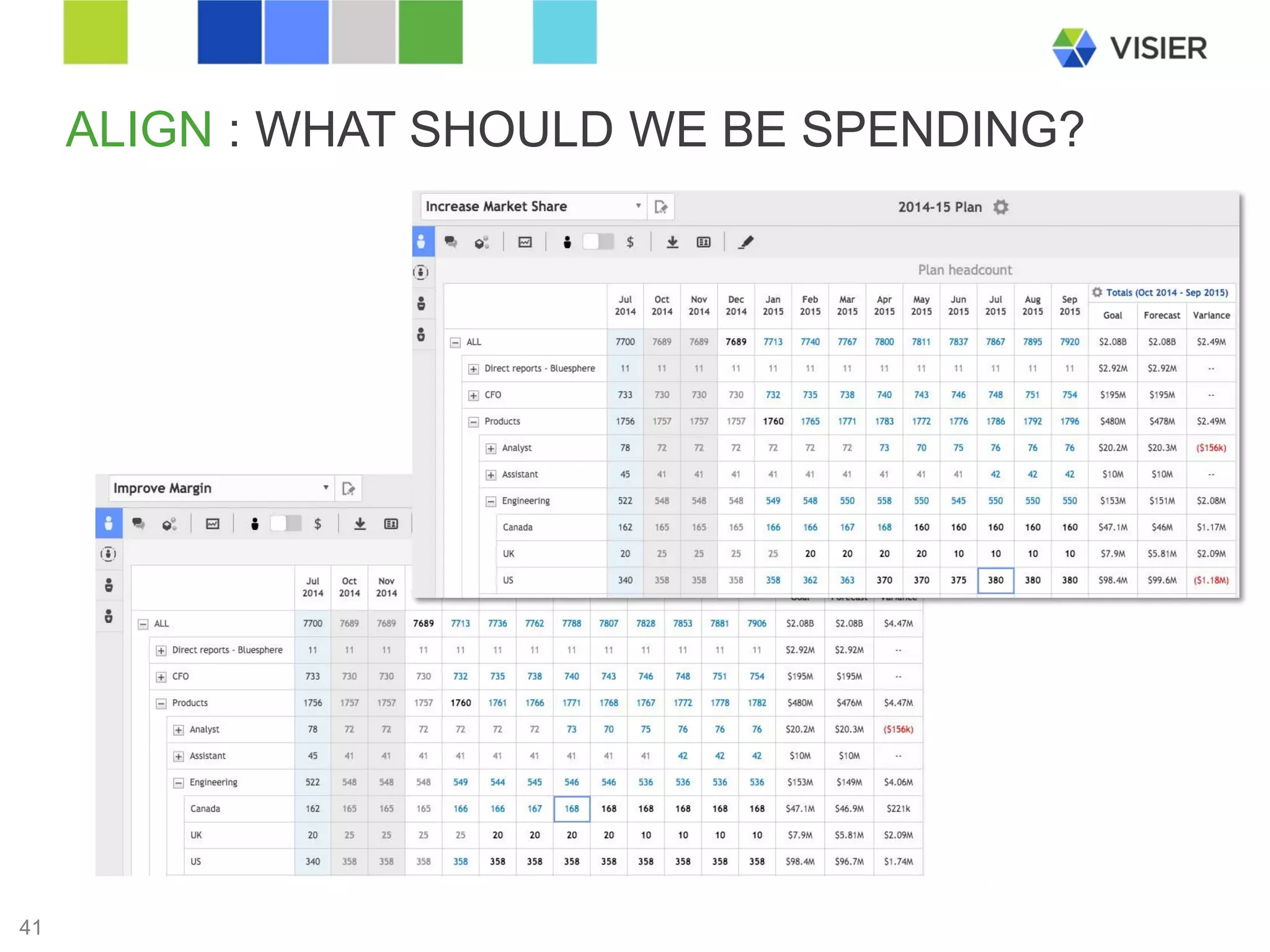
ALIGN : WHAT SHOULD WE BE SPENDING? 
41
Page 42 
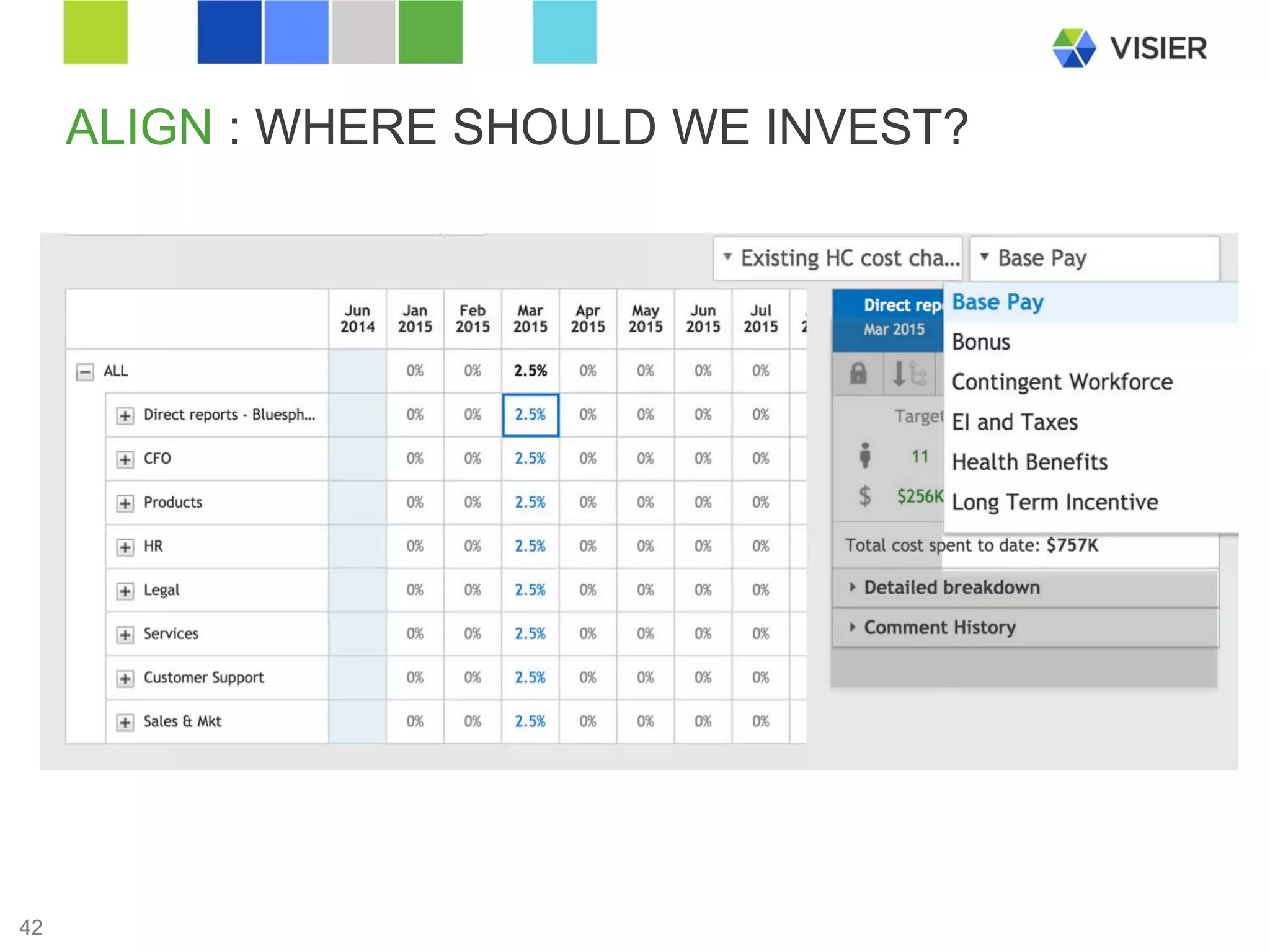
ALIGN : WHERE SHOULD WE INVEST? 
42
Page 43 
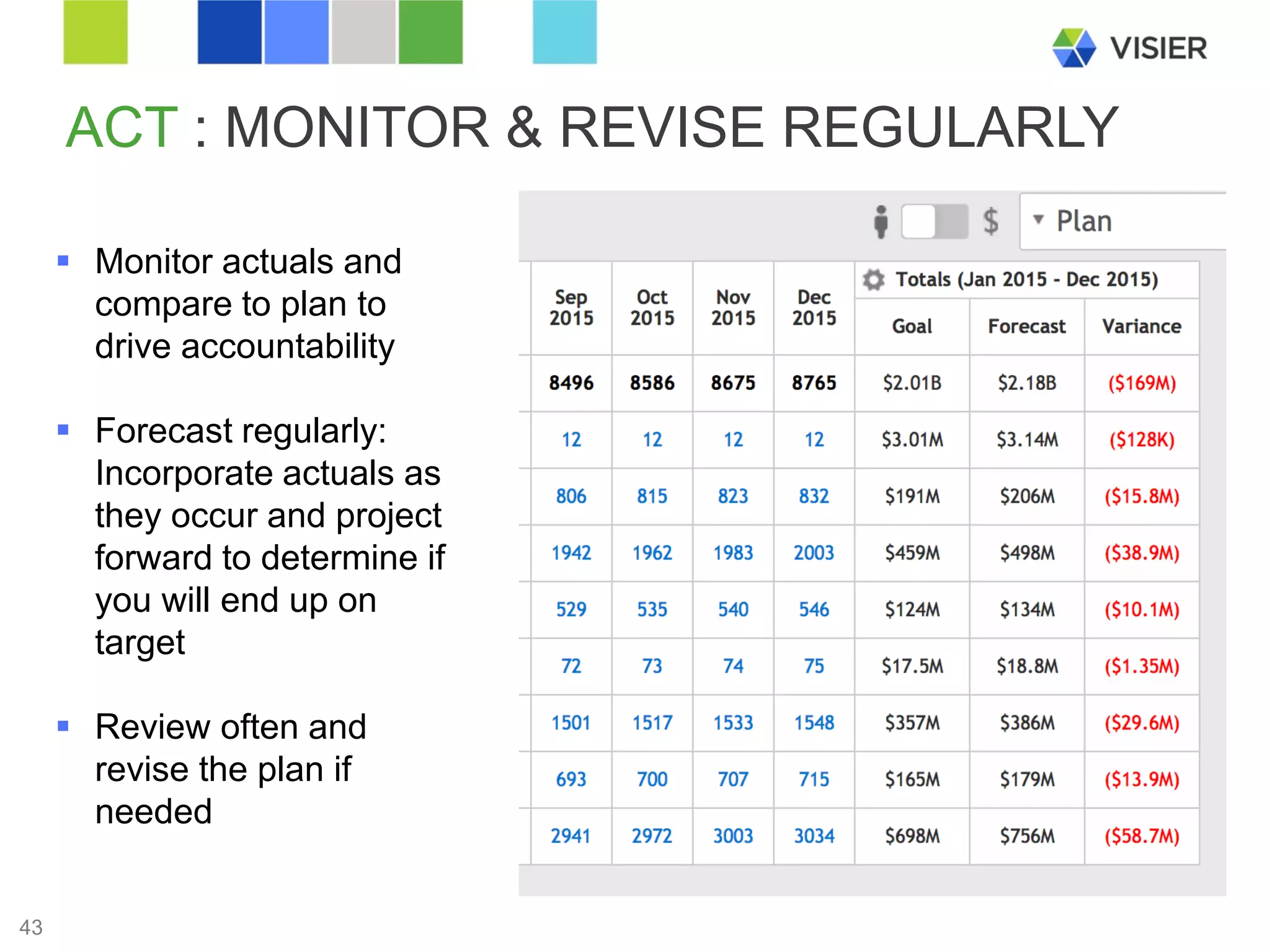
ACT : MONITOR & REVISE REGULARLY 
43 
 
Monitor actuals and compare to plan to drive accountability 
 
Forecast regularly: Incorporate actuals as they occur and project forward to determine if you will end up on target 
 
Review often and revise the plan if needed
Page 44 
WORKFORCE INTELLIGENCE 
Workforce Planning 
Analyze 
“What-If” Scenarios 
Align 
Workforce Budgeting 
Act 
Monitor & Forecast 
Understand where you are as the starting point for planning where you can be 
Build scenarios to align the people plan to the business strategy 
Predict future scenarios based on historical trends 
Collaborate across the organization to build plans Share and iterate on headcount demand to increase accuracy and buy-in Match costs to headcount to unify HR and Finance with one version of the truth 
Publish plan metrics to all stakeholders to increase visibility 
Compare actuals to plan to quantify execution 
Adapt to variances quickly by improving execution or modifying the plan
Page 45 
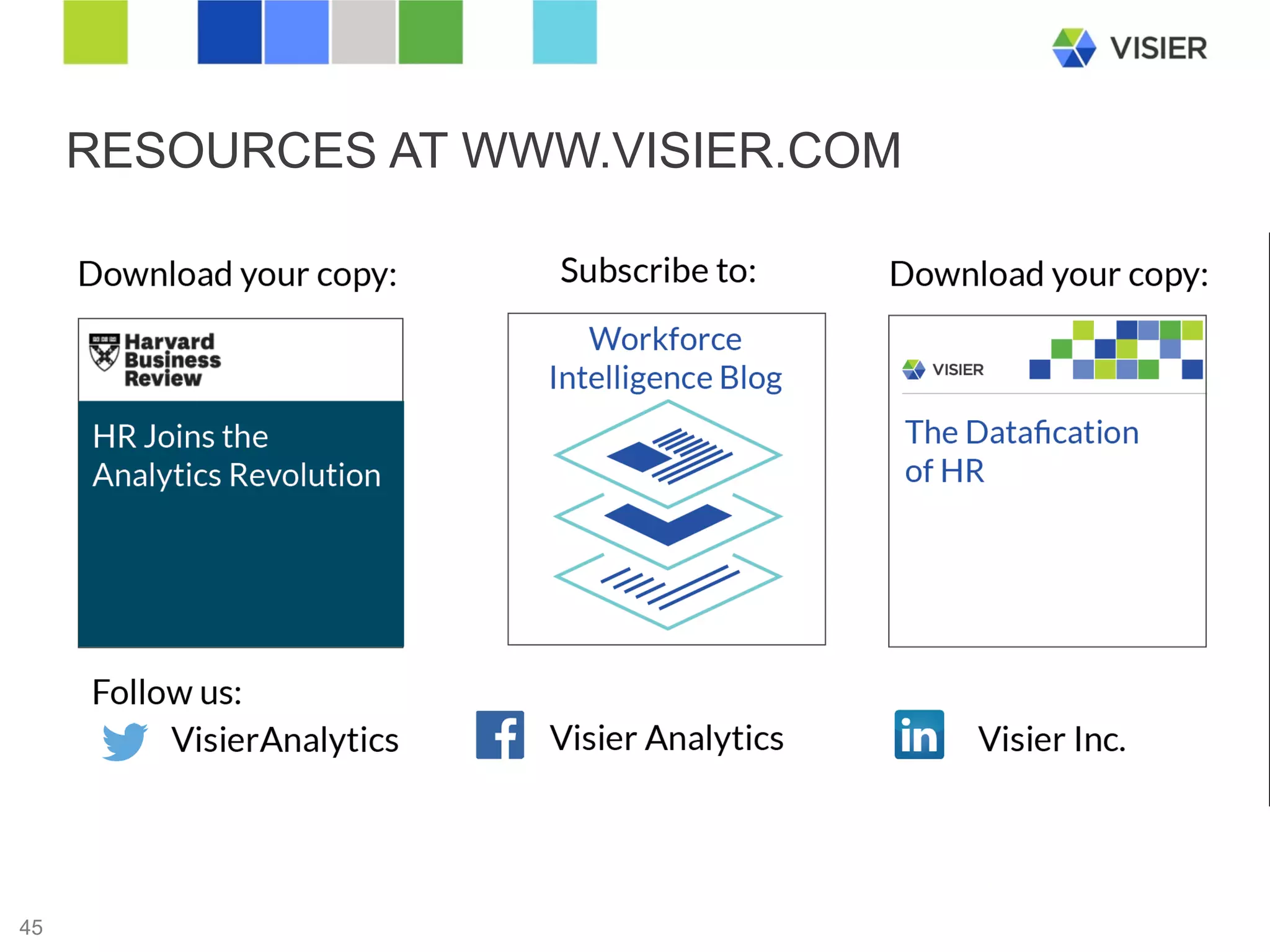
RESOURCES AT WWW.VISIER.COM 
45
Page 46 
DISCUSSION 
Dino Zincarini 
dino.zincarini@visier.com
#WFwebinar 
Please complete the webinar evaluation.
#WFwebinar 
Join our next Webinar! 
The Role of the HR Business Partner in Strategic Workforce Planning 
18, December, 2014 
Webinars start at 2 p.m. Eastern / 11 a.m. Pacific 
Register for all upcoming Talent Management Webinars at www.workforce.com/webinars

The Next Big HR Transformation: How to Excel at Workforce Planning

  • 1.
    #WFwebinar The presentationwill begin at the top of the hour. A dial in number will not be provided. Listen to today’s webinar using your computer’s speakers or headphones. The Next Big HR Transformation: How to Excel at Workforce Planning
  • 2.
    #WFwebinar Speaker: DinoZincarini Project Manager Workforce Planning Visier Moderator: Max Mihelich Associate Editor Workforce magazine The Next Big HR Transformation: How to Excel at Workforce Planning
  • 3.
    #WFwebinar Tools YouCan Use Audio Control –A dial in number will not be provided. –Adjust the volume by sliding the indicator in the Media Player box to the left. –Also check your computer’s volume for external speakers or headsets.
  • 4.
    #WFwebinar Tools YouCan Use Question & Answer –Type in your question in the “Q&A” box to the left. –These queries are visible by the presenter ONLY. –Type your question in the space at the bottom. –Click “Send.”
  • 5.
    #WFwebinar Tools YouCan Use Twitter -Click “Post” in the Twitter widget. #WFwebinar @WorkforceNews
  • 6.
    #WFwebinar Tools YouCan Use Speaker Bios Resources Media Player Q&A Slides Twitter Help Post Event Evaluation Share This
  • 7.
    #WFwebinar 1. MayI receive a copy of the slides? YES! Click on the resource list located on the top left portion of your screen. 2. May I review the webinar recording at a later date? YES! You may log in again using today’s link to review the presentation on-demand. Frequently Asked Questions
  • 8.
    #WFwebinar Max Mihelich Associate Editor Workforce magazine The Next Big HR Transformation: How to Excel at Workforce Planning
  • 9.
    #WFwebinar Dino ZincariniProject Manager Workforce Planning Visier The Next Big HR Transformation: How to Excel at Workforce Planning
  • 10.
    © 2014 Visier™ The Next Big HR Transformation: How to Excel at Workforce Planning Dino Zincarini December 2014
  • 11.
    Page 11 WORKFORCEINTELLIGENCE SOLUTIONS. SMART. INTUITIVE. COMPLETE.
  • 12.
    Page 12 SOMEOF OUR AMAZING CUSTOMERS
  • 13.
    Page 13 TODAY’STOPICS Context for the growing importance and value of workforce planning The BIG concepts that result in effective workforce planning How HR can be the catalyst for upgrading your company’s workforce planning
  • 14.
    Page 14 Settingthe Stage: Trends Driving Workforce Planning
  • 15.
    P1ag5e 15 FragileEconomic Recovery • Downward pressure on prices • Uncertain economic future • But, CEOs are starting to shift from survival to growth mode “76% of CEOs have cut costs in the last 12 months.”* Need to protect the bottom line Need for more responsive, proactive, and agile planning *PWC 2014 CEO Survey
  • 16.
    P1a6ge 16 Globalization • Global markets are increasingly important • By 2025 China will have 45% of global F500 • Increasing proportion of global GDP is coming from emerging markets Need to compete globally for talent Need to analyze and compare global options for growth, as part of planning “50% of CEOs want to increase headcount next year.”* *PWC 2014 CEO Survey
  • 17.
    Page 17 DemographicShift & Skills Shortages • The working-age population is undergoing a major geographic shift • Experienced Baby Boomers are retiring “CEOs in North America see tech advances & demographic shifts as the 2 key global trends that will transform their businesses over the coming 5 years.” 17 Need to ensure they have the skills needed to achieve corporate objectives. Need to manage rising labor costs in emerging economies. *PWC 2014 CEO Survey
  • 18.
    Page 18 SUPERFUN AUDIENCE PARTICIPATION TIME! POLL: WHAT IS YOUR COMPANY’S TOP WORKFORCE CONCERN? 18
  • 19.
    Page 19 1. Recruiting high performing talent for succession planning 2. Developing existing talent for future leadership or scare skills 3. Retention of high performing talent 4. Managing costs associated with the workforce 5. Managing labor and skills to ensure business continuity POLL: WHAT IS YOUR COMPANY’S TOP WORKFORCE CONCERN? 19
  • 20.
    Page 20 2014HARVARD BUSINESS REVIEW: TOP WORKFORCE CONCERNS *HR Joins the Analytics Revolution, HBR Analytic Services
  • 21.
    P2a1ge 21 Nearlytwo-thirds of CEOs believe the HR function is not well-prepared for the changes needed to respond to transformational trends. *PWC 2014 CEO Survey
  • 22.
    Page 22 HRMUST DRIVE THE PEOPLE STRATEGY TO RESPOND TO THESE TRENDS It is difficult to share and collaborate on workforce plans We have a limited view of workforce costs We can’t accurately map headcount to costs, so plan for positions, not costs HR Strategy Gap: How to connect your people strategy and workforce planning We do not know our historic trends for planning Finance owns cost management, but does not consider talent implications …
  • 23.
    Page 23 HRMUST UNDERSTAND THE TOTAL COST OF WORKFORCE How much does our workforce really cost? How can we optimize our workforce costs? How are our costs changing over time? Are we on track with our plan and budget? How can be better map to Finance? Most HR departments lack a complete view of workforce costs 76% of CEOs have cut costs in the last 12 months People are 70% of a company’s cost – and are the “final frontier” of savings in competitive markets
  • 24.
    Page 24 EffectiveWorkforce Planning: The BIG Concepts that Return Value
  • 25.
    Page 25 WORKFORCEINTELLIGENCE
  • 26.
    Page 26 WHATIS WORKFORCE PLANNING? Workforce Planning Workforce Planning is about: Projecting labor supply based on where you are today Capturing labor demand for where you want to go Drawing the picture of how you can get there
  • 27.
    Page 27 WORKFORCEINTELLIGENCE Analyze Align Act Where do we start? Where have we been? What can we do? How do we get there? How are we doing? Should we change? Workforce Planning
  • 28.
    Page 28 GETTINGAHEAD OF THE TRENDS Create “what-if” models to understand the people and cost impacts over time to your organization. Build workforce budgets by capturing labor demand and projecting labor supply. Monitor and forecast how well you are executing against your workforce budget to see if you are on or off track. Analyze Align Act
  • 29.
    Page 29 WHAT-IFMODELS Create what-if analyses to understand the people and cost impacts over time to your organization. Build out different scenarios at a high-level, based on different assumptions, and see the projected outcome. Why? Who? When? • Brainstorm ideas for future change • One person or small group • Support strategic planning • Quantify strategies • Confident with data • Major event • Compare possibilities • Ops or savvy leader • Ad-hoc question • Choose the best path •Business climate change • Magnitude over precision
  • 30.
    Page 30 COLLABORATIVEWORKFORCE BUDGETING Build workforce budgets by capturing labor demand and projecting labor supply. Why? Who? When? • Required by Finance to create annual budget • HR is the facilitator of the process • Typically annually in support of budget cycle • Required by HR to understand people plan • Finance sets the cost constraints • Re-planning may occur as the business changes • Compare different possibilities • Input from all people managers • Time constrained • Precision is needed over magnitude • Collaborate to get to the best estimate • Establish organizational buy-in
  • 31.
    Page 31 MONITORING& FORECASTING Monitor progress and forecast how well you are executing against your workforce plan to see if you are on or off track. Why? Who? When? • Turn plans into reality by tracking progress • Typically Finance with HR support • Monthly or quarterly forecasting • Quantify variance to spark corrective action • Senior leaders and people managers • Continuous reporting • Course-correct as business changes • See results during the plan lifecycle, not after • Drive accountability
  • 32.
    Page 32 HRAS THE DRIVER OF SUCCESSFUL WORKFORCE PLANNING Workforce Planning Analyze “What-If” Scenarios Align Workforce Budgeting Act Monitor & Forecast Understand where you are as the starting point for planning where you can be Build scenarios to align the people plan to the business strategy Predict future scenarios based on historical trends Collaborate across the organization to build plans Share and iterate on headcount demand to increase accuracy and buy-in Match costs to headcount to unify HR and Finance with one version of the truth Publish plan metrics to all stakeholders to increase visibility Compare actuals to plan to quantify execution Adapt to variances quickly by improving execution or modifying the plan
  • 33.
    Page 33 TransformingWorkforce Planning: Driven by HR
  • 34.
    Page 34 THEREALITY OF WORKFORCE PLANNING TODAY Many companies follow old processes for workforce planning that, in reality, are more about financial budgeting Planning happens infrequently and can be very tedious Plans document intentions but don’t change reality
  • 35.
    Page 35 OldSchool New School Run a compensation review process. Own workforce planning in support of the corporate people strategy. Explain variances between plan and actuals by comparing historical numbers with Finance. Manage variances by continuously updating the plan with actuals and projecting the impact forward. Spent too much? Freeze hiring. Build business scenarios with costs to quantify options and make an optimal recommendation. Focus on compensation, bonus, benefits. HR is the expert on the total cost of workforce. HR is the Administrator HR is the Facilitator and Advisor HR IS THE CATALYST TO TRANSFORM WORKFORCE PLANNING
  • 36.
    Page 36 PLANNING:HR IN THE DRIVER’S SEAT Analyze Align Act  What do our total costs look like?  What is contributing to our cost increases?  Where can we optimize costs?  What is the budget? What should it be?  Where do we want to invest or reduce costs?  What are the talent implications?  What should our workforce plan be?  How are we tracking against our plan and total costs?  Should we adjust our plans?
  • 37.
    Page 37 THEEVOLUTION OF WORKFORCE PLANNING Annual process Different source systems Headcount focused Explain the past Position management driven No standard processes Limited view of costs Continuous processes One version of the truth Cost focused Forecast the future Cost analytics driven Standardized processes Full view of costs (TCOW) Traditional WFP Visier WFP
  • 38.
    Page 38 ANALYZE: WHERE ARE COSTS GOING?
  • 39.
    P3a9ge 39 ALIGN: UNDERSTAND TOTAL COST OF WORKFORCE (AT LEAST WORK TOWARDS THIS)  Total Cost of Workforce includes all components of cost to the company  This data isn’t always in once place nor in one system  Looks intimidating? Visier can help 
  • 40.
    Page 40 ALIGN: WHAT DO WE EXPECT TO SPEND? 40
  • 41.
    Page 41 ALIGN: WHAT SHOULD WE BE SPENDING? 41
  • 42.
    Page 42 ALIGN: WHERE SHOULD WE INVEST? 42
  • 43.
    Page 43 ACT: MONITOR & REVISE REGULARLY 43  Monitor actuals and compare to plan to drive accountability  Forecast regularly: Incorporate actuals as they occur and project forward to determine if you will end up on target  Review often and revise the plan if needed
  • 44.
    Page 44 WORKFORCEINTELLIGENCE Workforce Planning Analyze “What-If” Scenarios Align Workforce Budgeting Act Monitor & Forecast Understand where you are as the starting point for planning where you can be Build scenarios to align the people plan to the business strategy Predict future scenarios based on historical trends Collaborate across the organization to build plans Share and iterate on headcount demand to increase accuracy and buy-in Match costs to headcount to unify HR and Finance with one version of the truth Publish plan metrics to all stakeholders to increase visibility Compare actuals to plan to quantify execution Adapt to variances quickly by improving execution or modifying the plan
  • 45.
    Page 45 RESOURCESAT WWW.VISIER.COM 45
  • 46.
    Page 46 DISCUSSION Dino Zincarini dino.zincarini@visier.com
  • 47.
    #WFwebinar Please completethe webinar evaluation.
  • 48.
    #WFwebinar Join ournext Webinar! The Role of the HR Business Partner in Strategic Workforce Planning 18, December, 2014 Webinars start at 2 p.m. Eastern / 11 a.m. Pacific Register for all upcoming Talent Management Webinars at www.workforce.com/webinars