A reflection on constructivism and
recent reforming efforts in
engineering education
[CDIO UTILIZATION] [PERSONAL OBSERVTION] [TANDT| BA VÌ | 12.APR.2015
]
STEM ‘Wave’
21st century skills
Science
Technology
Engineering
Mathematics
CDIO Initiative: Need for Reforming Education
“Engineering education and real-world demands on engineers have in
recent years drifted apart. Realizing that this widening gap must be
closed, leading engineering schools in the USA, Europe, Canada, UK,
Africa, Asia, and New Zealand formed the CDIO Initiative: A worldwide
collaborative to conceive and develop a new vision of engineering
education.”
Not only for Engineering education anymore
CDIO is constructivist
An education that stresses the fundamentals, set in the context of Conceiving
– Designing – Implementing – Operating systems and products:
• A curriculum organized around mutually supporting courses, but with CDIO
activities highly interwoven
• Rich with student design-build-test projects
• Integrating learning of professional skills such as teamwork and
communication
• Featuring active and experiential learning
• Constantly improved through quality assurance process with higher aims
than accreditation
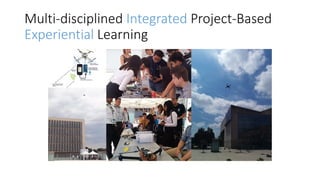
Multi-disciplined Integrated Project-Based
Experiential Learning
CDIO Standards
The 12 CDIO Standards address program philosophy (Standard 1),
curriculum development (Standards 2, 3 and 4),
design-build experiences and workspaces (Standards
5 and 6),
new methods of teaching and learning (Standards 7 and 8),
faculty development (Standards 9 and 10),
and assessment and evaluation (Standards 11 and 12).
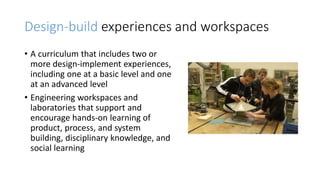
Design-build experiences and workspaces
• A curriculum that includes two or
more design-implement experiences,
including one at a basic level and one
at an advanced level
• Engineering workspaces and
laboratories that support and
encourage hands-on learning of
product, process, and system
building, disciplinary knowledge, and
social learning
FPT University settings
• FTICO
• FSOFT
• Innovation Lab
• Capstone Project
• Other project-based courses
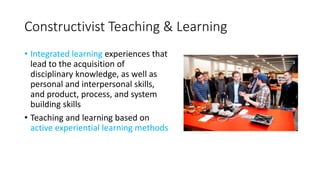
Constructivist Teaching & Learning
• Integrated learning experiences that
lead to the acquisition of
disciplinary knowledge, as well as
personal and interpersonal skills,
and product, process, and system
building skills
• Teaching and learning based on
active experiential learning methods
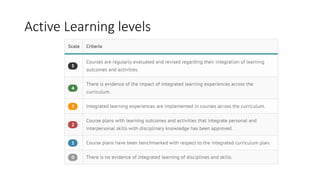
Active Learning levels
What does a constructivist [book] look like?
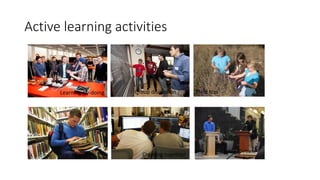
Active learning activities
Learning-by-doing Group discussion Field trip
Creating togetherResearch
Dialog/Debate
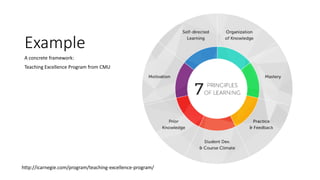
Example
A concrete framework:
Teaching Excellence Program from CMU
http://icarnegie.com/program/teaching-excellence-program/
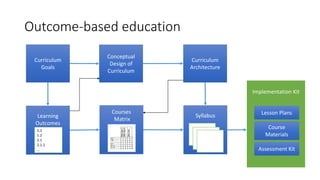
Outcome-based education
Implementation Kit
Curriculum
Goals
Conceptual
Design of
Curriculum
Learning
Outcomes
Curriculum
Architecture
Courses
Matrix
Syllabus
Course
Materials
Course
Materials
Lesson PlansLesson Plans
Assessment KitAssessment Kit
1.1
1.2
2.1
2.1.1
…
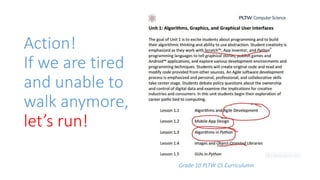
Action!
If we are tired
and unable to
walk anymore,
let’s run!
Grade 10 PLTW CS Curriculumn
Thank you!
Give me comments & questions 

A reflection on constructivism and engineering education

  • 1.
    A reflection onconstructivism and recent reforming efforts in engineering education [CDIO UTILIZATION] [PERSONAL OBSERVTION] [TANDT| BA VÌ | 12.APR.2015 ]
  • 2.
    STEM ‘Wave’ 21st centuryskills Science Technology Engineering Mathematics
  • 3.
    CDIO Initiative: Needfor Reforming Education “Engineering education and real-world demands on engineers have in recent years drifted apart. Realizing that this widening gap must be closed, leading engineering schools in the USA, Europe, Canada, UK, Africa, Asia, and New Zealand formed the CDIO Initiative: A worldwide collaborative to conceive and develop a new vision of engineering education.” Not only for Engineering education anymore
  • 4.
    CDIO is constructivist Aneducation that stresses the fundamentals, set in the context of Conceiving – Designing – Implementing – Operating systems and products: • A curriculum organized around mutually supporting courses, but with CDIO activities highly interwoven • Rich with student design-build-test projects • Integrating learning of professional skills such as teamwork and communication • Featuring active and experiential learning • Constantly improved through quality assurance process with higher aims than accreditation
  • 5.
  • 6.
    CDIO Standards The 12CDIO Standards address program philosophy (Standard 1), curriculum development (Standards 2, 3 and 4), design-build experiences and workspaces (Standards 5 and 6), new methods of teaching and learning (Standards 7 and 8), faculty development (Standards 9 and 10), and assessment and evaluation (Standards 11 and 12).
  • 7.
    Design-build experiences andworkspaces • A curriculum that includes two or more design-implement experiences, including one at a basic level and one at an advanced level • Engineering workspaces and laboratories that support and encourage hands-on learning of product, process, and system building, disciplinary knowledge, and social learning
  • 8.
    FPT University settings •FTICO • FSOFT • Innovation Lab • Capstone Project • Other project-based courses
  • 9.
    Constructivist Teaching &Learning • Integrated learning experiences that lead to the acquisition of disciplinary knowledge, as well as personal and interpersonal skills, and product, process, and system building skills • Teaching and learning based on active experiential learning methods
  • 10.
  • 11.
    What does aconstructivist [book] look like?
  • 12.
    Active learning activities Learning-by-doingGroup discussion Field trip Creating togetherResearch Dialog/Debate
  • 13.
    Example A concrete framework: TeachingExcellence Program from CMU http://icarnegie.com/program/teaching-excellence-program/
  • 14.
    Outcome-based education Implementation Kit Curriculum Goals Conceptual Designof Curriculum Learning Outcomes Curriculum Architecture Courses Matrix Syllabus Course Materials Course Materials Lesson PlansLesson Plans Assessment KitAssessment Kit 1.1 1.2 2.1 2.1.1 …
  • 15.
    Action! If we aretired and unable to walk anymore, let’s run! Grade 10 PLTW CS Curriculumn
  • 16.
    Thank you! Give mecomments & questions 