
Building a Learning Culture
Revisiting results - Yielding approaches

Sesh Sukhdeo
October 2013 – Kenya – I HRM
Summary
No single approach.
Out-of-the-box thinking
HR / Learning
Strategic advantage and imperatives

If knowledge =power, learning is = ?
LEARNOMICS
THE ECONOMICS OF LEARNING

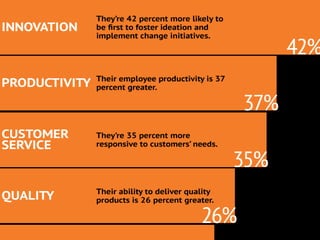
Organizations with strong learning cultures outperform their competitors.
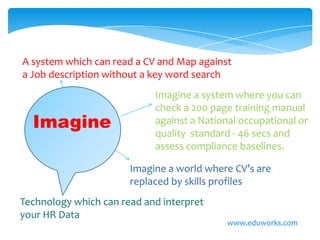
Imagine
A system which can read a CV and Map against
a Job description without a key word search

Imagine

Imagine a system where you can
check a 200 page training manual
against a National occupational or
quality standard - 46 secs and
assess compliance baselines.

Imagine a world where CV’s are
replaced by skills profiles
Technology which can read and interpret
your HR Data

www.eduworks.com
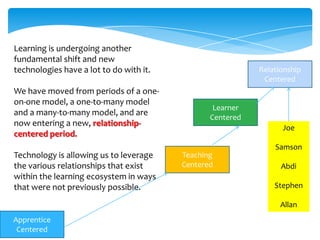
Learning is undergoing another
fundamental shift and new
technologies have a lot to do with it.
We have moved from periods of a oneon-one model, a one-to-many model
and a many-to-many model, and are
now entering a new, relationshipcentered period.
Technology is allowing us to leverage
the various relationships that exist
within the learning ecosystem in ways
that were not previously possible.

Relationship
Centered

Learner
Centered
Joe
Teaching
Centered

Samson
Abdi
Stephen
Allan

Apprentice
Centered
Building a learning organisation requires
a shift in the way you see your business..

A learning organisation always considers the impact of each
decision on the whole organisation.

Employers are waking up to this fact and to the
reality that a lot of learning occurs for their
employees outside of the organization.
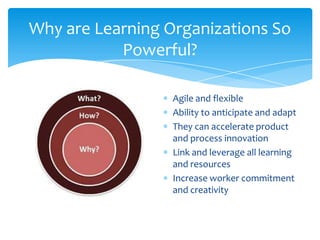
Why are Learning Organizations So
Powerful?
Agile and flexible
Ability to anticipate and adapt
They can accelerate product
and process innovation
Link and leverage all learning
and resources
Increase worker commitment
and creativity
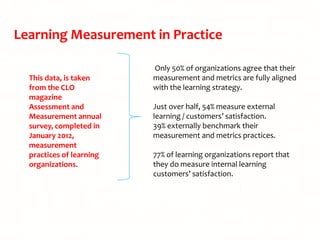
Learning Measurement in Practice
This data, is taken
from the CLO
magazine
Assessment and
Measurement annual
survey, completed in
January 2012,
measurement
practices of learning
organizations.

Only 50% of organizations agree that their
measurement and metrics are fully aligned
with the learning strategy.
Just over half, 54% measure external
learning / customers’ satisfaction.
39% externally benchmark their
measurement and metrics practices.
77% of learning organizations report that
they do measure internal learning
customers’ satisfaction.
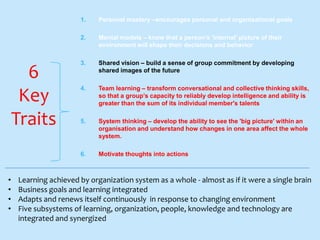
1.
2.

•
•
•
•

Mental models – know that a person’s 'internal' picture of their
environment will shape their decisions and behavior

3.

Shared vision – build a sense of group commitment by developing
shared images of the future

4.

Team learning – transform conversational and collective thinking skills,
so that a group’s capacity to reliably develop intelligence and ability is
greater than the sum of its individual member's talents

5.

System thinking – develop the ability to see the 'big picture' within an
organisation and understand how changes in one area affect the whole
system.

6.

6
Key
Traits

Personal mastery –encourages personal and organisational goals

Motivate thoughts into actions

Learning achieved by organization system as a whole - almost as if it were a single brain
Business goals and learning integrated
Adapts and renews itself continuously in response to changing environment
Five subsystems of learning, organization, people, knowledge and technology are
integrated and synergized
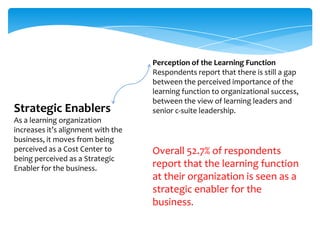
Strategic Enablers
As a learning organization
increases it’s alignment with the
business, it moves from being
perceived as a Cost Center to
being perceived as a Strategic
Enabler for the business.

Perception of the Learning Function
Respondents report that there is still a gap
between the perceived importance of the
learning function to organizational success,
between the view of learning leaders and
senior c-suite leadership.

Overall 52.7% of respondents
report that the learning function
at their organization is seen as a
strategic enabler for the
business.
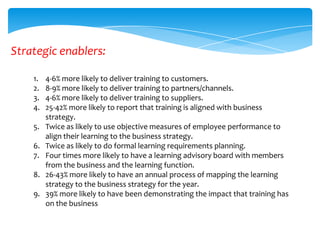
Strategic enablers:
1.
2.
3.
4.
5.
6.
7.
8.
9.

4-6% more likely to deliver training to customers.
8-9% more likely to deliver training to partners/channels.
4-6% more likely to deliver training to suppliers.
25-42% more likely to report that training is aligned with business
strategy.
Twice as likely to use objective measures of employee performance to
align their learning to the business strategy.
Twice as likely to do formal learning requirements planning.
Four times more likely to have a learning advisory board with members
from the business and the learning function.
26-43% more likely to have an annual process of mapping the learning
strategy to the business strategy for the year.
39% more likely to have been demonstrating the impact that training has
on the business
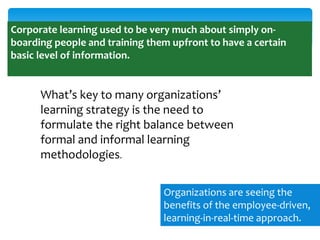
Corporate learning used to be very much about simply onboarding people and training them upfront to have a certain
basic level of information.

What’s key to many organizations’
learning strategy is the need to
formulate the right balance between
formal and informal learning
methodologies.
Organizations are seeing the
benefits of the employee-driven,
learning-in-real-time approach.
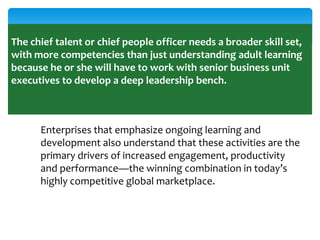
The chief talent or chief people officer needs a broader skill set,
with more competencies than just understanding adult learning
because he or she will have to work with senior business unit
executives to develop a deep leadership bench.

Enterprises that emphasize ongoing learning and
development also understand that these activities are the
primary drivers of increased engagement, productivity
and performance—the winning combination in today’s
highly competitive global marketplace.
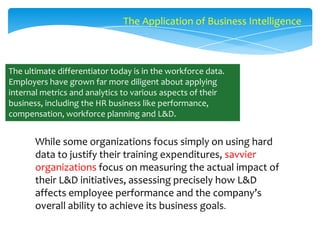
The Application of Business Intelligence

The ultimate differentiator today is in the workforce data.
Employers have grown far more diligent about applying
internal metrics and analytics to various aspects of their
business, including the HR business like performance,
compensation, workforce planning and L&D.

While some organizations focus simply on using hard
data to justify their training expenditures, savvier
organizations focus on measuring the actual impact of
their L&D initiatives, assessing precisely how L&D
affects employee performance and the company’s
overall ability to achieve its business goals.
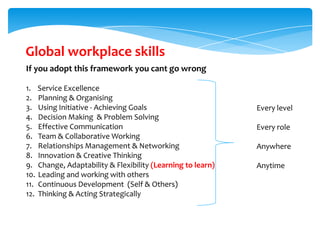
Global workplace skills
If you adopt this framework you cant go wrong
1.
2.
3.
4.
5.
6.
7.
8.
9.
10.
11.
12.

Service Excellence
Planning & Organising
Using Initiative - Achieving Goals
Decision Making & Problem Solving
Effective Communication
Team & Collaborative Working
Relationships Management & Networking
Innovation & Creative Thinking
Change, Adaptability & Flexibility (Learning to learn)
Leading and working with others
Continuous Development (Self & Others)
Thinking & Acting Strategically

Every level
Every role
Anywhere
Anytime
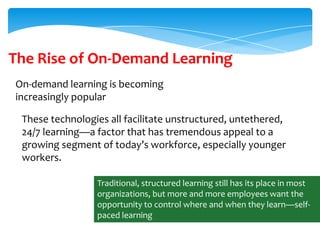
The Rise of On-Demand Learning
On-demand learning is becoming
increasingly popular
These technologies all facilitate unstructured, untethered,
24/7 learning—a factor that has tremendous appeal to a
growing segment of today’s workforce, especially younger
workers.
Traditional, structured learning still has its place in most
organizations, but more and more employees want the
opportunity to control where and when they learn—selfpaced learning
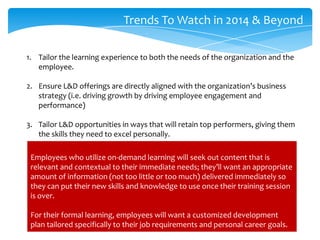
Trends To Watch in 2014 & Beyond
1. Tailor the learning experience to both the needs of the organization and the
employee.
2. Ensure L&D offerings are directly aligned with the organization’s business
strategy (i.e. driving growth by driving employee engagement and
performance)
3. Tailor L&D opportunities in ways that will retain top performers, giving them
the skills they need to excel personally.
Employees who utilize on-demand learning will seek out content that is
relevant and contextual to their immediate needs; they’ll want an appropriate
amount of information (not too little or too much) delivered immediately so
they can put their new skills and knowledge to use once their training session
is over.
For their formal learning, employees will want a customized development
plan tailored specifically to their job requirements and personal career goals.
Social media
Social media has become a fixture in many of our
lives.
For proof, look no further than the more than 1
billion active Facebook users and 72 hours of video
uploaded to YouTube every single minute.
Even the more professional platform, LinkedIn, has
175 million members worldwide.
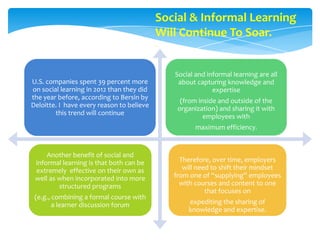
Social & Informal Learning
Will Continue To Soar.
.

U.S. companies spent 39 percent more
on social learning in 2012 than they did
the year before, according to Bersin by
Deloitte. I have every reason to believe
this trend will continue

Social and informal learning are all
about capturing knowledge and
expertise
(from inside and outside of the
organization) and sharing it with
employees with

maximum efficiency.

Another benefit of social and
informal learning is that both can be
extremely effective on their own as
well as when incorporated into more
structured programs

(e.g., combining a formal course with
a learner discussion forum

Therefore, over time, employers
will need to shift their mindset
from one of “supplying” employees
with courses and content to one
that focuses on
expediting the sharing of
knowledge and expertise.
To get started here are a few key
considerations to keep in mind:
1. If you build it, they will neither come nor participate. Develop incentives,
communicate, and have leadership model the behavior. All participating
parties need personal incentives.
2. Don’t think technology first; think human interactions and building a
shared understanding.
3. Support work that is accomplished through collaboration and team
interactions. It will drive social engagement.
4. Create learning models and tools that support a culture of coaching,
mentoring, feedback and interactions.

5. Ensure employees have a clear perception of your vision of learning,
talent management, and social interactions.
Most learning is informal

The U.S. Department of Labor estimates 70% or more of work related
learning occurs outside formal training.
The Center for Creative Leadership (CCL) similarly believes at least 70% of
learning occurs through informal learning processes driven by workers
seeking to find the information they need to do their jobs. CCL breaks
down the remaining 30% into two groups.
• The first (20%) is through non-formal or social learning which
is developed through collaborative relationships, networks and
dialogue.

• The balance (10%) occurs in well-designed formal learning programs6.
Finding content can be difficult

Informal learning implies a search for the right piece of information or
the clearest set of instructions.
Finding these learning assets is almost as important as having the
assets themselves.
Research shows that knowledge workers spend 15 to 30% of their time
gathering information and these searches are less than successful 50%
of the time.
That is why it is essential to provide for people’s ongoing needs to
gather information efficiently and to learn through formal, informal
and social means.
The workforce is now not only
comfortable with technology, they expect
mobile and social platforms to be readily
available to help them learn.

Learning organizations are moving from pushing learning
to employees to helping workers find answers by
leveraging mobile, video on-demand and other forms of
just-in-time learning.
It is important for leaders to select the right
practices for their individual business
strategies.

Organizations which are focused on product innovation
and excellence benefit from practices in the areas of empowerment
and reflection (single- and double-loop learning).
Companies that drive business value by being a low-cost producer benefit
most from enabling knowledge-sharing throughout the organization.
Employees are looking for bite-size learning
opportunities they can complete remotely
between meetings or while they’re waiting
for an appointment.

“You’re never going to get more agile by delivering more e-learning
courses or delivering more classroom workshops,”

“You’re going to get more agile by putting these kind of systemic pull
learning improvements into the culture of the learning organization
and increasing its ability to meet needs quickly.”
http://ima-changing.com/

If your interested in discovering how to enhance your learning
culture – Go to the above url and when you type in your name –
add hrm after it, for example – sesh sukhdeo hrm.
Three minutes will make a substantial impact – spend the time.
We will send you back some instant reports
Sesh Sukhdeo

ceo@iccspglobal.com

Building Learning Cultures - PPT HR summit Kenya

  • 1.
    Building a LearningCulture Revisiting results - Yielding approaches Sesh Sukhdeo October 2013 – Kenya – I HRM
  • 2.
    Summary No single approach. Out-of-the-boxthinking HR / Learning Strategic advantage and imperatives If knowledge =power, learning is = ?
  • 3.
    LEARNOMICS THE ECONOMICS OFLEARNING Organizations with strong learning cultures outperform their competitors.
  • 4.
  • 5.
    A system whichcan read a CV and Map against a Job description without a key word search Imagine Imagine a system where you can check a 200 page training manual against a National occupational or quality standard - 46 secs and assess compliance baselines. Imagine a world where CV’s are replaced by skills profiles Technology which can read and interpret your HR Data www.eduworks.com
  • 6.
    Learning is undergoinganother fundamental shift and new technologies have a lot to do with it. We have moved from periods of a oneon-one model, a one-to-many model and a many-to-many model, and are now entering a new, relationshipcentered period. Technology is allowing us to leverage the various relationships that exist within the learning ecosystem in ways that were not previously possible. Relationship Centered Learner Centered Joe Teaching Centered Samson Abdi Stephen Allan Apprentice Centered
  • 7.
    Building a learningorganisation requires a shift in the way you see your business.. A learning organisation always considers the impact of each decision on the whole organisation. Employers are waking up to this fact and to the reality that a lot of learning occurs for their employees outside of the organization.
  • 8.
    Why are LearningOrganizations So Powerful? Agile and flexible Ability to anticipate and adapt They can accelerate product and process innovation Link and leverage all learning and resources Increase worker commitment and creativity
  • 9.
    Learning Measurement inPractice This data, is taken from the CLO magazine Assessment and Measurement annual survey, completed in January 2012, measurement practices of learning organizations. Only 50% of organizations agree that their measurement and metrics are fully aligned with the learning strategy. Just over half, 54% measure external learning / customers’ satisfaction. 39% externally benchmark their measurement and metrics practices. 77% of learning organizations report that they do measure internal learning customers’ satisfaction.
  • 11.
    1. 2. • • • • Mental models –know that a person’s 'internal' picture of their environment will shape their decisions and behavior 3. Shared vision – build a sense of group commitment by developing shared images of the future 4. Team learning – transform conversational and collective thinking skills, so that a group’s capacity to reliably develop intelligence and ability is greater than the sum of its individual member's talents 5. System thinking – develop the ability to see the 'big picture' within an organisation and understand how changes in one area affect the whole system. 6. 6 Key Traits Personal mastery –encourages personal and organisational goals Motivate thoughts into actions Learning achieved by organization system as a whole - almost as if it were a single brain Business goals and learning integrated Adapts and renews itself continuously in response to changing environment Five subsystems of learning, organization, people, knowledge and technology are integrated and synergized
  • 12.
    Strategic Enablers As alearning organization increases it’s alignment with the business, it moves from being perceived as a Cost Center to being perceived as a Strategic Enabler for the business. Perception of the Learning Function Respondents report that there is still a gap between the perceived importance of the learning function to organizational success, between the view of learning leaders and senior c-suite leadership. Overall 52.7% of respondents report that the learning function at their organization is seen as a strategic enabler for the business.
  • 13.
    Strategic enablers: 1. 2. 3. 4. 5. 6. 7. 8. 9. 4-6% morelikely to deliver training to customers. 8-9% more likely to deliver training to partners/channels. 4-6% more likely to deliver training to suppliers. 25-42% more likely to report that training is aligned with business strategy. Twice as likely to use objective measures of employee performance to align their learning to the business strategy. Twice as likely to do formal learning requirements planning. Four times more likely to have a learning advisory board with members from the business and the learning function. 26-43% more likely to have an annual process of mapping the learning strategy to the business strategy for the year. 39% more likely to have been demonstrating the impact that training has on the business
  • 14.
    Corporate learning usedto be very much about simply onboarding people and training them upfront to have a certain basic level of information. What’s key to many organizations’ learning strategy is the need to formulate the right balance between formal and informal learning methodologies. Organizations are seeing the benefits of the employee-driven, learning-in-real-time approach.
  • 15.
    The chief talentor chief people officer needs a broader skill set, with more competencies than just understanding adult learning because he or she will have to work with senior business unit executives to develop a deep leadership bench. Enterprises that emphasize ongoing learning and development also understand that these activities are the primary drivers of increased engagement, productivity and performance—the winning combination in today’s highly competitive global marketplace.
  • 16.
    The Application ofBusiness Intelligence The ultimate differentiator today is in the workforce data. Employers have grown far more diligent about applying internal metrics and analytics to various aspects of their business, including the HR business like performance, compensation, workforce planning and L&D. While some organizations focus simply on using hard data to justify their training expenditures, savvier organizations focus on measuring the actual impact of their L&D initiatives, assessing precisely how L&D affects employee performance and the company’s overall ability to achieve its business goals.
  • 17.
    Global workplace skills Ifyou adopt this framework you cant go wrong 1. 2. 3. 4. 5. 6. 7. 8. 9. 10. 11. 12. Service Excellence Planning & Organising Using Initiative - Achieving Goals Decision Making & Problem Solving Effective Communication Team & Collaborative Working Relationships Management & Networking Innovation & Creative Thinking Change, Adaptability & Flexibility (Learning to learn) Leading and working with others Continuous Development (Self & Others) Thinking & Acting Strategically Every level Every role Anywhere Anytime
  • 19.
    The Rise ofOn-Demand Learning On-demand learning is becoming increasingly popular These technologies all facilitate unstructured, untethered, 24/7 learning—a factor that has tremendous appeal to a growing segment of today’s workforce, especially younger workers. Traditional, structured learning still has its place in most organizations, but more and more employees want the opportunity to control where and when they learn—selfpaced learning
  • 20.
    Trends To Watchin 2014 & Beyond 1. Tailor the learning experience to both the needs of the organization and the employee. 2. Ensure L&D offerings are directly aligned with the organization’s business strategy (i.e. driving growth by driving employee engagement and performance) 3. Tailor L&D opportunities in ways that will retain top performers, giving them the skills they need to excel personally. Employees who utilize on-demand learning will seek out content that is relevant and contextual to their immediate needs; they’ll want an appropriate amount of information (not too little or too much) delivered immediately so they can put their new skills and knowledge to use once their training session is over. For their formal learning, employees will want a customized development plan tailored specifically to their job requirements and personal career goals.
  • 21.
    Social media Social mediahas become a fixture in many of our lives. For proof, look no further than the more than 1 billion active Facebook users and 72 hours of video uploaded to YouTube every single minute. Even the more professional platform, LinkedIn, has 175 million members worldwide.
  • 22.
    Social & InformalLearning Will Continue To Soar. . U.S. companies spent 39 percent more on social learning in 2012 than they did the year before, according to Bersin by Deloitte. I have every reason to believe this trend will continue Social and informal learning are all about capturing knowledge and expertise (from inside and outside of the organization) and sharing it with employees with maximum efficiency. Another benefit of social and informal learning is that both can be extremely effective on their own as well as when incorporated into more structured programs (e.g., combining a formal course with a learner discussion forum Therefore, over time, employers will need to shift their mindset from one of “supplying” employees with courses and content to one that focuses on expediting the sharing of knowledge and expertise.
  • 23.
    To get startedhere are a few key considerations to keep in mind: 1. If you build it, they will neither come nor participate. Develop incentives, communicate, and have leadership model the behavior. All participating parties need personal incentives. 2. Don’t think technology first; think human interactions and building a shared understanding. 3. Support work that is accomplished through collaboration and team interactions. It will drive social engagement. 4. Create learning models and tools that support a culture of coaching, mentoring, feedback and interactions. 5. Ensure employees have a clear perception of your vision of learning, talent management, and social interactions.
  • 24.
    Most learning isinformal The U.S. Department of Labor estimates 70% or more of work related learning occurs outside formal training. The Center for Creative Leadership (CCL) similarly believes at least 70% of learning occurs through informal learning processes driven by workers seeking to find the information they need to do their jobs. CCL breaks down the remaining 30% into two groups. • The first (20%) is through non-formal or social learning which is developed through collaborative relationships, networks and dialogue. • The balance (10%) occurs in well-designed formal learning programs6.
  • 25.
    Finding content canbe difficult Informal learning implies a search for the right piece of information or the clearest set of instructions. Finding these learning assets is almost as important as having the assets themselves. Research shows that knowledge workers spend 15 to 30% of their time gathering information and these searches are less than successful 50% of the time. That is why it is essential to provide for people’s ongoing needs to gather information efficiently and to learn through formal, informal and social means.
  • 26.
    The workforce isnow not only comfortable with technology, they expect mobile and social platforms to be readily available to help them learn. Learning organizations are moving from pushing learning to employees to helping workers find answers by leveraging mobile, video on-demand and other forms of just-in-time learning.
  • 27.
    It is importantfor leaders to select the right practices for their individual business strategies. Organizations which are focused on product innovation and excellence benefit from practices in the areas of empowerment and reflection (single- and double-loop learning). Companies that drive business value by being a low-cost producer benefit most from enabling knowledge-sharing throughout the organization.
  • 28.
    Employees are lookingfor bite-size learning opportunities they can complete remotely between meetings or while they’re waiting for an appointment. “You’re never going to get more agile by delivering more e-learning courses or delivering more classroom workshops,” “You’re going to get more agile by putting these kind of systemic pull learning improvements into the culture of the learning organization and increasing its ability to meet needs quickly.”
  • 29.
    http://ima-changing.com/ If your interestedin discovering how to enhance your learning culture – Go to the above url and when you type in your name – add hrm after it, for example – sesh sukhdeo hrm. Three minutes will make a substantial impact – spend the time. We will send you back some instant reports
  • 30.