Muhammad Kamran Sial 
University Of Sargodha
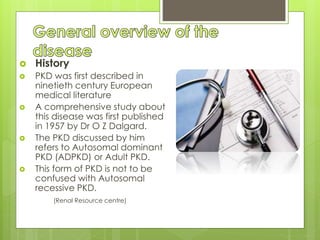
 History 
 PKD was first described in 
ninetieth century European 
medical literature 
 A comprehensive study about 
this disease was first published 
in 1957 by Dr O Z Dalgard. 
 The PKD discussed by him 
refers to Autosomal dominant 
PKD (ADPKD) or Adult PKD. 
 This form of PKD is not to be 
confused with Autosomal 
recessive PKD. 
(Renal Resource centre)
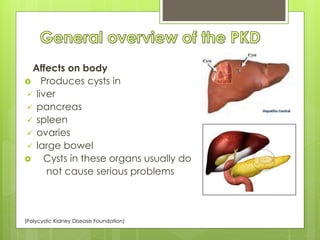
Affects on body 
 Produces cysts in 
 liver 
 pancreas 
 spleen 
 ovaries 
 large bowel 
 Cysts in these organs usually do 
not cause serious problems 
(Polycystic Kidney Disease Foundation)
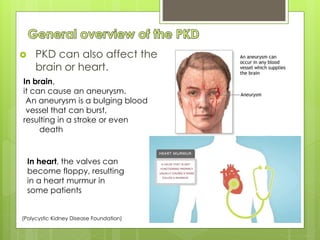
 PKD can also affect the 
brain or heart. 
In brain, 
it can cause an aneurysm. 
An aneurysm is a bulging blood 
vessel that can burst, 
resulting in a stroke or even 
death 
In heart, the valves can 
become floppy, resulting 
in a heart murmur in 
some patients 
(Polycystic Kidney Disease Foundation)
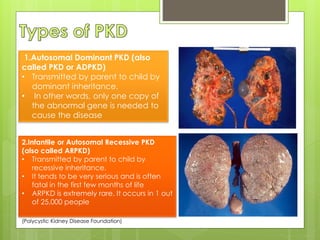
1.Autosomal Dominant PKD (also 
called PKD or ADPKD) 
• Transmitted by parent to child by 
dominant inheritance. 
• In other words, only one copy of 
the abnormal gene is needed to 
cause the disease 
2.Infantile or Autosomal Recessive PKD 
(also called ARPKD) 
• Transmitted by parent to child by 
recessive inheritance. 
• It tends to be very serious and is often 
fatal in the first few months of life 
• ARPKD is extremely rare. It occurs in 1 out 
of 25,000 people 
(Polycystic Kidney Disease Foundation)
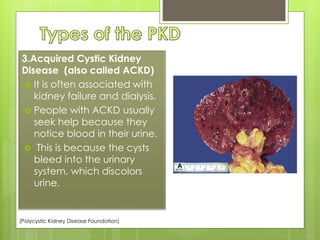
3.Acquired Cystic Kidney 
Disease (also called ACKD) 
 It is often associated with 
kidney failure and dialysis. 
 People with ACKD usually 
seek help because they 
notice blood in their urine. 
 This is because the cysts 
bleed into the urinary 
system, which discolors 
urine. 
(Polycystic Kidney Disease Foundation)
1.Polycystic kidney 
disease (PKD): 
• is passed down 
through families 
(inherited), usually as 
an autosomal 
dominant trait. 
• If one parent carries 
the gene, the children 
have a 50% chance 
of developing the 
disorder. 
2.Autosomal dominant PKD: 
• occurs in both children 
and adults, but it is much 
more common in adults. 
• Symptoms often do not 
appear until middle age. 
• It affects nearly 1 in 1,000 
Americans. 
• The actual number may 
be more, because some 
people do not have 
symptoms. 
U.S. National Library of Medicine
 Persons with PKD have 
many clusters of cysts in 
the kidneys. What 
exactly triggers the 
cysts to form is 
unknown. 
 A family history of PKD 
increases risk for the 
condition. 
An autosomal recessive: 
• It appears in infancy or 
childhood. 
• This form is much less 
common than autosomal 
dominant PKS, but it tends 
to be very serious and 
gets worse quickly. 
• It can cause serious lung 
and liver disease, end-stage 
kidney disease, and 
it usually causes death in 
infancy or childhood. 
U.S. National Library of Medicine
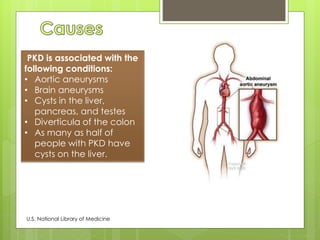
PKD is associated with the 
following conditions: 
• Aortic aneurysms 
• Brain aneurysms 
• Cysts in the liver, 
pancreas, and testes 
• Diverticula of the colon 
• As many as half of 
people with PKD have 
cysts on the liver. 
U.S. National Library of Medicine
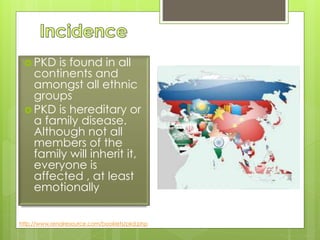
 PKD is found in all 
continents and 
amongst all ethnic 
groups 
 PKD is hereditary or 
a family disease. 
Although not all 
members of the 
family will inherit it, 
everyone is 
affected , at least 
emotionally 
http://www.renalresource.com/booklets/pkd.php
ADPKD 
between the ages 
of 30 and 40, but 
they can begin 
earlier, even in 
childhood 
In severe 
conditions (35- 
55%) (r5) 
prevalence of 
ADPKD of 1 in 1,000 
persons among 
children and adults 
ARPKD 
in the earliest 
months of life, 
even in the 
womb 
neonates 30% 
to 50% 
perinatal 
mortality 43% 
prevalence of 
ARPKD of 1 in 
10,000 neonates 
and children 
ACKD 
About 90 percent 
of people on 
dialysis for 5 years 
develop ACKD 
--------- 
------- 
Age or ethnic 
group 
(Appearance of 
Symptoms ) 
Mortality Rate 
People affected 
(Polycystic Kidney Disease Foundation) 
https://www.clinicalkey.com/topics/.../polycystic-kidney-disease.html
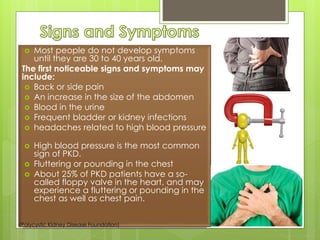
 Most people do not develop symptoms 
until they are 30 to 40 years old. 
The first noticeable signs and symptoms may 
include: 
 Back or side pain 
 An increase in the size of the abdomen 
 Blood in the urine 
 Frequent bladder or kidney infections 
 headaches related to high blood pressure 
 High blood pressure is the most common 
sign of PKD. 
 Fluttering or pounding in the chest 
 About 25% of PKD patients have a so-called 
floppy valve in the heart, and may 
experience a fluttering or pounding in the 
chest as well as chest pain. 
(Polycystic Kidney Disease Foundation)
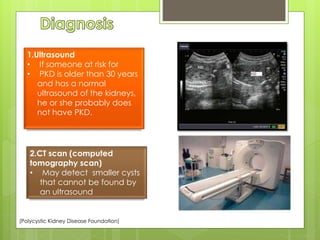
1.Ultrasound 
• If someone at risk for 
• PKD is older than 30 years 
and has a normal 
ultrasound of the kidneys, 
he or she probably does 
not have PKD. 
2.CT scan (computed 
tomography scan) 
• May detect smaller cysts 
that cannot be found by 
an ultrasound 
(Polycystic Kidney Disease Foundation)
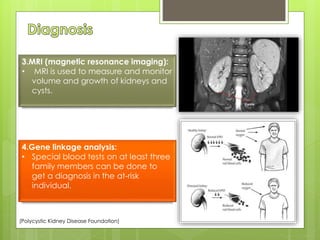
3.MRI (magnetic resonance imaging): 
• MRI is used to measure and monitor 
volume and growth of kidneys and 
cysts. 
4.Gene linkage analysis: 
• Special blood tests on at least three 
family members can be done to 
get a diagnosis in the at-risk 
individual. 
(Polycystic Kidney Disease Foundation)
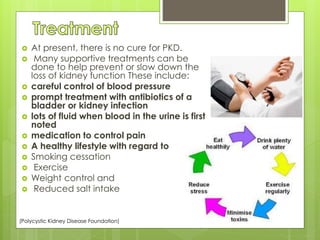
 At present, there is no cure for PKD. 
 Many supportive treatments can be 
done to help prevent or slow down the 
loss of kidney function These include: 
 careful control of blood pressure 
 prompt treatment with antibiotics of a 
bladder or kidney infection 
 lots of fluid when blood in the urine is first 
noted 
 medication to control pain 
 A healthy lifestyle with regard to 
 Smoking cessation 
 Exercise 
 Weight control and 
 Reduced salt intake 
(Polycystic Kidney Disease Foundation)
 Currently, no treatment can 
prevent the cysts from forming or 
enlarging. 
(U.S. National Library of 
Medicine) 
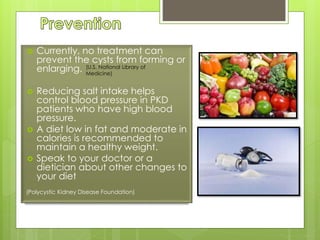
 Reducing salt intake helps 
control blood pressure in PKD 
patients who have high blood 
pressure. 
 A diet low in fat and moderate in 
calories is recommended to 
maintain a healthy weight. 
 Speak to your doctor or a 
dietician about other changes to 
your diet 
(Polycystic Kidney Disease Foundation)
 It is difficult to talk about this disease as a family, 
there are qualified counsellors who understand its 
inheritance pattern and implications of such a 
diagnosis 
 Counsellors can assist families to retain maximum 
productivity and acceptance whilst coping with 
what is difficult and challenging situation. 
 IT is important that patients discuss their disease 
concerns with doctors. 
(Renal Resource centre)
References: 
1.Renal Resource centre: www.kidny.org.au/renalresources 
2.Polycystic Kidney Disease Foundation: www.pkdcure.org 
3.U.S. National Library of Medicine : U.S. Department of Health 
and Human Services National Institutes of Health 
4. https://www.clinicalkey.com/topics/.../polycystic-kidney-disease. 
html 
http://www.renalresource.com/booklets/pkd.php 
5. Patient.co.uk http://www.patient.co.uk/doctor/autosomal-dominant- 
polycystic-kidney-disease

Polycystic kidney disease

  • 1.
    Muhammad Kamran Sial University Of Sargodha
  • 2.
     History PKD was first described in ninetieth century European medical literature  A comprehensive study about this disease was first published in 1957 by Dr O Z Dalgard.  The PKD discussed by him refers to Autosomal dominant PKD (ADPKD) or Adult PKD.  This form of PKD is not to be confused with Autosomal recessive PKD. (Renal Resource centre)
  • 3.
    Affects on body  Produces cysts in  liver  pancreas  spleen  ovaries  large bowel  Cysts in these organs usually do not cause serious problems (Polycystic Kidney Disease Foundation)
  • 4.
     PKD canalso affect the brain or heart. In brain, it can cause an aneurysm. An aneurysm is a bulging blood vessel that can burst, resulting in a stroke or even death In heart, the valves can become floppy, resulting in a heart murmur in some patients (Polycystic Kidney Disease Foundation)
  • 5.
    1.Autosomal Dominant PKD(also called PKD or ADPKD) • Transmitted by parent to child by dominant inheritance. • In other words, only one copy of the abnormal gene is needed to cause the disease 2.Infantile or Autosomal Recessive PKD (also called ARPKD) • Transmitted by parent to child by recessive inheritance. • It tends to be very serious and is often fatal in the first few months of life • ARPKD is extremely rare. It occurs in 1 out of 25,000 people (Polycystic Kidney Disease Foundation)
  • 6.
    3.Acquired Cystic Kidney Disease (also called ACKD)  It is often associated with kidney failure and dialysis.  People with ACKD usually seek help because they notice blood in their urine.  This is because the cysts bleed into the urinary system, which discolors urine. (Polycystic Kidney Disease Foundation)
  • 7.
    1.Polycystic kidney disease(PKD): • is passed down through families (inherited), usually as an autosomal dominant trait. • If one parent carries the gene, the children have a 50% chance of developing the disorder. 2.Autosomal dominant PKD: • occurs in both children and adults, but it is much more common in adults. • Symptoms often do not appear until middle age. • It affects nearly 1 in 1,000 Americans. • The actual number may be more, because some people do not have symptoms. U.S. National Library of Medicine
  • 8.
     Persons withPKD have many clusters of cysts in the kidneys. What exactly triggers the cysts to form is unknown.  A family history of PKD increases risk for the condition. An autosomal recessive: • It appears in infancy or childhood. • This form is much less common than autosomal dominant PKS, but it tends to be very serious and gets worse quickly. • It can cause serious lung and liver disease, end-stage kidney disease, and it usually causes death in infancy or childhood. U.S. National Library of Medicine
  • 9.
    PKD is associatedwith the following conditions: • Aortic aneurysms • Brain aneurysms • Cysts in the liver, pancreas, and testes • Diverticula of the colon • As many as half of people with PKD have cysts on the liver. U.S. National Library of Medicine
  • 10.
     PKD isfound in all continents and amongst all ethnic groups  PKD is hereditary or a family disease. Although not all members of the family will inherit it, everyone is affected , at least emotionally http://www.renalresource.com/booklets/pkd.php
  • 11.
    ADPKD between theages of 30 and 40, but they can begin earlier, even in childhood In severe conditions (35- 55%) (r5) prevalence of ADPKD of 1 in 1,000 persons among children and adults ARPKD in the earliest months of life, even in the womb neonates 30% to 50% perinatal mortality 43% prevalence of ARPKD of 1 in 10,000 neonates and children ACKD About 90 percent of people on dialysis for 5 years develop ACKD --------- ------- Age or ethnic group (Appearance of Symptoms ) Mortality Rate People affected (Polycystic Kidney Disease Foundation) https://www.clinicalkey.com/topics/.../polycystic-kidney-disease.html
  • 12.
     Most peopledo not develop symptoms until they are 30 to 40 years old. The first noticeable signs and symptoms may include:  Back or side pain  An increase in the size of the abdomen  Blood in the urine  Frequent bladder or kidney infections  headaches related to high blood pressure  High blood pressure is the most common sign of PKD.  Fluttering or pounding in the chest  About 25% of PKD patients have a so-called floppy valve in the heart, and may experience a fluttering or pounding in the chest as well as chest pain. (Polycystic Kidney Disease Foundation)
  • 13.
    1.Ultrasound • Ifsomeone at risk for • PKD is older than 30 years and has a normal ultrasound of the kidneys, he or she probably does not have PKD. 2.CT scan (computed tomography scan) • May detect smaller cysts that cannot be found by an ultrasound (Polycystic Kidney Disease Foundation)
  • 14.
    3.MRI (magnetic resonanceimaging): • MRI is used to measure and monitor volume and growth of kidneys and cysts. 4.Gene linkage analysis: • Special blood tests on at least three family members can be done to get a diagnosis in the at-risk individual. (Polycystic Kidney Disease Foundation)
  • 15.
     At present,there is no cure for PKD.  Many supportive treatments can be done to help prevent or slow down the loss of kidney function These include:  careful control of blood pressure  prompt treatment with antibiotics of a bladder or kidney infection  lots of fluid when blood in the urine is first noted  medication to control pain  A healthy lifestyle with regard to  Smoking cessation  Exercise  Weight control and  Reduced salt intake (Polycystic Kidney Disease Foundation)
  • 16.
     Currently, notreatment can prevent the cysts from forming or enlarging. (U.S. National Library of Medicine)  Reducing salt intake helps control blood pressure in PKD patients who have high blood pressure.  A diet low in fat and moderate in calories is recommended to maintain a healthy weight.  Speak to your doctor or a dietician about other changes to your diet (Polycystic Kidney Disease Foundation)
  • 17.
     It isdifficult to talk about this disease as a family, there are qualified counsellors who understand its inheritance pattern and implications of such a diagnosis  Counsellors can assist families to retain maximum productivity and acceptance whilst coping with what is difficult and challenging situation.  IT is important that patients discuss their disease concerns with doctors. (Renal Resource centre)
  • 18.
    References: 1.Renal Resourcecentre: www.kidny.org.au/renalresources 2.Polycystic Kidney Disease Foundation: www.pkdcure.org 3.U.S. National Library of Medicine : U.S. Department of Health and Human Services National Institutes of Health 4. https://www.clinicalkey.com/topics/.../polycystic-kidney-disease. html http://www.renalresource.com/booklets/pkd.php 5. Patient.co.uk http://www.patient.co.uk/doctor/autosomal-dominant- polycystic-kidney-disease