T I P S S Mihalcea A, Lesaru M, Grasu M, Georgescu SA, Valette PJ, Henry L, Gheorghe C, Mihaila M Indicati ons ,  work-up algorithm , re s ult s
TIPSS – transjugular intrahepatic  porto- systemic shunt interventional therapeutic procedure creates a permanent transhepatic communication between the portal and the caval systems  equilibration of the pressure in th e se two venous systems
INDICATION Severe portal hypertension of various etiology – complications recurent   digestive  bleeding Uncontroled variceal bleeding after two sessions  of sclerotherapy and  haemostasis  with  Sengstaken Blakemore baloon = TIPS S   emergency indication (in 12-24 hours) uncontroled ascit e s  hepatorenal syndrome cirrhotic patients with portal hypertension waiting for liver transplant
ABSOLUTE  CONTRAINDICATIONS PHT not proved  Total bilirubine   >50 micromol/l or seric creatinine > de 180 micromol/l Uncontrole d  portal encephalopathy  Chronic portal obstruction with portal cavernoma Spontaneous shunt with portal inversion  Tumor invasion of the hepatic venous system  Hemodinamic instability – APACHE II score> 20 Sepsis, activ e  infection
RELATIVE  CONTRAINDICATIONS Anatomic abnormalities of IVC, HV si PV; Recent thrombosis of PV; H ypervascular hepatic tumors; Liver policystic disease
Advantages  Immediat e   phys iopathologic impact on splahnic and hepatic circulation – reduction of portal pression with loose of the hepatic portal vascularisation  –  done only by the hepatic artery on the systemic circulation  on the cerebral function - ! encephalopathy risk Less invasive comparing with surgical shunts – diminishes the postoperatory risk  Shunt calibration according to the clinical context
PRE - TIPSS EVALUATION  Clinic  Laboratory   complete liver evaluation  seric and urinary ionogram seric creatinine,  coagulation tests hematologic tests  respiratory function ECG Imaging ultrasound – liver, venous anatomy - HV, PV; ascitis; spontaneous shunts CT – liver, PHT, parenchimal lesions  Angio-MRI - ficat, topografie venoasa - VH, VP; ascita; shunturi spntane  Anaesthetic risk evaluation
General an a esthesia 2-4 hours !!! Surgical aseptic conditions Ultrasound and radiological guidance Right jugular vein punction - cateterisation  Superior vena cava – right atrium – right or medium hepatic vein blocked pressure measurement – degree of PTH Creating a transhepatic communication, dilated with a baloon Metallic prosthesis between the portal vein and the hepatic vein T echnical aspects
Technical aspects Final portography Shunt permeability Decreased hepatic portal flow Reduction of collateral circulation  Measurement of the venous pressure Complementary procedures Prosthesis dilatation  Varices embolisation – coils Intravenous heparinotherapy
Postoperatory evolution ICU 0-5 days - depending on evolution  bed driven  24 h  anticoagulation correlated with the degree of hepatic disfunction platelets inhibitors heparine -  d0 – d7 fraxiparine 1 month Doppler ultrasound 24 hours –  velocity on portal side: 30 cm/sec si velocity on supra-hepatic side: 70-90 cm/sec Detection of early thrombosis Days 3, 5, 8, 15 and 30 Every 3 months after that
Case 1 – 43 y, M cirrhosis with PHT refractory ascites Evolution  ascites reduction clinical and lab tests improvement ultrasound follow-up 4 months – permeable TIPSS, minimum ascites
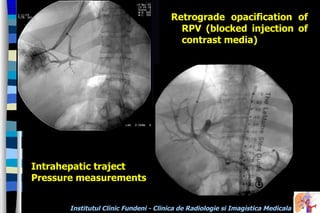
Retrograde opacification of RPV (blocked injection of contrast media) Intrahepatic traject Pressure measurements
Baloon dilatation of the intrahepatic traject
Evaluation of the length needed prothesis
C ase   2  – 50 y ,  M  –  emergency  TIPS S alcoholic  cirrhosis , Child C,  PTH, ascites   oesophageal varices  gr. III, 4 episo des of bleeding treated endoscopically variceal bleeding, uncontroled  endoscopic ally –  ICU TIPS S  –  PV pression  25 mm H 2 O   5 mm H 2 O Evolution variceal bleeding stops immediate clinical and laboratory tests improvement  ascites reduction (7 kg) ultrasound follow-up 12 months - permeable  TIPS S, clinically stable
Portal vein cateterisaton Gastric and oesophageal varices
Baloon dilatation Final portography
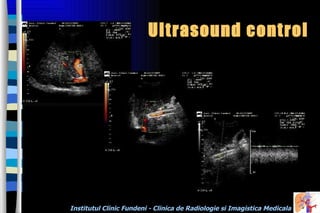
Ultrasound control
Case 3 – 24 y, F Budd Chiari  syndrome  TIPSS in Italy (2000) ascites prosthesis disfunction – low flow in hepatic segment of the prosthesis and reverse flow in left portal vein technical aspect: internal jugular vein thrombosis (during the first intervention) – external jugular vein cateterisation
RHV stenose PV and branches permeables
baloon  dilat ation improvement of the pressure  gradient
before 24H  after dilatation improvement of the flow
before 24H  after dilatation greater flow speed
Evolu tion   favorable with reduction of the ascites in the next 2 days ultrasound - persistance of the reverse flow in left portal vein . Final solution: liver transplant
C omplications Cau ses for technical failure PV thrombosis, HV occlusion or distorsion fibrous or atrophic liver massive ascites   Procedure complications   Cardiac arrithmias  Perforation of the liver capsule Pulmonary emboli Stent displacement Alergic reactions
Complications  Fatal complications -   1.7%   Intraperitoneal hemorrhage (PV, HA, capsule) Miocardial infarct during the procedure Right cardiac failure   Evolution complications Portal  encephalophaty Stent thrombosis  ( frecquent) inadecquate trans-hepatic traject low portal flow (spontaneous shunt)
Results  technical succes:  88% - 100% Mortality at 30 days:  3 - 7 % Results correlated with indications : Variceal haemorrhage:  90% succes – rapid and long lasting effect; if incomplete result an embolisation can be added  refractory ascites: 50% succes at 1-2 months after procedure
Results  Secondary disfunction:  40% at 1 an Shunt thrombosis – theoretical risk 100% at 2 years  Doppler survelliance and revision when a disfunction sign appears (reduction of flow speed, focal acceleration) Interest for  polytetrafluoroethylene-covered  and other covered  stent s
C onclusions TIPSS have immediat physiopathological impact  –  reduction of PHT and prevention of digestive bleedings The decision for TIPSS must respect the indications and contraindications in order to have good results an to reduce the rate of complications  TIPS S is better then surgical shunts, especially for fragiles patients – lower post-operatory risks

30

  • 1.
    T I PS S Mihalcea A, Lesaru M, Grasu M, Georgescu SA, Valette PJ, Henry L, Gheorghe C, Mihaila M Indicati ons , work-up algorithm , re s ult s
  • 2.
    TIPSS – transjugularintrahepatic porto- systemic shunt interventional therapeutic procedure creates a permanent transhepatic communication between the portal and the caval systems equilibration of the pressure in th e se two venous systems
  • 3.
    INDICATION Severe portalhypertension of various etiology – complications recurent digestive bleeding Uncontroled variceal bleeding after two sessions of sclerotherapy and haemostasis with Sengstaken Blakemore baloon = TIPS S emergency indication (in 12-24 hours) uncontroled ascit e s hepatorenal syndrome cirrhotic patients with portal hypertension waiting for liver transplant
  • 4.
    ABSOLUTE CONTRAINDICATIONSPHT not proved Total bilirubine >50 micromol/l or seric creatinine > de 180 micromol/l Uncontrole d portal encephalopathy Chronic portal obstruction with portal cavernoma Spontaneous shunt with portal inversion Tumor invasion of the hepatic venous system Hemodinamic instability – APACHE II score> 20 Sepsis, activ e infection
  • 5.
    RELATIVE CONTRAINDICATIONSAnatomic abnormalities of IVC, HV si PV; Recent thrombosis of PV; H ypervascular hepatic tumors; Liver policystic disease
  • 6.
    Advantages Immediate phys iopathologic impact on splahnic and hepatic circulation – reduction of portal pression with loose of the hepatic portal vascularisation – done only by the hepatic artery on the systemic circulation on the cerebral function - ! encephalopathy risk Less invasive comparing with surgical shunts – diminishes the postoperatory risk Shunt calibration according to the clinical context
  • 7.
    PRE - TIPSSEVALUATION Clinic Laboratory complete liver evaluation seric and urinary ionogram seric creatinine, coagulation tests hematologic tests respiratory function ECG Imaging ultrasound – liver, venous anatomy - HV, PV; ascitis; spontaneous shunts CT – liver, PHT, parenchimal lesions Angio-MRI - ficat, topografie venoasa - VH, VP; ascita; shunturi spntane Anaesthetic risk evaluation
  • 8.
    General an aesthesia 2-4 hours !!! Surgical aseptic conditions Ultrasound and radiological guidance Right jugular vein punction - cateterisation Superior vena cava – right atrium – right or medium hepatic vein blocked pressure measurement – degree of PTH Creating a transhepatic communication, dilated with a baloon Metallic prosthesis between the portal vein and the hepatic vein T echnical aspects
  • 9.
    Technical aspects Finalportography Shunt permeability Decreased hepatic portal flow Reduction of collateral circulation Measurement of the venous pressure Complementary procedures Prosthesis dilatation Varices embolisation – coils Intravenous heparinotherapy
  • 10.
    Postoperatory evolution ICU0-5 days - depending on evolution bed driven 24 h anticoagulation correlated with the degree of hepatic disfunction platelets inhibitors heparine -  d0 – d7 fraxiparine 1 month Doppler ultrasound 24 hours – velocity on portal side: 30 cm/sec si velocity on supra-hepatic side: 70-90 cm/sec Detection of early thrombosis Days 3, 5, 8, 15 and 30 Every 3 months after that
  • 11.
    Case 1 –43 y, M cirrhosis with PHT refractory ascites Evolution ascites reduction clinical and lab tests improvement ultrasound follow-up 4 months – permeable TIPSS, minimum ascites
  • 12.
    Retrograde opacification ofRPV (blocked injection of contrast media) Intrahepatic traject Pressure measurements
  • 13.
    Baloon dilatation ofthe intrahepatic traject
  • 14.
    Evaluation of thelength needed prothesis
  • 15.
    C ase 2 – 50 y , M – emergency TIPS S alcoholic cirrhosis , Child C, PTH, ascites oesophageal varices gr. III, 4 episo des of bleeding treated endoscopically variceal bleeding, uncontroled endoscopic ally – ICU TIPS S – PV pression 25 mm H 2 O 5 mm H 2 O Evolution variceal bleeding stops immediate clinical and laboratory tests improvement ascites reduction (7 kg) ultrasound follow-up 12 months - permeable TIPS S, clinically stable
  • 16.
    Portal vein cateterisatonGastric and oesophageal varices
  • 17.
  • 18.
  • 19.
    Case 3 –24 y, F Budd Chiari syndrome TIPSS in Italy (2000) ascites prosthesis disfunction – low flow in hepatic segment of the prosthesis and reverse flow in left portal vein technical aspect: internal jugular vein thrombosis (during the first intervention) – external jugular vein cateterisation
  • 20.
    RHV stenose PVand branches permeables
  • 21.
    baloon dilatation improvement of the pressure gradient
  • 22.
    before 24H after dilatation improvement of the flow
  • 23.
    before 24H after dilatation greater flow speed
  • 24.
    Evolu tion favorable with reduction of the ascites in the next 2 days ultrasound - persistance of the reverse flow in left portal vein . Final solution: liver transplant
  • 25.
    C omplications Causes for technical failure PV thrombosis, HV occlusion or distorsion fibrous or atrophic liver massive ascites Procedure complications Cardiac arrithmias Perforation of the liver capsule Pulmonary emboli Stent displacement Alergic reactions
  • 26.
    Complications Fatalcomplications - 1.7% Intraperitoneal hemorrhage (PV, HA, capsule) Miocardial infarct during the procedure Right cardiac failure Evolution complications Portal encephalophaty Stent thrombosis ( frecquent) inadecquate trans-hepatic traject low portal flow (spontaneous shunt)
  • 27.
    Results technicalsucces: 88% - 100% Mortality at 30 days: 3 - 7 % Results correlated with indications : Variceal haemorrhage: 90% succes – rapid and long lasting effect; if incomplete result an embolisation can be added refractory ascites: 50% succes at 1-2 months after procedure
  • 28.
    Results Secondarydisfunction: 40% at 1 an Shunt thrombosis – theoretical risk 100% at 2 years Doppler survelliance and revision when a disfunction sign appears (reduction of flow speed, focal acceleration) Interest for polytetrafluoroethylene-covered and other covered stent s
  • 29.
    C onclusions TIPSShave immediat physiopathological impact – reduction of PHT and prevention of digestive bleedings The decision for TIPSS must respect the indications and contraindications in order to have good results an to reduce the rate of complications TIPS S is better then surgical shunts, especially for fragiles patients – lower post-operatory risks