Download to read offline
![International Journal of Modern Engineering Research (IJMER)
www.ijmer.com Vol.3, Issue.2, March-April. 2013 pp-884-887 ISSN: 2249-6645
Study the Effect of Aluminum Variation on Hardness &Aluminum
Loss in Zn-Al Alloy
Mr. D. R. Raut, 1 Mr. S. H. Poratkar2
12
Yeshwantrao Chavan College of Engineering, Nagpur-441110
Abstract: The objective of this research is to study the hardness &aluminiumloss with percentage variation in Aluminium
content added to zinc. As there is a method for coating known as Galfan is available, in which combination of 95%zinc and
5% Aluminium is used for protecting steel from corrosion.As there are not much details available about why this
composition is used Zinc-5%Al, we are interested in study of effects of different composition of Aluminum with Zinc, so we
study the effect by adding different composition 2.5%,4.5%,6.5%,8.5% & 11.5% Aluminum in Zinc, for this study we are
using hot dip galvanizing process for studying this coating. Hot-dip galvanizing is widely used to improve the corrosion
resistance of steel. To obtain high-quality coatings, some alloy elements are added to the zinc bath. Aluminum is one of the
most important elements in galvanizing.Fe-Al phase diagram indicated thatα Fe is obtained between 1 to 11% of
AluminiumGalfan alloy consist of 95% Zn and 5% Al. It was decided to study the effect of variation in Al content in Zinc-
Aluminium alloy .Also during melting of this alloy we wanted to observed loss of Al due to oxidation hence the above
compositions were decided.
Keywords: Galfan, mildsteel
I. INTRODUCTION
In the zinc bath various elements are added in order to improve the melting characteristics of zinc and / or of the
layer deposited on the steel support.
Aluminiumis added to the zinc-plating bath in a continuous flow of the steel strips/plates at a rate of 0.1-0.3%
(optimal 0.14-0.17% [1]. Aluminium is added primarily to act as a brake to the reaction between zinc and steel support.
Reducing the iron-zinc reactions results a decrease in the brittle intermetallic compound layer which has a negative impact
the layer adhesion and plasticity. Because, compared with zinc, it has a higher affinity to iron; the aluminium present in the
zinc bath will quickly form the Fe2Al5-XZnX compound on the steel surface. This ternary compound arranged in a thin
layer onto the steel support will limit the diffusion processes leading to the formation of Fe-Zn intermetallic compounds [2].
The aluminum content in the layer will be much higher than that in the zinc bath. At 0.14% Al in the bath, the entire zinc
coating (Including the ternary alloy layer) contains about 0.20% Al [2].
We know that hot dip galvanized coating has excellent electrochemical protection (also known as the expense of
protection), when the coating damages, the coating of electrochemical protection can effectively protect the substrate and
prevents corrosion, galvanized coating layer also has welding protection. Thermal aluminum coating has excellent
atmospheric corrosion resistance and heat resistance, but at the expense of welding and poor protection. The new material
(Galfan) is integrated zinc and aluminum possessing coating advantages of both [3]. Galfan is a 5% Al + 95% Zn coating
with a small amount of mischmetal (Cerium, Lanthanum Neodybium) [4]. Mischmetal addition, containing lanthanum and
cerium additions upto about 0.5%[5]. As per ASTM B750 the specification covers GALFAN, zinc- aluminium – mischmetal
(Zn-5Al-MM) alloy is used in the production of hot dip coating on the steel. Cathodic protection provided by Galfan is more
or less the same as that for galvanizing, while general resistance to corrosion is up to twice than pure Zn [6].
Galfan is a trademark for hot dip galvanized steel sheet or wire covered with zinc 5% aluminium alloy coating,the
composition of which is near the eutectic point in the Zn-Al equilibrium phase diagram[7,8]. Two compositions based on
additions to the eutectic composition have been reported: small composition metal additions containing lanthanum and
cerium up to about 0.5%[9,10],and addition of 0.5% magnesium[11].
Shih reported that the nucleation and growth of Fe-Al intermetallics deplete the melt adjacent to the steel surface in
Al. If the dipping time is longer and the depletion continues, the usual Fe-Zn phases can be developing [12]. According to
Fe-Al-Zn ternary phase diagram at 4500c, [13, 14], the delta phase will be in thermodynamic equilibrium with the alpha iron,
as well an Fe2Al5 phase layer. According to Urednicek and Kirkaldy[15] and Perrot et al[14], the delta phase could dissolve
up to 8 wt%Al, therefore if the delta phase has been nucleated on the steel surface it would be in equilibrium with the Galfan
bath.
The present study is intended to evaluate experimentally the influence on the hardness and aluminium losses in Zn-
Al alloy due to variation in Aluminium content in alloy.
II. EXPERIMENTAL PROCEDURE
In order to study the effects of aluminium variation in Zn-Al alloy on hardness & loss of aluminium, the following
parameters were taken into consideration. The sizes of mild steel samples taken are 25mm*20mm with thickness of
5mm.After that polishing was carried out on all sides of samples with different grades of emery papers. Grades of emery
papers used are as follows 1/0, 2/0,3/0..Polished mild steel samples were immersed in CH3OH for 5 to 10 minutes. Then
samples were washed in distilled water. Samples were dried in in air for 5 to 10 minutes. These dried samples were ready for
www.ijmer.com 884 | Page](https://image.slidesharecdn.com/bt32884887-130402001138-phpapp01/85/Bt32884887-1-320.jpg)
![International Journal of Modern Engineering Research (IJMER)
www.ijmer.com Vol.3, Issue.2, March-April. 2013 pp-884-887 ISSN: 2249-6645
Study the Effect of Aluminum Variation on Hardness &Aluminum
Loss in Zn-Al Alloy
Mr. D. R. Raut, 1 Mr. S. H. Poratkar2
12
Yeshwantrao Chavan College of Engineering, Nagpur-441110
Abstract: The objective of this research is to study the hardness &aluminiumloss with percentage variation in Aluminium
content added to zinc. As there is a method for coating known as Galfan is available, in which combination of 95%zinc and
5% Aluminium is used for protecting steel from corrosion.As there are not much details available about why this
composition is used Zinc-5%Al, we are interested in study of effects of different composition of Aluminum with Zinc, so we
study the effect by adding different composition 2.5%,4.5%,6.5%,8.5% & 11.5% Aluminum in Zinc, for this study we are
using hot dip galvanizing process for studying this coating. Hot-dip galvanizing is widely used to improve the corrosion
resistance of steel. To obtain high-quality coatings, some alloy elements are added to the zinc bath. Aluminum is one of the
most important elements in galvanizing.Fe-Al phase diagram indicated thatα Fe is obtained between 1 to 11% of
AluminiumGalfan alloy consist of 95% Zn and 5% Al. It was decided to study the effect of variation in Al content in Zinc-
Aluminium alloy .Also during melting of this alloy we wanted to observed loss of Al due to oxidation hence the above
compositions were decided.
Keywords: Galfan, mildsteel
I. INTRODUCTION
In the zinc bath various elements are added in order to improve the melting characteristics of zinc and / or of the
layer deposited on the steel support.
Aluminiumis added to the zinc-plating bath in a continuous flow of the steel strips/plates at a rate of 0.1-0.3%
(optimal 0.14-0.17% [1]. Aluminium is added primarily to act as a brake to the reaction between zinc and steel support.
Reducing the iron-zinc reactions results a decrease in the brittle intermetallic compound layer which has a negative impact
the layer adhesion and plasticity. Because, compared with zinc, it has a higher affinity to iron; the aluminium present in the
zinc bath will quickly form the Fe2Al5-XZnX compound on the steel surface. This ternary compound arranged in a thin
layer onto the steel support will limit the diffusion processes leading to the formation of Fe-Zn intermetallic compounds [2].
The aluminum content in the layer will be much higher than that in the zinc bath. At 0.14% Al in the bath, the entire zinc
coating (Including the ternary alloy layer) contains about 0.20% Al [2].
We know that hot dip galvanized coating has excellent electrochemical protection (also known as the expense of
protection), when the coating damages, the coating of electrochemical protection can effectively protect the substrate and
prevents corrosion, galvanized coating layer also has welding protection. Thermal aluminum coating has excellent
atmospheric corrosion resistance and heat resistance, but at the expense of welding and poor protection. The new material
(Galfan) is integrated zinc and aluminum possessing coating advantages of both [3]. Galfan is a 5% Al + 95% Zn coating
with a small amount of mischmetal (Cerium, Lanthanum Neodybium) [4]. Mischmetal addition, containing lanthanum and
cerium additions upto about 0.5%[5]. As per ASTM B750 the specification covers GALFAN, zinc- aluminium – mischmetal
(Zn-5Al-MM) alloy is used in the production of hot dip coating on the steel. Cathodic protection provided by Galfan is more
or less the same as that for galvanizing, while general resistance to corrosion is up to twice than pure Zn [6].
Galfan is a trademark for hot dip galvanized steel sheet or wire covered with zinc 5% aluminium alloy coating,the
composition of which is near the eutectic point in the Zn-Al equilibrium phase diagram[7,8]. Two compositions based on
additions to the eutectic composition have been reported: small composition metal additions containing lanthanum and
cerium up to about 0.5%[9,10],and addition of 0.5% magnesium[11].
Shih reported that the nucleation and growth of Fe-Al intermetallics deplete the melt adjacent to the steel surface in
Al. If the dipping time is longer and the depletion continues, the usual Fe-Zn phases can be developing [12]. According to
Fe-Al-Zn ternary phase diagram at 4500c, [13, 14], the delta phase will be in thermodynamic equilibrium with the alpha iron,
as well an Fe2Al5 phase layer. According to Urednicek and Kirkaldy[15] and Perrot et al[14], the delta phase could dissolve
up to 8 wt%Al, therefore if the delta phase has been nucleated on the steel surface it would be in equilibrium with the Galfan
bath.
The present study is intended to evaluate experimentally the influence on the hardness and aluminium losses in Zn-
Al alloy due to variation in Aluminium content in alloy.
II. EXPERIMENTAL PROCEDURE
In order to study the effects of aluminium variation in Zn-Al alloy on hardness & loss of aluminium, the following
parameters were taken into consideration. The sizes of mild steel samples taken are 25mm*20mm with thickness of
5mm.After that polishing was carried out on all sides of samples with different grades of emery papers. Grades of emery
papers used are as follows 1/0, 2/0,3/0..Polished mild steel samples were immersed in CH3OH for 5 to 10 minutes. Then
samples were washed in distilled water. Samples were dried in in air for 5 to 10 minutes. These dried samples were ready for
www.ijmer.com 884 | Page](https://image.slidesharecdn.com/bt32884887-130402001138-phpapp01/75/Bt32884887-1-2048.jpg)
![International Journal of Modern Engineering Research (IJMER)
www.ijmer.com Vol.3, Issue.2, March-April. 2013 pp-884-887 ISSN: 2249-6645
Graph Between Hardness and Zn-Al Alloy Composition for Dendritic Structure
Result of loss of Aluminum (due to oxidation)
Sr. No. Initial Al % in Al % After Coating Loss of Al %
Zn
1. 2.5 2.48 0.02
2. 4.5 4.28 0.22
3. 6.5 6.23 0.27
4. 8.5 7.48 1.02
5. 11.5 8.44 3.06
IV. OBSERVATION
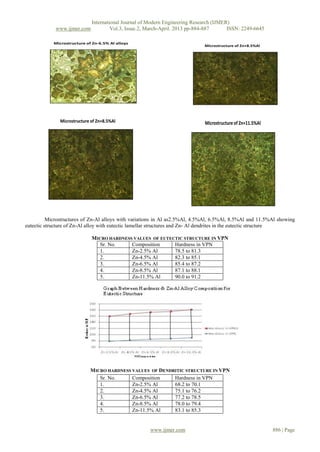
Hardness of eutectic lamellar structure with Al variation in Zn shows increasing order.
Hardness of dendrites also shows increasing order with increasing Al content in Zn.
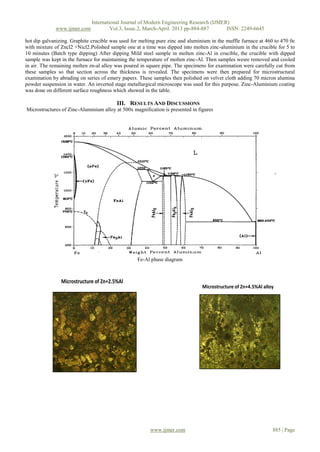
Microstructures of Zn-Al alloys with variation in Al as 2.5%Al, 4.5%Al, 6.5%Al, 8.5%Al, & 11.5%Al showing eutectic
structure of Zn-Al alloy with eutectic lamellar structures and Zn-Al dendrites in the eutectic structure.
Loss of Al increases with increase in percentage of Al in Zn-Al alloy.
V. CONCLUSION
From the present study it can be concluded that
Zinc-Aluminium alloys with variation in Al such as 2.5%, 4.5%, 6.5%,8.5%and 11.5%showing the formation of
Zn-Al dendritic structure inside the eutectic lamellar structure Dendrides formation is directly proportion to the Al
content .
The loss of aluminium increases with increase in aluminium percentage in Zn-Al alloy
Hardness at eutectic lamellar structure & at dendritic structure is increasing in order with Al content in Zn.
REFERENCE
[1] The Role of Aluminium in Continuous Hot-Dip Galvanizing, GalvInfoNote1.9, Rev 1.0 mar. 2009.
[2] Zinc Bath Management on Continuous Hot-Dip Galvanizing GalvInfoNote 2.4.1 Rev 1.0 Aug-09.
[3] Manxiu Zhao, Fucheng Yin, Zhi li, Yongxiong Liu, Zhahui Long, and Xuping Su. “PhaseEquilibria of the Al-Co-Zn system at 450°
[4] Gilles et al.”Preparation of steel surfaces for single dip Aluminium rich Zinc galvanizing” by United States patent application
publication.Pub. No.:US2005/0069653. Pub.Date:March 31, 2005
[5] Frank E.Goodwin,Roger N. Wright “The process Metallurgy of Zinc-Coated steel wire and Galfan Bath Management”.
[6] Wen-Ben Chena, Peter Chenb. , H.Y. Chenc, Jack Wuc, Wen-Ta Tsaia “Devlopment of Aluminium-containing Zinc-rich for
corrosion resistance”Applied surface science 187 (2002) accepted on 5 November, 2001
[7] J.L. Murray,Al-Zn binary alloy phase diagram. In:Massalski T. B., ed., 1986.Binary alloy phase diagram. Metals Park, OH 44073,
ASM1, 1983,185.
[8] R.Branders, A.Stacey, Zinc-aluminium coating: Management of Galfan lines, Wire Journal International, 41,11,2008, 74-77.
[9] D.C. Herrscaft, S.F. Radke., D.Coutsouradis, J.Pelerin, Galfan-A New Zinc-Alloy Coated Steel for Automotive Body Use.
Warrendale, PA: SAE, 1983, SAE Paper No.
[10] S.F. Radtke, D.C.Herrschaft, Role of mischmetal in galvanizing with a Zn-5%Al alloy.J.Less Common Met 93, 1983, 253.
[11] G.J. Harvey and P.N.Richards, Zinc-based coatings for corrosion protection of steel sheet and strip. Metals forum 6, 4, 1984, 235-
247
[12] H.C.Shih, J.W.Hsu, C.N.Sun and S.C.Chung, The lifetime assessment of hot-dip 5% Al-Zn coatings in chloride environments.
Surface and Coatings Technology, 150, 1, 2002, 70-75.
[13] Z.W.Chen, R.M.Sharp, J.T.Gregory, Fe-Al-Zn ternary phase diagram at 4500c. Mater. Sci. Technol.6, 1990, 1173.
[14] P. Perrot, J.C.Tissier, J.Y.Dauphin, Stable and metastable equilibria in the Fe-Zn –Al system at 4500c. Z Metallkde 83,1992,11
[15] Urednicek and Kirkaldy, investigation of the phase constitution of iron-zinc-aluminium at 4500c .Z Metallkde/Materials Research and
Advanced Techniques, 64, 6, 1973, 419-427.
www.ijmer.com 887 | Page](https://image.slidesharecdn.com/bt32884887-130402001138-phpapp01/85/Bt32884887-4-320.jpg)

This document summarizes a study on the effect of aluminum variation on hardness and aluminum loss in zinc-aluminum alloys. Samples of mild steel were coated with zinc-aluminum alloys containing 2.5%, 4.5%, 6.5%, 8.5%, and 11.5% aluminum. Microstructural analysis found the coatings consisted of zinc-aluminum dendrites within a eutectic lamellar structure. Hardness measurements showed both the eutectic and dendritic structures increased in hardness with higher aluminum content. Testing also revealed aluminum loss from the coatings increased with higher initial aluminum percentages in the alloy. The study concluded that dendrite formation and coating hardness rise with aluminum


![e-mail [email protected]Effect of Heat Treatment on Some M.docx](https://cdn.slidesharecdn.com/ss_thumbnails/e-mailemailprotectedeffectofheattreatmentonsomem-230104142415-5e6addf4-thumbnail.jpg?width=640&height=640&fit=bounds)


