 Atomic number
 group, period
 Block
 Element category
 standard atomic
weight
 electron
configuration
 electrons per
shell
 82
 group 14 (carbon
group), period 6
 p-block
 post-transition
metal
 207.2(1)[1]
 [Xe] 4f14 5d10 6s2
6p2
 2, 8, 18, 32, 18, 4
 Phase
 Melting point
 boiling point
 Density
 Heat of fusion
 Heat of
vaporization
 Molar heat
capacity
 solid
 600.61 K(327.46°C,
621.43 °F)
 2022 K (1749 °C, 31
80 °F)
 11.34 g/cm3
 4.77 kJ/mol
 179.5 kJ/mol
 26.650 J/(mol·K)
 Oxidation state
 Electronegativity
 Ionization energies
 atomic radius
 Covalent radius
 Van der Waals radius
 4, 3, 2, 1, −1, −2,
−4 (an amphoteric
oxide)
 pauling scale: 1.87
(+2)
 1st:715.6 kJ/mol
2nd:1450.5 kJ/mol
3rd:3081.5 kJ/mol
 empirical: 175 pm
 146±5 pm
 202 pm
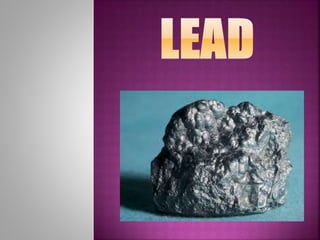
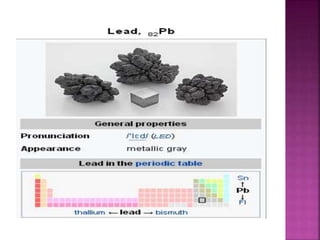
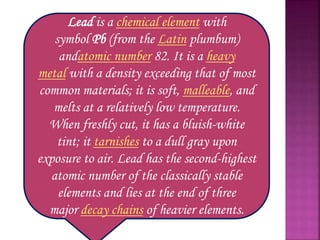
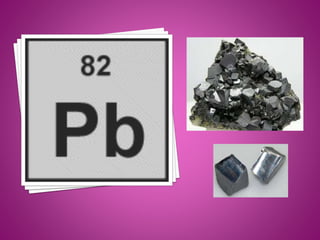
Lead is a chemical element with
symbol Pb (from the Latin plumbum)
andatomic number 82. It is a heavy
metal with a density exceeding that of most
common materials; it is soft, malleable, and
melts at a relatively low temperature.
When freshly cut, it has a bluish-white
tint; it tarnishes to a dull gray upon
exposure to air. Lead has the second-highest
atomic number of the classically stable
elements and lies at the end of three
major decay chains of heavier elements.
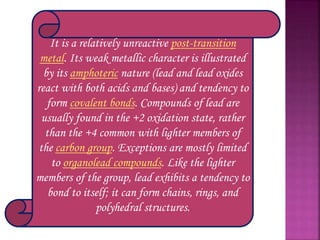
It is a relatively unreactive post-transition
metal. Its weak metallic character is illustrated
by its amphoteric nature (lead and lead oxides
react with both acids and bases) and tendency to
form covalent bonds. Compounds of lead are
usually found in the +2 oxidation state, rather
than the +4 common with lighter members of
the carbon group. Exceptions are mostly limited
to organolead compounds. Like the lighter
members of the group, lead exhibits a tendency to
bond to itself; it can form chains, rings, and
polyhedral structures.
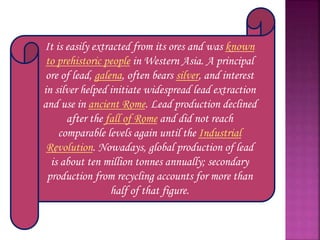
It is easily extracted from its ores and was known
to prehistoric people in Western Asia. A principal
ore of lead, galena, often bears silver, and interest
in silver helped initiate widespread lead extraction
and use in ancient Rome. Lead production declined
after the fall of Rome and did not reach
comparable levels again until the Industrial
Revolution. Nowadays, global production of lead
is about ten million tonnes annually; secondary
production from recycling accounts for more than
half of that figure.
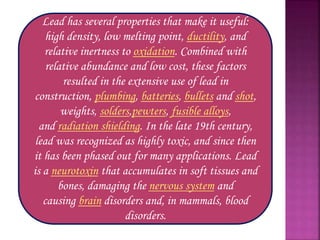
Lead has several properties that make it useful:
high density, low melting point, ductility, and
relative inertness to oxidation. Combined with
relative abundance and low cost, these factors
resulted in the extensive use of lead in
construction, plumbing, batteries, bullets and shot,
weights, solders,pewters, fusible alloys,
and radiation shielding. In the late 19th century,
lead was recognized as highly toxic, and since then
it has been phased out for many applications. Lead
is a neurotoxin that accumulates in soft tissues and
bones, damaging the nervous system and
causing brain disorders and, in mammals, blood
disorders.
Lead is an incredibly useful metal,
but it is also toxic to humans. In
fact, if we didn't have to worry about
breathing in its dust or ingesting its
particles, lead would be in
widespread use due to its highly
industry-friendly properties, such
as excellent malleability and
corrosion resistance.
Throughout history — before the scientific
advancements of the 20th century revealed
its potent toxicity — lead was widely used in a
variety of products, including cosmetics,
paint, solder, pipes and gasoline. Certain
properties of lead, namely its ductility and
resistance to corrosion and tiny leaks, make it
a particularly good material for constructing
water pipes. Even the ancient Romans made
their water pipes out of lead, causing some to
believe that lead poisoning, at least partially,
led to the fall of the Roman Empire.
Throughout history — before the scientific
advancements of the 20th century revealed its
potent toxicity — lead was widely used in a
variety of products, including cosmetics, paint,
solder, pipes and gasoline. Certain properties
of lead, namely its ductility and resistance to
corrosion and tiny leaks, make it a particularly
good material for constructing water pipes.
Even the ancient Romans made their water
pipes out of lead, causing some to believe that
lead poisoning, at least partially, led to the fall
of the Roman Empire.
Lead powerpoint-presentation

Lead powerpoint-presentation

  • 4.
     Atomic number group, period  Block  Element category  standard atomic weight  electron configuration  electrons per shell  82  group 14 (carbon group), period 6  p-block  post-transition metal  207.2(1)[1]  [Xe] 4f14 5d10 6s2 6p2  2, 8, 18, 32, 18, 4
  • 5.
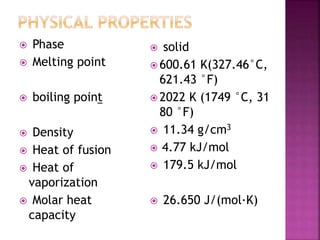
     Phase  Meltingpoint  boiling point  Density  Heat of fusion  Heat of vaporization  Molar heat capacity  solid  600.61 K(327.46°C, 621.43 °F)  2022 K (1749 °C, 31 80 °F)  11.34 g/cm3  4.77 kJ/mol  179.5 kJ/mol  26.650 J/(mol·K)
  • 6.
     Oxidation state Electronegativity  Ionization energies  atomic radius  Covalent radius  Van der Waals radius  4, 3, 2, 1, −1, −2, −4 (an amphoteric oxide)  pauling scale: 1.87 (+2)  1st:715.6 kJ/mol 2nd:1450.5 kJ/mol 3rd:3081.5 kJ/mol  empirical: 175 pm  146±5 pm  202 pm
  • 7.
    Lead is achemical element with symbol Pb (from the Latin plumbum) andatomic number 82. It is a heavy metal with a density exceeding that of most common materials; it is soft, malleable, and melts at a relatively low temperature. When freshly cut, it has a bluish-white tint; it tarnishes to a dull gray upon exposure to air. Lead has the second-highest atomic number of the classically stable elements and lies at the end of three major decay chains of heavier elements.
  • 8.
    It is arelatively unreactive post-transition metal. Its weak metallic character is illustrated by its amphoteric nature (lead and lead oxides react with both acids and bases) and tendency to form covalent bonds. Compounds of lead are usually found in the +2 oxidation state, rather than the +4 common with lighter members of the carbon group. Exceptions are mostly limited to organolead compounds. Like the lighter members of the group, lead exhibits a tendency to bond to itself; it can form chains, rings, and polyhedral structures.
  • 9.
    It is easilyextracted from its ores and was known to prehistoric people in Western Asia. A principal ore of lead, galena, often bears silver, and interest in silver helped initiate widespread lead extraction and use in ancient Rome. Lead production declined after the fall of Rome and did not reach comparable levels again until the Industrial Revolution. Nowadays, global production of lead is about ten million tonnes annually; secondary production from recycling accounts for more than half of that figure.
  • 10.
    Lead has severalproperties that make it useful: high density, low melting point, ductility, and relative inertness to oxidation. Combined with relative abundance and low cost, these factors resulted in the extensive use of lead in construction, plumbing, batteries, bullets and shot, weights, solders,pewters, fusible alloys, and radiation shielding. In the late 19th century, lead was recognized as highly toxic, and since then it has been phased out for many applications. Lead is a neurotoxin that accumulates in soft tissues and bones, damaging the nervous system and causing brain disorders and, in mammals, blood disorders.
  • 12.
    Lead is anincredibly useful metal, but it is also toxic to humans. In fact, if we didn't have to worry about breathing in its dust or ingesting its particles, lead would be in widespread use due to its highly industry-friendly properties, such as excellent malleability and corrosion resistance.
  • 13.
    Throughout history —before the scientific advancements of the 20th century revealed its potent toxicity — lead was widely used in a variety of products, including cosmetics, paint, solder, pipes and gasoline. Certain properties of lead, namely its ductility and resistance to corrosion and tiny leaks, make it a particularly good material for constructing water pipes. Even the ancient Romans made their water pipes out of lead, causing some to believe that lead poisoning, at least partially, led to the fall of the Roman Empire.
  • 14.
    Throughout history —before the scientific advancements of the 20th century revealed its potent toxicity — lead was widely used in a variety of products, including cosmetics, paint, solder, pipes and gasoline. Certain properties of lead, namely its ductility and resistance to corrosion and tiny leaks, make it a particularly good material for constructing water pipes. Even the ancient Romans made their water pipes out of lead, causing some to believe that lead poisoning, at least partially, led to the fall of the Roman Empire.