International Journal of Modern Engineering Research (IJMER)
                www.ijmer.com                 Vol.2, Issue.4, July-Aug. 2012 pp-1934-1939      ISSN: 2249-6645

               A class of Harmonic Univalent Functions with Varying
               Arguments Defined by Generalized Derivative Operator
                                                         Y. P. Yadav, N. D. Sangle
                      1
                          (Research Scholar, Department of Mathematics, Singhania University, Pacheri Bari,
                                                 Dist-Jhunjhunu, Rajasthan-333515)
                               2
                                 (Department of Mathematics, Annasaheb Dange College of Engineering,
                                                 Ashta, Sangali, (M.S) India 416 301)


Abstract: In this paper, we have introduced a new class of complex valued harmonic functions which are orientation
preserving and univalent in the open unit disc and are related to uniformly convex functions. Coefficient bounds,
neighborhood and extreme points for the functions belonging to this class are obtained.
2000 AMS subject classification: Primary 30C45, Secondary 30C50, 30C55.

Key Words: Harmonic, derivative operator, univalent, Neighborhoods, extreme points.

                                                             I. INTRODUCTION
A continuous complex-valued function            f  z   u  iv is defined in a simply-connected complex                     domain   D is said to be
harmonic in    D if both u and       v are real harmonic in D . Such functions can be expressed as
                                                                              f ( z )  h( z )  g ( z )                                          (1.1)
where   h( z ) and g ( z ) are analytic in D . We call h( z ) the analytic part and g ( z ) the co-analytic part of f ( z ) . A
necessary and sufficient condition for            f ( z ) to be locally univalent and sense preserving in D is that h  z   g  z 
          D , Clunie and Shell-Smail [2]. Let H be the class of functions of the form (1.1) that are harmonic univalent
for all z in
and sense-preserving in the unit disk U   z : z  1 for which                    f  0  f z  0 1  0 .Then for
 f ( z )  h( z )  g ( z )  H ,
        we may express the analytic functions              h( z ) and g ( z ) as
                                                                                               
                                         h  z   z   ak z k ,                   g  z    bk z k ,       z U , b1  1                      (1.2)
                                                            k 2                               k 1

In 1984, Clunie and Sheil-Small [2] investigated the class      S H as well as its geometric subclasses and obtained some
coefficient bounds. Since then, there have been several related papers on S H and its subclasses. Now we will introduce a
generalized derivative operator for f ( z )  h( z )  g ( z ) given by (1.2). For fixed positive natural m and                        2  1  0,
                                                              D1 ,,2 f  z   D1 ,,2 h  z   D1 ,,2 g  z  , z U
                                                               mk                 mk                 mk
                                                                                                                                                  (1.3)
where
                                                                        1   1  2  k  1 
                                                                                                           m
                                                                       
                                         D  m,k
                                            1 , 2   h z  z      1    k  1  ak z   
                                                                                                   k

                                                                  k 2            2             
and
                                                         1   1  2  k  1 
                                                                                                      m
                                                                   
                                    D g z  
                                               m,k
                                               1 , 2   1    k  1  bk z . 
                                                                                        k

                                                   k 1            2             
We note that by specializing the parameters, especially when 1  2  0, D , reduces to Dm which introduced by
                                                                                    m,k
                                                                                    1 2

Salagean in [6].
Now we will introduce the following definition.

Definition 1.1. For       0  l  1 , let GH l, m, k , 1, 2            denote the subfamily of starlike harmonic functions           f ( z )  H of
the form (1.1) such that


                                                                   www.ijmer.com                                                           1934 | Page
International Journal of Modern Engineering Research (IJMER)
                 www.ijmer.com                              Vol.2, Issue.4, July-Aug. 2012 pp-1934-1939      ISSN: 2249-6645

                                                              z D1 ,,2 f  z                    
                                                                                  '
                                                                  mk
                                                                                     i 
                                                  Re 1  e  ' m,k
                                                            i
                                                                                    e  l                                       z U ,
                                                                                                      
                                                                                                                          for                       (1.4)
                                                              z D1 ,2 ft  z         
                                                                                        
Where      ft  z   1  t  z  t h( z)  g ( z)                 ,
               D           f  z 
                                    d
                                                      
                                        D1 ,,2 f  rei  ,
                                                               d
                                                                              
                                                                  z  rei  .
                                           '
                    m, k                 mk
                   1 ,2
                                   d                         d
We also let VH  l , m, k , 1, 2   GH l , m, k , 1, 2  VH where VH is the class of harmonic functions with varying
arguments introduced by Jahangiri and Silverman [3] consisting of functions                                f ( z ) of the form (1.1) in H for which there
exists a real number               such that
                                                              k   k 1    mod 2  , k   k 1  0  k  2 ,                           (1.5)
where k   arg  ak  and  k  arg bk  . The same class introduced in [4] with different differential operator.
In this paper, we obtain a sufficient coefficient condition for functions f ( z ) given by (1.2) to be in the class
GH l, m, k , 1, 2  . It is shown that this coefficient condition is necessary also for functions belonging to the class
VH  l , m, k , 1, 2  . Further, extreme points for functions in VH  l , m, k , 1, 2  are also obtained.

                                                                          II. MAIN RESULT
We begin deriving a sufficient coefficient condition for the functions belonging to the class GH  l , m, k , 1 , 2  . This result
is contained in the following.
Theorem 2.1. Let f ( z )  h( z )  g ( z ) given by (1.2). Furthermore, let

                                                                            1       k  1 
                                                                                                                           m
                                               
                                                 2k  t  lt 2k  t  lt                             2  t  lt
                                             1  l ak  1  l bk   1 1  2k  1   1  3  l b1
                                           k 2                                                                                                (2.1)
                                                                                       2            

where   0  l  1 , then f  GH l , m, k , 1, 2  .
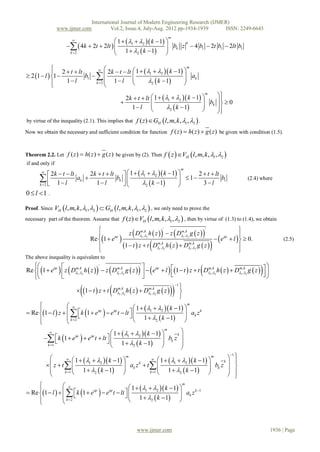
Proof: We first show that if the inequality (2.1) holds for the coefficients of f ( z )  h( z )  g ( z ) , then the required
condition (1.4) is satisfied. Using (1.3) and (1.4), we can write
                                                                                                                      
                                                                                             
                                                               z D1 ,,2 h  z   z D1 ,,2 g  z          
                                                                                   '                         '
                                                                                                                             A z  
                                                                                                                                    
                                                                      mk                      mk
                                                                                                                   i 
                                               Re 1  e 
                                                         i
                                                                                                                  e   Re         
                                                                                                                  
                                                                                                                                                    (2.2)
                                                           1  t  z  t Dm1 ,,2 h  z   Dm1 ,,2 g  z 
                                                                                  k                   k
                                                                                                                            B z
                                                                                                                                    
                                                                                                                      

where
                     
                     
                          mk
                                              mk
                                                       
                                                               '
                                                                     
                                                                       
                                                                                       mk
                                                                                                           
A  z   1  ei   z D1 ,,2 h  z   z D1 ,,2 g  z    ei 1  t  z  t D1 ,,2 h  z   D1 ,,2 g  z  
                                          '
                                                                                                           mk
                                                                                                                           
                                                                                                                                          
                                
 B  z   1  t  z  t D1 ,,2 h  z   D1 ,,2 g  z  .
                           mk                 mk
                                                                          
 In view of the simple assertion that                      Re  w  l if and only if 1  l  w  1  l  w ,it is sufficies to show that
                                                                   A  z   1  l  B  z   A  z   1  l  B  z   0.                     (2.3)

Substituting for    A  z  and B  z  the appropriate expressions in (2.3), we get
 A  z   1  l  B  z   A  z   1  l  B  z 

                                      1   1  2  k  1 
                                                                                          m
                     
 2 1  l  z    4k  2t  2lt  
                                                                      k
                                      1    k  1          ak z
                 k 2                           2             

                                                                              www.ijmer.com                                                    1935 | Page
International Journal of Modern Engineering Research (IJMER)
                 www.ijmer.com                  Vol.2, Issue.4, July-Aug. 2012 pp-1934-1939      ISSN: 2249-6645

                                            1   1  2  k  1 
                                                                                    m
                           
                        4k  2t  2lt  
                                            1    k  1  bk z  4 b1  2t b1  2lt b1
                                                                       k
                                                                     
                       k 2                           2             

                                
                                      2k  t  lt  1   1  2  k  1 
                                                                              m
              2  t  lt
 2 1  l  1          b1                                             ak
                 1 l         k 2    1 l             2  k  1      
                                                                            
                                   

                                                 2k  t  lt  1   1  2  k  1 
                                                                                           m
                                                                                              
                                                                                        bk    0
                                                    1 l            2  k  1        
                                                                                             
                                                                                              
by virtue of the inequality (2.1). This implies that f ( z)  GH  l , m, k , 1, 2  .

Now we obtain the necessary and sufficient condition for function f ( z )  h( z )  g ( z ) be given with condition (1.5).


Theorem 2.2. Let f ( z )  h( z )  g ( z ) be given by (2). Then                 f  z  VH  l , m, k , 1, 2 
if and only if
                          2k  t  lt   1   1    k  1 
                                                                                                m
        
             2k  t  lt                                          2  t  lt
         1  l ak  1  l bk     k 2 1   1  3  l b1
       k 2                                                                                                                (2.4) where
                                                 2              
0  l 1 .

Proof. Since VH  l , m, k , 1 , 2   GH l , m, k , 1, 2  , we only need to prove the
necessary part of the theorem. Assume that              f ( z) VH l, m, k , 1, 2  , then by virtue of (1.3) to (1.4), we obtain
                                                                                                               
                                                                                      
                                                      z D1 ,,2 h  z   z D1 ,,2 g  z          
                                                                         '                      '
                                                             mk                    mk
                                                                                                               
                                      Re 1  e 
                                                i
                                                                                                      e  l    0.
                                                                                                         i

                                                                                                         
                                                                                                                                                    (2.5)
                                                  1  t  z  t D1 ,2 h  z   D1 ,2 g  z 
                                                                      m,k             m,k
                                                                                                                
                                                                                                               
The above inequality is equivalent to
   
   
                 
                 
                       
                      mk
                                      '
                                          mk
                                                 
                                                           '

                                                            
                                                                          
                                                                           
                                                                                            mk
                                                                                                     
Re  1  ei   z D1 ,,2 h  z   z D1 ,,2 g  z     ei  l  1  t  z  t D1 ,,2 h  z   D1 ,,2 g  z 
                                                                                                               mk
                                                                                                                                     
                                                                                            
                                                                                           1
                                1  t  z  t D1 ,,2 h  z   D1 ,,2 g  z 
                                                 mk                 mk
                                                                                                
                                                                                                
                                                1   1  2  k  1 
                                                                              m
     
 Re 1  l  z     k 1  e   e t  lt  
                                 i     i
                                                  1    k  1  ak z
                                                                                k

                   k 2                        
                                                                            
                                                                            
                                                            2


                                      1   1  2  k  1 
                                                                  m
                                                                          
         k 1  e   e t  lt                              bk z 
                        i    i                                        k

                                     1    k  1                   
         k 1                                    2                      
                                                                                                        
                                                                                                                      1
                                                                                                                           
                           1   1  2  k  1                    1   1  2  k  1 
                                                     m                                           m
                                                                
                                                                                                                           
             z  t                                 ak z  t                                  bk z 
                                                                                                       k

                          1    k  1                            1    k  1 
                                                           k
                                                                                                                         
                   k 1                                      k 1                                                    
                                    2                                           2
                                                                                                                          
                                             1   1  2  k  1 
                                                                           m
     
 Re 1  l      k 1  e   e t  lt  
                               i    i
                                               1    k  1  ak z
                                                                             k 1

                 k 2                       
                                                                         
                                                                         
                                                         2


                                                                  www.ijmer.com                                                                1936 | Page
International Journal of Modern Engineering Research (IJMER)
               www.ijmer.com               Vol.2, Issue.4, July-Aug. 2012 pp-1934-1939      ISSN: 2249-6645

                      z                            1   1  2  k  1 
                                                                               m
                                                                                          
                        k 1  e   e t  lt  
                                                                                     k 1
                                   i    i
                                                   1    k  1             bk z 
                      z k 1                      
                                                                             
                                                                                         
                                                               2
                                                                                          
                                                                                                 
                                                                                                           1
                                                                                                                
                      1   1  2  k  1           z   1   1  2  k  1 
                                                m                                        m
                 
                                                                                             k 1               
       1  t     1    k  1          ak z  t  
                                                    k 1
                                                                                        bk z                    0.
              k 1                                    z k 1  1  2  k  1 
                                                                                                             
                               2
                                                                                                               
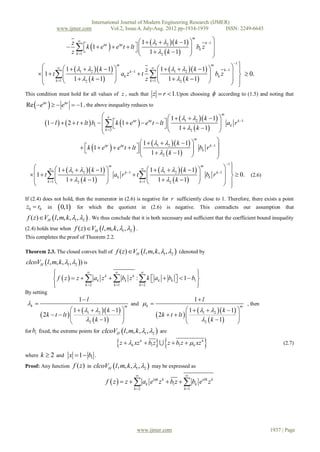
This condition must hold for all values of z , such that                z  r  1.Upon choosing  according to (1.5) and noting that
Re  ei    ei  1 , the above inequality reduces to
                                                                               1   1  2  k  1 
                                                                                                               m

         1  l    2  t  lt  b1    k 1  e   e t  lt  
                                                
                                                          i         i
                                                                                1    k  1  ak r      
                                                                                                                      k 1

                                          k 2                                                             
                                                                                           2


                                                                1   1  2  k  1 
                                                                                               m
                                                                                                           
                                k 1  e   e t  lt  
                                
                                           i     i
                                                               1    k  1                bk r k 1 
                                                                                                         
                                                                             2
                                                                                                           
                                                                                                                 
                                                                                                                 1
            
                  1   1  2  k  1   
                                              m
                                                                 
                                                                      1   1  2  k  1    
                                                                                                   m

   1  t                                                                                                     
                 1    k  1  ak r  t   1    k  1  bk r    0. (2.6)
                                                     k 1                                                  k 1

          k 1 
                                                                                               
                           2                                 k 1             2                               

If (2.4) does not hold, then the numerator in (2.6) is negative for r sufficiently close to 1. Therefore, there exists a point
z0  r0 in       0,1    for which the quotient in (2.6) is negative. This contradicts our assumption                             that

 f ( z) VH l, m, k , 1, 2  . We thus conclude that it is both necessary and sufficient that the coefficient bound inequality
(2.4) holds true when    f ( z) VH l, m, k , 1, 2  .
This completes the proof of Theorem 2.2.

Theorem 2.3. The closed convex hull of        f ( z) VH l, m, k , 1, 2  (denoted by
clcoVH l, m, k , 1, 2 ) is
              
                                                                     
                                                                         
               f  z   z   ak z   bk z :  k  ak  bk   1  b1 
                                    k        k
                                                             
              
                             k 2     k 1     k 2                     
                                                                         
By setting
                           1 l                                                              1 l
 k                                                   and          k                                             , then
                         1   1  2  k  1                                1   1  2  k  1 
                                                   m                                                            m

         2k  t  lt                                          2k  t  lt                           
                                2  k  1                                            2  k  1      
for b1 fixed, the extreme points for clcoVH  l , m, k , 1 , 2  are

                                              z   xzk
                                                                k
                                                                            
                                                                     b1 z  z  b1 z  k xz k                                  (2.7)

where   k2    and    x  1  b1 .
Proof: Any function      f ( z ) in clcoVH l , m, k , 1, 2  may be expressed as
                                                                                     
                                         f  z   z   ak ei k z k  b1 z   bk ei k z k
                                                           k 2                       k 1


                                                            www.ijmer.com                                                    1937 | Page
International Journal of Modern Engineering Research (IJMER)
                      www.ijmer.com               Vol.2, Issue.4, July-Aug. 2012 pp-1934-1939      ISSN: 2249-6645

where the coefficients satisfy the inequality (2.1). Set                      h1  z   z , g1  z   b1z , hk  z   z  k eik z k ,
                                                                                                                                         
                                                                             ak               bk
gk  z   b1z  k ei k z k for k  2,3, 4,... Writing  k                      ,   Yk             ,   k  2,3, 4,... and 1  1    k ;
                                                                             k               k                                        k 2
              
Y1  1   Yk , we get
          k 2
              
 f  z      k hk  z   Yk g k  z   .
              k 1


                                                                                                   
In particular, setting f1  z   z  b1 z and f k  z   z  k xz k  b1 z  k yz k , k  2, x  y  1  b1 ,              
we see that extreme points of clco           f ( z) VH l , m, k , 1, 2    f k  z  .
To see that  f1  z  is not in extreme point, note that f1  z  may written as

            f1  z  
                       1
                        2
                              
                           f1  z   2 1  b1  z 2 
                                                         1
                                                         2
                                                            
                                                             f1  z   2 1  b1  z 2           
a convex linear combination of functions in clcoVH  l , m, k , 1 , 2  .
To see that          f m is not an extreme point if both x  0 and y  0 , we will show that it can then also be expressed as a
convex linear combinations of functions in                clcoVH l , m, k , 1, 2  . Without loss of generality, assume               x y.
                                                                x                                               x
Choose      0          small    enough so that                . Set A  1 and                 B  1         . We then see that both
                                                                y                                                y
t1  z   z  k Axz k  b1 z  k yBz k and
t2  z   z  k  2  A xz k  b1 z  k y  2  B  z k are in clcoVH l , m, k , 1 , 2  and that

 fk  z  
              1
              2
                t1  z   t2  z .
The extremal coefficient bounds show that functions of the form (12) are the extreme points for                       clcoVH l , m, k , 1, 2  ,
and so the proof is complete.
Following Avici and Zlotkiewicz [1] and Ruscheweyh [5], we refer to the                             -neighborhood    of the functions         f  z
defined by (1.2) to be the set of functions         F for which
                                                                           
                                                                                                               
                      N  f    F  z   z   Ak z k  Bk z k ,  k  ak  Ak  bk  Bk  b1  B1                                     (2.8)
                                                   k 2        k 1         k 2                              
In our case, let us define the generalized  -neighborhood of f ( z ) to be the set
             
                         
                               1   1  2  k  1 
                                                          m

 N  f    F  z  :                                2k  t  lt  ak  Ak   2k  t  lt  bk  Bk 
                                                                                                           
                       k 2         2  k  1       
             
                                                                    1  l  b1  B1  1  l   .                                           (2.9)
Theorem 2.4. Let           f ( z ) be given by (1.2). If f ( z ) satisfies the conditions

                        1   1    k  1 
                                                            m
 

 k  2k  t  lt  ak    k 2 1 
                                               
k 2                            2              


                                                                www.ijmer.com                                                          1938 | Page
International Journal of Modern Engineering Research (IJMER)
                www.ijmer.com              Vol.2, Issue.4, July-Aug. 2012 pp-1934-1939      ISSN: 2249-6645

                                                1   1  2  k  1 
                                                                         m
                       
                   k  2k  t  lt  bk                                1  l  ,
                                                                                                              2.10 
                   k 1                                2  k  1      
                               1  l  2  t  lt 
where 0  l  1 and                     1             b1                                        (2.11)
                            3  t  lt          1 l         
then N  f   GH  l , m, k , 1 , 2  .
Proof. Let    f ( z ) satisfy (15) and F  z  be given by

                                          
                          
F  z   z  B1 z   Ak z k  Bk z k
                      k 2

which belong to to   N  f  . We obtain
                                                                   1   1  2  k  1 
                                                                                                 m
                      
 2  t  lt  B1     2k  t  lt  Ak   2k  t  lt  Bk  
                                                                                           
                                                                                            
                    k 2                                                  2  k  1      
  2  t  lt  B1  b1   2  t  lt  b1
                                                                   1   1  2  k  1 
                                                                                                 m
          
            2k  t  lt  Ak  ak   2k  t  lt  Bk  bk  
                                                                                           
                                                                                            
          k 2                                                            2  k  1      
                                                              1   1  2  k  1 
                                                                                           m
                 
                 2k  t  lt  ak   2k  t  lt  bk  
                                                                                      
                                                                                       
               k 2                                                  2  k  1      
 1  l     2  t  lt  b1
                                                                     1   1    k  1 
                                                                                                 m
              1 
                  k   2k  t  lt  ak   2k  t  lt  bk      k 2 1
                                                                                            
                                                                                             
            3  l k 2                                                       2            
                              1
 1  l     2  t  lt  b1 
                                 1  l    2  t  lt  b1   1  l.
                            3l                               
              1  l  2  t  lt 
Hence for         1         b1  , we infer that F  z   GH l , m, k , 1, 2  which concludes the proof Theorem
              3l       1 l      
2.4.

                                                        REFERENCES
[1]    Y. Avici and E. Zlotkiewicz, On harmonic univalent mappings, Ann. Univ. Mariae Curie-Sklodowska Sect. A 44
       (1990), 1-7.

[2]    J. Clunie and T. Shell-Smail, Harmonic univalent functions, Ann. Acad. Sci. Fenn. Ser. A. I. Math., 9:(1984), 3-25.

[3]    J. M. Jahangiri and H. Silverman, Harmonic univalent functions with varying arguments, Int. J. Appl. Math.
       8(3):(2002), 267-275.

[4]    G.Murugusundaramoorthy, K. Vijaya, and R. K. Raina, A subclass of harmonic functions with varying arguments
       defined by Dziok-Srivastava operator, Archivum Mathematicum. 45 (2009), 37-46.

[5]    S. Ruscheweyh. Neighborhoods of univalent functions, Proc. Amer. Math. Soc.81 (1981), 521-528.

[6]    G. S. Salagean, Subclass of univalent functions, Lecture Notes in Math., Springer-Verlag, Berlin, Heidelberg and New
       York., 1013:(1983), 362-372.


                                                       www.ijmer.com                                                     1939 | Page

Av2419341939

  • 1.
    International Journal ofModern Engineering Research (IJMER) www.ijmer.com Vol.2, Issue.4, July-Aug. 2012 pp-1934-1939 ISSN: 2249-6645 A class of Harmonic Univalent Functions with Varying Arguments Defined by Generalized Derivative Operator Y. P. Yadav, N. D. Sangle 1 (Research Scholar, Department of Mathematics, Singhania University, Pacheri Bari, Dist-Jhunjhunu, Rajasthan-333515) 2 (Department of Mathematics, Annasaheb Dange College of Engineering, Ashta, Sangali, (M.S) India 416 301) Abstract: In this paper, we have introduced a new class of complex valued harmonic functions which are orientation preserving and univalent in the open unit disc and are related to uniformly convex functions. Coefficient bounds, neighborhood and extreme points for the functions belonging to this class are obtained. 2000 AMS subject classification: Primary 30C45, Secondary 30C50, 30C55. Key Words: Harmonic, derivative operator, univalent, Neighborhoods, extreme points. I. INTRODUCTION A continuous complex-valued function f  z   u  iv is defined in a simply-connected complex domain D is said to be harmonic in D if both u and v are real harmonic in D . Such functions can be expressed as f ( z )  h( z )  g ( z ) (1.1) where h( z ) and g ( z ) are analytic in D . We call h( z ) the analytic part and g ( z ) the co-analytic part of f ( z ) . A necessary and sufficient condition for f ( z ) to be locally univalent and sense preserving in D is that h  z   g  z  D , Clunie and Shell-Smail [2]. Let H be the class of functions of the form (1.1) that are harmonic univalent for all z in and sense-preserving in the unit disk U   z : z  1 for which f  0  f z  0 1  0 .Then for f ( z )  h( z )  g ( z )  H , we may express the analytic functions h( z ) and g ( z ) as   h  z   z   ak z k , g  z    bk z k , z U , b1  1 (1.2) k 2 k 1 In 1984, Clunie and Sheil-Small [2] investigated the class S H as well as its geometric subclasses and obtained some coefficient bounds. Since then, there have been several related papers on S H and its subclasses. Now we will introduce a generalized derivative operator for f ( z )  h( z )  g ( z ) given by (1.2). For fixed positive natural m and 2  1  0, D1 ,,2 f  z   D1 ,,2 h  z   D1 ,,2 g  z  , z U mk mk mk (1.3) where  1   1  2  k  1  m  D m,k 1 , 2 h z  z    1    k  1  ak z  k k 2  2  and  1   1  2  k  1  m  D g z   m,k 1 , 2  1    k  1  bk z .  k k 1  2  We note that by specializing the parameters, especially when 1  2  0, D , reduces to Dm which introduced by m,k 1 2 Salagean in [6]. Now we will introduce the following definition. Definition 1.1. For 0  l  1 , let GH l, m, k , 1, 2  denote the subfamily of starlike harmonic functions f ( z )  H of the form (1.1) such that www.ijmer.com 1934 | Page
  • 2.
    International Journal ofModern Engineering Research (IJMER) www.ijmer.com Vol.2, Issue.4, July-Aug. 2012 pp-1934-1939 ISSN: 2249-6645  z D1 ,,2 f  z    ' mk  i  Re 1  e  ' m,k i e  l z U ,   for (1.4)  z D1 ,2 ft  z     Where ft  z   1  t  z  t h( z)  g ( z) , D f  z  d   D1 ,,2 f  rei  , d   z  rei  . ' m, k mk 1 ,2 d d We also let VH  l , m, k , 1, 2   GH l , m, k , 1, 2  VH where VH is the class of harmonic functions with varying arguments introduced by Jahangiri and Silverman [3] consisting of functions f ( z ) of the form (1.1) in H for which there exists a real number  such that k   k 1    mod 2  , k   k 1  0  k  2 , (1.5) where k  arg  ak  and  k  arg bk  . The same class introduced in [4] with different differential operator. In this paper, we obtain a sufficient coefficient condition for functions f ( z ) given by (1.2) to be in the class GH l, m, k , 1, 2  . It is shown that this coefficient condition is necessary also for functions belonging to the class VH  l , m, k , 1, 2  . Further, extreme points for functions in VH  l , m, k , 1, 2  are also obtained. II. MAIN RESULT We begin deriving a sufficient coefficient condition for the functions belonging to the class GH  l , m, k , 1 , 2  . This result is contained in the following. Theorem 2.1. Let f ( z )  h( z )  g ( z ) given by (1.2). Furthermore, let   1       k  1  m   2k  t  lt 2k  t  lt 2  t  lt   1  l ak  1  l bk   1 1  2k  1   1  3  l b1 k 2    (2.1) 2  where 0  l  1 , then f  GH l , m, k , 1, 2  . Proof: We first show that if the inequality (2.1) holds for the coefficients of f ( z )  h( z )  g ( z ) , then the required condition (1.4) is satisfied. Using (1.3) and (1.4), we can write      z D1 ,,2 h  z   z D1 ,,2 g  z   ' '  A z     mk mk  i  Re 1  e  i  e   Re     (2.2)  1  t  z  t Dm1 ,,2 h  z   Dm1 ,,2 g  z  k k   B z     where   mk  mk  '     mk  A  z   1  ei   z D1 ,,2 h  z   z D1 ,,2 g  z    ei 1  t  z  t D1 ,,2 h  z   D1 ,,2 g  z   ' mk     B  z   1  t  z  t D1 ,,2 h  z   D1 ,,2 g  z  . mk mk  In view of the simple assertion that Re  w  l if and only if 1  l  w  1  l  w ,it is sufficies to show that A  z   1  l  B  z   A  z   1  l  B  z   0. (2.3) Substituting for A  z  and B  z  the appropriate expressions in (2.3), we get A  z   1  l  B  z   A  z   1  l  B  z   1   1  2  k  1  m   2 1  l  z    4k  2t  2lt   k  1    k  1   ak z k 2  2  www.ijmer.com 1935 | Page
  • 3.
    International Journal ofModern Engineering Research (IJMER) www.ijmer.com Vol.2, Issue.4, July-Aug. 2012 pp-1934-1939 ISSN: 2249-6645  1   1  2  k  1  m    4k  2t  2lt    1    k  1  bk z  4 b1  2t b1  2lt b1 k  k 2  2     2k  t  lt  1   1  2  k  1  m  2  t  lt  2 1  l  1  b1      ak  1 l k 2  1 l   2  k  1     2k  t  lt  1   1  2  k  1  m     bk    0 1 l   2  k  1     by virtue of the inequality (2.1). This implies that f ( z)  GH  l , m, k , 1, 2  . Now we obtain the necessary and sufficient condition for function f ( z )  h( z )  g ( z ) be given with condition (1.5). Theorem 2.2. Let f ( z )  h( z )  g ( z ) be given by (2). Then f  z  VH  l , m, k , 1, 2  if and only if 2k  t  lt   1   1    k  1  m   2k  t  lt 2  t  lt   1  l ak  1  l bk     k 2 1   1  3  l b1 k 2    (2.4) where  2  0  l 1 . Proof. Since VH  l , m, k , 1 , 2   GH l , m, k , 1, 2  , we only need to prove the necessary part of the theorem. Assume that f ( z) VH l, m, k , 1, 2  , then by virtue of (1.3) to (1.4), we obtain      z D1 ,,2 h  z   z D1 ,,2 g  z   ' ' mk mk   Re 1  e  i   e  l    0. i   (2.5)  1  t  z  t D1 ,2 h  z   D1 ,2 g  z  m,k m,k    The above inequality is equivalent to      mk ' mk  '     mk  Re  1  ei   z D1 ,,2 h  z   z D1 ,,2 g  z     ei  l  1  t  z  t D1 ,,2 h  z   D1 ,,2 g  z  mk       1  1  t  z  t D1 ,,2 h  z   D1 ,,2 g  z  mk mk       1   1  2  k  1  m   Re 1  l  z     k 1  e   e t  lt   i i   1    k  1  ak z k   k 2       2   1   1  2  k  1  m    k 1  e   e t  lt    bk z  i i k    1    k  1   k 1  2     1  1   1  2  k  1  1   1  2  k  1  m m       z  t ak z  t   bk z  k  1    k  1   1    k  1  k     k 1   k 1      2 2       1   1  2  k  1  m   Re 1  l      k 1  e   e t  lt   i i   1    k  1  ak z k 1   k 2       2 www.ijmer.com 1936 | Page
  • 4.
    International Journal ofModern Engineering Research (IJMER) www.ijmer.com Vol.2, Issue.4, July-Aug. 2012 pp-1934-1939 ISSN: 2249-6645 z   1   1  2  k  1  m     k 1  e   e t  lt   k 1 i i   1    k  1  bk z  z k 1      2    1  1   1  2  k  1  z   1   1  2  k  1  m m   k 1   1  t    1    k  1   ak z  t   k 1  bk z    0.  k 1   z k 1  1  2  k  1       2   This condition must hold for all values of z , such that z  r  1.Upon choosing  according to (1.5) and noting that Re  ei    ei  1 , the above inequality reduces to    1   1  2  k  1  m 1  l    2  t  lt  b1    k 1  e   e t  lt    i i   1    k  1  ak r  k 1  k 2    2  1   1  2  k  1  m    k 1  e   e t  lt    i i   1    k  1   bk r k 1     2    1    1   1  2  k  1  m   1   1  2  k  1  m  1  t      1    k  1  ak r  t   1    k  1  bk r    0. (2.6) k 1 k 1  k 1      2  k 1  2     If (2.4) does not hold, then the numerator in (2.6) is negative for r sufficiently close to 1. Therefore, there exists a point z0  r0 in  0,1 for which the quotient in (2.6) is negative. This contradicts our assumption that f ( z) VH l, m, k , 1, 2  . We thus conclude that it is both necessary and sufficient that the coefficient bound inequality (2.4) holds true when f ( z) VH l, m, k , 1, 2  . This completes the proof of Theorem 2.2. Theorem 2.3. The closed convex hull of f ( z) VH l, m, k , 1, 2  (denoted by clcoVH l, m, k , 1, 2 ) is         f  z   z   ak z   bk z :  k  ak  bk   1  b1  k k     k 2 k 1 k 2   By setting 1 l 1 l k  and k  , then  1   1  2  k  1   1   1  2  k  1  m m  2k  t  lt     2k  t  lt     2  k  1   2  k  1  for b1 fixed, the extreme points for clcoVH  l , m, k , 1 , 2  are z   xzk k    b1 z  z  b1 z  k xz k  (2.7) where k2 and x  1  b1 . Proof: Any function f ( z ) in clcoVH l , m, k , 1, 2  may be expressed as   f  z   z   ak ei k z k  b1 z   bk ei k z k k 2 k 1 www.ijmer.com 1937 | Page
  • 5.
    International Journal ofModern Engineering Research (IJMER) www.ijmer.com Vol.2, Issue.4, July-Aug. 2012 pp-1934-1939 ISSN: 2249-6645 where the coefficients satisfy the inequality (2.1). Set h1  z   z , g1  z   b1z , hk  z   z  k eik z k ,  ak bk gk  z   b1z  k ei k z k for k  2,3, 4,... Writing  k  , Yk  , k  2,3, 4,... and 1  1    k ; k k k 2  Y1  1   Yk , we get k 2  f  z      k hk  z   Yk g k  z   . k 1  In particular, setting f1  z   z  b1 z and f k  z   z  k xz k  b1 z  k yz k , k  2, x  y  1  b1 ,  we see that extreme points of clco f ( z) VH l , m, k , 1, 2    f k  z  . To see that f1  z  is not in extreme point, note that f1  z  may written as f1  z   1 2  f1  z   2 1  b1  z 2  1 2   f1  z   2 1  b1  z 2  a convex linear combination of functions in clcoVH  l , m, k , 1 , 2  . To see that f m is not an extreme point if both x  0 and y  0 , we will show that it can then also be expressed as a convex linear combinations of functions in clcoVH l , m, k , 1, 2  . Without loss of generality, assume x y. x x Choose  0 small enough so that  . Set A  1 and B  1 . We then see that both y y t1  z   z  k Axz k  b1 z  k yBz k and t2  z   z  k  2  A xz k  b1 z  k y  2  B  z k are in clcoVH l , m, k , 1 , 2  and that fk  z   1 2 t1  z   t2  z . The extremal coefficient bounds show that functions of the form (12) are the extreme points for clcoVH l , m, k , 1, 2  , and so the proof is complete. Following Avici and Zlotkiewicz [1] and Ruscheweyh [5], we refer to the  -neighborhood of the functions f  z defined by (1.2) to be the set of functions F for which      N  f    F  z   z   Ak z k  Bk z k ,  k  ak  Ak  bk  Bk  b1  B1     (2.8)  k 2 k 1 k 2  In our case, let us define the generalized  -neighborhood of f ( z ) to be the set     1   1  2  k  1  m N  f    F  z  :      2k  t  lt  ak  Ak   2k  t  lt  bk  Bk      k 2  2  k  1    1  l  b1  B1  1  l   . (2.9) Theorem 2.4. Let f ( z ) be given by (1.2). If f ( z ) satisfies the conditions  1   1    k  1  m   k  2k  t  lt  ak    k 2 1    k 2  2  www.ijmer.com 1938 | Page
  • 6.
    International Journal ofModern Engineering Research (IJMER) www.ijmer.com Vol.2, Issue.4, July-Aug. 2012 pp-1934-1939 ISSN: 2249-6645  1   1  2  k  1  m    k  2k  t  lt  bk     1  l  ,   2.10  k 1  2  k  1  1  l  2  t  lt  where 0  l  1 and   1  b1  (2.11) 3  t  lt  1 l  then N  f   GH  l , m, k , 1 , 2  . Proof. Let f ( z ) satisfy (15) and F  z  be given by    F  z   z  B1 z   Ak z k  Bk z k k 2 which belong to to N  f  . We obtain  1   1  2  k  1  m   2  t  lt  B1     2k  t  lt  Ak   2k  t  lt  Bk      k 2  2  k  1    2  t  lt  B1  b1   2  t  lt  b1  1   1  2  k  1  m      2k  t  lt  Ak  ak   2k  t  lt  Bk  bk      k 2  2  k  1   1   1  2  k  1  m      2k  t  lt  ak   2k  t  lt  bk      k 2  2  k  1   1  l     2  t  lt  b1  1   1    k  1  m 1    k   2k  t  lt  ak   2k  t  lt  bk    k 2 1    3  l k 2  2   1  1  l     2  t  lt  b1  1  l    2  t  lt  b1   1  l. 3l   1  l  2  t  lt  Hence for   1  b1  , we infer that F  z   GH l , m, k , 1, 2  which concludes the proof Theorem 3l  1 l  2.4. REFERENCES [1] Y. Avici and E. Zlotkiewicz, On harmonic univalent mappings, Ann. Univ. Mariae Curie-Sklodowska Sect. A 44 (1990), 1-7. [2] J. Clunie and T. Shell-Smail, Harmonic univalent functions, Ann. Acad. Sci. Fenn. Ser. A. I. Math., 9:(1984), 3-25. [3] J. M. Jahangiri and H. Silverman, Harmonic univalent functions with varying arguments, Int. J. Appl. Math. 8(3):(2002), 267-275. [4] G.Murugusundaramoorthy, K. Vijaya, and R. K. Raina, A subclass of harmonic functions with varying arguments defined by Dziok-Srivastava operator, Archivum Mathematicum. 45 (2009), 37-46. [5] S. Ruscheweyh. Neighborhoods of univalent functions, Proc. Amer. Math. Soc.81 (1981), 521-528. [6] G. S. Salagean, Subclass of univalent functions, Lecture Notes in Math., Springer-Verlag, Berlin, Heidelberg and New York., 1013:(1983), 362-372. www.ijmer.com 1939 | Page