Mrs. Sonika, Mr. Anshuman Singh / International Journal of Engineering Research and
                    Applications (IJERA) ISSN: 2248-9622 www.ijera.com
                       Vol. 3, Issue 1, January -February 2013, pp.482-484
      Adaptive body biasing process compensation techniques for
                            Digital circuit
                              Mrs. Sonika*, Mr. Anshuman Singh**
                                       *(lecturer in GNIT ,Greater Noida)
                                  ** (Assistant professor in NIET,Greater Noida)

ABSTRACT
         The present invention relates generally            drain coupled with functional failure, parametric failure
to the integrated circuits(ICs) & in particular to          and/or device destruction.latch-up is an-undesirable
process, voltage & temperature(PVT) variations              but controllable phenomenon.
in an ICs. PVT variations are critical factor that          This Latchup may be prevented in two basic ways:•
hamper performance of Ics forexample PVT                    Latchup resistant CMOS process• Layout
variations can result in a change in setup &hold            technique.[16]
times of synchronous circuits. Different
components of asynchronous circuit are driven               2.2 ELCTROSTATIC DISCHARGE
by a common system clock. Therefore any                              Electrostatic discharge is a subclass of the
change in setup or hold times corresponding to              failure causes known as electrical overstress (EOS).
any one component causes an erroneous circuit               The ESD events have four major stages: (1) charge
ouput.one technique to reduce PVT variations in             generation (2) charge transfer (3) charge conduction
a circuit isbased on sensing the variations in the          (4) charge induced damage.There are two basic
circuit &then taking the appropriate action to              ways that circuits are protected: 1) Improve the
reducethese variations.                                     unprotected elements 2) Add additional circuit
                                                            elements to divert the charge and clamp the voltage
Keywords: PVT compensation,Adaptive body                    most circuits use a combination of these three
biasing.                                                    techniques.

INTRODUCTION                                                2.3 ELECTROMIGRATION
          In this era of ultra large scale integration                Electro migration refers to the gradual
for a chip to be efficient , the I/O structures requires    displacement of the metal atoms of a conductor as a
the circuit design expertise along with the                 result of the current flowing through that conductor.
knowledge of processes in detail. It is the I/O             Electromigration can be prevented by:1) Proper
element which finally interfaces with the core signal       design of the device 2) Good selection and
to the off chip environment. The i/o cells are placed       deposition of the passivation
on the periphery of chip along with supply cells,
corners & fillers. The supply for the core is               2.4 SIMULTANEOUS SWITCHING NOISE
separated from supply of I/O’s because the noise            (SSN):
that arise at the switching of the large output buffer               This Switching Noise is called Simultaneous
.PAD is basically a sandwitch of various metal              Switching Noise (SSN).SSN is studied byFeiYuan, Ph.D,
layers from where user can either receive the output        P.Eng[8] and discussed lot of methods to reduce
or apply the input. The present work describes some         it.SSN Reduction Techniques-Separate power and
of the basic design considerations for I/O pads.            ground pins and pads for analog and digital circuits
Wherever possible, design option for smaller area           whenever possible.
,low power &high speed has been comprehensively             Corner pads will have long bond wire and there
dealt with. The emphasis is on having an idea of the        inductance is very high.
various circuit elements involved in an I/O library
&an understanding of the behavior & their                   3. DESIGN SPECIFICATION
performance & finally an optimized design is                         The specifications are a set of conditions
proposed for 3.3V tolerant bidirectional I/O.               and functionality which are required by the
                                                            customer. For a designer it is necessary to observe
2. I/Os: problems & solutions                               specifications properly and then provide optimized
         Main problems occur in I/Os are                    solution. The design must be ensured to work under
Latchup,Electrostatic discharge, electromigration&          the process, temperature and Voltage variation.Here
simultaneous switching noise.                               by the design presented ensured to work under type
                                                            process, temperature variation from 0°C to 50°C ,
2.1    LATCH UP                                             core supply variation from 1.1 to 1.2 and VDDE
          Latch-up is a failure mechanism of CMOS           variation from 3.0 V to 3.6 V. Other specifications
integrated circuits characterized by excessive current      are delay, frequency of operation, VIL and VIH


                                                                                                    482 | P a g e
Mrs. Sonika, Mr. Anshuman Singh / International Journal of Engineering Research and
                   Applications (IJERA) ISSN: 2248-9622 www.ijera.com
                      Vol. 3, Issue 1, January -February 2013, pp.482-484
levels. These specifications are defined separately       maximum operational frequency and the maximum
for the input and output path.                            leakage power,in the presence of within die(WID)
                                                          variations
3.1 DESIGN OPTIMIZATION
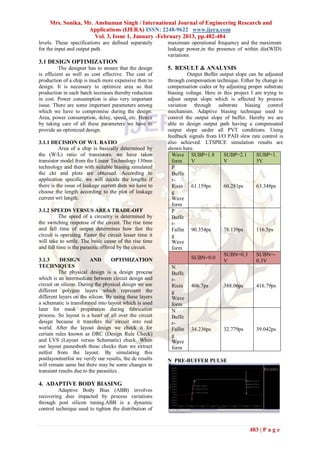
          The designer has to ensure that the design      5. RESULT & ANALYSIS
is efficient as well as cost effective. The cost of                Output Buffer output slope can be adjusted
production of a chip is much more expensive then to       through compensation technique. Either by change in
design. It is necessary to optimize area so that          compensation codes or by adjusting proper substrate
production in each batch increases thereby reduction      biasing voltage. Here in this project I am trying to
in cost. Power consumption is also very important         adjust output slope which is affected by process
issue. There are some important parameters among          variation through substrate biasing control
which we have to compromise during the design:            mechanism. Adaptive biasing technique used to
Area, power consumption, delay, speed, etc. Hence         control the output slope of buffer. Hereby we are
by taking care of all these parameters we have to         able to design output path having a compensated
provide an optimized design.                              output slope under all PVT conditions. Using
                                                          feedback signals from I/O PAD slew rate control is
3.1.1 DECISION OF W/L RATIO                               also achieved. LTSPICE simulation results are
          Area of a chip is basically determined by       shown here.
the (W/L) ratio of transistors. we have taken               Wave SUBP=1.8          SUBP=2.1        SUBP=1.
transistor model from the Linear Technology 130nm           form     V             V               5V
technology and then with suitable biasing simulated         P
the ckt and plots are obtained. According to                Buffe
application specific, we will decide the lengths if         r-
there is the issue of leakage current then we have to       Risin    61.159ps      60.281ps        63.348ps
choose the length according to the plot of leakage          g
current wrt length.                                         Wave
                                                            form
3.1.2 SPEEDS VERSUS AREA TRADE-OFF                          P
          The speed of a circuitry is determined by         Buffe
the switching response of the circuit. The rise time        r-
and fall time of output determines how fast the             Fallin 90.354ps        78.139ps        116.5ps
circuit is operating. Faster the circuit lesser time it     g
will take to settle. The basic cause of the rise time       Wave
and fall time is the parasitic offered by the circuit.      form
                                                                                   SUBN=0.3        SUBN=-
3.1.3     DESIGN          AND       OPTIMIZATION                     SUBN=0.0
                                                                                   V               0.3V
TECHNIQUES                                                  N
          The physical design is a design process           Buffe
which is an intermediate between circuit design and         r-
circuit on silicon. During the physical design we use       Risin    406.7ps       388.06ps        416.79ps
different polygon layers which represent the                g
different layers on the silicon. By using these layers      Wave
a schematic is transformed into layout which is used        form
later for mask preparation during fabrication               N
process. So layout is a heart of all over the circuit       Buffe
design because it transfers the circuit into real           r-
world. After the layout design we check it for              Fallin 34.236ps        32.779ps        39.042ps
certain rules known as DRC (Design Rule Check)              g
and LVS (Layout versus Schematic) check. When               Wave
our layout passesboth these checks then we extract          form
netlist from the layout. By simulating this
postlayoutnetlist we verify our results, the dc results   N PRE-BUFFER PULSE
will remain same but there may be some changes in
transient results due to the parasitics .

4. ADAPTIVE BODY BIASING
         Adaptive Body Bias (ABB) involves
recovering dies impacted by process variations
through post silicon tuning.ABB is a dynamic
control technique used to tighten the distribution of


                                                                                              483 | P a g e
Mrs. Sonika, Mr. Anshuman Singh / International Journal of Engineering Research and
                  Applications (IJERA) ISSN: 2248-9622 www.ijera.com
                     Vol. 3, Issue 1, January -February 2013, pp.482-484
N Pre-buffer Rise                                 References
                                                        [1]    A.Amerasekeraand C.Durrury,ESD in
                                                               Silicon Integrated Circuit ,John Wiley &
                                                               Sons,1995.
                                                        [2]    A.Amerasekeraet.,Al.,”ESD failure Modes
                                                               : Characteristics Mechanism and Process
                                                               Influences”     IEEE     Trans.    Electron
                                                               Devices,Vol.39,No2,pp.430-436,feb1992.
                                                        [3]    A.Amerasekera and C.Duvvury ” The
                                                               Impact of technology scaling on ESD
Simulation Waveform of Output Buffer                           Robustness and Protection Circuit design ,”
Output Waveform Pulse:                                         Proc.EOS/ESD Symp.,1994,pp 237-245.
                                                        [4]    C.Duvvury and A.Amerasekera,” ESD
                                                               issued for advanced CMOSTechnologies ,”
                                                               Microelectronics
                                                               Reliability,Vol36,No7,1996.
                                                        [5]    Canh Q Tran,Hiroshi Kawaguchi and
                                                               Takayasu Sakurai .” Low Power High
                                                               Speed Level Shifter design for Block-Level
                                                               dynamic voltage scaling environment ,”
                                                               University of Tokyo.
Output Waveform Rising                                  [6]    Craig Brunty and Laszlo Gal ,” Optimum
                                                               Tapered Buffer” IEEEJSSC Vol 27 Jan
                                                               1992.
                                                        [7]    C.R. Parthasarthy,” Investigation of Slew
                                                               Rate Control in the buffersof HCMOSS I/O
                                                               library,”       Library        development
                                                               group,Central R&D ,ST Microelectronics
                                                               Gr.Noida.
                                                        [8]    FeiYuan ,Ph.D,P.Engg,” Simultaneous
                                                               Switching Noise(SSN),” Department of
                                                               Electrical          and           computer
                                                               Engg,RyersonUniversity,Toronto,Canada.
                                                        [9]    Jose      Rocha,MarcelinoSantos,J.MDores
Output Waveform Falling                                        Costa and Floriberto Lima,” High Voltage
                                                               Tolerent Level Shifters and Logic Gates in
                                                               standard low voltage CMOS Technology .
                                                        [10]   J.S.Shor,Y.Afek and E.Engel,”I/O buffer
                                                               for high performance ,low power
                                                               application ,” CICC,pp,595-598,May,1997.
                                                        [11]   J.E.Vinson and J.J.Liou,” Electrostatic
                                                               discharge in semiconductor devices
                                                               ,protection technique “Proceeding of
                                                               IEEE,Vol 88,2000.


CONCLUSION:
         Due to change in Substrate Voltage Slope of
the output Curve changesIncrease inSubstrate Bias
Voltage  Decrease in Rise (tr) and Fall (tf) time of
output waveform. The Complete design of the
compensated circuit for an I/O buffer is presented
with the cost of area and process mask generation
time. The system will work at hundreds of MHz and
presents same quality of output signal and hence
reduces the noise encounters due to change in
process design.


                                                                                           484 | P a g e

Bt31482484

  • 1.
    Mrs. Sonika, Mr.Anshuman Singh / International Journal of Engineering Research and Applications (IJERA) ISSN: 2248-9622 www.ijera.com Vol. 3, Issue 1, January -February 2013, pp.482-484 Adaptive body biasing process compensation techniques for Digital circuit Mrs. Sonika*, Mr. Anshuman Singh** *(lecturer in GNIT ,Greater Noida) ** (Assistant professor in NIET,Greater Noida) ABSTRACT The present invention relates generally drain coupled with functional failure, parametric failure to the integrated circuits(ICs) & in particular to and/or device destruction.latch-up is an-undesirable process, voltage & temperature(PVT) variations but controllable phenomenon. in an ICs. PVT variations are critical factor that This Latchup may be prevented in two basic ways:• hamper performance of Ics forexample PVT Latchup resistant CMOS process• Layout variations can result in a change in setup &hold technique.[16] times of synchronous circuits. Different components of asynchronous circuit are driven 2.2 ELCTROSTATIC DISCHARGE by a common system clock. Therefore any Electrostatic discharge is a subclass of the change in setup or hold times corresponding to failure causes known as electrical overstress (EOS). any one component causes an erroneous circuit The ESD events have four major stages: (1) charge ouput.one technique to reduce PVT variations in generation (2) charge transfer (3) charge conduction a circuit isbased on sensing the variations in the (4) charge induced damage.There are two basic circuit &then taking the appropriate action to ways that circuits are protected: 1) Improve the reducethese variations. unprotected elements 2) Add additional circuit elements to divert the charge and clamp the voltage Keywords: PVT compensation,Adaptive body most circuits use a combination of these three biasing. techniques. INTRODUCTION 2.3 ELECTROMIGRATION In this era of ultra large scale integration Electro migration refers to the gradual for a chip to be efficient , the I/O structures requires displacement of the metal atoms of a conductor as a the circuit design expertise along with the result of the current flowing through that conductor. knowledge of processes in detail. It is the I/O Electromigration can be prevented by:1) Proper element which finally interfaces with the core signal design of the device 2) Good selection and to the off chip environment. The i/o cells are placed deposition of the passivation on the periphery of chip along with supply cells, corners & fillers. The supply for the core is 2.4 SIMULTANEOUS SWITCHING NOISE separated from supply of I/O’s because the noise (SSN): that arise at the switching of the large output buffer This Switching Noise is called Simultaneous .PAD is basically a sandwitch of various metal Switching Noise (SSN).SSN is studied byFeiYuan, Ph.D, layers from where user can either receive the output P.Eng[8] and discussed lot of methods to reduce or apply the input. The present work describes some it.SSN Reduction Techniques-Separate power and of the basic design considerations for I/O pads. ground pins and pads for analog and digital circuits Wherever possible, design option for smaller area whenever possible. ,low power &high speed has been comprehensively Corner pads will have long bond wire and there dealt with. The emphasis is on having an idea of the inductance is very high. various circuit elements involved in an I/O library &an understanding of the behavior & their 3. DESIGN SPECIFICATION performance & finally an optimized design is The specifications are a set of conditions proposed for 3.3V tolerant bidirectional I/O. and functionality which are required by the customer. For a designer it is necessary to observe 2. I/Os: problems & solutions specifications properly and then provide optimized Main problems occur in I/Os are solution. The design must be ensured to work under Latchup,Electrostatic discharge, electromigration& the process, temperature and Voltage variation.Here simultaneous switching noise. by the design presented ensured to work under type process, temperature variation from 0°C to 50°C , 2.1 LATCH UP core supply variation from 1.1 to 1.2 and VDDE Latch-up is a failure mechanism of CMOS variation from 3.0 V to 3.6 V. Other specifications integrated circuits characterized by excessive current are delay, frequency of operation, VIL and VIH 482 | P a g e
  • 2.
    Mrs. Sonika, Mr.Anshuman Singh / International Journal of Engineering Research and Applications (IJERA) ISSN: 2248-9622 www.ijera.com Vol. 3, Issue 1, January -February 2013, pp.482-484 levels. These specifications are defined separately maximum operational frequency and the maximum for the input and output path. leakage power,in the presence of within die(WID) variations 3.1 DESIGN OPTIMIZATION The designer has to ensure that the design 5. RESULT & ANALYSIS is efficient as well as cost effective. The cost of Output Buffer output slope can be adjusted production of a chip is much more expensive then to through compensation technique. Either by change in design. It is necessary to optimize area so that compensation codes or by adjusting proper substrate production in each batch increases thereby reduction biasing voltage. Here in this project I am trying to in cost. Power consumption is also very important adjust output slope which is affected by process issue. There are some important parameters among variation through substrate biasing control which we have to compromise during the design: mechanism. Adaptive biasing technique used to Area, power consumption, delay, speed, etc. Hence control the output slope of buffer. Hereby we are by taking care of all these parameters we have to able to design output path having a compensated provide an optimized design. output slope under all PVT conditions. Using feedback signals from I/O PAD slew rate control is 3.1.1 DECISION OF W/L RATIO also achieved. LTSPICE simulation results are Area of a chip is basically determined by shown here. the (W/L) ratio of transistors. we have taken Wave SUBP=1.8 SUBP=2.1 SUBP=1. transistor model from the Linear Technology 130nm form V V 5V technology and then with suitable biasing simulated P the ckt and plots are obtained. According to Buffe application specific, we will decide the lengths if r- there is the issue of leakage current then we have to Risin 61.159ps 60.281ps 63.348ps choose the length according to the plot of leakage g current wrt length. Wave form 3.1.2 SPEEDS VERSUS AREA TRADE-OFF P The speed of a circuitry is determined by Buffe the switching response of the circuit. The rise time r- and fall time of output determines how fast the Fallin 90.354ps 78.139ps 116.5ps circuit is operating. Faster the circuit lesser time it g will take to settle. The basic cause of the rise time Wave and fall time is the parasitic offered by the circuit. form SUBN=0.3 SUBN=- 3.1.3 DESIGN AND OPTIMIZATION SUBN=0.0 V 0.3V TECHNIQUES N The physical design is a design process Buffe which is an intermediate between circuit design and r- circuit on silicon. During the physical design we use Risin 406.7ps 388.06ps 416.79ps different polygon layers which represent the g different layers on the silicon. By using these layers Wave a schematic is transformed into layout which is used form later for mask preparation during fabrication N process. So layout is a heart of all over the circuit Buffe design because it transfers the circuit into real r- world. After the layout design we check it for Fallin 34.236ps 32.779ps 39.042ps certain rules known as DRC (Design Rule Check) g and LVS (Layout versus Schematic) check. When Wave our layout passesboth these checks then we extract form netlist from the layout. By simulating this postlayoutnetlist we verify our results, the dc results N PRE-BUFFER PULSE will remain same but there may be some changes in transient results due to the parasitics . 4. ADAPTIVE BODY BIASING Adaptive Body Bias (ABB) involves recovering dies impacted by process variations through post silicon tuning.ABB is a dynamic control technique used to tighten the distribution of 483 | P a g e
  • 3.
    Mrs. Sonika, Mr.Anshuman Singh / International Journal of Engineering Research and Applications (IJERA) ISSN: 2248-9622 www.ijera.com Vol. 3, Issue 1, January -February 2013, pp.482-484 N Pre-buffer Rise References [1] A.Amerasekeraand C.Durrury,ESD in Silicon Integrated Circuit ,John Wiley & Sons,1995. [2] A.Amerasekeraet.,Al.,”ESD failure Modes : Characteristics Mechanism and Process Influences” IEEE Trans. Electron Devices,Vol.39,No2,pp.430-436,feb1992. [3] A.Amerasekera and C.Duvvury ” The Impact of technology scaling on ESD Simulation Waveform of Output Buffer Robustness and Protection Circuit design ,” Output Waveform Pulse: Proc.EOS/ESD Symp.,1994,pp 237-245. [4] C.Duvvury and A.Amerasekera,” ESD issued for advanced CMOSTechnologies ,” Microelectronics Reliability,Vol36,No7,1996. [5] Canh Q Tran,Hiroshi Kawaguchi and Takayasu Sakurai .” Low Power High Speed Level Shifter design for Block-Level dynamic voltage scaling environment ,” University of Tokyo. Output Waveform Rising [6] Craig Brunty and Laszlo Gal ,” Optimum Tapered Buffer” IEEEJSSC Vol 27 Jan 1992. [7] C.R. Parthasarthy,” Investigation of Slew Rate Control in the buffersof HCMOSS I/O library,” Library development group,Central R&D ,ST Microelectronics Gr.Noida. [8] FeiYuan ,Ph.D,P.Engg,” Simultaneous Switching Noise(SSN),” Department of Electrical and computer Engg,RyersonUniversity,Toronto,Canada. [9] Jose Rocha,MarcelinoSantos,J.MDores Output Waveform Falling Costa and Floriberto Lima,” High Voltage Tolerent Level Shifters and Logic Gates in standard low voltage CMOS Technology . [10] J.S.Shor,Y.Afek and E.Engel,”I/O buffer for high performance ,low power application ,” CICC,pp,595-598,May,1997. [11] J.E.Vinson and J.J.Liou,” Electrostatic discharge in semiconductor devices ,protection technique “Proceeding of IEEE,Vol 88,2000. CONCLUSION: Due to change in Substrate Voltage Slope of the output Curve changesIncrease inSubstrate Bias Voltage  Decrease in Rise (tr) and Fall (tf) time of output waveform. The Complete design of the compensated circuit for an I/O buffer is presented with the cost of area and process mask generation time. The system will work at hundreds of MHz and presents same quality of output signal and hence reduces the noise encounters due to change in process design. 484 | P a g e