TELECOMMUNICATION
SERVICES FOR
HIGH RISE BUILDINGS
Taylor’s University
School of Architecture, Building and Design
Bachelor of Quantity Surveying (Hons)
Building Services I [BLD60403]
Assignment 1 - Presentation
Introduction
Telecommunication
• Exchange of information over a distance using
different kind of technologies
• Through physical medium like signal cables or
through electromagnetic waves
• The system consists of transmitters, channel and
receivers
High-rise Buildings
• A building that is at least 23m or 75 feet tall
• Popular in high population density countries as
they are able to save space
• However, it pose design challenges for engineers
Challenges of High-rise Buildings
• Fire safety system, HVAC systems (heating,
ventilation and air conditioning), elevator
evacuation and wind danger concerns
• Efficient telecommunication service, able to
provide services to every user in the tall building
• Must be precise and operate at maximum
efficiency to avoid error and cause losses
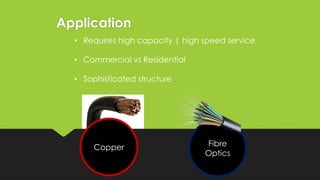
Application
Fibre
Optics
Copper
• Requires high capacity | high speed service
• Commercial vs Residential
• Sophisticated structure
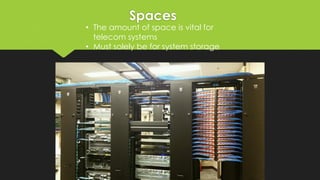
Spaces
• The amount of space is vital for
telecom systems
• Must solely be for system storage
Pest Control & Sufficient Coating on Surfaces
Rats chewing on
rubber tubing of
wires
Result of chewed wires
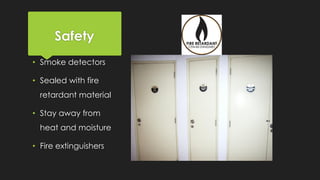
Safety
• Smoke detectors
• Sealed with fire
retardant material
• Stay away from
heat and moisture
• Fire extinguishers
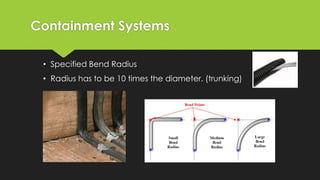
Containment Systems
• Specified Bend Radius
• Radius has to be 10 times the diameter. (trunking)
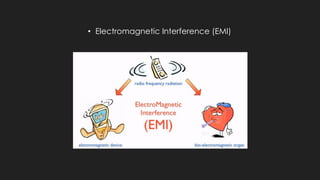
• Electromagnetic Interference (EMI)
STRUCTURED
CABLING
SYSTEMS
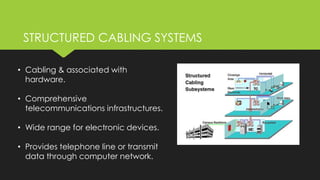
STRUCTURED CABLING SYSTEMS
• Cabling & associated with
hardware.
• Comprehensive
telecommunications infrastructures.
• Wide range for electronic devices.
• Provides telephone line or transmit
data through computer network.
Network Cabling System
• Specializes in design and installation.
• New construction and corporate relocations.
• Distributed Network Architecture (DNA)
• Centralized Network Architecture (CNA)
STRUCTURED CABLING SYSTEMS
Opening Cabling System
• Electrical system in surface mounted conduits and raceway.
• Visible and directly accessible from building interior.
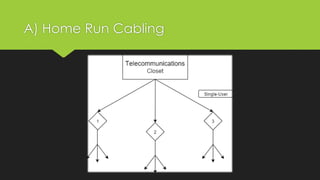
• Home Run Cabling.
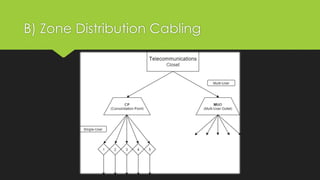
• Zone Distribution Cabling.
STRUCTURED CABLING SYSTEMS
MAIN DISTRIBUTION FRAME
MAIN DISTRIBUTION FRAME (MDF)
• Signal distribution frame to interconnect and manage
telecommunication wiring.
• Connects equipment to cables and subscriber carrier.
• Cable supplies services lines end up at MDF.
• Line distributed to equipment within local exchanges such as Private
Automatic Branch Exchange (PABX).
• Cabinets provides termination of individual twisted pairs of
telephony local loops for onward connection back to nearest
telephone exchange.
• MDF located in room on ground floor.
• Independent of exchange equipment, external cables
entering exchange be terminated.
• Cabling is drawn to building through overhead cable.
MAIN DISTRIBUTION FRAME (MDF)
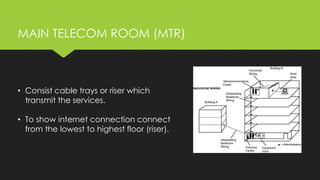
• Consist cable trays or riser which
transmit the services.
• To show internet connection connect
from the lowest to highest floor (riser).
MAIN TELECOM ROOM (MTR)
VERTICAL CABLING
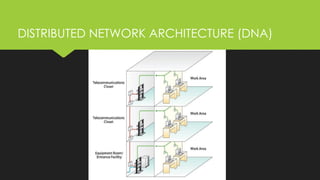
• Arrangement of network computers.
• Several processors on scattered machines, but working
independently and jointly.
• Powerful analytical tools allow prediction of system response to
operator actions & event via use of real time and achieved
data.
• Local Area Network (LAN).
DISTRIBUTED NETWORK ARCHITECTURE (DNA)
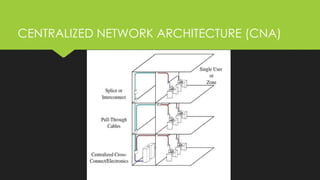
• Offer access service to stations(user) by distributing functions among
AC and multiple TPs.
• Centralized all network equipment in single location instead of
distributing among floors.
• LAN housed together, CNA reduces the time & cost of tasks.
• Provides fewer points of failure & less space utilized in
telecommunications closets.
CENTRALIZED NETWORK ARCHITECTURE (CNA)
Horizontal
Cabling
Systems
A) Home Run Cabling
B) Zone Distribution Cabling
A) Home Run Cabling
B) Zone Distribution Cabling
Management
Systems
Private Branch Exchange (PBX) and its Variations
Private Branch Exchange (PBX)
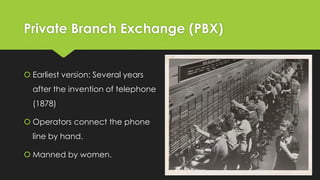
 Earliest version: Several years
after the invention of telephone
(1878)
 Operators connect the phone
line by hand.
 Manned by women.
Private Automated Branch Exchange (PABX)
 Automated version of PBX
 Cheaper to run; No live
operator.
 Same structure as the
traditional PBX.
Hosted PBX (Virtual PBX)
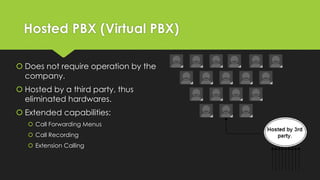
 Does not require operation by the
company.
 Hosted by a third party, thus
eliminated hardwares.
 Extended capabilities:
 Call Forwarding Menus
 Call Recording
 Extension Calling
Internet Protocol PBX (IP-PBX)
 Voice + Data on the
same line.
 Ultimately saves long run
maintenance costs.
Possible
Problems
Damage to The Cable Wiring
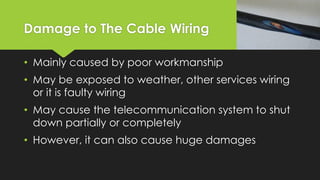
• Mainly caused by poor workmanship
• May be exposed to weather, other services wiring
or it is faulty wiring
• May cause the telecommunication system to shut
down partially or completely
• However, it can also cause huge damages
Negligence of Maintenance
• Owners often neglect the maintenance and repairs of
the system. Safety rules are also not followed.
• This causes the system to malfunction and cause
damages.
• One example of safety precautions: proper trunking
should be provided for laying and protecting the
cables
Space Shortage
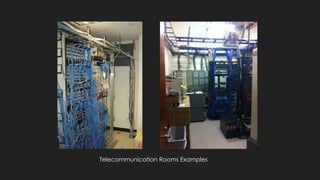
• Limited space in telecommunication room will cause
cable transmission problems and impact cable
performance.
• The room is packed with cables, telecommunication
equipment and other modern equipment.
• The space is getting more cramped and this causes
uncomfortable working conditions for the workers.
Telecommunication Rooms Examples
Space Shortage
• Manufacturers are trying to make smaller and
denser telecommunication equipment.
• Cabling designers are trying out new and better
designs for the systems.
• These issues are now given more thought
compared to before.
Space Shortage
• Before: brought up too late in the construction
process and must be worked around other
building systems.
• Now: during the early stages, further changes to
the room are envisioned that could emerge from
the installing of other equipment.
• The space needed is then planned accordingly.
Airflow Management, Electrical
Distribution and Ventilation
• The heat generated by systems such as servers and
cables causes issues like airflow management.
• Recommended to develop data centre heat maps
using ventilation requirements and equipment
power consumption.
• Leads to an optimal layout for efficient space uses,
electrical distribution and ventilation.
Types of
Cables
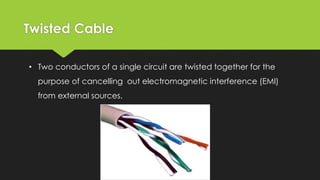
Twisted Cable
• Two conductors of a single circuit are twisted together for the
purpose of cancelling out electromagnetic interference (EMI)
from external sources.
Advantages
 Lower signal attenuation loss as
compared to the twisted and
coaxial cable.
 Immune to electrical noise,
electromagnetic interference and
radio frequency interference.
 Less restrictive in harsh environments.
Disadvantages
 Components are expensive.
 The lack of standardization in the
industry has also limited the
acceptance of fibre optics.
Optical Fiber Cable
 Consist a bundle of glass threads, transmitting messages
modulated onto light waves.
Advantages
 The components are cheaper relative
to their availability.
 Perfect to be use in small local area
network with limited number of users.
Disadvantages
 Very susceptible to signal distortion
errors and the relatively low
transmission rates they provide
over a long distance.
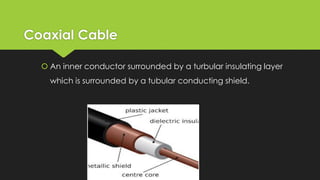
Coaxial Cable
 An inner conductor surrounded by a turbular insulating layer
which is surrounded by a tubular conducting shield.
Advantages
 Sufficient frequency range.
 Allows lower error rates, because of
the inner conductor which is located
in a Faraday shield .
 The greater spacing between
amplifiers coax's cable shielding
reduces noise and crosstalk.
Disadvantages
 More expensive to install compare
to twisted pair cable.
 Thicker cable = more difficult to
work with.
Case Study
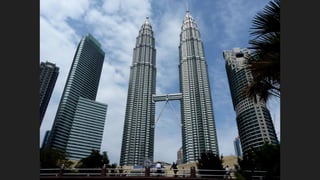
Petronas Twin Towers
Tower’s Internal
The Towers are "intelligent" buildings built with a system that
coordinates perfect telecommunications, environmental control, fire
and smoke control, power supply, lighting and, building safety.
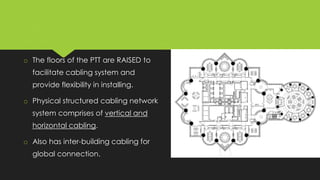
o The floors of the PTT are RAISED to
facilitate cabling system and
provide flexibility in installing.
o Physical structured cabling network
system comprises of vertical and
horizontal cabling.
o Also has inter-building cabling for
global connection.
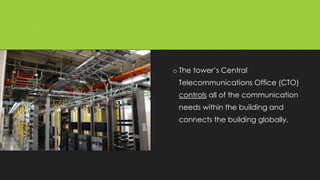
o The tower’s Central
Telecommunications Office (CTO)
controls all of the communication
needs within the building and
connects the building globally.
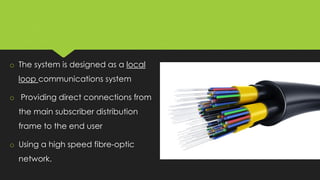
o The system is designed as a local
loop communications system
o Providing direct connections from
the main subscriber distribution
frame to the end user
o Using a high speed fibre-optic
network.
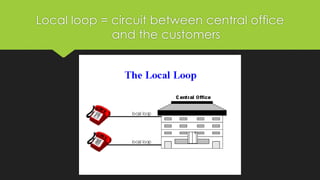
local loop?
Local loop = circuit between central office
and the customers
Shen Milsom & Wilke, LLC
o SM&W was the telecommunications, audiovisual and acoustic
consultant for the Petronas Twin Towers project in Kuala Lumpur,
Malaysia.
o SM&W designed a sophisticated cabling infrastructure, voice and
data network to support the PTT’s worldwide operations.
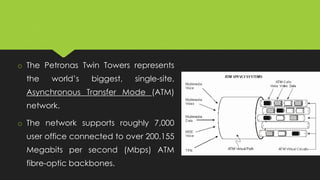
o The Petronas Twin Towers represents
the world’s biggest, single-site,
Asynchronous Transfer Mode (ATM)
network.
o The network supports roughly 7,000
user office connected to over 200.155
Megabits per second (Mbps) ATM
fibre-optic backbones.
o The backbone cables are linked to a fully matrixed bundle of core
ATM switches in the Network Control Center (NCC) with fully
repetitious connections to over 100 Ethernet and ATM-connected
servers.
o Extensive use of Virtual Local Area Networks (VLANs) allows
provisional networks to be created as needed using drag-and-drop
network management software.
KLCC Holdings has established a specialized
facility management firm to deliver a facilities
management service for the Petronas Towers,
KLCC park, infrastructure and other
developments.
End

Telecommunication Services for High Rise Buildings

  • 1.
    TELECOMMUNICATION SERVICES FOR HIGH RISEBUILDINGS Taylor’s University School of Architecture, Building and Design Bachelor of Quantity Surveying (Hons) Building Services I [BLD60403] Assignment 1 - Presentation
  • 2.
  • 3.
    Telecommunication • Exchange ofinformation over a distance using different kind of technologies • Through physical medium like signal cables or through electromagnetic waves • The system consists of transmitters, channel and receivers
  • 4.
    High-rise Buildings • Abuilding that is at least 23m or 75 feet tall • Popular in high population density countries as they are able to save space • However, it pose design challenges for engineers
  • 5.
    Challenges of High-riseBuildings • Fire safety system, HVAC systems (heating, ventilation and air conditioning), elevator evacuation and wind danger concerns • Efficient telecommunication service, able to provide services to every user in the tall building • Must be precise and operate at maximum efficiency to avoid error and cause losses
  • 6.
    Application Fibre Optics Copper • Requires highcapacity | high speed service • Commercial vs Residential • Sophisticated structure
  • 7.
    Spaces • The amountof space is vital for telecom systems • Must solely be for system storage
  • 8.
    Pest Control &Sufficient Coating on Surfaces Rats chewing on rubber tubing of wires Result of chewed wires
  • 9.
    Safety • Smoke detectors •Sealed with fire retardant material • Stay away from heat and moisture • Fire extinguishers
  • 10.
    Containment Systems • SpecifiedBend Radius • Radius has to be 10 times the diameter. (trunking)
  • 11.
  • 12.
  • 13.
    STRUCTURED CABLING SYSTEMS •Cabling & associated with hardware. • Comprehensive telecommunications infrastructures. • Wide range for electronic devices. • Provides telephone line or transmit data through computer network.
  • 14.
    Network Cabling System •Specializes in design and installation. • New construction and corporate relocations. • Distributed Network Architecture (DNA) • Centralized Network Architecture (CNA) STRUCTURED CABLING SYSTEMS
  • 15.
    Opening Cabling System •Electrical system in surface mounted conduits and raceway. • Visible and directly accessible from building interior. • Home Run Cabling. • Zone Distribution Cabling. STRUCTURED CABLING SYSTEMS
  • 16.
  • 17.
    MAIN DISTRIBUTION FRAME(MDF) • Signal distribution frame to interconnect and manage telecommunication wiring. • Connects equipment to cables and subscriber carrier. • Cable supplies services lines end up at MDF. • Line distributed to equipment within local exchanges such as Private Automatic Branch Exchange (PABX).
  • 18.
    • Cabinets providestermination of individual twisted pairs of telephony local loops for onward connection back to nearest telephone exchange. • MDF located in room on ground floor. • Independent of exchange equipment, external cables entering exchange be terminated. • Cabling is drawn to building through overhead cable. MAIN DISTRIBUTION FRAME (MDF)
  • 19.
    • Consist cabletrays or riser which transmit the services. • To show internet connection connect from the lowest to highest floor (riser). MAIN TELECOM ROOM (MTR)
  • 20.
  • 21.
    • Arrangement ofnetwork computers. • Several processors on scattered machines, but working independently and jointly. • Powerful analytical tools allow prediction of system response to operator actions & event via use of real time and achieved data. • Local Area Network (LAN). DISTRIBUTED NETWORK ARCHITECTURE (DNA)
  • 22.
  • 23.
    • Offer accessservice to stations(user) by distributing functions among AC and multiple TPs. • Centralized all network equipment in single location instead of distributing among floors. • LAN housed together, CNA reduces the time & cost of tasks. • Provides fewer points of failure & less space utilized in telecommunications closets. CENTRALIZED NETWORK ARCHITECTURE (CNA)
  • 24.
  • 25.
    Horizontal Cabling Systems A) Home RunCabling B) Zone Distribution Cabling
  • 26.
    A) Home RunCabling
  • 27.
  • 28.
  • 29.
    Private Branch Exchange(PBX)  Earliest version: Several years after the invention of telephone (1878)  Operators connect the phone line by hand.  Manned by women.
  • 30.
    Private Automated BranchExchange (PABX)  Automated version of PBX  Cheaper to run; No live operator.  Same structure as the traditional PBX.
  • 31.
    Hosted PBX (VirtualPBX)  Does not require operation by the company.  Hosted by a third party, thus eliminated hardwares.  Extended capabilities:  Call Forwarding Menus  Call Recording  Extension Calling
  • 32.
    Internet Protocol PBX(IP-PBX)  Voice + Data on the same line.  Ultimately saves long run maintenance costs.
  • 33.
  • 34.
    Damage to TheCable Wiring • Mainly caused by poor workmanship • May be exposed to weather, other services wiring or it is faulty wiring • May cause the telecommunication system to shut down partially or completely • However, it can also cause huge damages
  • 35.
    Negligence of Maintenance •Owners often neglect the maintenance and repairs of the system. Safety rules are also not followed. • This causes the system to malfunction and cause damages. • One example of safety precautions: proper trunking should be provided for laying and protecting the cables
  • 36.
    Space Shortage • Limitedspace in telecommunication room will cause cable transmission problems and impact cable performance. • The room is packed with cables, telecommunication equipment and other modern equipment. • The space is getting more cramped and this causes uncomfortable working conditions for the workers.
  • 37.
  • 38.
    Space Shortage • Manufacturersare trying to make smaller and denser telecommunication equipment. • Cabling designers are trying out new and better designs for the systems. • These issues are now given more thought compared to before.
  • 39.
    Space Shortage • Before:brought up too late in the construction process and must be worked around other building systems. • Now: during the early stages, further changes to the room are envisioned that could emerge from the installing of other equipment. • The space needed is then planned accordingly.
  • 40.
    Airflow Management, Electrical Distributionand Ventilation • The heat generated by systems such as servers and cables causes issues like airflow management. • Recommended to develop data centre heat maps using ventilation requirements and equipment power consumption. • Leads to an optimal layout for efficient space uses, electrical distribution and ventilation.
  • 41.
  • 42.
    Twisted Cable • Twoconductors of a single circuit are twisted together for the purpose of cancelling out electromagnetic interference (EMI) from external sources.
  • 43.
    Advantages  Lower signalattenuation loss as compared to the twisted and coaxial cable.  Immune to electrical noise, electromagnetic interference and radio frequency interference.  Less restrictive in harsh environments. Disadvantages  Components are expensive.  The lack of standardization in the industry has also limited the acceptance of fibre optics.
  • 44.
    Optical Fiber Cable Consist a bundle of glass threads, transmitting messages modulated onto light waves.
  • 45.
    Advantages  The componentsare cheaper relative to their availability.  Perfect to be use in small local area network with limited number of users. Disadvantages  Very susceptible to signal distortion errors and the relatively low transmission rates they provide over a long distance.
  • 46.
    Coaxial Cable  Aninner conductor surrounded by a turbular insulating layer which is surrounded by a tubular conducting shield.
  • 47.
    Advantages  Sufficient frequencyrange.  Allows lower error rates, because of the inner conductor which is located in a Faraday shield .  The greater spacing between amplifiers coax's cable shielding reduces noise and crosstalk. Disadvantages  More expensive to install compare to twisted pair cable.  Thicker cable = more difficult to work with.
  • 48.
  • 49.
  • 58.
    Tower’s Internal The Towersare "intelligent" buildings built with a system that coordinates perfect telecommunications, environmental control, fire and smoke control, power supply, lighting and, building safety.
  • 59.
    o The floorsof the PTT are RAISED to facilitate cabling system and provide flexibility in installing. o Physical structured cabling network system comprises of vertical and horizontal cabling. o Also has inter-building cabling for global connection.
  • 60.
    o The tower’sCentral Telecommunications Office (CTO) controls all of the communication needs within the building and connects the building globally.
  • 61.
    o The systemis designed as a local loop communications system o Providing direct connections from the main subscriber distribution frame to the end user o Using a high speed fibre-optic network.
  • 62.
  • 63.
    Local loop =circuit between central office and the customers
  • 64.
    Shen Milsom &Wilke, LLC o SM&W was the telecommunications, audiovisual and acoustic consultant for the Petronas Twin Towers project in Kuala Lumpur, Malaysia. o SM&W designed a sophisticated cabling infrastructure, voice and data network to support the PTT’s worldwide operations.
  • 65.
    o The PetronasTwin Towers represents the world’s biggest, single-site, Asynchronous Transfer Mode (ATM) network. o The network supports roughly 7,000 user office connected to over 200.155 Megabits per second (Mbps) ATM fibre-optic backbones.
  • 66.
    o The backbonecables are linked to a fully matrixed bundle of core ATM switches in the Network Control Center (NCC) with fully repetitious connections to over 100 Ethernet and ATM-connected servers. o Extensive use of Virtual Local Area Networks (VLANs) allows provisional networks to be created as needed using drag-and-drop network management software.
  • 67.
    KLCC Holdings hasestablished a specialized facility management firm to deliver a facilities management service for the Petronas Towers, KLCC park, infrastructure and other developments.
  • 68.