Building Services 1 Assignment 
Telecommunication Service for High Rise Building 
Abang Azrin 0319073 
Chua Jia Cheng 0315160 
Goh Jeng Jhieh 0315080 
Jake Sia Chyi Sern 0314396 
Kellyann Hiew 0319532 
Rachel Ernesta 0317966
1 
Table of Contents 
Introduction ................................................................................................................................ 2 
Installation Process .................................................................................................................... 3 
Application.................................................................................................................................. 6 
General requirements for a telecommunication system: ....................................................... 6 
Safety precautions taken in telecommunication spaces ....................................................... 7 
Pathways (Containment systems) ......................................................................................... 8 
Other special requirements .................................................................................................... 8 
Management System ................................................................................................................. 9 
Advantages and Disadvantages .............................................................................................. 11 
Advantages of Fiber Optics.................................................................................................. 11 
Disadvantages of Fiber Optics............................................................................................. 12 
Case Study : Santander Bank Tower ...................................................................................... 13 
Introduction........................................................................................................................... 15 
The Telecommunication Infrastructure Design.................................................................... 16 
Summary .............................................................................................................................. 17 
Recommendations for future improvement ............................................................................. 18 
Learning from the Group Work Project / Conclusion .............................................................. 21 
References and Bibliography................................................................................................... 22
2 
Introduction 
The topic that our group chose is ‘Telecommunication Service for High Rise Building’. 
Telecommunication is a global term that indicates to the exchange of information through 
electronic and electrical means over a significant distance. A proper efficient 
telecommunication arrangement consists of two or more stations that is supplied with 
transmitter and receiver devices. Telecommunication devices include telegraph, telephones, 
radio, microwave communication arrangements, fiber optics, satellites and the Internet. 
(Janssen, Telecommunications). Another term for telecommunications is telecom. Data is 
transmitted in the form of electrical signals that is known as carrier waves, which is then 
modulated into either analog or digital signals for transmitting the information. Analog 
modulation which is used in radio broadcasting is an amplitude modulation. Whereas digital 
modulation is just an updated form of this (Janssen, Telecommunications). 
Initial telecommunication transmissions used analog signals, which were transmitted over 
copper wires. In todays’ modern world, telephone and cable companies are still using these 
same lines, though majority of transmissions are now digital. Because of this, current 
telecommunications wiring is executed with cables that are optimized for digital 
communication, such as the fiber-optic cable and digital phone lines. 
As both the analog and digital communications depends on electrical signals, transmitted 
data is obtained almost instantaneously, regardless of the distance. This will allow users to 
quickly communicate with others across the street or across the globe. (Tech Terms, 2014)
3 
Installation Process 
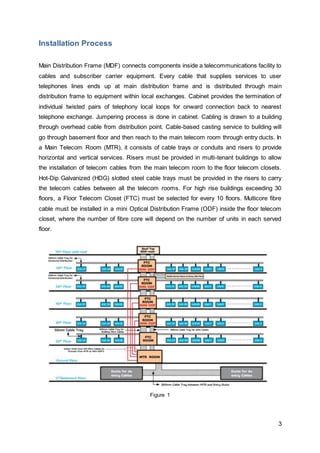
Main Distribution Frame (MDF) connects components inside a telecommunications facility to 
cables and subscriber carrier equipment. Every cable that supplies services to user 
telephones lines ends up at main distribution frame and is distributed through main 
distribution frame to equipment within local exchanges. Cabinet provides the termination of 
individual twisted pairs of telephony local loops for onward connection back to nearest 
telephone exchange. Jumpering process is done in cabinet. Cabling is drawn to a building 
through overhead cable from distribution point. Cable-based casting service to building will 
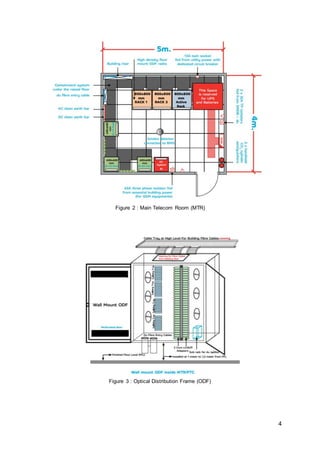
go through basement floor and then reach to the main telecom room through entry ducts. In 
a Main Telecom Room (MTR), it consists of cable trays or conduits and risers to provide 
horizontal and vertical services. Risers must be provided in multi-tenant buildings to allow 
the installation of telecom cables from the main telecom room to the floor telecom closets. 
Hot-Dip Galvanized (HDG) slotted steel cable trays must be provided in the risers to carry 
the telecom cables between all the telecom rooms. For high rise buildings exceeding 30 
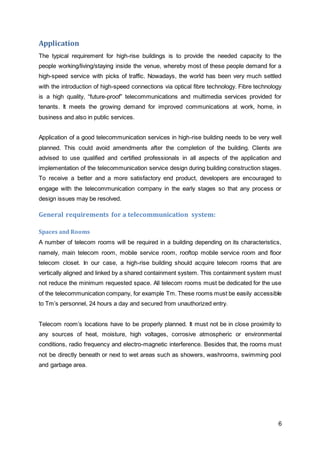
floors, a Floor Telecom Closet (FTC) must be selected for every 10 floors. Multicore fibre 
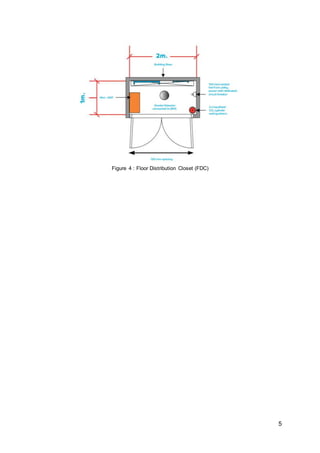
cable must be installed in a mini Optical Distribution Frame (ODF) inside the floor telecom 
closet, where the number of fibre core will depend on the number of units in each served 
floor. 
Figure 1
4 
Figure 2 : Main Telecom Room (MTR) 
Figure 3 : Optical Distribution Frame (ODF)
5 
Figure 4 : Floor Distribution Closet (FDC)
6 
Application 
The typical requirement for high-rise buildings is to provide the needed capacity to the 
people working/living/staying inside the venue, whereby most of these people demand for a 
high-speed service with picks of traffic. Nowadays, the world has been very much settled 
with the introduction of high-speed connections via optical fibre technology. Fibre technology 
is a high quality, “future-proof” telecommunications and multimedia services provided for 
tenants. It meets the growing demand for improved communications at work, home, in 
business and also in public services. 
Application of a good telecommunication services in high-rise building needs to be very well 
planned. This could avoid amendments after the completion of the building. Clients are 
advised to use qualified and certified professionals in all aspects of the application and 
implementation of the telecommunication service design during building construction stages. 
To receive a better and a more satisfactory end product, developers are encouraged to 
engage with the telecommunication company in the early stages so that any process or 
design issues may be resolved. 
General requirements for a telecommunication system: 
Spaces and Rooms 
A number of telecom rooms will be required in a building depending on its characteristics, 
namely, main telecom room, mobile service room, rooftop mobile service room and floor 
telecom closet. In our case, a high-rise building should acquire telecom rooms that are 
vertically aligned and linked by a shared containment system. This containment system must 
not reduce the minimum requested space. All telecom rooms must be dedicated for the use 
of the telecommunication company, for example Tm. These rooms must be easily accessible 
to Tm’s personnel, 24 hours a day and secured from unauthorized entry. 
Telecom room’s locations have to be properly planned. It must not be in close proximity to 
any sources of heat, moisture, high voltages, corrosive atmospheric or environmental 
conditions, radio frequency and electro-magnetic interference. Besides that, the rooms must 
not be directly beneath or next to wet areas such as showers, washrooms, swimming pool 
and garbage area.
All telecom spaces and pathways must be pest controlled using only the best available 
practices. It should be noted that rodents often gnaw cables resulting in damage and the 
potential for service disruption, hence, special attention are needed for these cases. This 
could involve the installation of covers to cable trays. As for the walls, floor and ceiling, it 
should be painted and treated with anti-dust and anti-static coating to minimize dust and 
static electricity. Walls and ceilings shall receive primer and finish coat of light colour paint. 
7 
Safety precautions taken in telecommunication spaces: 
 All telecom spaces should be fitted with smoke detectors, which is connected to the 
building management system. 
 All telecom spaces should be fitted with emergency lighting. 
 All containment openings to telecom spaces must be sealed with a regulation fire 
retardant material. 
 All doors to telecom rooms must be of solid wood core or steel construction, fire 
retardant with a minimum rating of 2 hours. 
 All doors to telecom rooms must be outward opening with an automatic door closer 
system fitted on the hinged edge. 
 All doors to telecom rooms must be labeled. 
 The room must be free from contaminants and pollutants. 
 All telecom rooms should have basic firefighting provision of handheld fire 
extinguishers.
8 
Pathways (Containment systems) 
Requirements applied to containment systems: 
 The containment system must be designed so that installed cables do not exceed the 
minimum specified bend radius. 
 All metal containment parts must be free from sharp edges and earth bonded. 
 Telecom riser openings must be sealed with a suitable fire retardant material. 
 Cable trays must be easily accessible in common areas to facilitate any future 
provision of additional cables. 
 Any cable trays that are in areas accessible to the public and less than 4.8m above 
the floor must be covered. 
 Containment systems must not run through areas exposed to excessive heat, 
moisture, corrosive atmospheric or environmental conditions, high voltages, radio 
frequency interference (RFI) or electro-magnetic interference (EMI). 
 For all containment systems a minimum separation must be maintained from sources 
of electromagnetic interference. 
Other special requirements 
Provision needs to be made for the connection of public phones, ATM machines and retail 
kiosks. A design that is normally prescribed for commercial buildings are installed, with a 2- 
core single mode fibre from the main telecom room, connected to a business consolidation 
cabinet.
9 
Management System 
A good telecommunication system is the most important key to a successful office building. It 
provides a greater and faster exchange of data between individuals within the building and 
connecting them to others anywhere through the whole world. . A good telecommunication 
system should be able to reduce toll charges, enhancing the productivity and efficiency, 
phone connections and locations can be move, remote and mobile employees, Flexible, 
scalable, and customizable. To get a good telecommunication system the first thing to be 
considered is the cost. The initial of a good telecommunication system might not be cheap 
but in long term a higher quality telecommunication system does not require much 
maintenance. The accessibility of telecommunication system to the people in building is also 
an important consideration for suitable telecommunication system. The last consideration is 
the type of systems that suit the building's work load. 
Private automatic branch exchange (PABX) also known as Private branch exchange is 
popularly use in high rise building nowadays. It was introduce by the 1960s, which makes 
things more easier for a building. PABX allows making calls within the building or it connects 
to an outside line without having to go through a receptionist. Most importantly it helps to 
reduce costs by cutting down the phone calls within the same building. Nowadays big 
buildings and high rises building definitely need a PABX to compete with the others building. 
There are 2 main component for Telecommunication systems for high rise buildings which 
are the Telecommunications Spaces and Pathways are normally deficient in existing 
buildings and the Telecommunications Cabling Systems which is use to link the 
telecommunications room together.
Telecommunications Spaces keep telecommunications equipment and terminations of 
telecommunications cables while telecommunications pathways transport the cables. A 
typical telecom System according to standards, there must be at least a telecommunications 
room (TR) at each floor. Each TR is around 1000 square metres and is dedicated to the 
telecommunications function. All of the TR are use to distribute all telecommunications 
signals to their significant area. The pathways carries telecommunications cables from the 
TR to the vicinity of the area served. Horizontal pathways usually supports a zone-distribution 
system which is usually between four columns and ranges in size from 30 to 80 
square metres. The equipment room is the central point for telecommunications within the 
building. The 
only electrical equipment in the Equipment room is the telecommunications equipment. The 
equipment room will be larger and have ample space to store LAN servers as well. The 
Equipment rooms are usually located in the basement. Equipment room must contains 
HVAC, from a separate stand-alone system which is able to operation continuous basis. 
Horizontal cabling of the telecommunication cabling system consists of two or more cables 
that are connect to each work area from a TR located on the equal floor as the work area. 
This is also known as "star wiring" with the TR being analogous to the centre of the star and 
each work area being analogous to the points of the star. Each cable is terminated at the 
cross-connection field in the TR. A number of spare horizontal cables are installed for future 
renovations purpose. Different types of cabling may be used for horizontal and backbone 
cabling. The standards limit the length of horizontal cabling to 90 metres. The most popular 
used horizontal cabling is the 4-pair unshielded-twisted pair (UTP) cable. It can transmit both 
voice and data applications. Backbone cables connect each TR to the main cross-connect 
which is store in the Equipment room. A "Star" topology used for backbone cabling as the 
main cross-connect is act as the center of the star. The backbone cabling extends from the 
main cross-connect to the demarcation point where the facilities of different 
telecommunications common which is serving the building that are located in the Entrance 
Room. Backbone cabling usually consists of 3 multi-pair UTP for telephone service and 
optical fiber for data. Coaxial cable may be used in both the horizontal and backbone cabling 
for special services such as CCTV. 
10
11 
Advantages and Disadvantages 
Originally, copper was used as the telephone line. It was shortly replaced by fiber optics due 
to higher bandwidth over longer distances which give better coverage. Fiber optics is the 
technique of light transmission through fibers of glass which results in the transmitting of 
data. In other words, fiber optic cables carry information between two places using entirely 
light-based technology. This means that data can be transferred significantly quicker. 
Compared to other materials, fiber optics is the most commonly used material in 
telecommunications. As good as it sound, fiber optics does have its disadvantages. 
Advantages of Fiber Optics 
Large bandwidth, light weight, and small diameter 
Nowadays, programs require more and more bandwidth. Consequently, it is crucial to take 
into consideration the limitations faced by the consumers. It is not uncommon to install new 
cabling to previously existing duct systems. Installations are now easy and practical and 
saves valuable conduit space since the optical cable is relatively small in diameter and light 
weight. 
Resistance to electromagnetic interference 
As a result of fiber being so resistant to electromagnetic interference, fiber has a very low 
rate of bit error (10 EXP-13). Fiber-optic transmissions are virtually noise free. 
Long-distance signal transmission 
While single-line, voice-grade copper systems longer than a couple of kilometers (1.2 miles) 
require in-line signal for satisfactory performance, it is not unusual for optical systems to go 
over 100 kilometers (km), or about 62 miles, with no active or passive processing. The low 
attenuation and superior signal integrity found in optical systems allow much longer intervals 
of signal transmission than metallic-based systems. 
Designed for future applications 
As electronics prices drop, the optical cable pricing remains low. In many cases, fiber 
solutions are cheaper than copper. As bandwidth demands increase rapidly with 
technological advances, fiber will continue to play a vital role in the long-term success of 
telecommunication.
Security 
Hacking into the fiber requires intervention that cannot go undetected by security. These 
circumstances make fiber extremely attractive to those with major security concerns. Unlike 
metallic-based systems, the dielectric nature of optical fiber makes it impossible to remotely 
detect the signal being transmitted within the cable. The only way to do so is by accessing 
the optical fiber. 
12 
Disadvantages of Fiber Optics 
Susceptibility to physical damage 
Since fiber small and light weight, it is likely to become damaged or cut during installation. It 
is necessary to take into consideration restoration, backup and survivability when fiber optic 
cabling is chosen as the transmission medium. In places that use fiber optics such as 
railroads, if the railroad car happens to derail, it can pose a serious threat that can disrupt 
service and events since the tremendous data transmission will be lost. 
Installation costs, while dropping, are still high 
Even though fiber installations are getting cheaper every year, it is still relatively costly. Fiber 
is expanding beyond its original realm and major application in the carrier backbone and is 
moving into the local loop, and through technologies such as FTTx (Fiber To The Home, 
Premises, etc,) and PONs (Passive Optical networks), enabling subscriber and end user 
broadband access as installation costs decreases. 
Special test equipment is often required 
The test equipment originally used for electron-based networking is useless in a fiber optic 
network. Equipment such as an Optical Time Domain Reflectometer (OTDR) is required, an 
expensive, specialized optical test equipment are needed at most fiber endpoints and 
connection nexuses to properly provide testing of optical fiber.
13 
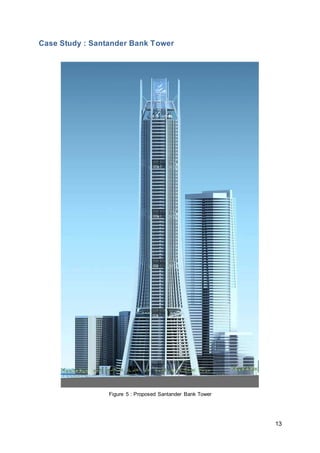
Case Study : Santander Bank Tower 
Figure 5 : Proposed Santander Bank Tower
14 
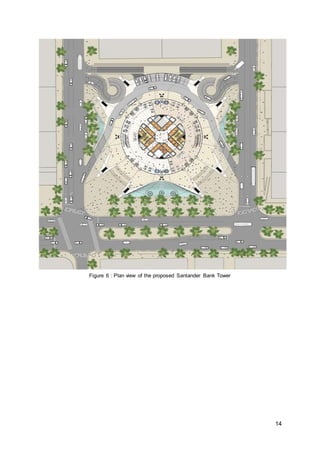
Figure 6 : Plan view of the proposed Santander Bank Tower
Introduction 
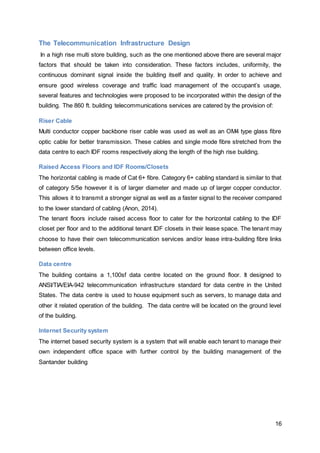
The Santander tower is a proposed multi storey building of 52 storeys, at 860 ft. The building 
was designed by kohn Pedersen fox associates upon winning a competition to design the 
building. Kohn Pedersen fox is a well renowned award winning architectural firm and very 
reputable for incorporate sustainability within their designs. 
The proposed building was designed to provide the client, the Santander bank group, a 
building for one of their many cooperate offices. Santander bank is a Spanish bank funded in 
approximately a century ago in 1957, it is one of the Top retail banks in the world. 
The main objective of the client, was to provide a hurricane proof building and a certified 
LEED gold, aiming to stand out amongst the neighbouring buildings architecturally and 
sustainably. Furthermore it will not only hope to create an ecological impact but to also 
create economic opportunities through the design itself. 
This building was chosen for this particular case study because the telecommunication 
design features within the building itself is also as impressive as the architectural attributes 
for it not only is designed to be sustainable by incorporating low voltage engineering but it is 
designed to include the best cabling systems as well. The telecommunication design made 
by Ferguson consulting. 
High rise buildings such as the proposed 52 storey Santander bank tower, the demand for 
telecom services increases whether it be through telephone services or internet connection. 
These provisions were made through careful planning design of telecommunication within 
the infrastructure. 
15
The Telecommunication Infrastructure Design 
In a high rise multi store building, such as the one mentioned above there are several major 
factors that should be taken into consideration. These factors includes, uniformity, the 
continuous dominant signal inside the building itself and quality. In order to achieve and 
ensure good wireless coverage and traffic load management of the occupant’s usage, 
several features and technologies were proposed to be incorporated within the design of the 
building. The 860 ft. building telecommunications services are catered by the provision of: 
Riser Cable 
Multi conductor copper backbone riser cable was used as well as an OM4 type glass fibre 
optic cable for better transmission. These cables and single mode fibre stretched from the 
data centre to each IDF rooms respectively along the length of the high rise building. 
Raised Access Floors and IDF Rooms/Closets 
The horizontal cabling is made of Cat 6+ fibre. Category 6+ cabling standard is similar to that 
of category 5/5e however it is of larger diameter and made up of larger copper conductor. 
This allows it to transmit a stronger signal as well as a faster signal to the receiver compared 
to the lower standard of cabling (Anon, 2014). 
The tenant floors include raised access floor to cater for the horizontal cabling to the IDF 
closet per floor and to the additional tenant IDF closets in their lease space. The tenant may 
choose to have their own telecommunication services and/or lease intra-building fibre links 
between office levels. 
Data centre 
The building contains a 1,100sf data centre located on the ground floor. It designed to 
ANSI/TIA/EIA-942 telecommunication infrastructure standard for data centre in the United 
States. The data centre is used to house equipment such as servers, to manage data and 
other it related operation of the building. The data centre will be located on the ground level 
of the building. 
Internet Security system 
The internet based security system is a system that will enable each tenant to manage their 
own independent office space with further control by the building management of the 
Santander building 
16
17 
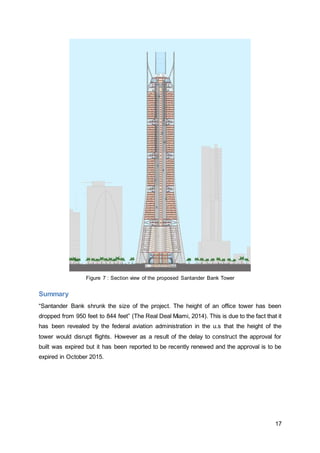
Figure 7 : Section view of the proposed Santander Bank Tower 
Summary 
“Santander Bank shrunk the size of the project. The height of an office tower has been 
dropped from 950 feet to 844 feet” (The Real Deal Miami, 2014). This is due to the fact that it 
has been revealed by the federal aviation administration in the u.s that the height of the 
tower would disrupt flights. However as a result of the delay to construct the approval for 
built was expired but it has been reported to be recently renewed and the approval is to be 
expired in October 2015.
18 
Recommendations for future improvement 
As the Santander Office Tower is a 52 story high rise tenant office building, it is likely to have 
a great deal of different office departments within the building. To assist with the 
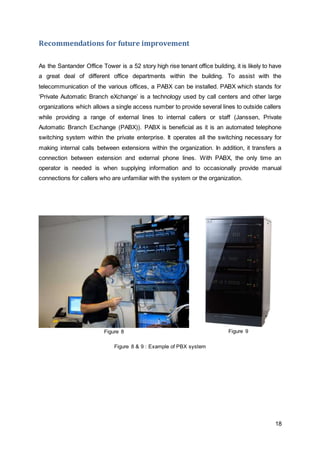
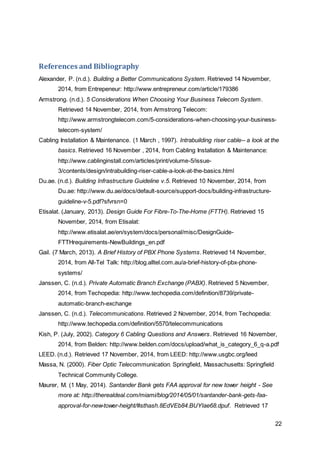
telecommunication of the various offices, a PABX can be installed. PABX which stands for 
‘Private Automatic Branch eXchange’ is a technology used by call centers and other large 
organizations which allows a single access number to provide several lines to outside callers 
while providing a range of external lines to internal callers or staff (Janssen, Private 
Automatic Branch Exchange (PABX)). PABX is beneficial as it is an automated telephone 
switching system within the private enterprise. It operates all the switching necessary for 
making internal calls between extensions within the organization. In addition, it transfers a 
connection between extension and external phone lines. With PABX, the only time an 
operator is needed is when supplying information and to occasionally provide manual 
connections for callers who are unfamiliar with the system or the organization. 
Figure 8 
Figure 9 
Figure 8 & 9 : Example of PBX system
Special facilities have to be provided when the communication system has more than 64 
extensions. 
Equipment room 
A room for exclusive use of the provider is needed for the telephone equipment. The room 
should be accessed by the underground cables, fibre optic cables, patch panel and the 
distribution to the floor cables. The main telecom room can be considered for PABX 
installation in case of commercial single owner building. 
Room size 
• For up to 100 extensions, the minimum floor space required is 2m X 3m 
• For up to 400 extensions, the floor space required is 4m X 4m 
• For large systems Etisalat must be consulted at the planning stage 
• The room should have a minimum height of 3m, be air-conditioned, clean, and dry and 
19 
free from dust 
Room general requirements 
• The room should be far away from high voltage plant. Other services/utility ducts should 
not run through this room and it should not be directly under a toilet or bathroom, kitchen 
and electrical rooms 
• The room should provide ready access to the provider’s personnel or the provider’s 
authorized personnel and equipment but must be secured from unauthorized entry 
• The room must be properly protected from the risk of flooding if provided in the 
basement 
• In multi-PBX user building, each is PBX to have its own room 
• Raised flooring should be provided when required depending on the PBX type 
• For large PBX installations, air-conditioned battery room adjacent to the equipment room 
will be required. The provider should supply details at the design stage. The battery room 
should be provided with an exhaust fan. Conduit or tray is required between the 
equipment room and the battery room 
• Direct sunlight should not fall in the PBX room. Curtains/screens are to be provided for 
the windows if any 
• Power conduit and telecom cable conduit must be separate
Electrical requirements 
• A minimum of two 13 amp 240 v A/C main outlets (via) UPS system should be provided. 
20 
The actual mains power requirements will depend on the size and type of the PBX 
• The room should be provided with an earth not more than 5 ohms 
• Anti-static flooring should be provided, including the battery room 
• The rooms must be provided with an emergency light, a smoke detector and a fire alarm 
PABX can be installed in the main telecom room in the case of a single owner. 
(Etisalat, 2013) 
Figure 10 : An example of how PABX fuctions
21 
Learning from the Group Work Project / Conclusion 
In this report assignment we have learnt that telecommunications is very important within a 
building. Through the various applications communication can be achieved as a result. It is 
essential that these applications are up to standards. These standards or requirements may 
vary from different countries but however it follows the same purpose of providing safe 
transmission of data to the receiver. 
We also discovered that Telecommunication systems in a high rise building which are more 
often to be commercial buildings differs from a low rise building by having a much more 
complex design and it requires transmission to a longer range compared to other buildings. 
Furthermore it should be taken into account that the quality of the materials and cabling will 
enable the system to be more improved and effective. Good management will allow the 
system less of maintenance throughout the life span of the building. The rooms are to be 
kept in a required temperature and follow fire safety requirement. 
During the course of producing the assignment, we found it challenging to find the 
information gathered. In addition, the content includes several technical terms relevant to 
telecommunication and electrical engineering. However we were able to produce a cohesive 
report and information which were very knowledgeable.
22 
References and Bibliography 
Alexander, P. (n.d.). Building a Better Communications System. Retrieved 14 November, 
2014, from Entrepeneur: http://www.entrepreneur.com/article/179386 
Armstrong. (n.d.). 5 Considerations When Choosing Your Business Telecom System. 
Retrieved 14 November, 2014, from Armstrong Telecom: 
http://www.armstrongtelecom.com/5-considerations-when-choosing-your-business-telecom- 
system/ 
Cabling Installation & Maintenance. (1 March , 1997). Intrabuilding riser cable-- a look at the 
basics. Retrieved 16 November , 2014, from Cabling Installation & Maintenance: 
http://www.cablinginstall.com/articles/print/volume-5/issue- 
3/contents/design/intrabuilding-riser-cable-a-look-at-the-basics.html 
Du.ae. (n.d.). Building Infrastructure Guideline v.5. Retrieved 10 November, 2014, from 
Du.ae: http://www.du.ae/docs/default-source/support-docs/building-infrastructure-guideline- 
v-5.pdf?sfvrsn=0 
Etisalat. (January, 2013). Design Guide For Fibre-To-The-Home (FTTH). Retrieved 15 
November, 2014, from Etisalat: 
http://www.etisalat.ae/en/system/docs/personal/misc/DesignGuide- 
FTTHrequirements-NewBuildings_en.pdf 
Gail. (7 March, 2013). A Brief History of PBX Phone Systems. Retrieved 14 November, 
2014, from All-Tel Talk: http://blog.alltel.com.au/a-brief-history-of-pbx-phone-systems/ 
Janssen, C. (n.d.). Private Automatic Branch Exchange (PABX). Retrieved 5 November, 
2014, from Techopedia: http://www.techopedia.com/definition/8739/private-automatic- 
branch-exchange 
Janssen, C. (n.d.). Telecommunications. Retrieved 2 November, 2014, from Techopedia: 
http://www.techopedia.com/definition/5570/telecommunications 
Kish, P. (July, 2002). Category 6 Cabling Questions and Answers. Retrieved 16 November, 
2014, from Belden: http://www.belden.com/docs/upload/what_is_category_6_q-a.pdf 
LEED. (n.d.). Retrieved 17 November, 2014, from LEED: http://www.usgbc.org/leed 
Massa, N. (2000). Fiber Optic Telecommunication. Springfield, Massachusetts: Springfield 
Technical Community College. 
Maurer, M. (1 May, 2014). Santander Bank gets FAA approval for new tower height - See 
more at: http://therealdeal.com/miami/blog/2014/05/01/santander-bank-gets-faa-approval- 
for-new-tower-height/#sthash.8EdVEb84.BUYIae68.dpuf. Retrieved 17
November, 2014, from The Real Deal: 
http://therealdeal.com/miami/blog/2014/05/01/santander-bank-gets-faa-approval-for-new- 
23 
tower-height/ 
Michigan State University. (n.d.). Telecommunication System. Retrieved 14 November, 
2014, from Michigan State University Infrastructure Planning and Facilites: 
http://ipf.msu.edu/about/departments/telecommunication.html 
Public Works and Government Services Canada. (24 January, 2014). Installation and 
Management of Telecommunications Infrastructure. Retrieved 16 November, 2014, 
from Public Works and Government Services Canada: http://www.tpsgc-pwgsc. 
gc.ca/biens-property/sngp-npms/bi-rp/tech/telecommunications/immobilieres-real- 
eng.html#a5 
Seibert, P. (4 June, 2009). The Advantages and Disadvantages of Fiber Optics. Retrieved 7 
November, 2014, from Hub Tech Insider: 
http://hubtechinsider.wordpress.com/2009/06/04/the-advantages-and-disadvantages-of- 
fiber-optics/ 
Staff, T. (30 April, 2014). Santander Bank Tower At 1401 Brickell Cut To Size After Feds 
Warn. Retrieved 17 November, 2014, from The Next Miami: 
http://www.thenextmiami.com/index.php/santander-bank-tower-1401-brickell-cut-size- 
feds-warn/ 
Tech Terms. (8 8, 2014). Telecommunications. Retrieved 2 November, 2014, from Tech 
Terms: http://www.techterms.com/definition/telecommunications 
Teko Telecom. (n.d.). High Rise Building. Retrieved 10 November, 2014, from Teko 
Telekom: http://www.tekotelecom.it/In-Building-High-Rise-Building_sol_sl113.aspx 
Weaver, S. (n.d.). Differences Between Cat6 and Cat6a Cables. Retrieved 17 November, 
2014, from Cable Organizer: http://www.cableorganizer.com/articles/what-is-difference- 
between-cat6-cat6a.html 
[Figure 1]. Retrieved November 16, 2014, from: http://www.du.ae/docs/default-source/ 
support-docs/building-infrastructure-guideline-v-5.pdf?sfvrsn=0 
[Figure 2]. Retrieved November 15, 2014, from: http://www.du.ae/docs/default-source/ 
support-docs/building-infrastructure-guideline-v-5.pdf?sfvrsn=0 
[Figure 3]. Retrieved November 16, 2014, from: http://www.du.ae/docs/default-source/ 
support-docs/building-infrastructure-guideline-v-5.pdf?sfvrsn=0 
[Figure 4]. Retrieved November 16, 2014, from: http://www.du.ae/docs/default-source/ 
support-docs/building-infrastructure-guideline-v-5.pdf?sfvrsn=0 
[Figure 5]. Retrieved November 18, 2014, from: 
http://www.skyscrapercity.com/showthread.php?t=739780&page=8
[Figure 6]. Retrieved November 17, 2014, from: 
http://www.skyscrapercity.com/showthread.php?t=739780&page=8 
[Figure 7]. Retrieved November 17, 2014, from: 
http://www.skyscrapercity.com/showthread.php?t=739780&page=8 
[Figure 8]. Retrieved November 17, 2014, from: http://www.businessphonescalgary.com/wp-content/ 
24 
uploads/2012/11/medium-range-business-pbx-installation.jpg 
[Figure 9]. Retrieved November 18, 2014, from: http://www.karel-electronics. 
com/telecom/ds200-series-ip-pbx-systems 
[Figure 10]. Retrieved November 18, 2014, from: 
http://pdfkhmer.wordpress.com/pabxtelephone/

Telecommunication for high rise building

  • 1.
    Building Services 1Assignment Telecommunication Service for High Rise Building Abang Azrin 0319073 Chua Jia Cheng 0315160 Goh Jeng Jhieh 0315080 Jake Sia Chyi Sern 0314396 Kellyann Hiew 0319532 Rachel Ernesta 0317966
  • 2.
    1 Table ofContents Introduction ................................................................................................................................ 2 Installation Process .................................................................................................................... 3 Application.................................................................................................................................. 6 General requirements for a telecommunication system: ....................................................... 6 Safety precautions taken in telecommunication spaces ....................................................... 7 Pathways (Containment systems) ......................................................................................... 8 Other special requirements .................................................................................................... 8 Management System ................................................................................................................. 9 Advantages and Disadvantages .............................................................................................. 11 Advantages of Fiber Optics.................................................................................................. 11 Disadvantages of Fiber Optics............................................................................................. 12 Case Study : Santander Bank Tower ...................................................................................... 13 Introduction........................................................................................................................... 15 The Telecommunication Infrastructure Design.................................................................... 16 Summary .............................................................................................................................. 17 Recommendations for future improvement ............................................................................. 18 Learning from the Group Work Project / Conclusion .............................................................. 21 References and Bibliography................................................................................................... 22
  • 3.
    2 Introduction Thetopic that our group chose is ‘Telecommunication Service for High Rise Building’. Telecommunication is a global term that indicates to the exchange of information through electronic and electrical means over a significant distance. A proper efficient telecommunication arrangement consists of two or more stations that is supplied with transmitter and receiver devices. Telecommunication devices include telegraph, telephones, radio, microwave communication arrangements, fiber optics, satellites and the Internet. (Janssen, Telecommunications). Another term for telecommunications is telecom. Data is transmitted in the form of electrical signals that is known as carrier waves, which is then modulated into either analog or digital signals for transmitting the information. Analog modulation which is used in radio broadcasting is an amplitude modulation. Whereas digital modulation is just an updated form of this (Janssen, Telecommunications). Initial telecommunication transmissions used analog signals, which were transmitted over copper wires. In todays’ modern world, telephone and cable companies are still using these same lines, though majority of transmissions are now digital. Because of this, current telecommunications wiring is executed with cables that are optimized for digital communication, such as the fiber-optic cable and digital phone lines. As both the analog and digital communications depends on electrical signals, transmitted data is obtained almost instantaneously, regardless of the distance. This will allow users to quickly communicate with others across the street or across the globe. (Tech Terms, 2014)
  • 4.
    3 Installation Process Main Distribution Frame (MDF) connects components inside a telecommunications facility to cables and subscriber carrier equipment. Every cable that supplies services to user telephones lines ends up at main distribution frame and is distributed through main distribution frame to equipment within local exchanges. Cabinet provides the termination of individual twisted pairs of telephony local loops for onward connection back to nearest telephone exchange. Jumpering process is done in cabinet. Cabling is drawn to a building through overhead cable from distribution point. Cable-based casting service to building will go through basement floor and then reach to the main telecom room through entry ducts. In a Main Telecom Room (MTR), it consists of cable trays or conduits and risers to provide horizontal and vertical services. Risers must be provided in multi-tenant buildings to allow the installation of telecom cables from the main telecom room to the floor telecom closets. Hot-Dip Galvanized (HDG) slotted steel cable trays must be provided in the risers to carry the telecom cables between all the telecom rooms. For high rise buildings exceeding 30 floors, a Floor Telecom Closet (FTC) must be selected for every 10 floors. Multicore fibre cable must be installed in a mini Optical Distribution Frame (ODF) inside the floor telecom closet, where the number of fibre core will depend on the number of units in each served floor. Figure 1
  • 5.
    4 Figure 2: Main Telecom Room (MTR) Figure 3 : Optical Distribution Frame (ODF)
  • 6.
    5 Figure 4: Floor Distribution Closet (FDC)
  • 7.
    6 Application Thetypical requirement for high-rise buildings is to provide the needed capacity to the people working/living/staying inside the venue, whereby most of these people demand for a high-speed service with picks of traffic. Nowadays, the world has been very much settled with the introduction of high-speed connections via optical fibre technology. Fibre technology is a high quality, “future-proof” telecommunications and multimedia services provided for tenants. It meets the growing demand for improved communications at work, home, in business and also in public services. Application of a good telecommunication services in high-rise building needs to be very well planned. This could avoid amendments after the completion of the building. Clients are advised to use qualified and certified professionals in all aspects of the application and implementation of the telecommunication service design during building construction stages. To receive a better and a more satisfactory end product, developers are encouraged to engage with the telecommunication company in the early stages so that any process or design issues may be resolved. General requirements for a telecommunication system: Spaces and Rooms A number of telecom rooms will be required in a building depending on its characteristics, namely, main telecom room, mobile service room, rooftop mobile service room and floor telecom closet. In our case, a high-rise building should acquire telecom rooms that are vertically aligned and linked by a shared containment system. This containment system must not reduce the minimum requested space. All telecom rooms must be dedicated for the use of the telecommunication company, for example Tm. These rooms must be easily accessible to Tm’s personnel, 24 hours a day and secured from unauthorized entry. Telecom room’s locations have to be properly planned. It must not be in close proximity to any sources of heat, moisture, high voltages, corrosive atmospheric or environmental conditions, radio frequency and electro-magnetic interference. Besides that, the rooms must not be directly beneath or next to wet areas such as showers, washrooms, swimming pool and garbage area.
  • 8.
    All telecom spacesand pathways must be pest controlled using only the best available practices. It should be noted that rodents often gnaw cables resulting in damage and the potential for service disruption, hence, special attention are needed for these cases. This could involve the installation of covers to cable trays. As for the walls, floor and ceiling, it should be painted and treated with anti-dust and anti-static coating to minimize dust and static electricity. Walls and ceilings shall receive primer and finish coat of light colour paint. 7 Safety precautions taken in telecommunication spaces:  All telecom spaces should be fitted with smoke detectors, which is connected to the building management system.  All telecom spaces should be fitted with emergency lighting.  All containment openings to telecom spaces must be sealed with a regulation fire retardant material.  All doors to telecom rooms must be of solid wood core or steel construction, fire retardant with a minimum rating of 2 hours.  All doors to telecom rooms must be outward opening with an automatic door closer system fitted on the hinged edge.  All doors to telecom rooms must be labeled.  The room must be free from contaminants and pollutants.  All telecom rooms should have basic firefighting provision of handheld fire extinguishers.
  • 9.
    8 Pathways (Containmentsystems) Requirements applied to containment systems:  The containment system must be designed so that installed cables do not exceed the minimum specified bend radius.  All metal containment parts must be free from sharp edges and earth bonded.  Telecom riser openings must be sealed with a suitable fire retardant material.  Cable trays must be easily accessible in common areas to facilitate any future provision of additional cables.  Any cable trays that are in areas accessible to the public and less than 4.8m above the floor must be covered.  Containment systems must not run through areas exposed to excessive heat, moisture, corrosive atmospheric or environmental conditions, high voltages, radio frequency interference (RFI) or electro-magnetic interference (EMI).  For all containment systems a minimum separation must be maintained from sources of electromagnetic interference. Other special requirements Provision needs to be made for the connection of public phones, ATM machines and retail kiosks. A design that is normally prescribed for commercial buildings are installed, with a 2- core single mode fibre from the main telecom room, connected to a business consolidation cabinet.
  • 10.
    9 Management System A good telecommunication system is the most important key to a successful office building. It provides a greater and faster exchange of data between individuals within the building and connecting them to others anywhere through the whole world. . A good telecommunication system should be able to reduce toll charges, enhancing the productivity and efficiency, phone connections and locations can be move, remote and mobile employees, Flexible, scalable, and customizable. To get a good telecommunication system the first thing to be considered is the cost. The initial of a good telecommunication system might not be cheap but in long term a higher quality telecommunication system does not require much maintenance. The accessibility of telecommunication system to the people in building is also an important consideration for suitable telecommunication system. The last consideration is the type of systems that suit the building's work load. Private automatic branch exchange (PABX) also known as Private branch exchange is popularly use in high rise building nowadays. It was introduce by the 1960s, which makes things more easier for a building. PABX allows making calls within the building or it connects to an outside line without having to go through a receptionist. Most importantly it helps to reduce costs by cutting down the phone calls within the same building. Nowadays big buildings and high rises building definitely need a PABX to compete with the others building. There are 2 main component for Telecommunication systems for high rise buildings which are the Telecommunications Spaces and Pathways are normally deficient in existing buildings and the Telecommunications Cabling Systems which is use to link the telecommunications room together.
  • 11.
    Telecommunications Spaces keeptelecommunications equipment and terminations of telecommunications cables while telecommunications pathways transport the cables. A typical telecom System according to standards, there must be at least a telecommunications room (TR) at each floor. Each TR is around 1000 square metres and is dedicated to the telecommunications function. All of the TR are use to distribute all telecommunications signals to their significant area. The pathways carries telecommunications cables from the TR to the vicinity of the area served. Horizontal pathways usually supports a zone-distribution system which is usually between four columns and ranges in size from 30 to 80 square metres. The equipment room is the central point for telecommunications within the building. The only electrical equipment in the Equipment room is the telecommunications equipment. The equipment room will be larger and have ample space to store LAN servers as well. The Equipment rooms are usually located in the basement. Equipment room must contains HVAC, from a separate stand-alone system which is able to operation continuous basis. Horizontal cabling of the telecommunication cabling system consists of two or more cables that are connect to each work area from a TR located on the equal floor as the work area. This is also known as "star wiring" with the TR being analogous to the centre of the star and each work area being analogous to the points of the star. Each cable is terminated at the cross-connection field in the TR. A number of spare horizontal cables are installed for future renovations purpose. Different types of cabling may be used for horizontal and backbone cabling. The standards limit the length of horizontal cabling to 90 metres. The most popular used horizontal cabling is the 4-pair unshielded-twisted pair (UTP) cable. It can transmit both voice and data applications. Backbone cables connect each TR to the main cross-connect which is store in the Equipment room. A "Star" topology used for backbone cabling as the main cross-connect is act as the center of the star. The backbone cabling extends from the main cross-connect to the demarcation point where the facilities of different telecommunications common which is serving the building that are located in the Entrance Room. Backbone cabling usually consists of 3 multi-pair UTP for telephone service and optical fiber for data. Coaxial cable may be used in both the horizontal and backbone cabling for special services such as CCTV. 10
  • 12.
    11 Advantages andDisadvantages Originally, copper was used as the telephone line. It was shortly replaced by fiber optics due to higher bandwidth over longer distances which give better coverage. Fiber optics is the technique of light transmission through fibers of glass which results in the transmitting of data. In other words, fiber optic cables carry information between two places using entirely light-based technology. This means that data can be transferred significantly quicker. Compared to other materials, fiber optics is the most commonly used material in telecommunications. As good as it sound, fiber optics does have its disadvantages. Advantages of Fiber Optics Large bandwidth, light weight, and small diameter Nowadays, programs require more and more bandwidth. Consequently, it is crucial to take into consideration the limitations faced by the consumers. It is not uncommon to install new cabling to previously existing duct systems. Installations are now easy and practical and saves valuable conduit space since the optical cable is relatively small in diameter and light weight. Resistance to electromagnetic interference As a result of fiber being so resistant to electromagnetic interference, fiber has a very low rate of bit error (10 EXP-13). Fiber-optic transmissions are virtually noise free. Long-distance signal transmission While single-line, voice-grade copper systems longer than a couple of kilometers (1.2 miles) require in-line signal for satisfactory performance, it is not unusual for optical systems to go over 100 kilometers (km), or about 62 miles, with no active or passive processing. The low attenuation and superior signal integrity found in optical systems allow much longer intervals of signal transmission than metallic-based systems. Designed for future applications As electronics prices drop, the optical cable pricing remains low. In many cases, fiber solutions are cheaper than copper. As bandwidth demands increase rapidly with technological advances, fiber will continue to play a vital role in the long-term success of telecommunication.
  • 13.
    Security Hacking intothe fiber requires intervention that cannot go undetected by security. These circumstances make fiber extremely attractive to those with major security concerns. Unlike metallic-based systems, the dielectric nature of optical fiber makes it impossible to remotely detect the signal being transmitted within the cable. The only way to do so is by accessing the optical fiber. 12 Disadvantages of Fiber Optics Susceptibility to physical damage Since fiber small and light weight, it is likely to become damaged or cut during installation. It is necessary to take into consideration restoration, backup and survivability when fiber optic cabling is chosen as the transmission medium. In places that use fiber optics such as railroads, if the railroad car happens to derail, it can pose a serious threat that can disrupt service and events since the tremendous data transmission will be lost. Installation costs, while dropping, are still high Even though fiber installations are getting cheaper every year, it is still relatively costly. Fiber is expanding beyond its original realm and major application in the carrier backbone and is moving into the local loop, and through technologies such as FTTx (Fiber To The Home, Premises, etc,) and PONs (Passive Optical networks), enabling subscriber and end user broadband access as installation costs decreases. Special test equipment is often required The test equipment originally used for electron-based networking is useless in a fiber optic network. Equipment such as an Optical Time Domain Reflectometer (OTDR) is required, an expensive, specialized optical test equipment are needed at most fiber endpoints and connection nexuses to properly provide testing of optical fiber.
  • 14.
    13 Case Study: Santander Bank Tower Figure 5 : Proposed Santander Bank Tower
  • 15.
    14 Figure 6: Plan view of the proposed Santander Bank Tower
  • 16.
    Introduction The Santandertower is a proposed multi storey building of 52 storeys, at 860 ft. The building was designed by kohn Pedersen fox associates upon winning a competition to design the building. Kohn Pedersen fox is a well renowned award winning architectural firm and very reputable for incorporate sustainability within their designs. The proposed building was designed to provide the client, the Santander bank group, a building for one of their many cooperate offices. Santander bank is a Spanish bank funded in approximately a century ago in 1957, it is one of the Top retail banks in the world. The main objective of the client, was to provide a hurricane proof building and a certified LEED gold, aiming to stand out amongst the neighbouring buildings architecturally and sustainably. Furthermore it will not only hope to create an ecological impact but to also create economic opportunities through the design itself. This building was chosen for this particular case study because the telecommunication design features within the building itself is also as impressive as the architectural attributes for it not only is designed to be sustainable by incorporating low voltage engineering but it is designed to include the best cabling systems as well. The telecommunication design made by Ferguson consulting. High rise buildings such as the proposed 52 storey Santander bank tower, the demand for telecom services increases whether it be through telephone services or internet connection. These provisions were made through careful planning design of telecommunication within the infrastructure. 15
  • 17.
    The Telecommunication InfrastructureDesign In a high rise multi store building, such as the one mentioned above there are several major factors that should be taken into consideration. These factors includes, uniformity, the continuous dominant signal inside the building itself and quality. In order to achieve and ensure good wireless coverage and traffic load management of the occupant’s usage, several features and technologies were proposed to be incorporated within the design of the building. The 860 ft. building telecommunications services are catered by the provision of: Riser Cable Multi conductor copper backbone riser cable was used as well as an OM4 type glass fibre optic cable for better transmission. These cables and single mode fibre stretched from the data centre to each IDF rooms respectively along the length of the high rise building. Raised Access Floors and IDF Rooms/Closets The horizontal cabling is made of Cat 6+ fibre. Category 6+ cabling standard is similar to that of category 5/5e however it is of larger diameter and made up of larger copper conductor. This allows it to transmit a stronger signal as well as a faster signal to the receiver compared to the lower standard of cabling (Anon, 2014). The tenant floors include raised access floor to cater for the horizontal cabling to the IDF closet per floor and to the additional tenant IDF closets in their lease space. The tenant may choose to have their own telecommunication services and/or lease intra-building fibre links between office levels. Data centre The building contains a 1,100sf data centre located on the ground floor. It designed to ANSI/TIA/EIA-942 telecommunication infrastructure standard for data centre in the United States. The data centre is used to house equipment such as servers, to manage data and other it related operation of the building. The data centre will be located on the ground level of the building. Internet Security system The internet based security system is a system that will enable each tenant to manage their own independent office space with further control by the building management of the Santander building 16
  • 18.
    17 Figure 7: Section view of the proposed Santander Bank Tower Summary “Santander Bank shrunk the size of the project. The height of an office tower has been dropped from 950 feet to 844 feet” (The Real Deal Miami, 2014). This is due to the fact that it has been revealed by the federal aviation administration in the u.s that the height of the tower would disrupt flights. However as a result of the delay to construct the approval for built was expired but it has been reported to be recently renewed and the approval is to be expired in October 2015.
  • 19.
    18 Recommendations forfuture improvement As the Santander Office Tower is a 52 story high rise tenant office building, it is likely to have a great deal of different office departments within the building. To assist with the telecommunication of the various offices, a PABX can be installed. PABX which stands for ‘Private Automatic Branch eXchange’ is a technology used by call centers and other large organizations which allows a single access number to provide several lines to outside callers while providing a range of external lines to internal callers or staff (Janssen, Private Automatic Branch Exchange (PABX)). PABX is beneficial as it is an automated telephone switching system within the private enterprise. It operates all the switching necessary for making internal calls between extensions within the organization. In addition, it transfers a connection between extension and external phone lines. With PABX, the only time an operator is needed is when supplying information and to occasionally provide manual connections for callers who are unfamiliar with the system or the organization. Figure 8 Figure 9 Figure 8 & 9 : Example of PBX system
  • 20.
    Special facilities haveto be provided when the communication system has more than 64 extensions. Equipment room A room for exclusive use of the provider is needed for the telephone equipment. The room should be accessed by the underground cables, fibre optic cables, patch panel and the distribution to the floor cables. The main telecom room can be considered for PABX installation in case of commercial single owner building. Room size • For up to 100 extensions, the minimum floor space required is 2m X 3m • For up to 400 extensions, the floor space required is 4m X 4m • For large systems Etisalat must be consulted at the planning stage • The room should have a minimum height of 3m, be air-conditioned, clean, and dry and 19 free from dust Room general requirements • The room should be far away from high voltage plant. Other services/utility ducts should not run through this room and it should not be directly under a toilet or bathroom, kitchen and electrical rooms • The room should provide ready access to the provider’s personnel or the provider’s authorized personnel and equipment but must be secured from unauthorized entry • The room must be properly protected from the risk of flooding if provided in the basement • In multi-PBX user building, each is PBX to have its own room • Raised flooring should be provided when required depending on the PBX type • For large PBX installations, air-conditioned battery room adjacent to the equipment room will be required. The provider should supply details at the design stage. The battery room should be provided with an exhaust fan. Conduit or tray is required between the equipment room and the battery room • Direct sunlight should not fall in the PBX room. Curtains/screens are to be provided for the windows if any • Power conduit and telecom cable conduit must be separate
  • 21.
    Electrical requirements •A minimum of two 13 amp 240 v A/C main outlets (via) UPS system should be provided. 20 The actual mains power requirements will depend on the size and type of the PBX • The room should be provided with an earth not more than 5 ohms • Anti-static flooring should be provided, including the battery room • The rooms must be provided with an emergency light, a smoke detector and a fire alarm PABX can be installed in the main telecom room in the case of a single owner. (Etisalat, 2013) Figure 10 : An example of how PABX fuctions
  • 22.
    21 Learning fromthe Group Work Project / Conclusion In this report assignment we have learnt that telecommunications is very important within a building. Through the various applications communication can be achieved as a result. It is essential that these applications are up to standards. These standards or requirements may vary from different countries but however it follows the same purpose of providing safe transmission of data to the receiver. We also discovered that Telecommunication systems in a high rise building which are more often to be commercial buildings differs from a low rise building by having a much more complex design and it requires transmission to a longer range compared to other buildings. Furthermore it should be taken into account that the quality of the materials and cabling will enable the system to be more improved and effective. Good management will allow the system less of maintenance throughout the life span of the building. The rooms are to be kept in a required temperature and follow fire safety requirement. During the course of producing the assignment, we found it challenging to find the information gathered. In addition, the content includes several technical terms relevant to telecommunication and electrical engineering. However we were able to produce a cohesive report and information which were very knowledgeable.
  • 23.
    22 References andBibliography Alexander, P. (n.d.). Building a Better Communications System. Retrieved 14 November, 2014, from Entrepeneur: http://www.entrepreneur.com/article/179386 Armstrong. (n.d.). 5 Considerations When Choosing Your Business Telecom System. Retrieved 14 November, 2014, from Armstrong Telecom: http://www.armstrongtelecom.com/5-considerations-when-choosing-your-business-telecom- system/ Cabling Installation & Maintenance. (1 March , 1997). Intrabuilding riser cable-- a look at the basics. Retrieved 16 November , 2014, from Cabling Installation & Maintenance: http://www.cablinginstall.com/articles/print/volume-5/issue- 3/contents/design/intrabuilding-riser-cable-a-look-at-the-basics.html Du.ae. (n.d.). Building Infrastructure Guideline v.5. Retrieved 10 November, 2014, from Du.ae: http://www.du.ae/docs/default-source/support-docs/building-infrastructure-guideline- v-5.pdf?sfvrsn=0 Etisalat. (January, 2013). Design Guide For Fibre-To-The-Home (FTTH). Retrieved 15 November, 2014, from Etisalat: http://www.etisalat.ae/en/system/docs/personal/misc/DesignGuide- FTTHrequirements-NewBuildings_en.pdf Gail. (7 March, 2013). A Brief History of PBX Phone Systems. Retrieved 14 November, 2014, from All-Tel Talk: http://blog.alltel.com.au/a-brief-history-of-pbx-phone-systems/ Janssen, C. (n.d.). Private Automatic Branch Exchange (PABX). Retrieved 5 November, 2014, from Techopedia: http://www.techopedia.com/definition/8739/private-automatic- branch-exchange Janssen, C. (n.d.). Telecommunications. Retrieved 2 November, 2014, from Techopedia: http://www.techopedia.com/definition/5570/telecommunications Kish, P. (July, 2002). Category 6 Cabling Questions and Answers. Retrieved 16 November, 2014, from Belden: http://www.belden.com/docs/upload/what_is_category_6_q-a.pdf LEED. (n.d.). Retrieved 17 November, 2014, from LEED: http://www.usgbc.org/leed Massa, N. (2000). Fiber Optic Telecommunication. Springfield, Massachusetts: Springfield Technical Community College. Maurer, M. (1 May, 2014). Santander Bank gets FAA approval for new tower height - See more at: http://therealdeal.com/miami/blog/2014/05/01/santander-bank-gets-faa-approval- for-new-tower-height/#sthash.8EdVEb84.BUYIae68.dpuf. Retrieved 17
  • 24.
    November, 2014, fromThe Real Deal: http://therealdeal.com/miami/blog/2014/05/01/santander-bank-gets-faa-approval-for-new- 23 tower-height/ Michigan State University. (n.d.). Telecommunication System. Retrieved 14 November, 2014, from Michigan State University Infrastructure Planning and Facilites: http://ipf.msu.edu/about/departments/telecommunication.html Public Works and Government Services Canada. (24 January, 2014). Installation and Management of Telecommunications Infrastructure. Retrieved 16 November, 2014, from Public Works and Government Services Canada: http://www.tpsgc-pwgsc. gc.ca/biens-property/sngp-npms/bi-rp/tech/telecommunications/immobilieres-real- eng.html#a5 Seibert, P. (4 June, 2009). The Advantages and Disadvantages of Fiber Optics. Retrieved 7 November, 2014, from Hub Tech Insider: http://hubtechinsider.wordpress.com/2009/06/04/the-advantages-and-disadvantages-of- fiber-optics/ Staff, T. (30 April, 2014). Santander Bank Tower At 1401 Brickell Cut To Size After Feds Warn. Retrieved 17 November, 2014, from The Next Miami: http://www.thenextmiami.com/index.php/santander-bank-tower-1401-brickell-cut-size- feds-warn/ Tech Terms. (8 8, 2014). Telecommunications. Retrieved 2 November, 2014, from Tech Terms: http://www.techterms.com/definition/telecommunications Teko Telecom. (n.d.). High Rise Building. Retrieved 10 November, 2014, from Teko Telekom: http://www.tekotelecom.it/In-Building-High-Rise-Building_sol_sl113.aspx Weaver, S. (n.d.). Differences Between Cat6 and Cat6a Cables. Retrieved 17 November, 2014, from Cable Organizer: http://www.cableorganizer.com/articles/what-is-difference- between-cat6-cat6a.html [Figure 1]. Retrieved November 16, 2014, from: http://www.du.ae/docs/default-source/ support-docs/building-infrastructure-guideline-v-5.pdf?sfvrsn=0 [Figure 2]. Retrieved November 15, 2014, from: http://www.du.ae/docs/default-source/ support-docs/building-infrastructure-guideline-v-5.pdf?sfvrsn=0 [Figure 3]. Retrieved November 16, 2014, from: http://www.du.ae/docs/default-source/ support-docs/building-infrastructure-guideline-v-5.pdf?sfvrsn=0 [Figure 4]. Retrieved November 16, 2014, from: http://www.du.ae/docs/default-source/ support-docs/building-infrastructure-guideline-v-5.pdf?sfvrsn=0 [Figure 5]. Retrieved November 18, 2014, from: http://www.skyscrapercity.com/showthread.php?t=739780&page=8
  • 25.
    [Figure 6]. RetrievedNovember 17, 2014, from: http://www.skyscrapercity.com/showthread.php?t=739780&page=8 [Figure 7]. Retrieved November 17, 2014, from: http://www.skyscrapercity.com/showthread.php?t=739780&page=8 [Figure 8]. Retrieved November 17, 2014, from: http://www.businessphonescalgary.com/wp-content/ 24 uploads/2012/11/medium-range-business-pbx-installation.jpg [Figure 9]. Retrieved November 18, 2014, from: http://www.karel-electronics. com/telecom/ds200-series-ip-pbx-systems [Figure 10]. Retrieved November 18, 2014, from: http://pdfkhmer.wordpress.com/pabxtelephone/