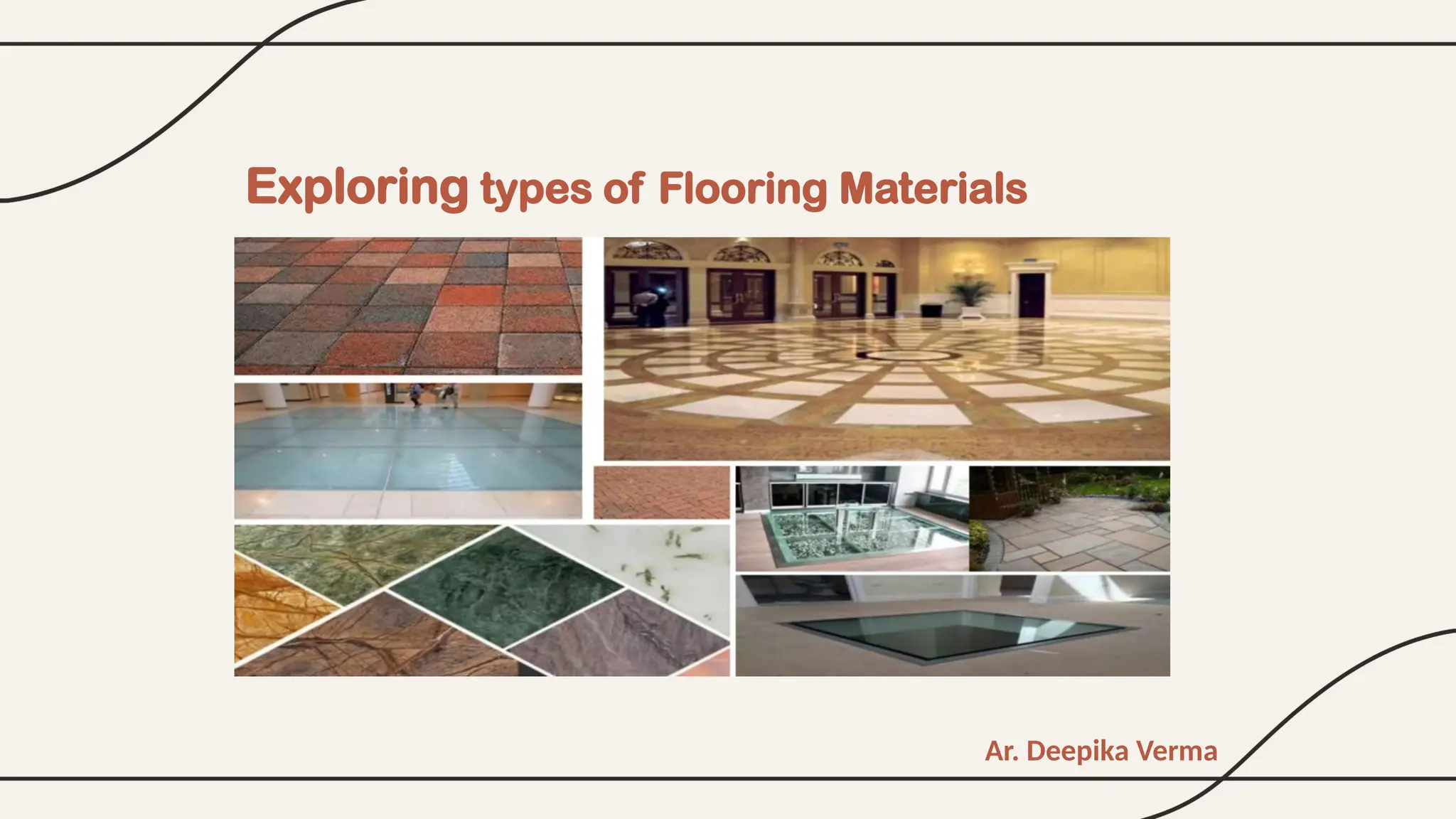


Exploring types of Flooring Materials
Ar. Deepika Verma
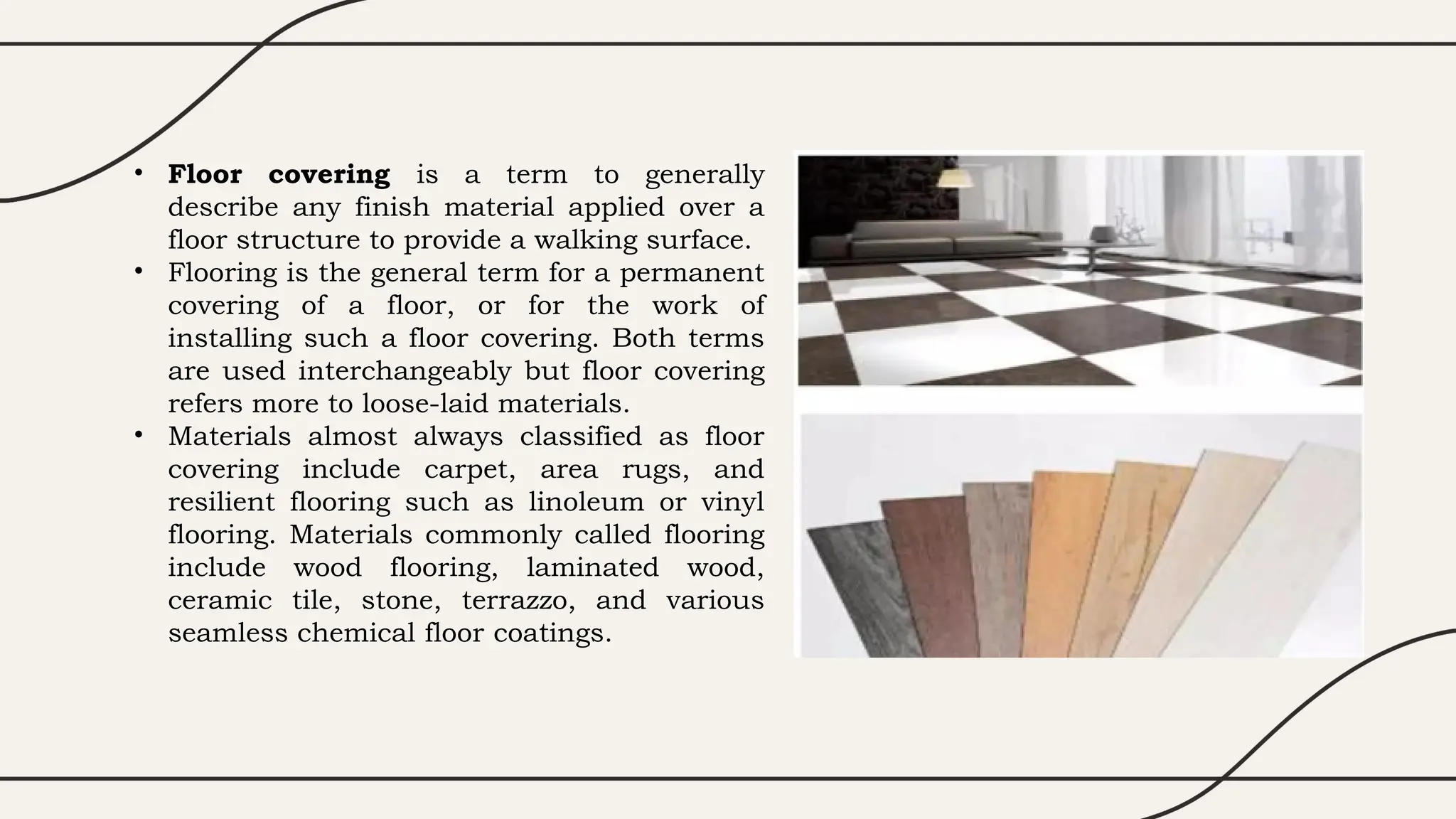
• Floor covering is a term to generally
describe any finish material applied over a
floor structure to provide a walking surface.
• Flooring is the general term for a permanent
covering of a floor, or for the work of
installing such a floor covering. Both terms
are used interchangeably but floor covering
refers more to loose-laid materials.
• Materials almost always classified as floor
covering include carpet, area rugs, and
resilient flooring such as linoleum or vinyl
flooring. Materials commonly called flooring
include wood flooring, laminated wood,
ceramic tile, stone, terrazzo, and various
seamless chemical floor coatings.
• Cement or lime
concrete
• Bricks
• Flagstones
• Marble
• Glass
• Ceramic
• Mud and murram
• Wood
• Cork
• Linoleum
• Asphalt
• Rubber
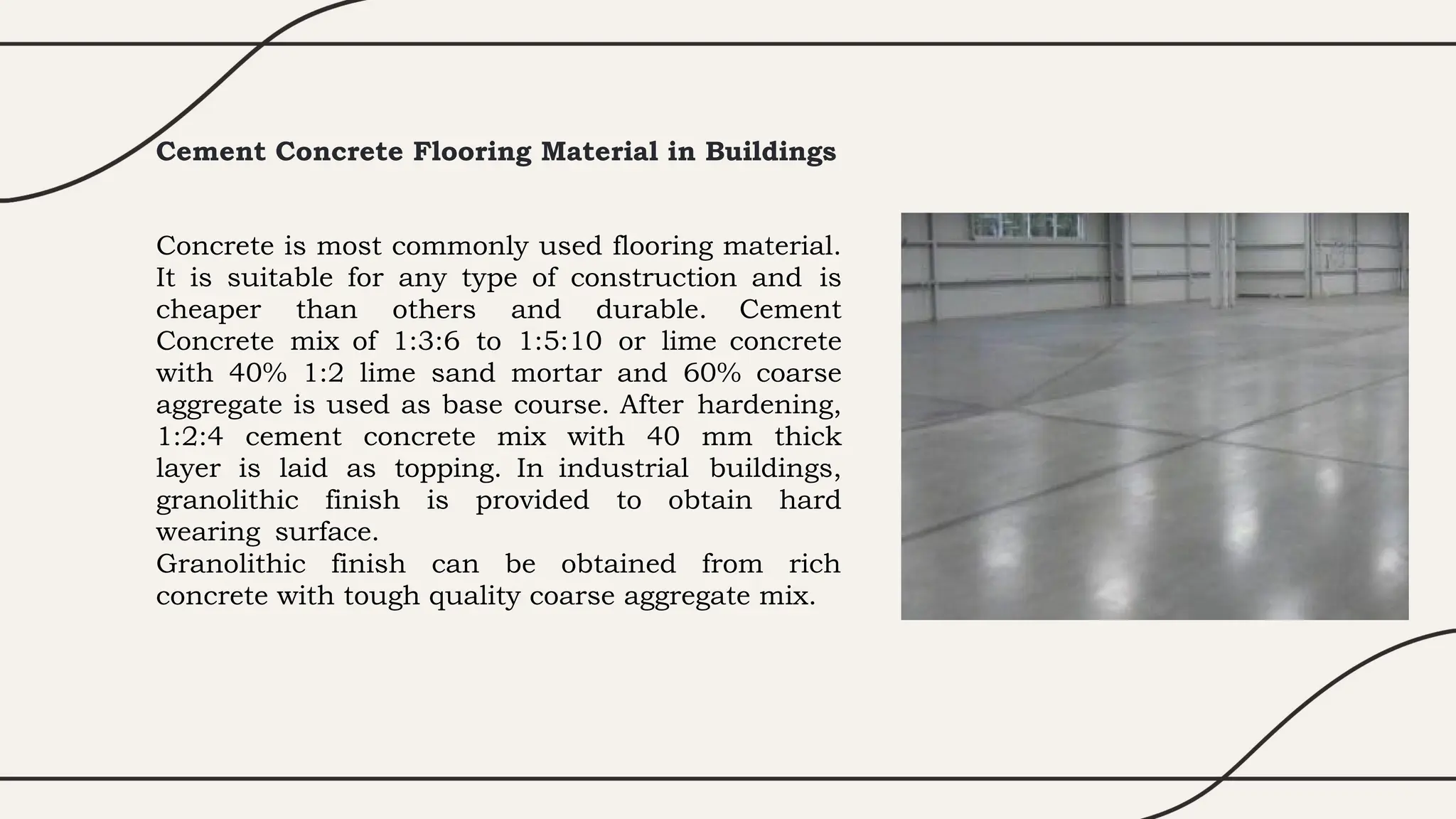
Cement Concrete Flooring Material in Buildings
Concrete is most commonly used flooring material.
It is suitable for any type of construction and is
cheaper than others and durable. Cement
Concrete mix of 1:3:6 to 1:5:10 or lime concrete
with 40% 1:2 lime sand mortar and 60% coarse
aggregate is used as base course. After hardening,
1:2:4 cement concrete mix with 40 mm thick
layer is laid as topping. In industrial buildings,
granolithic finish is provided to obtain hard
wearing surface.
Granolithic finish can be obtained from rich
concrete with tough quality coarse aggregate mix.
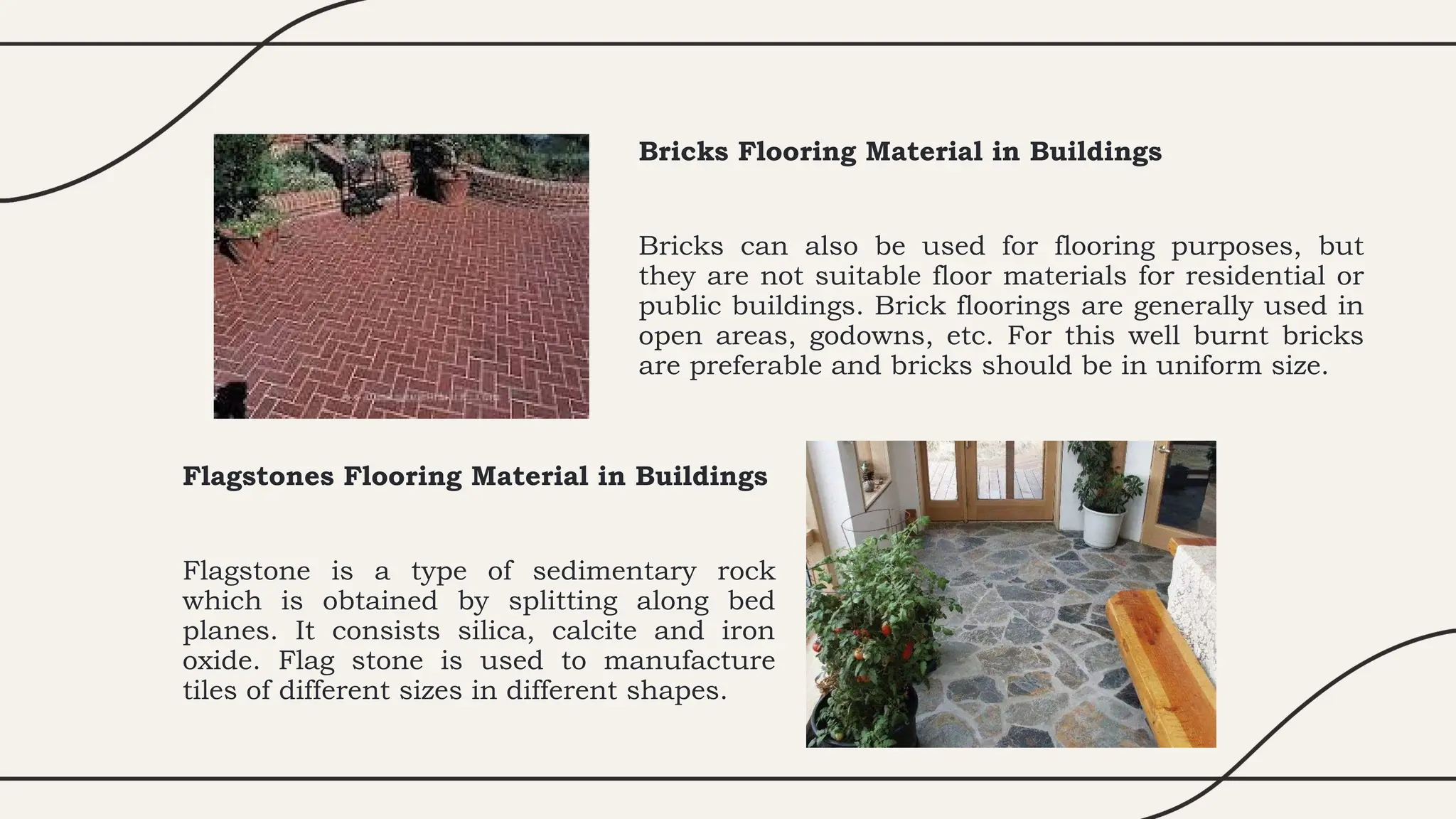
Bricks Flooring Material in Buildings
Bricks can also be used for flooring purposes, but
they are not suitable floor materials for residential or
public buildings. Brick floorings are generally used in
open areas, godowns, etc. For this well burnt bricks
are preferable and bricks should be in uniform size.
Flagstones Flooring Material in Buildings
Flagstone is a type of sedimentary rock
which is obtained by splitting along bed
planes. It consists silica, calcite and iron
oxide. Flag stone is used to manufacture
tiles of different sizes in different shapes.
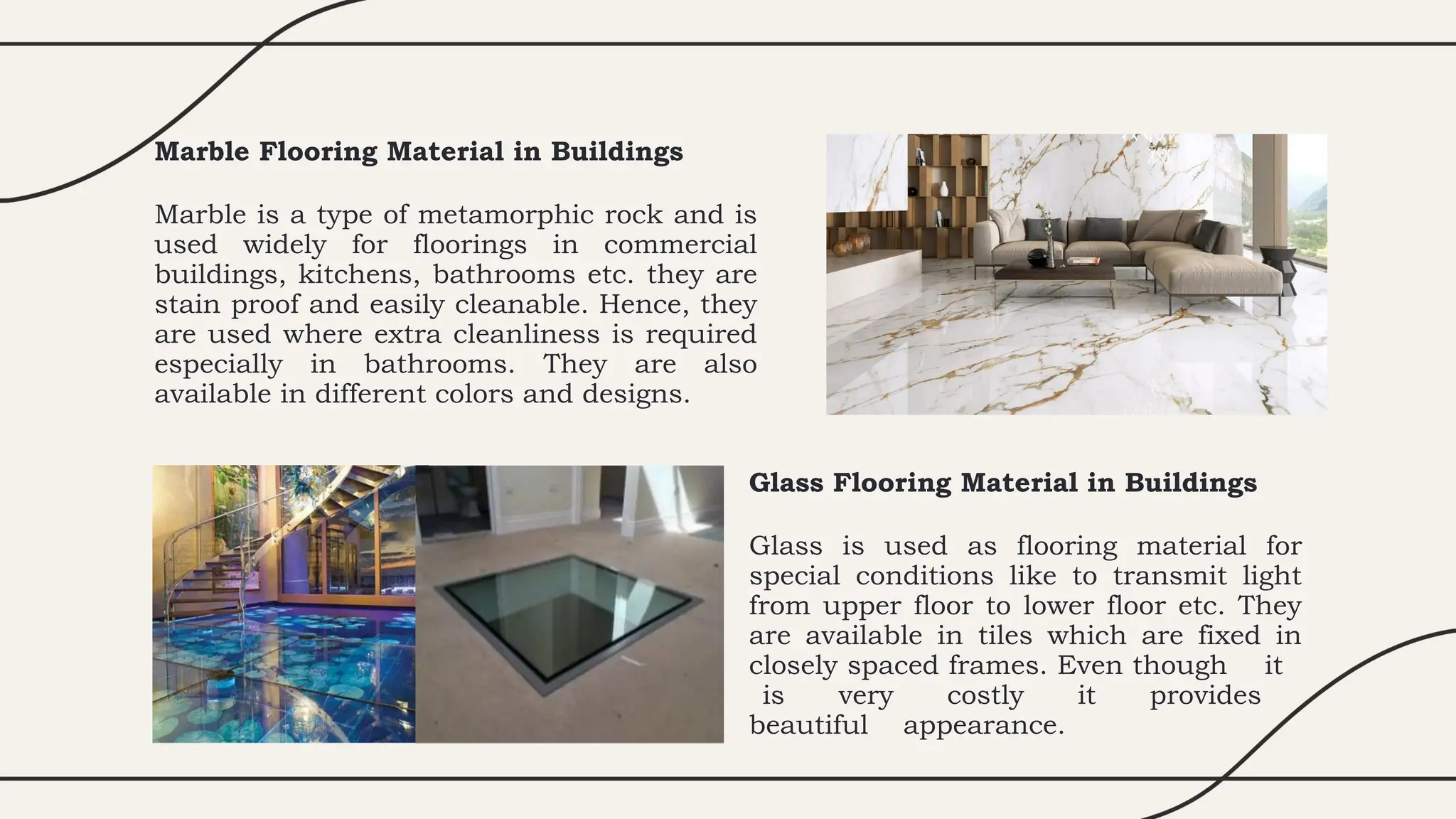
Marble Flooring Material in Buildings
Marble is a type of metamorphic rock and is
used widely for floorings in commercial
buildings, kitchens, bathrooms etc. they are
stain proof and easily cleanable. Hence, they
are used where extra cleanliness is required
especially in bathrooms. They are also
available in different colors and designs.
Glass Flooring Material in Buildings
Glass is used as flooring material for
special conditions like to transmit light
from upper floor to lower floor etc. They
are available in tiles which are fixed in
closely spaced frames. Even though it
is very costly it provides
beautiful appearance.
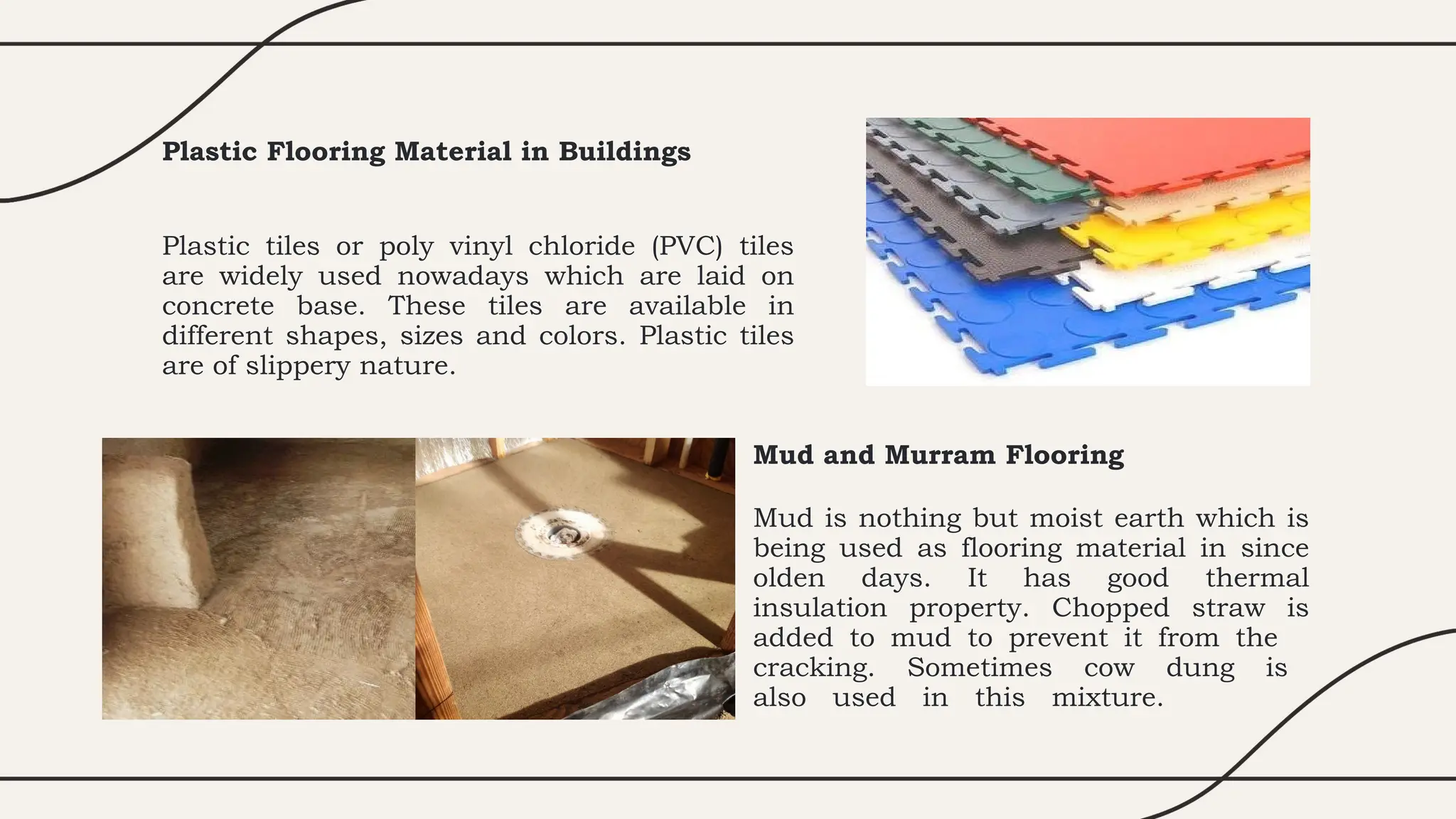
Plastic Flooring Material in Buildings
Plastic tiles or poly vinyl chloride (PVC) tiles
are widely used nowadays which are laid on
concrete base. These tiles are available in
different shapes, sizes and colors. Plastic tiles
are of slippery nature.
Mud and Murram Flooring
Mud is nothing but moist earth which is
being used as flooring material in since
olden days. It has good thermal
insulation property. Chopped straw is
added to mud to prevent it from the
cracking. Sometimes cow dung is
also used in this mixture.
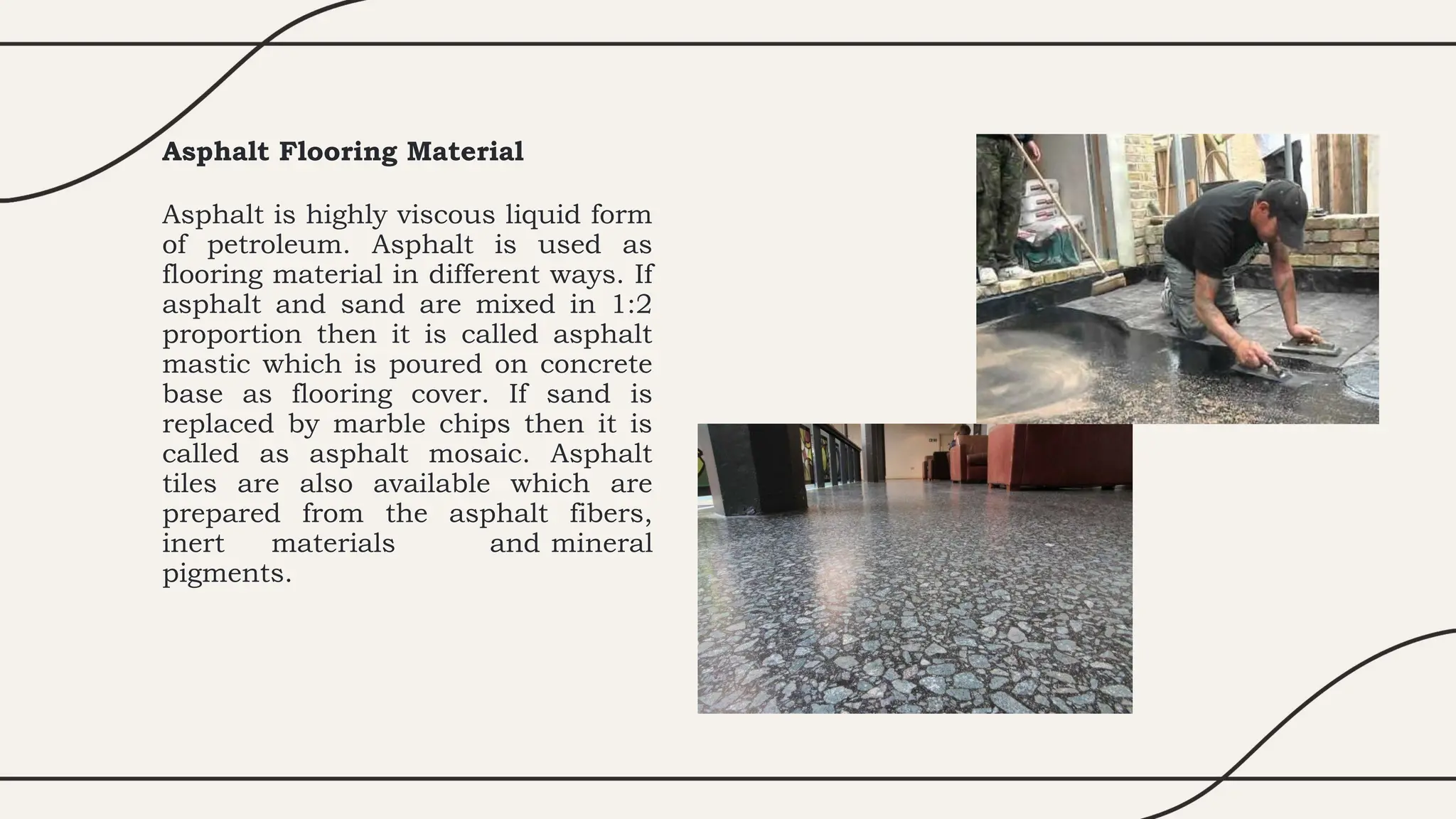
Asphalt Flooring Material
Asphalt is highly viscous liquid form
of petroleum. Asphalt is used as
flooring material in different ways. If
asphalt and sand are mixed in 1:2
proportion then it is called asphalt
mastic which is poured on concrete
base as flooring cover. If sand is
replaced by marble chips then it is
called as asphalt mosaic. Asphalt
tiles are also available which are
prepared from the asphalt fibers,
inert materials and mineral
pigments.
Factors Affecting Selection of Flooring Material
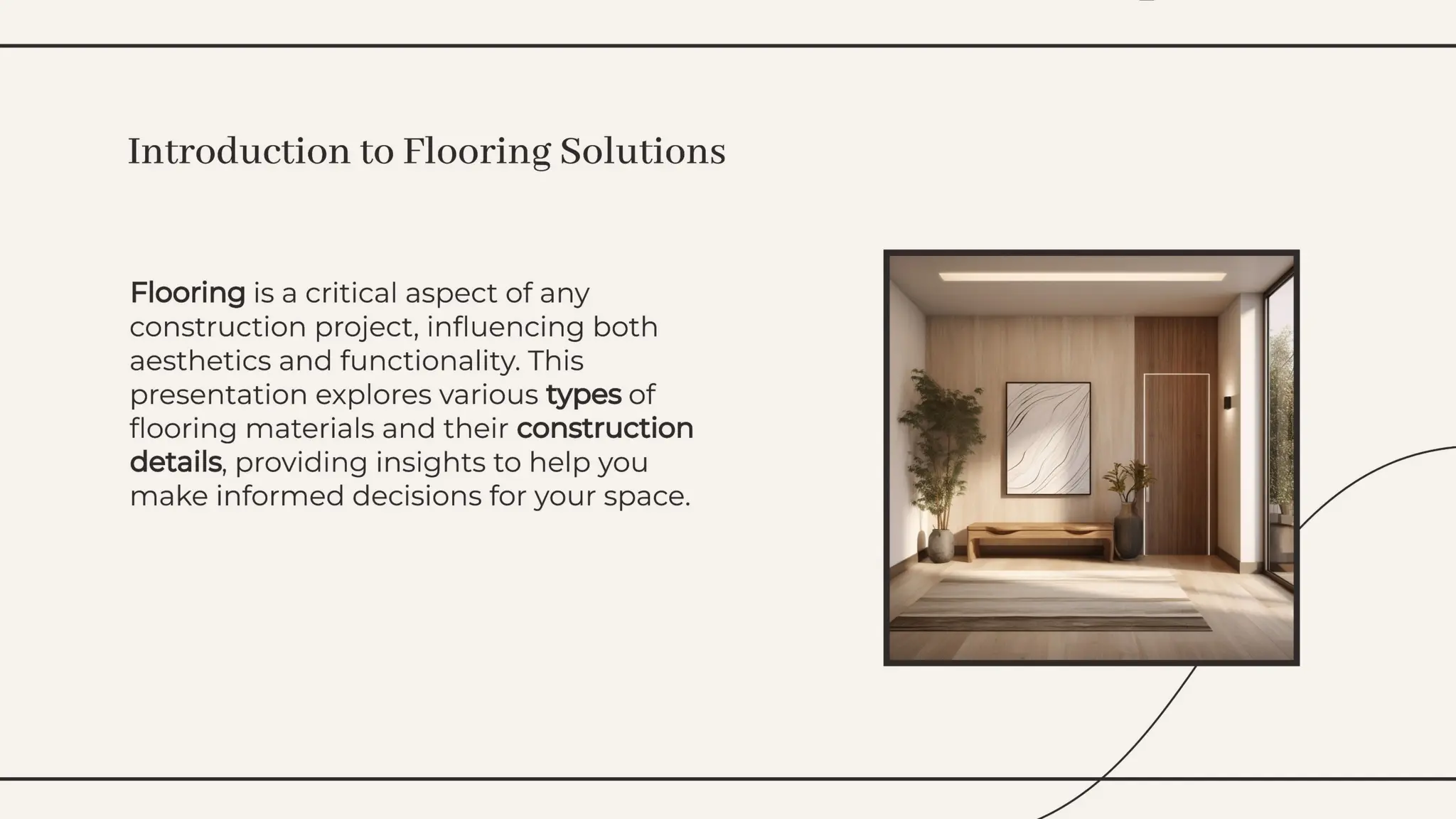
The selection of flooring material is done based on the following factors:
•Initial cost
•Durability
•Hardness
•Smoothness
•Cleanliness
•Appearance
•Sound insulation
•Thermal insulation
•Damp proof
•Fire resistance
•Maintenance
types of flooring materials and their applications

types of flooring materials and their applications

  • 1.
    Exploring types ofFlooring Materials Ar. Deepika Verma
  • 3.
    • Floor coveringis a term to generally describe any finish material applied over a floor structure to provide a walking surface. • Flooring is the general term for a permanent covering of a floor, or for the work of installing such a floor covering. Both terms are used interchangeably but floor covering refers more to loose-laid materials. • Materials almost always classified as floor covering include carpet, area rugs, and resilient flooring such as linoleum or vinyl flooring. Materials commonly called flooring include wood flooring, laminated wood, ceramic tile, stone, terrazzo, and various seamless chemical floor coatings.
  • 4.
    • Cement orlime concrete • Bricks • Flagstones • Marble • Glass • Ceramic • Mud and murram • Wood • Cork • Linoleum • Asphalt • Rubber
  • 5.
    Cement Concrete FlooringMaterial in Buildings Concrete is most commonly used flooring material. It is suitable for any type of construction and is cheaper than others and durable. Cement Concrete mix of 1:3:6 to 1:5:10 or lime concrete with 40% 1:2 lime sand mortar and 60% coarse aggregate is used as base course. After hardening, 1:2:4 cement concrete mix with 40 mm thick layer is laid as topping. In industrial buildings, granolithic finish is provided to obtain hard wearing surface. Granolithic finish can be obtained from rich concrete with tough quality coarse aggregate mix.
  • 6.
    Bricks Flooring Materialin Buildings Bricks can also be used for flooring purposes, but they are not suitable floor materials for residential or public buildings. Brick floorings are generally used in open areas, godowns, etc. For this well burnt bricks are preferable and bricks should be in uniform size. Flagstones Flooring Material in Buildings Flagstone is a type of sedimentary rock which is obtained by splitting along bed planes. It consists silica, calcite and iron oxide. Flag stone is used to manufacture tiles of different sizes in different shapes.
  • 10.
    Marble Flooring Materialin Buildings Marble is a type of metamorphic rock and is used widely for floorings in commercial buildings, kitchens, bathrooms etc. they are stain proof and easily cleanable. Hence, they are used where extra cleanliness is required especially in bathrooms. They are also available in different colors and designs. Glass Flooring Material in Buildings Glass is used as flooring material for special conditions like to transmit light from upper floor to lower floor etc. They are available in tiles which are fixed in closely spaced frames. Even though it is very costly it provides beautiful appearance.
  • 13.
    Plastic Flooring Materialin Buildings Plastic tiles or poly vinyl chloride (PVC) tiles are widely used nowadays which are laid on concrete base. These tiles are available in different shapes, sizes and colors. Plastic tiles are of slippery nature. Mud and Murram Flooring Mud is nothing but moist earth which is being used as flooring material in since olden days. It has good thermal insulation property. Chopped straw is added to mud to prevent it from the cracking. Sometimes cow dung is also used in this mixture.
  • 14.
    Asphalt Flooring Material Asphaltis highly viscous liquid form of petroleum. Asphalt is used as flooring material in different ways. If asphalt and sand are mixed in 1:2 proportion then it is called asphalt mastic which is poured on concrete base as flooring cover. If sand is replaced by marble chips then it is called as asphalt mosaic. Asphalt tiles are also available which are prepared from the asphalt fibers, inert materials and mineral pigments.
  • 16.
    Factors Affecting Selectionof Flooring Material The selection of flooring material is done based on the following factors: •Initial cost •Durability •Hardness •Smoothness •Cleanliness •Appearance •Sound insulation •Thermal insulation •Damp proof •Fire resistance •Maintenance