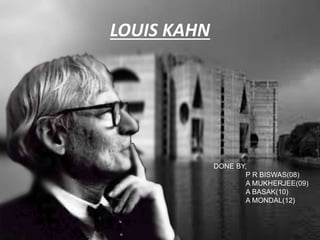
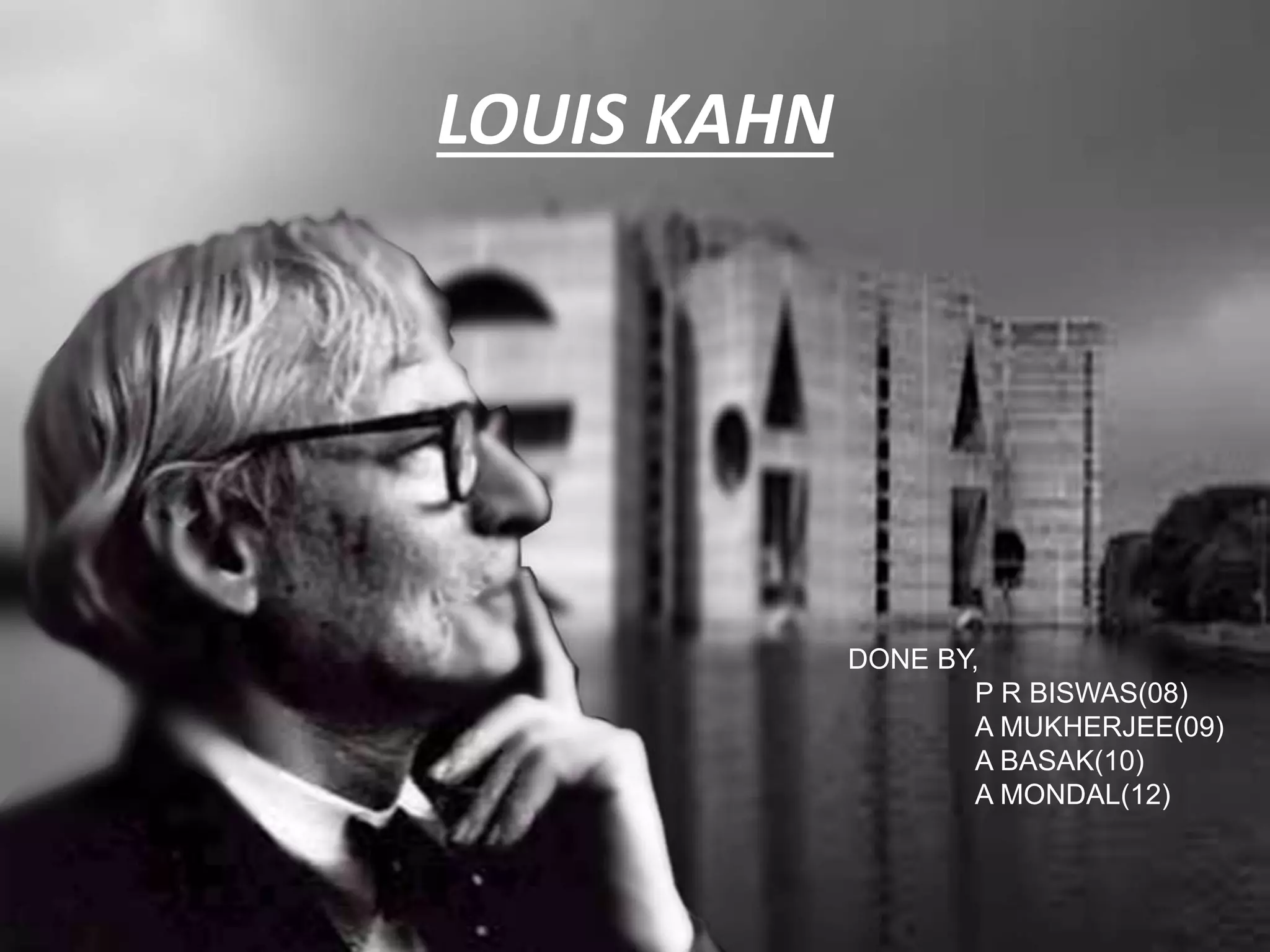
LOUIS KAHN
DONE BY,
P R BISWAS(08)
A MUKHERJEE(09)
A BASAK(10)
A MONDAL(12)
LIFE
• Born February 20, 1901 on Saaremmaa Island in Kuressaare.
• Kahn's Jewish parents immigrated to the United States in 1906.
• His given name at birth was Itze-Leib Schmuilowsky but was changed upon arrival in the US.
• Kahn's architecture is notable for its simple, platonic forms and compositions.
• Through the use of brick and poured-in place concrete masonry, he developed a contemporary
and monumental architecture that maintained a sympathy for the site.
• While rooted in the International Style, Kahn's architecture was an amalgam of his Beaux Arts
education and a personal aesthetic impulse to develop his own architectural forms.
• Kahn received the AIA Gold Medal in 1971 and the RIBA Gold Medal in 1972.
• Louis Kahn is considered one of the foremost architects of the late twentieth century.
• On March 17, 1974, he died of a heart attack in a men's restroom in Pennsylvania Station in New
York City.
Education/ Occupation
• He attended the University of Pennsylvania and received his Bachelors degree in architecture at
the age of 24.
• After college, he worked as a senior draftsman in the office of Philadelphia City Architect John
Molitor.
• To find his inspiration, he traveled through Europe visiting castles and medieval strongholds in
1928, only 4 years after graduating.
• He finally started his own firm in 1935.
• While he still designed and worked as a design critic on the side, Louis became a professor of
architecture at Yale school of Architecture.
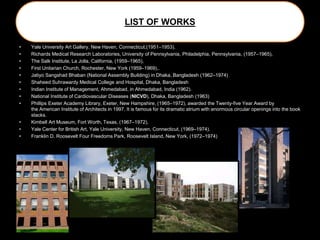
LIST OF WORKS
• Yale University Art Gallery, New Haven, Connecticut,(1951–1953),
• Richards Medical Research Laboratories, University of Pennsylvania, Philadelphia, Pennsylvania, (1957–1965),
• The Salk Institute, La Jolla, California, (1959–1965),
• First Unitarian Church, Rochester, New York (1959–1969),.
• Jatiyo Sangshad Bhaban (National Assembly Building) in Dhaka, Bangladesh (1962–1974)
• Shaheed Suhrawardy Medical College and Hospital, Dhaka, Bangladesh
• Indian Institute of Management, Ahmedabad, in Ahmedabad, India (1962).
• National Institute of Cardiovascular Diseases (NICVD), Dhaka, Bangladesh (1963)
• Phillips Exeter Academy Library, Exeter, New Hampshire, (1965–1972), awarded the Twenty-five Year Award by
the American Institute of Architects in 1997. It is famous for its dramatic atrium with enormous circular openings into the book
stacks.
• Kimbell Art Museum, Fort Worth, Texas, (1967–1972),
• Yale Center for British Art, Yale University, New Haven, Connecticut, (1969–1974).
• Franklin D. Roosevelt Four Freedoms Park, Roosevelt Island, New York, (1972–1974)
GEOMETRY IN HIS WORK
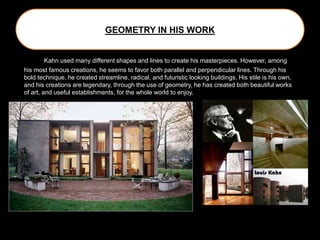
Kahn used many different shapes and lines to create his masterpieces. However, among
his most famous creations, he seems to favor both parallel and perpendicular lines. Through his
bold technique, he created streamline, radical, and futuristic looking buildings. His stile is his own,
and his creations are legendary, through the use of geometry, he has created both beautiful works
of art, and useful establishments, for the whole world to enjoy.
CONCEPT
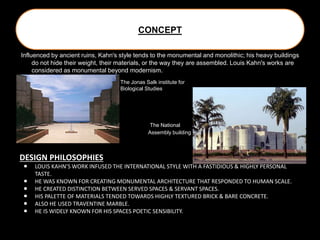
Influenced by ancient ruins, Kahn's style tends to the monumental and monolithic; his heavy buildings
do not hide their weight, their materials, or the way they are assembled. Louis Kahn's works are
considered as monumental beyond modernism.
The Jonas Salk institute for
Biological Studies
The National
Assembly building
DESIGN PHILOSOPHIES
 LOUIS KAHN’S WORK INFUSED THE INTERNATIONAL STYLE WITH A FASTIDIOUS & HIGHLY PERSONAL
TASTE.
 HE WAS KNOWN FOR CREATING MONUMENTAL ARCHITECTURE THAT RESPONDED TO HUMAN SCALE.
 HE CREATED DISTINCTION BETWEEN SERVED SPACES & SERVANT SPACES.
 HIS PALETTE OF MATERIALS TENDED TOWARDS HIGHLY TEXTURED BRICK & BARE CONCRETE.
 ALSO HE USED TRAVENTINE MARBLE.
 HE IS WIDELY KNOWN FOR HIS SPACES POETIC SENSIBILITY.
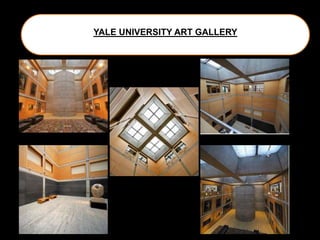
YALE UNIVERSITY ART GALLERY
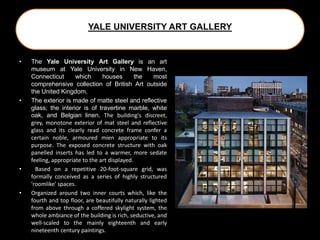
• The Yale University Art Gallery is an art
museum at Yale University in New Haven,
Connecticut which houses the most
comprehensive collection of British Art outside
the United Kingdom.
• The exterior is made of matte steel and reflective
glass; the interior is of travertine marble, white
oak, and Belgian linen. The building's discreet,
grey, monotone exterior of mat steel and reflective
glass and its clearly read concrete frame confer a
certain noble, armoured mien appropriate to its
purpose. The exposed concrete structure with oak
panelled inserts has led to a warmer, more sedate
feeling, appropriate to the art displayed.
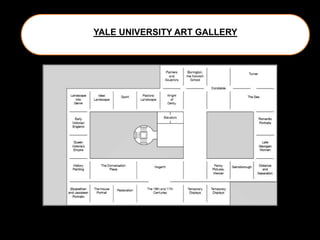
• Based on a repetitive 20-foot-square grid, was
formally conceived as a series of highly structured
'roomlike' spaces.
• Organized around two inner courts which, like the
fourth and top floor, are beautifully naturally lighted
from above through a coffered skylight system, the
whole ambiance of the building is rich, seductive, and
well-scaled to the mainly eighteenth and early
nineteenth century paintings.
YALE UNIVERSITY ART GALLERY
MARGARET ESHERICK HOUSE
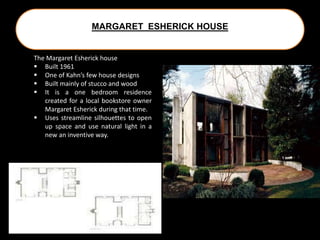
The Margaret Esherick house
 Built 1961
 One of Kahn’s few house designs
 Built mainly of stucco and wood
 It is a one bedroom residence
created for a local bookstore owner
Margaret Esherick during that time.
 Uses streamline silhouettes to open
up space and use natural light in a
new an inventive way.
THE NORMAN FISHER HOUSE
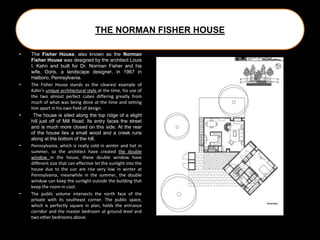
• The Fisher House, also known as the Norman
Fisher House was designed by the architect Louis
I. Kahn and built for Dr. Norman Fisher and his
wife, Doris, a landscape designer, in 1967 in
Hatboro, Pennsylvania.
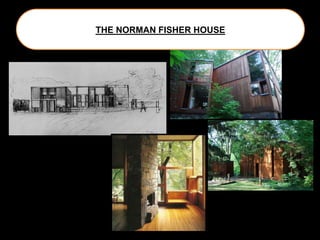
• The Fisher House stands as the clearest example of
Kahn's unique architectural style at the time, his use of
the two almost perfect cubes differing greatly from
much of what was being done at the time and setting
him apart in his own field of design.
• The house is sited along the top ridge of a slight
hill just off of Mill Road. Its entry faces the street
and is much more closed on this side. At the rear
of the house lies a small wood and a creek runs
along at the bottom of the hill.
• Pennsylvania, which is really cold in winter and hot in
summer, so the architect have created the double
window in the house, these double window have
different size that can effective let the sunlight into the
house due to the sun are rise very low in winter at
Pennsylvania, meanwhile in the summer, the double
window can keep the sunlight outside the building that
keep the room in cool.
• The public volume intersects the north face of the
private with its southeast corner. The public space,
which is perfectly square in plan, holds the entrance
corridor and the master bedroom at ground level and
two other bedrooms above.
THE NORMAN FISHER HOUSE
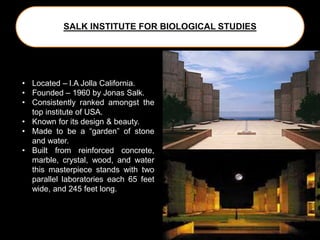
SALK INSTITUTE FOR BIOLOGICAL STUDIES
• Located – l.A Jolla California.
• Founded – 1960 by Jonas Salk.
• Consistently ranked amongst the
top institute of USA.
• Known for its design & beauty.
• Made to be a “garden” of stone
and water.
• Built from reinforced concrete,
marble, crystal, wood, and water
this masterpiece stands with two
parallel laboratories each 65 feet
wide, and 245 feet long.
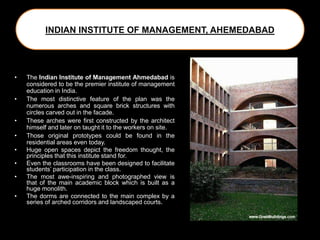
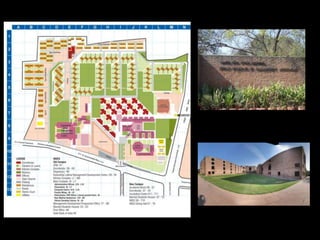
INDIAN INSTITUTE OF MANAGEMENT, AHEMEDABAD
• The Indian Institute of Management Ahmedabad is
considered to be the premier institute of management
education in India.
• The most distinctive feature of the plan was the
numerous arches and square brick structures with
circles carved out in the facade.
• These arches were first constructed by the architect
himself and later on taught it to the workers on site.
• Those original prototypes could be found in the
residential areas even today.
• Huge open spaces depict the freedom thought, the
principles that this institute stand for.
• Even the classrooms have been designed to facilitate
students’ participation in the class.
• The most awe-inspiring and photographed view is
that of the main academic block which is built as a
huge monolith.
• The dorms are connected to the main complex by a
series of arched corridors and landscaped courts.
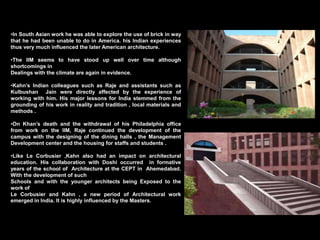
•In South Asian work he was able to explore the use of brick in way
that he had been unable to do in America. his Indian experiences
thus very much influenced the later American architecture.
•The IIM seems to have stood up well over time although
shortcomings in
Dealings with the climate are again in evidence.
•Kahn’s Indian colleagues such as Raje and assistants such as
Kulbushan Jain were directly affected by the experience of
working with him. His major lessons for India stemmed from the
grounding of his work in reality and tradition , local materials and
methods .
•On Khan’s death and the withdrawal of his Philadelphia office
from work on the IIM, Raje continued the development of the
campus with the designing of the dining halls , the Management
Development center and the housing for staffs and students .
•Like Le Corbusier ,Kahn also had an impact on architectural
education. His collaboration with Doshi occurred in formative
years of the school of Architecture at the CEPT in Ahemedabad.
With the development of such
Schools and with the younger architects being Exposed to the
work of
Le Corbusier and Kahn , a new period of Architectural work
emerged in India. It is highly influenced by the Masters.
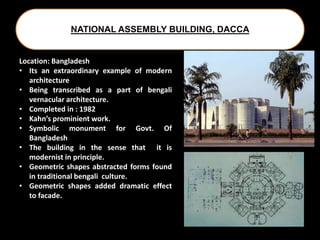
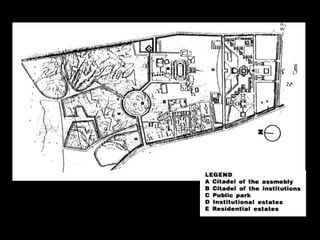
NATIONAL ASSEMBLY BUILDING, DACCA
Location: Bangladesh
• Its an extraordinary example of modern
architecture
• Being transcribed as a part of bengali
vernacular architecture.
• Completed in : 1982
• Kahn’s prominient work.
• Symbolic monument for Govt. Of
Bangladesh
• The building in the sense that it is
modernist in principle.
• Geometric shapes abstracted forms found
in traditional bengali culture.
• Geometric shapes added dramatic effect
to facade.
Louis kahn

Louis kahn

  • 1.
    LOUIS KAHN DONE BY, PR BISWAS(08) A MUKHERJEE(09) A BASAK(10) A MONDAL(12)
  • 2.
    LIFE • Born February20, 1901 on Saaremmaa Island in Kuressaare. • Kahn's Jewish parents immigrated to the United States in 1906. • His given name at birth was Itze-Leib Schmuilowsky but was changed upon arrival in the US. • Kahn's architecture is notable for its simple, platonic forms and compositions. • Through the use of brick and poured-in place concrete masonry, he developed a contemporary and monumental architecture that maintained a sympathy for the site. • While rooted in the International Style, Kahn's architecture was an amalgam of his Beaux Arts education and a personal aesthetic impulse to develop his own architectural forms. • Kahn received the AIA Gold Medal in 1971 and the RIBA Gold Medal in 1972. • Louis Kahn is considered one of the foremost architects of the late twentieth century. • On March 17, 1974, he died of a heart attack in a men's restroom in Pennsylvania Station in New York City. Education/ Occupation • He attended the University of Pennsylvania and received his Bachelors degree in architecture at the age of 24. • After college, he worked as a senior draftsman in the office of Philadelphia City Architect John Molitor. • To find his inspiration, he traveled through Europe visiting castles and medieval strongholds in 1928, only 4 years after graduating. • He finally started his own firm in 1935. • While he still designed and worked as a design critic on the side, Louis became a professor of architecture at Yale school of Architecture.
  • 3.
    LIST OF WORKS •Yale University Art Gallery, New Haven, Connecticut,(1951–1953), • Richards Medical Research Laboratories, University of Pennsylvania, Philadelphia, Pennsylvania, (1957–1965), • The Salk Institute, La Jolla, California, (1959–1965), • First Unitarian Church, Rochester, New York (1959–1969),. • Jatiyo Sangshad Bhaban (National Assembly Building) in Dhaka, Bangladesh (1962–1974) • Shaheed Suhrawardy Medical College and Hospital, Dhaka, Bangladesh • Indian Institute of Management, Ahmedabad, in Ahmedabad, India (1962). • National Institute of Cardiovascular Diseases (NICVD), Dhaka, Bangladesh (1963) • Phillips Exeter Academy Library, Exeter, New Hampshire, (1965–1972), awarded the Twenty-five Year Award by the American Institute of Architects in 1997. It is famous for its dramatic atrium with enormous circular openings into the book stacks. • Kimbell Art Museum, Fort Worth, Texas, (1967–1972), • Yale Center for British Art, Yale University, New Haven, Connecticut, (1969–1974). • Franklin D. Roosevelt Four Freedoms Park, Roosevelt Island, New York, (1972–1974)
  • 4.
    GEOMETRY IN HISWORK Kahn used many different shapes and lines to create his masterpieces. However, among his most famous creations, he seems to favor both parallel and perpendicular lines. Through his bold technique, he created streamline, radical, and futuristic looking buildings. His stile is his own, and his creations are legendary, through the use of geometry, he has created both beautiful works of art, and useful establishments, for the whole world to enjoy.
  • 5.
    CONCEPT Influenced by ancientruins, Kahn's style tends to the monumental and monolithic; his heavy buildings do not hide their weight, their materials, or the way they are assembled. Louis Kahn's works are considered as monumental beyond modernism. The Jonas Salk institute for Biological Studies The National Assembly building DESIGN PHILOSOPHIES  LOUIS KAHN’S WORK INFUSED THE INTERNATIONAL STYLE WITH A FASTIDIOUS & HIGHLY PERSONAL TASTE.  HE WAS KNOWN FOR CREATING MONUMENTAL ARCHITECTURE THAT RESPONDED TO HUMAN SCALE.  HE CREATED DISTINCTION BETWEEN SERVED SPACES & SERVANT SPACES.  HIS PALETTE OF MATERIALS TENDED TOWARDS HIGHLY TEXTURED BRICK & BARE CONCRETE.  ALSO HE USED TRAVENTINE MARBLE.  HE IS WIDELY KNOWN FOR HIS SPACES POETIC SENSIBILITY.
  • 6.
    YALE UNIVERSITY ARTGALLERY • The Yale University Art Gallery is an art museum at Yale University in New Haven, Connecticut which houses the most comprehensive collection of British Art outside the United Kingdom. • The exterior is made of matte steel and reflective glass; the interior is of travertine marble, white oak, and Belgian linen. The building's discreet, grey, monotone exterior of mat steel and reflective glass and its clearly read concrete frame confer a certain noble, armoured mien appropriate to its purpose. The exposed concrete structure with oak panelled inserts has led to a warmer, more sedate feeling, appropriate to the art displayed. • Based on a repetitive 20-foot-square grid, was formally conceived as a series of highly structured 'roomlike' spaces. • Organized around two inner courts which, like the fourth and top floor, are beautifully naturally lighted from above through a coffered skylight system, the whole ambiance of the building is rich, seductive, and well-scaled to the mainly eighteenth and early nineteenth century paintings.
  • 7.
  • 8.
  • 9.
    MARGARET ESHERICK HOUSE TheMargaret Esherick house  Built 1961  One of Kahn’s few house designs  Built mainly of stucco and wood  It is a one bedroom residence created for a local bookstore owner Margaret Esherick during that time.  Uses streamline silhouettes to open up space and use natural light in a new an inventive way.
  • 10.
    THE NORMAN FISHERHOUSE • The Fisher House, also known as the Norman Fisher House was designed by the architect Louis I. Kahn and built for Dr. Norman Fisher and his wife, Doris, a landscape designer, in 1967 in Hatboro, Pennsylvania. • The Fisher House stands as the clearest example of Kahn's unique architectural style at the time, his use of the two almost perfect cubes differing greatly from much of what was being done at the time and setting him apart in his own field of design. • The house is sited along the top ridge of a slight hill just off of Mill Road. Its entry faces the street and is much more closed on this side. At the rear of the house lies a small wood and a creek runs along at the bottom of the hill. • Pennsylvania, which is really cold in winter and hot in summer, so the architect have created the double window in the house, these double window have different size that can effective let the sunlight into the house due to the sun are rise very low in winter at Pennsylvania, meanwhile in the summer, the double window can keep the sunlight outside the building that keep the room in cool. • The public volume intersects the north face of the private with its southeast corner. The public space, which is perfectly square in plan, holds the entrance corridor and the master bedroom at ground level and two other bedrooms above.
  • 11.
  • 12.
    SALK INSTITUTE FORBIOLOGICAL STUDIES • Located – l.A Jolla California. • Founded – 1960 by Jonas Salk. • Consistently ranked amongst the top institute of USA. • Known for its design & beauty. • Made to be a “garden” of stone and water. • Built from reinforced concrete, marble, crystal, wood, and water this masterpiece stands with two parallel laboratories each 65 feet wide, and 245 feet long.
  • 13.
    INDIAN INSTITUTE OFMANAGEMENT, AHEMEDABAD • The Indian Institute of Management Ahmedabad is considered to be the premier institute of management education in India. • The most distinctive feature of the plan was the numerous arches and square brick structures with circles carved out in the facade. • These arches were first constructed by the architect himself and later on taught it to the workers on site. • Those original prototypes could be found in the residential areas even today. • Huge open spaces depict the freedom thought, the principles that this institute stand for. • Even the classrooms have been designed to facilitate students’ participation in the class. • The most awe-inspiring and photographed view is that of the main academic block which is built as a huge monolith. • The dorms are connected to the main complex by a series of arched corridors and landscaped courts.
  • 15.
    •In South Asianwork he was able to explore the use of brick in way that he had been unable to do in America. his Indian experiences thus very much influenced the later American architecture. •The IIM seems to have stood up well over time although shortcomings in Dealings with the climate are again in evidence. •Kahn’s Indian colleagues such as Raje and assistants such as Kulbushan Jain were directly affected by the experience of working with him. His major lessons for India stemmed from the grounding of his work in reality and tradition , local materials and methods . •On Khan’s death and the withdrawal of his Philadelphia office from work on the IIM, Raje continued the development of the campus with the designing of the dining halls , the Management Development center and the housing for staffs and students . •Like Le Corbusier ,Kahn also had an impact on architectural education. His collaboration with Doshi occurred in formative years of the school of Architecture at the CEPT in Ahemedabad. With the development of such Schools and with the younger architects being Exposed to the work of Le Corbusier and Kahn , a new period of Architectural work emerged in India. It is highly influenced by the Masters.
  • 16.
    NATIONAL ASSEMBLY BUILDING,DACCA Location: Bangladesh • Its an extraordinary example of modern architecture • Being transcribed as a part of bengali vernacular architecture. • Completed in : 1982 • Kahn’s prominient work. • Symbolic monument for Govt. Of Bangladesh • The building in the sense that it is modernist in principle. • Geometric shapes abstracted forms found in traditional bengali culture. • Geometric shapes added dramatic effect to facade.