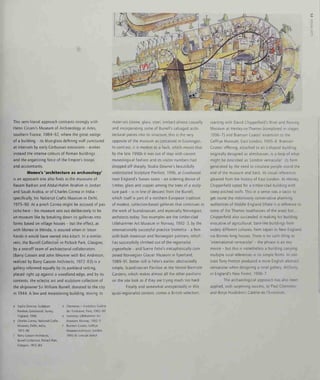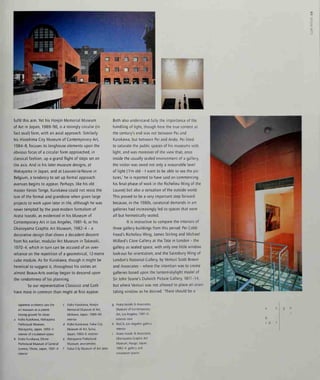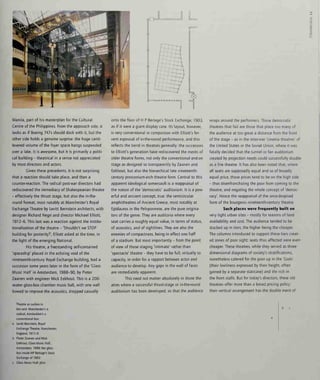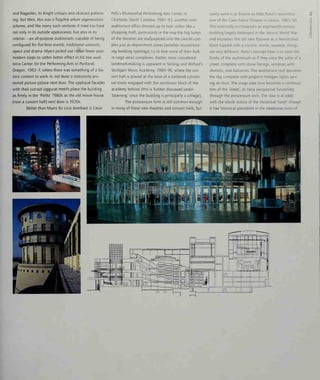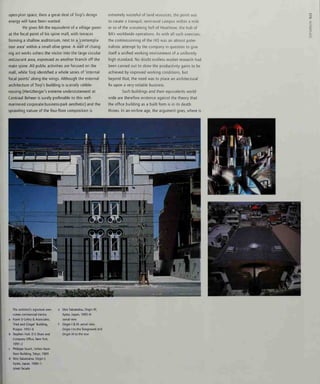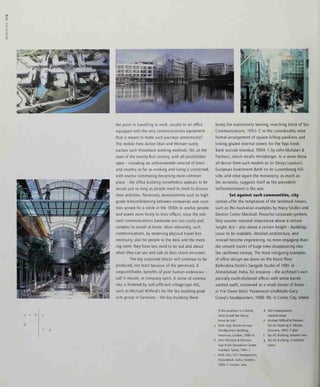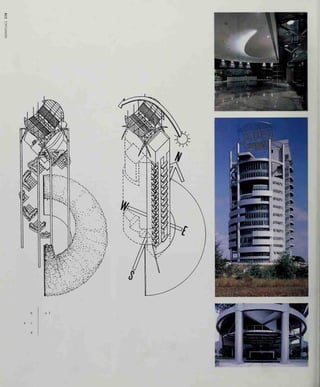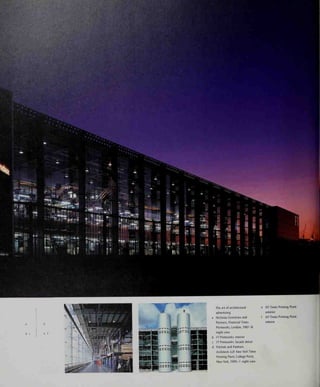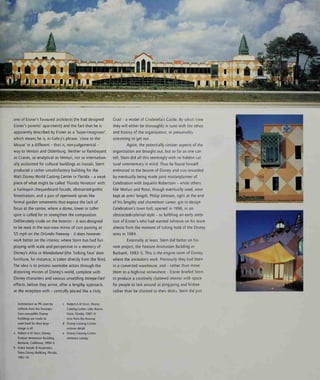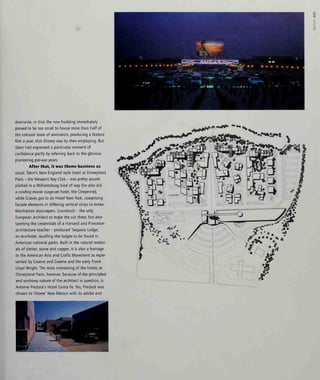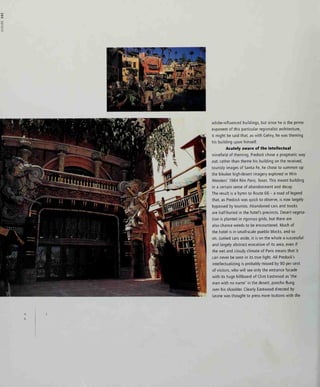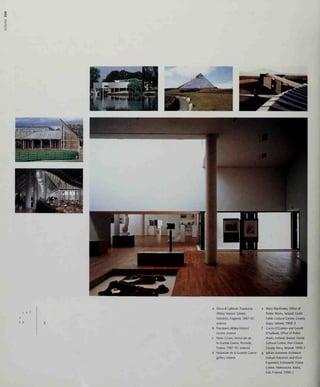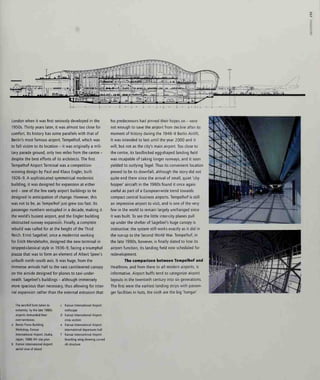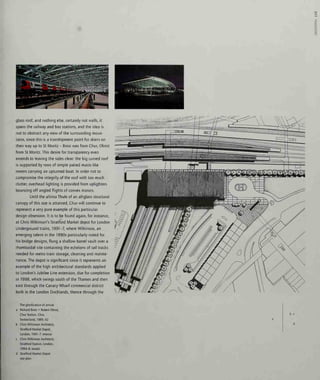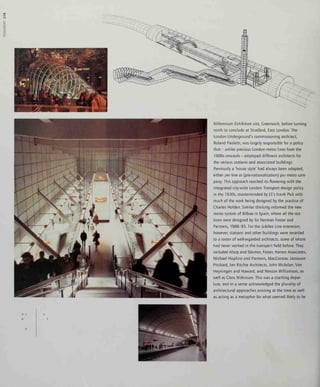


BEL-TIB NON-FICTION
724 Pearman 1998
Pearman, Hugh
Contemporary world
architecture
31111017810910
i**'
DATE DUE
Brodarl Co. Cat, #55 137 001 Printed in USA
CONTEMPORARY WORLD ARCHITECTURE
4086
CONTEMPORARY WORLD ARCHITECTURE is a comprehensive survey of inter
national architecture at the turning point of a new century. Focusing on modern
building types and the forces that shape them, it offers a critical study of more
than six hundred buildings by key architects worldwide. Analysing thirteen separate
building categories, it traces the pluralist paths of architectural thinking from the
seventies to the start of the new millennium. The evolving story of these new forms,
with their underlying quest for aesthetic consensus, is told by HUGH PEARMAN
CONTENTS Introduction 6, Visual Arts Museums & galleries 20, Performance Opera
houses, theatres & concert halls 66, Learning Schools, universities & libranes 102,
Religion Places of worship 136, Consumerism Malls, shops & bars 170, Living Houses &
apartments 202, Workplace Offices & business parks 246, Industry Factories & research
centres 282, Leisure Theme parks, hotels & visitor centres 320, Transport Airports,
stations & shipping terminals 352, Sport Stadia, gymnasia & pools 392, The Civic Realm
Public space & structures 426, Towers Vertical cities 464, Bibliography 488, Index 496
-^--
p?-rflBn
SV^
yv:
^^}¥^-
'
<^"5^
^i1^ *i
2 s
30
O
o
C
o
2
This book is about building types, but it is also
an oblique search for consensus. The last thirty years
have been pluralist times in architecture, after all,
but pluralism is not a style, a dogma, a movement,
nor an underlying structure. Pluralism is merely what
happens when there is no defining orthodoxy. Any
direct attempt to chase the chimaera of a new global
style, a replacement for what some have seen as the
united front of the old International Style - and
which others regard as a giant mid-twentieth-century
con-trick - is as likely to succeed as a quest for the
Yeti. The beast may be out there somewhere, but it
does not choose openly to reveal itself. Likewise, the
mood of architecture is today caught fleetingly in
sidelong glances and snatches of sound.
This study attempts no more than to con-
dense thinking across thirteen broad categories of
buildings at what is, by any measure, a significant
moment in architectural history. The architecture
considered ranges from the radical to the conven-
tional, but as always certain preoccupations with
elevational treatment tend to span the categories in
a way that the plan and section generally cannot.
There are ways of accommodating particular func-
tions and activities - a concert hall auditorium, say,
or a factory production line - that an architect chal-
lenges at his peril, whereas the outward appearance
offers far greater freedom. But in comparing the
a Piano & Rogers, Pompidou
Centre, Paris, 1971-7
b Luis Barragan, Plaza y Fuente
del Bebedero, Las Arboledas,'
Mexico City, 1958-61
c Louis Kahn, Kimbell Art
Museum, Fort Worth,
Texas, 1966-72
hundreds of examples of any given building type
with those of other categories, there are moments of
concurrence. An assonance, a half-rhyme, sometimes
becomes apparent.
There are those architects who espouse the
notion of the lightweight, all-enveloping structure -
the city as monolithic building. There are those who
work in a diametrically opposite way, breaking the
building down into its component parts, turning a
house into a township. Such concerns of the micro
and the macro, the mter-relationship of private and
public domains, are by no means new. However, the
return to such thinking at the start of the twenty-first
century is especially relevant in the light of three par-
ticular developments: the extreme importance placed
on 'masterplanning' in the commercial sector, and the
more cerebral activity of urbanism in the public realm;
the concept of 'bigness' in specific developments,
which is an architectural device in itself; and, related
to both of these, the resurgence of the super-tall build-
ing, particularly as part of the city-making frenzy of
the Pacific Rim. But to these three, there is a codicil:
experimentation continues at its most intense in the
design of individual homes. The tradition of domestic
radicalism is unbroken.
To see how far architecture has moved
during our chosen period, consider what was coming
to an end, and what was beginning, at the start of
the 1970s. In 1972, Louis Kahn completed his
Kimbell Art Museum at Fort Worth, Texas, a year
after Richard Rogers and Renzo Piano won the com-
petition for the Pompidou Centre in Paris, the proto-
type mediatheque. In 1974, Bruce Graham and
Fazlur Khan of SOM completed the Sears Tower in
Chicago, destined to remain the world's tallest for
many years. In 1975, in Ipswich, England, Norman
Foster completed the amoebic black glass form of
the Willis Faber Dumas headquarters. In 1978 the
Mexican architect Luis Barragan built his last house,
and that same year, in Sendai, Japan, the Italian
architect Carlo Scarpa died. He was buried in his
masterpiece, the Brion family cemetery atTreviso,
Italy, in a tomb designed by his son Tobia.
In the 1970s, it seemed as if one architectural
world - the world not only of international modern-
ism, but also of craftsmanship, of conservatism - had
died with Scarpa while another world - the world of
high-precision, machine-made, radical, architecture
-
was taking over. No comparison can readily be made
between Scarpa's last significant work, the Banca
Popolare di Verona, with its geologically incised
plinth and hand-rendered facade of mixed lime and
brick chippings, and Foster's impending Hongkong
and Shanghai Bank headquarters, its components
shipped and flown in from all over the world.
Similarly the completion of a landmark building by
Harry Seidler and Marcel Breuer, the heavyweight
concrete split drum of the Australian Embassy in
Paris, was almost wholly eclipsed by the exactly con-
temporaneous building of the comparatively light-
weight steel and glass Pompidou Centre. Seidler's
architecture, influenced by Oscar Niemeyer as well as
Breuer (he had earlier worl<ed for both), seemed to
represent the fag-end of a movement. Others influen-
tial in the post-war years, such as Josep LIuis Sert in
Barcelona, were undertaking their final commissions:
the last knockings, it seemed, of a pre-war manifesto
architecture that had first come to prominence in the
hermetic world of CIAM - the Congres Internationaux
d'Architecture Moderne - founded in 1928 and swiftly
appropriated by Le Corbusier and his disciples. All,
then, was set to change, and yet the previous genera-
tion of architects was not to be so easily eclipsed.
Who would have thought, after all that architecture
has been through since then, that Kahn, Scarpa and
Barragan would return to favour so strongly?
At the time, all that was being challenged.
Yet as the critic Peter Reyner Banham noted in an
introduction to the first, slim, volume devoted to
Foster Associates in 1978: 'The collapse of the
Modern Movement, when it finally happened, proved
not to be as much fun as had been anticipated.'
Banham was clear: the Modern Movement had col-
lapsed, though he saw Foster as an example of a
modernism that, he noted, 'survived as the dominant
element in the new pluralism'. In an endearingly typi-
cal case of Banham having his cake and eating it,
modernism was thus both very dead and very much
alive. But Banham was right in this sense: the term
'modernism' proved to be as stretchable as elastic.
The big question of what, if anything,
was going to replace orthodox. International Style
modernism went back rather further. In 1961 the
American critic Thomas Creighton, intrigued by the
stylistic diversity of new buildings in the USA and
impressed by then-new mathematical theories of
universal confusion, coined the phrase 'chaoticism'
to describe this pluralistic activity, and saw the
principles of chaos as a positive architectural force.
Chaoticism briefly became a bandwagon: the archi-
tect Philip Johnson, always quick to latch on to a
trend, found it suited his work and outlook admirably,
serving as an academic justification for his dilettante
approach. Others (Mies van der Rohe, Richard
Buckminster Fuller, Raphael Soriano) disagreed,
sometimes violently. Either way, the brouhaha soon
died down, to be revived in the 1990s when chaos
theory - along with a general interest in science and
scientists - again became fashionable. So fashion-
able, that the critic Charles Jencks could tackle 'com-
plexity science' as a force shaping architecture.
Creighton's earlier outbreak of lucidity on the same
subject went unremembered, except perhaps by
Johnson, who immediately embraced the new
Deconstruction movement that was chaos theory's
latest manifestation.
Conventionally, all such fussing about an
architecture after modernism is dated back to the
first time the hegemony of CIAM was challenged by
those on the inside: which happened in the mid-
1950s with the hugely influential Team X and those
sympathetic to its aims. Alison and Peter Smithson
and James Stirling in Britain, Ciancarlo de Carlo in
Italy, and Aldo van Eyck in The Netherlands formed
the core of a breakaway movement. In 1957 the
British architect and academic Colin St John Wilson
underwent a road-to-Damascus conversion when he
attended the 1957 RIBA discourse in London by
Alvar Aalto, which he described as 'a profound revela-
tion and the inspiration for a critical stance main-
tained and developed ever since'. In 1960, Wilson
wrote a paper, 'Open and Closed', in the Yale archi-
tectural journal which sought to identify an alterna-
tive tradition of modernism, the tradition of Cunnar
Asplund, Hans Scharoun, Alvar Aalto, Hugo Haring,
and Frank Lloyd Wright. Not an architecture after
modernism, in other words, but a continuing tradition
that served far better to connect past, present and
future - for the very good reason that a clean break
with the past was not part of its ideological make-up.
The mid-1950s was the period when Foster
and Rogers met at Yale, establishing a mutuality of
interest that was to lead, back m London, to the prac-
tice Team 4. They, and virtually all other British archi-
tects later to prove noteworthy, had made the
pilgnmage out west to see the 'Case Study' houses of
the Eames, Ellwood, Koenig, Soriano and others. They
had encountered Buckminster Fuller's passion for
lightweight enclosure, and had come home with an
enthusiasm for industrial components and a disdain
of 'wet', heavy building methods little changed since
medieval times. Meanwhile, in Britain, when Cedric
Price first flexed the muscles of his 'anticipatory archi-
tecture' and felt able to dismiss the cerebral products
of Wilson's Cambridge set, led by Sir Leslie Martin,
as 'just the Middle Ages with power points'. It was
the time when the Archigram Group, with its
studious emphasis on impermanent, flexible, service-
dominated buildings, was being established by Peter
Cook. In the United States, Frank Gehry was drawing
in the office of Victor Gruen, the inventor of the most
influential building type of the post-war period: the
edge-of-town shopping mall. At the same time,
Marcel Breuer was developing a brand of highly-
articulated Brutalism in projects such as the Koerfer
House on Lake Maggiore, Switzerland, and the
Whitney Museum in New York, while in Philadelphia,
Robert Venturi was combining the two strands of
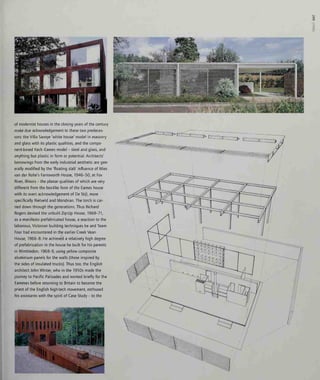
a Foster and Partners, Hongkong d Charles & Ray Eames, Eames
and Shanghai Bank, Hong
Kong, 1979-86
b Harry Seidler (with Marcel
Breuer), Australian Embassy,
Paris, 1973-7
c Marcel Breuer and Herbert
Beckhard Architects, Koerfer
House, Ascona, Ticino,
Switzerland, 1963-7
House, Pacific Palisades,
California, 1949
e Marcel Breuer, Whitney
Museum, New York, 1966
modernism he had experienced working for Kahn and
Saarinen to come up with the Guild House, establish-
ing a strand of symbolic architecture that would take
another twenty years to reach a state of decadence
in the work of Michael Graves and others.
So when the architectural historian Sir
Nikolaus Pevsner, in a radio broadcast in 1965,
proved sufficiently worried by the work in Britain of
Stirling, Denys Lasdun and others to detect a cult of
personality and to coin the term 'post-modern' to
describe its difference from his beloved International
Modern style, he was describing only the ripples on
the surface. The legacy of the renegade Team X - his
prime concern - was already being overtaken on both
sides. On one side was the 1960s movement that
came to be known as 'high-tech', inspired variously
by Case Study houses, Archigram's projects, and
nineteenth-century engineering. On the other side,
the work of Venturi and others pointed to a rather
different breed of post-modernism, the kind that
would, eventually, provide Banham with all the 'fun'
he claimed to be seeking in 1978, at which time an
economic recession in the West meant that nothing
much was being built anyway. But in architecture,
such movements take time to bubble up into the
public domain by being expressed in enough real and
large commissions to alter our perception of how the
built environment is developing. The 'fun' mostly
arrived in the 1980s, and proved rather wearing.
So the decade of the 1970s was the fulcrum,
the time when the ambitious background boys
elbowed their way to the front as the old order finally
(or so it seemed) crumbled. This, then, is the natural
starting point for an exploration of the sea change
that has taken place in architecture, worldwide, in
the thirty years leading up to the Millennium.
Mies van der Rohe repeatedly remarked
that one cannot invent a new kind of architecture
every Monday morning: however, in the final third of
the twentieth century, it seemed at times as if the
world was trying to disprove that assertion with
movement after movement, style after style. We have
seen new vernacular, new regionalism, new classi-
cism, high-tech, post-modernism, organic architecture,
deconstruction, eco-architecture, cosmological archi-
tecture, ultra-minimalism, and the inevitable return to
the period of heroic, 'white modern' architecture by a
new generation. The thirty years in question were
quite long enough for the avant-garde to become
absorbed into the mainstream. Thus high-tech - that
photographs very dramatically and is the preferred
architectural style of magazine picture editors every-
where, which partly explains its continuing appeal -
came to be seen as just another style, virtually a kit
of parts, to be called on by any competent architect
when the need arose. This it mostly achieved in
hands other than its progenitors. Buildings by Rogers,
Foster, Nicholas Crimshaw, Jean Nouvel and Renzo
Piano continued to be highly crafted one-offs, though
Foster achieved something like a production-line
effect with his lesser steel-framed, glass-clad build-
ings, and Piano developed an oft-repeated private
language of terracotta panelling, that evolved over
many projects. Instead, high-tech fell into the hands
of more anonymous 'commercial' practices who took
up the products and methods developed by, or in the
wake of, these pioneers. In this sense, the dullards of
the architectural business came closest to the future
so enchantingly previewed in the Fames House: an
architecture made of readily available component
parts. Scores of tasteful shiny buildings in business
parks the world over testified to the strength of the
original vision, their cost per square metre falling
almost as rapidly as the cost per gigabyte of comput-
ing power contained within them. As ever, it is the
details that count: but as Mies discovered, the effect
of over-familiarity with a given idiom is increasing
pressure on the big names of the business to continue
innovating, rather than refining. For a while these big
names were European, but simultaneously American
corporate steel-framed building techniques, refined
over the century since William Le Baron Jenney and
Louis Sullivan, were quietly conquering Europe in
their wake. The big American practices regrouped.
took a global (as opposed to merely Middle Eastern)
perspective, and by the century's end had achieved a
new domination in Pacific Rim nations - though not
without considerable challenge from the architectural
powerhouses of Japan and, increasingly, Australia.
And so the European 'tin gods' started to
appear wanting. Where do you go, once you have
built the Pompidou Centre, Lloyd's of London, Willis
Faber, the Hongkong and Shanghai Bank, Kansai
Airport, the Institut du Monde Arabe? How do you
follow the big early successes, apart from repairing
them? Few architects of any persuasion, it seems,
have the desire or the capability to alter their aes-
thetic approach radically in mid-career as Corbusier
or Stirling or Saarinen did. Others, such as Jean
Nouvel, Will Alsop or Eric Owen Moss, appear to
over-compensate and become restless gadflies,
each project having to reinvent the image of the
architect. The lucky ones are those who, like Nicholas
Crimshaw, turn out to be late developers, evolving an
approach down the years that reaches fruition, and
international acknowledgment, relatively late in life.
Even so, Crimshaw found it difficult to follow up the
tour de force of his Waterloo International Terminal in
London, an accomplished work of great maturity. The
work of Renzo Piano - whose built output is consider-
ably more prolific and diverse than Rogers' - is the
supreme example of architectural adaptability, given
his willingness to refine an approach using traditional
materials on one hand, and to innovate in other
areas, for instance stadium and airport design. The
British architect Michael Hopkins - who proved able
to move well away from the lightweight enclosure
technology of his old partner Norman Foster, to the
extent of rediscovering the elastic virtues of lime
mortar at his Clyndebourne Opera House - may also
come to be seen as a link between movements and
dogmas, fit to be placed in Wilson's evolving 'alterna-
tive tradition'. Some of these fully paid-up modernists
found a new seam of work in the context of historic
buildings: Foster in London, Berlin and the Ruhr;
Piano in the conversion of the Lingotto factory, Turin;
and architects such as Yves Lion with his 1987
Franco-American Museum at Blerancourt, France - an
addition to an existing building that is in the high-
definition tradition of Scarpa.
This book addresses the broad movements in
architecture over this period not by 'ism' - such cate-
gories are notoriously slippery and mutable, though
they serve their purpose and are not ignored here -
but by building type. The most basic changes in archi-
tecture occur not because of academic theory or pure
experiment, but because of changes in the way
people live, work, are governed, entertain themselves,
regard the outside world, and, most importantly, fund
their buildings. It is now axiomatic that form follows
Renzo Piano Building
Workshop, Kansai
International Airport, Osaka,
Japan, 1988-94
Michael Hopkins and Partners,
Clyndebourne Opera House,
Clyndebourne, Sussex,
1989-94
Frank Gehry & Associates,
Cuggenheim Museum, Bilbao,
Spain, 1991-7
Verturi Scott Brown &
Associates, Vanna Venturi
House, Chestnut Hill,
Philadelphia, 1963-4
Richard Meier & Partners,
Cetty Center, Brentwood,
California, 1984-96
(pages 12-13) Frank Cehry
& Associates, Cuggenheim
Museum, Bilbao, Spain,
1991-7
o
c
finance just as much as it follows fashion or function.
Aalto said; 'It is not what a building looks
like on the day it is opened, but what it is like thirty
years later that matters.' It took only fifteen of those
thirty years for the Willis Faber building - Foster
assisted by Michael Hopkins - to make its unprece-
dentedly rapid journey from radicalism to officially
acknowledged heritage icon. And it took less time
still for Deconstruction to move from being a parlour
game played between Peter Eisenman, Jacques
Derrida, and Bernard Tschumi, to the completion in
1997 of the melting forms of Frank Gehry's
Guggenheim Museum in Bilbao, as purely sculptural
a building as Frank Lloyd Wright's original in New
York, though perhaps kinder to the works of art it
contains: in essence a jewelled shrine intended for
Picasso's Guernica. For some (including this writer)
the Bilbao Guggenheim is one of the great buildings
of the era, for others it has a darker purpose. Basque
separatists were caught planting mortar-launchers in
Jeff Koons' giant floral 'puppy' placed outside the
building, resulting in a fatal shoot-out shortly before
the museum's official opening in late 1997. The build-
ing had come to be seen as a symbol of American
colonization - a franchise like McDonald's - rather
than, as the Basque government had intended, a
proud icon of cultural independence. That small, ugly
incident was the downside of what had become one
of the phenomena of the 1980s and 1990s: the cult
of the globe-trotting, international 'signature' archi-
tect. 'Richard Meier everywhere' as Rem Koolhaas
laconically put it: he himself being of the same set.
Alison and Peter Smithson put forward
the notion that, in urbanistic terms, a net of routes of
equal value is a better way to traverse a city than a
hierarchy of major, median and minor roads. Perhaps
the pluralism of architecture in the late twentieth
and early twenty-first centuries may be likened to
that Smithsonian net - they are all leading some-
where and, once the congested terrain is traversed,
the destination will become clear. That, at the time
of writing, seems just about possible, if admittedly
unlikely. The Argentine writer Jorge Luis Borges,
pluralism's finest fantasist, invented a more frighten-
ing notion: the Garden of Forking Paths. Endless
junctions, endless choice, no easy turning back, a
future only of infinitely expanding possibilities. No
conclusion, ever. This too, though powerfully attrac-
tive in some ways, does not quite hit the mark. To
introduce a third metaphor: for all that architects
have been rattling the bars of their cages these past
few decades, they are still in cages, and the cages
are becoming smaller.
There are only so many ways of making build-
ings. The laws of physics apply, while the laws of eco-
nomics dictate that, whatever architects may want to
do, the building must cost only so much. Indeed,
over-generous budgets tend to have the effect of
improving finishes rather than the daring of the con-
ception, not least because the architect is always
shackled by the materials and labour skills available.
Richard Meier's Getty Center in Los Angeles is Meier
in smooth metal panels and riven travertine, but it is
not discernibly different Meier. Moreover, litigation
always awaits the architect who pushes the boundary
too far - as it awaits the contractor and components
producer who find they have been seduced by the
architect or, more likely, the contract value, into
taking on more than they can handle. These and a
host of other reasons, mostly to do with the layers of
aesthetic control now present in developed societies,
go some way towards explaining why the design of a
building that wins a competition, say, can bear only a
passing resemblance to the finished product some
years later. But more often, architects are self-
censoring: a lifetime of operating within the con-
straints of the real world, coupled with the fierce
desire to build, can lead to an under-ambitious
approach in which - like stock markets anticipating a
set of bad economic data, and pricing shares accord-
ingly - the downside is considered before a line is
drawn. This may help when it comes to getting archi-
tecture on the ground, but when nobody can possibly
be offended, then equally nobody can possibly be
-*Q1
"oELj
1 .^
''^^1 ^^P^^^^^*^^"'*i^W"
ric
j^:M^2mm
#^'41V''
f^fct^* •"
- 1
f .:r ffl^^^

r m
1
4il
11 11 1
ji
Wit
--»':^i
n^^.i-n
'•A-
^^W
;>^-
W. -(«
'^
-•».»
n
1-^
1
1
1
a
o
enthralled. The best buildings will always stir fierce
emotions - for and against - which is why architects
such as Daniel Libeskind and Zaha Hadid have
tended to find themselves at the eye of a storm.
So has anything emerged from the muddle?
These thirty years have seen a restless quest, by archi-
tects of extremely different opinions and beliefs, to
find an architecture appropriate to the age. Banham
was right, back in 1978, to predict the rise of a new
modernism in the hands of the technology-based
practitioners, starting (with due deference to SOM's
Hancock and Sears Towers) in Europe but spreading
rapidly over the Atlantic and Pacific. Banham was
also pushing at an open door: everyone who did not
wear a blindfold saw high-tech that way and surpris-
ingly few people looked at the baroque characteris-
tics of a Rogers building and saw post-modernism
instead. Similarly, among his supporters, James
Stirling was usually taken to be a modernist rather
than the 'freestyle classicist' that some tried to label
him. It seemed that it was the attitude of the author
that counted, and anyway the real classicists had no
intention of claiming Stirling as their own, since they
were too busy fighting among themselves. As it hap-
pened, virtually no architect lumped into the post-
modern category agreed with it. The same was true
of deconstruction a decade later. To return to high-
tech (also a term usually rejected by its practitioners).
discussion in the 1990s tended to ignore the roots
of the movement by looking no further back than
Paxton and Fox's Crystal Palace, 1850-1, or, at a
pinch, Turner and Burton's Palm House at Kew,
1845-7. However an appreciation of the movement's
true lineage - which goes way back through the
Tudor 'prodigy houses', through the great Gothic
cathedrals, to the late Romanesque, and is all to
do with refining structure to achieve lightness and
drama - does nothing to dispel the power of this
ostensibly modern approach. This mode of designing
and building is, it can be argued, more than just one
of the forking paths in the garden, more than just
another strand in the net, but a highlighted route.
The inescapable fashion element is a phe-
nomenon of the architectural world that few would
care to admit to. Apart from a few self-aware ironists,
those who find themselves forming movements in
architecture take their task very seriously indeed.
Among the modernists there has always been a disin-
clination to admit to a spiritual or expressionist side
to their work: everything must be discussed in func-
tional terms. If you believe this then you also have to
believe that beauty, where it occurs, is a mysterious
by-product of an industrial process. If even a transpar-
ently conscious attempt at imagery - for instance, in
the design of an airport terminal, usually a safe bet
for some kind of aeronautical metaphor - is not to be
discussed, then it is hardly likely that architects will
prove willing to consider their work in fashion terms,
since this implies ephemerality and architecture,
despite growing evidence to the contrary, is still
regarded as the creation of permanent objects.
Nonetheless, architecture has always liked
to eat itself as one style succeeds another. The re-
facading of buildings down the centuries is sufficient
proof of this: such as medieval timber-framed houses
later clad in brick or stone, perhaps several times
over. Unpeeling the layers became one of the most
difficult challenges of building restorers in the 1990s.
Re-facading continues today, on a large scale. When
President Valery Ciscard d'Estaing inherited the new
Pompidou Centre project in Paris from his eponymous
predecessor, he disliked the design so much that he
seriously considered encasing it in a skin of his choos-
ing. But by then the building was too advanced to be
changed so radically and he had to live with the orig-
inal design. The tables were turned a quarter of a
century later, when Richard Rogers, by then Lord
Rogers of Riverside, won the competition to redevelop
London's South Bank arts quarter - a collection of
post-war concert halls and an art gallery where the
1960s Brutalist elements were widely (though by no
means exclusively) disliked. Other entrants in the
competitions added various modifying and linking
elements to the existing complex. Rogers' solution
a Zaha Hadid, Vitra Fire Station,
Weil-am-Rhein, Cermariy,
1988-94
b Bernard Tschumi Architects,
Le Fresnoy, Tourcoing, France,
1995-7
c Foster and Partners, Samsbury
Centre and Crescent Wing,
University of East Anglia,
England, 1978, 1988-91
30
O
o
C
was to encase the least popular parts in a glass roof,
so turning an area of separate buildings of a particu-
lar aesthetic into one very large building with a new
dominant aesthetic (unbuilt at the time of writing).
Similar thinking, if with a different aesthetic result,
was shown by Bernard Tschumi when he came to
remodel the fifty-year-old entertainment complex of
Le Fresnoy in Tourcoing, northern France, 1995-7, as
an art school. This he did by slipping a voluminous
metal jacket over the entire cluster of refurbished
buildings, oversailing them to create what he calls an
'in between' - precisely the result sought by Rogers in
London. At Le Fresnoy, the outcome is unsettling:
buildings that seemed to have a life of their own now
appear in a great hangar as if put into storage, and
suffer the indignity of being seen from angles and
distances they were never intended to be. None-
theless the surreal effect is curiously compelling.
Elsewhere, less extreme re-facading exercises
were underway as developers removed twenty or
thirty-year-old cladding systems from office blocks
and cheaply produced the appearance of new build-
ings by re-cladding the structure in the latest style -
or even sometimes, confusingly, in replicas of the
original. Nothing more convincingly demonstrated
how marginal the input of architects to commercial
buildings had become: architecture was confined to
the outside three inches of the building volume, a
suit of clothes to be removed and replaced as fashion
and economic cycles dictated. Even seemingly
untouchable buildings suffered this fate. In the case
of the Sainsbury Centre at the University of East
Anglia by Foster and Partners, it was the original
architects who replaced the carapace and, in the
process, altered the external appearance of their own
building significantly. The ribbed silvery aluminium
panels of the original, having begun to fail, were
replaced with smooth white panels of a type not
available at the time of construction, while the
interior of the building remained largely unaltered.
A subtle but noticeable chronological dissonance
between inside and outside was thus set up. In the
light of Tschumi's later work at Le Fresnoy, this was a
double irony, since the rationale of Foster's original
building was to throw a single roof over a number of
disparate functions that would normally, in the uni-
versity or gallery environment, be expressed as a
series of separate buildings. The re-cladding of the
Sainsbury Centre, an exercise that passed virtually
without comment, can thus be regarded as a dis-
course on the very nature of contemporary architec-
ture, and a prototype for the next generation of
buildings - long predicted by techno-buffs - which
will, we are assured, be capable of changing their
appearance virtually at will as they respond to
climate, light conditions, and the needs of their users.
Foster himself would probably prefer to see the exer-
cise more pragmatically as little different from the
lifetime maintenance schedules of aircraft, where the
majority of components are replaced or upgraded by
the end of the surprisingly long life of the average
commercial flying machine.
During the last third of the twentieth century,
there was rather more for architects to consider than
the increasing impermanence of their built ceuvre -
which anyway was a change well signalled by the
theorists of the 1960s from Cedric Price and the
Archigram group onwards. New building types began
to emerge, some more resistant to the attention of
architects than others. The covered shopping mall, for
all its eighteenth- and nineteenth-century roots, was
reborn as an American invention of the 1950s, and
achieved global dominance during the 1980s and
1990s. Mall-thinking came to inform the other great
building type of the era, the airport terminal. If a
Martian came to look at airports of the period, from
Paul Andreu's rotunda of the Roissy 1 terminal at
Charles de Gaulle airport in Paris, designed in the
late 1960s, to Kisho Kurokawa's cruciform Kuala
Lumpur airport designed in the late 1990s surround-
ed with its specially planted belt of rainforest, he
might conclude that airports were mankind's way
of working out a peculiar obsession with geometry.
In a way, they are - a geometry concerned with
o
3
Q
O
establishing the shortest walking distance within the
terminal while allowing steadily growing numbers of
planes to plug into it - but, working against this
purity of design intent, they also became mankind's
way of delaying the moment of departure long
enough to force a bored captive market of passengers
to shop, and for a very good reason: competition
among international airports has driven down land-
ing charges to a point where the operators can no
longer generate a sufficient profit from passenger
movements alone.
While the shopping mall proved a graveyard
for many architectural ambitions, the airport - and
transport buildings in general - became a way to
make, or confirm, a reputation, second only to such
cultural buildings as art galleries, concert halls and
theatres. Both cultural and transport buildings, as it
happens, learned much from the despised retail
sector. This was not to do with expressed architecture,
but the science of moving people around a building -
a science developed into an art by the retail special-
ists, who were honour-bound to give each store the
appropriate amount of passing trade and thus devel-
oped sophisticated methods to ensure the right distri-
bution of shoppers, particularly in multi-level malls.
The concept of the 'anchor store' was both to act as a
destination in its own right and to work in concert
with other 'anchors' and a mass of subsidiary shops
and restaurants in the bigger malls. These attractions
in turn were balanced by the presence and access-
ibility of car parking. Thus the mall became a con-
sumerist version of Ebenezer Howard's famous 'three
magnets' diagram of the Garden City, and can be
seen as the late twentieth century's greatest contribu-
tion to urbanism.
This may seem a curious conclusion,
given the anti-urban qualities of many shopping
malls, but it is noticeable, as the end of the century
draws near, how many cultural centres have begun to
be designed along remarkably similar lines. As
America invented the modern shopping mall in the
form of Victor Cruen's Northland Center in Detroit,
1949-54, and rapidly evolved it subsequently, so
America invented the modern cultural mall in the
form of New York's Lincoln Center, 1955-66, by
Harrison, Johnson, Foster, Abramovitz, Saarinen and
SOM, providing a choice of opera, ballet, symphonic
music and drama like rival department stores in a
mall. Just like a successful mall, the Lincoln Center
has extended itself at intervals, providing other cul-
tural attractions which add to the 'destination' status
of the place. Like London's South Bank Centre, 1951
onwards, it has proved durable and adaptable.
London's cultural mall slowly evolved over fifty years
into a classic retail dumbbell shape: the South Bank
Centre at one end, the Tate's Museum of Modern Art
at the other, and a gallimaufry of subsidiary attrac-
tions, including housing, cinemas, restaurants, shops
- even a replica of Shakespeare's Globe Theatre, com-
pleted 1997 - closely associated. This cultural mall
separates vehicles and pedestrians in the classic post-
war manner of shopping centres, with the Thames-
side walkway acting as the car-free zone and acres of
car parks plugged into the vehicular spine route
behind. The shift in London's centre of gravity that it
represents - the most significant change this century
in the way London functions - is a wholly uncon-
scious tribute to the art of the retail designer, and an
exact parallel with the Lincoln Center experiment,
which itself colonized a rough end of town.
While the shopping mall was easing its tenta-
cles into transport and cultural architecture, society
at large was rather more concerned with another
shift, particularly in the mature economies of the
West: the decline of heavy industry and the rise of
high-technology industries and office-based working.
The very specific flow patterns of the traditional fac-
tory - raw materials in, finished products out - were
modified to accommodate manufacturing at micro-
scale which required conditions of absolute cleanli-
ness and freedom from vibration, but which
nonetheless had an astonishingly high rate of failure
m the finished products, which had to be recycled.
Factories thus came to resemble laboratories.
Eero Saarinen, Vivian
Beaumont Theater, Lincoln
Center, New York, 1958-65
Herzog and de Meuron, Tate
Museum of Modern Art,
Bankside, London, 1994-9;
computer-generated graphic
Kevin Roche John Dinkeloo &
Associates, Ford Foundation
Headquarters, New/ York,
1963-8
o
o
c
g
o
Office buildings, in the meantime, found that
gearing up for the electronic information revolution
meant rediscovering their early twentieth-century
roots, in the form of tall-ceilinged rooms arranged
around an atrium. Despite the presence of this histor-
ical readymade, more research went into the design
of offices than any other aspect of the built environ-
ment, from the ergonomic design of chairs and key-
boards to the ability of the heating, lighting and
air-conditioning to cope with the loads put upon
them by rooms full of personal computers, fax
machines and printers. The profession of 'space plan-
ner' was born to add a further layer of consultancy
between architect and client. In many instances, the
floorplates of the building would be determined by
space planners (who themselves could be architects,
but for arcane reasons usually not the architects of
the whole building). Since all big office buildings
came to share the same American-derived steel-frame
construction system, and since others would nearly
always come to fit out the finished building, once
again only the external elevations were left for the
named architects to have any fun with. Even there,
their design role came close to being usurped by
globalized cladding manufacturers and their engi-
neers, while their traditional supervisory role was rou-
tinely removed by large construction management
companies. 'Fast-tracking' became the buzzword as
huge office developments sprang from the ground on
accelerated contracts while they were still in the
process of being designed. Meanwhile the stock of
the services engineer rose considerably as that of the
architect fell. To this day, architects who are perfectly
willing to sing the praises of certain structural engi-
neers can hardly ever find it in their hearts to do the
same for their services brethren - unwilling, perhaps,
to accept that, at least for a time, the office building
became less like a piece of architecture, and much
more like a very large piece of office equipment.
The surroundings of many office blocks
changed with the birth of the business park, spawned
from the unlikely union of the grimy industrial estate
and the research-based 'science park', usually
university-linked. Business parks claimed to be about
quality of the working environment but had more to
do with easy access either to airports or motorway
intersections, since they were aimed at international
companies. Consequently many business parks, along
with distribution depots and out-of-town shopping
and entertainment centres, came to form elements of
what are virtually new towns: either new towns
springing up around airports, which themselves
resemble cities, or the new towns umbilically connect-
ed to road junctions, which may be called 'intersec-
tion cities'. In many cases, both stimulants apply. At
first, Charles de Gaulle Airport north of Paris was just
an airport in the fields. Today, the airport is only one
element of the hugely expanded town of Roissy, a
trading centre on a trade route and, as such, both his-
torical and predictable in its growth pattern.
The exposed-services cliche of early high-tech
buildings represented an attempt to architecturalize,
and thus reclaim, the increasingly large services ele-
ment of the building's budget. Research into the
energy-efficient building - an immediate response to
the oil crisis of the early 1970s - however ran ahead
of available technology, which only began to seem
capable of meeting the challenge of drastically
reduced power consumption at the century's end. It
was not until the advent of 'green' buildings, for
offices, universities and the like, that a different lan-
guage began to evolve: the architecture of wind
towers and turbines, solar chimneys, cross-ventilation
or tholos-like stack-effect atria, double-wall glazing,
heat-sink heavy masonry or lightweight solar-powered
skins. Architects became keen on 'green' buildings
not only for environmental reasons, but because the
green agenda allowed them to reclaim some lost
design territory, take control of a larger proportion
of spending on a building. A revival of interest in the
use of timber - both structurally and, more frequent-
ly, as a cladding material - can also be seen as con-
cealing a different agenda beneath its 'renewable'
credentials. With timber cladding (indeed with the
use of most 'traditional' materials) the architect is
once more in charge of design and out of the hands
of the components manufacturers. Consequently a
great deal of experimentation with traditional materi-
als, used modernistically, began to take place from
the mid-1990s. The other side of the coin was the
first generation of 'green' high-tech buildings, where
the use of a limited selection of suitable industrial-
ized systems meant that a building by one architect
could end up looking uncannily like a building by
another, with such notable exceptions as the work of
T R Hamzah and Yeang in Malaysia. This sameness
may change as the industries develop more products.
It is arguable - but perfectly possible - that the
'green' movement signals the biggest shift in the
appearance of architecture since the advent of heroic
modernism in the 1920s. Then again, stylistic inertia
is a powerful force in its own right, with architects
often readier to adapt old forms than to embrace new
ones. This skeuomorphic tendency is inevitable and
ancient: thus theOreeks faithfully copied all the details
of timber temples into the new technology of stone.
Those modernists working with traditional
materials could take heart from the 'regionalist' archi-
tects who gradually came to prominence: the adobe-
influenced Antoine Predock in the southern United
States and the Wright-influenced Bart Prince; Charles
Correa and Raj Rewal in India; Geoffrey Bawa in Sri
Lanka; Rasem Badran in Jordan; the school of
Australian 'outback' architecture; the Hungarian
organic tradition headed by Imre Makovecz. While
in some cases such hand-made architecture has
amounted to a manifesto statement against mod-
ernism, in others the painstaking use of seemingly
retro materials was anything but. The growing appre-
ciation of the work of Peter Zumthor in Switzerland,
first with his archaeological shelters, then with his
thermal baths complex at Vals, is evidence of the
latter, as is much of the work of his fellow Swiss
Jacques Herzog and Pierre de Meuron.
All styles, however, do not suit all building
types. Even though Rafael Moneo could conceive an
airport terminal as a broadly traditional building, few
others do. Those experimenting with sappy forest
thinnings and turf as building materials, along with
those recycling discarded products such as whisky
barrels, would not attempt to apply their approach to
sports stadia or skyscrapers. A religious building, you
might think, could be anywhere and be made of any-
thing: but not so, it would seem that in most cases a
certain opacity and solidity is required. Theatres and
concert halls have acoustic and lighting demands
that partly militate against lightweight architecture;
the architecture of public spaces, in contrast, can be
positively ethereal. Office buildings need natural light
and often - as air-conditioning is seen to be an eco-
logical evil - cross-ventilation; art galleries and muse-
ums, as much as shopping centres, must turn their
backs on the world with windowless spaces, but can
counterbalance those with their 'low' recreational
elements - the cafes and shops. Schools must contain
a certain variety of spaces and perform specific
functions that tend to be expressed, by all architects
everywhere, in a limited number of plan forms -
relating the big communal space to cell-like teaching
space, a form adopted increasingly by office space
planners. Factories, however they are dressed up,
must respond to the nature of the manufacturing
process they shelter. Few homes look like offices, and
even fewer offices look like homes. Ail this may seem
truistic, but in the relentless categorizing of architec-
tural styles - as if style was something that floated
above the function of the buildings - it tends to be
forgotten that buildings in their unformed state,
as a set of needs, havetheirown demands, and that
those demands may well suit one approach rather
than another.
At the start of the twenty-first century, it is
telling that the category broadly referred to as 'mod-
ernism' now contains such a plurality of approaches
within its elastic sides. With its own tradition to draw
on, the notion of the modern - which means a desire
to express contemporary society in the buildings it
occupies - has strongly reasserted itself after the
a Bart Prmce with Bruce Coff,
Shinenkan Pavilion for
Japanese Art, Los Angeles
County Museum of Art,
1988-97
b T R Hamzah & Yeang, Menara
Mesiniaga, Selangor, Kuala
Lumpur, 1989-92
c Michael Hopkins and Partners,
Inland Revenue Centre,
Nottingham, England 1992-4
d Antoine Predock, Spencer
Theater, Ruidoso, New Mexico,
1994-6
30
O
c
period of doubt in tlie 1980s, as it did after a similar
period in the 1950s. Tliis is endlessly arguable: just
what should be described as 'modernist', just what
should form its own genus or species? But one should
perhaps dig deeper. Beneath the busy surface of
compatible or incompatible styles and approaches,
of endless architectural diversification, of interest
groupings, politics, beneath the horses-for-courses
business of the right architect for the job, a very
ancient game is still being played out. In its broadest
sense, the battle is the same as it has been since the
Renaissance: the classical versus the gothic. This is
not a surface difference, but a fundamental, in-the-
bones, thing. It is the symmetrical and completist
architecture of one mode versus the chameleon,
asymmetrical, accretive architecture of the other.
This most basic of all architectural differences is
quite capable of driving a wedge between practition-
ers seemingly in the same camp. Very few architects
are aware of such essential forces driving them. If it
is a game, then the rules are not so much learnt as
instinctively understood. It is not a game with
winners or losers: only ever players.
At the start of this introduction, I mentioned
those relatively rare but always stimulating moments
of concurrence when briefly - before things go hay-
wire again - it appears that all the needles on all the
dials are pointing in the same direction. One of these
moments is experienced more often, and registers
more strongly than others. Across all building types -
even skyscrapers - one encounters the remarkable
and increasing international popularity of the archi-
tectural approach that started in the Deconstructivist
parlour but which, now greatly diversified, can be
dubbed 'the displaced grid'. This is the skewing and
overlaying of geometries in plan, section, or both,
thus establishing tensions within what would conven-
tionally be orthogonal structures, and which erupt
sometimes violently but often beautifully into the
expression of the building's exterior. Unlike other
more shallow stylistic moments, this one has the
potential to transcend fashion since it cannot easily
be merely skin deep. Nor can it be in any respect
functionalist. It necessitates an architectural repos-
session of the entire building form, and thus has hov-
ering over it the ghost of a manifesto. It is moving, as
high-tech did before it, from the hands of high-art
practitioners into the mainstream. At the start of the
new century, if there is a dominant element emerging
from the past thirty years of pluralism, this looks a
more likely candidate than most.
Building typologies continue to shift their
ground, wax and wane in relative importance, and to
overlap. We have seen how retail mall design has
wormed its way into cultural, transport and leisure
architecture. Sports buildings, meanwhile - encour-
aged by non-stop television coverage - have become
highly fashionable, to the extent that they are now
symbols of civic pride in much the same way as the
theatre or city hall, and not only for those cities host-
ing the Olympics. Health buildings, no longer such an
important category, are subsumed into the 'civic
realm', where the cult of the 'signature bridge' shows
how architects, having lost ground in some areas, can
reclaim it in others.
In the next century the evolution of the
office workplace will continue to fascinate: just how
long can the big corporate headquarters survive as
a building type? Similarly, how necessary will a
physically cohesive university campus prove to be
in an on-line age? One-off houses and places of
worship will remain a testing-ground for ideas, and
have not yet exhausted their capacity to surprise.
Architects are still fascinated, as the Futurists were,
by the dramatic possibilities of industry. The building
type that can include all others, however, is only
now moving to maturity after a century of develop-
ment. The supertower - mixed-use, land-conserving,
capable of meeting more and more of its own energy
needs - will be the lodestone of the new century.
Achieving the sustainable tower - which means
the sustainable city - is the greatest challenge
now facing architecture. If that can be got right,
everything else will follow.
E#.c.
'•r^-^X^-,^-0.
VISUAL ARTS Museums & galleries Exhibition spaces have long been exceptional
buildings, their architecture drawing visitors as surely as their contents. But over the
past thirty years, architecture has overtaken art. The museum has assumed a supreme
role in moulding perceptions of a town or city, region or nation. With the onset of the
science of arts economics, it has also become axiomatic that the arts are an industry,
and a profitable one. As towns and cities once flaunted their cathedrals, factories and
railway stations, so now they depend on the magnetic attraction of their galleries.
<3
'Architects are both the victims and the beneficiaries
of the political will.'
James Stirling, March 1991.
Nothing defines the cultural monuments of
the late twentieth century more than the inability of
most people, when asked, to vouchsafe correctly or
even roughly what is inside them. The Sydney Opera
House surely stages opera? Not primarily: the build-
ing is a performing arts centre which caters for con-
certs, ballet, theatre and cinema as well as opera.
The Cuggenheims in New York and Bilbao exhibit
paintings and sculpture? Certainly, but that is not
the reason why people visit these buildings. Does
anyone who has been to see the Institut du Monde
Arabe in Paris have much recollection of the contents
disposed behind that masterly if occasionally trouble-
some Moorish diaphragm-mechanism solar wall? Very
few. And so it goes on. What does James Stirling and
Michael Wilford's Neue Staatsgalerie in Stuttgart,
contain? A foolish question: one might as well ask
what the dozens of museums built in Frankfurt
during the 1980s, or the five hundred reputedly built
in 1988 in Japan, were for, exactly.
Art museums are built for various reasons,
few of them to do with art. They are built to provide
a cultural destination for a provincial city with a dull
reputation, or to refresh the waning arts credentials
of a capital needing to keep the overseas tourists
pouring in, or to enhance the reputation of a seat of
learning, or to satisfy the ego of a private collector or
corporate billionaire. And they do all these things.
Long ago Hans Scharoun and Mies van der Rohe
placed the key pieces in Berlin's 'cultural forum' -
respectively the Philharmonie concert hall, 1956-63,
and the New National Gallery, 1965-8 - as different
from each other as chalk from cheese, or music from
silence. Mies' National Gallery in particular could
have been a house or a Chicagoan corporate head-
quarters, being as it was the customary beautifully
detailed box (with oversailing roof in deference to
sunshading) set on a plinth. No matter: Scharoun cre-
ated the unique landmark while Mies' presence was a
political statement that one particularera had passed,
and that the exiled architect - by then very aged -
had returned. The name was what mattered. The 'cul-
tural forum', built as it was close to the Berlin Wall,
was itself a political act, assuming as it did (correctly,
as it turned out) that a new centre would emerge
round here when East and West were reunited.
Later, in one of those tricks that architecture
loves to spring, Berlin returned to Chicago when
Josef Paul Kleihues designed that city's Museum of
Contemporary Art, 1991 -6. Kleihues bought the
Berlin notion of the grand, classically arranged city-
block building, clad in limestone, and set it up on a
plinth, as Mies had done when he brought his
Chicago preoccupations to Berlin. Despite the draw-
backs of the Mies building - an inability to house
permanent works in the glazed upper, pavilion level
because of light damage, for instance - Mies is
architecturally the clear winner on points. Curators,
however, may well prefer Kleihues.
Art museums are pulled four ways: by
the differing demands of their patrons, their public,
their architects, and their curators. From a curatorial
point of view, what matters most - apart from space,
space, and more space - is carefully controlled day-
lighting, precise atmospheric controls, gallery design
that allows easy display of a huge variety of different
art forms, and all the relevant back-up facilities in
terms of restoration workshops, storage, office space
and so on. The patrons of such buildings are less con-
cerned with the technicalities, and crave the cultural
landmark, frequently as a means to urban regenera-
tion. They may desire educational facilities such as
lecture theatres, which curators are seldom interested
in. Aesthetically the patrons tend to be more conserv-
ative than their architects. Meanwhile the public -
apart from the few visitors who are going for the art
rather than the 'experience' - wants soundbite-sized
cultural entertainment and a good cafe. The upshot
of all this is that, in all but a few cases, the modern
art museum is effectively a multi-use building.
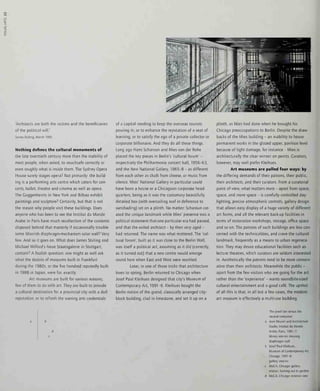
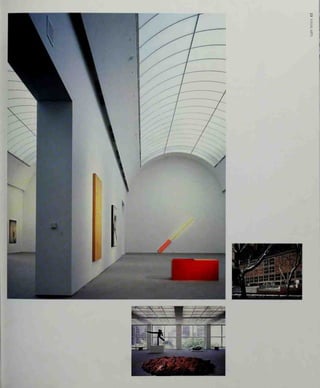
The jewel box versus the
neutral container:
Jean Nouvel and Architecture
Studio, Institut du Monde
Arabe, Pans, 1981-7:
library interior showing
diaphragm wall
Josef Paul Kleihues,
Museum of Contemporary Art,
Chicago, 1991-5:
gallery interior
MoCA, Chicago: gallery
interior, looking out to garden
MoCA, Chicago: exterior view
c
>
>3D
Wl
<
>
>30
The whole process reached an apotheosis of
sorts with the opening of The Getty Center in Los
Angeles by Richard Meier in late 1997, allegedly
America's first billion-dollar building (outside military
complexes, presumably). This sprawling acropolis of
an arts complex, thirteen years in the making, com-
plete with its own techno-funicular railway from the
city below, was accused by some critics of being
simply too good - of making its host city seem
scruffy, down-at-heel. Perched on its hilltop, gleaming
white, overlooking both the city grid and the Pacific,
the Getty is an ivory tower in the way that Frank
Gehry's Guggenheim in Bilbao, completed only two
months earlier, is not: Gehry engaged with his indus-
trial surroundings in Bilbao with characteristic verve
and relish. The two architects had become yin and
yang, the cool rationalist versus the outright emo-
tionalist, the aloof versus the committed, dividing
the world up between them. Meier had built the
Barcelona Art Museum, opened in 1996. Meier had
built galleries everywhere. Gehry was called in by
Bilbao: Gehry, too, had built everywhere.
But the white train at the Getty taking you
to the acropolis gives the game away. Like a pilotless
airport shuttle, it takes you to a no man's land where
national boundaries, let alone the rough and tumble
of a real city, are irrelevant. The Getty Center might
as well be in space. Its fame is its wealth: its
unlimited ability to buy the greatest art in the world
has distorted the art market considerably over many
years - in the process increasing the value of its own
collection. It may look white, but it is a black hole for
art. The fact that it is wholly privately financed adds
to its slightly sinister quality - as if some James Bond
villain were seated in a control room at its centre,
preparing to bring ruin on the world. Yet, in the end,
it is just a complex of Richard Meier buildings and
Meier - the master of brittle, perfect corporate
architecture - was no doubt the ideal choice for a
museum that operates as a global investor.
Politics and wealth are only part of the
stately dance involved in the selection of architects.
For instance Peter Eisenman's Wexner Center for
the Visual Arts, at the Ohio State University, has
attained a fame disproportionate to its setting or its
function, simply because at the time, 1982-9, it was
the largest project to be built by its famously egg-
headed architect, and also because it was conse-
quently one of the first built expressions of the style
known as deconstruction. In other hands, this rela-
tively modest insertion of new spaces between large
existing buildings need not have excited much com-
ment, but Eisenman was news. As well as creating a
fractured structural grid for the project, and slicing a
wall diagonally through the 3-D grid as you would
expect from a founding father of deconstructivism, he
added the post-modern touches of cartoon-like brick
towers and bastions, the main tower being split and
displaced from top to bottom as if placed on a fault
line. These towers were apparently a 'memory' of an
armoury that occupied the site until 1958, but some-
how this deliberately stage-set approach, abstracted
though it is, is more shocking than all the games of
displaced volumes that Eisenman plays inside, per-
haps because it brings home to us that even an
original thinker such as Eisenman was sufficiently
conditioned by the architectural mores of his time to
play the kind of post-modern joke that quickly palls.
The rest of the composition is to do with the
now familiar business of overlaying various confli-
cting grids present in the area. Only architects derive
such pleasure from fooling around with grids, which
after all are an architect-made construct in the first
place: the rest of humanity is merely bemused by
such acts of self-examination. It became an Eisenman
trademark, however, as well as being one of the signs
by which one assesses any building for 'Decon' con-
tent, and it has this merit: it is a way of breaking
down the bulk of a large building that can claim to
be somehow rational rather than being driven purely
by aesthetic considerations.
Thus Eisenman's later Columbus Convention
Center in Ohio, 1989-93, wittily takes its cue from
the tangle of railway tracks that used to exist on its
a Richard Meier & Partners,
Getty Center, Brentwood,
California, 1984-97: courtyard
with J Paul Getty Museum
beyond
b Getty Center: site axonometric
a Richard Meier & Partners,
Getty Center, Brentwood,
California, 1984-97;
gallery interior in the
J Paul Getty Museum
b Getty Center: plaza walkways
:??v»jfo.'vv"--w;?»;Tim!m«ww»e<ii^^iyA^^^
b c
^^afc£|p
HHsmmsbI
^:"^V^0'>'.:^
IS
<
>
>
3
goods-yard site, a tangle encountered also in skeins
of computer cabling. What would otherwise be a
huge volume of a building is expressed as conjoined
slices, snaking and undulating and presenting a very
varied frontage to the main street. This is as valid as
any other architectural scaling device.
As Eisenman built more, he loosened up a
little: his Aronoff Center for Design and Art at the
University of Cincinnati, Ohio, is less a dry academic
exercise in the layering and rupturing of grids, more
an intuitive response to the context of landforms and
existing buildings - which means it is closer to the
kind of thing a Cehry or a Behnisch might produce.
Perhaps only Daniel Libeskind, of the crowd loosely
described as 'Decon', is still inclined to plot out his
buildings according to intellectual geometries of his
own making, but even he has relaxed enough to pro-
duce gesturalist architecture such as his 'Spiral'
design for an extension to London's Victoria and
Albert Museum, and even more so with his 'shattered
globe' design for the Imperial War Museum North
in Manchester, north-west England. This is a fine
example of the museum-as-urban-generator theory
since Libeskind, the most cerebral of architects,
was also paradoxically seen by his client as being
highly commercial, to the extent that his archi-
tecture was deemed capable of drawing 400,000
visitors a year.
Stuttgart, never previously noted as a signifi-
cant tourist honeypot, became one of the most visited
cities in Germany following the completion in 1984
of the Staatsgalerie extension which James Stirling
and Michael Wilford had won in competition in 1977,
and which is notable far more for the quality and
ingenuity of its external public spaces than it is for its
frankly dull galleries inside. Frankfurt, with a reputa-
tion as a home of financiers and trade exhibitions,
also consciously set out to reinvent its cultural image;
not so much for tourist trade but to reinforce its posi-
tion as a place for international companies to relo-
cate to. Inward investment means moving quantities
of people to a place they may not wish to go; people
have certain demands when it comes to quality of
life: museums, galleries, theatres and concert halls
are therefore flung into the reckoning by those offer-
ing incentives of a more than purely fiscal nature.
The phenomenon is open-ended. Cities want
signature architects to produce trophy buildings.
Hence the success of such architects as Richard
Meier, Frank Gehry, Arata Isozaki, I M Pei, Norman
Foster. Theirs is a known and recognizable product.
Buying such names - as Bilbao in northern Spain has
bought Foster for its metro stations, Gehry for its
Guggenheim, Wilford for its Abando transport inter-
change; and as San Francisco employed Mario Botta
for its Museum of Modern Art - buys global renown.
The displaced grid and the
displaced globe:
Peter Eisenman, Wexner Center
for the Visual Arts, Columbus,
Ohio, 1982-9: view of
entrance
Peter Eisenman, Aronoff
Center for Design and Art,
University of Cincinnati, Ohio,
1988-96: interior view of
circulation space
c Aronoff Center: entrance
d Wexner Center: aerial view
e Daniel Libeskind, Imperial
War Museum North,
Manchester, 1997: 'shattered
globe' concept drawings
f Imperial War Museum North:
model
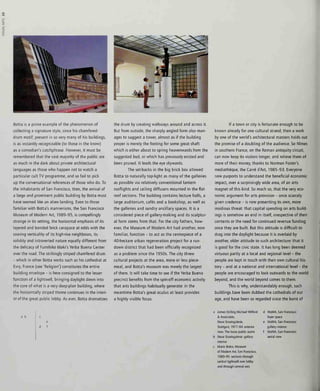
Botta is a prime example of the phenomenon of
collecting a signature style, since his chamfered-
drum motif, present in so very many of his buildings,
is as instantly recognizable (to those in the know)
as a comedian's catchphrase. However, it must be
remembered that the vast majority of the public are
as much in the dark about private architectural
languages as those who happen not to watch a
particular cult TV programme, and so fail to pick
up the conversational references of those who do. To
the inhabitants of San Francisco, then, the arrival of
a large and prominent public building by Botta must
have seemed like an alien landing. Even to those
familiar with Botta's mannerisms, the San Francisco
Museum of Modern Art, 1989-95, is compellingly
strange in its setting, the horizontal emphasis of its
layered and banded brick carapace at odds with the
soaring verticality of its high-rise neighbours, its
solidity and introverted nature equally different from
the delicacy of Fumihiko Maki's Verba Buena Center
over the road. The strikingly striped chamfered drum
- which in other Botta works such as his cathedral at
Evry, France (see 'Religion') constitutes the entire
building envelope - is here consigned to the lesser
function of a lightwell, bringing daylight down into
the core of what is a very deep-plan building, where
the horizontally striped theme continues in the interi-
or of the great public lobby. As ever, Botta dramatizes
the drum by creating walkways around and across it.
But from outside, the sharply angled form also man-
ages to suggest a tower, almost as if the building
proper is merely the footing for some great shaft
which is either about to spring heavenwards from the
suggested bud, or which has previously existed and
been pruned. It leads the eye skywards.
The set-backs in the big brick box allowed
Botta to naturally top-light as many of the galleries
as possible via relatively conventional lantern
rooflights and ceiling diffusers mounted in the flat
roof sections. The building contains lecture halls, a
large auditorium, cafes and a bookshop, as well as
the galleries and sundry ancillary spaces. It is a
considered piece of gallery-making and its sculptur-
al form stems from that. For the city fathers, how-
ever, the Museum of Modern Art had another, now
familiar, function - to act as the centrepiece of a
40-hectare urban regeneration project for a run-
down district that had been officially recognized
as a problem since the 1950s. The city threw
cultural projects at the area, more or less piece-
meal, and Botta's museum was merely the largest
of them. It will take time to see if the Verba Buena
precinct benefits from the spin-off economic activity
that arts buildings habitually generate: in the
meantime Botta's great oculus at least provides
a highly visible focus.
If a town or city is fortunate enough to be
known already for one cultural strand, then a work
by one of the world's architectural masters holds out
the promise of a doubling of the audience. So NTmes
in southern France, on the Roman antiquity circuit,
can now keep its visitors longer, and relieve them of
more of their money, thanks to Norman Foster's
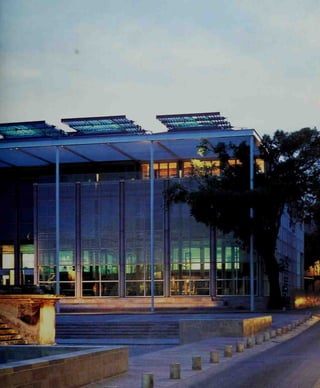
mediatheque, the Carre d'Art, 1985-93. Everyone
now purports to understand the beneficial economic
impact, over a surprisingly wide area, of an arts
magnet of this kind. So much so, that the very eco-
nomic argument for arts provision - once scarcely
given credence - is now presenting its own, more
insidious threat: that capital spending on arts build-
ings is somehow an end in itself, irrespective of their
contents or the need for continued revenue funding
once they are built. But this attitude is difficult to
drag into the daylight because it is overlaid by
another, older attitude to such architecture: that it
is good for the civic state. It has long been deemed
virtuous partly at a local and regional level - the
people are kept in touch with their own cultural his-
tory - and at a national and international level - the
people are encouraged to look outwards to the world
beyond, and the world beyond comes to them.
This is why, understandably enough, such
buildings have been dubbed the cathedrals of our
age, and have been so regarded since the burst of
a b
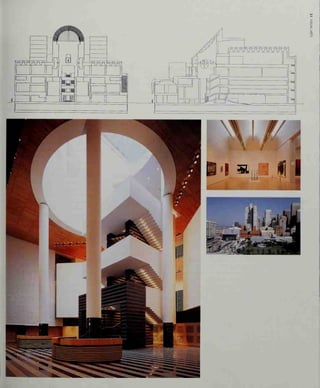
a James Stirling Michael Wilford d MoMA, San Francisco:
& Associates, foyer space
Neue Staatsgalerie, e MoMA, San Francisco:
Stuttgart, 1977-84: exterior gallery interior
view. The loose public realm f MoMA, San Francisco:
b Neue Staatsgalerie: gallery aenal view
interior
c Mario Botta, Museum
of Modern Art, San Francisco,
1989-95: sections through
central lightwell over lobby
and through central axis
c
>
>30
4
1>^^*^:
h' !?<«*«•
V
^'5mi
classically based museum building in the nineteenth
century (Smirke in London and Schinkel in Berlin
prime among them) offered a secular architecture of
world culture at a time when no cathedrals were
being built. The process of religious worship in most
cultures requires its holy places, expressed in strongly
architectural terms. For religion read art, in its broad-
est sense; for cathedral read gallery, museum, theatre
or concert hall; for pilgrim read tourist; and there is
your apt analogy, all tied up. It was true enough in
the late eighteenth and nineteenth centuries for the
moneyed classes, and, for all that it is now a cliche, it
is even more true today. There is virtually an obliga-
tion placed upon members of the affluent society to
travel. Their travelling has to be given a purpose. The
cultural destination provides that purpose. And when
historical remains and existing museological or art
collections become overloaded, then the response is
to create new destinations that are there because
they are there. The architecture, not the collection, is
the generator. There are certain rare exceptions: such
as the pious hope that Picasso's Guernica might be
moved from Madrid to the Bilbao Guggenheim in the
Basque country; a move that, it was thought, would
ensure mass movement of pilgrims to the new Gehry
museum, and hence pay off its development costs
more speedily. In theory the Bilbao Guggenheim was
not predicated upon Guernica, and the calculations
of the museum's income potential were made, it is
said, on the basis that the great work would not nec-
essarily be there: but there is no doubt that, without
it, the initial numbers of visitors to this previously
little-visited industrial city were not stupendously
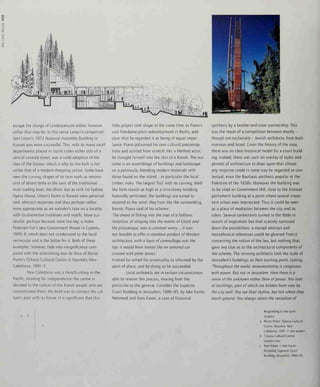
high. Gertainly, seeing a display of rather tired
Damien Hirst works in the room originally designed
to house Guernica - as one did in the Museum's
opening exhibition - was to experience a piquant
sense of bathos.
Although Meier's Getty Center in Los Angeles
and Gehry's Guggenheim in Bilbao bestrode the
world like some vast composite cultural colossus at
the close of 1997, they are only part of a continuing
tradition: the art gallery as urban regenerator and
economic stimulant. Two other buildings serve as
bookmarks in this open-ended history of the self-
generating cultural building: the Pompidou Centre
in Paris, 1971-7, and the Groninger Museum,
Groningen, The Netherlands, 1990-4. The Pompidou
Centre, won in competition in 1971 by Renzo Piano
and Richard Rogers, signalled a sea-change in twenti-
eth-century architecture, as a result of which the
whole modern tradition can be said to have subtly
altered. As with T S Eliot's theory of literary tradition,
this backwards modification is highly important: the
new work of art adjusts not only what comes after -
rivers would run uphill if that were not the case - but
also our perception of what has gone before. What
may have appeared to be the direction of a move-
ment at one moment in time turns out to have taken
a different route. We know this will happen again,
that our cultural histories will have to be re-revised
backwards down the centuries by some as yet
unknown development. The deconstructivism move-
ment of the late twentieth century, particularly as
handled by Frank Gehry, caused vibrations right
down to the root structure of modernism and forced
us to look at the Pompidou with different eyes: its
own place in the Pantheon was changed, and not
just by changing fashion.
The Pompidou took to extremes Louis
Kahn's famous notion of 'served and servant' spaces.
It may therefore have more in common than it seems
with Kahn's Kimbell Art Museum in Fort Worth,
Texas, 1966-72, which was nearing completion at
the time of the Pompidou competition. It also exem-
plifies an innate attribute of all grand public build-
ings, an attribute spun into space by Frank Lloyd
Wright at New York's Guggenheim: new architecture
as the prime cultural draw, rather than the contents.
Famously, the Pompidou replaced the Eiffel Tower as
the most popular destination in a city bright with
cultural lodestars. But notoriously, what most visitors
did was ride the snaking escalator tube slung on the
outside, look out across Paris from the top, have a
c d
Art for architecture's sake:
Piano & Rogers, Pompidou
Centre, Paris, 1971-7: detail of
the external escalators
Pompidou Centre: section,
competition scheme
Gwathmey Siege! & Associates,
Guggenheim Museum
Addition, New York, 1982-92:
exterior view showing the
spiral of the original
Guggenheim against the 'box'
of the new galleries
Guggenheim Museum
Addition: section through new
galleries
Pompidou Centre: exterior
view, looking down the Rue du
Renard
(pages 34-5) Foster and
Partners, Carre d'Art,
NTmes, France, 1985-93
/IP
4 .*WjS.a4„_iJ:i,L&cJICkliiiL
IS
I—
>
snack in the rooftop cafe, pose for photographs, and
leave. Meanwhile, inside the long-span, sometimes
rather low and gloomy, internal spaces, there was a
national art collection, a library, temporary exhibi-
tions, and IRCAM, a contemporary music centre,
underground. These became something of a lost
world. Despite the fact that this was the first of the
modern mediatheques, a visually biased athenaeum,
its serious functions (the reasons it was built) came
to seem incidental compared with its generative qual-
ity as a giant urban climbing-frame. In an exact paral-
lel, the spiral of Wright's Guggenheim was eventually
emptied of its paintings and sculpture, which had
never sat happily there. The collected art was put in
real galleries built alongside by Cwathmey Siegel &
Associates, 1982-92: the spiral was acknowledged as
art enough in itself. Thus Wright's Guggenheim
became another urban climbing frame, a pedestrian
version of the unbuilt spiral of his 1925 'Automobile
Objective', a mountain-top building which you were
meant to drive up, see the view, drive down again.
People had cars, their duty was to drive them some-
where, therefore Wright provided them with a desti-
nation. The Guggenheim crystallized this thinking
and is now duly acknowledged as an end in itself.
However, for all that the Pompidou Centre
became, it was never cynical in what it set out to
achieve. The Pompidou architects believed with a
passion in their cause. This was manifesto architec-
ture, carried out by men at the idealistic beginning,
not the glorious conclusion, of their careers. Piano
and Rogers seemed genuinely taken aback and
delighted when five times the projected numbers of
annual visitors turned up, 25,000 a day, year after
year, to a building that had been vilified through the
design and construction processes, and routinely
compared to an oil refinery upon completion. At one
point it even threatened to revive the Franco-German
hatreds of the Second World War when Krupps,
renowned for its armaments manufacture, secured
the contract to supply the heavy steelwork (Krupps'
lorries had to arrive at night with the company name
blanked out in order to maintam the peace). The
huge popularity of the building - and this, in a
sense, was what its architects found hard to credit -
was largely due to the architecture and what that
architecture did to the rest of the city, rather than to
the activities within for which it had been expressly
designed. Its rationale was, if not negated (the exhi-
bition programme in particular proved highly success-
ful) then at any rate set askew. Later to call in Gae
Aulenti, architect of the city's highly successful
Musee d'Orsay, 1980-6, to design the interiors of
the Museum of Modern Art, was either a mistake or
a clever touch, depending on your viewpoint. She
treated the Piano and Rogers shell much as she
.
rm
f
•
!<- >•-. .,
,
iH
I,
>VK*m—r^ iT^'fj^mf- 'I M^H' ^iia
m
I?
••
vr
'K
I
I
Jit^&Sh,
I
irY fe^
treated the impressive clear-span spaces of the old
Care d'Orsay and the Palau National in Barcelona
(the Museum of Catalan Art) - namely as big voids
to be partitioned with dividing walls to hang thmgs
on. At the Pompidou, what appear to be solid floor-
bearing walls are actually slightly flexible partitions
themselves suspended from the trusses. The result
was an appearance of permanence within an
avowedly changeable structure; an effect that was
dramatically removed from the original concept,
actually implemented for a while, of having
significant artworks stacked away on mechanized
panels that could be summoned on request.
Whether regarded as art museum or viewing-
platform, the Pompidou soon suffered from the num-
bers of feet tramping it. This, twenty years after its
completion, led the authorities to consider a radical
and undemocratic solution in the eyes of the archi-
tects: to limit numbers according to the ability and
desire to pay. Even the open parvis which the build-
ing commands had begun to cause concern to the
City of Paris - since that realm of happy buskers and
laughing tourists had degenerated, it was said, into
a honeypot for beggars and thieves, perhaps its tone
should be improved by making it an exclusive area
for paying guests. This soul-searching about just how
public, and just how managed, a public 'gallery'
should be, coincided with a major refurbishment for
b d f
g
the building, carried out by Piano in consultation
with Rogers, in time for the Millennium. This work,
oddly m some eyes, ossified much of the external
appearance of the building in its original form rather
than taking advantage of its design philosophy as
an interchangeable kit of parts. The reorganization
was largely confined to the interior, which raised
the intriguing question as to just how many of the
famous painted pipes on the Rue du Renard eleva-
tion still had a function beyond the sculptural. No
matter: the exercise raised questions pertinent to
any city considering a new arts centre and the way
it mediates between the state and the people. The
questioning of its original ideology drew attention
to the thinking that informed its design.
The Pompidou Centre is the fulcrum on
which all the architecture of the late twentieth
century pivots and thus is the true starting point of
this book. It realized the radical paper thinking of
the 1950s and 1960s, and its continuity and change
represents an enduring experiment. Therefore, any
subsequent visual arts building has to consider what
the Pompidou attempted, if only to reject it. Most
did: the old notion that an arts building must, like a
bank, architecturally represent stability rather than
mutability soon reasserted itself. By the time
London's National Gallery came to build its exten-
sion in 1986, its architect, Philadelphia-based Robert
Venturi, was forced into a contextual and deferential
straitjacket which even his 'pop' sensibilities could
not overcome, though the result was a more satisfac-
tory building than his Seattle Art Museum, 1984-91,
which IS less of a building, more of a decorated
hoarding. When Norman Foster came to build his
own version of a mediatheque in NTmes more than a
decade after the Pompidou was completed, it was a
formally arranged, effectively classical composition,
highly resistant to change, only its transparency
revealing its provenance. Even that clue vanished
when Foster came to build his stone-panelled exten-
sion to the Joslyn Art Museum in Omaha, Nebraska,
1992-4, which in its undemonstrative, blank-box way
is as deferential to its weak 1930s Beaux Arts parent
as Ventun's London effort is to its weak 1830s Creek
Revival parent. But at least these subdued later
buildings function well as correctly top-lit galleries:
the internal spaces of both engage the senses consid-
erably more than their exteriors which - surely - is
what an art gallery ought to be doing.
In similar vein, but structurally far more
expressive, is Piano and Fitzgerald's Menil Callery in
Houston, Texas, 1981 -6. Rogers, at the time of writ-
ing, had not designed another art gallery or museum
since the Pompidou: his former partner Piano, in con-
trast, was able to reflect and develop his ideas. As at
the Pompidou, the form of the building is dictated by
^
^^'r^bN^.
^K
'< «
sl~l
Cae Aulenti, Musee d'Orsay,
Paris, 1980-6: interior view
showing galleries inserted
into Orsay tram shed
Ventun Scott Brown &
Associates, Seattle Art
Museum, Seattle, 1984-91;
exterior view
Ventun Scott Brown &
Associates, Samsbury Wing,
National Gallery, London,
1986-91: plan
Seattle Art Museum: site plan
e Samsbury Wing: Exterior
detail of connection between
Samsbury Wing and National
Gallery
f Samsbury Wing: oblique view
of gallery at the north end of
the central range of galleries
g Samsbury Wing: interior of
gallery at the north end of
the central range of galleries
Ventun's mannered interiors
are unjustly neglected
<3
c
>
its most prominent element - in this case tine ferro-
cement light-deflecting blades that form the ceiling
of the building, which are continued as a colonnade
around its exterior where their ductile-iron trusses
can be appreciated. Piano had learned about ferro-
cement from boat building, and about the properties
of ductile iron from his VSS Experimental Car project
with Fiat, 1978-80, with the engineer Peter Rice.
Technology transfer was thus alive and well at the
Menil Collection, and applied to the one crucial
element of all art galleries, the handling of light.
The most telling contrast to the act of
late modern architectural soul-baring represented by
the Pompidou, or Piano's equally rational if less exu-
berant technology-led successor in Texas, is the
Croninger Museum in Groningen, The Netherlands,
1990-4. The Croninger Museum set out from the
first to seduce by appearance alone, unbothered by
the standard of its contents, or even the technical
niceties of displaying them to best effect. It may thus
be counted a cheerfully cynical exercise. This agree-
able northern Dutch university city with its ring of
canals was well away from the tourist circuit and,
worse, was best known as a centre for natural gas
production which had become a relocation point for
decentralized private companies and public utilities
from the south. To be sent to the gas fields of
Groningen had, to the horror of the city fathers,
come to mean a species of internal exile. An ambi-
tious programme of arts events and new building
was begun to correct this image, among them a pro-
gramme of temporary 'video bus shelters' by invited
stars such as Daniel Libeskind, Zaha Hadid, Rem
Koolhaas and Coop Himmelblau. Intrigued by all
this, the ambitious young director of the city's
museum, Frans Haks, saw an opportunity for glory.
What happened next was completely
unexpected to those who thought that the craze for
turbocharged plastic laminates was a passing fad of
the early 1980s associated with the Memphis group.
The Croninger Museum, built on a new island in a
basin of the city's main canal, sprang from the head
of Alessandro Mendini, the Italian post-modernist
designer much admired by Haks for, among other
works, his architectural tea set for Alessi, where each
piece was a miniature building. Haks had already
decided that the various elements of the museum's
collection and exhibition programme should be sepa-
rately expressed: Mendini's response to this was to
assemble an eclectic cast of characters to contribute
an element apiece. These were himself, fellow design-
ers Philippe Starck and Michele de Lucchi, and the
American visual artist Frank Stella. No architects:
'We believe that in the coming decade artistic
research based on the culture and technology of
design will be more modern and decisive than
"^--^^^^"^
^
3 1
-i
•v •ji
i^^«F^^^^^^^^^^^^^^HF ^^1 ^^^1
LJ
Top-light control
mechanisms become
the dominant symbol
in Renzo Piano's Menil
Collection and its adjacent
CyTwombly Gallery:
Piano and Fitzgerald, Menil
Collection, Houston, Texas,
1981-6: site elevation
Menil Collection: exterior view
Menil Collection: gallery
interior
d Renzo Piano Building
Workshop, Cy Twombly Gallery,
Houston, Texas, 1992-5:
elevation
e CyTwombly Gallery:
interior of gallery
f Renzo Piano Building
Workshop, National Centre
for Science and Technology
Amsterdam, 1992-7
academic architecture, which is in decline,' Mendini
announced in July 1988. He was obliged, however, to
include his architect brother Francesco while a Dutch
practice, the evocatively named Team 4, was retained
to make it all buildable. As late as December 1992,
Stella had to be dropped when his proposal for a
massively complex and costly Teflon structure as a
pavilion for 'old visual arts' threatened to drag the
whole project down. Within days, architect Wolf Prix
of the deconstructivist practice Coop Himmelblau
was drafted in to save the day with fractured sheets
of steel and shards of glass. This was a complete
reversal of Stella's proposed soft organic shapes, not
to mention an abandonment of two of Mendini's
principles: to have an art gallery at least partly
designed by a practising artist; and to have the mam
forms of the building determined by designers, not
architects. But somehow, this U-turn scarcely seemed
to matter. The museum forged ahead, despite con-
struction problems with Prix's late contribution. When
itopened, the Memphis-tinged architectural tea set
appeared to have been smashed up at one end but
there were acres of colourful laminate - even on the
underside of the canal drawbridge, where it takes the
form of abstracted Delftware - and it succeeded in its
aims. Croningen was on the map, and more impor-
tantly back on the tourist itinerary. Haks achieved
his apotheosis, and shortly afterwards he left.
The outcome of this extraordinary collabora-
tive exercise is undeniably arresting. At the western
end Starck's silver drum, housing ceramics, sits atop
de Lucchi's square red-brick plinth containing the
exhibition of the city's history - a rare example of
separate authorship for consecutive layers of the
same building. In the centre comes Mendini's blank
gilded tower, used slightly bathetically for storage,
flanked with lower blocks. To the east, the composi-
tion terminates with Coop Himmelblau's explosion.
Here there are even fewer walls to hang pictures on
than in Wright's Guggenheim, with the result that
many are on flats suspended from the roof. Because
the complex is built in a canal basin, and plunges
below the waterline, it is deeper and more spacious
than it first appears. Some of its internal finishes,
particularly the multicoloured mosaic work to the
main spiral staircase, are brilliantly handled. Yet the
best pavilion - meaning the most thoughtful, provid-
ing a mysterious, white-veiled setting for the ceramic
ware - is Starck's. In this context, relative understate-
ment (not a characteristic normally associated with
Starck) runs the risk of being overpowered, but the
Starck drum holds its own and provides a necessary
antidote to the Decon gymnastics.
Such detailed comments are, however, not
what the Croninger Museum is all about. It functions
on a larger scale. It works both nationally and
internationally. Its local collections and temporary
shows contribute little or nothing to its popularity,
something evidenced by the fact that when its collec-
tion and exhibition programme was housed else-
where, little notice was taken of them. The idea of
'museum' as a place of study and reflection thus
wholly shifted to mean merely 'museum building'.
Again, the parallel is with religion. In just this
manner the word 'church' had come over time to
apply not to the congregation, but to the architec-
ture that housed it. Croningen - an undeniable
popular success - is the paradigm of the museum
or gallery not as chaste muse, but as painted trollop.
One hesitates to bracket them together, but one
might make the same observation of Bruce Coff and
Bart Prince's Shinenkan Pavilion at Los Angeles
County Museum of Art, 1988-97, which is neither
particularly good Coff (he died during its early
design), nor particularly good Prince (he had yet to
establish his own voice when he inherited the pro-
ject), nor a particularly good exercise in Japanese
iconography or Wrightian organic metaphor. Instead
It comes over as a crude, seemingly self-parodying
bit of museum advertising, which was by no means
the original intention.
This is not a criticism that could be
levelled at Daniel Libeskind's Jewish Museum in
Berlin, 1993-7. A natural progression from his earlier
a b
c e g
f
A Memphis tea set becomes
a museum: the Gronirger
Museum, Croningen, The
Netherlands, 1990-4
a Croninger Museum: Coop
Himmelblau's East pavilion
b Croninger Museum: plan of
museum pavilions
c Croninger Museum: the
entrance pavilion (centre) by
Alessandro & Francesco
Mendini and (right) the West
pavilion
d Croninger Museum: interior of
East pavilion by Coop
Himmelblau
e Croninger Museum: interior of
pavilion by Michele de Lucchi
f Croninger Museum: the
entrance pavilion by
Alessandro & Francesco
Mendini
g Croninger Museum: interior
of entrance pavilion
IN
<3
b d
entry to Berlin's 'City Edge' competition, it appears at
first to be a higlily personal architecture, responding
not only to the condition of the city but to the sense
of absence, sorrow and anger that a Polish-born Jew
such as Libeskind experiences when considering
Berlin's recent past. Libeskind's personal mythology is
notoriously complex. To say that his Jewish Museum
resembles in plan a deconstructed elision of the geo-
metric forms of the Swastika and the Star of David is
at best a superficial comment, bearing in mind that
its geometry was partly determined by drawing a
matrix of lines between the addresses of prominent
pre-war German Jews - and remembering also its mis-
sion to express the invisible, the Void. Libeskind's
own summary is probably best:
'It is an attempt to give a voice to a common fate -
tlie inevitable integration ofJewish/Berlin history
despite tlie contradictions of the ordered and dis-
ordered, the chosen and not chosen, the vocal
and silent, the living and dead.'
However, Libeskind's subsequent architecture
uses related forms for entirely other, non-personal,
reasons. His competition-winning 'Spiral' extension to
London's Victoria and Albert Museum, while a freer
composition as we have noted, applies the notion of
fracture, of archaeological layering, to London as the
Jewish Museum does to Berlin. Therefore the archi-
tect's response begins to take on the characteristics
of a style rather than a dogma - either a personal
one or the broader deconstructivist view that aspires
to the condition of anti-architecture and which, as
more and more of it is built, becomes self-defeating
by virtue of becoming another norm requiring a re-
action. But what is an architect to do? You cannot, as
Mies repeatedly remarked, invent a new architecture
every Monday. And the Victoria and Albert Museum
knew exactly why it had chosen Libeskind, and said
so. It wanted a building of landmark status, that
would pull in the visitors just as I M Pel's central
glass pyramid at the Louvre in Paris acts as a must-
see tourist attraction.
Few architects have such a chance to
design around a source of cultural reference as pow-
erful as Libeskind's Jewish Museum. Henri Ciriani's
'Historiale de la Grande Guerre' in Peronne, France,
1987-92, which deals with the battlefields of the
Somme and much else, in a building partly reminis-
cent of a gun emplacement, is a rare example; the
entrance pavilion to the museum of cave-paintings at
Niaux, France, by Massimiliano Fuksas, is another;
along with a very few visitor centres - an entirely
new building type, originating in the 1970s - such as
Edward Cullinan's rough-hewn centre at Fountains
Abbey in Yorkshire, England, or the Blasket Island
Cultural Centre on the remote western coast of
Ireland by Ciaran O'Connor and Gerard O'Sullivan of
Exploring the poetics
of memory:
a Daniel Libeskind, Boilerhouse
extension, Victoria & Albert
Museum, London, 1996-:
view of model
b Daniel Libeskind, Berlin
Museum with the Jewish
Museum, Berlin, 1993-7;
exterior view
c Massimiliano Fuksas, Entrance
Pavilion, Niaux Caves, Niaux-
Ariege, France, 1988-93
d Jewish Museum: view of
circulation space
e Jewish Museum: sections
and site plan
iiiiq|i]l
raSliiii111
ilil!!
Iiilllll
^ 5 the republic's Office of Public Works (see 'Leisure').
^ S These are buildings that respond both to their land-
scape and to a sense of history. They have a force
born of necessity, something that could not be said,
despite their mystic and sculptural qualities, of, say,
Bernard Tschumi's 'folies' at La Villette, Paris, or Toyo
Ito's 'Egg of Winds' and 'Tower of the Wind' in Tokyo.
But even those open statements on the nature of
uninhabited architecture have, arguably, greater
power than a museum of very little but itself, which
has come to be the dominant cultural building form
at the close of the twentieth century.
As we have noted, Frank Cehry and Richard
Meier became past masters at producing the kind of
landmark museum and gallery buildings that the
world's competing cities required. Meier, master of all
the 'Whites', designed museums that could equally
be the headquarters of multinational corporations,
applying his refrigerator aesthetic with equal elan
everywhere: 'The Athenaeum' in New Harmony,
Indiana, 1975-9, his Museum fiJr Kunsthandwerk in
Frankfurt, 1979-85, or its later Ethnological neigh-
bour, his High Museum of Art, Atlanta, 1980-3. The
Getty Center in Los Angeles, 1984-97, combines the
genres - a container for art and business, or, art or
business - brilliantly.
Cehry is different because his product
is less immediately predictable, though just as
instantly recognizable. Cehry also hit the world's
museum circuit relatively late, but with immense
impact. Once he had broken out of California - the
Los Angeles Aerospace Museum, 1982-4, is the start-
ing point here - he took off. His break in Europe was
due to client Rolf Fehlbaum, whose company, Vitra,
made furniture in the out-of-the-way village of Weil-
am-Rhein near Basel in Germany. Fehlbaum, who
had discovered that commissioning famous names
to design furniture pieces paid dividends, had previ-
ously worked with Cehry on his chairs contrived from
cardboard-packing. In parallel with his furniture
designs, Fehlbaum also began to commission a selec-
tion of the world's architects to design parts of his
factory complex, beginning with Nicholas Crimshaw.
Cehry was commissioned both to extend a factory
building and to add a chair museum, to house the
important Vitra historic collection. Later Fehlbaum
added Tadao Ando and Zaha Hadid to his collection
of architecture, respectively for a conference building
a c
b
d f
e
and a fire station for the complex. But it was Cehry
who made the biggest impact. The Vitra Design
Museum, 1987-9, with its sinuous shapes struggling
to emerge from the white rendered, zinc roofed aes-
thetic of his adjacent factory building, caught the
imagination in a way that delighted Fehlbaum
immoderately. Europe had discovered a form of
Deconstructivism that could, unlike Tschumi's 'folies'
at La Villette in Paris, be useful. Vitra at Weil-am-
Rhein, previously a private industrial concern run
by a hobbyist finding ways to stave off boredom,
had become a place of pilgrimage with the opening
of a public museum. Though connected with the fac-
tory, it was by no means merely a collection of its
products - for Fehlbaum and his curator Alexander
von Wegesack bought widely and wisely. Vitra
became a paradigm for the whole late twentieth-
century museum or gallery culture. A place with
no profile became famous overnight simply by com-
missioning a relatively small piece of distinctive
public architecture, to house a collection that was
amassed for the purpose. Perhaps Fehlbaum had
noted the effect on Stuttgart of building Stirling
and Wilford's Staatsgalerie, at any rate he made
the crucial connection that it is not enough to build
excellent and eye-opening buildings merely for
private consumption: public access, and the veneer
of culture, are the two essential preconditions. It
must be noted that Fehlbaum had not founded Vitra:
the son of the man who established the company
he, like Alberto Alessi in Italy, inherited a viable busi-
ness and was able to play a little, so gaining an
fi
^
>
3
Meier and Cehry - yin and
yang - were international
brands by the 1990s:
Richard Meier & Partners,
High Museum of Art, Atlanta,
1980-83
Richard Meier & Partners,
Barcelona Art Museum,
Barcelona, 1996
Richard Meier & Partners,
Museum fiir Kunsthandwerk,
Frankfurt, Germany 1979-85
d Frank Cehry & Associates,
Vitra Design Museum,
Weil-am-Rhein, Germany
1987-9: extenor
e vitra Design Museum:
gallery interior
f Vitra Design Museum:
plans
g Frank Cehry & Associates,
California Aerospace Museum,
Los Angeles, 1982-4:
main facade
10
<
international profile never sought by his business-
minded parents.
The fact that Cehry's Vitra Museum suffered
in the damp climate of the upper Rhine valley - to
the extent of needing remedial surface treatment six
years after opening - did nothing to dampen his
progress. In America, his University of Toledo Art
Building, Ohio, 1990-2, and the Weisman Art
Museum in Minneapolis, 1990-3, followed, emphasiz-
ing Gehry's increasing preoccupation with fluid forms
and beaten-metal cladding. The process came to its
head at the Guggenheim Museum, Bilbao, 1991-7, a
very large cultural 'destination' that in its origins says
as much about fin-de-siecle museum aspirations as
Vitra's modest Basel venture. The Bilbao Guggenheim
is the offspring of the international ambitions of two
parents; the city, in its role as capital of the semi-
autonomous Basque region of northern Spain, and
the Solomon R Guggenheim Foundation, which fol-
lowing its initial all-American period had set its
sights globally under its new director Thomas Krens.
There was already a Guggenheim outstation in
Venice, Italy: plans had been laid in 1991 for a
Guggenheim in Salzburg, Austria, to be carved into
the Monchsberg mountain by Hans Hollein. Hollein
interested Krens but his scheme was beset with
difficulties. Bilbao offered more, not least a huge
building on a prominent site to be wholly paid for
and part revenue-funded by the Basque government.
It was a dream deal for Krens, allowing transatlantic
movement of exhibitions in a way previously denied
him, and a true international presence for the first
time. Bilbao was scarcely the centre of European civi-
lization, but it was trying hard to reinvent itself and,
anyway, there was no financial risk involved. It was
equally a dream deal for Bilbao, who had not only a
trophy architect in the shape of Gehry, but a trophy
cultural brand name - Guggenheim - to add lustre.
As ever, the aim of the city fathers was to change
perceptions of what had previously been seen as a
cultural backwater, a declining industrial centre (con-
cerned with shipbuilding and heavy manufacturing)
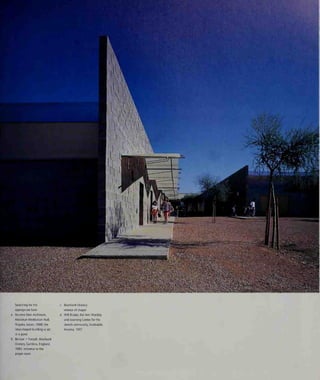
with a surrounding tourist industry considerably less
lucrative than its counterparts in sunnier and drier
southern Spain. Hence a multi-billion-dollar invest-
ment programme, conceived in the late 1980s for
completion by the year 2000, which brought the
world's architects flocking to a place some had never
heard of, let alone previously visited. When the
Basque Government's Minister of Gulture, M Karmen
Garmendia, remarked in 1996 upon the importance
of the Guggenheim to his city, he put its economic
impact first, and its 'visibility as a cultural centre'
second. It would be, he said, 'a landmark and
signature for our city, as well as one of the world's
great art museums'.
Landmark and signature. The two words that
encapsulate the museum and gallery building frenzy
of the closing years of this century. The Bilbao
Guggenheim is sited to act as a gateway to the city
on the riverfront, embracing even the traffic-choked
bridge of Puente de la Salve, exploiting its low-lying
position with an explosive, architectonic flower-like
roofscape. Gehry develops his persistent theme,
expressing otherwise discrete building shapes within
a connecting, sculptural and burnished envelope. The
various elements focus upon a mighty central atrium.
But there is even more than this. The political ele-
ment that is inescapable in all big cultural building
projects is here supercharged: for by building their
Guggenheim, the Basque government thought it was
declaring cultural independence from Madrid. A local
architect, thinking small, could not have done this.
But Gehry and the Guggenheim lent their signatures
and built the landmark. In just this fashion, Frank
Lloyd Wright originally solemnized what was an
upstart on the New York art scene with his own sig-
nature and landmark. But in Bilbao, things did not
work out quite as the politicians had planned.
The new Guggenheim instantly became the
single most famous building in the world when
it opened in autumn 1997. It was covered by all the
world's media to saturation levels, its exposure
helped rather than hindered by the fact that Basque
The single most evocative
architectural image of the late
twentieth century:
a Frank Gehry & Associates,
Guggenheim Museum, Bilbao,
Spam, 1991-7; Richard Serra's
7/)e5note sculpture in
the long gallery
b Bilbao Guggenheim: site plan
c Bilbao Guggenheim:
view of the museum from
the opposite bank of the
Nervion River
s?
<3
terrorists from the ETA group made a hamfisted
attempt to conceal mortars in Jeff Koons' giant floral
puppy installed in the museum's forecourt, intending
to bomb the opening ceremony, carried out by King
Juan Carlos. The discovery of this bomb plot, and the
death of a policeman in the ensuing shoot-out, did
more than focus the world's attention on Cehry's
extraordinarily fine architecture, however - that was
assured anyway. It highlighted an uncomfortable
fact: that although the Basque government had com-
missioned the Museum, along with so much else in
Bilbao, as an assertion of autonomous regional pride,
it was regarded by some at least as an example of
American cultural imperialism. The politicians had
purchased a Guggenheim franchise much as one
might buy a McDonald's franchise, and knowing that
the direction of the museum - at least at first - was
carried out entirely from New York only increased this
feeling. Gehry's sinuous, swooping architecture in
Bilbao, the culmination of a process of designing so
many other arts buildings over the years, showed him
at his best. Contrary to expectations the shape-
making is not arbitrary - the spaces inside range
from huge, warehouse-scale rooms for giant-scale con-
ceptual art and installations, to intimate spaces for
small drawings, even local artists. Nonetheless, as
Gehry himself noted regarding his contribution to
Disneyland Paris (see 'Leisure') his buildings are in
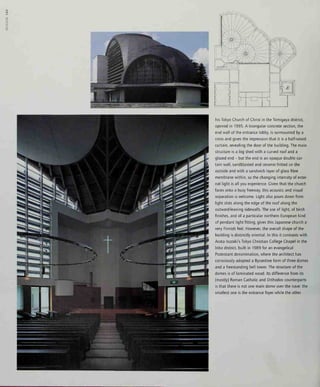
effect themed on himself. Gehry is an icon of
America, his style too recognizable. The brouhaha
surrounding the opening of the Bilbao Guggenheim
served as a reminder of how the meaning of a
cultural building has less to do with the architect
than with the preconceptions of those who see it.
There are architects working within the
cultural realm who do not depend upon an instantly
recognizable style as Meier or Gehry (and to a lesser
extent others such as Aldo Rossi, Mario Botta,
Arata Isozaki and Norman Foster) do. Their
response, though no less forceful, is more varied,
more contextual. Hans Hollein, though obsessed
by excavation - witness his European Volcanology
Centre, 1997-2000, at St-Ours-les-Roches in the
Auvergne, southern France, which takes up themes
first aired in his plans for a Salzburg Guggenheim -
is unpredictable in his overall responses: who could
have foreseen the sinister, quasi-industrial forms of
his Monchengladbach Abteiberg Museum, 1972-82,
or the blind wedge of his depressing Museum of
Modern Art in Frankfurt, 1982-91, for instance?
Rem Koolhaas of OMA is similarly inclined to go
out on a limb, his designs united only by their uni-
form absence of anything that might conventionally
be described as 'beauty'.
In America, the adobe-influenced Antoine
Predock is now working on a scale that has obliged
c d
Hans Hollein, Abteiberg
Municipal Museum,
Monchengladbach, Germany,
1972-82: entrance
Hans Hollein, European Centre
of Volcanology, St-Ours-les-
Roches, Auvergne, France,
1997-2000: model
Antoine Predock, Las Vegas
Library and Discovery Museum,
Las Vegas, 1986-90: exterior
view
d Las Vegas Library: interior view
e Antoine Predock, Amehcan
Heritage Center and Art
Museum, Wyoming, Laramie,
1986-93: section through
'tepee'
f American Hentage Center and
Art Museum: exterior view at
night
g Antoine Predock, Nelson Fine
Arts Center, Arizona State
University, Tempe, 1986-9:
exterior view
<
>3D
5<
him to rethink his approach, but not to the extent
that he abandons his response to context. Whether
it works successfully writ large is another matter.
His American Heritage Center and Art Museum,
1985-93, in Laramie, Wyoming, for instance, takes
the form of a tepee and abstracts it into a form
reminiscent of either a submarine's conning-tower
or a moon rocket's nose-cone. A landmark, again,
but here it has a function as the container of the
visitor centre, part of an otherwise relatively conven-
tional sequence of museum galleries, arranged as
an offset tail to the conical head. Predock's handling
of spaces here is very different to his Las Vegas
Library and Discovery Museum, 1986-90, where
the cone form again recurs, but is here subordinate
to the whole, which, since it is for children, is broken
down into child-scaled spaces. The Las Vegas build-
ing is as understated as the American Heritage
Center is assertive, though both contain stairs to a
viewing tower - at Laramie right on top of the big
cone, in Vegas as the summit of a helical 'science
tower'. At Predock's Arizona State University's Nelson
Fine Arts Center, 1986-9, the forms break down
still further into what is effectively a small village
of linked forms. What he would do if released from
his desert home ground to another part of the world
with an utterly different cultural tradition is anyone's
guess, and Disneyland Paris, where he designed a
<3
hotel with a Santa Fe theme, scarcely fulfils these
criteria. One wonders also about how well the work
of the Mexican architect Ricardo Legorreta travels.
Legorreta's Marco Museo d'Arte Contemporaneo,
Monterrey, 1991, takes the hot-climate response of
a relatively featureless building around an open
courtyard, using the coloured-render surface finish
and abstracted 'vernacular' forms common to the
region, first reinterpreted for the twentieth century
by Luis Barragan. Legorreta shares certain concerns
with museum architects the world over, not least his
desire to blur the distinctions between exterior and
interior and set up a public processional route: com-
pare Ando and Kurokawa in Japan, Stirling in
Stuttgart, or Evans and Shalev at the Tate Gallery's
St Ives outstation, England. But certain architects
are undeniably more 'regional' rather than interna-
tional, and Legorreta's architecture is resistant to
travel: though less so, perhaps, than the regionally-
based work of architects such as Geoffrey Bawa in
Sri Lanka, Balkrishna Doshi in India, orTurgut
Cansever in Turkey. Against the New Internationalism
in architecture must be set the New Regionalism,
which may justifiably claim a higher moral standing.
To try to separate cultural and climatic differences
is needless. As Charles Correa once observed with
admirable simplicity:
'In a warm climate, people develop a very different
relationship to built form ... ineffable indeed are the
variations of light and ambient air, as we step from
an enclosed room into a verandah, and thence per-
haps into a courtyard, which itself may be shadowed
by a pergola covered with plants, or by the spreading
branches of a tree.'
In this vein one might also cite the more
widely travelled Spanish architect Rafael Moneo as
a responder to context rather than to inner forces -
in particular his magical Museum of Roman Art at
Merida, 1980-5. The conventional response to the
rums Moneo faced would have been to design some-
thing light and transparent, a foil to the found object
of the massive masonry. Instead, Moneo chose to
work himself in thin Roman brick, and arched con-
struction, but set on a different grid to the under-
lying remains, so that the disjunction between old
and new is apparent. Moneo's museum, then, is not a
reconstruction, but an evocation of the Roman archi-
tecture which you look down on as if from bridges.
a c
b
d
f
9
The smaller museums, away
from the big cities, proved
fertile ground:
Ball<rishna Doshi, Hussam-
Cufa Gallery, Ahmedabad,
India, 1993: roof detail
Rafael Moneo, National
Museum of Roman Art,
Menda, Spam, 1980-5:
interior detail
Evans + Shalev, Tate Gallery, St
Ives, Cornwall, England, 1993
d Henri Ciriani, Museum of
Archaeology, Aries, France,
1984-92: the blue defining
wall evokes the intense
colours of Roman buildings
e Museum of Archaeology: plans
f Museum of Archaeology:
gallery interior
g Museum of Archaeology:
Corbusian extrusions
penetrate the blue-glass wall
<
<
fc..'Ji 1
^F^^
^ ^ ._^^^^it
c
a d
b
e
c
>
This semi-literal approach contrasts strongly with
Henri Ciriani's Museum of Archaeology at Aries,
southern France, 1984-92, where the great wedge
of a building - its blue-glass defining wall punctured
at intervals by early Corbusian extrusions - evokes
instead the intense colours of Roman buildings
and the organizing force of the Empire's troops
and accountants.
Moneo's 'architecture as archaeology'
IS an approach one also finds in the museums of
Rasem Badran and Abdul-Halim Ibrahim in Jordan
and Saudi Arabia, or of Charles Correa in India -
specifically, his National Crafts Museum in Delhi,
1975-90. At a pinch Correa might be accused of pas-
tiche here - his museum sets out deliberately to be
un-museum like by breaking down its galleries into
forms based on village houses - but the effect, as
with Moneo in Merida, is assured when in lesser
hands it would have veered into kitsch. In a similar
vein, the Burrell Collection in Pollock Park, Glasgow,
by a one-off team of architectural collaborators
(Barry Casson and John Meunier with Brit Andreson,
realized by Barry Casson Architects, 1972-83) is a
gallery informed equally by its parkland setting,
placed right up against a woodland edge, and by its
contents, the eclectic art and sculpture collection of
the shipowner Sir William Burrell, donated to the city
in 1944. A low and meandering building, mixing its
materials (stone, glass, steel, timber) almost casually
and incorporating some of Burrell's salvaged archi-
tectural pieces into its structure, this is the very
opposite of the museum as conceived in Groningen.
In contrast, it is modest to a fault, which meant that
by the late 1990s it was out of step with current
museological fashion and its visitor numbers had
dropped off sharply. Studio Downie's beautifully
understated Sculpture Pavilion, 1995, at Goodwood
near England's Sussex coast - an ordering device of
timber, glass and copper among the trees of a sculp-
ture park - is in line of descent from the Burrell,
which Itself IS part of a northern European tradition
of modest, collection-based galleries that continues in
the work of Scandinavian, and especially Norwegian,
architects today. Two examples are the timber-clad
Lillehammer Art Museum in Norway, 1992-3, by the
internationally successful practice Snohetta - a firm
with both American and Norwegian partners, which
has successfully climbed out of the regionalist
pigeonhole - and Sverre Fehn's metaphorically com-
posed Norwegian Glacier Museum in Fjaerland,
1989-91. Better still is Fehn's earlier, abstractedly
simple, Scandinavian Pavilion at the Venice Biennale
Gardens, which makes almost all the other pavilions
on the site look as if they are trying much too hard.
Finally and somewhat unexpectedly in this
quasi-regionalist context, comes a British selection,
starting with David Chipperfield's River and Rowing
Museum at Henley-on-Thames (completed in stages,
1996-7) and Branson Coates' extension to the
Geffrye Museum, East London, 1995-8. Branson
Coates' offering, attached to an L-shaped building
originally designed as almshouses, is a loop of what
might be described as 'London vernacular', its form
generated by the need to circulate people round the
end of the museum and back, its visual references
gleaned from the history of East London. At Henley,
Chipperfield opted for a timber-clad building with
steep pitched roofs. This in a sense was a tactic to
get round the notoriously conservative planning
authorities of Middle England (there is a reference to
some of the Thames boathouses of the area) but
Chipperfield also succeeded in making his building
evocative of agricultural, barn-like buildings from
widely different cultures, from Japan to New England
via Borneo long houses. There is no such thing as
'international vernacular' - the phrase is an oxy-
moron - but this is nonetheless a building carrying
multiple rural references in its simple forms. In con-
trast Tony Fretton produced a more English abstract
vernacular when designing a rural gallery, ArtSway,
in England's New Forest, 1996-7.
The archaeological approach has also been
applied, with surprising success, to Paul Chemetov
and Borja Huidobro's Calerie de I'Evoiution,
a Studio Downie, Sculpture
Pavilion, Goodwood, Surrey,
England, 1996
b Charles Correa, National Crafts
Museum, Delhi, India,
1975-90
c Barry Casson Architects,
Burrell Collection, Pollock Park,
Glasgow, 1972-83
d Chemetov -I- Huidobro, Galerie
de I'Evoiution, Pans, 1982-90
e Snahetta, Lillehammer Art
Museum, Norway, 1992-3
f Branson Coates, Geffrye
Museum extension, London,
1995-8: concept sketch
in
<3
1982-90, in Paris. The whole idea here is to reveal
a forgotten building, the 1877 Natural History
Museum by Jules Andre, which had been closed since
1965, its collection of unfashionable stuffed animals
gathering layers of dust in the dark for over twenty
years. Yet behind the standard if imposing belle-
epoque facade was one of the most stunning iron
and glass atrium interiors in all Paris. One of the
great installation experiences of the early 1980s,
when Andre's building began to be rediscovered, was
the way the public was allowed in to one of the bal-
conies overlooking the main floor, to gaze down at
the dust-covered animals below, animated by a mini-
malist light and sound programme. The achievement
of Chemetov and Huidobro is to retain some of that
air of lost-world mystery in a completely renovated
building, where the restored animals march diagonal-
ly across the atrium floor as if on their way to the
Ark. This tableau forms the centrepiece of a new
Natural History Museum, and, like all of President
Mitterrand's 'Grands Projets', the programme was
funded generously.
The Calerie de I'Evolution, Aulenti's museums
in Paris and Madrid, Adrien Fainsilber's Cite des
Sciences et de I'lndustrie at La Villete in Paris
(created from giant unfinished abattoirs) 1980-6,
and such projects as Herzog and de Meuron's Tate
Museum of Modern Art at Bankside in London,
1994-9, are examples of an increasingly popular
genre - the museum or gallery housed in a redun-
dant or rediscovered structure. Such buildings have
their own tradition, with Scarpa's 1964 Museo
Castelvecchio in Verona the shining institutional
example, while a large number of redundant ware-
houses and industrial buildings around the world
have proved ideal for the large-scale aspirations of
contemporary conceptual art and sculpture. Most
notable in this area is the late sculptor Donald
Judd's commandeering of the town of Marfa, Texas,
as a continuing experiment in the siting of installa-
tion art. In particular Judd's precise and minimalist
alterations of the buildings and spaces of a derelict
US Army barracks with its artillery ranges outside
Marfa - work continued by his Chinati Foundation -
is a near-perfect fusion of art and architecture, all
the more accomplished for being done by an artist
rather than an architect, and somehow the better for
being found space rather than purpose-built space.
When researching locations for its
MoMA, London's Tate Gallery duly discovered that
contemporary artists much prefer to work in the con-
text of existing, preferably industrial, spaces, than to
have to deal with purpose-designed buildings. This
attitude mirrors that of theatre directors who see
their art as best unfettered by the egos of architects
(see 'Performance'). With sculpture and installation
is
>
3
work in particular developing rapidly, especially in
size and scale, it transpired that, as with theatre
design, it was becoming impossible to pin down the
precise type of space that would be required. By the
time all the agonizing had gone on and the venues
built, artists' requirements would have moved on.
Hence the Tate's choice of a Cyclopean brick-built
former oil-fired power station (by Sir Giles Gilbert
Scott, 1955-60, but early twentieth century in feel)
for its most ambitious expansion to date: also the
most ambitious art gallery thus far for Herzog and
de Meuron, who at the time of their appointment
were best known for the tiny glowing box of their
Goetz Art Gallery in Munich, 1989-92. Similar think-
ing is apparent in the city of Gateshead's choice of a
redundant riverside flour mill building for its new
gallery of contemporary art (Ellis Williams architects,
1994-2001 ). Two previous ventures into this realm
had proved highly successful: Renzo Piano's conver-
sion of the titanic old Fiat works at Lingotto, Turin,
into a cultural and trade centre (see 'Performance');
and the Powerhouse Museum, 1985-8, in Sydney by
New South Wales public works architects, Denton
Corker Marshall, and Neil Burley. The latter is a con-
version of a waterside tramway generating centre
into a museum of technology and decorative arts,
the interiors of the generator halls being rather more
interesting than the rather flimsy external treatment.
a Adrien Famsilber, Cite des
Sciences et de I'lndustrie, Pare
dela Villette, Paris, 1980-6:
interior of exhibition space
b Herzog and de Meuron, Tate
Museum of Modern Art,
Banl<side, London, 1994-9:
computer-generated graphic of
exterior view
Frederick Fisher and
Partners Architects, PSl
Contemporary Art Centre, New
York, 1988-97
Aldo Rossi, Bonnefanten
Museum, Maastricht, The
Netherlands, 1990-4
Herzog and de Meuron, Coetz
Art Gallery, Munich, Germany,
1989-92
Gustav PeichI, Federal Art
Gallery, Bonn, Germany,
1986-92
Office for Metropolitan
Architecture, Kunsthal,
Rotterdam, The Netherlands,
1987-92: view into foyer
Axel Schultes, Kunst Museum,
Bonn, 1985-92: exterior detail
Alvaro Siza, Galician Centre for
Contemporary Art, Santiago de
Compostela, Spam, 1988-95:
gallery interior
>
>
Such thinking informs the creation of New
York's PSl Contemporary Art Center, 1988-97, run
by arts entrepreneur Alanna Heiss, which after
twenty-five years of using sundry abandoned ware-
house spaces, moved into premises converted out
of a rambling Romanesque former nineteenth-
century school complex by the Los Angeles architect
Fred Fisher, making it one of the largest galleries
for contemporary art shows in the world. In contrast
to the shoestring-budget previous life of this institu-
tion, the new centre was bankrolled to the tune
of $8.5 million by New York City's Department
of Cultural Affairs, so institutionalizing what had
originally been spontaneous. Fisher's trademark is
to reveal the existing building and to understate
his own interventions, and so works at the opposite
end of the visual spectrum to his erstwhile employer,
Frank Cehry.
One might be forgiven for concluding
that there is no such thing as a museum or gallery
typology when one has to compare such European
examples as Aldo Rossi's Bonnefanten Museum in
Maastricht, 1990-4, with its strange empty shell-case
of a dome; the Kunsthal in Rotterdam by Rem
Koolhaas of OMA, 1987-92, with its deliberate
crudeness in the handling of volumes; or the daunt-
ing museum plaza in Bonn where Custav Peichl's
Federal Art Gallery, 1986-92, with its defensive row
of freestanding columns and tepee rooflights faces
the disrupted grid of Axel Schultes' Kunstmuseum,
1985-92, both now threatened by the move of
political power to Berlin. After these and such other
visually rich fare as the Groninger Museum, a gallery
so relatively understated as Alvaro Siza's Galician
Centre for Contemporary Art at Santiago de
Compostela, Spain, 1988-95, is like a grapefruit
sorbet after a confit de canard. At last: a gallery
that is all to do with a sequence of interior spaces,
its simple stone-clad external walls jumbling them-
selves comfortably into the medieval townscape
without a trace of bombast.
In Japan, museum-making has been
even more frenetic, with both imported and home-
grown architects pitching in. Kenzo Tange, the elder
statesman of Japanese architecture, contributed his
Yokohama Museum of Art at Kanagawa, 1983-9,
which is as formally classical in its way as his
immensely important Peace Centre at Hiroshima,
1946-94, but with some of the tricksy post-modern
touches of its era that serve to lessen its organiza-
tional force. The running has mostly been made by
a younger generation, such as Kazuhiro Ishii, with
his San Juan Bautista Museum in Ojika, 1996, a
museum both wrapped around and overlooking a
historic replica ship; Toyo Ito with the Yatsuhiro
Municipal Museum at Kumamoto, 1988-91, which is
the modern expressionist's reply to Mies in Berlin,
its wing-like lightweight roof forms visually sheltering
the glass container beneath; Hiroshi Hara's Ida
City Museum in Nagano, 1988, exploring his
academic concern with vernacular forms that can
be abstracted into large-floorplate modern buildings;
Yoshio Taniguchi's Toyota Municipal Museum of Art
in Toyota City, 1995, a minimalist landscape-centred
building; and Arata Isozaki's Mito Cultural Complex
in Tokyo, 1986-90. Isozaki's building is notable not
so much for its rather lumpen collection of symbolist
museum buildings as for the fractal spiral of its
100-metre-tall 'Art Tower', like a solidified twisted
strip of photographic film.
Nothing - but nothing - unites the styles of
these Japanese architects, all of whom are roughly
of the same generation. So the supposedly exotic
imports, such as English architects Branson Coates
for their 'Art Silo' of the Penrose Institute of
Contemporary Arts in Tokyo, 1993, or Mario Botta's
'Watari-Um' contemporary art gallery, 1985-90, in
the same city with its trademark banded masonry,
are relatively modest in comparison. As Botta wrote
to his client, Mrs Watari: 'In the Babel of urban
languages that changes daily, I wanted to test the
durability of a strong, primary image, an architecture
generated by the building's own inner logic, its
geometry and the effects of light. These things came
in
<
Hiroshi Hara, Ida City e Branson Coates, Art Silo,
Museum, Nagano, Japan, Penrose ICA, NishI Azabu,
1988 Tokyo, 1993
Toyo Ito, Yatsuhiro Municipal f Mario Botta, 'Watari-Um'
Museum, Yatsuhiro, Museum, Tokyo, 1985-90:
Kumamoto, Japan, 1988-91 plan
Kazuhiro Ishii, San Juan g Watari-Um Museum: exterior
Bautista Museum, Ojika, h Watari-Um Museum:
Japan, 1996 contextual view
Yoshio Taniguchi, Toyota
Municipal Museum of Art,
Toyota City Japan, 1995
>
3
o(0
<3
before a consideration of its urban impact.' Seen in
an isolated pliotograph, wliere the building appears
impactful indeed, the image makes you wonder at
Botta's assertion. But pull back to see it in the con-
text of Tokyo, and it all but vanishes in the scrum,
just as a zebra's stripes act as camouflage.
All museum and gallery design, in theory,
comes down to one eternal concern: the handling of
space and light. These are the fundamentals of all
architecture, but when it comes to the display of art,
any mistakes here are unforgivingly prominent. This,
apart from the extreme public prominence of such
buildings, is why architects fight to have them in
their portfolio. Technically they are relatively com-
plex, particularly when it comes to diffusing natural
light into top-lit galleries (the aim of nearly a|l
curators) and maintaining the appropriate climate
controls and security. But it is the successful mani-
pulation of natural light that distinguishes the best
architects from those who are merely show-offs.
Arguably the most adept at this difficult art as the
twentieth century drew to its close were the Sino-
American architect leoh Ming Pei, and the Japanese
architects Kisho Kurokawa and Tadao Ando.
Pei and Kurokawa make an interesting
and fundamental contrast. Pei's weakness, if it can
be described as such, was his famous addiction to
deceptively simple geometric forms. From the triangle
or diamond stereometry of the East Wing of the
National Gallery of Art in Washington, 1971-8, (a
building thus overlaying the conception and con-
struction of the Pompidou Centre) via the triangulat-
ed crystalline Bank of China in Hong Kong,
1985-90, to, as an inevitable conclusion, the pyra-
mid of the Louvre redevelopment in Paris, 1983-9,
Pei became the master of the eternal form, derived
very clearly from his early Miesian predilections, but
overlaid with a Chinese love of order and placement
(this is not to be confused with Feng Shui, sometimes
at odds with the harsh angularity of Pei's buildings).
Kurokawa, in contrast, took a course of seeming
architectural complexity, the very opposite of Pei's
route. Where Pei espoused geometry, Kurokawa was
wedded to what he called Metabolism, a term that
meant whatever he chose to make it mean, but
which, later in life, he defined as 'the principle of life'
- a catch-all phrase that, according to his personal
myth, included 'symbiosis with nature', 'abstract
interrelationships' and 'asymmetry'. This last gives
the clue: to take a Western analogy, the best way to
think about the contrast between Pei and Kurokawa
is to consider the differences between a Classicist
and a Goth. The former imposes a rational, usually
symmetrical order upon nature or townscape: the
latter is accretive, evolutionary, and can claim to
derive much of its force from an observation of the
Pel's purism contrasts with
Freed's willingness to work
allusively;
Pei Cobb Freed & Partners,
Louvre Pyramid, 1983-9, and
Richelieu Wing, Paris,
1988-93: section through
Louvre
Louvre Pyramid: exterior view
Richelieu wing: interior of
gallery
Pel Cobb Freed & Partners,
East Wing, National Gallery of
Art, Washington, DC, 1971-8:
interior view
e Pei Cobb Freed & Partners
(James Ingo Freed), US
Holocaust Memonal Museum,
Washington, DC, 1989-93:
section
f US Holocaust Memorial
Museum: photographs of
Holocaust victims line the
walls
g US Holocaust Memonal
Museum: Hall of Witness
m m
I
I3iL
given forms of country or town. Thus a Pei museum
is as different from a Kurol<awa museum - as an
object to contemplate and as a sequence of spaces
to stroll through - as a Creek temple is from a
medieval monastery. Although to compare the work
of these two architects using a Western cultural
analogy might seem otiose, the classical or gothic
split is merely a way of describing what appears to
be a universal cultural phenomenon. In the case
of Kurokawa, some of his work has been compared
with the principles of free arrangement to be found
in Japanese garden-making. However, one should
not submit too readily to the temptation to over-
generalize. Pei's practice, after all, has given us the
US Holocaust Memorial Museum in Washington,
1989-93 - which although possessing a handful of
repeated geometrical elements such as a freestand-
ing octagonal auditorium and a sequence of pyrami-
dal-roofed towers, is inside, a fragmented series of
compartmentalized spaces. Although there is a cen-
tral 'Hall of Witness', this space is as different from
the expansive open spaces of the National Gallery
East Wing or those beneath the courtyard of the
Louvre as can be imagined. And for a good reason:
at the Holocaust Museum, Pei's partner James Ingo
Freed was dealing with forms that were deliberately
evocative of some of the places associated with the
Holocaust. The external pyramidal towers echo the
watchtowers of concentration camps: the gantry-
bridges spanning the building at high level bring to
mind the Warsaw Ghetto: within, sinister doors and
enclosed, claustrophobic spaces are fully intended to
echo some of the horrific experience of those impris-
oned and killed. This, then, is programme architec-
ture as much as Libeskind's in Berlin, though more
overtly symbolic. The Pei practice could also respond
to a context, though to suggest that its titanically-
scaled brick-built extension to the Portland Museum
of Art in Maine, 1981 -3, is, as some have suggested,
self-effacing, is fanciful in the extreme. The Portland
building, playing Kahnian facade games of circle and
semicircle, completely overwhelms its parent.
Those looking for a classically planned
museum from Kurokawa, will, against all the odds,
be rewarded if they search long enough. The
Metabolist is mostly true to his organic, gothic,
instincts. Like Pei, he shows a late fondness for
Platonic forms - the cone, the sphere, the cube -
but arranged as almost random elements within a
composition: a way of museum-making he shares
with Antoine Predock in his desert fastnesses. He is
on record as saying that he likes his compositions
to have no core, no apparent centre, and some, like
the fanciful shape-making of his Ehime Prefectural
Museum of General Science, 1991-4, or the earlier
and more sober Nagoya City Art Museum, 1983-7,
I
fulfil this aim. Yet his Honjin Memorial Museum
of Art in Japan, 1989-90, is a strongly circular (in
fact oval) form, with an axial approach. Similarly
his Hiroshima City Museum of Contemporary Art,
1984-8, focuses its longhouse elements upon the
obvious focus of a circular form approached, in
classical fashion, up a grand flight of steps set on
the axis. And in his later museum designs, at
Wakayama in Japan, and at Louvain-la-Neuve in
Belgium, a tendency to set up formal approach
avenues begins to appear. Perhaps, like his old
master Kenzo Tange, Kurokawa could not resist the
lure of the formal and grandiose when given large
projects to work upon later in life, although he was
never tempted by the post-modern formalism of
Arata Isozaki, as evidenced in his Museum of
Contemporary Art in Los Angeles, 1981 -6, or his
Okanoyama Graphic Art Museum, 1982-4 - a
decorative design that shows a decadent descent
from his earlier, modular Art Museum In Takasaki,
1970-4, which in turn can be accused of an over-
reliance on the repetition of a geometrical, 12-metre
cube module. As for Kurokawa, though it might be
heretical to suggest it, throughout his sixties an
almost Beaux-Arts overlay began to descend upon
the randomness of his planning.
So our representative Classicist and Goth
have more in common than might at first appear.
Both also understand fully the importance of the
handling of light, though here the true contest at
the century's end was not between Pei and
Kurokawa, but between Pei and Ando. Pei liked
to saturate the public spaces of his museums with
light, and was moreover of the view that, once
inside the usually sealed environment of a gallery,
the visitor was owed not only a reasonable level
of light (Tm old - I want to be able to see the pic-
tures,' he IS reported to have said on commencing
his final phase of work in the Richelieu Wing of the
Louvre) but also a sensation of the outside world.
This proved to be a very important step forward
because, m the 1980s, curatorial demands in art
galleries had increasingly led to spaces that were
all but hermetically sealed.
It is instructive to compare the interiors of
three gallery buildings from this period: Pei Cobb
Freed's Richelieu Wing, James Stirling and Michael
Wilford's Clore Gallery at the Tate in London - the
gallery as sealed space, with only one little window
look-out for orientation; and the Sainsbury Wing of
London's National Gallery, byVenturi Scott Brown
and Associates - where the intention was to create
galleries based upon the lantern-skylight model of
Sir John Soane's Dulwich Picture Gallery, 1811-14,
but where Venturi was not allowed to place an orien-
tating window as he desired. 'There should be a
Japanese architects saw the
art museum as a potent
testing ground for ideas:
Kisho Kurokawa, Wakayama
Prefectural Museum,
Wakayama, Japan, 1990-4:
interior of circulation space
Kisho Kurokawa, Ehime
Prefectural Museum of General
Science, Ehime, Japan, 1991-4:
interior
c Kisho Kurokawa, Honjm
Memorial Museum of Art,
Ishikawa, Japan, 1989-90:
interior
d Kisho Kurokawa, Fukui City
Museum of Art, Sukui,
Japan, 1993-6: exterior
e Wakayama Prefectural
Museum: axonometric
f Fukui City Museum of Art: plan
Arata Isozaki & Associates,
Museum of Contemporary
Art, Los Angeles, 1981-6:
exterior view
MoCA, Los Angeles: gallery
interior
Arata Isozaki & Associates,
Okanoyama Graphic Art
Museum, Hyogo, Japan,
1982-4: gallery and
circulation spaces
b
c d f
great window at the end of the central gallery
toward Pall Mall to disentomb the effect: the cura-
tors wanted the wall for a big picture which you
can't read from a distance,' Venturi later commented.
Despite this, and despite bemg necessarily handi-
capped by the extreme levels of daylight filtration
demanded by the curators of the Renaissance
collection, the gallery interiors of the Sainsbury
Wing do allow some idea of what is happening,
climatically, outside. Pei, however, wanted much
more than this. Like Venturi, he wanted to 'dis-
entomb the effect'. The existing windows in the
Richelieu Wing allowed the necessary orientation,
but he wanted more: he wanted visitors to be able
to look up and see the sky as they perambulated, at
the same time that direct sunlight was kept off the
pictures. In addition, knowing the frailty of auto-
mated active shading devices and the tendency of
museums and galleries not to indulge in routine
maintenance, he insisted of his engineers that the
natural top-lighting system should be fixed. All
these apparently conflicting demands were resolved
by the joint teams from Pei's office and the engineers
Ove Arup, under Peter Rice: the cruciform fibrous
plaster blades forming the ceilings of the Richelieu
Wing galleries, tested on computer models, do the
job almost miraculously and it is possible to see the
sky with its clouds and planes. Light levels are almost
worryingly high for those used to the tomb effect
of other galleries protective of their ancient
canvases: there is even the odd splash of sunlight
on the floor.
If Pei became the master of the technical
handling of natural light with his last work at the
Louvre, Tadao Ando emerged as the master of the
poetics of light - falling both externally and
internally, on solid and on water. In the Nariwa
Museum, 1992-4, in the Naoshima Contemporary
Art Museum and annexe, 1988-92, 1993-5, the
Forest of Tombs Museum, 1989-92, and in the fasci-
nating Chikatsu-Asuka Historical Museum in Osaka,
1990-4 - a building conceived as a grand flight of
steps - Ando, using few materials, particularly con-
crete, glass and stone, has achieved a quality both
luminous and numinous. In this respect he may be
compared to that other master of light and manipu-
lator of museum space. Carlo Scarpa (1906-78).
Scarpa's Museo Castelvecchio in Verona, 1964, is
one of the twentieth century's greatest examples
of how creative power, and the juxtaposition of old
and new, can enhance a museum's collection and
atmosphere, rather than serve the ego of architect
or than civic state. To be a master both of exhibition
design and of architectonics: Scarpa still represents
that particular Holy Grail and few, if any, present-
day architects can attain it.
<
>
>
o
a
o
All Ando buildings, whatever
their function, are temples:
Tadao Ando, Chikatsu-Asuka
Historical Museum,
Minamikawachi-gun, Osaka,
Japan, 1990-4
Tadao Ando, Naoshima
Contemporary Art Museum
and annexe, Naoshima,
Kagawa, Japan, 1988-92,
1993-5: view of courtyard
Tadao Ando, Forest of Tombs
Museum, Kumamoto, Kamoto-
gun, Kumamoto, Japan,
1989-92: view of courtyard
Tadao Ando, Nariwa Museum,
Nariwa, Okayama, Japan,
1992-4: exterior view
Naoshima Contemporary Art
Museum: plan
te
^1
PERFORMANCE Opera houses, theatres & concert halls The form of the auditorium-
based building places strong constraints upon architects. Paradoxically one of the
most introverted of building types - for the performance of opera, theatre, dance and
music, and the projection of film - it must also acknowledge its important public and
celebratory role. While the auditorium often reflects both the social hierarchy of the
society that builds it, and the complex science of acoustics, the most important
design aspect is more instinctive: magically to enable the possibility of catharsis.
eo
10
o
<
'We think, but we try not to think too much.'
Giinter Behnisch, March 1997.
The auditorium-based building is as highly
charged an urban form as the art gallery, and as
such it places strong constraints upon architects.
Paradoxically, one of the most introverted of building
types - encompassing theatre, concert hall, opera
house and cinema, plus often the financially expedi-
ent addition of conference trade - must also
acknowledge its important public and celebratory
role. Within, the auditorium does two things. It acts
as the 'room' in which audience and performers (or
images) interact. It also defines the social hierarchies
of the society that builds it - seating and perfor-
mance space arranged according to wealth, status,
or notions of democracy. Such buildings are among
the most demanding to design, both technically
and aesthetically.
They are especially difficult because techni-
cal competence can only go so far in determining the
feel of the space. A concert hall or opera house can
be acoustically brilliant, a theatre wonderfully com-
fortable, with uninterrupted sightlines, but the
atmosphere can still end up all wrong. Indeed, the
conclusion of many radical theatre, opera and dance
directors at the end of the twentieth century is that
comfort, sightlines and acoustics are in a sense
secondary to the main point: that performances -
particularly theatre - can be staged successfully any-
where, in even seemingly hostile conditions, so long
as the audience is piled into the same space as the
performers. Hence the frequent use of former ware-
houses and factories as galleried auditorium spaces:
hence the way that purpose-built 'experimental' the-
atres endeavour to replicate that black-box flexibility.
Such an approach is partly historical, acknowledging
the way theatre originally evolved in Europe as an
art form in existing, often galleried, public spaces
such as inn courtyards.
In this context, the Californian architect Eric
Owen Moss' project to insert a modest theatre
among his various developments in once seedy
Culver City, Los Angeles, is worth noting - particular-
ly in view of the continuing discussion in this chapter
about the relationship of actor and audience. The
Ince Theater project, which began in 1993, shows an
architect manipulating the intersecting circles of the
audience's and the actors' domains with assurance -
not least because he works not just on plan, but in
three dimensions. The circles thus become intersect-
ing spheres, a device that brings actor and audience
into the same 'room' while still defining the territories
of each. Externally, the modelling produces a curvilin-
ear building that achieves the second objective of a
theatre - to advertise itself in the civic realm. The
There is a continuing quest by
architects to contain
performers and audience m
the same room:
a Eric Owen Moss, Ince Theater,
Culver City, California, 1993-:
sectional perspectives
b Ince Theater: model
c Ince Theater: model
3
buildings surrounding it - including those already
transformed by Moss - are rectilinear and the con-
trast of building typologies is clear. Finally, Moss
intends his theatre to be an objective in itself, with
broad steps running up its exterior and a high-level
link built across to nearby office buildings. In this he
is treading the same ground as Mario Botta and
Tadao Ando do in certain of their projects - seeing
the building as a public route, an urban stepping-
stone. In the case of a theatre, this public function
plugs it into the movement patterns of the city, break-
ing down some of the barriers between art and life.
The Ince Theater was conceived as a home
for both live performances and cinema - a balancing
act that, as we shall see, is often problematic,
though less so in a small (450-seat) auditorium of
the kind proposed by Moss. A further distinction
needs to be made between speech-theatre and opera-
theatre. Although plenty of experimental opera com-
panies exist, the bulk of the operatic repertoire was
composed in a limited period (broadly speaking, from
the mid-eighteenth to the mid-twentieth centuries)
which has an immediate effect upon the design free-
dom of architects working in this medium. Grand
opera and grand opera houses, with proscenium
arches, go together. They are the most predictable,
and most costly, of all auditorium types. Concert
halls are also usually predictable in form - a
symphony orchestra plus choir and organ is an
absolute given, and everything else can be calculat-
ed from there; the needs of chamber music venues
are also pretty much a given. Cinemas are the easiest
of them all, since no interaction between audience
and performers is required, though even here per-
ceived intimacy is an advantage. But the acting of
plays has undergone such transformations in the
twentieth century - and particularly during the post-
war years - that theatre architects have been obliged
to follow the directors into the unknown, sometimes
with disastrous consequences.
There is no time when architects did not miss
the point entirely; some eighteenth- and nineteenth-
century theatres were fiercely criticized by actors,
directors and audiences alike for being monuments
to ego rather than instruments of performance, and
it has long been customary for architects to concen-
trate most on the public areas for effect - note Hans
Poelzig's extraordinary Expressionist Grosses
Schauspielhaus in Berlin, 1918-19, a dripping cave of
stalactites. But in this century, it is most usually the
attempts to house 'national' companies which have
gone most wrong. The Royal Shakespeare Company's
Memorial Theatre at Stratford-upon-Avon, designed
by Elizabeth Scott in 1930-2, proved that a theatre
can be completely 'dead' no matter how many
people you consult. Years of modifications were
necessary to bridge the chasm it created between
actor and audience, and the lessons had still not
been learned when the RSC came to build a new
London home in the Barbican (Chamberlin, Powell
and Bon, completed 1981 ). Similarly Eero Saarinen's
Vivian Beaumont Theater, 1958-65, in New York's
titanic Lincoln Center, 1955-66, comprising an opera
house, ballet-operetta theatre, concert hall and the
theatre (built on fourteen acres) fell into the trap of
trying to be dual-purpose: complex machinery was
designed to allow it to transform from a proscenium
theatre to a thrust-stage theatre. The compromise
was apparent, and within a decade the machinery
had permanently seized up anyway. Finally, Britain's
National Theatre by Sir Denys Lasdun, 1967-77, was
criticised for being too epic in scale in its open
Olivier Theatre, and too deadening in its proscenium-
based Lyttelton Theatre. Nobody complained about
the 'black-box' experimental space of its third audito-
rium, the Cottesloe Theatre, inserted at a late stage
of design.
Not all countries or regimes worried about
what went on inside, however: national theatres else-
where were conceived as huge buildings like city
halls or airport termini. While Lasdun was agonizing
over the nature of theatre in London, Leandro Locsin
was building the sub-Brazilian elevated concrete box
of the 1969 Theatre for the Performing Arts in
rrfrff itrrfrTrrrrrrfrrrrrri |jJJ
4?C^^ .^^
^fL>
s
Manila, part of his masterplan for tine Cultural
Centre of the Philippines. From the approach side, it
looks as if Boeing 747s should dock with it, but the
other side holds a genuine surprise: the huge canti-
levered volume of the foyer space hangs suspended
over a lake. It is awesome, but it is primarily a politi-
cal building - theatrical in a sense not appreciated
by most directors and actors.
Given these precedents, it is not surprising
that a reaction should take place, and then a
counter-reaction. The radical post-war directors had
rediscovered the immediacy of Shakespearian theatre
- effectively the thrust stage, but also the in-the-
round format, most notably at Manchester's Royal
Exchange Theatre by Levitt Bernstein architects, with
designer Richard Negri and director Michael Elliott,
1972-6. This last was a reaction against the institu-
tionalization of the theatre - 'Shouldn't we STOP
building for posterity?', Elliott asked at the time, in
the light of the emerging National.
His theatre, a freestanding self-contained
'spaceship' placed in the echoing void of the
nineteenth-century Royal Exchange building, had a
successor some years later in the form of the 'Glass
Music Hair in Amsterdam, 1988-90, by Pieter
Zaanen with engineer Mick Eekhout. This is a 200-
seater glass-box chamber music hall, with one wall
bowed to improve the acoustics, dropped casually
onto the floor of H P Berlage's Stock Exchange, 1903,
as if it were a giant display case. Its layout, however,
is very conventional in comparison with Elliott's fer-
vent espousal of in-the-round performance, and this
reflects the trend in theatres generally: the successors
to Elliott's generation have rediscovered the merits of
older theatre forms, not only the conventional end-on
stage as designed so transparently by Zaanen and
Eekhout, but also the hierarchical late nineteenth-
century proscenium-arch theatre form. Central to this
apparent ideological somersault is a reappraisal of
the notion of the 'democratic' auditorium. It is a pow-
erful and ancient concept, true: the semicircular
amphitheatres of Ancient Greece, most notably at
Epidauros in the Peloponnese, are the pure origina-
tors of the genre. They are auditona where every
seat carries a roughly equal value, in terms of status,
of acoustics, and of sightlines. They are also the
enemies of compactness, being in effect one half
of a stadium. But most importantly - from the point
of view of those staging 'intimate' rather than
'spectacle' theatre - they have to be full, virtually to
capacity, in order for a rapport between actor and
audience to develop. Any gaps in the wall of faces
are immediately apparent.
This need not matter absolutely in those the-
atres where a successful thrust-stage or in-the-round
auditorium has been developed, so that the audience
wraps around the performers. Those democratic
theatres that fail are those that place too many of
the audience at too great a distance from the front
of the stage - as in the inter-war 'cinema theatres' of
the United States or the Soviet Union, where it was
fatally decided that the tunnel or fan auditorium
created by projection needs could successfully double
as a live theatre. It has also been noted that, where
all seats are supposedly equal and so of broadly
equal price, those prices tend to be on the high side
- thus disenfranchizing the poor from coming to the
theatre, and negating the whole concept of 'democ-
racy'. Hence the reappraisal of the once-despised
form of the bourgeois nineteenth-century theatre.
Such places were frequently built on
very tight urban sites - mostly for reasons of land
availability and cost. The audience tended to be
stacked up in tiers, the higher being the cheaper.
The columns introduced to support these tiers creat-
ed zones of poor sight: seats thus affected were even
cheaper. These theatres, while they served as three-
dimensional diagrams of society's stratifications,
nonetheless catered for the poor up in the 'Gods'
(their lowliness expressed by their height, often
gained by a separate staircase) and the rich in
the front stalls. But for today's directors, these old
theatres offer more than a broad pricing policy:
their vertical arrangement has the double merit of
Theatre as cuckoo in
the nest: Manchester's is
radical, Amsterdam's a
conventional box:
Levitt Bernstein, Royal
Exchange Theatre, Manchester,
England, 1972-6
Pieter Zaanen and Mick
Eekhout, Class Music Hall,
Amsterdam, 1990: the glass
box inside HP Berlage's Stock
Exchange of 1903
Class Music Hall: plan
<
bringing the rearmost seats closer to the stage, while
a thin audience can line the visible edges of the
tiers and provide a workable atmosphere for the
performers - something impossible in a sparsely
populated open auditorium. Finally, the notion that
radical theatre needs radical architecture in order to
work freely also came to be questioned in the late
twentieth century: would it not succeed still better,
some argued, if it could be seen to work in a theatre
type associated with middlebrow entertainment?
London's Royal Court Theatre, a small late
nineteenth-century proscenium auditorium famed for
its ambience as much as the continuing success of its
'experimental' performances, is one such model.
Peter Brook is adept at finding them - as witness his
rediscovery of the 1904 Majestic Theater in Brooklyn
for a 1988 season, or his equivalent smaller base in
Paris. Wherever these theatres were built - which
means all over Europe and much of the United States
- they are returning to favour. In the case of the
Majestic, it later received its official makeover in a
design by Hardy Holzman Pfeiffer that is an interest-
ing and rare case of 'arrested decay'. Money was
spent on new seating (Brook-style benches rather
than individual seats) and basic upgrading of light-
ing and acoustics, rather than on tarting up the inte-
rior. Its appearance is therefore semi-distressed - in
places with sprayed fire-resistant coatings left fully
visible on old iron girders - with flaking layers of old
paintwork sanded down and left revealed like a
palimpsest of the theatre's past. The same architects
created a striking new theatre complex at the Hult
Center for the Performing Arts in Eugene, Oregon,
1982, where the practice's interpretation of a 'tradi-
tional' interior for the Silva Concert Hall was to line
it with a form of plaster basket-weave. In its disorien-
tating, hallucinogenic way it is in the tradition of
Poelzig. However, for the smaller Soreng Theater in
the same complex, a flexible auditorium, a more stan-
dard response of a 'black box' with exposed services,
was provided. Externally, with its mix of glass curtain
walling, zig-zag roofs and stone-clad elements, it
shouts less loudly, in keeping with its late 1970s,
early 1980s period.
Such relative modesty could not be claimed
for Barton Myers' Center for the Performing Arts in
Cerritos, California, 1993, which looks like a fantasy
Mongolian encampment with its cluster of towers
a
b c
d f
e g
Hardy Holzman Pfeiffer,
Brooklyn Academy of Music
(BAM) Majestic Theater,
Brooklyn, New York, 1987:
interior of auditorium:
theatre as found object
Hardy Holzman Pfeiffer, Hult
Center for Performing Arts,
Eugene, Oregon, 1982:
exterior view
Hult Center: detail of
the basket -weave
of the auditorium ceiling
Performance spaces serve
as urban landmarks:
Barton Myers Associates (with
BOORAand ELS Design
Group), Center for the
Performing Arts, Portland,
Oregon, 1982-7
e James Stirling Michael Wilford
& Associates, Music School
and Theatre Academy,
Stuttgart, Germany, 1986-96
f Cesar Pelli, Blumenthal
Performing Arts Center,
Charlotte, North Carolina,
1987-92: exterior view
q Blumenthal Center: section
and flagpoles, its bright colours and abstract pattern-
ing. But then, this was a flagship urban regeneration
scheme, and like many such ventures it tried too hard
not only in its outside appearance, but also in its
interior - an all-purpose auditorium, capable of being
configured for flat-floor events, traditional concerts,
opera and drama. Myers pulled out rather fewer post-
modern stops to rather better effect in his two audi-
toria Center for the Performmg Arts in Portland,
Oregon, 1982-7, where there was something of a his-
toric context to work in, not least a statutorily pro-
tected picture palace next door. The applique facades
with their cut-out ziggurat motifs place the building
as firmly in the 'PoMo' 1980s as the old movie house
(now a concert hall) next door is 1920s.
Better than Myers for civic bombast is Cesar
Pelli's Blumenthal Performmg Arts Center in
Charlotte, North Carolina, 1987-92, another twm-
auditorium affair dressed up to look rather like a
shopping mall, particularly in the way the big lumps
of the theatres are wallpapered into the overall com-
plex just as department stores (another inward-look-
ing building typology) try to lose some of their bulk
in large retail complexes. Rather more considered
landmark-making is apparent in Stirling and Wilford's
Stuttgart Music Academy, 1989-96, where the con-
cert hall is placed at the base of a battered cylindri-
cal tower engaged with the rectilinear block of the
academy behind (this is further discussed under
'Learning' since the building is principally a college).
The proscenium form is still common enough
in many of these new theatres and concert halls, but
surely none is so bizarre as Aide Rossi's reconstruc-
tion of the Carlo Felice Theatre in Genoa, 1983-90.
This externally re-classicises an eighteenth-century
building largely destroyed in the Second World War
and expresses the tall new flytower as a fenestrated
block topped with a cornice. Inside, however, things
are very different. Rossi's concept here is to treat the
flanks of the auditorium as if they were the sides of a
street, complete with stone facings, windows with
shutters, and balconies. The auditorium roof becomes
the sky, complete with pinpoint halogen lights serv-
ing as stars. The stage area thus becomes a continua-
tion of the 'street', its false perspective funnelling
through the proscenium arch. The idea is at odds
with the whole notion of the theatrical 'room' though
It has historical precedent in the streetwise roots of
o
<
o
a James Stirling IVlichael Wilford
& Associates, Music School
and Theatre Academy,
Stuttgart, Germany, 1986-96:
view towards the stage
b Stuttgart Academy:
auditorium
'
'-r 'm
[
.Yi
M'
^—-_-
^
^^ '
>1 ^ >
_M^ -'
r
^
r ^
1 HHir^
T-"''
'*''
'^m^mit
e f
b d
theatre, something that Rossi most fruitfully explored
in his earlier, iconic, temporary floating theatre, the
Teatro del Mondo (Venice and Dubrovnik, 1979-80).
The Teatro del Mondo worked as an image of theatre
rather than as theatre itself; built cheaply out of scaf-
folding and timber, it acknowledged the buildings
built to serve the earliest emerging European theatre
tradition. His later Lighthouse Theatre (Toronto,
1988) was a related scenographic exercise but made
a serious attempt to make a link between the theatres
of Ancient Greece and modern times through the
amphitheatre form.
In this allusive tradition, the Beckett Theatre
at Trinity College Dublin, by De Blacam and
Meagher, 1990-4, followed on from their earlier
insertions in timber at the college, which happened
to include a galleried atrium reminiscent of an
Elizabethan inn courtyard next to the eighteenth-
century dining hall. This became a semi-official
theatre space, while the 'black box' Beckett Theatre
nearby with its timber-clad, jettied external appear-
ance, tucked into a crevice of the existing complex,
formed the official counterpoint. At the same time in
Japan, Tadao Ando had also turned to history in the
search for a 'universal theatre', even though it was
designed for just one troupe. The Kara-Za Theatre,
1985-8, is appealing because it exists only as a set
of drawings for a polygonal building, as wide as it is
tail, to be built out of common scaffolding poles
and boarding wherever it is needed. Its relative
complexity means that it cannot be struck and moved
around on tour like a circus Big Top - but it is tran-
sient rather than permanent, and this as much as its
form reminds one of the earliest Elizabethan theatres.
Like so many practitioners of theatre, Ando had
noted that in his own country's oldest theatres,
actors and audience were crowded into the one
intense space. 'I wished to create a theatre that
would ring to the sound of a human voice,' he said.
He sees theatre in sacred terms - as a place removed,
in Buddhist terms, from this world.
Kara-Za is not your comfortable
airconditioned, mall-friendly American idea of
theatre, but comfort, some believe, is the enemy of
good drama, lain Mackintosh, of the consultancy
Theatre Projects, tells the story of when the Royal
Shakespeare Company director Adrian Noble staged
a Japanese version of Twelfth Night at the Cinza
Saison Theatre in Tokyo. Noble was at a loss to
explain why the audience totally failed to respond. It
was a new, well-equipped, theatre. Later, Noble real-
ized the root of the problem: the seats were so deep
and high-backed that the audience had lost contact
with one another. Each individual was as isolated as
if they were at home watching television. His suspi-
cions were confirmed when he discovered that Peter
o3D
Brook, who had earlier staged his Carmen at the
same theatre, had built right over this airline-type
seating with his own rudimentary benches. For Brook,
inter-audience contact - thigh-to-thigh, on hard
benches - was as important as actor-audience con-
tact: and both were more important than mere com-
fort. As Stephen Daldry, director of London's Royal
Court, later remarked: 'If people want comfortable
seats, my opinion is that they should not go to the
theatre.' A place where an alert audience shares the
same space and breathes the same air as the per-
formers: this is what is described, by Daldry and
others as with Ando, as 'sacred space'.
All those who design theatres tend to come
to similar conclusions, some expressing them more
overtly than others. James Stirling and Michael
Wilford, at their Cornell University Performing Arts
Center, Ithaca, New York, 1982-8, saw the complex
as an Italian hill town, with the auditorium expressed
as a 'church'. Antoine Predock played a subtler game
at his Mandell Weiss Forum in San Diego, 1988-91
Observing that: 'Going to the theater should be a
ritual, a ceremony', he accordingly designed a long
and stately approach along a freestanding mirror-
glass wall, 270 feet long and 13 feet high, in which
theatregoers would see themselves reflected as their
feet crunched on the gravel and dry eucalyptus
leaves. The point of arrival takes them quite literally
Architects plunder the tub of e De Blacam -t- Meagher, Beckett
historical references: Theatre, Trinity College,
Aide Rossi, Carlo Felice New Dublin, 1990-4: extenor view
Theatre, Genoa, Italy, 1983-9: of entrance
elevation f Beckett Theatre: elevation
Aldo Rossi, Teatro del Mondo, g Denys Lasdun, National
Venice, 1979-80 Theatre, London, 1967-77:
Carlo Felice Theatre: interior of interior of Lyttleton Theatre -
auditorium Epidauros reinvented
Tadao Ando, Kara-Za, Sendai, h Antoine Predock, IVlandell
Miyagi, and Asakusa, Tokyo, Weiss Forum, San Diego,
1985-8 1988-91: exterior view
i IVlandell Weiss Forum: plan
through the looking-glass. 'Depending on the level of
light, one sees through the mirror or is reflected in it.
Sometimes at night a glowing light from behind the
looking glass reveals furtive impressions of movement
visible to approaching patrons. The mirrored wall
becomes a threshold between the reality of the every-
day and the dreamlike, mythic power of the theater.'
Dealing in such magic has to be largely
intuitive - yet those who have studied the science of
the theatre, from Shakespeare's time onwards, claim
to detect a geometrical rationale, based upon the
circle and the triangle, that underlies all the best
theatre design, consciously or otherwise. There are
some interesting assonances, for instance, between
the auditorium of Predock's Mandel Weiss forum
with its thrust stage and semicircle of seating, and
Lasdun's Olivier Theatre at London's National,
designed more than 20 years previously Predock's is
smaller and simpler, but the intention and layout in
both cases is near-identical.
It was when designing the National, and in
search of sacred space, that Lasdun found himself
simultaneously researching Epidauros and question-
ing practitioners such as Brook - who was provoked
at one point to exclaim that you could put on a very
good performance on a bombsite. The theatre,
designed in 1967 and completed in 1977 on
London's South Bank, was destined to be instantly
?E.
unfashionable - its author was from an older
generation of modern individualists, working in
heavyweight concrete. It was the theatre's misfortune
to arrive on the scene just as concrete, as a facing
material, was at the depths of public unpopularity.
Or so the legend of the National went.
Actually, much evidence contradicts this version.
The theatre's public spaces were taken to instantly
by the public, and architects at the time were friend-
lier towards it than the growing myth of the building
later suggested. Moreover, the initial hostility of
directors and actors to the two main theatre spaces
- with the usual complaint regarding lack of inter-
relation between actor and audience - mellowed
somewhat over the years as productions were
devised to suit the spaces. But on the level of its
external appearance, it is undeniable that, by the
mid-1980s, the National had become a symbol of
hated 'modern' architecture in the mind of many
public commentators. It is equally undeniable that
by the mid-1990s it had moved back into favour and
was deemed to be a piece of living history. It was
statutorily listed as a structure of architectural and
historic importance in 1995, on the very day that its
director, Richard Eyre, announced a programme of
improvements and alterations by the architects
Stanton Williams, which Lasdun resisted: a
compromise was eventually reached.
a b c
As a stratified building with recessive
facades but with a Hawksmoor-like mastery of solid
and void, the National emerged almost archaeologi-
cally from the earth of the city - again, one can find
parallels with Predock's Mandel Weiss theatre in San
Diego, and with his later projects such as the unbuilt
Maryland Center for the Performing Arts, 1994,
which emerges from the ground like an uptilted rock
stratum, and his similar Spencer Theater at Ruidoso,
New Mexico, 1994-6. Lasdun's National is readable
from outside as two main theatres, differently
aligned, under one roof. It is self-evidently there for
just one purpose - again like Predock in San Diego,
where the curved back wall of the auditorium is fully
expressed. In this both are very unlike, say the
Sydney Opera House, finally completed only in 1973,
where Utzon's forms could cloak almost any activity
and where the symbolic, readily logographical, form
of the building is everything. Compare this with the
characteristically bravura shell of Frank Gehry's
Disney Concert Hall in Los Angeles, 1989-2001,
home to the LA Philharmonic, which is designed to
leave passers-by in no doubt that here is a building
of cultural importance, even if it is not wholly clear
from the outside what goes where. However, Predock
had an answer to this inside-outside problem, too, in
the crystalline form of his unbuilt Baltimore
Performing Arts Center, 1994 (in association with
Ayers Saint Gross). He conceived a carapace for a
twin-theatre complex that was transparent (he called
it an 'urban chandelier') within which the limestone
and metal monoliths of each theatre and their sup-
port spaces would be apparent, like objects caught in
amber. At the same time the overall shape of the
envelope - a quartz-like mountain, its shape
generated by the intersecting grid-lines of the city -
would form the necessary civic symbol.
The design problem of the multiple
auditorium complex can be tackled in numerous
other ways. In Nagaoka, Japan, Toyo Ito's 'L-Hall'
(L for Lyric), 1993-6, contains a 700-seat concert hall
and 450-seat theatre and many studio spaces, the
whole being partly earth-sheltered in the flat land-
scape. Ito expresses the two lumps of auditorium
architecture in opposite ways: a glowing, translucent
white oval signals the shape of the concert hall audi-
torium, a black box the flytower of the theatre. These
contrasting elements are then tied together by a
gently undulating roof that ripples beneath both
forms, and shelters all the other spaces, from public
foyers to private offices. The roof is pierced at inter-
vals to bring daylight into the plan, and the complex,
signalled by its twin crowns, is approached by pedes-
trians along an arched walkway that rises obliquely
up the mounded parvis of the building. It is a rela-
tively simple diagram which, on a larger scale.
Arata Isozaki & Associates,
Kyoto Concert Hall, Kyoto,
Japan, 1991-5: plan
Kyoto Concert Hall: interior of
auditorium
Kyoto Concert Hall: the
embracing wall
Frank Gehry & Associates,
Walt Disney Concert Hall, Los
Angeles, 1989-2001: the
mystic Gehry envelope
e Toyo Ito, L-Hall, Nagaoka,
Niigata, Japan, 1993-6: plan
f L-Hall: the sweep of the
exterior, with the revealed
auditona above
o30
applies also to Arata Isozaki's Kyoto Concert Hall,
1991 -5, where a 'classic' rectangular hall and a freer
circular chamber music hall are handled with confi-
dence as two great solids: the cube and the cylinder,
tied relatively loosely together with an undulating
and bifurcating glass curtain wall. Elsewhere - most
notably in his 1990 arts complex at Mito - Isozaki
chose to design a random element, the twisted, frac-
tal 'Art Tower' to act as the symbol for a place that
also happens to include twin concert halls.
The device of expressing the forms of the
auditoria applies on the grandest scale to Rafael
Viholy's Tokyo International Forum of 1990-6 (also
discussed in 'Civic Realm'). Viiioly's diagram of the
great public foyer leading into each of the four audi-
toria is not so dissimilar to Ito's, even if the external
architecture is very different: but for Viholy, the foyer
spaces dominate and the boxes of the auditoria are
subsidiary; for Ito it is vice-versa. Viholy's theatres are
nonetheless soberingly large. Taken as a whole, using
the public spaces as well as the auditoria, the
International Forum can accommodate 36,000
people at one event. Taken separately, the halls step
down from Hall A, which holds 5,000 and is used for
large-scale events and concerts; Hall B, a flexible
space for 3,000, used for banqueting; Hall C, an
adaptable 1,500-seater for music (lined entirely with
resonant Karim wood, the very colour of fine
Cremonese string instruments); and Hall D, a 600-
seat experimental 'black box' theatre. It is part of the
brilliance of Viholy's concept that the descending
size of these theatre boxes exactly mirrors the angle
of the site boundary determining the main facade of
the building, so allowing the perfect ellipse of his
public forum space.
At this gargantuan end of the performance
space market, one other option still remains - to
express each building separately as a discrete entity.
This is what Renzo Piano did with his Rome
Auditoria, 1994. Piano designed a grouping of three
beetle-like halls of different sizes (2,700, 1,200 and
500 seats), clustered with their heads together round
a circular plaza. Built to the north of the city near
the 1960 Olympics site, the complex encompasses
more than the performance spaces. These are
perched high over a plinth that contains, at the end
housing the smallest hall, shops, restaurants and five
cinemas, a library, museum and research centre, even
a flower market as part of an overall landscape strat-
egy that includes the exposed remains of a Roman
villa on the site.
The complex is notable, among much else,
for the fact that Piano succeeded in making the
largest concert hall a homage to Scharoun's Berlin
Philharmonie in the way the seating is disposed
around the orchestra. The smallest hall is an
adaptable space recalling his and Richard Rogers'
sunken 1970s IRCAM auditorium in Pans next to the
Pompidou Centre: while the medium-sized hall for
chamber and contemporary concerts is given a
flexible seating arrangement and adjustable
acoustics achieved with moveable ceiling segments.
This was a solution Piano had used on his earlier
2,000-seat concert and congress hall in the Lingotto
building in Turin, 1983-95, one of two main sunken
auditoria beneath one of the courtyards of the colos-
sal old Fiat factory. Like the horrific four-poster bed
of Edgar Allen Poe, the ceiling of the Lingotto con-
cert hall can be lowered until the balcony tier of seat-
ing vanishes altogether, in the process reducing the
reverberation time from an orchestral 1.9 seconds to
the 1.5 seconds preferred for chamber music recitals.
Unlike the big, fractally arranged orchestra room in
Rome, the Lingotto version is a classic acoustic shoe-
box - a form that was also the cheapest to excavate
and integrate with the grid of the existing building
above. The separate 480-seat auditorium is effective-
ly a miniaturized version, without the clever ceiling.
Going underground removes one problem
with concert halls, which is that they are introverted
forms that must attempt to achieve civitas by
addressing and augmenting their surroundings. This
duty takes on high political importance in the case
of the opera house. Of all arts buildings, this type
a Rafael Vifioly, Tokyo
International Forum, Tokyo,
1990-6: interiorof Hall A
b Tokyo Forum: mtenor of the
3,000-seat Hall B
c Renzo Piano Building
Workshop, Lingotto Factory
conversion, Turin, Italy,
1983-95: section through
Lingotto auditorium
d Lingotto: the virtuous
black box
c d
b d
e
represents the ultimate test of a city's, and a
nation's, virility - and of an architect's stamina.
Only prosperous societies can afford opera houses,
because only in prosperous societies can people
afford to go to the opera. Even so, opera as an art
form invariably requires heavy state subsidy. For
all these reasons, the prospect of a new opera
house tends to polarize opinion. The accusation of
elitism sticks only too easily, and architecture tends
to suffer as a result.
In some countries, therefore, new opera
houses have to be introduced by stealth - in the
United Kingdom, for instance, it is politically expedi-
ent to call them something else, such as 'lyric
theatres'. The proposed Cardiff Bay Opera House by
Zaha Hadid was abandoned at least partly due to
hostility to its function, although it was scheduled to
stage a greater proportion of musicals and rock
concerts than straight opera. The new Salford Opera
House in the north of England, designed by Michael
Wilford, was cannier, dropping the 'opera' tag before
going public. It has been named 'the Lowry Centre'
after the local artist because it will also include a
gallery of his work.
Elsewhere, such camouflage is not
always necessary. In Seville, Spain, the building of a
new city opera house was seen as a natural and
inevitable consequence of staging Expo 92 - along
with the new airport, railway station, and road
system. This concept of the opera house as an essen-
tial piece of cultural infrastructure also tends to
reduce the weight of expectation placed upon it: the
cylmdrical Seville buildmg, built by a non-heroic firm
of local architects, modestly addresses the riverside.
It is seen not as a landmark structure but as an
everyday container for performance, and was built
very quickly. Similarly, relatively little fuss attended
the building of Bilbao's much larger opera house and
concert hall, 1993-9, by Madrid-based Federico
Soriano and Dolores Palacios - perhaps because it
was overwhelmed by its neighbour, Frank Cehry's
Guggenheim. Yet the concert hall is a fine concep-
tion, a rusting hulk of a building intended to recall
the heavy industry of the old Euskalduna shipyards
that were once here. The architects refer to it as a
'ghost ship' and declare:
'Its plates and rivets appear rusty: we shall merely
clean up the old inside and set up, as if in the hold of
zo
a Renzo Piano Building
Workshop, Rome Auditoria,
Rome, 1994: sectional model
b Rome Auditoria; plan of
the 2,700-seat hall
c Rome Auditoria: c^os^
sectional model
d Rome Auditoria: site plan
of 'beetle-like' halls
e Rome Auditoria: c^os^
sectional detail
f Michael Wilford & Partners,
Lowry Centre, Salford, England,
1992-2000
r >
a ship, the rooms and large areas required for its use.
We shall transform this rusting hulk which we have
shored up as if in dry dock, into a music centre!
It is also large, containing three halls,
intended to be used for conferences as well as con-
certs, but Soriano and Palacios separate the uses,
and their entrances and exits, so that each function
has its own 'front door' and dedicated section of the
cavernous building. It does not set out to be pretty,
rather evocative. In an urban context that includes
Gehry and Calatrava on song, a beauty contest was
perhaps best avoided.
The relatively rapid gestation of the Bilbao
opera and concert centre and Carlos Ott's Opera
Bastille in Paris is rare: the norm is for such projects
to be very protracted. The Finnish National Opera
House in Helsinki, by architects Hyvamaki-Karhunen-
Parkkinen, took twenty years from inception to com-
pletion in 1993. The Essen Opera House in Germany
took thirty. It was designed by Alvar Aalto in 1959,
revised by him in 1964 and 1974, but built wholly
posthumously, being completed only in 1990. In
Sydney, Amsterdam or London, the story is much the
same. The Amsterdam story is particularly apposite:
originally the Austrian architect Wilhelm Holzbauer
won the competition for a new Amsterdam City Hall
in 1968 at the same time as a new opera house by
the elderly and distinguished Dutch modernist
Bernard Bijvoetwas being mooted elsewhere. Neither
made much progress, and in 1979 (the year of
Bijvoet's death at ninety) the city fathers decided to
combine both projects in one building by Holzbauer
at Waterlooplein on the banks of the Amstel. This
proved immensely controversial - the most con-
tentious new public building in The Netherlands for
centuries. Building the opera and town hall meant
flattening a famous flea-market district but worse,
the result was rightly seen by public and architects
alike as a bland compromise. Riots ensued. The anti-
opera movement became known as 'Stopera'. The
bureaucracy did not back down, the complex was
built by 1987, but the name stuck: Amsterdam
Opera to this day is known as the 'Stopera', and the
dullness of the eventual huge architecture justifies
the initial outrage. Bureaucracy grips the auditorium
in the form of an L-shaped office block wrapping
round it. A facade of repeating spindly post-and-
beam elements scarcely rises to the occasion, while a
covered mall gives a shopping-centre feel to the
whole. Bijvoet, an underrated original contributor to
the Modern Movement and a fine theatre designer,
did not deserve to be associated even tangentially
with the project, while the younger Holzbauer's
reputation suffered a considerable setback.
The end result has an air of weariness, typical of
the buildings that emerge from these political,
financial and artistic struggles. The scars of battle
have scarcely faded.
In London, they gave up: plans for a
National Opera House in the 1960s, designed by
Lasdun to sit as half of a pair with his National
Theatre, were shelved, instead, the cramped existing
Royal Opera House is finally being expanded to
designs by architects Jeremy Dixon and Edward
Jones, which leave the E M Barry auditorium of
1857-8 largely intact. It was a 'sacred space' that
worked. In the end, nobody had the nerve to gamble
on a new one. Opera houses are very intensively
used buildings - particularly when a ballet company
is also present - and much of their function is
surprisingly akin to that of a factory-distribution
complex. Sets of successful productions can last for
decades, and must be dismantled and stored. Sets of
particular scenes must be lined up and trundled on
in double-quick time. The mechanisms, revolves, and
palletized storage systems that allow this to happen
with speed and efficiency represent a colossal invest-
ment that the public hardly ever gets to see in
action. As with all investments in new technology,
it carries the risk of immediate obsolescence: a
problem that the earlier labour-intensive manual
methods of erecting and striking scenery did not
face. The old ways, however, represent a high run-
ning cost, and opera houses always want to reduce
Grand opera makes for
political football and
(usually) long delay;
Hyvamaki-Karhunen-Parkklnen,
Finnish National Opera House,
Helsinki, 1993
Carlos Ott, Opera Bastille,
Pans, 1983-90
Jeremy Dixon Edward Jones,
Royal Opera House, Covent
Garden, London, 1996-9:
model
Wilhelm Holzbauer with
Architectenbureau Dam,
Bijvoet en Holt, Opera House,
Waterlooplein, Amsterdam,
1982-8
b d
u
z
<
their running costs, even if it involves high levels of
capital spending to achieve this aim.
Sometimes, as in Helsinki, in Amsterdam and
at London's Royal Opera, enhanced public spaces
result from the long drawn-out process of getting an
opera house built. Helsinki has its new, somewhat
sterile, public square, Amsterdam its mall, London's
Royal Opera House development reinstates a corner
of the Covent Garden piazza, originally by Inigo
Jones. But whatever the urbanistic benefits, politics
usually ensure that this is one building type that will
never have an easy ride. As cultural statements,
opera houses are torn between their role in the
public realm and the truth of their existence as
publicly subsidised venues for an art form associated
with the rich. Architects accepting a commission
to design an opera house must prepare to be
vilified and, usually, expect to be very old - or
dead - before the project is completed.
There are exceptions. Jean Nouvel was
allowed to be pretty brisk when it came to extending
the Lyons Opera, 1989-93, and pretty radical too: his
reward, on opening night, was to walk out on stage
to be greeted with boos and catcalls from an audi-
ence bemused by the all-black interior and funereal
light levels. But opera audiences are notably conserv-
ative, and the place continues to function smoothly
enough. What tends to be forgotten, in discussions of
Nouvel's engagement with the sensibilities of the
opera-going public, is the extraordinary way he
turned a horizontally-arranged cultural building verti-
cally. The existing Italianate building was built by
Chenavard and Pollet in 1831, faced the Hotel de
Ville across the Place de la Comedie, and consisted
of two arcaded storeys and an attic pavilion. Nouvel
sandwiched the existing structure between two layers
of his own design. The attic storey was removed, and
replaced with a six-level barrel-vaulted pavilion to
house costume and scenery workshops, ballet
rehearsal spaces right on top, offices and restaurants
(he cited the rounded form of a lute as inspiration).
He dug just as far below ground, scooping out a
200-seat arena, rehearsal rooms for the opera play-
ers, and storage. By the time he had finished, a low-
lying building had taken on - internally especially -
the characteristics of a tower block, its internal
volume tripled from the original. With operatic
stars descending from the heights, and the chorus
Expansion of the existing
Lyons Opera was only
possible vertically:
a Jean Nouvel, Lyons Opera
House, Lyons, France,
1989-93: the expanded
opera house
b Lyons Opera House: interior
of auditorium
c Lyons Opera House: roof-top
ballet rehearsal space
d Lyons Opera House: cross
section
Clyndebourne is a revival of
the companionable horseshoe
auditorium:
e Michael Hopkins & Partners,
Clyndebourne Opera House,
Clyndebourne, Sussex,
England, 1989-94:
longitudinal section through
auditorium and flytower
f Clyndebourne Opera House:
exterior view
g Clyndebourne Opera House:
auditorium
ascending from the depths - in order to meet at the
same pomt bacl<stage to effect an entrance - the
reliance on reliable liftgear is absolute. Performers
on the opera circuit are routinely astonished at how
they are expected to circulate at Lyons.
In the context, however, Nouvel was respond-
ing to a straitjacket. The building, historic and pro-
tected, is guarded by its peristyle on three sides and
is jammed up against unmoveabte buildings to the
rear. Expanding at ground level was impossible.
Within the vertical envelope he created, Nouvel then
slung his black cube of an auditorium (at 1,300
seats, still quite a small capacity by opera standards)
high in the remade structure, accessing it from the
foyers via escalators, double flights of stairs, and sus-
pended walkways, A startling zone of bright red
plush must be traversed between the black zones
of circulation areas and auditorium. Perhaps some
of the audiences feel they are being dragged into
unwelcome realms of irony. In its way, however,
Nouvel's auditorium is as conventional as it could be:
high (30 metres, with galleries cut right back so as
not to impinge on the volume) and flanked with tiers
of boxes on six levels. With circulation beneath its
belly, it also functions as a discrete object within the
whole structure. And finally, the big barrel vault on
top, with its almost vertiginously airy ballet rooms,
serves as a neat way to conceal the flytower. One
remains entirely unaware of it. The louvres of the
barrel roof glow red at night in a lighting scheme
devised by Yann Kersale - a more intense red, when
the building is full to capacity. Nouvel is to be
applauded for resisting the temptation to apply
radial fanlight detailing or faux suspension rods to
his tympani: the facade reads horizontally, reflecting
the floor levels within.
Other opera houses that break the rules by
being built swiftly may be found first in Pans and at
Clyndebourne, England, where Michael Hopkins'
opera house, 1989-94, rose rapidly and (relatively)
cheaply because it was wholly privately financed.
Clyndebourne, in the hills of Sussex, has no urban
context: the Opera Bastille in Paris has little else.
And although Clyndebourne (built in handmade
brick jointed with ductile lime mortar so as to avoid
ugly expansion gaps) deals with the introverted audi-
torium problem by flanking it with windowed offices
and placing curving open galleries at the rear, it
>
zn
<
5
V,
iB:i%'
makes no attempt to conceal the inevitable flytower.
Early designs which handled this lump as a third
concentric circle to add to those of auditorium and
backstage areas were dropped in favour of an aus-
tere lead-clad box topped with exposed Vierendeel
beams. No artifice: the modernist principle that mate-
rials and forms should express their function is key to
Hopkins' thinking, however traditional some of his
buildings may seem. Inside, the timber-lined audi-
torium has been likened by Dr Germaine Greer to
sitting inside a musical instrument. An interesting
proposition, particularly in view of the fact that the
plan form of the auditorium and stage area - from
which the form of the opera house followed - was
initially proposed by Ian Mackintosh of Theatre
Projects as a modern interpretation of the
eighteenth-century principle of intersecting circles.
One circle is the horseshoe-shaped auditorium, the
other the performance zone, and the area of intersec-
tion - where the circles overlap, and where the musi-
cians sit - enables the audience to, in Mackintosh's
words, 'assist at the celebration' of opera. Although
Hopkins abandoned certain elements of
Mackintosh's 1990 plan, he retained the principle of
the zone of intersection, and it suited him to follow
the concentric-circles form not only to achieve an
intimate auditorium, but also to reduce the external
bulk of the building, which thus ended up as an oval.
Little of this finesse is apparent at Paris'
latest opera. It is now legendary that Parisians and
visitors alike prefer the exuberant charms of the exist-
ing 1861 Opera Gamier. Much of this is to do with
the way the two houses deal with public space. The
Opera Gamier has lots of it, inside and out, reflecting
the fact (quite literally, in its mirrored salons) that to
go to the opera in Napoleon Ill's Paris was to go on
parade. The Opera Bastille, 1983-90, by contrast,
fails badly, despite its spacious semicircular foyers.
Squeezed onto a cramped urban site like a fat man
in a tight suit, it addresses the immense square of
Bastille, but this is not publicly usable space: it is a
traffic maelstrom. In contrast, the area around
Gamier was built deferentially after his opera house,
giving it an appropriate setting. Inside, Ott cannot
compete with the succession of processional public
spaces provided by Gamier more than a century pre-
viously. The older building acknowledges that the
experience of opera is mostly to do with public inter-
action; the newer sees it merely as another auditorium
-based performance. Outside, it is too big and too
crude, with a confusing multi-level entrance. In
public image terms it cannot compete either with its
predecessor or with its contemporary, the Cite de la
Musique, 1985-95, by Christian de Portzamparc.
This, an element in the vast La Villette urban
park with its science museum, exhibition hall, rock
arena and 'follies', was intended to be a 'Beaubourg
for music' - as important as the Pompidou Centre
had been for the visual arts. Portzamparc was on the
up, following the success of his Paris Opera Dance
School in Nanterre, 1983-7, which demonstrated his
talent for the bold, simple plan - in that case a
comet-shaped configuration with a 'head' of the
teaching and performing areas and a 'tail' of accom-
modation, the whole arranged to maximize the
opportunities of its parkland setting. At La Villette,
Portzamparc built his musical township in two
phases: the western section, opened in 1990, houses
the National Conservatory of Music and Dance, while
the giant wedge of the eastern section includes a
1,200-seater concert hall and a museum of music.
The first part is virtuoso shape-making with a sinu-
soidal roof rippling over one wing and a small con-
cert hall housed in a freestanding chamfered cone
that recalls both an ancient Greek tholos and the
late-Corbusian feature of similar shape. The newer
half of the Cite is perhaps the more interesting, how-
ever, because this is more in the public domain, con-
ceived by the architect as an internalized streetscape,
spiralling round the elliptical form of its auditorium.
It is not quite as marked as in Garnier's opera house,
but the plan of the Cite de la Musique shows a simi-
lar concern with the public promenade space around,
and focusing upon, the auditorium, but capable of
Christian de Portzamparc's
Cite de la Musique is the
cultural stormtrooper of Paris'
regeneration:
Christian de Portzamparc, Cite
de la Musique, La Villette,
Paris, 1985-95: site plan
Cite de la Musique West:
a loggia separates the
teaching blocks from the
student residences
Cite de la Musique East:
interior of 1,200-seat
concert hall
Cite de la Musique West:
four elegant blocks under
an over-hanging roof form
the Conservatoire
Cite de la Musique West:
foyer to the concert hall
which forms an inner street
through the building
I-
c d
zo
independent life without it. This is culturally induced
town-making. It can be reliably dated by the bold
incision Portzamparc laid across his spiral plan in the
form of a giant tilted Vierendeel truss acting as a
raised walkway and visible spine - his version of the
late 1980s and early 1990s architectural obsession
with fault lines and displacement.
He then proceeded to win the 1997 competi-
tion for Luxembourg's Philharmonic Hall with a form
that is one great oval edged with slender p/'/ot/s. This
suggests an oval auditorium within, but no: it is recti-
linear. Portzamparc's design acknowledges that the
oval form has become a legible sign, meaning 'music
venue', and instead of making it only one part of a
larger complex, he reverses the usual procedure. The
usual small second hall is a curving form attached to
the main building by the nose, like a pilot fish to a
whale. The usual architectural morphic resonance is
applied here and on the other side of the world,
Arata Isozaki was making a related form in his Nara
Convention Hall, 1992-8. This is another great oval,
smoothly rounded rather than with a curtain of pilo-
tis, with a streamlined attachment (of foyer space).
Here, the great ellipse contains a pair of concert halls
in the customary major and minor keys. Whereas the
smaller, 450-seat one is a box, the internal shape of
the larger 1,700-seater does conform faithfully to the
boat shape of the building.
The dissonance between performance and
social interaction - so well understood by J LC
Gamier in nineteenth-century Paris - is tackled and
treated in contemporary form at Tel Aviv's opera
house. This is just one element in a huge urban com-
position - the Tel Aviv Performing Arts Centre,
1989-94, also including a theatre, concert hall,
offices and housing, designed in well-mannered main-
stream modern style by Yacov Rechter (appropriately
enough, one might think, given that the architectural
history of Tel Aviv in the twentieth century is a
history of international modernism). Rechter deliber-
ately left large unresolved spaces in his design for
the public areas, on the declared principle that other
architects would be invited to undertake this part of
the project. The idea worked. Audaciously, the young
and relatively untried architect Ron Arad with his
then partner Alison Brooks were drafted in early on
to apply their sculptural forms - more usually seen in
furniture - to the opera house. They saw their task as
not to dress up the existing architecture (in a sense,
there was none) but to insert their own building
within the maw of the Rechter project. Given that
an austere commercial square provides the approach
to the foyers, Arad's instinct was to challenge the
tyranny of the modernist right angle with swooping
and curving forms, and with a variety of textures and
colours. The Arad insertions scarcely touch Rechter's
a Yacov Rechter, Tel Aviv
Performing Arts Centre, Tel
Aviv, 1989-94: foyer by Ron
Arad and Alison Brooks
b Tel Aviv Performing Arts
Centre: interior view looking
up to skylight
c Tel Aviv Performing Arts
Centre: interior of auditonum
d Tel Aviv Performing Arts
Centre: plan
e Tel Aviv Performing Arts
Centre: aerial view
work, but inhabit its spaces. Different forms wrap
round the back of the auditorium, melt and twist to
form a bookshop, enclose box office and restaurant,
clad bars and fly off elsewhere. In its way - particu-
larly in its decorative exuberance, its brave choice of
materials ranging from woven stainless steel to fused
brass rods, sprayed concrete to glass - the Arad com-
mission at Tel Aviv compares with the insertions of
earlier times such as William Morris at London's
Victoria and Albert Museum: a building meant to
act as a permanent exhibition of the work of artists
and craftsmen. Strangely, Arad and Brooks' work in
Tel Aviv was anticipated by Rem Koolhaas and his
Office for Metropolitan Architecture in their first
significant built work, the National Dance Theatre
in The Hague, 1984-7. But in that case, Koolhaas
was simultaneously inserting rebellious elements
into a Miesian grid-building that he himself
had designed. Where Arad reacted to Rechter,
Koolhaas reacted to himself, in a mannered attempt
to exploit the collisions of seemingly irreconcilable
architectural approaches.
The argument in favour of opera houses
IS, curiously enough, often presented as an economic
one. When the brief was being drawn up for the
Cardiff Bay Opera House in South Wales, a case
had to be made for its economic significance. The
spending power of visitors was important, as was
A new desire for urban
drama made performance
spaces increasingly
controversial:
a Office for Metropolitan
Architecture, National Dance
Theatre, The Hague, 1984-7:
exterior view
b National Dance Theatre: view
from stairs looking down to
entrance foyer and up to
theatre bar
Zaha Hadid, Cardiff Bay Opera
House, Cardiff, Wales, 1994-6:
perspective view
Behnisch, Behnisch & Partner,
Bristol Centre for Performing
Arts, Bristol Docks, England,
1997-2000: model
w
m
s
the creation of a couple of hundred jobs in a high
unemployment area, but neither factor could justify
the high cost of building such a large and advanced
lyric theatre. What the arts economist Adrian Ellis
pointed to instead was the matter of inward invest-
ment. Wales was one of the highest-scoring areas of
the United Kingdom when it came to getting over-
seas firms - particularly in the form of high-volume
assembly plant - onto its patch rather than elsewhere
in Europe. Ellis argued that the opera house could be
justified if it could be shown to be instrumental in
attracting just a few more similar companies to the
area on the 'quality of life' principle. This was a pow-
erful line to take. Cardiff, in its former docks and
industrial bay area, was aware that earlier such
regeneration exercises - most notably London's
Docklands - had allowed for scarcely any cultural
input, at the same time neglecting the transport
infrastructure that would allow the new docklands
settlers speedy access to the old cultural centre of
London's West End and South Bank. But as Ellis him-
self later remarked, such economic arguments, true so
far as they went, were also a form of sophistry. If the
Welsh decided they wanted an opera house, then
they should just go ahead and build it, he suggested.
Everything else would follow.
The furore that followed Zaha Hadid's win-
ning of the competition to design the Cardiff Bay
Opera House - and successfully re-submitting it
to a subsequent appraisal panel - suggested
that the Welsh were not at all sure if they wanted
an opera house, or, if they did, whether they wanted
this one. Mishandled and refused its funding from
Britain's National Lottery-funded Millennium
Commission, Cardiff became the first and most
celebrated failure of a government policy to create
a series of landmark cultural buildings throughout
the United Kingdom. As is commonplace with archi-
tectural competitions, it later spawned an inferior
replacement project, the undesired product of a
strange kind of collective guilt.
Why some cultural buildings are built with
apparent ease, and some, apparently equally viable
and equally well funded, fall by the wayside is an
enduring mystery of architecture. Partly Hadid's fail-
ure (apart from being female and foreign-born) was
to be first on the block with what appeared to the
general public to be a new style; broadly speaking,
Deconstructivism. Later, Daniel Libeskind's consider-
ably more extreme exercise in that area, to add an
extension to London's Victoria and Albert Museum,
met with less resistance from the powers that be.
And finally, Ciinter and Stefan Behnisch's competi-
tion-winning design for a concert hall in Bristol's
docks area - another skewed-plate architectural
composition, emerging from a different yet related
tradition - met relatively little adverse comment.
So in tNO years, over three projects, in one country,
a broad-based architectural movement had shifted
from being outrageous to perfectly acceptable.
The Behnisch Bristol Centre for Performing
Arts, 1997-2000, is an example of a building form
that presents fewer difficulties than opera houses,
both technically and politically. The history of
concert-going is relatively more populist, there are
more precedents of orchestras being formed in, and
arising from, poor areas. Orchestral music has long
been thought capable of exerting a classless appeal.
Such reasoning is mostly nonsense - the artificiality
of grand opera holds no fears for a generation raised
on rock videos, for instance, while the visual appeal
of an orchestra playing is limited. No matter: concert
halls are also relatively cheap. No need for such
large and costly flytowers and underground scenery
storage. No complex mechanisms, no wings or
side-stages required unless dance is also to be per-
formed there. Rehearsal space separate from the
main auditorium is about the only luxury a concert
hall can aspire to, beyond generous public foyers. Yet
these buildings can command landmark status equal
to their costlier cousins. If Sydney has its opera
house, then Berlin has its Philharmonie, London its
Royal Festival Hall, and Thousand Oaks, California,
its Civic Arts Plaza.
The Civic Arts Plaza, by Antoine Predock
(executive architects Dworsky Associates) was com-
pleted in 1994. It is municipal hall as landscape
signifier. It mediates between the Ventura Freeway -
an eight-lane elevated concrete ribbon - and the
groves and mountains of Southern California. You
could whip past on the freeway and hardly know
you had passed a town at all. Thus the Civic Arts
Plaza was conceived as a way to anchor this scat-
tered ribbon-development of buildings north of Los
Angeles. Predock's response was to put the bulk of
the complex - the 1,800-seat auditorium - right up
close to the freeway, its monolithic end wall relieved
by nothing more than a large rectangular relief of
copper panels. Predock being adobe-influenced, the
stark forms of the Plaza are neither surprising nor
uncontextual: it is the scale that impresses, a scale
and a deliberate coarseness of detail that can
be read, through a blurry windshield, at speed.
Away from the road, speed of motion reduced, the
patterning becomes more complex for the eyes
of arriving concert-goers. A 'pictograph wall' of
embedded light sculptures refers to the art of the
original native settlers of this area: a further attempt
to apply a sense of place and history to a non-place.
This is a beguilingly old-fashioned conception, not
least because the auditorium element is only the
most visible part of what is in fact a large local
government complex.
The stand-alone concert hall can pose
a more difficult challenge than such civic complexes.
Like all auditorium-based building types, it must look
inwards. Its public function - in particular the large
number of people it must handle, is considerably
larger than most theatres - provides the opportunity
for an outer layer of space addressing the city. Not
all take this opportunity. While London's Royal
Festival Hall, 1951, remodelled 1967, by Robert
Matthew, Leslie Martin, Peter More and others may
be rather tentative, Scandinavian-influenced
modernism, it makes a virtue of transparency on all
four sides and, furthermore, suspends the auditorium
so as to create clear public space beneath, as Nouvel
later did in Lyons. Many of its successors worldwide
have achieved more architecturally, but relatively few
of its successors have tackled the public realm quite
so assiduously. In 1956 Hans Scharoun won the com-
petition for the Berlin Philharmonie (completed
1963). Its organic, highly distinctive form, bears com-
parison with J0rn Utzon's design for the Sydney
Opera House - also won in competition in 1956, but
not finally completed until 1973. By that time (Utzon
had resigned m 1956, handmg over the continuing
design of the building to the Australian architects
Peter Hall, David Littlemore and Lionel Todd) it had
ceased to be an opera house, becoming instead a
pair of concert halls - one large, one smaller. One of
the results of this was to negate Utzon's most inge-
nious solution to the perennial opera house problem:
what do you do with the great lump of the flytower?
Utzon had concealed his two flytowers within two
of his shell roof forms (each a segment of an imagi-
nary sphere). With the need for large flytowers
removed, the shells became what they have remained
ever since: purely sculptural forms. They did at least
give Eero Saarinen, the judge who championed
Utzon as the winner, some useful ideas which he
promptly used to design the curvaceous TWA
>
A strong tradition of lyric
metaphor persists in the
design of performance spaces:
Antoine Predock, Civic Arts
Plaza, Thousand Oaks,
California, 1990-4;
exterior view
Antoine Predock, Baltimore
Perfoming Arts Center,
Baltimore, Maryland, 1994:
sectional perspective
Civic Arts Plaza, Thousand
Oaks: interior of foyer
Antoine Predock, Maryland
Center for the Perfoming Arts,
University of Maryland,
College Park, Maryland,
1994: model
Hans Scharoun & Edgar
Wisniew/ski, Chamber Music
Hall, Philharmonie, Berlin,
1968-87: view tovuards
the stage of the Chamber
Music Hall
Philharmonie: exterior view
-;
'h
HI
i
'l
site
"1
^^i 1
f
ll
1
1
IsT^,
£
&.
i
'0 .
r^l
TO
O
Terminal at Kennedy Airport in that same annus
mirabilis, 1956. And time has shown that the
functionahty or otherwise of Utzon's shells does
not matter a jot.
The influence of Scharoun resurfaced in 1997
when CiJnter and Stefan Behnisch won the competi-
tion for the Bristol Centre for Performing Arts, later
named the Harbourside Centre, 1997-2000. It is a
concert hall, and an important international commis-
sion for the Stuttgart-based practice. The centre
starts from the same premise as Utzon's Sydney
Opera House: its waterside setting is highly visible
from higher parts of the city, therefore the roof
becomes an important face of the building, and
must be treated with as much care as a conventional
elevation. GiJnter Behnisch cites Scharoun, however,
not just for reasons of national solidarity, or because
of the precedent of the similarly asymmetrical Berlin
Philharmonie, but because Scharoun, for an architect
of the elder Behnisch's generation, is a more comfort-
able model than the so-called deconstructivists -
Hadid, Libeskind, Tschumi, Eisenman, Cehry, Coop
Himmelblau - with whom his later work has a ten-
dency to be bracketed. The younger Behnisch takes
the same view. Perhaps the key is that both the
Bristol and Berlin designs are concert halls informed
by the notion of movement. Other parallels can be
made; like Utzon at Sydney, Behnisch uses his roof
To express, or to conceal, the
tell-tale forms?
a Herman Hertzberger, Chasse
Theatre, Breda, The
Netherlands, 1992-5: foyer
b Fumihiko Maki, Kirishima
International Concert Hall,
KInshima, Japan, 1994
c Itsuko Hasegawa, Shonandai
Culture Centre, Yokohama,
Japan, 1990
forms - here composed of tilted plates - to hide the
lump of the flytower, which is necessary to handle
theatrical musicals. Indeed the whole design slips
and slides vertiginously over the water's edge, its
roofscape seemingly chaotic, its form built up in
skewed layers.
There is no reason why architecture com-
posed in this highly tectonic manner should perform
its function any less well than architecture of a more
conventional shape. In the case of a multi-functional
arts building such as this, it allows several differently
sized and shaped spaces - always needed in such
complex structures - to be housed comfortably
within the overall envelope. Herman Hertzberger
attempts the same trick with a multi-level undulating
roof at his Chasse Theatre at Breda in The
Netherlands, 1992-5 - a solid version of the 'glass
wave' designed by Richard Rogers for London's South
Bank complex. However, this rationalist explanation -
for what Behnisch at least would deny was a decon-
struction - is negated by his assertion that, had he
been building in a tight urban area of London, for
instance, rather than in the free-for-all post-industrial
context of Bristol's docks area, he would be just as
likely to come up with a sober rectilmear building to
serve the same purpose. As if to prove his point,
Herzog and de Meuron shortly after won a competi-
tion to design a large dance theatre in London's
Deptford that entirely conceals the theatre element
within a taut-skinned glass shoebox, a trick also
played by Fumihiko Maki in his unbuilt proposal for
the Musicon concert hall in Bremen, Germany.
Not only is such orthogonality the antithesis
of Behnisch, but also of those architects such as Holt
Hinshaw Pfau Jones in California who - in their 1995
design for the San Jose Repertory Theater - made a
virtue out of functionally expressing all the various
lumpen elements of a theatre, grouping them round
the skewed cube of the auditorium, even putting a
rehearsal room up on the roof to keep the flytower
company. But even that was conservative indeed
compared with Itsuko Hasegawa's explosively playful
Shonandai Culture Centre in the Tokyo suburbs,
1990, which is dominated by two spheres: one, a
globe of the earth with its continents, contains the
civic theatre while the smaller of the two houses a
planetarium - which is less rare for that building
type, as witnessed in Adrien Fainsilber's 'Geode' at La
Villette in Paris. Metallic silver 'trees' and a mystical
river wind their way through Hasegawa's complex,
which is like a grown-up children's playground.
Smaller scale concert halls tend to be more
homogenous, not least because their programme is
less complex. But parallels between the various sub-
genres can be made. The Kirishima International
Concert Hall, 1994, in Japan by Fumihiko Maki is a
medium-sized venue, clad in Maki's favoured stain-
less steel, with a faceted roof generated by acoustic
reverberation times. Kirishima is the concert-hall
equivalent to Hopkins' Clyndebourne Opera, and was
built at the same time. Here there is no urban
context, but a sylvan hilly landscape to command.
Instead of the South Downs of Sussex, the gentle
slope of the Kirishima Plateau of Southern Kyushu.
Like Hopkins, Maki wraps public spaces around the
rear of the auditorium, not in the form of galleries,
but as foyers behind a tall glass wall, revealed rela-
tively crudely by the breaking-down of the masonry
flank walls of the building. Instead of the horseshoe
shape of Clyndebourne's auditorium, Maki's is a
leaf shape, contained within a built envelope with
a pointed prow, as of a ship or spaceship. As at
Clyndebourne, the relative isolation of the building,
and the need to provide self-contained facilities for
performers and audience and administration, results
in a complex with a village-like quality, not least in
Maki's case by the provision of rehearsal rooms
around a courtyard (something present at the old
Clyndebourne, but not at the new). A separate
open-air concert bowl stands a short distance away
with an aerofoil-section reflector roof over the
stage. The startling superficial differences between
Clyndebourne and Kirishima turn out to be just
that - surface matters. Aside from the fact that the
English example stages opera (hence that tricky
flytower problem) and Kirishima does not, the
main differences are in the materials chosen as
external finishes. Inside, both auditoria are timber-
lined and both have been likened to the interiors
of string instruments. You could never mistake
Maki's faceted roof for Hopkins' shallow dome, but
what is astonishing is not how different these two
buildings for different cultures at opposite sides of
the world are - but how similar: Kirishima is, after
all, built for the performance of music from the
Western tradition.
Kirishima also compares with
Tanglewood, Massachusetts, in the United States,
especially in its campus character, its educational
mission, and its dedication to smaller scale orches-
tras and chamber groups. At Tanglewood, the task
was to preserve something of the ad hoc character of
a rural festival that has achieved permanence, and it
is no coincidence that the solution has parallels with
that achieved by the Clyndebourne summer opera
festival in England. The Seiji Osawa Hall at
Tanglewood, 1989-94, by Boston architects William
Rawn Associates, is a rather severe galleried concert
hall in brick, timber and lead, with a barrel-vaulted
roof. Probably intended to recall New England barns
but actually possessing a rather 1920s stripped-
classical air, its rectangular shape and broken
The rural music box:
a William Rawn Associates, Seiji
Osawa Hall, Tanglewood,
Lenox, Massachusetts,
1989-94
b Seiji Osawa Hall: longitudinal
section
c Seiji Osawa Hall: the audience
can sit on the grass and watch
the performance
d Seiji Osawa Hall: looking Into
the auditorium from outside
internal surfaces place it firmly in a conventional
acoustical context. The surprise is that, at the far end
from the stage, the building opens up via a massive
slot in the end wall to allow audiences to spill out
into the fields outside, getting progressively more
casual in their seating arrangements. Thus a covered
concert hall doubles as an open-air concert bowl,
broadcasting sound and vision from its capacious
interior, and supplemented with external loud-
speakers. The traditional form and materials of
the building in its sylvan landscape recall Hopkins'
Glyndebourne, its function and positioning establishes
links with Maki's Kirishima Hall, but the way Rawn's
Tanglewood building allows the same performance to
be enjoyed inside and outside simultaneously is more
ambitious than either.
Opinions differ on the ideal shape for a
concert hall auditorium. What may be perfect
acoustically - for example, the rectangular shoebox
shape, preferred and tirelessly promoted by the
American acoustician Russell Johnson and also
adopted by others, not least by Rawn at Tanglewood
- does not always appeal to architects, or even to
audiences who are not necessarily seeking aural per-
fection. Usually a compromise has to be reached
between the acoustic and aesthetic ideals. Johnson-
led halls, such as I M Pei's Meyerson Symphony
Center in Dallas, 1985-9, or Symphony Hall in
Birmingham by the Percy Thomas Partnership, tend
to be over-rigorous in feel. However, Pei's geometric
exuberance and handling of light at the Meyerson
Symphony Center make that hall as different as
could be in feel from the British example in
Birmingham, where the hall is hidden within a
regrettable conference complex. Pei cites Carnier -
an architect whose work he came to admire when
working in Paris on the Louvre - as an influence on
the way he handles public space in Dallas, and the
claim is not unjustified. Also like Gamier, the
Meyerson concert hall defines its own space rather
than having to accommodate itself to a space left
grudgingly by others, which was Ott's misfortune in
Paris. Michael Wilford's Lowry Centre in Salford
enjoys a similar position in space, and a waterside
setting for that Sydney reference, but shares the
geometric simplicity of neither Utzon nor Pei:
Wilford's complex and theatrical approach has,
perhaps, more m common with Behnisch.
When architects reject the shoebox
model, push the seating out at the sides and bring the
back seats closer to the orchestra, the model usually
cited is Scharoun's Philharmonie. Computer and laser
modelling of such spaces supposedly reduces the risks:
yet Birmingham's concert hall was acoustically
acclaimed from day one while Manchester's later
Bridgewater Hall, by RHWL, had a lengthy period of
acoustic problems. Some halls are more forgiving than
others, and better orchestras can cope with the differ-
ences. Music reviewers were swift to note that while
Birmingham had the renowned CBSO under Simon
Rattle, Manchester had to make do with the allegedly
inferior Halle Orchestra under Kent Nagano. Visiting
orchestras had an embarrassing habit of not encounter-
ing the same acoustic problems as the home team.
Where the Japanese models differ from their
Western counterparts is where, understandably
enough, the buildings cater for indigenous rather than
imported culture. Thus the National Noh Theatre of
1983 by Hiroshe Ohe is an exercise that in some ways
can be compared with Western theatre's search for
its Shakespeanan soul. In this case, the different
tradition produces an in-the-round format: more
specifically a square stage at the centre of the audito-
rium, linked to the backstage area via a narrow bridge
for entrances and exits. Hiroshe Ohe dads his largely
traditional forms with curving and intersecting roofs
of aluminium louvres.
In such unchanging theatrical traditions, the
layout of a theatre can be prescribed. For opera and
orchestral performance, as we have seen, there are
certain givens, while playacting is the most volatile
medium of all: the history of recent theatre design is a
history of architects lumberingly trying to pin down a
quicksilver medium. By the time it is done, the genius
director calling all the shots has departed, or changed
his mind. As Ciinter Behnisch remarked, sometimes it is
better not to think too much, just draw. Perhaps the
most ngorous examination of what is meant by theatre
is to be found in Provence. There, the late engineer
Peter Rice, of Ove Arup, was called in to advise on the
'Theatre of the Moon'. Set in an ancient amphitheatre
and open to the skies, there was only one thing to
address: by the use of tracking reflectors, could the
light of the moon be focused to allow night-time per-
formances? The result was as magical a place as any
deviser of theatrical entertainment has yet attempted.
s
>
Acoustic perfection can be of
secondary importance to
traditional intimacy:
Pel Cobb Freed & Partners,
Meyerson Symphony Center,
Dallas, 1985-9: entrance
Meyerson Symphony Center:
mterior
Percy Thomas Partnership,
Symphony Hall, Birmmgham,
England, 1986-91; auditorium
Symphony Hall: exterior view
Hiroshi Ohe, National Noh
Theatre, Tokyo, 1983
c d
i
II
LEARNING Schools, universities & libraries From the kindergarten, the village school and
the university to the national library, all buildings concerned with acquiring knowledge
must reconcile two contradictory functions: the need to combine open, communal areas
for collective learning, discussion and recreation, with small spaces for concentrated
study. The antecedent of the monk's cell in a medieval monastery is still highly relevant,
particularly in the case of training or residential colleges, while libraries have retained
and, in some cases, enhanced their relative importance in the current on-line age.
-• J
'I think of the school as a secret society,'
ZviHecker, 1995.
An elementary school needs to be built.
An architectural competition is organized. So far, so
commonplace - at any rate for those nations that
habitually put such everyday buildings out to compe-
tition, rather than regarding them as processing
plant, design-free zones. But then the stakes are
raised: eighty-three architects from around the world
take part. The 420 pupils planned for the school are
to benefit from the kind of architectural attention
normally focused only on great public buildings
usually dedicated to the arts. Why?
The answer is politics. The Heinz-Galinski
School is not only the first Jewish school to be built
in Germany for sixty years, and completed fifty years
after the end of the Second World War, but is in
Berlin, of all places. The school cannot, for a while,
be anything other than a symbol. Politicians and
press make hay out of the whole enterprise, vying for
points. And after opening day, when all the fuss has
gradually subsided, it has to function as a school.
The symbolism must, if cultural integration means
anything, fade away until this is just another building
performing a vital but humdrum task in a city suburb.
Zvi Hecker, the Israeli architect who won the
competition in 1990 and completed it in 1995, made
a point that some might see as a defence of ghetto-
ization, but which in fact sums up the whole nature
of educational buildings, from schools to universities,
training centres to libraries. 'I think of the school as a
secret society,' he said. 'It doesn't have to be like a
bank or public building, where routes are mapped
out at the entrance. It's a family community.'
A related social and architectural agenda is
apparent in the utterly different atmosphere of San
Diego, California, where Tod Williams and Billie Tsien
designed the Neurosciences Institute, 1993-5, to be
a 'scientific monastery' in the words of its founder,
Nobel Prize winner Gerald Edelman. Edeiman had
himself taught nearby at Louis Kahn's dauntingly
monumental Salk institute, 1959-65, and rejected
that approach, with the approval of his architects.
The Salk may be eternal architecture, a temple on its
great empty plinth overlooking the sea, but as Billie
Tsien remarked: 'People seem like litter in it'. So
instead of being the grand 'signature' research com-
plex of earlier times, the Neurosciences Institute is a
deliberate clutter. There are three disparate buildings
for different functions, each of which is itself broken
down into forms that merge with the contours of the
landscape, and which are arranged around a court-
yard. It is wholly unlike the 'tabula rasa' approach of
Kahn at the Salk. Family community? Monastery?
Clearly the fact that similar thinking is apparent in
such vastly differing educational establishments as a
Jewish school in the Berlin suburbs and a research
institute up in the Caiifornian hills, tells us that con-
sideration of the act of learning itself - and the
memory of it, since we have all been taught - now
guides architects' tectonic thinking more powerfully
than they might imagine. As much to the point, the
rejection of monumentality shows a greater concern
for what goes on in a place of learning, and a lesser
concern with the face shown to the outside world.
In the case of Hecker's Berlin building,
political and religious demands meant that this
school cost around 15 per cent more than the state
average, per square metre. Much of this money went
on the integration of an advanced security system
into the architecture, such that it is all but invisible.
But Hecker did not mean 'secret society' in any fear-
ful, sinister or historical sense: schools are like that,
in fact, they have to be. They are inward-looking
places of assembly and concentration, of interaction
and also recreation. They can seem like prisons:
they can also seem like magical walled gardens.
The link between broad education and religious
education - important in all strongly religious
societies, but apparent even in humanistic form in
non-denominational establishments - gives the clue
as to the origins of these establishments and the
persistence of certain layouts.
a b
d
e f
Villages of learning; c Zvi Hecker, Heinz-Gallnski
Williams, Tsien & Associates, School, Berlin, 1990-5; plan,
Neurosciences Institute, San the architect calls it 'a friendly
Diego, California, 1993-5; meeting of whales'
exterior view d Hemz-Calinski School;
Neurosciences Institute; view courtyard
of courtyard e Heinz-Calinski School; entrance
f Heinz-Calinski School; a
junction of forms
In its organization, the Heinz-Calinsl<i School
is undeniably unconventional. Hecker's concept has
been described as a 'sunflower' - a sequence of dis-
crete, roughly triangular, built elements radiating
from an open circular focus. One might choose
equally valid if sometimes contradictory similes: like
the rays of the sun in a child's drawing, or the radiat-
ing pages of a book stood on end with its covers
open: but again, Hecker came up with a telling anal-
ogy. Seeing it from the air, he remarked, it looked
to him like a friendly meeting of whales. To him
perhaps: the forms are indeed swimming head-to-
head in comfortable proximity, discoursing perhaps,
also sheltering - but their heads are the sharp noses
of sharks rather than the unthreatening snouts of
whales. The radial arrangement of six buildings
implies a common central courtyard criss-crossed with
people and activity - but again, this proves to be too
simple an assumption. The blocks are joined by
snaking walkways well away from their apexes, the
focus is an entrance court, the open play area is at
the back. While Hecker's obsession with the spiral
form (also seen in his earlier 'Spiral' apartment build-
ing at Ramat Can in Tel Aviv) is a fine way to gener-
ate a building complex, it appears rather differently
up close, at head level rather than seen from an aero-
plane. As with all buildings conceived as a geometri-
cal game - something that architects of educational
buildings have a weakness for - the generative plan
is not apparent, indeed can serve to confuse. The
complex is not random, but it appears to be. At the
focus those whale or shark heads take on the charac-
teristics of razor-sharp, menacing knives, and the
stark materials of the building (render and raw con-
crete and metal, mainly) are not overtly friendly. Yet
there are compensations, not least in the variety of
spaces to be discovered, internally and externally. As
the critic and teacher Peter Cook has pointed out,
the school is in fact a town - and for all its northerly
latitude, a Mediterranean town at that. Fair enough:
Zvi Hecker's school can pass as a casbah with its
intedocking forms, interpenetrating spaces, and - for
the stranger - utterly confusing layout. In Spain, the
1986-93 boarding school for the inland mountain
town of Morella by Enric Miralles and Carme Pinos
(Pinos was project architect) is arranged in similarly,
apparently random fashion, and not just because this
approach suits the higgeldy-piggeldy nature of
upland townscapes: it forms a town within a town, a
children's world.
What makes Hecker's and Pinos and
Miralles' schools school-like, despite their somewhat
brittle, high-architectural provenance and use of
harsh, semi-industrial materials, is precisely that seem-
ing randomness, that secret-society character. This
perhaps saves the pupils and teachers from being
merely guinea pigs in an arcane game of archi-
tectural theory of the kind played out by Hecker,
Frank Gehry or John Hejduk.
A family house is a secret society and a semi-
closed community: teachers are 'in loco parentis' and
thus the school is a substitute for the family house,
and is equally introspective. The same applies to the
child-care centres - effectively nursery schools - that
large corporations increasingly tend to incorporate
into their complexes. Thus Steven Ehrlich designed
his Sony Child Care Center, 1992-4, in Culver City,
California, as a protective oasis. It would have to be,
here, in this curious edge-city close to the sundry
urban interventions of Eric Owen Moss (see
'Performance' and 'Workplace') but in truth such
schools - presenting a wall to the outside world and
an open face to the private world of the children -
tend to adopt this form almost everywhere.
Schools and colleges, in their disposition of
spaces and in their relationship between teachers
and pupils, descend directly from medieval seats of
religious learning and their oriental equivalents: the
inner sanctum of all places of learning is the library
as information resource and symbolic Ark of the
Covenant. Similarly all places designed within educa-
tional buildings for intense, solitary study have the
characteristics of the monk's cell: hence the over-use
by architects and others of the portrait of St Jerome
a Enric Miralles and Carme
Pinos, Morella Boarding
School, Morella, Spain,
1986-93; view from the
playground
b Morella Boarding School:
interior of refectory
in his cluttered study by Antonello da Messina,
C1475-6, and the subsequent woodcut by Albrecht
Durer, C1492.
This fifteenth-century idea of the working
conditions of a fourth-century scholar in the deserts
of Palestine Is the enduring Image of concentrated
learning: undisturbed, reference material to hand,
aloof from the unheeding bustle of everyday life.
When Alvar Aalto came to design the Viipuri Library
in Finland In 1927 he consciously drew inspiration
from the Idea of the reader sitting In a fantasy moun-
tain landscape - plateaux, cliffs, numerous suns all
over the sky - very like the notion of the saint-scholar
In the miraculous desert. Aalto then internalized and
top-lit this multi-level landscape to arrive at his build-
ing, with the commanding semicircular desk of the
chief librarian symbolizing the mountain peak of soli-
tary contemplation. And this was a public library, the
most open of all Its kind. One might compare it with
the myth-making of Sir Denys Lasdun when design-
ing the University of East Anglia in the early 1960s,
where the ziggurat forms of his residential buildings
were conceived as rocky outcrops m the lush land-
scape. These carry certain echoes of ruined rural
Cistercian monasteries, but in their relentless geo-
metric composition they anticipate more the spatial
games of Zvi Hecker. As Alison and Peter Smithson
commented in 1973; 'Could it be that why we like
Lasdun's East Anglia student clusters is because they
are connective, they have a front and a back and
counterpart space?' Bear in mind that, at this time,
the heroes of college design across the Atlantic were
still Gropius and Mies: in particular Mies with the
modernist classical pavilion of his Crown Hall at the
Illinois Institute of Technology, 1952-6, the ideal of
the trophy educational building in a landscape.
The Smithsons had themselves defined the
terms of the educational architecture debate m the
late 1940s with their Hunstanton School in Norfolk,
1949-54, an early model of industrial-aesthetic
school architecture disposed on a classical, Miesian
model which they tirelessly propagated international-
ly through their membership of the breakaway
Team X of CIAM - the Congres Internationaux
d'Architecture Moderne that had been the personal
hefdom of Le Corbusier and his disciples. Others pur-
sued this grail into the field of prefabrication, and by
the mid-1950s school building systems were widely
available. In the United States, Ezra Ehrenkrantz's
steel-framed SCBSD school-building system, devel-
oped in 1965, followed on from experiments in
Britain's Hertfordshire schools, which in turn had led
to the British CLASP system. As with standardized
hospital building, however, any such systems are prey
to changes in teaching or medical practice while any
defect in design or materials is magnified by exactly
the numbers built. And like prefabricated housing
systems, the real generator was neither architectural
nor social, but the rather more basic need for
economies of scale. Ehrenkrantz's system however
-
successfully deployed in California - confined itself
to just four elements: structural roofdeck, air-
conditioning, lighting and partitions. It left other
architects free to decide the appearance of the exter-
nal envelope. This anticipated the design of office
blocks from the 1980s onwards, where architecture
again was virtually confined to the skin,
Hunstanton perhaps cast a longer
shadow than it deserved to, but it represents one
enduring model: the rational, symmetrically arranged
school building - rectangular, enclosing two court-
yards with the mam hall linking the perimeter class-
rooms at the centre. In plan, this disposition of space
can take any number of different surface forms. One
would not normally compare the 'New Brutalist'
Smithsons in England with the rational formalist Aldo
Rossi in Italy: but in their school designs their think-
ing IS closely related. Rossi's secondary school at
Broni, completed in 1981, is closely identifiable with
the plan of Hunstanton: a quad traversed by a wing
containing the central hall, the classrooms distrib-
uted around the perimeter. Elsewhere by the 1980s,
this type had evolved into an atrium-based model
with classrooms either side of a top-lit central space.
c d
Old plans, new clothes: the
handling of educational
spaces IS near-universal:
a Aldo Rossi, Secondary School,
Broni, Italy, 1979-81
b Foster and Partners, Lycee
Albert Camus, Frejus, France,
1991 -3: section
c Hodder Associates, St
Catherine's College, Oxford,
England, 1992-4; exterior view
d St Catherine's College;
external detail
e Lycee Albert Camus; view
of brise-solell canopy
t
v^ V /
In this the type differs from the equally valid free-plan
model exemplified by Walter Gropius and Maxwell
Fry's Impington Village College, 1938-40, outside
Cambridge, England (a type made all the easier by
the flexibility of flat-roofed modules) and which has
the merit of mimicking the organic way school com-
plexes tend to expand themselves over time.
So there is a paradox. The basic forms of
buildings devoted to learning are ancient and endur-
ing, while at the same time the academic, aesthetic
and political theories surrounding education have
long made them architectural test-beds. But from the
kindergarten to the national library, all buildings con-
cerned with acquiring knowledge must reconcile two
contradictory functions: the need for intense, undis-
turbed areas for collective or individual study, allied
with more public spaces for open discussion and
recreation. Particularly in the case of residential col-
leges, the antecedent of the medieval monastery )s
therefore still highly relevant. Just as the monastery
is a self-contained community - a town by any other
name - the concerns of educational buildings are
urbanistic, and work on both small and large scales.
There is no conceptual difference between the
'branch-and-leaves' spinal design of Lasdun's Hallfield
Schoolin London, 1947-51, and the equivalent, more
complex, spinal design of his University of East
Anglia. Had Lasdun been a dedicated self-publicist
like the Smithsons, Hallfield might have become
the famous European 1950s educational model
rather than its contemporary, Hunstanton. But the
two strands continue down to the present: Norman
Foster's Lycee Albert Camus in Frejus, France,
1991 -3, being in line of descent from Hunstanton,
while Mecanoo's Isala College at Silvode, The
Netherlands, is in the Hallfield tradition: or rather,
both belong to the same tradition of informally
linked forms that owe not a little to Aalto. For the
classically symmetrical answer to Lasdun's University
of East Anglia, look no further than Arne Jacobsen's
St Catherine's College, Oxford University, 1960-4, a
building as rigorously inflexible as Hunstanton, com-
plete and unalterable on its podium, sitting tightly
as a Palladian country house in its manicured land-
scape, but with the tradition of the Oxford quad to
justify Its introverted nature. When Stephen Hodder
came to extend St Catherine's with new student
rooms, 1992-4, he found it necessary to leave
Jacobsen entirely alone - as one would have to leave
Kahn's Salk Institute alone - and build outside the
sacred rectangle with a staggered block that nods
to Jacobsen without apeing him. As at Hunstanton,
Jacobsen's fenestration is the same all round, taking
no account of aspect: though in his defence it is said
that Jacobsen proposed sun-shading to the relevant
elevations at St Catherine's, but that this was rejected
^
o2
i
l
Mki1s

J:
i
t
a
b d
c
Rf
on the grounds of cost. Despite this evidence, Hodder
had to fight to overturn an exactly similar cost-
cutting proposal for his later extension. It seems
that a blindness to the sun is normal in academic
circles, since a similar story attaches to James
Stirling's History Faculty at Cambridge University,
1964-7, where the great fan of patent glazing over
the reading room faces into the sun, acting as an
unwanted solar collector. There, the legend has it
that the architect was forced by his client to rotate
the building from his original desired (and sheltered)
aspect. Unexpectedly, both stories are confirmed by
the two universities concerned.
Mecanoo's Isala College in The
Netherlands, 1990-5, and the Science Center School
in downtown Los Angeles by Morphosis, 1992,
1997-2000, are both case studies in the Janus-like
nature of educational buildings. The LA example -
designed to go right next to Frank Gehry's Aerospace
Museum - offers one face to the clamour of its urban
setting, and another to its landscaped 'underbelly', in
this case an extension to the ready-made landscape
of Exposition Park, known as the Rose Garden. As
with the work of so many architects of this genera-
tion, the school is an architectonic subversion of
what is, in plan, a fairly simple rectilinear block.
Much the same occurs in the quite different setting
of the Isala College, though not in the way you
The grid is skewed, but the
usual elements adhere:
a Mecanoo, Isala College,
Silvode, The Netherlands,
1990-5: facade facing river
b Isala College: the entrance is
situated to the right of the
zinc-clad hall
c Isala College: vertically striated
copper cladding
surrounds the sports halls
d Isala College: circulation space
e Isala College: plan
f Morphosis, California Science
Center School, LA Unified
School District, Los Angeles,
California, 1992, 1997-2000:
computer generated model
might imagine at first glance. On one side, it presents
an almost formal face; a long, curving block cranked
at intervals to provide facade variety and with one
full-height section of differently expressed glazing
signifying 'entrance'. This elevation faces the river
and faces south: hence some solar shading to the
classrooms. The other side comprises the private
realm of schooling, the area usually hidden from
public gaze. Here the forms become more intimate.
The long curving block - here clad in rough-mortared
clinker brick - sprouts a wing in two sections: the first
clad in zinc, leading onto a curving section in
vertically-striated copper cladding. The building
defines and overlooks public spaces, but in actuality,
it defies its visual clues. The formal elevation along
the river does not announce the entrance: that is on
the intimate side. The real entrance is thus tucked
between the zinc-clad hall and the clinker-brick class-
room wing to the north. The full-height glazing on
the south turns out to be expressing a broad stair-
well: it is intended for light and vision, not movement
from inside to outside. But this apparent contrariness
can also be fitted into theories of the secret-society
nature of schools and colleges. Grand entrances are
for public buildings that feel a need to indicate the
point of entrance through their architectural vocabu-
lary: 'secret' buildings need make no great play with
their entrances for precisely the opposite reason. As
it happens, the understated entrance of Isala College
is oriented towards the village from which the pupils
come, so familiarity soon establishes itself. For all its
variety of materials, the composition as a whole is far
less hectic than Hecker's, and disposed to be open
rather than defensive, not least because of its happy
freedom from a need for tight security - and is in a
rural-suburban setting rather than Heinz-Galinski's
city-suburban context. The result is that Mecanoo's
building, like Cropius and Fry's Impington Village
College, serves very well as a simple diagram of what
a school is. There, in the long, gently curving block,
are the cell-classrooms, split between 'theoretical' on
the southern side, and 'practical' on the northern.
This block tapers towards its ends, which allows the
broad central corridor to feel more spacious than it
really is - but in essence it is a modified spine-corri-
dor block. Plugged into this at an angle is a wing
containing the large-volume spaces that schools
need: hall (here with wavy timber Aalto-ish ceiling,
gymnasium and cloakrooms). Set protectively in the
crook of the building's arm is that symbolically
loaded space, the library, and the point of intersec-
tion between the big-space wing and the corridor
block is celebrated by the full-height, top- and side-
lit stairwell. It is a place of bustle and noise between
classes, for all its sound-absorbent timber slat
ceilings. The layout looks simple and, relatively
speaking, it is. It is resolving the relationship
between the conflicting elements - private and
public, cell and hall - which calls for ingenuity,
and in this case it is received. With a few deft
tweaks, the diagram has become architecture.
If Lasdun's University of East Anglia is the
Hallfield School writ large, can the same be said for
Mecanoo's contemporary Faculty of Economics at
Utrecht Polytechnic, 1991-5? Yes and no: the plan,
though quirky, is courtyard-based on the Hunstanton
model. However the common facilities block - con-
taining lecture halls, library, canteens and so forth -
takes up one full side of this essentially square build-
ing, and is expressed in a different architectural lan-
guage from the cellular classroom wings. Visually, the
effect is very different from the school. Tight site
planning led Mecanoo to consider this part of the
university complex as a casbah (that analogy again,
so appropriate for a private world) and consequently
the open space at its centre, crossed by two wings, is
carved up into three 'courtyards' - spaces in part so
narrow that they take on the characteristics of light
wells, or alleyways in a souk. These open spaces are
each given their own quality. A bamboo jungle tra-
versed by elevated walkways occupies the largest,
central, space, ringed by glass curtain walling. A Zen
garden occupies another space, the facades in that
case clad in cedar-slat panels. The third and narrow-
est space is turned into a rocky pool, again with
glazed but partially louvred elevations overlooking
it. Like the Isala College and Morphosis' Los Angeles
equivalent, the essentially simple diagram of the
college is then wrenched slightly out of kilter, the
geometry skewed, to prevent the monotony of recti-
linearity and parallelism. The same technique is
used in the internal streets within the blocks.
Unusually the entrance is in the facade that appears
to signal the public face. It is a much more muscular
composition than the school, and it certainly escapes
the criticism commonly levelled at campus universi-
ties of having no urban sense, of being too widely
spaced: but it also can be read as a desperate
attempt to make the best of a brief that demanded
too much accommodation on too small a site. There
was little elbow-room, but the elbow has been most
vigorously applied.
This desire by 1990s architects to subvert the
tyranny of the right angle - even when the right
angle seems to be the logical solution to a problem -
was based on the almost instinctive feeling that edu-
cational buildings are not factories, they have a
humanizing function, and the spaces within and
around them must be varied at all costs in order to
provide stimulation. Partly this was in response to an
earlier generation of school and college builders who
had proclaimed the virtues of system-building and
modularity. At a time of huge expansion of educa-
tional buildings in post-war years, the system-built
solution was an attractive one, and in retrospect was
a noble endeavour. At tertiary educational level, the
idea reached its apotheosis in the late 1960s
University of Paris buildings at Jussieu - officially
the Pierre and Marie Curie University. The architect
Albert conceived a grid of linked pavilions on a
podium, marching towards the river: with just one,
taller block set at 45 degrees to the grid in clear
space to act as a marker. Student unrest in 1968 led
to a design modification: the six-storey pavilions were
set up on very slender steel pilotis, leaving clear
space beneath except at staircase access points. This
was to protect university staff against intimidation
from rioting students at ground level. The resulting,
incomplete but very large complex was, spatially,
eerily effective. The extreme slenderness of the
columns, compared to the bulk of the steel-framed
monolithic complex above, made it appear to float.
The podium became a gloomy, Piranesian, strangely
exciting, underworld. Curious, perhaps, that such a
mechanistic complex was being built just when its
relative, Baltard's nineteenth-century iron pavilion-
based market hall of Les Halles, was being demol-
ished. But planning policy in central Paris changed,
as did the fashions in university buildings. Albert's
incomplete grid was later cut off from the Seine by
a b
a Mecanoo, Faculty of
Economics and Management,
Utrecht Polytechnic,
The Netherlands, 1991-5:
the Zen garden
b Faculty of Economics
and Management: plan
c Faculty of Economics
and Management:
circulation space
o
z
z
<
Jean Nouvel's Institut du Monde Arabe. The Jussieu
complex languished unloved and unmaintained (the
eternal Parisian problem) until one architect decided
to respond positively to its spirit: Rem Koolhaas of
OMA, who won the 1992 competition to add twin
arts and science libraries to it. Koolhaas' library took
the form of a part-buried cube, the arts stacked on
top of the sciences, at the open south-east corner. Its
concrete floorplates were designed as fractured, inter-
connecting ramps, like a square spiral cut out of
paper. Koolhaas understood that the Jussieu grid
contained an energy that could generate a new form
of absolute rectilinearity: something that was
at the same time static and eruptive, repetitive and
filled with incident. But that was a response to a
given context. Albert's fine version of that 1960s
architectural obsession, the megastructure, was not
about to suddenly influence a new generation of
educational buildings. However its existence acted
as a mute reproach to those architects who were
starting to get very tricksy indeed in their attempts
to 'humanize' the act of learning.
Perhaps at the back of everyone's mind was
Rudolf Sterner (1861 -1925) and his doctrine of
anthroposophy: the world explained spiritually rather
than rationally. Sterner schools - more than 170 of
them, worldwide - are the most visible residue of his
teaching. Steiner's Coetheanum at Dornach in
d e
f
g
Germany, 1924-8, gives us the picture: a resolute
rejection of the right angle, forms not so much
organic as mineral. Later, engineering developments
derived at least partly from natural forms provided
a new impetus for the Steiner movement. In the mid-
1990s, the Steiner School built in Stavanger, Norway,
by Arbeidgruppen HUS, was a timber-clad, shingle-
tiled, 'breathing' natural construction based upon
the form of their hyperbolic paraboloid roof struc-
tures. As the hyperbolic paraboloid is a double-
curved shell whose geometry is generated by straight
lines, this can be said to be the ultimate Stemeresque
paradox. But by the end of the century, you did not
have to be a nutty professor to subscribe to this kind
of thinking: the desire for 'organic' forms in architec-
ture had come to transcend most stylistic and techno-
logical boundaries, thus putting Frank Lloyd Wright
right back on the agenda. For education - and partic-
ularly for the schooling of young children - it was
seized upon worldwide. Some very folksy designs
emerged: for a time it seemed as if the neolithic ring-
hut was to be the architectural lodestone of the
epoch. As with all such reactive movements, it settled
down after a few years. In Britain, just as the
'Hertfordshire style' of light, prefabricated schools
under the Cropius-inspired county architect Charles
Aslin had dominated educational architecture post-
Hunstanton in the 1950s, so did the 'Hampshire
style' - ranging from high-tech to folksy, but always
concerned with human scale, communality and light.
It came to dominate thinking about school building
in the 1980s and 1990s under the county architect
Sir Colin Stansfield-Smith. Both men enjoyed an
influence reaching far beyond their respective parishes.
Elsewhere, other avenues were being
explored, most interestingly one that led from Steiner
towards the phenomenon of Deconstructivism. Two
buildings give the flavour: Patkau Architects' Seabird
Island School, 1988-91, at Agassiz, British Columbia,
Canada; and CiJnter Behnisch & Partner's Hysolar
Research Institute, 1987, at the University of
Stuttgart, Cermany, As its name implies, Seabird
Island School is poetic architecture, its form inspired
by its setting. Its form also derives from consultation
with the Salish Indian communities which it serves.
In its way it is as political a building as Zvi Hecker's
in Berlin, for this was the first of a series of new
schools for the native communities of northern
British Columbia and therefore it was both an act of
appeasement and an attempt at democracy. John
Patkau remarked that, in any case, he was against
the generalizing tendency of Western culture - that a
response to place and local needs was for him more
valid than an internationally recognizable architec-
tural style. Here he was being true to the concerns
of his old master, Arthur Erickson, who stated when
Patkau Architects, Seabird
Island School, British
Columbia, Canada, 1988-91:
exterior view
Michael Hopkins & Partners,
Fleet Velmead Infants School,
Fleet, Hampshire, England,
1984-6
Seabird Island School: plan
Edward Cullinan Architects,
Westminster Lodge for the
Parnham Trust at Hooke Park
College in Dorset, England
1994-6: exterior detail
Westminster Lodge:
exterior view
David Lea, Student Housing,
Royal Agricultural College,
Cirencester, England,
completed 1991:
Bledisloe Court
Royal Agricultural College:
view of courtyard, Coad Court
5
Z
.m
designing his Museum of Anthropology, 1971-6, at
the University of British Columbia:
'Architects foremost should be listeners, since architec-
ture is the art of relating a building to its environment
and this requires listening to what the environmental-
ists say - listening to total context ... a building is not
so much designed as it is decreed by the context'
Just as Erickson's 'listening' led to one of the more
extraordinary examples of museum architecture,
allegedly inspired by native villages (and this at a
time when that hymn to modern technology, the
Pompidou Centre, was going up in Paris) so his pupil
Patkau derived an intensely individualistic building
from his later discussions with the peoples of the
Northwest Coast. Unsurprisingly, perhaps, some have
seen echoes of Wright - particularly Taliesin West - in
the tilting loggia and plenty of other 'organic' prece-
dents can be cited, but this is unnecessary: mountain
ridges, birds, Crustacea are all echoed by its forms
and all derive from its location. It is a very site-
sensitive building. Beneath all the gymnastics, on
plan it is surprisingly orthodox, the almost universal
schools diagram asserting itself yet again. There is the
straight edged primary facade, behind the loggia,
with its entrance as is only right and proper. Behind
it, the cellular classrooms. Then the circulation space,
distorted by numerous interventions to avoid a sterile
corridor-feel. Finally, plugged into the teaching block
in such a way as to form a stubby second wing, is the
large hall. Dress it up as you will, this is what you
always come back to. The fact that Seabird Island
School has a political and ecological correctness to
it - its timbers are of the manufactured laminated
variety, for instance, rather than being the Douglas
Fir you might expect (to protect the habitat of the
grey spotted owl) - sends a signal to one audience,
but does not impinge on the clear-sighted planning
which serves the main audience: schoolchildren.
Similar thinking is apparent at another
eco-aware educational building: Edward Cullinan
Architects' Westminster Lodge for the Parnham Trust
at Hooke Park College in Dorset, England, 1994-6.
Cullinan, who has masterplanned complete university
campuses at the University of North Carolina at
Charlotte, and in East London's Docklands, here pro-
duced, with engineers Buro Happold, a small residen-
tial building, turf-roofed and made out of forest thin-
nings. Eight student rooms are arranged around
a central seminar and conference room. The Trust
teaches those training to work in the timber indus-
tries, and this experimental building was designed as
a prototype for low-impact buildings to be sited in
sensitive areas such as National Parks. What other
architectural response would have been appropriate?
By means of its innovative structure, it avoids the
whimsical. For different reasons, so does the work of
the 'vernacular' architect David Lea in designing
student housing at the Royal Agricultural College,
Cirencester: this is in the timeless tradition of Arts
and Crafts architecture, such as the work of Baillie
Scott (1865-1945).
At one end of the Seabird Island school,
beneath an upraised section of roof, is a section of
patent glazing set on a tilt - a standard product used
in a non-standard way. Halfway round the world, in
Stuttgart, CiJnter Behnisch had just produced a build-
ing that played exactly the same trick with the same
kind of glazing system, a feature that seems some-
how to have climbed out of the same box as
Patkau's. The Hysolar Research Institute, 1987,
emerged from two aspects of Behnisch's work: an
unrivalled experience in the design of schools from
the 1950s onwards, when he developed the principle
of the free plan, at first in conjunction with prefabri-
cated components; and the very slow, bureaucratic
process of designing and constructing the West
German government building in Bonn. When the
Stuttgart commission arose, Behnisch took it as an
opportunity to relax and work quickly, building upon
the basis of his earlier educational work. As at
Seabird Island, the restless roof forms, tilted planes
and overlapping plates cover a perfectly logical
sequence of spaces beneath, perhaps an extreme
variation on the theme of two wings either side of an
a b
atrium. As a bonus - since the purpose of the insti-
tute is to research the uses of hydrogen produced
with solar power - the building was provided with a
separate freestanding architectural element in the
form of a tilted plane of solar panels. Behnisch
claims that the building resulted from a process of
improvisation. This must surely be true of all build-
ings, but presumably he meant the rather more ad
hoc composition such as a jazz improvisation might
produce: starting off in one direction, it might end
up in quite another. It is notable that such an 'impro-
vised' building, resulting from and looking like an
architectonic experiment and devoted to the cause of
technology, should share certain attributes with an
organically considered building such as Patkau's. Far
from being improvised, Seabird Island School resulted
from four months of close consultation with those
who would ultimately use it, and, aesthetically
responds more to its setting than to the process (in
this case, teaching) taking place within. Both Hysolar
and Seabird Island are educational buildings, true,
but beyond that there is little to link the programme
of the two. One can only posit a stylistic Zeitgeist.
In any event, Behnisch - who once he had
abandoned grid-based prefab systems was wont to
experiment restlessly with form - applied some of the
lessons of Hysolar to a new school in Frankfurt,
1989-94. The overlapping planes and bits of
sculptural redundant structure are deployed again, in
less extreme fashion, as the practice moved towards
what was to become an oft-repeated gesture: at the
point where the tectonic plates of the building inter-
sect - the place of maximum spatial force - there is
the entrance and the main, usually full-height, public
space. It is a trick he has subsequently used on a vari-
ety of office buildings. But not all his later schools
exhibit the same tendencies. In an earlier phase of
his career, Behnisch had employed a radial plan,
most notably in the 1973 Progymnasium at Lorch. He
took up the idea afresh in designing a technical col-
lege at Ohringen in the mid-1990s, which takes the
form of a two-storey open torus raised on pilotis. This
gives the building a landmark quality (it is close to a
busy motorway) and also serves to embrace and
define its territory to protect it from the motorway.
It may be compared with Shin Takamatsu's Misumi
Elementary School, in Japan, begun in 1994, where
classrooms are also arranged in a circle. In both
cases, the thinking is the same as ever: larger vol-
umes, such as a science block and a sports hall, are
treated as separate objects connected to the main
run of rooms. The respective plans may fruitfully be
laid over those of James Stirling and Michael
Wilford's contemporary Temasek Polytechnic in
Singapore, 1991 -5, a colossal complex that works in
very much the same way. Where the Ohringen School
^
The cloister becomes a circle:
Behnisch & Partner, Hysolar
Research Building, University
of Stuttgart, Germany, 1987:
conceptual plan
Hysolar Research Building:
exterior view
Behnisch & Partner,
Progymnasium, torch,
Germany, 1973
Shin Takamatsu, Misumi
Elementary School, Misumi,
Shimane, Japan, 1994-7:
central courtyard
Misumi Elementary School:
interior of classroom
is a small building working on a large scale, Temasek
is large-scale, large-size, with mighty volumes plugged
into its equally mighty main horseshoe block. It is,
however, a town rather than a megastructure.
The retreat from the idea of the megastruc-
ture was - with certain key exceptions - one of the
characteristics of the 1970s and 1980s. Given a brief
that required architects to provide facilities for a
number of disparate activities, with very different
spatial needs, within one complex, architects increas-
ingly opted to express the forms as a cluster of ele-
ments, linked or merely proximate, forming academic
villages. Against this trend - and thus showing that it
was nearer the end of a line of architectural develop-
ment rather than at the start of a new one - was
Norman Foster's Sainsbury Centre, added to Lasdun's
University of East Anglia campus, 1974-8. This is an
art gallery, but it also houses a number of university
functions including tuition rooms and dining facili-
ties. Its purpose is educational as much as cultural.
By placing all the elements under one big clear-span
shell, clad with interchangeable aluminium sandwich
panels that (as with all flexibly conceived buildings)
were not interchanged except when they all needed
replacing some years later, Foster was applying the
1960s concept of the 'serviced shed'. It could, he
remarked at the time, have been several buildings
instead of one. As it was, an invisible fault-line divided
Lasdun's bony university from Foster's shiny shed.
The later masterplanning skills of the American
architect Rick Mather were needed to re-urbanize
the campus and - as much as possible - reconcile
the two approaches.
Foster stuck to the big-enclosure idea.
His Law Faculty in Cambridge, 1990-5, next to
Stirling's History Faculty, stacked a library above
basement lecture theatres, bringing daylight down to
the lower levels via a side atrium overlooked by the
open library decks. This was fine in principle, and is
spatially dramatic, particularly as the light pours
down through a curving latticework facade engi-
neered by Tony Hunt: but the acoustic consequence,
when the lecture halls turned out and students piled
noisily up the stairs to the exit, was scarcely con-
ducive to quiet study in the library above. This was
not a problem encountered in the Foster practice's
earlier less ambitious, monofunctional library at
Cranfield University, 1989-92, in the English
Midlands, which does its best to provide a centre-
piece for a very sorry ragbag of existing buildings.
Other architects had long since abandoned the
idea of the big, all-encompassing enclosure in the
educational context, for instance Stirling and Wilford
at their Cornell University Performing Arts Centre,
1982-8, where the elements gather and discourse. At
Temasek, where the volume of the library could have
been subsumed into the main horseshoe building, it
is instead pulled out as a discrete entity, a square
rising to a cross. Other wings with other functions -
technology, business, design and applied science -
run back from the horseshoe, bringing to mind
the spokes of Jeremy Bentham's Panopticon as trans-
lated into nineteenth-century prisons and hospitals.
Separate cylindrical residential blocks complete the
picture. With a total population of some 13,000
people, Temasek Polytechnic effectively entailed the
creation of a new town. Its similarity in plan to the
relatively tiny Heinz-Calinski School reinforces the
original and persistent idea: a school is a community.
On this scale, however, it is expressed not so much
as a secret society as a specialized urban district: an
educational quarter to set alongside the financial
centre, the retail and leisure area, the industrial
estate, the housing.
Something of a similar task faced the Lyons-
based architects Jourda and Perraudin when they
came to design the Cite Scolaire, 1989-92, in their
home town, and then the University of Marne-la-
Vallee outside Paris. At Lyons - an education village
including both elementary and secondary schools -
we find again the sheltering, curving form. One
reason was to design in sympathy with the undulat-
ing bank of the River Rhone on which it is sited, but
the big curve of the classroom block (the classroom
Foster and Partners,
Cambridge Law Faculty,
Cambridge, England, 1990-5:
a classic Fosterian supershed
James Stirling Michael Wilford
& Associates, Temasek
Polytechnic, Singapore,
1991-5: plan
Temasek Polytechnic: a
classic Stirling Wilford
township
units sitting inside independently of facades and
roof, allowing ready upgrading) also serves to
enclose and define an intermediate area of mast-
suspended grassed roofs beneath which lie the usual
big halls but also stairs, galleries, mezzanines and
service blocks. So this is an ingenious variation on a
common theme, not to mention a very rare example
of a suspended roof that is also planted - except in
its glazed atrium roof section where grass gives way
to glass, and the influence of the German engineer
Frei Otto's 1960s cable-net structures becomes trans-
parently visible.
Marne-la-Vallee, 1992-6, followed quickly.
n the architectural zoo of this new satellite town
outside Paris, Jourda and Perraudin contributed two
new forms: a big radiused block of lecture theatres
and restaurants, pinned vertically with one of the
Kurokawa or Predock type of conical towers which
equally became a Jourda and Perraudin trademark.
They also dared to offer what on plan is a straightfor-
ward, rectilinear teaching building, curtain-walled in
glass, with an absolutely central, linear atrium. In per-
spective there is more variation, since this block is built
on a sloping site, allowing its cubic volumes a vertical
displacement. If one were to combine these two build-
ings - the curving big-space block with the rectilinear
cellular teaching block - one would arrive at a form
such as the Centenary Building at the University of
Salford, England, by Hodder Associates, 1994-5. This
building contrives to be layered both horizontally and
vertically, where the two sides of the building have
utterly different characters, and where the central
atrium with its (few) linking gantries takes on the
character of one of those recurrent casbah streets.
Others try different stunts. For his Law
Faculty, 1990-6, at the University of Limoges,
Massimiliano Fuksas creates an orthogonal building
- respectful of its eighteenth-century neighbours -
which is subverted by the bulges of lecture auditoria,
clad in titanium and zinc, bursting literally out of the
grid. On the whole this is less successful as a device
than the wholly orthogonal sculptural massing of his
Michel de Montaigne University Art School in
Bordeaux, 1992-5, clad in patinated copper and
wood, which clearly owes a debt to artists Richard
Serra and Donald Judd.
The pull of landscape and tradition, as we
have seen on Seabird Island, can be as powerful a
Layering and expressing
the distinct forms of the
teaching building:
a Jourda & Perraudin, Cite
Scolaire, Lyons, France,
1989-92: axonometric
b Cite Scolaire: circulation space
c Cite Scolaire: external detail of
oversailmg roofs
d Hodder Associates, Centenary
Building, University of Salford,
England, 1994-5
e Massimiliano Fuksas, Michel
de Montaigne University Art
School, Bordeaux, France,
1992-5
f Teodoro Gonzalez de Leon,
Colegio de Mexico, Mexico
City. 1974-6: site plan
g Massimiliano Fuksas, Limoges
University Law/ Faculty,
Limoges, Haute-Vienne,
France, 1990-6
h Colegio de Mexico: external
circulation
IN
<N
force in educational architecture as a building's
programme. While the preceding examples derive their
form from the expression of the spaces they enclose,
an equally valid response is the contextual one. The
stratified terraces of Teodoro Gonzalez de Leon's
Colegio de Mexico, 1974-6, breathe the same air as
Lasdun's East Anglia, or Giancarlo de Carlo's student
residences at Urbino, 1962-6. They even share some
regionalist characteristics with Geoffrey Bawa's
University of Ruhunu, 1980-6, at Matara in Sri Lanka
with its post-colonial feel, or Raj Rewal's masterly
National Institute of Immunology in New Delhi,
1984-90, abstracted from local forms. But they are
in turn as different as could be from the university
'trophy building', created to add focus and drama,
such as Ventun Scott Brown's Gordon Wu Hall at
Butler College, Princeton, 1980-3, Michael Hopkins'
Queen's Building at Emmanuel College, Cambridge,
1993-5, or John Outram's Computational Engineering
Faculty, 1993-7, at Rice University, Houston, Texas,
with its Romanesque 'Robot Order' columns and
300-foot-long, 50-foot-high central gallery. This is not
to say that these buildings lack function - Outram's
plan at Rice is admirably rational, rather like a shop-
ping mall with big anchor stores (lecture halls and
auditorium) around a square at one end and smaller
units leading off either side of a street - but their
architects are also chosen for effect.
A better example can scarcely be imagined
than Building 8 at the Royai Melbourne Institute of
Technology, Australia. By Edmond and Corrigan, and
completed in 1995, this is postmodern facade-
making with a vengeance, its stridency quickly weari-
some. Edmond and Corrigan are also stage designers,
and this is a very theatrical building: a backdrop to a
drama of modern student life. As it houses the facul-
ties of architecture and design, one can only imagine
what its future users will think of it. But it also
imposes a kind of order on what was previously a
collection of left-over spaces. Nearby, and even
stranger, is Ashton Raggatt McDougall's Storey Hall,
1993-5 - a makeover of a nineteenth-century lecture
hall given a fuzzy-logic treatment of fractal geometric
forms in shocking colours and even, at one point, an
upholstered ceiling. The theories of the Oxford math-
ematician Dr Roger Penrose are cited as an influence.
Australia has no exclusive rights to bizarre academic
architecture: Britain can offer the offbeat turbo-
charged Gothic of De Montfort University's School of
Engineering in Leicester by Short Ford & Associates,
completed in 1993 (its shape though not its skin dic-
tated by its experimental nature as a wholly naturally
ventilated large college building) while Tokyo gives
us the Aoyama Technical College, 1990, by Makoto
Sei Watanabe. This can be compared to a large alien
insect, or perhaps some mutated form of plant life,
IL -tt&j-
'£*.-* *.<:f:.lf
K?
^•« ^^i^mmkmM
i
yifr'jt'^i* I
y/A
^^Kn--
'
. 7A V ^a r-<S v^.« *^ ill r
f
r
PgjgHwm"^m%^—'^hB
mm
i-r"—i-ftB ^'-iWJ,
'|| i vlc_il^^^H
i
'-^r
-•«.." ;'% -
ttfea!l-l'
jr^'
At
1 RMIT BOO
^€^ J
kr 1 J »-
E ^%m
From the urbane to the
extrovert: academic
assertiveness:
Raj Rewal, National Institute
of Immunology, New Delhi,
1984-90
John Outram Associates,
Computational Engmeering
Faculty, Rice University,
Houston, Texas, 1993-7
Short Ford & Associates, De
Montfort University
Engineering Building, Leicester,
England, 1993
Edmond + Corrigan, RMIT
Building 8, Melbourne,
Australia, 1990-5
Makoto Sei Watanabe,
Aoyama Technical College,
Tokyo, 1990
Ashton Raggatt McDougall,
RMIT, Storey Hall, Melbourne,
Australia, 1993-5
D y U U LJ Mi i"1
b d
>3D
Z
also fulfilling the functions of a school. Its rationale
is to be made of elements that have grown beyond
their necessary function, and have begun to jostle
each other frictionally, thus adjusting their relation-
ships accordingly to arrive at the building we see,
the process arrested. It is the architect's personal
metaphor for the chaotic urban nature of Tokyo
and quite possibly - though it is briefly reminiscent
of the work of Vienna's deconstruction kings, Coop
Himmelblau - it could only happen here.
While the academic village is one thing, the
all-embracing academic megastructure another, and
the deconstructed object a third, there is also a
fourth way in educational buildings, which is to do
with monumentalism. Stirling and Wilford's Music
School in Stuttgart, 1986-96, for 1,000 students,
sets its great rotund tower against the rectilinear
teaching block behind in memory of both Gunnar
Asplund's Stockholm Public Library of 1928, and of
Claude Nicholas Ledoux's 1789 Rotonde de la
Villette in Paris. Unlike both of those, however, where
the cylinder rises from the centre of the composition,
Stirling and Wilford pull their drum forward and to
one side, engaging it with the building rather than
making it the geometrical centre. Its urbanistic func-
tion is to act as the positive counterpoint to the void
of the circular courtyard in their eadier Staatsgalerie
next door, which is of exactly the same diameter: its
academic function is to house a concert hall, library
and seminar rooms. Stirling and Wilford's Science
Library, 1 988-94, at the University of California's
Irvine campus also sets the ancient form of the drum
with pierced openings against a rectangular block,
though in this case the drum is relatively larger and
its interior is itself an open courtyard, so combining
in one form the two separate elements present in the
Stuttgart work.
While the Music Academy sidesteps
true Beaux-Arts planning, another monumental
academy is happy to embrace it. This is the Research
Centre of Crete, 1985-90, outside Heraklion by
Panos Koulermos, who has taught at several eminent
American, British and Italian schools of architecture.
The research centre is a device to focus the other-
wise scattered and visually unconnected surrounding
buildings of the University of Crete. It has three ele-
ments, arranged along the grandest of implied axes
- one which leads from the Minoan city of Knossos
via the Venetian port of Heraklion to Athens over
the sea. A square open courtyard study building
leads into the atrium of a square enclosed
laboratory building, which in turn leads into the
cylinder containing library, seminar rooms and
lecture auditorium - exactly the same mix as Stirling
and Wilford's at Stuttgart, though this complex is
only two storeys high.
Koulermos' architecture is stripped classical,
with Minoan references in the fenestration.
Elsewhere, notably in the British universities of
Oxford and Cambridge, more mainstream historicism
is apparent. At Magdelen College Oxford, Demetri
Porphyrios has contributed the Longwall Quadrangle,
1991 -5, new student residences in the medieval
gothic-meets-classical manner of its parent college,
while at Downing College Cambridge the classicist
Quinlan Terry has gone to the books of Palladio for
his Maitland Robinson Library, 1989. Such a scholar-
ly exercise - nonetheless chastised by traditionalist
critics for being 'incorrect' - bears only the most
superficial resemblance to a turbo-charged classical
seat of learning such as Hammond Beeby Babka's
1991 Harold Washington Library in Chicago, which
boasts some references to early Louis Sullivan as well
as colossally scaled classical motifs atop the rare
treat of a fully glazed tympanum. It manages to
make Michael Craves' Clark County Library in Las
Vegas - a composition reminiscent of Ernst Sagebiel's
immense stripped-classical civic buildings in late
1930s Berlin, though made of fragile stucco rather
than durable limestone - look positively reticent; the
last thing you'd expect from the arch post-modernist
of the 1980s. Perhaps Graves could not compete with
the Strip: contributing a building with a 'serious'
function to the razzmataz of casinos, hotels and
Monumentallty suggests both
permanence and importance:
Panos Koulermos, Research
Centre of Crete and University
of Crete, Heraklion, Crete,
Greece, 1985-90: plans
James Stirlmg Michael Wilford
& Associates, Music School
and Theatre Academy,
Stuttgart, Germany
1986-96: plan
Research Centre of Crete:
exterior view
d Stuttgart Music Academy:
rehearsal in progress
e James Stirling Michael Wilford
& Associates, University of
California Science Library
Irvine, California, 1988-94
f Hammond Beeby Babka,
Harold Washington Library,
Chicago, 1991
IN
o
s
z
themed malls, he turned the classical volume control
right down, as did other 'serious' architects building
libraries and cultural buildings in the city. They
include Antoine Predock for the Las Vegas Library
(discussed with its Discovery Children's Museum in
'Visual Arts') and Meyer Scherer and Rockcastle with
Tate and Snyder for the Sahara West Library and Fine
Arts Museum - a rather less successful 'regionalist'
attempt than Predock's.
The opposite of the trophy-building approach
is the kind of architecture that manages to stitch the
urban realm together as well as adding new ele-
ments. The buildings of Rick Mather and John Miller
at the University of East Anglia (UEA), 1991 -3, are
urbanistic in this sense, serving to define outdoor
spaces and form a series of events between previously
isolated or unregarded sections of Lasdun's uncom-
pleted campus. Mather's student residences -
cranked straight blocks and an S-curved range - do
this while simultaneously recalling the somewhat
contradictory forms of both Cropius and Aalto,
notably, their late 1940s halls of residence in Boston
at the Harvard Graduate Centre and Massachusetts
Institute of Technology respectively - the former
rational and pragmatic and the latter sinuous and
site-responsive. Such urban interventions - filling in
the gaps, making sense of under-used space - is a
skill that works irrespective of style. Mather repeated
Michael Craves, Clark County
Library and Theater, Las Vegas,
1990-4; exterior view
Clarl< County Library:
circulation space
Michael Craves, Denver
Central Library Denver,
Colorado, 1991-6: plan
Denver Central Library:
contextual view
e Eduardo Souto de Moura,
Faculty of Geological
Science, Aveiro University,
Aveiro, Portugal, 1991-4:
exterior view
f Faculty of Geological Science:
lecture room
g Meyer, Scherer & Rockcastle
with Tate & Snyder, Sahara
West Library and Art Museum,
Las Vegas, Nevada, 1990-4,
1996-7: exterior view
Sahara West Library:
foyer space
Rick Mather, University of
East Anglia Buildings,
Norwich, England, 1991-3:
exterior view
UEA Buildings:
circulation space
<
the trick in an older context with his student resi-
dences at Keble College Oxford, 1992-5, delineating
a new quadrangle. Similar work can be seen in
progress at the chaotic University of Aveiro in
Portugal, where Alvaro Siza's library, 1995, and
Eduardo Souto de Moura's Faculty of Geological
Science, 1994, bring order and style - the former
Aalto-ish, the latter in the Cropius camp - to the dis-
persed campus. Siza's library helps to create a centre
for the university, a need felt by a large number of
the world's educational institutions, many of which
have either evolved piecemeal, or departed from their
original masterplans. Thus the Melbourne campus
of Deakin University was an inchoate collection of
suburban-scale brick buildings from the 1970s and
1980s until a radiating complex of four new build-
ings was designed at its centre by Wood Marsh
(project architects Pels Innes Neilson and Kosloff).
The pinwheel arrangement of buildings - each differ-
ently shaped, one with curving precast concrete walls
in homage to Harry Seidler - radiates from a central
stair tower and serves to draw in the various move-
ment paths running through the campus, while
reading from outside as a defining central cluster.
As the Australian critic Hamish Lyons wrote of
the project - and it is true of all such projects -
'It is not so much a gesture towards some
evolving masterplan or a furture urbanism as
about stamping an immediate authority upon an
undistinguishable background.'
In Oregon, the interventions of the very eclec-
tic firm Moore Ruble Yudeli (in this case mostly Buzz
Yudell rather than the better known Charles Moore)
at the University of Oregon, Eugene, stitched
together a 1914 campus in a knowing and successful
reinterpretation of the architecture of that period,
by means of a science complex, 1985-9. The faculty
had asked Yudell to provide 'a community of
scientists' on a site until then conspicuously lacking
a sense of community. As Yudell put it:
'We asked how this functions and what is most impor-
tant to that group of scientists in their daily life. How
our physical form can support and even enlighten
that process, or the lives of that group of scientists,
and in turn how this building can be a citizen withm
its greater context. To me those issues have nothing to
do with style.'
Behind his words lay the fact that, in the
1970s, the University of Oregon had been the subject
of a study by the planning guru Christopher
Alexander, holding a torch for public participation
and his theories of 'pattern language' in the relation-
ship of people and buildings. Moore Ruble Yudell
acknowledged this prior work, but the task was clear
enough: the original Beaux-Arts plan of the campus
had been disrupted by later additions that bore little
relationship either to it or to each other. The resulting
Science Complex provides suites for the disciplines of
geology, biology, physics and computer science on
the programmatic level, but, in Yudell's phrase,
became a 'citizen' by re-urbanizing the campus.
A four-storey entrance atrium provides the focus,
supplemented by landscaped external courtyards -
the whole working on the principle of 'open circula-
tion' rather than dead-end spur routes to various
departments. The library, as at Stirling and Wilford's
Temasek Polytechnic, is pulled just clear of the main
mass of the building although it is linked to it. While
many might object to the consciously archaic surface
treatment of the architecture, its planning logic and
understanding of the hierarchy of spaces within such
an institution is generally applicable. To each his
own guru: where Yudell had Alexander preparing the
ground for him in Oregon, and the historifymg
Charles Moore as master, Mather the modernist cites
the theoretical townscape work of Camillo Sitte
(1843-1903) as inspiration for his UEA work.
In thinking this way, it is sometimes neces-
sary to create an urban context from scratch, with
little on the ground to give a cue. One example
would be Ralph Erskine's Stockholm University
Buildings, 1973-83, comprising library, student
centre and sports hall, which in virtuoso fashion
create an area where no place of any note previously
Campuses functioning as
urban signiflers:
Moore Ruble Yudell, Oregon
University Science Complex,
Eugene, Oregon, 1985-9:
exterior view
Ralph Erskine, Stockholm
University Buildings,
Stockholm, 1973-83
Oregon University Science
Complex: interior view/
Wood Marsh (with Pels Innes
Neilson and Kosloff), Deakin
University, Melbourne,
Australia, 1995
1-^ • i
"«
ri.:-^^-^_'':1mU^^
I P'^ -immm-
1
1
existed. In connecting his library to an existing acade-
mic building, for instance, Erskine created a link
based on the notion of a railway terminus. The huge
library is based upon a rationalist grid, but elsewhere
tectonic experiments recalling Erskine's 1940s and
1950s work (looking very fresh again in the late
1990s) serve to informalize the space. Erskine's work
provided an inspiration to a small cabal of British
architects, such that the most complete example of
a whole educational complex inspired by his work
emerged from a group within a large commercial
practice, the Building Design Partnership. This is
the St Peter's College Campus of the University of
Sunderland, 1992-9, built upon a cleared industrial
site of former shipyards sloping down to the River
Wear, where there was no context to speak of. On this
site, BDP architects headed by Tony McCuirk (who
had previously worked for, and later collaborated
with, Erskine) have produced a convincing example
of an imagined Erskinian Scandinavian university: all
loose-fit, big-roofed, rough-sawn timber and smooth
patent cladding, angles askew, light flooding in, high-
level walkways, with both intimate and large-scale
open spaces. Some saw Aalto in it, and the similarity
is undeniable, but in truth this loose assemblage of
large forms, gathered as if in conversation around
an irregular university square, has the tectonic and
mixed-media qualities more readily associated with
Erskine - a Scandinavian-based Quaker architect
who was himself British by birth.
The symbolic nature of research libraries and
certain civic libraries, and their monofunctional
nature, often sets them apart from the programmatic
complexities of an educational complex, especially
when architects choose to express them as freestand-
ing objects. Where libraries stand alone, we expect
them to act as markers, and such places as Will
Bruder's Phoenix Central Library in Arizona, 1988-95
- an expressionist Sainsbury Centre for the written
word, its ribbed copper cladding standing up to the
adjacent freeway like a giant hangar or warehouse -
do just that. Bruder's library brought him inter-
national attention, not least because of its joyous
espousal of what was to become a very 1990s archi-
tectural concern - bigness. The Phoenix library is big
in every way. One can imagine it a great deal smaller,
like Herzog and de Meuron's signal box in Basle,
Switzerland: it is as if Bruder had designed at one
scale and then pressed the zoom button on his photo-
copier. Its biggest space, the fifth floor non-fiction
reading room, covers 4,000 square metres - a prairie
of bookstacks and readers' desks, accessed by a grand
double staircase and a set of glass lifts. Its bigness
and simplicity is also a function of its cost: as with the
huge Euralille development by Rem Koolhaas and
others, the single-minded vast enclosure proved to be
Cities without visible libraries
are cities lacking soul;
a Will Bruder, Phoenix Central
Library, Arizona, 1988-95:
view from the freeway
b Phoenix Library: fifth floor
reading room
c Dominique Perrault,
Bibliotheque Nationale de
France, Pans, 1989-96
d Bolles-Wiison & Partner,
Wlunster City Library, Wliinster,
Germany, 1987-93: plan
e Munster City Library: view of
circulation zone from first floor
z.
a surprisingly cheap way of getting tlie floorspace,
copper cladding or no. Phoenix is now known for its
library, just as the previously unregarded city of
MiJnster in Germany found itself on the map with
its City Library, 1987-93, and civic offices,
1991-96, (discussed in 'Civic Realm') by Boiies-
Wilson and Partner.
Where libraries are national, they
become a matter of international status. Thus we
have Dominique Perrault's rigidly geometric solution
to housing the French National Library, 1989-96, by
the Seine in Paris, comprising four L-shaped towers
of books rising from the corners of a massive podium
of reading rooms, the whole edifice clad in a forest's
worth of tropical hardwood. Hence the appeal of
Sn0hetta's Great Library in Alexandria, Egypt,
1989-99, with its tilted circular disc of a roof and its
curved rear stone wall incised with random lettering
from a thousand cultures. Perhaps this also explains
the disappointment felt by some at Colin St John
Wilson's British Library in London, 1976-98, which
is primarily concerned with programme and
function, and very little to do with gargantuan
external gestures: it reserves its surprises for the
inside, especially the great Aalto-esque foyer. But
Wilson's relatively low-key, Scandinavian-influenced
architecture goes back to first principles: what is a
library for? If it is to be a focus of learning, like a
a b
medieval monastery, then the monastic form of
successive linked spaces generated by their function
and grouped around a common public court, is as
valid as ever. Wilson's symbolic gesture is internal:
at the back of the entrance foyer a glass tower of
books rises, as if extruded from the book stacks
beneath. The tower is a building within a building,
housing the Library of King George III that was the
effective origin of the British national collection.
Rare books are a form of secret knowledge,
accessible only to initiates, and which speak
of history and continuity of culture.
The architect and theorist Richard
MacCormac tackled the same issue with his Ruskin
Library at the University of Lancaster, 1993-8, an
almost Botta-like oval clamshell of a building, con-
ceived as a metaphorical container for the John
Ruskin archive. It is expressed as a completely sepa-
rate entity from the university library he built there
at the same time - just as architects Joanna van
Heyningen and Birkin Haward had created a tiny
banded brick casket, the 1988 Katharine Stephen
Room, for the rare books collection of Newnham
College, Cambridge.
Given Ruskin's importance in the field of
nineteenth-century architectural criticism, and his
call for architecture to recognize the past while
avoiding sham revivalism, MacCormac developed a
sophisticated mythology for his building based on
the notion of the building as island and refuge, its
construction honestly expressed but amenable to
colouration and abstract surface decoration.
Central to its plan is the archive itself, expressed
as a freestanding vertical cabinet, emerging through
the glass and stone floor on axis, just as Wilson's
historic archive at the heart of the British Library
does. 'It is the great treasure chest ... it is an ark or
reliquary, a tabernacle, a bookcase or, by inference,
a great book,' MacCormac wrote of the Ruskin
archive, his 'keep within a keep'.
Wilson's equivalent internalized gesture of
the King's Library at the British Library is based on
the assumption that only those who need to know -
library users - will be offered the chance to under-
stand the coded signal. It is a very British response.
Contrariwise, Perrault's expression of the library as
symbol (each tower can be read as an open book)
glorifies the State and its literary patrimony as pub-
licly as possible: a very French response. All libraries
must, however, make a simple decision as to how
they are arranged: should they seat the scholars
among the books, allowing them to make their own
free choice, or should they treat the library as a
species of processing plant, with the raw material -
books - fetched from storage for the purpose?
The British and French National Libraries take the
De Blacam + Meagher, Cork
Institute of Technology
Library, Cork, Ireland, 1993-5:
circulation through bookstacks
and individual reading areas
Cork Institute of Technology
Library: main reading area
Snohetta, Bibliotheca
Alexandrina, Alexandna,
Egypt, 1989-99: model
Colin St John Wilson, British
Library, St Pancras, London,
1976-98: Reading Room
British Library: exterior, looking
towards St Pancras Station
British Library: circulation
space with the glass tower of
the King's Library stacks (right)
second course - although for scientific users, who rely
far more than humanities readers on topical journals
and reports, direct access is permitted in the British
example (Perrault's library is for humanities only).
University libraries, with their lesser resources, more
usually adopt the latter.
An example of the library as wholly inward-
looking place of learning, with an almost medieval
layout, is De Blacam and Meagher's library at Cork
Institute of Technology in the south of Ireland. This
practice had previously turned to forms evocative of
earlier times in their timber Beckett Theatre
at Trinity College, Dublin (see 'Performance'). At
Cork, the library is announced externally by a very
simple curving rectangular brick facade, with
absolutely minimal fenestration. Inside, it would be
immediately understandable to a Renaissance, even
a medieval, scholar. Rows of two-person booths,
separated by tall timber screens, span most of the
triple-height reading room, and there is also a variety
of other study spaces, from the very private to the
fairly public. Three levels of book stacks rise from
this space, and at the other side is a periodicals
gallery. The reader spaces are wired for computers.
The materials are self-finished and austere (brick,
block, concrete, timber and ply), daylight filters in
from high-level clerestories, supplemented by both
uplighting and task lighting. It is a diagram of
learning, a place for five hundred St Jeromes -
m fact, a thousand or so with the equivalent
second phase.
The definition of 'education', of course,
grows steadily wider. By the late 1980s, what had
previously been the unconsidered area of company
training centres had become very much like tradition-
al colleges. Some did not admit to the fact: Hiroshi
Hara's 1990 Sotetsu Cultural Centre in Yokohama,
for instance, does not let on that three-quarters of its
baroque bulk (Hara's architecture customarily erupts
into unexpected forms) is a research and training
institute, complete with dormitories, for a railway
company. Others are happy to express the collegiate
ethos: Richard MacCormac's Cable and Wireless
College in Coventry, England, 1989-93, with its Zen-
influenced layout and echelon of green-tiled curving
roofs inspired by a ceremonial ancient Chinese suit
of jade pieces, was quickly compared to a monastery.
Such places are closed to outsiders, accessible only to
those who are to be initiated into the mysteries of
the trade, profession, or craft. While there, they are
immersed, living on site, all needs catered for. There
are few areas in which such a place does not seem
very like a religious order, and if not then certainly a
residential school or university. But as we have seen,
the line of descent of such institutions makes the
comparison not merely plausible but inescapable.
Training centres assume a
monastic aspect:
a Hiroshi Hara, Sotetsu Cultural
Centre, Yokohama, Japan,
1990: entrance
b Sotetsu Cultural Centre:
interior space
c Sotetsu Cultural Centre: plan
d MacCormac Jamieson Prichard,
Cable and Wireless College,
Coventry, England, 1989-93
^Ifs
„rfe
€
m:,.
"®sr
RELIGION Places of worship Contemplative and inspirational space is required by
each of the world's major religions. People respond to a spiritual setting, joining
in congregations that can be either participatory or performance-led, depending
upon liturgical requirements. Sometimes highly public spaces of ritual, sometimes
spaces for meditation, retreat or prayer, these buildings designed for worship retain a
high level of significance, helping to mould architectural thought. Successfully redi-
recting religious tradition is one of the most challenging tasks any architect can face.
00
g
o
'I don't care about your church, I didn't ask you to
do it. And, if I do it, I'll do it my way. It interests me
because it's a plastic work. It's difficult.'
Le Corbusier accepting the commission to design the
chapel at Ronchamp, 1950.
in Sicily there is a surviving ancient Creeic
Done temple that functions today as a Christian
cathedral. In Seville, Spam, the great former mosque
with its Ciralda tower fulfils the same function. In
London's Spitalfields district a single building has
served successively as a Huguenot chapel, a syna-
gogue and, today, a mosque. In Japan, a Shinto-
infiuenced architect, Tadao Ando, has built Buddhist
temples and Christian chapels. Frank Lloyd Wright
designed both Christian and Jewish religious build-
ings. So did Louis Kahn, who also added a mosque to
his portfolio. Sir Frederick Cibberd produced a Roman
Catholic cathedral and a national mosque in the
United Kingdom. Santiago Calatrava, from Spain, has
worked for years on the Episcopalian Cathedral of St
John the Divine in New York. It would appear that
there is a certain amount of cross-talk between the
architectures of different religions, and between the
subdivisions within religions, and that this process of
transfer is not confined to the monotheistic cultures.
One could argue that it is perfectly possible
to design an all-purpose religious space that would
be acceptable to all faiths, if perhaps not all at the
same time. There would be difficulties, of course -
the consultative process alone would be a nightmare
- but the thing could be done. How to imagine the
resulting architecture? As it happens, there is no
need to imagine it, for it has already been done.
Between January 1994 and October 1995, Tadao
Ando designed and built a 'meditation space' next
to the Pans headquarters of UNESCO (the United
Nations Educational, Scientific, and Cultural
Organization). His brief from the client was to design
a building that would be 'a place of prayer for eter-
nal, global peace for all peoples of the world, tran-
scending their religious, ethnic, cultural and
historical differences and conflicts'.
Ando's resulting small drum of a building is
set in a sparse granite-paved courtyard washed with
rippling water, and approached indirectly by ribbon
walkways. Inside the drum (made of beautifully
moulded stacked curving sections of concrete) is a
granite floor of radiating sections, a chair - and light.
Light falling through the two entrance apertures,
light washing down the walls from the flat ceiling
above, cast as a concrete disc slightly smaller than
the container on which it is placed, and fixed by four
equidistant tabs, so allowing a very narrow annulus
of glazing. That is all. The granite flooring has in its
previous existence borne the brunt of the atomic
blast at Hiroshima, but one does not have to know
this to appreciate the place, any more than one
need necessarily know that some of the stones at
Corbusier's Pilgrimage Chapel at Ronchamp, 1953-5,
were salvaged from the burnt-out wreck of the
previous chapel on the site.
There are certain aspects to religious build-
ings that trigger responses, consciously or subcon-
sciously, in those who are of the faith. In Ando's
Meditation Space, Buddhists and Muslems will
acknowledge the presence of moving water and the
surrounding courtyard, while Christians may think of
a cloister. The circular form will be familiar to many,
among them Jews, where participants in ritual gather
round a central focus - while for others the circular
form is symbolic of sanctuary, or of Christ's sepulchre.
Christians may look up and find an echo of the Cross
in the barely discernible cruciform supports of the
circular ceiling or they may, along with other faiths,
imagine the pendentives of a dome. Those who place
importance upon the containers of wisdom, or of
relics, can see the little building as just such a con-
tainer. Those that set store by the notion of journey,
or of overcoming difficulties to arrive at enlighten-
ment, will find it in the oblique approach. The chair
against the wall assumes some of the characteristics
of altar, pulpit. Islamic mihrab or Jewish Aron Kodesh
-not overtly, but it provides a visual point of reference.
a b d e
Adding levels of meanmg to c Tadao Ando, Meditation
existing complexes; Space, UNESCO, Pans,
a Santiago Calatrava, Cathedral 1994-5; Ando's circular
of St John The Divine, pavilion sits in the courtyard
New York, 1991; of Marcel Breuer's 1958
longitudinal section UNESCO Headquarters
b Cathedral of St John The d Meditation Space, UNESCO;
Divine; detail of model interior of chapel
e Meditation Space, UNESCO;
view of ceiling
%
o
o
o
Whether or not Ando consciously endeav-
oured to fuse all these references is irrelevant - it is,
after all, an Ando building, sharing characteristics
with many other Ando buildings, and all of them pos-
sess a certam quality, both luminous and numinous.
They are serious, austere, they deal in light, volume
and tactility. He cannot help building temples, what-
ever their ostensible function may be.
His Meditation Space is universal in a
way that a Japanese equivalent - Togo Murano's
posthumous 1988 Meisokan Meditation Hall - is not.
Meisokan, though as austere internally and quite
as successful in its deployment of natural light as
Ando's, is a clearly regional form based upon the
pattern of a lotus blossom, and is set in a pond to
emphasize the point. Despite its architect's pro-
nouncement from as early as 1919; 'Be above style!',
this architecture does not travel. Outside its home-
land, it would seem contrived. Better is Benson and
Forsyth's 1985 cylindrical Boarbank Oratory at
Crange-over-Sands, Cumbria, England, a tiny room
for private prayer that - although designed for an
order of nuns - aspires to the condition of a universal
meditation space a la Ando.
With the exception of Judaism, the world's
religions have mostly sought, historically, to identify
themselves through recognizable forms of architec-
ture. Thus the layout of mosques may be traced
b c
back to the courtyard form of the House of the
Prophet at Medina, the plan of many Christian
churches to the Cross or the circular Sepulchre, non-
conformist Christian churches to the Greek Temple
(to distinguish them from the Gothic arches, towers
and spires of state conformism). A Hindu mandir is
a built mixed metaphor. Its pinnacles represent both
the mountains of the religion's origins and, like
Christian spires, upwards aspiration. Its foundations
are feet, its pillars are knees, the inner sanctum is
the stomach, the place of the idol is the navel,
windows are ears, flags the hair, and so on. Its
interior is not so far removed from the carved caves
of the earliest mandirs. But its purpose is remarkably
similar to Ando's UNESCO place of meditation. In
a mandir, time is suspended and the mind becomes
still. It focuses beneficial divine vibrations - not
only for the faithful who visit it, but also as a
harmonic generator for its surroundings (this is
taken very seriously: no steel is allowed in the
stone construction of a mandir, lest it interfere
with the vibrations). Like some Buddhist pagodas,
a mandir is meant to emanate enlightenment.
But then again, that aspiration holds good for all
the great religious buildings of the world. The down-
side scarcely needs mentioning: buildings symbolic
of one religion can become targets for the hatred
of another.
What style is most appropriate today for a
given religion? When Will Bruder came to design his
Kol Ami Worship and Learning Center for the Jewish
community of Scottsdale, Arizona, 1997, he eschewed
any obvious religious signifiers, opting instead to
reflect the desert vernacular of the region in defiance
of the building's suburban setting. This alone was
enough, for it sets the building apart and suggests
resonances with the religion's Middle Eastern roots.
The first phase was completed in 1996. Bruder's
main building material - large sand aggregate blocks
- are laid deliberately offset rather than flush, giving
the walls a rough-hewn quality. For the main syna-
gogue volume, the walls are also battered, emphasiz-
ing the fortress-like feel of the complex. Two parallel
wings of classrooms are attached, forming between
them an elongated cloister with zigzag lightweight
polycarbonate awnings. It might be argued that
Bruder's architecture implies that the Jewish commu-
nity IS on the defensive and ghettoized, turning its
back on its surroundings. But an inward focus is
apparent in the buildings of all religions, with the
place of worship in particular needing to be free
from outside distractions. Many religious buildings -
think of Durham Cathedral in England, or Albi in
France - are also fortresses.
It is a brave architect, then, who attempts an
open-aspect church. Fumihiko Maki pulled it off with
Searching for the
appropriate form:
Murano Mori Architects,
Meisokan Meditation Hall,
Niigata, Japan, 1988: the
lotus-shaped building is set
in a pond
Benson + Forsyth, Boarbank
Oratory, Cumbria, England,
1985: entrance to the
prayer room
Boarbank Oratory:
interior of chapel
Will Bruder, Kol Ami Worship
and Learning Center for the
Jewish community Scottsdale,
Arizona, 1997
IN
g
o
his Tokyo Church of Christ in the Tomigaya district,
opened in 1995. A triangular concrete section, the
end wall of the entrance lobby, is surmounted by a
cross and gives the impression that it is a half-raised
curtain, revealing the door of the building. The main
structure is a big shed with a curved roof and a
glazed end - but the end is an opaque double cur-
tain wall, sandblasted and ceramic-fritted on the
outside and with a sandwich layer of glass fibre
membrane within, so the changing intensity of exter-
nal light is all you experience. Given that the church
faces onto a busy freeway, this acoustic and visual
separation is welcome. Light also pours down from
light slots along the edge of the roof along the
outward-leaning sidewalls. The use of light, of birch
finishes, and of a particular northern European kind
of pendant light fitting, gives this Japanese church a
very Finnish feel. However, the overall shape of the
building is distinctly oriental. In this it contrasts with
Arata Isozaki's Tokyo Christian College Chapel in the
Inba district, built in 1989 for an evangelical
Protestant denomination, where the architect has
consciously adopted a Byzantine form of three domes
and a freestanding bell tower. The structure of the
domes is of laminated wood. Its difference from its
(mostly) Roman Catholic and Orthodox counterparts
is that there is not one main dome over the nave: the
smallest one is the entrance foyer while the other
o
o
1111
J
11
1
1
1
1
I
1
11iiii WE'-i ( --rr-T' « ^-^Ti'-n mT«l s9^
^ ^^1
- ~ V^ Tw.tir ' 1 1
^^1
1 1 ^-'^ m a = L
1 B^l- •=
n""
^^^1
1 ''t^^^
U L_j _ fl^l
I^M^M ^^^^lir^H1 t I
ri^-'-jiij ^^^
:. .i: 1 ^1
two are interlinked, so giving the roof a double focus.
Still, its purpose is immediately apparent, unlike the
subtler statement of Maki's.
The basilica form persistently recurs in this
way as a memory both of the early Christian church
and of its Ottoman connections, though it can be
quite drastically modified. The Swiss architect Justus
Dahinden, for instance, visited the form in two
churches in quite different locales; first Mityana
Cathedral, 1972, in Uganda, East Africa, the three
equal portions of which represent segments of a
dome. Like three nuns in conversation, these head-
pieces also address a larger community comprising a
convent, school and so on. Dahinden thus dismantled
the traditional dome, and in so doing arrived at
forms not unlike the straw huts of the area. Then in
Italy in 1996 he took the knife to the dome again,
this time at the church of St Maximilian Kolbe in
Varese, 1996. Here the dome is half hollowed out,
but the external form is allowed to continue round
to form two arms, embracing the semicircular court-
yard at the centre. Externally it is all rather crudely
done: internally, the timber structure of the half-
dome is a delight.
Building in the 'appropriate' style can
often result in confusing signals. In Britain in the late
nineteenth century, when the fast-expanding Jewish
middle class was swelled by poor refugees from
Central Europe, architects began to search for a style
for their new synagogues. Nathan Solomon Joseph,
commissioned to design the new Central Synagogue
in London in 1867, rejected Gothic as being
Christian, and neo-classical as pagan. The correct
style, he concluded, was Moorish - the architecture,
as he saw it, not so much of Islam as of all Semitic
peoples. But there was a need to relate to the con-
text of the British religious infrastructure. So for a
time synagogues were built that combined elements
of Gothic and Moorish - ogee and pointed arches,
rose windows, topped with minarets. At other periods
an Egyptian style was attempted for synagogues, but
no clear consensus was ever reached. A dispersed reli-
gion - particularly one that periodically suffered per-
secution - was finally unable or unwilling to set itself
apart with a readily distinctive style. Elsewhere in the
world, this could lead to some brave experiments -
Frank Lloyd Wright's Beth Sholom Synagogue in
Elkins Park, Pennsylvania, 1954-9, being an example
of architecture expressive of a religion's symbolism.
However, in its rationale and much of its organiza-
tion, the irregular hexagon of the Beth Sholom syna-
gogue was not so very different from Wright's
foursquare Unity Temple, 1904-6, in Oak Park,
Illinois - particularly in its combination of worship
and educational areas within the same complex, a
feature common to his circular Annunciation Creek
Orthodox Church, 1956-63, at Wauwatosa,
Wisconsin. This conjoining of worship and broader
community functions was to become a near-universal
element of new churches by the end of the century.
Style cross-referencing has been common-
place: six years after Joseph declared Moorish to be
the best possible style for synagogues, the competi-
tion for the expiatory church of the Sacre Coeur in
Montmartre, Paris, 1873-1919, was won by Paul
Abadie with a design he called 'Romano-Byzantine'.
Similarly the architect John Francis Bentley built
Westminster Roman Catholic Cathedral in London,
1895-1903, in Byzantine style to distinguish it from
the Gothic of nearby Westminster Abbey. The idea in
both cases was to return to the 'pure' architecture of
the early church around the Mediterranean, in which
the Arab influence could not be denied. As we have
seen, this approach is an enduring one. National
characteristics generally overlay the received form,
whether it be the carrot spires and onion domes of
German churches, or the extraordinary Hungarian
organic tradition as best exemplified by the churches
of Imre Makovecz, which deploy their overwhelming
fairytale imagery regardless of denomination: as in
his Siofok Lutheran Church, 1986-7, and his Roman
Catholic church in Paks, 1987. In the United States,
what might be termed a related 'forest tradition' of
chapel building is apparent in the work of Fay Jones,
a Arata Isozaki, Tokyo Christian d Fumihiko MakI, Tokyo Church
College Chapel, Tokyo, 1989:
overt histoncism can be seen
in the Byzantine form of the
three domes and bell tower
Tokyo Christian College
Chapel: interior of chapel
Tokyo Christian College
Chapel: plan
of Christ, Tokyo, 1995: Maki's
Church of Christ, in contrast
with Isozaki's Christian
College Chapel, exhibits
low-key symbolism
5
g
o
-^^
a one-time apprentice to Frank Lloyd Wright and
colleague of Bruce Coff. Jones' 1980 Thorncrown
Chapel at Eureka Springs, Arkansas, with its
Wrightian latticework detailing, is perhaps more suc-
cessful than the attempt at woodland gothic repre-
sented by his Mildred B Cooper Memorial chapel
in Bella Vista, 1982, which has a Goff-like whimsy
to it. Both, however, stand like extensions of the
trees around them, appearing to be open to the air
(in fact they are both glazed-in). Jones' later Leonard
Community Chapel in Fort Worth, Texas, 1990,
returns to the themes of the Thorncrown Chapel in
more solid form: it is no preparation for the shock
of discovering that Jones has turned to brick cylin-
ders and basilica-like domes for his latest exercise,
the Lindsey Wilson College Chapel in Columbia,
Kentucky, 1997.
By the late twentieth century, as in medieval
times, much religious architecture has come to be
associated with structural virtuosity. The difference
between Coventry Cathedral, 1951-62, as originally
drawn by Sir Basil Spence under the influence of AIbi,
with fat stone columns - and as ultimately developed
and built, with slender tapering cruciform concrete
columns rising to a fractal version of fan-vaulting, is
down to the engineering of Ove Arup. Like Auguste
Ferret's Notre Dame at Le Raincy, near Paris with its
prefabricated concrete-mesh walls, 1922-3, it is
Gothic in its sensibilities, if modern in its construction
methods. At the same period as Spence's and Arup's
cathedral, the Spanish born, Mexican-based architect-
engineer Felix Candela was going much further in
placing engineering at the service of church architec-
ture. As early as 1951, Candela's astonishing thin-
shell concrete constructions, with roof skins as thin as
16 millimetres were, he maintained, a matter as
much of intuition as of calculation, 'in the manner of
the old master-builders of cathedrals'. His Church of
Santa Maria Miraculosa in Mexico City, 1954-5,
(with Enrique de la Mora) has been compared with
Gaudi, but can seem almost vorticist from some
angles. In Italy, Candela's only peer in concrete
engineering. Pier Luigi Nervi, concluded his career
with the vast Papal Audience Hall in Rome, 1970-1,
while in Scotland architects Gillespie Kidd and
Coia were forcing the envelope of the church into
provocative structural forms, culminating in their
St Benedict's Drumchapel, 1964-70, its concave
copper roof seeming from inside the church to be a
suspended timber hull.
During the same fertile post-war period,
Walter Netsch of Skidmore, Owings and Merrill con-
tributed his notable Air Force Academy Chapel,
1959-63, in Colorado Springs. This, to an extent like
Ando's UNESCO Meditation Space, had the task of
being inter-denominational - but in the United
States at that time this meant merely Protestant,
Roman Catholic, and Jewish, with the majority
Protestants on top under the glorious roof, and
Catholics and Jews given smaller, purpose-designed
spaces tucked into the dark lower level. Even this
crudely hierarchical division of space astonished
some commentators at the time for its perceived
radicalism - fears were expressed that rival strands of
Protestantism and Judaism would have difficulty rub-
bing shoulders in their own allotted areas, let alone
in proximity to separate faiths. As it turned out, the
three chapel spaces beneath the extraordinary seven-
teen pointed blades of the tetrahedral roof structure,
intersected with strips of abstract stained glass, were
successfully commissioned with scarcely a murmur of
protest. Perhaps it was in the end simply the fact
that, viewed from outside or in, the chosen roof con-
struction - aluminium-clad steel space frames - was
thoroughly appropriate for an air force establish-
ment, echoing as it did the wings and fuselages of
the hardware the cadets were familiar with. This was
the period immortalized in Tom Wolfe's The Right
Stuff: the blades or spires seem ready to blast off
into the clouds at the speed of sound, even of light.
Another who wrought religous symbolism
from structural virtuosity was Kenzo Tange. His
1960-4 St Mary's Cathedral in Tokyo - built in the
same period as his Olympic buildings in that city -
The organic origins of gothic
infiltrate all styles:
Imre Makovea, Lutheran
Church, Siofok, Hungary,
1986-7
Skidmore, Owings and Merrill
(SOM), Air Force Academy
Chapel, Colorado Springs,
1959-63
Fay Jones + Maurice Jennings,
Thorncrown Chapel, Eureka
Springs, Arkansas, 1980
(and page 147) Fay Jones +
Maurice Jennings, Skyrose
Chapel, Rosehills Memorial
Park, Whittle, California, 1997
(page 146) Fay Jones -^
Maunce Jennings, Mildred B
Cooper Memorial Chapel, Bella
Vista, Arkansas, 1982
drapes metal-clad hyperbolic paraboloid shells from a
cruciform arrangement of glazed roof ridges. It is not
Tange's best building by any means, but the kite-
shaped floor plan that results is an ingenious rework-
ing of the standard nave-and-transept arrangement
of churches through the ages, and the external form
is undeniably arresting. Lesser hands, provoked by
such virtuosity, tried some of the same tricks more or
less successfully. So the matter of architecture and
engineering combining in religious architecture for
awesome effect had become very familiar, almost a
cliche, by the start of the last third of the twentieth
century. This was symptomatic of those religions, pre-
dominantly Christian, that deemed it necessary to
appear up-to-date rather than those, like Islam and
Hinduism, that relied upon traditional forms. This
striving for effect degenerated into the pursuit of
form-making almost for its own sake. Germany's
Gottfried Bohm practised in the tradition of
Expressionist ecclesiastical reform architecture estab-
lished by his father Dominikus Bbhm (1880-1955)
predicated on an abandonment of historical forms
and the melding of congregation and altar. However,
Gottfried Bohm's form-making became ever more
assertive. His Pilgrimage Church at Neviges, West
Germany, 1963-8, is a concrete mountain range of a
building which, though powerful, exerts a less subtle
force than Le Corbusier's Pilgrimage Chapel at
oz
tj^n
n
1
L.
r
B
^
^.J^
:| ",-.'
1 H m»^^H- '
^1 '
i^^l ill ^-:^Hi^H ^H'V'HJ i
<fl
^^B -.^H^^^^i ^^H .'"'-l^H
H^^ll 9 '
'fl ^H '- . ^1 nv:'l ^" I^^^H''HI
1H/^r-l
''''I l| K^^Hj| 1
!
11 n ^.sH fiifil ff^VHwf!1
1 1 F ' ~^H V- IB- '
'
i';=n
y '.<^BK 1 In ,'
1^BsK.'l ^;.ll^ ' 1
'm '*;
ij-1
1rl * r-^HUl
M If
'''
IE ^' [
VS
:.l ^II 1
m 'Jli
mm.
3&Ua
^;^
^^ I
/
J
A
^^^^^^^^^^^^^P
A
^^^^^^^^^^^^H/
li .fw
r^-
*#
»^/ *
 ^^
ri ^j1 L
fcl
" **IHf^.
.iS
!i
li ^ >!
rv ^
'fifl
1 ift 1
^l r^
i
'
1.1

i
V
00
o
o
Ronchamp, 1953-5, or his later Monastery of Ste
Marie-de-la-Tourette near Lyons, 1957-60. Even Alvar
Aalto was not immune from this bug: witness one of
his last works, the Riola church in Bologna, Italy,
1966-78, in which he seems to parody and make
crude his own lifetime's concerns with the undulating
form and the play of light.
Modern technology did not necessarily
make things better, athough Philip Johnson made a
brave attempt with his 'Crystal Cathedral' in Garden
Grove, California, 1977-80. Johnson had been the
author of a number of religious buildings during his
long career, in his usual restless ragbag of styles -
notable among them his spiralling 90-foot tall
Chapel of Thanksgivmg in Dallas, 1976, where light
pours in through stained glass panels placed in the
a c
b
d e
diminishing spiral of the roof, giving the building a
somewhat Islamic air (this was a device used to
egual effect by HOK in their considerably larger
1993 Mormon church in Independence, Missouri,
where the spiral is finally twisted into a spire). The
Crystal Cathedral is at the opposite extreme to the
Dallas chapel. It is a cathedral for the age of the TV
evangelist - in this case one particular TV evangelist,
the Reverend Robert H Schuller, who enjoyed an
audience of millions. Services are therefore televised,
which means the 'cathedral' is a filmic backdrop set.
This at least partly explains its camp characteristics,
such as a choir whose seating forms part of a giant
organ console, the organ pipes rising above them in
twin timber-clad towers. Fortunately Johnson's later
ideas for an otherwise conventional Gothic tower
built of glass (see 'Workplace') did not materialize
here. Instead there is a more abstract and, from a dis-
tance, rather fine 286-foot campanile which evokes
the feel of Perpendicular Gothic in its 'bundle of rods'
arrangement, like stainless-steel prisms or icicles.
Externally the Crystal Cathedral is a rather lumpen
mirror-glass arrangement: internally the mirror glass
makes for the usual drab view of the outside world
but, by reflecting 92 per cent of the sun's rays, allows
for the huge volume to be naturally ventilated. Visual
interest is instead sustained by the complex tracery
of the tubular steel space frame.
Even a church on this colossal scale was
not enough for the doughty Johnson. Aged 90, he
designed the Cathedral of Hope for Dallas, Texas,
unveiled in 1996 and scheduled for completion in
2004. This, for a 2,000-strong congregation mostly of
lesbian and gay worshippers, is best thought of
as a twin-auditorium concert hall, for it displays the
classic pairing of large and small auditoria, in this
case arranged either side of a large central lobby -
the smaller hall being the existing church, the lobby
and large new building being by Johnson. Between
the old building and new is a tall freestanding screen
wall doubling as an open bell tower. The style of the
'cathedral' (the term has a looser meaning in the
United States than in the rest of the world, being
applied to any large church) is the last of many to be
espoused by Johnson during his lengthy career: it is a
version of deconstructivism, the fractal variety, the
coloured concrete buildings appearing like icebergs
or detached chunks of craggy cliff-face. This apparent
design looseness is in fact scarcely more unorthodox
than Spence's saw-tooth walls at Coventry, since the
mterior is arranged conventionally and symmetrically.
Johnson acknowledged that this would be his swan-
song, to the extent of calling it 'the crowning jewel in
my lifetime of work'.
Despite such examples, by the last
third of the century attitudes had begun to change.
In Christian cultures, a return to less strident forms
became apparent, along with a desire to recapture
something of the timeless qualities of space and
light associated with traditional church building.
What this came down to in practice was either a
return to vernacular, or a reappraisal of the work of
the 'alternative' modernists - the grouping including
Wright, Asplund, Lewerentz, Aalto, Scharoun, and
o
o
The understated metaphor
versus showbiz glitz:
a Philip Johnson and Alan
Ritchie Architects, 'Crystal
Cathedral', Garden Grove
Community Church, Calfornia,
1977-80: the vast interior of
the church
b Crystal Cathedral: plan
c Alvar Aalto, Riola Church,
Bologna, Italy, 1966-78
Hellmuth Obata + Kassabaum,
Reorganized Church of Jesus
Christ of Latter Day Saints,
Independence, Missouri,
1988-93: exterior view/
Reorganized Church of
Jesus Christ of Latter Day
Saints: plan
olA
O
o
/^9h
(m^
A
v^f^-
-^^^^'^^^^sm
JWTI
others who constitute a different line to that offered
by Corbusier, Mies, and the CIAM axis. In this
context, J0rn Utzon's church at Bagsvaerd, near
Copenhagen, 1974-6, is instructive. Here is a church
that eschews structural gymnastics, instead choosing
to recognize the affinity between churches and indus-
trial buildings in the rural landscape. At a casual
glance you might assume that it had an agricultural
function but this, after all, is in the suburbs, not the
prairies. It is quite a small church but its scale speaks
of bigger things - such as the uncompleted Beauvais
Cathedral in northern France or the equally abruptly
terminated Lancing College chapel in southern
England. It has a nave and clerestory windows, and it
makes its effect through a conjunction of the indus-
trial aesthetic (corrugated aluminium roofing) and a
high level of finish on its concrete surfaces - subtly
patterned precast cladding to the exterior walls, and
a boardmarked in-situ thin-shell concrete roof to the
nave interior. In its mode of presentation, Bagsvaerd
was not a church such as one had seen previously,
but it was recognizably a church for all that.
Considerably rougher, and deliberately
so, is the slightly later church in Minas Cerais, Brazil,
by the Roman born, Brazilian adoptive, architect,
scenographer and theorist Lina Bo Bardi. Bo Bardi
saw in Brazilian ideals a greater hope than was possi-
ble in the reconstruction of everything she had seen
o
destroyed in her native country during the Second
World War. She was to be cruelly disappointed. By
the time she came to sketch out the Church of
Espirito Santo do Cerrado, 1976-82, she had moved
away from the sculptural modernism she had previ-
ously shared with Oscar Niemeyer and others - most
notably in the Sao Paulo Art Museum, 1957-68. This
church is Bo Bardi's reaction against what she saw as
the failed experiment of industrialization and social-
ism in Brazil, where all the evils of the First World's
industrial revolution had been compressed into a few
years, and the state had become decadent. Bo Bardi's
response to this was to reject 'Western' culture with
its gadgets, consumerism and finesse - and also, one
might say such triumphalist, highly engineered
church architecture as Niemeyer's Brasilia Cathedral,
completed in 1970, or the flash neon-lit resort-
architecture of the Sacred Heart Church in Carlos Paz,
Argentina, 1976-84, by Miguel Angel Roca. She did
not assume the William Morris view that a return to
craftsmanship was the answer: craftsmanship, she
asserted, had never existed in Brazil, only what she
described as 'a sparse domestic pre-craftsmanship'.
She had already experimented with primitivism in
housing projects: she now applied her theories to a
church. It appealed to her because it was in a very
poor district, was commissioned by Franciscan monks,
and had no budget - all its materials and labour
No good architect can ever
achieve true artlessness; but
Bo Bardi came close:
Una Bo Bardi, Espirito Santo
Do Cerrado Church,
Uberlandia, MInas Cerals,
Brazil, 1976-82
Espirito Santo Do Cerrado
Church: exterior view
Espirito Santo Do Cerrado
Church: site elevation
Espirito Santo Do Cerrado
Church: plan
Espirito Santo Do Cerrado
Church: interior of chapel
Jorn Utzon, Bagsvaerd Church,
Copenhagen, 1974-5
Miguel Angel Roca, Sacred
Heart Church, Carlos Paz,
Argentina, 1976-84: exterior
view
Sacred Heart Church:
axonometric
were to be given. 'It was all given freely,' she said,
'not in the sense of a catholic pietism, but astutely,
as how to arrive at things by very simple means.'
The church as built, though rough and ready,
was fully drawn up by the architect and is, in the
event, deceptively sophisticated in its simplicity.
Three intersecting circles of diminishing size form the
complex: respectively the worship area with its stubby
cylindrical bell tower; nuns' cells and meeting rooms
around a little circular cloister; and a covered open
yard, fenced around like a cattle pen and with a
beaten earth floor, for public gatherings. The final
element, naturally enough for Brazil, is a contiguous •
football field. Supports for the main church space are
of local rough timber, the main wall material is local
brick, the roofs are of colonial pantiles. But Bo Bardi
had not worked in vain. At the outbreak of war, she
worked with Cio Ponti on Domus magazine, and
rubbed shoulders with the exquisites of the Italian
and South American arts set: the neo-primitive church
interior with its carefully considered openings for
light - a narrow circlet where roof touches wall, a tri-
angular section taken out of the roof over the altar,
high pierced openings all round - is thoroughly
designerly. A sketch by the architect of a 'simple'
wooden seat (in fact highly architectonic) gives the
game away even more. Although she foreswore being
part of what she called a 'folkloric elite'. Bo Bardi
1
o
o
itiil liTI j i
{a ll>"- I
{
could not help her upbringing, her training, or her
own previous professional career. She had produced
a piece of fine architecture that did its damnedest to
appear nothing of the kind.
Relevant in this context are the philosopher-
designers of the Utopian architectural teaching com-
munity known as the Open City at Ritoque in the
extreme south of Chile, whose building methods
aspire to the artisanal, who build directly without
drawings (usually), and whose rationale is an archi-
tecture freed from economic power. But one might
also mention the way Edward Prior conceived St
Andrew's Church in Roker, England, in 1905, as a
'rational', Saxon-influenced building - artisanally
expressive, but in the event partly overlaid with Arts
and Crafts decoration. In the case of Bo Bardi's
church, the plan - enclosed worship space, semi-open
community space, wholly open parvis, here given
over to sport - is however a timeless diagram of the
ideal relationship between church and town.
The Mexican architect Ricardo
Legorreta attempted a different, though related,
primitivism when he came to design the new cathe-
dral in Managua, Nicaragua, 1993-5. This is not a
rejection of the prevailing ethos of the host nation, as
Bo Bardi's was. Instead, it is a response to a natural
catastrophe, the earthquake that destroyed much
of the Nicaraguan capital, including the previous
cathedral, in 1972. Rebuilding it was as symbolically
important an event as the rebuilding of Coventry
Cathedral in England after the wartime Blitz. This
is appropriately monumental architecture, wrought
out of a reasonably simple material for an impover-
ished nation, poured concrete. Interestingly,
Legorreta's response to the demands of the Second
Vatican Council in the early 1960s, calling for greater
active involvement of participants, and a reaching
out to the community, has resulted in a great internal
space reminiscent in some ways of a mosque.
Outside, the cross of the boardmarked concrete tower
is strangely subverted by the sequence of domed
rooflights, Arabian in feel, that are echoed both in
the larger companion domes of the semicircular sac-
risty and the Veneration Chapel, The cruciform motif
is everywhere - in ceilings, columns, light fittings -
but the arrangement of domes suggests something
beyond the 'Spanish influence in Nicaragua' offered
by the architects. The resulting space, however, has
fulfilled its purpose admirably: it has become a com-
munity building in which - like Seville's mosque-
turned cathedral or many Hindu events - the act of
religious worship feels almost incidental to the wider
activities going on.
This searching for the roots of indigenous
religious buildings became apparent everywhere.
In La Jolla, California, Charles Moore designed his
rural Church of the Nativity, 1985-9, as a take on
Spanish missionary architecture. In Chester, England,
Ceorge Pace - as eclectic in his own way as America's
Moore, but confined in his work almost exclusively to
church architecture - gave the city's cathedral a
detached Bell Tower, 1968-75, based on Saxon and
Romanesque precedents, its stress patterns calculated
by primitive computers. And in the Georgian settle-
ment of Clinton, New Jersey, Allan Creenberg pro-
duced the Church of the Immaculate Conception,
1994-6, as an eighteenth-century classical basilica,
complete with campanile - but its masonry, rather
than being loadbearing, dads a steel frame.
More extreme examples of roots-ism were
being designed elsewhere, however. In the grounds of
a hotel in Karuizawa, Japan, the Californian commu-
nity architect Kendrick Bangs Kellogg produced in
1988 an 'organic' wedding chapel comprising a
sequence of leaning concrete arches of varying sizes
joined with fishscales of overlapping glass and acrylic
panels, the whole curving and undulating, suggestive
of a cavern or igloo, rising from a plinth of loose
stone walls. It is ironic that a building so strongly
reminiscent of the forms of the extremely early
church, rough and basilica-like, complete with the
suggestion of round-topped Romanesque arches,
should be created for the greater glory of nothing
more than the Hoshino Hot Springs Resort Hotel.
Supercharged regionalism
compared to a cautious use
of the vernacular:
a Ricardo Legorreta, Managua
Metropolitan Cathedral,
Nicaragua, 1993-5:
exterior view
b Managua Cathedral: shrine
c Managua Cathedral:
view towards altar
d Moore Ruble Yudell,
Church of the Nativity,
Rancho Santa Fe, California,
1985-9: exterior view
e Church of the Nativity:
view towards altar
in
o
d f
g
Islamic cultures, though placing much more
store by tradition in their mosques, threw up some
interesting variations on a theme in the post-war
period. In a sense modernism never made much
headway, since Hassan Fathy rediscovered traditional
vernacular architecture and applied it to a mosque as
early as 1948, at New Courna, near Luxor in Egypt.
Its form, and its rammed-earth construction, were to
prove highly influential to succeeding generations of
architects in North Africa and the Middle East. Not
surprisingly, perhaps, one of the very few 'modernist'
mosques came from the hand of a Westerner: Louis
Kahn's Sher-e-BangIa mosque in Dhaka, Bangladesh,
1952-83. Kahn's characteristic late forms - monu-
mental brick pierced with vast semicircles, with a nod
to pointed arches in parts - seem strangely appropri-
ate, though a little redundant when applied to a
cubic form at the top of the minaret, which conse-
quently looks like a microphone. In a sense, the com-
mission came about by accident: Kahn was planning
and rebuilding the government centre of Dhaka, and
the religious building came as part of the package.
Since the Dhaka work found Kahn at his most histori-
cist (especially Roman-influenced) the range of cultur-
al references deployed by this Estonian-born architect
in his mosque is complex to say the least.
Islam's answer to Gottfried Bohm comes in
the form of Zlatko Uglien's Sherefuddin Mosque in
Visoko, Bosnia, completed in 1980. Expressionism is
to the fore, both in the 'organic' shapes of the main
building and in its minaret with its melting cowl.
Bosnia, in geographical if not political terms, is
close to Hungary, a nation with its own tradition of
organic architecture - particularly as applied to the
sequence of churches in the 1970s and 1980s by
Imre Makovecz and compatriots such as Cyorgi Csete
and Istvan Kistelegdi. The geometrical and modular
basis of much mosque design in theory lends itself to
modern reinterpretation, but comparatively seldom
receives it except in the most 'westernized' nations
such as Saudi Arabia, where the examples are uncon-
vincing. A better example elsewhere is the
Jondishapur University Mosque in Iran by Kamran
Diba: a sequence of rounded brick forms owing little
to tradition. It was completed in 1974, when Iran was
a Western-oriented state. Also by Diba (in collabora-
tion with Parvin Pezeshki) is the tiny and abstracted
Place of Prayer in the grounds of Tehran's Carpet
Museum: two open-roofed concrete cubes, one inside
the other and slightly rotated to face Mecca. It was
built in 1978, the year before the fall of the Shah
and the reversal of his programme of Westernization.
At this very moment of transition, Jahangir Mazlum's
Al Chadir Mosque, 1977-87, also in Tehran, shows
how broadly modernist geometrical forms were
starting to revert, in his case through rich applied
Evolving the ancient symbol;
a Jahangir Mazlum,
Al Chadir Mosque, Tehran,
1977-87: interior
b Al Chadir Mosque:
exterior view
c Zlatko Uglien, Sherefuddin
Mosque, Visoko, Bosnia, 1980
d Rasem Badran, Qasr Al Hokm
Palace of Justice and Al Jame
State Mosque, Riyadh, 1992:
exterior
e Abdel Wahed El-Wakil,
Corniche Mosque,
Jeddah, Saudi Arabia, 1986
f Al Jame Mosque:
courtyard interior
g Al Jame Mosque: plan
o
o
brickwork and decoration. Although Saudi Arabia
can produce a building such as the Palace of Justice
Mosque in Riyadh, 1992, by the Jordanian architect
Rasem Badran - a highly successful fusion of tradi-
tional Nadji architecture with modern techniques -
more normal are historicist mosques such as those
designed by the London-based architect Abdel Wahed
El-Wakil: most notably, his Al Qiblatain Mosque of
1987 in Medina. The divergent approaches of Badran
and El-Wakil have equal validity (the latter's has
more in common with Hindu temple builders), though
Badran is the more interesting to those who believe
that architecture is simultaneously capable of being
progressive and traditional. Badran's mosque, though
rich in ornament to mmimalistically inclined eyes, in
fact starts gently to abstract the elements of its tradi-
tion, which is entirely in keeping with a desert archi-
tecture. One might cite the precedent of Arthur
Shoosmith's Garrison Church in New Delhi, 1928-30,
which abstracts the image of the square-towered
Anglican church in brick rather as Edwin Lutyens pro-
duced the eternal form of the Cenotaph, the empty
tomb. Again, one can point to the return of traditional
forms. The British may not exactly have ushered in an
age of radical architecture during their stewardship of
India, but the promise of Shoosmith's Garrison Church
seemed to have faded by the time AGK Menon came
to design St Mary's Cathedral in Varanasi, 1990-3 -
:;
'
—tar —1]7 I
i I
mt uv /
-l
^
o
o
based on rather mosque-like interlocking cubic forms,
nonetheless recalling early Christian basilicas, but
with Hindu-influenced detailing.
This line of church architecture of predomi-
nantly solid form may be seen deployed with success
in Sir William Whitfield's mighty 1982 brick Chapter
House for St Alban's Cathedral, England. The Chapter
House demonstrates that it is possible to graft a sub-
stantial new building onto an ancient one without
resorting to the get-out of a glass box, by instead
evoking the forms of earlier times. No-one has ever
tried to bracket Sir William with California's Steven
Holl before, but HoH's Chapel of St Ignatius in
Seattle, 1997, is another play with elemental forms,
in this case in an entirely new building. The roof-
scape of this Jesuit chapel is like the eroded forms of
a Byzantine church, sliced and skewed, with a sepa-
rate campanile: like Corbusier at Ronchamp, Holl
clearly delights in the plasticity of his forms. Inside,
however, it is an utterly conventional rectangular
plan, the varying roof heights and shapes coupled
with the play of light serving to highlight the most
important areas - the tallest section, of course, being
focused on the altar. That Holl then chose to con-
struct the walls of his church out of great shaped pre-
cast concrete sections, fitting them together like
pieces of a child's jigsaw and then colouring them
ochre, finally rendering the lifting holes precious with
gilded caps, is more than artifice. Like Bruder m
Arizona, Holl wanted solidity, the idea of the strong
masonry walls of the ancient place of worship. This
longing is equally apparent in the bastion-like church
by Alvaro Siza at Forno, Portugal, where the white
forms are elemental indeed, austere to an extreme
both inside and out - but somehow legible as a
church despite the lack of any of the usual signals.
Mosque architecture in turn received
a stimulus in the 1990s, with the completion of the
Islamic Centre Mosque in Rome, 1975-95. In a city
where the main industry for a millennium has been
the Papacy and its administration of the Roman
Catholic church, this was no mean undertaking. But
the Muslim population m Italy was on the increase,
and neither the Italian government nor the Rome
Municipality wished to deny it. The site, however -
donated by the city - was never intended to cramp
the style of the Vatican: it is two miles from the city
centre. A competition to design an Islamic Centre
was won jointly in 1975 by Sami Mousawi (Iraqi-
born, partly English-based, Bauhaus-modern by incli-
nation) and the older Paulo Portoghesi (Italian
architect and academic, an eclectic often pigeon-
holed under 'post-modern') with the structural engi-
neer Vittorio Cigliotti. So architects of differing
persuasions found themselves yoked, a not infre-
quent occurrence in political competitions where
juries are split (consider the saga of Amsterdam's
Opera House). Twenty years later, however, this
particular scratch design team was still together and
had completed the centre with its meeting halls, the
largest Islamic library in the West, and its mosque.
Mousawi had managed to find in Islamic architecture
a connection to Western modernism - especially its
theoretical and often actual rejection of excess, but
also in its love of geometrical forms. Portoghesi
found it suited his historicist approach; he had previ-
ously worked with Cigliotti on the complex intersect-
ing circular geometries of the Church of the Sacra
Famiglia in Salerno, 1968-74, where poured concrete
was used to dramatic effect in the roof vaults.
Both men luxuriated in the symbolic aspects,
as expressed by the dome, the minaret, the colon-
nade and the courtyard - forms not so far removed
from the architecture of Renaissance Italy. As built,
the tour de force at the Rome Mosque, however, is
the expression of concrete columns and trusses as
'trees', treated in an organic, almost Art Nouveau or
Secessionist, manner. This - as opposed to the more
common and rigid use of steel 'trees' to support the
roofs of large public areas - exploits the plastic quali-
ties of concrete to combine structure and ornament
in a way that would please Louis Sullivan, if not
Adolf Loos. First encountered in the colonnade or
riwaq, the columns each consist of four bunched
a Stephen Holl, Chapel of
St Ignatius, Seattle, 1997:
chapel interior
b Chapel of St Ignatius:
chapel exterior
c Paulo Portoghesi, Sami
Mousawi and Vittorio Cigliotti,
Islamic Centre Mosque,
Rome, 1975-95
CO
in
o
o
elements, square in cross-section, that branch out
and curve to support the roof. When encountered in
the mam prayer hall, this system is elaborated.
Clasped by a ring at the first level of furcation - the
sw/elling of the column and the ring signalling a
capital - the trusses then loop off, ribbon-like, to
form intersecting open vaults. Notable beneath the
hall's sixteen smaller domes, this system becomes
very effective indeed where it delineates the main
dome comprising seven stepped concentric rings. The
result IS to dematerialize the usually prominent pen-
dentives of a large dome. Although, at a casual
glance, the looping trusses can look like spaghetti,
closer inspection reveals the very ingenious structural
rationale of the system, which is closely related to
the effect provided by a canopy of trees with its
spreading branches. At the earlier Salerno church,
Portoghesi and Cigliotti had concerned themselves
with the expression of mass; here they pare down the
concrete mass as far as possible to create a tracery of
light. Comparisons have been made with the
Baroque Ecclesiastical architecture of Borromini (on
whom Portoghesi is an expert) and Guarini. The
architect John Melvin has identified three churches to
which the Rome Mosque owes a large debt:
Borromini's St Carlo alle Quattro Fontane and St Ivo
della Sapienza; and the mathematician-architect
Guarini's St Lorenzo in Turin. Melvin concludes that
Portoghesi and Mousawi have introduced Counter-
Reformation Baroque to the Islamic tradition, blended
with references to those modern masters such as Kahn
who interpreted classicism afresh. Yet the overall
effect is convincingly Muslim, not merely the self-evi-
dent details such as minaret, water-tin kling courtyard
and the abstracted decorative use of calligraphy and
intertwining arabesques. The relatively lengthy gesta-
tion period of the Islamic Centre appears to have
helped, rather than hindered, its design.
Not to be completely outshone by the
new mosque down the road, the Vatican held its own
competition for a church to mark the Millennium - its
contribution to the year 2000 celebrations around
the world. It is a pilgrimage church, since every year
representatives of the Roman church travel to hear
the Pope, and this, in the poor Tor Tre Teste district
on the edge of town, is both a marker on this contin-
uously unrolling calendar, and a way to engage with
the deprived communities of Rome. The invited com-
petition was between Tadao Ando, GiJnter Behnisch,
Santiago Calatrava, Peter Eisenman, Frank Gehry and
Richard Meier. No Muslim architect was invited, and
no Italian, but there was no bar on other faiths or
other nations.
Richard Meier won. His church is relatively
small but succeeds in expressing its embedded impor-
tance by fairly simple means. For once it is not quite
another Meier refrigerator building, and in this it is
unlike his previous religious building, the Hartford
Seminary of 1978-81, which claims a Corbusian
influence but which might as well be the business
park headquarters of a computer company. In Rome
he breaks out of the fridge. Although there are
orthogonal elements in the associated community
centre with its auditorium, it depends for its effect
on three curving, overlapping shells - the idea of the
Trinity - sheltering and containing the side chapel,
baptistry and main worship area. The three shells
are made of poured concrete, their interstices glazed.
Meier is trying nothing that has not been tried by
many other architects in the post-war years.
He certainly attempts nothing so radical as
Calatrava's suggested 'opening wings' design, which
would have transformed a conical structure into the
suggestion of a great angel. Nor does he engage
with the neighbourhood as Behnisch did, who saw
the real need as being outside the church bound-
aries. Nor does he aspire to the monk-like calm of
Ando with his triangular building, cruciform rooflight,
and sunken meditative colonnade. Similarly the idea
of expressing the Trinity architecturally is common
enough - you see it, for instance, in the church of St
Thomas Aquinas at Charnwood, Australia, 1987-9.
There, architects Mitchell Giurgola and Thorp opt to
divide the white walls of the sanctuary into three,
b d
The Trinity used as an c Rome 2000 Millennium
architectural ordering device: Church: site plan
a Mitchell Giurgola & Thorp d Rome 2000 Millennium
Architects, St Thomas Aqumas Church: the three shells
Church, Charnwood, represent the Trmity
Australia, 1987-9
b Richard Meier & Partners,
Rome 2000 Millennium
Church, Rome, 1996-2000:
model view shows the inter-
stices between the three shells
o
oz
o
o
o
creating a central niche for the altar. Those less
attuned to such subtleties are left in no doubt as to
the building's function: the rear wall of the sanctuary
is incised with a full-height, full-width glazed cross.
Meier's Rome 2000 church can be seen as a summa-
tion of a line of thought in contemporary church
design, taking ideas of arch and dome and tower and
layered wails and the play of light, and recasting
those thoughts on a fairly modest scale.
New cathedrals - with a requirement for mon-
umentality built into the brief, whether or not this is
openly expressed - have sometimes tended in the
post-war years to adopt a circular form not so much
in memory of the primitive Church, but because of
the liturgical changes requiring participation between
clergy and worshippers. This is a requirement for
which the old form of long-nave cathedral, designed
for a largely passive congregation, is singularly
unsuited. Parallel experiments at this time with
'theatre in the round' made this an architectural and
theatrical, as much as a liturgical, movement. Hence
Niemeyer's great 'opening flower' of the Brasilia
Cathedral, 1970, and hence Frederick Cibberd's
related exercise in Liverpool, England, 1960-7. The
circular church (and sometimes synagogue) building
form continues to be applied - often in the teeth of
the appalling acoustic problems inherent in circular
places of assembly. But like the self-conscious engi-
neering of the early post-war period, it has come to
seem a cliche. In theory, fashions should have much
less hold over religious buildings than other types,
but in truth the Christian churches in particular have
been slaves to architectural fashion as they struggle
to update their image. So when Mario Botta came to
design Evry Cathedral in France, 1988-95, a bit of
back-tracking was required.
Botta is one of those late twentieth-
century architects who has made most fruitful use of
the circular form. Just before the commission at Evry,
he had designed the new church at Mogno in his
home patch, the Ticino. The original church and part
of this Maggia Valley village had been destroyed by
a spring avalanche in 1986. There Botta designed
the elliptical ark-like form of his church with its
banded masonry and sharply sloping glass roof, the
angle of the slice through the drum being such that
the oval of the building's plan becomes a disc for the
roof. This disc, split in two, faces down the valley
while the tall prow of the church (the bows of the
ark, If you like) faces away from the village towards
the higher ground that was the source of the
avalanche. Inside, two arches of Cyclopean scale
form the spine of the building while the walls, mas-
sively thick at ground level, gradually taper towards
the top, giving the interior a funnel shape. At their
thickest point behind the altar, a Romanesque apse
IS virtually quarried out, its banded stonework recall-
ing the rural chapels of the Normans. 'The attempt,'
remarked Botta, 'more symbolic than actual, [was] to
handle huge forces.' Sheltered within this dam-like
stone shell, one looks up past the arches and sees
the sky. The interior plan is rendered more subtle by
the fact that the rectangular nave plan of the lost
church is carved out of the thickness of the oval plan
of the new one. Angled, deeply incised, doors lead
defensively from a walled courtyard into the church
either side of the arch-spine. The building, like the
windowless fortress-churches of frontier districts,
appears more secure than it is, for it is still a puny
relative to the forces that could be ranged against it.
But its task is to represent sanctuary and security.
Having designed the Mogno church in
response to a natural calamity, Botta then with
seeming casualness took what amounted to a mould
of the tapering interior of Mogno, inverted it, and
expressed it externally as the cone-shaped roof of
the Church of Beato Odorico, Pordenone, 1987-92;
placed a cylinder within a cube for a church at
Sartirana, 1987-95, and finally re-applied the
Mogno form, on a large scale, at Evry Cathedral,
1988-95. No-one could accuse Botta, as they might
Jean Nouvel, of being profligate with his shape-
making and materials. Evry is so similar to Mogno,
that It appears to deny it its allegedly site-specific
reason for being. It is circular in plan, with a more
complex variant of Mogno's glazed roof on the angle.
The great thickness of the walls here used for ancil-
lary rooms and stairs, with a related apsidal arrange-
ment behind the altar, has a funnelling effect on the
interior, and is plugged into an enclosing courtyard.
But for Botta, the surroundings at Evry are no less
potentially hostile than those at Mogno. The differ-
ence is that, while Mogno shelters the community
symbolically against the forces of nature, Evry does
exactly the same against the forces of modern archi-
tecture. For Botta, Evry's New Town represents the
o
o
Botta's architecture is ready-
made for churches. The ark,
the sanctuary, the tomb:
Mario Botta, Church, Mogno,
Switzerland, 1986-96: the
elliptical drum is sliced by the
disk forming the roof
Mario Botta, Church, Sartirana,
Switzerland, 1987-95: altar
Mogno Church: the striations
of light from the skylight
crossing the masonry bands
evoke strong compansons
with Evry Cathedral
Sartirana Church: the cylinder
withm the cube
Mario Botta, Church of Beato
Odorico, Pordenone, Italy,
1987-92: looking up towards
the top of the cone
Church of Beato Odorico: view
from beyond the altar
Church of Beato Odorico: the
'beehive' cone of the church
o
u
very worst kind of modernist planning - rigidly func-
tional, with no room, as he says, for anything but
working and sleeping. 'The objective,' he declared,
'was to offer the city a call to believers that could,
even more importantly, [my italics] have strong mean-
ing for non-believers ... For them, the cathedral can
be seen as a moment of silence and meditation, not
necessarily religious or as a response to the need for
certain functions, but as a place where any citizen
may pause for a while.' In short, Botta wanted to
recapture the perceived community role of the
medieval cathedral, with the modernist housing
estates around standing in for the hovels of the peas-
ants of the Dark Ages. Nevertheless, there are some
highly original touches, although most had previous-
ly occurred on his secular buildings: Botta designed
Evry with a circlet of trees running round the perime-
ter on top, with a covered walkway beneath the tree-
line. While the glazed roof aspires to heaven, the
building thus has a more prosaic function as a van-
tage point. In a way, Botta has evolved his own myth
of church-making that, while clearly personal, he
applies with exactly as much flexibility or rigidity as
those designing mosques. For them, it is the symbol-
ism of the Prophet's House: for him, it is the shelter-
ing cave and the hillside above. And if proof were
needed of the old dictum that museums are the
cathedrals of today - why, Botta took the form of
Mogno and Evry and made it the centrepiece of his
Museum of Modern Art in San Francisco, 1989-95,
(see 'Visual Arts') and for identical reasons: to assert
its presence in the city, to constitute a point of
reference, to bring light washing down from above,
to set up a dialogue with the community, and to act
as an ark of tradition against the glassy vacuousness
of the business district round about. There is even an
apsidal detail at the root of the great circular atrium
beneath that slanting eye-on-the-sky (which at one
point Botta wanted to crown with trees). Wasting
not a single idea, Botta then took the idea of the
walkway round the roof, as used at Evry, and applied
it right back down the scale for his little chapel at
Monte Tamaro in the Ticino. This time he used the
Mogno giant arch element externally, as a bridge
leading to the apex of the roof. Like any medieval
church builder, Botta has his specialized vocabulary:
it is simply that it is personal to him, rather than to
any generalized tradition or system of belief.
a Mario Botta, Evry Cathedral,
Evry, France, 1988-95;
cross section
b Evry Cathedral: a cross sits at
the apex of the sliced drum
c Evry Cathedral: the altar
d Evry Cathedral: a circlet
of trees runs around the
roof perimeter
e Evry Cathedral: the intehor
of the cathedral
^^Bl
Er
ms
,jP^^^ft^^
i
1
1
M
JJ^^^KK^^^^M
b d
'^^:mm'^m^
» »
at
ui
o
o2
Perhaps the same could be said of Tadao
Ando, except that his churches are conceived within
a tradition of simplicity and austere forms. There is a
kind of shared thinking, for instance, between Ando's
'Church on the Water', Hokkaido, 1985-8, and
Roland Rainer's Parish Community Centre, 1973-5, at
Puchenau, near Linz in Austria. One can make similar
comparisons between Ando's Chapel on Mount
Rokko, 1985-86, and Corbusier's monastery of La
Tourette, 1957-60 - most notably the simple, raw
concrete, rectangular chapel - or between his Water
Temple, 1989-91, and Carlo Scarpa's Brion Cemetery,
1969-78; or even between his 'Church of the Light'
at Ibaraki, 1987-9, and aspects of Ricardo
Legorreta's Managua Cathedral in Nicaragua. This
tradition of unostentation, of delight in basic materi-
als used well, in the juxtaposition of light and dark, is
possibly the most enduring aspect of religious build-
ings down the centuries - whether achieved by the
hands of believers or non-believers. For an architect
of faith working in the austere monastic tradition, an
example would be the Belgian monk-architect Dom
Bellot. But it is clearly nonsense to suggest that the
best religious architecture comes from personal faith.
The best religious architecture comes from the best
architects, regardless of faith.
Ando, though his approach is characteristic
whatever the building, does not produce the same
response for Christian and Buddhist buildings. The
Water Temple on Awaji Island, 1989-91, is for the
Shingon Buddhist sect. As Ando used the form of
the crucifix architecturally in his churches, here he
employs such Buddhist symbols as the lotus flower
and vermilion-hued interiors. But perhaps only he
would place the temple hall beneath an oval pond
filled with lotus plants, and then devise a means of
entry which involves descending a staircase leading
down through the water. It is a meditation space of
an original quality. As remarked earlier in this chap-
ter, Ando cannot help building temples. His seminar
building atVitra in Weil-am-Rhein could be a chapel;
his Japanese Pavilion at Expo 92 in Seville was a
great timber temple - unlike any of his other work.
The qualities are consistent, but the architectural
expression of those qualities varies greatly according
both to client and context.
In the Christian Protestant area, those
churches that most successfully carry forward a tradi-
tion are to be found in Scandinavia, where the work
of Cunnar Asplund, Sigurd Lewerentz, Alvar Aalto
and others is a constant source of reference for
today's architects, who appear gratifyingly not to be
overawed by their illustrious predecessors. Lutheran
churches are paid for out of taxes, which ensures a
continued building programme, which is mostly
decided by competition. The Danish practice Fogh
Ando's contemplative
approach succeeds across
sects and denominations:
Tadao Ando, Church of the
Light, Ibaraki, Osaka, Japan,
1987-9
Tadao Ando, Church on
the Water, Yufutsu-gun,
Hokkaido, Japan, 1985-8
Tadao Ando, Chapel on
Mt Rokko, Nada, Kobe,
Hyogo, Japan, 1985-6: plan
Tadao Ando, Water Temple,
Tsuna-gun, Hyogo, Japan,
1989-91: interior of temple
Water Temple: aerial view
IS
IS
g
o
^^KL * -^"^ '
HL qB^K -. R n
Hlhiiii^Hfc'nBnimTTrrrmnTTi'nTiT nnciii^^H^HMiMnRR^HniiKri »ll>i f J
^MK',^B|^H^H
•i ".^** ^^^PWQBe- jj
-S^^H
and F0lner and the Finnish architects Cullichsen,
Kairamo & Vormala and Juha Leiviska are notable;
Fogh and Folner for Egedal Church, Koi<l<edal,
Denmark, 1990; Cullichsen, Kairamo & Vormala for
their Church at Kauniainen, 1983; and Leiviska for
his Church and Parish Centre at Kuopio, Finland,
1986-92, which has become justly celebrated. Its
planar architecture allows a distinctly northern use of
natural light - a church of this form would simply not
work in southerly climes. The vertical layering of brick
and glass, culminating in the bell tower, gives empha-
sis to the sequence of broken forms - the church at
its head, diminishing to a tail of ancillary buildings,
the worship area angled 15 degrees from the axial
spine of the complex, so generating drama. It is a
suburban church, but it somehow summarises both
the long tradition of Scandinavian rural churches and
the twentieth-century Scandinavian tradition of
humane modernism. It is also recognizably a church
rather than an exercise in ostentation; the mature
work of an architect well versed in the genre. It is the
handling of light that makes the difference: Leiviska's
Kuopio church is as much an instrument of light as
the best concert halls are instruments of sound.
And finally death, which brings Roman
Catholicism to the foreground. Other religions may
do more to celebrate, grieve over, or venerate the
dead at the moment of the funeral rite: some may
a b
d e
produce fine funerary monuments, and in the
nineteenth century the High Anglican tendency in
England became architecturally obsessed with the
trappings of death; but only the Roman Catholic
Church can make of death an entire architectural
discipline. Tombs, monuments, ossuaries, landscape:
'necropolis' is merely Greek for 'city of the dead', and
therefore requires urbanistic and architectural skills
comparable to a living city. When death, and the
remembrance of the dead, is not a taboo subject,
then the architecture of death is not morbid, but
both pragmatic and poetic. Hence the existence of
such places as Aldo Rossi's San Cataldo Cemetery in
Modena, Italy, 1971-81. Rossi had an admirable
black humour about the commission - a competition
win. The cemetery appears to include an apartment
block - a brick cube with punched windows. But the
windows are unglazed, and the wind whistles
through as if through a skeletal ribcage; the galleried
centre is open to the sky. This is the bone-house, the
above-ground equivalent of the catacombs of ancient
times. It is, Rossi observed, a place for zombies. There
is a conical chapel, and regimented rows of ancillary
accommodation. Of the whole composition, he said:
'I refer to it as the great cemetery, but in actual fact
all cemeteries are great because they are the place of
death.' Those interested in architectural 'isms' may
note that Rossi was a neo-rationalist, which means
anti-modernist or more specifically anti-technologist.
The Modena Cemetery is regarded as the finest built
example of what was in essence a 1960s academic
movement. But the occurrence of architecture in the
landscapes of the dead is natural enough, particular-
ly when it is expressed as family vaults and chapels.
Examples recur the world over, though one will suffice
here: Richard England's chapel at the Addolorata
Cemetery in Malta, 1987. With its deceptively simple,
angled geometric shapes, this is a building of small
size but large scale, visible and clearly definable from
quite a distance. 'In order to know a place, one must
know its memories,' he said. In Malta's case, the
memories are of more cultures and religions than
almost any other nation on earth.
Only a Mediterranean Roman Catholic
nation would put up tourist signs to a recent tomb.
But those driving near Treviso in Italy will find just
such signs guiding them to Carlo Scarpa's master-
work, the Brion Cemetery at San Vito d'Altivole,
1969-78. The Brion cemetery (a large family plot
wrapped round an existing village cemetery, includ-
ing Scarpa's own tomb) is so famous as to need
little description. Indeed it is so famous that it is,
in a strange way, regarded not as a place of death
but of life, a much-visited piece of landscape archi-
tecture. Part of its genius, perhaps, lies in the fact
that this is architecture designed to be at one with
o
o
Aldo Rossi, San Cataldo
Cemetery, Modena, Italy,
1971-81: 'the great house of
the dead'
Gullichsen, Kalramo &
Vormala, Church at
Kaunlainen, Finland, 1983
Richard England, Chapel,
Addolorata Cemetery,
Malta, 1987
Fogh + Falner, Egedal Church,
Kokkedal, Denmark, 1990
Juha Leiviska, Mannisto
Church and Parish Centre,
Kuopio, Finland, 1986-92
00
10
o
o
y^'-.T... .
;
•,.'B^;';i-i u 't ;?y>.:; :.<;i».T;<>;>:.> :.«'i»t^..->.^,.:.:.«^^^.:..-.,;^«^.:
BfnfflfH * ';i^i-V
1
1
,, ftfi^ .ill
1 ^^fl^m^'^^^H
}^m
the landscape to an extent that its eventual ruin is
designed in: the erosion and fragmentation of the
sculptural concrete built forms and its partial inunda-
tion with water, inherent from the first, will be - if it
is allowed to take its course - entirely appropriate.
The forms are also non-religious in their imagery,
which is abstract, though the way the matching
tombs of the Brions, man and wife, lean together
under their sheltering arch is clear enough. The whole
arrangement with its sequence of spaces is a repre-
sentation of the passage to the next life. In the twen-
tieth century, perhaps only Edwin Lutyens achieved
such an emotive, non-denominational, architecture of
death - in Lutyens' case the Cenotaph ('empty tomb')
in London's Whitehall, 1919-20, and the Memorial
to the Missing of the Somme at Thiepval in France,
1932. Nothing could possibly be the same after
the madness of the Great War, least of all the certain-
ties embodied by the established Church. It was a
reaction against organized religion that led to the
downplaying of Christian imagery in many of the
war memorials of the time. Lutyens' Memorial to
the Missing of the Somme is pure architecture - arch
piled on arch - on a grand scale, the open halls of
the building lined with the names of those whose
bodies were never recovered. Like Rossi's ossuary, it
is a building left open for the elements and ghosts
to move around. The bones may not be there - they
could not be - but the names, with all their cumula-
tive resonance, are. Just as powerful, in the modern
context, is Takefumi Aida's 1988 Tokyo War Memorial
Park, which suggests ruin and desolation but also the
hope of redemption and reconstruction.
Of similar power to the coupled tomb of the
Brions is the primitivist pairing of tombs at the Open
City in Ritoque, Chile. The graves are of one child
who died by fire, and another who drowned. The first
is a broken brick dome spiralling into the ground,
the second a broken brick dome spiralling into the
sky. The nearby Cenotaph at the Open City (they
use Lutyens' term) is a room cut into the earth,
and roofed by the sky, in spirit if not in form like
a Mycenaean tholos. Related thinking, though
expressed in more finished architectural terms, is
to be found at the Igualada Cemetery, Barcelona,
1985-97, by Enric Miralles and Carme Pinos. This
project - similar to Rossi's at Modena - reclaimed a
dried-up, once industrial valley as a landscape of the
dead, conveying the idea of a procession into the
earth. The buildings that house Rossi's 'zombies' are
here ship-like and stately, both of and separate from
the earth. There is a notion of descent and ascent,
death and rebirth, in materials as well as form: living
trees are contrasted with a ground treatment of
random timber railway sleepers, trampled underfoot
like bodies after the massacres of the Somme.
Cemeteries expressed as
points of departure:
a Carlo Scarpa, Brion Cemetery,
Treviso, Italy, 1969-78:
two tombs lean towards
each other
b Brion Cemetery: detail
of tombs showing water
channel in landscaped garden
c Brion Cemetery: screen
of mtersecting circles
d Erric Miralles and Carme
Pinos, Igualada Cemetery
and Chapel, Igualada,
Barcelona, 1985-97: plan
e Igualada Cemetery: view
of cemetery buildings and
landscaped walkways
f Igualada Cemetery: concrete
wall with niches
o
o
z
CONSUMERISM Malls, shops & bars Retail design embraces building types as
diverse as the one-off bar or restaurant, the 'statement' fashion store, covered inner-
city arcades and the giant themed edge-of-town shopping mall - both the smallest
and largest elements of the urban environment. Crucial to the advance of consumerist
architecture are the relationships of interiors to frontages, and of the shopfront to the
streetscape in the crowded heart of existing cities. A new retail mall must contribute
to the diverse and convivial life of the urban centre, rather than draining it dry.
s
o
'The merchant has always been and will always be
most successful where his activity is integrated with
the widest possible palette of human experiences
and urban expressions.'
Victor Cruen, 1973.
There are shops, and there is retail. A 'shop' -
a term which includes bars and restaurants - can be
the most designed object on earth, subject to the
attentions of the best and most fashionable archi-
tects, and has a glorious, brief, life. One thinks of
Los Angeles watering holes such as the 1986 Kate
Mantilini Restaurant in Beverly Hills by Morphosis, or
RoTo's Nicola Restaurant of 1992-5, or of Branson
Coates' series of Tokyo bars in the 1980s, or of any
hotel restaurant by the designer Philippe Starck.
Retail, in contrast, is a huge and multi-headed organ-
ism. Retail means zoning. Retail means high-streets,
malls, edge-of-town superstores, great big metal
sheds, enormous car parks. Retail has a relatively
long, and usually inglorious, life. One thinks of the
West Edmonton Mall in Canada, or the Mall of
America in Minnesota, both involving Maurice
Sunderland architects - themed private kingdoms.
The world of big retail is a world where architects
with famous names seldom venture. Small wonder: it
is a highly specialized discipline which, like hospital
design, a relatively few practitioners guard jealously
working closely with an equally tightly drawn
circle of financiers and developers. Retail develop-
ments scarcely ever show up in architectural
awards schemes, nor, usually, do their originators
want them to.
A perusal of the standard art-historical
accounts of twentieth-century architecture reveal
that retail gets short shrift if it is mentioned at all.
It is as if it does not exist, yet by any standards the
shopping mall, to take one manifestation of the
genre, has since the Second World War had a greater
impact than almost any other building form, both on
the way people conduct their lives and on the
appearance and usage patterns of towns and cities.
For example: if a modern mall is carved out of a town
with an inherited medieval street pattern, then the
maximum force for physical change is dictated not
so much by swarms of people and their cars, nor
even by the very large areas needed for the big
stores, important though these are - but by the
turning circle of the maximum permitted length of
delivery truck, which is enormous. Towns have to be
broken up to accommodate this dimensional need.
Why the curious silence about retail develop-
ments, save for those rare nineteenth-century exam-
ples that fall within the art-historical ambit because
of their use of advanced materials - the Calleria in
Milan, say, or the great Parisian department stores of
the belle epoque? Robert Venturi has noted the
'mental-aesthetic blackout and photographic crop-
ping' used by architectural historians to focus in on
the things they want to see, to the exclusion of the
rest of the built environment. Venturi notes the way
Japanese temples and shrines are described as dis-
crete objects when they are sited - especially in the
case of Kyoto - in teeming and highly commercial
urban surroundings. This, of course, exemplifies
Venturi's 'complexity and contradiction' theory. In
general American architects and some critics are
more comfortable with commercialism than their
European counterparts - and Venturi's and Denise
Scott Brown's 1972 homage to the Las Vegas com-
mercial strip. Learning from Las Vegas, is rightly cele-
brated. But when Venturi and Scott Brown returned
to the Strip in 1994, they found that it had changed.
The original Strip, rising from the desert, had been
urban sprawl 'at its most pure'. By the mid-1990s, the
Strip had been built up and renamed Las Vegas
Boulevard. '[It] has become in some ways the equiva-
lent of the shopping mall that accommodates the
pedestrian in safe and explicitly artificial environ-
ments,' Venturi noted. He was making no overt value
judgements - his commentary suggests that he saw
this as merely part of the evolution of cities over time
in all kinds of ways. Vegas had changed from pop
culture to gentrification, from pop taste to 'good'
Impermanence offers the
radical an outlet:
a Branson Coates, Caffe Bongo,
Tokyo, 1986
b Branson Coates, Bohemia
Jazz Club, Tokyo, 1986
c RoTo Architects,
Nicola Restaurant,
Los Angeles, 1992-5
d Nicola Restaurant:
interior view
m^-:^
1 1 wn
oo
r.
oz
c
S
taste, from electric to electronic and, most tellingly,
from 'folk art, vivid, vulgar, and vital, to unconvincing
irony'. Strips become malls, malls become edge-cities.
All of which suggests that shopping mall designers
are the first architectural-planning troops sent in by
the authorities in an attempt to impose order on
retail chaos - hence the love of crude theming as
exemplified byJerde Partnership International's 1985
Norton Plaza in San Diego, vjhch attempted to revi-
talize a w/recked area in Hispanic post-modern style.
It can be compared w/ith such related developments
as William Lim's Central Square in Kuala Lumpur,
1990, where the seemingly random placing of
primary-coloured PoMo motifs serves to cloak a
breaking-down of the bulk of the development into
smaller forms that are derived from the shop-houses
of the neighbourhood. Lim also designed Singapore's
Golden Mile shopping centre of 1974: the trouble is
that the 'regionalism' of su'ch architects tends to be
overlaid by the perception of theming that is now
endemic to most such complexes, which in turn leads
to the impression that they could be anywhere in the
world. To my knowledge Lim has not yet designed
shopping malls in the United States; however Jerde
has come to the Far East in a big way with its Canal
City Hakata in Fukuoka, 1996. Thankfully, the theme
there is not an American's take on Orientalism:
instead it is all to do with geology and the elements
Malls and theme parks enjoy
a symbiotic relationship:
a William Lim Associates,
Central Square, Kuala Lumpur,
Malaysia, 1990, in collabora-
tion with Chen Voon Fee:
randomly placed coloured
PoMo blocks
b Jerde Partnership
International, Horton Plaza,
San Diego, 1985
c Central Square; outdoor cafe
on terrace
Jerde Partnership
International, Canal City
Hakata, Fukuoka, Japan, 1996
Design Partnership (William
Lim, Koh Seow Chuan and Tay
Kheng Soon), Golden Mile
Complex, Singapore, 1974
Branson Coates, 'The Wall',
Tokyo, 1990
Ryoji Suzuki, 'Azabu Edge',
Tokyo, 1987: exterior view
Azabu Edge: exploded
axonometric
- an excuse for layered, striated and highly coloured
building forms. It may be more crudely made but
intellectually this is possibly no more false than, say,
Branson Coates' tongue-in-cheek historicism of 'The
Wall' of 1990 (the matter of theming versus narrative
architecture is considered in 'Leisure'). In contrast,
consider the very tough and rigorous retail develop-
ment (bars, shops and offices) known as the 'Azabu
Edge' in Tokyo by Ryoji Suzuki, 1987. This explores
the notion of a city's edge condition rather more fruit-
fully, and incorporates thoughts on archaeology and
stratification just as much as Coates or Jerde, if utter-
ly differently. At the time of construction, this rough-
hewn, brutalist building overlooked a wasteland. Now
it is part of a wall of buildings along a new road, but
embodies the memory of that frontier moment. And
this is the essence of shopping buildings on the city
fringes. Roughly brought to heel by horny-handed,
dusty-booted retail architects and developers (whose
work is seldom published), the tamed Strip is then
ripe for the attentions of aesthetically minded urban-
ists and signature architects (whose work is always
published). It is unusual to find an architect such as
Suzuki who combines the two roles of retail pioneer
and darling of the magazines.
Tadao Ando's 'Collezione' building of 1986-9
in Tokyo is a different animal entirely, being a fashion
building for fashion retailers on a very fashionable
!S
''^.m^^Wii
-^MH
»
AV^AV
1 SSl,.^
U *' J
f
i
r^iF
it K
iirllft
z
street. Car parking, a pool and gymnasium occupy
the basement levels, followed by shops on ground
and first floors, showrooms and gallery on the
second, and the owner's flat on top. The whole is an
especially good Andoan exercise in intersecting
geometries - here the circle and the square - and the
play of light against concrete, rising from the cool
depths to the brightness of the sky. In contrast to
Ando's very exclusive and concentrated building,
Fumihiko Maki's nearby 'Spiral' of 1985 attempts a
broader mixed-use agenda in a more outgoing way.
Maki combines retail elements (design shop, bar, cafe
and restaurant) with an art gallery and a multi-use
auditorium for theatre and music. From the street it
is a series of stepped, fragmented forms, a reflection
of the urban chaos of the surronding city; inside, the
elements are pulled together by the visually floating
spiral ramp that gives the building its name: a
modest exercise in Japanese vertical city-making.
The American model - the model of a
nation with lots of cheap land for continuing sprawl
and transformation - strikes few chords in crowded,
expensive Japan, and scarcely more in crowded, tightly
regulated Europe, but seems just the business for the
emerging economies of the Far East where, as we are
constantly being reminded, large cities mushroom vir-
tually overnight to create vast megalopolises by the
weekend - halted only by the occasional economic
crisis. What took Europe two centuries, and Las Vegas
thirty years, is telescoped into - maybe - a decade
in some parts of the Pacific Rim. Or so we are told,
but such an attitude is questionable. Manchester,
England, for instance, achieved a rate of growth
during parts of the nineteenth century that would
impress even the Koreans, growth that was fuelled by
the same precipitate flight from poor countryside to
wealthy city. Then as now, the rapid growth of the
city was arrested at intervals by recession as it over-
reached itself, as Korea and its neighbours did at
the end of the twentieth century; but it always
dusted itself down and carried on. The old industrial
centres have just had longer than the Pacific Rim
nations to get over first industrialization, and then
post-industrialization. But always, the retail mall is
an intrinsic part of the process of transformation.
The nineteenth-century cities spawned their iron and
glass arcades. A century or so later, the cleared heavy
industrial sites - so handy for low-cost, low-rise devel-
opment and hectares of car parking - were first colo-
nized by retail malls. 'Architecture' in the normally
accepted sense, was largely absent. But then, it was
not the famous architects of the nineteenth century
who built the arcades.
The modern shopping centre has a hero,
Victor Cruen, and a pivotal date: 1948. While in
Holland and Britain - more specifically, in Rotterdam
and Coventry - planners and architects were devising
ways to separate vehicles and pedestrians in the new
precincts arising from the ashes of war, Cruen - a
Viennese refugee architect born Viktor CriJnbaum in
1903, who had studied under Peter Behrens in the
1920s before fleeing the Nazi Anschluss in 1938 -
found himself grounded in Detroit by bad weather in
1948. He went to see one of the sights of the city,
the great J L Hudson department store. 'Hudson's is
for Detroit what the Eiffel Tower is for Paris,' Cruen
later noted. He found that the store's directors, in
particular one Oscar Webber, were undecided over
the future of Detroit's suburban Strip. On the one
hand, there were customers out there. On the other,
to open a store in that tacky hinterland would
degrade the proud name of Hudson. Over subsequent
meetings, Cruen and Webber sketched out the
modern shopping centre as a solution. Cruen's first
stab, 1948-50, was, he later admitted, comical: he
envisaged the large 'magnet store' - Hudson's - as
one of a necklace of smaller stores on a roughly oval
plan, with car parking both in the middle of the resul-
tant egg shape and outside it. Luckily, the Korean
War with its materials shortages intervened to pro-
vide valuable thinking time. Cruen's next attempt
became Detroit's Northland Center, 1949-54.
Northland put the magnet store at its centre,
grouped tenant buildings around it in a logical.
Shops become a chic
urban rendezvous:
Tadao Ando, Collezione,
Minato, Tokyo, 1986-9
Fumihiko Maki, Spiral
Building, Tokyo, 1985
o
linked fashion, with landscaped, pedestrianized
garden courts and an impressive programme of
public art. Parking was on the outside, and an under-
ground service road kept the stores supplied invisibly.
No insurance company would fund the Center, on the
grounds that it was too big, so Webber built it out of
the firm's capital. Analysts predicted a $50 million
turnover after five years: it did $100 million of busi-
ness in its first year.
Northland was still - for all its external colon-
nades and linking covered ways - open to the skies
outside each store, as was Cruen's equally celebrated
Fort Worth Center in Texas, 1955. With his next pro-
ject, however, Gruen established the canonic form of
the enclosed, multi-level shopping centre. The
Southdale Center in Minneapolis, 1953-6, responded
to a continental climate where temperatures swing
from minus 30 degrees Celsius in winter to plus 42
degrees Celsius in summer. Gruen was inspired by
nineteenth-century arcades as he drew, roofing over
an internal mall, pierced with glazing for natural
light, providing a stable microclimate. It was a
supreme marketing coup. Southdale also brought the
shops together around an atrium in a single building
- another first, as was the addition of entertainments
such as a children's zoo. Two magnet department
stores - the local rivals, Daytons and Allied - were
placed either end of the mall, with smaller shops in
between, so originating the classic dumbbell plan of
most such centres since. To save money on the roof,
the footprint of the Center was reduced by building
upwards - two levels above ground, plus a half-
basement. Harry Bertoia created the big abstract
sculptures. A new building type had arrived.
Gruen himself quickly realized that his edge-
of-town invention was a Frankenstein's monster
(though he never used that term). Like Venturi years
later, he understood that shopping malls were merely
the first step towards town-making. Thinking first of
'shopping towns' in contrast to lesser centres he
scornfully dubbed 'machines for selling', he then con-
ceived the idea of the 'multifunctional centre' where
the car would be largely unnecessary as everything -
living, working, recreation - would be in close proxim-
ity. He became a government advisor and a theorist
on the subject. Gruen was neither an intuitive acade-
mic nor an art-architect (at best his architecture was
competent International Style) but a brilliant planner.
His 1973 book Urban Environment - Survival of the
Cities may have had none of the architectural impact
of Venturi's Las Vegas bombshell of the year before,
but it anticipated the idea of the sustainable, com-
pact modern city as endlessly discussed in the 1990s.
The twin cities of Minneapolis-St Paul, how-
ever, did not become that sustainable city. They saw
instead only more and more shopping centres and
cars. By 1992, when the extraordinarily ambitious
Ghermezian family of developers (the Triple Five
Corporation) opened their 'Mall of America' - the
biggest in the United States - in the city, there were
already nine other competing centres including
Gruen's pioneer. The Mall of America added 4.2
million square feet of space, four magnet stores, 350
other shops arranged along four themed malls, a cen-
tral seven-acre leisure park ('Camp Snoopy') with a
half-mile roller-coaster and flume ride, scores of
restaurants, forty-four escalators and 12,750 parking
spaces, arranged in huge buildings either end of the
rectangular complex. Were it not for a financial reces-
sion, it would have been larger at opening. The
main architect for the West Edmonton Mall, Maurice
Sunderland Architects of Calgary, also planned the
Mall of America, but the work was later handed over
to the Jerde Partnership of Venice, California.
Such mall design is conventionally regarded
as building rather than architecture, and to a certain
extent this is true. The Mall of America has a very
coherent plan - a perimeter rectangle, with the
magnet stores pushed out diagonally at each corner,
and the covered leisure park filling in the middle.
Weirdly enough, this hollow parti is reminiscent of
Gruen's first, abandoned, 'egg' design for a Detroit
shopping centre in the 1940s - but the centre has
been given a recreational purpose, which itself is
a Victor Gruen, Eastland
Shopping Center, Harper
Woods, Missouri, 1958; after
the success of his Southdale
Center, Gruen, the grandfather
of enclosed edge-of-town malls
went on to design many more
retail centres
(pages 177-8) Maurice
Sunderland Architects with
Jerde Partnership
International, Mall of Amenca,
Bloomington, Minnesota,
1986-7: retail gigantism
at its most extreme
o
Gruen's idea of a leisure zone writ large. Such a deep-
plan, low complex offers the architect little in terms
of facade treatment, but even that little is not
exploited. It is the tragedy of shopping centres that
individual stores always want their own architects.
Thus each of the four prominent corners of the com-
plex has a different skin treatment: Sears is PoMo,
Macy's classical, Bloomingdales corporate white
marble, Nordstrom a bricky Tudorbethan. The flanks
of the rest of the centre are mostly stripy brickwork.
The best architecture there is engineering, as
expressed in the glazed roof of the leisure centre
and the railway-station roof design of the nineteenth-
century themed West Avenue. But for High
Architecture or even 'good' architecture, look else-
where. This is true of all such centres, which is why
some of the largest, and most intensively used build-
ings on earth have a mysterious critical invisibility.
Can we learn from such places? Venturi asked himself
that question on revisiting Vegas, but elected not to
answer it. The journey from Rome to the Las Vegas
Strip, he implied but did not state, was rather more
fruitful than the journey from Strip to Boulevard.
If, then, we regard the shopping mall as a
piece of Ur-city - one step up from the fascinating
protozoan slime of the Strip, a primitive life form
which might one day evolve into something
sophisticated - what of its variants? It is routinely
accepted, for instance, that the huge out-of-town
shopping malls can suck the life-blood out of tradi-
tional city centres. By the early 1980s, Europe's plan-
ning gurus were warning about the dangers of what
was then virtually an exclusively North American phe-
nomenon known as the 'doughnut effect'. If every-
thing - shopping, office parks, middle-class homes -
moves to the suburbs, then, so the wisdom went, the
centre cannot hold together. It collapses, into derelic-
tion, vandalism and crime.
From Edmonton in central Canada
(sucked dry by the mighty West Edmonton Mall) to
Gateshead in northern England (sucked just as dry by
the virtually unheralded arrival of Europe's biggest
shopping mall, The Metro Centre, m the mid-1980s)
the doughnut effect seems real enough in terms of
ghostly town centres, even if the predicted crime
wave does not necessarily occur. There are strategic
consequences to such places. While the old centre of
Gateshead became eerily empty, with 1960s multi-
story car parks demolished through lack of use, it
was a different picture on the town's bypass - which
happens to be the Al London-Edinburgh trunk road.
This became snarled up with queues of traffic head-
ing for the Metro Centre. Permanent road signs were
erected to warn of possible delays.
The edge-of-town problem is, however, only
one, albeit daunting, aspect of retail design today.
There are broadly seven main types of shopping
centre, each with many variations. First is the open
mall, which is a purpose-built version of a traditional
shopping street, but usually with vehicles and pedes-
trians segregated. Second is the 'black box' enclosed
mall, where the idea is not only to provide cover from
the weather but to concentrate attention on the
brightness of individual shop fronts and so encour-
age buying rather than strolling. Third is the daylit
covered mall, which abandons that theory in favour
of the attraction of the well-tempered environment,
drawing on such historical precedents as nineteenth-
century arcades, and in particular the lofty Galleria
in Milan, and which can consist of several vertically
stacked layers around atria. The fourth category con-
tains the mega-malls such as Gateshead, Edmonton,
and Minneapolis, which take the principles of the m-
town daylit covered mall and reproduces them, usual-
ly at only one or two levels, on a vast scale, often on
cleared fringe industrial sites and often with a large
entertainment element as well as shops and restau-
rants. Fifthly, the 'speciality centre', which - usually
in popular tourist areas - eschews big stores and mul-
tiples in favour of small, preferably one-off, units sell-
ing high-value goods, combining these with lots of
cafes and restaurants. Sixth is the village-like, cheaply
built 'factory shopping centre' or 'Designer Outlet vil-
lage' where cut-price fashion brands are hawked. And
•)
iz-^*f- 'jiSmmi, sMifjiiMj.*- .^i!.««i%-4m,.^Ai*
-^ ji*"^^1^
"liiil 1
.'-.'jaa
ii"
1'
•i'se
fiU
'™ '
1'
i rij
UL.
z~:-<
rm.':.rTL ft^^.
P|r
'
fl^^^^^^HR^^Bs
^
r^arvi l^^pC/T^BBBBMBWwjj
f Hii_
^K^^SH B '-
C^l
M jyERgttMjd
: :mi
POi^- Hi
o
finally, there is what might be called 'intersection
city', a phenomenon that springs up on key road
junctions and consists usually of discrete large-scale
sheds separated by acres of car parks, and which typ-
ically includes furniture and toy stores, discount food
stores, fast-food outlets, a multiplex cinema, a hotel,
some distribution warehouses, perhaps even some
light industry. Intersection City can take wide varia-
tions. One such is the American-Australian invention
of the 'megaplex' - multi-screen cinema and leisure
complex, which invaded Europe as a mutation of the
out-of-town shopping idea. What previously was
shopping with cinema and leisure attached became
cinema and leisure with shopping attached.
To these seven, you could add the big
department stores, such as La Samaritaine or
Printemps in Paris, Selfridges or Harrods in London,
or Macy's, Bloomingdales, and Hudson's in the
United States. Although department stores form the
large-floorplate 'anchors' (also called 'magnets') of
conventional shopping malls, some are large enough
to be regarded virtually as shopping centres in their
own right. It can be argued that a shopping centre is
just a department store writ large; contrariwise there
was a trend in the 1980s for ailing department
stores to be converted into multi-tenanted shopping
centres. However, the traditional big store survived:
new ones were built such as Hans Hollein's Haas
Haus in Vienna of 1985-90, and old ones extended
successfully, as with the Stockmann department
store extension in Helsinki by Culiichsen, Kairamo
and Vormala, 1989.
The first six of the main shopping centre
categories outlined above can be seen as logical
developments of conventional ad hoc streets with
individualized shop fronts, of the kind that first
emerged in the eighteenth century. Malls are, after
all, just arrangements of streets with shops on them.
However, the seventh category. Intersection City,
comes from a different lineage. It accommodates
almost all the different manifestations of commerce
combining elements of the industrial estate, the busi-
ness park, the retail park and the transport-related
distribution centre, familiar to us from the canal and
railway eras. All Intersection City lacks is housing, or
it would be more akin to a tarmacked garden suburb.
But in its simplest form it is not a city at all, merely a
superstore like Carrefour (meaning 'crossroads') or
a b
e
d f
g
Mammouth in France. The first name tells you where
to expect to find them - an idea borrowed by one of
Britain's biggest Intersection Cities, Cross Point out-
side Coventry. The second name tells you how big
they are. In Europe, the French undoubtedly pio-
neered Intersection City - they have been active in
the retail sheds sector since the 1950s and a key
example of the genre is the 200-shop Cite Europe,
1995, at Coquelles near the French terminal of the
Channel Tunnel. This was designed by Paul Andreu of
the Aeroports de Paris practice (the link with trans-
port buildings is significant) together with Pierre
Michel Delpeuch and Francois Tamisier.
The seven categories break down in other
ways. When, for instance, does a 'speciality centre'
such as Ghirardelli Square of 1964 in San Francisco
(Wurser, Bernadi & Emmons, with Lawrence Haiprm &
Associates) become a 'festival marketplace' such as
Boston's 1976 Faneuil Hall (Benjamin Thompson •+
James Rouse), for instance? The answer is that 'festi-
val marketplace' is more of a brand name, coined by
the American developer James Rouse to describe the
developments - usually involving the conversion of
old buildings - at which he and Thompson became
adept. Then, at what point does a straightforward
megamall transform into a 'theme centre', like West
Edmonton Mall, which features more submarines
than the Canadian Navy? There are elements of
theming in all of them, particularly in the food
courts. Whatever the jargon of the day, all types of
shopping centre have a habit of learning from, and
merging with, other types.
o
o
z
c
s
The new urban store versus
the transport-node strip:
Hans Hollein, Haas Haus,
Vienna, 1985-90: cross section
Haas Haus: the atrium has
an Art-Deco quality
Haas Haus: the building wraps
around the street corner
Architecten Bureau van den
Broek en Bakema (M D Booy &
M van Strijp), Renovation of
the Lijnbaan Centre,
Rotterdam, 1996-7
e Benjamin Thompson -i-
James Rouse, Faneuil Hall,
Boston, 1976
f Wurser, Bernadi & Emmons,
Ghirardelli Square, San
Francisco, 1954 (with
Lawrence Haiprm &
Associates): the original
'speciality centre'
g Aeroports de Pans (Paul
Andreu, Pierre Michel
Delpeuch, FranfoisTamisier),
Cite Europe, Calais, France,
1995
00
ou
Rotterdam's Lijnbaan Centre, first conceived
by the city planner Cornelis van Traa and designed
by Johannes van den Broek and Jacob Bakema in the
mid-1940s (and recently renovated in the 1990s by
the same architects), might claim to be the first
modern open shoppmg centre, as it removes vehicles
from sight, giving the mall over wholly to pedestri-
ans. However, similar thinking was occurring in the
bombed cities and new towns of Britain at the time,
most notably Coventry and Harlow. In Europe, the
segregated centre was seen as an in-town thing.
Gruen, as we have seen, designed his for the edge
of town, catering for a car-owning population:
Conversely, then, Cruen is, therefore, the begetter of
the 'doughnut effect'. But all of these were in turn
undoubtedly influenced by the segregatory principles
of 'Radburn planning', dating from the 1920s and
which, involving Lewis Mumford and first being put
into effect in Radburn, New Jersey, in 1929, could be
said to be an all-American trend.
For a while, 'dark' malls - selling
machines - became the norm, but the rules soon
changed. In 1970 the Houston Calleria by Hellmuth,
Obata -I- Kassabaum (HOK) had revived the old
notion of the glazed arcade, and put an ice rink in
the mall - a feature that was later to become a
shopping centre cliche- and a running track around
the roof. Callerias became, and remained, the thing.
with Toronto's Eaton Centre by Bregman and
Hamann with Craig Zeidler Strong, 1977-80, eventu-
ally becoming a place of pilgrimage for a generation
of notebook-filling European retail architects. Even
the rigorous 'real' architects of the new UK city of
Milton Keynes, obsessed with their 1970s concept of
a linear mall marching on for ever (at 650 metres it
is still the world's longest) were prepared to let in
daylight through clerestory glazing. Just about every
mall everywhere then had to be daylit, even under-
ground oddities such as Pei, Cobb Freed & Partners'
Carrousel du Louvre in Pans, lit by an upside-down
pyramid on axis with the more famous one in the
Louvre courtyard, its glazed upturned base incorpo-
rated into a traffic roundabout. Older 'dark' centres
are now routinely opened up in order to compete
with their newer rivals while the first-generation
open malls from the 1950s and 1960s are equally
routinely retrofitted with glazed canopies.
Although invented in the 1960s, the 1970s
saw the speciality centre take off as a way to bring
life and tourists back into abandoned buildings: first
in San Francisco, then Boston, then London, and
then select locations worldwide. The big idea of the
speciality centre was to abolish the sacrosanct
anchor store by making a combination of food out-
lets the effective crowd-pulling anchor. A speciality
centre may also decide not to provide car parking.
though this can be risky unless it is right at the
tourist heart of things.
The West Edmonton Mall is on a 121 -acre
site and includes more than 800 outlets, of which
eleven are big department stores. Not enough differ-
ent store chains exist in European countries to fill an
equivalent of all the space that Edmonton provides.
In comparison, a speciality centre is minute: for
instance Sydney's Harbourside Festival Markets by
Architecture Oceania and RTKL Associates is just
15,000 square metres, and that in turn is three times
the size either of San Francisco's Chirardelli Square or
of Covent Garden Market in London. Arguably the
sunken Forum des Halles in Paris, by Vasconi &
Pencreac'h, 1979, is a speciality centre: that manages
a relatively large 40,000 square metres. But its size
was dictated largely by its site - the huge hole in the
ground left by the excavations of the Les Halles quar-
ter, which became a touchstone for architectural
debate in France in the 1970s (see 'The Civic Realm').
From a North American standpoint,
European cities have survived remarkably intact pre-
cisely because of what are perceived as rigid zoning
and green belt laws restricting the spread of out-of-
town malls, despite the threat of the Metro Centre.
The downside of this is that retail competition is
reduced: prices in European shops can be twice as
high as their equivalents in the United States.
a b c
a Architecture Oceania and RTKL
Associates, Harbourside
Festival Markets, Sydney, 1988
b Vasconi & Pencreac'h, Forum
des Halles, Pans, 1979: going
underground in the city
c Lambert Scott and Innes,
Castle Mall, Norwich,
England, 1993
Hellmuth, Obata + Kassabaum
(HOK), Houston Calleria,
Houston, Texas, 1955-70,
1985: the Houston Calleria
and Eaton Centre spawned
a host of imitators
Bregman & Hamann with
Craig Zeidler Strong, Eaton
Centre, Toronto, 1977-80:
the exterior is a nondescript
office tower
Eaton Centre: the galleria
IS a place of pilgrimage for
retail architects
Ul
<-,
o
z
c
s
00
oo
a b d f
a CHM Rock Townsend, 'Hello'
store, Co-op Shopping, Cardiff,
1995: restaurant interior
b 'Hello' store: entrance canopy
c SITE, Best Stores, Inside
Outside Showroom, Milwaukee,
Illinois, 1984: the wall breaks
away to reveal a 'ghost' shop
d SITE, Best Stores, 'Notch'
Showroom, Sacramento,
California, 1977: the store
seems to have inhabited
the remnants of a larger
crumbling building
SITE, Best Stores,
Indeterminate Facade,
Houston, Texas, 1975:
the corner is undermined
alarmingly
SITE, Best Stores, Tilt
Showroom, Towson, Maryland,
1978: the whole facade is
lifted and tilted, as
if by a giant hand
o
z
'Planners and preservationists conspire against a
population that would prefer greater convenience
and lower prices' as the Wall Street Journal succinctly
put It in 1995, apropos the English city of Norwich.
Norwich was hailed by many as a beacon of hope,
its Castle Mall shopping centre ingeniously inserted
right into the centre of the urban doughnut. This
top-lit but largely underground multi-level centre is
the dirigiste planner's answer to the West Edmonton
Mall and its brethren. Castle Mall's architects, the
previously local practice of Lambert Scott and Innes,
soon found themselves advising the City of Moscow
on the tricky problem of threading big commercial
malls into historic areas. But such successes bring
their own problems: the centre may be alive, but
thousands of cars then come right into the centre
instead of staying out on the edges. Despite the best
attempts at creating public transport alternatives, it
is almost impossibly difficult to separate shoppers
from their cars. If you do so forcibly, then trade suf-
fers, and that will never do.
The family of shopping centre types constantly
expands. Stand-alone food superstores become vir-
tual department stores, mini-malls flanking the open
food floors of many a new supermarket, but this is
only the start. The 'Hello' store on the rural fringe of
Cardiff, Wales, designed by CHM Rock Townsend, is
simply a food store and a non-food store, treated very
differently architecturally, pushed together. At the
point of collision, the forces generate a street of
smaller shops running through the middle, with a
restaurant on an upper level. The floor area of the
food hall equates to a traditional market square,
while the specialist units around the walls - wine
shop, butcher, baker, delicatessen - correspond to the
specialist shops you tend to find around the edges of
squares in old market towns. What makes 'Hello' dif-
ferent from a French perimeter-road tin shed of equiv-
alent floorspace is the addition of architecture of a
relatively complex and, at certain points, expensive
nature. This indicates perhaps that this particular
architectural language is maturing, or maybe that
profit margins in some countries are high enough to
afford a level of architectural indulgence. Thus the
famous 1970s examples of Best stores in the United
States by SITE architects and Venturi, or Sainsbury's
stores in Britain by an assortment of architects
including Nicholas Grimshaw and Partners (Camden
Town, London, 1985-8) and Dixon Jones (Plymouth,
1992-4).
The 'Factory Shopping' village evolved
towards the end of the twentieth century. They
developed from the cut-price shops where clothes
factories supplying chain stores traditionally sold
their rejects and over-stocks. Originally placed beside
the factory compounds, they came to be grouped
together - sometimes on cleared industrial sites,
sometimes in semi-rural positions - in largely ad hoc
fashion. Economic recession in the early 1990s
hastened their development as their perceived
cheapness became desirable. Rapidly they became
alternative outlets for (mainly) well-known fashion
labels - selling at wholesale prices. Leisure elements
- rides, zoos, restaurants - were introduced to rein-
force the family image. The buildings remained styl-
istically impoverished, if honest, until mainstream
developers began to take an interest, and the size of
such places began to interest planning controllers.
By the late 1990s, signature architects had become
involved, with even Richard Rogers designing a
210,000-square-foot factory outlet centre on an old
industrial site in Ashford, southern England, next to
a new international railway station. Ambitiously
aimed at shoppers from France and Belgium as well
as England, the Ashford centre - in another eerie
reinterpretation of Gruen's original abandoned oval
shopping-centre plan - was designed as a linked
series of tensile-roofed pavilions arranged elliptically
around an enclosed central space. Factory shopping
outlets, like speciality centres, rely on many small
units and a large element of catering to compensate
for the lack of a department store 'magnet'. For this
reason and to keep costs down, they develop as
simple single-storey discrete units, clustered like an
00
CO
5
o
African village. While supermarkets transformed
themselves into department stores that also sell
petrol as a loss-leader, traditional filling stations, in
search of the profits they could no longer make from
petrol alone, expanded to become niche super-
markets, thus plugging the gap at the bottom and
contributing still further to the relentless rise of car-
borne shopping. The presence of car parks at such
filling stations, plus occasionally more adventurous
architecture, indicated that people drove there
specifically to shop, rather than, as previously,
merely making small impulse purchases while wait-
ing at the pumps.
There are two options for the traditional
town centre in the face of such competition. One,
already well-developed, is to become, in effect, an
open added-value speciality centre (or 'festival desti-
nation'), leaving the high-volume, low value shopping
to the edge-of-town boys. This, combined with up-
market housing, is virtually the only option left for
smaller towns. The other is the Norwich way, or on a
larger scale the Indianapolis way, which is to thread
mall routes through, by or under existing city streets
and blocks, linking up at node points corresponding
to the crossings of greenfield malls, and picking up
on traditional pedestrian routes across town. The
big malls have always been introverted, a linked
sequence of mostly blank boxes that only come alive
inside. Using stealth techniques to ease them into
the grain of existing cities can make a virtue out of
what was previously a defect. Or so it is piously
hoped. Surprisingly, the model of Milan's Calleria
Vittorio Emanuele, 1861 -7, by Giuseppe Mengoni,
though routinely cited, is very seldom properly fol-
lowed through. The Calleria, though comprising two
streets in cruciform pattern, is here rendered public
on a large scale, in the tradition of the city block
with an inner courtyard. The block thus has street
facades on both outside and inside, with the inside
being treated architecturally as if it was an open
street, in free Renaissance style, despite its wondrous
glazed and domed roof. Thus inserted into a commer-
cial block, with comparatively little impact on the
world outside, and with retail as the ground level of
a mixed-use sandwich, Mengoni's Calleria is a better
model for modern malls even than its supporters -
seduced by the marvellous roof and the grandeur of
the public space - imagine. In the 1990s the only
architect to rise successfully to the challenge set by
Mengoni was Santiago Calatrava, who successfully
introduced a galleria of original form into the mas-
sive commercial and retail block in Toronto, known as
BCE Place, 1987-92. Calatrava's organic forms - con-
ceived as a forest canopy - make a sense of place out
of a street with some otherwise very bland facades
indeed. The trick was not just to span the gap at the
top of the buildings - Calatrava does that with a
fairly standard curve - but to create a narrower,
almost gothic, vault within it, springing from bifurcat-
ing trunks or columns running the length of the mall
and so serving to impose an architectural rhythm on
the facades. It is five storeys - 27 metres - high.
Calatrava's work is sometimes compared to that of
Antoni Caudi, and this comparison is nowhere more
apparent than in the central square of this scheme
with its nine intersecting barrel vaults rising from an
arched brick substructure and the impressive device
of two enormous angled wings of glass that can be
tilted open. In a sense this is architecture as social
Band-Aid - Calatrava's overlaid architecture partly
conceals and serves to heal the dull overscaled corpo-
ratism of the buildings it strides between - but it
is also a building in its own right, defining space
and allowing retail activity such as restaurants and
cafes to spill out into the 'open'. It is the Barcelona
Ramblas for an extreme climate. Remarkably, it came
about not as a conventional architectural competi-
tion for a part of this commercial development, but
as an invited contest for public art that could serve
to humanize the leftover spaces between the blocks.
Such virtuosity is, however, rare in retail
schemes, and Calatrava's can be seen as much as an
office atrium as an enclosed shopping street. Civen
that the plan of a shopping mall, while derived from
Dealing with a perennial prob-
lem: the black hole of the mall
roof. A light-reflecting super-
structure helps:
a Building Design Partnership,
Bentalls Centre, Kingston-on-
Thames, England, 1985-92;
detail of the coffered panels
of the glazed vaulted roof
b Bentalls Centre: overlooking
circulation and glass lifts in
the mall
Santiago Calatrava, Toronto
Gallena, Toronto, 1987-92:
detail of the roof structure
Toronto Calleria: Calatrava's
Caudiesque vaults serve to
mediate and conceal the
corporatism of the buildings
It links
a street, is also closely related to the plan of an
atrium-based department store, why do malls so
seldom achieve what is conventionally regarded as a
high quality of architecture - something that plenty of
stand-alone department stores have managed? The
problem is seemingly intractable: studying the world's
shopping centres is one of the most depressing things
it is possible to do for anyone with an enthusiasm for
architecture. Part of the problem is the introverted
nature of the beast. It generally turns its back on all
around it, concentrating its energies on the mall
within. Its largest volumes - the biggest stores - usu-
ally require large windowless facades, in order to max-
imize display space inside and control the lighting. To
compensate for the fortress-like appearance that
results, the public entrances to the malls are generally
glitzed up as far as possible so as to entice shoppers -
though this is not deemed so necessary in edge-of-
town examples where everyone is expected to arrive
by motor vehicle and therefore presumed to want to
go there anyway. Finally, almost any cohesive architec-
tural theme is immediately overwhelmed by the stri-
dency of the competing corporate identities and
frontage variations of the shops within the mall. The
architect can seldom win: in those malls (usually the
small, specialist centres) where a shop-front design
code is introduced and enforced, the result is usually
anaemic and unduly repetitive. Yet the opposite of
o
O)
oo
s
c
design control - the genuinely anarchic free-for-all of
the Venturian Strip - is emasculated by being com-
pressed and contained within a space. The only
escape left to mall architects is the grand gesture -
usually an arresting feature in the mail such as trees
or rides or fountains, and especially the gallery roof -
as in BDP's Bentalls Centre in Kingston-on-Thames,
just outside London, 1985-92. This is one of the
better UK examples inside, rather than out. The
perennial problem of the glazed vaulted roof becom-
ing a black hole after dark is solved with a coffering
device of perforated white metal dotted with fibre-
optic lighting at the intersections, so providing solar
shading during the day and a reflective surface for
uplighting, highlighted by the optic points, at night.
Such gestures are not easily achieved, since shopping
malls are giant pieces of equipment incorporating
smoke-venting in the event of fire. The roof is the con-
ventional place for such equipment: to leave the roof
clear, you either have to extrude the vault upwards to
allow extraction ducts to plug in the sides above the
main mass of the building (the prime example here is
Richard Rogers' Lloyd's of London building) or, if
resources do not allow that, you must arrange your
smoke extraction through the backs of stores - the
Bentall's model. In such circumstances, architecture
becomes dependent upon the goodwill of those
enforcing local fire regulations.
Architectural detailing in retail malls
is necessarily crude. The malls work at primary levels
of detailing - all subtlety is lost in the competitive
maelstrom - that usually do not bear close scrutiny.
The task to find either a local identity or a widely
applicable architectural language (the generic galle-
ria barrel-vaulted roof) that can somehow both read
urbanistically and pinion the squirming retail mon-
ster beneath is made more difficult by the fact that
neither retailers nor financiers - the clients - care
either way: all they want is profitable space for
shops and cars.
So by the start of the twenty-first century,
forty-five years after Cruen enclosed the Southdale
Mall in Minneapolis, the archetypal urban example is
the Sun Dong An Plaza in Beijing, China, by RTKL
Associates of Los Angeles, 1992-6. This is interna-
tional mall-land, with little regional touches. Just as
Cesar Pelli placed vaguely pagoda-like tips on his
Petronas Towers in Kuala Lumpur, just as hordes of
Western architects make their window openings
pointed when designing otherwise identikit hotels
and office blocks in the Middle East, so the Sun
Dong An Plaza sports slightly hipped 'oriental' roofs.
Those aside, it could be anywhere in the world. It is a
canonic example of the mall being used to impose
order on previously existing chaos, for its site is the
famous Dong An open-air food and clothing market.
established in 1903. This behemoth of a develop-
ment, costed at US$300 million, was a touchstone of
China's runaway economy in the late 1990s, sig-
nalling its desire for profitable Western-led develop-
ments at the expense of tradition. So importantly
was it regarded that the contract to build it was
signed in the Great Hall of the People in June 1992;
approvals were granted in three months; work on site
began in October 1993; and it was open for business
by late 1996. It was an astonishingly rapid pro-
gramme even by North American fast-track stan-
dards, and it created the single largest retail centre
in Beijing. For all its hamfisted attempts at a region-
alist style, it contrives to be on a dense city scale. It
incorporates office blocks and - at its southern end -
new facilities for the Ji Xing Theatre and Beijmg
Opera. It acknowledges the outside streets to the
extent of having small outward-facing shops running
round its flanks. It provides open space in the form of
roof gardens. Not much more can be said - malls are
malls, the world over - but it seems a model of con-
straint compared with other examples of the genre in
the Pacific Rim, such as The Mines Shopping Fair in
Selangor, Malaysia, by the Buchan Croup of
Brisbane, Australia, 1997. This themed mall - close
to Kuala Lumpur and the new airport, and within
striking distance of six rapidly expanding new town-
ships - has boats on a canal moving through one
Mall theming taken
to extremes:
a Buchan Group, The Mines
Shopping Fair, Selangor,
Malaysia, 1997; campanile
tower
b The Mines Shopping Fair:
traditional references are
mixed with contemporary
glitz to produce unadulterated
kitsch
c The Mmes Shopping Fair:
boats take shoppers
along canals
d RTKL Associates, Sun Dong An
Plaza, Beijing, 1997
oo
mall, and a hallucinogenic cyclorama playing on the
dome of another, and everywhere debased motifs of
the area, sanitized for tourists and locals alike. It is
quite open about its kitschness. Arguably this is what
shopping malls do best.
So what happens when an architect of noted
aesthetic sensibilities is given a 100 per cent retail
mall to create? First, you get an attempt mildly to
subvert the conventional layouts of such places -
Rogers prefers the curving layout, as seen not only in
his 1990s factory outlet village, but also in his
design for a huge semicircular mall in London's Royal
Docks (part of his Royal Docks Strategic Plan,
1984-6) where the main spine mall is intersected by
subsidiary radiating spines, chopping up the mass
into variously sized units. Rogers made the Venturian
move from mall to city with ease: his 1991 master-
plan for Berlin's Potsdamerplatz is remarkably similar
to the parti of the Royal Docks centre, and on an
even larger canvas he turned the semicircle into a
circle to produce his Lu Jai Masterplan in Shanghai
in 1992 (see 'Workplace'). This generative principle
also recurs in the practice's business park projects.
The fan-shaped, radiating grid of streets: for Rogers,
it works at all scales and for all building typologies.
It is a further confirmation of the ancestry of the
retail mall as, simply, a covered street.
Aldo Rossi, when given a commission
for a big edge-of-town supermarket set in the middle
of the usual acres of car parking, had to deal with
the equally usual problem of how to urbanize a blank
box. Where other architects pour their energies into
the principle facade, making essentially one-dimen-
sional buildings, Rossi chose instead to soar heaven-
wards, giving the eponymous Centro Torri, 1985-8,
a cluster of tall square-plan brick towers, together
advertising the name of the store. Far more numer-
ous, and far bigger, than the heating and ventilation
needs of the store demanded, the towers with their
ceramic lettering were for Rossi - like those he saw
on factories round about - an appropriate typology,
given the equally introverted nature of a factory
building. They also solved one of the perennial
problems of such places, which is how to give a
ground-hugging building type sufficient presence
to command the empty spaces it is beached in. In
Coventry, England, architects Lifschutz Davidson
gave their brick-box Sainsbury's store, 1995, a
All malls need not look
the same; some are more
expressive than others:
Aldo Rossi, Centra Torri,
Parma, Italy, 1985-8: exterior
Centra Torn: interior
Jean Nouvel, Euralille
(Triangle des Cares),
France, 1991-6: extenor
Euralille (Triangle des Cares):
circulation space
Jean Nouvel, Mediapark
project, Cologne, Cermany,
1991
strongly uptilted tensile fabric canopy, illuminated at
night, to act as their signalling device.
Jean Nouvel tried the same thing in two
ways with his retail mall at Euralille in France,
1991 -6, originally called Triangle des Cares', and his
'Quartier 207' office and retail development for
Caleries Lafayette and others in Berlin, 1991-6.
These coincident projects gave Nouvel the chance to
reflect on the nature of city-making. As he observed
in a conference at the Pompidou Centre in 1992:
'In the face of economic pressure, political factors con-
nected to unemployment and consumption, what's
the good of talking about aesthetics, proportions, har-
mony and ways of life? Responses conditioned by
finances or traffic flow undoubtedly have serious
political underpinnings. They make the architecture
of cities a game played by everyone, without anybody
knowing the rules or the value of the cards.'
For all his talk of displacement and disconti-
nuity forming one of the bases of his work, however,
Nouvel as a good Parisian felt appropriate respect for
that part of a city's character formed by advertising
and consumption. His 1991 competition-winning
Mediapark project in Cologne envisaged the use of
electronically-projected signage and logos to animate
the all-glass facades of the principle buildings: they
would provide the ornament to otherwise ornament-
free sleek-tech architecture. As with most such
schemes (one thinks of the original competition-win-
ning entry for the Pompidou Centre competition by
Piano and Rogers), this building-as-sign-matrix idea
is a recurring one that tends to get diluted in the
execution of 'real' architecture - but which happens
entirely naturally in ad hoc fashion in the commercial
and entertainment districts of most world cities,
where existing buildings are smothered in a visual
frenzy of neon signs. Even in brash Euralille - a vast
commercial development masterplanned by Rem
Koolhaas by and over the new TCV station at Lille in
northern France - Nouvel had difficulty getting his
commercial images to stick. His plan to enliven the
tops of the marching line of office towers with wrap-
round commercial signs was rejected in favour of art
works. 'It would seem that nowadays in the city we
orientate ourselves by works of art rather than pub-
licity signs,' he remarked - an interesting inversion of
the traditional view of urban degeneration, particu-
larly given that Nouvel regarded such signs as a form
of art anyway. Nor was he eventually allowed to deck
the carapace of the commercial centre beneath with
advertismg signs - his model was a Formula 1 racing
car, festooned randomly with sponsors' logos. With
the interior design of this very large mall given to
others, it seemed that there was little for Nouvel and
his collaborator Marc Pandavoine to do beyond pro-
vide the shell space with its runway-like malls. His
transparent curtain-walling system to the flanks of
the centre, however, work as intended, allowing
advertising slogans and logos to hang down from the
floor slabs behind near the entrance - giving way to
light refracting foils and holograms along the
Avenue Willy Brandt where Nouvel's stubby towers
are sunk through the canopy like knives stuck in
cheese. There, art rather than commerce has won out,
as Nouvel had accurately predicted. The acres of
oversailing roof above the centre, which allows
filtered daylight to penetrate, is unrelated to the
malls below and so will allow whatever internal
changes are needed in the future. This is one of
those developments that has a greater importance
than at first appears, for one of the 'givens' of con-
ventional mall design is that the galleria roof with its
crossing-point domes forms a visible and fixed ele-
ment of the roofscape: not so here. In general, the
Euralille centre is fully in accordance with Koolhaas'
notions of Bigness and congestion culture ('Above a
The creative admission
of daylight:
e a Jean Nouvel, Galenas
Lafayette, Berlin,
b d 1991 -6: section
b Renzo Piano Building
Workshop, Bercy 2 Shopping
Centre, Charenton le Pont,
Pans, 1987-90; interior view
certain scale, it is no longer a matter of architecture,
but that the building itself becomes a kind of urban-
ism,' as Koolhaas said of his adjacent Grand Palais
conference centre and concert hall; see 'The Civic
Realm'). Curiously enough, it is exactly this principle
that has always guided the design of retail malls,
consciously or unconsciously.
In Berlin, the task was rather different.
Nouvel had a large urban block to work on where the
principal tenant - Caleries Lafayette - provided a
ready-made and historically significant model for the
department store. The interior of Lafayette's 1900
store by Chanut is arguably the finest of the
sequence of great stores built in Paris that began in
1876 (Bon Marche, by Boileu and Eiffel), continued
through Magasms du Printemps, 1881-9, by Paul
Sedille and, after the Caleries Lafayette, concluded
with La Samaritaine, 1905, by Franz Jourdam. An
evolution of the Parisian arcades or 'passages' of the
early nineteenth century, the principal point of these
buildings was their spacious atriums rising to dramatic
glazed roofs. Of these and their brethren, Lewis
Mumford had commented: 'If the vitality of an insti-
tution can be measured by its architecture, one can
say that the department store was one of the most
vital institutions of the epoch from 1880 to 1914.'
Given such precedents, Nouvel had a lot riding on his
Berlin design, particularly as it was in a prime loca-
c Caleries Lafayette:
the rational exterior
curtain w/all
d Bercy 2 Shopping Centre:
aerial view
e Caleries Lafayette: the
interior of the conical atrium
tion on two major routes, Friedrichstrasse and
Franzosische Strasse. He realized that the design 'had
to create an event'. The way he did this was to make
a smooth curtain-wall facade wrapping round the
corner; to throw open the ground floor to the street;
and, once inside, to create an atrium that plunged
down as well as up. Up in a glazed cone to the roof -
so making the store appear to rise to the sky, when in
fact the cone pierces through the offices above; and
down in a smaller cone to the levels of car parking.
By playing with light projections on these angled and
curved glazed surfaces, the effect becomes weirdly
displacing. In the office levels, smaller inverted cones
act as lightwelis or atria. As completed, it is (as
usual) not quite the giant electronic matrix that
Nouvel at first envisaged, inside and out, with his
idea of giant ever-changing pixelated signboards on
the external facades dwindling to old-fashioned large
banners. Of the unbuilt design, he said:
'This building stands mid-way between abstraction
and figuration, between the atmospherics of natural
light and the spectacle of artificial projection. It plays
a scenographic game of seduction and desire, juxta-
posing the visible and the hidden, the mtelligible and
the perceptible.'
But retail has a habit of asserting itself over
the desires of architects. The people behind such
schemes have a habit of slapping down their
?i.
——13 -^-i
J_l ..L L
.1'
rt~tj
 !
j^
oo
architects' wilder and costlier ideas, while in Berlin a
tight planning policy forbade breaking out of the
standard city-block envelope of a certain area and
height. So Caleries Lafayette in Berlin turned out to
be Quartier 207: a block of shops and offices, not
quite the revolution in urban perceptions it first
promised to be.
Renzo Piano also became involved with retail
design on the city-block scale. His Bercy 2 shopping
centre in Paris, 1987-90, can in retrospect be seen as
a dry run for the later, larger, Kansai International
airport terminal, and involved the same Piano associ-
ate, Noriaki Okabe. The necessarily large windowless
bulk of the centre - a corner block, hemmed in by
autoroutes - is rendered palatable by expressing it as
a curved, semi-toroidal form clad in stainless steel.
The rectangular panels are thus made to clad a
double-curved shape, which meant that thirty-four
variations in panel size were necessary. In effect.
Piano and Okabe found a visually simple (if techni-
cally complex) geometric resolution of the need to
clad large-span spaces - Bercy II has 100,000 square
metres of shops and services. Inside, in a not un-
typical Piano theatrical coup, what appears from the
outside to be a giant high-tech car fender becomes
the interior of a great ship's hull, complete with ply-
wood purlins. However, he was in a sense only
retreading ground previously explored by Cesar Pelli
with Cruen Associates in the 'Blue Whale' of the
Pacific Design Center, a huge furniture mart in Los
Angeles, 1971-5, and its later, less well-known
second phase, a green ziggurat, 1984-8, with show-
rooms and conference centre. In both phases, the
glass skin is stretched as tightly as possible over the
unadorned structural shapes beneath, with no flour-
ishes, sliced off at the ends and corners as if with a
knife. The taut skin of the first phase was built at the
same time as the guts-on-the-outside arts palace of
the Pompidou Centre in Paris by Piano and Rogers.
Pelli liked to observe that, per square foot, his cost a
quarter as much. This is the problem all architects
face with retail buildings, which is why they all prefer
to design art galleries. However, Piano bit the bullet
at Bercy and came up with an ail-sheltering form that
looks a great deal less brittle than Pelli's earthquake-
resistant glass skins (and probably still costs more).
Yet there are places when even retail developers
allow for higher than usual costs, and will spend on
architecture, as when Mario Botta was tempted out
of his Ticino base to provide Florence with a shop-
ping centre. Only in extreme cases, with watchful
planning authorities, do such wonders occur; usually
the bottom line of the accounts sheet is the key
determinant of design quality. This is not only in
order to attract tenants with competitive rents, while
also maximizing the developer's profit, but also
a Cesar Pelli with Cruen
Associates, Pacific Design
Center Phase 2, Los Angeles,
1984-8
b Mario Botta, Esselunga Centro
Commerciale, Florence,
1988-92: trainshed allusion
The sophisticated
minimalism of Pawson
and Jincna pre-selects
the customers:
c John Pawson, Jigsaw,
London, 1995: shop interior
d Eva Jincna, Joseph,
London, 1989
e Jigsaw: minimal circulation
««r#FiBi,
^ "^^KBi
^i
•
1^' '-' —fM
•~«i
p^iJB
mNw ^ 3H -—
-
n_^I^Hi^^^^B^^^^^^flP -o^^^
^because new shopping centres mean lucrative land
purchases and spin-off trade for towns and cities that
may be struggling to balance their own books. It is
difficult for any city to turn down the money
promised by a big new mall.
Searching like Nouvel in Berlin for low-cost
visual impact, the German architect RiJdiger Kramm
achieved more than his French colleague with his
slightly earlier 'Zeil-Calerie Les Facettes' in Frankfurt,
1990-3. As in Nouvel's Berlin Galeries Lafayette, a
French word was used to define shopping chic, but
the 'facettes' in question were the zig-zag perforated
metal panels Kramm placed as a large screen on the
street, activated by weather sensors to act as the
matrix for a changing computer-driven colour light
display. It is rather endearingly low-tech, but it works.
Because Kramm's specialist small-unit arcade was
internalized, with no need for window space on the
outside to display goods, the big screen slung on the
outside was a way of providing an elevation to the
otherwise narrow slot of the arcade's entrance.
Inside, it is one of the tallest shopping centres in the
world. Four levels are usually considered daring by
retail developers - here there are twelve, four of them
below ground. Pompidou-style escalators move
between the levels in the narrow slot of an atrium.
Kramm and his associated artists and techni-
cians were able to make an impact on shopping by
w^
i
<
i

If**'
IS
o
z
treating architecture as a mode of ephemeral dis-
play. More normally, if an architect wishes to create
effect, it is as an interior designer of specific individ-
ual retail units that wish to convey a unique brand
image. Thus we have high-style architects such as
Eva Jiricna and John Pawson doing such stores as
the Joseph shops in London's Brompton Cross, 1989,
or the flagship Calvin Klein store in New York, 1995.
Like restaurants and bars, these are in a sense
themed interiors - but themed on architecture itself
rather than any outside influence. When Rick Mather
produced his 1980s and early 1990s series of
Chinese restaurants for the Zen chain in London,
Montreal and Hong Kong, a theme of running water
emerged. There was an excuse: it is a Chinese symbol
of good fortune - but as handled by Mather it was
refined from a relatively simple cascade into a series
of gravity-defying trickling glass bowls spiralling in
the air above the diners. Zaha Hadid's Moonsoon
restaurant in Sapporo, Japan, 1989-90, was selling
the Zaha experience. In Jiricna's shops in London,
Paris and New York, the theme is the sequence of
extraordinarily delicate steel-and-glass spiral stair-
cases. In Pawson's case, extreme minimalism is the
luxury fit-out deployed: luxury because of the quality
of materials and the discipline it imposes on the
shop staff. Frank Gehry does a restaurant in Japan:
it takes the form of a giant fish. Alfredo Arribas'
Barcelona bars are as eclectic as the Australian
designer Mark Newson's restaurants or Philippe
Starck's hotels, and it is that very eclecticism, their
film-set inspiration, that brands them and their
brethren. Arribas' 1994 Estandard bar, restaurant
and nightclub complex in Barcelona, with its differ-
ent moods for different spaces and levels within the
same building envelope, is comparable with
Newson's 1997 'Mash & Air' restaurant and bar com-
plex in Manchester, England for the entrepreneur
Oliver Peyton, followed in 1998 by a London equiva-
lent. Peyton, like Nigel Coates' Tokyo clients in the
1980s, was partial to collecting designer names:
afterNewson, he signed up Zaha Hadid for another
restaurant in Knightsbridge. Such retail outlets, like
fashion stores, are relatively ephemeral pieces of
interior design, more than shopfitting but less than
architecture: they generally last only as long as the
particular economic cycle that created them, and
sometimes not even that.
Minimalist shop interiors, such as John
Pawson's Calvin Klein store in New York, or Claudio
Silvestrin's outlet for the same company in Paris,
1997, were commissioned because minimalism was
at that time fashionable: at other times more
baroque, stagey designers and architects are
favoured, as with Coates' flagship store for Jigsaw
in London's Knightsbridge of 1990. Somewhere in
between came the curiously disorientating effect
of Shiro Kuramata's 1988 Issey Miyake Men depart-
ment within Tokyo's Seibu store: an exercise in the
creative use of expanded metal sheet, used both
structurally (to support shelves and hangers) and as
a finishing material both for walls and the vaulted
ceiling. This was radical indeed compared with his
1984 Miyake Boutique in New York's Bergdorf
Goodman store, which merely explored the possibili-
ties of terrazzo. Later he returned to the defining
curved ceiling for one of his last works, the Kiyotomo
Sushi Restaurant in Tokyo, which in its sparse furnish-
ings, simple materials and careful handling of light,
evinces a thoroughly Japanese sensibility in a wholly
contemporary setting. But for all that, such interiors
are clearly stage sets, changeable at the whim either
of the fashion designer or of the store or restaurant
owner. It is a Faustian pact: the designer is given a
freedom not possible in more 'permanent' and larger
architectural works, but he or she knows the work
will die sooner rather than later.
It is rare for an architect to be allowed to
design an entire building, with elevations, as a shop,
which at any rate ensures an average longevity for
the product. This is something the classicist Allan
Greenberg achieved with his Tommy Hilfiger fashion
store in Los Angeles, designed in 1996 in full
nineteenth-century historicist mode with a sweeping
In the 1980s, restaurants
became urban theatre. In
the 1990s, restaurant
culture exploded worldwide,
replacing shops as the fashion-
able architect's standby:
Conran Roche, Bibendum,
Michelin Building,
London, 1986
Alfredo Arnbas, Velvet
Nightclub, Barcelona, 1994
Kuramata Design, Kiyotomo
Sushi Restaurant, Minatoku,
Tokyo, 1988
Mark Newson, 'Mash & Air'
restaurant and bar,
Manchester, England, 1997
Zaha Hadid, Moonsoon
Restaurant, Sapporo,
Japan, 1989-90
Frank Gehry, Fishdance
Restaurant, Kobe,
Japan, 1986-7
Rick Mather, Zen Restaurant,
Pacific Place, Hong Kong,
1989
staircase under a central dome. Even ephemeral inte-
riors can, however, prove to have staying power.
Philippe Starck's 1984 Cafe Costes in Paris, with its
declared intention of being 'Sad and Beautiful as the
Buffet of Prague's Railway Station' proved very
influential, not least on the series of basement
restaurants created by Terence Conran and CD
Design in London in the 1990s such as Quaglino's
and Mezzo. Conran, a designer and retailer as well as
a restaurateur throughout his career, successfully
mingled the serving of food with the selling of goods
in a number of his developments, most notably the
1986 Bibendum Restaurant and Conran Shop com-
plex carved out of the old Michelin Tyre building in
London's South Kensington - a building that, as with
his 1997 Bluebird Cafe in Chelsea, came ready-
themed with an automotive motif. Starck tended to
make up his own themes as he went along: his
revamp of the Royalton Hotel in New York with its
restaurant, 1988, is Starck's hallucinogenic take on
the idea of clubbishness. The boutique hotel (see
'Leisure') is part of the same culture as the high-
design clubs, bars and restaurants discussed here.
Thus Melbourne, which produced the 1993 Adelphi
Hotel on Flinders Lane by Denton Corker Marshall, is
celebrated for its glass-bottomed rooftop pool that
cantilevers out over the facade: but its basement
bistro, in fashionable 1990s displaced-grid style, is
more frequented. The same city gave us Tom Kovac's
1994 Capitol Nightclub and, more interestingly, his
1995 Sapore restaurant, which is another 'organic'
cavern-like rejection of the designer chic afflicting
that city's restaurant quarter, as it afflicted the
restaurant quarter of every affluent city in the world.
Kovac's swooping plasterwork world may be com-
pared with some of the work of London-based Ron
Arad, though perhaps a more genuine exercise in
retail non-design would be Una Bo Bardi's 'Bar of the
3 Arches' and Coaty Restaurant in Salvador, Brazil,
completed in 1987 as virtually her last design.
Equally consciously, if more artfully,
created are the interiors the Muji chain of 'no-brand-
goods' stores, which began in Japan in the 1980s as
a corrective to rampant consumerism, and which has
proved successful worldwide as a recognizable brand
in its own right. A good mid-period Muji interior was
the Aoyama branch of 1993 by Tagashi Sugimoto
(creator of the identity for the whole chain) and the
Super Potato design group. It made a virtue of the
use of two salvaged materials: steel panels from
scrap merchants and reclaimed timber. With many
local variations, this rough-hewn look became the
trademark of Muji everywhere, but to use recycled
materials in Japan at this time was a strong political
statement, since the nation was under fire from
environmentalists for its devil-may-care use of rare
tropical hardwoods, much of it used by the construc-
tion industry merely for moulding concrete.
Sometimes a retail group can adopt a given
image that can be interpreted by many designers and
architects - as the Benetton chain of clothes stores
tends to - or it can go to the opposite extreme and
employ no fixed house style, as first Fiorucci and then
Diesel stores attempted. But in general, the rule is
that customers must have a sense of what store they
are in. The design of the interiors is crucial to that
act of recognition. In food stores, the time-and-motion
experts have developed strict ideas on internal orga-
nization that anyway leave architects with little to do
but draw the standard layout and reserve their best
effort for the exterior. In Europe in the late 1980s
this came to be a Holy Crail, to the extent that
emphasis on interior and graphic design diverted
attention from the lifeblood of all shops - the quality
and type of goods being sold. When recession bit,
svelte interiors did not show up on the balance sheet.
But in contrast to the demands of the chain
stores, there are the occasional shops that are pure
architecture. James Stirling's and Tom Muirhead's
Electa Bookshop in Venice's Biennale Gardens, sail-
ing like a vaporetto between the rows of trees, is
large-scale, small-size architecture, doing all the
things you would expect a large, complex building to
do in terms of structure, roof treatment, natural and
a b c d
e t
Lina Bo Bardi, Marcelo
Carvaiho Ferraz and Marcelo
Suzuki, Misericordia Slope,
('Bar of the 3 Arches', Coaty
Restaurant), Salvador, Bahia,
Brazil, 1987: plan
Coaty Restaurant: an existing
tree forms the centrepiece
Tom Kovac, Capitol Nightclub,
Melbourne, Australia, 1994
Denton Corker Marshall,
Adelphi Hotel, Melbourne,
1993
Eventually the symbols of
retail became detached from
their settings entirely: 'virtual
shoppmg' was born, along
with a heavy dose of
consumerist irony:
Mark Fisher, set design for
U2 'Pop Mart' Tour, vanous
locations, 1997-8
'Pop Mart': view at night
during the performance
artificial lighting, glazed curtain wall, ground condi-
tion and acknowledgment of context - but for some-
thing that is httle more than an enlarged kiosk. The
boat-shop concept was taken a stage further by
Michael Hopkins & Partners in his tiny demountable
summer ticket office, 1994, for Buckingham Palace in
London, which is as close to a wooden sailing boat
as it is possible for a rectilinear building to be, and
which can be packed away in winter.
Consumerism has its own style, its different
elements being separately recognizable to anyone
who ever exchanges money for goods. Consumerist
design thus increasingly escapes from the malls and
the stores into virtual reality, where you can buy
goods electronically by navigating round a 'virtual
mail' with its own architecture. This can then be
applied back to a form of reality, as one of the
world's most successful rock bands, U2, did on their
'PopMart' tour of 1997-8 (sets by the architect Mark
Fisher). Even when 'permanently' housed, there is
something about buying and selling that gives a tem-
porary feel to any architecture set up to contain it.
Retail is an animal that can morph itself into new
shapes and guises: architects have to deal with a
volatile element that is capable of slipping invisibly
right out of the mall and re-forming somewhere else
entirely. Whereupon, the city wakes up and attempts
to impose a new order.
O
c
no ^ '*^
l.-^ 'i
^
merits, followed by social housing projects, continue to be among the best ways
for an architect to establish a reputation. The house has always been a radical
testmg ground for original design ideas which can subsequently be developed on
projects of increasing scale and complexity: a house is a city in microcosm. The
bespoke house, or apartment, is not merely a fashionable interior -
whether it be
deconstructivist, minimalist or functional - but is a potent urban generator
o
o
>
r^
VJ
'The idea of all these houses I build is not to create a
containment (but) to allow nearly everything to come
together in a fluid sense as a complete whole. That's
all in the handling of space.'
Frank Lloyd Wright, 1955,
One of the more intriguing images of, and
opaque commentaries on, the modern house is the
last painting by the opium-addicted artist
Christopher Wood before his suspected suicide in
1930, Zebra and Parachute. The zebra stands, un-
expectedly but meekly enough, on the roof terrace of
a house clearly recognizable as Le Corbusier's Villa
Savoye at Poissy, 1929-31, still being completed at
the time of painting but well known to the Paris-
based Wood. Critical commentary on the painting
has tended to focus on the animal - why is it there?
What does it mean? - and generally concludes that it
represents the spiritual or poetic aspect of the sup-
posedly rational Modern Movement - the antithesis
of machine-living. As Alan Powers has pointed out,
most pioneering modern houses of the time pos-
sessed a Zebra - a displaced, anachronistic element
such as an ornate fireplace or window surround or
chandelier or animal skin (Berthold Lubetkin always
took care to include such an item in his housing - a
pair of antlers, rough-hewn countryish chairs, peasant
bedspreads, even a classical caryatid). But too much
attention is paid to the zebra, while the other myste-
rious element is overshadowed - the descending
parachute in the top right of the picture with a limp -
presumably dead or dying - figure suspended from it.
One can imagine the zebra clattering down
Corbusier's great ramp to the meadows around the
house. One can sense the lifeless airman crumpling
amid the dandelions and cow-parsley. But you do not
have to imagine any event outside the captured
moment which - as some historians of art rather
than architecture have surmised - is perhaps to do
with reaching the point of no return in the transition
from the representative to the abstract. Wood had
taken his representative art as far as it could go. The
dangling airman, as Sebastian Faulks has suggested
in his biography of Wood, therefore acknowledges,
quite literally, the death of figuration.
At this remove, we can only marvel at the
aptness of Wood's choice of subject matter, for what
he instinctively guessed, we know now with the cer-
tainty of hindsight: that the Villa Savoye defines the
moment at which the modern house matured as a
complete work of art and craft. It achieved this, rela-
tively few years after the modernizing, mechanizing
and cleansing impetus given by the Great War. It was
an intense period of prototyping in the hands of,
amongst others, Adolf Loos, J J P Oud, Cerrit
Rietveld, Mart Stam, Josef Frank, Giuseppe Terragni,
Alvar Aalto, Walter Gropius, Marcel Breuer, Mies van
der Rohe: Rudolph Schindler and Richard Neutra in
the United States; and Corbusier himself. In a way,
the Villa Savoye's function as an out-of-town party
villa for a wealthy Parisian socialite helps its cause,
for the house - untrammelled by the exigencies of
day-to-day living - can stand as a universal exemplar,
as much a place of pilgrimage as Corbusier's later
chapel at Ronchamp.
However, while Le Corbusier was at pains to
establish connections between his work and that of
classical architecture, the European moment of tran-
sition as seen with such deadly clarity by Wood had
very little to do with the work of the heirs to the
nineteenth-century Arts and Crafts tradition, as prac-
tised pre-eminently in America by Frank Lloyd Wright.
Wright's Barnsdall, Millard, Storer and Ennis houses
from the early 1920s would have taken their place in
the modernist pantheon much earlier were it not for
their intrinsic use of ornament: which is why his rela-
tively unadorned Fallingwater House, 1935, still
enjoys greater acclaim. It is telling that Schindler
worked in Wright's office from 1917 to 1921, and
supervised the building of the Barnsdall House -
without which, one suspects, Schindler's Lovell Beach
House, 1925-6, at Newport Beach, California, would
have been the poorer. Neutra, like his Vienna-born
colleague Schindler, also passed through Wright's
a b
An early return to white
1930s modernism:
Richard Meier & Partners,
Douglas House, Harbor
Sprmgs, Michigan, 1971-3:
elevation
Douglas House: plan
Douglas House: external
stair and deck
Douglas House: internal
voids and layers
Douglas House: in context
oui
<
z
o
o(N
o
>
office and this informed the other Lovell House in Los
Angeles, 1927-9, which with its cable-suspended
slabs was structurally more audacious than the
European brethren it stylistically resembled. Although
it is commonplace to assert that the 'Wright style'
had no successors, the sheer numbers of architects
who had contact with the man, and assisted in his
work, of necessity felt his influence, some directly.
John Lautner, who worked atTaliesin in the late
1930s and set up his own office in Hollywood in
1939, was always happy to acknowledge the debt his
buildings clearly owe to Wright (and, later, Saarmen).
As if driven by memories of Fallingwater, he was con-
stantly building houses upon rocks, doing so right up
to the early 1990s. He never forgot the Wrightian
metaphor of the cave, either, normally making his
houses a process of transition from the dark interior
out to some stunning outlook.
Living so long - but somehow remaining
friendly with his clients in a way that Wright did
not always manage - Lautner was able to update
some of his houses in the light of evolving technology.
A prime example is his Sheats House in Los Angeles,
first built in 1963, where the living area was at first
conceived to be entirely open to the view across
the city - an invisible air curtain, Lautner thought,
would provide the necessary climatic protection.
This Wright-like optimism proved misplaced, so he
installed floor-to-ceiling glazing with the thinnest
mullions then possible. By the late 1980s, frameless
silicon-sealed glazing had arrived: so Lautner
returned to the Sheats house (by then in different
The spirit of Wright:
John Lautner, Sheats-Coldstein
House, Los Angeles, 1963,
1989-96: view of the pool and
house
Sheats-Coldstein House:
frameless silicon-sealed
glazing allowed the mullions
of the 1963 Sheats House
to be removed
Office for Metropolitan
Architecture, Villa dall'Ava,
St Cloud, Pans, 1985-91:
Le Corbusier deconstructed
ownership) to make the inside to outside distinction
almost as insubstantial as he had originally
envisaged. This was not so much remodelling as
'perfecting', he said.
However, like Wright, Lautner was able to
wear down his clients. Celebrated Lautner composi-
tions such as the Arango House overlooking
Acapuico Bay, Mexico, 1973-7, with its extraordinary
cantilevered terrace complete with edge-moat, tends
to conceal comparative failures of the same period
such the Hope House in Palm Springs, originally
designed in 1973 for Bob Hope. This was designed
with an exposed concrete shell roof engineered by
Felix Candela, very reminiscent of the outspread
wings of Saarinen's TWA Terminal at Kennedy
Airport. The shell roof was later modified to a steel-
frame structure with timber sheathing - a mistake,
since it caught fire from welders' sparks, burnt away
completely, and had to be rebuilt. By which time, the
fight had gone out of the Hopes, who trimmed back
Lautner's design considerably. The atrium, 60 feet in
diameter with an openable roof - conceived as the
ultimate party space - became an open courtyard.
The house took six years to complete, even in its
truncated form, and stands as a member of that curi-
ous architectural club - buildings designed for one
material and method and completed in another, for
which the form is unsuitable.
Client economics may force the architect's
hand this way sometimes, but in other cases the
architects themselves indulge in games with appro-
priate forms and materials. Rem Koolhaas and his
<
z
o
ao
e
o
>
1
I
w-m^^»^ ..
>i. ^^^pn
1 1
i :.rmm^d^.^.^si^'-j
-; '*
*
.^ipg
Office for Metropolitan Architecture enjoy this kind of
fun more than most. This may be why, when OMA's
Villa dair Ava at St Cloud, Paris, was designed,
1985-91, Koolhaas thought of the Villa Savoye and
then subverted the image. The house, with its strips
of windows raised on its pilotis, is clad not in white
render but corrugated metal, horizontally applied.
Where Le Corbusier offset the rectilinear nature of
the main block with curving roof forms, Koolhaas
does the same in bright orange plastic perforated
fencing of the kind seen around roadworks. And
where Christopher Wood depicted Corbusier's Villa
with a zebra, certain photographs of the Villa dall'
Ava mysteriously show a real baby giraffe strolling
around. In fact, the plan of the house is entirely dif-
ferent from the Villa Savoye, and it is replete with
other architectural references from Mies to Pierre
Koenig, but the visible mutation shows the enduring
power of that particular Corbusian moment.
The Villa dall' Ava is one of a multitude
of the Villa Savoye's mutated offspring; a not dissimi-
lar example, this time faced in plywood rather than
crinkly metal, is Dirk Alten's little suburban house
extension in Braunschweig, Germany, grandiosely
named The Eagle, 1989-92, which also has a touch
of Rietveld about its window shutters. The name is
most probably a reference to the first manned
moon-landing craft: the famous radio message
'the Eagle has landed' describes exactly its resolute
anti-contextualism. Alten previously worked for
Koolhaas' Office of Metropolitan Architecture, so
the line of descent is clear.
After the Villa Savoye, the next logical step
for the 'modern' house was to establish a more than
nodding acquaintance with industrialization. The
United States led the way, first with Lawrence Kocher
and Albert Prey's 'Aluminaire' House of 1931 at
Syosset on Long Island - also known as the Harrison
House. With its slender aluminium frame members
and thin corrugated cladding in the same metal, ren-
dered in a distinctly Corbusian aesthetic, this showed
the possibilities of mechanized production, and eerily
also anticipated certain aspects of Koolhaas' Villa
dair Ava. More radical still was George and William
Keek's 'Crystal House' at the Century of Progress
Exhibition in Chicago of 1934. This was an astonish-
ingly prescient structure with an external space-frame
that was as factory-made as Bruno Taut's celebrated
'glass house' of the 1914 Cologne Werkbund was
hand-crafted. Moreover it was a considerably less
bespoke item than Pierre Chareau's iconic Maison de
Verre in Paris of 1931.
Next came the Californian 'Case Study' houses
from the 1940s to the 1960s, and in particular Charles
and Ray Eames' 1949 house at Pacific Palisades, made
from off-the-peg industrial components. The majority
d f
The descendants of Case Study
Lonfirmed the enduring appeal
of the Californian dream:
a Dirk Alten, The Eagle,
Braunschweig, Germany,
1989-92: entrance stair
b The Eagle: shutters enclose
the ribbon wmdow
c Richard and Su Rogers, House
in Wimbledon, London,
1968-9
John Winter, Winter House,
Highgate, London, 1969
Simon Unger and Tom Kinslow,
'T House', Wilton, New York,
1988-94
Jonathan Ellis-Miller,
Prickwillow, Cambridgeshire
Fens, England, 1989-93
Jonathan Ellis-Miller,
Mary Reyner Banham House,
Cambridgeshire Fens,
England, 1997: plan
o
<
z
o
of modernist houses in the closing years of the century
make due acknowledgement to these two predeces-
sors: the Villa Savoye 'white house' model in masonry
and glass with its plastic qualities, and the compo-
nent-based Keck-Eames model - steel and glass, and
anything but plastic in form or potential. Architects'
borrowings from the early industrial aesthetic are gen-
erally modified by the 'floating slab' influence of Mies
van der Rohe's Farnsworth House, 1946-50, at Fox
River, Illinois - the planar qualities of which are very
different from the box-like form of the Eames house
with its overt acknowledgement of De StijI, more
specifically Rietveld and Mondrian. The torch is car-
ried down through the generations. Thus Richard
Rogers devised the unbuilt Zip-Up House, 1968-71,
as a manifesto prefabricated house, a reaction to the
laborious, Victorian building techniques he and Team
Four had encountered in the earlier Creek Vean
House, 1966-8. He achieved a relatively high degree
of prefabrication in the house he built for his parents
in Wimbledon, 1968-9, using yellow composite
aluminium panels for the walls (these inspired by
the sides of insulated trucks). Thus too, the English
architect John Winter, who in the 1950s made the
journey to Pacific Palisades and worked briefly for the
Eameses before returning to Britain to become the
priest of the English high-tech movement, enthused
his assistants with the spirit of Case Study - to the
extent that in the early 1990s one of them, Jonathan
Ellis-Miller, built himself a steel-framed home in the
agricultural village of Prickwillow. The building in the
flatlands of the Cambridgeshire Fens is a miniatur-
ized homage to Case Study seen through a Miesian
filter. Then, in 1997, he produced a larger and more
sophisticated house and studio next door for Mary
Banham, widow of the critic and adoptive Californian
Peter Reyner Banham. These houses are curiously at
home in the utterly different geography of the
English Fens - a fact ascribed by Ellis-Miller to the
kinship such places have with the ad hoc homes
made by self-builders in such remote farming areas.
Winter himself, in the meantime, having
occupied his own house, 1969, clad in Cor-Ten oxidiz-
ing steel in London's Highgate for over a quarter of a
century, saw the rust revival come around in the form
of Simon Ungers and Tom Kinslow's 'T House' in
Wilton, New York, 1988-94, which owes nothing at
all to Case Study or Mies and which was incorrectly
thought by some at the time to be the first house
ever built out of weathermg steel. The powerful form
of the 'T House' derives from the fact that a 13-metre-
long library for ten thousand books is expressed as a
rectangular volume cantilevered at high level and at
right angles to the living accommodation beneath.
Many sculptors, but relatively few architects, make
use of the patination possible with untreated steel;
its colours changing from vivid orange to dark
brown over time. When used with flush glazing,
as at Winter's house, however, it creates a whitish
bloom on the glass.
Three more models emerged in the post-
war years: the mass-produced house, as predicated by
Richard Buckminster Fuller with his Dymaxion and
Wichita prototypes, and the 'junk house' - exploiting
cheap, readily available materials such as fencing
materials to dress up basic structures, plus a use
where possible of found materials - a strand that is
also American in origin, which leads from Bruce Goff
through Frank Gehry in his 'chicken wire' phase - his
own house, Santa Monica, 1978 - to Eric Owen Moss,
and which has indissoluble links with 'organic' archi-
tecture. To compare Goff's last built work - the Al
Struckus House of 1979 in Woodland Hills, California
- with the work of emerging Hungarian organic archi-
tects of the same period such as Gyorgi Csete and
Imre Makovecz, is to realize that internationalism in
architecture is as much a matter of morphic reso-
nance as of manifestos, exhibitions and publications.
An offshoot from the junk or organic house
design movement is the eco-home. This can be a
technologically biased construction, either actively
power-generating or - as with T R Hamzah and
Yeang's 'Roof-Roof house in Selangor, Malaysia of
1983-4 - passive, making a virtue out of the need
for solar shading. More commonly though, the eco-
home places the notion of recyclability, maximum
insulation and power generation above aesthetic
considerations, but the two are not mutually exclu-
sive: just as there is an assonance between all the
homes made of old oil drums and car tyres and bot-
tles, scattered across the American deserts, so there
is to the homes of alternative communes in forested
areas, those who incorporate old railway cars, ship-
ping containers and trailers into homes in isolated
coastal regions, and those - such as the 300-popula-
tion Findhorn community in northern Scotland - who,
in 1962, started their community with trailer homes
('caravans' in English) but who have since turned to
other large containers provided by industry, in their
case huge whisky tuns. The 'Barrel House' by Andrew
Yeats, 1995, is one of the more sophisticated exam-
ples, rising two-and-a-half levels and using the
Douglas Fir staves of the recycled tuns structurally
rather than as mere cladding. Such eco-communities
(compare also the Open City at Ritoque in Chile, an
architect-led equivalent) depend not so much on a
style or choice of materials and forms - though
image plays a bigger role than their designers would
perhaps care to admit - as the notion of commun-
ality and freedom from capital constraints.
That architecture of a high order can
result from such recycling exercises is shown most
Eco-junk meets collage culture:
a Frank Cehry & Associates,
Gehry House, Santa Monica,
1978 (renovated 1992-3)
b TR Hamzah & Yeang,
'Roof-Roof House, Selangor,
Malaysia, 1983-4
c Andrew Yeats, Eco Arc,
The (Whisky) 'Barrel House',
Findhorn, Scotland, 1995
I
'j^i^mmram'
'rmj'
if
A
4
L
'0^tMU"m..,^
IS^BaCK^ir
rs
o
wonderfully by Coff's mast-suspended Bavinger
House, Oklahoma, 1950, and the nearby Joe Price
house and studio, Bartlesville, built in phases, in
1956, 1966 and 1974. But for all their site-specificity
and use of found materials, these are once again
single homes for relatively wealthy clients. Price, for
example, was of the family that had commissioned
the Price Tower at Bartlesville from Wright, and he
was later to 'collect' other architects including Bart
Prince and Kisho Kurokawa. This is hardly on the
same level of eco-commitment as, say, the 'earth-
ships' built from the mid-1970s onwards by Michael
Reynolds in Taos, New Mexico, which are made from
old tyres and aluminium drinks cans, bolstered with
rammed and bermed earth, usually U-shaped with
one glazed south-facing elevation supplemented
with photovoltaic panels for energy self-sufficiency.
The results are strangely beautiful, if less openly
architectural than Coff's.
Such 'garbage houses', built by affluent and
healthy Westerners, act as a gloss on the large per-
centage of the world's poor population that has
absolutely no choice in the method of housing con-
struction other than to use recycled materials and
practise low-energy consumption. To adopt the con-
struction techniques and materials of the shanty
town is in a sense insulting to the inhabitants of
such places, however correct the principle may be
energy-wise. Even so, this kind of eco-awareness takes
its place as one element in the architectural develop-
ment of the living place: successfully enough to
begin to feed back into the mainstream, where the
house or apartment continues to be a sure-fire way
for a young architect to establish a reputation. In
London, architects Sarah Wigglesworth and Jeremy
Till set 'high' architecture against 'low' materials in
their design for a low-energy house and studio,
1998-9, where the external walls are of straw bales
visible behind polycarbonate, the structural cross
walls are of rubble-filled gabions, and the elevation
facing a busy railway track is of stacked sandbags.
This is in a sense a house partly in the 'garbage'
tradition, and partly in the tradition of Eames and
Walter Segal in its use of cheap readymade compo-
nents. This experimental home on the urban fringes
is far removed from the sleek, Corb-influenced
modernism of another London triumph from the
period - Richard Paxton and Heidi Locher's studio
apartment block on Clerkenwell Green, 1997, where a
street elevation in the tradition of 1930s modernism
conceals the architect's own home behind, arranged
somewhat in the manner of a Roman atrium house.
It is, however, modified for the British climate by
having a motorized opening glass roof over the
courtyard and living area, a dramatic device success-
fully concealing the fact that, being locked in by
Low-grade materials and
sustainability do not exclude
'high' architecture:
Sarah Wigglesworth Architects
and Jeremy Till, The Bale
House, Islington, London,
1998-9: model
The Bale House: section
c Paxton Locher, Clerkenwell
House, London, 1997: plan of
Paxton Locher apartment and
office space and entrance to
other apartments
d Clerkenwell House: entrance
facade
e Clerkenwell House: living
space under sliding glazed roof
-the Roman atrium
rediscovered
f Clerkenwell House: courtyard
with glazed roof open
z
o
o
>
m
r-.l '
''iT ''
If
MmmIBB!
surrounding buildings, it has no conventional
outward-facing windows. Paxton and Locher pulled
this off where others would easily have failed; as
Paxton remarked at the time: 'The theatrical edge
of Modernism can be a dangerous place.'
The home, then, continues to be a
test-bed for design ideas that can subsequently be
developed on projects of increasing scale and com-
plexity: a house is a city in microcosm. Those design
ideas are usually recycled, since absolute originality
is as rare in housing as in other building types. But
the importance of the house as a honing tool for
architectural ideas means that, for this reason if no
other, the architectural home has nothing whatever
to do with the cult of the interior designer and deco-
rator. As with the distinction between 'shops' and
'retail', however, there is a sharp distinction to be
made between 'houses' and 'housing'. Housing can
be a social project of the kind familiar to us from the
mid-nineteenth century onwards, with examples
of extreme size and scale such as Emile Aillaud's
attempts to personalize system-built estates in France
in the 1950s and 1960s. These were experiments that,
though often informal in layout, paved the way for the
neo-classical experiments in prefabrication by Ricardo
BofiN's Taller de Arquitectura such as the Arcades du
Lac at St Quentin-en-Yvelines, France, 1978-83, the
Espaces d'Abraxas at Marne-la-Vallee near Paris,
a b
c d
1978-82, and similar exercises in Montpellier and
Montparnasse, Paris, through to the mid-1980s. None
of these could have been predicted from BofiN's earlier,
less megalomaniac and more spritely housing schemes
of a regional character in Spain such as his Walden 7
complex outside Barcelona, 1973-5.
Such thinking must be compared with the
large-scale housing experiments of the Smithsons in
England (Robin Hood Gardens, East London, com-
pleted 1972) or the related but larger scale experi-
ment of Callaratese 2 in Milan, 1967-73, by Carlo
Aymonino and Aldo Rossi or - as perhaps the most
successful attempt to humanize the megablock -
Ralph Erskine's Byker Wall development in
Newcastle-upon-Tyne, 1969-80. All these were
attempts to lend dignity to mass housing, to create
less regimented plans and sections than, say, the
influential early built experiments in Germany by
Gropius (Dammerstock, Karlsruhe, 1927-8;
Siemensstadt, Berlin, 1929-30, both of which placed
identical blocks in parallel lines, in the latter case
with generous open space). The influence of Le
Corbusier's later series of Unite d'Habitation blocks,
no less than his monastery of La Tourette, necessarily
informed many of these projects, not least because
they were early attempts to produce the very kind of
self-propelled communities now seen as vital to the
well-being of cities.
But 'housing' can also mean a suburban
estate, laid out by private developers to maximize
returns and beloved of film-makers in search of dark
doings beneath the squeaky-clean surface {The
Stepford Wives, Halloween, Edward Scissorhands
and so forth). Suburbanism is the ubiquitous
housing movement of the twentieth century, made
possible first by improvements in public transport -
so allowing rapid commuting into the old city cen-
tres - and then by the growth in car ownership,
which relieved the isolation of these communities
for those who looked after the home. Suburban
housing - like shopping malls - has traditionally
received little attention from art historians, who
prefer their examples to be of one-off architecture
rather than oft-repeated buildings. Its defining char-
acteristic - heavy land consumption, the land for
each home fenced off like a pioneer farmstead -
was always unfashionable, and came also to be
seen as ecologically and environmentally unsound
in densely populated nations by the century's
end. Instead, high-density city living was heavily
promoted in an attempt to save the remaining
countryside for amenity and food production.
However, the taste for suburban living cannot
be killed: the mix of town and country, allied to
the freedom of the private car, is just too beguiling
for too many.
<
z
o
Housing can equally be the kind of astonish-
ing high-rise social housing clusters that sprang up
from the 1970s onwards in Hong Kong (a graphic
response to land shortage) and from the 1980s
onwards in the rest of the oriental countries of the
Pacific Rim as workers flocked from country to city.
Housing can mesh in with the urban grain of the city,
or it can disrupt it, turn its back on it - a characteris-
tic shared both by many large problematic social
housing estates of mid-century, and by the guarded
apartment complexes, with their secure parking and
health clubs, that have become such a feature of the
world's wealthier cities as city-centre living became
fashionable again in the 1990s.
Occasionally, however, the two categories -
one-off house or house type and housing project -
coincide. The German-Austrian model housing exhi-
bitions set the example - the Weissenhofsiedlung
(housing estate) in Stuttgart in 1927, directed by
Mies on behalf of the Deutscher Werkbund, and its
successors in Breslau, 1929, and Vienna, 1932,
employed most of the leading European modernist
architects of the day. Rather more eclectic in its
approach was the International Building Exhibition
(IBA) in Berlin in 1984, directed by Paul Kleihues, by
which time post-modernism, or at any rate anti-
modernism, was at its peak, and the new historical
urbanism (as exemplified by the work of Rob Krier)
Social and private housing
schennes assume a civic
importance beyond their
function:
Ralph Erskine, BykerWall,
Newcastle-upon-Tyne, England,
1969-80: the successful
attempt to humanize the
housing 'megablock'
Byker Wall: exterior detail
c Ricardo Bofill, Les Espaces
d'Abraxas, Marne-la-Vaiiee,
France. 1978-82
d Ricardo Bofill, Walden 7
Complex, Barcelona, 1973-5
e Rob Krier, Apartment Building,
Ritterstrasse, Berlin, 1977-80
f Mark Horton, House on a
Hilltop, San Francisco, 1995
^^
1^
m
m
-. J"
<
o
was being propagated. In several cases, the architects
had the task merely of dressing up otherwise identically
massed blocks, something that was never wished
upon the architects of the Werkbundsiedlungen.
Housing projects do, however, sometimes
evolve virtually unplanned. In San Francisco, after the
Oaklands Hill district was razed by fire in 1991, such
an extraordinary collection of new individual homes
sprouted afterwards that it could be considered as,
ipso facto, an exhibition. It was an exhibition in some
cases of ostentation - insurance payouts were gener-
ous, the clients were wealthy square footage was
often sought at the expense of appropriate massing,
scale, and detailing - but in other cases it was gen-
uine experimentation of the kind tried out in the
critic and publisher John Entenza's earlier Case Study
programme in which Eames, Saarinen, Koenig, Neutra
et al participated. In the case of Oaklands Hill, the
architects were anything but birds of a feather: Frank
Israel, Charles Moore (Moore Ruble Yudell), David
Baker, James Gillam, Savidge Warren Fillinger ... work-
ing amid styles ranging from hacienda and assertive
post-modern to hard-edged industrial. Stanley
Saitowitz's McLane-Looke House uses corrugated
metal a la Koolhaas, as does Jim Jennings in his
Becker House (to distinguish a block containing work-
space and children's rooms from the main living
block); Philip Banta's XYZ House is a not entirely suc-
cessful reworking of Neutra; while Mark Horton's
House on a Hilltop, another linked pair of forms, car-
ries references from Utzon through Botta to Alvaro
Siza (and unlike the others dares to have furniture by
hands other than the universally desired pieces by
Eames, Bertoia, Corbusier and Mies). None of these
uses the canyon topography as successfully, say, as
Schindler's Janson House of 1949 in Hollywood Hills
or a later example such as Richard Meier's Douglas
House at Harbor Springs, Michigan, 1971 -3. Yet to
pick out such examples is in a way invidious, since
the West Coast of the United States, like the west
coasts of Ireland and Australia, is dotted with such
enclaves of rich people's retreats, some of which are
by good architects but most of which are not. Unlike
the Villa Savoye - which was diminished when the
Parisian suburbs encroached - such places work as an
ensemble; good jostling alongside bad.
Perhaps one response to the jostling suburb
IS not to design your house in conscious reaction
against it, but to extract the suburban qualities you
desire and re-direct them. This kind of response can
vary from the updating of a vernacular, as seen in the
Middle East and India, to the randomizing of forms
and the introduction of alien elements: at which
latter art, the Miami-based practice of Arquitectonica
has proved itself adept. Their Casa Los Andes in Lima,
Peru, 1983-5, took the one element that bound
Topography is an architect's
best friend;
a Jim Jennings, Becker House,
Oakland, California, 1996:
views out across the San
Francisco area
b Becker House: the house is
approached at its upper level
o
>
a c
b
Philip Banta & Associates
Atchitecture, XYZ House,
Oakland, California, 1995; the
XYZ House takes advantage
of Its steep slope
XYZ House: outdoor deck
XYZ House: interior
d Arquitectonica, 'Atlantis'
Condominium, Miami, Florida,
1980-2: exterior view
e Arquitectonica, Mulder House
(Casa Los Andes), Lima, Peru,
1983-5: view from the garden
f Mulder House: living space
g Mulder House: axonometric
zCI
1l
c d e
<
z
o
together all the varying house styles in the suburb -
the high, strong boundary wall. The result is a cruci-
form spine to a building that is sternly rectilinear on
one side, and which bursts out into a looser assem-
blage of forms on the other. While the white render
and faded pink tiles of the area are taken as the
basic palette, other elements are introduced, such as
intense red and yellow. The whole composition is
then set askew in the oblong box of a site within a
green garden. The Bauhaus-modern feel of the
straight elevation is belied by a sinusoidal pink form
efflorescing in one corner of the intersecting walls,
and acting as the entrance lobby and stairwell.
If a house could be described as being Calvinist
and Catholic at the same time, then this house is it.
As artists of all disciplines discover, one has to
know the rules in order to break them: this is as
successfully achieved by Arquitectonica as by
Koolhaas and OMA. A rural equivalent to the Casa
Los Andes is Studio Cranda's Haus im Vordertaunus
in Wiesbaden, Germany, 1989-92, where an interna-
tionalist Iceland-based practice produced a convinc-
ing fantasia on the vernacular of the Rhineland,
quite possibly unconsciously.
In house design perhaps more than any
other discipline, regional variations in architecture
become more apparent, according to climate, local
materials, and the traditional ways of dealing with
them. Yet it is equally true that a handful of interna-
tional styles of house design, handed down from Le
Corbusier, Mies, Wright and Eames, seem capable of
settling in all their variations anywhere in the world.
In contrast to these, Mario Botta's many houses in
the Ticino district, such as the Casa Rotonda of
1981 -2 at Stabio, have become almost a local ver-
nacular of their own. Arquitectonica successfully
build upon the Miami Beach aesthetic of the 1930s
(Atlantis apartments, 1980-2). Glen Murcutt in
Australia is the leader of a number of architects who
respond in part to their national legacy of farm build-
ings and sheep stations with their steel frames and
corrugated-metal roofs: Murcutt's Ball-Eastaway
House at Glenorie, 1981-3 - an extruded shed raised
on stilts among the trees - is one example; Clare
Design's Thrupp and Summers House at Nambour,
1986-7, with its more expansive interior is another;
while the Gartner House at Mount Tamborine,
1989-90, by Gabriel Poole brings a touch of chinois-
erie to the type; but the supreme example is the
Newman house at Balgownie, 1988-91, by James
Grose of Grose Bradley. Here is a house which looks
at a glance like an animal shed - perhaps a winter
shelter for cattle, an impression heightened by the
row of agricultural rotary ventilators along the roof
ridge. Grose himself sees it as a mix of the generic
shearing shed and the jumble of long metal-clad
buildings of the BMP Steelworks - the products of
which constitute the principal materials of the house.
The Newman House is separated laterally into three
zones, the central zone being higher - like the tradi-
tional basilica plan. The ends of the 'nave' with their
animalistic, paired eye-like windows and bent steel
legs, give the building a multivalent imagery. The
quality of internal space and light is exceptional.
Outside of this shed-influenced architecture,
other houses completed in Australia during the
period point to an emergmg regional, rather than
Euro-American, aesthetic sensibility (although note
that Australian shed-architecture itself became so
influential as to inspire copies on other continents,
for instance Schaudt Architekten's 1996 Jungerhalde
row-housing in Konstanz, Germany, which takes the
Eames principle of readymade industrial components
and marries it to an outback aesthetic - all in a sub-
urban context). Although it has been noted that
most Australian architects emerging in practice from
the 1970s onwards had received some of their
training at either pluralistic British schools of archi-
tecture or post-modern inclined American schools,
buildings such as these show a distinctly Australian
aesthetic emerging from the welter of international
references. Prime among these, perhaps, is the Athan
House at Monbulk, 1986-8, by Maggie Edmond and
Peter Corrigan. These two architects subsequently
An example of the emerging
'modern vernacular':
a Studio Cranda, Haus im
Vordertaunus, Wiesbaden,
Germany, 1989-92:
view of pavilions
b Haus im Vordertaunus: plan
c Clare Design, Thrupp and
Summers House, Nambour,
Queensland, Australia,
1985-7: extenor
d Thrupp and Summers House:
interior
e Grose Bradley, Newman House,
Balgownie, Australia, 1988-91
#'4:
?^9I;/,;^B!BBSBHBBSSB3r ?nS^^^^^^^H
1 ll
1
<
O
Regionalism thrives: certain
areas became famed for their
one-off houses;
a Glen Murcutt, Ball-Eastaway
House, Clenorie, Australia,
1981-3
b Edmond + Corrigan, Athan
House, Monbulk, Australia,
1986-8: jagged forms
c Athan House: the building
addresses the site topography
d Athan House: entrance
e Athan House: plan
b
c
d e
o
>
developed an aggressive post-modern style for their
1995 Building 8 at the Royal Melbourne Institute of
Technology (see 'Learning'). The Athan House
promises something else. Resolutely anti-
International Style, to an extent it partakes of
Robert Venturi's complexity theory, and Nigel Coates-
ish 'narrative architecture', as well as the disassem-
bly-of-elements that preoccupies Frank Gehry and
thus, if it must be pigeonholed, would be filed in the
Deconstruction slot. But Peter Corrigan appears not
to be one for movements in architecture. Declaring
himself an Australian patriot, a lover of suburbia and
of theatricality, Corrigan aspires to and here achieves
a unique architecture - unique in its choice of materi-
als, colours and patterning, as well as in form. It is
essentially V-shaped in plan, a footprint taken merely
as a starting point for explorations of the meeting
point of inside and outside, building and ground con-
dition. With its sharp prow, it has been likened to a
ship sailing through the woodland.
The Athan House is best left in its own cate-
gory - something that can be said of few buildings
and even fewer houses but which is equally true of
John Outram's Rausing House, 1981-6, in Sussex,
England, and Bart Prince's houses in California.
Outram, like Edmond and Corrigan, constructs and
pursues his own very personal iconography; in his
case it is a 'myth-making' architecture, derived very
broadly from classicism and the Romanesque, but
now standing alone and inimitable. The Rausing
House, built for a very wealthy UK-based Swedish
industrialist, is an example of what can emerge when
a client gives a (relatively unproven) architect his
head. Its linked pavilions of nougat-like masonry
(including a material invented by Outram, called
'Blitzcrete', of broken brick set in concrete and then
sliced) are evidence of a highly original mind at
work - as are the rich interiors of the Rausing House
with such sumptuous materials as panelling made
of burr elm edged with polished aluminium. Bart
Prince, while working in the Wright-Coff tradition,
has a wider sphere of vision. His own house at
Albuquerque, New Mexico, 1983-4, is a science-
fantasy dwelling - a spaceship perched on a poly-
chromatic masonry plinth - while his other houses
such as the Mead-Penhail House, also in
Albuquerque (industrial-insect imagery) and the Joe
and Etsuko Price House, Corona del Mar, California,
1983-90 (timber-copper organic) confirm that this
is a man who designs without a book of the modern
masters at his elbow.
Such one-offs do little to unsettle the two
main thrusts of architect-designed houses: interna-
tionalist and regionalist. The regionalist tendency
in particular continues to be a powerful force. In
Arizona, Antoine Predock's architecture sprang from
the pueblo adobe dwellings of the area, though by
the time he came to design the Zuber House in
Paradise Valley, Phoenix, 1987-9, he had graduated
to heavyweight concrete and blockwork. Increasingly
his homes took on distinctive forms of their own, but
always reflected the topography and landscape tones
of their setting. At first this would seem to be the
opposite approach of Joshua Schweitzer, a former
employee of Frank Gehry, whose house. The
Monument at Joshua Tree, California, 1987-90, is a
linked group of stuccoed pavilions painted in intense
colours. But in reality, the harsh light of the rocky
desert landscape with its huge skies subdues this rel-
atively tiny grouping to the extent that, from any dis-
tance, it seems an entirely natural outcrop. Like many
others, Schweitzer pays due deference to the pioneer-
ing work of Luis Barragan in and around Mexico city,
notably such works as the Egerstrom House and sta-
bles in Mexico City of 1968 or his late masterpieces,
the Gilardi House, 1976, and the Meyer House, 1978.
The first two are noted for their use of intense
colours, the last shows Barragan in plainer and more
austere mood. All three are brilliant exercises in land-
scape as much as architecture. Ricardo Legorreta,
one of the inheritors of the Barragan mantle, draws
heavily upon tradition without slavishly copying it.
While his Akie House at Valle de Bravo, Mexico,
1994, on a vertiginous site is deliberately traditional
a b
z
o
with its steep tiled roof, exposed log beam-ends and
ochre stucco, it is also entirely supported upon a mas-
sive exposed concrete frame, peeping beneath the
traditional dressings like a hooped petticoat under-
pinning a Victorian gown. Legorreta's son Victor has
built a house for himself and his wife Jacinta on the
outskirts of Mexico City that, with its unostentatious
exterior and magical inner space, is a reworking of
the courtyard-based walled house. Away from home
in Los Angeles, however, Ricardo Legorreta upped the
scale and the image for his Creenberg House, 1991,
and employed more abstract forms without losing
sight of the tradition.
In Argentina, Miguel Angel Roca, whose work
sometimes recalls Barragan in its use of native-
derived forms and strong colours, nonetheless has a
different and more internationalist sensibility. His
Vespasiani House in Cordoba, Argentina, 1984-90, is
like Lutyens or Prior in its butterfly plan, with a touch
of Venturi in the great entrance portico, entering the
house on the diagonal. But Roca has another sly ref-
erence to make: beneath the portico ripples a gridded
glass wall, curving seemingly at random. It is, in fact,
a slice through Mies van der Rohe's famous unbuilt
glass tower in Berlin, transposed most oddly to sub-
urban Argentina. The house is also placed up on a
Miesian plinth, but a solid one: Roca has no desire to
make the house appear to float.
Regionalism came more openly to the fore in
the work of Hassan Fathy and his followers in Egypt
and elsewhere, Raj Rewal in India (Asian Games
Housing, New Delhi, 1982) Balkrishna Doshi
(Hyderabad housing, 1976) and in the work of Black
Forest architects Mahler, GiJnster, Fuchs in Germany,
with their series of timber-clad barn-like sheltered
housing blocks for the elderly on the riverfront in
Neuenberg, 1993-6. Regionalistic tendencies are also
present, arguably but persuasively, in the work of
such classicists as Allan Creenberg in New England
and the aptly named Robert Adam in Old England -
both responding to a particular tradition. Adam's
own house, Crooked Pightle, in Crawley outside
Winchester, is a successful exercise in understated
domestic classicism, working through implication
rather than bravura. A similar claim might be made
of the classical-vernacularist Demetri Porphyrios,
whose architectural responses range from a farm-
house and stables in Windsor, England, to a resort
village at Pitiousa on the Greek island of Spetses. In
such places, God is not so much in the details as in
the planning, and Porphyrios conceived of the place
as a sequence of spaces rather than as a collection of
individual buildings. It is in one sense a manifesto-
town, like the settlement of Seaside in Florida, 1980
onwards, masterplanned by Andres Duany and
Elizabeth Plater Zyberk, with individual buildings by
a Bart Prince, Joe and Etsuko
Price House, Corona del Mar,
California, 1983-90: plan
b Price House; exterior detail
c Joshua Schweitzer, The
Monument, Joshua Tree,
California, 1987-90
d Raj Rewal, Asian Games
Housing, New Delhi, 1982
e Demetri Porphyrios, Belvedere
Farm Village, Windsor, England
1989-91
<
z
o
Legorreta and Predock
are both inheritors of the
Barragan tradition:
Victor Legorreta, Victor and
Jacinta House, Mexico City,
Mexico, 1996
Ricardo Legorreta,
Creenberg House, Brentwood,
California, 1991
Ricardo Legorreta, Akie House,
Valle de Bravo, Mexico, 1994
Antoine Predock, Zuber House,
Phoenix, Arizona, 1987-9:
exterior view
Zuber House: courtyard
Zuber House: looking towards
the city from the deck
d f
o
> I
I I
-r^'
!.: X J. L)
^
:i cm
a
I fr'' !(~i'i
g E3(W
T3;:r^
P
ffl
^^
ffi ^''
^^i'ptl
If I I
ll I I
ggg
mc
9B BE-
¥
MM
ZCI
1I^^^^^^^^^^^^^^B
s^^^^feS^^^^^^^^. "Zfl
U 11^ ' '^^
^M - wt
^^^^^^^^^^^^^^LJ^Jm
other architects including Leon Krier (Belvedere,
1988) and Tony Atkin (Beach pavilion, 1987) where
the aim is to rediscover the virtues of traditional
townships and reinforce them with covenants and
design codes. Or like Lucien KroH's masterplan for
'Ecolonia' at Alphen aan den Rijn in The Netherlands,
1995 onwards, a European Union-funded demonstra-
tion project for low-energy housing designed by nine
firms of Dutch and Belgian architects working with
nine developers. Or even like the town of Celebration
in Florida, a Disney venture masterplanned by Robert
Stern and Jaquelin Robertson - with buildings con-
tributed byAldo Rossi, Robert Venturi, Philip Johnson
and others (see 'Leisure'). These places are little dif-
ferent in principle from the model villages built
either by enlightened industrialists or patrician land-
lords from the eighteenth to the twentieth centuries
- except that today they tend to become vehicles for
anti-modernist fervour. But in another sense,
Porphyrios at Spetses was doing nothing more radi-
cal, say, than Francis Spoerry did when laying out the
Mediterranean resort of Port Crimaud from the
1960s onwards: expressing holiday centres through
the medium of regional architecture and individual
homes rather than via alien resort hotels.
Even Jean Nouvel takes his place in this
local-vernacular aspect of housing: his Pierre et
Vacances apartment villas at Cap d'Ail, France,
1987-91, his Hotel Les Thermes at Dax, France,
1990-2, and his Hotel St James in Bordeaux, France,
1987-9, all draw on regional architectural character-
istics, respectively houses clinging to cliffs like mineral
outcrops, big resort houses shuttered against the sun,
and rusting agricultural sheds. But in housing,
Nouvel is perhaps better known for his social housing
experiment of 'Nemausus' in NTmes, 1985-7, which
followed on from his earlier housing scheme at Saint-
Ouen and is not remotely contextual. Nemausus is, in
plan, a very familiar model: two parallel blocks of
deck-access flats raised on pilotis with cars beneath.
The difference comes both in the internal layout of
the apartments, and in the architectural expression
of low-cost industrialized components. Far from being
standardized, the flats come in seventeen types (for
the total of 114 units). They can be one, two, or three
levels inside, and are all double-aspect - the access
deck on the northern side and balconies to the south.
The use of industrial metal cladding, doors and stairs
on the outside of the six-storey blocks is an attempt
at 'utility building' but is also a knowing nod at
precedents such as the Fames House. Similarly the
decks and balconies are treated highly architecturally,
the mesh balustrades tilted outwards and terminated
on each side short of the prow of each building,
which is fully glazed from top to bottom. The horizon-
tal mesh sun-louvres at roof level, however, continue
all the way round. The end effect is another knowing
reference - linked to the white-modern 'steamship'
aesthetic of the 1920s and 1930s, but reinterpreted
for the post-Star Wars generation. The composition of
each block depends upon the success of outside com-
munity living. Nemausus turned the plan of Le
Corbusier's Unite d'Habitation mside out, as so many
architects in the 1950s and 1960s had done, to
create 'streets in the sky' on the outside rather than
inside of the building. On the balcony sides, the
industrial doors extend to the full width of each
apartment, so allowing it to be opened up fully to
the Mediterranean climate. This is fine if neighbour
relations are amicable, since the screening between
each apartment's slice of deck is rudimentary, but
not so good if they are not. 'Challenging orthodox
attitudes', as Nouvel claimed to have done with
Nemausus, is always a dangerous thing to attempt
with social housing, since the architect must some-
how carry with him hundreds of other individuals
whom he has never met and never will. How many of
the tenants at Nemausus, one wonders, appreciated
the industrial imagery (red warning lights, factory
panic-buttons for bellpushes, raw interior finishes,
punched-metal stairs) as a wry commentary on
Corbusier's celebrated and misunderstood dictum,
'a house is a machine for living in'? One of the more
revealing weaknesses of architects in the late
Less radical than it looks:
Jean Nouvel, Nemausus
Housing, NTmes, France,
1985-7: section across site
Nemausus Housmg:
two parallel blocks of
deck-access flats
Nemausus Housing: courtyard
Nemausus Housing:
detail of stairwell
e Clare Design, Cotton Tree
Housmg, Sunshine Coast,
Australia, 1992-5: Cotton Tree
is a social housing scheme
which IS both flexible and
sustainable, for families and
single occupiers
f Cotton Tree Housing: interior
of apartment
c d
e f
om
oz
>
twentieth century was to take a contemporary-art
aesthetic (in which the notion of 'installation' is key,
and cross-cultural references abound) and apply it
not only to the wealthy private patrons who collect
such art and architecture, but also to social housing.
The user response is inevitably different, and cannot
be programmed.
Yet social housing of all types creates
its own folk memory. When the notorious 'crescents'
of the concrete 1960s system-built Hulme Estate in
Manchester, England, degenerated into modern
slums inhabited by squatters, the estate became
known not only as a black spot for drugs dealing
and crime, but also for an extraordinary flowering of
creative culture as the illegal tenants set up studios
and crafts-based businesses within the generous
spaces of the neglected blocks. The solution of the
authorities in the 1990s was exactly the same as the
response of Victorian authority to the 'rookeries' of a
century or more earlier: the perceived slums were
demolished. The difference was that in the 1990s,
many of the displaced tenants were then offered the
chance not only to go legitimate, but to have a say
in the design of the replacement buildings. Irony of
ironies, 'Homes for Change' (by Mills Beaumont
Leavey Channon. 1993-6), the building that evolved
from this process, was a densely urban, part system-
built, deck-access block, in direct line of descent from
e g
f
b d
the demolished housing. The clothes of the build-
ings, in particular timber cladding and mesh bal-
conies, no more disguised the origin of the building
type than did Nouvel's industrial appurtenances in
NTmes: but in the case of the Manchester housing, it
was as a direct result of tenant consultation (and
included a workshop element, another nineteenth-
century idea). This did not prevent the inevitable
process of entropy from beginning afresh: within a
few months of the first buildings being completed,
reports began to circulate of graffiti and security
grilles beginning to appear.
What all such experiments come down to is
funding, or the lack of it. Lack of money - always the
case with publicly funded housing - means lack of
space, particularly in places where land costs are
high. Social housing is therefore nearly always an
exercise in achieving density of population, both
within a given area and within a given building.
Whether that density is dressed up in the industrial
aesthetic of Nouvel or the Cyclopean classicism of
Bofill makes, in the end, little difference. Ultimately
the poor are packaged in a way that the rich are
not The trade-off, for the architect, is always the
same: if a certain number of homes has to be
provided within a development for a set price per
square metre, then how much of the available
money should be spent on good quality materials
J ii
and fittings, and how much should be devoted to
providing more generous spaces? The answer is
nearly always that space is the most desirable
attribute of housing, therefore attempts must be
made - through simplification, through repetition,
through use of industrialized components, by build-
ing tall - to maximize the interior volume of each
individual home and to maximize the usable outdoor
space for gardens, play areas and so forth. Oddly,
this laudable emphasis on space can go too far: it is
not unusual to find social housing with relatively
generous room sizes - and cheaply built to achieve
that - virtually alongside private-sector speculative
housing where rooms are smaller but materials gen-
erally better. That dissonance reflects the fact of who
is making the investment in each case, and what the
perceived value of the home to the occupier is: as a
place to live, as an investment, as a status symbol.
Rules are never absolute: there are strongly
architectural developments that defy conventional
categorization, such as Piet Blom's extraordinary
'Tree' Houses, 1973-8, in Helmsond,The Netherlands,
where each house takes the form of a cube balanced
on one point, arranged in series around the
t'Speelhuis community centre like an architectural
forest But this raises a further point the difference
between nationalities when it comes to attitudes
between the public and private sectors. In a society
Piet Blom, Tree' Houses.
Helmsond, The Netheriands.
1973-8: detail
Kisho Kurokawa, Nagakin
Capsule Tower. Tokyo. 1970-2:
contextual view
Tree' Houses: exterior view
Nagakin Capsule Tower
interior of capsule
e Mills Beaumont
Leavey Channon Architects,
'Homes for Change'.
Hulme Estate, Manchester.
England. 1993-6:
deck access block
f 'Homes for Change': model
g 'Homes for Change": exterior
i-
-Ha:r:M2^i^^rt«r5«Cfry^j :N3-^'-^i:;a^ia
o
where housing is habitually though not exclusively
rented in both sectors and across all classes (France
and The Netherlands are examples), there is not such
a sharp distinction in attitude as there is, for
instance, in the United States or United Kingdom,
where property-owning is a way of life that defines
class and status. There, the difference between
private housing and social housing is mstantly
apparent. In the case of Piet Blom's 'Tree' houses
(and many another Dutch residential quarter) you
would not know, or need to know.
However, the old desire for economies of
scale constantly reassert themselves: hence Richard
Rogers' experimental project for an industrialized
housing system in Korea, 1992 - a modular system
of prefabricated housing units, deliverable by truck
and stackable in virtually any configuration and to
great heights if necessary. There was a more than
passing similarity to the earlier work of the Japanese
Metabolists (Arata Isosaki's unbuilt 'Clusters in the
Air', 1962, and especially Kisho Kurokawa's Nagakin
Capsule Tower, Tokyo, 1970-2) where, as with
Rogers' scheme, the house modules were driven to
the site and craned into position, in that case on
twin concrete cores. Similarly the idea can be cross-
referenced to Paul Rudolph's unbuilt 1967 Graphic
Arts Center project in New York, which played with
its room-elements in related fashion. But as Charles
Jencks pointed out in 1977, the notion of creating
buildings by stacking boxes has recurred every five
years or so since Walter Cropius suggested it in
1922: Kurokawa is one of the very few to have
achieved it. In Rogers' case, the research showed
that a production run of 100,000 units could be
produced in factory conditions at 20 per cent of con-
ventional construction costs. As is perhaps typical in
such circumstances (Wright's Usonian Houses spring
to mind) the ideas tend to be recirculated into homes
for wealthier people: so Rogers returned to the
stacked-units idea, though the construction principles
were more Kahnian, for his large-scale Montevetro
apartment building of 1994-9 in Battersea, London:
Thames-side homes for the well-heeled, rather than
humane housing for the Korean industrial workforce.
A more pragmatic solution to achieving
urban density and economy of scale in social housing
was provided by Renzo Piano's large Rue de Meaux
housing complex m Pans, 1987-91, which explores
facade-making with large terracotta tiles within a
delicate rectilinear grid of glass-reinforced concrete
panels. It fills an urban block - taking in some existing
buildings - around a large courtyard and represents
an intelligent modernist reworking of an ancient and
highly effective European urban typology.
For one-off houses, clients - although rarely
with an unlimited budget - are commissioning for
f
g
The rationalist grid meets
the new organicism:
a Renzo Piano Building
Workshop, Rue de Meaux
Housing, Pans, 1987-91:
elevation
b Rue de Meaux Housing:
facade detail
c Rue de Meaux Housing:
courtyard
d Ushida Findlay, Soft and Hairy
House, Tsukuba, Japan, 1994
e Ushida Findlay, Truss Wall
House, Tokyo, 1991-3:
view from the street
f Truss Wall House: living space
g Soft and Hairy House:
bathroom
z
o
themselves and can make their own decisions as to
how the balance is struck between space, quality of
materials, and valuable objects such as furniture and
electric gadgetry. A significant number of architect-
designed private houses are on tight plots that place
most emphasis on the architectonic quality of inter-
nal spaces, rather than on the extent or quality of
outdoor space. This is especially true in Japan, where
land is scarce and very valuable. Ushida Findlay's
series of private houses in Tokyo from the late 1980s
onwards (the Echo Chamber, the Truss Wall House,
the Soft and Hairy House and so on) are exercises in
a particular art of containment which is the exact
opposite, for example, of the disassembled forms of a
typical American house by 'Jumbly' architects such as
Frank Cehry or Stephen Hoil or Eric Owen Moss. The
Truss Wall House, 1991 -3, in Tsurukawa, a suburb of
Machida-City in Japan, is - despite its startling
Expressionist-Organic form - a typically Japanese
response to an amazingly hostile urban environment.
These are not the suburbs of the gently hissing
summer lawns one associates with other world cities.
These are places where people build homes on tiny
plots jammed together like tombs in a cemetery - but
without the associated calm. A clutter of electric
wires festoons these streets at high level, traffic
whips past, railways rattle close by, open gardens are
rare and tiny. Unsurprisingly, such suburban houses
tend to turn in on themselves: there is nowhere else
remotely comfortable to turn. Thus the Truss Wall
House (a name that misleadingly implies something
rectilinear) is focused on a small internal courtyard -
itself something of a miracle, considering the tiny
footprint of the building - and also manages a ramp
to a little patch of roof garden.
Bedrooms are sunk partly below street level,
the first-floor living room is double-height, and the
house's fluid exterior is matched by an equally fluid
interior, both in plan and section. Concrete sprayed
onto mesh hung from vertical trusses achieves the
plastic appearance. Inside, the parallels are as much
with boat fit-outs as with conventional furnishing: as
with boats, space is so limited that built-in furniture
is the most efficient option. Recalling Art Nouveau
and the work of such disparate architects as Gaudi
and even Mackintosh, the house is conceived as a
metaphor for a human organ: its spaces are like
the auricles and ventricles of the heart, its people-
circulation flows similarly, while its double walls
contain air circulation as well as insulation.
It is worth recording that not all
Japanese architects respond to such a crowded con-
text in this introverted way. Shinichi Ogawa's Cubist
House in Yamaguchi, 1990, for instance, is a glass
cube containing a ground floor of four linked smaller
solid cubes enclosing bedroom, kitchen, bathroom.
and so on. But the first floor - on top of these,
attained by a perforated stainless steel ramp
with glass landings - is the client's studio, agora-
phobically open to view on all sides. It thus aggres-
sively and belligerently does exactly what instinct
suggests it should not. The house is, incidentally,
not Cubist, merely cubic.
The architect Kazuhiro Ishii reacted against
the increasingly exhibitionist architecture of new indi-
vidual houses by returning to a consideration of the
traditional Sukiya style. Just as humble homes had
always acted as a corrective to the grandiose castles
and temples of the elite, so Ishii wished to point up
the decadence of much modern architecture. 'I sus-
pect urban conditions in the Japan of today have
reached a limit,' he wrote. 'Although our cities brim
with vitality, from the standpoint of an environment
for daily life, they are no more than artificialities
heaped on top of other artificialities.' But Ishii, in
designing a 1995 rural retreat for an old widow in
hilly woodland near the Seto Inland Sea, was no
Luddite: he used a Fuller dome, covered with Teflon
film, at the centre of his plan, where it shelters the
Buddhist shrine, next to the tea pavilion.
This, however, was a rich client's privilege.
For most, the dense urban condition had to be faced,
and the new generation of Japanese architects
proved capable of a modernist restraint there too, as
a Toshio Akimoto, Yakult
company housing, Tokyo,
1990; plan
b Yakult Company Housing:
dormitory block
c Kazuo Sejima, Seiyaku
Women's Dormitory
Kumamoto, Japan, 1991:
communal livmg space
d Yakult Company Housing:
circulation between blocks
e Seiyaku Women's Dormitory:
street facade
f Shinichi Ogawa, Cubist House,
Yamaguchi, Japan, 1990
Tradition - plus a Bucky dome
recalling Bruno Taut:
Kazuhiro Ishil, Sukiya-Yu,
Seto Inland Sea, Japan, 1995:
tea pavilion interior
Sukiya-Yu: aerial view
Sukiya-Yu: site plan
and elevations
m
o
z
>
with Kazuo Sejima's Seiyaku Women's Dormitory in
Kumamoto, 1991, or the tougher, industrial forms of
the mid-1990s Yal<ult company housing in Tokyo by
Toshio Akimoto, with its blind walls at ground level
and raised plinth around which two-storey dormitory
blocks gather like staircases round an Oxbridge quad.
Tadao Ando internalized his 1983-5 Nakayama
House in Nara for some of the same reasons that
Ushida Findlay did at the Truss Wall House - though
Ando's site was not quite so hemmed-in by the city.
At Nara he simply created a rectangular concrete box
divided in half longitudinally - half being the house,
and half a prison-like yard, echoed in a smaller but
equally enclosed roof terrace to the house. The sense
of containment is absolute, and Ando used the split
box on a number of other projects. Elsewhere, as at
his Kidosaki House, 1982-6, things are less extreme,
the great curve of the entrance wall acting as a shel-
tering hand rather than an abrupt barrier.
Just as space is routinely referred to as the
ultimate luxury so, by the end of the century, an
apparent absence of possessions had come to signify
wealth rather than monastic austerity. The minimalist
house is the ultimate statement of separation from
normal humanity, for several reasons. Poor people
like to display what little they own, for the very
reason that it is all they have. Averagely wealthy
people still accumulate clutter, and the art objects
that some of them collect and mostly hang on the
walls, are different only qualitatively from the mass-
produced bibelots of the lower orders (and that itself
is arguable, in Jeff Koons' terms). But the very rich
and very self-aware can live a life that is in itself a
form of performance art, merely by dressing a certain
way and inhabiting a certain kind of space. A small
but elite band of minimalist architects designs the
houses for these people, and also the shops that sell
the kind of well-cut, unostentatious clothes they like
to wear, and the restaurants where they like to dine.
Their cars, one imagines, are German, and usually
either black or silver.
If one was looking for a precedent - outside
the monastic cell - for this kind of living, one would
look inevitably at Mies van der Rohe's Farnsworth
House in Illinois, 1946-50, and its Philip Johnson
derivative at New Canaan, Connecticut, 1949-50.
One would consider the 'traditional' Japanese house
and its raked Zen garden. In both cases, the act of
living is of symbolic or religious significance. There
are rituals to be undertaken. The living is not easy -
it is a disciplined act. Slobbing around is not an
option. Yet for all that it is easy to poke fun at the
minimalists - they are too easily characterized, as
in Evelyn Waugh's Bauhaus-derived architect.
Professor Otto Silenus {Decline and Fall, 1928), as
humourless, emotionally suspect beings preying on
Some of Ando's houses are
astonishingly austere:
a Tadao Ando, Koshino House
and addition, Ashiya, Hyogo,
Japan, 1979-81, 1983-4:
section and plan
b Koshino House: view
Into living space
c Tadao Ando, Nakayama
House, Nara, Japan,
1983-5: interior of living space
d Nakayama House: courtyard
e Nakayama House: aenal view
o
o
>
the affectations of the rich - the best of their work
genuinely attempts to capture some of the attributes
of home-mal<ing before consumerism became perva-
sive. It is therefore both paradoxical and fully under-
standable that only the wealthy (people for whom,
like monks, money is not a problem) tend to indulge
in this way of living. One could go further and
wonder if it is a kind of subconscious act of contri-
tion, but it is probably easier to conclude that, when
you can have what most people would regard as
everything, perhaps the neat response is to appear
to have nothing. Nothing but land, and air, and
water, and limitless space. This way of thinking is
related to the ultimate symbol of power in the corpo-
rate office hierarchy - not to need an office, or a
desk, when you have the wide world and all that is
in it. Emptiness implies fullness, the way that white
contains all the colours of the spectrum.
In one sense the work of John Pawson and
Claudio Silvestrin - partners at one point, later prac-
tising separately - or of less severe architects such as
Richard Meier in the United States, David
Chipperfield or Rick Mather in Britain (particularly
with Mather's masterly Hampstead house of 1997,
The Priory) - is historicist rather than contemporary.
Their houses have the authentic casbah look but they
can do with ease what their modernist ancestors only
dreamed of - particularly in the way they use the
new technology of structural and electronic glass.
Even Future Systems' Hauer-King house in London's
Canonbury, 1995, deemed very radical at the time,
was content to echo Chareau and Lubetkin in its
d
c e
The architect's bag of
references Is both
geographic and historical:
John Pawson and Claudio
Silvestrin, Neuendorf House,
Mallorca, Spam, 1987-9: plan
Neuendorf House:
exterior view
Anthony Hudson, Baggy
House, Devon, England,
1993-4: contextual view
Future Systems, Hauer-King
House, Canonbury
London, 1995
Hudson Featherstone
Architects, Baggy House
Pool, Devon, 1997
glass-block front elevation. While Meier, Chipperfield
and Mather fruitfully explored and developed the
heroic white-modern architecture of the 1920s and
1930s, Paw/son and Silvestrin's Neuendorf House in
Mallorca, Spain, is as much an exploration of the
ancient architecture of that island as any adobe-
inspired exercise by Antoine Predock in Arizona. It is
only a holiday home yet, like so many fortresses in the
area, it is approached with reverence up a long,
stepped path, cars being kept at a distance. Another
approach is invisibility: while plenty of architects
choose to express, overtly or covertly, references from
architects of the past in their work - a heroic example
such as Anthony Hudson's 1994 'Baggy House' on the
cliffs in Devon, England, is bursting with references to
Mies, Voysey, Mackintosh et al - an increasing trend is
z
o
(N
o
>
for earth-sheltered housing, scarcely visible from its
surroundings, which draws its luxury not from its
internal spaces or its external architecture but solely
from the views it commands. An early example of this
type IS the Hill House at La Honda, California,
1977-9, perched high on a ridge, by Steven Badanes
and John Ringel in the 'alternative' practice known
as Jersey Devil, A later example is by Future Systems
on the Pembroke coast in Wales, 1997-8, which acts
as an 'eye' out over the sea. Exclusiveness here comes
from a combination of secrecy and perfect siting.
The antidote to such refined exercises in
architectural editing and excision is, as implied
earlier, the houses constructed by the 'Jumblies'.
Disassembled, deconstructed, call it what you
will, Jumbly architecture, from Cehry in California
(Schnabel House, Brentwood, 1986-9) to Daryl
Jackson in New South Wales (Beach House,
Bermagui, 1989-90) can be seenas an expression
of engagement with the disorder of modern life,
rather than retreat from it. Thus RoTo's Qwfk House
in New Jersey, 1989-95, while nominally obscure, is
physically joyous. RoTo (Michael Rotondi and Clark
Stevens, both formerly key members of Morphosis)
has a more complex approach than merely the
architecture-as-complexity-theory. The Qwfk House,
also known as the Teiger House, is L-shaped in plan,
but bursts out ail over in all kinds of materials - a
Once more, houses aspire
to townships:
a Frank Cehry & Associates,
Schnabel House, Brentwood,
California, 1986-9: plan
b Daryl Jackson, Beach House,
Bermagui, New South Wales,
Australia, 1989-90: extenor
c Bermagui Beach House: interior
d Schnabel House: exterior
J^^
--"v..
,t^. *
I
5IN
O
z
>
-^
-v^
d e
rare example of extreme Californian architecture
making it across to the conservative East Coast, to be
compared m some respects with the Sag Pond House,
1990-94, on Long Island by Argentinian-born Diane
Agrest and Mario Candelsonas, which dissassembles
the various components of the house in a manner
not unrelated to Cehry. But then RoTo have built
not only elsewhere in the States, but also in Japan,
and are capable of moving from primitive hut archi-
tecture to the sophisticated plate-tectonics of their
Warehouse C centre in Nagasaki. Rather more ordered
though, in its celebration of industrial bits and
pieces just as Jumbly, is John Young's Deckhouse
in Hammersmith, London, 1986-9. Young, the partner
of Richard Rogers most concerned with the sourcing
and development of components, designed a house
that - though with its own strong sense of domestic
ritual - is another modern alternative to extreme
minimalism. Indeed, like all the products of the
Rogers stable, it is positively decorative - consider
the use of circular industrial heating units as
roundels, a theatrical lighting rig, and brightly
coloured exposed structural members. Its celebration
of the bathroom - the space around which the
house revolves - may be very 1990s, but in feel
the place is historicist, with its references not only
to Eames but also to Neutra, Chareau and Prouve.
Just as the speculative builders of Victorian times
frequently made themselves a house in a row that
was a little bigger and finer than its for-sale
neighbours, so Young's Deckhouse is the bookend
to a row of apartments built by the Rogers
Partnership as a way of funding their own office
development alongside.
The house continues its Janus-like progress.
It becomes increasingly apparent that however
frantic the headline form-making becomes there are
constraints that tie all but a few architects to deriva-
tives of layouts and styles that have evolved over
centuries - those constraints bemg as much to do
with experience and appropriateness as bureaucratic
interference. It is not just the prevalence of architect-
designed furniture from the middle years of the
century that gives so many house interiors an over-
familiar feel: it is the fact that, ultimately, the house
as a building type cannot be endlessly re-invented.
Its variants can, however, be re-combined and
reinterpreted.
z
o
The abstracted domesticity
at Sag Pond versus the
anti-domesticity of the
Deckhouse:
a Agrest & Candelsonas
Architects, House on Sag Pond,
Long Island, New York,
1990-3: plan
b House on Sag Pond:
extenor view
c House on Sag Pond: Interior
of living space
d John Young, Deckhouse,
Hammersmith, London,
1986-9: viewof dming
space with views beyond
to the Thames
e Deckhouse: use of mdustrial
baroque details
«; i
^^?s«sisa^
at ! r
'1
•
.^.
i
r V
WORKPLACE Offices & business parks The office building survives, despite the
threat of low-cost electronic links, the steady rise of self-employment, and the
ecological need to reduce car journeys and power consumption. The corporate
headquarters building is in rude health, both in and out of town, and the growth
of science and business parks has become a worldwide phenomenon, employing
millions. But more interesting than either, perhaps, is the 'boutique office' - the
small-scale building that allows for alternative ways of working closer to home.
00
^
'The role of the architect is to transform society and
tal<e it forward, to give people a desire to discover
new ways of living and working.'
Caetano Pesce, 1994.
Two contradictory sets of sociological data
make any consideration of future office architecture
intriguing, if not downright dangerous. One set of
forecasts shows an ever greater proportion of the
world's working population becoming office-based,
as blue-collar manual occupations decline and white-
collar service activities become steadily more domi-
nant. Another predicts the death of the office
building, brought about by a combination of new
information technology, greater self-employment, the
need to reduce wasteful travel between home and
work, and - in the public sector - the fashion for
decentralization of public services into small, locally
based buildings that appear more approachable and
democratic. Yet for all this, the corporate headquar-
ters building - now augmented by the explosive
growth in direct-sales and telephone-helpline build-
ings - appears to be burgeoning. This has proved to
be one of the most enduring of all building types,
and one capable of embracing both the overblown
corporatism of Philip Johnson's AT&T building in
New York (the 'Chippendale Skyscraper') 1978-83,
and the small-scale bricolage of Eric Owen Moss's
Gary Group Headquarters in Culver City, Los Angeles
of 1988-90. From KenzoTange's Kafkaesque Tokyo
Metropolitan Government HQ, 1991, to the hermit's
caves of Balkrishna Doshi's Sangath studio develop-
ment of 1981 in Ahmedabad, India.
The vast scale differences and surface treat-
ments possible in office buildings are however mostly
a factor of repetition: the individual workplace varies
comparatively little across the various types of build-
ing on offer. As a typology, then, the office building
is adaptable only up to a point. A seldom challenged
assumption has it that no single aspect of the built
environment has changed so radically in the last two
decades of the twentieth century as this particular
building type. In respect of the genre of edge-of-town
workplaces, this is perhaps true. But in the urban cen-
tres, the process of change has mostly come down to
three things: the need to accommodate computer-
based working methods with their predictable, if in
the short term dramatic, heat and cabling implica-
tions; the idea of the 'democratic' rather than hier-
archical workplace, particularly when desk-sharing is
in evidence; and the return, after a relatively short
period in abeyance, of the atrium.
In terms of physical appearance, the notion
of radical change means little more, perhaps, than
that the designers of city centre standard speculative
office blocks have finally adopted some of the
d
e f
The chameleon office
transforms itself at will:
Philip Johnson, AT&T
building, New York, 1978-83
Kenzo Tange, Tokyo
Metropolitan Government HQ,
Tokyo, 1991
Enc Owen Moss,
Paramount-Linblade-Gary
Group Complex, Culver City,
California, 1988-90:
plan and section
Paramount-Linblade-Gary
Group: street facade
James Stirling Michael
Wilford & Associates,
No 1 Poultry, London,
1986-97: exterior view
No 1 Poultry: plan
elements of the great American and European corpo-
rate headquarters. Frank Lloyd Wright's atrium-based
Larkin Building of 1903 was the harbinger of this
particular building type that was to mature in the
1960s and 1970s. The chasm that existed between
the relative quality of commissioned headquarters
and mere containers of net lettable space has there-
fore narrowed somewhat, and occasionally a great
deal. James Stirling and Michael Wilford's muscular
arrangement of drum and triangle at Number One
Poultry in the City of London, 1986-97, looks very
like a tailor-made office building, but is in fact specu-
lative lettable office and retail space. Its strength
derives from its unusual and strong-minded developer,
the landowner Lord (Peter) Palumbo, and the legend-
arily lengthy planning battle he fought in order to
build on that site. In general, though, the lessons
learned by the speculative builders are mainly con-
cerned with the quality of internal space, transparency,
and external landscape. Their avatars include the
vastly differing examples of Kevin Roche John
Dinkeloo & Associates' Ford Foundation building in
New York, 1963-8, and Herman Hertzberger's
Centraal Beheer insurance company at Apeldoorn in
The Netherlands, 1968-72.
Roche's building anticipates the grand cor-
porate edifices of the late 1980s as much as it recalls
Wright at Larkin - again there is the grand central
ein
<
space, but here it is vastly enlarged, planted and
side-lit, drawing in the outside world. In contrast,
Larkin was a self-contained fortress. At Apeldoorn
Hertzberger used his structuralist theories to produce
a beehive of cells, an arrangement that offered both
a more domestic scale and - within the grid frame-
work provided - the opportunity for the users to
customize their own spaces, still open-plan in format.
From here to the 'democratic' offices of the 1980s
was not a big step. Niels Torp's SAS headquarters
in Frosundavik, Sweden, 1985-7, keeps its big
space for the public areas and is otherwise cellular.
Ralph Erskine's 'Lila Bommen' block in Gothenburg
1986-90, questioned the orthogonality of the
atrium, an exploration that culminated in its
immediate successor, the 'Ark' building in London's
Hammersmith, 1988-91, now the UK headquarters
of Seagram. Like Centraal Beheer, 'The Ark' mixed
large open-plan spaces with smaller areas for ad hoc
colonization. More originally, it subverts the idea of
the forest-floor atrium, inherent to the genre since
the Ford Foundation, by urbanizing it with a settle-
ment of little buildings and alleys. The great space
contained at the heart of the building's hull thus
becomes apparent by degrees, rather than yielding
all its dramatic potential at once.
Such discussions inevitably return to one
cardinal rule of office design, with three sub-clauses.
The cardinal rule is that, with relatively rare excep-
tions, office design is to do with interiors: it is space-
planning. The sub-clauses relate to those interiors -
should they be cellular, open-plan, or BiJrolandschaft
(more of which later)? As with the classical orders of
architecture, we can add another: composite, mean-
ing a mix of these types. All office interiors of the
twentieth century necessarily fall into one camp or
other. So despite its regimented open-plan layout,
the Larkin building anticipated many elements of
later office blocks. In particular, its forbidding exterior,
yielding internally to a tall narrow atrium overlooked
by open galleries, is compellingly reworked in the
Lloyd's of London building, designed by the Richard
Rogers Partnership in 1976 and opened in 1986.
The Larkin building's floorpiates were
startlingly modern in proportion. It was mechanically
ventilated, top-lit, with strongly expressed external
stair towers and even such popular touches, nearly a
century on, as a roof garden. Little had changed,
aside from the sophistication of the structural
columns and beams, by the time Wright came to
build his Johnson Wax building in 1936. There, the
atrium had expanded to become the main event, at a
time when almost all other architects had temporari-
ly abandoned the idea of the galleried space. In both
buildings, workers were regarded as adjuncts to the
fixtures and fittings. At Larkin, the desk workers were
constrained by the limited movement of the swing-
out chairs attached to the desks. At Johnson, legen-
darily, it was necessary to sit with the correct posture
on the (separate) three-legged chairs, or tip over back-
wards. Freedom of movement, let alone expression,
was not on the agenda.
Then in the 1950s, spurred by the post-war
economic reconstruction of Germany, came the
notion of BiJrolandschaft, purveyed by the Schnelle
brothers. They took Wright's regimented open plan,
and fruitfully rearranged it, soon with the help of the
freestanding partitioning systems then beginning to
appear. It meant office as landscape, rather than
office as a clerical equivalent of the factory floor.
It was meant to imply improved productivity and
happiness. Designing BiJrolandschaft was a highly
technical and partly intuitive process. In the wrong
hands, it became just a mess of scattered furniture.
Inevitably, the cellular office made a swift return,
sometimes in whole but more usually as part of a
composite interior design - which usually means, in
true hierarchical office fashion, that the lower orders
stay out in the open (landscaped or not) while the
management retreats back into its defensible cells.
The persistence of the Roman atrium plan
in office design has been remarkable. There have
been influential variations on this, such as the long
narrow courtyard of Vasari and Buontalenti's Uffizi
b d
c e
The democratic workspace
is wholly internalized:
Ralph Erskine, 'Lila Bommen',
Gothenburg, Sweden, 1986-90
Ralph Erskine, The Ark,
Hammersmith, London,
1988-91: the great space at
the heart of the building
becomes apparent by degrees
The Ark: built speculatively, the
occupation of the entire build-
ing by Seagram ensured that
the atrium did not become
enclosed for fire separation
The Ark: the ship-like extenor
The Ark: plan
s
o
>
IN
ID
O
<
in Florence, begun in 1560, a programme with
resonances for the many architects who see atria as
internal streets. Sometimes the form expands to
become virtually a city square - consider Sir William
Chambers' late eighteenth-century Somerset House
in London. Whatever the detail differences, the form
of the office annulus with the private or public space
at its centre - yielding light, air, and a tempered ver-
sion of 'outside' that owes something to the monk's
cloister - is immensely successful as a taxonomy. So
much so, that the great mystery must be why it fell
from fashion during mid-century, only to be rediscov-
ered in the mid-1960s by such architects as Roche,
John Portman with his hotels, and in Britain by the
Cambridge-London axis of Colin St John Wilson and
James Stirling. Once revived, however, it became one
of the enduring images of the last third of the twen-
tieth century. Although the atrium form might seem
at odds with the other great development of the
past hundred years - the skyscraper - it has now
been successfully addressed in the form of the
'sky lobby': successive atria interleaving the office
floors or - as in the case of Foster and Partners'
Commerzbank building in Frankfurt, 1991-7 - by
spiralling the atrium voids around the building as it
rises, so giving all floors visual access to the spaces.
This exemplifies the other aspect of the atrium's
mutability during the period; popular though the
ring-doughnut plan remains, the side atrium - the
bite taken out of the circumference - came to be
regarded as equally important. Once again, this was
partly to do with hierarchy. In buildings with fine
To every worker a window
and a garden:
Foster and Partners,
Commerzbank, Frankfurt,
Germany, 1991-7: atrium
garden
Commerzbank: contextual view
Commerzbank: plan
Commerzbank: view of atrium
in
^
O
internal atria, the spaces overlooking the atrium
have a higher value, while those placed on the
outside-facing walls - perhaps with perceived noise
and pollution problems - can be seen as inferior. The
side atrium addresses this problem while at the same
time relating the building's interior to the city at
large, thus partially overcoming the feeling that such
places are turning their backs on the urban realm.
In this sense the atrium becomes much more like a
large conservatory, acting as an intermediate space
between interior and exterior whilst preserving the
visual links between the two. The distinction between
the side atrium and the doughnut-plan atrium is the
same as that between plaza and courtyard.
While such subtle morphological shifts were
taking place in the city centre office building, a
rather larger revolution was taking place on the out-
skirts of town. Many companies in the post-war years
had built new headquarters out-of-town, so creating
mini-townships of their own. This was particularly
true of land-hungry industrial concerns: hence such
notable buildings as Kevin Roche and John
Dinkeloo's West Office for the Deere and Company
headquarters in Moline, Illinois, 1975-8. The line
here goes straight back to Eero Saarinen, who had
designed the original HQ, 1957-64, before his death,
upon which it passed to Roche and Dinkeloo as his
successors. The West Office doubled the size of the
administration area, its facades of weathering steel
derived from the original curtain wall, but were
adapted to be more energy efficient. Though linked
umbilically back to the main building, the West
Office functions as an independent entity, its two low
staggered wings enclosing a garden under a glazed
roof expressed as a series of vaults. The block is
sliced through by a route that echoes and exagger-
ates the slight displacement of the wings, kinking as
it passes through the garden, the presence of the
route acknowledged by triangular sections taken out
of each wing to act as portals. In a way this internal
focus is strange in the parkland setting of the Deere
complex, but in fact the occupants of the building
can face either way, the effect being like a temperate
glasshouse in a botanical garden. Elsewhere, out-of-
town company headquarters took on the role and
scale of country houses, but the Deere building had
more influence on current developments in a new
building type: the office or business park.
The business park is another tempered 'out-
side' environment. Memorably captured by one devel-
oper in the phrase 'PhDs rolling in the grass', office
parks emerged from their science-park roots because
high-tech businesses used airports intensively, and
the world's airports, being sited generally outside the
cities they serve, offered hectares of flat land to build
on. If not airports, then motorway intersections
would do. Seen in this light, office parks became the
equivalent of nineteenth-century railway towns.
The business and science park as we under-
stand it today was born in California in the early
1960s, when graduates of the University of
California versed in the new skills of computer sci-
ence wanted to establish their businesses in close
proximity to the research facilities that the University
could offer. The Californian headquarters of Hewlett-
Packard evolved in exactly this way, cheek by jowl
with the university. Here were the makings of what
was to become Silicon Valley. Because university-
based research is a globally mobile activity, reports of
the Californian model soon flashed across the world.
In particular it came to the attention of the scientists
at Cambridge University in England. At the end of
the 1960s, Trinity College, which owned a large area
of unproductive land on the city's north-eastern edge,
decided to create an equivalent of the American
experience, as related by returning researchers.
The idea appealed to city planners, who had long
resisted heavy industry in the city (unlike Oxford,
their great rivals) but who saw the clean, non-
intrusive, futuristic idea of a science park as a
legitimate way to generate economic growth.
Cambridge established a pattern: such parks
generally began with relatively small businesses gen-
erated by the university itself, then acquired a name
a b
The workplace becomes a
semi-rural retreat;
a Kevin Roche John Dinkeloo &
Associates, John Deere &
Company West Office Building,
Illinois, 1975-8: the out-of-
town headquarters building,
begun by Eero Saarinen
in 1957
b John Deere & Company West
Office Building: two wings
enclose a garden under glazed
vaulted roofs
c Arthur Erickson Architects,
Napp Laboratories, Trinity
College Science Park,
Cambridge, 1979
M
8
that attracted small multinationals, so 'legitimizing'
the area and attracting bigger multinationals. At this
point developers, rather than universities and research
groups, began to take an interest. Instead of building
office blocks in traditional locations, they realized
that they could build a different type of office build-
ing in a parkland setting out on the edges of towns,
so attracting a different breed of occupier. Airports
and motorway intersections were duly targeted. Retail
soon followed where the offices had led, and leisure
elements began to be included as well. Rapid decen-
tralization from the city centre to the perimeter was
soon under way.
Genres and sub-genres began to emerge.
There are industrial parks, where the units are pre-
dominantly to do with manufacturing, storage and
distribution. There are the research-based science and
technology parks, such as the highly successful
Sophia Antipolis on the French Riviera, or Tsukuba
Science City in Japan. There are office parks, such as
Stockley Park or Aztec West (Bristol) in Britain, its
equivalent at Charles de Caulle airport in Paris
(indeed, at virtually every major airport in the world),
or Yokohama in Japan. And, increasingly, there are
'Almost Everything Parks', invariably also at motorway
or trunk road intersections near big cities, where all
these elements converge - retail sheds, distribution
warehouses, multiplex cinemas, office buildings.
7"^W www*"*" ^ m»m
A A-;
1^
7"" Tw imiiii
^ "I"
m ii
iH«»
'kvfi'ii
Ff :N'i' ^^'i'l
MUl
research company headquarters, hotels. In the United
Kingdom, the biggest of these Intersection Cities to
date (see also 'Consumerism') may be found at
Cribb's Causeway outside Bristol and at Cross Point
outside Coventry. These are non-residential towns,
utterly dependent upon the use of automobiles.
Two factors work against this trend, however.
The first is the rediscovery of the traditional city,
where land values have in recent years been falling.
Tighter-packed office parks on reclaimed industrial
land closer to the old centres are periodically
mooted. The second is the research - carried out
mostly as a joint project between Japan and
Australia - into what is called 'The Multi-Function
Polls' or MFP First conceived in 1987 as a 'city of the
future' for the Pacific Rim, this project went through
a phase where people asked: why, given global elec-
tronic communications, does the MFP have to be
gathered in one place like business parks or tradition-
al cities? Could it not be a net of small nodes, linked
electronically all around the Rim and indeed the
globe? After endless conferences and papers, it was
concluded that people still need to meet face to face
in order to strike sparks off each other, and the MFP
idea once again focused on the idea of a single, new
urban centre, envisaged outside Adelaide in southern
Australia. The trouble with such long-term research is
that cities have a habit of moving faster than the
researchers. Workplaces, or work districts, emerge
constantly, usually without the aid of heavyweight
academic study or enlightened architectural input.
Thus in 1992 Richard Rogers masterplanned a new
quarter of Shanghai - Lu Jai - on ecological princi-
ples related to Radburn planning to create what the
practice called a 'comprehensive design for a sustain-
able, compact twenty-four-hour city'. Scarcely had the
ink dried on the plans when Shanghai, in the grip of
economic boom, went ahead without Rogers and
developed the land piecemeal and non-ecologically.
The MFP is really the Almost Everything Park
with the added ingredients of housing and culture.
To some extent, this means that the planning wheel
has come full circle: for what is it but a New Town?
This then raises another question: if all this, from the
Californian experiments of the 1960s onwards, is
really just about making segments of cities that are
well connected both electronically and in terms of
physical transport, then cannot existing cities absorb
such functions perfectly happily? In response to this
concepts emerge such as 'Millennium Point' in
Birmingham, England, designed by Nicholas
Crimshaw. This is a Japanese-French-style techno-
polis - which means a science and business park -
shoehorned right into the old city centre where land
has been released by the collapse of old-fashioned
industries. The old 'polls' thus returns to reclaim the
new. The dense city is the winner, the spacious land-
scaped environment is the loser.
The effects of those early parks m California
and Cambridge continue to ripple around the world,
however. Every former Eastern bloc city, from Berlin
to Brno, acquired its necklace of office parks.
Increasingly, internationally renowned architects -
such as Mario Bellini at Yokohama or Murphy Jahn at
Munich - were asked to design them. It has become
evident that, like shopping centres, in the long term
they are a necessary phase in the evolution of the
modern city, rather than a replacement for the tradi-
tional centre. Consequently, the architecture of indi-
vidual buildings within them varies disconcertingly:
cod-vernacular or faux-warehouse styles are frequent-
ly associated with, respectively, 'rural' and formerly
industrial, particularly riverside, sites: science parks
are fond of the image of high-tech; while more ambi-
tious developers opt for an Expo-inspired approach of
discrete pavilions in an intensive landscape. Like
international Expos, these pavilions are by signature
architects, on a masterplan that, likely as not, is
drawn up by another big name.
An early example of the genre, Stockley Park
near London's Heathrow, is a slice of history. Begun
Ways to dress up a standard
floorpiate:
Arup Associates, Stockley Park,
Heathrow, London, 1985-6
Ian Ritchie, B8 Building,
Stockley Park, Heathrow,
London, 1988-90
Foster and Partners, Stockley
Park, Heathrow, London,
1987-9
in
IN
UJ
<
o
as a relatively low-key exercise with a family of
unassuming pavilions developed by Arup Associates,
it quickly grew in ambition, soon boasting contribu-
tions from Ian Ritchie, Norman Foster, Eric Parry,
SOM, and rather more expansive and progressive
buildings by the new generation who took over
Arups. Such evolution partly reflected a desire to
move away from the trading-estate origins of the
business park towards something more akin to the
landscape-with-buildings parks of the eighteenth
century. But mostly it is to do with added value:
perceived higher quality leading to actual higher
rents and a better class of tenant.
In a final twist, some companies have
gone right back to the Deere Company principle
established by Saarinen and Roche, and formed their
own out-of-town campuses which have become
single-company townships. The most staggering
growth was recorded by the Microsoft Corporation,
which between 1984 and 1994 built 3,2 million
square feet of office and research space on a 260-
acre campus at Redmond, Washington. Seattle-based
Callison Architecture began with an almost
Hertzbergian cluster of small linked cruciform build-
ings dubbed 'starships' but soon found that the com-
pany's growth demanded more conventional and
larger corporate-style office buildings. In spite of this
the Microsoft campus has continued to evolve as just
that - a campus - to the extent that the company, for
all its world domination, does not have an obvious
architectural image, a key HQ building.
These continued to be as popular as ever.
Philip Johnson provided a kind of grandfather clock
with broken pediment for AT&T and (at roughly the
same time) the camp perpendicular gothic of his
Pittsburgh Plate Class HQ in Pittsburgh, Pennsylvania.
Michael Craves produced the awe-inspiring entrance
portico of his Humana building in Louisville,
Kentucky, 1982-6; Pei the unmistakable profile of
his angular, looming Bank of China in Hong Kong,
1985-90, or the related First Interstate Bank in
Dallas, 1984-6. In Japan, Hiroshi Hara produced an
extraordinary collection of buildings including the
hallucinogenic, vaguely Mediterranean, acropolis of
the Yamato International Building in Tokyo, 1987,
and the linked Crand Arch of his Umeda Sky Building
in Osaka, 1993, which with its gantries and great
central aperture looks as if it should launch rockets to
Mars. Like KenzoTange's architecturally related Fuji
Television Building in Tokyo, 1995 - another experi-
ment in carving random holes out of a rectilinear
grid - it is ugly in a way no truly functional structure
taking this form would be, but that is not the point:
it is right there, and you cannot help recognizing it.
After such examples, one warms to Microsoft.
Just as the company produces software rather than
I
IS
Corporate symbolism can
override all else:
Philip Johnson, Pittsburgh
Plate Class Headquarters,
Pittsburgh, Pennsylvania,
1979-84
Hiroshi Hara, Yamato
International Building,
Tokyo, 1987
Michael Craves, Humana
Building, Louisville, Kentucky,
1982-6: exterior view
d Humana Building: the awe-
inspiring entrance portico
e Hiroshi Hara, Umeda Sky
Building, Umeda City,
Osaka, Japan, 1993
f Kenzo Tange, Fuji Television
Building, Tokyo, 1995
c d
e f
oID
<
hardware, so its company image - insofar as it exists
at all - is of landscape and water and general busi-
ness park sprawl rather than of signature architec-
ture. In a curious way it mirrors the older industry of
the American Northwest represented by Boeing,
which has evolved a 'university of the air' around its
massive assembly plant in nearby Seattle. And for the
same reason: companies undergoing explosive expan-
sion, as Boeing did after it invented the wide-bodied
passenger jet in 1969, need site planning and practi-
cal, rapidly built accommodation rather than glossy
facades. Boeing's image, recognized worldwide, was
the 747 'Jumbo' jet, a building in itself.
Similarly in England, the rapid growth of the
Dyson domestic appliances company meant that
plans for a company building of note - designed by
architect Chris Wilkinson and engineer Tony Hunt -
were overtaken by expansion as the firm became the
fastest growing company in the UK and created its
own campus on an industrial estate in rural Wiltshire.
Again, the architecture proved less important than
the clear image of James Dyson's designerly and
increasingly ubiquitous cleaning machines. The dif-
ference was that Dyson - unlike the Boeing bosses or
Bill Gates of Microsoft - had always hankered after a
building that would express his company's ethos, and
finally began to build it. In the meantime, he placed
his staff at purpose-made giant tables of ten people
each, and bought an Antonio Citterio Vitara chair
(1997 cost: £400) for each employee, to ensure com-
fort and equality - office hierarchy being most
usually expressed by a subtle gradation of chair
types, from trainee to managing director. Dyson's phi-
losophy of office design sounded very like that
espoused by Microsoft or Disney Animation (see
'Leisure'): 'There are no department boundaries or
borders or walls, ditches, moats, ha-has or minefields:
freedom of movement and of expression is total,'
Dyson wrote in 1997. 'I hope, in this way, to make
everyone design-conscious, and to feel encouraged to
make creative contributions.'
The middle way - a building that quietly
expresses an unmistakable image of the organization
it contains without shouting it from the rooftops - is
exemplified by Carlo Scarpa's last building, the
Banca Popolare di Verona, 1973-5. This is, as you
would expect of Scarpa, as tailor-made and hand-
crafted as a building can get. It has something of the
1
zrifJ
a b
d
c e
Architecture skin-deep;
Michael Craves, Public Service
Building, Portland, Oregon,
1980-3: plan
Public Service Building,
Portland: exterior view
Rejection of the orthogonal:
Ton Alberts and Max van
Huut, NMB Headquarters,
Amsterdam, 1979-87: the
biggest gingerbread house
ever created
NMB Headquarters; the
rejection of the right angle
in the interior, true to
Stelneresque Expressionism
Ton Alberts and Max van
Huut, Casunie Headquarters,
Cronlngen, The Netherlands,
1989-94
feel of a painstakingly made boardroom interior
brought out into the street, blinking in the sun. All
Scarpa's tricks are here: of layering and incising, of
sinking some apertures and projecting others, of
relating the interior to the exterior, of using tactile
materials and rich paint effects. Many a corporate
building is all broad statement and no detail:
Scarpa's Banca Popolare di Verona appears to work
from the details up to the broad form. Such exercises
in subtlety do not often commend themselves to the
corporate mind.
While office park 'rurbania' continued to
evolve on the fringes as an alternative form of w/ork-
place, the role of city-centre offices came under
scrutiny. If the nature of the office is to be an inter-
nalized planning exercise, then what forms do office
buildings contribute to the city at large? The
uncomfortable fact is that the office block, like the
shopping centre, usually does not want to be part of
urban life. It generally gives little to the street in the
form of shops, restaurants and public alleyways (an
exception is the ground levels of North American
superblocks, where an urban realm exists almost
independently of what goes on up above). None-
theless, this anti-urbanistic quality of the office build-
ing is contrasted with the desire of corporate clients
to present a public image - something that is excep-
tionally difficult to design into a speculatively built
block, where the final user is unknown. In the closing
years of the century, certain architects began to
ponder this. In the United States, after the shock
administered to corporate America by the fame and
7^
i
M
s
>
notoriety of Philip Jotinson's AT&T building with its
sumptuous entrance lobby, Michael Graves applied
richly decorative facades to otherwise conventional
blocks to house, among others, the Humana head-
quarters in Louisville, Kentucky Corporation, 1982-6
- arguably the lushest of them all - and the earlier
Public Services Building in Portland, Oregon, 1980-3,
which was not as lush as he'd originally wanted. In
Europe, Ton Alberts and Max van Huut produced the
anthroposophical NMB headquarters in Amsterdam,
1979-87 - a reaction against the tyranny of the right
angle, true both to Expressionism and the thoughts
of Rudolf Steiner - to house 2,000 banking staff. The
general effect is to create what appears to be the
biggest gingerbread house ever constructed. Where
Craves relished large scale, Alberts and Van Huut try
to break it down, both in the Amsterdam building
and in their later, no less individual Casunie
Headquarters in Croningen, 1989-94.
Such buildings work on the macro-scale:
driving the autoroute round Croningen, the Casunie
building stands in the flat landscape like a mesa in
the Arizona desert. It is no less a declaration of the
might of its occupants (northern Holland is built on
natural gas, and the gas company funded the build-
ing of the city's bizarrely eclectic Croninger Museum,
see 'Visual Arts') than Norman Foster's exaggeratedly
detailed Hongkong and Shanghai Bank headquarters,
a Arquitectonica, Banco de
Credito, Lima, Peru, 1982-8:
the architecture of power
and wealth
b Banco de Credito: exterior view
c Arquitectonica, Banque de
Luxembourg Headquarters,
Luxembourg, 1989-94
d Richard Rogers Partnership,
Lu Jai masterplan,
Shanghai, China, 1992
e Pel Cobb Freed & Partners,
Banl< of China, Hong Kong,
1985-90
1979-86, or its looming neighbour, the aggressively
angular Bank of China, 1985-90, by I M Pei. This is
universal. Consider, for instance, Arquitectonica's
Banco de Credito headquarters in Lima, Peru,
1982-8 - a large courtyard block of conventional
plan, subverted both by its rocky landscape and by
the free-form elements arranged around its inner
facades. There is nothing so new in these examples
apart from their differently extreme forms: they all
represent an architecture of power and wealth.
This is most apparent in the world's
financial centres, where show counts for a great deal
but broad massing - the termite-hill aspect of such
places - counts for more. Rogers' masterplan for Lu
Jai in Shanghai, 1992, though overtaken by events,
nonetheless represents a rare example of an attempt
to impose order on the looming possibility (and,
as it turned out, rapid arrival) of apparent chaos.
The scheme remains as a valid diagram of how an
office district can, so far as is possible, be 'sustain-
able' in the extraordinary growth conditions of the
Pacific Rim. At this time, the population of Shanghai
grew over a five year period from thirteen million to
seventeen million as an industrial revolution overtook
the country. Rogers' favourite motif of the radiating
plan is here employed to create a Haussmann-like
array of boulevards. As well as the radial routes there
are three concentric rings of roads around a circular
park. The innermost is for pedestrians and bicycles;
the middle ring is for trams and buses; and the
outermost for cars. Conceived as a mixed-use commu-
nity, with housing and shops as well as a preponder-
ance of office blocks and towers, this diagram
permits facilities within walking distance for inhabi-
tants, while obliging those commuting by car to
leave their vehicles at the perimeter (underground
railways providing alternative transport). The build-
ings are massed in such a way as to create view
corridors to the Huangpo River and Old Shanghai.
The estimate was that Lu Jai would have an energy
'take' 70 per cent lower than a conventional
commercial scheme of similar magnitude. Well,
perhaps: it certainly proved that there is life in
the century-old idea of segregatory planning, not
to mention the equally venerable idea of the self-
contained polls. By offering a solution to the
urbanistic problem of the big office district - that
the hundreds of thousands of desk spaces available
result in a huge tidal drag of the population in
and out every day, with associated pollution and
congestion problems - the Rogers masterplan in
a sense acknowledges the fate of mature business
districts: that gradually, after the event of long-
term building, car movements are discouraged and
public transport increased. The inclusion of housing,
however, is something that tends not to occur in
bee
<
existing financial quarters, mainly because land is
too scarce and expensive.
In this context, the architecture of individual
office buildings becomes secondary, the ensemble
effect being more important. In Hong Kong,
Frankfurt, Atlanta, Dallas, the City of London,
Manhattan, La Defense in Paris, and equivalent areas
around the world, the appearance of commercial cen-
tres reflects their origins as teeming markets, w/here
jostling, high-density existence is reflected in the
clustering of the key buildings. To glance at the sky-
line of Hong Kong is to realize how^ deeply selective
architectural photography must be in such places,
where not only the relatively fine detail of Foster's
Hongkong and Shanghai Bank building, but the
coarser, larger scale of I M Pel's Bank of China, all
but disappear in the throng. In the commercial arena
buildings such as these are relatively rare: even when
commissioned by the organization that is to use
them, the need for speed generally means a standard
approach of steel frame with clip-on skin, where the
visible architecture goes no deeper than 6 inches
into the depth of the building - always with the
exception of a gorgeously tricked-out reception and
lift lobby area. Such interventions that the architect
can make, beyond the choice of surface materials,
are therefore generally confined to modelling the
mass of the structure.
It is paradoxical, then, that one of the
canonic office buildings of the post-war era - Foster's
Willis Faber Dumas (now Willis Corroon) building
in Ipswich, England, 1970 - makes a play at not
being architecture at all. By simply tracing the amoe-
bic shape of the site in walls of black glass which,
by day, reflect back the other buildings of the city
around it, Willis Faber (to which Michael Hopkins,
then with Foster Associates, contributed a great
deal) seems to be an anti-building. With its deep
plan and self-sufficiency of facilities - originally
including a swimming pool for staff, and a lawn on
the roof - it appears to exclude the town it reflects.
By night, however, the lighting inside turns the walls
transparent and all the workings are laid bare. Thus
it becomes apparent that, all the time, the city was
being observed by the workers within. And although
the glass walls are a celebration of a particular
moment in technological advancement - the build-
ing happened to be commissioned at the very
moment when the Pilkington Class Company had
devised an early silicon-jointed frameless glazing
system, which Foster then pushed to its limits -
the night-time view reveals that the building is
about more than its walls, that there is a tectonic
quality to its open-plan interior that is almost
wholly lacking in the skin-deep architecture of most
commercial buildings.
~~ - u
o3D
7^
^
If Willis Faber represents one point of depar-
ture at the start of our chosen period, then so too,
for very different reasons, does Herman Hertzberger's
Centraal Beheer - another decentralizing insurance
company headquarters, designed and built only three
years earlier, 1968-72, which owes nothing to
advances in technology, but a great deal to
Hertzberger's theories about individual workspace.
The Centraal Beheer is a deliberately rough-hewn
building, designed in casbah-like fashion as a
sequence of small modules building up to an indeter-
minate whole: a far more whole-hearted exercise in
seeming non-architecture than the Foster building.
For this reason, while Willis Faber looms large in
any architectural appreciation of the modern office
building - and little is ever said about how it func-
tions internally - Centraal Beheer, with no particularly
striking external aesthetic (so no stunning photos for
the glossy magazines and books), tends to command
the attention of space-planners and sociologists as
the key building of the era.
In any Foster office building, self-discipline
on the part of the worker is essential and personal
space-making with its concomitant clutter is anathe-
ma. The appearance of his own office is testament to
this. For Hertzberger, personal space-making and clut-
ter were precisely the point of the exercise. The build-
ing is non-hierarchical to a fault - it does not even
have a single main entrance, which reinforces the
village-like quality of its interior. And although open-
plan in concept, it is divided up on a grid pattern
with low walls, paths and furniture to allow each
worker to colonize a part of it. Indeed, the workers
appear to have seen this as a challenge and done
their best to customize their own areas, even, in the
early days, with makeshift partitions made of rope
and bird-cages as well as the usual posters, plants
and so on. All this freedom is given a focus in the
galleried full-height social centre of the building,
overlooked by restaurants and cafes. In contrast, the
equivalent centre of Willis Faber is occupied by a suc-
cession of escalators rising through the building -
though at the top, in the white space-frame pavilion
overlooking the rooftop lawn, the clusters of Eames
tables and chairs announce 'relaxation' in the usual
controlled Fosterian manner. In the end, the differ-
ence was in the perceived nature of the companies
themselves. At Willis Faber, it was stated from the
outset that 'the pride taken in the immaculate run-
ning of the building ... would reflect on the company's
working philosophy as a whole.' In contrast, Centraal
Beheer also saw its building as a reflection on the co-
operative company philosophy - and to this end was
happy to allow the slightly anarchic consequences of
Hertzberger's design. Hertzberger himself turned
later to more assertive external architecture while not
abandoning his egalitarian views: his X-plan Benelux
Merkenburo (trademark office) building in The
Hague, 1990-3, has a distinctive and accomplished
external form that is not merely the expression of
interior function.
If Willis Faber remained committed to full
open-plan, and Centraal Beheer to modified open-
plan, neither as it happened was in tune with the
emerging mood of the later 1970s and 1980s, which
was a swing back to cellular office working. Office
furniture and partitioning systems - not least
Herman Miller's famous 'Action Office', designed in
the 1960s - at first grappled with the problems of
defining personal space and providing personal
storage and working surfaces within the open-plan
context. Later generations of furniture were more par-
tition-based, creating relocatable walls that could be
braced firmly between floor and ceiling. Because the
upper tiers of management were the first to retreat
back into small rooms, the cellular office came to be
seen as a desirable objective for the ambitious office
worker. Far from being democratic, the open floor
therefore became associated with the lower orders.
Promotion up the ranks - at first a matter of securing
a bigger chair, more floor space, and increased
amounts of storage compared with one's unpromoted
colleagues - was finally symbolized by the accep-
tance into the elite of those entitled to their own cell,
Few architects can maintain
a non-architectural position
for long:
Foster and Partners, Willis
Faber Dumas Headquarters,
Ipswich, England, 1970-5:
the curtain wall
Herman Hertzberger, Centraal
Beheer I, Apeldoorn, The
Netherlands, 1968-72: aerial
view clearly showing 'honey-
comb' of modules
c Willis Faber Dumas: intenor
d Centraal Beheer: extenor detail
e Centraal Beheer: employees
are able to personalize their
own spaces
f Herman Hertzberger, Benelux
Merkenburo, The Hague, The
Netherlands, 1990-3: plan
g Benelux Merkenburo:
exterior view
d e
f g
better still an inner cell guarded by an antechamber
occupied by one's secretary. Upon attaining this
Nirvana - vanishing from view/ of the general work-
force as if received into Heaven - the aim then
became to acquire a steadily larger cell in order to
rise up the pecking order within the new cellular
community. Because of the social distinctions it
introduces, therefore, the worst kind of office layout
for those committed to democracy is the 'mixed'
system which is no different from the old front office
and factory floor distinction of the industrial era.
Far better perhaps, to espouse wholly one option
or the other.
However, a new factor crept in during the
late 1980s, spearheaded by IBM with its 'hot desk-
ing' policy, which made the art of space planning
into a science. This, driven by the recession-hit com-
pany's need to reduce its worldwide overheads, was
at first little more than a formalizing of the fact that
many people in a large organization are relatively
mobile, and at their desks relatively seldom, therefore
that deskspace can be shared with others. The simple
idea that people need not have one permanently
designated personal space within an organization -
because much time is spent in groups, in other
branches, or working from home - was a big step for
the personal ethos of a company and the way of lives
of its staff, but did not radically alter the way office
buildings were created. It merely reduced the square
metres necessary to process a given number of
people, and put more emphasis on communal rather
than individual work environments. That age-old
cultural form - the open library floor flanked with
carrels for intense study, the whole available for
whoever comes along to use it - suddenly seemed
highly relevant again.
The commercial need to reduce square
footage coincided with the revolution in communica-
tions equipment to create a new breed of aspira-
tional manager - the freebooting new Action Man
and Woman, toting mobile phone and lap-top com-
puter, needing no office beyond the corner of a cafe
table (an intriguing return to one of the sources of
the modern office, the eighteenth-century coffee
house). The New Action Employee still possesses the
desired upper-management status of near-invisibility
to the general workforce, but has the added bonus of
emancipation from the desk, which therefore comes
to be a symbol of slavery rather than power. Such
mobile workers used to command relatively low
status - sales people out on the road, generally - but
have come to be seen as more glamorous, along the
lines of foreign correspondents in the media. It is no
coincidence that New Action Man and Woman
arrived at a time when outside consultancies also
came to enjoy very high status, being called in as
experts to advise on company policy in a way that no
in-house team could hope to emulate. To be desk-
bound, in this particular pecking order, is to seem
unambitious. However, the desk - as we shall see
later - has a powerful magnetic pull despite such
developments.
Overriding all such social and hierarchical
movements taking place in the white-collar labour
market is a factor so enduring as to be regarded as
permanent: the headquarters building as an expres-
sion of corporate image. It has been said that a
company that takes the time to commission a
purpose-built headquarters is probably past its peak,
since its attention is being diverted from the neces-
sary business of growth. There may be some truth in
this, but there is also research evidence that suggests
the advertising power of signature architecture. Thus
we find such buildings as Decq and Cornette's head-
quarters for the Banque Populaire de I'Ouest outside
Rennes in Brittany, France, 1988-90 - an exercise in
what the architects insist is 'soft-tech', that answered
the bank's expressed need for a new business culture
in what had become a highly competitive financial
services market. The main externally braced sheer
glass facade, derived in part from the slightly earlier
work of English high-tech exponents such as Nicholas
Crimshaw and engineered by Peter Rice's RFR consul-
tancy, was a new kind of architecture for France -
<
'p
'yivM^ piiii^:! asf-
J>^^ti-.
I
1
Office buildings must be
functional up to a point but
many are expressionist, too:
Decq + Cornette, Banque
Populaire de I'Ouest,
Rennes, France, 1988-90:
exterior view
Jean Nouvel, CLM-BBDO
Advertising HQ, St Germain,
Paris, 1988-92: the oxidized
steel hull is curiously
contextualized on the riverside
c Banque Populaire de I'Ouest:
circulation behind the
glass facade
d CLM-BBDO HQ: studio interior
e Banque Populaire de I'Ouest:
axonometnc
f Frank Cehry & Associates
and Claes Oldenburg,
Chiat-Day Headquarters,
Venice, California, 1975-91
g Richard Rogers Partnership,
Channel 4 Headquarters,
London, i990-4
b d f
particularly rural France. It had bags of shock value,
and did much to establish a new image for the bank.
Crimshaw then proceeded to do exactly the same -
in rather different form - in England's Celtic fringe
with his Western Morning News building outside
Plymouth, completed 1992 (see 'Industry'). A region-
al newspaper with a stuffy image was given a drastic
image makeover. Although the ship or spaceship
metaphor is clear in both, neither is as overt, for
example, as Sumit Jumsai's 'Robot' building for the
Bank of Asia in Bangkok, 1986. This is high-tech
expressed in post-modern fashion, a visual joke fully
in keeping with the spirit of the era. Purists may sniff,
but from the corporate point of view its effect is the
same as 'purer' architecture: it is a landmark. In
which context, Arata Isozaki'sTeam Disney building
in Orlando, Florida, 1987-91, (see 'Leisure') with its
jumble of brightly coloured cubic forms jostling
round a 120-foot-high central funnel, is relatively
sophisticated stuff, though clearly from the same
mid-eighties mindset as the Robot bank.
As a subtler example of advertising through
architecture, consider Jean Nouvel's barge-like office
building in St Germain, Paris for the advertising
group CLM-BBDO, 1988-92. This is not at first overt-
ly self-proclaiming: not in the installation-art sense of
Frank Cehry and Claes Oldenburg's HQ for another
advertising agency, Chiat-Day, in Venice, California,
1975-91, with its giant pair of binoculars as centre-
piece. Nor even like Richard Rogers' rather ostenta-
tious Channel 4 television headquarters, 1990-4,
in London, where (as with Isozaki in Orlando) the
flamboyant entrance front is everything, but where
the wings of offices behind are, in contrast, pedestri-
an. In comparison, the oxidized steel hull of the CLM-
BBDO building is fairly reticent - until its roof opens
up. This simple device (the skylights over the central
atrium are contained in four large moveable panels
flush with the pitch of the roof, hinging open at
either side of a central pintle) means that the build-
ing appears to be stretching its wings for flight. This
is a curiously contextual building for Nouvel - real
snub-nosed barges are moored nearby, their hatches
opening in similar fashion - but on a larger scale,
the architecture becomes kinetic sculpture and the
agency has its visual slogan.
No mention of Rogers can be made without
due reference to the Lloyd's of London building,
1978-86, which together with Norman Foster's
nearly contemporary Hongkong and Shanghai Bank,
1979-86, constitutes one of the most hand-crafted
and, per square metre, expensive corporate buildings
of the twentieth century. Although falling into the
architectural pigeonhole labelled 'high-tech', and
indeed being assembled to reasonably tight toler-
ances from components sourced globally, the highly
individual nature of these two buildings marks them
out as almost Edwardian exercises in empire-building.
Both reject the existing relatively simple and
well-tried North American methods of producing such
buildings - oddly perhaps, given their respective
architects' knowledge and love of American architec-
ture. Both do however try to reinvent an American
idiom. In Rogers' case it is the rectangular, atrium-
centred office building, in clear line of descent from
Wright's Larkin Building in Buffalo. Foster's self-
appointed task was to come up with a new kind of
skyscraper, ninety years or so since the invention of
the iron or steel skeleton frame in Chicago.
The Hongkong and Shanghai Bank is
the more radical of the pair, in that the floors are
hung in bunches from bridge-like trusses rather than
evenly distributing their weight to a frame. It intro-
duces a lofty atrium at its base, deriving its natural
light not from the sky above but via a periscope
arrangement of reflectors; and it deploys what was
to become the familiar tactic of 'sky lobbies' higher
up the building. The open ground level sweeps right
under the curving glass belly of the building, effec-
tively creating a covered public plaza. Lloyd's of
London, in contrast, has an underlying conservatism
belied by its startlingly modelled exterior. The Rogers
practice, still committed to the idea of clear-span
internal space derived from the external placement
M
8
^
The new baroque, verging on
the rococo:
a Richard Rogers Partnership,
Lloyd's Building, London,
1978-86: section
b Lloyd's Building: atrium
c Lloyd's Building: plans
d Lloyd's Building: amid Rogers'
high-tech structure sits the
original Lutine Bell
^••fs
sr '^1
U
^ " --*'" -s ^ f-
m1
M
1
i
rip vi V
-« ^SifSL^"sL^fe jS HP
•> ^i
-•' ^1
,^:
/-
ir iLLi?^.'^i4ir K m rK^ ^BBm^kJI^^^^^^^^^^ 1
1 1 ^^^^^
B?MudKyiMjyi m^ jJ/^^A
1 1 ' A^-'"^^^^
^
HI
IffLiiP HI « 1 !! 1 aHpFtfa^BL. * J^Pl^H^^^P^^^^^^^^^^^
.irTPiSSBWH~ ^H^^^^^^^^^^^^^^^^^^P '
JIHHBbI
o
>o
of services (a refinement of Louis Kahn's 'served' and
'servant' methodology) took an absolutely rectangu-
lar plan and produced a tall galleried interior, criss-
crossed at the lower levels by escalators. Unusual,
perhaps, to use a concrete frame for such a place,
even though it rises to only a relatively modest
twelve storeys at its highest, but that was forced
upon the designers by nervous fire officers, fearful
of an atrium blaze. The very fine finish to the in-situ
concrete columns is one of the marvels of the interior.
Externally, all the gymnastics are to do with the
servant spaces being pushed to the perimeter.
Lavatory pods, escape stairs, lifts, ductwork rising
to openly expressed air-conditioning plant rooms,
all combine to result in a huge amount of archi-
tectural movement over the glazed face of the
building, which as a consequence recedes as a
plane and which - since much of the glazing is
opaque - imparts no clue as to what happens within
except the sight of pinstriped gents and power-
suited women whizzing up and down in glass lifts.
While the fortress characteristic goes back to Larkin,
here the severity of an inward-looking rectangular
building is softened by the fact that its mass is
cut back sharply and asymmetrically on three sides,
allowing the glazed barrel vault of the atrium
roof to be extruded through the centre as a
separate element.
This highly sculptural modelling is one factor
that saves Lloyd's of London from being a mau-
soleum - sitting amid the medieval streets of the City
of London, glimpsed at intervals through narrow
gaps, it never appears to be orthogonal in plan at
all. The other factor is the constitution of the London
insurance market, whereby brokers are constantly
arriving to meet underwriters in the building, arrange
some business, and then depart. Its appearance at
busy times is of a giant beehive. Its black-ceilinged
interiors with their turbine-like circular light fittings -
combined with the sense experienced by some of
being sealed in visually as well as atmospherically -
led to some criticism, mostly in the early days (unfair-
ly, given that this was a response to the declared
preferences of the underwriters themselves). The
interiors seemed gloomier than the light meter said
they were. Yet (and this was undoubtedly a coinci-
dence) Lloyd's actually is an institution that began
life in a coffee-house: knowing this, the atmosphere
deep into the working floors of Lloyd's seems
strangely appropriate. Again, the contrast with
Foster is instructive: from Willis Faber onwards,
through the Hongkong and Shanghai Bank to the
Commerzbank in Frankfurt and many another build-
ing, transparency has always been the Foster goal.
The Rogers-Wright connections go further than plan
form: witness the internalized nature of so many
The Hongkong and Shanghai
Bank was Foster's most highly
articulated building:
a Foster and Partners,
Hongkong and Shanghai
Bank, Hong Kong, 1979-86:
view into office floors
b Hongkong and Shanghai Bank:
atrium interior
c Hongkong and Shanghai Bank:
plan
<
Wright buildings and the sanctuary-lil<e quality of his
Kaufmann office of 1935-7 with its low level of
filtered daylight.
In this context one might consider the work
of the Californian architect Eric Owen Moss, whose
architecture is a beguiling mix of fin-de-siecle 'dis-
placed grid' mingled in the early days with a kind of
bricolage and love of found materials. Moss' home
patch, Culver City, is becoming pock-marked with his
developments, from the Paramount-Lindblade-Gary
Group headquarters, 1988-90, onwards. He is con-
cerned with light as it affects mass, rather than light-
ness as an end in itself, and this is shown in his many
collaborations with the developer Frederick Smith.
These are gradually taking over various plots of
waste ground and merging to form an alternative
commercial district, surreally close to the themed
environment of the Sony (formerly MGM) Picture
Studios complex by Gensler Associates, 1990-94. Like
Jean Nouvel, Moss likes to give his schemes resonant
names: hence Samitaur of 1990-6 and Stealth of
1992-6, each successive scheme becoming more
brooding. Note that in his related restaurant scheme
The Box of 1990-4 - a raised, tilted volume very
characteristic of fashionable architecture in the late
1990s - he uses the cubic corner window as a device.
This is very reminiscent of the similar device in
Scarpa's Canova Museum extension in Treviso of
1955-7 (though Scarpa, working at mid-century
rather than at the end of the century, felt no need to
place his box on a tilt). Taken as a whole, the Moss-
Smith work in Culver City is gradually achieving
piecemeal the kind of mixed-use commercial environ-
ment that occurs elsewhere either much more slowly
(urban evolution over many years) or relatively rapid-
ly (in a masterplanned urban development). It is cor-
porate, in a way - there are real companies there -
but they are blue-jeans corporate rather than blue-
suit corporate. The official planned version of what
might be called 'Mossville' could well turn out to look
like Ricardo Legorreta's Plaza Reforma office complex
of 1993 in Mexico City -an exotic and highly
coloured composition dropped into an edge-of-town
development area - or the yet more startling frag-
ments of Legorreta's office complex in Monterrey,
Mexico, 1991 : one orange building is the domain of a
wealthy businessman with his offices and inevitable
art gallery, the other is speculative space.
Such places, lacking the size of their land-
mark cousins, are the workplace equivalent of 'bou-
tique hotels' and became just as fashionable at just
the same time. There were precursors such as Minoru
Takeyama's Ni-Ban-Kan offices in Tokyo of 1970 - a
colourful assemblage seen by some as a dry run for
post-modernism but in fact betraying more of the
'pop' sensibilities of the early 1960s, which places
d g
e
All these architects are in
the business of urban repair.
The result is the 'boutique
workplace':
Enc Owen Moss, Samitaur,
Culver City, California, 1990-6
Eric Owen Moss, Stealth,
Culver City, California, 1992-6
Eric Owen Moss, The Box,
Culver City, California, 1990-4
Mario Botta, Ransila Building,
Lugano, Switzerland, 1981-5
Ricardo Legorreta, Plaza
Reforma, Mexico City, 1993
Ricardo Legorreta, Office com-
plex, Monterrey, Mexico, 1991
Minoru Tateyama, Ni-Ban-Kan
Building, Tokyo, 1970
oJO
7^
it in the same box as the Pompidou Centre in Paris.
Mario Botta's 'Ransila' building in Lugano, 1981-85,
its deep brickwork cut away in great zig-zags to
reveal a glass skin beneath (this device became a
post-modern cliche in lesser hands), is a trophy build-
ing of this kind: but it is positively self-effacing com-
pared with Frank Gehry's 'Fred and Ginger' building
for the INC Nederlanden Bank, 1992-6, in Prague
which, with interiors by Eva Jiricna, is the boutique
office building par excellence. An interiors project,
Stephen Holl's offices for the financial trading com-
pany DE Shaw and Co in New York, 1991-2, fits the
bill as a Zen-like environment for a sometimes fren-
zied activity; and even the helmet-like forms of Shin
Takamatsu's developments in Kyoto (Takamatsu
could be seen as a Japanese Eric Owen Moss in his
adherence to one urban area) are of the genre.
Takamatsu's 'Origin' series of commercial buildings,
1980-6, and 'Syntax' store, 1988-90, are one-offs of
the most extreme variety. Takamatsu's designs are
essentially buildings as defence mechanisms. More
obviously boutique-like are the green cowls of
Philippe Starck's 'Nani-Nani' building of 1989 in
Tokyo and 'Le Baron Vert' in Osaka of 1990 (again,
note the obligatory funny names), the latter subse-
quently joined by a red twin. Starck saw his buildings
both as monsters and as forts - that is, defensive but
capable of attack. They appear at a glance to be
1_>
<
merely scaled-up domestic products of the kind
Starck tinrows out by the hundred, but in fact
they yield some appealing and well-daylit small
office floors.
Elsewhere, the goal of the 'democratic work-
place' has been assiduously pursued, mainly in
Scandinavia. Under architects such as Ralph Erskine
and Niels Torp, the notion of the democratic office
as defined by Hertzberger has been developed fruit-
fully. The idea that the crucial factor is the office
environment, rather than its location, is one thing
that has separated Scandinavian thinking from
British and American real estate theory - which
always maintains that location is of prime impor-
tance. Central to the development of the genre was
Niels Torp's SAS building in Frosundavik, Sweden,
followed by his far larger headquarters for British
Airways at Harmondsworth near London's Heathrow
Airport. For BA, Torp saw the building as a village,
comprising 'houses'. The houses are wings radiating
from a central spine, but not uniform wings: the need
for identifiable areas within the complex, the princi-
ple established by Hertzberger, is fully in evidence
here, but the plan form of each wing was principally
dictated by what Torp calls 'protected views' - both
from the spine route, and from individual working
areas. To protect those views, a percentage of cellular
office space no greater than 12.5 per cent was envis-
aged; the cells in each wing are grouped to achieve
these viewing corridors. Although some expansion of
the cell percentage is possible, if a future manage-
ment decides to renounce the predominance of
open-plan space, then a great deal of Torp's design
energy will have been wasted.
He gives BA the equivalent of a village green
at the focal point of his spine mall, with terraces
forming a shallow auditorium, next to a 'contempla-
tion area' within a small olive grove. A wall of chang-
ing art works ushers the visitor into the large circular
restaurant area, expressed as another branch off the
main spine. All public activities are focused on the
mall, while Torp identified a whole series of 'internal
focal points' along the wings. Although the external
architecture of Torp's building is scarcely rabble-
rousing (Hertzberger's extreme understatement at
Centraal Beheer is surely preferable to this well-
mannered corporate-business-park aesthetic) and the
sprawling nature of the four-floor composition is
extremely wasteful of land resources, the point was
to create a tranquil, semi-rural campus within a mile
or so of the screaming hell of Heathrow, the hub of
BA's worldwide operations. As with all such exercises,
the commissioning of the HQ was an almost pater-
nalistic attempt by the company in question to give
itself a unified working environment of a uniformly
high standard. No doubt endless market research had
been carried out to show the productivity gains to be
achieved by improved working conditions, but
beyond that, the need was to place an architectural
fix upon a very volatile business.
Such buildings and their equivalents world-
wide are therefore evidence against the theory that
the office building as a built form is in its death
throes. In an on-line age, the argument goes, where is
^
The architect's signature over-
comes commercial inertia:
Frank Cehry & Associates,
'Fred and Ginger' Building,
Prague, 1992-6
Stephen Holl, D E Shaw and
Company Office, New York,
1991-2
Philippe Starck, Unhex Nani-
Nani Building, Tokyo, 1989
Shin Takamatsu, Origin I,
Kyoto, Japan, 1980-1:
street facade
Shin Takamatsu, Origin III,
Kyoto, Japan, 1985-6;
aerial view
Origin I & III: aerial view,
Origin I to the foreground and
Origin III to the rear
<
the point m travelling to work, usually to an office
equipped with the very communications equipment
that is meant to make such journeys unnecessary?
The mobile New Action Man and Woman surely
eschew such throwback working methods. Yet, at the
start of the twenty-first century, with all possibilities
open - including an unforeseeable reversal of town
and country so far as working and living is concerned,
with reverse commuting becoming more common-
place - the office building nonetheless appears to be
secure just so long as people need to meet to discuss
their activities. Perversely, developments such as high-
grade teleconferencing between companies and coun-
tries served for a while in the 1990s to anchor people
and teams more firmly to their offices, since the rele-
vant communications hardware was too costly and
complex to install at home. More relevantly, such
communications, by rendering physical travel less
necessary, also tie people to the desk and the meet-
ing room: they have less need to be out and about
when they can see and talk to their client on-screen.
The big corporate blocks will continue to be
produced, not least because of the perceived, if
unquantifiable, benefits of joint human endeavour -
call it morale, or company spirit. A sense of commu-
nity IS fostered by self-sufficient village-type HQ,
such as Michael Wilford's for the Sto building prod-
ucts group in Germany - the key building there
being the expressively leaning, marching block of Sto
Communications, 1993-7, or the considerably more
formal arrangement of square hilltop pavilions and
linking glazed internal streets for the Yapi Kredi
Bank outside Istanbul, 1994-7, by John McAslan &
Partners, which recalls Hertzberger. In a sense these
all derive from such models as Sir Denys Lasdun's
European Investment Bank on its Luxembourg hill-
side, and once again the monastery, as much as
the acropolis, suggests itself as the precedent.
Self-containment is the aim.
Set against such communities, city
centres offer the temptation of the landmark towers,
such as the Australian examples by Harry Seidler and
Denton Corker Marshall. Powerful corporate symbols,
they assume national importance above a certain
height. But - also above a certain height - buildings
cease to be readable, detailed architecture, and
instead become engineering, no more engaging than
the smooth trunks of huge trees disappearing into
the rainforest canopy. The most intriguing examples
of office design are down on the forest floor:
Balkrishna Doshi's Sangath Studio of 1981 in
Ahmedabad, India, for instance - the architect's own
partially earth-sheltered offices with white barrel-
vaulted roofs, conceived as a small cluster of forms -
or Eric Owen Moss' Paramount-Lindblade-Cary
Group's headquarters, 1988-90, in Culver City, where
a c d
b
f
g
If the workforce is a family,
what should the family
home be like?
Niels Torp, British Airways
Headquarters Building,
Heathrow, London, 1996-8
John McAslan & Partners,
Yapi Kredi Operations Centre,
Istanbul, Turkey, 1994-7
Niels Torp, SAS Headquarters,
Frosundavik, Solna, Sweden,
1985-7: exterior view
SAS Headquarters:
internal street
Michael Wilford & Partners,
Sto AC Building K, Weizen,
Germany 1993-7: plan
sto AC Building: exterior view
Sto AC Building: circulation
space
00
^
• *.
' • - -.."t
PCL-o&.SSy^i* ."-"•V
••
-,:.} .r-i ; •.• • . . -^v. :v•.•?'. •« •
... . . . ..-
7
^
;. • •.;•".''>•'
e f
^••«'''
§
^
the imagery is post-holocaust, junk-festooned, semi-
derelict, and therefore an antidote to the preening
gloss of the conventional group HQ. And, as
Oldenburg's binoculars on Cehry's Chiat-Day
building proved, sheer size is not nearly as much
of a guarantee of landmark status as the memorable
image, on w^hatever scale.
All this assumes a historical tendency:
to zone workplaces as somewhere different from
other urban or suburban activities - living, shop-
ping, entertainment. Most fruitful now, from the
architectural point of view, is the challenge of the
mixed-use development. Emerging from 1970s experi-
ments with managed workspace, and energized by
a growing move towards high-density urban living
and the tendency to employ staff on flexible self-
employed contracts, the mixed-use block will be the
focus of intense design scrutiny in the early years of
the twenty-first century. Whether it will be the
European, Berlin or Paris model of layered, relatively
low-rise courtyard development that will come to
the fore, or the North American apartment-office-
and-shops vertical alternative, or the late Corbusian
Unite ideal, remains to be seen. This time, though,
the forces stimulating mixed development are a
little different: not mere convenience, but the
urgent need to reduce movement of people, due to
the sheer amounts of energy consumption and
pollution that such movement causes.
Two factors combine in the latter years of
the century; the attempt to design an ecological
office tower, along with earnest attempts to mix the
uses within those towers in order to - in theory at
least - reduce the pollution-generating potential of
such behemoths. Arguably the skyscraper, though
heavy indeed in 'embodied energy costs' and, usually,
everyday energy consumption, is a form that reduces
the pollution inherent in car travel to outlying office
parks. City centres, generally speaking, are well
served by public transport. The American model of
mixing apartments with offices in the same tower
looks good in principle but, generally, those living
there are not also those working there - there is a
two-way pattern of daily travel. In general, the quest
to 'green' the skyscraper has been concerned with
naturally ventilating it, and moderating the microcli-
matic effects that such very large buildings create. In
this sense the work of the Malaysian architects
Robert Hamzah and Ken Yeang has been exemplary.
Yeang's own Selangor house of 1983-4 (the 'Roof
Roof House) tried out the principle of the 'environ-
mental filter' that he and Hamzah later applied to
office buildings. 'Roof Roof is aligned to minimize
exposure to the sun, and to maximize the cooling
effect of the prevailing winds, while a louvred para-
sol, supported on columns, oversails the whole
complex. Its pool acts as a heat sink to regulate tem-
perature extremes. The theory tested here was then
applied to the cylindrical office tower Menara
Mesiniaga, 1989-92, also in Selangor. Although
other architects had long tinkered with the idea of
the 'sky lobby' - Future Systems' 'Coexistence' tower
project 1985, with its aerial parks was a relatively
early design concept in this area, and was moreover
designed to function as a self-contained community -
Hamzah and Yeang can be credited with being first
actually to build an ecologically designed office
tower, complete with external, high-level open courts.
These, hung with cascading plants, attempted with
some success to take traditional ground-level shelter-
ing devices and extrude them upwards. Planting and
open terraces had been established for years on
ground-hugging office buildings, and of course solar-
shading devices were an ancient technology, but to
take all these devices and express them vertically
was a step in a new direction.
The cylindrical, or at any rate curved-sided,
office tower came to be a symbol of a certain kind
of eco-architecture. Where Hamzah and Yeang's
Menara Mesiniaga was a mere fourteen storeys high,
the RWE Tower in Essen, Germany completed in early
1997, by Ingenhoven Overdiek Kahlen & Partner
(lOK) rises to over thirty - and is uncannily similar
in plan and appearance to Foster's unbuilt 1982
Air conditioning sidestepped:
a T R Hamzah & Yeang,
Menara Mesiniaga, Selangor,
Kuala Lumpur, 1989-92:
sketches of atrium gardens
and solar movements
b Menara Mesiniaga:
lobby interior
c Menara Mesiniaga:
exterior view
d Menara Mesiniaga: entrance
e Ingenhoven, Overdiek, Kahlen
& Partner, RWE Tower, Essen,
Germany, 1997: extenorview
f RWE Tower: plan
5
o3D
7^
competition entry for the Humana tower in Louisville,
Kentucky (won by Michael Craves). In Essen, there
are no sky lobbies of the kind that mark out Foster's
Commerzbank in Frankfurt, completed a few months
later with a similar double-facade. And it was esti-
mated at the time of opening that natural ventila-
tion would only be effective for between 50 and 70
per cent of the time - which was conceded by lOK's
partner Achim Nagel to be no better than a conven-
tional seven-storey building could achieve, without
even trying. But these were still relatively early exam-
pies, still lacking the skin of photovoltaic cells that,
when these two towers were built, was a technology
that promised drastically to reduce the energy con-
sumption of such buildings. The climatic conditions
of the Far East may prove the best testing-ground of
such buildings, though the graceful office building
known as the Telecom Tower in a suburb of Kuala
Lumpur, 1997, by Hijjas Kasturi, was still at the inter-
mediate stage: intelligently climate-controlled but
not actively power-generating. Such large-scale build-
ings contrast with lower-tech examples such as
Sauerbruch and Mutton's office tower for Berlin's
social housing department, 1996-8, which depends
upon a narrow plan for cross-ventilation and timber
solar shading. A more pragmatic example of the
'breathing wall', however, is apparent in Daimler-Benz
Haus by Renzo Piano, 1993-8, the tallest building in
Berlin's titanic Potsdamer Platz redevelopment (see
'Civic Realm'). Piano employs a double-skin glass wall
on the south and west sides like lOK or Foster, but
simply makes the outer skin of continuous opening
louvres - their movement orchestrated by climate
sensors - and the inner skin of manually openable
windows, so that anyone can get cool air either from
the cavity or, when conditions are right, from the
world outside. This tower, though the flagship HQ
building of the Daimler-Benz company which owns a
huge chunk of the Potsdamer Platz area, is modest in
other ways, being surprisingly reticent for so large a
building. The mood after the fall of the Berlin Wall
was against corporate triumphalism, and the overall
masterplan for the area was conservative. Piano even
employed exactly the same glass and terracotta
cladding details for a smaller, triangular-plan office
tower at the apex of the scheme - alongside a more
solid, punched-window affair by Hans Kollhoff and
Helga Timmermann - as if to emphasize the family
nature of the development. Of the other contribu-
tions to the area, Richard Rogers' pair of deeply
incised office, housing and retail blocks, 1992-9, suc-
ceed rather better in their handling of the Berlin
urban block model than do the lumpen stripy specu-
lative offices of Arata Isozaki to their south, 1993-7.
The Holy Crail of workplace design, hinted
at by some of these buildings, is to achieve a largely
self-sustaining building that can cool or heat itself
without tearing holes in the sky: that is accessible by
fuel-efficient public transport; that is part of a mixed-
use development rather than being zoned in a white-
collar workers' ghetto, with affordable housing
available locally; that is laid out on broadly democra-
tic principles, allowing free movement of personnel,
the acknowledgement of family life, and the ability
to work remotely when needed; that can be flexible
enough to accommodate future changes in working
methods; that can still communicate through its
architecture a strong sense of identity. Some of these
factors imply an urban - and a dense urban - solu-
tion. The future envisaged by Shin Takamatsu's
Earthtecture Sub-1 in Shibuya, Tokyo, 1987-91, is
one possibility: four floors of wholly subterranean
space, dimly top-lit via sculptural metallic quarter-
sphere 'towers', implying a retreat from a hostile envi-
ronment. The other possibility, with more going for it,
is the endless tower shooting skywards, a very Pacific
Rim obsession (that is discussed further in 'Towers').
At the time of writing, some office buildings
have achieved aspects of the criteria for social and
environmental acceptability laid out above. Apart
from small ecological home-offices, none - due to
social, bureaucratic, and technological problems -
had achieved them all. This is one of the most
significant design tasks of the twenty-first century.
New cities: to go up,
or down'
Shin Takamatsu,
Earthteaure Sub-1, Shibuya,
Tokyo, 1987-91: view
looking down into the
subterranean environs
Earthtecture Sub-1 : quarter-
sphere towers light the
below-ground building
c Earthtecture Sub-1 : stair detail
d Renzo Piano Building
Workshop, Daimler-Benz
building, Potsdamer Platz,
Berlin, 1993-8 b c
m
con.a,„ ,.s p.cesses, has change. ,a.ca„, ^™,.„. .,e wo,,:;„?;t'.ve„ way „ „,. „ a .ai„ employe,, while both have been ^nda.ellly!! e
by automation and new methods of din,ih,„in„ c=„„..„ ,
. '
anclNa. .„ct.es soch as p™p,n, stations anllKi;Ib^t^Z : si^ave a p„h ,c face. The „se of the pharmaceutical and electronics sectors has placed Iheavy emphasis on research, and new forms of building have ansen to meet this need
IN
3
a
'It IS only here, my friend, that the machinery and
buildings can be found commensurate with the
miracles of modern times - they are called factories.'
Letter from Peter Beuth in Manchester to Karl Fnedrich Schmkel in
Berlin, 1823.
'What the effects of automation will be
remains to be seen'
Nikolaus Pevsner, 1975
For the Californian architect Wes Jones -
charged with the task of designing the vast central
power-heat-chiller plant for the University of
California at Los Angeles (UCLA) - the architectural
handling of big pieces of mechanical equipment
must at first have seemed paradoxical in a society
where electronics had forged a new industrial revolu-
tion. As built, 1987-94, Jones' mechanistic building
is in keeping with the tradition of modernist worship
of heavy industry, and is therefore a throwback to the
Italian Futurists and all that followed. Yet, he argues,
mechanical forms are necessary in an electronic age.
They provide a solid underpinning to the all-pervasive
electronic miasma. Jones accordingly designed his
chunk of industry - sited right at the heart of
electronically biased academia - not as some well-
mannered sleek container, but as an eruption of
chimneys, ductwork and grilles, bursting out of a
c
brick facade with such energy that some of its panels
are tilted forwards, as if yielding to the force within.
!t is a reminder that industry is notoriously untame-
able. It is also nostalgic.
The three years that elapsed between the
Prussian civil servant Peter Beuth's visit to Manchester
and his return in 1826 - this time accompanied by
the architect Karl Friedrich Schinkel - demonstrates
the speed at which industrialization can affect both
the appearance of a townscape, and the living and
working conditions within it. At the time of their joint
visit, Manchester had reached the end of its first
massive phase of industrial expansion - comparable
to that experienced by Pacific Rim countries in the
19905. Schinkel was intrigued by Manchester's infra-
structure - its canal network with its transhipment
points, its broad pavements, its elevated walkways -
but was less complimentary about what he regarded
as the non-architecture of the cotton mills ('mon-
strous shapeless buildings put up only by foremen
without architecture - only the least that was neces-
sary and out of red brick.') His perception was affect-
ed by the social unrest in Manchester. Unemployment
was rife, Irish labourers were being shipped back
home, property values were plummeting, and life was
scarcely more agreeable for those left in work:
12,000 workers are now coming together to rise up.
Many workers work sixteen liours a day, and tlien get
a weekly wage of only two shillings. Establishments
that cost 500,000 pounds sterling are now worth
only 5,000. A dreadful state of affairs ... there is a
great English military presence in Manchester to
ensure security'
Small wonder - the memory was still fresh of
the 'Peterloo' massacre of 1819 in the city, when a
peaceful protest of 60,000 in favour of political
reform was met by a cavalry charge that left eleven
dead and up to 500 injured, inspiring Shelley's
'Masque of Anarchy' the following year. Industry is
always inextricably tied to economics and politics,
and for a time Manchester was both one of the most
profitable and volatile places on earth - driving the
wealth of the British Empire, but at the same time
threatening to tip it into revolution. Beuth and
Schmkel's visit was a type of above-board industrial
espionage on behalf of a nation that consciously
wished to modernize (Beuth headed the Department
of Trade and Industry in Prussia's Finance Ministry:
Schinkel was Privy Counsellor for Public Works). What
intrigued both men during their tour was new tech-
nology, both in terms of manufacturing equipment
and in architecture and engineering. Schinkel in par-
ticular noted the increasing use of cast iron and
fireproof construction techniques in buildings, from
mills to museums, and the advanced bridge, road
and canal engineering of Thomas Telford. His diaries
of the journey usually do not mention working condi-
tions: that social unrest in Manchester should have
stirred his interest shows the extent of the troubles.
At intervals, this scenario repeats itself.
Although Pevsner says nothing more in his 1976-4
History of Building Types than that the impact of
automation was yet to be felt on industrial architec-
ture, he must have known well enough, even at the
age of seventy-four, that change was in the air. The
shift to automated manufacture was to have conse-
quences as great as the arrival of Arkwright's
Spinning Jenny in the Lancashire mills in the late
eighteenth century, and was accompanied by compa-
rable industrial unrest, if not outright massacre. And
since automation is impossible without the making
of computer components, one of the two building
types that define industrial architecture at the end of
the twentieth century - notwithstanding such exam-
ples to the contrary, as Wes Jones' energy plant at
UCLA - is the microprocessor manufacturing plant,
the other being the research laboratory. Neither of
these has much in common with the buildings
erected in earlier times to accommodate heavy indus-
try, and the extensive storage such buildings demand
for bulky raw materials and finished products.
For the purposes of this book, an industrial
building is a building devoted to production, storage,
distribution and research. Administration buildings
Revelling in the
industrial aesthetic:
a Holt Hinshaw Pfau Jones and
Jones, Partners: Architecture,
Chiller plant, University of
California at Los Angeles,
1987-94: industry at the
heart of academia
b Chiller plant: street-level view
c Chiller plant: chimneys,
ductwork and grilles burst
forth from the brickworl<
will normally be found in the 'Workplace' section
unless they are architecturally part and parcel of the
industrial facilities. Other ancillary buildings are,
however, included here. Farm buildings also count -
since agriculture is a form of production - as do
those buildings connected with infrastructure -
power and pumping stations, transmission-
communications buildings and the like.
Yet the factory remains the building most
associated with industry. Factories by nature have a
flow pattern to them - materials arrive, are
processed, and depart in new forms. Waste is gener-
ated and has to be dealt with on a separate loop,
but the basic diagram is very simple - be it a steel-
works or a video recorder assembly plant. The best
architects and engineers have always striven to make
that diagram clear - from Ledoux with his semicircu-
lar Royal Salt Works in Arc-et-Senans, 1775-6, to Wes
Jones (first with Holt Hinshaw Pfau Jones, then in his
own practice of Jones, Partners). Jones designed
other industrial buildings, including an administra-
tion building for a concrete batching company in
Oakland, California, and a film and tape archives
building for Paramount Pictures in Los Angeles, both
of which, like the UCLA energy plant, take care to
reveal and celebrate the activities they serve. In the
case of the concrete plant, the admin block derived
its form from that existing of the batching plant with
its open steelwork, conveyor belts and hoppers. For
Paramount, Jones mingled editing activities in the
same building as the industrial business of film stor-
age, and relieved the blank exterior of the building
with an authentic Hollywood artificial sky backdrop,
its support structure left exposed along with the
building's chiller plant. Wes Jones quotes Heidegger:
that what we must fear is not the dangers of technol-
ogy, but our own desire to keep them hidden. He has
been described as a child of the Cold War, his work
the result of the fear of the mechanisms of the
nuclear age, but this is fanciful: his outlook is not so
different, say, from Britain's Nicholas Crimshaw,
whose newspaper printworks for the Financial Times
in London, 1987-8, was one of a series of buildings
that exposed the industrial process to view, in this
case through a very large glazed flank wall. 'We were
astounded by the scale and beauty of the presses
which were like great ship's engines, and felt they
should be seen by the outside world,' remarked
Crimshaw when recalling the project later.
This, coupled with Crimshaw's typical atten-
tion to the details of the glazing support structure -
a system of external outriggers to brace the glass
skin - led the fashion designer Jean Muir in 1989 to
describe the building as 'an inlaid jewel box'. The
building can also be read as a classically columnated
facade, 16 metres high and 96 metres long, complete
e f
Nicholas Crimshaw and
Partners, Rank Xerox, Welwyn
Garden City, Hertfordshire,
England, 1988: elevation
Holt Hinshaw Pfau Jones,
Paramount Studios Film and
Tape Archive, Los Angeles,
1989
Rank Xerox: corner detail
Holt Hinshaw Pfau Jones,
'Right Away Redy Mix',
Oakland, California, 1986-7
Nicholas Crimshaw and
Partners, Igus Factory and
Headquarters, Cologne,
Cermany, 1990-2: roof detail
Igus Factory: roof detail
z
with abstracted entablature. On this reading, the
assemblage of the vertical structural arms, horizontal
outriggers, and slender vertical tension rods have a
depth, and together define a space. It is reminiscent
of a fat Doric column built up from drums of stone,
while the entablature is refined down to a double
row of punched circular holes in the crowning hori-
zontal bracing I-beams - the simple pattern of aper-
tures carrying all the implied imagery of guttae,
triglyphs and so forth. A distinctly Schinkelian shed,
as opposed to its transatlantic cousin, the New York
Times printing plant by Polshek and Partners,
1995-7, which is also located on a semi-industrial
city edge, is similarly rectilinear, and similarly expos-
es the press through big windows (as did its prede-
cessor, Albert Kahn's printing plant of 1929 in
Brooklyn). Polshek's version appears as a deliberately
brash decorated shed, right down to the corrugated
metal cladding emblazoned with the paper's giant
masthead at a jaunty angle. Using saturated colours
to highlight other, smaller elements of the complex,
such as the air handling machinery (yellow) and a
paper store (bright blue), it eschews the jewel-like
architectural detail in favour of effects that can be
read at speed from passing cars.
Occasionally, well-known architects of gal-
leries and offices are asked to produce factory build-
ings at the behest of image-conscious clients. More
usually, factories are purely functional enclosures and
their architects, if any, are virtually unknown outside
the industrial sector. However, Grimshaw is an inter-
esting case because he has managed, since 1972, to
make factories an important part of his practice's
work, and through them to win the commissions for
transport buildings, offices, homes and galleries that
are more usually the preserve of the 'signature' archi-
tect. He was the first architect of note to be commis-
sioned by Rolf Fehlbaum at the Vitra furniture
factory in Weil-am-Rhein, Germany, 1981, the first
arrival at what was to become an international archi-
tectural zoo also featuring buildings by Frank Gehry,
Tadao Ando, Zaha Hadid and Alvaro Siza. A later
Grimshaw building, the research centre for Rank
Xerox in Welwyn Garden City, Hertfordshire, England,
1988, with its active facade of automatic rotatable
aluminium louvres and externally expressed ductwork
for high-volume air handling, was notable for one
other thing; it was designed in the certainty that the
working practices within it would undergo rapid
change, and that such changes were unpredictable.
The client's best guess was that - since its future
course was unknowable in the light of technological
advances - up to a quarter of the total floor space
might have to be redesigned and re-equipped every
year. The solution - clear, unencumbered internal
space, a simple doughnut plan, and an active light-


-J
1
N^

%
ii
II
•i
;i
modifying facade coupled with flexible internal ser-
vicing - was perhaps the answer to Pevsner's 1976
warning of the looming effects of automation.
Grimshaw returned to Germany for the
Igus plastics-moulding factory in Cologne, 1990-2.
The line of development, right back to his early work,
is clear: but the familiar prefabricated panels here
take their place in a mast-supported structure with
domed north-facing glass-reinforced plastic 'eyeball'
roof lights. Inserted into a diamond pattern of steel
roof beams, the roof lights give a grandeur to the fac-
tory floor that is a nod towards the loftier thin-shell
domes of the hugely ambitious, historically impor-
tant, and perpetually economically unviable,
Brynmawr Rubber Factory in South Wales, 1946-51
(by the Architects' Co Partnership and Ove Arup).
Brynmawr is routinely referred to, with some
justification, as an industrial cathedral. It is notable
that Crimshaw's client at Igus, Gunter Blase, also
refers to his factory as 'my cathedral'.
Religion is hardly the most obvious source
of inspiration for the image of an industrial building,
and so the question arises, what exactly is the most
appropriate image for a factory? Some indication of
what goes on within - either through revealing the
actual process, or suggesting it through the built
form - is a clear enough response. Philippe Starck
takes this to extremes with his 1988 Laguiole knife
^^#^:->» '*
*i
b c
d
e f
The art of architectural
advertising:
Nicholas Crimshaw and
Partners, Financial Times
Pnrtworks, London, 1987-8:
night view
FT Printworks: interior
FT Printworks: facade detail
Polshek and Partners
Architects LLP, New York Times
Printing Plant, College Point,
New York, 1995-7: night view
NY Times Printing Plant:
extenor
NY Times Printing Plant:
interior
ifi'-irii
factory in France - a simple silver-sided, glass-ended
box of a building but for the fact that a giant knife
blade sticks out of the roof at an angle. Starck said,
apropos of the project: 'Architecture has no need of
charity to survive and prosper if it can help industry
and commerce in a dignified manner ... architecture
can actually help an industry's reputation.' No doubt
about the purpose of that building, a decorated shed
if ever there w/as one. But elsewhere, appearances
can deceive. Kisho Kurakawa's Wacoal headquarters
in east central Tokyo, 1984, carries conflicting
imagery: an entrance portico like a flying saucer
leads to a building reminiscent of a streamlined
steam locomotive of the kind worshipped by the
Futurists, clad in white and silver. Two circular
window apertures at its nose are combined into a
camshaft or piston motif. What mighty industrial
enterprise goes on within? In fact Wacoal makes
women's underwear and this building - facing the
Imperial Palace - houses mainly office space and
storage. In the case of the Igus Factory in Cologne,
the glass-reinforced roof mouldings clearly express
the nature of the plastics business within. What
Ciinter Blase sought was clear enough: a factory with
all the usual clear-span flexibility (hence the tapering
latticework masts) but which would raise the profile
of Igus, a company that was very successful but had
zero public image. Blase wanted from Crimshaw
exactly what Rolf Fehlbaum of Vitra had wanted at
the start of his architectural odyssey a decade previ-
ously: status, for his company rather than necessarily
for himself. The notion of the industrial building as a
corporate image-enhancer rather than lowest-cost
option was undergoing one of its periodic revivals.
In the twentieth century, this tradition
includes Peter Behrens' AEG Turbine Factory of
1908-9 in Berlin; Walter Cropius and Adolf Meyer's
Fagus shoe-last factory in Alfeld, northern Germany,
1910-11; Hans Poelzig's Luban Chemical Factory of
1911-12 in what is now Poland; Erich Mendelsohn's
hat factory in Luckenwalde, south of Berlin, 1921-3;
the Van Nelle coffee, tea and tobacco factory,
Rotterdam, 1926-9, by Johannes Brinkman, Leendert
Cornells van der Flugt and Mart Stam; and the Boots
pharmaceuticals factory in Nottingham, England,
1930-32, by the engineer Sir Owen Williams, as well
as the post-war example of Brynmawr, intended to
act as a regeneration beacon for an impoverished
b c
The research building is the
new factory:
Frank Cehry & Associates,
Herman Miller Western
Distribution Plant, Rocklin,
California, 1987-9: the
buildings are grouped
around a 'town square'
Herman Miller Western
Distribution: exterior detail
Herman Miller Western
Distribution: view of atrium
Antoine Predock, Center for
Integrated Systems, Stanford
University, Palo Alto,
California, 1993-7: loggia
Center for Integrated Systems:
plan
Center for Integrated Systems:
little of the strong daylight of
this area penetrates the solid
facade
region. In the post-war years the Herman Miller
company became a patron of good architecture,
commissioning Crimshaw in England and, later,
Frank Cehry for its Western Distribution plant in
Rocklin, California, completed in 1989. The factory -
relatively subdued by Cehry's standards - centres on
a 'town square' as a hub, in response to the fact
that by that time the company was a worker-
partnership with a strong social agenda. Gehry
admires and evokes industrial structures in much of
his work: when designing the Advanced Technology
Laboratories at the University of Iowa, completed
1993, he hit upon the university's craggy 1936 brick-
built power house as 'the most animated and gutsy
building on campus'. His laboratory block is just as
uncompromising as any power plant: a rectangular.
limestone-clad box, windowless at the rear, against
which are placed a low curved copper-clad wing
on one side, and a more characteristically Cehryish
jumble of offices on the other, finished in polished
stainless steel. Contrast this with a similar university-
based research facility: Antoine Predock's Center
for Integrated Systems at Stanford University, Palo
Alto, California, 1993-7. There, Predock chooses
to make no reference to any industrial or electronic
form, preferring instead to abstract and subvert
the neo-Romanesque architecture of the original
1885 campus. Only the relative lack of fenestration
in this stone and copper-clad building gives the
game away: inside are labs and offices in which
the strong daylight of the region is a positive
disadvantage.
l
Ltg^_U ,
-j^
In the 1980s, a key building to note in the
model-factory tradition was Norman Foster's Renault
Distribution Centre, 1980-2, in Swindon, England.
Renault was achieving good sales in Britain at the
time and, wanting to expand, saw Foster as the
architect to give physical form to its ambitions.
As always, a strong client proved the key. Although
Renault UK's bosses were unconcerned about the
type of building they were to purvey, Renault
France's Sebastien de la Selle had other ideas.
De la Selle rejoiced in the resounding title of
'Co-ordinateur d'Expression Visuelle', and saw the
distribution centre as a means to upgrade Renault's
image. Accordingly the French side instructed the
English side to consider the possibilities of architec-
ture rather than merely building.
The resulting building - contaming storage,
offices, staff restaurant and a showroom - uses a
structural 'umbrella' module of the kind that was to
be refined into the 'trees' of Foster's later Stansted
Airport in Essex. Here, however, the structure of each
module broke through the roof as a mast. Each
square bay was therefore self-supporting and in
theory capable of being grouped in any configura-
tion, though the confines of the site dictated a largely
rectilinear building, cut away at one end. As part of
his research, Foster had travelled to Quimper in
Brittany to see Richard Rogers' recent Fleetguard
factory, 1980 - the first Rogers building since he and
Renzo Piano had gone their separate ways after the
Pompidou Centre in Paris. Fleetguard - part of the
Cummins engine empire - had been given to Rogers
on the recommendation of Kevin Roche, who had
designed many of the company's factories in the
United States. With its busy, bright red mast-and-strut
exposed structure, it was known locally either as 'the
spider' or 'the circus'. Foster, however, noticed what
was for him a visual infelicity: the depth of the flat
roof was such that much of the roof structure disap-
peared from view as one approached the building. It
was, he pointed out, 'really a flat roof structure with
applique'. This was perhaps a little hard - Fleetguard
was composed of a series of repeatable modules not
unlike Foster's instinctive first ideas for Renault at
Swindon. The plan adopted a similar rectilinear
layout with a cutaway at one end, and the brief from
Cummins was for a factory, pure and simple, with
little in the way of public interface; but Foster had
seen something he could improve on, and according-
ly rejected his own flat-roofed design, and introduced
the undulating roofscape that so distinguishes the
Renault depot. The masts emerge from the low point
of each dished bay and are clearly visible from within
the building through rooflights. By extending the
structure out into the open to create a porte-cochere,
Foster also visually explained the structural system -
again, a trick he was to refine and repeat at
Stansted. There is no doubt about it - the yellow
masts of Foster's Renault centre at Swindon are
much more satisfyingly handled than the red masts
of Rogers's Fleetguard plant at Quimper. The fact
that the latter informed the former only extended a
relationship that, just a few years previously, had
seen Foster and Rogers working together as Team
Four on the Reliance Controls building, 1965-6, also
in Swindon. They had been recommended for the pro-
ject by James Stirling, and were influenced in turn by
the work of such disparate talents as Craig Ellwood
and the Californian Case Study house programme,
and by Ezra Ehrenkrantz's steel-framed system for
schools - both in the United States - and the
Smithsons' Hunstanton School in Britain, the water
tower of which was directly quoted. Foster also estab-
lished a working relationship with the structural
engineer Anthony Hunt on the Reliance Controls
building, while for both Rogers and Foster it marked
a turning point - the move away from massive con-
struction to lightweight, industrialized systems.
This was what Rogers called 'shaking off Yale', where
both architects had met as students. The 'follow-my-
leader' relationship has continued throughout the
two mens' careers as both find themselves designing
similar types of buildings at similar times, even occa-
sionally in close proximity.
a b
o
Very much of a period: the
1980s obsession with masts:
Richard Rogers Partnership,
Fleetguard Manufacturing and
Distribution Centre, Quimper,
France, 1980: entrance
Fleetguard: plan
Foster and Partners, Renault
Distribution Centre, Swindon,
England, 1980-2: plan
Renault: Foster was chosen
to design a signature building
to improve Renault's image
in the UK
Renault: the showroom
Renault's expansionist phase at this time
extended to Mexico, where, in the desert landscape
of Gomez Palacio near Durango, the company com-
missioned Ricardo Legorreta to build a factory, com-
pleted in 1985. Unlike Foster's Swindon building,
which IS principally a distribution centre, Legorreta's
houses production lines actually making the cars.
And where Foster's building was a celebration of the
roof, Legorreta's is a celebration of the wall, and the
roof does not feature as an architectural event at all.
Inspired by the desert and its apparent infinity, his
choice was to make a building that was of its sur-
roundings rather than acting as a foil to them. 'The
desert is magic, it is not possible to describe it; it
only absorbs you,' said the architect later. 'I found
myself with desert and walls, walls that never end. I
did not want to soften this emotion.' The language is
as different from Foster's rational descriptions as is
the architecture. What makes Legorreta's factory
interesting is the fact that such a building type can
be emotional in a non-mechanistic sense.
It is, like most factories, a low-lying box,
albeit a large one occupying 500,000 square feet.
The main north-south axis has the entrance at one
end. On the east of the spine is the main assembly
building, engine-testing area, research offices, and
storage - including a blue water-splashing courtyard
as a cooling element. On the western side is a
restaurant, also arranged around a courtyard,
and landscaped open spaces. Everything comes
down to the handling of the vertical surfaces.
As Legorreta said:
'A wall IS much more than a linear enclosing element.
When thickened, it provides security and thermal
mass: when stretched, extruded or duplicated, it offers
shelter from the sun; when punctuated with opening,
it provides light, access, and visual connection; when
covered in vibrant colours, it radiates. This factory is a
multidimensional celebration of the wall.'
Although this much is true of a great deal of
hot-zone architecture, and especially Legorreta's
oeuvre, it is also particularly suitable as a strategy for
the largely windowless nature of a factory building.
Small windows are not punched but extruded as box
forms, or shaded with angled freestanding walls in
front of them. Outside, the colour is a recessive ochre
while inside - again, typical of Legorreta - they
become bright and saturated. Overall, the assembly
of boxy forms is wholly in keeping with the architec-
ture of the region. There are correspondences
between all of Legorreta's buildings, but perhaps the
most surprising cross-cultural reference is between
the Renault factory and his Marco Contemporary
Art Museum in Monterrey, completed in 1991.
Museums, like factories, are predominantly top-lit
'black box' buildings, with the need for relatively
Ul
z
o
c
little fenestration, and that mostly for orientation.
Like factories, they need a variety of different spaces
for different activities and effects. Although taller
than the earlier Renault plant, the ochre forms of the
Marco with their small punched and extruded win-
dows and perforated masonry screens share much of
the same language. In similar fashion the refined
brick skin of Rafael Moneo's Diestre transformer fac-
tory in Saragossa, Spain, 1963-7, anticipated the
arts buildings he was later to become best known for.
The question, then, arises as to what, exactly,
a factory is. For Ledoux at Arc-et-Senans - and for
others during the Industrial Revolution such as
Robert Owen with his New Lanark in Scotland and
New Harmony in Indiana, United States - a factory
was a focus for a complete community, the heart of
a hamlet or town. This reaction against the horrors of
unregulated industrialization was a continuing con-
cern of the time, leading to a number of paternalistic
if not wholly Utopian industrial communities. Ledoux
quickly lapsed into fantasy at his saltworks. What
began as a geometric arrangement of the production
areas, the administrative offices, and workers' hous-
ing arranged in blocks around a semicircle - this
much was built in his capacity as the King's Architect
- became in his subsequent theoretical developments
a new town with a huge church and market square,
all the usual public buildings and some unusual ones
including a House of Morals, a Temple of Love (or
brothel), and sundry other elements given over to
conciliation, happiness and so on. Hierarchical and
ancien regime as Ledoux's plan was, it also antici-
pated certain aspects of a new, freer society.
The more pragmatic industrial communities
of Robert Owen succeeded better for a while: indeed.
New Lanark, arranged in relatively ad hoc fashion in
a rural valley not far from Glasgow, became a place
of pilgrimage for everyone from the Tsar of Russia
downwards. In turn it inspired such developments as
Bruno Renard's Le Grand Hornu complex near
Valenciennes in Belgium, 1822 - which took the
paternalism of Owen and married it to the large-scale
geometries of Ledoux, being a huge oval range
within a rectangle. Such exercises were early
attempts not only at caring for workers, but also in
worker control - if they lived on the premises, with
facilities for their families laid on, then they could
easily be accounted for. Such cradle-to-grave worker
complexes were to be enthusiastically adopted by the
Japanese in the post-war years, but in general during
the twentieth century the residential and manufac-
turing elements became separate entities.
One result of this separation was the idea of
the separate but adjacent model village - as at Port
Sunlight near Liverpool for the Lever soap empire,
begun in 1888; Bourneville, Birmingham, for the
chocolate manufacturer Gadbury, begun 1879; and
New Earswick, York, for the confectioners Rowntree,
begun 1902. These were harbingers of the Garden
Gity movement and indeed houses at New Earswick
were made available to people outside the business
that spawned them. New towns, and increased
mobility, generally phased out the idea that industri-
alists should provide homes of any kind for their
workforce; between them the state and the private
sector would deal with the housing issue. There
remain exceptions, such as Giancarlo de Garlo's
densely plotted exercise in low-rise worker housing at
Matteotti Village, 1970-5, for the employees of the
Terni Company in the town of that name: the prod-
uct of a dingiste local administration rather than the
usual market forces.
What usually remains a given in the
evolution of the industrial building is its form.
Factories clearly have to model themselves on the
industrial processes taking place within them and
this tends to lead to buildings that are disposed
either in relatively long and narrow elements - suit-
able for goods that undergo successive processes,
and of course production lines - or deep-plan virtu-
ally square buildings, which allow for freer circulation
and back-loops within the process. Courtyards may
be introduced into the plan to combine these two
types - a template that has the virtue of being
a Ricardo Legorreta, Renault
Factory, Gomez Palacio
Durango, Mexico, 1985:
Legorreta's factory suits
the nature of its desert
surroundings
b Renault, Mexico: courtyard
c Rafael Moneo, Diestre Factory,
Saragossa, Spam, 1963-7
at
ID
Q
a d
b
e f
z
oc
relatively frugal on land requirements. From the earli-
est industrial centres - medieval farm and barn com-
plexes (merely another way of expressing in built
form production, storage and distribution), through
the later works of printers, dyers and weavers, to
today's automated plant, these same forms tend to
dominate. Indeed, the disposition of elements within
and around a Cistercian monastery anticipate by
hundreds of years the ideal self-sustaining worker
communities of Ledoux, Owen and others, in plan
being sophisticated and efficient diagrams of the
process of living, working, and producing.
There is of course a difference between rural
industrial centres and those in cities. The unexpected
successor to the economic powerhouse of the
medieval monastery, for instance, would be a place
such as the necessarily introverted and highly staffed
reprocessing plant of British Nuclear Fuels (BNFL) at
Sellafield in Cumbria, 1950s to 1990s, much of it
designed in serviced-shed form by BDP from 1980 to
1990 - an apparently sprawling, but in fact inge-
niously organized, industrial complex demanding an
almost feudal allegiance from the workforce of the
surrounding towns and villages - which are economi-
cally dependent upon it, there being little other local
employment. Having, like a monastery, an air of mys-
tery and power to it, BNFL even spawned the kind of
building more usually associated with ruined abbeys
than factories - a visitor centre to handle tourists.
In contrast to such a land-hungry rural devel-
opment (estuarial refineries the world over may be
compared) compare the car maker Fiat's titanic
Lingotto factory in Turin, designed by Ciacomo Matte
Trucco, 1915-21. There, the production process spirals
upwards from the raw materials intake at ground
level, with railway marshalling yards alongside to
provide the necessary mobility, to a final rooftop test-
track for the finished vehicles. This almost Futurist
vision lacked only the final element of cars being
whisked away by cargo airships. Le Corbusier was fas-
cinated by the Fiat factory, and both the ramps
within the Villa Savoye and the rooftop exercise track
on the Marseilles Unite may be traced back to it. The
form of the Turin building - in essence a very long
rectangle with subsidiary transverse blocks forming
inner courtyards - is however true to the lineage of
industrial developments, and in its vertical stacking
is not so very different from nineteenth-century multi-
level textile mills. Its conversion into a multi-purpose,
culture-based centre from the late 1980s onwards in
the hands of Renzo Piano proved to be a lengthy and
at times controversial business. When a building's
form is dictated so completely by its original func-
tion, finding a suitable new use is no easy task.
By the late twentieth century, architects -
who as a general rule are employed on industrial
projects as mere facilitators of built square footage -
were sometimes inclined to challenge the time-
honoured form of the factory building. Where
Grimshaw's FT Printworks was sternly rectangular, his
Western Morning News building in Plymouth, com-
pleted 1992, is in the alternative tradition of factory
as a landmark statement. True, it housed the offices
of a newspaper group as well as its production plant
and so had more of a public face. Even so, adapting
the externally braced glass wall of the earlier build-
ing to the flaring bows of its ship-like building - com-
plete with aircraft-carrier-style bridge - was an
extreme example of expressionism triumphing over
functionalism, to the extent that its curving internal
office floors do not occupy the prow, which is left as
a void. 'The thing about modernism is that it was to
do with the shortest distance between two points,'
the classicist Quinlan Terry was heard to observe, in
apparent perplexity, after visiting the Western
Morning News. Not so here, although it is noticeable
that only the desk-workers occupy the curving part of
the building. The machine hall at the rear, taking up
more than half the building, is a virtually square
production area.
Related exercises in structural and aesthetic
virtuosity include Valode and Pistre's L'Oreal
Factory at Aulnay-sous-Bois, France, 1988-91. One
of the practice's declared aims - to personalize
Breaking away from the box:
a Valode and Pistre, L'Oreal
Factory, Aulnay-sous-Bois,
France, 1988-91: view from
central garden
b L'Oreal: elevations
c LOreal: plan
d LOreal: exterior view
Nicholas Grimshaw and
Partners, Western Morning
News, Plymouth, 1992: its
ship-like imagery makes it
a strong landmark statement
Western Morning News: section
1
industrialized building methods - is achieved here,
and with some flair. Its appearance to an extent
belies its underlying plan - this starts off as a hollow
square, the familiar courtyard typology - but success-
fully subverts that with a few well-handled interven-
tions. Standard long rectangular blocks form the
perimeter of the site on three sides, while the fourth
is shortened and angled inwards as a discrete object,
thus making a wedge-shaped incision into the plan.
However, these are not immediately obvious. What
you notice are the very complex curves of the alu-
minium roof wrapped over the main production
floors which line the courtyard and sweep down to a
circular garden at the centre. Virtuoso engineering is
clearly apparent: this is the work of the late Peter
Rice. The 'petals' of the roof are almost sublimely
complex in construction terms, but yield shapes of
great purity and beauty - appropriate, perhaps, for a
factory that makes cosmetics. Nor is the roof a merely
architectonic gesture, for it allows a very high level
of natural daylight into the deep floors from high
level clerestories.
Such architecture is possible for the produc-
tion plant of companies making high-image, high-
value goods, but it is a great deal less easy to
convince the manufacturers of high-volume low-
margin goods, where overheads are constantly being
driven down and money spent on high aesthetics is
a Jean Nouvel, Poulain Factory,
Blois, France, 1989-91:
land art
b Poulam Factory: facade detail
c Jean Nouvel, Cartler Factory,
Saint-lmier, Switzerland,
1989-92: a jewel casket
in the landscape
d Cartier Factory: elevation
e Cartier Factory: interior
ID
Z
O
c
regarded as money wasted. At the luxury end of the
market, fellow travellers of Vaiode and Pistre's L'Oreal
plant are Jean Nouvel's factories for Poulain at Blois,
1989-91, and for the watchmakers Cartier at Saint-
Imier in Switzerland, 1989-92. For Poulain, Nouvel
thought along similar lines to Legorreta in Mexico,
to the extent that the main issue is the wall. In black
picked out with red (a favourite Nouvel colour
scheme), the walls arrange themselves across the
landscape in a consciously 'land art' fashion that is
also a wry commentary on the standard profiled-metal
factory box. At Saint-lmier, home of Swiss horological
skills, the Cartier factory is, like Crimshaw's print-
works, a jewel casket - in this case a block of black
glass surmounted by an oversailing lid. The lid
denotes luxury as much as the costly glass, since it
projects far more than is necessary for solar shading
in this cool climate. Its almost decadent structural
redundancy is parallelled by Nouvel's Fondation
Cartier in Paris, 1991-4, an administration building
with a contemporary art gallery funded by the same
client, where elements of the glass facade not only
continue their sideways march beyond the envelope of
the building, but are also expressed as freestanding
screens - again, an unexpected link with Legorreta
and his shielding screens at Renault.
The 'luxury factory' - remember also in this
context the Vitra furniture complex at Weil-am-Rhein
c d
outside Basel - may be defined as one that steps
architecturally outside the rigours of the technical
brief. This is a grey area - only in unadorned sheds is
architecture absent, and even there the expression of
manufacturing processes - not to mention the engi-
neering prowess apparent in, for instance, long-span
construction - can have a powerful 'unconscious'
impact. Why else would legions of architects, critics
and photographers from the earliest years of the cen-
tury onwards have been seduced by the might of the
machine and the allure of the industrial structure? In
contrast, however, consider two factories; Herzog and
de Meuron's warehouse for Ricola at Laufen,
Switzerland, 1986-7, and Coop Himmelblau's Funder
Factory in St Veit, Austria, 1988-9. Both are relatively
modest attempts to subvert the standard industrial
box, in both cases on a tight budget. The Ricola
warehouse, placed somewhat surreally in a former
chalk quarry with soft craggy cliffs all round, is in
plan simply the usual rectangular box with a loading
bay for lorries at the front. Inside the structure is the
usual arrangement of girders, spanning to a central
line of columns. The usual automated storage equip-
ment is used. Cheap materials have been used to
divert attention to the building's skin. A busy cornice
of slender sticks crowns walls of tilted horizontal
bands of proprietary boarding, the bands diminishing
in width from top to bottom. Shiny square panels of
c
en
flush-fitted galvanized steel clad the loading bay.
That is all, but - as with the same practice's Basel
railway signal box - the use of a familiar material in
an unfamiliar context gives the building a sense of
the uncanny.
In Austria, Coop Himmelblau's Funder
Factory - a paper-coating works - achieves much the
same thing by other means. Again, there is the stan-
dard rectangular box with a frontal canopy. The prac-
tice's Wolf Prix and Helmut Swiczinsky then play their
familiar game of bursting wildly out of the frame,
but at selected points only, notably one of the front
corners. Although some of the interventions - for
instance the asymmetrical angular red canopies
tacked on at intervals - are functionally almost com-
pletely useless, the separate power plant with its
chimney stacks is treated more seriously as a sculp-
tural object. The architects successfully challenge the
assumption that a pair of chimneys should be either
parallel or vertical, which is as good a way as any of
creating a corporate identity for a company engaged
in a dull but necessary process.
The architecturally considered factory is pri-
marily a continental European phenomenon. It is
not encountered very much in the United Kingdom -
sadly, given the twentieth-century precedents of
Boots in Nottingham and Brynmawr in South Wales -
and this is sometimes ascribed to the 'short-termism'
that afflicts much of British industry, coupled with
the perceived need to maximize dividends to share-
holders rather than invest in buildings or even equip-
ment. There are certain exceptions. Not being British,
the Cummins engine company felt free to appoint
architects of merit for the Scottish heavy engineering
plant it commissioned in the mid-1970s at Shotts in
Lanarkshire. Cummins' home town of Columbus,
Ohio, is notable for its buildings - not just industrial
buildings - by the likes of SOM and Roche and
Dinkeloo. Previously in Britain it had commissioned
Kevin Roche, John Dinkeloo and Associates for its
engineering factory in Darlington. This was a classic
Miesian box, in Cor-Ten weathering steel, completed
in 1967. The Miesian factory proved to be an import
with staying power: by 1974 the tobacco products
company Wills had completed its own Cor-Ten com-
plex outside Bristol by Skidmore, Owings and Merrill
with Yorke Rosenberg Mardall, an Anglo-American
pairing that had just produced the head office for the
Boots company in Nottingham, completed 1968. But
come 1975, Mies seemed old hat to some of the
British, so Ahrends Burton and Koraiek - principally
Peter Ahrends - ignored precedent with a highly
articulated composition that 'wrapped' an existing
factory on the site, added new production areas,
defined the perimeter by means of a splayed, ten-
sioned aluminium wall giving an undulating effect,
True architect-designed
manufacturing plants are rare;
the opportunities offered are
even more seldom taken:
a Coop Himmelblau, Funder
Factory Works 3, St Veit,
Austria, 1988-9: sculpturally
bursts out of its box
b Herzog and de Meuron, Ricola
Factory, Laufen, Switzerland,
1986-7: the unconventional
treatment of the exterior skin
diverts attention from the
functional form
c Ricola Factory: loading bay
d Funder Factory: entrance
canopy
e Funder Factory: axonometric
f Ahrends Burton Koraiek,
Cummins Engine Company
Ltd, Shotts, Lanarkshire,
Scotland, 1975-83
g Kevin Roche John Dinkeloo &
Associates, Cummins Engine
Company Components Plant,
Darlington, England, 1963-7
o1*1
>-
and sliced it through with the cowled forms of three
high access spines, dividing the complex into four
production areas and serving to buttress the build-
ing. Those four areas - classic deep-plan factory
spaces - described the four stages of the production
process: receiving and parts inspection; machining;
assembly and stores; and testing.
The needs of the factory were extensively
researched, 20 per cent of the workforce was
interviewed, and a thirty-year low-energy strategy
with heat reclaim implemented. Opened in 1983, the
Cummins complex at Shotts was hailed as Scotland's
finest post-war industrial scheme. However research
and life-cycle costing are no talismans against changes
in economic circumstances. The plant's working life
was to be comparatively short: it closed in 1997.
Private companies without institutional
shareholders to please are often capable of produc-
ing one-off industrial buildings of note. Examples in
Britain are the circular stone-built David Mellor cut-
lery factory at Hathersage in Derbyshire, by Michael
Hopkins & Partners, 1988-9; a startling change from
the rectangular glass pavilion of a factory Hopkins
had just produced for Solid State Logic outside
Oxford, 1986-8. The two factories are on the cusp of
Hopkins' move away from 'high-tech', apparently
lightweight buildings (see also his partly mast-
supported, fabric-roofed Schlumberger Research
building outside Cambridge, England, 1982-92),
towards a concern with weight and mass. The small
rural factory takes its place in the Utopian tradition -
Mellor both lived and worked at Hathersage, and his
workforce helped to make and build the Hopkins fac-
tory - and is seen as a means to employment. Thus
a descendant of Hathersage is the Dr Martens
shoe factory at Wollaston in Northamptonshire by
Haworth Tompkins, 1994-6: small town, small
factory, local industry, vernacular materials used in
a contemporary manner.
If ABK's Cummins plant shows how vulnera-
ble factories are to changing economic conditions;
Hopkins' Schlumberger demonstrates the mutability
of the concepts that originally inform the brief. The
reason for the great caterpillar-like translucent-fabric
central hall, built in the first phase of 1982-5, was to
provide a daylit clear-span space for Schlumberger's
test drilling equipment (the company being con-
cerned with oil exploration). Drilling pits are sunk
b c
"^J-l
jf^
y^7rrxrr7''r:^r^w^^-:i^v^^^^^^x:?py
m
[
Ways to get industry into the
countryside, where employ-
ment is often badly needed:
IVIichael Hopl<ins & Partners,
Schlumberger Cambridge
Research Centre, Cambridge,
England, 1982-92:
section
Haworth Tompkins, Dr Martens
Factory, Wollaston,
Northhamptonshire,
England, 1994-6
Michael Hopkins & Partners,
David Mellor Cutlery Factory,
Hathersage, Derbyshire,
England, 1988-9
Schlumberger Cambridge: view
towards the caterpillar-like
central hall with its
mast-supported fabric roof
om
Z)
snnw^Mdmi'i
a Richard Rogers Partnership,
Inmos Factory, Newport, South
Wales, 1982: exterior
b Inmos Factory: entrance
c Inmos Factory: view of the
central suspended structure
and rooftop ductwork
d Renzo Piano Building
Workshop, Schlumberger
Facilities Restructuring,
Montrouge, Pans, 1981-4
o
o
into the ground beneath the building for this pur-
pose, and a high level gantry crane moves heavy
items of equipment about. Hopkins' decision to
place the big test-rig hall in the centre of the com-
plex, and allow everyone in the laboratories and
offices around to see v/hat was going on, was an
inspired move and put into architectural form what
the company was all about. The roof was a relatively
early use of Teflon-coated glass fibre, transmitting
about 13 per cent of daylight and - as importantly -
glowing at night from within. Yet within a few years,
Schlumberger found it could simulate most of its test-
ing procedures on computer. The prime determinant
of the building's form had shrivelled in importance.
But the company continued to expand its Cambridge
site and when Hopkins came to design the second
phase in 1990-2, no such b.ravura gesture was
needed to house the laboratories and offices
required. So he played a subtler game, casting the
exposed first-floor slab of the building in geometric
stress-patterns recalling the work of Pier Luigi Nervi.
As if to show that his technology, too, had moved on,
Hopkins decided against continuing the aesthetic of
the circus-tent roof for the atrium and meeting areas
of the new block. Instead, the light-transmitting roofs
here are inflated pillows of fluorocarbon film.
The tent roof became a trademark for
Schlumberger in the early 1980s, since the Renzo
Piano Building Workshop adopted the form for the
renovation of the company's large historic industrial
site in Montrouge, southern Paris, 1981-4, thus slightly
antedating Hopkins. In Paris, Schlumberger was
already fully engaged in changing technological
horses, from the making of heavy equipment to the
making of electronic components. Piano accordingly
demolished the old single-storey factories on the site,
renovated the higher blocks around the perimeter for
the new working methods, and placed a communal
'street' across the middle, its buildings earth-sheltered
and with an undulating canopy of Teflon-coated
fabric marking the spine route. In the old buildings.
Piano exposed the frame and placed within (and
sometimes behind) it a kit of brightly coloured parts
out of which the new areas are made: a similar
approach was to be taken with the Fiat factory at
Lingotto in Turin. This was the first big project for the
Building Workshop, and the first industrial building
for Piano since, within the Piano and Rogers practice,
he had helped designed the Patscentre research labo-
ratories in Melbourn, England, 1976-83 - where the
original idea was also for an earth-sheltered building,
but where finally the bermed landscape was allowed
to approach but not engulf it.
The Patscentre (for the PA Technology Croup)
is often overlooked in the development of Piano and
Rogers, but the philosophy behind it is crucial in the
way it took both men in different directions. It led
Piano to the earth-sheltered forms of Schlumberger in
Paris, but it took Rogers towards the expressed-
services solution of the Inmos microchip plant at
Newport, South Wales. At first glance there is little in
common between the two buildings - one with its
understated, smooth carapace of interchangeable
panels, the other with its frenetic disposition of sus-
pension structure and rooftop ductwork. But Inmos,
1982, is, in a sense, the Patscentre turned upside-
down. At the latter, the services are exposed beneath
the elevated floor slab, under which cars park, and
form an intrinsic part of the architecture; at the
former, the slab sits on the ground, and all the ser-
vices spill out of the roof - without them, the archi-
tecture would be almost nothing. Effectively nine
suspension bridges in parallel carry the big roof,
while their paired masts define a central circulation
spine beneath, and a zone of exposed services on
top. This was in the cause of ultimate flexibility of
space and use, as was the by now familiar pattern of
(this time square) interchangeable cladding panels -
opaque for the sealed 'clean room' production areas
on one side of the spine, dotted with windows for
the office and recreation areas on the other. The logic
seems impeccable, even if the effect is somewhat
startling. But microchip production requires not only
ultra-clean production areas - hence the high level
ID
Om
3
f^f^^33SS5fe
of servicing for rapid air changes and filtration - but
also freedom from vibration. Design measures thus
needed to be taken to guard against the structure
quivering in high winds - a precaution that would
not have been necessary in a conventional building
envelope. All the same, the experiment was success-
ful enough for Rogers to repeat in greatly simplified
form at the PA Technology Center, Princeton, New
Jersey, 1982-5, where engineer Peter Rice's paring
down of the structure, and the alignment of the ser-
vices more precisely with the central spine, makes
the piggy-back arrangement of served and servant
elements very much clearer.
A decade or more on from those early 1980s
projects, some of the imagery of those heroic times
cropped up again in the work of others. In 1992
Samyn and Partners completed laboratories for M&C
Richerche in Venafro, Italy, that looked again at the
Piano and Hopkins idea of the tensile fabric roof. In
their case, they used the technique to provide not
just an element of a building complex, but the entire
envelope. Six steel horseshoe arches increasing in
size towards the middle serve to tension the PVC-
coated polyester fabric of the roof from end to end,
like a hooped skirt. Beneath the enclosure, freestand-
ing buildings of one and two storeys do not touch
the envelope. A broad moat surrounds the building,
over which cooling air is drawn in summer and which
serves to protect the membrane against casual
vandalism (since it comes down to ground level,
save for scalloped glazed openings) Later, Philippe
Samyn's practice turned to timber technology for the
>^(^o a)a)(^,a)a)(o)(oja)&('
rsrr^to'){o)(o)(o){o li o
k°v'^^^L!J(^'^)!>v;<;c^vi^v:
o )( o )( o )i o ji o /( o )( o )' o i( o iTi—
r
d
e f
Convincing use of the
hooped tensile structure:
a Samyn & Partners, M&C
Richerche Venafro,
Venafro, Italy, 1989-92:
SIX horseshoe arches tension
the PVC fabric roof
b M&C Richerche Venafro: plan
c Samyn & Partners, Walloon
Forestry Centre, Marche-en-
Famenne, Belgium, 1992-5:
sections
d Walloon Forestry Centre: plan
e Walloon Forestry Centre:
exterior view
f Walloon Forestry Centre:
interior
o
'^
...-. V '
//
oo
o
3
a d
b
e f
g
h
egg-shaped Walloon Forestry Centre in Belgium.
Industrial buildings occur in the public
sector in the form of power and pumping stations,
dams and refuse disposal plant. The potential of
hydro-electric schemes has been convincingly demon-
strated since Victorian times, not least in the titanic
structures of the Tennessee Valley Authority from
1933 onwards. When power stations were small
and coal-fired they convincingly employed the skills
of architects as well as engineers - though the
larger they become, the more the contribution of
the former seems puny in comparison with the
latter. The smooth intersecting metallic forms of
Rotterdam's smoke cleaning plant, 1991-3, by
Maarten Struijs - a new variation on the old trick
of articulating sheer blank industrial walls - is a
notable exception. Into this category also fits the
1993 electricity substation at Amersfoort in The
Netherlands by Van Berkel and Bos, which achieves
its effect by splitting the usual transformer box,
slightly displacing the two interlocking halves and
expressing them with different surface treatments,
one being black basalt, the other silvery aluminium
(representing respectively insulating and conducting
properties). By subtly altering the external envelope
in this way, the architect achieves a feeling of real
power in what is usually a shallow building type. A
similar approach works egually well at the Viborg
Architects become seduced by
'Big Industry' and express it
rather than conceal it:
a Peter Kjelgaard and Thomas
Pedersen, Viborg District
Heating Plan, Denmark,
1993-6: longitudinal section
b Maarten Struijs (Public
Works, Rotterdam), Smoke
Cleaner, Brielselaan Refuse
Combustion Plant, Rotterdam,
The Netherlands, 1991-3:
aerial view
c Smoke Cleaner: exterior
Viborg District Heating
Plant: exterior
Van Berkel -i- Bos, Electric
Substation, Amersfoort,
The Netherlands, 1993
John Outram Associates, Storm
Water Pumping Station, Isle of
Dogs, London, 1986-8
Oswald Mathias Lingers,
Tiergarten Pumping Station,
Berlin, 1987: interior
Tiergarten Pumping Station:
exterior
oIS
o
tjl^t T(^^^^^B
^"«J Jrk
District Heating Plant in Denmarl<, 1993-6, by Peter
Kjelgaard and Thomas Pedersen. This acl<nowledges
the fact that such large freestanding chunks of plant
cannot easily or cheaply be hidden and that there-
fore the appropriate answer is to celebrate them.
The plant with its central chimney and large cylindri-
cal heat storage tank is therefore clasped by two
clamshell walls, tilting inwards and clad with
reflective ceramic tiles. Both walls dramatize and
partly reveal the process of power generation, since
slots of glazing are formed in the gaps between the
shells, allowing passing motorists a glimpse of the
machinery within. The composition is made all the
more powerful by the fact that the big storage tank
is separately expressed, just caught between the
shells at the front as if emerging from within.
In the 1980s and 1990s pumping stations -
which can be and often are invisible underground
chambers - began to reclaim some of the glory that
their Victorian forbears had enjoyed. Government
regeneration agencies, usually dependent on private
developers to invest in their former industrial and
dockside areas, find that of the infrastructure they
must put in, pumping stations and bridges offer the
most opportunity. Bridges are in the civic realm, and
will be dealt with in that section. Pumping stations,
however, must be considered industrial, since the
public seldom gains access to them. In this context
Oswald Mathias Lingers' Tiergarten Pumping Station
in Berlin, 1987, sets the scene. This is a sewage
pumping works, treating effluent from 680 hectares
of the city. Most of the works are below ground but -
in common with all building of the type - the works
had to be ventilated to avoid a potentially explosive
build-up of methane. The buildings that sit above
such Stygian chambers need do little more than
provide access for engineers and some kind of
mechanical ventilation. Lingers, however, expresses
his building on a heroic scale, with pure, unadorned
forms: four tall chimneys inset slightly from the
corners, a solid plinth, a dark pitched roof. It is
enough; it abstracts the elements of its predecessors.
In London's Docklands, John Outram in contrast
applied his iconographic theories to a building of
similar function, a storm-water pumping station,
1986-8: but turns it into a temple, complete with
the complex language that is personal to the archi-
tect but which results in some original decorative
details immediately appreciated by the public
and which conceal the fact that this is a large,
bomb-proof, windowless shed. A small, fast extractor
fan would have vented the interior sufficiently,
but Outram prefers a very large, slow-turning, multi-
bladed number set into a cowling reminiscent of a
turbofan jet engine, which is set right at the centre
of the pediment.
The London Docklands Development
Corporation also commissioned pumping stations
from Nicholas Crimshaw and Richard Rogers.
Grimshaw's is a steel-plate design, reminiscent of a
surfacing submarine, while Rogers', 1977, is a jolly
pair of concentric drums with an overlay of breezy
maritime imagery. Of the London examples, Outram's
most perfectly captures the mysterious romance of
such places, but in Berlin, Custav PeichI achieved a
similar urban success by other means. His Phosphate
Elimination Plant, 1980-5, is in fact a sewage treat-
ment works, cleansing effluent before it flows into
Lake Tegel. As befits a project from that city's
International Building Exhibition of 1984, it is treat-
ed as an important object in the landscape, Peichl's
joke being to make it into a great submerged ship, of
which only the bridge and top-hamper is visible
above the surrounding greensward, overlooking the
purification tanks.
In the United States, aqueous industrial
architecture has had a lot to live up to since 1932
when Gordon B Kaufman styled the Hoover Dam, on
the Colorado River between Arizona and Nevada.
Between 1978 and 1985 the practice Gatje
Papachristou Smith (principally Hamilton Smith) did
their damnedest with the Richard B Russell Power-
house on the Savannah River between Georgia and
South Carolina. The Powerhouse is a hydroelectric
power-generating dam built by the US Corps of
Engineers. Hamilton Smith, who had previously
worked for Eero Saarinen and Marcel Breuer, made
the dam and power station into a highly sculptural
and massive in situ concrete building in which the
workings are on display - for instance the eight
arched window openings on the downstream side,
which give the dam the feel of a Roman aqueduct,
related to eight giant turbines inside, clearly visible.
Perhaps uniquely for an industrial project, it includes
an open-air theatre, overlooking the water. Compare
a project on this scale with Ingimundur Sveinsson's
geothermal storage plant in Reykjavik, 1987-91 - a
cluster of six cylindrical insulated tanks containing
water piped from a nearby extractor plant, held here
before being distributed as a heating medium
throughout the city. Sveinsson arranged the six found
tanks in a ring, put a glass dome over the central
void, and there created a lush winter garden of hot-
climate plants - making a civic space with upper
levels devoted to a bar and observation deck. Again,
the industrial process has been made public.
Farm buildings have been industrial buildings
from the beginning, and as with all other forms of
industry, centralized distribution and mechanization
have made great differences to the appearance of
agricultural architecture. Grain silos came to define
America's Midwest just as much as its tall furnace
sheds spoke of the wealth of its Steel Belt. Today the
low wide sheds of chicken and pig 'farms' are produc-
tion plant in all but name, requiring large amounts
of energy to run. Although occasionally an industrial
loop can be closed - the small power station at Eye
in Suffolk, England, 1990-4, by architects Lifschutz
Davidson, for instance, is powered entirely by chicken
litter, produces fertiliser as the product of combustion,
and is architecturally ambitious. More usually
agricultural buildings are of little architectural merit,
integrated with no process other than their own.
Exceptions include ecological farm complexes
such as the Laredo Demonstration Farm, begun in
1987 on the Texan-Mexican border by the organiza-
tion known as the Center for Maximum Potential
Building Systems. Although a model for a sustainable
eco-farm, Laredo is arranged not in the ad hoc fashion
beloved of many environmentalists, but on a stern
grid, using an equally stern system of component
parts, and recycled and local materials. Its principal
designers, Pliny Fisk and Gail Vittori, have a Kahn-
influenced feel for buildings and their systems that
works even at this relatively humble level. An impor-
tant part of Laredo's function is to offer teaching,
which is one reason why it has to appear serious and
convincing. Perhaps this is why more conventional
agricultural study centres are also more concerned
than most farms with self-presentation. The Japanese
Custav PeichI, Phosphate
Elimination Plant, Berlin,
1980-5: overlooking the
punfication tanks
Phosphate Elimination Plant:
aerial view
Lifschutz Davidson, Eye Power
Station, Eye, Suffolk, England,
1990-4: powered by a
renewable resource and
process waste is recycled
Eye Power Station:
exterior detail
Eye Power Station: for such
a small industrial building
its aims are architecturally
ambitious
Ingimundur Sveinsson,
Ceothermal Plant, Reykjavik,
Iceland, 1987-91: section
Ceothermal Plant:
winter garden roof
Ceothermal Plant: six
insulated tanks surround
the central public space
a
b
c d e
r
1
k'
c
born, French-based architect Masasaku Bokura adopt-
ed an aesthetic more usually associated with elec-
tronics companies for his Saint-Lo Agricultural Study
Centre, Brittany, France. Here, low, single-storey alu-
minium-clad buildings with glazed apsidal ends stand
alongside more conventional wide-span box build-
ings, their roofs hung from simple suspension masts.
Surrounded by its own arable land on the edge of the
city, most of the rest of that land has been swallowed
up by a typical industrial park - a fact that Bokura's
buildings both acknowledge and subvert.
Similarly, the Kumamoto Grasslands
agricultural institute in Japan by the Anglo-Icelandic
partnership of Tom Heneghan and Inga Dagfinnsdot-
tir was conceived on a more elevated plane than
usual as part of a programme of new public build-
ings, dubbed 'Art Polls', across this southern region.
Moreover, it is in a glorious mountain setting (very
unlike the flat suburban site of Bokura's Saint-Lo
centre) which is a national park. The buildings,
1991-2, are barnlike in many senses, some with apsi-
dal ends recalling great airship hangars. They are
clustered into two distinct groups for dairy and beef
farming, with a separate collection of research build-
ings. Each of the main buildings appears naturally to
fall into the tripartite division of central nave flanked
with aisles, familiar to large agricultural buildings
across the world. Here, however, the aisles extend
Enlightened new architecture
in agriculture is even scarcer
than in other industries:
Centre for Maximum Potential
Building Systems (principal
designers Pliny Fisk and Gail
Vittori), Laredo Demonstration
Farm, Texas, on US-Mexican
Border, 1987: interior of farm
buildings
Laredo Demonstration Farm:
exterior
The Architecture Factory (Tom
Heneghan and Inga Dagfinns-
dottir) in association with
Ojukai Furukawa Architects,
Kumamoto Grasslands
Agricultural Institute,
Kumamoto, Japan, 1991-2:
dairy building
Kumamoto Grasslands
Institute: plan and elevation
Kumamoto Grasslands
Institute: intenor of dairy
bee
d
>-
a d f
b e
c
g I
I
k
h
A breed of new model c Domaine Chandon Winery:
industrialists began to emerge loading bay
from the entrepreneurs of the d Magill Estate: restaurant
19805 and 1990s: e Domaine Chandon Winery:
Allen Jack & Cottier, Penfold's site plan
Magill Estate, Adelaide, f Magill Estate: wine storage
Australia, 1993-6: extenor g Van Berkel + Bos, Karbouw
Allen Jack & Cottier, Domaine Office and Workshop,
Chandon Winery, Coldstream, Amersfoort, The Netherlands
Australia, 1987-90: extenor 1990-2: the deconstructed
shed
h John McAslan & Partners, Max
Mara Headquarters, Reggie
Emilia, Milan, Italy, 1995-9
i Karbouw Office and Workshop:
the upper level shifts off
the grid
j Karbouw Office and Workshop:
window and cladding detail
k Afra + Tobia Scarpa, Benetton
Factory, Treviso, Italy, 1993-5
z
o
c
into freestanding shelters for open cattle pens
beneath aerofoil-section roofs.
Higher architectural budgets are possible in
agriculture, as with other industries, when the prod-
uct has an added value. Hence the agricultural equiv-
alent of the 'luxury factory' such as Cartier or L'Oreal
is the winery. In certain areas such as California,
Bordeaux and Southern Australia, the wine industry
produces added-value industrial buildings. A perfect
diagram of the genre is provided by Allen Jack &
Cottier's Domaine Chandon Winery at Coldstream in
Australia's Yarra Valley, 1987-90, where a linear plan
beginning with the shed-like forms of the production
and storage areas (press, tanks, sieving vats) gives
way to a long colonnade in costly looking brick and
stone, leading to a spacious tasting room and restau-
rant overlooking the vines. Thus the winery is an
exact architectural description of the path from raw
materials, through production, to consumption and
back, visually, to the raw materials again. The prac-
tice later added a glass-pavilion restaurant, with rich
coloured and timber-veneer interiors, to Penfold's his-
toric Magill Estate in Adelaide. This estate had
become more of a tourist destination as its viticultural
and wine-making activities had declined, a not
uncommon example of an industrial complex becom-
ing 'heritage' like many a Scotch whisky distillery.
The pursuit of the ideal factory continues,
especially in Europe. Italy, with its craft tradition, fre-
quently produces places that are studios and show-
rooms as well as places of production or distribution.
Into this category falls the MaxMara Group headquar-
ters at Reggio Emilia, just south of Milan, by John
McAslan & Partners, 1995-9, where the differing
needs of offices, studios, showrooms and warehousing
are expressed as discrete elements within a small
company township set among a grid-pattern of land-
scaped olive groves and water courses. Emphatically
not in this category, however, is the Benetton factory
in Treviso by Afra and Tobia Scarpa - long-term archi-
tects to the Benetton empire. This is purely and
simply a factory building. In plan, the Treviso factory,
completed 1995, is remarkably similar to Rogers'
Inmos plant - central circulation spine flanked by
long bays, their roofs held by a succession of masts
and cables. These bays gradually assume pitched
roofs towards their ends as their flank walls taper
down: but the impression of the building being just a
collection of linked, long sheds is belied by the vast
spaces of the interior. For all the single-minded nature
of the building, this is still a factory shed considered
in architectural terms. As such, it shows that even the
most basic industrial buildings can be raised a few
notches above the norm. It compares with others in
the field such as the moderately deconstructed indus-
trial shed outside Amersfoort in The Netherlands by
Ben van Berkel, where the upper level is wrenched
slightly away from the orthogonal grid, and the ten-
sion between the levels then fruitfully exploited.
Very much more ambitious, however, are two
industrial complexes in Germany - homeland of the
advanced factory since Behrens. These are Thomas
Herzog's Wilkhahn factory in Munder, 1989-92, and
James Stirling and Michael Wilford's Braun complex
in Melsungen, 1986-92. The Wilkhahn factory makes
chairs and tables for the contract market, so perhaps
the influence of Vitra in the south was starting to
make an impression: in 1987 the company had built
a sequence of pyramid-roofed industrial pavilions by
Frei Otto. Because the Wilkhahn manufacturing phi-
losophy is group-working, with a co-operative, profit-
sharing structure, there are no production lines. As a
result the factory adopts what is an ancient form -
the virtually square, deep-plan production floor,
familiar since Carmen's tobacco factory in Seville,
built between 1728 and 1770. At Wilkhahn, Herzog
provides three such floors in a row, with four high
transverse nave elements containing stairs, offices
and workshops serving to divide and bookend the
spaces. The two-storey building is timber-framed and,
on the administrative western side, partially timber-
clad as well: although Herzog had previously worked
mostly in steel, he had by this time, developed a
system of timber high-tech. Accordingly the longer
span beams are here braced with steel chords. The
fact remains, however, that the building looks a
natural for total steel-framing - unlike Ernst
Ciselbrecht's carpenter's school in Murau, Austria, for
instance, where the short spans and central pitched
glass-clad spine lend themselves to timber used au
naturel. One must assume, then, that for Wilkhahn, it
was the image of the material, rather than any struc-
tural or economic benefits it might bring, that accord-
ed best with the company philosophy. Its approach
may be compared with that of the Phillips Plastics
Factory, 1991, near New Richmond, Wisconsin. This,
another organization with a humane, team-oriented
approach to its manufacture, commissioned Julie
Snow of the practice James-Snow to design its build-
ing - clad in masonry, but with large arched trusses
to achieve the required clear span, the structure
being exposed by cutbacks at the corners. Phillips
wanted its offices on the factory floor in a non-
hierarchical fashion: Snow designed fully glazed
acoustic partitions to make this possible - so white
and blue collar workers are in view of each other.
This might seem no great advance, but the
'democratic' factory is rare in the West: usually man-
agement offices are either placed separately from the
factory, or designed to overlook the workers from a
dominant position. Snow went on to design the QMR
plastics factory at River Falls, Wisconsin, 1995 - with
its tilting roof and gable windows an interesting vari-
ant of the small rural factory type - and a third, not
so overtly industrial, complex, the Origen Center,
Menominee, Wisconsin, 1995, intended to be a train-
ing centre and factory space for start-up businesses.
This IS a very restrained reworking of the Miesian
ideal, its rectilinear grid expressed in a series of pavil-
ions on a shallow granite plinth, incorporating such
non-industrial materials as cedar, cherrywood, and
fabric ceilings: a manifesto production building.
Such non-hierachical factories are more
common in Japan, along with a philosophy that man-
agement and workers should enter by the same door
and, as far as possible given the different nature of
their activities, wear the same clothes. This is part
of the concept of employer as cradle-to-grave carer,
which often results in an employee living in company-
built housing as well. This tradition came under
strain in the 1990s as Japan's economy came off the
rails and full employment ceased to be possible, but
the concept persisted. When Japanese companies
built factories overseas, they invariably exported this
practice. Hence when the Sakata company set up a
rice-cracker factory m Melbourne, Australia - effec-
tively a bakery and packaging-distribution plant -
Joseph Toscano architects studied the working prac-
tices and produced a building, 1993-5, that some
have seen as Japanese in its simplicity, but which in
a b c f
d g
e h
Thomas Herzog, Wilkhahn
Factory, Bad Munder, Germany,
1989-92: elevation
Wilkhahn Factory: detail
of facade
James-Snow Architects,
Phillips Plastics Factory,
New Richmond, Wisconsin,
1991: plan
James-Snow Architects, QMR
Plastics Factory, River Falls,
Wisconsin, 1995: interior
e James-Snow Architects, Origen
Center, Menominee, Wisconsin,
1995: the factory is ordered
on a Miesian grid
f Phillips Plastics Factory:
exterior view
g QMR Plastics Factory: its
tilting roof and gable windows
are an interesting variant on a
rural factory
h Origen Center: the rural
factory in the landscape
o
c
=...=:] *^
>
n n an n n
1
rr
":"•"•
t"~™"3
^:^
„
—
=^
oe
m
>
ID
D
any event is an assured modelling of what in other
hands would turn out to be a standard portal-shed
form. The plan is ultra-simple: a linear progression
from raw materials to finished products, with a small
general office and company restaurant extruded
beneath a sheltering roof at one side.
At Melsungen, James Stirling produced the
last large-scale work he saw completed, one which,
unlike Phillips in the United States or many
Japanese equivalents, is unashamedly hierarchical in
the paternalistic sense. The Braun complex was per-
haps ideal for Stirling Wilford - here working with
Walter Nageli - since it comprised a number of ele-
ments - factory, distribution warehouse, offices, car
park, amenity buildings - that could be expressed as
clearly distinct objects in an Arcadian landscape. If
Nouvel's Poulain factory was land art, then Braun,
for these architects, was a sculpture park. The com-
pany was far from being a producer of added-value
goods: it made plastic medical components. The
brief was for a large industrial centre: it got a dispo-
sition of objects in the tradition of the picturesque.
The largest building here - the factory proper - is
treated in understated fashion, its bulk reduced by
being cut into the valley side. In compensation, the
very much smaller, curving administration block
with its parti-coloured window openings and
upturned-cone pilotis is designed on a giant scale.
The distribution building, usually a bland affair for
trucks to plug into, is here treated heroically as a
long tilted oval dish of copper. A long, ceremonial
pedestrian bridge on a forest of marching legs cross-
es the shallow valley from the entrance and car park
to the factory. There is no worker housing here, yet
this feels very much in the Owenite tradition of the
Utopian community, since all the built elements are
given equal architectural value. It is sad but perhaps
not wholly surprising that such places are rare.
The image of the industrial building, be it a
factory or power station, is today more powerful than
its actuality. Few new industrial buildings can match
the might and grandeur of the old, for the simple
reason that production, storage and distribution
processes have changed, and with them the need for
large numbers of manual labourers. As the old build-
ings are demolished, converted - as with the German
Design Centre at Essen in Germany's Ruhr, created in
the huge, late 1920s boilerhouse of the Zollverein XII
coal mine building by Foster and Partners in 1995-7
- and turned into museums of themselves, the spirit
of industrial architecture is perhaps more to be found
in buildings of other types. The industrial aesthetic
is alive and well - but is as likely to be encountered
in a house, bar or office block as it is in the world
of manufacturing, where the most basic short-life
enclosure is now usually thought to suffice.
a Joseph Toscano, Sakata d Braun HQ: distnbution
Factory, Melbourne, Australia, building
1993-5: exterior e Braun HQ: factory or
b Sakata Factory: entrance sculpture park?
c James Stirling Michael Wilford f Braun HQ: pedestrian bridge
& Associates, in association g Braun HQ: each of the
with Walter Nageli, Braun elements of the factory
Research and Production are treated differently
Headquarters, Melsungen, but without hierarchy
Germany, 1986-92: site plan
^ .»
^
<
A
LEISURE Theme parks, hotels & visitor centres Tourism is the world's single biggest
industry. Providing the hotels, resorts, theme parks and visitor centres to cope with
huge global tidal flows of people, with high expectations of how they want to spend
their leisure time, now represents a significant proportion of new building. In the late
twentieth century the leisure industry would seem to be dominated by the Disney
organization. But the themed environment spreads its tentacles wider, even into the
earnest bastions of recent World Expos and innovative high-tech educational centres.
yyaUemiPt
'I'm not "Walt Disney" anymore. Disney is a thing,
an attitude, an image in the eyes of the public. I've
spent my whole career creating that image, and I'm
a great believer in w/hat Disney is. But it's not me,
the person.'
Walter Elias Disney quoted by his 'Imaglneer', Marty Sklar, in 1996.
There is a picture of Salvador Dali, nattily
dressed and seated cross-legged like a Buddha, riding
a miniature steam railway train in the back yard of
Walt Disney's Burbank home. It was the early 1950s,
and Walt's replica Canadian Pacific railway ride was
his first stab at reproducing American history as a
leisure event. Socially awkward himself, Disney found
that the train gave him something to do at his own
parties - and the planning of the little railroad, and
the making of the models that went with it, provided
a release from the increasingly irksome and union-
plagued business of making animated feature films.
To protect his new hobby from prying eyes -
though he said it was to protect his neighbours from
the clatter and whistles of the train - he built an
earth bank around his garden. Walt never let go of
a good idea: all the later public Disney theme parks,
whatever their content, featured some kind of railway
in a park sheltered from the outside world by land-
scaped earthworks. Dali, one of a number of promi-
nent artists patronized by Disney at the time, was
merely quick to exploit the surrealist potential
offered by this fledgling genre.
Disney's personal back yard theme ride was
developed at the same time as he was considering
how best to cope with public demand for a 'studio
tour', of the kind routinely provided by the live-
action Hollywood movie companies. The business
of animation being a dull, repetitive one with little
visual interest, he conceived instead a pleasure park
featuring characters from his films, set in a version
of America that would be both cosily nostalgic and,
in places, resolutely forward-looking. He set up a
separate company, WED Enterprises, in 1952, to
bring it into reality. Disneyland opened in Anaheim,
California, on 17 July 1955. The company later
became known as the 'Imagineers'. At the time of
writing, the eighth and ninth Disney theme parks,
in California next to the original, and in Tokyo, were
in the intensive design stage. Each now costs
around $1 billion, and takes up to seven years from
concept to opening. They are massive pieces of
urban planning and detail design. Leisure architec-
ture - the architecture of tourism and affluence -
cannot be ignored as a perhaps regrettable architec-
tural sideline, not to be compared with serious stuff
like art galleries and office blocks. Just as Walt
Disney recognized early on that 'Disney' was not a
person but an attitude, so our own response to that
attitude is changing, even if we still nurture a
residual feeling that 'theming' is somehow not
a pure form of architecture or design. Perhaps
we are becoming aware of the historical evidence
(Gothic or Italianate detailing of nineteenth-century
Western public buildings, for instance, or the
Moorish revival in the Middle East, or the temple
references in many secular Japanese buildings)
that theming has long been with us. Perhaps we
are a little uncomfortable at the revisiting of the
'heroic modern' phase of architecture by some of
today's architects, realizing that this is no less
pastiche than vernacular, neo-classical or any other
of architecture's 'isms'. The 1980s vogue for 'narra-
tive architecture', which emerged in the projects,
interiors and buildings of Nigel Coates and others,
is more closely related to the normally despised
theme parks than many realized at the time.
Finally, while it is obvious that many shopping
malls have now become themed environments,
it is also now clearer than it used to be that Disney
himself borrowed a great deal from the emerging
mall architecture of the 1950s as pioneered by
Victor Gruen and others. Shopping malls and theme
parks have therefore been intertwined all the way
through: a grudging critical respect for the urbanis-
tic imperatives of both, while overdue, is nonethe-
less beginning to emerge.
Inventing a history
from scratch:
a Wimberiy, Allison, Tong & Coo,
'Palace of the Lost City',
Bophuthatswana, South Africa,
1990-2
|P
B"" *^ ""^'ifc-Nin
^ 1 1
• 1 ^ '
iWB li
• ~ ^^"^
Walt Disney World in Florida, for instance -
comprising the differing but linked attractions of
The Magic Kingdom, Epcot, the Disney-MGM Studio
tours. Pleasure Island, three water parks, two
shopping centres, Disney's offices, the emerging
Celebration new town of 20,000 permanent inhabi-
tants, and lashings of hotels of all types - covers over
35,000 acres and attracts 30 million visitors a year,
many of whom stay for as long as a week. The Disney
way to urbanism is now the subject of serious acade-
mic and anthropological study. The quasi-religious,
ritual quality of Walt Disney World has been com-
pared with Mecca, the aims of the organization
regarded as alternately Utopian and fascist - but
always capitalist. One of what the Disney people call
'Mickey's Ten Commandments' for making such
places can sound chilling, but applies to all such
environments: 'Organize the flow of people and ideas'.
Disney rules the roost when it comes to
theming, but there are plenty of other operators
working in this area: indeed, theming was one of
fastest-growing influences on the urban realm during
the thirty-year timespan of this book, going as ever
hand-in-hand with the retailing boom. Even though it
is so familiar, the excesses of theming can still be
startling. Consider the 'Palace of the Lost City' in the
Republic of Bophuthatswana, South Africa, by archi-
tects Wimberly, Allison, Tong & Goo. Built in 1990-2,
this is a hotel-based leisure complex themed upon a
fictional narrative spun by the design architect - the
buildings serving to 'rediscover' the style of a civiliza-
tion that nobody, least of all the architects, pretend-
ed had ever existed there. The hotel, according to
this model, is a recreation of an imagined TOOO-year-
old royal palace. Its architecture is richly eccentric to
beyond the point of decadence - it is as fanciful as
anything dreamed up by Disney's architects and
'imagineers'. It effortlessly outperforms the same
architects' comparatively restrained hotel at
Disneyland Paris, and the 68-acre African site also
includes an Olympic-sized swimming pool and two
professional-standard golf courses - so relating it
distantly to the history of sports-leisure venues such
as the Roman baths of Caracalla and Diocletian.
European architects and critics tend to sneer
at such projects, which are seen as exported exam-
ples of Las Vegas frippery. Yet this fictionalizing ten-
dency is by no means confined to the New World. In
1989 the British architect John Outram was short-
listed in an international competition to design a
rural opera house at Compton Verney near Stratford-
upon-Avon, England. After all the usual suspects had
been thrown out by the judges, Outram was finally in
a head-to-head with the Danish architect Henning
Larsen. Outram chose to theme his entire composi-
tion upon a notion of a lost Mughal empire, and
a Wimberly, Allison, Tong & Coo,
'Palace of the Lost City',
Bophuthatswana, South Africa,
1990-2: hotel intenor
b 'Palace of the Lost City':
courtyard of hotel
Tourism by stealth:
c Franfois Spoerry, Port
Gnmaud, France, 1967-75: a
holiday village for the jet-set
d Francois Spoerry Port Liberte,
Jersey City, New York, 1984
e Port Crimaud: aerial view
spent much time inventing the archaeological traces
of this vanished kingdom as a landscape strategy,
with the opera house itself as the rediscovered
palace. I telephoned Outram at the time to discuss
how the design was evolving. 'You'll like it,' Outram
replied, equably. 'It's got elephants on it.' Yet
Outram, though sometimes regarded as an eccentric
maverick, is a deeply serious architect who needs the
force of his symbolic narratives to drive his designs
forward - be they a storm-water pumping station in
London's Isle of Dogs, or a computer studies faculty
building at Rice University, Texas. Outram's proposal
was too gamey for the competition assessors. The
declared winner was Larsen, with a rather sexless
modern-classical design that remained unbuilt.
Compton Verney was an example of what became
rather too common in Britain in the 1990s - a com-
petition involving the world's architects that brought
prestige to the organizers and their advisors, but for
a building that never stood a realistic chance of
being financed.
One person's theming is another's historical
revival. It could be argued that the concept of the
Olympic Games since their revival in 1896 - 1,500
years after the original Ancient Greek Olympics were
discontinued - is also based upon a largely fictional-
ized historical premise, and that the Olympics, which
are undeniably touristic, are therefore as deeply
implicated in the business of theming as a Wild West
shopping mall. You cannot chase this particular
animal to ground: theming crops up everywhere, con-
sciously or unconsciously, even in the hushed control
rooms of nuclear power stations, where white-coated
officials act out their version of a thousand science
fiction and horror films as they stride on glistening
floors between the dials, switches and blinking
lights. Unconsciously or not, such places are
designed theatrically.
Not all tourist-related architecture, of
course, is themed. A concrete hotel on the Costa del
Sol is the same as its equivalents anywhere else in
the world: a glance at the holiday brochures soon
reveals that these bastardized offspring of the
International Style continue to sprout like fungal
fruiting bodies wherever conditions allow. One can
argue, perhaps, that such places have become a
theme in themselves, that they represent a global
package-holiday vernacular that carries with it the
reassurance of familiarity; but as long ago as 1967,
when Fran(;;ois Spoerry began to design Port Grimaud
on France's southern littoral near StTropez, an alter-
native was on offer. Completed in 1975, this was a
relatively early response to a growing recognition that
the damaging impact of tourism is the flipside of the
economic benefits it brings, and that therefore the
design and siting of such places must be considered
with care. Port Grimaud can, depending on your
point of view, be described as pastiche, as vernacular,
as contextualist, as themed. True, it is an artificial
Mediterranean fishing village for those with Sunseeker
motor yachts moored outside their houses, but it
marked a point at which it began to be felt that
tourist developments should start to dig themselves
into their locale. Spoerry later went to the United
States to design Port Liberte in New York Harbour,
1984, an exercise in New England vernacular.
Today's inheritors of this tradition include
the town of Seaside in Florida by Andres Duany
and Elizabeth Plater Zyberk - which is governed by
its own internal logic, guarded by building codes,
and which thus evolves in a very controlled manner,
very unlike the settlements of the past that it tips
its hat to. Also in this vein is the Creek holiday
resort of Pitiousa on the island of Spetses, by
Demetri Porphyrios. This, like Seaside and a great
deal of Disney's new town Celebration in Florida, is
built in what the philosopher Roger Scruton describes
as 'the classical vernacular', which he defines as an
aesthetic building system that works adequately
even in the hands of workaday, less than inspired,
architects. There is no overcoming the fact, however,
that such developments are highly self-conscious,
and that this over-awareness of their own mission
militates against the simultaneous desire for a kind
of invisibility and anonymity. Perhaps, in time, they
will cease to be noticed, and so fulfil one of their
stated aims. There are now plenty of post-Spoerry
developments in the Mediterranean Olive Belt and
elsewhere, built as close to the relevant local
vernacular as rendered and painted concrete block
will allow. They are generally given away by their
marinas, golf courses, and high levels of perimeter
security, but otherwise they blend into the landscape
well enough. The headline developments, however,
are less likely to find such welcome obscurity. They
will probably continue to be regarded as model
settlements, along the lines of the Utopian worker-
village projects built by Western paternalistic land-
owners and industrialists from the late eigteenth
century through to the early twentieth century. Their
greatest difficulty is to avoid seeming merely quaint:
but until the modernist tradition can come up with a
workable alternative, it seems that quaintness is the
price we must pay for a reduced urban impact.
Geoffrey Bawa in Sri Lanka and Jean
Nouvel in France (odd bedfellows) have emerged as
architects prepared to respond creatively to context
with touristic buildings. Bawa is usually regarded as
'regionalist' in his approach, with such buildings as
the Triton Hotel in Ahungalla, 1982, with its big
roofs and courtyards, influenced to an extent by the
local vernacular. However, Bawa's architecture had
a Demetn Porphynos, PItlousa
Resort Village, Spetses, Greece,
1993-5
b Tony Atkm, Beach pavilion.
Seaside New Town, Florida,
1987
c Leon Kner, 'Belvedere' House,
Seaside New Town, Florida,
1988
d Geoffrey Bawa, Triton Hotel,
Ahungalla, Sri Lanka, 1982:
local vernacular
e Triton Hotel: interior view
imii mwmmiiMi! ^e m >
m llifei*
¥
moved on by the time it came to the 1 50-bed
Kandalama Hotel at Dambuila, 1991-5. Built deep
in the dry-zone jungle of the interior, it is positively
Miesian in the rigour of its timber-framed detailing,
the horizontals extending into timber-slatted balconies
and green planted roofs and terraces. However, it is
not a rectilinear plan but a ribbon. Its narrow wings
are cranked along a contour against a rock face, over-
looking an extensive reservoir. It manages to be at
one with its setting, probably precisely because of its
ultra-simple post-and-beam construction, raised on
pilotis above the otherwise undisturbed landscape.
The Kandalama is an example of an 'eco-hotel',
designed for minimum environmental impact, draw-
ing water from its own wells and with its own
sewage-treatment plant: a model for other regions.
Nouvel, the sophisticated Westerner, is not
such a curious name to yoke with that of Bawa.
Nouvel's Hotel Les Thermes, 1990-2, in the spa town
of Dax, southwest France, has an external facade of
full-height timber shutters, a related solar canopy at
eaves level, and big awnings all round the double-
height common areas at the base - details drawn
from, but not directly copying, the hot-climate indige-
nous architecture. Similarly his earlier Hotel
St James in Bordeaux, 1987-9, broken down into a
cluster of smaller forms rather than being a single
imposing structure as in Dax, sports an external gril-
lage of oxidized steel. Instead of the folding external
shutters of Dax, the grilles rise on gas struts where
they cover the windows. The appearance of the com-
plex makes clear reference to the tobacco-drying
sheds of the region. Inside, the rooms were finished
in plain waxed plaster and concrete - an early exam-
ple of the luxury monk's cell look that was to become
one of the architectural cliches of the 1990s as 'mini-
malism' came back into fashion and architects led by
John Pawson indulged in interiors of 'exquisite
restraint' for exquisitely wealthy clients.
By 1997, even London's boutique hotelier
Anouska Hempel had abandoned her other oriental
cluttered chic look in order to create her eponymous
minimalist-with-a-twist hotel. The Hempel. A noted
stickler for detail, Hempel was quoted as saying,
when her hotel was finished but not yet open:
'Terrible things go wrong when you're working in the
minimalism [sic] because there's nothing for the eye
to look at except light and shade, so it sees all the
The 'boutique hotel' is now an
established type:
a Jean Nouvel, Hotel Les
Thermes, Dax, France, 1990-2:
exterior view
b Jean Nouvel, Hotel St James,
Bouiliac Bordeaux, France,
1987-9
c Hotel Les Thermes:
swimming pool
d Anouska Hempel Designs,
The Hempel, London, 1997
Kisho Kurokawa, Hotel
Kyocera, Kagoshima, Japan,
1991-5: the legacy of John
Portman's atrium hotels
Philippe Starck, Penninsula
Hotel, Hong Kong, 1987
Aldo Rossi, Hotel II Palazzo,
Fukuoka, Japan, 1987-9
mistakes.' There is the authentic voice of the interior
decorator. The architects involved included Hugh
Tuffley and Russell Jones of Hempel's design company.
Such ostensibly 'modern' hotels, and their designerly
equivalents such as the many hotels with interiors by
Philippe Starck, must be regarded as fashion state-
ments, to be considered with the rash of designerly
restaurants that bloomed during the 1980s and
1990s. There are clear differences within the restau-
rant genre, however - a relatively restrained modern
interior by an architect such as Rick Mather (the
international Zen chain of Chinese restaurants in
the 1970s and 1980s, and London's Avenue
Restaurant of 1996) or Julyan Wickham (Bank
Restaurant, London, 1996) is a rather different
animal from the designer-led restaurant interior
produced by, for instance, Mark Newson (Mash and
Air, Manchester, 1997; Atlantic Bar and Grill, Coast,
etc, London, 1995-6, see 'Consumerism').
On the hotels side, the fashion interiors
could not be more different than, say, the almost
overwhelmingly corporate-modern Hotel Kyocera in
Kagoshima, 1991-5, by Kisho Kurokawa, which takes
the glass-clad atrium office block as its model, but
moulds it into an ovoid shape, thirteen storeys high.
As with the pioneering hotels of John Portman in the
1960s, the rooms are arranged around this colossal
atrium rather than focused on the external land-
scape, although such is the height and relative
narrowness of the space that this is perhaps less
of an event than it might be. Contrast this with the
1980s fashion in Japan for 'trophy architects' where
developers acquired a taste for collecting famous
Western names. Into this category comes Aide
Rossi's II Palazzo Hotel in Fukuoka (with Morris
Adjimi) 1987-9, in which Rossi's blind rationalist
facade with its regular bays might as well be
another of his famous ossuaries. Inside the funereal
feel is continued, with rich sombre colours, mau-
soleum-like forms, and a bar with all the liveliness
of a chapel of rest (but for the witty touch of the
hotel's grid-like facade being reproduced, scaled
down, as the reredos to the bar counter).
Nouvel, however, did not confine his
touristic designs to hotels. His 'Pierre et Vacances'
complex of 174 holiday apartments at Cap d'Ail,
1987-91, was a way of dealmg with the old problem
of the need for single-aspect housing - all anyone is
interested in is the sea view - by virtually hanging
the strings of apartments off a cliff, like seagulls'
nests, in three descending rows: the materials being
chosen for their mineral qualities in order to relate
them to the rocky background. This is tough,
stratified architecture: Nouvel has said, in a comment
that might have been made by Wright or Lautner:
'The density and rawness of the material combine
with the volume and depth of space to make this
building, inscribed in the cliff a reminiscence, and
inscription on our consciousness of what architecture
has always been: a shelter, a strategic place in the
face of the elements.'
The hotel is a building form with a long
history - as long as the history of travel. Some vast
hotels were being built by the late nineteenth and
early twentieth centuries, spurred by the develop-
ment of the railways, but as early as 1855 the first
tourist tie-in hotel appeared. This was the Hotel du
Grand Louvre on the Rue Rivoli in Paris - built for the
largely forgotten Second International Exhibition of
that year (the first, in London in 1851, having engen-
dered the Crystal Palace exhibition hall). The Hotel
du Grand Louvre was described by commentators of
the time as 'a little town', with its own shops, a large
internal courtyard, vast public rooms, and 700 bed-
rooms (though only twenty lavatories). It was ahead
of its time in everything but plumbing, but it was a
commercial failure as a hotel. Its shops took over, to
the extent that it finally became a department store.
The mix of facilities originally provided, and the
reason for its construction, are familiar enough today,
and are still prone to the same problems. When the
Disney organization came to plan EuroDisney (now
Disneyland Paris) in the 1980s, they made the same
mistake of assuming that a big popular European
attraction would yield dividends in the form of stop-
over visitors - as they were accustomed to in the
United States. They were, at least at first, wrong:
EuroDisney in the new town of Marne-la-Vallee,
was built close to Paris with all its hotels and shops,
and the vast majority of visitors to the new theme
park in the troubled early years were day visitors
only who preferred to return to the big city at night.
So the resort hotels by Michael Graves (New York
theme), Robert Stern (New England theme), Antoine
Grumbach (mountain wilderness theme), Antoine
Predock (New Mexico desert theme), and the
Imagineers with Wimberly Allison, Tong & Goo
(fantasy-chateau theme), did bad business to begin
with. Just how bad is reflected by the fact that the
park was forced to make its name more site-specific
in order to locate itself more firmly in peoples' minds.
Disneyland Paris, however, is remembered
not primarily for its hotels - unlike its older equiva-
lent in Florida, for instance, where Craves produced
his 'Swan' and 'Dolphin' hotels. Those in search of
architects of repute who have taken the Disney
shilling most usually head for Frank Gehry's Festival
Disney restaurant and shopping mall, in which Gehry
mostly dispenses with the iconography of the host
organization and uses his trademark abstract forms
and metallic cladding in a hot. Las Vegas, way
(though Mickey is to be found zooming out of the
complex aboard a space rocket). As Gehry was to
remark, his contribution to the park was not meant
to be themed - but later he saw that it was: the Frank
Gehry theme. He himself had become a recognizable
American trade mark and he had not realized it.
In an interview in 1996 with Karal Ann
Marling and Phyllis Lambert at the Canadian Centre
for Architecture in Montreal, Gehry made some
telling comments about the process of
Disneyfication, recounting how Robert Venturi
had shocked the Disney organization by going
literally too far down the Mickey Mouse path to be
comfortable. The event took place at a joint
presentation given by all the architects involved
at Robert Stern's office, and Gehry's account is worth
considering at some length because it lays open the
whole curious and touchy business of how you treat
Mickey as an icon:
'Venturi came in with his best Princeton professorial
demeanour He had the cardigan sweater Of course
a b
d e
Jean Nouvel, Pierre
et Vacances holiday
apartments, Cap d'Ail, France,
1987-91: stratified layers
of apartments
Pierre et Vacances holiday
apartments: the mineral
qualities of the building's
materials are chosen to relate
to the surroundings
Frank Gehry & Associates,
Festival Disney, Disneyland
Pans, 1988-92: Gehry's
theme is Gehry himself; his
architecture wields its own
signature
Festival Disney: Las Vegas
forms in the French landscape
Festival Disney: Mickey
presides over the walkways
in his space rocket
/
^<
-J :
1^sMv
11
I
i^ 03 i
-:>^;->>^«s•>a •?«-:;;*:A i ,.-».: a; _ii
he doesn't smoke a pipe. He stood up and presented
the fall line. An "allee" of 150-foot-high flat cutouts of
Mickey Mouse and Minnie Mouse, every fifty feet on
center, from the entry to the Castle ...he had pictures
of it in relation to the distance between Place de la
Concorde and the Arc de Triomphe. It was the same
distance. You would be confronted with Mickey and
Minnie frontally holding hands across this "allee"
every 50 feet, 150 feet high. It was breathtaking and
spectacular
7 guess in Disney's context it would have been
the wrong thing to do, but it was so strong, so beauti-
ful, and so to the point of what the whole thing is
about. They would have, in one fell swoop, replanted
the Champs-Elysees and taken control of it for Disney.
It was just hilarious. Disney president Frank Wells got
up and said, "You can't do this, Robert."'
Venturi had suffered an earlier setback with
Disney in the mid-1980s when, asked to collaborate
with Michael Graves on a pair of hotels at Walt
Disney World in Florida, he had insisted instead on
a competition between them - and lost. Graves was
then at the height of his imagistic powers, and came
up with the double-whammy of his 'Swan' and
'Dolphin' hotels (both 1987-90). Note that these,
although themed buildings, were not themed on
any particular Disney characters such as the Little
Mermaid. Graves, who said he wanted imagery 'that
a Michael Graves, Walt Disney
World Swan Hotel, Lake Buena
Vista, Florida, 1987-90: view
across the lake
b Swan Hotel: interior of lobby
c Michael Craves, Walt Disney
World Dolphin Hotel, Lake
Buena Vista, Florida, 1987-90
d Michael Craves, Team Disney
Corporate Headquarters,
Burbank, California, 1985-91
a child could identify with, but wasn't sappy', had
turned to Bernini for baroque inspiration after his
competition-winning designs were at first judged
over-austere. Given that the pair of gilded swans atop
one hotel were each 47 feet high, and the dolphins
on the other scarcely less gargantuan, it is fair to say
that Bernini may have helped design St Peter's in
Rome, but never had an opportunity like this.
Graves quickly got over his Ivy League
distaste of Disney characters with the Team Disney
building in Burbank, California, 1985-91, where
he employed the Seven Dwarfs as telamones. Six
of them - Sleepy, Happy, Grumpy, Doc, Sneezy and
Bashful - support the entablature while little Dopey
takes pride of place in the apex of the pediment,
seemingly holding up the roof. This is something of
a classical irony, since it is not a place where visible
support is needed and one would not normally find a
caryatid or telamon there. Graves' earlier designs for
the building were dwarf-free, and he more correctly
proposed a free-standing statue (of Mickey Mouse) in
the tympanum before being urged to 'lighten up' by
Disney chairman Michael Eisner. Given the context of
cartoon imagery, and the fact that Graves is not a
classical architect in the accepted sense, the solecism
should not matter. Classical rules, we are often told,
are anyway made to be broken - otherwise, how did
the likes of Hawksmoor and Vanbrugh ever get on?
Here, however, it does matter because Dopey looks
all wrong up there on the pediment, his positioning
and needlessly outstretched arms unfortunately sug-
gesting a Crucifixion. If only there had been Six
Dwarfs instead of Seven, Graves' problems would
have been solved and a new Dwarf Order created to
go into the classical casebooks.
Venturi, however, had played a different game
in Paris by scaling Mickey and Minnie up to become
Collossi, and repeatedly so. This was not 'lightening
up', since at that level an air of menace was
inescapable. One thinks of the giant-scaled scimitar-
wielding forearms of the Iraqi leader Saddam Hussein,
forming an arch across the main road into Baghdad,
or the huge images erected of many another despotic
leader around the world. As Gehry concluded:
'It pointed out to me something very important ... that
Venturi plays close to their edge, but he does it in a
way that is art, that is meaningful, that is relevant to
where we are in the world and what we are doing. He
tells the truth. There is an essence and a truth in
Venturi's portrayal of this whole thing. That's why he
could not work for them.'
Thus Venturi - who with his grasp of popular
culture might be supposed a natural for Disney -
found he had transgressed an unwritten code and
was excluded, while Gehry - who with his high-art
.
credentials might be thought an odd choice, and
^^-.^r^
if
*j '4 f# fi • t ' t 'i i
•B IL
i Ml
aHH
who refused to design to any theme but his own -
paradoxically found himself both involved and rea-
sonably happy with the process. Significantly Cehry's
long-term artist collaborator, Claes Oldenburg,
refused to work with him for Disney. Cehry's conclu-
sion was that both Oldenburg and Venturi had the
same problem: Those two get very close to the
Mouse,' he said, 'but Oldenburg and Venturi are also
commentators.' It was that implied commentary that
the Disney organization could not take, and it was
the lack of it in Cehry's case that they appreciated.
Venturi and Scott Brown agreed with Cehry's
analysis of the situation when I put the transcript
to them. 'Denise Scott Brown and I think Frank
Cehry's reporting and interpretations are sound,'
Venturi wrote, adding in parentheses: 'I remember
also at a later meeting with the Disney Imagineers
in California, Steven Izenour [another partner] and I
were called vulgar ...'
One pauses to consider the delicious irony of
the Disney organization convincing itself that one of
America's most academically inclined architects was
a vulgarian. It is a mark of just how seriously Walt's
empire takes itself that it could not recognize a
parallel seriousness m the work of Venturi. He is
clear on the credentials of his practice, concluding:
'There is the irony that Denise Scott Brown was the
first "respectable" architect - along with Charles
Moore - to acknowledge Disneyland, taking her
UCLA students there in the mid-60s. And we both
are fundamentally in our work as a whole (rather
than just for Disney) employers of iconography,
symbolism as valid (and historically substantiated)
elements of architecture.'
Interestingly it is Cehry's view that the forbid-
den ironic view of Mickey as proposed by Venturi,
would have worked in France in a way that it could
not in the United States, presumably on the grounds
that the French, with their European self-awareness
and un-American cynicism, would have noticed and
appreciated the wry gesture.
Such national stereotyping works both ways.
As Jean Baudrillard once acidly observed, Disneyland
exists in order for Americans to believe that what lies
outside it is real. What this stinging generalization
overlooks is that the likes of Venturi and Cehry, with
their Europhile scholarliness, are also 'Americans', no
less than the perhaps more naive Robert Stern, of
whom more in a moment, and Craves. However, the
fact that Crumbach was the only European architect
to get to build at EuroDisney - out of an initial trawl
that also included Bernard Tschumi, Hans Hollein,
Rem Koolhaas, Jean Nouvel, Jean-Paul Vigier and
Aldo Rossi - tells its own story. Rossi got a certain
way down the line but then resigned under pressure.
He wrote to Eisner, astutely (especially given Craves'
built references to the same sculptor-architect in
Florida) comparing his problems with those of Cian
Lorenzo Bernini. Bernini had fallen foul of an over-
demanding and petulant Sun King, Louis XIV, when
asked to produce designs for the Louvre. Rossi told
Eisner: 'I realize I am not Bernini, but you are not the
king of France. I quit.'
Venturi makes no reference to his Parisian
disappointment in his published writings, although
there is a tantalizing essay, written in bursts from
1993 to 1995, comparing the Americanization of
Pans with what he saw as the 'Parisification' of
Philadelphia, his home city. In it he remarks, 'What
if I were to say there's nothing wrong with the
Champs-Elysees that a few billboards won't cure?
Is that so different from saying how about 'grands
projets for South Broad Street?' Despite the
EuroDisney setback, the Mouse did not entirely
forget Robert Venturi and Denise Scott Brown;
the projects they got to do - 'in the interstices'
as Venturi puts it - include a minor office building
on the Burbank campus and a fire station, the
ponderously named Reedy Creek Emergency Services
Center at Lake Buena Vista, part of Walt Disney
World in Florida.
At Lake Buena Vista, Venturi Scott Brown
and Associates produced a building that looks as if
it is a child's building-brick composition - a true
b c
d
e
Venturi Scott Brown and
Associates, Reedy Creek
Emergency Services Center,
Orlando, Florida, 1992-4
Aldo Rossi, Celebration Place,
Orlando, Florida, 1991-6:
Rossi's office buildings at the
heart of Celebration
Celebration Place: serious
urban planning for Disney
Robert A IVl Stern, Wlasterplan,
Celebration, Florida, 1991
Philip Johnson, Town Hall,
Celebration, Florida, 1994-6
ilt
c
'decorated shed' in the Venturian tradition that
acknowledges Disney history in the form of a wall
covered with Dalmatian spots. This is in its way as
much a reference to Venturi's earlier applique
designs - the Best supermarket covered with flowers,
for instance - as it is to the iconography of the com-
missioning client. Venturi, like Cehry or Rossi, is per-
fectly capable of theming a design upon himself.
This, no doubt, is why Rossi was also given another
chance: in 1995 he completed the commercial heart
of Disney's new town of Celebration in Florida - next
door to Walt Disney World - in his characteristic
rationalist-classical-stage-set manner. The strangeness
of a Rossi set-piece urban composition - the space
between the buildings feels somehow warped, and
one expects a raggle-taggle procession out of Fellini to
appear at any moment - is appropriate to Disney, and
besides. Celebration is one of Disney's serious pieces
of straight urban planning rather than one of its
equally serious but differently presented theme parks.
Disney always saw his fun-park develop-
ments, from the original Disneyland to EPCOT in
Florida, as being the core of expanding new-town
developments. However, the fun-park element always
got in the way. EPCOT was conceived by Walt in
1966 as the 'Experimental Prototype Community of
Tomorrow' - that 'Tomorrow' unconsciously or
otherwise echoing Ebenezer Howard's famous garden
city manifesto of 1898, so closing a particular histori-
cal loop. Howard had spent five years in America
between 1872 and 1877 and had immersed himself
in the Utopian writings of Walt Whitman, Ralph
Waldo Emerson and Edward Bellamy. Thus America
was the inspiration for a phenomenon - the garden
city - that took root in the Old Country, and Disney
was merely returning to the subject to reclaim it for
the New. But he died too soon to see it reach the
kind of reality he had envisaged. EPCOT with its
monorail, Buckminster Fuller geodesic dome and
John Portman-inspired atrium hotel became merely a
futuristically themed fun park rather than a historically-
themed one. In contrast. Celebration is a serious
attempt to engineer an ideal community, even
though what brought it into existence was the
prosaic need to claim land as a buffer zone to
prevent undesirable non-Disney developments
getting too close to the Mouse's kingdom.
The Disney organization's courting of 'name'
architects - a policy initiated by Eisner when he took
over as chairman in 1984 - has had mixed results,
just as his predecessors found that all was not plain
sailing when it came to roping in serious artists and
musicians. At their best, these signature buildings
have a symbolic strength that communicates very
well through pictures; such as Arata Isozaki's Team
Disney headquarters in Florida, 1987-91, a design
that has all the traditional architectonic force of the
drum, cone and dome set against the rectilinear
block. In pictures it is as forceful an image in its way
as other twentieth-century buildings that play the
same trick: Lutyens' Viceroy's House in New Delhi, Le
Corbusier's Chandigarh, Asplund's Stockholm Public
Library Jones and Kirkland's Mississauga City Hall,
Stirling and Wilford's Music Academy in Stuttgart,
and so on. What Isozaki brought to this ancient
game, apart from an accomplished post-modern jum-
bling of colourful cubic forms breaking through the
rectilinear grid in front of the rotunda, was an almost
too perfect glossiness. The building has a quality of
finish to rival Dali that - as with Dali's paintings -
works better in reproduction than in actuality. Like
Dali's The Metamorphosis of Narcissus, the weird
transformation of traditional forms is reflected eerily
in the lake that was created in front of it. This is a
building that loves the large-format colour reproduc-
tion more than life itself.
Again, the question of theming came up.
The theme turned out to be time, and the rotunda
functions within as the biggest sundial in the world,
the gnomon of which projects horizontally across
the oculus at its apex. Unlike Craves, Isozaki was
happy to think of arranging statues of Disney charac-
ters around the floor of the rotunda - Pluto, Bambi,
Snow White and so on - but was dissuaded, and an
unadorned Japanese pebble garden now occupies
the space. What remained from his first designs for
this open-air interior, however, is the abstracted but
wholly recognizable 'Mouse ears' fanlight above the
main entrance to the building.
One can read much into the fact that Isozaki
never went to see his completed building. His stated
reason is that 'I saw it when I designed it - I saw it in
my mind'. This is fair enough, but this is also true of
all architects and ail buildings. One remembers the
writer William Somerset Maugham (1874-1965) stay-
ing in India close to the Taj Mahal, but refusing to go
and see it on the grounds that it was bound to be a
disappointment after all the familiar chocolate-box
versions of it. Perhaps Isozaki felt the same. For sure
the images of his Team Disney building at Walt
Disney World, with their intense colours and magical
sheen, are so perfect that reality, with its weathering
and human wear and tear, could only be a let-down.
For Eisner and Disney, the building brought architec-
tural respectability. Critics may have been a little -
or even very - unsure of the brash PoMo elements
of the Craves and Stern buildings, but here was an
authentic global architectural star, from another cul-
ture entirely, producing something that looked as if it
might have claims to being a masterpiece.
Robert Stern does not stand up so well in
such comparisons, despite the start he was given as
one of Eisner's favoured architects (he had designed
Eisner's parents' apartment) and the fact that he is
apparently described by Eisner as a 'Super-lmagineer',
which means he is, in Cehry's phrase, 'close to the
Mouse' in a different - that is, non-judgemental -
way to Venturi and Oldenburg. Neither so flamboyant
as Craves, so analytical as Ventun, nor so mternation-
ally acclaimed for cultural buildings as Isozaki, Stern
produced a rather unsatisfactory building for the
Walt Disney World Casting Center in Florida - a weak
piece of what might be called 'Florida Venetian' with
a harlequin chequerboard facade, abstracted-gothic
fenestration, and a pair of openwork spires like
formal garden ornaments that expose the lack of
focus at the centre, where a dome, tower or taller
spire is called for to strengthen the composition.
Deliberately crude on the exterior - it was designed
to be read in the rear-view mirror of cars passing at
55 mph on the Orlando Freeway - it does however
work better on the interior, where Stern has had fun
playing with scale and perspective in a memory of
Disney's Alice In Wonderland (the 'talking face' door
furniture, for instance, is taken directly from the film).
The idea is to process wannabe actors through the
distorting mirrors of Disney's world, complete with
Disney characters and various unsettling trompe-l'oell
effects, before they arrive, after a lengthy approach,
at the reception with - centrally placed like a Holy
Crail - a model of Cinderella's Castle. By which time
they will either be thoroughly in tune with the ethos
and history of the organization, or presumably
screaming to get out.
Again, the potentially sinister aspects of the
organization are brought out, but so far as one can
tell, Stern did all this seemingly with no hidden cul-
tural commentary in mind. Thus he found himself
embraced to the bosom of Disney and was rewarded
by eventually being made joint masterplanner of
Celebration with Jaquelin Robertson - while others
like Venturi and Rossi, though eventually used, were
kept at arms' length. Philip Johnson, right at the end
of his lengthy and chameleon career, got to design
Celebration's town hall, opened in 1996, in an
abstracted-colonial style - so fulfilling an early ambi-
tion of Eisner's who had wanted Johnson on his team
almost from the moment of taking hold of the Disney
reins in 1984.
Externally at least. Stern did better on his
next project, the Feature Animation Building in
Burbank, 1993-5. This is the engine room of Disney,
where the animators work. Previously they had been
in a converted warehouse, and - rather than move
them to a high-rise somewhere - Eisner briefed Stern
to produce a creatively cluttered interior with space
for people to lark around at ping-pong and frisbee
rather than be chained to their desks. Stern did just
Architecture as PR, seen by
millions from the freeways.
Even non-public Disney
buildings are made to
work hard for their keep -
image is all:
a Robert A M Stern, Disney
Feature Animation Building,
Burbank, California, 1994-5
b Arata Isozaki & Associates,
Team Disney Building, Florida,
1987-91
c Robert A M Stern, Disney
Casting Center, Lake Buena
Vista, Florida, 1987-9:
view from the freeway
d Disney Casting Center:
exterior detail
e Disney Casting Center:
entrance canopy
this, but mixed his metaphors as well. The exterior is
an amalgam of 1930s Moderne - a reference to Walt
Disney's favoured architect of the 1930s, Kern Weber
- and PoMo fantasy. Its great crown of parti-coloured
profiled metal, seen by some as being a strip of film
complete with sprocket-holes, is a reference to both
the Mad Hatter's topper and, for that matter, Uncle
Sam's, the whole composition leaning vertiginously.
The entrance is marked with a spire based on Mickey's
star-spangled conical hat as the Sorcerer's Apprentice
in Fantasia. Although most of the complex consists
of barrel-vaulted buildings that are very like ware-
houses, it is these images that persist - these and the
more than somewhat over-the-top office of Roy E
Disney, nephew of Walt and head of animation. This
is a retina-searing, 1930s-referential confection that
is how you imagine a Toontown executive's office
might look - in a cartoon. It is also built inside the
Sorcerer's Apprentice's hat.
The very public statement that the
Animation building made - right on the Ventura
Freeway in Burbank - served to re-establish the cre-
dentials of a group of people who had, during the
1970s and early 1980s, become disenchanted and
demoralized: the animators themselves. After a string
of feature film successes from then onwards under
the Eisner regime - from The Little Mermaid to
Hercules - they regained their status. This had its
Michael Craves, Hotel New
York, Disneyland Pans,
1988-92: complex seen across
the lake
Hotel New York: Downtown
Athletic Club
Robert Stern, Newport Bay
Club, Disneyland Paris,
1988-92
Antoine Predock, Hotel
Santa Fe, Disneyland Paris,
1988-92: echoes of Wim
Wenders' Pans. Texas
e Hotel Santa Fe: illuminated
sign of Clint Eastwood above
the hotel
f Hotel Santa Fe: site plan
g (pages 340-1 ) Las Vegas by
night, with the illuminated
Statue of Liberty of Caskin
and Besanski, New York,
New York Casino, Las Vegas,
1997
downside, in that the new building immediately
proved to be too small to house more than half of
the colossal team of animators, producing a feature
film a year, that Disney was by then employing. But
Stern had expressed a particular moment of
confidence partly by referring back to the glorious
pioneering pre-war years.
After that, it was theme business as
usual. Stern's New England style hotel at Disneyland
Paris - the Newport Bay Club - was pretty accom-
plished in a Williamsburg kind of way (he also did
a cowboy movie stage-set hotel, the Cheyenne),
while Graves got to do Hotel New York, comprising
facade elements in differing vertical strips to evoke
Manhattan skyscrapers. Grumbach - the only
European architect to make the cut there, but also
sporting the credentials of a Harvard and Princeton
architecture teacher - produced 'Sequoia Lodge',
an eco-hotel, recalling the lodges to be found in
American national parks. Built in the natural materi-
als of timber, stone and copper, it is also a homage
to the American Arts and Crafts Movement as repre-
sented by Greene and Greene and the early Frank
Lloyd Wright. The most interesting of the hotels at
Disneyland Paris, however, because of the principled
and unshowy nature of the architect in question, is
Antoine Predock's Hotel Santa Fe. Yes, Predock was
chosen to 'theme' New Mexico with its adobe and
m^^^^9
1 llll'
u ^Bmn
pSL-Li.Ji£j^^BE
In
•:imiiiii i|||.^''«ii|,
' rMllllllI 1,1^1
''ll'ju
,.un1,.,,, s
J-^
Psa4^^'^^^—
^
HI
m•
,» 1 '
|Mi ^_^,
"»^?
^sm-^'
'^^--:,S^. r^^SE^5S - J 1 J
A ^"i^fp^
•^i ^•Htefr
^^i^^^.:
'>
*>*'•
^nwiijtimi
'^ 1
< *-'
S*! ;&.:;•'' °*;H«8i'if'i'iB
c^^tJ--
^ .^
'^_j«^f<m
^g^^
^^i^^^r^^
BE^^
^^m
i-..
adobe-influenced buildings, but since he is the prime
exponent of this particular regionalist architecture,
it might be said that, as with Cehry, he was theming
his building upon himself.
Acutely aware of the intellectual
minefield of theming, Predock chose a pragmatic way
out: rather than theme his building on the received,
touristy images of Santa Fe, he chose to summon up
the bleaker high-desert imagery explored in Wim
Wenders' 1984 film Paris, Texas. This meant building
in a certain sense of abandonment and decay.
The result is a hymn to Route 66 - a road of legend
that, as Predock was quick to observe, is now largely
bypassed by tourists. Abandoned cars and trucks
are half-buried in the hotel's precincts. Desert vegeta-
tion is planted in rigorous grids, but there are
also chance weeds to be encountered. Much of
the hotel is in small-scale pueblo blocks, and so
on. Junked cars aside, it is on the whole a successful
and largely abstract evocation of its area, even if
the wet and cloudy climate of Paris means that it
can never be seen in its true light. All Predock's
intellectualizing is probably missed by 90 per cent
of visitors, who will see only the entrance facade
with its huge billboard of Clint Eastwood as 'the
man with no name' in the desert, poncho flung
over his shoulder. Clearly Eastwood directed by
Leone was thought to press more buttons with the
3D
public than Harry Dean Stanton directed by Wanders.
After all, Santa Fe is - in American travel
terms - very close to Las Vegas, and one has to
return to Las Vegas, as Venturi and Scott Brown did
(see 'Consumerism') in order to appreciate how an
entire city can be made out of nowhere, built on the
artless use of symbolism and iconography, and still
develop as a real organism. To describe Vegas as
themed is the same as describing Paris or Rome as
urban - it is not a surface finish, it is the thing itself.
From Caesars Palace onwards, so many of its princi-
pal buildings have been the entertainment business'
take on world monuments - perhaps most famously
in recent years, the Great Pyramid of Veldon
Simpson's hotel, the Luxor, which comes complete
with a mighty Sphinx (opened 1993). It is a perfect,
gleaming pyramid and a perfect, gleaming Sphinx as
never seen by modern man: that is the power of
Vegas. The fact that such buildings are but one step
on from film sets is entirely appropriate. Film sets
themselves took on a durability as soon as 'studio
tours' were invented to satisfy the public's appetite
to see behind the scenes of film-making: an interest-
ingly Platonic case of wanting to see the physical
unreality behind the apparent reality of the projected
image. When film-set design invades 'real' architec-
ture, and thus raises questions of durability and
'reality', it only serves to demonstrate what happens
everywhere anyway: that buildings are built, com-
plete with their particular system of architectural
symbolism - and in time are either demolished and
replaced, or given a new set of clothes, or symbols.
This process of 'churn' used to happen faster in the
United States than anywhere, and faster in Vegas
than elsewhere in the States - but as with skyscrap-
ers, that distinction has now passed to the Far East.
So it was noteworthy, in the late 1990s, that
Vegas should have taken the Manhattan skyline as
one of its symbols, just as Disneyland Paris had done.
The previously unquestioned American pre-eminence
in this field had been transmuted into something dis-
cernible as a historic period, ripe for theming. While
a slightly earlier development such as the Treasure
Island casino and hotel complex by Joel D Bergman
(with the Jerde Partnership and AA Marnell II) was
safely in the fictionalized past, the 'New York, New
York' development (also hotels and casinos) consists
of a cluster of Manhattan towers and the Statue of
Liberty grouped at much-reduced scale, just as Disney
used to create Main Street, USA, at slightly reduced
scale. A scary roller-coaster ride goes looping through
this composite cityscape, making the experience of
the place even more hallucinogenic. By Gaskin and
Bezanski with Yates and Silverman - with various
other designers also involved - this miniaturized but
still vast rendering of Manhattan covers 20 acres and
cost $400 million. It opened in 1997. It is a curious
case: in its way like the miniaturized cityscapes to be
found in many theme parks including Legoland, but
habitable, to the extent that its towers shoot above
500 feet - though all of them, like Stern's far smaller
version of Manhattan at Disneyland Paris, are in fact
just part of one vast building. It has been suggested
that people 'suspend disbelief when they go to such
places, but this is nonsense. Nobody going there
really thinks they are in the real New York, any more
than someone in a themed Italian restaurant
believes he is truly in Sorrento. It is the same exer-
cise, writ large, merely the creation of a mood. Is
a facade composed of nine shrunken faux-Manhattan
towers more or less architecture than an eighteenth-
century English country house cobbled together
out of Palladio? One remembers Lord Hervey's
biting comment on Burlington and Kent's Chiswick
House, London, 1723-9, a villa which is a scaled-
down reworking of Palladio's Villa Rotonda. It
was, said Hervey, 'too small to live in, too big to
wear on one's watch chain'. Belief or disbelief do
not enter into the equation - one merely notes
the architectural references and carries on. Sir
John Summerson's description of Chiswick House -
'an architectural laboratory, a collection of exposi-
tions and experiments' - might very well describe
Las Vegas.
Suspension of reality -
not disbelief:
a Joel D Bergman with the Jerde
Partnership and AA Marnell II,
Treasure Island Casino
Hotel, Las Vegas, 1993:
entrance gate
b Treasure Island Casino Hotel:
the fictionalized past of pirates
and lost treasure
c Veldon Simpson, The Luxor,
Las Vegas, 1993
f
13^
i m
i
.y^i
jSSSi
J-'y
|>
f rr
CLUB
1;
Hm!
h
f-iili"
kl
,
it' 1
h
1
i^
. ;
'«'#:!•
ir.
m
i^A r-
^ ^
-J aMARCH ^s
OF THE f
*•,
TOV • k
SOLDIERS ' If 1
The architect Jon Jerde, with his MCA
Universal City Walk in Los Angeles and his Fremont
Street Experience in Las Vegas, is a l<ey example of
the cross-fertilization that goes on between the rela-
tively 'straight' architecture of the shopping mall and
the 'unreal' architecture of the themed world.
Working fluently in both areas, Jerde Associates
brings theming to shopping malls and mall design
techniques to themed attractions. The Fremont Street
Experience, 1995, for instance, is a very large but rel-
atively conventional mall overlaid with a richer
theme than usual. Far richer, for the theme in ques-
tion is Las Vegas itself. The mall is supposed to recre-
ate the naive early days of the Vegas strip, as it was
back when Scott Brown and Venturi discovered and
appropriated it. As it was before it became self-con-
scious. But commercially speaking, the Experience
does what all good in-town shopping malls do: it acts
as a magnet to correct the sprawl of the out-of-town
world, in this case the new Vegas Strip to the south.
As ever, big developer-led retailing is being used to
shape a city, quite consciously - and so quite unlike
the early days of Vegas itself, where anarchy pre-
vailed. At the 1993-4 MCA Universal City Walk, in
contrast, there was the pre-existing attraction of the
Universal Studios, and the streets Jerde created were
a way of spinning retail sales off the back of the
enormous numbers of visitors. Just as Universal's film
sets of American towns were used for film after film,
so Jerde uses the architecture of the whole of
America in his mall design - not forgetting to give
the whole a film-set quality. Thus does architecture
eat itself.
If you seek reality in this peculiar but fasci-
nating area, the place to find it is in an old-fashioned
- indeed simply old - permanent mega-fairground,
the Blackpool Pleasure Beach in north-west England.
The Pleasure Beach has evolved over a century very
like a real town, in that its 'rides' are frequently
demolished and replaced by newer, better ones - but
some of the very oldest rides, being very good, have
simply been kept going and therefore perform the
function of historic buildings in a 'real' town. There
are surviving buildings there, including a casino, by
the inter-war modernist Joseph Emberton, but several
of the working rides - including the 1904 'Flying
Machines' built by Sir Hiram Maxim, inventor of the
Maxim machine gun - are older still. Because of an
obscure British planning law which places fun parks
in the same category as chemical refineries - that is,
that they do not need planning permission to modify
or replace even very large built objects, since these
are deemed to be items of equipment rather than
architecture - the Pleasure Beach has developed
largely unhindered by the normal town planning and
conservationist constraints. It is a complete 42-acre
township that effortlessly solves the problems of her-
itage versus fakery, tradition versus modernity, mech-
anized transport versus pedestrians. A town run by
benevolent dictators (the same family firm for the
past century) who install the latest ride technology
while being - perhaps precisely because of their
sense of their own personal history - fully aware of
their built patrimony. Although relatively little-known
outside the hermetic world of international roller-
coaster fanatics, the Pleasure Beach is one of the
largest such attractions in the world and makes a
convincing case for unplanned development. When
the giant roller-coaster known as 'The Big One' was
built there in 1992-4 (at the time the world's tallest),
its beguiling snaking, twisting form was dictated as
much by the site boundaries and the need to place
its giant feet carefully among the existing attrac-
tions, as by computer-designed gravity engineering.
Design credits, as always for such non-building pro-
jects, are interestingly different from the usual. Arrow
Dynamics of Utah designed the ride. Allot and
Lomax engineers of Manchester bedded it into the
existing urban fabric of the Pleasure Beach, and the
multi-level 'station' for the cars was designed by
architect Fiona Gilje. At a cost of £13 million, rising
to a height of 235 feet, with a capacity of 1,700 pas-
sengers each hour, and creating a form on the flat
coastline strangely reminiscent of the ranges of hills
Jerde Partnership
International, Fremont Street
Experience, Las Vegas, 1995:
Las Vegas themes itself
Arrow Dynamics Inc (Utah,
nde designers), Allott and
Lomax (Manchester, engi-
neers), Fiona Cilje (architect)
in association with Philip
England, 'The Pepsi Max Big
One' ride, Blackpool Pleasure
Beach, Blackpool, England,
1992-4
rising behind, the Big One is architecture in every-
thing but name. Its sense of theming is rooted in the
world of the fairground barl<er: every ride has its own
exotic identity, some with no discernible theme
beyond the celebration of technology.
Even existing for a century, as the Pleasure
Beach has, does not bring such places to the notice
of most architectural historians. However, the six-
month lives of World Expos with their similarly
jostling scrum of structures are quite long enough
to generate acres of commentary. This may seem
unbalanced, but the Expos - from the first Great
Exhibition of 1851 onwards - have always served as
snapshots of architectural tastes. Moreover they are
deemed to be 'educational' and to have a wider polit-
ical role in generating international understanding,
so their importance - though always overestimated -
is nonetheless real.
It is now coming to be appreciated that
Walt Disney synthesized the twin experiences of the
shabby pleasure parks of his youth - the small-time
American equivalents of Blackpool's resplendent
Pleasure Beach - with the snootier but safer experi-
ences of trade fairs and World's Fairs. The fault line
between high and low culture has always been a
difficult one to bridge, and those pleasure parks that
start off with high ideals - from London's Vauxhall
Gardens, opened in the 1660s, onwards - tend
a b e f
c d
relatively quickly to descend into raffishness. The
undisputed success of Disney's theme parks has been
never to go below a given quality threshold, and to
mix screaming beer-and-skittles entertainment with a
particular sense of vision and celebration. Now that
Disney has become an important patron of new
architecture by some of the world's finest architects,
it is becoming increasingly difficult to distinguish
between the aims of the theme park and the aims of
the World Expo. But that has long been the case.
Expo '67 in Montreal boasted a Buckminster Fuller
geodesic dome - the American pavilion - with an
exciting, futuristic-looking monorail running through
it. Disney's EPCOT in Florida, planned during that
Expo and opened in 1971, copied these features
quite openly: the idea of EPCOT, once it had ceased
to be thought of as a Utopian city for Disney employ-
ees, was to give exactly the same taste of the wold's
cultures that a World's Fair did - only permanently.
The Disney organization at first even tried to get the
nations of the world to sponsor their themed attrac-
tions in the World Showcase section of EPCOT,
opened in 1982. They would not, so this area
became a kind of themed shopping-and-eating mall
instead, tilting it towards the Las Vegas world view.
A key architect in the design of the 1971 EPCOT was
Welton Becket, the hotel architect, who devised an
innovative programme of modularized hotel rooms to
be stacked and slung on A-frame structures. This, of
course, was at the time of maximum world architec-
tural interest in modular construction, something
that - along with inflatable structures - informed
many of the pavilions at Expo '70 in Osaka.
For both Expos and theme parks, huge num-
bers of visitors are required - more so by the Expos
than by the theme parks, since their lives are so
short. In both cases, the only way to achieve this is
by offering a spectacle sufficiently dramatic to bring
people flocking from far afield. In both cases they
are themed - in Disney's case, usually on aspects of
American culture, but in the case of Expos, on a
given theme (it might be exploration, or nature)
which always comes down to individual national
themes based on individual national pavilions.
The World Expo is to do with the countries of the
world showing off their prowess to each other.
Sometimes that prowess is to do with tradition, but
more usually it is to do with the concept of techno-
logical progress. Largely discredited elsewhere, the
idea that all technology is good, benign and getting
constantly better and more exciting, is arguably now
confined only to Expos.
The desire to seem go-ahead is most keenly
felt by those nations with some catching up to do,
and least keenly by those with nothing to prove.
So at Expo '92 in Seville, Spain, the most arresting
m^vf^w^m
c3)
pavilion technologically was that of the United
Kingdom, with its shimmering water wall rippling
down its glass facade. Architect Nicholas Crimshaw
had been specifically chosen for his 'high-tech' cre-
dentials by the Thatcher government, which badly
needed world export orders. However the most
impressive, and largest, pavilion, was Japan's, which
had the reverse problem when it came to its balance
of payments, and eschewed an overtly technological
image in favour of Tadao Ando's great timber
'temple' with its awe-inspiring approach via a convex
flight of steps. The Expo yielded a crop of smaller
projects that in their way were more interesting, such
as Santiago Calatrava's Kuwaiti Pavilion - a kinetic
sculpture, a mechanical Venus Flytrap - or Imre
Makovecz's Hungarian offering, a pavilion very remi-
niscent of one of his 'organic' churches. Much of the
incidental design of the Expo was to do with dealing
with the extreme summer heat of this part of Spain -
for example the Avenue of Europe by Jean Marie
Henning and Nicolas Normier, which used fabric
cooling towers activated by mist sprays, within the
confines of which was a 400-metre-long water wall
by SITE architects. Both psychologically and actually,
these devices made visitors feel cooler - a couple of
degrees difference from the searing heat of the
unprotected terrain was enough. Thus Expo '92
became, if nothing else, a demonstration project in
Expos are theme paries, for
all their high-mindedness:
Nicholas Crimshaw, British
Pavilion, Expo '92, Seville,
Spam, 1990-2
SITE, Water Wall, Avenue of
Europe, Expo '92, Seville,
Spain, 1992
Powell and Moya, British
pavilion. Expo '70, Osaka,
Japan, 1970
d Antonio Cano, Pedro Silva and
Manuel Alvarez, Bioclimatic
Sphere, Expo '92, Seville,
Spam, 1992
e Imre Makovecz, Hungarian
Pavilion, Expo '92, Seville,
Spam, 1992
f Nicolas Normier and Jean-
Mane Henning, Avenue of
Europe, Expo '92, Seville,
Spam, 1992
g Cambirdge Seven Associates,
The Oceanarium, Expo '98,
Lisbon, 1997-8
how to keep cool without air-conditioning, using
many techniques present in Moorish architecture.
There was a downside, however. Andalusia was suf-
fering a crippling drought and the huge quantities of
water required by the Expo, not least for its natural-
cooling purposes, had the effect of depriving farmers
of the region of much-needed irrigation water. As for
what was inside many of the pavilions - nobody ever
remembers that. The buildings are the thing, since
they constitute the experience of going. For instance
the 'Pavilion of the Future' by Oriol Bohigas of MBM,
Barcelona, is remembered principally for the structural
audacity of its slender loadbearmg, freestanding
screen of granite arches, held apparently impossibly
in place with tensioned steel cables. These arches
acted as suspension towers for a building behind, but
that was unimportant: the image was what counted.
Similarly the mast-suspended British pavilion at Expo
'70 in Osaka by Powell and Moya, which floated free
of the ground, is remembered mainly for the shelter it
offered from the rainstorms which lashed the event.
Recent world Expos, up until the last of the century.
Expo 98 m Lisbon, Portugal, lacked a feature that
was frequently present right up to the 1960s: the big
landmark feature, be it the Crystal Palace in London
m 1951, the Eiffel Tower and Palace of Machines of
the Paris Expo of 1889, the Atomium of Brussels in
1958, or the 'Bucky Ball' of the American Pavilion of
Montreal '67. Montreal was the high point of post-
war Expos, since it also featured the pioneering use
of cable net structures by Frei Otto in the German
Pavilion (a system nostalgically revived by others in
the German Pavilion at Seville in '92). The lack of
the big landmark in later expositions would certainly
not have been understood by Walt Disney, who
always insisted on what he called the 'wienie' - his
term for the eye-catching central tall feature, usually
but not always a fairytale castle - to draw people
through the park.
Lisbon in 1998 learned some of the
lessons both of the theme park and of earlier
Expositions and World Fairs. It sported a landmark
feature of sorts - the 120-metre Vasco da Gama
tower, which was rather upstaged by the new Tagus
bridge behind it. It placed national displays inside
two large temporary building complexes rather than
letting them compete as pavilions out m the open.
However Alvaro Siza's Portuguese Pavilion, acting as
the foyer for the whole event, naturally took centre
stage and was notable for its audacious thin-shell
catenary-curved concrete canopy over the ceremonial
square. Close to it was a 15,000-seat auditorum for a
multi-media 'experience' in the form of SOM's 'Utopia
Pavilion': a grey metal-clad shark's head of a building
with a highly successful all-timber interior. And it had
the Oceanarium by Peter Chermayeff of Cambridge
00
Seven Associates - the largest aquarium in Europe,
containing habitats from four of the world's climate
zones, expressed in a robust late high-tech manner.
Lisbon, then, was tightly organized as a place of
mass entertainment and, crucially, all these key build-
ings were designed to be permanent features of the
cityscape after the Expo closed.
Permanent attractions have to offer
more than the rather two-dimensional fare provided
by the pavilions of World Fairs and Expos, where
the day visitor is often content merely to browse
along the avenues. In some themed attractions, an
element of 'authenticity' is sometimes present in a
way that is very rare in the Disney venues. The
Shakespeare Country Park at Maruyama in Japan,
1995-7, by Julian Bicknell is a re-creation of a
village of Shakespeare's time, based loosely on
Stratford-upon-Avon. Bicknell was almost archaeolog-
ically thorough in his re-creations (some of the
buildings copied still exist in Stratford, others are
stabs at long-demolished examples), and the build-
ings erected at Maruyama were built the medieval
way, full-size, from English oak - invisibly strength-
ened with steel clasps, however, to guard against
earthquakes. They do not pretend to be the actual
houses they depict: for Bicknell, they are metaphors,
'an educational and cultural resource'. But the fact
that their frames were made the old way in England
before being shipped out to Japan like flat-pack
furniture suggests that, for Bicknell's client,
something more than Disney-style stage-set archi-
tecture was required, even if something rather less
than absolute authenticity would do.
The problem is much the same with other
visitor attractions that try to be educational, such as
the plethora of cultural projects in the United
Kingdom, part-funded by that country's National
Lottery, built around the year 2000. These of course
have their themes: sustainability in the case of 'The
Earth Centre' outside Doncaster, with buildings by
Future Systems, Alsop and Stormer, and Feilden
Clegg; industrial renewal in the case of 'Magna', a
project created out of a former steelworks in
Sheffield, by Peter Clash; and botanical diversity in
the case of 'Project Eden' in Cornwall - a mighty
series of linked glasshouses curled around the precip-
itous interiors of a worked-out quarry, by Nicholas
Crimshaw. All these and many more could not have
been built without the advent of Britain's Lottery -
but despite some sophisticated market research,
nobody really knew how popular with the public they
would turn out to be. Would a 'Centre for Life' in
Newcastle by Terry Farrell, predicated on the idea of
genetics, really turn out to be a significant popular
draw? The research said that it would.
It is a different problem with another very
characteristic late twentieth-century building type,
the visitor centre. Such buildings - apart from being
relatively small - exist to contain and process people
who are coming to see some pre-existing historic or
cultural magnet. Like Edward Cullinan's visitor centre
at Fountains Abbey in Yorkshire, 1987-92, like Henri
Ciriani's 'Historiale de la Grand Guerre' at Peronne
in the Somme battlefields, or like the range of
sophisticated visitor and interpretative centres built
around Ireland, often in remote areas of archaeologi-
cal interest, by that country's Office of Public Works,
these are in a sense ancillary buildings - even if they
also act as museums in their own right. They do not
have to generate a new audience from scratch.
What all such buildings and developments
recognize, wherever in the world they occur, is that
tourism is the biggest single global industry, and
moreover, involves the mass movement of people
rather than information, money or manufactured
goods. Building new theme parks and semi-educa-
tional centres, Expos, hotels and visitor centres is
much the same as building factories; as in any pro-
cessing plant, the trick is to ensure that there is not
too much in the way of toxic residue.
t
c30
None of these schemes can
be considered less 'genuine'
than another:
Julian Bicknell, Shakespeare
Country Park, Maruyama,
Japan, 1995-7
Clash Associates, Magna,
Sheffield, England,
1997-2000
Nicholas Crimshaw, Eden
Project, Cornwall, England,
1998-2000: the original
scheme proposed one large
enclosure
Terry Farrell, Centre for Life,
Newcastle-upon-Tyne, England,
1997: computer-generated
model
Centre for Life: computer-
generated perspective
Eden Project: the revised
proposals are for a number
of 'pods' enclosing different
functions
d
c e
f
oin
c e f
a
b d
a Edward Culllnan, Fountains
Abbey Visitors' Centre,
Yorkshire, England, 1987-92:
exterior
b FountamsAbbeyVisitors'
Centre: interior
c Henri Ciriani, Historiale de
la Grande Guerre, Peronne,
France, 1987-92: exterior
d Historiale de la Grande Guerre:
gallery interior
Mary MacKenna, Office of
Public Works, Ireland, Ceide
Fields Cultural Centre, County
Mayo, Ireland, 1990-3
Ciaran O'Connor and Gerald
O'Sullivan, Office of Public
Works, Ireland, Blasket Island
Cultural Centre, Dun Chaoin,
County Kerry, Ireland, 1990-3
Juhani Katainen Architects
(Juhani Katainen and Olavi
Koponen), Kolinportti Visitor
Centre, Ahmovaara, Juuka,
Koli, Finland, 1990-2
mm^
i
TRANSPORT Airports, stations & shipping terminals The story of modernity is the
story of movement. The nodal points of the global movement network generate
dynamic structures that very often go beyond their function to celebrate the fact of
arrival, departure and transition. Providing some of the most successful partnerships
of architect and engineer, airports, railway stations and shipping terminals of the late^
twentieth century are some of the purest examples of fine architecture. As in the nine-
teenth century, new transport infrastructure stimulates new buildings of a high order.
'Just as the ancients took their artistic inspiration
from the elements of nature, so too must we - who
are materially and spiritually artificial - find our
inspiration in the elements of the new mechanical
world that we have created.'
Antonio Sant'Elia, 1914.
The story of modernity is the story of
movement. The nodal points of the global movement
network generate structures that very often go
beyond their function to celebrate arrival, departure
and transit. Rail and shipping terminals, bridges and
airports provide some of the most successful partner-
ships of architect and engineer. Yet these buildings
have to adapt to constant change: in the nature of
the vehicles they serve, in patterns of travel, and in
economic circumstances.
At the close of the twentieth century, the
most important transport buildings are inevitably air-
ports, and moreover a global consensus has emerged
on the most profitable way to park planes and trans-
fer passengers. After decades of experimentation, the
preferred plan turns out to be a progression of long
narrow wings - the first in the sequence having a
passenger hall and retail mall at its centre and,
where needed, with subsequent waves of departure
malls being arranged in parallel echelons, reached
via underground walkways or trams. Murphy Jahn
adopted this plan for their Terminal One complex at
Chicago's O'Hare Airport, 1983-7, and the plan dif-
fers only in scale from Renzo Piano's Kansai Airport,
1988-94; Richard Rogers' proposed Terminal Five at
Heathrow, 1989-2010; Gensler Associates' John
Wayne International Airport in California, 1991, and
Detroit Metropolitan Airport, 1989-95; or HOK's
Fukuoka International Passenger Terminal in Japan,
1993-7 - all arranged in this way. As with Victorian
railway stations, there also seems to be broad agree-
ment as to how the main terminal halls should feel -
big, light, busy, structurally audacious. But history
suggests that this consensus will only hold for so
long before travel patterns change, causing alterna-
tive architectural solutions.
For instance, airport terminals designed in
the 1950s on the basis of expensive scheduled ser-
vices by nationalized airlines found themselves, only
a decade later, having to adapt to an entirely differ-
ent air travel market - package holidays with charter
aircraft. Shipping terminals, too, had to undergo a
more radical and upmarket change with the com-
plete cessation of long-haul scheduled services as
transcontinental air travel took over. This was to
some extent compensated for by a steady rise in the
cruise-ship market, but was affected deeply by the
closure of many traditional docklands departure
points. In the meantime short-hop journeys - by air
b c d e
f
g
Murphy Jahn, Terminal One,
O'Hare United Airlines Airport,
Chicago, 1983-7: aerial view
Terminal One, O'Hare Airport:
arrivals and departures
Terminal One, O'Hare Airport:
concourse
Gensler Associates, John
Wayne International Airport,
Santa Ana, California, 1990:
aerial view
John Wayne International
Airport: baggage reclaim
Hellmuth Obata Kassabaum
(HOK), Fukuoka International
Passenger Terminal, Fukuoka,
Japan, 1993-7: computer-
generated perspective
Fukuoka International
Passenger Terminal: model
MIII
HI
s30
or by sea - boomed. From the 1980s onwards, car
ferries became either much larger and more lil<e
cruise ships, or smaller and faster as waterjet catama-
ran designs attempted to compete with air and,
where applicable, rail tunnel. The railways them-
selves - neglected in many parts of the world as inter-
nal air routes and new motorways stole their custom
- underwent something of a revival in more densely
populated parts of the world as new train and track
designs enabled them to match the airlines for speed
on the shorter inter-city routes. Everywhere, increas-
ingly sophisticated interchanges between the various
modes of transport became necessary. One of the
principal arguments at the very lengthy public
inquiry into Heathrow Airport's enormous proposed
fifth terminal by Richard Rogers was the level of
public transport necessary to service what had long
been one of the world's busiest airports. The terminal
would generate considerable extra demand and the
designer had to consider whether sufficient capacity
would be provided on rail express and metro links in
order to avoid gridlock on the already overloaded
road system in the area.
Airports are the buildings that most closely
define the course of twentieth-century architecture,
and the fifth terminal argument was really concerned
with the problem of adapting to the constancy of
change. Heathrow had seemed a long way out of
10
in
O
3
London when it was first seriously developed in the
1950s. Thirty years later, it was almost too close for
comfort. Its history has some parallels with that of
Berlin's most famous airport, Tempelhof, which was
to fall victim to its location - it was originally a mili-
tary parade ground, only two miles from the centre -
despite the best efforts of its architects. The first
Tempelhof Airport Terminal was a competition-
winning design by Paul and Klaus Engler, built
1926-9. A sophisticated symmetrical modernist
building, it was designed for expansion at either
end - one of the few early airport buildings to be
designed in anticipation of change. However, this
was not to be, as Tempelhof just grew too fast. Its
passenger numbers sextupled in a decade, making it
the world's busiest airport, and the Engler building
obstructed runway expansion. Finally, a complete
rebuild was called for at the height of the Third
Reich. Ernst Sagebiel, once a modernist working
for Erich Mendelsohn, designed the new terminal in
stripped-classical style in 1936-9, facing a triumphal
piazza that was to form an element of Albert Speer's
unbuilt north-south axis, it was huge, from the
immense arrivals hall to the vast cantilevered canopy
on the airside designed for planes to taxi under-
neath. Sagebiel's buildings - although immensely
more spacious than necessary, thus allowing for inter-
nal expansion rather than the external extrusion that
his predecessors had pinned their hopes on - were
not enough to save the airport from decline after its
moment of history during the 1948-9 Berlin Airlift.
It was intended to last until the year 2000 and it
will, but not as the city's main airport. Too close to
the centre, its landlocked egg-shaped landing field
was incapable of taking longer runways, and it soon
yielded to outlying Tegel. Thus its convenient location
proved to be its downfall, although the story did not
quite end there since the arrival of small, quiet 'city
hopper' aircraft in the 1980s found it once again
useful as part of a European-wide trend towards
compact central business airports. Tempelhof is still
an impressive airport to visit, and is one of the very
few in the world to remain largely unchanged since
it was built. To see the little inter-city planes pull
up under the shelter of Sagebiel's huge canopy is
instructive: the system still works exactly as it did in
the run-up to the Second World War. Tempelhof, in
the late 1990s, however, is finally slated to lose its
airport function, its landing field now scheduled for
redevelopment.
The comparison between Tempelhof and
Heathrow, and from there to all modern airports, is
informative. Airport buffs tend to categorize airport
layouts in the twentieth century into six generations.
The first were the earliest landing strips with passen-
ger facilities in huts, the sixth are the big 'hangar'
The aerofoil form taken to
extremity: by the late 1980s
airports demanded their
own territories:
Renzo Piano Building
Workshop, Kansai
International Airport, Osaka,
Japan, 1988-94: site plan
Kansai International Airport:
aerial view of island
c Kansai International Airport:
roofscape
d Kansai International Airport:
cross section
e Kansai International Airport:
international departures hall
f Kansai International Airport:
boarding wing showing curved
nb structure
terminal buildings such as Renzo Piano's Kansai or
Norman Foster's Hong Kong International Airport,
1992-8, second terminal 2040, leadmg into their
long rows of departure gates. On this chronology,
Tempelhof, with its buildings on the perimeter, is
second or third generation; Heathrow, with its termi-
nal cluster originally built right in the centre of the
runway configuration, is fourth; and the circular
Terminal One at Charles de Gaulle Airport, Roissy,
Paris, with its satellite mini-terminals (Paul Andreu of
Aeroports de Pans, 1967-74) is fifth. The Tempelhof
generation having been mostly pensioned off, it is
now the turn of the Heathrow generation to adapt or
die. Originally laid out in the 1940s, with its first pas-
senger buildings by Frederick Cibberd dating from
the 1950s (some of which survive), Heathrow has
lasted longer, but in time has, like Tempelhof,
become landlocked, despite continuing attempts to
keep up with changing fashions in airport design.
Rogers' Terminal Five with its undulating roofline,
originally designed in 1989 and due to be built in
phases up to the year 2010, is to be its last develop-
ment (at the time of writing it had not officially been
approved). Significantly, in the late 1990s British gov-
ernment economists were already factoring into their
calculations the economic effect on the capital of the
eventual closure of Heathrow, while simultaneously
new rapid rail links are being built to it. Airports, it
The apotheosis of the still cur-
rent circular terminal:
a Aeroports de Pans
(Paul Andreu), Terminal One,
Roissy, Charles De Gaulle
Airport, Pans, 1967-74:
site plan
b Roissy Terminal One: the
approach by road
c Roissy Terminal One:
cross section
d Roissy Terminal One:
escalators cross the
central space
e Roissy Terminal One:
internal space
seems, are transitory features of the world's topogra-
phy: like lakes, they are destined eventually to vanish
as the silt they attract finally chokes them. Conse-
quently, the world's newest and largest international
airports have less and less to do with one particular
city or another. Instead, they come to serve whole
regions or countries. Such hubs are then supplied by
feeder airlines from smaller airports which are closer
to target destinations.
Getting an architectural fix on this forever
mutating industry is tricky precisely because the actu-
ality of air travel tends to run ahead of architectural
ideas - or run on a different track entirely. In 1914
the Italian Futurist architect Antonio Sant'Elia set
out what was to become a century-long vision of a
romanticized integrated transport system. Railway
lines at the base of Sant'Elia's airport provide the
circulation feed. People then rise on funiculars and
elevators past street level, eventually emerging onto
the roof, between twin pairs of towers, whence they
are whisked away in planes. As a layered diagram,
this was astonishingly prescient: the rail-road-air
sandwich is precisely how most major airports devel-
oped. However, like many architects of the early to
mid-twentieth century, Sant'Elia made the mistake
of thinking that things of the air should alight and
take off from a roof. Endless architect-designed air-
ports, including that in Le Corbusier's 1922 Ville
K!^^K'4
^.^^B
mi
^"^
HI
f
•
^m# '
"*
^.»
oto
Contemporaine, also placed on the roof of a railway
station, made the same understandable but erro-
neous assumption. This showed a complete igno-
rance of the ground-hugging, land-hungry nature of
real airports, which even then was becoming appar-
ent: because airports have always been about more
than a terminal building and a launch pad. Huge
amounts of hangars and ancillary maintenance and
administration buildings are necessary. Taxi-ways
have to be included. Wind direction may indicate
use of one runway rather than another. Safety alone
would suggest not landing civilian planes on an ele-
vated deck in the middle of a city - even military
aircraft carriers have the sea to ditch into. And the
inflexibility of such rooftop designs meant that any
changes in aircraft type - requiring longer runways,
for instance - could not be allowed for, any more
than Corbusier's Villa Savoye could accommodate
a car of more than an absolutely specified size and
turning radius. The notion of the runway in the sky,
however, persisted among architects for a surprisingly
long time after it was conclusively proved to be
a silly idea. It survives today in all the buildings
designed with a helicopter pad on the roof - which
at any rate is practicable, if sometimes noisy and
expensive,
Norman Foster's Hongkong and Shanghai
Bank building of 1979-86 has more than a touch of
Sant'Elia about it, with the helicopter pad expressed
as an intrinsic part of an ovoid architectural element
that included private dining rooms and a viewing
gallery: the final landing platform was not installed,
however, as it was not permitted by the authorities.
Even more overtly, Chemetov and Huidobro's Ministry
of Finance at Bercy in Paris, 1982-90, returned to
the brooding horizontalist masses of Sant'Elia. Roads
- in one case a six-lane highway - sweep beneath
this megastructure on both sides, a railway station
slots in alongside, one end stands right in the Seine,
providing an implied water gate, and the whole
titanic mass rises to the helicopter pad on the roof,
expressed as an oversailing disc. This is a building to
be read at speed, when it is exhilarating: at close
quarters, however, its details are crude. Although its
function IS to be an office complex for civil servants,
its appearance is that of a multi-level transport
interchange, and a heroic one at that. The Italian
Futurists' influence does not end there. As late as
1995, a rooftop airport placed above a raised railway
station was being proposed by the Bell Helicopter
company to be used by a putative new generation of
vertical take-off inter-city aircraft.
Once they engaged with airport reality,
architects relatively quickly evolved a form of termi-
nal or control building that became universally recog-
nizable. The clean-lined block with control tower
became a leitmotif of modernism, so useful was the
tower as a vertical foil to the horizontal mass. Of the
endless variations on this theme, a mature and suc-
cessful example - although by a very young architect
- was Desmond Fitzgerald's terminal at Dublin
Airport, 1937-41. Ireland came late to air travel,
unlike pioneering Germany, and this was the first
building for the new national airline Aer Lingus. As
such it was a manifestation of national pride, with
every detail right down to the cutlery in the restau-
rant being scrutinized by Fitzgerald's team at the
Office of Public Works. A bilaterally symmetrical curv-
ing plan was given aileron-like cantilevered rectangu-
lar viewing platforms at either end at first floor level:
the ends of the wings were rounded, and left
unglazed on their top level, so exposing the columns
as a form of wing strut. The horizontal bands of win-
dows were relieved by vertical glazing placed central-
ly beneath the octagonal control room on top, so
implying an embedded tower; and the whole thrust
of the building was aimed towards the apron where
the planes await. The radius of its curvature was simi-
lar to the wingspan of the Douglas DC3s that pulled
up in front of it, and the approach road from the rear
(also strictly symmetrical) provided the building with
a 'fuselage' on plan, even kicking out at the ends to
suggest a tailplane. The plan form of Fitzgerald's
building was anything but whimsical - an almost
Great aeronautical metaphor,
or hamfisted orientalism?
a Eero Saarinen, Dulles airport,
Washington, DC, 1958-63
identically planned and massed terminal at United
Airport, Burbank, California by the Austin Company,
1930, proves that Fitzgerald cannot be accused of
needlessly forcing a building into an aeroplane
shape. But of all the many examples of airport build-
ings that express the symbolism of flight - inevitably
Saarinen's terminals at Kennedy, 1956-62, and
Dulles, 1958-63, airports loom large as abstract
examples, and Nicholas Grimshaw's additions to
London Heathrow and Manchester as literal ones -
Fitzgerald's was one of the most successfully overt.
However, the problem remained: one still
had to walk across the apron to board the plane -
a problem that terminal buildings like the second
Tempelhof with its high sheltering canopy could only
partially solve. Experiments with moveable access
corridors to aircraft had begun at Berkeley in
California in the 1920s; however, the first building
fully to exploit this technology came in 1936 at
Britain's rural Gatwick Airport, known then as
London South. Gatwick compensated for its great
distance (twenty-five miles) from the city by being
the first European airport with an express rail link.
Architects Hoar, Marlow and Lovett devised a circu-
lar terminal - the hub - accessed via a subway from
the rail station. Six 'gates' led to spokes radiating
from this hub to waiting planes, via telescoping
electric-powered passageways running on rails sunk
9>
?
into the apron. Ironically, considering that the
Gatwick Terminal was the forerunner of a series of
airports of this radial pattern leading up to Paris'
Charles de Gaulle airport in 1974, it was initially crit-
icized for being impossible to expand. The idea of
simply replicating it with more, linked hubs had not
yet occurred. Even without such replication, the
Gatwick terminal had a working life of twenty years,
a long time in airport terms. Catwick's new terminal
built in the late 1950s placed its gates along a long
narrow steel-framed spine building by architects
Yorke, Rosenberg and Mardall: however the same
practice returned to the hub form in the 1980s with
its circular South Terminal, 1983-8, umbilically
linked to its original via automatic tramcars.
Always, the architects and engineers of air-
port terminal buildings have to reconcile two oppos-
ing factors: to accommodate more and more planes,
and therefore departure gates, while at the same
time trying to reduce as much as possible the dis-
tance that passengers have to travel on foot within
the terminal buildings. Piecemeal development over
time always erodes this ideal, leading to confusing
airports with a welter of moving walkways and remote
waiting areas, combined with that old standby,
buses across the tarmac to the waiting plane.
Consequently, at regular intervals existing terminal
complexes are abandoned and a new start made on
another side of the landing field. Or, where that is
not possible, complete new airports are created on
new sites. And since land is inevitably scarce, costly,
and fought over by local residents and environmen-
tal interests, the idea of building on reclaimed land
regularly crops up - from Amsterdam's Schipol,
one of the first to be built on reclaimed land in
1919, to the end-of-century Far Eastern giants of
Kansai and Hong Kong.
Dirigiste governmental regimes,
however, have less difficulty getting new transport
infrastructure built, and such was the case with Paul
Andreu's Charles de Gaulle Terminal One at Roissy.
Gatwick had been designed around a rapid rail link -
not so much because of low car ownership in the
1930s, not a problem for the wealthy clientele of the
fledgling airlines, but because a railway existed and
roads were poor in the area. Heathrow, in the post-
war years, relied on roads and did not connect itself
to London's metro system until the late 1970s, or to
mainline express railways until the late 1990s.
Roissy, even more than Heathrow, was designed first
and foremost for the motor car. Conceived well
before the first oil crisis of the 1970s, its whole archi-
tecture is a homage to the car as much as the plane.
As at the Villa Savoye, you could drive up to the
great rotunda at Roissy, whip round it, and return
whence you came like a slingshot. As with Frank
Lloyd Wright's unbuilt 'automobile objective' of
1925, this is a building you can drive into, spiraNing
upwards and arriving finally on the roof of the drum,
which IS given over to car parking. A related exercise
was being carried out at Berlin's Tegel airport,
1965-75, by Meinhard von Gerkan, Volkwin Marg
and Klaus Nickels: there the centre of a hexagonal
terminal building was given over to layers of parking,
leaving only a relatively thin rim to penetrate the
plane stands. At Roissy, Andreu went a step further,
by surrounding the central rotunda with seven
freestanding 'satellites', each a mini-terminal,
accessed by moving walkways in double-decker tun-
nels beneath the taxiways. The spiritual descendent
of the 1 936 Gatwick rotunda, the image of Roissy 1
was of process rather than product. The building had
a sense of movement, highlighted by the criss-crossing
walkway tubes at the central void of the torus, much
favoured by sci-fi film makers. It is emphatically not a
place to linger. Contemporaries of Roissy 1 include
the great multi-hub airports of the United States such
as Kansas City (Kivett and Myers, 1968-72) and
Dallas-Fort Worth (Tippetts Abbett McCarthy and
HOK, 1965-73), which again are experiments in
movement as much as architecture.
The circular terminal layout recurs at inter-
vals, for instance in Gensler's Palm Springs Regional
Airport expansion, 1999, where linked octagonal
a Von Cerkan, Marg und Partner
with Nickel, Tegel Airport,
Berlin, 1965-75: runway
across roadway approach
b Tegel Airport: aerial view
c Censler Associates, Palm
Springs Regional Airport
extension, California, 1999:
model
b c d
5z
s
S^^^^B
pavilions returned to the radial pattern of plane
stands pioneered in the 1930s. However, for Roissy's
second phase through to the mid-1990s, Andreu
turned to a sequence of linked ellipses, with a multi-
lane elevated highway forming the spine and the
voids between the curved ranges of buildings given
over to car parl<ing. Despite its greater complexity, the
basic movement diagram was still very simple: arrival
- short perambulation across a building - departure;
and vice-versa. However, for the latest phase of Roissy
(Terminal 2F, 1989-98) Andreu was obliged to adopt
a more conventional longer-walk approach, with a
glazed 200-metre spine of gates projecting from the
concrete shell of the terminal building: although the
curvilinear feel of the earlier phases is (just) main-
tained, this looks like the end of Roissy's radicalism.
Four things served to upset the apple cart
from the mid-1970s onwards. Public transport became
more necessary as roads and car parks reached satura-
tion point: international terrorism made stringent
security checks necessary; airlines were deregulated in
many countries, meaning they could no longer be told
where to go and were free to set up their own termi-
nals and points of transit; and, by the 1980s, airports
were turning into shopping centres. The first of these
factors had relatively little impact on airport architec-
ture, since the expensive fix was to run a railway in
under the new or existing buildings (at Norman
The spinal approach:
Aeroports de Pans (Paul
Andreu), Terminal 2F, Roissy,
Charles de Gaulle Airport,
Paris, 1989-98: perspective
Terminal 2F, Roissy: view
from across ramp back to
main building
Terminal 2F, Roissy: model
Terminal 2F, Roissy: roof detail
The search for compactness
and legibility:
Foster and Partners,
Stansted Airport, Essex,
1981-91: section
Stansted Airport: site plan
Stansted Airport:
baggage reclaim
^
—
zen
3
Foster's Stansted Airport, 1986-91 - London's third -
the railway linl< was decided on at a late stage, while
the building was advanced in design but still adapt-
able). But the other three factors in conjunction had
a profound effect. Security checks mean bottlenecks
and passengers milling around, so obstructing the
movement from arrival to departure; airline deregula-
tion makes it difficult to forecast traffic flow and inte-
grate movement through a complete airport; and,
worst of all for those who saw airport terminals
purely as movement processors, the airport operators
discovered that they could make much more money
out of retail than they could out of landing and han-
dling charges - which, after deregulation, were sub-
ject to such cut-throat competition that the mere
handling of millions of passengers and cargo pallets
could even show up as a loss on the balance sheet.
With the collapse of the previous municipal-
national status of airports - where the facility was
provided by the state and profitability was not an
issue - the planning of airport buildings changed
utterly, except in certain provincial towns and cities
where traveller numbers are low enough to keep
the retail tide at bay. This was the case at Riegler
Riewe's minimalist airport terminal at Craz, Austria,
1989-97, which relies for its effect on precisely
detailed good manners rather than any dramatics.
The airport as retail mall was at first a British
phenomenon, consequent upon the privatization of the
state airport operator, but quickly spread elsewhere.
Foster found himself on the cusp of two eras
at Stansted. His idea of an upper medium-sized air-
port that retains the small-airfield visual link from
arrival to departure, together with a dignified and
elegant internal rhythm of structural 'trees' to sup-
port the unencumbered roof, was sorely tested by the
need to put lots of shops in the concourse, with the
inevitable visual clutter that a retail mall provides.
His solution was to produce a system of structural
'cabins' for the retail, of a uniform height, to sit in
the centre of the concourse. But the tide of clutter
began to creep up even before the building opened,
causing Foster to grumble publicly. Shortly after-
wards Richard Rogers was to find himself faced with
a similar challenge when charged with the task of
designing a market-tested Terminal Five at Heathrow:
when cheapness of build and maximum profitability
in use are the main criteria, where does architecture
go? The answer would appear to be to enclose a
single large volume in such a way that the roof and
its supports become the key visual architectural ele-
ment: at Terminal Five, this is seen as an undulating,
Aalto-esque roof that rises and falls over the central
spine of the building, with related mini-waves over
the parallel 'satellite' spines. This big roof was a rela-
tion of Rogers' similarly undulating glass roof over
London's pre-existing arts complex known as the
South Bank Centre, designed in the mid-1990s. Such
issues aside, the perceived need to retain people for
longer within the airport concourse, rather than
moving them through as rapidly as possible, makes
a dramatic difference to the way such spaces are
designed and the amount of space required. With
airports increasingly resembling self-contained towns
- complete with industry, office buildings, residential
areas and of course transport links - the retail mall,
with its captive clientele in the passenger concourses,
was bound to follow sooner or later. Different cul-
tures have different priorities, however: at the King
Khaled Airport in Saudi Arabia, for instance, by
Hellmuth, Obata and Kassabaum, 1975-83, the
central building in the concourse - rising high above
the areas of linked triangulated domes that cover
the main concourse areas - is a mosque capable of
holding 5,000 people. Anything further than the
apologetic chapels always to be found tucked away
somewhere in Western airports could scarcely be
imagined. Moreover, by happy coincidence, the tall
dome of the King Khaled mosque and its associated
minaret anchored the low, sprawling mass of the air-
port complex rather as the control towers of the
1920s and 1930s did.
After the rotunda-terminals of America and
Europe in the 1960s and 1970s, and acting as an
The symbolic gateway: The no-fuss people processor:
a Hellmuth, Obata + Kassabaum c Riegler Riewe (Florian Riegler
(HOK), King Khaled Airport, and Roger Riewe), Craz
Saudi Arabia, 1975-83; aerial Airport, passenger termmal
view and offices, Craz, Austria,
b King Khaled Airport: interior of 1989-97: site plan
airport mosque d Craz Airport: minimalist and
mannered exterior
e Craz Airport: entrance to
concourse
alternative to the rigid big-shed terminal buildings
emerging in the next two decades, two airports
explored the different aesthetic of the tensile roof.
SOM's Haj Terminal at Jeddah, Saudi Arabia, 1977-87,
and Fentress and Bradburn's Denver Airport, 1992,
however use the technology to different ends. The
Haj terminal, part of the King Abdul Aziz Airport at
Jeddah, was designed purely to handle the mass of
pilgrims en route for Mecca every year. It is an open-
sided transit area, handling pilgrims moving from
planes to buses. Therefore its chosen aesthetic - of
mast-suspended tented roofs in Teflon-coated glass
fibre fabric - was appropriate in its suggestion of a
temporary encampment, even if the use of the mater-
ial dates it firmly as part of a 1970s architectural
fashion. At Denver, however, Fentress & Bradburn
liiiiiiiiiiiiiiiiiiiiiiiiiiiiiiiiiii
DTTniiTmim
yliHiniiiiniii iniiiiiliiiii
h I
returned to the tensile roof technique - this time
using a more sophisticated double-skin arrangement
for thermal and acoustic purposes - in order to cover
the concourse of what was at the time the largest
international airport in the United States. Designed
with engineers Severud Associates, the peaks of the
roof - then the largest tensile roof in the world at
275 metres long - were intended to echo the snowy
peaks of the Rocky Mountains rising in the distance
from the Denver Plateau. Where the Haj Terminal sus-
pended its roof via cables strung from external masts
and is loose-fit, Denver is tensioned on internal masts
and is sealed, with sophisticated pneumatic joints
taking up the movement between flexing roof and
rigid glazing. Although at first glance the roof seems
to be a series of fabric domes, in fact there are two
ranges of these peaks, with wide fabric 'valleys' ten-
sioned between them, spanning 50 metres between
the parallel lines of masts. Denver Airport acknowl-
edges that in any building of this kind, the roof is
everything (the solid architectural elements are dull
indeed). It also recognizes the high economic impor-
tance of such places. Its trading power, when all its
ancillary high-tech building developments were built,
was predicted to be more than the gross domestic
product of some European nations. Such calculations
depend very much on where you define the bound-
aries of an airport proper, and how widely you
assume its gravitational field operates. What is not in
question is that the economic pull of a transport
interchange is huge. This much was true of the towns
that sprang up on canal and railway junctions in the
eighteenth and nineteenth centuries, the 'intersection
cities' to be found on motorways (see 'Consumerism'),
and the huge retail developments associated with
any new ground-based transport project. An example
is the Channel Tunnel and its associated fast rail
links, which include what is virtually a new town
with a new name: Euralille in northern France.
At the end of the century all of the
world's biggest airports have gone the same way,
with variations: the big roof is the dominant image.
Foster's system of structural 'trees' at Stansted,
supporting an uncluttered roof beneath which activi-
ties can change freely, is one motif frequently repeat-
ed, not least by Rogers at his Heathrow Terminal
Five, which despite its rippling roof owes more to
Stansted than to Piano's Kansai. Kisho Kurokawa's
w
—
*
z
3
UULJI )( )( )U( )( )( )UUl:
Tensile structures provide
shelter and light for
deep-plan terminals:
C W Fentress J H Bradburn
and Associates, Denver
International Airport,
Denver, Colorado, 1991-4:
exterior vievw
Denver International Airport:
plan
c Denver International Airport:
flexible pneumatic joints
allow for movement between
the fabric roof and the
fixed glazing
d Denver International Airport:
concourse
e Skidmore, Owings and Merrill
(SOM), Haj Terminal, Jeddah,
Saudi Arabia, 1977-87, 1992:
exterior view
f Haj Terminal: passenger
waiting areas
Kisho Kurokawa, Kuala Lumpur
International Airport, Kuala
Lumpur, Malaysia, 1993-8:
section
Kuala Lumpur International
Airport: site plan
Kuala Lumpur International
Airport: model
Kuala Lumpur International
Airport: model of glazing
structure and 'trees'
Kuala Lumpur International terminal, 1993-8, uses
the 'trees' as a visual echo of the brand-new tropical
rainforest planted as a thick green belt around the
airport - his terminal plan, unusually, is cruciform,
being two long spines crossing at right angles.
The 1980-90 Stuttgart Airport by Von Cerkan, Marg
and Partner deployed 'trees' at their most literal,
supporting a sloping roof on an organically derived
branching structural system. The later Oslo
International Airport, 1993-8, by Aviaplan - a con-
sortium including Niels Torp - is remarkably similar
despite claiming a Nordic, specifically Norwegian,
sensibility. Such big spaces frequently deploy -
usually in conjunction with structural 'trees' - the
long-span roof truss, which gives a deeper and busier
roof structure but fewer columns. Bangkok's second
airport, by Murphy Jahn, 1993-2000, envisages a
colossal flat louvered roof formed in this way, while
San Francisco's international arrivals hall (SOM and
others, 1994-2000) deploys bowed trusses based
on the Forth Bridge principle to give a shallow
'wingspread' roof profile. Trees and trusses can be
combined, as by Von Gerkan, Marg and Partner at
Hamburg International Airport, 1986-93, and most
notably at Renzo Piano's Kansai, 1988-94. At
Kansai, the trusses curve and swoop across the width
of the main concourse like a spinal column, supp-
orted by two lines of 'trees' comprising raking struts
(this was the last project engineered by Peter Rice,
who had first worked with Piano on Paris' Pompidou
Centre). This sinusoidal curve visually ripples the
building - and thus the passengers - towards the
business end of the airport where the planes stand
(and roots the building clearly in the 1990s, the
decade of the wavy roof). The terminal building is,
however, two structures rather than one since the
boarding 'wing' at the front is a separate arrange-
ment of toroidal latticed steel arches which, at 1 .7
kilometres from end to end, was, at its opening, the
longest enclosed space in the world. Where
Kurokawa's Kuala Lumpur airport wraps itself in an
environmental mantle of forest, Kansai isolates itself
by virtue of being built on a complete artificial island
in Osaka Bay - large enough to be visible from space.
Foster himself moved to the long-truss
technique when it came to Hong Kong's new airport
- like Piano's, built on a man-made island, called
Chek Lap Kok - islands proving increasingly attrac-
tive for new airports as a way both of creating the
enormous areas of land needed, and of removing
the noise and pollution of planes from the inhabited
city. It is an idea frequently mooted for Chicago
and London, and adopted by Fentress and Bradburn
for the new Seoul Metropolitan Airport in South
Korea, 1994-2000. Superlatives are always called
upon for these mega-airports: although Foster's did
The tree, the truss, and
their combinations;
Von Cerkan, Marg und
Partner with Karsten Brauer,
Stuttgart Airport, Stuttgart,
Germany, 1980-90: section
Stuttgart Airport: interior
iVIurphy Jahn, New Bangkok
International Airport, Bangkok,
1993-2000: model
Bangkok Airport: computer-
generated interior perspective
Aviaplan, Oslo International
Airport, Oslo, Norway, 1993-8:
section
Von Cerkan, Marg und Partner
with Karsten Brauer, Hamburg
International Airport,
Hamburg, Germany, 1986-93:
trees and trusses combined
Hamburg International
Airport: entrance canopy
Oslo International Airport:
exterior view shows the depth
of the roof structure
Oslo International Airport:
detail of truss-column
connection
C W Fentress J H Bradburn and
Associates, New Inchon
International Air Passenger
Terminal Complex, Seoul,
Republic of South Korea,
1994-2000
a
b
c d
f g
not attain the length of Kansai's boarding wing - his
terminal was 200 metres shorter - it could claim to
be the largest airport in the world when it came to
passenger movements, as well as the world's largest
single construction site. Completed in its first phase
in 1998, the Hong Kong airport is planned to be
expanded until, by the year 2040, it will be handling
87 million passengers, more than Heathrow and JFK
combined. Where Piano created a single long board-
ing arm, Foster chose a Y-shaped configuration,
which on plan is like a pair of aircraft wings.
The whole of Hong Kong airport's roof struc-
ture is based upon a repeated module of linked
barrel vaults, each 36 metres across, and of steel
shell construction on concrete support structure. For
the main landside terminal building, these vaults
rise up and over the main concourse before descend-
ing to the lower main spine out to the planes. On
plan, this looks spindly but this is only because of
the huge size of the entire building: the spine is a
broad three-storey construction, raised to allow sur-
face service vehicles beneath, and with twin
tramways and service roads buried beneath the
ground. Even so, and despite the colossal scale of
the interior of the main concourse which can hardly
fail to be stunningly impressive. Hong Kong suffers
like all mega-airports from the sheer area it has to
cover. Airport buildings cannot be tall. They have
very little by way of facades. Viewed from above, the
Hong Kong airport looks as if a giant has taken a
machete to a fieldful of Dutch glasshouses, and
carved himself out an interesting pattern - vaguely
reminiscent of a giant parked aircraft when viewed
horizontally, very like a child's stick-figure of a
human when seen vertically. Either way, it is another
man-made symbol doubtless visible from space.
Such structural gymnastics might almost
make one believe that there are, at most, only three
ways to enclose an airport terminal. This may be
true of the very largest, but on the smaller scale
interesting alternatives are possible. Aldo Rossi's
Linate airport project at Milan, Italy, 1991-3, was
a visually heavyweight composition of columns,
Vierendeel girders and masonry infill owing more
to inter-war factory construction methods than high-
tech computer wizardry. Deliberately austere in the
way Rossi's buildings tend to be, it was nonetheless
seen by the architect as holding symbolic impor-
tance. 'Antique writers spoke of the sky's limits
but the sky is becoming an increasingly inhabited
space,' he observed in 1994. 'Airports have there-
fore become the new gates of the cities and they
should express their spirit and character and at the
same time be ready for change.' A sentiment with
which no architect, of whatever stylistic persuasion,
would disagree.
d f
g
e h
Lightweight, insubstantial, but
huge:
Foster and Partners, Hong
Kong International Airport,
Hong Kong, 1992-8: model
Aldo Rossi, Linate Airport,
Milan, 1991-3: Rossi attempts
to impose solidity and perma-
nence
Hong Kong International
Airport: plan
d Rafael Moneo, San Pablo
Airport, Seville, Spam,
1987-92: site plan
e Forbes and Fitzhardinge,
Stirling Station, Perth,
Australia, 1992: site plan
f San Pablo Airport: exterior
g San Pablo Airport: interior of
concourse
h Stirling Station; exterior view
Similarly Rafael Moneo's San Pablo
airport at Seville, Spam, 1987-92, was a deliberate
exercise in the architecture of weight. Moneo deter-
minedly rejected any avian or aeronautical metaphor.
'The perfection and lightness of flying machines have
very little in common with the complex, functional
mechanisms behind airports,' observed the 1997
Pritzker Prize winner. 'Airports belong to the world
of things built on land, and not to the sky, and are
by definition places of transit ... the idea is for the
space defined by the vaults to act as a threshold to
the sky.' To reinforce the point, the vaults of his
departure concourse were painted deep blue.
Outside, the terminal sports traditional pyramidal
roof forms. Moneo's big arches do not span anything
like the distance of Piano's or Jahn's roof trusses, but
they hardly need to in this relatively modest regional
airport. While Moneo's airport was at any rate
'modern' in the broad sense, other new airports,
particularly in the United States, turned out to be
rampantly historicist. Nantucket Memorial Airport,
1992, architects HNTB Corporation, for instance, is a
shingled, mock-colonial theming exercise.
Airports are the city gateways of today but
railways performed that function in the past and,
to some extent, still do. In 1875, Britain's Building
News observed:
'Railway termini and hotels are to the nineteenth
century what monasteries and cathedrals were to the
thirteenth century. They are truly the only real repre-
sentative buildings we possess ... Our metropolitan
termini have been leaders of the art spirit of our time.'
One could take this sentiment, replace 'railway' with
'airport' and the words would be as valid today, but
for one thing: the late twentieth-century revival of
the landmark railway station. This has, unsurprising-
ly, taken place in crowded regions where fast trains
can compete on time and comfort with airlines.
Hence their resurgence in Europe and the Far East,
but their relative scarcity in North America and
Australia. Fast railways came to assume high impor-
tance as physical links between the countries of the
European Union, for instance, and central European
funds were available to help finance them. There are
exceptions to this European-Far Eastern rule, such as
the Northern Suburbs Transit System in Perth,
Australia, which has generated seven new stations.
The best result of this programme was Stirling
Station by Forbes and Fitzhardmge, completed m
1992. This IS a successful composition of overlapping
mast-supported butterfly roofs on a station placed
unpromisingly in the gap between the two carriage-
ways of a new freeway, served at high level by a
curving bus and pedestrian bridge. Complete in
itself for rail users, it also functions as a kind of
speed-sculpture for passing drivers. This symbiotic
?
o3D
X
f^
-A-A^•Wr4^4^nWrnUrtUI.+^^tWti
Tif--Y-Y-^^-rr--Y-f-
aji^OfUY--Y^wL
relationship between transport systems is one of
the main factors ensuring the continued health of
railway architecture.
The most successful examples can hold their
own even in the context of flight, particularly if the
same architect is involved. Paul Andreu's rail terminal
at Roissy, Paris, whizzing through the terminal at
right angles to its main road spine, acknowledges
the crossing by building itself up in steel and glass
wedges either side of the elongated oval of the
station and airport hotel set on the axis. This simple
gesture generates some powerful interlocking spaces.
Again, the roof structure was a late work of Peter
Rice (completed two years after his death in 1993),
in this case a series of inverted bowstring trusses
rather wilfully hung from the familiar 'trees' instead
of being supported directly from below. The bows
could equally well have been reversed and placed
above the roof, but the effect of the tubes swooping
low over the tracks and rising clear at the edges was
what mattered, coupled with the stately rise of the
trusses up towards the Roissy spine. The diagram of
the inter-European express line slicing across the air-
port is very important. In global terms, London, Paris
and Frankfurt are in fairly close proximity. With trains
this fast serving Roissy, and a rail tunnel in operation
under the English Channel, passengers can be
enticed from both city's airports if the connections
are right. Where passengers go, trade inevitably fol-
lows, and the whole Roissy area was accordingly
expectantly laid out for commerce.
At Euralille, a relatively short distance to the
north, the French-German high-speed train network
generated a famous knot of architecture. The new
express rail line, thundering towards the Channel
Tunnel, was not originally scheduled to pause at Lille
until local interests campaigned to change the gov-
ernment's mind. As a result, a complete new commer-
cial district, Euralille, was created, which like the
original Berlin Tempelhof Airport was previously an
area given over to the military. It was masterplanned
by Rem Koolhaas of OMA with buildings by him,
Jean Nouvel, Christian de Portzamparc, and others.
The station is yet another to involve Peter Rice as an
engineer (Rice was intensely productive in the years
before his early death, here working with fellow engi-
neers Jean-FranQois Blassel of the RFR consultancy
and Sophie Lebourva of Ove Arup), while the archi-
tects were Jean-Marie Duthilleul, Etienne Tricaud and
Pierre Saboya. The station, Lille-Europe, started with
a brief from Duthilleul, the chief architect of the
French Railways, that it should recapture the sense of
excitement apparent at those stations dating from
the railways' nineteenth-century heyday. But for all
the talent thrown at it and the importance attached
to it, Lille-Europe does not succeed in its relationship
with the development it traverses nearly as success-
fully as Andreu and Rice's effort at Roissy. Ironically,
this is partly because the engineered structure is so
pure and insubstantial, the slender tubular steel
arches supporting the obligatory 1990s wavy roof
like bent canes. The almost wilful over-engineering of
Roissy is absent, although at Lille-Europe the weight
of the roof is communicated to the tops of the hoops
via a little game of struts and cables that is meant to
make the roof 'float' and is surely inspired by the
unconscious engineering of the railways' overhead
power lines. The overall effect, however, with its semi-
translucent roof, is more that of a market hall than a
glasshouse. This is a crucial difference, since the tech-
nology of the nineteenth-century terminals evolved
directly from the great botanical glasshouses of a few
years earlier. Moreover, by running along the spine of
the Euralille development, with two big buildings
and a road spanning it at high level, there is none of
the tectonic force generated by Roissy's powerful
cross-axis. While clearly ingenious, Lille-Europe is also
strangely indetermmate.
The glasshouse railway aesthetic is
much better handled at Chur in Switzerland, where
the station is by Richard Brosi and Robert Obrist,
1985-92 for the first phase, though the engineering
is by the familiar pedigree partnership of Peter Rice
with Ove Arup and (for the glazing) RFR. A curved
Acknowledging the
intersection:
Aeroports de Paris (Paul
Andreu), TCV Station, Roissy,
Charles de Gaulle Airport,
Paris, 1992-4: site plan
TCV Station, Roissy: interior
TCV Station, Roissy: croissant-
shaped roof trusses are
supported on 'tree' columns
Jean-Marie Duthilleul with RFR
and Ove Arup, Lille-Europe,
Lille, 1988-94: concourse
Lille-Europe: aerial view
b c
d e
glass roof, and nothing else, certainly not walls, it
spans the railway and bus stations, and the idea is
not to obstruct any view of the surrounding moun-
tains, since this is a transhipment point for skiers on
their way up to St Moritz - Brosi was from Chur, Obrist
from St Moritz. This desire for transparency even
extends to leaving the sides clear: the big curved roof
is supported by rows of simple paired masts like
rowers carrying an upturned boat. In order not to
compromise the integrity of the roof with too much
clutter, overhead lighting is provided from uplighters
bouncing off angled flights of convex mirrors.
Until the ultima Thule of an all-glass structural
canopy of this size is attained, Chur will continue to
represent a very pure example of this particular
design obsession. It is to be found again, for instance,
at Chris Wilkinson's Stratford Market depot for London
Underground trains, 1991 -7, where Wilkinson, an
emerging talent in the 1990s particularly noted for
his bridge designs, flung a shallow barrel vault over a
rhomboidal site containing the echelons of rail tracks
needed for metro train storage, cleaning and mainte-
nance. The depot is significant since it represents an
example of the high architectural standards applied
to London's Jubilee Line extension, due for completion
in 1998, which swings south of the Thames and then
east through the Canary Wharf commercial district
built in the London Docklands, thence through the
The glorification of arrival:
a Richard Brosi + Robert Obrist,
Chur Station, Chur,
Switzerland, 1985-92
b Chns Wilkinson Architects,
Stratford Market Depot,
London, 1991-7: interior
c Chris Wilkinson Architects,
Stratford Station, London,
1994-8: model
d Stratford Market Depot:
site plan
b c
d
00
Millennium Exhibition site, Greenwich, before turning
north to conclude at Stratford, East London. The
London Underground's commissioning architect,
Roland Paoletti, was largely responsible for a policy
that - unlike previous London metro lines from the
1900s onwards - employed different architects for
the various stations and associated buildings.
Previously a 'house style' had always been adopted,
either per line or (pre-nationalization) per metro com-
pany. This approach reached its flowering with the
mtegrated city-wide London Transport design policy
in the 1930s, masterminded by LT's Frank Pick with
much of the work being designed by the practice of
Charles Holden. Similar thinking informed the new
metro system of Bilbao in Spain, where all the sta-
tions were designed by Sir Norman Foster and
Partners, 1988-95. For the Jubilee Line extension,
however, stations and other buildings were awarded
to a roster of well-regarded architects, some of whom
had never worked in the transport field before. They
included Alsop and Stormer, Foster, Herron Associates,
Michael Hopkins and Partners, MacCormac Jamieson
Prichard, Ian Ritchie Architects, John McAslan, Van
Heyningen and Haward, and Weston Williamson, as
well as Chris Wilkinson. This was a startling depar-
ture, and in a sense acknowledged the plurality of
architectural approaches existing at the time as well
as acting as a metaphor for what seemed likely to be
5
o
the break-up and privatization of the Underground
network in the absence of a city-wide London authority
(the Greater London Council and its strategic powers
had been abolished in 1987). It was plurality, how-
ever, in a strictly confined sense since - although
Richard MacCormac's architecture, for instance, was
very different from Norman Foster's, likewise John
McAslan's from Will Alsop's, and so on - all fell
within the parameters of modernism. Therefore the
Jubilee Line project, conceived at the end of the
1980s, can be seen as an indicator of the official
reassertion of the modernist establishment in Britain
after a decade of uncertainty. Had the post-modernists
or classicists, or even the eclectic individualists, got a
foothold here, then that would have indicated that
the course of public architecture in Britain was going
in a different direction. Alsop was perhaps the most
extreme of the bunch, but only in British terms. His
designs for North Greenwich station were regarded as
daring indeed at first but, by the time of completion,
had come to be seen in European terms as relatively
mainstream, not least because public commissioning
clients had by then emerged from their mid-1980s
aesthetic bunkers and were doing things like commis-
sioning Daniel Libeskind and CiJnter Behnisch to
design museum extensions and concert halls. Alsop,
furthermore, found his previously isolated station -
built in the middle of cleared industrial wasteland in
anticipation of new development - suddenly in the
thick of things as the British government declared its
support for an Expo-style 'Millennium Experience' for
the year 2000 on the Greenwich site. Thus Alsop's
underground architecture was topped with a wing-
shaped transport interchange designed by Foster to
sit alongside Richard Rogers' Millennium Dome: an
architectural triple-whammy.
Railway buildings will always represent
engineering at its most architectural, and always
have done. London's St Pancras Station of 1865-77 is
conventionally attributed to George Gilbert Scott,
and indeed the fantastical Gothic hotel at the front is
his: but the station's still awe-inspiring column-free
train shed behind, 100 feet high with a span of 243
feet, was by the Midland Railway Company's engi-
neer William Henry Barlow with R M Ordish. Since
the architectural competition for the hotel was held
after the shed was designed - Scott remarking on
Barlow's happy structural choice of a pointed arch
for the shed, which suited his own Gothic sensibilities
- and the hotel only built after the station was in
use, there must have been a moment when Barlow's
shed on its great brick plinth stood revealed as proud-
ly as that of Chur does today. Curiously enough St
Pancras - latterly a somewhat under-used London
terminus, and at times threatened with demolition -
was suddenly woken from its slumbers at the end of
Making visual links to
the surface:
a Foster and Partners, Metro
System, Bilbao, Spain,
1988-95: entrance canopy
b Bilbao Metro System:
escalators down to trains
c Bilbao Metro System:
axonometric
Bilbao Metro System:
platform level
MacCormacJamieson Prichard,
Southwark Jubilee Line station,
London, 1993-8
Alsop and Stormer, North
Creenw/ich Jubilee Line station,
London, 1991: model
eee
m
the twentieth century as the London conclusion of
the new express rail link to the Channel Tunnel. This
provided Sir Norman Foster with the ticklish chal-
lenge of adding an extension to Barlow's shed capa-
ble of sheltering the immensely long Eurostar trains.
Before the building of that rail link, however,
London brought the Eurostars along old lines into a
new terminal at Waterloo Station, 1988-93,
designed by Nicholas Crimshaw, with the roof engi-
neered by Anthony Hunt. Crimshaw immediately saw
the terminal as the equivalent of a twenty-first-century
airport. He had just completed a speculative airport
terminal for the 1991 Venice Architecture Biennale -
the underlying principle of which was to do away
with the conventional 'gate' system, by taking pas-
sengers from a central terminal building out to their
planes by train only when their plane was ready to
take off. Similarly (though this was an operational
coincidence) at Waterloo International, passengers
move from waiting areas directly onto the trains,
with no hanging around on the platforms. This was
made possible by the fact that the terminal is in
effect a two-storey curved building with trains arriv-
ing on its roof - above which is the asymmetrical
canopy that is the building's principal aesthetic
image. The fact that passengers are marshalled
down below contradicts the received image of the
bustling Victorian terminus. Although St Pancras was
also built up high, its undercroft was designed for
transhipment of goods - the module of its columned
bays calculated from the dimensions of the barrels
of Burton beer stored there. Similarly Foster's
Stansted Airport put its railway station, baggage
handling and other services into the undercroft, so
releasing passengers to wander freely beneath the
terminal canopy.
In another railway station 'sandwich' -
Hellmuth Obata and Kassabaum's New Penn Station
in New York (scheduled for completion in 1999) -
the passenger concourse is beneath the great arched
tubular steel-framed roof, and passengers descend
to trains beneath, just as they did at the original
Pennsylvania Station, 1904-10, by McKim, Mead and
White, which was demolished for air rights develop-
ment in the 1960s. The irony is that HOK's new
station was designed to slot into another, surviving,
McKim, Mead and White creation - the adjacent
James A Farley building, home of the United States
postal service, completed in 1918. Crimshaw's
Waterloo International works the other way round:
the platforms are eerily deserted until the passengers
are released in bursts from below to embark or
disembark. The usual promenade down the platforms
from the mouth of the shed is absent: that mouth,
though left open and proudly visible from the main
Waterloo station concourse, is guarded by a moat
e f
Layering a station's functions
gives priority to people or
trains, but seldom both;
a Hellmuth Obata -^ Kassabaum,
New Penn Station, New York,
1999: model
b New Penn Station: perspective
of interior
c Nicholas Crimshaw and
Partners, Waterloo
International Terminal,
London, 1988-93: section
Waterloo International
Terminal: tram shed
Waterloo International
Termmal: Eurostar trains
leaving Waterloo
Waterloo International
Terminal: aerial view
IN
00 and placed behind a glass wall. On such a tight
site that the insertion of a complete new station
was in itself something of a miracle (its snaking
form defining the very edge of the available land)
the high level of the tracks above ground was
the only way to make space for the extra parapherna-
lia of customs and security contingent upon an
international terminal. In another historical twist,
St Pancras' shallower undercroft was, at the time
of writing, due to be pressed similarly into interna-
tional service, over a hundred and thirty years after
it was built.
None of this mattered. The Grimshaw-Hunt
train shed with its ingenious knucklebone engineer-
ing and asymmetrical, tapering form was almost uni-
versally acclaimed and immediately became a
beloved London landmark, with none of the usual
frenzy of press-stimulated architect-bashing. Indeed,
when at one point it appeared that the design, prior
to even being built, was going to be stamped on by
new office blocks a la Euralille, a petition was orga-
nized to 'save' it. This serves to demonstrate that the
big train shed was always a symbolic rather than a
practical architectural type. Platforms do not have to
be sheltered in this expansive way - little separate
canopies running along each one, as Santiago
Calatrava modestly provided at Zurich's Stadelhofen
station, 1984-90 - provide all the shelter necessary.
Indeed, the enclosing roof was always an environ-
mental problem in the era of smoky steam or diesel
locomotives, something readily apparent even today
at Isambard Kingdom Brunei and Matthew Digby
d
c e
f g
h
Wyatt's Paddington Station, 1852-4, terminus of the
Great Western Railway. It is chokingly apparent here
that the Great Western is still not electrified at the
start of the twenty-first century. But railway compa-
nies wanted to advertise their presence in cities, and
the spectacle of the big roof was, and is, the way to
do it. Waterloo International represented the swan-
song of the nationalized British Railways as an archi-
tectural patron, and of Jane Priestman as effectively
its last design director, since the network was sold off
in pieces to private companies soon after. Priestman,
who had previously held a similar post at the British
Airports Authority - also privatized after her depar-
ture - went on to advise on the building of the Hong
Kong metro system, which was handed over to Ghina
along with the rest of the colony in 1 997. She would
Transport interchanges f Michael Wilford & Partners,
continue to be spurs for Abando Station Interchange,
city regeneration: Bilbao, Spain, 1990-2000:
a Santiago Calatrava, concept plan
Stadelhofen Station, g Abando Station: model
Zurich, Switzerland, 1983-90 h Nicholas Crimshaw, Pusan
b Terry Farreil, Kowloon Station
Interchange, Hong Kong,
1992-8: axonometric
Bay interchange, Korea, 1993
c Santiago Calatrava,
Lyon-Satolas TCV Station,
Lyons, France, 1988-94
d Kowloon Station: model
e Lyon-Satolas: platform
be forgiven for thinking that the British government
held a grudge against her: fortunately the buildings
remain as a legacy. Terry Farrell's titanic transport
interchange and commercial development at
Kowloon in Hong Kong, 1992-8 - on the line out
to Foster's airport - is an example. Farreil typically
sets solid against void by interrupting what in other
hands would be a continuous arched roof, inserting
four curved masonry towers which define the axis of
the station building (much of which is below podium
level) and the whole development. As frequently
happens, former partners find themselves designing
buildings with similar functions in similar parts of
the world: as Farreil was finishing his Kowloon inter-
change, Nicholas Grimshaw was commencing work
on his also immense Pusan Bay interchange in
Korea, in which the roof is expressed as a giant
compound 'eye' overlooking the sea.
So the big roof was revived for railway sta-
tions and transport interchanges at the same time
that it was adopted for airports, taking sometimes
highly sculptural forms - Farrell's in Kowloon;
Calatrava's great winged head-dress at Lyon-Satolas
airport, France, 1988-94, with its refined, bony con-
crete structure below; and Michael Wilford's Abando
station and interchange in Bilbao, Spain, 1990-
2000. At Abando the curved vault, 166 metres wide,
is constructed as a diagonal latticework, with a
strongly facetted skin, interspersed with other build-
ing forms both inside and outside including a funnel-
shaped office building acting as conning-tower.
Elsewhere, architects decided to consider older forms
?
00
s
of the station vault - Santa Justa station in Seville,
Spain, for instance (Cruz and Ortiz, 1988-92), has six
parallel tall, narrow vaults stretching back from its
austerely palatial brick-built concourse: a somewhat
unexpected conclusion, given the enormously wide
and shallow roof that spans the entire frontage of
the station. The direct successor to Seville - built for
the 1992 Expo - is the Calatrava-designed station for
the 1998 Expo in Lisbon, Portugal. There, Calatrava
roofed the concourse with a forest of structural
'trees', so serving to merge railway and airport build-
ing typologies still further, but also giving a Gothic
feel to the elevated station that must please all
those who see the Gothic mode first and foremost
as a naturally derived structural system. Whereas at
Abando Wilford embraced both trains and buses in
his inclusive architecture, at Lisbon Calatrava chose
to express the bus concourse in a different architec-
ture of cantilevered canopies, set behind and at a
lower level than the station. His characteristic
response of concrete ground structure rising to light-
weight steel superstructure - both treated in equally
plastic fashion - is particularly appropriate here,
given the 12-metre height difference between road
and railway.
Others also tried to redefine the
traditional form. Also in Lyon, Jourda and Perraudin
had produced the influential Pariliy metro station.
1985-92. As with Calatrava, concrete undercrofts
rise to a lightweight roof. But the undercrofts are
deliberately heavy and crude, with massive fluted
stripped-classical columns - some impressively
angled, and supporting a form of fan vaulting. The
roof above, of coloured glass supported on delicate
steel branches, was a gently curving square, semi-
enclosed with a wall of glass that rose from the
ground but stopped well short of the roof. This was a
temporary covering, since the area above the station
was zoned for commercial development. But its gen-
erative principle was permanent: the square lightwell
provided by the canopy was placed at an angle to
the rectangle of the station concourse just beneath
the surface, so forcefully skewing the geometry.
In The Netherlands, Harry Reijnders bent
over backwards in his efforts to find a new kind of
station roof. The Rotterdam Blaak station, 1986-93,
is crowned with a tilted glazed disc 35 metres in
diameter - precisely a shallow dome like an upturned
saucer - hung at its upturned front edge from a
soaring curved arched truss, 62.5 metres long, that
whizzes overhead to plant itself on the street edge.
This assemblage defines the crossing point of railway
and metro lines at different levels below ground. The
disc follows the shape of the circular shaft down with
its stairs and escalators. It is brightly and garishly lit
with changing coloured lighting. This is in a part of
Placing the urban marker;
stations rediscovering their
civic role:
a Antonio Cruz + Antonio Ortiz,
Santa Justa Station, Seville,
Spain, 1988-92: entrance
b Santa Justa Station: escalators
from platform to concourse
c Santa Justa Station: platforms
and tracks
d Santa Justa Station: at the rear
six vaults span the tracks
Santiago Calatrava, Expo '98
Station, Lisbon, 1993-8: section
Jourda & Perraudin, Station
at Parilly Metro, Lyons,
1985-92: platform
Enric Miralles, Entrance to
Takaoka Tram Station,
Takaoka, Toyama, Japan,
1991-3
Parilly Metro: canopy over
entrance hall
Harry Reijnders, Rotterdam
Blaak, Rotterdam, The
Netherlands, 1986-93
w
ui
z
s
IS
ee
The Netherlands where startling geometrical gestures
have mysteriously become the norm: not far away are
Piet Blom's famous balancing-cube 'tree houses' (see
'Living'). The station can, then, be regarded as con-
textual, in a city where - like Tokyo - the only context
would appear to be chaotic. Two stations in Japan
respond to their differing contexts in this way: Enric
Miralles' Takaoka Train Station, 1991-3, where
Miralles makes a purely symbolic freestanding facade
of twisting metal beams, recalling both tangled rail
tracks and the city's looping overhead power lines;
and Kuniaki Ito's Hanawa Station, Japan, 1996.
Here a small rural halt takes the form of a group of
linked conical and pyramidal huts with expressed
heavy internal timber structure - the geometry
responding to, but not copying, local building forms.
Miralles' contribution in particular reminds us that
individual architects can make telling contributions
to the genre on a small scale, as Herzog and de
Meuron did with their copper-banded signal box in
Basel, 1989-94 - a veritable Faraday's cage for its
occupants and a mystic totem for passing travellers -
and Kate Diamond's (of Siegel Diamond) control
tower at Los Angeles International Airport, 1993,
with its heavily expressive sunshading cowls on
angled struts making it a giant semi-organic tree-
house. It spins off from the space-age fantasy of
the nearby 1958 'Theme Building' - a circular
a Kuniaki Ito, Hunawa Station,
Japan, 1995: plan
b Hunawa Station: the group
of conical huts respond
to local building forms
c Herzog and de Meuron,
Signal Box, Basel, Switzerland,
1989-94
d Kate Diamond (Siegel
Diamond), Control Tower, Los
Angeles International Airport,
Los Angeles, 1993
restaurant suspended from slender intersecting
arches - by Pereira, Williams and Becket, which was
an earlier attempt to glamorize the surroundings of a
big airport which became an achingly fashionable
rendezvous for the Hollywood set by the late 1990s.
The vernacular-inspired Hanawa
station reflected other developments in railway
design in Japan. The nation that invented the new
generation of fast trains and at first traded on that
idea of modernity both in the appearance of the
trains and their stations, was the first to investigate a
less technology-obsessed image. The Kyushu Railway
company's trains of the late 1990s, though tech-
nically advanced with their tilt mechanisms, allowing
high speeds on corners, were given a colourful snap-
on body kit and interior treatment by Eiji Mitooka of
Don Design Associates that ameliorated the usual
airliner aesthetic. In response, the airlines started
doing the same thing. Although the large Dallas-
based Braniff International Airways had deployed
informal 'non-liveries' designed by the architect
Alexander Cirard in the 1960s and 1970s, giving
its planes bright individual colour schemes and
liquorice-allsort interiors, corporatism generally held
sway until the moment in 1997 when British Airways,
one of the largest in the world, abandoned its stern
and rigorously applied blue, white and red corporate
livery for a looser, less nationalistic appearance. In
5Z
s
I'~T-~>^.
t—'M
-
1
'
J -1
^
} -^-
MM^^I ^^^^^^^jjj^^^^S
I
particular the tailplanes - usually given over to some
kind of flag, monogram - or both in the case of BA,
were turned over to spray-painted reproductions of
contemporary artworks from around the world. Some
saw this as a fatal move away from the one thing
that distinguished the airlme - its stiff-upper-lip
Britishness. But for both the Sonic trains of the
Kyushu Railway and the 747s of BA, the change
was a fresh attempt to make a visual impact in
the marketplace.
Other, long neglected, means of transport
had begun to revive. New technology in shipping
seemed for a long time to be confined to freight car-
riers: the return of profitability to passenger shipping
began to change that. Alsop and Stormer's Hamburg
Ferry Terminal derived from a competition win in
1987-8 for a crustacean-like building the practice
called the 'shipfish'. As built, it transmogrified into an
office building with the passenger-processing ele-
ment much reduced: however, the new form this took
was to extend what was already a long building to
500 metres, in anticipation of a cruise ship terminal
being added. The final form was not so much the
cliched one of the ocean liner as the perhaps more
valid image of the dockside industrial structure. Thus
the building - with a striking nipped-in waist - jetties
out at one end on angled struts as if it wished to be
a loading gantry.
In Japan, Shin Takamatsu rejected
maritime imagery completely with the interlocking
geometrical forms of the Nagasaki Ferry Terminal,
1994-5, scoring a notable success with the cham-
fered concrete drum that anchors the composition
and brings a superb quality of light washing down
into the circular entrance hall. Upstairs in the wait-
ing area - placed in the oval tube forming the sea
frontage - a panoramic window is scooped out of
the form as one might take a thin slice off a cucum-
ber. This window provides a direct visual link with the
shipping movements outside. The complex is rather
calmer than the same architect's ferry terminal and
museum at Mihonoseki, its waving roof forms pierced
by a sharp cone and topped with a shiny egg. This
wizard's concoction does however have a semi-
mystical origin, since the only reason for its existence
is the public interest in the town stirred up by the
destructive arrival, in 1992, of a weighty meteorite in
what had been a declining fishing village. The fame
^^^^^^^-
^^^^mL^ ^^
s. -I —-^t.
(
4 m
p^-ttrtfwir.in^B
mi
_ . -:-<^S-
^tttitk-
After years of decline,
passenger shipping recovered
Its confidence and invested in
new architecture:
a Shin Takamatsu, Nagasaki Port
Terminal Building, Nagasaki,
Japan, 1994-5: exterior
b Nagasaki Port Terminal
Building: interior of
entrance hall
c Nagasaki Port Terminal
Building: plan
d Shin Takamatsu, Meteor Plaza
and Shichiruiko Ferry Terminal,
Mihonoseki, Shimane, Japan,
1994-5: the form marks the
landing of a meteorite
e Meteor Plaza and Shichiruiko
Ferry Terminal: plan
f Meteor Plaza and Shichiruiko
Ferry Terminal: interior
g Alsop and Stormer, Hamburg
Ferry Terminal, Hamburg,
Germany, 1988-92: circulation
h Hamburg Ferry Terminal:
exterior
d f
e h
9
a c
b d e g
f h
this astral visitation brought ensured the place
not only a new ferry building, but also an integral
museum (the egg-shaped element) to commemorate
the event. Though whimsical, this complex has just a
little in common with the strongly geometrical layout
of Minoru Takeyama's Tokyo International Port termi-
nal, 1991, with its stumpy cage-like tower of a termi-
nal building acting almost as a navigation beacon.
More straightforwardly pragmatic than any
of the foregoing marine buildings was the Sydney
Overseas Passenger Terminal, 1983-7, by Lawrence
Nield and Partners. This was an attempt to rectify the
fact that the city's Sydney Cove Terminal - opened in
1960 to handle both cruise-ship passengers and
large numbers of immigrants - had become under-
used and under-maintained due to the rise of air
travel. As part of a re-appraisal of Sydney's quay area
- J0rn Utzon's Opera House was nearby - the huge
building had a third of its bulk removed to make a
new public open space, and its remaining portal
frame with secondary cantilevers was re-used in the
new building, its previously opaque cladding
replaced with glazing. From the harbour, this exercise
in revealing and transforming an engineered struc-
ture of merit resulted in a terraced appearance,
anchored at each end by circular tower forms. As
so often with such buildings, much of the interest
is created at the point where they connect up to
ships: the extendible covered walkways sloping down
from the building's flanks imply another, portable
architectural element that will shortly arrive.
This is always the paradox of the transport
building: that the place where we really want to be is
not there at all. Unless we are train, plane or ship-
spotting, these buildings are not true destinations,
merely points of transit. When the spur to develop-
ment is the arrival of a new kmd of vehicle - as in
Manser Associates' series of low-budget ferry termi-
nals linking Great Britain with Ireland, 1990-6, for
the world's biggest waterjet ferry - then the vehicle
rather than the place is what matters. The one con-
stant and familiar piece of architecture, for instance,
to be found at all the world's big airports was
designed in 1969 by a team headed by one Joseph
F Sutter. Sutter's architecture outlasted many conven-
tional airport buildings, was modified into a number
of different forms, and came to enjoy global recogni-
tion. It was called the Boeing 747.
5ZI/*
3
Minoru Takeyama, Tokyo
International Passenger
Terminal, Tokyo, 1988-91:
exterior view
Tokyo International Passenger
Terminal: interior
Tokyo International Passenger
Terminal: section
Tokyo International Passenger
Terminal: the cage-like tower
lights up like a beacon
Lawrence Nield + Partners,
Overseas Passenger Terminal,
Sydney, 1983-7: exterior view
Overseas Passenger Terminal:
entrance canopy
Manser Associates,
Southampton Airport,
Southampton, England,
1993-4
Manser Associates,
Ferry Terminal, Holyhead,
Wales, 1995-6
^..
,;-i>:>:'rj5^f/|/2tj
TTwiras
**ii''5
3^Ii
'^i^'O-'^i^l^-i^'i:'!
,
i-S'i5^'i'^5'»*-i^*2'
» >>
i' A- A' i. ^ A' A.
:i§';§)d^^4! lit' :]&:'&'
>»^
qjfi^%%^^ # « ^ » ft « :f {£ « « » Ji'
^^i^^^qj^^^^^^'<|^ ^||: ^' ^i t§: i^ ig:
^'% tg;
^K^ n^^ri^!^''W^l<-'i'i-v'i"r-i'l''l--i-'X
SPORT Stadia, gymnasia & pools Art and technology combine in the buildings that
house sport, just as they do in the activity itself. From stadia to swimming pools,
sports buildings have an aspirational as much as a practical function. In their hand-
ling of spectators and participants, they share certain attributes both with the perfor-
mance buildings of 'high' culture and with those of 'low' culture where sport becomes
leisure. But even a humble sports hall can become a building of international status
and civic stature when nations chase the honour of hosting the next Olympic Games.
>?SKi^ 4i^t
at
o
'Sport is theatre where the primal things are in play -
courage, passion, perfidy, endeavour, fear; where grace
and sometimes incredible gifts pass in front of us.'
David Robson, sports writer.
There is no immense difference between the
aims of the Flavian Amphitheatre (better known as
the Colosseum) in Rome, built in ad 72-80, and the
Sydney rugby football stadium of 1988 by Philip Cox
- or its larger contemporary, the San Nicola football
and athletics stadium in Bari, Italy, 1987-90, by
Renzo Piano. Convincing demonstrations were carried
out in 1995 by engineer Chris Wise of Ove Arup that
showed the method by which the Romans were capa-
ble of achieving retractable mast-supported fabric
awnings on their stadia, nearly two millennia before
this became commonplace for modern sports arenas.
Similarly a Roman plunging into the Baths
of Caracalla, ad 212-217, or the later and even larger
Baths of Diocletian, would have had no trouble in
recognizing the genre of building today known as the
'leisure pool'. Since hotels and inns can also trace
their ancestry back to the xenodochium of classical
times, then it quickly becomes apparent that the
buildings associated with the art of recreation -
meaning sport and leisure in their broadest senses -
enjoy a more distinguished architectural pedigree
than many other building types.
Art and technology combine as much in
the buildings that house sport, as in the activity
itself. From stadiums to athletics halls, sports build-
ings have an aspirational as much as a practical
function. In their handling of spectators and partici-
pants, they share certain attributes both with the
buildings of 'high' culture and with those of 'low'
culture where sport becomes leisure. But whereas
a theme park and a sports complex have common
characteristics, only 'pure' sport provides buildings
of civic and international stature. Thus, at one end
of this spectrum, you have the supposedly lofty
ideals of the Olympic movement expressed in build-
ings ranging from Pier Luigi Nervi's Palazzetto delta
Sport and Flaminio Stadium in Rome, 1959-60,
through Kenzo Tange's Tokyo Olympics buildings
of four years later, to the equivalent architecture of
Arata Isozaki and others at Barcelona in 1992. At
the other end of the spectrum, you find the themed
hotels, leisure complexes and fun parks (discussed
further in 'Leisure').
While both sports and leisure complexes are
greedy for space, the large stadia required by sports
buildings present particular difficulties in engaging
with the urban grain. To take a typical late twentieth-
century example: the Camden Yard Sports Complex
in Baltimore, Maryland, USA, by RTKL Associates,
completed in 1992, occupies eighty-five acres
e f
g
International rivalry leads
to prestige commissions by
the host nation of major
sporting events:
RTKL Associates, Camden Yard
Sports Complex, Baltimore,
1992: aerial view
Camden Yard: site plan
Kenzo Tange, Tokyo Olympic
Gymnasium, Tokyo, 1964
d Renzo Piano Building
Workshop, San Nicola
Stadium, Ban, Italy,
1987-90: exterior view
e San Nicola Stadium: underside
of concrete seating tier
and staircase
f San Nicola Stadium: site plan
g San Nicola Stadium: inside
the stadium
Ul
3
m
3
of land downtown, near the Inner Harbour; the site
bisected by an urban freeway. The usual two types
of American stadium were required: a fan-shaped
baseball park and a rectangular football ground
(attempts to combine these two utterly different
sporting activities at one venue, as at New York's
1964 Shea Stadium, are today usually regarded as
unduly compromised projects). The baseball park was
closer to the built centre of town and its site mcluded
a redundant 1,100-foot-long brick warehouse build-
ing. Accordingly the park was given a 'street edge'
which consisted of the long warehouse on one side
and a new contextual brick frontage on the other
(though baseball parks, being an odd shape, never
fit easily into any grid plan and usually leave an
unresolved corner or two: here, it is where the sharply
curving back of the grandstand collides at an angle
with the centre of the warehouse facade). The foot-
ball ground aspect of the masterplan, in contrast,
was treated in a much more open manner, sitting
amid acres of car parking - though not as much as
many such stadia, given the routing of a light rail
service past the site.
These two utterly different sports building
types, yoked together, have come to define the down-
town areas of numerous North American cities. The
'Cleveland Gateway', for instance, 1990-4, gives us
the same pairing - covered football stadium by
Ellerbe Becket, open baseball ground by Hellmuth
Obata and Kassabaum. This is a tighter composition
in that an L-shaped multi-storey parking building
mediates between the two, which are thus brought
closer together than in Baltimore with its open park-
ing. Here, though the football ground is the usual
clamshell, no attempt has been made, as in
Baltimore, to screen off the 'dead' end of the base-
ball stadium. Instead it is left open, facing the main
road and a small urban park on the corner. Suddenly
the only advantage of this curious sporting building
type becomes apparent: passers-by can directly view
the massed ranks of ball game fans staring straight
back out at them. Very rarely do such large sports
buildings give anything to their urban surroundings
in this way since all but a few are wholly enclosed.
There are ways round this problem. Renzo
Piano's San Nicola soccer stadium at Ban makes
an architectural virtue out of the fact that it does
not have a built edge of any kind - neither one that
engages with an existing urban condition nor one
that stands alone like a vast pavilion. The outside
edge of the Bari stadium is merely an expression
of its structure: the undersides of the concrete shell
forms of the upper tiers of seating, free-flying stair-
cases that descend from them, and the fabric roof
which is tensioned across lightweight steel framing.
Because the floor of the stadium and the lower tier
of seating is excavated, the building seems shallower
than It really is, which contributes to its insubstan-
tial appearance. It is, inevitably, in the tradition of
the engineer Pier Luigi Nervi's Communal Stadium
in Florence, 1930-2, an early expression of pure
concrete structure in stadium design, though its
quest for drama and beauty make it a very different
proposition from, say, the 1989-94 Athletics
Stadium m Madrid, Spain, by Cruz and Ortiz, which
is an exercise in bare-minimum concrete structure.
The tilted plane of the grandstand, its curved rim
oversailing the accommodation tucked in below, is
unmistakably a Platonic form. The grandstand can
hold 12,500 spectators plus a further 8,000 on a
lower tier arranged on the earth bank of the sunken
stadium. When it was first opened, it had no roof to
shelter it from the fierce sun of inland Spain: unlike
bullrings, this was a place that is all sol and no
sombra. All the built forms are of in-situ concrete,
unpainted and unrelieved apart from the bright red
splashes of the signage. It comes almost as a disap-
pointment to learn that the structure was engi-
neered to take a canopy at a later date - so
uncompromising and effective was its original
appearance as a paring-down of the essential forms
of the genre. The Madrid Athletics stadium was con-
ceived as the first part of a larger sporting complex
intended to bring international events to Spain's
The stadium stripped bare: e Hellmuth Obata -(- Kassabaum,
a Antonio Cruz + Antonio Ortiz, Cleveland Gateway Baseball
Madrid Athletics Stadium, Stadium, Cleveland, Ohio,
Madrid, 1989-94: exit ramp 1990-4: view of stand
b Madrid Athletics Stadium: f Cleveland Gateway Baseball
circulation under the Stadium: aerial view
grandstand
c Madrid Athletics stadium:
grandstand
d Madrid Athletics Stadium:
exterior of grandstand
00
]
5.
^^^."ll
W^ '«inin>»Atij|^^^pUf HtJ: :: J ^^ - _sr«=^H^^5, ^". SSfci:^'
,
^g^lffigl^M ^^MjjS
"Sp;-, . •- ,
l^_ ._.^r''
f-r.,^^ <'i.'^ K«^H^i^r!|V^'''j^SL ^^' '4
m.MSEr^
^
capital for the first time - despite its extreme conti-
nental climate and smog problem - yet its solitary
appearance as the first part of the plan was especial-
ly effective. In its simplicity it can be compared with
another Spanish building, the Sports Centre in
Cirona by Esteve Bonell and Josep Gil, which again
is an expression of the appropriate form - in this
case, the large enclosed clear-span volume - but
steering clear of tin-shed functionalism. Bonell (who
with his then partner Francesc Ruis designed the
well thought-of basketball stadium for the Barcelona
Olympics of 1992) takes the stadium trick of sinking
the arena into the ground, here cutting the volume
of the hall into the sloping site to reduce its appar-
ent volume. Placing a terrace of sloping seating
against the south-east elevation also reduces the
apparent bulk and gives an otherwise internalized
building an eye on the outside world (compare
David Morley's Indoor Cricket School at Lord's,
London, later in this section). Its flanks are relieved
by well-judged openings and canopies for escape
stairs. The resulting relatively low building, finished
in plain concrete set off with heavily veined local
golden stone, is a calm presence in the landscape.
There is always a geometric problem
involved with wrapping a building full of spectators
around a given shape of games area. At the
Colosseum in Rome, the Roman builders overcame
Design engineering in the
service of large-span enclosure:
a RAN International Architects
and Engineers (Rod Robbie
with Michael Allen), Skydome,
Toronto, 1989: Toronto skyline
b Skydome: the roof retracts in
sections
c Lobb Partnership, McAlpine
Stadium, Huddersfield,
Yorkshire, England, 1993-5
d Hellmuth, Obata -I-
Kassabaum, Hong Kong
Stadium, Hong Kong, 1991-5:
underneath the arched lattice
truss of the roof canopy
e Hong Kong Stadium:
aerial view
IP
w
3
the problem simply by making the arena a perfect
oval, which then dictated the whole plan of the
building. But the Colosseum was built for spectacle,
not competitive games, and thus has more in
common with theatre or the modern-day boxing or
wrestling ring. Most sports, however, have a given
size and shape of playing area that makes such a
beautifully simple solution as the Colosseum impossi-
ble. The difficulty with the fan shape of a baseball
pitch, for instance, is that there is little point in fully
surrounding it with seating as the action is concen-
trated at the apex of the fan. Thus a rough V-forma-
tion of seating is the normal response, though there
are exceptions, such as Toronto's 1989 Skydome with
its retractable roof of sliding and rotating sections,
by architect Rod Robbie and engineer Michael Allen.
But for most sports, the playing area is rectangular.
Every architect thus faces the same choice: either to
generate the shape of the stands and their roofs
from the rectangle - which creates curious seating
configurations and unsatisfactory sightlines in the
corners, not to mention the sometimes desperate
aesthetic measures needed to crank a deep canti-
levered roof through 90 degrees - or to overlay an
oval or circular geometry of seating, which can
create 'dead' areas on either side of the rectangle.
The usual continental European solution to
the problem - to incorporate an oval athletics track
around the rectangular football pitch - has the draw-
back of distancing spectators from the action on the
pitch, particularly at the ends. At England's 1924
Wembley Stadium, for instance - the national stadi-
um that resulted from the Empire Exhibition of that
year - some seats were placed so far back that the
ball could simply not be seen. For all these reasons,
many older football grounds tend to leave the cor-
ners open, and merely place four rectilinear stands
on each face of the pitch. The resulting voids are
then filled - if at all - in ad hoc fashion by electronic
scoreboards and the like. In European football, the
Arsenal Football Club in North London is a classic of
this genre, its two flanking stands dating from the
1930s being squeezed onto such a tight site that
spectators on the lower tiers sit virtually on the
touchline and the style of play is constricted by the
lack of run-off. A modern example is the Sir Alfred
McAlpine Stadium in Huddersfield, Yorkshire,
1993-5, by the Lobb Partnership, where drama is
introduced to an otherwise potentially unexciting
layout by means of curving clear-span roofs running
longitudinally and supported by grandly gestural
arched trusses, one per stand. In such places the con-
tribution of the structural engineer - in this case
Stephen Morley, working under Anthony Hunt -
becomes aesthetically crucial. A similar and even
showier exercise in this vein is the Hong Kong
o
o
Stadium by Hellmuth, Obata and Kassabaum, where
the arched lattice trusses - one per stand, again, but
in this case there are only two covered stands, run-
ning each side of the rectangular pitch - describe a
higher and wider arc than the Huddersfield example.
As a consequence the roofs are much taller, even
given the fact that they cover three tiers of seating
apiece and the trusses continue their stride well
beyond the circumference of the arena before finally
making contact with the ground. As at Piano's Bari
Stadium, much emphasis is given to expressing the
bony concrete structure of the underside of the seat-
ing tiers. The siting of the stadium - in a former
quarry on a wooded hillside looking across to the
city's skyline - does no harm to the image, either.
But one curious consequence of the design, with its
pleated fabric roofs, is that it looks like - though is
not - a potentially complete enclosure for the
ground. One half expects the two shells to close
together, clam-like, but this feat was not attempted.
Such virtuoso design input is sadly lacking in
the biggest of British four-stand grounds, Ibrox Park
in Glasgow (architects The Miller Partnership and
Careth Hutchinson). The home of Glasgow Rangers
was rebuilt after a crowd-control disaster in the
ground in 1971 that killed sixty-six people. It still
boasts the frontage of its redbrick 10,000-seat south
stand by the football architect Archibald Leitch.
Designed in 1927-9, the ground was then the largest
and most lavish in the world but sadly the cumber-
some trio of stands that joined it in the 1970s and
1980s do not compare. As built, the gaps between
the corners of the four stands were left unresolved,
whereas at the Sir Alfred McAlpine ground in
Huddersfield this problem was neatly resolved by
springing the single curved roof truss of each stand
from shared pylons in the corners. The perhaps sur-
prisingly high quality of design devoted to a relatively
minor sports venue is explained by the fact that
Huddersfield was the first built example of a previ-
ously hypothetical generic British stadium design
system: one evolved by Lobb, Morley and Hunt with
the British Government's Sports Council. This was in
response to another football tragedy, the disaster in
1989 at Hillsborough Stadium in Sheffield, in which
nearly a hundred spectators died, and which prompt-
ed a nationwide rebuilding programme to provide all-
seater stadia, removing the danger areas of open
terraces. Huddersfield was the first all-new product of
that intense period of thinking: crucially, its design
was influenced not only by safety criteria but also by
the expressed views of spectators as to where they
liked to sit, and what they liked to be able to see.
More usually, however, the demand for seats
and the need to maximize income at top-ranking
clubs meant that the pragmatic four-stands approach
to sports ground design became obsolete at this
level: fully enclosed stadia being the best way to
get enough customers in (Glasgow Rangers began
to fill in the open corners at Ibrox with seating in
the 1990s in response to this need). Again, the
Colosseum is the high-density precedent. In an
amphitheatre measuring only 188 metres long by
156 metres wide, rising to 48.5 metres high at the
top ambulatory terrace, crowds estimated at between
50,000 and 70,000 could pack in, mostly seated on
benches. A wholly permeable ground-level perimeter
of eighty entrance arches, coupled with an advanced
complex internal structure providing a separate
'service route' for performers, animals and equip-
ment, meant that these numbers could be handled
with remarkable ease and speed. Present-day rules
governing the speed of evacuation of stadia in an
emergency tend to lead to broadly similar design
solutions. However, examination of the Greek
Olympic stadium at Athens - the reconstructed
survivor of the type used in the original Games -
shows that high density is not the sole preserve
of the enclosed arena. The Greek model, designed
principally for running, is for a U-shaped arena,
open at one end, rather than an endless loop, and
can seat 50,000.
Tennis is one of only two major sports in the
world where spectators are happy to sit all around
b d
Fitting the shelter to the pre-
ferred spectator areas invites
contortions. Tennis is in-the-
round, other sports are not:
The Miller Partnership with
Careth Hutchinson, Ibrox Park,
Glasgow, 1990s
Building Design Partnership,
Number One Court, All England
Lawn Tennis Club, Wimbledon,
1992-7: the dished torus roof
allows a slot of light in around
the perimeter
Philip Cox, Sydney Football
Stadium, Sydney 1988:
exterior structure
Number One Court: grand-
stand building
Sydney Football Stadium: the
saddle-shaped roof undulates
on either side of the pitch
(pages 402-3) Sydney
Football stadium: the interior
of the arena
o
the action rather than generally preferring the
two longer sides; another such sport is Australian
Rules Football, which plays on an oval pitch.
Consequently the All England Lawn Tennis and
Croquet Club - better known as Wimbledon after the
south-west London suburb where the famous epony-
mous Grand Slam tennis championship takes place
each year - makes an ideal case study of sports stadi-
um design. Each of its two major arenas - Centre
Court and Number One Court - takes an opposite
approach to the other. Centre Court, seating 13,100,
has evolved since 1922 in a number of hands as a
rectangular stadium, its geometry originally generat-
ed by the shape of the tennis court. Its companion,
the 11,000-seat Number One Court, 1992-7, by the
Building Design Partnership, is in contrast a circular
stadium, partly sunk into the ground to disguise its
four-storey height. The seating does not quite follow
the same circular geometry as the dished torus roof,
instead being divided into wedges such that every
seat is precisely angled towards the centre of the net
dividing the court. Seating is also brought forward to
fill the spaces left between the rectangle and the
circle. There is consequently a sense of focus that is
often absent in rectangular-format stadia. Moreover
the roof, being expressed as a free-sailing element,
allows a slot of light in through the perimeter. The
result is far less claustrophobic than Centre Court
where seats are packed virtually up into the dark roof
rafters at the back of the stands. However it was dis-
covered, at the very first championship to be played
there in 1997, that the new Number One Court did
not generate quite the same fervent atmosphere as
its older sibling. This was partly due to a lower densi-
ty of people per square metre, but also because of
the more open nature of the design. Number One
Court is more of an arena, while Centre Court is more
of a cockpit. This difference was apparent also to
those watching on television, because in the new
court it was more difficult to capture the crowd's
reaction. This was to some extent intentional - the
previous Number One Court had also had a more
open character and was itself subservient to the
Centre Court where it was always intended that the
gladiatorial combat of the finals would continue to
be played. But it confirms the instinctive belief that
nothing creates atmosphere in the theatre of sport -
as in the theatre of performance - more than packing
the audience into the space as close as possible
to the action.
Shaping a stadium to respond to the
need for the shortest possible sight-lines between
spectator and action - especially with a rectangular
playing area, which means those seated at the back
at each end are furthest removed - leads to further
problems. Given that in most sports, spectators
would prefer to be seated on the sides rather than
the ends, the obvious response is to reduce the tiers
of seating at the ends and increase them at the
sides. This, however, results in an uneven profile to
the stands, particularly if the steepness of the rake is
increased at the sides so as to give those right at the
back a reasonable view. This matters little when the
stands at each side are discrete buildings in the old-
fashioned way. But where the stands wrap round the
ground uninterrupted, the architectural response is
usually to try to warp the usual flat doughnut, curv-
ing the sides up and in, and bringing the roof swoop-
ing up to meet it. Renzo Piano did this very subtly at
his San Nicola football stadium in Bari, Italy, raising
the sides gradually towards a modest peak at either
side and bringing the metal frames of his (relatively
vestigial) fabric canopy up in a smooth curve to mark
the transition. In Sydney, Philip Cox chose a more
radical solution, swooping his mast-suspended
detached roof dizzyingly up and down to create a
roofline with a pronounced saddle shape. The Sydney
stadium goes to extremes because very little seating
is placed at the ends, behind the goals, and by far
the greater proportion of it is pushed up at either
side. The roof not only undulates but - because of
the lesser need for shelter at the ends - also narrows
from its maximum width of 30 metres down to 10
metres. Its height at the peak is exaggerated by the
HOOVER
,ijr(j^ x ^<
,.(,BS57
f-<ivi»:b's
^^i
-.=^i^!:r^~
^^Xw^wM ^ *!: ' l**v««««*A»i4-
nwiTOg
! :!! ! iUt*fct'^i«P.'J
fail
LL.„- „ ^
•OKPamntT LocKSMrras •
»»»«w«^'
<?y©N
,.;fr-
ItiST
o suspension masts, which are absent at the ends.
As a diagram of the conflicting geometrical forces
inherent in stadium design, it could not be bettered.
And as at Bari, the roof is as much an architectural
engineering gesture as it is a practical shield from
the weather, yet there were complaints that it did not
provide sufficient guard against the rain.
A more enclosed version of this 'saddleback'
concept was designed by James Burland of Arup
Associates - who had worked briefly with Cox - for
the new stadium in Manchester, England, originally
designed as part of an Olympic bid but intended
as a subsidiary national stadium, (project, 1993-8).
Burland combined the saddleback principle with an
idea encountered in Italy and the United States:
rapid and safe exit from the arena via spiral ramps.
This device is employed on Leo Finzi's San Siro
Stadium in Milan, and the Joe Robbie stadium in
Miami by Hellmuth Obata and Kassabaum, and by
Burland himself for Arups' Johannesburg Athletics
Stadium. It was also deployed as part of Lobb,
Morley and Hunt's British 'stadium for the 1990s'
scheme. For the Manchester project, Burland made a
repetitive architectural feature of such spiral ramps
by placing them all around his oval stadium, curling
them around the masts that support the roof
Another architectural response - to lift the
roof so high above the stands that its integrity is
entirely unaffected by the unequal disposition of
seating below - risks taking the gesturalism inherent
in canopy design to impractical extremes. The Stade
de France at St Denis, Paris, the French national
a Hellmuth Obata +
Kassabaum, Joe Robbie
Stadium, Miami, Florida,
1985-7: interior of the
stadium
b Joe Robbie Stadium: spiral
exit ramps
c Arup Associates (James
Burland), Manchester Stadium,
Manchester, 1993-8:
computer-generated model
d Manchester Stadium: form
continues the 'saddleback'
concept of Sydney, with
spiral ramps that curl
around the roof masts
e Arup Associates, Johannesburg
Athletics Stadium,
Johannesburg, 1993-5: plan
f Johannesburg Athletics
Stadium: canopy detail
g Johannesburg Athletics
Stadium: aerial view
Henri & Bruno Gaudin,
Charlety Stadium, Paris,
1991-4: site plan
Charlety Stadium: exterior
stadium for soccer and rugby, completed for the
1998 soccer World Cup, raises its elliptical disc of
a glass roof on eighteen masts, 43 metres up. The
architects Macary, Zublena, Regembal and
Costantini took the view that sufficient weather
protection could be afforded by making the disc very
broad, so that it projects as far outside the stadium
perimeter as it projects inwards. Thus the need to
spring the roof from or near the back of the stands
was theoretically obviated. At the time of writing,
the Stade de France with its giant Frisbee of a hat
has not yet been tested by the public in severe
weather conditions: in Sydney, extra weather protec-
tion in the form of tensioned fabric vertical spats
I
had to be designed after the stadium had been in
use for a while, in order to cope with wind-driven
rain through the slot between roof and stands. There
is no doubt, however, that this solution is urbanisti-
cally better than the fully enclosed alternative, as
demonstrated by a number of North American
'domes' and by Amsterdam's Ajax soccer club
stadium outside Amsterdam with its retractable
roof, 1990-6 (by architects Rob Schuurman and
Sjoerd Soeters with engineers Crabowsky and Poort).
Far from trying to sink its bulk into the ground, the
Ajax stadium is perched on top of a car park - the
'ground' starting 10 metres up - so making it highly
visible for many miles around in the flat landscape.
Despite its flaring elevation following the shape of
the internal stands, this structure does not read as
a sports venue at all: ill-proportioned and sinister, it
looks more like an assembly building for giant planes
o
330
10
o
or spaceships. Four external stairways each bear twin
pylons from which spring the two main roof trusses.
Although the Stade de France can hold twice as
many spectators - up to 100,000 - and covers a
much greater land area, it is saved by its evident
gracefulness. In contrast the lumpen Amsterdam
stadium is to become the centrepiece of an
American-style 'gateway' development, complete
not only with a 600-metre boulevard of offices and
shops, but also a theatre, cinema and concert hall.
These later buildings may help to redeem this part of
south-east Amsterdam and are intended to mitigate
the initial raw bulk of the stadium by clustering
around it as foothills. However, the relationship is
one-sided; unlike the 'Cleveland Gateway' in Ohio,
let alone the Bari and Paris stadia, the Ajax stadium
itself gives little to its surroundings.
All of these more or less successful
theatrical attempts to heighten the drama of the
sporting event must be considered in relation to the
Munich Olympic Park, completed in 1972, by the
architect Gunter Behnisch and the engineers Frei
Otto and Fritz Leonardt. Otto's cable-net structures
defined the 1972 games and resolved the problem
of the wall-roof connection by, effectively, doing
away with the walls. The draped forms provided a
type of facade as well as a roofscape, and proved
to be adaptable to many of the key buildings of the
Games. For the stadium, Behnisch and Otto decided
to shift the centre of gravity. Instead of an oval with
largely equal tiers of seating all round, the seating
was shifted up so that most of it was on the southern
side. The cable-net roof then wrapped around this
taller half of the stadium, leaving the far side in the
open. In those days before Teflon-coated fabric or
architectural PVC, Otto's solution using plexiglass
panels, fixed to the cable net like fish scales, was
daring. By the end of the century the great Munich
roofs, covering 8.5 hectares in all, were badly in
need of repair - even so, they had lasted longer than
the designed life of their more commonplace and
simpler-to-use fabric successors, and were unexpect-
edly and nostalgically revived on the German pavil-
ion at Expo '92 in Seville. Meanwhile the notion
of the asymmetrical stadium was revisited at the
Johannesburg Athletics centre by James Burland of
Arup Associates: as well as the undulating ribbon
of a Cox-like roof, an additional broad mast-suspend-
ed roofing element in scimitar shape was added over
the highest and deepest part of the stand. The shape
is a pure one, in contrast to the peaks and troughs
of Munich, but the intention is broadly the same.
Something of the same layered-canopy approach
was tried out a few years earlier at the Charlety
stadium in Paris by Henri and Bruno Gaudin, and
completed in 1994.
The Munich Games were architecturally
important as much for what the buildings were not,
as for what they were. These were the first Olympic
Games to be held in Germany since the notorious
1936 event, where the monumental architecture of
Werner March's Berlin stadium as communicated
through the lens of Leni Riefenstahl became more
associated with Nazi propaganda than sporting
prowess. March deserves better publicity, since his
design was a relatively advanced steel-frame struc-
ture, and in the modern manner, the sports field was
sunk into the ground to lessen the stadium's bulk.
Moreover, he wanted to give the stadium a modernist
carapace of lightweight cladding. However, Hitler
disapproved and his architect Albert Speer ordered
a stone colonnaded exterior instead, to give it the
monumental approach. The Italians feared no ghosts
in returning to this classical model for their stadium
for the 1 960 Olympics (by Annibale Vitellozzi) but
Germany had more to be haunted by. Consequently,
the Behnisch-Otto design was a clean break with
tradition - although they did not invent the idea
of 'weighting' the ellipse towards one side: that was
a feature of both Tokyo in 1964 and Mexico City
in 1968, each of which, like Berlin in 1936, were
rebuilds of existing stadia. Nor for that matter was
this the first use of such a mast-suspended roof, since
Otto had deployed a similar, if smaller, roof on the
a Gunter Behnisch, Frei Otto and
Fritz Leonardt, Munich Olympic
Park, Munich, Germany,
1 968-72: view of the park
b Macary, Zublena, Regembal
and Costantini, Stade de
France, Paris, 1995-7
c Munich Olympic Park:
the cable-net roof wraps
around the higher southern
side of the stadium
-XJ,^}
:,'.;-VV '^
,
x^;>5s^x
:< .
^
-X,
x: ., ''
A,
vV> X;
^^,^.
xr "N. '
'-C!-h~
^/>s
VN
1 n^^^^^S^U:'
/^'
.-X -V .^l
.
ii^:
^
5SSC3"
> A"
sz:^N -
^s; r?ri
'^*-^-^
./XXX-^' ^^*^^
fil
'_>i^^.-7_>:; ^ ^
">>->^^
"^l
ee
o
a d
b
c e
f
g i
J
I
a Cregotti AssociatI International
and Partners, Olympic
Stadium, Barcelona, Spain,
1 983-9: side view of stand
b Olympic Stadium, Barcelona:
cross section
c Olympic Stadium, Barcelona:
circulation space
d Olympic Stadium, Barcelona:
aenal view
s
3
e Olympic Stadium, Barcelona
exit from the stands
f Ricardo Bofill, Physical
Education Centre, Barcelona
Spain, 1989-91: gymnasia
Physical Education Centre:
the classical facade
h Arata IsozakI & Associates,
Palau D'Esports San Jorda,
Barcelona, Spam, 1983-90:
interior of sports hall
German Pavilion in Expo '67 in Montreal, and this
in turn built upon his own experiments from 1955
onwards, and related American projects of the time
by Eero Saarinen, Bruce Goff and others. Kenzo
Tange's National Gymnasium for the 1964 Tokyo
Olympics can also stake a claim, since Tange hung
concrete roof panels from cables spiralling from a
single offset mast - a larger-scale version of Goff's
1950 Bavinger House. But by bringing all these ideas
together into an amoebic cable-net city, such that
the undulating landscape of the reclaimed Munich
Olympiapark was echoed in the undulations of the
roofline, a complete 'organic' entity was formed.
Ironically in view of the ghastly Arab-Israeli terrorist
incidents that blighted the 1972 games, the
Behnisch-Otto Olympic buildings successfully sug-
gested a peaceful competitive environment rather
than an arena for nationalist preening. Behnisch was
to become a master at such humane architecture in
other forms, to the extent that he was the natural
choice to design the then West German parliament
building in Bonn (see 'Civic Realm').
Perhaps the least expected, and least suc-
cessful, Olympian successor to Munich, however,
was the extraordinary Montreal Olympic stadium of
1976, though completed only in 1988, where a vast
leaning tower suspended an oval fabric roof over
the entire stadium from a fan of cables. The idea
that the roof could simply be pulled up and away
when needed was a very direct homage to another
of Otto's projects, the similarly engineered, but con-
siderably smaller, roof covering to the Open Air
Theatre at Bad Hersfeld in Germany, 1967-8, where
the square roof, hung from a single mast, could be
pulled down to cover the roofless ruined abbey that
constituted the theatre. However, not only was the
Montreal stadium roof not completed until more
than a decade after the relevant Games, but it has
hardly ever been opened since - unlike Otto's theatre
roof. Montreal, in fact, marked the point when the
decadent political pastime of striving for inter-
national kudos by building ever more spectacular
Olympics buildings was shown to be fraught with
danger. After Goff, Tange, Otto and Behnisch, it
would perhaps have been wise not to try to go one
better with the same system.
Stadia are frequently adapted for changing
circumstances, as we have seen, and nations can try
to cut costs by making use of an existing arena for
the Olympics. This is what they did in London in
1948 (with the adaptation of the 1924 Wembley
Stadium by its original engineer, Sir Owen Williams)
and also in Barcelona in 1992 (the same year Spain
also held an international Expo, in Seville). Both
events were seen as means to urban regeneration,
which was not the way Olympiads had been
regarded, at least up until the public spending fiasco
of Montreal '76. For Barcelona, the Montjuic stadium
left over from the Barcelona World's Fair of 1929
was pressed into use - though in reality the architect
Vittorio Gregotti left only the original facades rela-
tively untouched; everything inside the shell was
redesigned. He adopted a simple cantilevered roof
for the main grandstand, its proportions reflecting
the massing of the 1929 entrance frontage behind.
'Modification has gradually assumed a special impor-
tance as the conceptual instrument that presides
over the project of architecture,' Gregotti was to
write later. 'It might be considered the most continu-
ous and structural element of the changes that
have occurred within the theory of architectural
design during the past thirty years.' For Gregotti,
modification of an existing building helped to pre-
serve a sense of belonging and avoid feelings of dis-
placement - but he also saw it as a chance to take
breath during what he described as 'the unbearable
supertechnical and superstylistic chatter of recent
architectural production'. In addition it happened
to suit Barcelona's frugal budget, and was, for all
its heaviness, considerably more of an aesthetic suc-
cess than Ricardo Bofill's nearby Physical Education
Centre, a weak classical composition complete with
underscaled pedimented portico atop overscaled
flights of stairs.
a b
The pavilion rather than
the stadium:
Michael Hopkins & Partners,
Mound Stand, Lord's Cricket
Ground, London, 1984-91:
Hopkins' stand curves around
with the plinth of the original
building
Mound Stand: cross section
GAPP Architects & Urban
Designers with ACC Architects,
Hartleyvale Hockey Stadium,
Cape Town, South Africa,
1994-6: elevation
Hartleyvale Hockey Stadium:
view of pitch
Hartleyvale Hockey Stadium:
detail of end of stand
Hartleyvale Hockey Stadium:
section
3
Similarly, in 1986, Vienna's Prater Stadium of
1928-31 - constructed as an open ellipse - was
given a compression-tension ring roof, rather like a
spoked bicycle wheel, by architects Erich FrantI and
Peter Hoffstatter. This project is interesting because
the sometimes over-busy roofscape generated by a
forest of stubby suspension masts is counterbalanced
by the simple expedient of linking the tops of all the
masts with a continuous slender ring beam, thereby
creating an abstracted cornice. In 1990, Vitellozzi's
1960 Rome stadium was tweaked in almost exactly
the same manner by the engineer Massimo
Majowiecki, in this case using fabric tensioned over
horizontal struts in a manner the ancient Romans
would have recognized from the Colosseum.
Gregotti ought, one feels, to approve of one
of the iconic British sporting buildings of the 1980s:
the Mound Stand at Lord's cricket ground in London
by Michael Hopkins, 1984-91. This grandstand
serves to fuse Hopkins' apparently paradoxical twin
interests in lightweight structures and loadbearing
masonry. The starting point was an existing cl890
curved brick wall with seven infilled arches at ground
level, retained from the otherwise demolished stand
undercroft by Frank Verity, a prolific architect of
theatres and cinemas. Hopkins decided to complete
an arcade as Verity might have originally intended,
using it as a plinth from which to build a stand that
became progressively lighter as it rose, culminating
in a mast-supported tensioned fabric roof, still follow-
ing the same curve round one radiused corner of the
roughly square 150-year-old playing field. The whole
edifice is balanced on a row of only six steel columns
which terminate as the masts. The natural tendency
of the building to tip forward under the weight of its
projecting concrete seating tiers is counterbalanced
with tension rods running down the back, pinning
the rear of the slabs to the ground. This remarkable
leanness of structure, by engineers Ove Arup, is not
readily apparent to the casual user, perhaps because
of the reassuring presence of that massive ground-
level arcade. As a result of this layering, the Mound
Stand is one of the few examples of an essentially
introverted type to be more visually interesting from
the outside than from within. It created something
of a 'school' of grandstand design, aesthetically if
not necessarily structurally. The Hartleyvale hockey
stadium in Cape Town, South Africa (GAPP and ACG
Architects, 1994-6) is a clear descendant, with its
sequence of tented roofs. Although not set on the
curve as Hopkins' stand is, and lacking the earlier
building's crown of suspension masts, being instead
tensioned from beneath, the stadium is undoubtedly
the more dramatic for its context of river and moun-
tains, and was accordingly used as a symbol for
South Africa's bid for the 2004 Olympics.
^^
m
h--r:^rr
i
ms^^
•SBIrawr^ ^--i. ><;s-
j
c
a d
Lord's is famed as the home of MCC
(Marylebone Cricket Club), the ruling body for the
game, one of the most conservative sporting organi-
zations on earth. Despite its occasionally fearsome
reputation, MCC has pursued a policy of enlightened
architectural patronage at Lord's, starting with
Hopkins. The decision was made early on that the
ground should not become a stadium, and that it
should remain a mix of separate stands and pavil-
ions, relatively loosely arranged around the ground
as they had evolved over the years. This was the
assemblage that Sir Nikolaus Pevsner, the architect-
ural historian, primly described in 1950 as 'a jumble
without aspirations, quite unthinkable in a country
like Sweden or Holland'. Being German born and
bred, Pevsner was understandably not attuned to
the village-green basis of cricket, the ad hoc tents
and pavilions of which form a folk memory which
pervades the game to the highest level. This is the
case at least in England, India and the Caribbean,
for this IS a game that went with much of the old
British Empire. (Australia, another cricketing nation
resulting from that era, has, however, gone over to
stadia for the game, witness Daryl Jackson's great
floodlit bowl of the Melbourne Cricket Ground,
1988-9T) When Lord's began to rebuild, it accord-
ingly invited different architects for different build-
ings. After Hopkins (who masterplanned the first
3
phases of the changes) came David Morley with
his Indoor Cricket School and English TCCB Cricket
Board Offices, 1994-5, and Future Systems (Jan
Kaplicky and Amanda Levete) with their aluminium-
hulled Media Centre, 1996-8, raised high on
columns as the television and press gallery. Then,
as if determined to provide a building that would
be structurally even more audacious than Hopkins'
(visually at least), Nicholas Grimshaw arrived. His
contribution (phase 1, 1995-8) replaces the previous
1926 stand by Herbert Baker, and faces the Mound
Stand across the greensward. Hopkins' roof was
tethered by a series of booms running the width
of the building from the six masts. However,
Crimshaw's, designed a decade later, has a single,
central mast supporting the entire roof via a
longitudinal lattice beam. Where the Hopkins
imagery was tents and yachts, Crimshaw's is
aeronautical: the roof is a wing. One would be
interested to hear Pevsner's views today: Lord's
is now consciously rather than unconsciously a
jumble, and aspiration has not so much crept as
marched in.
The individual stand, as opposed to the
complete stadium, has life in it yet outside the
rarefied atmosphere of cricket. Two of the best exam-
ples in recent years are built on the proceeds of horse
racing. The stand at the Selangor Turf Club, Sungei
Daryl Jackson, Melbourne
Cricket Ground, Melbourne,
Australia, 1988-91: cross
section
Melbourne Cricket Ground:
site plan
Melbourne Cricket Ground:
interior of stadium
Melbourne Cncket Ground:
exterior
David Morley, Indoor Cricket
School, Lord's Cricket Ground,
London, 1994-5: exterior
f Indoor Cricket School:
practice areas
g T R Hamzah & Yeang, Selangor
Turf Club, Sungei Besi,
Malaysia, 1989-92
h Nicholas Grimshaw and
Partners, New Stand, Lord's
Cricket Ground, London,
1995-8
i Future Systems, NatWest
Media Centre, Lord's Cricket
Ground, London, 1996-8
i*
mtM'i^
Tr"if1 1! ninri nr^XT—ir irnr jttt I
IfMiiniiM •••iiMiMiMi
iltlitK t^Pll lltitlitlllli^J
;iliiniiiiiiiiiif <|jijjiiriirtii
RE ADMISSION TO ENCLOSURE
BY WRIST STRAP ONLY ';&w
>f
''
rssB
Mimli!^
s
Besi, Malaysia, by T R Hamzah & Yeang, 1989-92, is
topped with a parasol rather than an umbrella: there,
the need was to shade spectators from the sun as
much as to protect them from the rain. Consequently
the roof - notable for its delicate tapering latticed
cantilevers - projects rather further forward than the
grandstand roofs of more temperate climates.
Equally, a greater proportion of its spectator area is
climate-controlled behind glass. Ken Yeang's environ-
mental concerns would suggest that the shading roof
is a device to reduce the need for the high energy
consumption of artificial cooling in the sealed areas.
Racecourse stands owe more to the tradition
of the galleried building than to the arena or stadium,
since they tend to have to contain rather more ancil-
lary areas for entertainment, betting and so forth,
with less of an emphasis merely on providing banks
of seating. The numbers of spectators involved are
also far smaller. The Queen's Stand at Epsom race-
course, England, completed in 1992 by architect
Richard Horden, has a capacity of only 5,000 - far
fewer than its equivalents in the world of soccer.
Its function, in theatrical terms, is to provide the
private boxes for the top end of the market, while
the mass seating of football stands represent the
cheaper seats in the stalls and circle. The Queen's
Stand is thus a vertically stacked building, each
level expressed in projecting balconies on three sides,
with a relatively small amount of raked seating
at the front. Consequently it does not have the
characteristic grandstand feature of a large roof -
indeed its only roofs are modest little articulated
affairs to shelter spectators on the top two decks.
Its exaggeratedly tall twin masts, which fold back-
wards when necessary, also serve to heighten the
atmosphere. The ensemble effect of the wall of
faces, the pavilion-like roofscape, and the closeness
to the action, is much more akin to a galleried
Shakespearian theatre: a sea of groundlings
spread out in front of rising vertical tiers of
wealthier punters.
Although some stadia are enclosed, or have
retractable roofs, particularly in Canada (for climatic
reasons) and the United States, the full enclosure of
a grassed playing area is fraught with problems;
especially with the transmission of natural light to
the growing surface. The retractable roof avoids this
particular problem by standing open most of the
time, as it is only closed during periods of bad
weather: its disadvantage is the high cost of a build-
ing component that is only used occasionally.
Anyhow, it is best suited to a relatively compact play-
ing area such as baseball: over entire multi-use sports
stadia it is usually an unaffordable luxury. Air-sup-
ported roofs are one cost-effective way of covering
stadia - the 1973 Silverdome in Pontiac, USA, has
just such a Teflon-coated glass fibre fabric roof,
strengthened by a net of cables (architects and engi-
neers: Howard Needles Tammen and Bergendoff).
Higher air pressure within the stadium than outside
keeps the roof aloft while the cable net would hold it
just clear of spectators in the event of pressure loss.
A quarter of a century on, the technology has
improved and research is being conducted into
stadium roofs made of inflatable cushions of clear
ETFE foil with high transmission of natural light. In
the meantime, however, the pragmatic state of the
art was represented by the Georgia Dome in Atlanta,
1990-2, built for the 1996 Olympics, which contrived
a translucent fabric roof supported by a 'tensegrity'
rigid cable-supported structure. Three architects were
involved - Heery International, Rosser Fabrap
International, and Thompson, Ventulett, Stainback
Architects and Engineers - and eight other firms of
consultants, making it the kind of collaborative effort
inherent to such huge sports buildings, particularly
when the deadline of an Olympic Games presses. The
Georgia dome has a number of rare design details,
such as angled five-storey atria at each corner to
draw light into the plan, but the roof, as always, is
what holds the interest. Where Buckminster Fuller
conceived his tensegrity structures as pure domes
or spheres, in Atlanta the concept is expanded and
an elliptical form is used. The components were
Richard Horden, Queen's
Stand, Epsom, 1992:
the wall of faces is like an
Elizabethan theatre
Heery International, Rosser
Fabrap International and
Thompson, Ventulett,
Stainback Architects and
Engineers, Georgia Dome,
Atlanta, Georgia, 1990-92:
the elliptical translucent fabric
roof is a 'tensegrity' rigid
cable-supported structure
Georgia Dome: exterior
b c
assembled at ground level, then lifted and finally
jacked into place in a manner related to Arata
Isozaki's athletics arena for the 1992 Olympics.
Smaller arenas have always been
enclosed, for example, gymnastics halls and swim-
ming pool buildings. Here the challenge is to span a
relatively large space without columns, using conven-
tional means. Examples are the two circular buildings
engineered by Pier Luigi Nervi at the 1960s Rome
Olympics: the large Palazzo della Sport (architect
Marcello Piacentini) and its baby brother, the
Palazzetto della Sport (Annibale Viteiozzi). The big
building conceals its ingenuity within, while the
Palazzetto is the more successful externally, with
its domed concrete-shell roof meeting the ground
via thirty-six modernist flying buttresses. The Nervian
tradition of the sports building as pure structure was
continued by such architects as Norman Foster in
his unbuilt Frankfurt Sports Hall project of 1981-6.
For Foster, the idiom was appropriate for athletics
because of its attempt to combine maximum
strength with minimum weight - an almost spiritual
goal. The curving form, partially sunk into the ground
to reduce its bulk, was later to recur in his American
Air Museum at Duxford near Cambridge, England,
1995-7: a demonstration that large clear spans, if
using an arched or domed structure, do not necessarily
demand a paraphernalia of masts and cables.
However, the goal of structural purity came
to be challenged by those who sought a less under-
stated architectural input into such buildings. Of
these, the sports buildings of Enric Miralles in Spain
are notable. Miralles' contribution to the Barcelona
Olympics was confined to the poetics of his sun-
shading 'Icaria pergolas' on the central avenue of
the Olympic Village and the Olympic Archery Range
buildings. Outside of the Olympics, he did rather
better. His Huesca Basketball Stadium, 1988-94, and
Alicante Eurythmics Centre, 1989-93, are buildings
that, though fully expressive of their structure, are con-
ceived, like the pergolas, as metaphorical responses
to their settings. At Huesca the arched trusses from
which the roof is hung, and the concrete pylons on
which they bear, have a redundancy of structure that
turns them into sculpture, since the materials make
shapes that have little to do with their absolute func-
tion. Miralles noted that the area covered by the hall
and its ancillary open spaces was roughly equivalent
to the area of the wooded hill it abutted. Thus in
his mind the roof structure with its masts became
influenced by the trees, and the banked earth used
as a basis for the seating was a response to the hill.
As Sir Denys Lasdun once observed, every architect
needs his own personal myth. Beneath all the slightly
frenzied external activity is an entirely conventional
basketball court with rational tiers of seating. Pulling
a c
b fg
A frantic search for new
forms to enclose old uses,
these Spanish sport
buildings nonetheless helped
to re-invigorate the genre:
Enric Miralles and Carme
Pinos, National Training Centre
for Rhythmic Gymnastics,
Spain, Valencia, 1989-93
Enric Miralles and Carme
Pinos, Icaria Pergolas, Olympic
Village, Vail d'Hebror,
Barcelona, 1989-92
National Training Centre for
Rhythmic Gymnastics: section
Enric Miralles and Carme
Pinos, Olympic Archery Range,
Olympic village, Vail d'Hebron,
Barcelona, 1989-92: plan
and elevation
e Enric Miralles, Augustin
Obnol, Carme Pinos and
Robert Brufau, Huesca
Basketball Sports Hall, Huesca,
Spain, 1988-94: site plan
f Olympic Archery Range:
competition building
g Olympic Archery Range:
surshading
h Huesca Basketball
Sports Hall: exterior
s
7 vvvvgvvv.'g^.'^vqwqqvqv^vvvvv
9 <«
« « «
V « ^
V « « fl « » «|
« « 9 « « v «l
V « « fl <7 V V|
C « « V 9 « "Jt
V V « V V V '"
y q u g q V
9Q«9«««9<7«q««4994
i/q«ffflflffCCflCq9C'J*fl9
3
out the varying volumes of the changing rooms as
'fingers' protruding unevenly beyond the main build-
ing envelope is a curiously endearmg gesture.
Miralles' spidery drawings can at times appear to be
produced by a stream of consciousness, and indeed,
for him buildings exist as much through process as
through final product.
Following hard on the heels of Huesca came
the Eurythmics Centre at Alicante. Again, a mass
of activity around and above the building leaves a
calm, clear space at its heart. The broken entrance
facade with its approach ramps are to Miralles like
a sprawled human body, heavy with religious
imagery. Yet inside are found wholly witty touches
such as his unequally tilted tripartite columns with
their little feet, perfectly evocative of rhythmic gym-
nasts struggling to maintain a pose. The extraordi-
nary railway-bridge aesthetic of the roof structure -
as at Huesca, both mast-suspension and arched
trusses are employed - coupled with devices such
as raking columns to support the exposed underside
of a tier of seating, suggests that Miralles sees
engineering structures in what an engineer would
see as an impure way - as decorative devices, here
echoing in their undulations the form of the moun-
tain ranges in the middle distance.
A contemporary modernist architect such as
Stephen Hodder used just one unifying engineering
motif at his swimming pool building at Colne,
England, 1990-1 : a deliberately unbalanced struc-
ture of overlapping shells is tethered to a single
external anchor like a line of mountaineers leaning
backwards on a rope, engineered by Stephen Morley
of Anthony Hunt. On a larger scale, but with a simi-
lar aim in mind, Graeme Law's Netball Centre in
Victoria, Australia, 1995, tethers each of its overlap-
ping roof shells separately and sets them at 45
degrees to the grid of the four courts beneath. In
both cases the gaps between the overlaps, made by
the depth of the steel roof trusses, are used as
clerestories to bring natural light into what would
otherwise be large unrelieved spaces beneath - and
a bit of syncopation is provided by means of one
of the masts and tapering trusses being placed in
reverse to the others. Hodder later developed the
engineering principle of structural 'beaks', with
engineers Whitby and Bird, for the unifying roof
element of his larger and more sophisticated Clissold
swimming and leisure centre in London's Stoke
Newington, 1996-9 - the 'beaks' once more being
employed as a daylighting device as well as a solu-
tion to the eternal big-roof problem. In contrast to
such relatively restrained one-principle structural
measures, at Alicante Miralles was happy with a
riotous confusion of engineering methods, each work-
ing individually. Meanwhile in the Canberra suburbs.
Daryl Jackson and Alastair Swayn stole a trick from
superstore design by treating the Tuggeranong pool
building, 1989-94, more as a neutral box, instead
opting to concentrate attention on the facade. This
'head' of the usual pool ancillary functions is indi-
cated by a skewed and pointed freestanding canopy
somewhat reminiscent of Zaha Hadid's famous pri-
vate fire station attheVitra headquarters in
Germany. Here the grid is displaced in characteristic
1990s style: a hallmark as associated with the era as
Art Deco was to the 1930s.
The 'both-and' rather than 'either-or' ideology
evident in Miralles' work is nonetheless one demon-
stration of the plurality of approaches in the broad
church known as modernism at the end of the century.
Standing midway between these two extremes is the
work of an architect such as Fumihiko Maki, whose
Fujisawa Gymnasium, 1984-6, is more in the sculp-
tural tradition of Kenzo Tange's 1964 Olympic build-
ings. At Fujisawa, Maki produced a complex of
buildings sheathed in forms that recall samurai
armour or astronautical equipment, depending on
your point of view. Using a relatively pure structural
system to create the clear-span spaces within, Maki
nonetheless created very strong external forms, using
his then favoured cladding material of ultra-thin
stainless steel sheeting. Anything but recessive in the
Fosterian sense, certainly not wildly exuberant in the
Where the spaces are given,
the roof form becomes
all-important:
Fumihiko Maki, Tokyo
Metropolitan Gymnasium,
Tokyo, Japan, 1990: elevation
Fumihiko Maki, Fujisawa
Municipal Gymnasium,
Fujisawa, 1984-6: the
sheathed forms recall
samurai armour
Fujisawa Municipal
Gymnasium: interior
d Tokyo Metropolitan
Gymnasium: site plan
e Tokyo Metropolitan
Gymnasium: exterior
f Hodder Associates, Swimming
Pool, Colne, England, 1990-1
g Hodder Associates,
Clissold Leisure Centre,
London, 1996-9
Miralles sense, the Fujisawa Gymnasium is what
Maki calls 'a more subtle relationship between struc-
ture and expression, a search for the power that
details within abstract figures seem to suggest.'
He repeated the trick with the Tokyo Metropolitan
Gymnasium of 1990, where the same imagery
recurs in the arena building with its characteristic
folded metal roof. Elsewhere on the site, the
swimming pool was expressed as a rectangular
box and a smaller arena in the form of a ziggurat.
But the main building is interesting because of its
clearly anthropomorphic and biological nature.
Even more than at Fujisawa, it has a 'face' with
clearly defined eyes, nose and mouth. The purpose
of such a building demands an axial organization,
but on these large legible spaces Maki overlaid the
Japanese principles of 'mujokan', defined as a pat-
tern of discontinuous and deflected movement
inspired by notions of mutability. Maki's imagery
is multivalent, but one is still tempted to conclude
that no other architect but a Japanese one could
produce such a place. However, one would be wrong,
for a very similar, if slightly less complex, response
is apparent in Niels Torp's Hamar Olympic Hall in
Lillehammer, Norway, built in 1992 for the 1995
Winter Olympics. Torp's hooped helmet-like structure
is given an overlapping jointed carapace like a
trilobite or armadillo, its backbone descending to
b c
a point at ground level. In the case of both Maki
and Torp, then, it is the expression of the roof as
shaped by the dynamics of the underlying long-
span structure that has led to such an unexpected
similarity between two sports buildings at opposite
sides of the world.
The swimming pool building has generally
not received as much design attention as other
sports or leisure types, for two reasons. Firstly, the
capital cost of providing pools with their water filtra-
tion, sterilizing, heating and ventilation systems is
very high and tends to eat into the budget for the
building envelope, particularly since so many of
them are public-sector financed. Secondly, the evolu-
tion of the 'fun pool' means that interiors - and
often exteriors - are frequently dominated by the
specialist manufacturers of water slides, wave
effects, flume rides and such like. So, to return to
the analogy made at the start of this section, if
'conventional' rectangular pools for exercise fall
into the Olympian camp, then the fun pools partake
of the theme park ethos. It is quite difficult to
indulge in any serious swimming at a fun pool: con-
trariwise, larking about at the sports-and-fitness-
oriented variety is frowned upon. Architects of pools
tend to be specialist firms, some good; Britain's
Faulkner Browns consultancy has produced pool
buildings of merit ranging from the 'serious' and
structurally impressive Pond's Forge International
Sports Centre in Sheffield, 1991 - designed for the
Commonwealth Games - to the 'fun' pool-and-ice-
rink complex of the Dome leisure centre in nearby
Doncaster, unexpectedly powered by coal from the
local pits but also using heat-transfer technology
between cold ice and warm water. Pond's Forge
was an example of a former industrial site reclaimed
by the leisure industry, and can be directly compared
with Richard Dattner's Asphalt Green Aqua Center,
1990-3, on New York's Upper East Side - part of
a sports complex made out of a former riverside
asphalt plant that still includes a parabolic arched
industrial structure by Ely Jacques Kahn and Robert
Jacobs, 1942. Internally, Dattner's 50-metre pool,
the first of its size in New York, is conventional
enough, and structurally could be regarded as
a lean-to version of the pin-jointed arch of the
Pond's Forge building. Outside, however, it is of
interest since the pool volume is treated as the
long side - parallel with the East River - of a
triangular mass that rises to a five-storey brick
administrative and fitness centre at its apex. One
corner of the pool breaks through the plan, and
so the wail curves to accommodate it - a device
repeated for its own sake elsewhere in the building,
combined with ribbon windows, to give it something
of a Moderne feel. More importantly, pushing up
Faulkner Browns, Pond's Forge
International Sports Centre,
Sheffield, England, 1991:
section
Niels Torp, Hamar
Olympic Hall, Lillehammer,
Norway, 1992
Richard Dattner, Asphalt
Green Aqua Centre,
New York, 1990-3
Pond's Forge International
Sports Centre: diving boards
VWVMVW ,iMp
ttai
O
the bulk to one corner overcomes one of the
perennial problems of this building type: that they
are usually low-lying warehouse-like structures which
do not necessarily achieve the necessary urban
presence. Another method is successfully tried by
architects Shaughnessy Fickel and Scott for their
Maryville Aquatic Center in Missouri, 1993-5,
where the pool is outside but a big roof, as if lifted
at one corner, defines the changing rooms and
restaurant alongside. The roof rises to a freestanding
clock tower like a ship's bridge which houses the
complex's offices.
Occasionally non-specialized 'name' archi-
tects such as Britain's Stephen Hodder win competi-
tions and break into this aqueous market, but as with
all such specialisms (shopping centres and hospitals
are typical examples) technical experience is generally
prized above architectonic ability - except when an
international sporting event is looming. The excep-
tions usually have to find ingenious means, as Daryl
Jackson does, to escape from the cheap-shed image
of the standard portal-frame pool building. Alsop
and Lyall's 'Splash' pool, completed 1988, at the sea-
side resort of Sheringham in Norfolk, England, is an
example of an architect - then with little built and
lacking the international reputation Alsop was later
to acquire - thinking of ways to reconcile architec-
ture with a rock-bottom budget for a local client
(Alsop lived in the town). They devised a throwback
timber structural system, using the material in both
latticed and laminated forms. This, coupled with a
patented colour-stained plywood external cladding
system and some unusual details such as massively
oversized rainwater spouts and hoppers, resulted in a
building that was jolly without being kitsch and is
the nearest Alsop got to the 'PoMo' style.
The high-tech style is more usual when it
comes to throwing a roof over a number of disparate
elements. As a unifying device, it works pretty well
at the pool complex at Kolding in Denmark by Nohr
and Sigsgaard, 1994-8, where the big wavy roof
serves to pull together old and new buildings alike
(this is much the same thinking as Richard Rogers'
proposed enclosure for London's South Bank Centre
arts ghetto - see 'Civic Realm'). As usual, the archi-
tecture at Kolding is compromised by the worm-like
form of the flume ride, an imported piece of equip-
ment that architects of sensibility always dread. More
effective in its way, however, is the underground
swimming baths in Helsinki by Hyvamaki-Karhunen-
Parkkinen, 1993, where a curving entrance canopy
leads you into a cavern hollowed out of a granite
mountainside, occupied by a slightly festive swim-
ming pool. This is Finnish pragmatism: such caverns
were made as nuclear shelters at the height of
the Cold War, and were so costly to excavate that
b c d g
f h
Lessons in creativity on
municipal low budgets:
Shaughnessy Fickel and Scott
Architects Inc, Maryville Family
Aquatic Center, Maryville,
Missoun, 1993-5
Alsop & Lyall, Splash Pool,
Sheringham, Norfolk, England,
1988: latticed and laminated
timber structure
Splash Pool: exterior of colour
stained plywood cladding
Nehr & Sigsgaard with
Niels sigsgaard, Pool complex.
Kolding, Denmark, 1994-8:
interior
Pool complex, Kolding: plan
Hyvamaki-Karhunen-Parkkinen,
Underground Swimming Baths,
Helsinki, 1993: Jacuzzi
Pool complex, Kolding: exterior
Underground Swimming Baths,
Helsinki: changing areas
Underground Swimming Baths,
Helsinki: fun pools
o30
'^^^-l/^fXif:^ .W-v^-.
a d
b
c
alternative continuous uses such as this were found
for them. The Finns, living in a cold watery country,
developed an almost Roman delight in warm commu-
nal bathing, and thus produced above-ground pool
buildings of equal quality, such as Helin and
Siitonen's baths at Forssa in the south-west of the
country, 1988-93, or - in mildly deconstructivist
mode - the equivalent in Siilinjarvi by Esa Laaksonen
of the same period. Whereas in many nations such
pools are placed on the edges of town, in Finland
they are more usually treated as town-centre object
buildings because of their important social function.
The pool complex is a building form undergo-
ing mutation into something altogether more sybaritic.
For instance the traditional Japanese bath house -
by no means merely a place for washing even at
its most historic - lends itself to becoming, like the
Scandinavian sauna, a place associated with indul-
gence, even of the most innocent kind. The twin late
twentieth-century obsessions of the moneyed classes
are fitness and spending - hence a project such as
the 'Video Sento', 1996 onwards, by Klein Dytham
Architects of Tokyo - a 'sento' being the traditional
name for a bath house. The proposal, at the time of
writing, is for the complex - in fashionable pod-on-
stilts style - to house a health club and cafe as well
as the baths. A twist is added by the proposal to
build mirror-image buildings, on either side of a road:
one for women, one for men. The sliced-off end
walls of each building would then form video walls
(another late twentieth-century architectural fad).
It is a relief to turn from such metropolitan 'lifestyle'
buildings to something as severely well-made
as Peter Zumthor's Thermal Baths at Vals in
Switzerland, 1989-97. This is a complex arranged
around the hot springs found high in the Alps, and
is as much an act of landscaping as of architecture -
or perhaps, in the light of some of Zumthor's other
projects, a piece of ready-made archaeology. The
key is that sort of austerity, favoured by some of
the wealthier members of society, where there are
no superflous details, no glitz, no obvious comfort
signals in the riven-gneiss and concrete public
spaces, but warmer and costly materials where they
count: the changing rooms are lined in polished red
mahogany and have curtains of soft black leather,
doors and other fittings are of bronze. The indoor
sequence of watery rooms achieves its effects
through the masterly handling of light and space.
Cave-like but lit with shafts of light from above,
they are very like the rediscovered Roman baths
of earlier times, set as they are well below modern-
day ground level. Zumthor manages to replicate
that sense of mystery and sensuality, even of
history, in a modern building that could be
described as austere.
s3D
From the sublime to the ubiquitous.
It is odd that the commonest sporting meeting-
place of the affluent Western world - the golf
clubhouse - should not have received better treat-
ment from its custodians. One wonders if there
is something in the game itself that is innately
Philistine, it is a curious omission, considering
that boating and yachting clubhouses have a
distinguished history of fine design from the early
modernist era to late twentieth-century exercises
such as Ian Ritchie's London Docklands Sailing
Centre, 1996-9; Marks and Barfield's Liverpool
Watersports Centre, 1992-5; Mario Botta's
Water Sports Centre on the shores of Lake Maggiore
in Switzerland, 1990-3; and Lindsay Clare of
Clare Design's Ski 'n' Skurf Centre, Bli-Bli,
Queensland, Australia, 1994. Going against the
trend, a rare piece of good fin-de-siecle golf
architecture is Sheila O'Donnell and John Tuomey's
Blackwood Coif Club, 1992-4, at Clandeboye
near Bangor in Northern Ireland, which is a
highly sophisticated 'constructed landscape'. Each
element in the composition of the buildings receives
a different architectural treatment in timber, ren-
dered masonry and metal, with the complex as a
whole treated as a village. As a sensitive response
to building in a contemporary vein in the rural
landscape, it compares with such Scandinavian
a Marks and Barfield Architects
Ltd, Liverpool Watersports
Activities Centre, Liverpool,
England, 1992-5
b O'Donnell -HTuomey,
Blackwood Golf Centre,
Bangor, Northern Ireland,
1992-4: interior
c Blackwood Coif Centre:
entrance approach
d Clare Design, Ski 'n' Skurf
Centre, Bli Bli, Queensland,
Australia, 1994
e Helin & Siitonen, Forssa
Swimming Hall, Forssa,
Finland, 1988-93
f Rafael Vifioly, Lehman College
Physical Education Facility,
New York, 1991-4:
sport as gateway
to the campus - no longer
concealed but glorified
g Lehman College PE Facility:
basketball hall
examples as Lund Hagem's deceptively simple
ski-slope cabin at Kvitfjell in Norway, 1990-3:
both were initially contentious in planning terms.
Any building, in any discipline, stands an
equal chance of achieving greatness, in theory at
least. The odds, however, are conventionally more in
favour of cultural buildings with their large budgets
and prestige associations, than they are with a
humble sports hall. This, however, is a situation that
shows signs of changing. In the late twentieth centu-
ry it is notable that stadia in particular - like bridges
- have become the focus of attention by the best
architects instead of the journeyman trade special-
ists. Sport has become glamorous enough to be
considered cultural, and it is part of the health and
fashion industries. Sport can transcend class and,
often, wealth differences. Sport is primarily a televi-
sion medium, thus must be well dressed. It has also
become, like world Expos, a spur to urban regenera-
tion - hence the keen competition to host the
Olympics for economic, as well as image, reasons.
Those economists who note the beneficial spin-off
of a new concert hall also note the financial lever-
age of a significant sporting venue (and as a side-
line the desirability of a healthy population and
fully-occupied youth). Therefore some cities go all
out for art, and some for sport: excellence and crowd-
pulling capability being the aim in both cases.
Governments are more popular when their national
teams are winning: so encouraging sport is political-
ly expedient. Sport, now, is no longer cold and faint-
ly disreputable. This is why an architect such as
Rafael Viholy - Uruguayan-born, American-based,
called upon to build internationally - was given a
free hand to design something as modest as a stu-
dent gym for Lehman College in New York's Bronx,
1989-94. Modest? This gym cost $40 million. It is
608 feet long and occupies a prime site on the
campus, marking the edge between town and col-
lege and so also forming a portal gate to the col-
lege. Viholy noted that a fine gym was now as much
of a reason to choose one college over another as a
fine library, and he himself persuaded the academic
authorities not to tuck the building away in the
usual corner. The college realized that the building
could be used by the public as well as by students,
which was good both for income and public
relations. The resulting long, low building with its
tough concrete masonry wall facing the Bronx and
its mill-finished stainless-steel roof curving down to
the college campus behind like a great aerofoil
section, is a built expression of the new-found
acceptability of sport architecture. As with the
wonderful library or gallery, you don't even have to
go in. But you feel good, knowing that it exists. It -
has an equal cultural value.
sflflstffl BflflaaHfl gsffiffflflMfl flfluBBB
tfflnHflBB 1
aSHHBBfl
jaflflflBfl
ffllQBBflBB
fffflflBBBB
^SBBBBB
1
BBBBBBBr
BBBBBBB
BBBBBBB
w£^Bj^^^BjV-r^Bt-t_-_t^B
i
TT^ f I 1 LJ
BBBBBBB
BJBBBBBB
BBBBBBB
BBBBBBB
BBBBBBB
bbbbbbeI
fflBBBBBIS
1 II II |"^|
PBBBBBIj
BBBBBBB
BBBBBBCl
^^
BBBBilffi
BBBOBffi
IT
IB fl Bill
LiBII
nn ji
PTin
"
' 1 1 n
THE CIVIC REALM Public space & structures The State has a ways expressed its
power, influence and benevolence through its public buildings - government offices,
city halls, law courts, embassies and hospitals. The civic realm, however, is as much to
do with public space and the way it is perceived and manipulated, by privately funded
agencies as well as public organizations. From large-scale masterplans for new towns
and inner-city regeneration to sculptural landmark bridges or small pedestrian ones,
this is a most important factor in the revitalization of many declining urban centres.
>
'The building should not assume power,
but deserve it.'
Ada Karmi-Melamed, architect of the
Supreme Court Building, Jerusalem
The State has always expressed its power and
influence through its buildings - palaces, government
offices, city halls, law courts, embassies, cultural
pavilions, prisons, even hospitals. The civic realm is,
however, to do with more than buildings, and more
than the State: it is also concerned with the connec-
tions between buildings and places - the streets,
squares, parks, roads and bridges that make up
public open space, and their equivalents in privately-
financed developments, from shopping malls and
business parks to certain city-centre atria. These, the
places in between, became the focus of attention
from the 1970s onwards and became associated with
two key words: 'urbanism' and 'masterplanning'.
The difference between these terms is mostly,
though not entirely, semantic. 'Masterplanning' is
an American term while 'urbanism' emanates from
Europe, most notably from France. Consequently,
given the power of the private sector in America, and
the power of the centralized state in France, the
former is more often applied to large-scale commer-
cial developments, the latter more to public-sector
projects. However, there is another difference.
'Masterplanning' usually concerns real-life, fee-paying
projects (some famous architectural offices make
most of their money this way, and start to lose that
money when they are obliged to design and super-
vise the construction of actual buildings), while
'urbanism' is quite likely an academic, theoretical
exercise. There is however considerable overlap
between the genres.
The architect David Chipperfield wrote a
straightforward enough description of masterplan-
ning, apropos his Aalemann Kanal housing block in
Berlin, 1994-97:
'The project began with a series of master-planning
workshops organized by the developer Eight archi-
tects participated and developed a strategy for
twenty-four individual commissions. The master-plan
provided clear volumetnc limitations for each block,
and tight space and cost requirements that made
efficient planning necessary Each block faces an
access street on one side and a landscaped garden
on the other Car parking is separated from the mam
residential area in a similar way to the urban designs
conceived for New Towns, with circulation intended to
be pnmarily pedestnan.'
Such a description is admirably clear and
pragmatic, and indeed makes a useful distinction
between the masterplan and ordinary old 'efficient
planning'. The first establishes the parameters
common to all the architects taking part, the second
is what each individual architect must engage with
in detail. Urbanism, on the other hand, would appear
to be a far more intellectual and aesthetic exercise,
moreover one in which the cost element - identified
by Chipperfield as being an important aspect of
masterplanning - need not necessarily be present. A
final clue: while large urban developments, from the
1980s onwards, increasingly named an architect as
'masterplanner' - who determined the overall disposi-
tion of the development, probably contributed one
building, but invited in a roster of other architects to
do all the rest - this person was never given the title
of 'urbanist'. Urbanism can thus be seen as more of
a state of mind - a way of thinking about the city -
while masterplanning is a transitive, dirty-hands
exercise that comes into the architect's scheme of
work. Urbanism can be seen in the work of the
Luxembourg-born Krier brothers, Rob and Leon, who
seem happy to design their pre-mdustrial Utopias
as independent exercises in idealism; masterplanning
in Cooper, Eckstut Associates' Battery Park City,
1983-90, a commercial quarter in New York.
The Kriers differ: Leon has a stronger classi-
cist bias than his sibling, who is more concerned with
the bones of city making, the relation of public to
private space. But occasionally they are invited into
the real world by real clients, and when that happens
a b
Cesar Pelli, World Financial
Center, New York, 1980-1:
the towers combine with a
sophisticated ground-level
public realm
World Financial Center:
there is a considered approach
to external and public space at
street level
World Financial Center:
the Winter Garden forms
the public space between
the towers
S^ f^^m
^^^^^j^B
4R|B -
'**^^l
X!
n^
l^i/.- ..-'%^
^^^^1b'-
i^a|r^.^'^'^w.ml
% ''J^sLE
^ '.trJ^ HB 13k
'^
wmmmik--;:^-^^:- -3|
l^fe^i^;^#^
w:'<m •
i^Np-.-^^*
-. Xi '..-
'^-^^
«,^^
^ r
-^l^i:SiSB»«^
I
%
:r 1
1 ;
K 1^
1H
'«f
1
mm
o
<LLt
cn
o
>
c f
d e
Masterplanning burgeoned in
importance alongside one-off
public commissions:
Studio Cranda, Reyl<javikTown
Hall, Reykjavik, Iceland,
1987-92: interior of council
chamber
Reykjavik Town Hall: the
civic approach
Moore Ruble Yudell,
Playa Vista Master Plan, Los
Angeles, California, 1987-:
masterplan of area
Leon Krier, Poundbury
Master Plan, Dorset, England,
1989-: the town itself has
developed relatively quickly
Poundbury Master Plan:
rendered aerial perspective
Playa Vista Master Plan:
perspective of proposed
buildings
»
o
<
>
i
the boundaries between urbanism, architecture and
masterplanning blur almost totally. Leon Krier's
Atlantis project for a new town in Tenerife, 1987-8,
was designed down to the very last detail of each
individual building and its intended use, lacking only
technical drawings in order to get started on site.
There was a real client, too, committed to building a
settlement that would provide a 'model for the art of
living'. Inevitably financial difficulties meant that it
was never built. Indeed Leon Krier never got to build
very much at all, unlike Rob with his Berlin housing
masterplans (Ritterstrasse, 1982- Rauchstrasse,
1982-4) and individual homes. Leon Krier's remarks
on this are ambivalent. In 1992 he wrote:
'/ have in twenty-five years made over 10,000 architec-
tural drawings and with all that achieved the building
of a small house for myself three podiurns for Rob's
sculptures and have received planning permission for
a small town ... The weight of paper used in my publi-
cations and drawings probably exceeds that of my
building materials. The kerosene consumed travel-
feeding this paper tiger is probably enough to set on
fire all the buildings I will ever be able to dislike. In
short, a life of waste and failure, a modern life.'
The small town was Poundbury, outside
Dorchester in Dorset, England, 1989-, parts of which
have been built by others. Yet in his plans for
Poundbury Krier established a pattern for a mixed-
use development, a town of linked individual neigh-
bourhoods, that showed a clear understanding of
how to reduce car-dependence and reduce the pres-
sure on existing overloaded town centres. Moreover
this was a genuine masterplan, in that the architec-
ture of individual buildings was always intended to
be carried out by many hands. Like many urbanists,
Krier follows Leone Battista Alberti (1404-72) in
regarding the house as a city in microcosm (from De
re aedificatoria, 1452, published in 1485) and seems
to have no trouble at all in gearing up from the
small-scale single house to the complete integrated
community. Yet the difficulties of such exercises were
emphasized by the one building that Krier reserved
for himself at Poundbury: the civic marker that was
to replace the church tower in settlements of a new
age. Krier was adamant that the village needed such
a symbol, which he saw as a 'market tower', and
designed according to the Golden Section. The build-
ing had an open gothic porch at its base, a meeting
room in its shaft lit by triangular dovecote-like aper-
tures, and a composite crown comprising an attic
storey of Egyptian columns surmounted by four
obelisks. Yet settlements that are wholly in the com-
mercial realm - as Poundbury is, despite the close
involvement of a multi-millionaire royal patron.
Prince Charles - cannot justify building desirable but
ultimately useless civic monuments. Krier's market
tower remained on paper as a reminder that the past
really is another country. Leon Krier built a small
house for himself at Seaside in Florida, a settlement
masterplanned by the like-minded architects Andres
Duany and Elizabeth Plater Zyberk. Like the Disney
town of Celebration, also in Florida (see 'Housing'
and 'Leisure') this is a slightly unnerving exercise in
rigorously policed and rather brittle idealized living
in which it is assumed that tight controls are needed
to prevent a slide into regrettable sprawl and low
aesthetic standards. This is true, but it consequently
means that such places, unlike their historic forbears,
can only be wholly artificial.
More interesting, perhaps, are the
continuing attempts to grapple with an existing,
notoriously uncontrolled city: Los Angeles. As Peter
Reyner Ban ham pointed out in 1971 {Los Angeles:
the Architecture of Four Ecologies), LA has long been
a planned city - it is just that the plans have a habit
of not sticking, which is normal in most places. In a
pre-echo of Leon Krier, Banham observed:
'The failure rate of town planning is so high through-
out the world that one can only marvel that the
profession has not long since given up trying: the
history of the art of planning is a giant wastebin
of sumptuously forgotten paper projects.'
However, a section of LA began to be
planned in 1987, and construction began, in
>
consultation with local residents, from then on: this
was Playa Vista, the largest New Town in the USA (in
fact a sizeable residential and commercial district
covering 957 acres). The masterplanners were Moore
Ruble Yudell, Charles Moore's firm, which saw Playa
Vista rather as Krier saw Poundbury: as self-sufficient
and mixed-use, a place not depending on the car
(ironic, regarding its LA location). To this is added
another element of 'greenness': the preservation of
existing wetlands at one end of the site, and the use
of renewable materials in some of the (generally low-
rise) building work. The circle was closed by the
involvement of a Krier connection, Elizabeth Plater
Zyberk, on the wider multi-disciplinary team, but in
fact Moore Ruble Yudell, who also completed the 6-
acre Plaza las Fuentes in Pasadena in 1992, take
more of a Rob Krier line in identifying the key urban
typologies - the spaces - and working up from there.
This line of thought goes back through the elder
Krier to Camillo Sitte (1843-1903) and his theories
of handling empty spaces (Der Stddtebau, 1889).
Today, it is enough of a victory just to have a mixed-
use development accepted, since the post-war ten-
dency has leaned towards rigorous zoning and
separation of activities, and the coincident assump-
tion of road-building to link them. Playa Vista, as
an urban typology, is not too far removed from the
original nineteenth-century grid-plan of urban blocks:
a sequence of spaces, some public, some private,
with a relatively modest central focus in a largely
decentralized layout.
A pervading factor in many such develop-
ments (as with airports) is to design according to
maximum walking time. There is a consensus on this.
From Leon Krier's Poundbury m England to RTKLs
388-acre residential new town outside Jakarta,
Indonesia, 1994 onwards, it was decided to be ten
minutes. According to this theory large developments
therefore must be divided up into neighbourhoods,
each with its local centre. Similarly, Balkrishna
Doshi's Aranya low-cost housing project at Indore,
India, 1983-6, was divided into six neighbourhoods,
plugged into a spine containing schools, surgeries,
shops and so on. More ambitiously, Doshi's 1995
masterplan for Bombay's International Finance and
Business Centre envisaged 25 per cent of the build-
ing to be residential and the rest commercial, not
only in order to reduce commuting, but also to
ensure that the centre did not become deserted after
office hours. There, the plan was for homes to be no
further than five minutes' walk from a bus stop, run-
ning on a loop system. Allow another five minutes
on the bus, and the magic ten-minute figure from
home to work resurfaces. However, Doshi's plan - like
most such plans in the commercial realm - was not
ideally balanced. For 190,000 jobs, there was
provision for a resident population of just 20,000.
Nonetheless, the idea of combining work
with homes is not wholly alien to the large-scale
developers and their masterplanners. Battery Park
City in New York, one of the biggest planned devel-
opments in Manhattan's history, covers 92 acres of
spoil created when they dug the foundations of
Minoru Yamasaki's adjacent World Trade Center,
1966-73. Battery Park City is known for its World
Financial Center, 1980-88, a complex of office
towers by Cesar Pelli, but less well known for its
apartment blocks and town houses by a number of
architects working to Stanton Eckstut's guidelines,
among them James Stewart Polshek, Charles Moore,
Mitchell Ciurgola, Conklin and Rossant, Ulrich
Franzen, Cruzen Stanton Steinglass, and Davis, Brody
and Associates. The significance of Battery Park City
is that it was stitched into the pattern of the existing
city rather than being viewed as a defensible
enclave. Its residential buildings verge on the nostal-
gic and its public areas are lavish. These include
Eckstut's Esplanade, over a mile long, and the South
Cove Park by Eckstut, artist Mary Miss, and land-
scape architect Susan Child - from which is available
an awe-inspiring view of Manhattan of the kind previ-
ously only available from Central Park. They also
include Pelli's huge Winter Garden within the
Financial Center, which stages public concerts and
c d
o
o
r-
exhibitions. Like the 1930s Rockefeller Center, the
base of Pelli's buildings are given over to the public
along with the office workers.
London's attempt to mimic Battery Parle
City at Canary Wharf, 1987-99, in its former dock-
lands area was masterplanned by Skidmore, Owings
and Merrill. Its central tower by Pelli was a taller ver-
sion of his New York exercise, and its landscaping
was by the same firm used at the World Financial
Center, Hanna Olin. But despite being much larger
than its New York cousin, its very formal public open
spaces and relatively small-scale public interior
spaces do not compare. This indicates contrast
between the urban cultures on either side of the
Atlantic, even though many of the same developers
and designers are involved.
In many parts of the world, architecture and
town planning have become two separate profes-
sions with different career paths. The supposed cre-
ativity of architects thus came to be held in check by
the supposedly constraining influence of the planners
- whose job it became to police what others had
designed. The fact that it is usually possible for one
person to be qualified in both disciplines - just as it
is possible for an architect to be an engineer and
vice-versa - does not alter the fact that, in most
cases, one tends to fall into either category. This pro-
fessional split is all the more marked in countries
RTKL Associates, Wanakerta
Residential Masterplan,
Jakarta, Indonesia, 1994-:
aerial perspective of
masterplan
Wanakerta Residential
Masterplan: perspective view/
of typical street
London's Docklands
redevelopment achieved
very different results to
Battery Park City:
c Skidmore, Owings and Merrill,
Canary wharf, London
Docklands, London, 1987-99:
public squares
d Canary Wharf Canada Square,
at the foot of Pelli's Canary
Wharf Tower
e Canary Wharf: aerial view
>
that do not have a strong public sector design set-up
- depending on private practices - but which do have
powerful restrictions on what may or may not be
built. Different countries have systems that vary to
such an extent that this theme can be taken no fur-
ther than to note that 'masterplanners' are nearly
always, first and foremost, architects.
Moreover, the 'master' prefix is important.
The word, though perhaps originally intended merely
to convey the broad-outline nature of the job, has by
virtue of its association with master-class, master-
race and so on, come to mean superiority. The master-
planner is more important than any of the other
architects involved in the project, even if he or she
does not personally contribute the majority of the
buildings. Thus Rem Koolhaas is forever associated
with the Euralille transport interchange and commer-
cial district in northern France. Those other archi-
tects involved - Nouvel, Portzamparc, Andreu - are
merely bit-players, as are the distinguished architects
who worked under Rob Krier in Berlin. Similarly,
when Norman Foster masterplanned a large (and
ultimately abortive) commercial and residential
development north of London's King's Cross in the
late 1980s, the involvement of such other architects
as Nouvel (again) and Jourda and Perraudin scarcely
had a chance to register before the plug was pulled
on the scheme. The title is therefore a coveted one:
a c
b
d e
<
o
so much so that, for the second of three successive
masterplans, 1987-97, to rebuild the commercial
office district just north of London's St Paul's
Cathedral, no fewer than three of the participating
architects were called masterplanners: Terry Farrell
and John Simpson from the UK, and Thomas Beeby
from the United States. Perhaps to resolve potential
conflict, Farrell was named 'superintending master-
planner'. That scheme, like the one before it by Arup
Associates, was abandoned. The third scheme for the
site, presented in 1997, was masterplanned by the
veteran historic-modernist William Whitfield, and
included buildings by Michael Hopkins and Richard
MacCormac (both of whom had been involved in
the Arup scheme). Allies and Morrison, and John
Simpson, a classicist brought forward from the Farrell
scheme. Whitfield, a reticent and diplomatic individ-
ual who dated from a pre-superstar era in architec-
ture and who had previously been Surveyor to the
Fabric of St Paul's, hardly fitted the modern notion of
the masterplanner as hero. Nonetheless the scheme
was 'his' in the accepted sense.
The Paternoster Square saga was salutary
because so much of it was to do with matters of both
style and politics, and how the two meshed. An early
public consultation exercise by Arup (winners of the
original competition), setting out the loosest possible
ground rules for the site in order to get maximum
input from interested parties, counted for nothing
because a rival architect, Simpson, designed a com-
plete classical scheme without the benefit of any
such consultation, and put it on public display. Arup's
scheme, consisting at that stage merely of planning
diagrams, did not capture the public's attention as
Simpson's beguiling sunny perspectives did, and from
that moment - although they clung on grimly through
a change m site ownership - their scheme was
doomed. Neither project was ultimately realized. In
1990, Simpson went on to design, and subsequently
quit, a commercial office project called London Bridge
City, facing the Tower of London across the Thames.
Based on St Mark's Square, Venice, complete with
Doge's Palace and campanile, this marked the high-
water mark of classical pastiche in Britain, oddly
enough on a site previously earmarked for a piece
of Tudorbethan kitsch by Philip Johnson. In 1998 a
remarkably similar scheme by others - with the addi-
tion of a towering hotel, the 'Venetian' - was pro-
posed for Las Vegas at a cost of $2.5 billion, where
it looked quite at home.
An equally explosive economic climate
surrounded the development of Paris' Les Halles
district in the late 1970s. The closure, and contro-
versial demolition, of Baltard's nineteenth-century
iron-and-glass market pavilions left an ugly wound in
the city centre that took a very long time to heal.
a Rem Koolhaas, OMA,
Le Grand Palais, Lille, France,
1990-4; detail of exterior
b Le Grand Palais: the congress
hall was part of Koolhaas'
masterplan for the Euralille
district
c Christian de Portzamparc,
Credit Lyonnais, Lille,
France, 1991-5
d William Whitfield, Paternoster
Square, London, 1997
perspective view
e Paternoster Square: site plan
f John Simpson, London Bridge
City Scheme, London, 1990
The architectural competition to re-plan Les Halles
was, like Paternoster Square in London, a defining
moment for the nation's architecture, when a new
guard (Paul Chemetov, Henri Ciriani, Henri Caudin,
Yves Lion, Christian de Portzamparc and Jean Nouvel
among them) made their presence felt. Not a
moment too soon: in 1971, Richard Rogers had been
advised, by the French chairman of the competition
jury for the Pompidou Centre, not to employ any
French architects because of their low standards.
The period from the early 1970s onwards was, for
this the most centrally-planned of cities, a time of
architectural scandales, from the Montparnasse
Tower of 1973 through the growth of the La Defense
business district, the Les Halles affair, the Pompidou
Centre, the museum and park of La Villette, and
finally the grands projets under President Francois
Mitterrand culminating in the new National Library
by Dominique Perrault. But Les Halles caused the
biggest row of them all.
Les Halles was at first intended to be a new
central high-rise business district (the Pans Bourse is
at one end). A conservation battle was fought, very
similar to the battle in London to save the Covent
Garden Market: but Baltard's pavilions were felled
in 1971 despite enormous protest, and a colossal
hole excavated to build an underground express
railway station. This hole became a symbol of the
Parisian planning struggle and when Ciscard suc-
ceeded Pompidou as president in 1974, he initiated
a competition for the site, which he declared should
be mostly a park. Ricardo Bofill won, albeit with
modifications, but there was a backlash by the
breakaway architects' body named the Syndicat
de I'Architecture, in which Nouvel was a leading
member. The Syndicat launched its own ideas compe-
tition in 1979, receiving 600 international entries.
But the end result was a botched compromise typical
of such overheated corners of the public realm. A
sunken shopping centre by Vasconi and Pencreac'h,
dating from before the Syndicat's contest, was built
on top of the buried station, and surrounded by a
slightly whimsical urban park, itself ringed with dull
mansard-roofed office and apartment buildings. The
controversy had saved central Paris from overscaled
redevelopment, but had provided little of particular
merit in its place.
It was noted that Piano and Rogers'
Pompidou Centre, named in memory of the mod-
ernistically inclined president who had approved it,
had become the most popular visitor attraction in
Paris after its opening in 1977. The building stole
most of the thunder of the later, rather indetermi-
nate, Les Halles quarter by creating a discrete object
on a public piazza in what had previously been a
notorious slum district. Ciscard had briefly considered
cancelling the project in 1974, but let his predeces-
sor's decision stand. Instead he started to consider
his own monument - which in true Parisian fashion
was to be much more than just a building. This was
the project known as La Villette and involved three
competitions, consisting of the science museum, built
in the hulk of a colossal under-used abattoir complex,
the surrounding 35-acre park, and a concert hall.
Adrien Fainsilber won the museum commission.
Christian de Portzamparc the concert hall, known as
the Cite de la Musique (to counterbalance the Cite
des Sciences of Fainsilber) and Bernard Tschumi the
park. It was all built between 1980 and 1995, and
again a new president - this time Mitterrand - let his
predecessor's decision stand while continuing with
his own projects.
La Villette deserves study, in particular as
an exercise in creating a civic sense of place. In this
it succeeds in a way that Les Halles does not. It was
a cruel outcome for the former markets area, which
as a permeable private kingdom was by all accounts
one of the magical places of Paris, its tall iron and
glass pavilions as evocative as the earlier glazed gal-
leries - still to be found - that were the prototypes
for the fin-de-siecle department stores. La Villette, in
contrast, was not an existing piece of city centre
that the authorities decided had to be remade. It
was an industrial complex conceived - or rather,
misconceived - in what some might see as a typi-
cally centrist French way. The vast abattoirs for this
meat-eating city, planned during the earlier De
Caulle presidency, were designed on the assumption
that live animals had to be brought in from the
countryside and killed locally for distribution to the
shops. The invention and universal adoption of the
refrigerated truck, however, made a nonsense of this
premise. The stockyards and unfinished buildings,
placed beside a canal junction, became redundant.
This area became the Pare de la Villette with its scat-
tering of buildings large and small: a late twentieth-
century version of John Nash's Regent's Park in
London. And the key determinant of the feel of the
place - like the villas that Nash envisaged in his
park - IS Tschumi's matrix of red-painted buildings
described as 'folies'. Each differs in appearance; each
derives its form from a basic 10-metre cube; and
none is quite as useless as the word 'folic' might
suggest, since each houses a function such as an
information centre, cafe, cinema, sports pavilion,
play area, and so on. Some, it is true, are little more
than a kind of habitable sculpture, but on Tschumi's
grid, placing the pavilions 120 metres apart, there
was room for everything. About twenty-five have
been built at the time of writing, and this was
enough to give the necessary sense of definition to
what had previously been a very bleak open space
Re-making the city; c Pare de la Villette: some of the
a Christian de Portzamparc, Cite 'folies' house functions such as
de la Musique, La Villette, cinema, cafe or play area
Paris, 1984-95: this aenal d Pare de la Villette: the 'folies'
view of the west wing of the also mark points of arrival and
Cite also shows Bernard departure
Tschumi's 'folies' and Adrien
Fainsilber's Cite des Sciences et
de I'lndustrie (top right)
b Bernard Tschumi Architect,
Pare de la Villette, Paris,
1982-91: the 'folies' are
more useful than their
name might suggest
b c d
between the science and music complexes at oppo-
site ends of the site.
Mitterrand's monument-building was
more famous, because it involved more that was cen-
tral to Paris, not least I M Pel's work at the Louvre
which proved to be both a popular and critical suc-
cess. (Though it was not always so. In the early days
when Pei's pyramid was first announced, one French
magazine asked of Mitterrand: 'Who does he think he
is, Rameses II?' a dig that led the president, with his
acknowledged preference for pure form of the
Boullee-Ledoux variety, to be dubbed 'Mitterramses'
ever after). If the Grand Louvre project (not finally
completed in all its ramifications until 1998) was a
success, then the Opera Bastille by Carlos Ott was
widely regarded as a failure and the Grande Arche at
La Defense by Johan Otto von Spreckelsen as an
intriguing enigma. This last project was perhaps the
most obvious attempt by the French government to
finally get a grip on the business district that had
first been declared in the mid-1950s and which had
become such a hot potato in the early 1970s when
the big towers started to impinge on the view down
the grand axis from the centre. The notion of creating
a visual barrier to the axis by placing a building right
across it (the commercial towers were kept to either
side) led to a competition in 1982, won by
Spreckelsen with his open-cube design, 1984-9, com-
pleted posthumously. His simple device - two cham-
fered office towers joined with an identical horizontal
lid - became surprisingly popular even though it
proved hard to find tenants (the Government moved
a department in). Equally the building deliberately
missed the point: it does not terminate the great
axis, merely frames it, thereby implying that the
colossal boulevard continues out to the west.
Moreover its enormous bulk, when seen from an
angle rather than face-on, is only too apparent from
the gardens of the nearby Bois de Boulogne.
However its simplicity and scale, along with the Rice-
Francis-Ritchie 'nuages' cable-net canopy suspended
within the arch, and the glass-tube lift shooting up
to an observation gallery in the roof, made this a
popular symbol with the public. Paris and Mitterrand
now had three platonic forms: the shiny sphere of the
'Geode' Omnimax cinema by Fainsilber at La Villette,
the Pei pyramid of the Louvre, and the cube of
Spreckelsen's Grande Arche at La Defense (to which
Nouvel, with Emmanuel Cattani, appended his
design of a pure cylinder, the unbuilt 1989 'Tour
Sans Fins' or Endless Tower, 420 metres high, which
is discussed further in 'Towers').
For all the magnitude of such projects,
however - and no city in the world had a similarly
state-sponsored building programme to compare with
France's at this time, or anything like its paradoxical
idea of 'new monuments' - the successive French
presidents were merely adding to an existing coher-
ent urban fabric, and not nearly so radically as archi-
tects in the era of Napoleon III and Haussmann. A
rather different prospect faced the newly reunified
state of Germany in 1990, following the crumbling
of the former Communist East German regime upon
the collapse of the Berlin Wall in 1989.
With Berlin divided into four sectors follow-
ing the Second World War (American, British, French
and Russian), it effectively became a two-part city
when the Wall was constructed in 1966, namely East
and West. From that point onwards, Berlin developed
two centres. In the smaller eastern sector, the govern-
ment of the German Democratic Republic was, broad-
ly speaking, based around the original city centre
and possessed most of the cultural buildings remain-
ing after the War. Here in 1973-6, the architects
Heinz Graffunder and Karl-Ernst Swora built the
sprawling white marble and reflective glass Palast
der Republik on the banks of the Spree. The building
now stands empty because of its association with the
old Communist regime but is by no means the worst
example of gubernatorial architecture of the period,
East or West. In West Berlin, therefore - with no
national government function, following the removal
of the West German government to Bonn, and no
arts district to speak of either - it was necessary to
Johan Otto von Sprecklesen,
Grande Arche de la Defense,
Paris, 1984-9: a macro-scale
urban event
Grande Arche de la Defense:
the suspended RFR-designed
cable-net canopy
HI i'
P^ wr' I »ir Til
'^H^^^^^H^^b^^H
1 ft' ^ '; F >
f«!f
^11
li^HtfflflH
fa l
Bff
l^^^^K ^-r-w.J
1 H ly'WlF'
uv
/
1-^
/
w^ «!•' '
I I
!ii>5i' ^5 jir:^'ir
.
MIWIIk!il
liViSfkB! I! 11:1
:)K vvk'
.j''"^
.r Mp^iil%'% '
BSwi^ikl'iitt
i^
|^B^^B^P^;/ >
^g^^g^j^mg^^
mi'^.
;^i. .»^
1^ IT
V
r
1 /^Stt
w
l^l^s^iHl^Ha^^^M^IB^U^PH
t
-i Ifl
rau
^S ?s
i SM
o
9
>
start to create a separate city. This happened com-
mercially out west around Zoo station, which became
the shop and restaurant district, and also towards
the east, close up to the Wall as near to the old
centre as was possible, where the new cultural area
was laid out.
It was there that Hans Scharoun, placed in
charge of the city's reconstruction, conceived the
idea of a 'cultural forum' that might one day serve
to reunite the city. He built the Philharmonie concert
hall, 1956-63, and State Library, 1964-79 (complet-
ed posthumously), and designed a large and promi-
nent Chamber Music Hall as an adjunct to the
Philharmonie that was finally built in 1968-87.
Here Mies van der Rohe contributed his New
National Gallery, 1955-8, and later James Stirling
and Michael Wilford built the more introverted
Wissenschaftszentrum or Science Centre, 1984-8,
replete with monumental Berlin quotations
including sly references to the Third Reich architec-
ture of Ernst Sagebiel in the window surrounds.
However, as a cultural forum, these different
buildings do not cohere; each stands as a discrete
object despite their propinquity and the guiding
hand (in the early days) of Scharoun. Odd
weed-covered plots of land between them remain
unbuilt on at the time of writing. But in a sense
Scharoun was right: with the collapse of the Wall,
his Cultural Forum was very close indeed to the
biggest re-creation of the civic realm seen since
the war: the reconstruction of the adjacent
Potsdamer-Leipziger Platz area.
It is difficult to over-estimate the importance
- symbolically, aesthetically and commercially - of
this giant project, which at its height in the late
1990s represents one of the largest single building
projects in the world, and which is the nearest
Europe has come at this time to the huge city-build-
ing projects of the Pacific Rim, or to the earlier city-
making exercises of Brasilia and Canberra. When the
buildings, by such architects as Renzo Piano, Helmut
Jahn, Arata Isosaki, Richard Rogers, Giorgio Grassi,
Rafael Moneo and Hans Kollhoff, began to appear,
it was equally difficult not to feel disappointed. To
a certain extent this was because they were partly
laid out according to a deeply conservative
competition-winning urban design plan by the
Munich architects Hilmer and Sattler, 1992-4, but
then nobody could really complain about those archi-
tects' desire to recreate the original radial street plan
of the area, once so fundamental to movement
throughout the city. Their espousal of the traditional
low-rise Berlin multi-use block - typically around 50
metres square with a layer of uses from retail at
ground level to offices and housing above, usually set
around a courtyard - was less appealing to the com-
mercial interests that owned the three large parcels
of land making up the site. These developers - Sony,
ABB, and (the largest) Daimler Benz - at first acted
jointly by commissioning a rival masterplan from
Richard Rogers. It was rejected by the city fathers,
though some elements found their way into a
modified Hilmer and Sattler plan. The developers
then signed up different planners and architects for
their respective portions, though the scale of the
operation, combined with the creation of a new rail
link underneath it, was such that the work had to be
carefully co-ordinated. Building of the city's new cen-
tral railway station on the banks of the Spree a little
to the north (a veritable glass cathedral, complete
with transepts, by Von Cerkan, Marg and Partner,
1993-2002) began soon after, along with the new
government quarter. The estimate of thirty million
passengers annually passing through the new Berlin
Central indicates the astonishing level of develop-
ment activity here.
In a sense the whole Potsdamer Platz exer-
cise was doomed to be unsatisfactory because, like
Les Halles in Paris, it was just too large, too much in
the public eye, and people were too nervous about it.
Moreover, with the exception of its transport infra-
structure, it was and is an entirely commercially led
piece of city making. Will Alsop, an entrant in the
1991 urban design competition, believes that cities
evolve riskily and chaotically, and that therefore it is
fruitless to attempt to get things exactly right.
In 1992, considering the situation in Berlin,
Alsop wrote in his notebook:
'What is happening in Berlin? There is great confu-
sion which has resulted in a return to conservative
views and expectations mixed with nationalism. What
should happen in Berlin? The city should take the
unique opportunity it has to develop a test bed for a
continuing experiment into urban and suburban life,
forms and structures. With uncertainty: there is no
guarantee that any proposal would work. Once this
Im
O
>t—
Berlin became the world's
biggest building site: but it
attracted architects long
before the fall of the Wall:
a James Stirling Michael Wilford
& Associates,
Wissenschaftszentrum, Berlin,
1984-8: makes overt reference
to past times
b wissenschaftszentrum:
courtyard view
c Hilmer & Sattler (with
Johannes Modersohn),
Potsdamer-Leipziger Platz
masterplan, Berim, 1992-4
d Von Gerkan, Marg und Partner,
Lehrter Bahnhof, Berlin,
1993-2002
e Richard Rogers Partnership,
Daimler Benz Building,
BerIm, 1992-9
>
good principle Is accepted there Is no reliance
on history. Dare you Imagine it, let alone realise It?'
Later he added the rider:
'We live with the disastrous failures of proposals guar-
anteed to work. In Berlin above all It should be
acknowledged that there are no certainties. They have
crumbled all around: how many times, how many
ways. In the memory of the century?'
The building of Potsdamer-Leipziger Platz
continued as a curious mixture. On the one hand it
was the kind of public-private mega-development
familiar from such places as La Defense in Paris,
Battery Park in New York, Canary Wharf in London,
and Euralille in Northern France. On the other hand
it was deeply traditionalist, in keeping with the build-
ings around the octagon of Leipziger Platz itself,
slightly away from the main development. Here a plan
was approved to rebuild the Wertheim department
store as an exact replica of its pre-war, nineteenth-
century state, right down to the construction tech-
niques. At Pariser Platz behind the Brandenburg Gate,
a few yards to the north of Potsdamer Platz, similarly
historicist buildings were constructed (with modern
techniques) to the designs of Paul Kleihues, in
memory of those that had been lost in the war: an
approach that disappointed other German architects
such as GiJnter Behnisch who wanted a more contem-
porary approach. Given that Berlin's pre-war building
codes and height restrictions continued to be respect-
ed far more in the old eastern quarter than
the west (with some notable exceptions such as the
East German TV Tower and high-rise apartment
blocks) this sudden lowering of scale had a historic
piquancy to it as a means to mark the old division
between East and West.
Tucked away behind Kleihues at the
Brandenburg Gate, Frank Gehry was commissioned to
design a new headquarters for Deutscher Bank, also
keeping low, if not exactly traditional. Christian de
Portzamparc was later commissioned to add his
French Embassy, 1997-200T to the mix and this
reserved its architectural exuberance for a circular
internal courtyard. As it turned out, only one true
tower was built in this whole sea of development: set
well back at the south end of the Daimler-Benz devel-
opment, this was by Renzo Piano in his sober brick-
and-glass mode. Piano let himself go a little more in
his low-rise theatre scheme nearby, but more typical
were the urban blocks by Isozaki, Rogers et al, includ-
ing a hotel by Moneo. Forced together, and obliged by
the city planners not to misbehave, their relationship
was slightly uneasy, leading one to the heretical
thought that things might not have turned out so very
differently if the usual cheap and cheerful commercial
architects, unencumbered by celebrity or aesthetic
ambition, had been left to get on with things. Berlin
a Christian de Portzamparc,
French Embassy, Berlin,
1997-2001: perspective
b French Embassy, Berlin: model
c Foster and Partners, New
German Government Reichstag
Project, Berlin, 1992-9: section
d Reichstag Project:
photomontage
e Axel Schultes ^- Charlotte
Frank, Federal buildmgs,
Spreebogen, Berlin, 1989-:
masterplan
f Spreebogen: model of the
Bundeskanzleramt or
Chancellory Building of the
unified German Government
ISN
;iii
1 rl1 1 "-^i
I4 +1
had been this way before, with many world architects
invited in over the years to design new housing and
related developments for the IBA project. Some were
good, some indifferent: looking at them now, it is
apparent that the most successful IBA exercises in
terms of urban mending were carried out by archi-
tects not trying to make too much of a point.
All this was only part of what was going on
in the area. Because the unified Germany moved its
Government back to Berlin - but not, for largely ideo-
logical reasons, into the 1970s Palast der Republik
built for the former East German president Erich
Honecker - a large-scale parliamentary building
programme began in parallel with the commercial
developments. Some existing buildings were to be
re-used: first among them Paul Wallot's Reichstag
(1884-94, rebuilt 1958-72 with insertions by Paul
Baumgarten). This was once again rebuilt, this time
to the designs of Sir Norman Foster who gave it a
new glass dome and viewing gallery to replace
Wallot's dome burnt down by the Nazis in 1933 and
not replaced since then. Foster's dome, with its
internal spiral ramp, also contains an inverted cone
supplying light and natural ventilation to the ple-
nary chamber below. This scheme was rather lower-
key than Foster's original competition entry, which
envisaged an enormous open canopy over the entire
building and surrounding area as a symbolic public
gathering place. However, an equivalently grandiose
scheme was taking shape alongside the Reichstag.
There architects Axel Schultes and Charlotte Frank
won a competition in 1989 to build a 'Federal
Ribbon' of buildings, in effect a new 1.5-kilometre
grand axis running straight across the northern
Tiergarten just north of the Reichstag, leaping
twice over bends in the River Spree. This ribbon -
part buildings, part bridge, part hard landscape -
includes offices for the Bundestag members and
the Federal Chancellor. A separate oval presidential
building, designed by Martin Cruber and Helmut
Kleine-Kraneburg, was built further west in the
Tiergarten in 1994-8. Elsewhere in Berlin - mostly
in older buildings in the former eastern sector -
other government departments moved in. The
Federal Ministry of Finance, for instance, moved
into Ernst Sagebiel's 1936 Air Ministry.
All this, combined with new underground
roads and the intersecting railways with an imposing
main station, amounted to a re-ordering of a capital
city of a kind not seen since the reconstruction pro-
jects of the immediate post-war years. The feeling
in the city was that the great rebuilding would serve
to remove, rather than re-create, the one-time atmos-
phere of Berlin. There was a feeling, too, that it
was a city still waiting for its moment. As Daniel
Libeskind, himself responsible for Berlin's new Jewish
Museum, expressed in 1997:
'Berlin is like a mystery town - it is similar to that
strange silence that always comes up in the airplane
shortly before landing when the "Fasten Seat Belt"
sign lights up and everybody forgets to chat!
In Tokyo, a city notoriously lacking public
space, the opportunities for calm public space as
provided byTakefumi Aida's Furusato Village Hall
of 1994 are rare. For this outlying community, the
architect provided five buildings offering different
town hall services, from welfare and health centre to
library - and shuffled these into an intriguing compo-
sition of varying wall planes, arranged so that views
appear and disappear as one moves around the site.
Recalling Alberti, this is the small building as city in
microcosm, since the freestanding structures jointly
give an impression of a crowded townscape of inter-
secting streets. In scale and expression, if not in
ambition, it is the exact opposite of the Tokyo
International Forum. The 1990 competition for the
building provided the opportunity to create a village
hall on a super-scale, since seven acres of city-centre
land were liberated by the demolition of the old city
hall by Kenzo Tange (who also designed the new one,
see 'Workplace'). The winner of the competition was
Rafael Viholy, Uruguayan born and American-based.
Viholy made a very simple diagram: the
descending size of the auditoria required could be
a Rafael Viiioly, Tokyo
International Forum,
Tokyo, 1990-6: site plan
b Tokyo International Forum:
bridges criss-cross the interior
of the atrium
c Tokyo International Forum:
a Village hall' for one of
the world's great cities, its
success lies in its simplicity
d Tokyo International Forum: the
atrium at the heart of the
building is urban theatre
«4
—
(
Xm
O
<
balanced against the slanting edge of the site, allow-
ing a perfect elongated oval of enclosed public
space, and a sequence of open landscaped courts, to
be created between the two. The great event of the
building is therefore the architecture of this enclosed
oval space, crossed by walkways which then lead over
the open courts to the auditoria. It is an extraordi-
nary piece of urban theatre, comparable with the
great railway stations and botanic glasshouses of the
past, but with the massive steel trusses of the roof
curving down rather than up: the effect is like look-
ing up at the hull of a ship, or airship. The result is
that Tokyo - which is like Los Angeles only in its lack
of apparent centre - has a 'there'. The Forum, opened
in 1997, lives up to its name.
The construction of a new Parliament
Building is usually a protracted process, one almost
certain to provoke public controversy, and one which,
due to the international competition system, increas-
ingly involves architects foreign to the countries
in question. Hence Foster designing the Berlin
Reichstag. Hence the East Coast American firm
of Mitchell Giurgola winning the competition for
Australia's Parliament House in Canberra - itself
a new city designed by Americans in 1911, namely
Walter and Marion Griffin who had worked with
Frank Lloyd Wright. Mitchell Giurgola entered with
the Australian architect Richard Thorp, and built
what became the nation's largest building in the
1980s, in time for its bicentennial celebrations.
The scale of the building is massive.
This, coupled with its hilltop setting in a mature
'garden city' arrangement of radial avenues, is
enough to provoke comparisons with the roughly
contemporary New Delhi, laid out by Lutyens and
Baker: the difference is that Lutyens' Viceroy's
House, 1913-24, was built as soon as possible,
while Canberra's politicians spent fifty years in
a temporary building waiting for the right conditions
to build their eventual workplace. Its ordering of
spaces owes something to Louis Kahn's 1963
Dacca Parliament Building in Bangladesh, while
the identification of this site by the Griffins in 1911
as the location for a 'capitol' gives a Washingtonian
flavour. Certain classical devices - the strict symmetri-
cality of the layout, the grand approach, the mighty
portico with the flag fluttering high above an implied
dome - are universal symbols of government.
Inside, certain visual cues establish links with the
nineteenth-century British Houses of Parliament,
on which the Australian parliamentary democracy
was modelled: the Senate or Upper Chamber is in
deep red like the original House of Lords, while
the House of Representatives (lower chamber) is in
green like the British House of Commons. The build-
ing thus ends up encoded with various American,
British and Australian messages, but succeeds by
over-stressing none of them.
The cleverness of the composition, with its
butterfly plan of two long walls placed back to back,
is compelling. The effect of this simple plan is to
divide the building into quadrants - relating to the
upper chamber, the lower chamber, administration,
and the public areas. The sweep of the long stepped
walls serves to embrace the outside world and draw
the eye, while at the same time screening one ele-
ment from another. Only from a plane can the full
extent of the complex be seen, not least because it
is shaped to follow the contours of the site and thus
can appear smaller than it is: the tilted walls to
either side of the public entrance portico fade away
into the ground, for instance, rather than kicking up
into Lutyensesque end pavilions. This understate-
ment is compensated for by the extreme prominence
of the central flagpole, borne aloft by four angled
stainless-steel legs like the armature of a dome.
However the Beaux-Arts use of geometrical forms -
circle, square, triangle - both as planning devices
and decoratively, is much in evidence. One of the
chief successes of the design is that it is to an extent
divorced from its period - this, after all, was the time
of flashy post-modernism, a style that even found its
way into the public sector in the form of Michael .
Craves' Public Service building in Portland, Oregon,
a Mitchell Giurgola & Thorp
Architects, Parliament House,
Canberra, Australia, 1980-8:
site plan
b Parliament House, Canberra:
landscape is an integral
element
c Parliament House, Canberra:
interior
b c
>
1980-3. Where Craves took abstracted notions of
classical grandeur and applied them in a thin veneer
to the cladding of an otherwise standard foursquare
steel-framed block, Mitchell Ciurgola and Thorp paid
some heed to the competition brief calling for a
building to last two hundred years. No building is
timeless, however: the stepped curving walls of the
Canberra building with their rectangular cut-outs,
and the freestanding screen-colonnade of the formal
entrance, provide the clues to its era.
In India, Charles Correa took a more directly
historicist model for his State Assembly for Madhya
Pradesh in Bhopal, India, first phase, 1980-96.
This takes a circular form, incorporating several
other shapes relating to the uses within, especially
the large dome over the Vidhan Sabha or Lower
Chamber, which consciously reflects the great domed
Buddhist stupa at nearby Sanchi. Moreover, Correa
took the Hindu mandala (temple) pattern of nine
square within a square, but juxtaposed the
nine elements within a circle. Correa and other
architects in the Indian subcontinent can achieve
a synthesis of tradition and modernity - and use
rich decoration and overt symbolism - in an assured
manner that seems beyond the grasp of most
Western architects, who it seems must needs fall into
'traditional' or 'modern' camps. Thus Geoffrey Bawa's
Parliament Building in Colombo, Sri Lanka, 1980-3,
while consciously and obviously in the tradition
of the hipped-roof temples and village halls of the
region, was on a larger scale, arranged more formally
and - once more - followed an internal layout like
a Charles Correa, State
Assembly, Madhya Pradesh,
Bhopal, India, 1980-96 (first
phase): exterior
b State Assembly: interior
c Cunther Behnisch & Partner,
West German Parliament
Building, Bonn, 1992: interior
d West German Parliament
Building: site plan
e Henning Larsen, Ministry of
Foreign Affairs, Riyadh, Saudi
Arabia, 1982-4: plan
f Ministry of Foreign Affairs,
Riyadh: entrance
g Geoffrey Bawa, Parliament
Building, Colombo, Sri Lanka,
1980-3: loggia
h Parliament Building, Colombo:
the building reflects its roots in
the surrounding landscape
I Ministry of Foreign Affairs,
Riyadh: interior circulation
that of the British House of Commons. This is a
physical layout which has done much to foster con-
frontational politics around the world, particularly
suiting two-party states. It is, however, a design
rejected by those countries with governments com-
prised of a multitude of small parties and, often,
no overall majority. Thus the German Government -
both in Bonn, in Cunter Behnisch's building, and
in its new incarnation in the Berlin Reichstag as
remodelled by Norman Foster - disposes its represen-
tatives in-the-round.
The question of national characteristics for
government buildings is a notoriously tricky one for
overseas architects to address and only a few -
Lutyens, Le Corbusier and Kahn among them - could
ever manage the task with sufficient aplomb. One
wonders just how different Henning Larsen's Ministry
of Foreign Affairs in Riyadh, Saudi Arabia, 1982-4,
would have turned out if its attempt to absorb Arabic
vernacular architecture had been made instead by an
architect of the region such as the Jordanian Rasem
Badran. Generally regarded as successful, Larsen's
building is certainly better than most of the commer-
cial buildings produced by foreign architects in the
Middle East during the period - most of which were
standard floorplate buiidmgs with patronizing cut-out
'Islamic' motifs in their cladding. In many ways it is
even better than many buildings produced by indige-
nous architects, which can tend to copy Western tech-
niques. But Larsen's intellectual reworking of the idea
of the thick-walled massive sheltering form and inter-
nal courtyard - a kind of Moorish fortress - cannot
<
o
m
>
escape the charge of condescension either, however
unfair that may be. In this sense Larsen's compatriot
Jorn Utzon's 1972 National Assembly Building in
Kuwait was more successful. This, with its many small
departments placed in top-lit cubes either side of a
central covered street, was a valid adoption of the
idea of the bazaar, which is why its low bulk is not
unlike that of a modern shopping centre. Some have
seen the curving shapes of its twin roofs as reminis-
cent of desert tents or the sails of the traditional
Arab trading boat, the dhow: but as with his Sydney
Opera House, Utzon's forms in Kuwait were personal-
ized, abstract responses and thus perhaps rather
more appropriate as an outsider's take on a locality
with its distinctive traditions and motifs. More suc-
cessful, perhaps because more low-key, is Kohn
Pedersen Fox's new Government House in Cypress,
1995-8, which does not condescend to the local
vernacular and is the better for it. Both of these
examples, however, fade into insignificance com-
pared with the astonishing tour de force of Renzo
Piano's Tjibaou Cultural Centre in Noumea, New
Caledonia, 1991-7.
New Caledonia was a French colony in the
Pacific, heading for independence: the centre is
devoted to the culture of the Kanak people who are
concentrated there; the brief was to connect the cul-
ture's past with its future. It is significant that this
little project took shape at the same time as Piano's
vast Potsdamerplatz redevelopment in Berlin, and
clear that he regarded it as being of equal impor-
tance. Piano jettisoned his own cultural preconcep-
tions and started from scratch: like a Method actor,
he thought himself into the skin of a Kanak. The out-
come is an assemblage of buildings and landscape
on a peninsula, blending modern materials with
those found on the island - in particular the local
timber, iroko. The largest 'hut' with its curving, shell-
like form stands as high as a nine-storey building.
Naturally ventilated, the buildings are tuned to
respond to the wind: they hum like the surrounding
forests. Piano said of his scheme:
'The dread of falling into the trap of a folkloric
imitation, of straying into the realms of kitsch and
the picturesque, was a constant worry ... it was
not feasible to offer a standard product of Western
architecture, with a layer of camouflage over the
top: it would have looked like an armored car
covered with palm leaves.'
Instead he aimed for universality as informed by the
spirit of place, and by doing so he succeeded.
Local architects are in certain circumstances
able to reverse this process, moving from the
particular to the general. Consider the Supreme
Court Building in Jerusalem, 1986-95, by Ada Karmi-
Melamed and Ram Karmi, a case of historical
synthesis by a brother-and-sister partnership. This
was the result of a competition between mostly -
though not exclusively - Jewish architects, from both
overseas and Israel. Given the history of the area,
there was no clear historical model for a court build-
ing. Indeed, there was such an overlay of styles and
periods of architecture to draw upon that almost
any response could in some way be regarded as con-
textual, even the Bauhaus aesthetic popular in the
Palestine of the 1930s. Moreover the building was
to be sited on Government Hill, close to the Knesset
parliament building at a point where several impor-
tant urban axes intersected. Thus it could be seen
as a place of mediation between the city and its
rulers. Several contestants turned to the Bible in
search of inspiration but that scarcely narrowed
down the possibilities: a myriad abstract and
metaphorical references could be gleaned from it
concerning the notion of the law, but nothing that
gave any clue as to the architectural components of
the scheme. The winning architects took the scale of
Jerusalem's buildings as their starting point, stating:
'Throughout the world, monumentality is congruous
with power But not in Jerusalem. Here there is a
sense of the unknown rather than of power You look
at buildings, part of which are hidden from view by
the city wall. You see their skyline, but not where they
touch ground. You always retain the sensation of
Responding to the spirit
of place:
a Renzo Piano, Tjibaou Cultural
Centre, Noumea, New
Caledonia, 1991 -7; site section
b Tjibaou Cultural Centre;
exterior view
c Ram Karmi -( Ada Karmi-
Melamed, Supreme Court
Building, Jerusalem, 1986-95
IN
in
hidden layers and indefinite heights. This imparts a
certain mystique to the buildings. Anywhere else in
the world it would be called monumentality'
A sense of the unknown, a sense of mystique,
a sense of topography and hierarchy - these are qual-
ities that the Jerusalem Supreme Court Building
shares with the Parliament House in Canberra, along
with the use of the dommant wall both as an order-
ing device within the building, and to root it in its
landscape. In most other respects - particularly its
asymmetry - the court building is completely differ-
ent, and it certainly nods more towards the past, but
both succeed in being austere with a stern beauty.
The most successful civic buildings achieve this. As
with Le Corbusier's government complex in
Chandigarh, India, so with Teodoro Gonzalez de
Leon's Supreme Court in Mexico City, 1987-92,
which likewise treats concrete as a poetic medium
suitable for a poor country, employing it in a
sequence of portals and pergolas.
None of the above remarks on locality apply
to the Hotel du Departement in Marseilles, 1990-5,
also known as 'Le Grand Bleu', and (to local taxi dri-
vers at least) as 'Le maison des Stroumphs' after the
blue comic dwarf-characters, also known as Smurfs,
that are unaccountably popular in Europe. This, the
regional government headquarters of the Bouches-
du-Rhone department, was a competition win by
Alsop, Lyall and Stormer (now Alsop and Stormer).
Will Alsop's painterly approach to architecture is well
documented, and is often characterized as an
absolute reversal of the 'form follows function'
dictum. This is perhaps overstated: Alsop draws or
paints according to a very clear view of what the
function of the building, and its hierarchy of uses, is
to be: 'form swallows function' as the architectural
critic Paul Finch noted at the time. But at first the
building certainly appears to be wilfully different
from standard city-hall models, and moreover flaunts
its otherness by the use of its ultramarine cladding -
International Klein Blue or 1KB as the artist Yves
Klein (1928-62) called it, while claiming to have
patented the shade. The colour is important to the
Alsop building because of what it says about the
architect's attitude both to context and to conven-
tional 'good taste'. Until quite late in the design
process the building was white, as it remained inter-
nally, and in a hot sunny Mediterranean climate the
adoption of a heat-absorbing dark colour was quixotic,
to say the least. But it is important because it also
tells us that, if the building can be ultramarine, it
can be any other colour as well. It could be red, like
Tschumi's 'folies' at La Villette. It could be bright
yellow, like some mid-period Anthony Caro sculp-
tures. It could be all-over orange, like the jacket of
the book Alsop produced on the building. But what it
certainly could not be, finally, was a sensible heat-
reflecting white, or the brown and russet tones of the
surrounding buildings and landscape. Nor could it be
anything as rational as the colour of its materials.
Like Klein, Alsop applies his blue over virtually every-
thing - structural steelwork, concrete, aluminium and
glass cladding. One is surprised to encounter the
occasional external element that is left unblued.
Given its highly articulated nature, this is a building
that looks as if it could march over to a giant sheet
of paper and roll on it to produce a Klein body print.
In fact, it has done just that: against the dry land-
scape the effect is uncannily like one of Klein's
'anthropometries' on burnt paper. So, it is not contex-
tual. The sea and the sky are very seldom that colour,
though we might like to think so, and landscape and
cityscape are never that colour (Corb's nearby Unite
is the contextual building here); moreover, nothing in
the town is at all like that shape. The very confined
site, landlocked by busy roads, militates against both
the sprawling built form and the generous axial
approaches seen in Canberra and Jerusalem.
The association with Caro and Tschumi is
informative. Sculpture can be contextual, most
strongly perhaps in the work of Andy Coldsworthy,
but is more usually a three-dimensional statement set
against its surroundings - which is precisely why the
siting of open-air sculpture is so important. The
a b c d
An act of bravura that
put the city back on the
architectural map:
a Teodoro Gonzalez de Leon,
Supreme Court, Mexico City,
1987-92: exterior view
b Supreme Court,
Mexico City: plan
c Alsop and Stormer, Hotel du
Departement, Marseilles,
1990-4; interior
d Hotel du Departement; section
e Hotel du Departement;
exterior
references, if any, to the surroundings can be implied
or concealed. Le Grand Bleu is therefore not a 'foil'
to its neighbours in the manner beloved of post-war
modernists, but a sculpture representing authority,
which also just happens to be an exploded diagram
of Its own workmg elements. Alsop pulls the func-
tions apart and expresses each differently: therefore
the building is readable and visually permeable from
a distance. In use, a second set of values comes into
play as one is drawn up the gentle slope into the
equally sloping floor of the main concourse, where
all is cool and rational. In a way, this outside to
inside switch, and the clustering of disparate built
elements, gives Alsop something in common with
Frank Cehry. What it gives the Departement des
Bouches-du-Rhone is a symbol of the kind that French
municipal and regional leaders - in this case Lucien
Weygand, president of the council - love. Such archi-
tectural hard talking, regardless of the language,
works the world over: for many, the Canadian town
of Missisauga was unknown until the architects Ed
Jones and Michael Kirkland won a competition to
build its new city hall, and achieved one of the few
convincing examples of post-modern classicism, a
structure broken down into separate building
elements of cube, drum, triangle and tower
Such expressions of power can, of course,
send out the wrong message, hence the wise
b c
d
e f h
Symbols of nationhood and
the power of the state.
Richard Rogers Partnership,
European Court of Human
Rights, Strasbourg, France,
1989-95
Richard Rogers Partnership,
Bordeaux Law Courts,
Bordeaux, France, 1993-8:
section
Bordeaux Law Courts: building
m progress
Harry Seidler (with Marcel
Breuer), Australian Embassy,
Pans, 1975: plan
Denton Corker Marshall,
Australian Embassy, Tokyo,
1987-90
Allies & Morrison, British
Embassy, Dublin, Ireland, 1995
Australian Embassy Pans:
looking towards Eiffel Tower
Arquitectonica, US Embassy,
Lima, Peru, 1988-5
comment of Ada Karmi-Melamed that state buildings
should deserve power rather than assume it. For an
example of a building that both assumes and exudes
power of a perhaps unintentionally menacing nature,
one can take a late building by Kenzo Tange - the
bastions of the Tokyo Metropolitan Government
Headquarters, completed 1991. It is the largest single
set of buildings to be constructed in Japan in the
twentieth century, a titanic fortress complex - an
example of how not to construct an interface between
government and people. The City of Tokyo wanted
a clear image of power to distinguish it from the
national government buildings in the same city -
rather as the Greater London Council built its massive
headquarters in Edwardian times directly across
the Thames from the Houses of Parliament - but
appeared not to rate very highly the notion of the
accessible public face. Better - again because, as
with Alsop in Marseilles and Jones and Kirkland in
Missisauga, the differing functions of the building
are readable - are Richard Rogers' European Court
of Human Rights in Strasbourg, and subsequent (very
different) Law Courts in Bordeaux, where in both
cases the forms of the courts are expressed as sepa-
rate elements within the overall composition.
The world is scattered with embassies where
countries try to express, however ponderously and
unconvincingly, something of their perceived interna-
tional importance. Very often, these commissions are
far from being their architects' finest work - due to
government interference, perhaps. There are excep-
tions, such as Harry Seidler's Australian embassy in
<
o
m
>f—
s
Pans, a Breueresque composition somewhat over-
looked at the time of its completion in 1975 because
of the modishness of the contemporary Pompidou
Centre; or Denton Corker Marshall's later Australian
Embassy in Tokyo, or Arquitectonica's United States
Embassy in Lima, Peru, 1988-95. The British archi-
tects Allies and Morrison combined a convmcingly
domestic-scaled, big-roofed building with the
demands of high security for the British Embassy in
Dublin in 1995, but perhaps none of these gestures -
because their hallmark must be a seeming perma-
nence - generally succeed so well as the (usually)
short-life pavilions the same countries put up for
Expos. The British government chose the solid virtues
of Michael Wilford for its Berlin Embassy, 1995-, fol-
lowing the unification and enhanced importance of
that city. For its Moscow Embassy, following the col-
lapse of the Soviet regime, it selected the veteran
modernist practice of Ahrends Burton Koraiek, noted
for its university work; but for Expo '92 in Seville it
chose the glass, steel and cascading water on offer
from Nicholas Crimshaw: a typically British allocation
of horses for courses, the exportable high-tech style
being fine for a forward-looking Expo but apparently
wrong for the overseas expression of the historic
state. Expo thinking understandably won out when it
came to choosing a design for Britain's Millennium
celebrations. The Millennium Dome, 1996-9, by the
Richard Rogers Partnership - principally Mike Davies
- IS technically not a dome, but a mast-supported
cable-net structure of vast proportions, the ultimate
circus Big Top. It is also a memory of Buckminster
Fuller's city-enclosing bubbles, though its engineering
is entirely different. As with so many such events, the
presence of the landmark structure promised to be
more memorable than the contents of the exhibition
inside it, and the same problem remained of exactly
what to do with it after the event.
The civic realm is in the end concerned with
much more than government buildings, expressions
of national pride, and large-scale planning. A
Hungarian dancing barn by Dezsi Ecker, from that
country's organic school of architects, is part of it.
Piers Cough's public lavatory-cum-flower shop in
West London, 1993, combines function and frivolity
seamlessly. A fire station such as Toyo Ito's in
Yatsushiro, 1992-5, or his old people's home of
1992-4 in the same town, is equally relevant. Peter
Zumthor's obsessively understated timber-slat pavil-
ions built to shelter the Roman ruins at Chur in
Switzerland, 1985-6, are also public spaces. Visitor
and information centres are vital to interpret towns
or other buildings - and in Berlin, Schneider and
Schumacher's elevated big red 1995 'Info Box' has
served for five years as a centre for interpreting the
construction site that the reunited Berlin has become.
d f
e g
a Richard Rogers Partnership,
Millennium Dome, Greenwich,
London, 1996-9:
photomontage
b Toyo Ito, Yatsushiro Fire
Station, Yatsushiro, Kumamoto,
Japan, 1992-5
c Tadao Ando, Fukuhara Clinic,
Setagaya, Tokyo, 1982-87
d Morphosis, Cedars-Sinai
Comprehensive Cancer Center,
Los Angeles, California, 1985-6
e CZWG (Piers Cough), Public
Lavatory, Westbourne Grove,
London, 1993: plan
f Toyo Ito, Old people's
home, Yatsushiro, Kumamoto,
Japan, 1992-4
g Public Lavatory: flonst's shop
and public facilities
Ul
<
>
i
Much more problematic are city hospitals
and clinics. These are usually no-go areas for good
architecture, despite such precedents as Johannes
Duiker's and Bernard Bijvoet's Zonnestraal
Sanatorium in Hilversum, The Netherlands, 1926-8,
or Alvar Aalto's Paimio Sanatorium of 1929-33. Of
note m this area are such vastly differmg buildings
as Miguel Angel Roca's series of sometimes vivid
Bolivian health centres, 1988-90; Morphosis' Cedars-
Sinai Cancer Center in Los Angeles, 1985-6; Tadao
Ando's Fukuhara Arthritis Clinic m Tokyo, 1982-7;
Ahrends Burton Koralek's attempt to marry human-
scale wards and public art and landscape w^ith a glit-
tering stainless-steel skin at their low-energy St
Mary's Hospital, Isle of Wight, England, 1982-91; or,
from the architectural mainstream, RTKL's John
Hopkins Bayview Medical Center, 1994, in Baltimore.
The impersonality of post-war city hospitals in the
West is only now beginning to be addressed: health
buildings at a small scale that are less set apart from
their contexts are therefore either community experi-
ments (such as Edward Cullman's Lambeth
Community Care Centre, London, 1980-5, or Hodder
Associates' City Road surgery in Hulme, Manchester,
1995-6) or in less industrialized nations where such
buildings are smaller-scale and unafraid of the
regional vernacular, such as Andre Ravereau's mud-
walled Mopti Medical Centre, 1970, in Mali. The
e
f h
d g
a Ahrends Burton Koraiek,
St Mary's Hospital, Newport,
Isle of Wight, 1982-91:
extenor
b St Mary's Hospital: plan
c RTKL Associates, John Hopkins
Bayview Medical Center,
Baltimore, 1994
d Andre Ravereau, Medical
Centre, Mopti, Mali, 1970
O'Donnell + Tuomey, Croup 91,
Irish Film Centre, Temple Bar,
Dublin, 1987-92: plan
Irish Film Centre: projection
wall
Hodder Associates, City Road
Surgery, Hulme, Manchester,
1995-6
Irish Film Centre: ticket office
<
o
i
influence of Duiker-Bijvoet and Aalto is surprisingly
small, considering the health claims made for the
first wave of modern architecture: however, the undu-
lating, ribbon-windowed white hospital of Bruck in
Austria by architects Domenig Eisenkock, 1987-94, is
happy to wear its homage on its sleeve.
The painstaking patchwork-mending of a
decayed existing urban area, though such work lacks
the media impact of comprehensive redevelopment,
has the virtues of continuity and evolution. Into this
category comes the Temple Bar project in Dublin, first
phase 1987-92, by various Irish architects under the
'Croup 91 ' banner and including O'Donnell and
Tuomey's Irish Film Centre; Joachim Eble's Nuremberg
mixed development with its glazed public courtyards;
and the Barrio del Canyeret project in Lerida, Spain,
1982-91, by Amado-Domenech Architects, (reminis-
cent in one way of some of the late Brazilian work of
Lina Bo Bardi, in another of the Urbino projects of
Ciancarlo de Carlo since 1962). Even the signature
buildings of Eric Owen Moss in Culver City, Los
Angeles (see 'Workplace') are part of this mending
process, standing outside comprehensive redevelop-
ment or regeneration schemes. Such projects were
and are both necessary and rewarding exercises in
acknowledging and reviving the civic realm. In the
case of Dublin's Temple Bar, a once neglected but
characterful area which - like London's Covent
Garden market - was saved from demolition in the
1970s became almost too popular for its own good
once the revival was established: its once deserted
alleys became overrun with tourists. Success in the
urban realms thus tends to breed its own problems.
From the late 1980s onwards, governments
and cities had discovered a highly visible and nearly
always immensely popular way to build big in the
public eye. Bridges appear not to be 'architecture'
and moreover embody a highly appropriate, conve-
nient and universally recognized symbolism. Ben van
Berkel's Erasmus Bridge in Rotterdam, 1990-6, link-
ing formerly derelict areas of docklands, was as much
a symbol of regeneration as the giant harp form of
Santiago Calatrava's Alamillo Bridge in Seville,
1987-92, built as a lasting residue of Expo '92, or
Christopher Wilkinson's deceptively ingenious Hulme
Arch in Manchester, 1995-7. The Hulme bridge, a
road over another road, was designed to link what
had become a no-go area of social housing with the
city centre. The structure has a diagonally placed
arch and opposing sets of cables resulting in an
almost kinetic, sculptural object. Wilkinson and his
partner Jim Eyre became almost unbeatable in British
bridge competitions, being responsible for one of the
most notable of a clutch built in the mid to late
1990s in London's Docklands (other designers
involved here being Lifschutz Davidson, Eva Jiricna,
Nicholas Lacey, Future Systems, and the engineer
Tony Hunt). It was belatedly acknowledged that, in
the commercially driven exercise of docklands regen-
eration, a high standard of design in the public realm
was necessary to create the right matrix for invest-
ment. That lesson was applied in a small handful of
other British regeneration projects in the 1990s, from
Will Alsop's involvement in the Cardiff Bay Barrage
and its associated structures, to the Millennium
Bridges in London and Gateshead. Of these two the
former was a taut ribbon, won by Sir Norman Foster
with the sculptor Sir Anthony Caro, the latter a rotat-
ing 'eyeball' design by Wilkinson that neatly resolved
the problem of making an openable bridge work aes-
thetically open as well as it did shut.
It is arguable but probable that the explosion
of interest in architect-designed bridges in the 1990s
would not have happened to anything like the same
extent, were it not for the lyrical possibilities opened
up by the architect-engineer Santiago Calatrava in
his work in tliis area. This remains the most success-
ful of his output, since Calatrava's organic approach
appears to work most happily on essentially horizon-
tal structures. Despite the earlier twentieth-century
example of bridges by Robert Maillart (1872-1940),
Eugene Freyssinet (1879-1962), Eduardo Torroja
(1899-1961 ) and others, the fact remains that, by
the 1980s, too much bridge design work had
descended to the level of unimaginative value engi-
neering. Calatrava reminded everyone of the civic
and sculptural value of the bridge form. At the same
time, growing resistance to new roads in Europe
meant that bridges took on a fresh environmental
importance: hence the commissioning of Foster for
perhaps the most dominant new bridge in France for
decades, the Grand Viaduc du Millau marching
<
n
Architects reclaimed bridges
from engineers as the civic
Importance of these structures
was rediscovered. Would this
have happened without
Calatrava?
Santiago Calatrava, Alamlllo
Bridge, Seville, Spam, 1987-92
Van Berkel -i- Bos, Erasmus
Bridge, Rotterdam, The
Netherlands, 1990-6
Chris Wilkinson Architects,
South Quay bridge, London
Docklands, 1994-7
Future Systems, Docklands
Bridge, London, 1996
Chris Wilkinson Architects,
Tyne Millennium Bridge,
Gateshead, England,
1996-2000: computer-
generated perspective
f Tyne Millennium Bridge:
section
g Chris Wilkinson Architects,
Hulme Arch, Manchester,
1995-7
h Foster and Partners, Grand
Viaduc du Millau, Tarn, France,
1996-
b c d
e g
h
b e
c d f
g
Bramante Architects, Citizen's
Advice Bureau, Chessington,
England, 1995-6
Bolles-Wilson & Partner, Local
Government Offices, MiJnster,
Germany, 1994-7: exterior
Juan Navarro Baldeweg,
Law Courts, Mahon,
Menorca, Spam, 1994-6
Marcel Meili and Markus Peter
with Brauger & Couzett,
Pedestrian Bridge, Murau,
Austna, 1993-5
Local Government Offices,
MiJnster: plan
Arthur Erickson Architects,
Robson Sguare, Provincial
Government Offices and Law
Courts Complex, Vancouver,
Canada, 1973-9; interior
Vancouver Law Courts:
terraced exterior
i
'"^
^ 'X-. V-jf
1-^^ :^i3l
^i^^~
m
BPBWjgB
'*°^'''^
"
"
i^mMBW
|je^^^^
M^n^^
tagfflBBgB
IBhi Ir
"PVPH
HmL^mm^^-.0^i
1^^^1 ^B
<
>
across the Tarn gorge. As Foster pointed out, with its
road deck reaching a maximum height of 275 metres
(and the A-frame cable-stay masts going 90 metres
above that), the Grand Viaduc with its coupled
columns was taller than his Commerzbank in
Frankfurt - then Europe's tallest tower. But its height
seemed incidental to its length of 2.5 kilometres, a
distance covered in seven strides of 350 metres each.
Foster had come to the Millau Bridge with
a reputation as an ennobler of civic forms - his
Collserola communications tower, 1988-92, on the
ridge overlooking Barcelona, designed with engineers
Ove Arup, gathered the usual clutter of aerials and
dishes into one structure - but in the years prior to
the burgeoning of Calatrava, bridges were most usu-
ally seen as the province of highway engineers rather
than architects and their favoured structural engi-
neers. So far did the art of bridge design then
advance in a short time that now it is hard to credit
the international impact of Calatrava's modest little
La Devesa pedestrian bridge in Ripoli, Spain,
1989-91, designed later but completed earlier than
his Alamillo Bridge in Seville, and contemporary with
his more conventional Lusitania Bridge in Merida. By
the simple act of tilting the bow of the La Devesa
arch sideways - with all the structural implications
that this gesture implied - Calatrava freed the bridge
once more from its functionalist shackles. Although
stimulating a legion of imitators, he upped the
stakes once more in 1997 with the opening of his
gravity-defying Nervion pedestrian bridge in Bilbao,
where the double-curved glass deck and its tilting
arch both spring insouciantly from the graceful canti-
levers of the approach ramps. This slender apparition
in the midst of Bilbao's riverside dereliction is - as so
often with bridges - a symbolic precursor of the
area's regeneration rather than a response to any
pressing pedestrian need.
There might, in the end, appear to be little
to link such creatures of the civic realm as Arthur
Erickson's craggy Vancouver Civic Centre, Bolles-
Wilson and Partner's wriggling local government
offices in MiJnster, Germany, Gabriel Bramante's
Miesian Citizens' Advice Bureau in Chessington,
England, Juan Navarro Baldeweg's rubble-and-render
law courts in Mahon, Menorca, a covered timber
bridge in Murau, Austria, by Marcel Meili and Markus
Peter, or the remarkable range of rural and urban
visitor centres designed by Ireland's Office of Public
Works. A vast range of styles from the high-tech to
the wholemeal. But nevertheless there is a link, which
is that all these places are for the use of the people,
with a greater or lesser degree of freedom. They are
not private fiefdoms of industry, desk-working, or
domesticity. Sometimes directly, sometimes in oblique
ways, they all partake of the notion of d/tas.
jH ^WWil^^m^
SjmCm^^^
'^^
TOWERS Vertical cities Supertowers dissolve the boundaries of building types. They are
entire city districts, vertically extruded. Once mono-cultural, they have steadily become
mixed-use, containing offices, apartments, shops, hotels, recreation and public space.
Inevitably they have a symbolic meaning as markers for the global economy with the race
to build the world's tallest tower being a strong expression of financial machismo. Their
importance transcends that distinction, however: if the world is not to be wholly urban-
ized, the supertower could be our eventual salvation if ecological needs are to be met.
'Of all mankind's achievements in the field of archi-
tecture in the twentieth century, probably the sky-
scraper has emerged as the most dramatic, exciting,
and profound.'
Jan Kapllcky, Future Systems, 1985.
Will all building types, in the end, boil down
to separate departments within megalopolises of
great towers? Many predict that the economic and
population growth of the world is such that the only
salvation for humanity is to concentrate in great
cities, building higher and higher in order to spare
vital food-producing land and gambling on the long-
predicted arrival of the sustainable eco-scraper. There
are plenty of indications to support this contention.
The growth of Tokyo - the paradigm of a great city
uncomfortably shoehorned into limited space - has
thrown up a succession of ideas for supertowers,
many of them even built out in the sea. Tokyo Bay
has been the subject of fantastical building projects
since the early 1960s but the latest crop of proposals
- from Shin Takamatsu's Future Port City of 1990, an
island with airport, to Nikken Sekkei's 1994 'Soft
Landing Island', an atoll of super-buildings, via
Norman Foster's Tokyo Millennium Tower of 1989
with a harbour at its base - are all based around the
need to create entire cities in high-rise form, away
from existing land.
Such concepts were once science fiction, but
are now structurally perfectly possible: which is not to
say that financing them is any easier than the politi-
cal will needed to realize them. Mixed use or mono-
cultural, what is certain is that the progress of the
ultra-tall building, which halted for nearly twenty
years after Chicago's Sears Tower was finished in
1974, resumed in earnest as the new century loomed:
and made its greatest leaps forward on the far side
of the Pacific Rim from its American birthplace.
In any discussion of building types, the sky-
scraper tends to be considered only in its function
as an office building, residential tower, or communi-
cations armature. Many of the Vi/orld's best and
tallest (the one by no means implies the other) are
purely corporate buildings and are considered here.
It is unusual for entirely domestic towers to achieve
global recognition, usually because these tend to
be smaller, low-cost, low-quality buildings: an excep-
tion might be made for Richard Rogers' Korean pre-
fabricated housing tower project of 1992, or his
Montevetro apartment building in London, 1994-9.
But increasingly, the skyscraper can be regarded in
its own right, both as a particularly demanding built
form, and as an example of the ultimate urbanism:
vertical city-making. At first this is a concept that
may seem to be a particular concern of the 1990s,
but in truth the skywards city arrived, if not quite
with the Empire State Building in 1930-1 (that being
exclusively offices) then certainly in 1970 with the
mixed-use John Hancock Center in Chicago, of which
the artist Jeff Koons later observed: 'Mozart would
have had a condo on 93rd.'
The Hancock tower had (and has) offices,
apartments, shops, a hotel, even its famous swim-
ming pool on the fortieth floor. The tenants who
live there may well choose to leave the building often
but have no compelling reason, in the normal run of
their lives, ever to need to do so. Thus the emerging
technology of super-tall buildings met the Corbusian
dream of inclusive living and working: the Unite.
Architect Bruce Graham and engineer Fazlur Khan
of SOM, caused the Hancock to have as much to do
with the emerging high-tech movement as it did
with the nineteenth-century origins of the American
skyscraper. Although the building underwent a
period of eclipse, it can now be seen to have been
extraordinarily influential.
No other kind of building is so
circumscribed - and so liberated - by available
technology. Slender towers are possible even in mud
construction - those of the Yemen are notably daring
- and medieval cathedral towers and Renaissance
campaniles tested the structural properties of masonry,
frequently to destruction. The skyscraper as it is com-
monly understood, however, was made possible by
b
c d
The search for space -
towers rising from the sea:
a Shin Takamatsu,
Future Port City, 1990
b Foster and Partners,
Millennium Tower,
Tokyo, 1989; model
c Millennium Tower: plan
d Millennium Tower: section
o
^
mm
]
1
i M
m
fll'^'
%
^mL .7.-.3^H ^^^1
the invention of the high-speed elevator, coupled
with the progressive refinement of the steel-frame
structure. Today, the latter is no less vital than the
former, since going steadily higher not only requires
an equally steady improvement in the speed and
efficiency of vertical transport, but also demands an
increasingly stiff structure which simultaneously must
not consume too much of the floor area of the lower
regions. The higher you build, the less efficient the
net-to-gross fioorspace ratio of the entire building
tends to become, as the structure thickens towards
the point of maximum load (for services as well as
structure) at the base. Similarly, the higher you go,
the more it costs per gross square foot to build, and
the more it costs to run the finished building.
Therefore from the economic standpoint, skyscrapers
are a very strange way of achieving large amounts of
covered space - unless land is very scarce and expen-
sive indeed, and ground conditions are favourable.
Both conditions apply in rocky, sea-girt
Manhattan and to a lesser extent in lakeside
Chicago, but a financial or corporate district does not
have to be physically restricted and geologically help-
ful in order for its buildings to go high. Proximity of
the main institutions is more often what counts, and
as these expand on their historic sites, up is the only
way to go. As a we shall see, saving land is becoming
increasingly crucial for other reasons, most of them
residential as much as commercial. Finally and
inevitably, the symbolic value of the tall building -
to an institution, to a city, or to a nation - can be
sufficient to outweigh any purely financial or space
consideration. Macho it most certainly is. The femi-
nist critic Camille Paglia claimed in 1993 that it was
impossible to imagine a skyscraper designed by a
woman. Nobody contradicted her.
Primitive powered elevators were relatively
common in British factories and warehouses by
1835, transferred soon after to hotels. They were
transformed in the United States when, in 1851,
Elisha Craves Otis devised a safety brake to halt
the car if the hoisting rope broke. Confidence in
the modern elevator arrived at the New York Crystal
Palace exhibition in 1853-4, when Otis personally
cut the rope of his steam-powered elevator in the
observation tower, and visibly did not plummet to
his death. Around this time, the technology of high-
pressure water and gas pipes, and steam-heating sys-
tems, had also evolved to a point where they were
safe for use in high-rise buildings. Hydraulic power
for elevators arrived in 1870 (and was used on the
Eiffel Tower in 1889) and finally, by the turn of the
century, reliable electric power. In the late 1990s
cable-free electro-magnetic lifts, able to move later-
ally as well as vertically, are being developed, liberat-
ing towers such that they can do almost anything.
Even before this technology was adopted, the 1990s
had already seen an extraordinary outbreak of tower-
building, much of it in the Far East. The trend is
inevitably ever upwards. Moreover, it is becoming
normal for such buildings to have a layered mix of
uses - retail, offices, housing, hotels being the usual
ingredients, sometimes combined with a telecommu-
nications function - each normally requiring its own
entrance lobby at the relevant height. While mixed-
use developments can function at almost any size,
skyscrapers seems to work better on a large scale: the
different functions are stacked rather than shuffled.
Frank Lloyd Wright claimed to have
been there first, of course. He toyed intermittently
with towers all his life - the unbuilt National Life
Insurance scheme of 1924 was a stratified twenty-
five-storey tower clad in permeable copper and
glass screens - and m 1933 he conceived the idea
of a half-mile high building to house the entire
Chicago World's Fair. He conceived it as:
'a great skyscraper in which the Empire State Building
might stand free in a central interior court space ...
Instead of the old stage-props of the previous fairs,
the same old miles of picture buildings faked in
cheap materials, wrapped around a lagoon, fountain
or theatrical waterfall in the middle ... let there be,
for once, a genuine modern construction.'
After the Fair, he suggested, the tower could
Only now are architects
beginning to come near
Wnght's prophecy of 1956:
Jean Nouvel, Tour Sans Fins,
Pans, 1989-93: model
Skidmore, Owings and Merrill
(SOM), John Hancock Center,
Chicago, 1965-70
Pel, Cobb, Freed & Partners,
Bank of China, Hong Kong,
1985-90
Frank Lloyd Wright, Mile High
Tower, Illinois, 1955
lO
—1
o
S
house all the administrative departments of the
City of Chicago.
There is no doubt about the graphic reality
of Wright's 26-foot high rendering of the 'Mile-High
Illinois' in 1956, a tower that proved to be strikingly
prophetic. Building almost literally on the earlier idea,
Wright proposed to put all the state departments of
Illinois into it, and much more besides. It would be
over 500 storeys high, contain a 100,000 people,
15,000 automobiles, and 100 helicopters. It would
be nuclear-powered. He remarked: 'No one can afford
to build it now, but in the future no one can afford
not to build it'. Later he added: 'The Mile High would
absorb, justify and legitimize the gregarious instinct
of humanity.'
Wright appeared to think that by losing a lot
of people and activities within the Mile High, land
could be freed up for his earlier big idea - Broadacre
City, his rurbanian 1930s riposte to Le Corbusier's
Ville Contemporaine, 1922, in which Wright proposed
that everyone would have an acre of land to farm.
The vertical, in other words, would provide room for
the horizontal, and this too was by no means an ill-
judged theory. By the 1990s it had become apparent
that, in order to maintain enough agricultural land
to feed the rapidly expanding populations of the
Third World and Far East, those populations would
have to be concentrated in cities - and, in order to
accommodate the masses, those cities were going to
have to be built very high. Others would farm the
acre of land, but the idea was the same: the tower
would spare the field.
Various construction methods are employed
to achieve the necessary strength with height, but
the commonest is the skeleton frame, developed from
Its nineteenth-century origins into the sophisticated
stressed-skin structures of today. Of the alternatives,
the relatively rigid central core or 'mast' with canti-
levered floors survives despite its tendency to con-
sume usable floorspace (a twin-core arrangement was
proposed in 1989 for Jean Nouvel and Emmanuel
Cattam's externally cylindrical Tour Sans Fins project
at La Defense in Paris) while the solution of massive
loadbearing walls ended with the nineteenth century.
The turning point came with Bradford Lee Gilbert's
Tower Building in New York, 1888-9 - in reality a
very narrow eleven-storey slab, with an expressed
tower frontage. Gilbert found that if he followed the
New York building codes for wall thicknesses, so
much floorspace would be lost at the lower levels
that the building would be uneconomic. Instead he
proposed a wind-braced iron frame. The structural
diagram of this simple structure with its asymmetrical
diagonal bracing, the beams diminishing in gauge
the further up the building they appeared, is an aes-
thetic prediction of such structurally expressive later
, "«n
^
buildings as the Hancocl< Tower, or I M Pei's Bank of
China, 1985-90, in Hong Kong. Gilbert, however, hid
his structure behind a conventional masonry facade;
much the same can be said of the granite-clad 1993
Landmark Tower in Yokohama, Japan's tallest at 296
metres, by Stubbins Associates. This acknowledges
the main servicing problem of a skyscraper - the
need for large vertical cores in the lower sections -
by starting wide and tapering as it rises.
Gilbert's Tower Building was already much
more advanced structurally than the three 1895
Chicago examples more commonly associated with
the birth of the modern skyscraper - William Le
Baron Jenney's ten-storey Home Insurance Building,
Daniel Burnham's Reliance Building with fifteen
storeys of relatively conventional semi-rigid riveted
steel frame but which had a highly glazed modern-
looking external skin, and Adier and Sullivan's
Guaranty Building - the square block aspiring to the
condition of the tower. None of these attempted to
tackle wind loading in the way that Gilbert did on
the east coast.
New York being New York, Gilbert's
pioneering construction was demolished as early as
1914. Building inspectors and engineers gathered to
examine the building as it was dissected, and they
concluded that Gilbert's famed cross-bracing was
unstable and insecurely fastened, and that what had
really held the building upright for 25 years was the
weight of the masonry flank walls. This was of no
consequence: by adopting the space-saving braced
frame, Gilbert won his client an extra $ 1 0,000 a
year in rent in the 1890s. Such economics are fre-
quent determinants of skyscraper design. Fazlur
Khan's externally braced solution to the Hancock
Tower, which allowed cheaper steel to be used more
sparingly, is claimed to have saved $15 million over
a conventionally engineered tower of the same
height, while the bundled 'tube' engineering princi-
ple of his and Bruce Graham's 1974 Sears Tower, also
determined by economics, led to its distinctive exter-
nal setbacks. The Sears held the record as the world's
tallest for more than twenty years. Savings of a dif-
ferent kind prevailed at Norman Foster's Hongkong
and Shanghai Bank tower, 1979-86, long famed as
the most costly building per square foot m the world
(see also 'Workplace'). There, the decision to cool the
building with seawater piped through a tunnel from
Hong Kong's harbour - rather than using convention-
al chillers - saved 25,000 square feet of space and
recouped its extra capital cost within ten years, with
considerable long-term ecological benefits.
After a century when tall building technology
was a predictable battle between New York and
Chicago, with New York taking the honours for most
of the century the situation became more complicated.
For four decades, the 381 -metre Empire State
Building in New York by Shreve, Lamb and Harmon
had held the title. It lost it to the 344-metre John
Hancock Center in Chicago in 1969, and snatched it
back in 1972 with Minoru Yamasaki's 417-metre twin-
towered World Trade Center, 1966-73, the apparent
blandness of which concealed an advanced stressed
steel-mesh skin. In 1974, Chicago and SOM regained
o
a Skidmore, Owings and
Merrill, Sears Tower, Chicago,
1974
b The Stubbins Associates,
Landmark Tower, Yokohama,
Japan, 1993: plans
c Landmark Tower:
contextual view
Skyline of Hong Kong
showmg Pei Cobb Freed &
Partners, Bank of Chma,
Hong Kong, 1985-90;
Foster and Partners, Hongkong
and Shanghai Bank,
Hong Kong, 1979-86
b c
the trophy with the 443-metre Sears Tower, and there
it rested until 1997, when Cesar Pelli - an architect
who came to skyscrapers relatively late in his career -
completed the twin pagodas of the 450-metre
Petronas Towers in Kuala Lumpur, Malaysia. Named
after the state petroleum company, the Petronas
Towers were the first in a new series of the 'world's
tallest building' contest, a game played now
between China, Taiwan, Japan, Korea and Australia.
A game that is, as it was before, all to do with
prestige: for architects, their clients, the host city,
the host nation.
The post-modern era brought back the
notion of the 'classical' skyscraper. That is, a building
that is not just a kind of extruded tube or faceted
crystal, but one which has a clearly defined bottom,
middle and top. The aptness of the tower as an
inhabited classical column was explored by Adolf
Loos with his giant Doric pillar in the Chicago
Tribune competition of 1922: curious that the
winning design in that famous competition - by
Raymond Hood and John Mead Howells - should
have been superficially gothic, so relating it to archi-
tecture's other great structural system (but this was
truly 'Gothick' in the Walpole manner: an architect-
ural principle reduced to decorative cladding). Hood
and Howells played the game rather more success-
fully in one key aspect: the base of the building was
regarded as being of the street, and treated as if it
were a four-storey city block turning the corner.
Then came the vertical shaft - not unremmiscent
of Barry and Pugin's Victoria Tower at the Palace of
Westminster, 1835-52 - and finally the octagonal
lantern top, poached from Ely Cathedral, with added
flying buttresses. Such a search for historic prece-
dents for the skyscraper building differed only in
Its lack of irony from Philip Johnson's famous
'Chippendale Skyscraper', the AT&T building of
1978-83 with its broken pediment and melange
of classical, gothic and Deco motifs, which became
a touchstone in architectural debate (also discussed
in 'Workplace'). Raymond Hood, as it happened,
abandoned historicism soon after. Regardless of the
elevational treatment, skyscrapers continued
to separate into the two types: the extruded and the
horizontally layered. The World Trade Center in New
York, the 1974 Fiat tower at La Defense m Pans by
Roger Saubot and Frangois Jullien with SOM, and
Nouvel's unbuilt Tour Sans Fins, also intended for La
Defense, are exUusions par excellence: in contrast
Johnson's AT&T building and Foster's Hongkong and
Shanghai Bank have their tripartite division in
common, if nothing else.
The social dimension of a skyscraper need
not be, but often is, associated with its permeability
or otherwise to the city around. The multi-use
Hancock Tower was designed to have its own internal
life-patterns, and largely excluded the city, while the
monocultural Fiat Tower in Paris, rising shiny and
black from the La Defense podium like a missile
emerging from its silo, is as purely corporate and
exclusive as it is possible to get: so uncompromising,
so sleek, and so intensely powerful as a result. It is
unlike most American skyscrapers, which have a tradi-
tion of bringing in public space at lobby level. The
Miesian plaza, as explored in the Seagram building of
1954-8, IS not the typical New York response, which
has rather more to do with the inclusive ground-life
of the Rockefeller Center (Raymond Hood going
modern with a consortium of others, 1931 -40). Now
here was a model: a complete assemblage of city
uses at low level, including entertainment in the form
of a music hall and the Radio City movie house, plus
a two-level public square - part of which later
became a winter ice rink - with shops, plus an under-
ground shopping plaza and a variety of terraces.
From this rose the tall and slender seventy-storey RCA
tower, limestone-clad but stripped of historic accre-
tions, acknowledging the spirit of the age by gently
stepping back to form an understated pinnacle. But
to those at street level, the tower might as well not
be there, so little does it impinge: that is the usual
New York trick, and it is one that the later slab-and-
podium solution, pioneered by Gordon Bunshaft of
The move towards greater
articulation of towers
carries the danger of cultural
condescension:
a Cesar Pelli, Petronas Towers,
Kuala Lumpur, Malaysia,
1992-7: aerial perspective
b Petronas Towers:
contextual view
c Petronas Towers: plans
d Mmoru Yamasaki, World Trade
Center, New York, 1966-73
c d
SOM's widely copied Lever House of 1950-2, could
not manage nearly so successfully.
Mies would have none of it, rejecting
even the mediating device of the podium block: his
towers were designed to be seen full-on, though they
were usually made permeable at ground level by the
device of raising the block on pilotis. Norman Foster
to some extent goes the Miesian route in the setting
of his Hongkong and Shanghai Bank, but there the
public space of Statue Square is made to sweep right
underneath the building, the belly of which is trans-
parent. Bunshaft, revisiting the genre for his National
Commercial Bank of Jeddah in 1979-83, slyly placed
the podium - a low-rise circular building - alongside
the tower, which thus acted as a detached cam-
panile. This historical moment - the tower hops down
off its podium, like the sculpture of David Smith in
the late 1950s - was overlooked because of the bril-
liance of Bunshaft's other new tricks. By now over
seventy years old, at Jeddah he invented the cut-out
skyscraper by slicing three huge square holes in its
solid flanks - two one side, one on the other, all three
together combining to provide daylight on every
floor. This marked the birth of the 'sky lobby'.
Aesthetically speaking, the building could be disas-
sembled and rearranged as three blocks, side by side.
It took Foster some years to catch up with Bunshaft's
late-flowering creativity, but he managed it in his
Commerzbank tower in Frankfurt, 1991-7, Europe's
tallest, where the 'bites' are taken out of the tower in
spiral fashion and faired-in behind glazing like sports
car headlights (see 'Workplace').
If the Chippendale skyscraper represented
one return to the street-aware towers of the inter-war
period, then Hugh Stubbins' Citicorp Center of 1977
was an attempt to create another Rockefeller. By
starting the tower high m the air on four vast
columns - placed not at the corners but at the cen-
tres of each side - Stubbins made room both for a
new church (this was all previously church land) and
a successful, if small, open plaza; but also a very
good seven-storey public atrium, complete with shops
and restaurants. European atrium buildings very
seldom open to the public: here, the Citicorp atrium
succeeds in achieving some of the public vitality of
the Rockefeller Center. True, you cannot ignore the
huge tower rising above you in all its fifty-seven
storeys of dazzling white aluminium cladding: its
powerful cantilevered bottom corners hover rather
menacingly high above the plaza. The chamfered top
to the Citicorp tower succeeds in imparting character
with none of the theatricality of a Johnson building
(his 'Lipstick' tower, clad in shiny red granite, is
nearby) and moreover it has a purpose, containing a
400-ton concrete damper block that slides on a film
of oil, controlled by hydraulic rams, to counteract its
tendency to sway in high winds. The engineers Ove
Arup later devised a 'pendulum' for a similar purpose
in Nouvel's Tour Sans Fins in Paris, intended to be on
public display in the top-floor restaurant. This poten-
tially alarming device has yet to see the light of day.
The smaller skyscrapers, which are less
dependent on large-scale structure than those in the
'supertair league, tend to offer more architecturally:
from Cio Ponti and Pier Luigi Nervi's beautiful slen-
der Pirelli Tower of 1958 in Milan - a stretched hexa-
gon in plan - to Kohn Pedersen Fox's 333 Wacker
Drive in Chicago, a curvilinear building of 1979-83
that attempts some of the same tricks in unrelieved
reflective curtain walling, and with some success. It is
certainly more memorable than the same practice's
massively taller octagonal 311 South Wacker Drive
tower, 1990. Perhaps nobody worked harder at re-
inventing the skyscraper, however, than Norman
Foster, and no building of this type in the world was
so heavily, intensely designed as the Hongkong and
Shanghai Bank, 1979-86. There is a touch of
Raymond Hood's RCA tower in the way the building
is conceived as a bundle of vertical slices, although
one would be hard pressed to find any other resem-
blance. The Hong Kong bank is in the Eiffel tradition
of a tower derived from bridge technology. In this
case the whole building is supported from eight steel
masts via suspension trusses and vertical hangers,
3
s
a Philip Johnson, 'Lipstick'
building, NewYorl<, 1981-6
b Kohn Pederson Fox, 333
Wacker Drive, Chicago,
Illinois, 1979-83
c The Stubbins Associates,
Citicorp Center, New York,
1977; contextual view
d Citicorp Center: street level
e Foster and Partners, Century
Tower, Tokyo, 1987-91
o
S
Skldmore, Owlngs and Merrill
National Commercial Bank,
Jeddah, 1979-83: a moment
of transformation: the
invention of the sky lobby
National Commercial Bank,
Jeddah; site plan
National Commercial Bank,
Jeddah: typical plan
and this structure - as with the cross-bracing of the
Hancock Tower - is fully expressed externally.
Internally, a series of double-height spaces coincides
with the intervals of the deep trusses with their asso-
ciated cross-bracing running through the depth of
the building. An internal atrium rising a third of the
way up is partially daylit via a periscope arrange-
ment involving a 30-ton rectangular 'sunscoop' slung
off the south side of the building tracking the sun.
With the vast majority of its components prefabri-
cated all over the world and shipped in, this was
an example of the globally sourced, high-technology
building, an image rendered all the stronger by the
fact that, during construction, it was shrouded in
bamboo scaffolding tied together with string - the
traditional Asian method, and one capable of with-
standing hurricanes.
The aesthetic of the Hongkong bank is
wholly a result of its method of construction, an aes-
thetic that is not confined to the exterior, but perme-
ates the whole internal life of the building. At every
point you are reminded how you are being suspend-
ed in the sky: every visable structural conponent evi-
dently has an important role within the load bearing
capacity. It is both earnest and restless, and quite
unlike a conventional tower, where big efforts are
made to make the internal spaces as neutral as those
found in any low-rise building. As usual, a process of
unarguable logic led Foster through many permuta-
tions to the final built design. It raises the question:
did the skyscraper need to be reinvented in this beefy
engineering-led aesthetic? After all, subsequent
Foster buildings used their own unarguable logic to
arrive at rather different solutions. This reinvented
skyscraper turned out not to be an easily reproduced
kit of parts, as at first it might appear, but - as usual
with the Great Leaps Forward of the high-tech set -
a very highly crafted one-off item. Of course some
of the lessons learned here were applied elsewhere -
not least in Foster's own earthquake-proof Century
Tower in Tokyo, 1987-91 - but this was not to be a
repeatable, steadily refined design approach of the
type that Mies accomplished.
The corporate skyscraper, for so long a
symbol of competing companies in New York and
Chicago - and of the rivalry of those two cities - had
finally come to Europe relatively late in the twentieth
century to play the same game. Paris, London and
Frankfurt indulged in fitful bursts of tower building
from the 1960s onwards. The cluster of towers, as an
urban form, came to imply prosperity and available
floorspace. The height of the buildings did not neces-
sarily have to match the economic importance of the
city: indeed London, routinely acknowledged as one
of the three main centres of world finance (the others
being New York and Tokyo), is strangely ambivalent
about the form, with the result that many London
examples are half-hearted. Nonetheless, when
Frankfurt built Helmut Jahn's Messeturm, 1985-91,
to be Europe's tallest at 251 metres, the City of
London saw it as a challenge to its power. While it
had never bothered much about Paris in the 1970s
when its La Defense office district began to sprout
heavenwards along with the separate 229-metre
Montparnasse tower, Frankfurt was seen as a real
challenger to the might of London's financial district
in a way that Paris - with its relatively unimportant
Bourse - had not been. Much was made of the fact
that the Messeturm was even taller than London's
Canary Wharf tower by Cesar Pelli, and opened
slightly earlier than that gleaming obelisk. For his
part, Jahn insisted that the height of the building
was not the prime consideration: he had to house a
given number of workers, German building codes
insisted that office workers must be seated near a
window - so a deep plan was out - and so the tower,
much influenced by the jazz-age skyscrapers of
Manhattan, rose high and slender.
By 1996, the Messeturm was about to be
eclipsed in Frankfurt by Norman Foster's slightly
taller Commerzbank tower, and the Norwegian-
owned Kvserner group duly gave Foster the opportu-
nity to design London a related Millennium Tower,
complete with a bifurcated headpiece of apartments
a Murphy Jahn, Messeturm,
Frankfurt, Germany, 1985-91
b Foster and Partners,
Millennium Tower, London,
1995: photomontage
on top, that would bring the crown to the United
Kingdom. London refused the offer; the tower was
seen as being simply too bulky, and Foster had to
design a smaller building for the site instead. Given
that the number of people employed in the financial
services industry alone in London was by that time
higher than the entire population of Frankfurt, this
kind of 'mine's bigger than yours' exercise, popular in
the 1980s, had come to be seen by many in the
conservation-minded British Establishment as rather
vulgar and unnecessary.
Yet other factors were at play. London
undoubtedly had a shortage of a particular kind of
large-floorplate office space at the time, when an eco-
nomic boom was under way and financial institutions
were jostling for position in the Square Mile. The
proximity factor started to make itself felt. Foster's
tower design could be seen as no more than an ele-
gant block graph demonstrating supply and demand:
if desire for good office space and a prestigious
address increases to a certain level in a confined and
wealthy financial centre, and if there are no artificial
constraints, then up shoots the graph, and the tower
gets higher accordingly. In the centre of London,
however, artificial constraints do apply, more strongly
than in most world cities. To make a parallel with
economics, the London planning system is Keynesian
rather than monetarist. The physical result of this
compression was to force the new office space out
sideways - either in the form of deep-basement
'groundscrapers' in the traditional City, or into another
location altogether. Canary Wharf, in London's previ-
ously derelict Docklands a few miles east, fitted the
bill. It took a healthy amount of the City overspill,
and recreated the old London tradition of having
newspapers cheek by jowl with finance houses, as the
City had rubbed along with Fleet Street. Squeezed
out of their ancient home to make way for ground-
scrapers, several British national newspapers found a
home in Pelli's Canary Wharf tower instead.
The posturings of European cities were minor-
league in comparison. European towers were usually
monocultural - either offices or homes, very seldom
mixed, although there are quirky exceptions such as
the 1976-9 David Murray John Tower in Swindon,
England, which is an aluminium-clad double-decker
sandwich of flats over offices, in turn sprouting from
a retail mall, designed by Douglas Stephen and the
Building Design Partnership. Not until Foster's swiftly
abandoned London Millennium Tower project was
this typically American high-rise arrangement of
retail-corporate-residential seriously proposed again
in the UK. Frightened by the prospect, London's plan-
ners then introduced anti-tower guidelines to make
sure nothing similar happened again. Sporadic pro-
jects for European great towers continued to pop up.
particularly in former Eastern bloc cities such as
Warsaw and Moscow, but the big shift that has hap-
pened in skyscraper pre-eminence towards the end of
the twentieth century leapfrogged Europe en route
from America to the Pacific Rim.
Some of the early research on the emerging
breed of mixed-use supertower was, however, Anglo-
American. In 1985 the theory-based Future Systems -
then comprising Jan Kaplicky in London and David
Nixon in Los Angeles, and working for NASA on the
design of a space station, moon base, and extendible
orbiting structures - devised a modular, repeatable,
and potentially very tall mixed-use tower named
'Coexistence'. Kaplicky and Nixon deliberately photo-
montaged their design into the skylines of both New
York and London, in order to emphasize its univer-
sality. Unlike previous tower visionaries such as
Wright, who cared little for dull things like construc-
tion feasibility, they took very great care with the
nuts and bolts of the scheme, right down to the
building methods and sequence. As their starting
point they took a United Nations report predicting
(correctly) that by the year 2000 half of the world's
population would be city-based, and that many of
those cities would start to coalesce into eighteen or
twenty megacities. Kaplicky and Nixon designed
Coexistence to combine high-density housing with
both offices and public open space. The pair knew
that the office and homes mix was nothing new, at
least not in the United States, and they acknowl-
edged the precedent of the John Hancock Tower: but
the way the two elements were differently expressed
within the building, and the creation of open space
in the sky, was highly original.
Future Systems' optimistic view of
technology was clear in its description of the project:
'The concept proposed ... combines a wide range of
liuman activities in a single giant "mother-structure"
of the future - a structure conceived in the belief that
people can live and coexist in self-contained commu-
nities in the sky, nurtured and protected by twenty-
first-century construction technology.'
They placed their accommodation in a series of
doughnut-shaped units dropped onto a central ser-
vice and structural mast. The lower half of each
doughnut ring, forming an inverted cone, would be
offices, the upper half residential. While the offices
filled their conic volume, the apartments were taken
back into a cylindrical form, surrounded with gar-
dens, the resulting open space protected by an open-
able transparent enclosure. Therefore neither offices
nor homes would overlook each other. A larger cone
of entertainment, hotel and parking space would
form the base, while educational institutions and
civic offices would be right at the top. The resulting
stack of city pods was to be tensioned by an external
Future Systems, 'Coexistence'
research project, New York
and London, 1985: an
Influential project that
completely reinvented the
idea of the mixed-use tower
Cesar Pelli, Canary Wharf,
London, 1988-91
Skidmore, Owings and Merrill,
Jin Mao Tower, Shanghai,
1993-8
cylindrical truss structure, tied down to the ground
like a television mast.
It was not such a great step from here
to the Far East, with Norman Foster's more famous
Millennium Tower project of 1989. This was the one
designed not for London but for a site near Tokyo,
intended not to be the tallest in Europe, but in the
world - and, at twice the height of the Sears Tower,
by a considerable margin. Intended to accommodate
50,000 people, living and working, the Millennium
Tower, designed for the Obayashi Corporation, was
intended to work in a way quite like the earlier
Coexistence. Much of the thinking was along the
same lines: the central mast, the clumps of accommo-
dation separated by 'skyparks', the basket-weave
external structure to stiffen it. It looked entirely
different, however - a proportionally slender cone,
its external structure arranged helically - reflecting
perhaps the greater structural engineering input.
Where Coexistence could in theory extend on
upwards indefinitely - but would in reality be halted
by the far higher wind loadings at great height -
the Millennium Tower diminished to a point beyond
which it could not go, its height determined by the
width of its base. The taper was an elegant response
to the problem of wind loading, offering less resis-
tance the higher it rose. The designed project was
scaled to rise to 840 metres - still lower than
Wright's 'Mile High', but beginning to approach it
in ambition. To emphasize its land-saving aspects,
the tower was depicted rising from a man-made
lagoon in the middle of Tokyo Bay.
Few of the very tall towers now being
designed and built approach this for purity of line.
SOM, once so restrained, had by the 1990s loosened
up considerably, with dubious aesthetic conse-
quences. Their octagonal 88-storey Jin Mao Tower in
Shanghai, 1993-8, ostensibly designed in accor-
dance with the principles of geomancy or feng shut -
and sometimes compared to a bamboo shoot - came
out looking even more pagoda-like than Cesar Pelli's
Petronas Towers in Kuala Lumpur. The design unease
was reminiscent of Western architects' efforts to
come to grips with Islamic motifs in the Middle East
in the 1970s. Elsewhere, symmetry was abandoned
in the 457-metre Chongqing Tower by Haines,
Lundberg, Waehler of New York, completed in 1997,
which snitched the 'world's tallest' crown from Pelli's
Petronas Towers by just 7 metres. There, a polygonal
shaft breaks away into a tall atrium and rectilinear
hotel at the summit. Other towers that had con-
fidently started out as 'world's tallest' lost the crown
before they even gained it, such as Kohn Pedersen
Fox's gracefully chamfered Shanghai World Financial
Tower, 1997-2001, close to SOM's offering. But
though KPF could not win in pure height terms, this
practice's record in re-thinking the external appear-
ance of the skyscraper stood it in good stead. Where
its early buildings unashamedly derived from the
Manhattan of the 1930s, its more recent buildings -
such as their 1993 DC Bank building in Frankfurt,
sharing the skyline with the throwback Messeturm -
have been more of their own time. The DC Bank
engages a square tower with a taller cylinder, both
o
a Kohn Pedersen Fox, Shanghai
World Financial Centre,
Shanghai, 1997-2001:
the huge aperture reduces
wind resistance
b Kohn Pedersen Fox, DC
Bank Headquarters, Frankfurt,
Cermary, 1993: elevations
and plan
c DC Bank HQ: exterior view
rising, as is the Frankfurt way, from a wider floorplate
block on the building line of the street, and the
whole building is topped with a huge Statue-of-
Liberty headpiece that is overscaled to say the least.
The Shanghai Tower is far better because it makes a
virtue out of one particular structural necessity. The
need to reduce wind resistance at very high level,
solved by others with a tapering form, is here
achieved by means of a large circular aperture mark-
ing the observation deck above the hotel element.
This return to relative design simplicity, if not
modesty, was also signalled by the veteran Australian
architect Harry Seidler with the first 1996 version of
the super-tall Melbourne Tower - rigorously geo-
metric within a strongly expressed tapering frame -
and then by Denton Corker Marshall with the pre-
ferred second, more ethereal, version. Unusually, the
two were put out to public vote by the tower's pro-
moter, Bruno Crollo, who had funded DCM's earlier
Governor Phillip and Macquarie Towers in Sydney.
Denton Corker Marshall's Melbourne Tower, 1996
onwards, is intended to be 680 metres tall, comfort-
ably the world's tallest so far. A four-sided obelisk, its
cladding cantilevers out beyond the edge of each
face to form a re-entrant angle in which scenic lifts
will run. As with Nouvel's Tour Sans Fins project in
Paris, the tower continues on above the final inhabited
level as a dematerializing glass screen, lit from within
as the ne plus ultra of lighthouses. But more impor-
tantly for the development of the tower form, it is
conceived as a mixed-use building - apartments,
shops, offices, auditoria, restaurants, hotel and, of
course, observation decks. Like a greatly enlarged ver-
sion of Stubbins' Citicorp Center in New York, the
building will stand on four legs and start high up in
the air - 35 metres from the ground, allowing it to
straddle a public garden within a park, rather as the
Eiffel Tower does. The section of the building is
simple; like Bunshaft's National Commercial Bank in
Jeddah, it is three buildings on top of each other, but
in this case three towers instead of three blocks, each
with its own lobby. All are served by a complex verti-
cal transport network including triple-decker lifts.
Such projects depend on a boom economy
and are inevitably delayed or abandoned as soon as
the world's financial winds turn chill. These, of
course, blow on the bad projects as well as the good.
It is inescapable that most of the very tall towers in
the world - for instance Central Plaza in Hong Kong
(Ng Chun Man and Associates, 1992), the Nina
Tower (1994 on, Kwok and Associates) or their
Taiwanese equivalents - have little going for them
except their height. They do not necessarily come to
define the cities or countries they bloom in. Few
people know what Frankfurt's Messeturm looks like -
its existence is curiously as much statistical as
Tr——n n err
IBM^ c=n S^
•i
.-Jn-^ I -?"K.
^
^
rr?^~r~^^n-y
i
physical, a characteristic It shares with Pei Cobb
Freed's First Interstate Bank tower in Los Angeles,
1984-6, which may be the tallest building in the
western United States, may sport a curious crown on
top, but which is so banal, it manages to slide out of
everyone's consciousness. The RIalto Centre In
Melbourne by Gerard de Peu and Partners, 1985, Is
at the time of writing Australia's tallest sharing with
Kenzo Tange's 1985 Oub Building in Singapore (that
country's tallest) a well-justified anonymity. What this
tells us is that sl<yscrapers are now so common as not
necessarily to be considered as individually special as
they used to be; most of them are merely the build-
ing-blocks of the city, working as an ensemble.
In contrast, everyone knows the unique
shape of San Francisco's Transamerica Pyramid by
William Pereira, 1972, which although relatively
short, makes an aesthetic virtue out of its movement-
absorbing earthquake-protecting structure. All tall
towers, in fact, perform reasonably creditably In
quakes, owing to the vertical flexibility of their high
steel frames; conventional low masonry structures are
far more dangerous. Pereira however made much of
his above-ground triangulated shock absorbers,
which although scarcely subtle, fit in neatly with the
triangular geometry of the building. It has come to
define San Francisco as much as the Golden Gate
Bridge: perhaps because the ostensible reason for its
Mixed-use, a template for
the twenty-first-century city;
a Denton Corker Marshall,
Melbourne Tower, Melbourne,
Australia, 1996: section
b Melbourne Tower: plans
c Melbourne Tower:
photomontage
d Sauerbruch Hutton, CSW
Headquarters Office Tower,
Berlin, 1991-9; section.
Attempts at an eco-scraper;
can a truly sustainable tower
be achieved?
e Denton Corker Marshall,
Governor Phillip Tower,
Melbourne, Australia,
1996: exterior
f Governor Phillip Tower: lobby
g Skidmore, Owmgs and Merrill
etal, Post and Telecom Tower
project, Xiamen, China,
1996-2000: model
appearance is directly related to the fault-line men-
tality of that city. Such one-offs happen as seldom as
they ever did: the best one can usually hope for are
the sleeker constructions of the better traditional sky-
scraper practices, such as the tapering oval of Ellerbe
Becket's Graha Kunlnghan tower In Jakarta, Indonesia,
1995-9, or KPF's spiral-glazed constructions planned
for Beirut and Malaysia.
Malaysia was the birthplace of the
'bioclimatic skyscraper' as pioneered by Ken Yeang
of T R Hamzah and Yeang. His relatively tiny
1989-92 cylindrical office tower in Kuala Lumpur,
Menara Meslniaga, festooned with vegetation,
equipped with an ascending spiral of open 'sky-
courts', and designed to capture cooling breezes,
became a symbol of high-rise eco-architecture in a
way that his larger mixed-use Y-shaped MBF Tower in
Penang, 1990-3, did not. Partly this was because the
Kuala Lumpur building chimed in more with the aes-
thetic preoccupations of Western architects, who
themselves were working in this direction. Yeang's
1994 HItechnlaga tower project took this thinking
further, but the true test of Its success lies m the fact
that SOM's 66-storey Post and Telecom Tower project
in Xiamen, China, 1996-2000, adopted the Yeang
look with its spiralling sky lobbies on a far larger
scale, although it was supposedly inspired by the
wave-forms of radio frequencies. Instantly, it seemed.
r

this eco-style had hit the mainstream. Wmd-tunnel-
tested, naturally ventilated skyscraper schemes then
became as commonplace in the Far East as double-
skinned chimney-effect blocks by Piano, Foster ero/
became In Europe (see 'Workplace'). Piano designed
a wind-cooled mixed-use tower, 1996 onwards, on
Macquarle Street, Sydney, with sail-like flanks:
another nautical metaphor for Sydney Harbour.
In Berlin, the young practice of Sauerbruch
and Hutton instead plumped for cross-ventilation
combined with a solar chimney effect In their very
narrow-plan GSW Tower, 1991 -9, for the city's public
housing agency. This is notable for the painterly
effect of its internal mesh solar screens behind the
west-facing facade, and also for the fact that it dares
to revive the idea of the slab and podium. However,
the very slender tall curving slab form was chosen for
historical as much as passive solar reasons: it is sited
on the vanished line of the old Berlin Wall where a
dialogue takes place between the showpiece residen-
tial towers of the former East and the ostentatiously
affluent office towers of the old West. It is conse-
quently both a mediating device and a commentary
on a moment in history: building after the Wall.
Architects and engineers began to tinker
with the idea of rooftop wind turbines to help
reduce the enormous power consumption of sucb
large buildings: coincidentally the technology of
e f
eo
5o
cT^ ta^
y// 1  _—^^^ !
^f—^
'
LflMfcl * 1
U s Ly

Vc^J ^Tip L I^^T ^
f, 1 1 1 1 lV=
;u -I r^l^ ^.^^11^
f I II-
~i—
n
nHI
photo-voltaic panels reached a point at which they
could be made translucent, even near-transparent.
This brought tantalizingly nearer to reality the
dream of the sustainable skyscraper, using its great
height to generate its own cooling and power needs
from wind and sun combined. Yeang was quick to
research the possibilities of photovoltaic 'fritting' in
glass - the frits, or applied dots, serving both to gen-
erate power and to act as solar shading - and in
1995 he estimated that 60 per cent of a building's
power needs could be met in this way. This techno-
logical development had a further implication: given
the highly polluted air of many cities - which makes
natural ventilation a poisonous business - self-
generated air-conditioning would deal with the prob-
lem inside while not adding to it outside. At the time
that this book went to press, such an ideal balance
had yet to be struck in any significantly tall building,
not least on grounds of cost; yet it appears a realis-
tic medium-term proposition.
When it comes to the new generation of
giants, architects either struggle to put an appropri-
ate jacket on the chosen structural solution, or go
with the flow and let the structure dictate the aes-
thetics. Either way the outcome, successful or unsuc-
cessful, can work only at the macro scale. The normal
architectural concerns of detail at the human scale,
of fine detailing, become irrelevant. Therefore - if we
are to regard supertowers as a form of city planning
rather than architecture, and increasingly we must -
it follows that their designers must be regarded prin-
cipally as masterplanners. It follows equally that
other architects should be called in to design specific
elements within the overall tower: elements that -
were it a horizontal city - would conventionally be
regarded as 'buildings'.
The single biggest shift in architectural
patronage this century has undoubtedly been the
separation of external architecture and internal fit-
out. This dubious distinction between inside and out-
side, spurred by the corporate sector's speculative
building frenzy, has resulted in some bizarrely schizo-
phrenic buildings - cool modern interiors with
encrusted post-modern skins, and high-tech blocks
with faux-Regency boardrooms. There are architects
who design only the outer three inches of a building,
and others who only create environments within
them. Well, so be it: the practice stands a chance of
redemption in the logical conclusion of the twenty-
first-century supertower. The skyscraper skin, under
this new dispensation, ceases to be 'architecture' at
all, and becomes instead an enveloping device, the
equivalent of the old city wall. The burgeoning of
ever-greater towers at the world's node points is a
cause for optimism rather than despair. Within them,
a very great deal of new thinking is possible.
a T R Hamzah & Yeang,
Hitechniaga Tower project,
1994: model
b Hitechniaga Tower; elevation
c T R Hamzah & Yeang, MBF
Tower, Penang, Malaysia,
1990-3
d William Pereira,Transamerica
Pyramid, San Francisco,
1972: a form that was to
prove prescient
m
.:X ':'•'./ ^Tti,
i li 1
2
•'
i
•.i^A^ at
If*'
. 1
.r//^'
00
SELECT BIBLIOGRAPHY
TYPOLOGY
General
Forsyth, Alastair, Buildings for the Age -
New Building Types, 1900- 1939,
London, 1982
Kronenbourg, Robert, Portable
Architecture, Oxford, 1996
Pevsner, Nikolaus, /4 History of Building
Types, London, 1976
Saxon, Richard, Atrium Buildings,
London, 1986
Visual Arts
Brawne, Michael, Kimbell Art Museum
by Louis 1 Kahn, London, 1992
Davis, Douglas, The Museum
Transformed, New York, 1990
Martin, Wagenaar, and Welkamp, (eds),
Mendini, Starck, de Lucchi, Coop
Himmelblau in Groningen,
Groningen, 1995
Montaner, Josep, New Museums,
London, 1990
Steele, James, (ed). Museum Builders,
London, 1994
Performance
Mulryne, Ronnie, and Margaret
Shewring, Making Space for Theatre,
Stratford-upon-Avon, 1995
Neumann, Dietrich, (ed). Film
Architecture, Munich, 1996
Steele, James, (ed). Theatre Builders,
London, 1995
Sydney Opera House, London, 1995
Learning
Koolhaas, Rem, 2 Bibliotheques: Jussieu,
(private printing)
Library Builders (introduction by
Michael Brawne), London, 1995
Jacques, Michael, (ed). La Bibliotheque
Nationale de France, Basel, 1995
Weston, Richard, Schools of Thought -
Hampshire Architecture 1974- 1991
,
Winchester, 1991
Religion
Bruegmann, Robert, (ed). Modernism at
Mid-Century: the Architecture of the
United States Air Force Academy,
Chicago and London, 1994
Drew, Philip, Church on the Water and
Church of the Light by Tadao Ando,
London, 1996
Frishman, Martin, and Hasan-Uddin
Khan, (eds). The Mosque,
London, 1994
Norman, Edward, The House of God:
Church Architecture, Style and History,
London, 1990
Serageldm, Dr Ismail, and James Steele,
The Architecture of the Contemporary
Mosque, London, 1996
Spence, Basil, Phoenix at Coventry - The
Building of a Cathedral, London, 1962
Zabalbeascoa, Anatxu, Igualada
Cemetery, London, 1996
Consumerism
Cruen, Victor, Urban Environment -
Survival of the Cities, Chicago, 1973
Maitland, Barry, The New Architecture of
the Retail Mall. London, 1990
Manser, Jose, Joseph Shops, Eva Jiricna,
London, 1991
Wenz-Cahler, Ingrid, Cafe Bar Bistro -
Design und Gastlichkeit,
Stuttgart, 1993
Living
Betsky, Aaron, Drager House,
London, 1996
Frampton, Kenneth (photographs by
M Freeman and P Rocheleau), The
Twentieth-Century American House:
Masterworks of Residential
Architecture, London, 1995
Coldberger, Paul and Richard Rogers,
Richard Meier Houses, London, 1996
Kronenburg, Robert, Houses in Motion,
London, 1995
Lloyd, Peter, and Keith Collie, San
Francisco Houses after the Fire,
Cologne, 1997
Mead, Christopher, Houses by Bart
PA/nce, Albuquerque, 1991
Muthesius, Hermann, The English
House, Berlin, 1911
Muthesius, Stefan, The English Terraced
House, New Haven and London, 1982
Norberg-Schuiz, Christian, The Concept
of Dwelling: On the Way to Figurative
Architecture, New York, 1985
Oliver, Davis, Bentley, Dunroamin: the
Suburban Semi and its Enemies,
London, 1981
Overy, Paul, et al. The RIetveld Schroder
House, London and Naarden, 1988
Pearson, Clifford A, (ed). Modern
American Houses, New York, 1996
Steele, James, Fames House: Charles
and Ray Fames, London, 1994
Welsh, John, Modern House,
London, 1995
Zabalbeascoa, Anatxu, The House of the
Architect, Barcelona, 1995
Workplace
Duffy, Francis, The New Office,
London, 1997
Duffy, Francis, The Changing Workplace,
London, 1992
Lambot, Ian, The New Headquarters for
the Hongkong and Shanghai Banking
Corporation, Hong Kong, 1986
Pelegrin-Genel, Elisabeth, The Office,
Paris, 1996
Powell, Kenneth, Lloyd's Building
by Richard Rogers Partnership,
London, 1994
Powell, Kenneth, Vauxhall Cross,
London, 1992
industry
Abel, Chris, Renault Centre,
London, 1991
Jenkins, David, Financial Times Print
Works, London, 1991
Jenkins, David, Schlumberger Cambridge
Research Centre, London, 1993
Perry, Victoria, Built for a Better Future:
the Brynmawr Rubber Factory,
Oxford, 1994
Leisure
Dunlop, Beth, Building a Dream -
The Art of Disney Architecture,
New York, 1996
Friebe, Wolfgang, Buildings of the World
Exhibitions, Leipzig, 1985
Marling, Kara! Ann, (ed). Designing
Disney's Theme Parks,
Paris and New York, 1997
Transport
Binney, Marcus, Architecture of Rail:
the Way Ahead, London, 1995
Bode, Steven, and Jeremy Millar, (eds).
Airport, London, 1997
Lawrence, David, Underground
Architecture, London, 1994
Parissien, Steven, Station to Station,
London, 1997
Richards, Brian, Transport in Cities,
London, 1990
Zukowsky, John, Building for Air Travel,
Zurich, 1996
Sport
Bale, John, Sport, Space and the City,
London, 1993
Gaudin, Henri and Bruno Caudin,
LeStade Charlety, Pans, 1994
Inglis, Simon, The Football Grounds of
Europe, London, 1990
The Civic Realm
Fitzgerald, Alan, Canberra and the New
Parliament House, Sydney, 1983
Beck, Haig, (ed). Parliament House,
Canberra: A Building for the Nation,
Sydney, 1988
Myerson, Jeremy, (ed). New Public
Architecture, London, 1996
Rogers, Richard and Philip Gumuchdjian
(eds), Cities for a Small Planet,
London, 1998.
Sharon, Yosef, The Supreme Court
Building, Jerusalem, Jerusalem, 1993
Spens, Michael, William Alsop - Le
Grand Bleu, Marseilles, London, 1994
Towers
Bennett, David, Skyscrapers: The World's
Tallest Buildings and How They Work,
London, 1995
Glendinning and Muthesius, (eds).
Tower Block, New Haven and
London, 1994
Coldberger, Paul, The Skyscraper,
New York, 1981
Golding, William, The Spire,
London, 1964
Huxtable, Ada Louise, The Tall Building
Artistically Reconsidered: The Search
for a Skyscraper Style, New York, 1984
Landau, Sarah Bradford, and Carl W
Condit, Rise of the New York
Skyscraper 1865-1913, New Haven
and London, 1996
Sabbagh, Karl, Skyscraper, the Making
of a Building, London, 1989
Yeang, Kenneth, The Skyscraper,
Bioclimatically Considered,
London, 1995
i
GEOGRAPHICAL LOCATION
Asia
Gavin, Angus, and Ramez Maluf, Beirut
Reborn, London and Beirut, 1996
Hillenbrand, Robert, Islamic
Architecture, Edinburgh, 1994
Khan, Hasan-Uddin, Contemporary
Asian Architects, Cologne, 1995
Kroyanker, David, Jerusalem
Architecture, London, 1994
Mitchell, George, (ed), Architecture of
the Islamic World: Its History and
Social Meaning, London, 1995
Steele, James, Architecture for Islamic
Societies Today, London, 1994
Tillotson, Giles, 7776 Tradition of
Indian Architecture, New Haven
and London, 1989
Australia
Jahn, Graham, Contemporary Australian
Architecture, Sydney, 1994
Europe
Alsop, McLean, Stormer, City of Objects
- Designs on Berlin, London, 1992
Balfour, Alan, (ed). World Cities: Berlin,
London, 1995
Barker, Felix, and Ralph Hyde, London
As It Might Have Been, London, 1982
Becker, OIley Wang, (eds), 20th century
Architecture - Ireland, Munich and
New York, 1997
Beret, Chantal, (ed), Architectures en
France - Modernite, Post-Modernite,
Paris, 1981
British Architects Today: Six
Protagonists, Milan, 1991
Contemporary European Architects I,
Cologne, 1994
Fraser, Derek, Berlin, Manchester, 1996
Gleiniger, Matzig, Redecke, (eds), Pans
Contemporary Architecture, Munich
and New York, 1997
Ibelmgs, Hans, 20th Century
Architecture in the Netherlands,
Rotterdam, 1995
Jodidio, Philip, Contemporary European
Architects III, IV, Cologne, 1995, 1996
Hans Kollhoff and Helga Timmermann:
Projects for Berlin, Antwerp, 1994
Meyhofer, Dirk, Contemporary European
Architects II, Cologne, 1995
Nairn, Ian, Nairn's London,
Harmondsworth, 1988
Powell, Kenneth, (ed). World Cities:
London, London, 1993
Tafuri, Manfredo, History of Italian
Architecture, 1944-1985, Cambridge,
MA, 1989
Thome, Martha, and Pauline Saliga,
(eds). Building in a New Spam,
Contemporary Spanish Architecture,
Madrid and Chicago, 1992
Tzonis, Alexander, and Liane Lefaivre,
Architecture in Europe Since 1968,
London, 1992
Japan
Bognar, Botond, (ed). World Cities:
Tokyo, London, 1997
Bognar, Botond, (ed). The New Japanese
Architecture, New York, 1990
Coaldrake, William H, Architecture and
Authonty in Japan, London, 1996
Contemporary Japanese Architects I,
Cologne, 1995
'Japanese Architecture I, II, III',
Architectural Design, Nos 73, 99, 107,
London, 1988, 1992, 1994
Kurokawa, Kisho, New Wave Japanese
Architecture, London, 1993
Nitschke, Ciinter, From Shinto to Ando:
Studies in Architectural Anthropology
in Japan, London, 1993
Stewart, David B, The Making of a
Modern Japanese Architecture, 1868
to the Present, Tokyo, 1987
Tange, Kenzo, and Noboru Kawazoe, Ise:
Prototype ofJapanese Architecture,
Cambridge, MA, 1965
North America
Anderton, Frances, and John Chase,
Las Vegas: The Success of Excess,
London, 1997
Anyone Corporation, 'Seaside and the
Real World: A Debate on American
Urbanism,' Architecture New York,
No 1 (July/August 1993)
Bluestone, Daniel, Constructing Chicago,
New Haven and London, 1991
Cohen, S, Chicago Architects,
Chicago, 1976
Expenmental Architecture in LA
(introduction by Frank Cehry),
New York, 1991
Hays, Michael, and Carol Burns, (eds),
Thinking the Present. Recent American
Architecture, New York, 1990
Hess, Alan, Viva Las Vegas: After Hours
Architecture (foreword by R Venturi,
D Scott Brown and S Izenour),
San Francisco, 1993
Huxtable, Ada Louise, The Unreal
America: Architecture and Illusion,
New York, 1997
Jacobs, Jane, The Death and Life of
Great American Cities, New York, 1961
Jodidio, Philip, Contemporary
Californian Architects, Cologne, 1995
Jodidio, Philip, Contemporary Amencan
Architects I, II, Cologne, 1993, 1996
Jordy William H, Amencan Buildings
and their Architects, Vol 4: The Impact
of European Modernism in the Mid-
Twentieth Century, New York, 1972
Mohney David, and Keller Easterling,
(eds). Seaside: Making A Town in
America, New York, 1991
Steele, James, Los Angeles Architecture:
The Contemporary Condition,
London, 1993
Toy Maggie, (ed). World Cities:
Los Angeles, London, 1994
Tzonis, Alexander, Liane Lefaivre and
Richard Uamor6, Architecture in North
America Since I960, London, 1995
South America
Holston, James, The Modernist City, an
Anthropological Critigue of Brasilia,
Chicago, 1989
Pendleton-Jullian, Ann M, The Road
That Is Not a Road and the Open City,
Ritoque, Chile, Cambridge, MA, 1996
General
Cohen, Jean-Louis, Scenes of the World
to Come - European Architecture and
the American Challenge 1893- 1960,
Montreal and Paris, 1995
Davidson, Cynthia D, and Ismail
Serageldin, Architecture Beyond
Architecture, The Aga Khan Award for
Architecture, London, 1996
Economakis, Richard, (ed), Building
Classical: A Vision of Europe and
America, London, 1993
Kulterman, Udo, Architects of the Third
World. Cooqne, 1980
o
o
o
ARCHITECTS MONOGRAPHS
Alvar Aalto
Weston, Rchard, Alvar Aalto,
London, 1995;
Alvar Aalto, London, 1978
Ahrends Burton and Koraiek
Ahrends Burton Koraiek (introduction
by Peter Blundell Jones), London,
1991;
Vance, Mary, Ahrends Burton Koraiek,
Monticello, Illinois, 1985
Allies & Morrison
Allies & Morrison, Ann Arbor,
Michigan, 1996
Alsop & Stormer
Gooding, Mel, William Alsop:
Buildings and Projects. London, 1992;
Spens, Michael, Le Grand Bleu,
London, 1994
Tadao Ando
Dal Co, Francesco, Complete Works:
Tadao Ando, London, 1995 (includes
articles by and on Ando);
Pare, Richard, Tadao Ando: The
Colours of Light, London, 1996
Architecture Studio
Architecture Studio, Selected and
Current Works, Vaona, 1995
Alfredo Arribas
Alfredo Arnbas Arquitectos Asociados:
works 1991-95, Wasmuth, 1995;
Alfredo Arnbas, Barcelona, 1991
Arquitectonica
Dunlop, Qeth, Arquitectonica,
New York, 1991
Arup Associates
Dunster, David (ed), Arups on
Engineering, Berlin, 1997;
Brawne, Mchae, Arup Associates,
London, 1983
Cunnar Asplund
Cruickshank, Dan (ed). Masters
of Building: Erik Cunnar Asplund,
London, 1988
Shigeru Ban
Shigeru Ban, Barcelona, 1997
Una Bo Bardi
Carvalho Ferraz, Marcelo, Lina Bo
Bardi, Milan and Sao Paulo, 1994
Luis Barragan
Rispa, Paul (ed), Barragan: The
Complete Works, London, 1996;
Riggen Martinez, Antonio, Luis
Barragan: Mexico's Modern Master
1902-1988, NewYork, 1996;
Ambasz, Emilio, The Architecture of
Luis Barragan, New York, 1976
Geoffrey Bawa
Brace Taylor, Brian, Geoffrey Bawa,
London, 1992
Giinter Behnisch
Cauzin-Muller, Dominique, Behnisch &
Partner 50 Years of Architecture, Berlin
and London, 1997;
Kandzia, Christian (ed), Behnisch
and Partner: Designs 1952-87,
Stuttgart, 1987
Ben van Berkel
Ben van Berkel: Mobile Forces,
Berlin, 1994
Gunnar Birkerts
Kaiser, Kay, The Architecture of
Gunnar Birkerts, Washington and
Florence, 1989
Ricardo Bofill
James, Warren A (ed), Ricardo Bofill,
Taller de Arquitectura: Buildings and
Projects 1960-1985, New York, 1988
Gottfried Bohm
Darius, Veronika, DerArchitekt
Gottfried Bohm: Bauten der sechziger
Jahre, Dusseldorf, 1988;
Gottfried Bohm, Stuttgart, 1988;
Raev, S (ed), Gottfned Bohm: Bauten
und Projekte 1950- 1980,
Cologne, 1982
Bolles-Wilson & Partner
Bolles-Wilson, Barcelona, 1994;
Architekturburo Bolles-Wilson Projekte
1988-92, Miinster, 1993;
Architekturburo Bolles-Wilson,
Barcelona, 1991
Mario Botta
Nicolin, Perluigi, Mario Botta:
Buildings and Projects 1961-1982,
New York, 1984;
Pizzi, Emilio, Mario Botta, The Complete
Works, vol. I, 1960-1985, Basel, Boston
and Berlin, 1993; vol. 2, 1985-1990,
1994
Branson Coates
Poynor, Rick, Nigel Coates, The City
in Motion, London, 1989
Richard Buckminster Fuller
Pawley, Martin, Buckminster Fuller,
London, 1990
Santiago Calatrava
Sharp, Dennis, Santiago Calatrava,
London, 1996
Alberto Campo Baeza
Alberto Campo Baeza (introduction
by Kenneth Frampton), Boston, 1996
Giancarlo de Carlo
Mioni, Angela, and Etra Connie
Ocihialini, Giancarlo de Carlo: imagini
e frammenti, Milan, 1995;
Maki, Fumihiko, Giancarlo de Carlo:
architect of harmony between the old
and the new, Tokyo, 1987
David Chipperfield
Chipperfield, David, Theoretical
Practice (introduction by Joseph
Rykwert), London, 1994;
David Chipperfield, Barcelona, 1992
Henri Ciriani
Henn Ciriani (foreword by Richard
Meier, introduction by Francois
Chaslin), Rockport, 1997;
Chaslin, Frangois, etal, Henn Ciriani,
Paris, 1984
Coop Himmelblau
Coop Himmelb(l)au: From Cloud to
Cloud, Klagenfurt, 1996;
Blaubox, Coop Himmelblau:
Wolf D Prix, H Swiczinsky,
London, 1988;
Coop Himmelblau: die Faszination der
Stodt (foreword by Frank Werner),
Darmstadt, 1988
Charles Correa
Correa, Charles, and Kenneth
Frampton, Charles Correa,
London, 1996;
Cantacuzino, Sherban, Charles Correa,
London and Singapore, 1984 (2nd
edn, 1987)
Antonio Cruz + Antonio Ortiz
Cmz/OAf/z (introduction by Rafael
Moneo), New York, 1996;
Antonio Cruz y Antonio Ortiz,
Barcelona, 1991
Edward Cullinan
Powell, Kenneth, Edward Cullinan
Architects, London, 1995
CZWG
Sudjic, Deyan, etal, English Extremists:
The Architecture of Campbell
Zogolovitch Wilkinson & Cough,
London, 1988
Decq + Cornette
Melhuish, Clare, Odile Decq Benoit
Cornette, London, 1997
Denton Corker Marshall
Beck, Haig, and Jackie Cooper,
Australian Architects: Denton Corker
Marshall, Canberra, 1987
Giinther Domenig
Raja, Raffaele, Cunther Domenig:
Werkbuch, Salzburg, 1991
Balkrishna Doshi
Curtis, William, Balkrishna Doshi:
An Architecture for India,
Ahmedabad, 1988
Mary and Peter Doyle
The Architecture of Mary & Peter
Doyle 1970-1990, Dublin, 1990
Andres Duany and Elizabeth
Plater Zyberk
Mohney, D, and K Easterling (eds),
Seaside: Making a New Town in
America, London, 1991
Charles and Ray Eames
Kirkham, Pat, Charles and Ray Eames:
Designers of the Twentieth Century,
Cambridge, MA, 1995
Edmond + Corrigan
Hamann, Conrad, Cities of Hope:
Australian Architecture and Design by
Edmond and Corngan, 1962-92,
Melbourne, 1993
Peter Eisenman
Eisenman Architects: Selected and
Current Works, Mulgrave, 1995;
Bedard, Jean-Fran^ois (ed). Cities of
Artificial Excavation.The Work of Peter
Eisenman 1978-1988, Montreal and
New York, 1994;
Moneo, Rafael, etal, Wexner Center
for the Visual Arts: The Ohio State
University, New York, 1989
Abdel Wahed El-Wakil
'The Mosque; Architecture of El-Wakil',
Albenaa, vol. 6, no. 34, 1987
Craig Ellwood
McCoy, Esther, Craig Ellwood,
Venice, 1968
Richard England
Abel, Chris, Transformations -
Richard England, 25 Years of
Architecture, Malta, 1987
Ralph Erskine
Egelius, Mats, Ralph Erskine, Architect,
Stockholm, 1990;
Collymore, Peter, The Architecture
of Ralph Erskine, London, 1982
Terry Farrell
Terry Farrell: Selected and Current
Works, Mulgrave, 1994;
Terry Farrell, London, 1993
Hassan Fathy
Steele, James, Hassan Fathy,
Architectural Monograph,
London, 1988;
Richards, J M, I Serageldm and D
Rastorfer; Hassan Fathy, London, 1985
Sverre Fehn
Norberg-Schultz, Christian, Sverre Fehn:
opera completa, Milan, 1997;
Fjeld, Per Olaf, Sverre Fehn:
The Thought ofConstruction,
New York, 1983
Norman Foster
Treiber, Daniel, Norman Foster,
London, 1995;
Lambot, Ian (ed), Norman Foster...
Buildings and Projects, vol. 1
,
1 964-1973,Codamnq, 1991, vol 2,
1971-1978, Hong Kong, 1990, vol. 3,
1978-1985, Hong Kong, 1990
Massimiliano Fuksas
Massimiliano Fuksas: neue Bauten und
Projekte, lunch and London, 1994
Future Systems
Pawley Martin, Future Systems -
Story of Tomorrow, London, 1993
Frank Gehry
Futagawa, Yukio (ed), Frank Cehry,
Tokyo, 1993;'
Arnell, Peter, et al, Frank Cehry:
Buildings and Projects,
New York, 1985
Bruce Coff
Saliga and Woolever, (eds), The
Architecture of Bruce Coff Munich
and New York, 1995
Teodoro Gonzalez de Leon
Heyer, Paul, Mexican Architecture:
The Work ofAbraham Zabludovsky
and Teodoro Conzalez de Leon,
New York, 1978
Michael Graves
Michael Craves; Buildings and Projects
1990-1994, New York, 1995;
Vogel Nichols, Karen, Patrick] Burke
and Caroline Hancock, Michael
Craves: Buildings and Projects
/5S2-/9S9, New Haven and
London, 1990
Allan Greenberg
Allan Creenberg, Selected Work,
London, 1995
Vittorio Gregotti
Tafuri, Manfredo, Vittono Cregotti:
progetti e architetture, Milan and
New York, 1982
Nicholas Grimshaw
Architecture, Industry and Innovation:
The Early Work of Nicholas Crimshaw
and Partners (introduction by Colin
Amery), London, 1995;
Moore, Rowan (ed). Structure, Space
and Skin, The Work of Nicholas
Crimshaw & Partners, London, 1993
Walter Gropius
Ciedion, Sigfried, Walter Cropius,
New York, 1992
Cwathmey Siegel
Cwathmey Siegel, Buildings and
Projects 1982-1992, New York, 1993
Zaha Hadid
Futagawa, Yukio (ed), Zaha Hadid.
Tokyo, 1986;
Zaha Hadid 1983-1991, El Croquis
monograph, Madrid, 1991
Hiroshi Hara
Stewart, David B and Yukio Futagawa
(eds), Hiroshi Hara. Tokyo, 1993
itsuko Hasegawa
Itsuko Hasegawa, 1993;
Itsuko Hasegawa: Recent Buildings
and Projects, Basel, 1997
Zvi Hecker
m
q
Feireiss, Kristin (ed), Zvi Hecker: die
sCD
r-
Heinz-Calinski Schule in Berim, g
Tubingen, 1996 5uX-<
John Hedjuk
Five Architects: Eisenman, Craves,
Cwathmey, Hejduk, Meier,
New York, 1972
Ron Herron
Banham, Reyner, The Visions of Ron
Herron, London, 1994
Herman Hertzberger
Herman Hertzberger: Accommodating
the Unexpected: Projects 1990- 1995,
Rotterdam, 1995
Herzog & de Meuron
Herzog & de Meuron, Tokyo, 1995;
Herzog & de Meuron, Madrid, 1993;
Wang, Wilfried, Herzog & de Meuron,
luuch. 1992;
Wang, Wilfried, Herzog & de Meuron,
Projects and Buildings 1982- 1990.
New York, 1990
Hodgetts + Fung
Hodgetts + Fung: Scenarios and
Spaces (introduction by Kurt Foster),
New York, 1997
Steven Holl
Steven Holl. Tokyo. 1996
Hans Hollein
Pettena, Giani, Hans Hollein: Works
1960-1988. Man. 1988;
Architekten Hans Hollein,
Stuttgart, 1987;
Mackler, ChrJstoph, Hans Hollein.,
Aachen, 1978;
Michael Hopkins
Davies, Colin, Hopkins: The Work of
Michael Hopkins and Partners,
London, 1993
Ingenhoven, Overdeik,
Kahlen & Partner
Hochhaus RWE AC Essen,
Dusseldorf, 1997
(N
O
o
Kazuhiro Ishii
Kazuhiro Ishii, Tokyo, 1990
Arata Isozaki
Doi, Yoshitake and Arata Isozaki,
Arata Isozaki: opere e progetti (preface
by Francesco Dal Co), Milan, 1994;
Futagawa, Yukio (ed) (criticism by
Kenneth Frampton), Arata Isozaki, Vol.
1: 1959-1978, lokyo, 1991;
Stewart, David B and Hajime Yatsuka,
Arata Isozaki: Architecture I960- 1990
(preface by Richard Koshaiek), New
York, 1991
Franklin D Israel
Hines, Thomas S and Franklin D Israel,
Franklin D Israel, Buildings and
Projects (introduction by Frank
Cehry), New York, 1992
Toyo Ito
Toyo Ito (introduction by Charles
Jencks), London, 1995
Helmut Jahn (Murphy Jahn)
Miller, Nory, Helmut Jahn,
New York, 1986;
Helmut Jahn 1982-1992,
Tokyo, 1992;
Murphy Jahn, Master Senes,
Mulgrave, 1995
Eva Jiricna
EvaJiricna Designs, London, 1987;
Pawley, Martin, EvaJiricna: Design in
Exile, London, 1990
Philip Johnson
Jacobus, John M, Philip Johnson:
Architecture, New York, 1979;
Knight, Carleton, Philip Johnson
John Burgee Architecture 1979-85,
New York, 1985;
Kipnis, Jeffrey (ed), Philip Johnson:
Recent Works, London, 1995
Jourda et Perraudin
Mardaga, Pierre (ed), Jourda et
Perraudin, Liege, 1993
Louis I Kahn
Scully, Vincent, Louis I Kahn,
New York, 1962;
Ronner, Heinz, Sharad Jhaveri and
Alessandro Vesella, Louis I Kahn:
The Complete Works 1935- 1974,
Boulder, 1977;
Brownlee, David and David G
De Long, Louis I Kahn: In the Realm
of Architecture, New York, 1991;
Buttiker, Urs, Louis I Kahn: Light
and Space, Basel, 1993
Josef Paul Kleihues
O'Regan, John, Josef Paul Kleihues,
Dublin, 1983;
Shkapich, Kim (ed), Josef P Kleihues,
The Museum Projects, New York, 1989;
Mesecke, Andrea and Thorsten Scheer
(eds), Josef Paul Kleihues: Themes and
Projects, Basel, 1996
Kohn Pedersen Fox (KPF)
James, Warren A (ed), KPF:
Kohn Pedersen Fox: Architecture and
Urbanism 1986-1992, New York,
1993;
Chao, Sonia R and Trevor D
Abramson (eds), Kohn Pedersen Fox:
Buildings and Projects 1976- 1986,
New York, 1987
Hans Kollhoff
Hans Kollhoff, Barcelona, 1991
Rem Koolhaas OMA
OMA/Rem Koolhaas, 1987- 1992,
Madrid, 1992;
Goulet, Patrice, OMA, Rem Koolhaas:
Six Projects: Paris, 1990;
Lucan, Jacques, OMA, Rem Koolhaas,
Milan and Paris, 1990
Tom Kovac
Tom Kovac, London, 1998
Leon Krier
Economakis, Richard (ed), Leon Krier:
Architecture and Urban Design
1967-1992, London, 1992
Rob Krier
Frampton, Kenneth (ed), Rob Krier,
New York, 1982
Shiro Kuramata
Shiro Kuramata 1967- 1987,
Tokyo, 1988
Kisho Kurokawa
Kisho Kurokawa: Abstract Symbolism
(preface by Aido Castellano, introduc-
tion by Kisho Kurokawa), Milan, 1996;
Kisho Kurokawa: Selected and Current
M/brfo, Mulgrave, 1995
Denys Lasdun
Curtis, William J R, Denys Lasdun,
Architecture, City, Landscape,
London, 1994
John Lautner
Escher, Frank (ed), John Lautner,
Architect, London, 1994
Le Corbusier
Le Corbusier, Architect of the Century,
London, 1987;
Curtis, William J R, /.e Corbusier: Ideas
and Forms, London, 1986
Juha Leiviska
Webb, Michael (ed),Juha Leiviskd,
Tokyo, 1995
Ricardo Legorreta
Attoe, Wayne, The Architecture of
Ricardo Legorreta, Austin, 1990;
Mutlow, John V (ed). The Architecture
of Ricardo Legorreta, London, 1997
Daniel Libeskind
Libeskind, Daniel, Radix: Matrix: Works
and Writings of Daniel Libeskind,
New York, 1996;
Libeskind, Daniel, Daniel Libeskind:
Countersign, London, 1992
Berthold Lubetkin
Allan, John, Berthold Lubetkin,
London, 1992
Fumihiko Maki
Maki, Fumihiko, Maki and Associates:
Recent Major Work, Tokyo, 1990;
Salat, Serge, Fumihiko Maki, an
Aesthetic of Fragmentation,
New York, 1988
imre Makovecz
Edwin Heathcote, Imre Makovecz,
London, 1997;
Janos, Frank, Imre Makovecz,
Budapest, 1979
Werner March
Schmidt, Thomas, Werner March:
Architekt des Olympia Stadions
/894- 7975, Berlin, 1992
Martoreil, Bohigas, Mackay
Drew, Philip, Real Space: The
Architecture of Martoreil, Bohigas,
Mackay, Puig, Berlin, 1993
Rick Mather
Pearman, Hugh, Rick Mather: Urban
Approaches, London, 1992
Welsh, John, Zen Restaurants: Rick
Mather, London, 1992
Mecanoo
Somer, Kees, Mecanoo architecten,
Rotterdam, 1995;
Mecanoo architekten, Madrid, 1994
Richard Meier
Flaggel, Ingeborg (ed), Richard Meier
in Europe, Berlin, 1997;
Blaser, Werner, Richard Meier
Details, Basel, 1996;
Jodidio, Philip, Richard Meier,
Cologne, 1995;
Rykwert, Joseph, Richard Meier,
Architect, New York, 1986
(vol 1), 1991 (vol 2)
Ludwig Mies van der Rohe
Blaser, Werner, Mies van der Rohe,
Basel, 1997;
Schultz, Franz, Mies van der Rohe: A
Critical Biography,
Chicago and London, 1985
i
Enric Miralles
Tagliabue, Benedetta, Enric Miralles:
Opere e progetti, Milan, 1996;
Tagliabue, Benedetta (ed), Enric
Miralles, London, 1995
Mitchell Ciurgola Architects
Mitchell Giurgola Arcliitects,
New York, 1983
Rafael Moneo
Rafael Moneo: Contra la indiferencia
como norma, Santiago, 1995;
Rafael Moneo, Tokyo, 1989; Rafael
Moneo 1990-1994, Madnd, 1994
Charles Moore
Charles W Moore: Buildings and
Projects, 1949-1986, New York, 1986
Moore Ruble Yudell
Steele, James (ed), Moore Ruble Yudell,
London and Berlin, 1993
Morphosis
Weinstein, Richard, Morphosis:
Buildings and Projects II,
New York, 1994;
Cook, Peter and George Rand,
Morphosis: Buildings and Projects,
New York, 1989
Eric Owen Moss
Eric Owen Moss, Buildings and
Projects 2, introduction by Anthony
Vidler, New York, 1996;
Eric Owen Moss, London, 1993;
Enc Owen Moss, Buildings and
Projects I (foreword by Philip Johnson,
introduction by Wolf Prix),
New York, 1991
Glenn Murcutt
Fromonot, Frangoise, Clenn Murcutt:
Works and Projects, London, 1995;
Farrelly, E M, Three Houses,
London, 1993;
Drew, Philip, Leaves of Iron: Clenn
Murcutt, Pioneer of an Australian
Architectural Form, Sydney, 1985
Juan Navarro Baldeweg
Lahverta, Juan Jose, Angel Gonzalez
Garcia and Juan Navarro Baldeweg,
Juan Navarro Baldeweg: opere
progetti, Milan, 1990; 2nd edn, 1996
(Spanish edn, Madnd, 1993);
Juan Navarro Baldeweg, Madrid, 1995
Pier Luigi Nervi
Louis de Irizarry, Florita Z, Work and
Life of Pier Luigi Nervi, Monticello,
Illinois, 1984
Jean Nouvel
Boissiere, Olivier, 7eon Nouvel,
Basel, 1996'
Coulet, Patrice, Jeon Nouvel,
Pans, 1994;
Jean Nouvel: Ra obra reciente
1987-1990, Barcelona, 1990
Frei Otto
Schanz, Sabine (ed), Frei Otto, Bodo
Rasch, finding form, Stuttgart, 1995
John Pawson
John Pawson (introduced by Bruce
Chatwin and Deyan Sudjic),
Barcelona, 1992
I M Pei (Pei Cobb Freed & Partners)
Cannell, Michael, IM Pei: Mandann
of Modernism, New York, 1995;
Wiseman, Carter, The Architecture
of I M Pei, London, 1990
Custav PeichI
Custav PeichI: neue Projekte,
Basel, 1996;
Custav PeichI: Buildings and Projects,
Stuttgart, 1992
Cesar Pelli
Pelli, Cesar: Selected and Current
Works (introduction by Michael J
Crosbie, Mulgrave), 1993;
Gray, Lee Edward and David Walters,
Pattern and Context, Essays on Cesar
Pe///, Charlotte, NC, 1992;
Goldberger, Paul, etal, Cesar Pelli:
Buildings and Projects 1965- 1990,
New York, 1990
Dominique Perrault
Michael Jacques (ed). La Bibliotheque
Nationale de France, Basel, 1995;
Dominique Perrault, London, 1994
Renzo Piano
Piano, Renzo, The Renzo Piano
Logbook, London, 1997;
Buchanan, Peter, Renzo Piano Building
Workshop: Complete Works, 1994 (vol
1), 1996 (vol 2), 1997 (vol 3);
Goldberger, Paul, Renzo Piano and
Building Workshop: Buildings and
Projects 1971-89. New York, 1989
Demetri Porphyrios
Demetri Porphynos: Selected Buildings
and Writings, London, 1993
John Portman
Goldberger, Paul, CA57: John Portman
and Associates, Tokyo, 1981
Christian de Portzamparc
Cenealogie des formes, les designs de
Christian de Portzamparc, Paris, 1996;
Christian de Portzamparc, Institut
Francais dArchitecture, Paris, 1984
Antoine Predock
Antoine Predock, London, 1997;
Architectural Journeys - Antoine
Predock, New York, 1995
Collins, Brad and Juliette Robbins,
Antoine Predock Architect,
New York, 1994
Bart Prince
Mead, Christopher, Houses by Bart
Prince, Albuquerque, 1991
Raj Rewal
Brace Taylor, Brian, Raj Rewal, London,
1992;
Raj Rewal, Pans, 1986
Peter Rice
Rice, Peter, Exploring Materials - the
Work of Peter Rice, London, 1992
Ian Ritchie
Ritchie, Ian, (Well) Connected
Buildings, London, 1990
Miguel Angel Roca
Broad bent, Geoffrey (ed), Miguel
Angel Roca, London, 1994
Richard Rogers
Burdett, Richard, Richard Rogers
Partnership, Milan, 1995;
Sudjic, Dejan, The Architecture of
Richard Rogers, London, 1994
Appleyard, Bryan, Richard Rogers, A
Biography, London, 1986
Aldo Rossi
Ferlenga, Alberto (ed), Aldo Rossi:
opera completa 1993- 1996,
Milan, 1996;
Morris Adjmi (ed) et al, Aldo Rossi:
Drawings and Projects,
New York, 1993;
Rossi, Aldo, Aldo Rossi Architect,
Berlin, 1993;
Aldo Rossi: The Complete Buildings
and Projects 1981-1991,
London, 1992;
Ferlenga, Alberto (ed), Aldo Rossi:
architetture 1959-1987. Milan, 1987
RoTo
RoTo, Michigan Architecture Papers I,
Ann Arbor, 1996
Eero Saarinen
Nakamina, Toshio, Eero Saarinen,
Tokyo, 1984
Stanley Saitowitz
Bell, Michael (ed), Stanley Saitowitz.
postscript by Lars Larup,
Houston, 1996
Philippe Samyn
Samyn & Partners: Architecture
to be Lived. Milan, 1997
Antonio Sant'Elia
Da Costa Meyer, Esther, The Work of
Antonio Sant'Elia, New Haven and
London, 1995
q
sOB
5o
?T>
X-<
Carlo Scarpa
Los, Sergio, Carlo Scarpa,
Cologne, 1993;
Dal Co, Francesco and Mazzariol,
(eds). Carlo Scarpa: The Complete
IVor/Irs, New York, 1986
Hans Scharoun
Blundell Jones, Peter, Hans Scharoun,
London, 1995
Rudolph Schindler
March, Lionel and Judith Sheine,
R M Schindler, Composition and
Construction, London, 1993
Karl Friedrich Schinkel
Bindman, David and Gottfried
Riemann, (eds), Karl Fnednch Schinkel
'the English Journey', New Haven and
London, 1993
Scogin, Elam and Bray
Linder, Mark (ed), Scogin, Elam and
Bray: Critical Architecture/Architectural
Criticism, New York, 1992
Harry Seidler
Frampton, Kenneth, Harry Seidler: Four
Decades ofArchitecture, London, 1992
Kazuo Shinohara
Kazuo Shinohara (introduction by
Irmtraud Schaarschmidt-Richtor),
Berlin, 1994;
Kazuo Shinohara, New York, 1981
SITE
Restany, Pierre and Bruno Zevi, SITE:
Architecture as Art, London and
New York, 1980
Alvaro Siza
Castanheira (eds), Alvaro Siza: opere e
progetti, Milan, 1996;
Fleck, Brigitte, /A/voro5/zo,
London, 1995;
Trigueiros, Luiz (ed), Alvaro Siza
1986-1995, Usbon, 1995;
de Llano, Pedro and Carlos
Dos Santos, Jose Paulo (ed), Alvaro Siza:
Works and Projects 1954- 1992,
Barcelona, 1993
Skidmore Owings & Merrill
Skidmore, Owings & Mernll: Selected
and Current Works, Mulgrave, 1995;
Herselle Krinsky, Carol, Cordon
Bunshaft of Skidmore, Owings
& Mernll, Cambridge, MA, and
London, 1988;
Skidmore Owings & Merrill:
Architecture and Urbanism
1973-1983 (introduction by Albert
Bush-Brown), London, 1984
Alison and Peter Smithson
Webster, Helena (ed). Modernism
without Rhetonc: the work ofAlison
and Peter Smithson, London, 1997
Snehetta
Bibliotheca Alexandrina, Oslo, 1995
Sir Basil Spence
Spence, Basil Phoenix at Coventry -
The Building of a Cathedral,
London, 1962
Philippe Starck
Bertoni, Franco, The Architecture
of Philippe Starck, London, 1994;
Philippe Starck, Cologne, 1991
Robert A M Stern
Robert A M Stern: Buildings,
New York, 1996;
Robert A M Stern: Selected Works,
London, 1991
James Stirling
James Stirling and Michael Wilford,
London, 1994
Arnell, Peter and Ted Bickford (ed),
James Stirling: Buildings and Projects
1950-1980, New York, 1984
Hugh Stubbins
Ludman, Diane M, Hugh Stubbins and
his Associates: the First Fifty Years,
Cambndge, MA, 1986
Studio Asymptote
Asymptote: Architecture at the Interval,
New York, 1995
Studio Cranda
Studio Cranda, London, 1992
Shin Takamatsu
Shin Takamatsu: Architecture
and Nothingness, Milan, 1996;
Cuillot, Xavier, Shin Takamatsu,
Pans, 1989
Takasaki Masaharu
Takasaki Masaharu: An Architecture of
Cosmology, Princeton, 1997
Minoru Takeyama
Bognar, Botond (ed), Minoru
Takeyama, London, 1995
Kenzo Tange
Kultermann, Udo, Kenzo Tange,
Barcelona, 1989;
Boyd, R, Kenzo Tange, New York
and London, 1962;
Kultermann, Udo (ed), Kenzo Tange
1946- 1969: Architecture and Urban
Design, Zurich and London, 1970
Yoshio Taniguchi
Taniguchi, Yohio, The Architecture of
Yoshio Taniguchi, Kyoto, 1996
Quinlan Terry
Aslet, Clive, Quinlan Terry: The Revival
ofArchitecture, London, 1986
Bernard Tschumi
Bernard Tschumi, Tokyo, 1994
Oswald Matthias Lingers
Klotz, Heinrich, OM Lingers,
1951-1984, Bauten und Projekte,
Brauschweig and Weisbaden, 1985
Ushida Findlay
van Schaik, Leon and Paul Carter
(eds), Ushida Findlay - 2C
Monograph, Barcelona, 1998;
Parallel Landscapes, Tokyo, 1996
Jorn Utzon
Sydney Opera House, London, 1995;
Jorn Utzon, Houses in Fredensborg,
Berlin, 1991
Venturi Rauch and Scott Brown &
Associates
Venturi Rauch Scott Brown Associates:
On Houses and Housing,
London, 1992;
von Moos, Stanislaus, Venturi Rauch
and Scott Brown: Buildings and
Projects, New York, 1987
Von Cerkan, Marg und Partner
Marg, Volkwin, Neue Messe
Leipzig/New Trade Fair Leipzig,
Basel, 1997;
Von Cerkan, Marg & Partner,
London, 1993
Michael Wilford
James Stirling and Michael Wilford,
London, 1994
Owen Williams
Cottam, David, Sir Owen Williams
1890-1969. London. 1986
Frank Lloyd Wright
McCarter, Robert, Frank Lloyd Wright,
Architect, London, 1997;
Gill, Brendan, Many Masks, a Life of
Frank Lloyd Wright, London, 1988
Minoru Yamasaki
Doumato, Lamia, Minoru Yamasaki.
Monticello, 1986
Ken Yeang
Balfour, Alan and Ivor Richards,
Bioclimatic Skyscrapers/Ken Yeang,
London, 1994;
Powell, Robert, Ken Yeang:
Rethinking the Environmental Filter,
Singapore, 1989
le
w
FURTHER READING
Historical
Benevolo, Leonardo, History of
Modem Architecture, 2 Vols,
Cambridge, MA, 1971
Benton, Charlotte, A Different World -
Emigre Architects In Britain, 1928-58,
London, 1995
Cruickshank, Dan, (ed). Sir Banister
Fletcher's A History ofArchitecture,
London, 1996
Curtis, William J R, Modern Architecture
5/nce/500 (third edition),
London, 1996
De Jong, Cees, and Erik Mattie,
Architectural Competitions,
1792-1949, and 1950-Today,
Cologne and Naarden, 1994
De Witt, Dennis, and Elizabeth De Witt,
Modern Architecture in Europe,
London, 1987
Ford, Edward R, The Details Of Modern
Architecture Volume 2: 1928- 1988,
Cambridge, MA, 1996
Frampton, Kenneth, Modern
Architecture: A Critical History, New
York and London, 1980 (revised and
enlarged, 1985; third edition, 1992)
Cossel, Peter, and Cabriele Leuthauser,
Architecture in the 20th Century,
Cologne, 1991
Jacobus, J, Twentieth-Century
Architecture: The Middle Years
1945-1965, New York, 1966
Koulermos, Panos (and James Steele,
(ed)), Twentieth-Century European
Rationalism, London, 1995
Lampugnani, Vittorio Magnano, (ed),
Encyclopaedia of 20th Century
Architecture, Stuttgart, 1983
Peter, John, The Oral History of Modern
Architecture, New York, 1994
Pevsner, Nikolaus, Pioneers of the
Modern Movement, London, 1936,
republished as Pioneers of Modern
Design from William Morns to Walter
Cropius, New York, 1949, reprint 1975
Samuel, Raphael, Theatres of Memory,
London, 1994
Sharp, Dennis, Modern Architecture and
Expressionism, London, 1966
Steele, James, Architecture Today,
London, 1997
Tafuri, Manfredo, and Francesco Dal Co,
Modern Architecture, New York, 1979
Theoretical
'Aspects of Minimal Architecture',
Architectural Design, No 110,
London, 1994
Banham, Reyner, A Critic Writes, San
Francisco, 1996
Banham, Reyner, Los Angeles: The
Architecture of Four Ecologies,
London, 1971
Banham, Reyner, The Architecture of the
Well-Tempered Environment,
London, 1969
Betsky, Aaron, Violated Perfection,
Architecture and the Fragmentation of
the Modern. New York, 1990
Brand, Stewart, How Buildings Learn -
What Happens After They're Built,
New York, 1994
Corn, Joseph J, (ed). Imagining
Tomorrow - History Technology
and the American Future,
Cambndge, MA, 1986
'Deconstruction in Architecture, II, III',
Architectural Design, No 72, 77, 87,
London, 1988, 1989, 1990
Duffy, Francis, and Alex Henney,
The Changing City, London, 1989
Farmer, John, Creen Shift - Towards
a Creen Sensibility in Architecture,
Oxford, 1996
Frampton, Kenneth (and John Cava,
(ed)). Studies In Tectonic Culture,
Cambndge, MA, 1995
Chirardo, Diane, Architecture After
Modernism, London, 1996
Ciedion, Sigfried, Space, Time and
Architecture, Cambridge, MA, 1941
Hitchcock, Henry-Russell, and Philip
Johnson, The International Style, New
York, 1932 and 1966
Howard, Ebenezer, Garden Cities of
Tomorrow, London, 1898 and 1902
Jencks, Charles, Architecture of the
Jumping Universe, London, 1996
Jencks, Charles, The Language
of Postmodern Architecture,
London, 1977
Jencks, Charles, Modern Movements In
Architecture, New York, 1973
Jenks, Burton, Williams, (eds). The
Compact City - a Sustainable Urban
Form?, London, 1996
Johnson, Philip, and Mark Wigley,
Deconstructivlst Architecture,
New York, 1988
Koolhaas, Rem, Delirious New York: A
Retroactive Manifesto for Manhattan,
New York, 1978 and 1994
Koolhaas, Rem, and Bruce Mau, 5, M, L,
XL, New York, 1995, Rotterdam, 1996
Kner, Rob, Urban Space. London, 1979
Larson, Magali Sarfatti, Behind the
Postmodern Facade: Architectural
Change In Late Twentieth-Century
America, Los Angeles, 1993
Macrae-Cibson, Cavin, The Secret
Life of Buildings: An Amencan
Mythology for Modern Architecture,
Cambndge, MA, 1988
Norberg-Schuiz, Christian, Architecture:
Meaning and Place, New York, 1988
Papadakis, Andreas, (ed). Theory and
Expenmentation, London, 1992
Papanek, Victor, The Green Imperative:
Ecology and Ethics In Design and
Architecture, London, 1995
Pawley, Martin, Theory and Design
In the Second Machine Age,
London, 1990
Rassmussen, Steen Eiler, Experiencing
Architecture. Boston, 1957
Rogers, Richard, Cities for a Small
Planet. London, 1997
Rogers, Richard, Architecture, a Modern
View, London, 1990
Riewoldt, Otto, Intelligent Spaces -
Architecture for the Information Age,
London, 1997
Rossi, Aldo, The Architecture of the City,
(translated by Diane Chirardo and
Joan Ockman), Cambridge, MA, 1982
Rowe, Colin, The Architecture of Good
Intentions: Towards a Possible
Retrospect. London, 1994
Rowe, Colin, The Mathematics of the
Ideal Villa. Cambridge, MA, 1976
Rudofsky, Bernard, Architecture without
Architects, London, 1981
Stern, Robert A M, Modern Classicism,
London, 1988
Sudjic, Deyan, The 100 Mile City,
London, 1992
Tafuri, Manfredo, Architecture and
Utopia: Design and Capitalist
Development, Cambridge, MA, 1976
Tschumi, Bernard, Architecture and
Disjunction, Cambridge, MA, 1994
Tschumi, Bernard, The Manhattan
Transcripts, London, 1985, 1995
Turner, J F, Housing by People:
Towards Autonomy In Building
Environments, London, 1976
Tzonis, Alexander, and Liane Lefaivre,
Classical Architecture: The Poetics of
Order, Cambridge, MA, 1986
Unwin, Simon, Analysing Architecture,
London, 1997
Venturi, Robert, Iconography and
Electronics upon a Generic
Architecture, Cambridge, MA, 1996
Venturi, Robert, Complexity and
Contradiction in Architecture,
New York, 1966
Venturi, Robert, Denise Scott Brown and
Steven Izenour, Learning From Las
Vegas, Cambridge, MA, 1972, 1977
Wilson, Colin St John, The Other
Tradition of Modern Architecture,
London, 1995
Wilson, Colin St John, Architectural
Reflections, London, 1992
General
Chesterton, C K, The Napoleon of
Notting Hill, London, 1904
Herzog, Thomas, (ed). Solar Energy in
Architecture and Urban Planning,
Munich and New York, 1996
Holden, Robert, International Landscape
Design. London, 1996
Jellicoe, Geoffrey, and Susan Jellicoe,
The Landscape of Man, London, 1987
Lubbock, Jules, The Tyranny of Taste,
New Haven and London, 1995
Mackintosh, am. Architecture, Actor
and Audience, London and
New York. 1993
Moore, Suzi, and Terrence Moore, Under
the Sun - Desert Style and Architecture,
New York and Toronto, 1995
Nanji, Asim, (ed). Building for Tomorrow:
The Aga Kahn Award For Architecture,
London, 1995
Rand, Ayn, The Fountalnhead,
New York, 1943
Rice, Peter, An Engineer Imagines,
London, 1993
Robbin, Tony, Engineenng a New
Architecture, Cambridge, MA, 1996
Rosenthal, Ruth, and Maggie Toy (eds).
Building Sights, London, 1995
Scheuermann, Rudi, and Keith Boxer,
Tensile Architecture in the Urban
Context. Oxford, 1996
Wigginton, Michael, Glass in
Architecture, London, 1996
Wolfe, Tom, From Bauhaus to Our
House, New York, 1981
o
o
INDEX
Page numbers m bold refer to the illustrations
All buildings listed by architect, followed by prac-
tice name m parentheses where applicable.
Aalemann Kanal housing block, Berlin, 428
Aalto, Alvar, 8, 11, 109, 131, 149, 165, 204, 459
Essen Opera House, 85
Massachusetts Institute of Technology, 127
Paimio Sanatorium, 458
Riola church, Bologna, 148, 148
Viipuri Library, 108
Abadie, Paul
Sacre Coeur, Pans, 143
Abando Station Interchange, Bilbao,
383-4, 383
ABB, 441
Abramovitz, Max
Lincoln Center, New York, 16
Abteiberg Municipal Museum, Mbnchengladbach,
48,48
ACC Architects
Hartleyvale Hockey Stadium, Cape Town, 411, 411
Adam, Robert
Crooked Pightle, Crawley, 225
Addolorata Cemetery chapel, Malta, 166, 166
Adelaide, 257
Adelphi Hotel, Melbourne, 200, 201
Adjimi, Morris, 329
Adier, Dankmar (Adier and Sullivan)
Guaranty Building, Chicago, 470
Advanced Technology Laboratories, University
of Iowa, 291
AEG Turbine Factory, Berlin, 290
Aer Lingus, 360-2
Aeroports de Paris
Cite Europe, Calais, 183, 183
Roissy, Charles de Gaulle Airport, Pans, 15, 17,
358, 358-9, 363, 364, 365, 374, 375
Agrest & Candelsonas
Sag Pond House, Long Island, 244, 245
Ahrends, Peter (Ahrends Burton Koraiek), 301
Ahrends Burton Koraiek (ABK)
British Embassy, Moscow, 456
Cummins Engine Company Shotts, 301 -2, 301
St Mary's Hospital. Newport, Isle of Wight,
458, 458
Aida, Takefumi
Furusato Village Hall, Tokyo, 444
Tokyo War Memorial Park, 168
Aillaud, Emile, 214
Air Force Academy Chapel, Colorado Springs,
144, 145
Air Ministry, Berlin, 444
airports, 14-17 353-73
Ajax soccer club, Amsterdam, 405-6
Akimoto, Toshio
Yakult company housing, Tokyo, 234, 238
Akie House, Valle de Bravo, 224-5, 226
Al Ghadir Mosque, Tehran, 154-5, 154
Al Jame State Mosque, Riyadh, 155, 155
Al Qiblatain Mosque, Medina, 155
Al Struckus House, Woodland Hills, California, 210
Alamillo Bridge, Seville, 450, 460, 463
Albert
University of Paris, 112-14
Alberti, Leon Battista, 431, 444
Alberts, Ton (Ton Alberts and Max Van Huut)
Casunie Headquarters, Gronmgen, 261, 263
NMB Headquarters, Amsterdam, 261, 263
Alessi, 39
Alessi, Alberto, 45
Alexander, Christopher, 128
All England Lawn Tennis Club, Wimbledon,
401,401-3
Allen Jack & Cottier
Domaine Chandon Winery, Coldstream, 314, 315
Penfold's Magill Estate, Adelaide, 314, 315
Allen, Michael (RAN International)
Skydome, Toronto, 398, 399
Allies & Morrison, 435
British Embassy, Dublin, 455, 456
Allot and Lomax
'The Pepsi Max Big One' ride, Blackpool,
345-5, 345
Alsop, Will (Alsop & Stormer), 441 -2
Cardiff Bay Barrage, 460
'The Earth Centre', Doncaster, 348
Hamburg Ferry Terminal, 389, 389
Hotel du Departement, Marseilles,
452-3,453,455
North Greenwich Jubilee Line station, 378-9, 379
Alsop & Lyall
'Splash' pool, Sheringham, 422, 422
Alten, Dirk
The Eagle, Braunschweig, 208. 208
'Alummaire' House, Syosset, Long Island, 208
Alvarez, Manuel (Antonio Cano, Pedro Silva and
Manuel Alvarez)
Bioclimatic Sphere, Expo '92, Seville, 346, 346
Amado-Domenech Architects
Barrio del Canyeret project, Lerida, 459
American Air Museum, Duxford, 416
American Heritage Center and Art Museum,
Laramie, Wyoming, 49. 49
Amersfoort Electric Substation. 308. 309
Ando, Tadao, 44-5, 50, 60, 63, 59. 138,
158,287,347
Chapel on Mt Rokko, Kobe, 165, 165
Chikatsu-Asuka Historical Museum, Osaka, 64, 65
Church of the Light, Ibaraki, 164, 165
Church on the Water, Hokkaido, 165, 165
Collezione, Minato, Tokyo, 175-7 176
Forest of Tombs Museum, Kumamoto, 64, 65
Fukuhara Arthntis Clinic, Tokyo, 457, 458
Japanese Pavilion, Expo 92, Seville, 165
Kara-Za Theatre, Tokyo, 76. 76
Kidosaki House, 238
Koshino House, Ashiya, Hyogo, 238
Meditation Space, UNESCO, Pans, 138-40,
139, 144
Nakayama House, Nara, 238, 239
Naoshima Contemporary Art Museum, 64-5, 55
Nariwa Museum, Okayama, 64, 65
Water Temple, Hyogo, 155, 165
An
Contemporary world architecture

Contemporary world architecture

  • 3.
    BEL-TIB NON-FICTION 724 Pearman1998 Pearman, Hugh Contemporary world architecture 31111017810910 i**' DATE DUE Brodarl Co. Cat, #55 137 001 Printed in USA
  • 7.
  • 9.
    CONTEMPORARY WORLD ARCHITECTUREis a comprehensive survey of inter national architecture at the turning point of a new century. Focusing on modern building types and the forces that shape them, it offers a critical study of more than six hundred buildings by key architects worldwide. Analysing thirteen separate building categories, it traces the pluralist paths of architectural thinking from the seventies to the start of the new millennium. The evolving story of these new forms, with their underlying quest for aesthetic consensus, is told by HUGH PEARMAN
  • 11.
    CONTENTS Introduction 6,Visual Arts Museums & galleries 20, Performance Opera houses, theatres & concert halls 66, Learning Schools, universities & libranes 102, Religion Places of worship 136, Consumerism Malls, shops & bars 170, Living Houses & apartments 202, Workplace Offices & business parks 246, Industry Factories & research centres 282, Leisure Theme parks, hotels & visitor centres 320, Transport Airports, stations & shipping terminals 352, Sport Stadia, gymnasia & pools 392, The Civic Realm Public space & structures 426, Towers Vertical cities 464, Bibliography 488, Index 496
  • 12.
  • 13.
    30 O o C o 2 This book isabout building types, but it is also an oblique search for consensus. The last thirty years have been pluralist times in architecture, after all, but pluralism is not a style, a dogma, a movement, nor an underlying structure. Pluralism is merely what happens when there is no defining orthodoxy. Any direct attempt to chase the chimaera of a new global style, a replacement for what some have seen as the united front of the old International Style - and which others regard as a giant mid-twentieth-century con-trick - is as likely to succeed as a quest for the Yeti. The beast may be out there somewhere, but it does not choose openly to reveal itself. Likewise, the mood of architecture is today caught fleetingly in sidelong glances and snatches of sound. This study attempts no more than to con- dense thinking across thirteen broad categories of buildings at what is, by any measure, a significant moment in architectural history. The architecture considered ranges from the radical to the conven- tional, but as always certain preoccupations with elevational treatment tend to span the categories in a way that the plan and section generally cannot. There are ways of accommodating particular func- tions and activities - a concert hall auditorium, say, or a factory production line - that an architect chal- lenges at his peril, whereas the outward appearance offers far greater freedom. But in comparing the a Piano & Rogers, Pompidou Centre, Paris, 1971-7 b Luis Barragan, Plaza y Fuente del Bebedero, Las Arboledas,' Mexico City, 1958-61 c Louis Kahn, Kimbell Art Museum, Fort Worth, Texas, 1966-72 hundreds of examples of any given building type with those of other categories, there are moments of concurrence. An assonance, a half-rhyme, sometimes becomes apparent. There are those architects who espouse the notion of the lightweight, all-enveloping structure - the city as monolithic building. There are those who work in a diametrically opposite way, breaking the building down into its component parts, turning a house into a township. Such concerns of the micro and the macro, the mter-relationship of private and public domains, are by no means new. However, the return to such thinking at the start of the twenty-first century is especially relevant in the light of three par- ticular developments: the extreme importance placed on 'masterplanning' in the commercial sector, and the more cerebral activity of urbanism in the public realm; the concept of 'bigness' in specific developments, which is an architectural device in itself; and, related to both of these, the resurgence of the super-tall build- ing, particularly as part of the city-making frenzy of the Pacific Rim. But to these three, there is a codicil: experimentation continues at its most intense in the design of individual homes. The tradition of domestic radicalism is unbroken. To see how far architecture has moved during our chosen period, consider what was coming to an end, and what was beginning, at the start of the 1970s. In 1972, Louis Kahn completed his Kimbell Art Museum at Fort Worth, Texas, a year after Richard Rogers and Renzo Piano won the com- petition for the Pompidou Centre in Paris, the proto- type mediatheque. In 1974, Bruce Graham and Fazlur Khan of SOM completed the Sears Tower in Chicago, destined to remain the world's tallest for many years. In 1975, in Ipswich, England, Norman Foster completed the amoebic black glass form of the Willis Faber Dumas headquarters. In 1978 the Mexican architect Luis Barragan built his last house, and that same year, in Sendai, Japan, the Italian architect Carlo Scarpa died. He was buried in his masterpiece, the Brion family cemetery atTreviso, Italy, in a tomb designed by his son Tobia. In the 1970s, it seemed as if one architectural world - the world not only of international modern- ism, but also of craftsmanship, of conservatism - had died with Scarpa while another world - the world of high-precision, machine-made, radical, architecture - was taking over. No comparison can readily be made between Scarpa's last significant work, the Banca Popolare di Verona, with its geologically incised plinth and hand-rendered facade of mixed lime and brick chippings, and Foster's impending Hongkong and Shanghai Bank headquarters, its components shipped and flown in from all over the world. Similarly the completion of a landmark building by
  • 14.
    Harry Seidler andMarcel Breuer, the heavyweight concrete split drum of the Australian Embassy in Paris, was almost wholly eclipsed by the exactly con- temporaneous building of the comparatively light- weight steel and glass Pompidou Centre. Seidler's architecture, influenced by Oscar Niemeyer as well as Breuer (he had earlier worl<ed for both), seemed to represent the fag-end of a movement. Others influen- tial in the post-war years, such as Josep LIuis Sert in Barcelona, were undertaking their final commissions: the last knockings, it seemed, of a pre-war manifesto architecture that had first come to prominence in the hermetic world of CIAM - the Congres Internationaux d'Architecture Moderne - founded in 1928 and swiftly appropriated by Le Corbusier and his disciples. All, then, was set to change, and yet the previous genera- tion of architects was not to be so easily eclipsed. Who would have thought, after all that architecture has been through since then, that Kahn, Scarpa and Barragan would return to favour so strongly? At the time, all that was being challenged. Yet as the critic Peter Reyner Banham noted in an introduction to the first, slim, volume devoted to Foster Associates in 1978: 'The collapse of the Modern Movement, when it finally happened, proved not to be as much fun as had been anticipated.' Banham was clear: the Modern Movement had col- lapsed, though he saw Foster as an example of a modernism that, he noted, 'survived as the dominant element in the new pluralism'. In an endearingly typi- cal case of Banham having his cake and eating it, modernism was thus both very dead and very much alive. But Banham was right in this sense: the term 'modernism' proved to be as stretchable as elastic. The big question of what, if anything, was going to replace orthodox. International Style modernism went back rather further. In 1961 the American critic Thomas Creighton, intrigued by the stylistic diversity of new buildings in the USA and impressed by then-new mathematical theories of universal confusion, coined the phrase 'chaoticism' to describe this pluralistic activity, and saw the principles of chaos as a positive architectural force. Chaoticism briefly became a bandwagon: the archi- tect Philip Johnson, always quick to latch on to a trend, found it suited his work and outlook admirably, serving as an academic justification for his dilettante approach. Others (Mies van der Rohe, Richard Buckminster Fuller, Raphael Soriano) disagreed, sometimes violently. Either way, the brouhaha soon died down, to be revived in the 1990s when chaos theory - along with a general interest in science and scientists - again became fashionable. So fashion- able, that the critic Charles Jencks could tackle 'com- plexity science' as a force shaping architecture. Creighton's earlier outbreak of lucidity on the same subject went unremembered, except perhaps by Johnson, who immediately embraced the new Deconstruction movement that was chaos theory's latest manifestation. Conventionally, all such fussing about an architecture after modernism is dated back to the first time the hegemony of CIAM was challenged by those on the inside: which happened in the mid- 1950s with the hugely influential Team X and those sympathetic to its aims. Alison and Peter Smithson and James Stirling in Britain, Ciancarlo de Carlo in Italy, and Aldo van Eyck in The Netherlands formed the core of a breakaway movement. In 1957 the British architect and academic Colin St John Wilson underwent a road-to-Damascus conversion when he attended the 1957 RIBA discourse in London by Alvar Aalto, which he described as 'a profound revela- tion and the inspiration for a critical stance main- tained and developed ever since'. In 1960, Wilson wrote a paper, 'Open and Closed', in the Yale archi- tectural journal which sought to identify an alterna- tive tradition of modernism, the tradition of Cunnar Asplund, Hans Scharoun, Alvar Aalto, Hugo Haring, and Frank Lloyd Wright. Not an architecture after modernism, in other words, but a continuing tradition that served far better to connect past, present and future - for the very good reason that a clean break with the past was not part of its ideological make-up.
  • 15.
    The mid-1950s wasthe period when Foster and Rogers met at Yale, establishing a mutuality of interest that was to lead, back m London, to the prac- tice Team 4. They, and virtually all other British archi- tects later to prove noteworthy, had made the pilgnmage out west to see the 'Case Study' houses of the Eames, Ellwood, Koenig, Soriano and others. They had encountered Buckminster Fuller's passion for lightweight enclosure, and had come home with an enthusiasm for industrial components and a disdain of 'wet', heavy building methods little changed since medieval times. Meanwhile, in Britain, when Cedric Price first flexed the muscles of his 'anticipatory archi- tecture' and felt able to dismiss the cerebral products of Wilson's Cambridge set, led by Sir Leslie Martin, as 'just the Middle Ages with power points'. It was the time when the Archigram Group, with its studious emphasis on impermanent, flexible, service- dominated buildings, was being established by Peter Cook. In the United States, Frank Gehry was drawing in the office of Victor Gruen, the inventor of the most influential building type of the post-war period: the edge-of-town shopping mall. At the same time, Marcel Breuer was developing a brand of highly- articulated Brutalism in projects such as the Koerfer House on Lake Maggiore, Switzerland, and the Whitney Museum in New York, while in Philadelphia, Robert Venturi was combining the two strands of a Foster and Partners, Hongkong d Charles & Ray Eames, Eames and Shanghai Bank, Hong Kong, 1979-86 b Harry Seidler (with Marcel Breuer), Australian Embassy, Paris, 1973-7 c Marcel Breuer and Herbert Beckhard Architects, Koerfer House, Ascona, Ticino, Switzerland, 1963-7 House, Pacific Palisades, California, 1949 e Marcel Breuer, Whitney Museum, New York, 1966 modernism he had experienced working for Kahn and Saarinen to come up with the Guild House, establish- ing a strand of symbolic architecture that would take another twenty years to reach a state of decadence in the work of Michael Graves and others. So when the architectural historian Sir Nikolaus Pevsner, in a radio broadcast in 1965, proved sufficiently worried by the work in Britain of Stirling, Denys Lasdun and others to detect a cult of personality and to coin the term 'post-modern' to describe its difference from his beloved International Modern style, he was describing only the ripples on the surface. The legacy of the renegade Team X - his prime concern - was already being overtaken on both sides. On one side was the 1960s movement that came to be known as 'high-tech', inspired variously by Case Study houses, Archigram's projects, and nineteenth-century engineering. On the other side, the work of Venturi and others pointed to a rather different breed of post-modernism, the kind that would, eventually, provide Banham with all the 'fun' he claimed to be seeking in 1978, at which time an economic recession in the West meant that nothing much was being built anyway. But in architecture, such movements take time to bubble up into the public domain by being expressed in enough real and large commissions to alter our perception of how the built environment is developing. The 'fun' mostly arrived in the 1980s, and proved rather wearing. So the decade of the 1970s was the fulcrum, the time when the ambitious background boys elbowed their way to the front as the old order finally (or so it seemed) crumbled. This, then, is the natural starting point for an exploration of the sea change that has taken place in architecture, worldwide, in the thirty years leading up to the Millennium. Mies van der Rohe repeatedly remarked that one cannot invent a new kind of architecture every Monday morning: however, in the final third of the twentieth century, it seemed at times as if the world was trying to disprove that assertion with movement after movement, style after style. We have seen new vernacular, new regionalism, new classi- cism, high-tech, post-modernism, organic architecture, deconstruction, eco-architecture, cosmological archi- tecture, ultra-minimalism, and the inevitable return to the period of heroic, 'white modern' architecture by a new generation. The thirty years in question were quite long enough for the avant-garde to become absorbed into the mainstream. Thus high-tech - that photographs very dramatically and is the preferred architectural style of magazine picture editors every- where, which partly explains its continuing appeal - came to be seen as just another style, virtually a kit of parts, to be called on by any competent architect when the need arose. This it mostly achieved in
  • 16.
    hands other thanits progenitors. Buildings by Rogers, Foster, Nicholas Crimshaw, Jean Nouvel and Renzo Piano continued to be highly crafted one-offs, though Foster achieved something like a production-line effect with his lesser steel-framed, glass-clad build- ings, and Piano developed an oft-repeated private language of terracotta panelling, that evolved over many projects. Instead, high-tech fell into the hands of more anonymous 'commercial' practices who took up the products and methods developed by, or in the wake of, these pioneers. In this sense, the dullards of the architectural business came closest to the future so enchantingly previewed in the Fames House: an architecture made of readily available component parts. Scores of tasteful shiny buildings in business parks the world over testified to the strength of the original vision, their cost per square metre falling almost as rapidly as the cost per gigabyte of comput- ing power contained within them. As ever, it is the details that count: but as Mies discovered, the effect of over-familiarity with a given idiom is increasing pressure on the big names of the business to continue innovating, rather than refining. For a while these big names were European, but simultaneously American corporate steel-framed building techniques, refined over the century since William Le Baron Jenney and Louis Sullivan, were quietly conquering Europe in their wake. The big American practices regrouped. took a global (as opposed to merely Middle Eastern) perspective, and by the century's end had achieved a new domination in Pacific Rim nations - though not without considerable challenge from the architectural powerhouses of Japan and, increasingly, Australia. And so the European 'tin gods' started to appear wanting. Where do you go, once you have built the Pompidou Centre, Lloyd's of London, Willis Faber, the Hongkong and Shanghai Bank, Kansai Airport, the Institut du Monde Arabe? How do you follow the big early successes, apart from repairing them? Few architects of any persuasion, it seems, have the desire or the capability to alter their aes- thetic approach radically in mid-career as Corbusier or Stirling or Saarinen did. Others, such as Jean Nouvel, Will Alsop or Eric Owen Moss, appear to over-compensate and become restless gadflies, each project having to reinvent the image of the architect. The lucky ones are those who, like Nicholas Crimshaw, turn out to be late developers, evolving an approach down the years that reaches fruition, and international acknowledgment, relatively late in life. Even so, Crimshaw found it difficult to follow up the tour de force of his Waterloo International Terminal in London, an accomplished work of great maturity. The work of Renzo Piano - whose built output is consider- ably more prolific and diverse than Rogers' - is the supreme example of architectural adaptability, given his willingness to refine an approach using traditional materials on one hand, and to innovate in other areas, for instance stadium and airport design. The British architect Michael Hopkins - who proved able to move well away from the lightweight enclosure technology of his old partner Norman Foster, to the extent of rediscovering the elastic virtues of lime mortar at his Clyndebourne Opera House - may also come to be seen as a link between movements and dogmas, fit to be placed in Wilson's evolving 'alterna- tive tradition'. Some of these fully paid-up modernists found a new seam of work in the context of historic buildings: Foster in London, Berlin and the Ruhr; Piano in the conversion of the Lingotto factory, Turin; and architects such as Yves Lion with his 1987 Franco-American Museum at Blerancourt, France - an addition to an existing building that is in the high- definition tradition of Scarpa. This book addresses the broad movements in architecture over this period not by 'ism' - such cate- gories are notoriously slippery and mutable, though they serve their purpose and are not ignored here - but by building type. The most basic changes in archi- tecture occur not because of academic theory or pure experiment, but because of changes in the way people live, work, are governed, entertain themselves, regard the outside world, and, most importantly, fund their buildings. It is now axiomatic that form follows Renzo Piano Building Workshop, Kansai International Airport, Osaka, Japan, 1988-94 Michael Hopkins and Partners, Clyndebourne Opera House, Clyndebourne, Sussex, 1989-94 Frank Gehry & Associates, Cuggenheim Museum, Bilbao, Spain, 1991-7 Verturi Scott Brown & Associates, Vanna Venturi House, Chestnut Hill, Philadelphia, 1963-4 Richard Meier & Partners, Cetty Center, Brentwood, California, 1984-96 (pages 12-13) Frank Cehry & Associates, Cuggenheim Museum, Bilbao, Spain, 1991-7
  • 17.
    o c finance just asmuch as it follows fashion or function. Aalto said; 'It is not what a building looks like on the day it is opened, but what it is like thirty years later that matters.' It took only fifteen of those thirty years for the Willis Faber building - Foster assisted by Michael Hopkins - to make its unprece- dentedly rapid journey from radicalism to officially acknowledged heritage icon. And it took less time still for Deconstruction to move from being a parlour game played between Peter Eisenman, Jacques Derrida, and Bernard Tschumi, to the completion in 1997 of the melting forms of Frank Gehry's Guggenheim Museum in Bilbao, as purely sculptural a building as Frank Lloyd Wright's original in New York, though perhaps kinder to the works of art it contains: in essence a jewelled shrine intended for Picasso's Guernica. For some (including this writer) the Bilbao Guggenheim is one of the great buildings of the era, for others it has a darker purpose. Basque separatists were caught planting mortar-launchers in Jeff Koons' giant floral 'puppy' placed outside the building, resulting in a fatal shoot-out shortly before the museum's official opening in late 1997. The build- ing had come to be seen as a symbol of American colonization - a franchise like McDonald's - rather than, as the Basque government had intended, a proud icon of cultural independence. That small, ugly incident was the downside of what had become one of the phenomena of the 1980s and 1990s: the cult of the globe-trotting, international 'signature' archi- tect. 'Richard Meier everywhere' as Rem Koolhaas laconically put it: he himself being of the same set. Alison and Peter Smithson put forward the notion that, in urbanistic terms, a net of routes of equal value is a better way to traverse a city than a hierarchy of major, median and minor roads. Perhaps the pluralism of architecture in the late twentieth and early twenty-first centuries may be likened to that Smithsonian net - they are all leading some- where and, once the congested terrain is traversed, the destination will become clear. That, at the time of writing, seems just about possible, if admittedly unlikely. The Argentine writer Jorge Luis Borges, pluralism's finest fantasist, invented a more frighten- ing notion: the Garden of Forking Paths. Endless junctions, endless choice, no easy turning back, a future only of infinitely expanding possibilities. No conclusion, ever. This too, though powerfully attrac- tive in some ways, does not quite hit the mark. To introduce a third metaphor: for all that architects have been rattling the bars of their cages these past few decades, they are still in cages, and the cages are becoming smaller. There are only so many ways of making build- ings. The laws of physics apply, while the laws of eco- nomics dictate that, whatever architects may want to do, the building must cost only so much. Indeed, over-generous budgets tend to have the effect of improving finishes rather than the daring of the con- ception, not least because the architect is always shackled by the materials and labour skills available. Richard Meier's Getty Center in Los Angeles is Meier in smooth metal panels and riven travertine, but it is not discernibly different Meier. Moreover, litigation always awaits the architect who pushes the boundary too far - as it awaits the contractor and components producer who find they have been seduced by the architect or, more likely, the contract value, into taking on more than they can handle. These and a host of other reasons, mostly to do with the layers of aesthetic control now present in developed societies, go some way towards explaining why the design of a building that wins a competition, say, can bear only a passing resemblance to the finished product some years later. But more often, architects are self- censoring: a lifetime of operating within the con- straints of the real world, coupled with the fierce desire to build, can lead to an under-ambitious approach in which - like stock markets anticipating a set of bad economic data, and pricing shares accord- ingly - the downside is considered before a line is drawn. This may help when it comes to getting archi- tecture on the ground, but when nobody can possibly be offended, then equally nobody can possibly be -*Q1 "oELj 1 .^ ''^^1 ^^P^^^^^*^^"'*i^W" ric j^:M^2mm
  • 18.
    #^'41V'' f^fct^* •" - 1 f.:r ffl^^^ r m 1 4il 11 11 1 ji Wit
  • 19.
  • 20.
    a o enthralled. The bestbuildings will always stir fierce emotions - for and against - which is why architects such as Daniel Libeskind and Zaha Hadid have tended to find themselves at the eye of a storm. So has anything emerged from the muddle? These thirty years have seen a restless quest, by archi- tects of extremely different opinions and beliefs, to find an architecture appropriate to the age. Banham was right, back in 1978, to predict the rise of a new modernism in the hands of the technology-based practitioners, starting (with due deference to SOM's Hancock and Sears Towers) in Europe but spreading rapidly over the Atlantic and Pacific. Banham was also pushing at an open door: everyone who did not wear a blindfold saw high-tech that way and surpris- ingly few people looked at the baroque characteris- tics of a Rogers building and saw post-modernism instead. Similarly, among his supporters, James Stirling was usually taken to be a modernist rather than the 'freestyle classicist' that some tried to label him. It seemed that it was the attitude of the author that counted, and anyway the real classicists had no intention of claiming Stirling as their own, since they were too busy fighting among themselves. As it hap- pened, virtually no architect lumped into the post- modern category agreed with it. The same was true of deconstruction a decade later. To return to high- tech (also a term usually rejected by its practitioners). discussion in the 1990s tended to ignore the roots of the movement by looking no further back than Paxton and Fox's Crystal Palace, 1850-1, or, at a pinch, Turner and Burton's Palm House at Kew, 1845-7. However an appreciation of the movement's true lineage - which goes way back through the Tudor 'prodigy houses', through the great Gothic cathedrals, to the late Romanesque, and is all to do with refining structure to achieve lightness and drama - does nothing to dispel the power of this ostensibly modern approach. This mode of designing and building is, it can be argued, more than just one of the forking paths in the garden, more than just another strand in the net, but a highlighted route. The inescapable fashion element is a phe- nomenon of the architectural world that few would care to admit to. Apart from a few self-aware ironists, those who find themselves forming movements in architecture take their task very seriously indeed. Among the modernists there has always been a disin- clination to admit to a spiritual or expressionist side to their work: everything must be discussed in func- tional terms. If you believe this then you also have to believe that beauty, where it occurs, is a mysterious by-product of an industrial process. If even a transpar- ently conscious attempt at imagery - for instance, in the design of an airport terminal, usually a safe bet for some kind of aeronautical metaphor - is not to be discussed, then it is hardly likely that architects will prove willing to consider their work in fashion terms, since this implies ephemerality and architecture, despite growing evidence to the contrary, is still regarded as the creation of permanent objects. Nonetheless, architecture has always liked to eat itself as one style succeeds another. The re- facading of buildings down the centuries is sufficient proof of this: such as medieval timber-framed houses later clad in brick or stone, perhaps several times over. Unpeeling the layers became one of the most difficult challenges of building restorers in the 1990s. Re-facading continues today, on a large scale. When President Valery Ciscard d'Estaing inherited the new Pompidou Centre project in Paris from his eponymous predecessor, he disliked the design so much that he seriously considered encasing it in a skin of his choos- ing. But by then the building was too advanced to be changed so radically and he had to live with the orig- inal design. The tables were turned a quarter of a century later, when Richard Rogers, by then Lord Rogers of Riverside, won the competition to redevelop London's South Bank arts quarter - a collection of post-war concert halls and an art gallery where the 1960s Brutalist elements were widely (though by no means exclusively) disliked. Other entrants in the competitions added various modifying and linking elements to the existing complex. Rogers' solution a Zaha Hadid, Vitra Fire Station, Weil-am-Rhein, Cermariy, 1988-94 b Bernard Tschumi Architects, Le Fresnoy, Tourcoing, France, 1995-7 c Foster and Partners, Samsbury Centre and Crescent Wing, University of East Anglia, England, 1978, 1988-91
  • 21.
    30 O o C was to encasethe least popular parts in a glass roof, so turning an area of separate buildings of a particu- lar aesthetic into one very large building with a new dominant aesthetic (unbuilt at the time of writing). Similar thinking, if with a different aesthetic result, was shown by Bernard Tschumi when he came to remodel the fifty-year-old entertainment complex of Le Fresnoy in Tourcoing, northern France, 1995-7, as an art school. This he did by slipping a voluminous metal jacket over the entire cluster of refurbished buildings, oversailing them to create what he calls an 'in between' - precisely the result sought by Rogers in London. At Le Fresnoy, the outcome is unsettling: buildings that seemed to have a life of their own now appear in a great hangar as if put into storage, and suffer the indignity of being seen from angles and distances they were never intended to be. None- theless the surreal effect is curiously compelling. Elsewhere, less extreme re-facading exercises were underway as developers removed twenty or thirty-year-old cladding systems from office blocks and cheaply produced the appearance of new build- ings by re-cladding the structure in the latest style - or even sometimes, confusingly, in replicas of the original. Nothing more convincingly demonstrated how marginal the input of architects to commercial buildings had become: architecture was confined to the outside three inches of the building volume, a suit of clothes to be removed and replaced as fashion and economic cycles dictated. Even seemingly untouchable buildings suffered this fate. In the case of the Sainsbury Centre at the University of East Anglia by Foster and Partners, it was the original architects who replaced the carapace and, in the process, altered the external appearance of their own building significantly. The ribbed silvery aluminium panels of the original, having begun to fail, were replaced with smooth white panels of a type not available at the time of construction, while the interior of the building remained largely unaltered. A subtle but noticeable chronological dissonance between inside and outside was thus set up. In the light of Tschumi's later work at Le Fresnoy, this was a double irony, since the rationale of Foster's original building was to throw a single roof over a number of disparate functions that would normally, in the uni- versity or gallery environment, be expressed as a series of separate buildings. The re-cladding of the Sainsbury Centre, an exercise that passed virtually without comment, can thus be regarded as a dis- course on the very nature of contemporary architec- ture, and a prototype for the next generation of buildings - long predicted by techno-buffs - which will, we are assured, be capable of changing their appearance virtually at will as they respond to climate, light conditions, and the needs of their users. Foster himself would probably prefer to see the exer- cise more pragmatically as little different from the lifetime maintenance schedules of aircraft, where the majority of components are replaced or upgraded by the end of the surprisingly long life of the average commercial flying machine. During the last third of the twentieth century, there was rather more for architects to consider than the increasing impermanence of their built ceuvre - which anyway was a change well signalled by the theorists of the 1960s from Cedric Price and the Archigram group onwards. New building types began to emerge, some more resistant to the attention of architects than others. The covered shopping mall, for all its eighteenth- and nineteenth-century roots, was reborn as an American invention of the 1950s, and achieved global dominance during the 1980s and 1990s. Mall-thinking came to inform the other great building type of the era, the airport terminal. If a Martian came to look at airports of the period, from Paul Andreu's rotunda of the Roissy 1 terminal at Charles de Gaulle airport in Paris, designed in the late 1960s, to Kisho Kurokawa's cruciform Kuala Lumpur airport designed in the late 1990s surround- ed with its specially planted belt of rainforest, he might conclude that airports were mankind's way of working out a peculiar obsession with geometry. In a way, they are - a geometry concerned with
  • 22.
    o 3 Q O establishing the shortestwalking distance within the terminal while allowing steadily growing numbers of planes to plug into it - but, working against this purity of design intent, they also became mankind's way of delaying the moment of departure long enough to force a bored captive market of passengers to shop, and for a very good reason: competition among international airports has driven down land- ing charges to a point where the operators can no longer generate a sufficient profit from passenger movements alone. While the shopping mall proved a graveyard for many architectural ambitions, the airport - and transport buildings in general - became a way to make, or confirm, a reputation, second only to such cultural buildings as art galleries, concert halls and theatres. Both cultural and transport buildings, as it happens, learned much from the despised retail sector. This was not to do with expressed architecture, but the science of moving people around a building - a science developed into an art by the retail special- ists, who were honour-bound to give each store the appropriate amount of passing trade and thus devel- oped sophisticated methods to ensure the right distri- bution of shoppers, particularly in multi-level malls. The concept of the 'anchor store' was both to act as a destination in its own right and to work in concert with other 'anchors' and a mass of subsidiary shops and restaurants in the bigger malls. These attractions in turn were balanced by the presence and access- ibility of car parking. Thus the mall became a con- sumerist version of Ebenezer Howard's famous 'three magnets' diagram of the Garden City, and can be seen as the late twentieth century's greatest contribu- tion to urbanism. This may seem a curious conclusion, given the anti-urban qualities of many shopping malls, but it is noticeable, as the end of the century draws near, how many cultural centres have begun to be designed along remarkably similar lines. As America invented the modern shopping mall in the form of Victor Cruen's Northland Center in Detroit, 1949-54, and rapidly evolved it subsequently, so America invented the modern cultural mall in the form of New York's Lincoln Center, 1955-66, by Harrison, Johnson, Foster, Abramovitz, Saarinen and SOM, providing a choice of opera, ballet, symphonic music and drama like rival department stores in a mall. Just like a successful mall, the Lincoln Center has extended itself at intervals, providing other cul- tural attractions which add to the 'destination' status of the place. Like London's South Bank Centre, 1951 onwards, it has proved durable and adaptable. London's cultural mall slowly evolved over fifty years into a classic retail dumbbell shape: the South Bank Centre at one end, the Tate's Museum of Modern Art at the other, and a gallimaufry of subsidiary attrac- tions, including housing, cinemas, restaurants, shops - even a replica of Shakespeare's Globe Theatre, com- pleted 1997 - closely associated. This cultural mall separates vehicles and pedestrians in the classic post- war manner of shopping centres, with the Thames- side walkway acting as the car-free zone and acres of car parks plugged into the vehicular spine route behind. The shift in London's centre of gravity that it represents - the most significant change this century in the way London functions - is a wholly uncon- scious tribute to the art of the retail designer, and an exact parallel with the Lincoln Center experiment, which itself colonized a rough end of town. While the shopping mall was easing its tenta- cles into transport and cultural architecture, society at large was rather more concerned with another shift, particularly in the mature economies of the West: the decline of heavy industry and the rise of high-technology industries and office-based working. The very specific flow patterns of the traditional fac- tory - raw materials in, finished products out - were modified to accommodate manufacturing at micro- scale which required conditions of absolute cleanli- ness and freedom from vibration, but which nonetheless had an astonishingly high rate of failure m the finished products, which had to be recycled. Factories thus came to resemble laboratories. Eero Saarinen, Vivian Beaumont Theater, Lincoln Center, New York, 1958-65 Herzog and de Meuron, Tate Museum of Modern Art, Bankside, London, 1994-9; computer-generated graphic Kevin Roche John Dinkeloo & Associates, Ford Foundation Headquarters, New/ York, 1963-8
  • 23.
    o o c g o Office buildings, inthe meantime, found that gearing up for the electronic information revolution meant rediscovering their early twentieth-century roots, in the form of tall-ceilinged rooms arranged around an atrium. Despite the presence of this histor- ical readymade, more research went into the design of offices than any other aspect of the built environ- ment, from the ergonomic design of chairs and key- boards to the ability of the heating, lighting and air-conditioning to cope with the loads put upon them by rooms full of personal computers, fax machines and printers. The profession of 'space plan- ner' was born to add a further layer of consultancy between architect and client. In many instances, the floorplates of the building would be determined by space planners (who themselves could be architects, but for arcane reasons usually not the architects of the whole building). Since all big office buildings came to share the same American-derived steel-frame construction system, and since others would nearly always come to fit out the finished building, once again only the external elevations were left for the named architects to have any fun with. Even there, their design role came close to being usurped by globalized cladding manufacturers and their engi- neers, while their traditional supervisory role was rou- tinely removed by large construction management companies. 'Fast-tracking' became the buzzword as huge office developments sprang from the ground on accelerated contracts while they were still in the process of being designed. Meanwhile the stock of the services engineer rose considerably as that of the architect fell. To this day, architects who are perfectly willing to sing the praises of certain structural engi- neers can hardly ever find it in their hearts to do the same for their services brethren - unwilling, perhaps, to accept that, at least for a time, the office building became less like a piece of architecture, and much more like a very large piece of office equipment. The surroundings of many office blocks changed with the birth of the business park, spawned from the unlikely union of the grimy industrial estate and the research-based 'science park', usually university-linked. Business parks claimed to be about quality of the working environment but had more to do with easy access either to airports or motorway intersections, since they were aimed at international companies. Consequently many business parks, along with distribution depots and out-of-town shopping and entertainment centres, came to form elements of what are virtually new towns: either new towns springing up around airports, which themselves resemble cities, or the new towns umbilically connect- ed to road junctions, which may be called 'intersec- tion cities'. In many cases, both stimulants apply. At first, Charles de Gaulle Airport north of Paris was just an airport in the fields. Today, the airport is only one element of the hugely expanded town of Roissy, a trading centre on a trade route and, as such, both his- torical and predictable in its growth pattern. The exposed-services cliche of early high-tech buildings represented an attempt to architecturalize, and thus reclaim, the increasingly large services ele- ment of the building's budget. Research into the energy-efficient building - an immediate response to the oil crisis of the early 1970s - however ran ahead of available technology, which only began to seem capable of meeting the challenge of drastically reduced power consumption at the century's end. It was not until the advent of 'green' buildings, for offices, universities and the like, that a different lan- guage began to evolve: the architecture of wind towers and turbines, solar chimneys, cross-ventilation or tholos-like stack-effect atria, double-wall glazing, heat-sink heavy masonry or lightweight solar-powered skins. Architects became keen on 'green' buildings not only for environmental reasons, but because the green agenda allowed them to reclaim some lost design territory, take control of a larger proportion of spending on a building. A revival of interest in the use of timber - both structurally and, more frequent- ly, as a cladding material - can also be seen as con- cealing a different agenda beneath its 'renewable' credentials. With timber cladding (indeed with the
  • 24.
    use of most'traditional' materials) the architect is once more in charge of design and out of the hands of the components manufacturers. Consequently a great deal of experimentation with traditional materi- als, used modernistically, began to take place from the mid-1990s. The other side of the coin was the first generation of 'green' high-tech buildings, where the use of a limited selection of suitable industrial- ized systems meant that a building by one architect could end up looking uncannily like a building by another, with such notable exceptions as the work of T R Hamzah and Yeang in Malaysia. This sameness may change as the industries develop more products. It is arguable - but perfectly possible - that the 'green' movement signals the biggest shift in the appearance of architecture since the advent of heroic modernism in the 1920s. Then again, stylistic inertia is a powerful force in its own right, with architects often readier to adapt old forms than to embrace new ones. This skeuomorphic tendency is inevitable and ancient: thus theOreeks faithfully copied all the details of timber temples into the new technology of stone. Those modernists working with traditional materials could take heart from the 'regionalist' archi- tects who gradually came to prominence: the adobe- influenced Antoine Predock in the southern United States and the Wright-influenced Bart Prince; Charles Correa and Raj Rewal in India; Geoffrey Bawa in Sri Lanka; Rasem Badran in Jordan; the school of Australian 'outback' architecture; the Hungarian organic tradition headed by Imre Makovecz. While in some cases such hand-made architecture has amounted to a manifesto statement against mod- ernism, in others the painstaking use of seemingly retro materials was anything but. The growing appre- ciation of the work of Peter Zumthor in Switzerland, first with his archaeological shelters, then with his thermal baths complex at Vals, is evidence of the latter, as is much of the work of his fellow Swiss Jacques Herzog and Pierre de Meuron. All styles, however, do not suit all building types. Even though Rafael Moneo could conceive an airport terminal as a broadly traditional building, few others do. Those experimenting with sappy forest thinnings and turf as building materials, along with those recycling discarded products such as whisky barrels, would not attempt to apply their approach to sports stadia or skyscrapers. A religious building, you might think, could be anywhere and be made of any- thing: but not so, it would seem that in most cases a certain opacity and solidity is required. Theatres and concert halls have acoustic and lighting demands that partly militate against lightweight architecture; the architecture of public spaces, in contrast, can be positively ethereal. Office buildings need natural light and often - as air-conditioning is seen to be an eco- logical evil - cross-ventilation; art galleries and muse- ums, as much as shopping centres, must turn their backs on the world with windowless spaces, but can counterbalance those with their 'low' recreational elements - the cafes and shops. Schools must contain a certain variety of spaces and perform specific functions that tend to be expressed, by all architects everywhere, in a limited number of plan forms - relating the big communal space to cell-like teaching space, a form adopted increasingly by office space planners. Factories, however they are dressed up, must respond to the nature of the manufacturing process they shelter. Few homes look like offices, and even fewer offices look like homes. Ail this may seem truistic, but in the relentless categorizing of architec- tural styles - as if style was something that floated above the function of the buildings - it tends to be forgotten that buildings in their unformed state, as a set of needs, havetheirown demands, and that those demands may well suit one approach rather than another. At the start of the twenty-first century, it is telling that the category broadly referred to as 'mod- ernism' now contains such a plurality of approaches within its elastic sides. With its own tradition to draw on, the notion of the modern - which means a desire to express contemporary society in the buildings it occupies - has strongly reasserted itself after the a Bart Prmce with Bruce Coff, Shinenkan Pavilion for Japanese Art, Los Angeles County Museum of Art, 1988-97 b T R Hamzah & Yeang, Menara Mesiniaga, Selangor, Kuala Lumpur, 1989-92 c Michael Hopkins and Partners, Inland Revenue Centre, Nottingham, England 1992-4 d Antoine Predock, Spencer Theater, Ruidoso, New Mexico, 1994-6
  • 25.
    30 O c period of doubtin tlie 1980s, as it did after a similar period in the 1950s. Tliis is endlessly arguable: just what should be described as 'modernist', just what should form its own genus or species? But one should perhaps dig deeper. Beneath the busy surface of compatible or incompatible styles and approaches, of endless architectural diversification, of interest groupings, politics, beneath the horses-for-courses business of the right architect for the job, a very ancient game is still being played out. In its broadest sense, the battle is the same as it has been since the Renaissance: the classical versus the gothic. This is not a surface difference, but a fundamental, in-the- bones, thing. It is the symmetrical and completist architecture of one mode versus the chameleon, asymmetrical, accretive architecture of the other. This most basic of all architectural differences is quite capable of driving a wedge between practition- ers seemingly in the same camp. Very few architects are aware of such essential forces driving them. If it is a game, then the rules are not so much learnt as instinctively understood. It is not a game with winners or losers: only ever players. At the start of this introduction, I mentioned those relatively rare but always stimulating moments of concurrence when briefly - before things go hay- wire again - it appears that all the needles on all the dials are pointing in the same direction. One of these moments is experienced more often, and registers more strongly than others. Across all building types - even skyscrapers - one encounters the remarkable and increasing international popularity of the archi- tectural approach that started in the Deconstructivist parlour but which, now greatly diversified, can be dubbed 'the displaced grid'. This is the skewing and overlaying of geometries in plan, section, or both, thus establishing tensions within what would conven- tionally be orthogonal structures, and which erupt sometimes violently but often beautifully into the expression of the building's exterior. Unlike other more shallow stylistic moments, this one has the potential to transcend fashion since it cannot easily be merely skin deep. Nor can it be in any respect functionalist. It necessitates an architectural repos- session of the entire building form, and thus has hov- ering over it the ghost of a manifesto. It is moving, as high-tech did before it, from the hands of high-art practitioners into the mainstream. At the start of the new century, if there is a dominant element emerging from the past thirty years of pluralism, this looks a more likely candidate than most. Building typologies continue to shift their ground, wax and wane in relative importance, and to overlap. We have seen how retail mall design has wormed its way into cultural, transport and leisure architecture. Sports buildings, meanwhile - encour- aged by non-stop television coverage - have become highly fashionable, to the extent that they are now symbols of civic pride in much the same way as the theatre or city hall, and not only for those cities host- ing the Olympics. Health buildings, no longer such an important category, are subsumed into the 'civic realm', where the cult of the 'signature bridge' shows how architects, having lost ground in some areas, can reclaim it in others. In the next century the evolution of the office workplace will continue to fascinate: just how long can the big corporate headquarters survive as a building type? Similarly, how necessary will a physically cohesive university campus prove to be in an on-line age? One-off houses and places of worship will remain a testing-ground for ideas, and have not yet exhausted their capacity to surprise. Architects are still fascinated, as the Futurists were, by the dramatic possibilities of industry. The building type that can include all others, however, is only now moving to maturity after a century of develop- ment. The supertower - mixed-use, land-conserving, capable of meeting more and more of its own energy needs - will be the lodestone of the new century. Achieving the sustainable tower - which means the sustainable city - is the greatest challenge now facing architecture. If that can be got right, everything else will follow.
  • 26.
  • 27.
    '•r^-^X^-,^-0. VISUAL ARTS Museums& galleries Exhibition spaces have long been exceptional buildings, their architecture drawing visitors as surely as their contents. But over the past thirty years, architecture has overtaken art. The museum has assumed a supreme role in moulding perceptions of a town or city, region or nation. With the onset of the science of arts economics, it has also become axiomatic that the arts are an industry, and a profitable one. As towns and cities once flaunted their cathedrals, factories and railway stations, so now they depend on the magnetic attraction of their galleries.
  • 28.
    <3 'Architects are boththe victims and the beneficiaries of the political will.' James Stirling, March 1991. Nothing defines the cultural monuments of the late twentieth century more than the inability of most people, when asked, to vouchsafe correctly or even roughly what is inside them. The Sydney Opera House surely stages opera? Not primarily: the build- ing is a performing arts centre which caters for con- certs, ballet, theatre and cinema as well as opera. The Cuggenheims in New York and Bilbao exhibit paintings and sculpture? Certainly, but that is not the reason why people visit these buildings. Does anyone who has been to see the Institut du Monde Arabe in Paris have much recollection of the contents disposed behind that masterly if occasionally trouble- some Moorish diaphragm-mechanism solar wall? Very few. And so it goes on. What does James Stirling and Michael Wilford's Neue Staatsgalerie in Stuttgart, contain? A foolish question: one might as well ask what the dozens of museums built in Frankfurt during the 1980s, or the five hundred reputedly built in 1988 in Japan, were for, exactly. Art museums are built for various reasons, few of them to do with art. They are built to provide a cultural destination for a provincial city with a dull reputation, or to refresh the waning arts credentials of a capital needing to keep the overseas tourists pouring in, or to enhance the reputation of a seat of learning, or to satisfy the ego of a private collector or corporate billionaire. And they do all these things. Long ago Hans Scharoun and Mies van der Rohe placed the key pieces in Berlin's 'cultural forum' - respectively the Philharmonie concert hall, 1956-63, and the New National Gallery, 1965-8 - as different from each other as chalk from cheese, or music from silence. Mies' National Gallery in particular could have been a house or a Chicagoan corporate head- quarters, being as it was the customary beautifully detailed box (with oversailing roof in deference to sunshading) set on a plinth. No matter: Scharoun cre- ated the unique landmark while Mies' presence was a political statement that one particularera had passed, and that the exiled architect - by then very aged - had returned. The name was what mattered. The 'cul- tural forum', built as it was close to the Berlin Wall, was itself a political act, assuming as it did (correctly, as it turned out) that a new centre would emerge round here when East and West were reunited. Later, in one of those tricks that architecture loves to spring, Berlin returned to Chicago when Josef Paul Kleihues designed that city's Museum of Contemporary Art, 1991 -6. Kleihues bought the Berlin notion of the grand, classically arranged city- block building, clad in limestone, and set it up on a plinth, as Mies had done when he brought his Chicago preoccupations to Berlin. Despite the draw- backs of the Mies building - an inability to house permanent works in the glazed upper, pavilion level because of light damage, for instance - Mies is architecturally the clear winner on points. Curators, however, may well prefer Kleihues. Art museums are pulled four ways: by the differing demands of their patrons, their public, their architects, and their curators. From a curatorial point of view, what matters most - apart from space, space, and more space - is carefully controlled day- lighting, precise atmospheric controls, gallery design that allows easy display of a huge variety of different art forms, and all the relevant back-up facilities in terms of restoration workshops, storage, office space and so on. The patrons of such buildings are less con- cerned with the technicalities, and crave the cultural landmark, frequently as a means to urban regenera- tion. They may desire educational facilities such as lecture theatres, which curators are seldom interested in. Aesthetically the patrons tend to be more conserv- ative than their architects. Meanwhile the public - apart from the few visitors who are going for the art rather than the 'experience' - wants soundbite-sized cultural entertainment and a good cafe. The upshot of all this is that, in all but a few cases, the modern art museum is effectively a multi-use building. The jewel box versus the neutral container: Jean Nouvel and Architecture Studio, Institut du Monde Arabe, Pans, 1981-7: library interior showing diaphragm wall Josef Paul Kleihues, Museum of Contemporary Art, Chicago, 1991-5: gallery interior MoCA, Chicago: gallery interior, looking out to garden MoCA, Chicago: exterior view
  • 29.
  • 31.
    Wl < > >30 The whole processreached an apotheosis of sorts with the opening of The Getty Center in Los Angeles by Richard Meier in late 1997, allegedly America's first billion-dollar building (outside military complexes, presumably). This sprawling acropolis of an arts complex, thirteen years in the making, com- plete with its own techno-funicular railway from the city below, was accused by some critics of being simply too good - of making its host city seem scruffy, down-at-heel. Perched on its hilltop, gleaming white, overlooking both the city grid and the Pacific, the Getty is an ivory tower in the way that Frank Gehry's Guggenheim in Bilbao, completed only two months earlier, is not: Gehry engaged with his indus- trial surroundings in Bilbao with characteristic verve and relish. The two architects had become yin and yang, the cool rationalist versus the outright emo- tionalist, the aloof versus the committed, dividing the world up between them. Meier had built the Barcelona Art Museum, opened in 1996. Meier had built galleries everywhere. Gehry was called in by Bilbao: Gehry, too, had built everywhere. But the white train at the Getty taking you to the acropolis gives the game away. Like a pilotless airport shuttle, it takes you to a no man's land where national boundaries, let alone the rough and tumble of a real city, are irrelevant. The Getty Center might as well be in space. Its fame is its wealth: its unlimited ability to buy the greatest art in the world has distorted the art market considerably over many years - in the process increasing the value of its own collection. It may look white, but it is a black hole for art. The fact that it is wholly privately financed adds to its slightly sinister quality - as if some James Bond villain were seated in a control room at its centre, preparing to bring ruin on the world. Yet, in the end, it is just a complex of Richard Meier buildings and Meier - the master of brittle, perfect corporate architecture - was no doubt the ideal choice for a museum that operates as a global investor. Politics and wealth are only part of the stately dance involved in the selection of architects. For instance Peter Eisenman's Wexner Center for the Visual Arts, at the Ohio State University, has attained a fame disproportionate to its setting or its function, simply because at the time, 1982-9, it was the largest project to be built by its famously egg- headed architect, and also because it was conse- quently one of the first built expressions of the style known as deconstruction. In other hands, this rela- tively modest insertion of new spaces between large existing buildings need not have excited much com- ment, but Eisenman was news. As well as creating a fractured structural grid for the project, and slicing a wall diagonally through the 3-D grid as you would expect from a founding father of deconstructivism, he added the post-modern touches of cartoon-like brick towers and bastions, the main tower being split and displaced from top to bottom as if placed on a fault line. These towers were apparently a 'memory' of an armoury that occupied the site until 1958, but some- how this deliberately stage-set approach, abstracted though it is, is more shocking than all the games of displaced volumes that Eisenman plays inside, per- haps because it brings home to us that even an original thinker such as Eisenman was sufficiently conditioned by the architectural mores of his time to play the kind of post-modern joke that quickly palls. The rest of the composition is to do with the now familiar business of overlaying various confli- cting grids present in the area. Only architects derive such pleasure from fooling around with grids, which after all are an architect-made construct in the first place: the rest of humanity is merely bemused by such acts of self-examination. It became an Eisenman trademark, however, as well as being one of the signs by which one assesses any building for 'Decon' con- tent, and it has this merit: it is a way of breaking down the bulk of a large building that can claim to be somehow rational rather than being driven purely by aesthetic considerations. Thus Eisenman's later Columbus Convention Center in Ohio, 1989-93, wittily takes its cue from the tangle of railway tracks that used to exist on its a Richard Meier & Partners, Getty Center, Brentwood, California, 1984-97: courtyard with J Paul Getty Museum beyond b Getty Center: site axonometric
  • 32.
    a Richard Meier& Partners, Getty Center, Brentwood, California, 1984-97; gallery interior in the J Paul Getty Museum b Getty Center: plaza walkways
  • 34.
  • 35.
    IS < > > 3 goods-yard site, atangle encountered also in skeins of computer cabling. What would otherwise be a huge volume of a building is expressed as conjoined slices, snaking and undulating and presenting a very varied frontage to the main street. This is as valid as any other architectural scaling device. As Eisenman built more, he loosened up a little: his Aronoff Center for Design and Art at the University of Cincinnati, Ohio, is less a dry academic exercise in the layering and rupturing of grids, more an intuitive response to the context of landforms and existing buildings - which means it is closer to the kind of thing a Cehry or a Behnisch might produce. Perhaps only Daniel Libeskind, of the crowd loosely described as 'Decon', is still inclined to plot out his buildings according to intellectual geometries of his own making, but even he has relaxed enough to pro- duce gesturalist architecture such as his 'Spiral' design for an extension to London's Victoria and Albert Museum, and even more so with his 'shattered globe' design for the Imperial War Museum North in Manchester, north-west England. This is a fine example of the museum-as-urban-generator theory since Libeskind, the most cerebral of architects, was also paradoxically seen by his client as being highly commercial, to the extent that his archi- tecture was deemed capable of drawing 400,000 visitors a year. Stuttgart, never previously noted as a signifi- cant tourist honeypot, became one of the most visited cities in Germany following the completion in 1984 of the Staatsgalerie extension which James Stirling and Michael Wilford had won in competition in 1977, and which is notable far more for the quality and ingenuity of its external public spaces than it is for its frankly dull galleries inside. Frankfurt, with a reputa- tion as a home of financiers and trade exhibitions, also consciously set out to reinvent its cultural image; not so much for tourist trade but to reinforce its posi- tion as a place for international companies to relo- cate to. Inward investment means moving quantities of people to a place they may not wish to go; people have certain demands when it comes to quality of life: museums, galleries, theatres and concert halls are therefore flung into the reckoning by those offer- ing incentives of a more than purely fiscal nature. The phenomenon is open-ended. Cities want signature architects to produce trophy buildings. Hence the success of such architects as Richard Meier, Frank Gehry, Arata Isozaki, I M Pei, Norman Foster. Theirs is a known and recognizable product. Buying such names - as Bilbao in northern Spain has bought Foster for its metro stations, Gehry for its Guggenheim, Wilford for its Abando transport inter- change; and as San Francisco employed Mario Botta for its Museum of Modern Art - buys global renown. The displaced grid and the displaced globe: Peter Eisenman, Wexner Center for the Visual Arts, Columbus, Ohio, 1982-9: view of entrance Peter Eisenman, Aronoff Center for Design and Art, University of Cincinnati, Ohio, 1988-96: interior view of circulation space c Aronoff Center: entrance d Wexner Center: aerial view e Daniel Libeskind, Imperial War Museum North, Manchester, 1997: 'shattered globe' concept drawings f Imperial War Museum North: model
  • 36.
    Botta is aprime example of the phenomenon of collecting a signature style, since his chamfered- drum motif, present in so very many of his buildings, is as instantly recognizable (to those in the know) as a comedian's catchphrase. However, it must be remembered that the vast majority of the public are as much in the dark about private architectural languages as those who happen not to watch a particular cult TV programme, and so fail to pick up the conversational references of those who do. To the inhabitants of San Francisco, then, the arrival of a large and prominent public building by Botta must have seemed like an alien landing. Even to those familiar with Botta's mannerisms, the San Francisco Museum of Modern Art, 1989-95, is compellingly strange in its setting, the horizontal emphasis of its layered and banded brick carapace at odds with the soaring verticality of its high-rise neighbours, its solidity and introverted nature equally different from the delicacy of Fumihiko Maki's Verba Buena Center over the road. The strikingly striped chamfered drum - which in other Botta works such as his cathedral at Evry, France (see 'Religion') constitutes the entire building envelope - is here consigned to the lesser function of a lightwell, bringing daylight down into the core of what is a very deep-plan building, where the horizontally striped theme continues in the interi- or of the great public lobby. As ever, Botta dramatizes the drum by creating walkways around and across it. But from outside, the sharply angled form also man- ages to suggest a tower, almost as if the building proper is merely the footing for some great shaft which is either about to spring heavenwards from the suggested bud, or which has previously existed and been pruned. It leads the eye skywards. The set-backs in the big brick box allowed Botta to naturally top-light as many of the galleries as possible via relatively conventional lantern rooflights and ceiling diffusers mounted in the flat roof sections. The building contains lecture halls, a large auditorium, cafes and a bookshop, as well as the galleries and sundry ancillary spaces. It is a considered piece of gallery-making and its sculptur- al form stems from that. For the city fathers, how- ever, the Museum of Modern Art had another, now familiar, function - to act as the centrepiece of a 40-hectare urban regeneration project for a run- down district that had been officially recognized as a problem since the 1950s. The city threw cultural projects at the area, more or less piece- meal, and Botta's museum was merely the largest of them. It will take time to see if the Verba Buena precinct benefits from the spin-off economic activity that arts buildings habitually generate: in the meantime Botta's great oculus at least provides a highly visible focus. If a town or city is fortunate enough to be known already for one cultural strand, then a work by one of the world's architectural masters holds out the promise of a doubling of the audience. So NTmes in southern France, on the Roman antiquity circuit, can now keep its visitors longer, and relieve them of more of their money, thanks to Norman Foster's mediatheque, the Carre d'Art, 1985-93. Everyone now purports to understand the beneficial economic impact, over a surprisingly wide area, of an arts magnet of this kind. So much so, that the very eco- nomic argument for arts provision - once scarcely given credence - is now presenting its own, more insidious threat: that capital spending on arts build- ings is somehow an end in itself, irrespective of their contents or the need for continued revenue funding once they are built. But this attitude is difficult to drag into the daylight because it is overlaid by another, older attitude to such architecture: that it is good for the civic state. It has long been deemed virtuous partly at a local and regional level - the people are kept in touch with their own cultural his- tory - and at a national and international level - the people are encouraged to look outwards to the world beyond, and the world beyond comes to them. This is why, understandably enough, such buildings have been dubbed the cathedrals of our age, and have been so regarded since the burst of a b a James Stirling Michael Wilford d MoMA, San Francisco: & Associates, foyer space Neue Staatsgalerie, e MoMA, San Francisco: Stuttgart, 1977-84: exterior gallery interior view. The loose public realm f MoMA, San Francisco: b Neue Staatsgalerie: gallery aenal view interior c Mario Botta, Museum of Modern Art, San Francisco, 1989-95: sections through central lightwell over lobby and through central axis
  • 37.
  • 38.
    4 1>^^*^: h' !?<«*«• V ^'5mi classically basedmuseum building in the nineteenth century (Smirke in London and Schinkel in Berlin prime among them) offered a secular architecture of world culture at a time when no cathedrals were being built. The process of religious worship in most cultures requires its holy places, expressed in strongly architectural terms. For religion read art, in its broad- est sense; for cathedral read gallery, museum, theatre or concert hall; for pilgrim read tourist; and there is your apt analogy, all tied up. It was true enough in the late eighteenth and nineteenth centuries for the moneyed classes, and, for all that it is now a cliche, it is even more true today. There is virtually an obliga- tion placed upon members of the affluent society to travel. Their travelling has to be given a purpose. The cultural destination provides that purpose. And when historical remains and existing museological or art collections become overloaded, then the response is to create new destinations that are there because they are there. The architecture, not the collection, is the generator. There are certain rare exceptions: such as the pious hope that Picasso's Guernica might be moved from Madrid to the Bilbao Guggenheim in the Basque country; a move that, it was thought, would ensure mass movement of pilgrims to the new Gehry museum, and hence pay off its development costs more speedily. In theory the Bilbao Guggenheim was not predicated upon Guernica, and the calculations of the museum's income potential were made, it is said, on the basis that the great work would not nec- essarily be there: but there is no doubt that, without it, the initial numbers of visitors to this previously little-visited industrial city were not stupendously high. Gertainly, seeing a display of rather tired Damien Hirst works in the room originally designed to house Guernica - as one did in the Museum's opening exhibition - was to experience a piquant sense of bathos. Although Meier's Getty Center in Los Angeles and Gehry's Guggenheim in Bilbao bestrode the world like some vast composite cultural colossus at the close of 1997, they are only part of a continuing tradition: the art gallery as urban regenerator and economic stimulant. Two other buildings serve as bookmarks in this open-ended history of the self- generating cultural building: the Pompidou Centre in Paris, 1971-7, and the Groninger Museum, Groningen, The Netherlands, 1990-4. The Pompidou Centre, won in competition in 1971 by Renzo Piano and Richard Rogers, signalled a sea-change in twenti- eth-century architecture, as a result of which the whole modern tradition can be said to have subtly altered. As with T S Eliot's theory of literary tradition, this backwards modification is highly important: the new work of art adjusts not only what comes after - rivers would run uphill if that were not the case - but also our perception of what has gone before. What may have appeared to be the direction of a move- ment at one moment in time turns out to have taken a different route. We know this will happen again, that our cultural histories will have to be re-revised backwards down the centuries by some as yet unknown development. The deconstructivism move- ment of the late twentieth century, particularly as handled by Frank Gehry, caused vibrations right down to the root structure of modernism and forced us to look at the Pompidou with different eyes: its own place in the Pantheon was changed, and not just by changing fashion. The Pompidou took to extremes Louis Kahn's famous notion of 'served and servant' spaces. It may therefore have more in common than it seems with Kahn's Kimbell Art Museum in Fort Worth, Texas, 1966-72, which was nearing completion at the time of the Pompidou competition. It also exem- plifies an innate attribute of all grand public build- ings, an attribute spun into space by Frank Lloyd Wright at New York's Guggenheim: new architecture as the prime cultural draw, rather than the contents. Famously, the Pompidou replaced the Eiffel Tower as the most popular destination in a city bright with cultural lodestars. But notoriously, what most visitors did was ride the snaking escalator tube slung on the outside, look out across Paris from the top, have a c d Art for architecture's sake: Piano & Rogers, Pompidou Centre, Paris, 1971-7: detail of the external escalators Pompidou Centre: section, competition scheme Gwathmey Siege! & Associates, Guggenheim Museum Addition, New York, 1982-92: exterior view showing the spiral of the original Guggenheim against the 'box' of the new galleries Guggenheim Museum Addition: section through new galleries Pompidou Centre: exterior view, looking down the Rue du Renard (pages 34-5) Foster and Partners, Carre d'Art, NTmes, France, 1985-93
  • 39.
    /IP 4 .*WjS.a4„_iJ:i,L&cJICkliiiL IS I— > snack inthe rooftop cafe, pose for photographs, and leave. Meanwhile, inside the long-span, sometimes rather low and gloomy, internal spaces, there was a national art collection, a library, temporary exhibi- tions, and IRCAM, a contemporary music centre, underground. These became something of a lost world. Despite the fact that this was the first of the modern mediatheques, a visually biased athenaeum, its serious functions (the reasons it was built) came to seem incidental compared with its generative qual- ity as a giant urban climbing-frame. In an exact paral- lel, the spiral of Wright's Guggenheim was eventually emptied of its paintings and sculpture, which had never sat happily there. The collected art was put in real galleries built alongside by Cwathmey Siegel & Associates, 1982-92: the spiral was acknowledged as art enough in itself. Thus Wright's Guggenheim became another urban climbing frame, a pedestrian version of the unbuilt spiral of his 1925 'Automobile Objective', a mountain-top building which you were meant to drive up, see the view, drive down again. People had cars, their duty was to drive them some- where, therefore Wright provided them with a desti- nation. The Guggenheim crystallized this thinking and is now duly acknowledged as an end in itself. However, for all that the Pompidou Centre became, it was never cynical in what it set out to achieve. The Pompidou architects believed with a passion in their cause. This was manifesto architec- ture, carried out by men at the idealistic beginning, not the glorious conclusion, of their careers. Piano and Rogers seemed genuinely taken aback and delighted when five times the projected numbers of annual visitors turned up, 25,000 a day, year after year, to a building that had been vilified through the design and construction processes, and routinely compared to an oil refinery upon completion. At one point it even threatened to revive the Franco-German hatreds of the Second World War when Krupps, renowned for its armaments manufacture, secured the contract to supply the heavy steelwork (Krupps' lorries had to arrive at night with the company name blanked out in order to maintam the peace). The huge popularity of the building - and this, in a sense, was what its architects found hard to credit - was largely due to the architecture and what that architecture did to the rest of the city, rather than to the activities within for which it had been expressly designed. Its rationale was, if not negated (the exhi- bition programme in particular proved highly success- ful) then at any rate set askew. Later to call in Gae Aulenti, architect of the city's highly successful Musee d'Orsay, 1980-6, to design the interiors of the Museum of Modern Art, was either a mistake or a clever touch, depending on your viewpoint. She treated the Piano and Rogers shell much as she
  • 40.
    . rm f • !<- >•-. ., , iH I, >VK*m—r^iT^'fj^mf- 'I M^H' ^iia m I? •• vr 'K I I Jit^&Sh,
  • 41.
  • 42.
    irY fe^ treated theimpressive clear-span spaces of the old Care d'Orsay and the Palau National in Barcelona (the Museum of Catalan Art) - namely as big voids to be partitioned with dividing walls to hang thmgs on. At the Pompidou, what appear to be solid floor- bearing walls are actually slightly flexible partitions themselves suspended from the trusses. The result was an appearance of permanence within an avowedly changeable structure; an effect that was dramatically removed from the original concept, actually implemented for a while, of having significant artworks stacked away on mechanized panels that could be summoned on request. Whether regarded as art museum or viewing- platform, the Pompidou soon suffered from the num- bers of feet tramping it. This, twenty years after its completion, led the authorities to consider a radical and undemocratic solution in the eyes of the archi- tects: to limit numbers according to the ability and desire to pay. Even the open parvis which the build- ing commands had begun to cause concern to the City of Paris - since that realm of happy buskers and laughing tourists had degenerated, it was said, into a honeypot for beggars and thieves, perhaps its tone should be improved by making it an exclusive area for paying guests. This soul-searching about just how public, and just how managed, a public 'gallery' should be, coincided with a major refurbishment for b d f g the building, carried out by Piano in consultation with Rogers, in time for the Millennium. This work, oddly m some eyes, ossified much of the external appearance of the building in its original form rather than taking advantage of its design philosophy as an interchangeable kit of parts. The reorganization was largely confined to the interior, which raised the intriguing question as to just how many of the famous painted pipes on the Rue du Renard eleva- tion still had a function beyond the sculptural. No matter: the exercise raised questions pertinent to any city considering a new arts centre and the way it mediates between the state and the people. The questioning of its original ideology drew attention to the thinking that informed its design. The Pompidou Centre is the fulcrum on which all the architecture of the late twentieth century pivots and thus is the true starting point of this book. It realized the radical paper thinking of the 1950s and 1960s, and its continuity and change represents an enduring experiment. Therefore, any subsequent visual arts building has to consider what the Pompidou attempted, if only to reject it. Most did: the old notion that an arts building must, like a bank, architecturally represent stability rather than mutability soon reasserted itself. By the time London's National Gallery came to build its exten- sion in 1986, its architect, Philadelphia-based Robert Venturi, was forced into a contextual and deferential straitjacket which even his 'pop' sensibilities could not overcome, though the result was a more satisfac- tory building than his Seattle Art Museum, 1984-91, which IS less of a building, more of a decorated hoarding. When Norman Foster came to build his own version of a mediatheque in NTmes more than a decade after the Pompidou was completed, it was a formally arranged, effectively classical composition, highly resistant to change, only its transparency revealing its provenance. Even that clue vanished when Foster came to build his stone-panelled exten- sion to the Joslyn Art Museum in Omaha, Nebraska, 1992-4, which in its undemonstrative, blank-box way is as deferential to its weak 1930s Beaux Arts parent as Ventun's London effort is to its weak 1830s Creek Revival parent. But at least these subdued later buildings function well as correctly top-lit galleries: the internal spaces of both engage the senses consid- erably more than their exteriors which - surely - is what an art gallery ought to be doing. In similar vein, but structurally far more expressive, is Piano and Fitzgerald's Menil Callery in Houston, Texas, 1981 -6. Rogers, at the time of writ- ing, had not designed another art gallery or museum since the Pompidou: his former partner Piano, in con- trast, was able to reflect and develop his ideas. As at the Pompidou, the form of the building is dictated by
  • 43.
    ^ ^^'r^bN^. ^K '< « sl~l Cae Aulenti,Musee d'Orsay, Paris, 1980-6: interior view showing galleries inserted into Orsay tram shed Ventun Scott Brown & Associates, Seattle Art Museum, Seattle, 1984-91; exterior view Ventun Scott Brown & Associates, Samsbury Wing, National Gallery, London, 1986-91: plan Seattle Art Museum: site plan e Samsbury Wing: Exterior detail of connection between Samsbury Wing and National Gallery f Samsbury Wing: oblique view of gallery at the north end of the central range of galleries g Samsbury Wing: interior of gallery at the north end of the central range of galleries Ventun's mannered interiors are unjustly neglected
  • 44.
  • 45.
    c > its most prominentelement - in this case tine ferro- cement light-deflecting blades that form the ceiling of the building, which are continued as a colonnade around its exterior where their ductile-iron trusses can be appreciated. Piano had learned about ferro- cement from boat building, and about the properties of ductile iron from his VSS Experimental Car project with Fiat, 1978-80, with the engineer Peter Rice. Technology transfer was thus alive and well at the Menil Collection, and applied to the one crucial element of all art galleries, the handling of light. The most telling contrast to the act of late modern architectural soul-baring represented by the Pompidou, or Piano's equally rational if less exu- berant technology-led successor in Texas, is the Croninger Museum in Groningen, The Netherlands, 1990-4. The Croninger Museum set out from the first to seduce by appearance alone, unbothered by the standard of its contents, or even the technical niceties of displaying them to best effect. It may thus be counted a cheerfully cynical exercise. This agree- able northern Dutch university city with its ring of canals was well away from the tourist circuit and, worse, was best known as a centre for natural gas production which had become a relocation point for decentralized private companies and public utilities from the south. To be sent to the gas fields of Groningen had, to the horror of the city fathers, come to mean a species of internal exile. An ambi- tious programme of arts events and new building was begun to correct this image, among them a pro- gramme of temporary 'video bus shelters' by invited stars such as Daniel Libeskind, Zaha Hadid, Rem Koolhaas and Coop Himmelblau. Intrigued by all this, the ambitious young director of the city's museum, Frans Haks, saw an opportunity for glory. What happened next was completely unexpected to those who thought that the craze for turbocharged plastic laminates was a passing fad of the early 1980s associated with the Memphis group. The Croninger Museum, built on a new island in a basin of the city's main canal, sprang from the head of Alessandro Mendini, the Italian post-modernist designer much admired by Haks for, among other works, his architectural tea set for Alessi, where each piece was a miniature building. Haks had already decided that the various elements of the museum's collection and exhibition programme should be sepa- rately expressed: Mendini's response to this was to assemble an eclectic cast of characters to contribute an element apiece. These were himself, fellow design- ers Philippe Starck and Michele de Lucchi, and the American visual artist Frank Stella. No architects: 'We believe that in the coming decade artistic research based on the culture and technology of design will be more modern and decisive than "^--^^^^"^ ^ 3 1 -i •v •ji i^^«F^^^^^^^^^^^^^^HF ^^1 ^^^1 LJ Top-light control mechanisms become the dominant symbol in Renzo Piano's Menil Collection and its adjacent CyTwombly Gallery: Piano and Fitzgerald, Menil Collection, Houston, Texas, 1981-6: site elevation Menil Collection: exterior view Menil Collection: gallery interior d Renzo Piano Building Workshop, Cy Twombly Gallery, Houston, Texas, 1992-5: elevation e CyTwombly Gallery: interior of gallery f Renzo Piano Building Workshop, National Centre for Science and Technology Amsterdam, 1992-7
  • 46.
    academic architecture, whichis in decline,' Mendini announced in July 1988. He was obliged, however, to include his architect brother Francesco while a Dutch practice, the evocatively named Team 4, was retained to make it all buildable. As late as December 1992, Stella had to be dropped when his proposal for a massively complex and costly Teflon structure as a pavilion for 'old visual arts' threatened to drag the whole project down. Within days, architect Wolf Prix of the deconstructivist practice Coop Himmelblau was drafted in to save the day with fractured sheets of steel and shards of glass. This was a complete reversal of Stella's proposed soft organic shapes, not to mention an abandonment of two of Mendini's principles: to have an art gallery at least partly designed by a practising artist; and to have the mam forms of the building determined by designers, not architects. But somehow, this U-turn scarcely seemed to matter. The museum forged ahead, despite con- struction problems with Prix's late contribution. When itopened, the Memphis-tinged architectural tea set appeared to have been smashed up at one end but there were acres of colourful laminate - even on the underside of the canal drawbridge, where it takes the form of abstracted Delftware - and it succeeded in its aims. Croningen was on the map, and more impor- tantly back on the tourist itinerary. Haks achieved his apotheosis, and shortly afterwards he left. The outcome of this extraordinary collabora- tive exercise is undeniably arresting. At the western end Starck's silver drum, housing ceramics, sits atop de Lucchi's square red-brick plinth containing the exhibition of the city's history - a rare example of separate authorship for consecutive layers of the same building. In the centre comes Mendini's blank gilded tower, used slightly bathetically for storage, flanked with lower blocks. To the east, the composi- tion terminates with Coop Himmelblau's explosion. Here there are even fewer walls to hang pictures on than in Wright's Guggenheim, with the result that many are on flats suspended from the roof. Because the complex is built in a canal basin, and plunges below the waterline, it is deeper and more spacious than it first appears. Some of its internal finishes, particularly the multicoloured mosaic work to the main spiral staircase, are brilliantly handled. Yet the best pavilion - meaning the most thoughtful, provid- ing a mysterious, white-veiled setting for the ceramic ware - is Starck's. In this context, relative understate- ment (not a characteristic normally associated with Starck) runs the risk of being overpowered, but the Starck drum holds its own and provides a necessary antidote to the Decon gymnastics. Such detailed comments are, however, not what the Croninger Museum is all about. It functions on a larger scale. It works both nationally and internationally. Its local collections and temporary shows contribute little or nothing to its popularity, something evidenced by the fact that when its collec- tion and exhibition programme was housed else- where, little notice was taken of them. The idea of 'museum' as a place of study and reflection thus wholly shifted to mean merely 'museum building'. Again, the parallel is with religion. In just this manner the word 'church' had come over time to apply not to the congregation, but to the architec- ture that housed it. Croningen - an undeniable popular success - is the paradigm of the museum or gallery not as chaste muse, but as painted trollop. One hesitates to bracket them together, but one might make the same observation of Bruce Coff and Bart Prince's Shinenkan Pavilion at Los Angeles County Museum of Art, 1988-97, which is neither particularly good Coff (he died during its early design), nor particularly good Prince (he had yet to establish his own voice when he inherited the pro- ject), nor a particularly good exercise in Japanese iconography or Wrightian organic metaphor. Instead It comes over as a crude, seemingly self-parodying bit of museum advertising, which was by no means the original intention. This is not a criticism that could be levelled at Daniel Libeskind's Jewish Museum in Berlin, 1993-7. A natural progression from his earlier a b c e g f A Memphis tea set becomes a museum: the Gronirger Museum, Croningen, The Netherlands, 1990-4 a Croninger Museum: Coop Himmelblau's East pavilion b Croninger Museum: plan of museum pavilions c Croninger Museum: the entrance pavilion (centre) by Alessandro & Francesco Mendini and (right) the West pavilion d Croninger Museum: interior of East pavilion by Coop Himmelblau e Croninger Museum: interior of pavilion by Michele de Lucchi f Croninger Museum: the entrance pavilion by Alessandro & Francesco Mendini g Croninger Museum: interior of entrance pavilion
  • 48.
    IN <3 b d entry toBerlin's 'City Edge' competition, it appears at first to be a higlily personal architecture, responding not only to the condition of the city but to the sense of absence, sorrow and anger that a Polish-born Jew such as Libeskind experiences when considering Berlin's recent past. Libeskind's personal mythology is notoriously complex. To say that his Jewish Museum resembles in plan a deconstructed elision of the geo- metric forms of the Swastika and the Star of David is at best a superficial comment, bearing in mind that its geometry was partly determined by drawing a matrix of lines between the addresses of prominent pre-war German Jews - and remembering also its mis- sion to express the invisible, the Void. Libeskind's own summary is probably best: 'It is an attempt to give a voice to a common fate - tlie inevitable integration ofJewish/Berlin history despite tlie contradictions of the ordered and dis- ordered, the chosen and not chosen, the vocal and silent, the living and dead.' However, Libeskind's subsequent architecture uses related forms for entirely other, non-personal, reasons. His competition-winning 'Spiral' extension to London's Victoria and Albert Museum, while a freer composition as we have noted, applies the notion of fracture, of archaeological layering, to London as the Jewish Museum does to Berlin. Therefore the archi- tect's response begins to take on the characteristics of a style rather than a dogma - either a personal one or the broader deconstructivist view that aspires to the condition of anti-architecture and which, as more and more of it is built, becomes self-defeating by virtue of becoming another norm requiring a re- action. But what is an architect to do? You cannot, as Mies repeatedly remarked, invent a new architecture every Monday. And the Victoria and Albert Museum knew exactly why it had chosen Libeskind, and said so. It wanted a building of landmark status, that would pull in the visitors just as I M Pel's central glass pyramid at the Louvre in Paris acts as a must- see tourist attraction. Few architects have such a chance to design around a source of cultural reference as pow- erful as Libeskind's Jewish Museum. Henri Ciriani's 'Historiale de la Grande Guerre' in Peronne, France, 1987-92, which deals with the battlefields of the Somme and much else, in a building partly reminis- cent of a gun emplacement, is a rare example; the entrance pavilion to the museum of cave-paintings at Niaux, France, by Massimiliano Fuksas, is another; along with a very few visitor centres - an entirely new building type, originating in the 1970s - such as Edward Cullinan's rough-hewn centre at Fountains Abbey in Yorkshire, England, or the Blasket Island Cultural Centre on the remote western coast of Ireland by Ciaran O'Connor and Gerard O'Sullivan of Exploring the poetics of memory: a Daniel Libeskind, Boilerhouse extension, Victoria & Albert Museum, London, 1996-: view of model b Daniel Libeskind, Berlin Museum with the Jewish Museum, Berlin, 1993-7; exterior view c Massimiliano Fuksas, Entrance Pavilion, Niaux Caves, Niaux- Ariege, France, 1988-93 d Jewish Museum: view of circulation space e Jewish Museum: sections and site plan
  • 49.
  • 50.
    ^ 5 therepublic's Office of Public Works (see 'Leisure'). ^ S These are buildings that respond both to their land- scape and to a sense of history. They have a force born of necessity, something that could not be said, despite their mystic and sculptural qualities, of, say, Bernard Tschumi's 'folies' at La Villette, Paris, or Toyo Ito's 'Egg of Winds' and 'Tower of the Wind' in Tokyo. But even those open statements on the nature of uninhabited architecture have, arguably, greater power than a museum of very little but itself, which has come to be the dominant cultural building form at the close of the twentieth century. As we have noted, Frank Cehry and Richard Meier became past masters at producing the kind of landmark museum and gallery buildings that the world's competing cities required. Meier, master of all the 'Whites', designed museums that could equally be the headquarters of multinational corporations, applying his refrigerator aesthetic with equal elan everywhere: 'The Athenaeum' in New Harmony, Indiana, 1975-9, his Museum fiJr Kunsthandwerk in Frankfurt, 1979-85, or its later Ethnological neigh- bour, his High Museum of Art, Atlanta, 1980-3. The Getty Center in Los Angeles, 1984-97, combines the genres - a container for art and business, or, art or business - brilliantly. Cehry is different because his product is less immediately predictable, though just as instantly recognizable. Cehry also hit the world's museum circuit relatively late, but with immense impact. Once he had broken out of California - the Los Angeles Aerospace Museum, 1982-4, is the start- ing point here - he took off. His break in Europe was due to client Rolf Fehlbaum, whose company, Vitra, made furniture in the out-of-the-way village of Weil- am-Rhein near Basel in Germany. Fehlbaum, who had discovered that commissioning famous names to design furniture pieces paid dividends, had previ- ously worked with Cehry on his chairs contrived from cardboard-packing. In parallel with his furniture designs, Fehlbaum also began to commission a selec- tion of the world's architects to design parts of his factory complex, beginning with Nicholas Crimshaw. Cehry was commissioned both to extend a factory building and to add a chair museum, to house the important Vitra historic collection. Later Fehlbaum added Tadao Ando and Zaha Hadid to his collection of architecture, respectively for a conference building a c b d f e
  • 51.
    and a firestation for the complex. But it was Cehry who made the biggest impact. The Vitra Design Museum, 1987-9, with its sinuous shapes struggling to emerge from the white rendered, zinc roofed aes- thetic of his adjacent factory building, caught the imagination in a way that delighted Fehlbaum immoderately. Europe had discovered a form of Deconstructivism that could, unlike Tschumi's 'folies' at La Villette in Paris, be useful. Vitra at Weil-am- Rhein, previously a private industrial concern run by a hobbyist finding ways to stave off boredom, had become a place of pilgrimage with the opening of a public museum. Though connected with the fac- tory, it was by no means merely a collection of its products - for Fehlbaum and his curator Alexander von Wegesack bought widely and wisely. Vitra became a paradigm for the whole late twentieth- century museum or gallery culture. A place with no profile became famous overnight simply by com- missioning a relatively small piece of distinctive public architecture, to house a collection that was amassed for the purpose. Perhaps Fehlbaum had noted the effect on Stuttgart of building Stirling and Wilford's Staatsgalerie, at any rate he made the crucial connection that it is not enough to build excellent and eye-opening buildings merely for private consumption: public access, and the veneer of culture, are the two essential preconditions. It must be noted that Fehlbaum had not founded Vitra: the son of the man who established the company he, like Alberto Alessi in Italy, inherited a viable busi- ness and was able to play a little, so gaining an fi ^ > 3 Meier and Cehry - yin and yang - were international brands by the 1990s: Richard Meier & Partners, High Museum of Art, Atlanta, 1980-83 Richard Meier & Partners, Barcelona Art Museum, Barcelona, 1996 Richard Meier & Partners, Museum fiir Kunsthandwerk, Frankfurt, Germany 1979-85 d Frank Cehry & Associates, Vitra Design Museum, Weil-am-Rhein, Germany 1987-9: extenor e vitra Design Museum: gallery interior f Vitra Design Museum: plans g Frank Cehry & Associates, California Aerospace Museum, Los Angeles, 1982-4: main facade
  • 52.
    10 < international profile neversought by his business- minded parents. The fact that Cehry's Vitra Museum suffered in the damp climate of the upper Rhine valley - to the extent of needing remedial surface treatment six years after opening - did nothing to dampen his progress. In America, his University of Toledo Art Building, Ohio, 1990-2, and the Weisman Art Museum in Minneapolis, 1990-3, followed, emphasiz- ing Gehry's increasing preoccupation with fluid forms and beaten-metal cladding. The process came to its head at the Guggenheim Museum, Bilbao, 1991-7, a very large cultural 'destination' that in its origins says as much about fin-de-siecle museum aspirations as Vitra's modest Basel venture. The Bilbao Guggenheim is the offspring of the international ambitions of two parents; the city, in its role as capital of the semi- autonomous Basque region of northern Spain, and the Solomon R Guggenheim Foundation, which fol- lowing its initial all-American period had set its sights globally under its new director Thomas Krens. There was already a Guggenheim outstation in Venice, Italy: plans had been laid in 1991 for a Guggenheim in Salzburg, Austria, to be carved into the Monchsberg mountain by Hans Hollein. Hollein interested Krens but his scheme was beset with difficulties. Bilbao offered more, not least a huge building on a prominent site to be wholly paid for and part revenue-funded by the Basque government. It was a dream deal for Krens, allowing transatlantic movement of exhibitions in a way previously denied him, and a true international presence for the first time. Bilbao was scarcely the centre of European civi- lization, but it was trying hard to reinvent itself and, anyway, there was no financial risk involved. It was equally a dream deal for Bilbao, who had not only a trophy architect in the shape of Gehry, but a trophy cultural brand name - Guggenheim - to add lustre. As ever, the aim of the city fathers was to change perceptions of what had previously been seen as a cultural backwater, a declining industrial centre (con- cerned with shipbuilding and heavy manufacturing) with a surrounding tourist industry considerably less lucrative than its counterparts in sunnier and drier southern Spain. Hence a multi-billion-dollar invest- ment programme, conceived in the late 1980s for completion by the year 2000, which brought the world's architects flocking to a place some had never heard of, let alone previously visited. When the Basque Government's Minister of Gulture, M Karmen Garmendia, remarked in 1996 upon the importance of the Guggenheim to his city, he put its economic impact first, and its 'visibility as a cultural centre' second. It would be, he said, 'a landmark and signature for our city, as well as one of the world's great art museums'. Landmark and signature. The two words that encapsulate the museum and gallery building frenzy of the closing years of this century. The Bilbao Guggenheim is sited to act as a gateway to the city on the riverfront, embracing even the traffic-choked bridge of Puente de la Salve, exploiting its low-lying position with an explosive, architectonic flower-like roofscape. Gehry develops his persistent theme, expressing otherwise discrete building shapes within a connecting, sculptural and burnished envelope. The various elements focus upon a mighty central atrium. But there is even more than this. The political ele- ment that is inescapable in all big cultural building projects is here supercharged: for by building their Guggenheim, the Basque government thought it was declaring cultural independence from Madrid. A local architect, thinking small, could not have done this. But Gehry and the Guggenheim lent their signatures and built the landmark. In just this fashion, Frank Lloyd Wright originally solemnized what was an upstart on the New York art scene with his own sig- nature and landmark. But in Bilbao, things did not work out quite as the politicians had planned. The new Guggenheim instantly became the single most famous building in the world when it opened in autumn 1997. It was covered by all the world's media to saturation levels, its exposure helped rather than hindered by the fact that Basque The single most evocative architectural image of the late twentieth century: a Frank Gehry & Associates, Guggenheim Museum, Bilbao, Spam, 1991-7; Richard Serra's 7/)e5note sculpture in the long gallery b Bilbao Guggenheim: site plan c Bilbao Guggenheim: view of the museum from the opposite bank of the Nervion River
  • 54.
    s? <3 terrorists from theETA group made a hamfisted attempt to conceal mortars in Jeff Koons' giant floral puppy installed in the museum's forecourt, intending to bomb the opening ceremony, carried out by King Juan Carlos. The discovery of this bomb plot, and the death of a policeman in the ensuing shoot-out, did more than focus the world's attention on Cehry's extraordinarily fine architecture, however - that was assured anyway. It highlighted an uncomfortable fact: that although the Basque government had com- missioned the Museum, along with so much else in Bilbao, as an assertion of autonomous regional pride, it was regarded by some at least as an example of American cultural imperialism. The politicians had purchased a Guggenheim franchise much as one might buy a McDonald's franchise, and knowing that the direction of the museum - at least at first - was carried out entirely from New York only increased this feeling. Gehry's sinuous, swooping architecture in Bilbao, the culmination of a process of designing so many other arts buildings over the years, showed him at his best. Contrary to expectations the shape- making is not arbitrary - the spaces inside range from huge, warehouse-scale rooms for giant-scale con- ceptual art and installations, to intimate spaces for small drawings, even local artists. Nonetheless, as Gehry himself noted regarding his contribution to Disneyland Paris (see 'Leisure') his buildings are in effect themed on himself. Gehry is an icon of America, his style too recognizable. The brouhaha surrounding the opening of the Bilbao Guggenheim served as a reminder of how the meaning of a cultural building has less to do with the architect than with the preconceptions of those who see it. There are architects working within the cultural realm who do not depend upon an instantly recognizable style as Meier or Gehry (and to a lesser extent others such as Aldo Rossi, Mario Botta, Arata Isozaki and Norman Foster) do. Their response, though no less forceful, is more varied, more contextual. Hans Hollein, though obsessed by excavation - witness his European Volcanology Centre, 1997-2000, at St-Ours-les-Roches in the Auvergne, southern France, which takes up themes first aired in his plans for a Salzburg Guggenheim - is unpredictable in his overall responses: who could have foreseen the sinister, quasi-industrial forms of his Monchengladbach Abteiberg Museum, 1972-82, or the blind wedge of his depressing Museum of Modern Art in Frankfurt, 1982-91, for instance? Rem Koolhaas of OMA is similarly inclined to go out on a limb, his designs united only by their uni- form absence of anything that might conventionally be described as 'beauty'. In America, the adobe-influenced Antoine Predock is now working on a scale that has obliged c d Hans Hollein, Abteiberg Municipal Museum, Monchengladbach, Germany, 1972-82: entrance Hans Hollein, European Centre of Volcanology, St-Ours-les- Roches, Auvergne, France, 1997-2000: model Antoine Predock, Las Vegas Library and Discovery Museum, Las Vegas, 1986-90: exterior view d Las Vegas Library: interior view e Antoine Predock, Amehcan Heritage Center and Art Museum, Wyoming, Laramie, 1986-93: section through 'tepee' f American Hentage Center and Art Museum: exterior view at night g Antoine Predock, Nelson Fine Arts Center, Arizona State University, Tempe, 1986-9: exterior view
  • 55.
    < >3D 5< him to rethinkhis approach, but not to the extent that he abandons his response to context. Whether it works successfully writ large is another matter. His American Heritage Center and Art Museum, 1985-93, in Laramie, Wyoming, for instance, takes the form of a tepee and abstracts it into a form reminiscent of either a submarine's conning-tower or a moon rocket's nose-cone. A landmark, again, but here it has a function as the container of the visitor centre, part of an otherwise relatively conven- tional sequence of museum galleries, arranged as an offset tail to the conical head. Predock's handling of spaces here is very different to his Las Vegas Library and Discovery Museum, 1986-90, where the cone form again recurs, but is here subordinate to the whole, which, since it is for children, is broken down into child-scaled spaces. The Las Vegas build- ing is as understated as the American Heritage Center is assertive, though both contain stairs to a viewing tower - at Laramie right on top of the big cone, in Vegas as the summit of a helical 'science tower'. At Predock's Arizona State University's Nelson Fine Arts Center, 1986-9, the forms break down still further into what is effectively a small village of linked forms. What he would do if released from his desert home ground to another part of the world with an utterly different cultural tradition is anyone's guess, and Disneyland Paris, where he designed a
  • 56.
    <3 hotel with aSanta Fe theme, scarcely fulfils these criteria. One wonders also about how well the work of the Mexican architect Ricardo Legorreta travels. Legorreta's Marco Museo d'Arte Contemporaneo, Monterrey, 1991, takes the hot-climate response of a relatively featureless building around an open courtyard, using the coloured-render surface finish and abstracted 'vernacular' forms common to the region, first reinterpreted for the twentieth century by Luis Barragan. Legorreta shares certain concerns with museum architects the world over, not least his desire to blur the distinctions between exterior and interior and set up a public processional route: com- pare Ando and Kurokawa in Japan, Stirling in Stuttgart, or Evans and Shalev at the Tate Gallery's St Ives outstation, England. But certain architects are undeniably more 'regional' rather than interna- tional, and Legorreta's architecture is resistant to travel: though less so, perhaps, than the regionally- based work of architects such as Geoffrey Bawa in Sri Lanka, Balkrishna Doshi in India, orTurgut Cansever in Turkey. Against the New Internationalism in architecture must be set the New Regionalism, which may justifiably claim a higher moral standing. To try to separate cultural and climatic differences is needless. As Charles Correa once observed with admirable simplicity: 'In a warm climate, people develop a very different relationship to built form ... ineffable indeed are the variations of light and ambient air, as we step from an enclosed room into a verandah, and thence per- haps into a courtyard, which itself may be shadowed by a pergola covered with plants, or by the spreading branches of a tree.' In this vein one might also cite the more widely travelled Spanish architect Rafael Moneo as a responder to context rather than to inner forces - in particular his magical Museum of Roman Art at Merida, 1980-5. The conventional response to the rums Moneo faced would have been to design some- thing light and transparent, a foil to the found object of the massive masonry. Instead, Moneo chose to work himself in thin Roman brick, and arched con- struction, but set on a different grid to the under- lying remains, so that the disjunction between old and new is apparent. Moneo's museum, then, is not a reconstruction, but an evocation of the Roman archi- tecture which you look down on as if from bridges. a c b d f 9 The smaller museums, away from the big cities, proved fertile ground: Ball<rishna Doshi, Hussam- Cufa Gallery, Ahmedabad, India, 1993: roof detail Rafael Moneo, National Museum of Roman Art, Menda, Spam, 1980-5: interior detail Evans + Shalev, Tate Gallery, St Ives, Cornwall, England, 1993 d Henri Ciriani, Museum of Archaeology, Aries, France, 1984-92: the blue defining wall evokes the intense colours of Roman buildings e Museum of Archaeology: plans f Museum of Archaeology: gallery interior g Museum of Archaeology: Corbusian extrusions penetrate the blue-glass wall
  • 58.
    < < fc..'Ji 1 ^F^^ ^ ^._^^^^it c a d b e
  • 59.
    c > This semi-literal approachcontrasts strongly with Henri Ciriani's Museum of Archaeology at Aries, southern France, 1984-92, where the great wedge of a building - its blue-glass defining wall punctured at intervals by early Corbusian extrusions - evokes instead the intense colours of Roman buildings and the organizing force of the Empire's troops and accountants. Moneo's 'architecture as archaeology' IS an approach one also finds in the museums of Rasem Badran and Abdul-Halim Ibrahim in Jordan and Saudi Arabia, or of Charles Correa in India - specifically, his National Crafts Museum in Delhi, 1975-90. At a pinch Correa might be accused of pas- tiche here - his museum sets out deliberately to be un-museum like by breaking down its galleries into forms based on village houses - but the effect, as with Moneo in Merida, is assured when in lesser hands it would have veered into kitsch. In a similar vein, the Burrell Collection in Pollock Park, Glasgow, by a one-off team of architectural collaborators (Barry Casson and John Meunier with Brit Andreson, realized by Barry Casson Architects, 1972-83) is a gallery informed equally by its parkland setting, placed right up against a woodland edge, and by its contents, the eclectic art and sculpture collection of the shipowner Sir William Burrell, donated to the city in 1944. A low and meandering building, mixing its materials (stone, glass, steel, timber) almost casually and incorporating some of Burrell's salvaged archi- tectural pieces into its structure, this is the very opposite of the museum as conceived in Groningen. In contrast, it is modest to a fault, which meant that by the late 1990s it was out of step with current museological fashion and its visitor numbers had dropped off sharply. Studio Downie's beautifully understated Sculpture Pavilion, 1995, at Goodwood near England's Sussex coast - an ordering device of timber, glass and copper among the trees of a sculp- ture park - is in line of descent from the Burrell, which Itself IS part of a northern European tradition of modest, collection-based galleries that continues in the work of Scandinavian, and especially Norwegian, architects today. Two examples are the timber-clad Lillehammer Art Museum in Norway, 1992-3, by the internationally successful practice Snohetta - a firm with both American and Norwegian partners, which has successfully climbed out of the regionalist pigeonhole - and Sverre Fehn's metaphorically com- posed Norwegian Glacier Museum in Fjaerland, 1989-91. Better still is Fehn's earlier, abstractedly simple, Scandinavian Pavilion at the Venice Biennale Gardens, which makes almost all the other pavilions on the site look as if they are trying much too hard. Finally and somewhat unexpectedly in this quasi-regionalist context, comes a British selection, starting with David Chipperfield's River and Rowing Museum at Henley-on-Thames (completed in stages, 1996-7) and Branson Coates' extension to the Geffrye Museum, East London, 1995-8. Branson Coates' offering, attached to an L-shaped building originally designed as almshouses, is a loop of what might be described as 'London vernacular', its form generated by the need to circulate people round the end of the museum and back, its visual references gleaned from the history of East London. At Henley, Chipperfield opted for a timber-clad building with steep pitched roofs. This in a sense was a tactic to get round the notoriously conservative planning authorities of Middle England (there is a reference to some of the Thames boathouses of the area) but Chipperfield also succeeded in making his building evocative of agricultural, barn-like buildings from widely different cultures, from Japan to New England via Borneo long houses. There is no such thing as 'international vernacular' - the phrase is an oxy- moron - but this is nonetheless a building carrying multiple rural references in its simple forms. In con- trast Tony Fretton produced a more English abstract vernacular when designing a rural gallery, ArtSway, in England's New Forest, 1996-7. The archaeological approach has also been applied, with surprising success, to Paul Chemetov and Borja Huidobro's Calerie de I'Evoiution, a Studio Downie, Sculpture Pavilion, Goodwood, Surrey, England, 1996 b Charles Correa, National Crafts Museum, Delhi, India, 1975-90 c Barry Casson Architects, Burrell Collection, Pollock Park, Glasgow, 1972-83 d Chemetov -I- Huidobro, Galerie de I'Evoiution, Pans, 1982-90 e Snahetta, Lillehammer Art Museum, Norway, 1992-3 f Branson Coates, Geffrye Museum extension, London, 1995-8: concept sketch
  • 60.
    in <3 1982-90, in Paris.The whole idea here is to reveal a forgotten building, the 1877 Natural History Museum by Jules Andre, which had been closed since 1965, its collection of unfashionable stuffed animals gathering layers of dust in the dark for over twenty years. Yet behind the standard if imposing belle- epoque facade was one of the most stunning iron and glass atrium interiors in all Paris. One of the great installation experiences of the early 1980s, when Andre's building began to be rediscovered, was the way the public was allowed in to one of the bal- conies overlooking the main floor, to gaze down at the dust-covered animals below, animated by a mini- malist light and sound programme. The achievement of Chemetov and Huidobro is to retain some of that air of lost-world mystery in a completely renovated building, where the restored animals march diagonal- ly across the atrium floor as if on their way to the Ark. This tableau forms the centrepiece of a new Natural History Museum, and, like all of President Mitterrand's 'Grands Projets', the programme was funded generously. The Calerie de I'Evolution, Aulenti's museums in Paris and Madrid, Adrien Fainsilber's Cite des Sciences et de I'lndustrie at La Villete in Paris (created from giant unfinished abattoirs) 1980-6, and such projects as Herzog and de Meuron's Tate Museum of Modern Art at Bankside in London, 1994-9, are examples of an increasingly popular genre - the museum or gallery housed in a redun- dant or rediscovered structure. Such buildings have their own tradition, with Scarpa's 1964 Museo Castelvecchio in Verona the shining institutional example, while a large number of redundant ware- houses and industrial buildings around the world have proved ideal for the large-scale aspirations of contemporary conceptual art and sculpture. Most notable in this area is the late sculptor Donald Judd's commandeering of the town of Marfa, Texas, as a continuing experiment in the siting of installa- tion art. In particular Judd's precise and minimalist alterations of the buildings and spaces of a derelict US Army barracks with its artillery ranges outside Marfa - work continued by his Chinati Foundation - is a near-perfect fusion of art and architecture, all the more accomplished for being done by an artist rather than an architect, and somehow the better for being found space rather than purpose-built space. When researching locations for its MoMA, London's Tate Gallery duly discovered that contemporary artists much prefer to work in the con- text of existing, preferably industrial, spaces, than to have to deal with purpose-designed buildings. This attitude mirrors that of theatre directors who see their art as best unfettered by the egos of architects (see 'Performance'). With sculpture and installation
  • 61.
    is > 3 work in particulardeveloping rapidly, especially in size and scale, it transpired that, as with theatre design, it was becoming impossible to pin down the precise type of space that would be required. By the time all the agonizing had gone on and the venues built, artists' requirements would have moved on. Hence the Tate's choice of a Cyclopean brick-built former oil-fired power station (by Sir Giles Gilbert Scott, 1955-60, but early twentieth century in feel) for its most ambitious expansion to date: also the most ambitious art gallery thus far for Herzog and de Meuron, who at the time of their appointment were best known for the tiny glowing box of their Goetz Art Gallery in Munich, 1989-92. Similar think- ing is apparent in the city of Gateshead's choice of a redundant riverside flour mill building for its new gallery of contemporary art (Ellis Williams architects, 1994-2001 ). Two previous ventures into this realm had proved highly successful: Renzo Piano's conver- sion of the titanic old Fiat works at Lingotto, Turin, into a cultural and trade centre (see 'Performance'); and the Powerhouse Museum, 1985-8, in Sydney by New South Wales public works architects, Denton Corker Marshall, and Neil Burley. The latter is a con- version of a waterside tramway generating centre into a museum of technology and decorative arts, the interiors of the generator halls being rather more interesting than the rather flimsy external treatment. a Adrien Famsilber, Cite des Sciences et de I'lndustrie, Pare dela Villette, Paris, 1980-6: interior of exhibition space b Herzog and de Meuron, Tate Museum of Modern Art, Banl<side, London, 1994-9: computer-generated graphic of exterior view Frederick Fisher and Partners Architects, PSl Contemporary Art Centre, New York, 1988-97 Aldo Rossi, Bonnefanten Museum, Maastricht, The Netherlands, 1990-4 Herzog and de Meuron, Coetz Art Gallery, Munich, Germany, 1989-92
  • 62.
    Gustav PeichI, FederalArt Gallery, Bonn, Germany, 1986-92 Office for Metropolitan Architecture, Kunsthal, Rotterdam, The Netherlands, 1987-92: view into foyer Axel Schultes, Kunst Museum, Bonn, 1985-92: exterior detail Alvaro Siza, Galician Centre for Contemporary Art, Santiago de Compostela, Spam, 1988-95: gallery interior
  • 63.
    > > Such thinking informsthe creation of New York's PSl Contemporary Art Center, 1988-97, run by arts entrepreneur Alanna Heiss, which after twenty-five years of using sundry abandoned ware- house spaces, moved into premises converted out of a rambling Romanesque former nineteenth- century school complex by the Los Angeles architect Fred Fisher, making it one of the largest galleries for contemporary art shows in the world. In contrast to the shoestring-budget previous life of this institu- tion, the new centre was bankrolled to the tune of $8.5 million by New York City's Department of Cultural Affairs, so institutionalizing what had originally been spontaneous. Fisher's trademark is to reveal the existing building and to understate his own interventions, and so works at the opposite end of the visual spectrum to his erstwhile employer, Frank Cehry. One might be forgiven for concluding that there is no such thing as a museum or gallery typology when one has to compare such European examples as Aldo Rossi's Bonnefanten Museum in Maastricht, 1990-4, with its strange empty shell-case of a dome; the Kunsthal in Rotterdam by Rem Koolhaas of OMA, 1987-92, with its deliberate crudeness in the handling of volumes; or the daunt- ing museum plaza in Bonn where Custav Peichl's Federal Art Gallery, 1986-92, with its defensive row of freestanding columns and tepee rooflights faces the disrupted grid of Axel Schultes' Kunstmuseum, 1985-92, both now threatened by the move of political power to Berlin. After these and such other visually rich fare as the Groninger Museum, a gallery so relatively understated as Alvaro Siza's Galician Centre for Contemporary Art at Santiago de Compostela, Spain, 1988-95, is like a grapefruit sorbet after a confit de canard. At last: a gallery that is all to do with a sequence of interior spaces, its simple stone-clad external walls jumbling them- selves comfortably into the medieval townscape without a trace of bombast. In Japan, museum-making has been even more frenetic, with both imported and home- grown architects pitching in. Kenzo Tange, the elder statesman of Japanese architecture, contributed his Yokohama Museum of Art at Kanagawa, 1983-9, which is as formally classical in its way as his immensely important Peace Centre at Hiroshima, 1946-94, but with some of the tricksy post-modern touches of its era that serve to lessen its organiza- tional force. The running has mostly been made by a younger generation, such as Kazuhiro Ishii, with his San Juan Bautista Museum in Ojika, 1996, a museum both wrapped around and overlooking a historic replica ship; Toyo Ito with the Yatsuhiro Municipal Museum at Kumamoto, 1988-91, which is the modern expressionist's reply to Mies in Berlin, its wing-like lightweight roof forms visually sheltering the glass container beneath; Hiroshi Hara's Ida City Museum in Nagano, 1988, exploring his academic concern with vernacular forms that can be abstracted into large-floorplate modern buildings; Yoshio Taniguchi's Toyota Municipal Museum of Art in Toyota City, 1995, a minimalist landscape-centred building; and Arata Isozaki's Mito Cultural Complex in Tokyo, 1986-90. Isozaki's building is notable not so much for its rather lumpen collection of symbolist museum buildings as for the fractal spiral of its 100-metre-tall 'Art Tower', like a solidified twisted strip of photographic film. Nothing - but nothing - unites the styles of these Japanese architects, all of whom are roughly of the same generation. So the supposedly exotic imports, such as English architects Branson Coates for their 'Art Silo' of the Penrose Institute of Contemporary Arts in Tokyo, 1993, or Mario Botta's 'Watari-Um' contemporary art gallery, 1985-90, in the same city with its trademark banded masonry, are relatively modest in comparison. As Botta wrote to his client, Mrs Watari: 'In the Babel of urban languages that changes daily, I wanted to test the durability of a strong, primary image, an architecture generated by the building's own inner logic, its geometry and the effects of light. These things came
  • 64.
    in < Hiroshi Hara, IdaCity e Branson Coates, Art Silo, Museum, Nagano, Japan, Penrose ICA, NishI Azabu, 1988 Tokyo, 1993 Toyo Ito, Yatsuhiro Municipal f Mario Botta, 'Watari-Um' Museum, Yatsuhiro, Museum, Tokyo, 1985-90: Kumamoto, Japan, 1988-91 plan Kazuhiro Ishii, San Juan g Watari-Um Museum: exterior Bautista Museum, Ojika, h Watari-Um Museum: Japan, 1996 contextual view Yoshio Taniguchi, Toyota Municipal Museum of Art, Toyota City Japan, 1995
  • 65.
  • 66.
    o(0 <3 before a considerationof its urban impact.' Seen in an isolated pliotograph, wliere the building appears impactful indeed, the image makes you wonder at Botta's assertion. But pull back to see it in the con- text of Tokyo, and it all but vanishes in the scrum, just as a zebra's stripes act as camouflage. All museum and gallery design, in theory, comes down to one eternal concern: the handling of space and light. These are the fundamentals of all architecture, but when it comes to the display of art, any mistakes here are unforgivingly prominent. This, apart from the extreme public prominence of such buildings, is why architects fight to have them in their portfolio. Technically they are relatively com- plex, particularly when it comes to diffusing natural light into top-lit galleries (the aim of nearly a|l curators) and maintaining the appropriate climate controls and security. But it is the successful mani- pulation of natural light that distinguishes the best architects from those who are merely show-offs. Arguably the most adept at this difficult art as the twentieth century drew to its close were the Sino- American architect leoh Ming Pei, and the Japanese architects Kisho Kurokawa and Tadao Ando. Pei and Kurokawa make an interesting and fundamental contrast. Pei's weakness, if it can be described as such, was his famous addiction to deceptively simple geometric forms. From the triangle or diamond stereometry of the East Wing of the National Gallery of Art in Washington, 1971-8, (a building thus overlaying the conception and con- struction of the Pompidou Centre) via the triangulat- ed crystalline Bank of China in Hong Kong, 1985-90, to, as an inevitable conclusion, the pyra- mid of the Louvre redevelopment in Paris, 1983-9, Pei became the master of the eternal form, derived very clearly from his early Miesian predilections, but overlaid with a Chinese love of order and placement (this is not to be confused with Feng Shui, sometimes at odds with the harsh angularity of Pei's buildings). Kurokawa, in contrast, took a course of seeming architectural complexity, the very opposite of Pei's route. Where Pei espoused geometry, Kurokawa was wedded to what he called Metabolism, a term that meant whatever he chose to make it mean, but which, later in life, he defined as 'the principle of life' - a catch-all phrase that, according to his personal myth, included 'symbiosis with nature', 'abstract interrelationships' and 'asymmetry'. This last gives the clue: to take a Western analogy, the best way to think about the contrast between Pei and Kurokawa is to consider the differences between a Classicist and a Goth. The former imposes a rational, usually symmetrical order upon nature or townscape: the latter is accretive, evolutionary, and can claim to derive much of its force from an observation of the Pel's purism contrasts with Freed's willingness to work allusively; Pei Cobb Freed & Partners, Louvre Pyramid, 1983-9, and Richelieu Wing, Paris, 1988-93: section through Louvre Louvre Pyramid: exterior view Richelieu wing: interior of gallery Pel Cobb Freed & Partners, East Wing, National Gallery of Art, Washington, DC, 1971-8: interior view e Pei Cobb Freed & Partners (James Ingo Freed), US Holocaust Memonal Museum, Washington, DC, 1989-93: section f US Holocaust Memorial Museum: photographs of Holocaust victims line the walls g US Holocaust Memonal Museum: Hall of Witness
  • 67.
    m m I I3iL given formsof country or town. Thus a Pei museum is as different from a Kurol<awa museum - as an object to contemplate and as a sequence of spaces to stroll through - as a Creek temple is from a medieval monastery. Although to compare the work of these two architects using a Western cultural analogy might seem otiose, the classical or gothic split is merely a way of describing what appears to be a universal cultural phenomenon. In the case of Kurokawa, some of his work has been compared with the principles of free arrangement to be found in Japanese garden-making. However, one should not submit too readily to the temptation to over- generalize. Pei's practice, after all, has given us the US Holocaust Memorial Museum in Washington, 1989-93 - which although possessing a handful of repeated geometrical elements such as a freestand- ing octagonal auditorium and a sequence of pyrami- dal-roofed towers, is inside, a fragmented series of compartmentalized spaces. Although there is a cen- tral 'Hall of Witness', this space is as different from the expansive open spaces of the National Gallery East Wing or those beneath the courtyard of the Louvre as can be imagined. And for a good reason: at the Holocaust Museum, Pei's partner James Ingo Freed was dealing with forms that were deliberately evocative of some of the places associated with the Holocaust. The external pyramidal towers echo the
  • 68.
    watchtowers of concentrationcamps: the gantry- bridges spanning the building at high level bring to mind the Warsaw Ghetto: within, sinister doors and enclosed, claustrophobic spaces are fully intended to echo some of the horrific experience of those impris- oned and killed. This, then, is programme architec- ture as much as Libeskind's in Berlin, though more overtly symbolic. The Pei practice could also respond to a context, though to suggest that its titanically- scaled brick-built extension to the Portland Museum of Art in Maine, 1981 -3, is, as some have suggested, self-effacing, is fanciful in the extreme. The Portland building, playing Kahnian facade games of circle and semicircle, completely overwhelms its parent. Those looking for a classically planned museum from Kurokawa, will, against all the odds, be rewarded if they search long enough. The Metabolist is mostly true to his organic, gothic, instincts. Like Pei, he shows a late fondness for Platonic forms - the cone, the sphere, the cube - but arranged as almost random elements within a composition: a way of museum-making he shares with Antoine Predock in his desert fastnesses. He is on record as saying that he likes his compositions to have no core, no apparent centre, and some, like the fanciful shape-making of his Ehime Prefectural Museum of General Science, 1991-4, or the earlier and more sober Nagoya City Art Museum, 1983-7,
  • 69.
    I fulfil this aim.Yet his Honjin Memorial Museum of Art in Japan, 1989-90, is a strongly circular (in fact oval) form, with an axial approach. Similarly his Hiroshima City Museum of Contemporary Art, 1984-8, focuses its longhouse elements upon the obvious focus of a circular form approached, in classical fashion, up a grand flight of steps set on the axis. And in his later museum designs, at Wakayama in Japan, and at Louvain-la-Neuve in Belgium, a tendency to set up formal approach avenues begins to appear. Perhaps, like his old master Kenzo Tange, Kurokawa could not resist the lure of the formal and grandiose when given large projects to work upon later in life, although he was never tempted by the post-modern formalism of Arata Isozaki, as evidenced in his Museum of Contemporary Art in Los Angeles, 1981 -6, or his Okanoyama Graphic Art Museum, 1982-4 - a decorative design that shows a decadent descent from his earlier, modular Art Museum In Takasaki, 1970-4, which in turn can be accused of an over- reliance on the repetition of a geometrical, 12-metre cube module. As for Kurokawa, though it might be heretical to suggest it, throughout his sixties an almost Beaux-Arts overlay began to descend upon the randomness of his planning. So our representative Classicist and Goth have more in common than might at first appear. Both also understand fully the importance of the handling of light, though here the true contest at the century's end was not between Pei and Kurokawa, but between Pei and Ando. Pei liked to saturate the public spaces of his museums with light, and was moreover of the view that, once inside the usually sealed environment of a gallery, the visitor was owed not only a reasonable level of light (Tm old - I want to be able to see the pic- tures,' he IS reported to have said on commencing his final phase of work in the Richelieu Wing of the Louvre) but also a sensation of the outside world. This proved to be a very important step forward because, m the 1980s, curatorial demands in art galleries had increasingly led to spaces that were all but hermetically sealed. It is instructive to compare the interiors of three gallery buildings from this period: Pei Cobb Freed's Richelieu Wing, James Stirling and Michael Wilford's Clore Gallery at the Tate in London - the gallery as sealed space, with only one little window look-out for orientation; and the Sainsbury Wing of London's National Gallery, byVenturi Scott Brown and Associates - where the intention was to create galleries based upon the lantern-skylight model of Sir John Soane's Dulwich Picture Gallery, 1811-14, but where Venturi was not allowed to place an orien- tating window as he desired. 'There should be a Japanese architects saw the art museum as a potent testing ground for ideas: Kisho Kurokawa, Wakayama Prefectural Museum, Wakayama, Japan, 1990-4: interior of circulation space Kisho Kurokawa, Ehime Prefectural Museum of General Science, Ehime, Japan, 1991-4: interior c Kisho Kurokawa, Honjm Memorial Museum of Art, Ishikawa, Japan, 1989-90: interior d Kisho Kurokawa, Fukui City Museum of Art, Sukui, Japan, 1993-6: exterior e Wakayama Prefectural Museum: axonometric f Fukui City Museum of Art: plan Arata Isozaki & Associates, Museum of Contemporary Art, Los Angeles, 1981-6: exterior view MoCA, Los Angeles: gallery interior Arata Isozaki & Associates, Okanoyama Graphic Art Museum, Hyogo, Japan, 1982-4: gallery and circulation spaces b c d f
  • 71.
    great window atthe end of the central gallery toward Pall Mall to disentomb the effect: the cura- tors wanted the wall for a big picture which you can't read from a distance,' Venturi later commented. Despite this, and despite bemg necessarily handi- capped by the extreme levels of daylight filtration demanded by the curators of the Renaissance collection, the gallery interiors of the Sainsbury Wing do allow some idea of what is happening, climatically, outside. Pei, however, wanted much more than this. Like Venturi, he wanted to 'dis- entomb the effect'. The existing windows in the Richelieu Wing allowed the necessary orientation, but he wanted more: he wanted visitors to be able to look up and see the sky as they perambulated, at the same time that direct sunlight was kept off the pictures. In addition, knowing the frailty of auto- mated active shading devices and the tendency of museums and galleries not to indulge in routine maintenance, he insisted of his engineers that the natural top-lighting system should be fixed. All these apparently conflicting demands were resolved by the joint teams from Pei's office and the engineers Ove Arup, under Peter Rice: the cruciform fibrous plaster blades forming the ceilings of the Richelieu Wing galleries, tested on computer models, do the job almost miraculously and it is possible to see the sky with its clouds and planes. Light levels are almost worryingly high for those used to the tomb effect of other galleries protective of their ancient canvases: there is even the odd splash of sunlight on the floor. If Pei became the master of the technical handling of natural light with his last work at the Louvre, Tadao Ando emerged as the master of the poetics of light - falling both externally and internally, on solid and on water. In the Nariwa Museum, 1992-4, in the Naoshima Contemporary Art Museum and annexe, 1988-92, 1993-5, the Forest of Tombs Museum, 1989-92, and in the fasci- nating Chikatsu-Asuka Historical Museum in Osaka, 1990-4 - a building conceived as a grand flight of steps - Ando, using few materials, particularly con- crete, glass and stone, has achieved a quality both luminous and numinous. In this respect he may be compared to that other master of light and manipu- lator of museum space. Carlo Scarpa (1906-78). Scarpa's Museo Castelvecchio in Verona, 1964, is one of the twentieth century's greatest examples of how creative power, and the juxtaposition of old and new, can enhance a museum's collection and atmosphere, rather than serve the ego of architect or than civic state. To be a master both of exhibition design and of architectonics: Scarpa still represents that particular Holy Grail and few, if any, present- day architects can attain it. < > > o a o All Ando buildings, whatever their function, are temples: Tadao Ando, Chikatsu-Asuka Historical Museum, Minamikawachi-gun, Osaka, Japan, 1990-4 Tadao Ando, Naoshima Contemporary Art Museum and annexe, Naoshima, Kagawa, Japan, 1988-92, 1993-5: view of courtyard Tadao Ando, Forest of Tombs Museum, Kumamoto, Kamoto- gun, Kumamoto, Japan, 1989-92: view of courtyard Tadao Ando, Nariwa Museum, Nariwa, Okayama, Japan, 1992-4: exterior view Naoshima Contemporary Art Museum: plan
  • 72.
  • 73.
    PERFORMANCE Opera houses,theatres & concert halls The form of the auditorium- based building places strong constraints upon architects. Paradoxically one of the most introverted of building types - for the performance of opera, theatre, dance and music, and the projection of film - it must also acknowledge its important public and celebratory role. While the auditorium often reflects both the social hierarchy of the society that builds it, and the complex science of acoustics, the most important design aspect is more instinctive: magically to enable the possibility of catharsis.
  • 74.
    eo 10 o < 'We think, butwe try not to think too much.' Giinter Behnisch, March 1997. The auditorium-based building is as highly charged an urban form as the art gallery, and as such it places strong constraints upon architects. Paradoxically, one of the most introverted of building types - encompassing theatre, concert hall, opera house and cinema, plus often the financially expedi- ent addition of conference trade - must also acknowledge its important public and celebratory role. Within, the auditorium does two things. It acts as the 'room' in which audience and performers (or images) interact. It also defines the social hierarchies of the society that builds it - seating and perfor- mance space arranged according to wealth, status, or notions of democracy. Such buildings are among the most demanding to design, both technically and aesthetically. They are especially difficult because techni- cal competence can only go so far in determining the feel of the space. A concert hall or opera house can be acoustically brilliant, a theatre wonderfully com- fortable, with uninterrupted sightlines, but the atmosphere can still end up all wrong. Indeed, the conclusion of many radical theatre, opera and dance directors at the end of the twentieth century is that comfort, sightlines and acoustics are in a sense secondary to the main point: that performances - particularly theatre - can be staged successfully any- where, in even seemingly hostile conditions, so long as the audience is piled into the same space as the performers. Hence the frequent use of former ware- houses and factories as galleried auditorium spaces: hence the way that purpose-built 'experimental' the- atres endeavour to replicate that black-box flexibility. Such an approach is partly historical, acknowledging the way theatre originally evolved in Europe as an art form in existing, often galleried, public spaces such as inn courtyards. In this context, the Californian architect Eric Owen Moss' project to insert a modest theatre among his various developments in once seedy Culver City, Los Angeles, is worth noting - particular- ly in view of the continuing discussion in this chapter about the relationship of actor and audience. The Ince Theater project, which began in 1993, shows an architect manipulating the intersecting circles of the audience's and the actors' domains with assurance - not least because he works not just on plan, but in three dimensions. The circles thus become intersect- ing spheres, a device that brings actor and audience into the same 'room' while still defining the territories of each. Externally, the modelling produces a curvilin- ear building that achieves the second objective of a theatre - to advertise itself in the civic realm. The There is a continuing quest by architects to contain performers and audience m the same room: a Eric Owen Moss, Ince Theater, Culver City, California, 1993-: sectional perspectives b Ince Theater: model c Ince Theater: model
  • 75.
    3 buildings surrounding it- including those already transformed by Moss - are rectilinear and the con- trast of building typologies is clear. Finally, Moss intends his theatre to be an objective in itself, with broad steps running up its exterior and a high-level link built across to nearby office buildings. In this he is treading the same ground as Mario Botta and Tadao Ando do in certain of their projects - seeing the building as a public route, an urban stepping- stone. In the case of a theatre, this public function plugs it into the movement patterns of the city, break- ing down some of the barriers between art and life. The Ince Theater was conceived as a home for both live performances and cinema - a balancing act that, as we shall see, is often problematic, though less so in a small (450-seat) auditorium of the kind proposed by Moss. A further distinction needs to be made between speech-theatre and opera- theatre. Although plenty of experimental opera com- panies exist, the bulk of the operatic repertoire was composed in a limited period (broadly speaking, from the mid-eighteenth to the mid-twentieth centuries) which has an immediate effect upon the design free- dom of architects working in this medium. Grand opera and grand opera houses, with proscenium arches, go together. They are the most predictable, and most costly, of all auditorium types. Concert halls are also usually predictable in form - a symphony orchestra plus choir and organ is an absolute given, and everything else can be calculat- ed from there; the needs of chamber music venues are also pretty much a given. Cinemas are the easiest of them all, since no interaction between audience and performers is required, though even here per- ceived intimacy is an advantage. But the acting of plays has undergone such transformations in the twentieth century - and particularly during the post- war years - that theatre architects have been obliged to follow the directors into the unknown, sometimes with disastrous consequences. There is no time when architects did not miss the point entirely; some eighteenth- and nineteenth- century theatres were fiercely criticized by actors, directors and audiences alike for being monuments to ego rather than instruments of performance, and it has long been customary for architects to concen- trate most on the public areas for effect - note Hans Poelzig's extraordinary Expressionist Grosses Schauspielhaus in Berlin, 1918-19, a dripping cave of stalactites. But in this century, it is most usually the attempts to house 'national' companies which have gone most wrong. The Royal Shakespeare Company's Memorial Theatre at Stratford-upon-Avon, designed by Elizabeth Scott in 1930-2, proved that a theatre can be completely 'dead' no matter how many people you consult. Years of modifications were necessary to bridge the chasm it created between actor and audience, and the lessons had still not been learned when the RSC came to build a new London home in the Barbican (Chamberlin, Powell and Bon, completed 1981 ). Similarly Eero Saarinen's Vivian Beaumont Theater, 1958-65, in New York's titanic Lincoln Center, 1955-66, comprising an opera house, ballet-operetta theatre, concert hall and the theatre (built on fourteen acres) fell into the trap of trying to be dual-purpose: complex machinery was designed to allow it to transform from a proscenium theatre to a thrust-stage theatre. The compromise was apparent, and within a decade the machinery had permanently seized up anyway. Finally, Britain's National Theatre by Sir Denys Lasdun, 1967-77, was criticised for being too epic in scale in its open Olivier Theatre, and too deadening in its proscenium- based Lyttelton Theatre. Nobody complained about the 'black-box' experimental space of its third audito- rium, the Cottesloe Theatre, inserted at a late stage of design. Not all countries or regimes worried about what went on inside, however: national theatres else- where were conceived as huge buildings like city halls or airport termini. While Lasdun was agonizing over the nature of theatre in London, Leandro Locsin was building the sub-Brazilian elevated concrete box of the 1969 Theatre for the Performing Arts in
  • 76.
  • 77.
    ^fL> s Manila, part ofhis masterplan for tine Cultural Centre of the Philippines. From the approach side, it looks as if Boeing 747s should dock with it, but the other side holds a genuine surprise: the huge canti- levered volume of the foyer space hangs suspended over a lake. It is awesome, but it is primarily a politi- cal building - theatrical in a sense not appreciated by most directors and actors. Given these precedents, it is not surprising that a reaction should take place, and then a counter-reaction. The radical post-war directors had rediscovered the immediacy of Shakespearian theatre - effectively the thrust stage, but also the in-the- round format, most notably at Manchester's Royal Exchange Theatre by Levitt Bernstein architects, with designer Richard Negri and director Michael Elliott, 1972-6. This last was a reaction against the institu- tionalization of the theatre - 'Shouldn't we STOP building for posterity?', Elliott asked at the time, in the light of the emerging National. His theatre, a freestanding self-contained 'spaceship' placed in the echoing void of the nineteenth-century Royal Exchange building, had a successor some years later in the form of the 'Glass Music Hair in Amsterdam, 1988-90, by Pieter Zaanen with engineer Mick Eekhout. This is a 200- seater glass-box chamber music hall, with one wall bowed to improve the acoustics, dropped casually onto the floor of H P Berlage's Stock Exchange, 1903, as if it were a giant display case. Its layout, however, is very conventional in comparison with Elliott's fer- vent espousal of in-the-round performance, and this reflects the trend in theatres generally: the successors to Elliott's generation have rediscovered the merits of older theatre forms, not only the conventional end-on stage as designed so transparently by Zaanen and Eekhout, but also the hierarchical late nineteenth- century proscenium-arch theatre form. Central to this apparent ideological somersault is a reappraisal of the notion of the 'democratic' auditorium. It is a pow- erful and ancient concept, true: the semicircular amphitheatres of Ancient Greece, most notably at Epidauros in the Peloponnese, are the pure origina- tors of the genre. They are auditona where every seat carries a roughly equal value, in terms of status, of acoustics, and of sightlines. They are also the enemies of compactness, being in effect one half of a stadium. But most importantly - from the point of view of those staging 'intimate' rather than 'spectacle' theatre - they have to be full, virtually to capacity, in order for a rapport between actor and audience to develop. Any gaps in the wall of faces are immediately apparent. This need not matter absolutely in those the- atres where a successful thrust-stage or in-the-round auditorium has been developed, so that the audience wraps around the performers. Those democratic theatres that fail are those that place too many of the audience at too great a distance from the front of the stage - as in the inter-war 'cinema theatres' of the United States or the Soviet Union, where it was fatally decided that the tunnel or fan auditorium created by projection needs could successfully double as a live theatre. It has also been noted that, where all seats are supposedly equal and so of broadly equal price, those prices tend to be on the high side - thus disenfranchizing the poor from coming to the theatre, and negating the whole concept of 'democ- racy'. Hence the reappraisal of the once-despised form of the bourgeois nineteenth-century theatre. Such places were frequently built on very tight urban sites - mostly for reasons of land availability and cost. The audience tended to be stacked up in tiers, the higher being the cheaper. The columns introduced to support these tiers creat- ed zones of poor sight: seats thus affected were even cheaper. These theatres, while they served as three- dimensional diagrams of society's stratifications, nonetheless catered for the poor up in the 'Gods' (their lowliness expressed by their height, often gained by a separate staircase) and the rich in the front stalls. But for today's directors, these old theatres offer more than a broad pricing policy: their vertical arrangement has the double merit of Theatre as cuckoo in the nest: Manchester's is radical, Amsterdam's a conventional box: Levitt Bernstein, Royal Exchange Theatre, Manchester, England, 1972-6 Pieter Zaanen and Mick Eekhout, Class Music Hall, Amsterdam, 1990: the glass box inside HP Berlage's Stock Exchange of 1903 Class Music Hall: plan
  • 78.
    < bringing the rearmostseats closer to the stage, while a thin audience can line the visible edges of the tiers and provide a workable atmosphere for the performers - something impossible in a sparsely populated open auditorium. Finally, the notion that radical theatre needs radical architecture in order to work freely also came to be questioned in the late twentieth century: would it not succeed still better, some argued, if it could be seen to work in a theatre type associated with middlebrow entertainment? London's Royal Court Theatre, a small late nineteenth-century proscenium auditorium famed for its ambience as much as the continuing success of its 'experimental' performances, is one such model. Peter Brook is adept at finding them - as witness his rediscovery of the 1904 Majestic Theater in Brooklyn for a 1988 season, or his equivalent smaller base in Paris. Wherever these theatres were built - which means all over Europe and much of the United States - they are returning to favour. In the case of the Majestic, it later received its official makeover in a design by Hardy Holzman Pfeiffer that is an interest- ing and rare case of 'arrested decay'. Money was spent on new seating (Brook-style benches rather than individual seats) and basic upgrading of light- ing and acoustics, rather than on tarting up the inte- rior. Its appearance is therefore semi-distressed - in places with sprayed fire-resistant coatings left fully visible on old iron girders - with flaking layers of old paintwork sanded down and left revealed like a palimpsest of the theatre's past. The same architects created a striking new theatre complex at the Hult Center for the Performing Arts in Eugene, Oregon, 1982, where the practice's interpretation of a 'tradi- tional' interior for the Silva Concert Hall was to line it with a form of plaster basket-weave. In its disorien- tating, hallucinogenic way it is in the tradition of Poelzig. However, for the smaller Soreng Theater in the same complex, a flexible auditorium, a more stan- dard response of a 'black box' with exposed services, was provided. Externally, with its mix of glass curtain walling, zig-zag roofs and stone-clad elements, it shouts less loudly, in keeping with its late 1970s, early 1980s period. Such relative modesty could not be claimed for Barton Myers' Center for the Performing Arts in Cerritos, California, 1993, which looks like a fantasy Mongolian encampment with its cluster of towers a b c d f e g Hardy Holzman Pfeiffer, Brooklyn Academy of Music (BAM) Majestic Theater, Brooklyn, New York, 1987: interior of auditorium: theatre as found object Hardy Holzman Pfeiffer, Hult Center for Performing Arts, Eugene, Oregon, 1982: exterior view Hult Center: detail of the basket -weave of the auditorium ceiling Performance spaces serve as urban landmarks: Barton Myers Associates (with BOORAand ELS Design Group), Center for the Performing Arts, Portland, Oregon, 1982-7 e James Stirling Michael Wilford & Associates, Music School and Theatre Academy, Stuttgart, Germany, 1986-96 f Cesar Pelli, Blumenthal Performing Arts Center, Charlotte, North Carolina, 1987-92: exterior view q Blumenthal Center: section
  • 79.
    and flagpoles, itsbright colours and abstract pattern- ing. But then, this was a flagship urban regeneration scheme, and like many such ventures it tried too hard not only in its outside appearance, but also in its interior - an all-purpose auditorium, capable of being configured for flat-floor events, traditional concerts, opera and drama. Myers pulled out rather fewer post- modern stops to rather better effect in his two audi- toria Center for the Performmg Arts in Portland, Oregon, 1982-7, where there was something of a his- toric context to work in, not least a statutorily pro- tected picture palace next door. The applique facades with their cut-out ziggurat motifs place the building as firmly in the 'PoMo' 1980s as the old movie house (now a concert hall) next door is 1920s. Better than Myers for civic bombast is Cesar Pelli's Blumenthal Performmg Arts Center in Charlotte, North Carolina, 1987-92, another twm- auditorium affair dressed up to look rather like a shopping mall, particularly in the way the big lumps of the theatres are wallpapered into the overall com- plex just as department stores (another inward-look- ing building typology) try to lose some of their bulk in large retail complexes. Rather more considered landmark-making is apparent in Stirling and Wilford's Stuttgart Music Academy, 1989-96, where the con- cert hall is placed at the base of a battered cylindri- cal tower engaged with the rectilinear block of the academy behind (this is further discussed under 'Learning' since the building is principally a college). The proscenium form is still common enough in many of these new theatres and concert halls, but surely none is so bizarre as Aide Rossi's reconstruc- tion of the Carlo Felice Theatre in Genoa, 1983-90. This externally re-classicises an eighteenth-century building largely destroyed in the Second World War and expresses the tall new flytower as a fenestrated block topped with a cornice. Inside, however, things are very different. Rossi's concept here is to treat the flanks of the auditorium as if they were the sides of a street, complete with stone facings, windows with shutters, and balconies. The auditorium roof becomes the sky, complete with pinpoint halogen lights serv- ing as stars. The stage area thus becomes a continua- tion of the 'street', its false perspective funnelling through the proscenium arch. The idea is at odds with the whole notion of the theatrical 'room' though It has historical precedent in the streetwise roots of o
  • 80.
    < o a James StirlingIVlichael Wilford & Associates, Music School and Theatre Academy, Stuttgart, Germany, 1986-96: view towards the stage b Stuttgart Academy: auditorium
  • 81.
    ' '-r 'm [ .Yi M' ^—-_- ^ ^^ ' >1^ > _M^ -' r ^ r ^ 1 HHir^ T-"'' '*'' '^m^mit
  • 82.
    e f b d theatre,something that Rossi most fruitfully explored in his earlier, iconic, temporary floating theatre, the Teatro del Mondo (Venice and Dubrovnik, 1979-80). The Teatro del Mondo worked as an image of theatre rather than as theatre itself; built cheaply out of scaf- folding and timber, it acknowledged the buildings built to serve the earliest emerging European theatre tradition. His later Lighthouse Theatre (Toronto, 1988) was a related scenographic exercise but made a serious attempt to make a link between the theatres of Ancient Greece and modern times through the amphitheatre form. In this allusive tradition, the Beckett Theatre at Trinity College Dublin, by De Blacam and Meagher, 1990-4, followed on from their earlier insertions in timber at the college, which happened to include a galleried atrium reminiscent of an Elizabethan inn courtyard next to the eighteenth- century dining hall. This became a semi-official theatre space, while the 'black box' Beckett Theatre nearby with its timber-clad, jettied external appear- ance, tucked into a crevice of the existing complex, formed the official counterpoint. At the same time in Japan, Tadao Ando had also turned to history in the search for a 'universal theatre', even though it was designed for just one troupe. The Kara-Za Theatre, 1985-8, is appealing because it exists only as a set of drawings for a polygonal building, as wide as it is tail, to be built out of common scaffolding poles and boarding wherever it is needed. Its relative complexity means that it cannot be struck and moved around on tour like a circus Big Top - but it is tran- sient rather than permanent, and this as much as its form reminds one of the earliest Elizabethan theatres. Like so many practitioners of theatre, Ando had noted that in his own country's oldest theatres, actors and audience were crowded into the one intense space. 'I wished to create a theatre that would ring to the sound of a human voice,' he said. He sees theatre in sacred terms - as a place removed, in Buddhist terms, from this world. Kara-Za is not your comfortable airconditioned, mall-friendly American idea of theatre, but comfort, some believe, is the enemy of good drama, lain Mackintosh, of the consultancy Theatre Projects, tells the story of when the Royal Shakespeare Company director Adrian Noble staged a Japanese version of Twelfth Night at the Cinza Saison Theatre in Tokyo. Noble was at a loss to explain why the audience totally failed to respond. It was a new, well-equipped, theatre. Later, Noble real- ized the root of the problem: the seats were so deep and high-backed that the audience had lost contact with one another. Each individual was as isolated as if they were at home watching television. His suspi- cions were confirmed when he discovered that Peter
  • 83.
    o3D Brook, who hadearlier staged his Carmen at the same theatre, had built right over this airline-type seating with his own rudimentary benches. For Brook, inter-audience contact - thigh-to-thigh, on hard benches - was as important as actor-audience con- tact: and both were more important than mere com- fort. As Stephen Daldry, director of London's Royal Court, later remarked: 'If people want comfortable seats, my opinion is that they should not go to the theatre.' A place where an alert audience shares the same space and breathes the same air as the per- formers: this is what is described, by Daldry and others as with Ando, as 'sacred space'. All those who design theatres tend to come to similar conclusions, some expressing them more overtly than others. James Stirling and Michael Wilford, at their Cornell University Performing Arts Center, Ithaca, New York, 1982-8, saw the complex as an Italian hill town, with the auditorium expressed as a 'church'. Antoine Predock played a subtler game at his Mandell Weiss Forum in San Diego, 1988-91 Observing that: 'Going to the theater should be a ritual, a ceremony', he accordingly designed a long and stately approach along a freestanding mirror- glass wall, 270 feet long and 13 feet high, in which theatregoers would see themselves reflected as their feet crunched on the gravel and dry eucalyptus leaves. The point of arrival takes them quite literally Architects plunder the tub of e De Blacam -t- Meagher, Beckett historical references: Theatre, Trinity College, Aide Rossi, Carlo Felice New Dublin, 1990-4: extenor view Theatre, Genoa, Italy, 1983-9: of entrance elevation f Beckett Theatre: elevation Aldo Rossi, Teatro del Mondo, g Denys Lasdun, National Venice, 1979-80 Theatre, London, 1967-77: Carlo Felice Theatre: interior of interior of Lyttleton Theatre - auditorium Epidauros reinvented Tadao Ando, Kara-Za, Sendai, h Antoine Predock, IVlandell Miyagi, and Asakusa, Tokyo, Weiss Forum, San Diego, 1985-8 1988-91: exterior view i IVlandell Weiss Forum: plan through the looking-glass. 'Depending on the level of light, one sees through the mirror or is reflected in it. Sometimes at night a glowing light from behind the looking glass reveals furtive impressions of movement visible to approaching patrons. The mirrored wall becomes a threshold between the reality of the every- day and the dreamlike, mythic power of the theater.' Dealing in such magic has to be largely intuitive - yet those who have studied the science of the theatre, from Shakespeare's time onwards, claim to detect a geometrical rationale, based upon the circle and the triangle, that underlies all the best theatre design, consciously or otherwise. There are some interesting assonances, for instance, between the auditorium of Predock's Mandel Weiss forum with its thrust stage and semicircle of seating, and Lasdun's Olivier Theatre at London's National, designed more than 20 years previously Predock's is smaller and simpler, but the intention and layout in both cases is near-identical. It was when designing the National, and in search of sacred space, that Lasdun found himself simultaneously researching Epidauros and question- ing practitioners such as Brook - who was provoked at one point to exclaim that you could put on a very good performance on a bombsite. The theatre, designed in 1967 and completed in 1977 on London's South Bank, was destined to be instantly ?E.
  • 84.
    unfashionable - itsauthor was from an older generation of modern individualists, working in heavyweight concrete. It was the theatre's misfortune to arrive on the scene just as concrete, as a facing material, was at the depths of public unpopularity. Or so the legend of the National went. Actually, much evidence contradicts this version. The theatre's public spaces were taken to instantly by the public, and architects at the time were friend- lier towards it than the growing myth of the building later suggested. Moreover, the initial hostility of directors and actors to the two main theatre spaces - with the usual complaint regarding lack of inter- relation between actor and audience - mellowed somewhat over the years as productions were devised to suit the spaces. But on the level of its external appearance, it is undeniable that, by the mid-1980s, the National had become a symbol of hated 'modern' architecture in the mind of many public commentators. It is equally undeniable that by the mid-1990s it had moved back into favour and was deemed to be a piece of living history. It was statutorily listed as a structure of architectural and historic importance in 1995, on the very day that its director, Richard Eyre, announced a programme of improvements and alterations by the architects Stanton Williams, which Lasdun resisted: a compromise was eventually reached. a b c As a stratified building with recessive facades but with a Hawksmoor-like mastery of solid and void, the National emerged almost archaeologi- cally from the earth of the city - again, one can find parallels with Predock's Mandel Weiss theatre in San Diego, and with his later projects such as the unbuilt Maryland Center for the Performing Arts, 1994, which emerges from the ground like an uptilted rock stratum, and his similar Spencer Theater at Ruidoso, New Mexico, 1994-6. Lasdun's National is readable from outside as two main theatres, differently aligned, under one roof. It is self-evidently there for just one purpose - again like Predock in San Diego, where the curved back wall of the auditorium is fully expressed. In this both are very unlike, say the Sydney Opera House, finally completed only in 1973, where Utzon's forms could cloak almost any activity and where the symbolic, readily logographical, form of the building is everything. Compare this with the characteristically bravura shell of Frank Gehry's Disney Concert Hall in Los Angeles, 1989-2001, home to the LA Philharmonic, which is designed to leave passers-by in no doubt that here is a building of cultural importance, even if it is not wholly clear from the outside what goes where. However, Predock had an answer to this inside-outside problem, too, in the crystalline form of his unbuilt Baltimore Performing Arts Center, 1994 (in association with Ayers Saint Gross). He conceived a carapace for a twin-theatre complex that was transparent (he called it an 'urban chandelier') within which the limestone and metal monoliths of each theatre and their sup- port spaces would be apparent, like objects caught in amber. At the same time the overall shape of the envelope - a quartz-like mountain, its shape generated by the intersecting grid-lines of the city - would form the necessary civic symbol. The design problem of the multiple auditorium complex can be tackled in numerous other ways. In Nagaoka, Japan, Toyo Ito's 'L-Hall' (L for Lyric), 1993-6, contains a 700-seat concert hall and 450-seat theatre and many studio spaces, the whole being partly earth-sheltered in the flat land- scape. Ito expresses the two lumps of auditorium architecture in opposite ways: a glowing, translucent white oval signals the shape of the concert hall audi- torium, a black box the flytower of the theatre. These contrasting elements are then tied together by a gently undulating roof that ripples beneath both forms, and shelters all the other spaces, from public foyers to private offices. The roof is pierced at inter- vals to bring daylight into the plan, and the complex, signalled by its twin crowns, is approached by pedes- trians along an arched walkway that rises obliquely up the mounded parvis of the building. It is a rela- tively simple diagram which, on a larger scale.
  • 85.
    Arata Isozaki &Associates, Kyoto Concert Hall, Kyoto, Japan, 1991-5: plan Kyoto Concert Hall: interior of auditorium Kyoto Concert Hall: the embracing wall Frank Gehry & Associates, Walt Disney Concert Hall, Los Angeles, 1989-2001: the mystic Gehry envelope e Toyo Ito, L-Hall, Nagaoka, Niigata, Japan, 1993-6: plan f L-Hall: the sweep of the exterior, with the revealed auditona above
  • 87.
    o30 applies also toArata Isozaki's Kyoto Concert Hall, 1991 -5, where a 'classic' rectangular hall and a freer circular chamber music hall are handled with confi- dence as two great solids: the cube and the cylinder, tied relatively loosely together with an undulating and bifurcating glass curtain wall. Elsewhere - most notably in his 1990 arts complex at Mito - Isozaki chose to design a random element, the twisted, frac- tal 'Art Tower' to act as the symbol for a place that also happens to include twin concert halls. The device of expressing the forms of the auditoria applies on the grandest scale to Rafael Viholy's Tokyo International Forum of 1990-6 (also discussed in 'Civic Realm'). Viiioly's diagram of the great public foyer leading into each of the four audi- toria is not so dissimilar to Ito's, even if the external architecture is very different: but for Viholy, the foyer spaces dominate and the boxes of the auditoria are subsidiary; for Ito it is vice-versa. Viholy's theatres are nonetheless soberingly large. Taken as a whole, using the public spaces as well as the auditoria, the International Forum can accommodate 36,000 people at one event. Taken separately, the halls step down from Hall A, which holds 5,000 and is used for large-scale events and concerts; Hall B, a flexible space for 3,000, used for banqueting; Hall C, an adaptable 1,500-seater for music (lined entirely with resonant Karim wood, the very colour of fine Cremonese string instruments); and Hall D, a 600- seat experimental 'black box' theatre. It is part of the brilliance of Viholy's concept that the descending size of these theatre boxes exactly mirrors the angle of the site boundary determining the main facade of the building, so allowing the perfect ellipse of his public forum space. At this gargantuan end of the performance space market, one other option still remains - to express each building separately as a discrete entity. This is what Renzo Piano did with his Rome Auditoria, 1994. Piano designed a grouping of three beetle-like halls of different sizes (2,700, 1,200 and 500 seats), clustered with their heads together round a circular plaza. Built to the north of the city near the 1960 Olympics site, the complex encompasses more than the performance spaces. These are perched high over a plinth that contains, at the end housing the smallest hall, shops, restaurants and five cinemas, a library, museum and research centre, even a flower market as part of an overall landscape strat- egy that includes the exposed remains of a Roman villa on the site. The complex is notable, among much else, for the fact that Piano succeeded in making the largest concert hall a homage to Scharoun's Berlin Philharmonie in the way the seating is disposed around the orchestra. The smallest hall is an adaptable space recalling his and Richard Rogers' sunken 1970s IRCAM auditorium in Pans next to the Pompidou Centre: while the medium-sized hall for chamber and contemporary concerts is given a flexible seating arrangement and adjustable acoustics achieved with moveable ceiling segments. This was a solution Piano had used on his earlier 2,000-seat concert and congress hall in the Lingotto building in Turin, 1983-95, one of two main sunken auditoria beneath one of the courtyards of the colos- sal old Fiat factory. Like the horrific four-poster bed of Edgar Allen Poe, the ceiling of the Lingotto con- cert hall can be lowered until the balcony tier of seat- ing vanishes altogether, in the process reducing the reverberation time from an orchestral 1.9 seconds to the 1.5 seconds preferred for chamber music recitals. Unlike the big, fractally arranged orchestra room in Rome, the Lingotto version is a classic acoustic shoe- box - a form that was also the cheapest to excavate and integrate with the grid of the existing building above. The separate 480-seat auditorium is effective- ly a miniaturized version, without the clever ceiling. Going underground removes one problem with concert halls, which is that they are introverted forms that must attempt to achieve civitas by addressing and augmenting their surroundings. This duty takes on high political importance in the case of the opera house. Of all arts buildings, this type a Rafael Vifioly, Tokyo International Forum, Tokyo, 1990-6: interiorof Hall A b Tokyo Forum: mtenor of the 3,000-seat Hall B c Renzo Piano Building Workshop, Lingotto Factory conversion, Turin, Italy, 1983-95: section through Lingotto auditorium d Lingotto: the virtuous black box c d
  • 88.
  • 89.
    represents the ultimatetest of a city's, and a nation's, virility - and of an architect's stamina. Only prosperous societies can afford opera houses, because only in prosperous societies can people afford to go to the opera. Even so, opera as an art form invariably requires heavy state subsidy. For all these reasons, the prospect of a new opera house tends to polarize opinion. The accusation of elitism sticks only too easily, and architecture tends to suffer as a result. In some countries, therefore, new opera houses have to be introduced by stealth - in the United Kingdom, for instance, it is politically expedi- ent to call them something else, such as 'lyric theatres'. The proposed Cardiff Bay Opera House by Zaha Hadid was abandoned at least partly due to hostility to its function, although it was scheduled to stage a greater proportion of musicals and rock concerts than straight opera. The new Salford Opera House in the north of England, designed by Michael Wilford, was cannier, dropping the 'opera' tag before going public. It has been named 'the Lowry Centre' after the local artist because it will also include a gallery of his work. Elsewhere, such camouflage is not always necessary. In Seville, Spain, the building of a new city opera house was seen as a natural and inevitable consequence of staging Expo 92 - along with the new airport, railway station, and road system. This concept of the opera house as an essen- tial piece of cultural infrastructure also tends to reduce the weight of expectation placed upon it: the cylmdrical Seville buildmg, built by a non-heroic firm of local architects, modestly addresses the riverside. It is seen not as a landmark structure but as an everyday container for performance, and was built very quickly. Similarly, relatively little fuss attended the building of Bilbao's much larger opera house and concert hall, 1993-9, by Madrid-based Federico Soriano and Dolores Palacios - perhaps because it was overwhelmed by its neighbour, Frank Cehry's Guggenheim. Yet the concert hall is a fine concep- tion, a rusting hulk of a building intended to recall the heavy industry of the old Euskalduna shipyards that were once here. The architects refer to it as a 'ghost ship' and declare: 'Its plates and rivets appear rusty: we shall merely clean up the old inside and set up, as if in the hold of zo a Renzo Piano Building Workshop, Rome Auditoria, Rome, 1994: sectional model b Rome Auditoria; plan of the 2,700-seat hall c Rome Auditoria: c^os^ sectional model d Rome Auditoria: site plan of 'beetle-like' halls e Rome Auditoria: c^os^ sectional detail f Michael Wilford & Partners, Lowry Centre, Salford, England, 1992-2000
  • 90.
  • 91.
    a ship, therooms and large areas required for its use. We shall transform this rusting hulk which we have shored up as if in dry dock, into a music centre! It is also large, containing three halls, intended to be used for conferences as well as con- certs, but Soriano and Palacios separate the uses, and their entrances and exits, so that each function has its own 'front door' and dedicated section of the cavernous building. It does not set out to be pretty, rather evocative. In an urban context that includes Gehry and Calatrava on song, a beauty contest was perhaps best avoided. The relatively rapid gestation of the Bilbao opera and concert centre and Carlos Ott's Opera Bastille in Paris is rare: the norm is for such projects to be very protracted. The Finnish National Opera House in Helsinki, by architects Hyvamaki-Karhunen- Parkkinen, took twenty years from inception to com- pletion in 1993. The Essen Opera House in Germany took thirty. It was designed by Alvar Aalto in 1959, revised by him in 1964 and 1974, but built wholly posthumously, being completed only in 1990. In Sydney, Amsterdam or London, the story is much the same. The Amsterdam story is particularly apposite: originally the Austrian architect Wilhelm Holzbauer won the competition for a new Amsterdam City Hall in 1968 at the same time as a new opera house by the elderly and distinguished Dutch modernist Bernard Bijvoetwas being mooted elsewhere. Neither made much progress, and in 1979 (the year of Bijvoet's death at ninety) the city fathers decided to combine both projects in one building by Holzbauer at Waterlooplein on the banks of the Amstel. This proved immensely controversial - the most con- tentious new public building in The Netherlands for centuries. Building the opera and town hall meant flattening a famous flea-market district but worse, the result was rightly seen by public and architects alike as a bland compromise. Riots ensued. The anti- opera movement became known as 'Stopera'. The bureaucracy did not back down, the complex was built by 1987, but the name stuck: Amsterdam Opera to this day is known as the 'Stopera', and the dullness of the eventual huge architecture justifies the initial outrage. Bureaucracy grips the auditorium in the form of an L-shaped office block wrapping round it. A facade of repeating spindly post-and- beam elements scarcely rises to the occasion, while a covered mall gives a shopping-centre feel to the whole. Bijvoet, an underrated original contributor to the Modern Movement and a fine theatre designer, did not deserve to be associated even tangentially with the project, while the younger Holzbauer's reputation suffered a considerable setback. The end result has an air of weariness, typical of the buildings that emerge from these political, financial and artistic struggles. The scars of battle have scarcely faded. In London, they gave up: plans for a National Opera House in the 1960s, designed by Lasdun to sit as half of a pair with his National Theatre, were shelved, instead, the cramped existing Royal Opera House is finally being expanded to designs by architects Jeremy Dixon and Edward Jones, which leave the E M Barry auditorium of 1857-8 largely intact. It was a 'sacred space' that worked. In the end, nobody had the nerve to gamble on a new one. Opera houses are very intensively used buildings - particularly when a ballet company is also present - and much of their function is surprisingly akin to that of a factory-distribution complex. Sets of successful productions can last for decades, and must be dismantled and stored. Sets of particular scenes must be lined up and trundled on in double-quick time. The mechanisms, revolves, and palletized storage systems that allow this to happen with speed and efficiency represent a colossal invest- ment that the public hardly ever gets to see in action. As with all investments in new technology, it carries the risk of immediate obsolescence: a problem that the earlier labour-intensive manual methods of erecting and striking scenery did not face. The old ways, however, represent a high run- ning cost, and opera houses always want to reduce Grand opera makes for political football and (usually) long delay; Hyvamaki-Karhunen-Parkklnen, Finnish National Opera House, Helsinki, 1993 Carlos Ott, Opera Bastille, Pans, 1983-90 Jeremy Dixon Edward Jones, Royal Opera House, Covent Garden, London, 1996-9: model Wilhelm Holzbauer with Architectenbureau Dam, Bijvoet en Holt, Opera House, Waterlooplein, Amsterdam, 1982-8 b d
  • 92.
    u z < their running costs,even if it involves high levels of capital spending to achieve this aim. Sometimes, as in Helsinki, in Amsterdam and at London's Royal Opera, enhanced public spaces result from the long drawn-out process of getting an opera house built. Helsinki has its new, somewhat sterile, public square, Amsterdam its mall, London's Royal Opera House development reinstates a corner of the Covent Garden piazza, originally by Inigo Jones. But whatever the urbanistic benefits, politics usually ensure that this is one building type that will never have an easy ride. As cultural statements, opera houses are torn between their role in the public realm and the truth of their existence as publicly subsidised venues for an art form associated with the rich. Architects accepting a commission to design an opera house must prepare to be vilified and, usually, expect to be very old - or dead - before the project is completed. There are exceptions. Jean Nouvel was allowed to be pretty brisk when it came to extending the Lyons Opera, 1989-93, and pretty radical too: his reward, on opening night, was to walk out on stage to be greeted with boos and catcalls from an audi- ence bemused by the all-black interior and funereal light levels. But opera audiences are notably conserv- ative, and the place continues to function smoothly enough. What tends to be forgotten, in discussions of Nouvel's engagement with the sensibilities of the opera-going public, is the extraordinary way he turned a horizontally-arranged cultural building verti- cally. The existing Italianate building was built by Chenavard and Pollet in 1831, faced the Hotel de Ville across the Place de la Comedie, and consisted of two arcaded storeys and an attic pavilion. Nouvel sandwiched the existing structure between two layers of his own design. The attic storey was removed, and replaced with a six-level barrel-vaulted pavilion to house costume and scenery workshops, ballet rehearsal spaces right on top, offices and restaurants (he cited the rounded form of a lute as inspiration). He dug just as far below ground, scooping out a 200-seat arena, rehearsal rooms for the opera play- ers, and storage. By the time he had finished, a low- lying building had taken on - internally especially - the characteristics of a tower block, its internal volume tripled from the original. With operatic stars descending from the heights, and the chorus Expansion of the existing Lyons Opera was only possible vertically: a Jean Nouvel, Lyons Opera House, Lyons, France, 1989-93: the expanded opera house b Lyons Opera House: interior of auditorium c Lyons Opera House: roof-top ballet rehearsal space d Lyons Opera House: cross section Clyndebourne is a revival of the companionable horseshoe auditorium: e Michael Hopkins & Partners, Clyndebourne Opera House, Clyndebourne, Sussex, England, 1989-94: longitudinal section through auditorium and flytower f Clyndebourne Opera House: exterior view g Clyndebourne Opera House: auditorium
  • 93.
    ascending from thedepths - in order to meet at the same pomt bacl<stage to effect an entrance - the reliance on reliable liftgear is absolute. Performers on the opera circuit are routinely astonished at how they are expected to circulate at Lyons. In the context, however, Nouvel was respond- ing to a straitjacket. The building, historic and pro- tected, is guarded by its peristyle on three sides and is jammed up against unmoveabte buildings to the rear. Expanding at ground level was impossible. Within the vertical envelope he created, Nouvel then slung his black cube of an auditorium (at 1,300 seats, still quite a small capacity by opera standards) high in the remade structure, accessing it from the foyers via escalators, double flights of stairs, and sus- pended walkways, A startling zone of bright red plush must be traversed between the black zones of circulation areas and auditorium. Perhaps some of the audiences feel they are being dragged into unwelcome realms of irony. In its way, however, Nouvel's auditorium is as conventional as it could be: high (30 metres, with galleries cut right back so as not to impinge on the volume) and flanked with tiers of boxes on six levels. With circulation beneath its belly, it also functions as a discrete object within the whole structure. And finally, the big barrel vault on top, with its almost vertiginously airy ballet rooms, serves as a neat way to conceal the flytower. One remains entirely unaware of it. The louvres of the barrel roof glow red at night in a lighting scheme devised by Yann Kersale - a more intense red, when the building is full to capacity. Nouvel is to be applauded for resisting the temptation to apply radial fanlight detailing or faux suspension rods to his tympani: the facade reads horizontally, reflecting the floor levels within. Other opera houses that break the rules by being built swiftly may be found first in Pans and at Clyndebourne, England, where Michael Hopkins' opera house, 1989-94, rose rapidly and (relatively) cheaply because it was wholly privately financed. Clyndebourne, in the hills of Sussex, has no urban context: the Opera Bastille in Paris has little else. And although Clyndebourne (built in handmade brick jointed with ductile lime mortar so as to avoid ugly expansion gaps) deals with the introverted audi- torium problem by flanking it with windowed offices and placing curving open galleries at the rear, it > zn
  • 94.
    < 5 V, iB:i%' makes no attemptto conceal the inevitable flytower. Early designs which handled this lump as a third concentric circle to add to those of auditorium and backstage areas were dropped in favour of an aus- tere lead-clad box topped with exposed Vierendeel beams. No artifice: the modernist principle that mate- rials and forms should express their function is key to Hopkins' thinking, however traditional some of his buildings may seem. Inside, the timber-lined audi- torium has been likened by Dr Germaine Greer to sitting inside a musical instrument. An interesting proposition, particularly in view of the fact that the plan form of the auditorium and stage area - from which the form of the opera house followed - was initially proposed by Ian Mackintosh of Theatre Projects as a modern interpretation of the eighteenth-century principle of intersecting circles. One circle is the horseshoe-shaped auditorium, the other the performance zone, and the area of intersec- tion - where the circles overlap, and where the musi- cians sit - enables the audience to, in Mackintosh's words, 'assist at the celebration' of opera. Although Hopkins abandoned certain elements of Mackintosh's 1990 plan, he retained the principle of the zone of intersection, and it suited him to follow the concentric-circles form not only to achieve an intimate auditorium, but also to reduce the external bulk of the building, which thus ended up as an oval. Little of this finesse is apparent at Paris' latest opera. It is now legendary that Parisians and visitors alike prefer the exuberant charms of the exist- ing 1861 Opera Gamier. Much of this is to do with the way the two houses deal with public space. The Opera Gamier has lots of it, inside and out, reflecting the fact (quite literally, in its mirrored salons) that to go to the opera in Napoleon Ill's Paris was to go on parade. The Opera Bastille, 1983-90, by contrast, fails badly, despite its spacious semicircular foyers. Squeezed onto a cramped urban site like a fat man in a tight suit, it addresses the immense square of Bastille, but this is not publicly usable space: it is a traffic maelstrom. In contrast, the area around Gamier was built deferentially after his opera house, giving it an appropriate setting. Inside, Ott cannot compete with the succession of processional public spaces provided by Gamier more than a century pre- viously. The older building acknowledges that the experience of opera is mostly to do with public inter- action; the newer sees it merely as another auditorium -based performance. Outside, it is too big and too crude, with a confusing multi-level entrance. In public image terms it cannot compete either with its predecessor or with its contemporary, the Cite de la Musique, 1985-95, by Christian de Portzamparc. This, an element in the vast La Villette urban park with its science museum, exhibition hall, rock arena and 'follies', was intended to be a 'Beaubourg for music' - as important as the Pompidou Centre had been for the visual arts. Portzamparc was on the up, following the success of his Paris Opera Dance School in Nanterre, 1983-7, which demonstrated his talent for the bold, simple plan - in that case a comet-shaped configuration with a 'head' of the teaching and performing areas and a 'tail' of accom- modation, the whole arranged to maximize the opportunities of its parkland setting. At La Villette, Portzamparc built his musical township in two phases: the western section, opened in 1990, houses the National Conservatory of Music and Dance, while the giant wedge of the eastern section includes a 1,200-seater concert hall and a museum of music. The first part is virtuoso shape-making with a sinu- soidal roof rippling over one wing and a small con- cert hall housed in a freestanding chamfered cone that recalls both an ancient Greek tholos and the late-Corbusian feature of similar shape. The newer half of the Cite is perhaps the more interesting, how- ever, because this is more in the public domain, con- ceived by the architect as an internalized streetscape, spiralling round the elliptical form of its auditorium. It is not quite as marked as in Garnier's opera house, but the plan of the Cite de la Musique shows a simi- lar concern with the public promenade space around, and focusing upon, the auditorium, but capable of Christian de Portzamparc's Cite de la Musique is the cultural stormtrooper of Paris' regeneration: Christian de Portzamparc, Cite de la Musique, La Villette, Paris, 1985-95: site plan Cite de la Musique West: a loggia separates the teaching blocks from the student residences Cite de la Musique East: interior of 1,200-seat concert hall Cite de la Musique West: four elegant blocks under an over-hanging roof form the Conservatoire Cite de la Musique West: foyer to the concert hall which forms an inner street through the building
  • 96.
  • 97.
    zo independent life withoutit. This is culturally induced town-making. It can be reliably dated by the bold incision Portzamparc laid across his spiral plan in the form of a giant tilted Vierendeel truss acting as a raised walkway and visible spine - his version of the late 1980s and early 1990s architectural obsession with fault lines and displacement. He then proceeded to win the 1997 competi- tion for Luxembourg's Philharmonic Hall with a form that is one great oval edged with slender p/'/ot/s. This suggests an oval auditorium within, but no: it is recti- linear. Portzamparc's design acknowledges that the oval form has become a legible sign, meaning 'music venue', and instead of making it only one part of a larger complex, he reverses the usual procedure. The usual small second hall is a curving form attached to the main building by the nose, like a pilot fish to a whale. The usual architectural morphic resonance is applied here and on the other side of the world, Arata Isozaki was making a related form in his Nara Convention Hall, 1992-8. This is another great oval, smoothly rounded rather than with a curtain of pilo- tis, with a streamlined attachment (of foyer space). Here, the great ellipse contains a pair of concert halls in the customary major and minor keys. Whereas the smaller, 450-seat one is a box, the internal shape of the larger 1,700-seater does conform faithfully to the boat shape of the building. The dissonance between performance and social interaction - so well understood by J LC Gamier in nineteenth-century Paris - is tackled and treated in contemporary form at Tel Aviv's opera house. This is just one element in a huge urban com- position - the Tel Aviv Performing Arts Centre, 1989-94, also including a theatre, concert hall, offices and housing, designed in well-mannered main- stream modern style by Yacov Rechter (appropriately enough, one might think, given that the architectural history of Tel Aviv in the twentieth century is a history of international modernism). Rechter deliber- ately left large unresolved spaces in his design for the public areas, on the declared principle that other architects would be invited to undertake this part of the project. The idea worked. Audaciously, the young and relatively untried architect Ron Arad with his then partner Alison Brooks were drafted in early on to apply their sculptural forms - more usually seen in furniture - to the opera house. They saw their task as not to dress up the existing architecture (in a sense, there was none) but to insert their own building within the maw of the Rechter project. Given that an austere commercial square provides the approach to the foyers, Arad's instinct was to challenge the tyranny of the modernist right angle with swooping and curving forms, and with a variety of textures and colours. The Arad insertions scarcely touch Rechter's a Yacov Rechter, Tel Aviv Performing Arts Centre, Tel Aviv, 1989-94: foyer by Ron Arad and Alison Brooks b Tel Aviv Performing Arts Centre: interior view looking up to skylight c Tel Aviv Performing Arts Centre: interior of auditonum d Tel Aviv Performing Arts Centre: plan e Tel Aviv Performing Arts Centre: aerial view
  • 98.
    work, but inhabitits spaces. Different forms wrap round the back of the auditorium, melt and twist to form a bookshop, enclose box office and restaurant, clad bars and fly off elsewhere. In its way - particu- larly in its decorative exuberance, its brave choice of materials ranging from woven stainless steel to fused brass rods, sprayed concrete to glass - the Arad com- mission at Tel Aviv compares with the insertions of earlier times such as William Morris at London's Victoria and Albert Museum: a building meant to act as a permanent exhibition of the work of artists and craftsmen. Strangely, Arad and Brooks' work in Tel Aviv was anticipated by Rem Koolhaas and his Office for Metropolitan Architecture in their first significant built work, the National Dance Theatre in The Hague, 1984-7. But in that case, Koolhaas was simultaneously inserting rebellious elements into a Miesian grid-building that he himself had designed. Where Arad reacted to Rechter, Koolhaas reacted to himself, in a mannered attempt to exploit the collisions of seemingly irreconcilable architectural approaches. The argument in favour of opera houses IS, curiously enough, often presented as an economic one. When the brief was being drawn up for the Cardiff Bay Opera House in South Wales, a case had to be made for its economic significance. The spending power of visitors was important, as was A new desire for urban drama made performance spaces increasingly controversial: a Office for Metropolitan Architecture, National Dance Theatre, The Hague, 1984-7: exterior view b National Dance Theatre: view from stairs looking down to entrance foyer and up to theatre bar Zaha Hadid, Cardiff Bay Opera House, Cardiff, Wales, 1994-6: perspective view Behnisch, Behnisch & Partner, Bristol Centre for Performing Arts, Bristol Docks, England, 1997-2000: model
  • 99.
    w m s the creation ofa couple of hundred jobs in a high unemployment area, but neither factor could justify the high cost of building such a large and advanced lyric theatre. What the arts economist Adrian Ellis pointed to instead was the matter of inward invest- ment. Wales was one of the highest-scoring areas of the United Kingdom when it came to getting over- seas firms - particularly in the form of high-volume assembly plant - onto its patch rather than elsewhere in Europe. Ellis argued that the opera house could be justified if it could be shown to be instrumental in attracting just a few more similar companies to the area on the 'quality of life' principle. This was a pow- erful line to take. Cardiff, in its former docks and industrial bay area, was aware that earlier such regeneration exercises - most notably London's Docklands - had allowed for scarcely any cultural input, at the same time neglecting the transport infrastructure that would allow the new docklands settlers speedy access to the old cultural centre of London's West End and South Bank. But as Ellis him- self later remarked, such economic arguments, true so far as they went, were also a form of sophistry. If the Welsh decided they wanted an opera house, then they should just go ahead and build it, he suggested. Everything else would follow. The furore that followed Zaha Hadid's win- ning of the competition to design the Cardiff Bay Opera House - and successfully re-submitting it to a subsequent appraisal panel - suggested that the Welsh were not at all sure if they wanted an opera house, or, if they did, whether they wanted this one. Mishandled and refused its funding from Britain's National Lottery-funded Millennium Commission, Cardiff became the first and most celebrated failure of a government policy to create a series of landmark cultural buildings throughout the United Kingdom. As is commonplace with archi- tectural competitions, it later spawned an inferior replacement project, the undesired product of a strange kind of collective guilt. Why some cultural buildings are built with apparent ease, and some, apparently equally viable and equally well funded, fall by the wayside is an enduring mystery of architecture. Partly Hadid's fail- ure (apart from being female and foreign-born) was to be first on the block with what appeared to the general public to be a new style; broadly speaking, Deconstructivism. Later, Daniel Libeskind's consider- ably more extreme exercise in that area, to add an extension to London's Victoria and Albert Museum, met with less resistance from the powers that be. And finally, Ciinter and Stefan Behnisch's competi- tion-winning design for a concert hall in Bristol's docks area - another skewed-plate architectural composition, emerging from a different yet related
  • 100.
    tradition - metrelatively little adverse comment. So in tNO years, over three projects, in one country, a broad-based architectural movement had shifted from being outrageous to perfectly acceptable. The Behnisch Bristol Centre for Performing Arts, 1997-2000, is an example of a building form that presents fewer difficulties than opera houses, both technically and politically. The history of concert-going is relatively more populist, there are more precedents of orchestras being formed in, and arising from, poor areas. Orchestral music has long been thought capable of exerting a classless appeal. Such reasoning is mostly nonsense - the artificiality of grand opera holds no fears for a generation raised on rock videos, for instance, while the visual appeal of an orchestra playing is limited. No matter: concert halls are also relatively cheap. No need for such large and costly flytowers and underground scenery storage. No complex mechanisms, no wings or side-stages required unless dance is also to be per- formed there. Rehearsal space separate from the main auditorium is about the only luxury a concert hall can aspire to, beyond generous public foyers. Yet these buildings can command landmark status equal to their costlier cousins. If Sydney has its opera house, then Berlin has its Philharmonie, London its Royal Festival Hall, and Thousand Oaks, California, its Civic Arts Plaza. The Civic Arts Plaza, by Antoine Predock (executive architects Dworsky Associates) was com- pleted in 1994. It is municipal hall as landscape signifier. It mediates between the Ventura Freeway - an eight-lane elevated concrete ribbon - and the groves and mountains of Southern California. You could whip past on the freeway and hardly know you had passed a town at all. Thus the Civic Arts Plaza was conceived as a way to anchor this scat- tered ribbon-development of buildings north of Los Angeles. Predock's response was to put the bulk of the complex - the 1,800-seat auditorium - right up close to the freeway, its monolithic end wall relieved by nothing more than a large rectangular relief of copper panels. Predock being adobe-influenced, the stark forms of the Plaza are neither surprising nor uncontextual: it is the scale that impresses, a scale and a deliberate coarseness of detail that can be read, through a blurry windshield, at speed. Away from the road, speed of motion reduced, the
  • 101.
    patterning becomes morecomplex for the eyes of arriving concert-goers. A 'pictograph wall' of embedded light sculptures refers to the art of the original native settlers of this area: a further attempt to apply a sense of place and history to a non-place. This is a beguilingly old-fashioned conception, not least because the auditorium element is only the most visible part of what is in fact a large local government complex. The stand-alone concert hall can pose a more difficult challenge than such civic complexes. Like all auditorium-based building types, it must look inwards. Its public function - in particular the large number of people it must handle, is considerably larger than most theatres - provides the opportunity for an outer layer of space addressing the city. Not all take this opportunity. While London's Royal Festival Hall, 1951, remodelled 1967, by Robert Matthew, Leslie Martin, Peter More and others may be rather tentative, Scandinavian-influenced modernism, it makes a virtue of transparency on all four sides and, furthermore, suspends the auditorium so as to create clear public space beneath, as Nouvel later did in Lyons. Many of its successors worldwide have achieved more architecturally, but relatively few of its successors have tackled the public realm quite so assiduously. In 1956 Hans Scharoun won the com- petition for the Berlin Philharmonie (completed 1963). Its organic, highly distinctive form, bears com- parison with J0rn Utzon's design for the Sydney Opera House - also won in competition in 1956, but not finally completed until 1973. By that time (Utzon had resigned m 1956, handmg over the continuing design of the building to the Australian architects Peter Hall, David Littlemore and Lionel Todd) it had ceased to be an opera house, becoming instead a pair of concert halls - one large, one smaller. One of the results of this was to negate Utzon's most inge- nious solution to the perennial opera house problem: what do you do with the great lump of the flytower? Utzon had concealed his two flytowers within two of his shell roof forms (each a segment of an imagi- nary sphere). With the need for large flytowers removed, the shells became what they have remained ever since: purely sculptural forms. They did at least give Eero Saarinen, the judge who championed Utzon as the winner, some useful ideas which he promptly used to design the curvaceous TWA > A strong tradition of lyric metaphor persists in the design of performance spaces: Antoine Predock, Civic Arts Plaza, Thousand Oaks, California, 1990-4; exterior view Antoine Predock, Baltimore Perfoming Arts Center, Baltimore, Maryland, 1994: sectional perspective Civic Arts Plaza, Thousand Oaks: interior of foyer Antoine Predock, Maryland Center for the Perfoming Arts, University of Maryland, College Park, Maryland, 1994: model Hans Scharoun & Edgar Wisniew/ski, Chamber Music Hall, Philharmonie, Berlin, 1968-87: view tovuards the stage of the Chamber Music Hall Philharmonie: exterior view
  • 102.
  • 103.
    TO O Terminal at KennedyAirport in that same annus mirabilis, 1956. And time has shown that the functionahty or otherwise of Utzon's shells does not matter a jot. The influence of Scharoun resurfaced in 1997 when CiJnter and Stefan Behnisch won the competi- tion for the Bristol Centre for Performing Arts, later named the Harbourside Centre, 1997-2000. It is a concert hall, and an important international commis- sion for the Stuttgart-based practice. The centre starts from the same premise as Utzon's Sydney Opera House: its waterside setting is highly visible from higher parts of the city, therefore the roof becomes an important face of the building, and must be treated with as much care as a conventional elevation. GiJnter Behnisch cites Scharoun, however, not just for reasons of national solidarity, or because of the precedent of the similarly asymmetrical Berlin Philharmonie, but because Scharoun, for an architect of the elder Behnisch's generation, is a more comfort- able model than the so-called deconstructivists - Hadid, Libeskind, Tschumi, Eisenman, Cehry, Coop Himmelblau - with whom his later work has a ten- dency to be bracketed. The younger Behnisch takes the same view. Perhaps the key is that both the Bristol and Berlin designs are concert halls informed by the notion of movement. Other parallels can be made; like Utzon at Sydney, Behnisch uses his roof To express, or to conceal, the tell-tale forms? a Herman Hertzberger, Chasse Theatre, Breda, The Netherlands, 1992-5: foyer b Fumihiko Maki, Kirishima International Concert Hall, KInshima, Japan, 1994 c Itsuko Hasegawa, Shonandai Culture Centre, Yokohama, Japan, 1990 forms - here composed of tilted plates - to hide the lump of the flytower, which is necessary to handle theatrical musicals. Indeed the whole design slips and slides vertiginously over the water's edge, its roofscape seemingly chaotic, its form built up in skewed layers. There is no reason why architecture com- posed in this highly tectonic manner should perform its function any less well than architecture of a more conventional shape. In the case of a multi-functional arts building such as this, it allows several differently sized and shaped spaces - always needed in such complex structures - to be housed comfortably within the overall envelope. Herman Hertzberger attempts the same trick with a multi-level undulating roof at his Chasse Theatre at Breda in The Netherlands, 1992-5 - a solid version of the 'glass wave' designed by Richard Rogers for London's South Bank complex. However, this rationalist explanation - for what Behnisch at least would deny was a decon- struction - is negated by his assertion that, had he been building in a tight urban area of London, for instance, rather than in the free-for-all post-industrial context of Bristol's docks area, he would be just as likely to come up with a sober rectilmear building to serve the same purpose. As if to prove his point, Herzog and de Meuron shortly after won a competi- tion to design a large dance theatre in London's Deptford that entirely conceals the theatre element within a taut-skinned glass shoebox, a trick also played by Fumihiko Maki in his unbuilt proposal for the Musicon concert hall in Bremen, Germany. Not only is such orthogonality the antithesis of Behnisch, but also of those architects such as Holt Hinshaw Pfau Jones in California who - in their 1995 design for the San Jose Repertory Theater - made a virtue out of functionally expressing all the various lumpen elements of a theatre, grouping them round the skewed cube of the auditorium, even putting a rehearsal room up on the roof to keep the flytower company. But even that was conservative indeed compared with Itsuko Hasegawa's explosively playful Shonandai Culture Centre in the Tokyo suburbs, 1990, which is dominated by two spheres: one, a globe of the earth with its continents, contains the civic theatre while the smaller of the two houses a planetarium - which is less rare for that building type, as witnessed in Adrien Fainsilber's 'Geode' at La Villette in Paris. Metallic silver 'trees' and a mystical river wind their way through Hasegawa's complex, which is like a grown-up children's playground. Smaller scale concert halls tend to be more homogenous, not least because their programme is less complex. But parallels between the various sub- genres can be made. The Kirishima International Concert Hall, 1994, in Japan by Fumihiko Maki is a
  • 104.
    medium-sized venue, cladin Maki's favoured stain- less steel, with a faceted roof generated by acoustic reverberation times. Kirishima is the concert-hall equivalent to Hopkins' Clyndebourne Opera, and was built at the same time. Here there is no urban context, but a sylvan hilly landscape to command. Instead of the South Downs of Sussex, the gentle slope of the Kirishima Plateau of Southern Kyushu. Like Hopkins, Maki wraps public spaces around the rear of the auditorium, not in the form of galleries, but as foyers behind a tall glass wall, revealed rela- tively crudely by the breaking-down of the masonry flank walls of the building. Instead of the horseshoe shape of Clyndebourne's auditorium, Maki's is a leaf shape, contained within a built envelope with a pointed prow, as of a ship or spaceship. As at Clyndebourne, the relative isolation of the building, and the need to provide self-contained facilities for performers and audience and administration, results in a complex with a village-like quality, not least in Maki's case by the provision of rehearsal rooms around a courtyard (something present at the old Clyndebourne, but not at the new). A separate open-air concert bowl stands a short distance away with an aerofoil-section reflector roof over the stage. The startling superficial differences between Clyndebourne and Kirishima turn out to be just that - surface matters. Aside from the fact that the English example stages opera (hence that tricky flytower problem) and Kirishima does not, the main differences are in the materials chosen as external finishes. Inside, both auditoria are timber- lined and both have been likened to the interiors of string instruments. You could never mistake Maki's faceted roof for Hopkins' shallow dome, but what is astonishing is not how different these two buildings for different cultures at opposite sides of the world are - but how similar: Kirishima is, after all, built for the performance of music from the Western tradition. Kirishima also compares with Tanglewood, Massachusetts, in the United States, especially in its campus character, its educational mission, and its dedication to smaller scale orches- tras and chamber groups. At Tanglewood, the task was to preserve something of the ad hoc character of a rural festival that has achieved permanence, and it is no coincidence that the solution has parallels with that achieved by the Clyndebourne summer opera festival in England. The Seiji Osawa Hall at Tanglewood, 1989-94, by Boston architects William Rawn Associates, is a rather severe galleried concert hall in brick, timber and lead, with a barrel-vaulted roof. Probably intended to recall New England barns but actually possessing a rather 1920s stripped- classical air, its rectangular shape and broken The rural music box: a William Rawn Associates, Seiji Osawa Hall, Tanglewood, Lenox, Massachusetts, 1989-94 b Seiji Osawa Hall: longitudinal section c Seiji Osawa Hall: the audience can sit on the grass and watch the performance d Seiji Osawa Hall: looking Into the auditorium from outside
  • 106.
    internal surfaces placeit firmly in a conventional acoustical context. The surprise is that, at the far end from the stage, the building opens up via a massive slot in the end wall to allow audiences to spill out into the fields outside, getting progressively more casual in their seating arrangements. Thus a covered concert hall doubles as an open-air concert bowl, broadcasting sound and vision from its capacious interior, and supplemented with external loud- speakers. The traditional form and materials of the building in its sylvan landscape recall Hopkins' Glyndebourne, its function and positioning establishes links with Maki's Kirishima Hall, but the way Rawn's Tanglewood building allows the same performance to be enjoyed inside and outside simultaneously is more ambitious than either. Opinions differ on the ideal shape for a concert hall auditorium. What may be perfect acoustically - for example, the rectangular shoebox shape, preferred and tirelessly promoted by the American acoustician Russell Johnson and also adopted by others, not least by Rawn at Tanglewood - does not always appeal to architects, or even to audiences who are not necessarily seeking aural per- fection. Usually a compromise has to be reached between the acoustic and aesthetic ideals. Johnson- led halls, such as I M Pei's Meyerson Symphony Center in Dallas, 1985-9, or Symphony Hall in Birmingham by the Percy Thomas Partnership, tend to be over-rigorous in feel. However, Pei's geometric exuberance and handling of light at the Meyerson Symphony Center make that hall as different as could be in feel from the British example in Birmingham, where the hall is hidden within a regrettable conference complex. Pei cites Carnier - an architect whose work he came to admire when working in Paris on the Louvre - as an influence on the way he handles public space in Dallas, and the claim is not unjustified. Also like Gamier, the Meyerson concert hall defines its own space rather than having to accommodate itself to a space left grudgingly by others, which was Ott's misfortune in Paris. Michael Wilford's Lowry Centre in Salford enjoys a similar position in space, and a waterside setting for that Sydney reference, but shares the geometric simplicity of neither Utzon nor Pei: Wilford's complex and theatrical approach has, perhaps, more m common with Behnisch.
  • 107.
    When architects rejectthe shoebox model, push the seating out at the sides and bring the back seats closer to the orchestra, the model usually cited is Scharoun's Philharmonie. Computer and laser modelling of such spaces supposedly reduces the risks: yet Birmingham's concert hall was acoustically acclaimed from day one while Manchester's later Bridgewater Hall, by RHWL, had a lengthy period of acoustic problems. Some halls are more forgiving than others, and better orchestras can cope with the differ- ences. Music reviewers were swift to note that while Birmingham had the renowned CBSO under Simon Rattle, Manchester had to make do with the allegedly inferior Halle Orchestra under Kent Nagano. Visiting orchestras had an embarrassing habit of not encounter- ing the same acoustic problems as the home team. Where the Japanese models differ from their Western counterparts is where, understandably enough, the buildings cater for indigenous rather than imported culture. Thus the National Noh Theatre of 1983 by Hiroshe Ohe is an exercise that in some ways can be compared with Western theatre's search for its Shakespeanan soul. In this case, the different tradition produces an in-the-round format: more specifically a square stage at the centre of the audito- rium, linked to the backstage area via a narrow bridge for entrances and exits. Hiroshe Ohe dads his largely traditional forms with curving and intersecting roofs of aluminium louvres. In such unchanging theatrical traditions, the layout of a theatre can be prescribed. For opera and orchestral performance, as we have seen, there are certain givens, while playacting is the most volatile medium of all: the history of recent theatre design is a history of architects lumberingly trying to pin down a quicksilver medium. By the time it is done, the genius director calling all the shots has departed, or changed his mind. As Ciinter Behnisch remarked, sometimes it is better not to think too much, just draw. Perhaps the most ngorous examination of what is meant by theatre is to be found in Provence. There, the late engineer Peter Rice, of Ove Arup, was called in to advise on the 'Theatre of the Moon'. Set in an ancient amphitheatre and open to the skies, there was only one thing to address: by the use of tracking reflectors, could the light of the moon be focused to allow night-time per- formances? The result was as magical a place as any deviser of theatrical entertainment has yet attempted. s > Acoustic perfection can be of secondary importance to traditional intimacy: Pel Cobb Freed & Partners, Meyerson Symphony Center, Dallas, 1985-9: entrance Meyerson Symphony Center: mterior Percy Thomas Partnership, Symphony Hall, Birmmgham, England, 1986-91; auditorium Symphony Hall: exterior view Hiroshi Ohe, National Noh Theatre, Tokyo, 1983 c d
  • 108.
  • 109.
    LEARNING Schools, universities& libraries From the kindergarten, the village school and the university to the national library, all buildings concerned with acquiring knowledge must reconcile two contradictory functions: the need to combine open, communal areas for collective learning, discussion and recreation, with small spaces for concentrated study. The antecedent of the monk's cell in a medieval monastery is still highly relevant, particularly in the case of training or residential colleges, while libraries have retained and, in some cases, enhanced their relative importance in the current on-line age.
  • 110.
    -• J 'I thinkof the school as a secret society,' ZviHecker, 1995. An elementary school needs to be built. An architectural competition is organized. So far, so commonplace - at any rate for those nations that habitually put such everyday buildings out to compe- tition, rather than regarding them as processing plant, design-free zones. But then the stakes are raised: eighty-three architects from around the world take part. The 420 pupils planned for the school are to benefit from the kind of architectural attention normally focused only on great public buildings usually dedicated to the arts. Why? The answer is politics. The Heinz-Galinski School is not only the first Jewish school to be built in Germany for sixty years, and completed fifty years after the end of the Second World War, but is in Berlin, of all places. The school cannot, for a while, be anything other than a symbol. Politicians and press make hay out of the whole enterprise, vying for points. And after opening day, when all the fuss has gradually subsided, it has to function as a school. The symbolism must, if cultural integration means anything, fade away until this is just another building performing a vital but humdrum task in a city suburb. Zvi Hecker, the Israeli architect who won the competition in 1990 and completed it in 1995, made a point that some might see as a defence of ghetto- ization, but which in fact sums up the whole nature of educational buildings, from schools to universities, training centres to libraries. 'I think of the school as a secret society,' he said. 'It doesn't have to be like a bank or public building, where routes are mapped out at the entrance. It's a family community.' A related social and architectural agenda is apparent in the utterly different atmosphere of San Diego, California, where Tod Williams and Billie Tsien designed the Neurosciences Institute, 1993-5, to be a 'scientific monastery' in the words of its founder, Nobel Prize winner Gerald Edelman. Edeiman had himself taught nearby at Louis Kahn's dauntingly monumental Salk institute, 1959-65, and rejected that approach, with the approval of his architects. The Salk may be eternal architecture, a temple on its great empty plinth overlooking the sea, but as Billie Tsien remarked: 'People seem like litter in it'. So instead of being the grand 'signature' research com- plex of earlier times, the Neurosciences Institute is a deliberate clutter. There are three disparate buildings for different functions, each of which is itself broken down into forms that merge with the contours of the landscape, and which are arranged around a court- yard. It is wholly unlike the 'tabula rasa' approach of Kahn at the Salk. Family community? Monastery? Clearly the fact that similar thinking is apparent in such vastly differing educational establishments as a Jewish school in the Berlin suburbs and a research institute up in the Caiifornian hills, tells us that con- sideration of the act of learning itself - and the memory of it, since we have all been taught - now guides architects' tectonic thinking more powerfully than they might imagine. As much to the point, the rejection of monumentality shows a greater concern for what goes on in a place of learning, and a lesser concern with the face shown to the outside world. In the case of Hecker's Berlin building, political and religious demands meant that this school cost around 15 per cent more than the state average, per square metre. Much of this money went on the integration of an advanced security system into the architecture, such that it is all but invisible. But Hecker did not mean 'secret society' in any fear- ful, sinister or historical sense: schools are like that, in fact, they have to be. They are inward-looking places of assembly and concentration, of interaction and also recreation. They can seem like prisons: they can also seem like magical walled gardens. The link between broad education and religious education - important in all strongly religious societies, but apparent even in humanistic form in non-denominational establishments - gives the clue as to the origins of these establishments and the persistence of certain layouts. a b d e f Villages of learning; c Zvi Hecker, Heinz-Gallnski Williams, Tsien & Associates, School, Berlin, 1990-5; plan, Neurosciences Institute, San the architect calls it 'a friendly Diego, California, 1993-5; meeting of whales' exterior view d Hemz-Calinski School; Neurosciences Institute; view courtyard of courtyard e Heinz-Calinski School; entrance f Heinz-Calinski School; a junction of forms
  • 112.
    In its organization,the Heinz-Calinsl<i School is undeniably unconventional. Hecker's concept has been described as a 'sunflower' - a sequence of dis- crete, roughly triangular, built elements radiating from an open circular focus. One might choose equally valid if sometimes contradictory similes: like the rays of the sun in a child's drawing, or the radiat- ing pages of a book stood on end with its covers open: but again, Hecker came up with a telling anal- ogy. Seeing it from the air, he remarked, it looked to him like a friendly meeting of whales. To him perhaps: the forms are indeed swimming head-to- head in comfortable proximity, discoursing perhaps, also sheltering - but their heads are the sharp noses of sharks rather than the unthreatening snouts of whales. The radial arrangement of six buildings implies a common central courtyard criss-crossed with people and activity - but again, this proves to be too simple an assumption. The blocks are joined by snaking walkways well away from their apexes, the focus is an entrance court, the open play area is at the back. While Hecker's obsession with the spiral form (also seen in his earlier 'Spiral' apartment build- ing at Ramat Can in Tel Aviv) is a fine way to gener- ate a building complex, it appears rather differently up close, at head level rather than seen from an aero- plane. As with all buildings conceived as a geometri- cal game - something that architects of educational buildings have a weakness for - the generative plan is not apparent, indeed can serve to confuse. The complex is not random, but it appears to be. At the focus those whale or shark heads take on the charac- teristics of razor-sharp, menacing knives, and the stark materials of the building (render and raw con- crete and metal, mainly) are not overtly friendly. Yet there are compensations, not least in the variety of spaces to be discovered, internally and externally. As the critic and teacher Peter Cook has pointed out, the school is in fact a town - and for all its northerly latitude, a Mediterranean town at that. Fair enough: Zvi Hecker's school can pass as a casbah with its intedocking forms, interpenetrating spaces, and - for the stranger - utterly confusing layout. In Spain, the 1986-93 boarding school for the inland mountain town of Morella by Enric Miralles and Carme Pinos (Pinos was project architect) is arranged in similarly, apparently random fashion, and not just because this approach suits the higgeldy-piggeldy nature of upland townscapes: it forms a town within a town, a children's world. What makes Hecker's and Pinos and Miralles' schools school-like, despite their somewhat brittle, high-architectural provenance and use of harsh, semi-industrial materials, is precisely that seem- ing randomness, that secret-society character. This perhaps saves the pupils and teachers from being merely guinea pigs in an arcane game of archi- tectural theory of the kind played out by Hecker, Frank Gehry or John Hejduk. A family house is a secret society and a semi- closed community: teachers are 'in loco parentis' and thus the school is a substitute for the family house, and is equally introspective. The same applies to the child-care centres - effectively nursery schools - that large corporations increasingly tend to incorporate into their complexes. Thus Steven Ehrlich designed his Sony Child Care Center, 1992-4, in Culver City, California, as a protective oasis. It would have to be, here, in this curious edge-city close to the sundry urban interventions of Eric Owen Moss (see 'Performance' and 'Workplace') but in truth such schools - presenting a wall to the outside world and an open face to the private world of the children - tend to adopt this form almost everywhere. Schools and colleges, in their disposition of spaces and in their relationship between teachers and pupils, descend directly from medieval seats of religious learning and their oriental equivalents: the inner sanctum of all places of learning is the library as information resource and symbolic Ark of the Covenant. Similarly all places designed within educa- tional buildings for intense, solitary study have the characteristics of the monk's cell: hence the over-use by architects and others of the portrait of St Jerome a Enric Miralles and Carme Pinos, Morella Boarding School, Morella, Spain, 1986-93; view from the playground b Morella Boarding School: interior of refectory
  • 114.
    in his clutteredstudy by Antonello da Messina, C1475-6, and the subsequent woodcut by Albrecht Durer, C1492. This fifteenth-century idea of the working conditions of a fourth-century scholar in the deserts of Palestine Is the enduring Image of concentrated learning: undisturbed, reference material to hand, aloof from the unheeding bustle of everyday life. When Alvar Aalto came to design the Viipuri Library in Finland In 1927 he consciously drew inspiration from the Idea of the reader sitting In a fantasy moun- tain landscape - plateaux, cliffs, numerous suns all over the sky - very like the notion of the saint-scholar In the miraculous desert. Aalto then internalized and top-lit this multi-level landscape to arrive at his build- ing, with the commanding semicircular desk of the chief librarian symbolizing the mountain peak of soli- tary contemplation. And this was a public library, the most open of all Its kind. One might compare it with the myth-making of Sir Denys Lasdun when design- ing the University of East Anglia in the early 1960s, where the ziggurat forms of his residential buildings were conceived as rocky outcrops m the lush land- scape. These carry certain echoes of ruined rural Cistercian monasteries, but in their relentless geo- metric composition they anticipate more the spatial games of Zvi Hecker. As Alison and Peter Smithson commented in 1973; 'Could it be that why we like Lasdun's East Anglia student clusters is because they are connective, they have a front and a back and counterpart space?' Bear in mind that, at this time, the heroes of college design across the Atlantic were still Gropius and Mies: in particular Mies with the modernist classical pavilion of his Crown Hall at the Illinois Institute of Technology, 1952-6, the ideal of the trophy educational building in a landscape. The Smithsons had themselves defined the terms of the educational architecture debate m the late 1940s with their Hunstanton School in Norfolk, 1949-54, an early model of industrial-aesthetic school architecture disposed on a classical, Miesian model which they tirelessly propagated international- ly through their membership of the breakaway Team X of CIAM - the Congres Internationaux d'Architecture Moderne that had been the personal hefdom of Le Corbusier and his disciples. Others pur- sued this grail into the field of prefabrication, and by the mid-1950s school building systems were widely available. In the United States, Ezra Ehrenkrantz's steel-framed SCBSD school-building system, devel- oped in 1965, followed on from experiments in Britain's Hertfordshire schools, which in turn had led to the British CLASP system. As with standardized hospital building, however, any such systems are prey to changes in teaching or medical practice while any defect in design or materials is magnified by exactly the numbers built. And like prefabricated housing systems, the real generator was neither architectural nor social, but the rather more basic need for economies of scale. Ehrenkrantz's system however - successfully deployed in California - confined itself to just four elements: structural roofdeck, air- conditioning, lighting and partitions. It left other architects free to decide the appearance of the exter- nal envelope. This anticipated the design of office blocks from the 1980s onwards, where architecture again was virtually confined to the skin, Hunstanton perhaps cast a longer shadow than it deserved to, but it represents one enduring model: the rational, symmetrically arranged school building - rectangular, enclosing two court- yards with the mam hall linking the perimeter class- rooms at the centre. In plan, this disposition of space can take any number of different surface forms. One would not normally compare the 'New Brutalist' Smithsons in England with the rational formalist Aldo Rossi in Italy: but in their school designs their think- ing IS closely related. Rossi's secondary school at Broni, completed in 1981, is closely identifiable with the plan of Hunstanton: a quad traversed by a wing containing the central hall, the classrooms distrib- uted around the perimeter. Elsewhere by the 1980s, this type had evolved into an atrium-based model with classrooms either side of a top-lit central space. c d Old plans, new clothes: the handling of educational spaces IS near-universal: a Aldo Rossi, Secondary School, Broni, Italy, 1979-81 b Foster and Partners, Lycee Albert Camus, Frejus, France, 1991 -3: section c Hodder Associates, St Catherine's College, Oxford, England, 1992-4; exterior view d St Catherine's College; external detail e Lycee Albert Camus; view of brise-solell canopy
  • 115.
    t v^ V / Inthis the type differs from the equally valid free-plan model exemplified by Walter Gropius and Maxwell Fry's Impington Village College, 1938-40, outside Cambridge, England (a type made all the easier by the flexibility of flat-roofed modules) and which has the merit of mimicking the organic way school com- plexes tend to expand themselves over time. So there is a paradox. The basic forms of buildings devoted to learning are ancient and endur- ing, while at the same time the academic, aesthetic and political theories surrounding education have long made them architectural test-beds. But from the kindergarten to the national library, all buildings con- cerned with acquiring knowledge must reconcile two contradictory functions: the need for intense, undis- turbed areas for collective or individual study, allied with more public spaces for open discussion and recreation. Particularly in the case of residential col- leges, the antecedent of the medieval monastery )s therefore still highly relevant. Just as the monastery is a self-contained community - a town by any other name - the concerns of educational buildings are urbanistic, and work on both small and large scales. There is no conceptual difference between the 'branch-and-leaves' spinal design of Lasdun's Hallfield Schoolin London, 1947-51, and the equivalent, more complex, spinal design of his University of East Anglia. Had Lasdun been a dedicated self-publicist like the Smithsons, Hallfield might have become the famous European 1950s educational model rather than its contemporary, Hunstanton. But the two strands continue down to the present: Norman Foster's Lycee Albert Camus in Frejus, France, 1991 -3, being in line of descent from Hunstanton, while Mecanoo's Isala College at Silvode, The Netherlands, is in the Hallfield tradition: or rather, both belong to the same tradition of informally linked forms that owe not a little to Aalto. For the classically symmetrical answer to Lasdun's University of East Anglia, look no further than Arne Jacobsen's St Catherine's College, Oxford University, 1960-4, a building as rigorously inflexible as Hunstanton, com- plete and unalterable on its podium, sitting tightly as a Palladian country house in its manicured land- scape, but with the tradition of the Oxford quad to justify Its introverted nature. When Stephen Hodder came to extend St Catherine's with new student rooms, 1992-4, he found it necessary to leave Jacobsen entirely alone - as one would have to leave Kahn's Salk Institute alone - and build outside the sacred rectangle with a staggered block that nods to Jacobsen without apeing him. As at Hunstanton, Jacobsen's fenestration is the same all round, taking no account of aspect: though in his defence it is said that Jacobsen proposed sun-shading to the relevant elevations at St Catherine's, but that this was rejected
  • 116.
  • 117.
    on the groundsof cost. Despite this evidence, Hodder had to fight to overturn an exactly similar cost- cutting proposal for his later extension. It seems that a blindness to the sun is normal in academic circles, since a similar story attaches to James Stirling's History Faculty at Cambridge University, 1964-7, where the great fan of patent glazing over the reading room faces into the sun, acting as an unwanted solar collector. There, the legend has it that the architect was forced by his client to rotate the building from his original desired (and sheltered) aspect. Unexpectedly, both stories are confirmed by the two universities concerned. Mecanoo's Isala College in The Netherlands, 1990-5, and the Science Center School in downtown Los Angeles by Morphosis, 1992, 1997-2000, are both case studies in the Janus-like nature of educational buildings. The LA example - designed to go right next to Frank Gehry's Aerospace Museum - offers one face to the clamour of its urban setting, and another to its landscaped 'underbelly', in this case an extension to the ready-made landscape of Exposition Park, known as the Rose Garden. As with the work of so many architects of this genera- tion, the school is an architectonic subversion of what is, in plan, a fairly simple rectilinear block. Much the same occurs in the quite different setting of the Isala College, though not in the way you The grid is skewed, but the usual elements adhere: a Mecanoo, Isala College, Silvode, The Netherlands, 1990-5: facade facing river b Isala College: the entrance is situated to the right of the zinc-clad hall c Isala College: vertically striated copper cladding surrounds the sports halls d Isala College: circulation space e Isala College: plan f Morphosis, California Science Center School, LA Unified School District, Los Angeles, California, 1992, 1997-2000: computer generated model might imagine at first glance. On one side, it presents an almost formal face; a long, curving block cranked at intervals to provide facade variety and with one full-height section of differently expressed glazing signifying 'entrance'. This elevation faces the river and faces south: hence some solar shading to the classrooms. The other side comprises the private realm of schooling, the area usually hidden from public gaze. Here the forms become more intimate. The long curving block - here clad in rough-mortared clinker brick - sprouts a wing in two sections: the first clad in zinc, leading onto a curving section in vertically-striated copper cladding. The building defines and overlooks public spaces, but in actuality, it defies its visual clues. The formal elevation along the river does not announce the entrance: that is on the intimate side. The real entrance is thus tucked between the zinc-clad hall and the clinker-brick class- room wing to the north. The full-height glazing on the south turns out to be expressing a broad stair- well: it is intended for light and vision, not movement from inside to outside. But this apparent contrariness can also be fitted into theories of the secret-society nature of schools and colleges. Grand entrances are for public buildings that feel a need to indicate the point of entrance through their architectural vocabu- lary: 'secret' buildings need make no great play with their entrances for precisely the opposite reason. As it happens, the understated entrance of Isala College is oriented towards the village from which the pupils come, so familiarity soon establishes itself. For all its variety of materials, the composition as a whole is far less hectic than Hecker's, and disposed to be open rather than defensive, not least because of its happy freedom from a need for tight security - and is in a rural-suburban setting rather than Heinz-Galinski's city-suburban context. The result is that Mecanoo's building, like Cropius and Fry's Impington Village College, serves very well as a simple diagram of what a school is. There, in the long, gently curving block, are the cell-classrooms, split between 'theoretical' on the southern side, and 'practical' on the northern. This block tapers towards its ends, which allows the broad central corridor to feel more spacious than it really is - but in essence it is a modified spine-corri- dor block. Plugged into this at an angle is a wing containing the large-volume spaces that schools need: hall (here with wavy timber Aalto-ish ceiling, gymnasium and cloakrooms). Set protectively in the crook of the building's arm is that symbolically loaded space, the library, and the point of intersec- tion between the big-space wing and the corridor block is celebrated by the full-height, top- and side- lit stairwell. It is a place of bustle and noise between classes, for all its sound-absorbent timber slat ceilings. The layout looks simple and, relatively
  • 118.
    speaking, it is.It is resolving the relationship between the conflicting elements - private and public, cell and hall - which calls for ingenuity, and in this case it is received. With a few deft tweaks, the diagram has become architecture. If Lasdun's University of East Anglia is the Hallfield School writ large, can the same be said for Mecanoo's contemporary Faculty of Economics at Utrecht Polytechnic, 1991-5? Yes and no: the plan, though quirky, is courtyard-based on the Hunstanton model. However the common facilities block - con- taining lecture halls, library, canteens and so forth - takes up one full side of this essentially square build- ing, and is expressed in a different architectural lan- guage from the cellular classroom wings. Visually, the effect is very different from the school. Tight site planning led Mecanoo to consider this part of the university complex as a casbah (that analogy again, so appropriate for a private world) and consequently the open space at its centre, crossed by two wings, is carved up into three 'courtyards' - spaces in part so narrow that they take on the characteristics of light wells, or alleyways in a souk. These open spaces are each given their own quality. A bamboo jungle tra- versed by elevated walkways occupies the largest, central, space, ringed by glass curtain walling. A Zen garden occupies another space, the facades in that case clad in cedar-slat panels. The third and narrow- est space is turned into a rocky pool, again with glazed but partially louvred elevations overlooking it. Like the Isala College and Morphosis' Los Angeles equivalent, the essentially simple diagram of the college is then wrenched slightly out of kilter, the geometry skewed, to prevent the monotony of recti- linearity and parallelism. The same technique is used in the internal streets within the blocks. Unusually the entrance is in the facade that appears to signal the public face. It is a much more muscular composition than the school, and it certainly escapes the criticism commonly levelled at campus universi- ties of having no urban sense, of being too widely spaced: but it also can be read as a desperate attempt to make the best of a brief that demanded too much accommodation on too small a site. There was little elbow-room, but the elbow has been most vigorously applied. This desire by 1990s architects to subvert the tyranny of the right angle - even when the right angle seems to be the logical solution to a problem - was based on the almost instinctive feeling that edu- cational buildings are not factories, they have a humanizing function, and the spaces within and around them must be varied at all costs in order to provide stimulation. Partly this was in response to an earlier generation of school and college builders who had proclaimed the virtues of system-building and modularity. At a time of huge expansion of educa- tional buildings in post-war years, the system-built solution was an attractive one, and in retrospect was a noble endeavour. At tertiary educational level, the idea reached its apotheosis in the late 1960s University of Paris buildings at Jussieu - officially the Pierre and Marie Curie University. The architect Albert conceived a grid of linked pavilions on a podium, marching towards the river: with just one, taller block set at 45 degrees to the grid in clear space to act as a marker. Student unrest in 1968 led to a design modification: the six-storey pavilions were set up on very slender steel pilotis, leaving clear space beneath except at staircase access points. This was to protect university staff against intimidation from rioting students at ground level. The resulting, incomplete but very large complex was, spatially, eerily effective. The extreme slenderness of the columns, compared to the bulk of the steel-framed monolithic complex above, made it appear to float. The podium became a gloomy, Piranesian, strangely exciting, underworld. Curious, perhaps, that such a mechanistic complex was being built just when its relative, Baltard's nineteenth-century iron pavilion- based market hall of Les Halles, was being demol- ished. But planning policy in central Paris changed, as did the fashions in university buildings. Albert's incomplete grid was later cut off from the Seine by a b a Mecanoo, Faculty of Economics and Management, Utrecht Polytechnic, The Netherlands, 1991-5: the Zen garden b Faculty of Economics and Management: plan c Faculty of Economics and Management: circulation space
  • 120.
    o z z < Jean Nouvel's Institutdu Monde Arabe. The Jussieu complex languished unloved and unmaintained (the eternal Parisian problem) until one architect decided to respond positively to its spirit: Rem Koolhaas of OMA, who won the 1992 competition to add twin arts and science libraries to it. Koolhaas' library took the form of a part-buried cube, the arts stacked on top of the sciences, at the open south-east corner. Its concrete floorplates were designed as fractured, inter- connecting ramps, like a square spiral cut out of paper. Koolhaas understood that the Jussieu grid contained an energy that could generate a new form of absolute rectilinearity: something that was at the same time static and eruptive, repetitive and filled with incident. But that was a response to a given context. Albert's fine version of that 1960s architectural obsession, the megastructure, was not about to suddenly influence a new generation of educational buildings. However its existence acted as a mute reproach to those architects who were starting to get very tricksy indeed in their attempts to 'humanize' the act of learning. Perhaps at the back of everyone's mind was Rudolf Sterner (1861 -1925) and his doctrine of anthroposophy: the world explained spiritually rather than rationally. Sterner schools - more than 170 of them, worldwide - are the most visible residue of his teaching. Steiner's Coetheanum at Dornach in d e f g Germany, 1924-8, gives us the picture: a resolute rejection of the right angle, forms not so much organic as mineral. Later, engineering developments derived at least partly from natural forms provided a new impetus for the Steiner movement. In the mid- 1990s, the Steiner School built in Stavanger, Norway, by Arbeidgruppen HUS, was a timber-clad, shingle- tiled, 'breathing' natural construction based upon the form of their hyperbolic paraboloid roof struc- tures. As the hyperbolic paraboloid is a double- curved shell whose geometry is generated by straight lines, this can be said to be the ultimate Stemeresque paradox. But by the end of the century, you did not have to be a nutty professor to subscribe to this kind of thinking: the desire for 'organic' forms in architec- ture had come to transcend most stylistic and techno- logical boundaries, thus putting Frank Lloyd Wright right back on the agenda. For education - and partic- ularly for the schooling of young children - it was seized upon worldwide. Some very folksy designs emerged: for a time it seemed as if the neolithic ring- hut was to be the architectural lodestone of the epoch. As with all such reactive movements, it settled down after a few years. In Britain, just as the 'Hertfordshire style' of light, prefabricated schools under the Cropius-inspired county architect Charles Aslin had dominated educational architecture post- Hunstanton in the 1950s, so did the 'Hampshire style' - ranging from high-tech to folksy, but always concerned with human scale, communality and light. It came to dominate thinking about school building in the 1980s and 1990s under the county architect Sir Colin Stansfield-Smith. Both men enjoyed an influence reaching far beyond their respective parishes. Elsewhere, other avenues were being explored, most interestingly one that led from Steiner towards the phenomenon of Deconstructivism. Two buildings give the flavour: Patkau Architects' Seabird Island School, 1988-91, at Agassiz, British Columbia, Canada; and CiJnter Behnisch & Partner's Hysolar Research Institute, 1987, at the University of Stuttgart, Cermany, As its name implies, Seabird Island School is poetic architecture, its form inspired by its setting. Its form also derives from consultation with the Salish Indian communities which it serves. In its way it is as political a building as Zvi Hecker's in Berlin, for this was the first of a series of new schools for the native communities of northern British Columbia and therefore it was both an act of appeasement and an attempt at democracy. John Patkau remarked that, in any case, he was against the generalizing tendency of Western culture - that a response to place and local needs was for him more valid than an internationally recognizable architec- tural style. Here he was being true to the concerns of his old master, Arthur Erickson, who stated when Patkau Architects, Seabird Island School, British Columbia, Canada, 1988-91: exterior view Michael Hopkins & Partners, Fleet Velmead Infants School, Fleet, Hampshire, England, 1984-6 Seabird Island School: plan Edward Cullinan Architects, Westminster Lodge for the Parnham Trust at Hooke Park College in Dorset, England 1994-6: exterior detail Westminster Lodge: exterior view David Lea, Student Housing, Royal Agricultural College, Cirencester, England, completed 1991: Bledisloe Court Royal Agricultural College: view of courtyard, Coad Court
  • 121.
    5 Z .m designing his Museumof Anthropology, 1971-6, at the University of British Columbia: 'Architects foremost should be listeners, since architec- ture is the art of relating a building to its environment and this requires listening to what the environmental- ists say - listening to total context ... a building is not so much designed as it is decreed by the context' Just as Erickson's 'listening' led to one of the more extraordinary examples of museum architecture, allegedly inspired by native villages (and this at a time when that hymn to modern technology, the Pompidou Centre, was going up in Paris) so his pupil Patkau derived an intensely individualistic building from his later discussions with the peoples of the Northwest Coast. Unsurprisingly, perhaps, some have seen echoes of Wright - particularly Taliesin West - in the tilting loggia and plenty of other 'organic' prece- dents can be cited, but this is unnecessary: mountain ridges, birds, Crustacea are all echoed by its forms and all derive from its location. It is a very site- sensitive building. Beneath all the gymnastics, on plan it is surprisingly orthodox, the almost universal schools diagram asserting itself yet again. There is the straight edged primary facade, behind the loggia, with its entrance as is only right and proper. Behind it, the cellular classrooms. Then the circulation space, distorted by numerous interventions to avoid a sterile corridor-feel. Finally, plugged into the teaching block in such a way as to form a stubby second wing, is the large hall. Dress it up as you will, this is what you always come back to. The fact that Seabird Island School has a political and ecological correctness to it - its timbers are of the manufactured laminated variety, for instance, rather than being the Douglas Fir you might expect (to protect the habitat of the grey spotted owl) - sends a signal to one audience, but does not impinge on the clear-sighted planning which serves the main audience: schoolchildren. Similar thinking is apparent at another eco-aware educational building: Edward Cullinan Architects' Westminster Lodge for the Parnham Trust at Hooke Park College in Dorset, England, 1994-6. Cullinan, who has masterplanned complete university campuses at the University of North Carolina at Charlotte, and in East London's Docklands, here pro- duced, with engineers Buro Happold, a small residen- tial building, turf-roofed and made out of forest thin- nings. Eight student rooms are arranged around a central seminar and conference room. The Trust teaches those training to work in the timber indus- tries, and this experimental building was designed as a prototype for low-impact buildings to be sited in sensitive areas such as National Parks. What other architectural response would have been appropriate? By means of its innovative structure, it avoids the whimsical. For different reasons, so does the work of
  • 122.
    the 'vernacular' architectDavid Lea in designing student housing at the Royal Agricultural College, Cirencester: this is in the timeless tradition of Arts and Crafts architecture, such as the work of Baillie Scott (1865-1945). At one end of the Seabird Island school, beneath an upraised section of roof, is a section of patent glazing set on a tilt - a standard product used in a non-standard way. Halfway round the world, in Stuttgart, CiJnter Behnisch had just produced a build- ing that played exactly the same trick with the same kind of glazing system, a feature that seems some- how to have climbed out of the same box as Patkau's. The Hysolar Research Institute, 1987, emerged from two aspects of Behnisch's work: an unrivalled experience in the design of schools from the 1950s onwards, when he developed the principle of the free plan, at first in conjunction with prefabri- cated components; and the very slow, bureaucratic process of designing and constructing the West German government building in Bonn. When the Stuttgart commission arose, Behnisch took it as an opportunity to relax and work quickly, building upon the basis of his earlier educational work. As at Seabird Island, the restless roof forms, tilted planes and overlapping plates cover a perfectly logical sequence of spaces beneath, perhaps an extreme variation on the theme of two wings either side of an a b atrium. As a bonus - since the purpose of the insti- tute is to research the uses of hydrogen produced with solar power - the building was provided with a separate freestanding architectural element in the form of a tilted plane of solar panels. Behnisch claims that the building resulted from a process of improvisation. This must surely be true of all build- ings, but presumably he meant the rather more ad hoc composition such as a jazz improvisation might produce: starting off in one direction, it might end up in quite another. It is notable that such an 'impro- vised' building, resulting from and looking like an architectonic experiment and devoted to the cause of technology, should share certain attributes with an organically considered building such as Patkau's. Far from being improvised, Seabird Island School resulted from four months of close consultation with those who would ultimately use it, and, aesthetically responds more to its setting than to the process (in this case, teaching) taking place within. Both Hysolar and Seabird Island are educational buildings, true, but beyond that there is little to link the programme of the two. One can only posit a stylistic Zeitgeist. In any event, Behnisch - who once he had abandoned grid-based prefab systems was wont to experiment restlessly with form - applied some of the lessons of Hysolar to a new school in Frankfurt, 1989-94. The overlapping planes and bits of sculptural redundant structure are deployed again, in less extreme fashion, as the practice moved towards what was to become an oft-repeated gesture: at the point where the tectonic plates of the building inter- sect - the place of maximum spatial force - there is the entrance and the main, usually full-height, public space. It is a trick he has subsequently used on a vari- ety of office buildings. But not all his later schools exhibit the same tendencies. In an earlier phase of his career, Behnisch had employed a radial plan, most notably in the 1973 Progymnasium at Lorch. He took up the idea afresh in designing a technical col- lege at Ohringen in the mid-1990s, which takes the form of a two-storey open torus raised on pilotis. This gives the building a landmark quality (it is close to a busy motorway) and also serves to embrace and define its territory to protect it from the motorway. It may be compared with Shin Takamatsu's Misumi Elementary School, in Japan, begun in 1994, where classrooms are also arranged in a circle. In both cases, the thinking is the same as ever: larger vol- umes, such as a science block and a sports hall, are treated as separate objects connected to the main run of rooms. The respective plans may fruitfully be laid over those of James Stirling and Michael Wilford's contemporary Temasek Polytechnic in Singapore, 1991 -5, a colossal complex that works in very much the same way. Where the Ohringen School
  • 123.
    ^ The cloister becomesa circle: Behnisch & Partner, Hysolar Research Building, University of Stuttgart, Germany, 1987: conceptual plan Hysolar Research Building: exterior view Behnisch & Partner, Progymnasium, torch, Germany, 1973 Shin Takamatsu, Misumi Elementary School, Misumi, Shimane, Japan, 1994-7: central courtyard Misumi Elementary School: interior of classroom
  • 125.
    is a smallbuilding working on a large scale, Temasek is large-scale, large-size, with mighty volumes plugged into its equally mighty main horseshoe block. It is, however, a town rather than a megastructure. The retreat from the idea of the megastruc- ture was - with certain key exceptions - one of the characteristics of the 1970s and 1980s. Given a brief that required architects to provide facilities for a number of disparate activities, with very different spatial needs, within one complex, architects increas- ingly opted to express the forms as a cluster of ele- ments, linked or merely proximate, forming academic villages. Against this trend - and thus showing that it was nearer the end of a line of architectural develop- ment rather than at the start of a new one - was Norman Foster's Sainsbury Centre, added to Lasdun's University of East Anglia campus, 1974-8. This is an art gallery, but it also houses a number of university functions including tuition rooms and dining facili- ties. Its purpose is educational as much as cultural. By placing all the elements under one big clear-span shell, clad with interchangeable aluminium sandwich panels that (as with all flexibly conceived buildings) were not interchanged except when they all needed replacing some years later, Foster was applying the 1960s concept of the 'serviced shed'. It could, he remarked at the time, have been several buildings instead of one. As it was, an invisible fault-line divided Lasdun's bony university from Foster's shiny shed. The later masterplanning skills of the American architect Rick Mather were needed to re-urbanize the campus and - as much as possible - reconcile the two approaches. Foster stuck to the big-enclosure idea. His Law Faculty in Cambridge, 1990-5, next to Stirling's History Faculty, stacked a library above basement lecture theatres, bringing daylight down to the lower levels via a side atrium overlooked by the open library decks. This was fine in principle, and is spatially dramatic, particularly as the light pours down through a curving latticework facade engi- neered by Tony Hunt: but the acoustic consequence, when the lecture halls turned out and students piled noisily up the stairs to the exit, was scarcely con- ducive to quiet study in the library above. This was not a problem encountered in the Foster practice's earlier less ambitious, monofunctional library at Cranfield University, 1989-92, in the English Midlands, which does its best to provide a centre- piece for a very sorry ragbag of existing buildings. Other architects had long since abandoned the idea of the big, all-encompassing enclosure in the educational context, for instance Stirling and Wilford at their Cornell University Performing Arts Centre, 1982-8, where the elements gather and discourse. At Temasek, where the volume of the library could have been subsumed into the main horseshoe building, it is instead pulled out as a discrete entity, a square rising to a cross. Other wings with other functions - technology, business, design and applied science - run back from the horseshoe, bringing to mind the spokes of Jeremy Bentham's Panopticon as trans- lated into nineteenth-century prisons and hospitals. Separate cylindrical residential blocks complete the picture. With a total population of some 13,000 people, Temasek Polytechnic effectively entailed the creation of a new town. Its similarity in plan to the relatively tiny Heinz-Calinski School reinforces the original and persistent idea: a school is a community. On this scale, however, it is expressed not so much as a secret society as a specialized urban district: an educational quarter to set alongside the financial centre, the retail and leisure area, the industrial estate, the housing. Something of a similar task faced the Lyons- based architects Jourda and Perraudin when they came to design the Cite Scolaire, 1989-92, in their home town, and then the University of Marne-la- Vallee outside Paris. At Lyons - an education village including both elementary and secondary schools - we find again the sheltering, curving form. One reason was to design in sympathy with the undulat- ing bank of the River Rhone on which it is sited, but the big curve of the classroom block (the classroom Foster and Partners, Cambridge Law Faculty, Cambridge, England, 1990-5: a classic Fosterian supershed James Stirling Michael Wilford & Associates, Temasek Polytechnic, Singapore, 1991-5: plan Temasek Polytechnic: a classic Stirling Wilford township
  • 126.
    units sitting insideindependently of facades and roof, allowing ready upgrading) also serves to enclose and define an intermediate area of mast- suspended grassed roofs beneath which lie the usual big halls but also stairs, galleries, mezzanines and service blocks. So this is an ingenious variation on a common theme, not to mention a very rare example of a suspended roof that is also planted - except in its glazed atrium roof section where grass gives way to glass, and the influence of the German engineer Frei Otto's 1960s cable-net structures becomes trans- parently visible. Marne-la-Vallee, 1992-6, followed quickly. n the architectural zoo of this new satellite town outside Paris, Jourda and Perraudin contributed two new forms: a big radiused block of lecture theatres
  • 127.
    and restaurants, pinnedvertically with one of the Kurokawa or Predock type of conical towers which equally became a Jourda and Perraudin trademark. They also dared to offer what on plan is a straightfor- ward, rectilinear teaching building, curtain-walled in glass, with an absolutely central, linear atrium. In per- spective there is more variation, since this block is built on a sloping site, allowing its cubic volumes a vertical displacement. If one were to combine these two build- ings - the curving big-space block with the rectilinear cellular teaching block - one would arrive at a form such as the Centenary Building at the University of Salford, England, by Hodder Associates, 1994-5. This building contrives to be layered both horizontally and vertically, where the two sides of the building have utterly different characters, and where the central atrium with its (few) linking gantries takes on the character of one of those recurrent casbah streets. Others try different stunts. For his Law Faculty, 1990-6, at the University of Limoges, Massimiliano Fuksas creates an orthogonal building - respectful of its eighteenth-century neighbours - which is subverted by the bulges of lecture auditoria, clad in titanium and zinc, bursting literally out of the grid. On the whole this is less successful as a device than the wholly orthogonal sculptural massing of his Michel de Montaigne University Art School in Bordeaux, 1992-5, clad in patinated copper and wood, which clearly owes a debt to artists Richard Serra and Donald Judd. The pull of landscape and tradition, as we have seen on Seabird Island, can be as powerful a Layering and expressing the distinct forms of the teaching building: a Jourda & Perraudin, Cite Scolaire, Lyons, France, 1989-92: axonometric b Cite Scolaire: circulation space c Cite Scolaire: external detail of oversailmg roofs d Hodder Associates, Centenary Building, University of Salford, England, 1994-5 e Massimiliano Fuksas, Michel de Montaigne University Art School, Bordeaux, France, 1992-5 f Teodoro Gonzalez de Leon, Colegio de Mexico, Mexico City. 1974-6: site plan g Massimiliano Fuksas, Limoges University Law/ Faculty, Limoges, Haute-Vienne, France, 1990-6 h Colegio de Mexico: external circulation
  • 128.
    IN <N force in educationalarchitecture as a building's programme. While the preceding examples derive their form from the expression of the spaces they enclose, an equally valid response is the contextual one. The stratified terraces of Teodoro Gonzalez de Leon's Colegio de Mexico, 1974-6, breathe the same air as Lasdun's East Anglia, or Giancarlo de Carlo's student residences at Urbino, 1962-6. They even share some regionalist characteristics with Geoffrey Bawa's University of Ruhunu, 1980-6, at Matara in Sri Lanka with its post-colonial feel, or Raj Rewal's masterly National Institute of Immunology in New Delhi, 1984-90, abstracted from local forms. But they are in turn as different as could be from the university 'trophy building', created to add focus and drama, such as Ventun Scott Brown's Gordon Wu Hall at Butler College, Princeton, 1980-3, Michael Hopkins' Queen's Building at Emmanuel College, Cambridge, 1993-5, or John Outram's Computational Engineering Faculty, 1993-7, at Rice University, Houston, Texas, with its Romanesque 'Robot Order' columns and 300-foot-long, 50-foot-high central gallery. This is not to say that these buildings lack function - Outram's plan at Rice is admirably rational, rather like a shop- ping mall with big anchor stores (lecture halls and auditorium) around a square at one end and smaller units leading off either side of a street - but their architects are also chosen for effect. A better example can scarcely be imagined than Building 8 at the Royai Melbourne Institute of Technology, Australia. By Edmond and Corrigan, and completed in 1995, this is postmodern facade- making with a vengeance, its stridency quickly weari- some. Edmond and Corrigan are also stage designers, and this is a very theatrical building: a backdrop to a drama of modern student life. As it houses the facul- ties of architecture and design, one can only imagine what its future users will think of it. But it also imposes a kind of order on what was previously a collection of left-over spaces. Nearby, and even stranger, is Ashton Raggatt McDougall's Storey Hall, 1993-5 - a makeover of a nineteenth-century lecture hall given a fuzzy-logic treatment of fractal geometric forms in shocking colours and even, at one point, an upholstered ceiling. The theories of the Oxford math- ematician Dr Roger Penrose are cited as an influence. Australia has no exclusive rights to bizarre academic architecture: Britain can offer the offbeat turbo- charged Gothic of De Montfort University's School of Engineering in Leicester by Short Ford & Associates, completed in 1993 (its shape though not its skin dic- tated by its experimental nature as a wholly naturally ventilated large college building) while Tokyo gives us the Aoyama Technical College, 1990, by Makoto Sei Watanabe. This can be compared to a large alien insect, or perhaps some mutated form of plant life,
  • 129.
    IL -tt&j- '£*.-* *.<:f:.lf K? ^•«^^i^mmkmM i yifr'jt'^i* I y/A ^^Kn-- ' . 7A V ^a r-<S v^.« *^ ill r f r PgjgHwm"^m%^—'^hB mm i-r"—i-ftB ^'-iWJ, '|| i vlc_il^^^H i '-^r -•«.." ;'% - ttfea!l-l' jr^' At 1 RMIT BOO ^€^ J kr 1 J »- E ^%m From the urbane to the extrovert: academic assertiveness: Raj Rewal, National Institute of Immunology, New Delhi, 1984-90 John Outram Associates, Computational Engmeering Faculty, Rice University, Houston, Texas, 1993-7 Short Ford & Associates, De Montfort University Engineering Building, Leicester, England, 1993 Edmond + Corrigan, RMIT Building 8, Melbourne, Australia, 1990-5 Makoto Sei Watanabe, Aoyama Technical College, Tokyo, 1990 Ashton Raggatt McDougall, RMIT, Storey Hall, Melbourne, Australia, 1993-5
  • 130.
    D y UU LJ Mi i"1 b d
  • 131.
    >3D Z also fulfilling thefunctions of a school. Its rationale is to be made of elements that have grown beyond their necessary function, and have begun to jostle each other frictionally, thus adjusting their relation- ships accordingly to arrive at the building we see, the process arrested. It is the architect's personal metaphor for the chaotic urban nature of Tokyo and quite possibly - though it is briefly reminiscent of the work of Vienna's deconstruction kings, Coop Himmelblau - it could only happen here. While the academic village is one thing, the all-embracing academic megastructure another, and the deconstructed object a third, there is also a fourth way in educational buildings, which is to do with monumentalism. Stirling and Wilford's Music School in Stuttgart, 1986-96, for 1,000 students, sets its great rotund tower against the rectilinear teaching block behind in memory of both Gunnar Asplund's Stockholm Public Library of 1928, and of Claude Nicholas Ledoux's 1789 Rotonde de la Villette in Paris. Unlike both of those, however, where the cylinder rises from the centre of the composition, Stirling and Wilford pull their drum forward and to one side, engaging it with the building rather than making it the geometrical centre. Its urbanistic func- tion is to act as the positive counterpoint to the void of the circular courtyard in their eadier Staatsgalerie next door, which is of exactly the same diameter: its academic function is to house a concert hall, library and seminar rooms. Stirling and Wilford's Science Library, 1 988-94, at the University of California's Irvine campus also sets the ancient form of the drum with pierced openings against a rectangular block, though in this case the drum is relatively larger and its interior is itself an open courtyard, so combining in one form the two separate elements present in the Stuttgart work. While the Music Academy sidesteps true Beaux-Arts planning, another monumental academy is happy to embrace it. This is the Research Centre of Crete, 1985-90, outside Heraklion by Panos Koulermos, who has taught at several eminent American, British and Italian schools of architecture. The research centre is a device to focus the other- wise scattered and visually unconnected surrounding buildings of the University of Crete. It has three ele- ments, arranged along the grandest of implied axes - one which leads from the Minoan city of Knossos via the Venetian port of Heraklion to Athens over the sea. A square open courtyard study building leads into the atrium of a square enclosed laboratory building, which in turn leads into the cylinder containing library, seminar rooms and lecture auditorium - exactly the same mix as Stirling and Wilford's at Stuttgart, though this complex is only two storeys high. Koulermos' architecture is stripped classical, with Minoan references in the fenestration. Elsewhere, notably in the British universities of Oxford and Cambridge, more mainstream historicism is apparent. At Magdelen College Oxford, Demetri Porphyrios has contributed the Longwall Quadrangle, 1991 -5, new student residences in the medieval gothic-meets-classical manner of its parent college, while at Downing College Cambridge the classicist Quinlan Terry has gone to the books of Palladio for his Maitland Robinson Library, 1989. Such a scholar- ly exercise - nonetheless chastised by traditionalist critics for being 'incorrect' - bears only the most superficial resemblance to a turbo-charged classical seat of learning such as Hammond Beeby Babka's 1991 Harold Washington Library in Chicago, which boasts some references to early Louis Sullivan as well as colossally scaled classical motifs atop the rare treat of a fully glazed tympanum. It manages to make Michael Craves' Clark County Library in Las Vegas - a composition reminiscent of Ernst Sagebiel's immense stripped-classical civic buildings in late 1930s Berlin, though made of fragile stucco rather than durable limestone - look positively reticent; the last thing you'd expect from the arch post-modernist of the 1980s. Perhaps Graves could not compete with the Strip: contributing a building with a 'serious' function to the razzmataz of casinos, hotels and Monumentallty suggests both permanence and importance: Panos Koulermos, Research Centre of Crete and University of Crete, Heraklion, Crete, Greece, 1985-90: plans James Stirlmg Michael Wilford & Associates, Music School and Theatre Academy, Stuttgart, Germany 1986-96: plan Research Centre of Crete: exterior view d Stuttgart Music Academy: rehearsal in progress e James Stirling Michael Wilford & Associates, University of California Science Library Irvine, California, 1988-94 f Hammond Beeby Babka, Harold Washington Library, Chicago, 1991
  • 132.
  • 133.
    s z themed malls, heturned the classical volume control right down, as did other 'serious' architects building libraries and cultural buildings in the city. They include Antoine Predock for the Las Vegas Library (discussed with its Discovery Children's Museum in 'Visual Arts') and Meyer Scherer and Rockcastle with Tate and Snyder for the Sahara West Library and Fine Arts Museum - a rather less successful 'regionalist' attempt than Predock's. The opposite of the trophy-building approach is the kind of architecture that manages to stitch the urban realm together as well as adding new ele- ments. The buildings of Rick Mather and John Miller at the University of East Anglia (UEA), 1991 -3, are urbanistic in this sense, serving to define outdoor spaces and form a series of events between previously isolated or unregarded sections of Lasdun's uncom- pleted campus. Mather's student residences - cranked straight blocks and an S-curved range - do this while simultaneously recalling the somewhat contradictory forms of both Cropius and Aalto, notably, their late 1940s halls of residence in Boston at the Harvard Graduate Centre and Massachusetts Institute of Technology respectively - the former rational and pragmatic and the latter sinuous and site-responsive. Such urban interventions - filling in the gaps, making sense of under-used space - is a skill that works irrespective of style. Mather repeated Michael Craves, Clark County Library and Theater, Las Vegas, 1990-4; exterior view Clarl< County Library: circulation space Michael Craves, Denver Central Library Denver, Colorado, 1991-6: plan Denver Central Library: contextual view e Eduardo Souto de Moura, Faculty of Geological Science, Aveiro University, Aveiro, Portugal, 1991-4: exterior view f Faculty of Geological Science: lecture room g Meyer, Scherer & Rockcastle with Tate & Snyder, Sahara West Library and Art Museum, Las Vegas, Nevada, 1990-4, 1996-7: exterior view Sahara West Library: foyer space Rick Mather, University of East Anglia Buildings, Norwich, England, 1991-3: exterior view UEA Buildings: circulation space
  • 134.
    < the trick inan older context with his student resi- dences at Keble College Oxford, 1992-5, delineating a new quadrangle. Similar work can be seen in progress at the chaotic University of Aveiro in Portugal, where Alvaro Siza's library, 1995, and Eduardo Souto de Moura's Faculty of Geological Science, 1994, bring order and style - the former Aalto-ish, the latter in the Cropius camp - to the dis- persed campus. Siza's library helps to create a centre for the university, a need felt by a large number of the world's educational institutions, many of which have either evolved piecemeal, or departed from their original masterplans. Thus the Melbourne campus of Deakin University was an inchoate collection of suburban-scale brick buildings from the 1970s and 1980s until a radiating complex of four new build- ings was designed at its centre by Wood Marsh (project architects Pels Innes Neilson and Kosloff). The pinwheel arrangement of buildings - each differ- ently shaped, one with curving precast concrete walls in homage to Harry Seidler - radiates from a central stair tower and serves to draw in the various move- ment paths running through the campus, while reading from outside as a defining central cluster. As the Australian critic Hamish Lyons wrote of the project - and it is true of all such projects - 'It is not so much a gesture towards some evolving masterplan or a furture urbanism as about stamping an immediate authority upon an undistinguishable background.' In Oregon, the interventions of the very eclec- tic firm Moore Ruble Yudeli (in this case mostly Buzz Yudell rather than the better known Charles Moore) at the University of Oregon, Eugene, stitched together a 1914 campus in a knowing and successful reinterpretation of the architecture of that period, by means of a science complex, 1985-9. The faculty had asked Yudell to provide 'a community of scientists' on a site until then conspicuously lacking a sense of community. As Yudell put it: 'We asked how this functions and what is most impor- tant to that group of scientists in their daily life. How our physical form can support and even enlighten that process, or the lives of that group of scientists, and in turn how this building can be a citizen withm its greater context. To me those issues have nothing to do with style.' Behind his words lay the fact that, in the 1970s, the University of Oregon had been the subject of a study by the planning guru Christopher Alexander, holding a torch for public participation and his theories of 'pattern language' in the relation- ship of people and buildings. Moore Ruble Yudell acknowledged this prior work, but the task was clear enough: the original Beaux-Arts plan of the campus had been disrupted by later additions that bore little relationship either to it or to each other. The resulting Science Complex provides suites for the disciplines of geology, biology, physics and computer science on the programmatic level, but, in Yudell's phrase, became a 'citizen' by re-urbanizing the campus. A four-storey entrance atrium provides the focus, supplemented by landscaped external courtyards - the whole working on the principle of 'open circula- tion' rather than dead-end spur routes to various departments. The library, as at Stirling and Wilford's Temasek Polytechnic, is pulled just clear of the main mass of the building although it is linked to it. While many might object to the consciously archaic surface treatment of the architecture, its planning logic and understanding of the hierarchy of spaces within such an institution is generally applicable. To each his own guru: where Yudell had Alexander preparing the ground for him in Oregon, and the historifymg Charles Moore as master, Mather the modernist cites the theoretical townscape work of Camillo Sitte (1843-1903) as inspiration for his UEA work. In thinking this way, it is sometimes neces- sary to create an urban context from scratch, with little on the ground to give a cue. One example would be Ralph Erskine's Stockholm University Buildings, 1973-83, comprising library, student centre and sports hall, which in virtuoso fashion create an area where no place of any note previously Campuses functioning as urban signiflers: Moore Ruble Yudell, Oregon University Science Complex, Eugene, Oregon, 1985-9: exterior view Ralph Erskine, Stockholm University Buildings, Stockholm, 1973-83 Oregon University Science Complex: interior view/ Wood Marsh (with Pels Innes Neilson and Kosloff), Deakin University, Melbourne, Australia, 1995
  • 136.
  • 137.
    1 1 existed. In connectinghis library to an existing acade- mic building, for instance, Erskine created a link based on the notion of a railway terminus. The huge library is based upon a rationalist grid, but elsewhere tectonic experiments recalling Erskine's 1940s and 1950s work (looking very fresh again in the late 1990s) serve to informalize the space. Erskine's work provided an inspiration to a small cabal of British architects, such that the most complete example of a whole educational complex inspired by his work emerged from a group within a large commercial practice, the Building Design Partnership. This is the St Peter's College Campus of the University of Sunderland, 1992-9, built upon a cleared industrial site of former shipyards sloping down to the River Wear, where there was no context to speak of. On this site, BDP architects headed by Tony McCuirk (who had previously worked for, and later collaborated with, Erskine) have produced a convincing example of an imagined Erskinian Scandinavian university: all loose-fit, big-roofed, rough-sawn timber and smooth patent cladding, angles askew, light flooding in, high- level walkways, with both intimate and large-scale open spaces. Some saw Aalto in it, and the similarity is undeniable, but in truth this loose assemblage of large forms, gathered as if in conversation around an irregular university square, has the tectonic and mixed-media qualities more readily associated with Erskine - a Scandinavian-based Quaker architect who was himself British by birth. The symbolic nature of research libraries and certain civic libraries, and their monofunctional nature, often sets them apart from the programmatic complexities of an educational complex, especially when architects choose to express them as freestand- ing objects. Where libraries stand alone, we expect them to act as markers, and such places as Will Bruder's Phoenix Central Library in Arizona, 1988-95 - an expressionist Sainsbury Centre for the written word, its ribbed copper cladding standing up to the adjacent freeway like a giant hangar or warehouse - do just that. Bruder's library brought him inter- national attention, not least because of its joyous espousal of what was to become a very 1990s archi- tectural concern - bigness. The Phoenix library is big in every way. One can imagine it a great deal smaller, like Herzog and de Meuron's signal box in Basle, Switzerland: it is as if Bruder had designed at one scale and then pressed the zoom button on his photo- copier. Its biggest space, the fifth floor non-fiction reading room, covers 4,000 square metres - a prairie of bookstacks and readers' desks, accessed by a grand double staircase and a set of glass lifts. Its bigness and simplicity is also a function of its cost: as with the huge Euralille development by Rem Koolhaas and others, the single-minded vast enclosure proved to be Cities without visible libraries are cities lacking soul; a Will Bruder, Phoenix Central Library, Arizona, 1988-95: view from the freeway b Phoenix Library: fifth floor reading room c Dominique Perrault, Bibliotheque Nationale de France, Pans, 1989-96 d Bolles-Wiison & Partner, Wlunster City Library, Wliinster, Germany, 1987-93: plan e Munster City Library: view of circulation zone from first floor
  • 138.
    z. a surprisingly cheapway of getting tlie floorspace, copper cladding or no. Phoenix is now known for its library, just as the previously unregarded city of MiJnster in Germany found itself on the map with its City Library, 1987-93, and civic offices, 1991-96, (discussed in 'Civic Realm') by Boiies- Wilson and Partner. Where libraries are national, they become a matter of international status. Thus we have Dominique Perrault's rigidly geometric solution to housing the French National Library, 1989-96, by the Seine in Paris, comprising four L-shaped towers of books rising from the corners of a massive podium of reading rooms, the whole edifice clad in a forest's worth of tropical hardwood. Hence the appeal of Sn0hetta's Great Library in Alexandria, Egypt, 1989-99, with its tilted circular disc of a roof and its curved rear stone wall incised with random lettering from a thousand cultures. Perhaps this also explains the disappointment felt by some at Colin St John Wilson's British Library in London, 1976-98, which is primarily concerned with programme and function, and very little to do with gargantuan external gestures: it reserves its surprises for the inside, especially the great Aalto-esque foyer. But Wilson's relatively low-key, Scandinavian-influenced architecture goes back to first principles: what is a library for? If it is to be a focus of learning, like a a b medieval monastery, then the monastic form of successive linked spaces generated by their function and grouped around a common public court, is as valid as ever. Wilson's symbolic gesture is internal: at the back of the entrance foyer a glass tower of books rises, as if extruded from the book stacks beneath. The tower is a building within a building, housing the Library of King George III that was the effective origin of the British national collection. Rare books are a form of secret knowledge, accessible only to initiates, and which speak of history and continuity of culture. The architect and theorist Richard MacCormac tackled the same issue with his Ruskin Library at the University of Lancaster, 1993-8, an almost Botta-like oval clamshell of a building, con- ceived as a metaphorical container for the John Ruskin archive. It is expressed as a completely sepa- rate entity from the university library he built there at the same time - just as architects Joanna van Heyningen and Birkin Haward had created a tiny banded brick casket, the 1988 Katharine Stephen Room, for the rare books collection of Newnham College, Cambridge. Given Ruskin's importance in the field of nineteenth-century architectural criticism, and his call for architecture to recognize the past while avoiding sham revivalism, MacCormac developed a sophisticated mythology for his building based on the notion of the building as island and refuge, its construction honestly expressed but amenable to colouration and abstract surface decoration. Central to its plan is the archive itself, expressed as a freestanding vertical cabinet, emerging through the glass and stone floor on axis, just as Wilson's historic archive at the heart of the British Library does. 'It is the great treasure chest ... it is an ark or reliquary, a tabernacle, a bookcase or, by inference, a great book,' MacCormac wrote of the Ruskin archive, his 'keep within a keep'. Wilson's equivalent internalized gesture of the King's Library at the British Library is based on the assumption that only those who need to know - library users - will be offered the chance to under- stand the coded signal. It is a very British response. Contrariwise, Perrault's expression of the library as symbol (each tower can be read as an open book) glorifies the State and its literary patrimony as pub- licly as possible: a very French response. All libraries must, however, make a simple decision as to how they are arranged: should they seat the scholars among the books, allowing them to make their own free choice, or should they treat the library as a species of processing plant, with the raw material - books - fetched from storage for the purpose? The British and French National Libraries take the
  • 139.
    De Blacam +Meagher, Cork Institute of Technology Library, Cork, Ireland, 1993-5: circulation through bookstacks and individual reading areas Cork Institute of Technology Library: main reading area Snohetta, Bibliotheca Alexandrina, Alexandna, Egypt, 1989-99: model Colin St John Wilson, British Library, St Pancras, London, 1976-98: Reading Room British Library: exterior, looking towards St Pancras Station British Library: circulation space with the glass tower of the King's Library stacks (right)
  • 140.
    second course -although for scientific users, who rely far more than humanities readers on topical journals and reports, direct access is permitted in the British example (Perrault's library is for humanities only). University libraries, with their lesser resources, more usually adopt the latter. An example of the library as wholly inward- looking place of learning, with an almost medieval layout, is De Blacam and Meagher's library at Cork Institute of Technology in the south of Ireland. This practice had previously turned to forms evocative of earlier times in their timber Beckett Theatre at Trinity College, Dublin (see 'Performance'). At Cork, the library is announced externally by a very simple curving rectangular brick facade, with absolutely minimal fenestration. Inside, it would be immediately understandable to a Renaissance, even a medieval, scholar. Rows of two-person booths, separated by tall timber screens, span most of the triple-height reading room, and there is also a variety of other study spaces, from the very private to the fairly public. Three levels of book stacks rise from this space, and at the other side is a periodicals gallery. The reader spaces are wired for computers. The materials are self-finished and austere (brick, block, concrete, timber and ply), daylight filters in from high-level clerestories, supplemented by both uplighting and task lighting. It is a diagram of learning, a place for five hundred St Jeromes - m fact, a thousand or so with the equivalent second phase. The definition of 'education', of course, grows steadily wider. By the late 1980s, what had previously been the unconsidered area of company training centres had become very much like tradition- al colleges. Some did not admit to the fact: Hiroshi Hara's 1990 Sotetsu Cultural Centre in Yokohama, for instance, does not let on that three-quarters of its baroque bulk (Hara's architecture customarily erupts into unexpected forms) is a research and training institute, complete with dormitories, for a railway company. Others are happy to express the collegiate ethos: Richard MacCormac's Cable and Wireless College in Coventry, England, 1989-93, with its Zen- influenced layout and echelon of green-tiled curving roofs inspired by a ceremonial ancient Chinese suit of jade pieces, was quickly compared to a monastery. Such places are closed to outsiders, accessible only to those who are to be initiated into the mysteries of the trade, profession, or craft. While there, they are immersed, living on site, all needs catered for. There are few areas in which such a place does not seem very like a religious order, and if not then certainly a residential school or university. But as we have seen, the line of descent of such institutions makes the comparison not merely plausible but inescapable. Training centres assume a monastic aspect: a Hiroshi Hara, Sotetsu Cultural Centre, Yokohama, Japan, 1990: entrance b Sotetsu Cultural Centre: interior space c Sotetsu Cultural Centre: plan d MacCormac Jamieson Prichard, Cable and Wireless College, Coventry, England, 1989-93
  • 142.
  • 143.
    RELIGION Places ofworship Contemplative and inspirational space is required by each of the world's major religions. People respond to a spiritual setting, joining in congregations that can be either participatory or performance-led, depending upon liturgical requirements. Sometimes highly public spaces of ritual, sometimes spaces for meditation, retreat or prayer, these buildings designed for worship retain a high level of significance, helping to mould architectural thought. Successfully redi- recting religious tradition is one of the most challenging tasks any architect can face.
  • 144.
    00 g o 'I don't careabout your church, I didn't ask you to do it. And, if I do it, I'll do it my way. It interests me because it's a plastic work. It's difficult.' Le Corbusier accepting the commission to design the chapel at Ronchamp, 1950. in Sicily there is a surviving ancient Creeic Done temple that functions today as a Christian cathedral. In Seville, Spam, the great former mosque with its Ciralda tower fulfils the same function. In London's Spitalfields district a single building has served successively as a Huguenot chapel, a syna- gogue and, today, a mosque. In Japan, a Shinto- infiuenced architect, Tadao Ando, has built Buddhist temples and Christian chapels. Frank Lloyd Wright designed both Christian and Jewish religious build- ings. So did Louis Kahn, who also added a mosque to his portfolio. Sir Frederick Cibberd produced a Roman Catholic cathedral and a national mosque in the United Kingdom. Santiago Calatrava, from Spain, has worked for years on the Episcopalian Cathedral of St John the Divine in New York. It would appear that there is a certain amount of cross-talk between the architectures of different religions, and between the subdivisions within religions, and that this process of transfer is not confined to the monotheistic cultures. One could argue that it is perfectly possible to design an all-purpose religious space that would be acceptable to all faiths, if perhaps not all at the same time. There would be difficulties, of course - the consultative process alone would be a nightmare - but the thing could be done. How to imagine the resulting architecture? As it happens, there is no need to imagine it, for it has already been done. Between January 1994 and October 1995, Tadao Ando designed and built a 'meditation space' next to the Pans headquarters of UNESCO (the United Nations Educational, Scientific, and Cultural Organization). His brief from the client was to design a building that would be 'a place of prayer for eter- nal, global peace for all peoples of the world, tran- scending their religious, ethnic, cultural and historical differences and conflicts'. Ando's resulting small drum of a building is set in a sparse granite-paved courtyard washed with rippling water, and approached indirectly by ribbon walkways. Inside the drum (made of beautifully moulded stacked curving sections of concrete) is a granite floor of radiating sections, a chair - and light. Light falling through the two entrance apertures, light washing down the walls from the flat ceiling above, cast as a concrete disc slightly smaller than the container on which it is placed, and fixed by four equidistant tabs, so allowing a very narrow annulus of glazing. That is all. The granite flooring has in its previous existence borne the brunt of the atomic blast at Hiroshima, but one does not have to know this to appreciate the place, any more than one need necessarily know that some of the stones at Corbusier's Pilgrimage Chapel at Ronchamp, 1953-5, were salvaged from the burnt-out wreck of the previous chapel on the site. There are certain aspects to religious build- ings that trigger responses, consciously or subcon- sciously, in those who are of the faith. In Ando's Meditation Space, Buddhists and Muslems will acknowledge the presence of moving water and the surrounding courtyard, while Christians may think of a cloister. The circular form will be familiar to many, among them Jews, where participants in ritual gather round a central focus - while for others the circular form is symbolic of sanctuary, or of Christ's sepulchre. Christians may look up and find an echo of the Cross in the barely discernible cruciform supports of the circular ceiling or they may, along with other faiths, imagine the pendentives of a dome. Those who place importance upon the containers of wisdom, or of relics, can see the little building as just such a con- tainer. Those that set store by the notion of journey, or of overcoming difficulties to arrive at enlighten- ment, will find it in the oblique approach. The chair against the wall assumes some of the characteristics of altar, pulpit. Islamic mihrab or Jewish Aron Kodesh -not overtly, but it provides a visual point of reference. a b d e Adding levels of meanmg to c Tadao Ando, Meditation existing complexes; Space, UNESCO, Pans, a Santiago Calatrava, Cathedral 1994-5; Ando's circular of St John The Divine, pavilion sits in the courtyard New York, 1991; of Marcel Breuer's 1958 longitudinal section UNESCO Headquarters b Cathedral of St John The d Meditation Space, UNESCO; Divine; detail of model interior of chapel e Meditation Space, UNESCO; view of ceiling
  • 145.
  • 146.
    o o o Whether or notAndo consciously endeav- oured to fuse all these references is irrelevant - it is, after all, an Ando building, sharing characteristics with many other Ando buildings, and all of them pos- sess a certam quality, both luminous and numinous. They are serious, austere, they deal in light, volume and tactility. He cannot help building temples, what- ever their ostensible function may be. His Meditation Space is universal in a way that a Japanese equivalent - Togo Murano's posthumous 1988 Meisokan Meditation Hall - is not. Meisokan, though as austere internally and quite as successful in its deployment of natural light as Ando's, is a clearly regional form based upon the pattern of a lotus blossom, and is set in a pond to emphasize the point. Despite its architect's pro- nouncement from as early as 1919; 'Be above style!', this architecture does not travel. Outside its home- land, it would seem contrived. Better is Benson and Forsyth's 1985 cylindrical Boarbank Oratory at Crange-over-Sands, Cumbria, England, a tiny room for private prayer that - although designed for an order of nuns - aspires to the condition of a universal meditation space a la Ando. With the exception of Judaism, the world's religions have mostly sought, historically, to identify themselves through recognizable forms of architec- ture. Thus the layout of mosques may be traced b c back to the courtyard form of the House of the Prophet at Medina, the plan of many Christian churches to the Cross or the circular Sepulchre, non- conformist Christian churches to the Greek Temple (to distinguish them from the Gothic arches, towers and spires of state conformism). A Hindu mandir is a built mixed metaphor. Its pinnacles represent both the mountains of the religion's origins and, like Christian spires, upwards aspiration. Its foundations are feet, its pillars are knees, the inner sanctum is the stomach, the place of the idol is the navel, windows are ears, flags the hair, and so on. Its interior is not so far removed from the carved caves of the earliest mandirs. But its purpose is remarkably similar to Ando's UNESCO place of meditation. In a mandir, time is suspended and the mind becomes still. It focuses beneficial divine vibrations - not only for the faithful who visit it, but also as a harmonic generator for its surroundings (this is taken very seriously: no steel is allowed in the stone construction of a mandir, lest it interfere with the vibrations). Like some Buddhist pagodas, a mandir is meant to emanate enlightenment. But then again, that aspiration holds good for all the great religious buildings of the world. The down- side scarcely needs mentioning: buildings symbolic of one religion can become targets for the hatred of another. What style is most appropriate today for a given religion? When Will Bruder came to design his Kol Ami Worship and Learning Center for the Jewish community of Scottsdale, Arizona, 1997, he eschewed any obvious religious signifiers, opting instead to reflect the desert vernacular of the region in defiance of the building's suburban setting. This alone was enough, for it sets the building apart and suggests resonances with the religion's Middle Eastern roots. The first phase was completed in 1996. Bruder's main building material - large sand aggregate blocks - are laid deliberately offset rather than flush, giving the walls a rough-hewn quality. For the main syna- gogue volume, the walls are also battered, emphasiz- ing the fortress-like feel of the complex. Two parallel wings of classrooms are attached, forming between them an elongated cloister with zigzag lightweight polycarbonate awnings. It might be argued that Bruder's architecture implies that the Jewish commu- nity IS on the defensive and ghettoized, turning its back on its surroundings. But an inward focus is apparent in the buildings of all religions, with the place of worship in particular needing to be free from outside distractions. Many religious buildings - think of Durham Cathedral in England, or Albi in France - are also fortresses. It is a brave architect, then, who attempts an open-aspect church. Fumihiko Maki pulled it off with
  • 147.
    Searching for the appropriateform: Murano Mori Architects, Meisokan Meditation Hall, Niigata, Japan, 1988: the lotus-shaped building is set in a pond Benson + Forsyth, Boarbank Oratory, Cumbria, England, 1985: entrance to the prayer room Boarbank Oratory: interior of chapel Will Bruder, Kol Ami Worship and Learning Center for the Jewish community Scottsdale, Arizona, 1997
  • 148.
    IN g o his Tokyo Churchof Christ in the Tomigaya district, opened in 1995. A triangular concrete section, the end wall of the entrance lobby, is surmounted by a cross and gives the impression that it is a half-raised curtain, revealing the door of the building. The main structure is a big shed with a curved roof and a glazed end - but the end is an opaque double cur- tain wall, sandblasted and ceramic-fritted on the outside and with a sandwich layer of glass fibre membrane within, so the changing intensity of exter- nal light is all you experience. Given that the church faces onto a busy freeway, this acoustic and visual separation is welcome. Light also pours down from light slots along the edge of the roof along the outward-leaning sidewalls. The use of light, of birch finishes, and of a particular northern European kind of pendant light fitting, gives this Japanese church a very Finnish feel. However, the overall shape of the building is distinctly oriental. In this it contrasts with Arata Isozaki's Tokyo Christian College Chapel in the Inba district, built in 1989 for an evangelical Protestant denomination, where the architect has consciously adopted a Byzantine form of three domes and a freestanding bell tower. The structure of the domes is of laminated wood. Its difference from its (mostly) Roman Catholic and Orthodox counterparts is that there is not one main dome over the nave: the smallest one is the entrance foyer while the other
  • 149.
    o o 1111 J 11 1 1 1 1 I 1 11iiii WE'-i (--rr-T' « ^-^Ti'-n mT«l s9^ ^ ^^1 - ~ V^ Tw.tir ' 1 1 ^^1 1 1 ^-'^ m a = L 1 B^l- •= n"" ^^^1 1 ''t^^^ U L_j _ fl^l I^M^M ^^^^lir^H1 t I ri^-'-jiij ^^^ :. .i: 1 ^1 two are interlinked, so giving the roof a double focus. Still, its purpose is immediately apparent, unlike the subtler statement of Maki's. The basilica form persistently recurs in this way as a memory both of the early Christian church and of its Ottoman connections, though it can be quite drastically modified. The Swiss architect Justus Dahinden, for instance, visited the form in two churches in quite different locales; first Mityana Cathedral, 1972, in Uganda, East Africa, the three equal portions of which represent segments of a dome. Like three nuns in conversation, these head- pieces also address a larger community comprising a convent, school and so on. Dahinden thus dismantled the traditional dome, and in so doing arrived at forms not unlike the straw huts of the area. Then in Italy in 1996 he took the knife to the dome again, this time at the church of St Maximilian Kolbe in Varese, 1996. Here the dome is half hollowed out, but the external form is allowed to continue round to form two arms, embracing the semicircular court- yard at the centre. Externally it is all rather crudely done: internally, the timber structure of the half- dome is a delight. Building in the 'appropriate' style can often result in confusing signals. In Britain in the late nineteenth century, when the fast-expanding Jewish middle class was swelled by poor refugees from Central Europe, architects began to search for a style for their new synagogues. Nathan Solomon Joseph, commissioned to design the new Central Synagogue in London in 1867, rejected Gothic as being Christian, and neo-classical as pagan. The correct style, he concluded, was Moorish - the architecture, as he saw it, not so much of Islam as of all Semitic peoples. But there was a need to relate to the con- text of the British religious infrastructure. So for a time synagogues were built that combined elements of Gothic and Moorish - ogee and pointed arches, rose windows, topped with minarets. At other periods an Egyptian style was attempted for synagogues, but no clear consensus was ever reached. A dispersed reli- gion - particularly one that periodically suffered per- secution - was finally unable or unwilling to set itself apart with a readily distinctive style. Elsewhere in the world, this could lead to some brave experiments - Frank Lloyd Wright's Beth Sholom Synagogue in Elkins Park, Pennsylvania, 1954-9, being an example of architecture expressive of a religion's symbolism. However, in its rationale and much of its organiza- tion, the irregular hexagon of the Beth Sholom syna- gogue was not so very different from Wright's foursquare Unity Temple, 1904-6, in Oak Park, Illinois - particularly in its combination of worship and educational areas within the same complex, a feature common to his circular Annunciation Creek Orthodox Church, 1956-63, at Wauwatosa, Wisconsin. This conjoining of worship and broader community functions was to become a near-universal element of new churches by the end of the century. Style cross-referencing has been common- place: six years after Joseph declared Moorish to be the best possible style for synagogues, the competi- tion for the expiatory church of the Sacre Coeur in Montmartre, Paris, 1873-1919, was won by Paul Abadie with a design he called 'Romano-Byzantine'. Similarly the architect John Francis Bentley built Westminster Roman Catholic Cathedral in London, 1895-1903, in Byzantine style to distinguish it from the Gothic of nearby Westminster Abbey. The idea in both cases was to return to the 'pure' architecture of the early church around the Mediterranean, in which the Arab influence could not be denied. As we have seen, this approach is an enduring one. National characteristics generally overlay the received form, whether it be the carrot spires and onion domes of German churches, or the extraordinary Hungarian organic tradition as best exemplified by the churches of Imre Makovecz, which deploy their overwhelming fairytale imagery regardless of denomination: as in his Siofok Lutheran Church, 1986-7, and his Roman Catholic church in Paks, 1987. In the United States, what might be termed a related 'forest tradition' of chapel building is apparent in the work of Fay Jones, a Arata Isozaki, Tokyo Christian d Fumihiko MakI, Tokyo Church College Chapel, Tokyo, 1989: overt histoncism can be seen in the Byzantine form of the three domes and bell tower Tokyo Christian College Chapel: interior of chapel Tokyo Christian College Chapel: plan of Christ, Tokyo, 1995: Maki's Church of Christ, in contrast with Isozaki's Christian College Chapel, exhibits low-key symbolism
  • 150.
    5 g o -^^ a one-time apprenticeto Frank Lloyd Wright and colleague of Bruce Coff. Jones' 1980 Thorncrown Chapel at Eureka Springs, Arkansas, with its Wrightian latticework detailing, is perhaps more suc- cessful than the attempt at woodland gothic repre- sented by his Mildred B Cooper Memorial chapel in Bella Vista, 1982, which has a Goff-like whimsy to it. Both, however, stand like extensions of the trees around them, appearing to be open to the air (in fact they are both glazed-in). Jones' later Leonard Community Chapel in Fort Worth, Texas, 1990, returns to the themes of the Thorncrown Chapel in more solid form: it is no preparation for the shock of discovering that Jones has turned to brick cylin- ders and basilica-like domes for his latest exercise, the Lindsey Wilson College Chapel in Columbia, Kentucky, 1997. By the late twentieth century, as in medieval times, much religious architecture has come to be associated with structural virtuosity. The difference between Coventry Cathedral, 1951-62, as originally drawn by Sir Basil Spence under the influence of AIbi, with fat stone columns - and as ultimately developed and built, with slender tapering cruciform concrete columns rising to a fractal version of fan-vaulting, is down to the engineering of Ove Arup. Like Auguste Ferret's Notre Dame at Le Raincy, near Paris with its prefabricated concrete-mesh walls, 1922-3, it is Gothic in its sensibilities, if modern in its construction methods. At the same period as Spence's and Arup's cathedral, the Spanish born, Mexican-based architect- engineer Felix Candela was going much further in placing engineering at the service of church architec- ture. As early as 1951, Candela's astonishing thin- shell concrete constructions, with roof skins as thin as 16 millimetres were, he maintained, a matter as much of intuition as of calculation, 'in the manner of the old master-builders of cathedrals'. His Church of Santa Maria Miraculosa in Mexico City, 1954-5, (with Enrique de la Mora) has been compared with Gaudi, but can seem almost vorticist from some angles. In Italy, Candela's only peer in concrete engineering. Pier Luigi Nervi, concluded his career with the vast Papal Audience Hall in Rome, 1970-1, while in Scotland architects Gillespie Kidd and Coia were forcing the envelope of the church into provocative structural forms, culminating in their St Benedict's Drumchapel, 1964-70, its concave copper roof seeming from inside the church to be a suspended timber hull. During the same fertile post-war period, Walter Netsch of Skidmore, Owings and Merrill con- tributed his notable Air Force Academy Chapel, 1959-63, in Colorado Springs. This, to an extent like Ando's UNESCO Meditation Space, had the task of being inter-denominational - but in the United States at that time this meant merely Protestant, Roman Catholic, and Jewish, with the majority Protestants on top under the glorious roof, and Catholics and Jews given smaller, purpose-designed spaces tucked into the dark lower level. Even this crudely hierarchical division of space astonished some commentators at the time for its perceived radicalism - fears were expressed that rival strands of Protestantism and Judaism would have difficulty rub- bing shoulders in their own allotted areas, let alone in proximity to separate faiths. As it turned out, the three chapel spaces beneath the extraordinary seven- teen pointed blades of the tetrahedral roof structure, intersected with strips of abstract stained glass, were successfully commissioned with scarcely a murmur of protest. Perhaps it was in the end simply the fact that, viewed from outside or in, the chosen roof con- struction - aluminium-clad steel space frames - was thoroughly appropriate for an air force establish- ment, echoing as it did the wings and fuselages of the hardware the cadets were familiar with. This was the period immortalized in Tom Wolfe's The Right Stuff: the blades or spires seem ready to blast off into the clouds at the speed of sound, even of light. Another who wrought religous symbolism from structural virtuosity was Kenzo Tange. His 1960-4 St Mary's Cathedral in Tokyo - built in the same period as his Olympic buildings in that city - The organic origins of gothic infiltrate all styles: Imre Makovea, Lutheran Church, Siofok, Hungary, 1986-7 Skidmore, Owings and Merrill (SOM), Air Force Academy Chapel, Colorado Springs, 1959-63 Fay Jones + Maurice Jennings, Thorncrown Chapel, Eureka Springs, Arkansas, 1980 (and page 147) Fay Jones + Maurice Jennings, Skyrose Chapel, Rosehills Memorial Park, Whittle, California, 1997 (page 146) Fay Jones -^ Maunce Jennings, Mildred B Cooper Memorial Chapel, Bella Vista, Arkansas, 1982
  • 151.
    drapes metal-clad hyperbolicparaboloid shells from a cruciform arrangement of glazed roof ridges. It is not Tange's best building by any means, but the kite- shaped floor plan that results is an ingenious rework- ing of the standard nave-and-transept arrangement of churches through the ages, and the external form is undeniably arresting. Lesser hands, provoked by such virtuosity, tried some of the same tricks more or less successfully. So the matter of architecture and engineering combining in religious architecture for awesome effect had become very familiar, almost a cliche, by the start of the last third of the twentieth century. This was symptomatic of those religions, pre- dominantly Christian, that deemed it necessary to appear up-to-date rather than those, like Islam and Hinduism, that relied upon traditional forms. This striving for effect degenerated into the pursuit of form-making almost for its own sake. Germany's Gottfried Bohm practised in the tradition of Expressionist ecclesiastical reform architecture estab- lished by his father Dominikus Bbhm (1880-1955) predicated on an abandonment of historical forms and the melding of congregation and altar. However, Gottfried Bohm's form-making became ever more assertive. His Pilgrimage Church at Neviges, West Germany, 1963-8, is a concrete mountain range of a building which, though powerful, exerts a less subtle force than Le Corbusier's Pilgrimage Chapel at oz tj^n n 1 L. r
  • 152.
    B ^ ^.J^ :| ",-.' 1 Hm»^^H- ' ^1 ' i^^l ill ^-:^Hi^H ^H'V'HJ i <fl ^^B -.^H^^^^i ^^H .'"'-l^H H^^ll 9 ' 'fl ^H '- . ^1 nv:'l ^" I^^^H''HI 1H/^r-l ''''I l| K^^Hj| 1 ! 11 n ^.sH fiifil ff^VHwf!1 1 1 F ' ~^H V- IB- ' ' i';=n y '.<^BK 1 In ,' 1^BsK.'l ^;.ll^ ' 1 'm '*; ij-1 1rl * r-^HUl M If ''' IE ^' [ VS :.l ^II 1 m 'Jli mm. 3&Ua ^;^
  • 153.
    ^^ I / J A ^^^^^^^^^^^^^P A ^^^^^^^^^^^^H/ li .fw r^- *# »^/* ^^ ri ^j1 L fcl " **IHf^. .iS !i li ^ >! rv ^ 'fifl 1 ift 1 ^l r^ i ' 1.1 i V
  • 154.
    00 o o Ronchamp, 1953-5, orhis later Monastery of Ste Marie-de-la-Tourette near Lyons, 1957-60. Even Alvar Aalto was not immune from this bug: witness one of his last works, the Riola church in Bologna, Italy, 1966-78, in which he seems to parody and make crude his own lifetime's concerns with the undulating form and the play of light. Modern technology did not necessarily make things better, athough Philip Johnson made a brave attempt with his 'Crystal Cathedral' in Garden Grove, California, 1977-80. Johnson had been the author of a number of religious buildings during his long career, in his usual restless ragbag of styles - notable among them his spiralling 90-foot tall Chapel of Thanksgivmg in Dallas, 1976, where light pours in through stained glass panels placed in the a c b d e diminishing spiral of the roof, giving the building a somewhat Islamic air (this was a device used to egual effect by HOK in their considerably larger 1993 Mormon church in Independence, Missouri, where the spiral is finally twisted into a spire). The Crystal Cathedral is at the opposite extreme to the Dallas chapel. It is a cathedral for the age of the TV evangelist - in this case one particular TV evangelist, the Reverend Robert H Schuller, who enjoyed an audience of millions. Services are therefore televised, which means the 'cathedral' is a filmic backdrop set. This at least partly explains its camp characteristics, such as a choir whose seating forms part of a giant organ console, the organ pipes rising above them in twin timber-clad towers. Fortunately Johnson's later ideas for an otherwise conventional Gothic tower built of glass (see 'Workplace') did not materialize here. Instead there is a more abstract and, from a dis- tance, rather fine 286-foot campanile which evokes the feel of Perpendicular Gothic in its 'bundle of rods' arrangement, like stainless-steel prisms or icicles. Externally the Crystal Cathedral is a rather lumpen mirror-glass arrangement: internally the mirror glass makes for the usual drab view of the outside world but, by reflecting 92 per cent of the sun's rays, allows for the huge volume to be naturally ventilated. Visual interest is instead sustained by the complex tracery of the tubular steel space frame. Even a church on this colossal scale was not enough for the doughty Johnson. Aged 90, he designed the Cathedral of Hope for Dallas, Texas, unveiled in 1996 and scheduled for completion in
  • 155.
    2004. This, fora 2,000-strong congregation mostly of lesbian and gay worshippers, is best thought of as a twin-auditorium concert hall, for it displays the classic pairing of large and small auditoria, in this case arranged either side of a large central lobby - the smaller hall being the existing church, the lobby and large new building being by Johnson. Between the old building and new is a tall freestanding screen wall doubling as an open bell tower. The style of the 'cathedral' (the term has a looser meaning in the United States than in the rest of the world, being applied to any large church) is the last of many to be espoused by Johnson during his lengthy career: it is a version of deconstructivism, the fractal variety, the coloured concrete buildings appearing like icebergs or detached chunks of craggy cliff-face. This apparent design looseness is in fact scarcely more unorthodox than Spence's saw-tooth walls at Coventry, since the mterior is arranged conventionally and symmetrically. Johnson acknowledged that this would be his swan- song, to the extent of calling it 'the crowning jewel in my lifetime of work'. Despite such examples, by the last third of the century attitudes had begun to change. In Christian cultures, a return to less strident forms became apparent, along with a desire to recapture something of the timeless qualities of space and light associated with traditional church building. What this came down to in practice was either a return to vernacular, or a reappraisal of the work of the 'alternative' modernists - the grouping including Wright, Asplund, Lewerentz, Aalto, Scharoun, and o o The understated metaphor versus showbiz glitz: a Philip Johnson and Alan Ritchie Architects, 'Crystal Cathedral', Garden Grove Community Church, Calfornia, 1977-80: the vast interior of the church b Crystal Cathedral: plan c Alvar Aalto, Riola Church, Bologna, Italy, 1966-78 Hellmuth Obata + Kassabaum, Reorganized Church of Jesus Christ of Latter Day Saints, Independence, Missouri, 1988-93: exterior view/ Reorganized Church of Jesus Christ of Latter Day Saints: plan
  • 156.
    olA O o /^9h (m^ A v^f^- -^^^^'^^^^sm JWTI others who constitutea different line to that offered by Corbusier, Mies, and the CIAM axis. In this context, J0rn Utzon's church at Bagsvaerd, near Copenhagen, 1974-6, is instructive. Here is a church that eschews structural gymnastics, instead choosing to recognize the affinity between churches and indus- trial buildings in the rural landscape. At a casual glance you might assume that it had an agricultural function but this, after all, is in the suburbs, not the prairies. It is quite a small church but its scale speaks of bigger things - such as the uncompleted Beauvais Cathedral in northern France or the equally abruptly terminated Lancing College chapel in southern England. It has a nave and clerestory windows, and it makes its effect through a conjunction of the indus- trial aesthetic (corrugated aluminium roofing) and a high level of finish on its concrete surfaces - subtly patterned precast cladding to the exterior walls, and a boardmarked in-situ thin-shell concrete roof to the nave interior. In its mode of presentation, Bagsvaerd was not a church such as one had seen previously, but it was recognizably a church for all that. Considerably rougher, and deliberately so, is the slightly later church in Minas Cerais, Brazil, by the Roman born, Brazilian adoptive, architect, scenographer and theorist Lina Bo Bardi. Bo Bardi saw in Brazilian ideals a greater hope than was possi- ble in the reconstruction of everything she had seen
  • 157.
    o destroyed in hernative country during the Second World War. She was to be cruelly disappointed. By the time she came to sketch out the Church of Espirito Santo do Cerrado, 1976-82, she had moved away from the sculptural modernism she had previ- ously shared with Oscar Niemeyer and others - most notably in the Sao Paulo Art Museum, 1957-68. This church is Bo Bardi's reaction against what she saw as the failed experiment of industrialization and social- ism in Brazil, where all the evils of the First World's industrial revolution had been compressed into a few years, and the state had become decadent. Bo Bardi's response to this was to reject 'Western' culture with its gadgets, consumerism and finesse - and also, one might say such triumphalist, highly engineered church architecture as Niemeyer's Brasilia Cathedral, completed in 1970, or the flash neon-lit resort- architecture of the Sacred Heart Church in Carlos Paz, Argentina, 1976-84, by Miguel Angel Roca. She did not assume the William Morris view that a return to craftsmanship was the answer: craftsmanship, she asserted, had never existed in Brazil, only what she described as 'a sparse domestic pre-craftsmanship'. She had already experimented with primitivism in housing projects: she now applied her theories to a church. It appealed to her because it was in a very poor district, was commissioned by Franciscan monks, and had no budget - all its materials and labour No good architect can ever achieve true artlessness; but Bo Bardi came close: Una Bo Bardi, Espirito Santo Do Cerrado Church, Uberlandia, MInas Cerals, Brazil, 1976-82 Espirito Santo Do Cerrado Church: exterior view Espirito Santo Do Cerrado Church: site elevation Espirito Santo Do Cerrado Church: plan Espirito Santo Do Cerrado Church: interior of chapel Jorn Utzon, Bagsvaerd Church, Copenhagen, 1974-5 Miguel Angel Roca, Sacred Heart Church, Carlos Paz, Argentina, 1976-84: exterior view Sacred Heart Church: axonometric were to be given. 'It was all given freely,' she said, 'not in the sense of a catholic pietism, but astutely, as how to arrive at things by very simple means.' The church as built, though rough and ready, was fully drawn up by the architect and is, in the event, deceptively sophisticated in its simplicity. Three intersecting circles of diminishing size form the complex: respectively the worship area with its stubby cylindrical bell tower; nuns' cells and meeting rooms around a little circular cloister; and a covered open yard, fenced around like a cattle pen and with a beaten earth floor, for public gatherings. The final element, naturally enough for Brazil, is a contiguous • football field. Supports for the main church space are of local rough timber, the main wall material is local brick, the roofs are of colonial pantiles. But Bo Bardi had not worked in vain. At the outbreak of war, she worked with Cio Ponti on Domus magazine, and rubbed shoulders with the exquisites of the Italian and South American arts set: the neo-primitive church interior with its carefully considered openings for light - a narrow circlet where roof touches wall, a tri- angular section taken out of the roof over the altar, high pierced openings all round - is thoroughly designerly. A sketch by the architect of a 'simple' wooden seat (in fact highly architectonic) gives the game away even more. Although she foreswore being part of what she called a 'folkloric elite'. Bo Bardi
  • 158.
  • 159.
    o o itiil liTI ji {a ll>"- I { could not help her upbringing, her training, or her own previous professional career. She had produced a piece of fine architecture that did its damnedest to appear nothing of the kind. Relevant in this context are the philosopher- designers of the Utopian architectural teaching com- munity known as the Open City at Ritoque in the extreme south of Chile, whose building methods aspire to the artisanal, who build directly without drawings (usually), and whose rationale is an archi- tecture freed from economic power. But one might also mention the way Edward Prior conceived St Andrew's Church in Roker, England, in 1905, as a 'rational', Saxon-influenced building - artisanally expressive, but in the event partly overlaid with Arts and Crafts decoration. In the case of Bo Bardi's church, the plan - enclosed worship space, semi-open community space, wholly open parvis, here given over to sport - is however a timeless diagram of the ideal relationship between church and town. The Mexican architect Ricardo Legorreta attempted a different, though related, primitivism when he came to design the new cathe- dral in Managua, Nicaragua, 1993-5. This is not a rejection of the prevailing ethos of the host nation, as Bo Bardi's was. Instead, it is a response to a natural catastrophe, the earthquake that destroyed much of the Nicaraguan capital, including the previous cathedral, in 1972. Rebuilding it was as symbolically important an event as the rebuilding of Coventry Cathedral in England after the wartime Blitz. This is appropriately monumental architecture, wrought out of a reasonably simple material for an impover- ished nation, poured concrete. Interestingly, Legorreta's response to the demands of the Second Vatican Council in the early 1960s, calling for greater active involvement of participants, and a reaching out to the community, has resulted in a great internal space reminiscent in some ways of a mosque. Outside, the cross of the boardmarked concrete tower is strangely subverted by the sequence of domed rooflights, Arabian in feel, that are echoed both in the larger companion domes of the semicircular sac- risty and the Veneration Chapel, The cruciform motif is everywhere - in ceilings, columns, light fittings - but the arrangement of domes suggests something beyond the 'Spanish influence in Nicaragua' offered by the architects. The resulting space, however, has fulfilled its purpose admirably: it has become a com- munity building in which - like Seville's mosque- turned cathedral or many Hindu events - the act of religious worship feels almost incidental to the wider activities going on. This searching for the roots of indigenous religious buildings became apparent everywhere. In La Jolla, California, Charles Moore designed his rural Church of the Nativity, 1985-9, as a take on Spanish missionary architecture. In Chester, England, Ceorge Pace - as eclectic in his own way as America's Moore, but confined in his work almost exclusively to church architecture - gave the city's cathedral a detached Bell Tower, 1968-75, based on Saxon and Romanesque precedents, its stress patterns calculated by primitive computers. And in the Georgian settle- ment of Clinton, New Jersey, Allan Creenberg pro- duced the Church of the Immaculate Conception, 1994-6, as an eighteenth-century classical basilica, complete with campanile - but its masonry, rather than being loadbearing, dads a steel frame. More extreme examples of roots-ism were being designed elsewhere, however. In the grounds of a hotel in Karuizawa, Japan, the Californian commu- nity architect Kendrick Bangs Kellogg produced in 1988 an 'organic' wedding chapel comprising a sequence of leaning concrete arches of varying sizes joined with fishscales of overlapping glass and acrylic panels, the whole curving and undulating, suggestive of a cavern or igloo, rising from a plinth of loose stone walls. It is ironic that a building so strongly reminiscent of the forms of the extremely early church, rough and basilica-like, complete with the suggestion of round-topped Romanesque arches, should be created for the greater glory of nothing more than the Hoshino Hot Springs Resort Hotel. Supercharged regionalism compared to a cautious use of the vernacular: a Ricardo Legorreta, Managua Metropolitan Cathedral, Nicaragua, 1993-5: exterior view b Managua Cathedral: shrine c Managua Cathedral: view towards altar d Moore Ruble Yudell, Church of the Nativity, Rancho Santa Fe, California, 1985-9: exterior view e Church of the Nativity: view towards altar
  • 160.
    in o d f g Islamic cultures,though placing much more store by tradition in their mosques, threw up some interesting variations on a theme in the post-war period. In a sense modernism never made much headway, since Hassan Fathy rediscovered traditional vernacular architecture and applied it to a mosque as early as 1948, at New Courna, near Luxor in Egypt. Its form, and its rammed-earth construction, were to prove highly influential to succeeding generations of architects in North Africa and the Middle East. Not surprisingly, perhaps, one of the very few 'modernist' mosques came from the hand of a Westerner: Louis Kahn's Sher-e-BangIa mosque in Dhaka, Bangladesh, 1952-83. Kahn's characteristic late forms - monu- mental brick pierced with vast semicircles, with a nod to pointed arches in parts - seem strangely appropri- ate, though a little redundant when applied to a cubic form at the top of the minaret, which conse- quently looks like a microphone. In a sense, the com- mission came about by accident: Kahn was planning and rebuilding the government centre of Dhaka, and the religious building came as part of the package. Since the Dhaka work found Kahn at his most histori- cist (especially Roman-influenced) the range of cultur- al references deployed by this Estonian-born architect in his mosque is complex to say the least. Islam's answer to Gottfried Bohm comes in the form of Zlatko Uglien's Sherefuddin Mosque in Visoko, Bosnia, completed in 1980. Expressionism is to the fore, both in the 'organic' shapes of the main building and in its minaret with its melting cowl. Bosnia, in geographical if not political terms, is close to Hungary, a nation with its own tradition of organic architecture - particularly as applied to the sequence of churches in the 1970s and 1980s by Imre Makovecz and compatriots such as Cyorgi Csete and Istvan Kistelegdi. The geometrical and modular basis of much mosque design in theory lends itself to modern reinterpretation, but comparatively seldom receives it except in the most 'westernized' nations such as Saudi Arabia, where the examples are uncon- vincing. A better example elsewhere is the Jondishapur University Mosque in Iran by Kamran Diba: a sequence of rounded brick forms owing little to tradition. It was completed in 1974, when Iran was a Western-oriented state. Also by Diba (in collabora- tion with Parvin Pezeshki) is the tiny and abstracted Place of Prayer in the grounds of Tehran's Carpet Museum: two open-roofed concrete cubes, one inside the other and slightly rotated to face Mecca. It was built in 1978, the year before the fall of the Shah and the reversal of his programme of Westernization. At this very moment of transition, Jahangir Mazlum's Al Chadir Mosque, 1977-87, also in Tehran, shows how broadly modernist geometrical forms were starting to revert, in his case through rich applied Evolving the ancient symbol; a Jahangir Mazlum, Al Chadir Mosque, Tehran, 1977-87: interior b Al Chadir Mosque: exterior view c Zlatko Uglien, Sherefuddin Mosque, Visoko, Bosnia, 1980 d Rasem Badran, Qasr Al Hokm Palace of Justice and Al Jame State Mosque, Riyadh, 1992: exterior e Abdel Wahed El-Wakil, Corniche Mosque, Jeddah, Saudi Arabia, 1986 f Al Jame Mosque: courtyard interior g Al Jame Mosque: plan
  • 161.
    o o brickwork and decoration.Although Saudi Arabia can produce a building such as the Palace of Justice Mosque in Riyadh, 1992, by the Jordanian architect Rasem Badran - a highly successful fusion of tradi- tional Nadji architecture with modern techniques - more normal are historicist mosques such as those designed by the London-based architect Abdel Wahed El-Wakil: most notably, his Al Qiblatain Mosque of 1987 in Medina. The divergent approaches of Badran and El-Wakil have equal validity (the latter's has more in common with Hindu temple builders), though Badran is the more interesting to those who believe that architecture is simultaneously capable of being progressive and traditional. Badran's mosque, though rich in ornament to mmimalistically inclined eyes, in fact starts gently to abstract the elements of its tradi- tion, which is entirely in keeping with a desert archi- tecture. One might cite the precedent of Arthur Shoosmith's Garrison Church in New Delhi, 1928-30, which abstracts the image of the square-towered Anglican church in brick rather as Edwin Lutyens pro- duced the eternal form of the Cenotaph, the empty tomb. Again, one can point to the return of traditional forms. The British may not exactly have ushered in an age of radical architecture during their stewardship of India, but the promise of Shoosmith's Garrison Church seemed to have faded by the time AGK Menon came to design St Mary's Cathedral in Varanasi, 1990-3 - :; ' —tar —1]7 I i I mt uv /
  • 162.
  • 163.
    o o based on rathermosque-like interlocking cubic forms, nonetheless recalling early Christian basilicas, but with Hindu-influenced detailing. This line of church architecture of predomi- nantly solid form may be seen deployed with success in Sir William Whitfield's mighty 1982 brick Chapter House for St Alban's Cathedral, England. The Chapter House demonstrates that it is possible to graft a sub- stantial new building onto an ancient one without resorting to the get-out of a glass box, by instead evoking the forms of earlier times. No-one has ever tried to bracket Sir William with California's Steven Holl before, but HoH's Chapel of St Ignatius in Seattle, 1997, is another play with elemental forms, in this case in an entirely new building. The roof- scape of this Jesuit chapel is like the eroded forms of a Byzantine church, sliced and skewed, with a sepa- rate campanile: like Corbusier at Ronchamp, Holl clearly delights in the plasticity of his forms. Inside, however, it is an utterly conventional rectangular plan, the varying roof heights and shapes coupled with the play of light serving to highlight the most important areas - the tallest section, of course, being focused on the altar. That Holl then chose to con- struct the walls of his church out of great shaped pre- cast concrete sections, fitting them together like pieces of a child's jigsaw and then colouring them ochre, finally rendering the lifting holes precious with gilded caps, is more than artifice. Like Bruder m Arizona, Holl wanted solidity, the idea of the strong masonry walls of the ancient place of worship. This longing is equally apparent in the bastion-like church by Alvaro Siza at Forno, Portugal, where the white forms are elemental indeed, austere to an extreme both inside and out - but somehow legible as a church despite the lack of any of the usual signals. Mosque architecture in turn received a stimulus in the 1990s, with the completion of the Islamic Centre Mosque in Rome, 1975-95. In a city where the main industry for a millennium has been the Papacy and its administration of the Roman Catholic church, this was no mean undertaking. But the Muslim population m Italy was on the increase, and neither the Italian government nor the Rome Municipality wished to deny it. The site, however - donated by the city - was never intended to cramp the style of the Vatican: it is two miles from the city centre. A competition to design an Islamic Centre was won jointly in 1975 by Sami Mousawi (Iraqi- born, partly English-based, Bauhaus-modern by incli- nation) and the older Paulo Portoghesi (Italian architect and academic, an eclectic often pigeon- holed under 'post-modern') with the structural engi- neer Vittorio Cigliotti. So architects of differing persuasions found themselves yoked, a not infre- quent occurrence in political competitions where juries are split (consider the saga of Amsterdam's Opera House). Twenty years later, however, this particular scratch design team was still together and had completed the centre with its meeting halls, the largest Islamic library in the West, and its mosque. Mousawi had managed to find in Islamic architecture a connection to Western modernism - especially its theoretical and often actual rejection of excess, but also in its love of geometrical forms. Portoghesi found it suited his historicist approach; he had previ- ously worked with Cigliotti on the complex intersect- ing circular geometries of the Church of the Sacra Famiglia in Salerno, 1968-74, where poured concrete was used to dramatic effect in the roof vaults. Both men luxuriated in the symbolic aspects, as expressed by the dome, the minaret, the colon- nade and the courtyard - forms not so far removed from the architecture of Renaissance Italy. As built, the tour de force at the Rome Mosque, however, is the expression of concrete columns and trusses as 'trees', treated in an organic, almost Art Nouveau or Secessionist, manner. This - as opposed to the more common and rigid use of steel 'trees' to support the roofs of large public areas - exploits the plastic quali- ties of concrete to combine structure and ornament in a way that would please Louis Sullivan, if not Adolf Loos. First encountered in the colonnade or riwaq, the columns each consist of four bunched a Stephen Holl, Chapel of St Ignatius, Seattle, 1997: chapel interior b Chapel of St Ignatius: chapel exterior c Paulo Portoghesi, Sami Mousawi and Vittorio Cigliotti, Islamic Centre Mosque, Rome, 1975-95
  • 164.
    CO in o o elements, square incross-section, that branch out and curve to support the roof. When encountered in the mam prayer hall, this system is elaborated. Clasped by a ring at the first level of furcation - the sw/elling of the column and the ring signalling a capital - the trusses then loop off, ribbon-like, to form intersecting open vaults. Notable beneath the hall's sixteen smaller domes, this system becomes very effective indeed where it delineates the main dome comprising seven stepped concentric rings. The result IS to dematerialize the usually prominent pen- dentives of a large dome. Although, at a casual glance, the looping trusses can look like spaghetti, closer inspection reveals the very ingenious structural rationale of the system, which is closely related to the effect provided by a canopy of trees with its spreading branches. At the earlier Salerno church, Portoghesi and Cigliotti had concerned themselves with the expression of mass; here they pare down the concrete mass as far as possible to create a tracery of light. Comparisons have been made with the Baroque Ecclesiastical architecture of Borromini (on whom Portoghesi is an expert) and Guarini. The architect John Melvin has identified three churches to which the Rome Mosque owes a large debt: Borromini's St Carlo alle Quattro Fontane and St Ivo della Sapienza; and the mathematician-architect Guarini's St Lorenzo in Turin. Melvin concludes that Portoghesi and Mousawi have introduced Counter- Reformation Baroque to the Islamic tradition, blended with references to those modern masters such as Kahn who interpreted classicism afresh. Yet the overall effect is convincingly Muslim, not merely the self-evi- dent details such as minaret, water-tin kling courtyard and the abstracted decorative use of calligraphy and intertwining arabesques. The relatively lengthy gesta- tion period of the Islamic Centre appears to have helped, rather than hindered, its design. Not to be completely outshone by the new mosque down the road, the Vatican held its own competition for a church to mark the Millennium - its contribution to the year 2000 celebrations around the world. It is a pilgrimage church, since every year representatives of the Roman church travel to hear the Pope, and this, in the poor Tor Tre Teste district on the edge of town, is both a marker on this contin- uously unrolling calendar, and a way to engage with the deprived communities of Rome. The invited com- petition was between Tadao Ando, GiJnter Behnisch, Santiago Calatrava, Peter Eisenman, Frank Gehry and Richard Meier. No Muslim architect was invited, and no Italian, but there was no bar on other faiths or other nations. Richard Meier won. His church is relatively small but succeeds in expressing its embedded impor- tance by fairly simple means. For once it is not quite another Meier refrigerator building, and in this it is unlike his previous religious building, the Hartford Seminary of 1978-81, which claims a Corbusian influence but which might as well be the business park headquarters of a computer company. In Rome he breaks out of the fridge. Although there are orthogonal elements in the associated community centre with its auditorium, it depends for its effect on three curving, overlapping shells - the idea of the Trinity - sheltering and containing the side chapel, baptistry and main worship area. The three shells are made of poured concrete, their interstices glazed. Meier is trying nothing that has not been tried by many other architects in the post-war years. He certainly attempts nothing so radical as Calatrava's suggested 'opening wings' design, which would have transformed a conical structure into the suggestion of a great angel. Nor does he engage with the neighbourhood as Behnisch did, who saw the real need as being outside the church bound- aries. Nor does he aspire to the monk-like calm of Ando with his triangular building, cruciform rooflight, and sunken meditative colonnade. Similarly the idea of expressing the Trinity architecturally is common enough - you see it, for instance, in the church of St Thomas Aquinas at Charnwood, Australia, 1987-9. There, architects Mitchell Giurgola and Thorp opt to divide the white walls of the sanctuary into three, b d The Trinity used as an c Rome 2000 Millennium architectural ordering device: Church: site plan a Mitchell Giurgola & Thorp d Rome 2000 Millennium Architects, St Thomas Aqumas Church: the three shells Church, Charnwood, represent the Trmity Australia, 1987-9 b Richard Meier & Partners, Rome 2000 Millennium Church, Rome, 1996-2000: model view shows the inter- stices between the three shells
  • 165.
  • 166.
    o o o creating a centralniche for the altar. Those less attuned to such subtleties are left in no doubt as to the building's function: the rear wall of the sanctuary is incised with a full-height, full-width glazed cross. Meier's Rome 2000 church can be seen as a summa- tion of a line of thought in contemporary church design, taking ideas of arch and dome and tower and layered wails and the play of light, and recasting those thoughts on a fairly modest scale. New cathedrals - with a requirement for mon- umentality built into the brief, whether or not this is openly expressed - have sometimes tended in the post-war years to adopt a circular form not so much in memory of the primitive Church, but because of the liturgical changes requiring participation between clergy and worshippers. This is a requirement for which the old form of long-nave cathedral, designed for a largely passive congregation, is singularly unsuited. Parallel experiments at this time with 'theatre in the round' made this an architectural and theatrical, as much as a liturgical, movement. Hence Niemeyer's great 'opening flower' of the Brasilia Cathedral, 1970, and hence Frederick Cibberd's related exercise in Liverpool, England, 1960-7. The circular church (and sometimes synagogue) building form continues to be applied - often in the teeth of the appalling acoustic problems inherent in circular places of assembly. But like the self-conscious engi- neering of the early post-war period, it has come to seem a cliche. In theory, fashions should have much less hold over religious buildings than other types, but in truth the Christian churches in particular have been slaves to architectural fashion as they struggle to update their image. So when Mario Botta came to design Evry Cathedral in France, 1988-95, a bit of back-tracking was required. Botta is one of those late twentieth- century architects who has made most fruitful use of the circular form. Just before the commission at Evry, he had designed the new church at Mogno in his home patch, the Ticino. The original church and part of this Maggia Valley village had been destroyed by a spring avalanche in 1986. There Botta designed the elliptical ark-like form of his church with its banded masonry and sharply sloping glass roof, the angle of the slice through the drum being such that the oval of the building's plan becomes a disc for the roof. This disc, split in two, faces down the valley
  • 167.
    while the tallprow of the church (the bows of the ark, If you like) faces away from the village towards the higher ground that was the source of the avalanche. Inside, two arches of Cyclopean scale form the spine of the building while the walls, mas- sively thick at ground level, gradually taper towards the top, giving the interior a funnel shape. At their thickest point behind the altar, a Romanesque apse IS virtually quarried out, its banded stonework recall- ing the rural chapels of the Normans. 'The attempt,' remarked Botta, 'more symbolic than actual, [was] to handle huge forces.' Sheltered within this dam-like stone shell, one looks up past the arches and sees the sky. The interior plan is rendered more subtle by the fact that the rectangular nave plan of the lost church is carved out of the thickness of the oval plan of the new one. Angled, deeply incised, doors lead defensively from a walled courtyard into the church either side of the arch-spine. The building, like the windowless fortress-churches of frontier districts, appears more secure than it is, for it is still a puny relative to the forces that could be ranged against it. But its task is to represent sanctuary and security. Having designed the Mogno church in response to a natural calamity, Botta then with seeming casualness took what amounted to a mould of the tapering interior of Mogno, inverted it, and expressed it externally as the cone-shaped roof of the Church of Beato Odorico, Pordenone, 1987-92; placed a cylinder within a cube for a church at Sartirana, 1987-95, and finally re-applied the Mogno form, on a large scale, at Evry Cathedral, 1988-95. No-one could accuse Botta, as they might Jean Nouvel, of being profligate with his shape- making and materials. Evry is so similar to Mogno, that It appears to deny it its allegedly site-specific reason for being. It is circular in plan, with a more complex variant of Mogno's glazed roof on the angle. The great thickness of the walls here used for ancil- lary rooms and stairs, with a related apsidal arrange- ment behind the altar, has a funnelling effect on the interior, and is plugged into an enclosing courtyard. But for Botta, the surroundings at Evry are no less potentially hostile than those at Mogno. The differ- ence is that, while Mogno shelters the community symbolically against the forces of nature, Evry does exactly the same against the forces of modern archi- tecture. For Botta, Evry's New Town represents the o o Botta's architecture is ready- made for churches. The ark, the sanctuary, the tomb: Mario Botta, Church, Mogno, Switzerland, 1986-96: the elliptical drum is sliced by the disk forming the roof Mario Botta, Church, Sartirana, Switzerland, 1987-95: altar Mogno Church: the striations of light from the skylight crossing the masonry bands evoke strong compansons with Evry Cathedral Sartirana Church: the cylinder withm the cube Mario Botta, Church of Beato Odorico, Pordenone, Italy, 1987-92: looking up towards the top of the cone Church of Beato Odorico: view from beyond the altar Church of Beato Odorico: the 'beehive' cone of the church
  • 168.
    o u very worst kindof modernist planning - rigidly func- tional, with no room, as he says, for anything but working and sleeping. 'The objective,' he declared, 'was to offer the city a call to believers that could, even more importantly, [my italics] have strong mean- ing for non-believers ... For them, the cathedral can be seen as a moment of silence and meditation, not necessarily religious or as a response to the need for certain functions, but as a place where any citizen may pause for a while.' In short, Botta wanted to recapture the perceived community role of the medieval cathedral, with the modernist housing estates around standing in for the hovels of the peas- ants of the Dark Ages. Nevertheless, there are some highly original touches, although most had previous- ly occurred on his secular buildings: Botta designed Evry with a circlet of trees running round the perime- ter on top, with a covered walkway beneath the tree- line. While the glazed roof aspires to heaven, the building thus has a more prosaic function as a van- tage point. In a way, Botta has evolved his own myth of church-making that, while clearly personal, he applies with exactly as much flexibility or rigidity as those designing mosques. For them, it is the symbol- ism of the Prophet's House: for him, it is the shelter- ing cave and the hillside above. And if proof were needed of the old dictum that museums are the cathedrals of today - why, Botta took the form of Mogno and Evry and made it the centrepiece of his Museum of Modern Art in San Francisco, 1989-95, (see 'Visual Arts') and for identical reasons: to assert its presence in the city, to constitute a point of reference, to bring light washing down from above, to set up a dialogue with the community, and to act as an ark of tradition against the glassy vacuousness of the business district round about. There is even an apsidal detail at the root of the great circular atrium beneath that slanting eye-on-the-sky (which at one point Botta wanted to crown with trees). Wasting not a single idea, Botta then took the idea of the walkway round the roof, as used at Evry, and applied it right back down the scale for his little chapel at Monte Tamaro in the Ticino. This time he used the Mogno giant arch element externally, as a bridge leading to the apex of the roof. Like any medieval church builder, Botta has his specialized vocabulary: it is simply that it is personal to him, rather than to any generalized tradition or system of belief.
  • 169.
    a Mario Botta,Evry Cathedral, Evry, France, 1988-95; cross section b Evry Cathedral: a cross sits at the apex of the sliced drum c Evry Cathedral: the altar d Evry Cathedral: a circlet of trees runs around the roof perimeter e Evry Cathedral: the intehor of the cathedral ^^Bl Er ms ,jP^^^ft^^ i 1 1 M JJ^^^KK^^^^M b d
  • 170.
  • 171.
    at ui o o2 Perhaps the samecould be said of Tadao Ando, except that his churches are conceived within a tradition of simplicity and austere forms. There is a kind of shared thinking, for instance, between Ando's 'Church on the Water', Hokkaido, 1985-8, and Roland Rainer's Parish Community Centre, 1973-5, at Puchenau, near Linz in Austria. One can make similar comparisons between Ando's Chapel on Mount Rokko, 1985-86, and Corbusier's monastery of La Tourette, 1957-60 - most notably the simple, raw concrete, rectangular chapel - or between his Water Temple, 1989-91, and Carlo Scarpa's Brion Cemetery, 1969-78; or even between his 'Church of the Light' at Ibaraki, 1987-9, and aspects of Ricardo Legorreta's Managua Cathedral in Nicaragua. This tradition of unostentation, of delight in basic materi- als used well, in the juxtaposition of light and dark, is possibly the most enduring aspect of religious build- ings down the centuries - whether achieved by the hands of believers or non-believers. For an architect of faith working in the austere monastic tradition, an example would be the Belgian monk-architect Dom Bellot. But it is clearly nonsense to suggest that the best religious architecture comes from personal faith. The best religious architecture comes from the best architects, regardless of faith. Ando, though his approach is characteristic whatever the building, does not produce the same response for Christian and Buddhist buildings. The Water Temple on Awaji Island, 1989-91, is for the Shingon Buddhist sect. As Ando used the form of the crucifix architecturally in his churches, here he employs such Buddhist symbols as the lotus flower and vermilion-hued interiors. But perhaps only he would place the temple hall beneath an oval pond filled with lotus plants, and then devise a means of entry which involves descending a staircase leading down through the water. It is a meditation space of an original quality. As remarked earlier in this chap- ter, Ando cannot help building temples. His seminar building atVitra in Weil-am-Rhein could be a chapel; his Japanese Pavilion at Expo 92 in Seville was a great timber temple - unlike any of his other work. The qualities are consistent, but the architectural expression of those qualities varies greatly according both to client and context. In the Christian Protestant area, those churches that most successfully carry forward a tradi- tion are to be found in Scandinavia, where the work of Cunnar Asplund, Sigurd Lewerentz, Alvar Aalto and others is a constant source of reference for today's architects, who appear gratifyingly not to be overawed by their illustrious predecessors. Lutheran churches are paid for out of taxes, which ensures a continued building programme, which is mostly decided by competition. The Danish practice Fogh Ando's contemplative approach succeeds across sects and denominations: Tadao Ando, Church of the Light, Ibaraki, Osaka, Japan, 1987-9 Tadao Ando, Church on the Water, Yufutsu-gun, Hokkaido, Japan, 1985-8 Tadao Ando, Chapel on Mt Rokko, Nada, Kobe, Hyogo, Japan, 1985-6: plan Tadao Ando, Water Temple, Tsuna-gun, Hyogo, Japan, 1989-91: interior of temple Water Temple: aerial view
  • 172.
    IS IS g o ^^KL * -^"^' HL qB^K -. R n Hlhiiii^Hfc'nBnimTTrrrmnTTi'nTiT nnciii^^H^HMiMnRR^HniiKri »ll>i f J ^MK',^B|^H^H •i ".^** ^^^PWQBe- jj -S^^H and F0lner and the Finnish architects Cullichsen, Kairamo & Vormala and Juha Leiviska are notable; Fogh and Folner for Egedal Church, Koi<l<edal, Denmark, 1990; Cullichsen, Kairamo & Vormala for their Church at Kauniainen, 1983; and Leiviska for his Church and Parish Centre at Kuopio, Finland, 1986-92, which has become justly celebrated. Its planar architecture allows a distinctly northern use of natural light - a church of this form would simply not work in southerly climes. The vertical layering of brick and glass, culminating in the bell tower, gives empha- sis to the sequence of broken forms - the church at its head, diminishing to a tail of ancillary buildings, the worship area angled 15 degrees from the axial spine of the complex, so generating drama. It is a suburban church, but it somehow summarises both the long tradition of Scandinavian rural churches and the twentieth-century Scandinavian tradition of humane modernism. It is also recognizably a church rather than an exercise in ostentation; the mature work of an architect well versed in the genre. It is the handling of light that makes the difference: Leiviska's Kuopio church is as much an instrument of light as the best concert halls are instruments of sound. And finally death, which brings Roman Catholicism to the foreground. Other religions may do more to celebrate, grieve over, or venerate the dead at the moment of the funeral rite: some may a b d e produce fine funerary monuments, and in the nineteenth century the High Anglican tendency in England became architecturally obsessed with the trappings of death; but only the Roman Catholic Church can make of death an entire architectural discipline. Tombs, monuments, ossuaries, landscape: 'necropolis' is merely Greek for 'city of the dead', and therefore requires urbanistic and architectural skills comparable to a living city. When death, and the remembrance of the dead, is not a taboo subject, then the architecture of death is not morbid, but both pragmatic and poetic. Hence the existence of such places as Aldo Rossi's San Cataldo Cemetery in Modena, Italy, 1971-81. Rossi had an admirable black humour about the commission - a competition win. The cemetery appears to include an apartment block - a brick cube with punched windows. But the windows are unglazed, and the wind whistles through as if through a skeletal ribcage; the galleried centre is open to the sky. This is the bone-house, the above-ground equivalent of the catacombs of ancient times. It is, Rossi observed, a place for zombies. There is a conical chapel, and regimented rows of ancillary accommodation. Of the whole composition, he said: 'I refer to it as the great cemetery, but in actual fact all cemeteries are great because they are the place of death.' Those interested in architectural 'isms' may note that Rossi was a neo-rationalist, which means anti-modernist or more specifically anti-technologist. The Modena Cemetery is regarded as the finest built example of what was in essence a 1960s academic movement. But the occurrence of architecture in the landscapes of the dead is natural enough, particular- ly when it is expressed as family vaults and chapels. Examples recur the world over, though one will suffice here: Richard England's chapel at the Addolorata Cemetery in Malta, 1987. With its deceptively simple, angled geometric shapes, this is a building of small size but large scale, visible and clearly definable from quite a distance. 'In order to know a place, one must know its memories,' he said. In Malta's case, the memories are of more cultures and religions than almost any other nation on earth. Only a Mediterranean Roman Catholic nation would put up tourist signs to a recent tomb. But those driving near Treviso in Italy will find just such signs guiding them to Carlo Scarpa's master- work, the Brion Cemetery at San Vito d'Altivole, 1969-78. The Brion cemetery (a large family plot wrapped round an existing village cemetery, includ- ing Scarpa's own tomb) is so famous as to need little description. Indeed it is so famous that it is, in a strange way, regarded not as a place of death but of life, a much-visited piece of landscape archi- tecture. Part of its genius, perhaps, lies in the fact that this is architecture designed to be at one with
  • 173.
    o o Aldo Rossi, SanCataldo Cemetery, Modena, Italy, 1971-81: 'the great house of the dead' Gullichsen, Kalramo & Vormala, Church at Kaunlainen, Finland, 1983 Richard England, Chapel, Addolorata Cemetery, Malta, 1987 Fogh + Falner, Egedal Church, Kokkedal, Denmark, 1990 Juha Leiviska, Mannisto Church and Parish Centre, Kuopio, Finland, 1986-92
  • 174.
    00 10 o o y^'-.T... . ; •,.'B^;';i-i u't ;?y>.:; :.<;i».T;<>;>:.> :.«'i»t^..->.^,.:.:.«^^^.:..-.,;^«^.: BfnfflfH * ';i^i-V 1 1 ,, ftfi^ .ill 1 ^^fl^m^'^^^H }^m the landscape to an extent that its eventual ruin is designed in: the erosion and fragmentation of the sculptural concrete built forms and its partial inunda- tion with water, inherent from the first, will be - if it is allowed to take its course - entirely appropriate. The forms are also non-religious in their imagery, which is abstract, though the way the matching tombs of the Brions, man and wife, lean together under their sheltering arch is clear enough. The whole arrangement with its sequence of spaces is a repre- sentation of the passage to the next life. In the twen- tieth century, perhaps only Edwin Lutyens achieved such an emotive, non-denominational, architecture of death - in Lutyens' case the Cenotaph ('empty tomb') in London's Whitehall, 1919-20, and the Memorial to the Missing of the Somme at Thiepval in France, 1932. Nothing could possibly be the same after the madness of the Great War, least of all the certain- ties embodied by the established Church. It was a reaction against organized religion that led to the downplaying of Christian imagery in many of the war memorials of the time. Lutyens' Memorial to the Missing of the Somme is pure architecture - arch piled on arch - on a grand scale, the open halls of the building lined with the names of those whose bodies were never recovered. Like Rossi's ossuary, it is a building left open for the elements and ghosts to move around. The bones may not be there - they could not be - but the names, with all their cumula- tive resonance, are. Just as powerful, in the modern context, is Takefumi Aida's 1988 Tokyo War Memorial Park, which suggests ruin and desolation but also the hope of redemption and reconstruction. Of similar power to the coupled tomb of the Brions is the primitivist pairing of tombs at the Open City in Ritoque, Chile. The graves are of one child who died by fire, and another who drowned. The first is a broken brick dome spiralling into the ground, the second a broken brick dome spiralling into the sky. The nearby Cenotaph at the Open City (they use Lutyens' term) is a room cut into the earth, and roofed by the sky, in spirit if not in form like a Mycenaean tholos. Related thinking, though expressed in more finished architectural terms, is to be found at the Igualada Cemetery, Barcelona, 1985-97, by Enric Miralles and Carme Pinos. This project - similar to Rossi's at Modena - reclaimed a dried-up, once industrial valley as a landscape of the dead, conveying the idea of a procession into the earth. The buildings that house Rossi's 'zombies' are here ship-like and stately, both of and separate from the earth. There is a notion of descent and ascent, death and rebirth, in materials as well as form: living trees are contrasted with a ground treatment of random timber railway sleepers, trampled underfoot like bodies after the massacres of the Somme. Cemeteries expressed as points of departure: a Carlo Scarpa, Brion Cemetery, Treviso, Italy, 1969-78: two tombs lean towards each other b Brion Cemetery: detail of tombs showing water channel in landscaped garden c Brion Cemetery: screen of mtersecting circles d Erric Miralles and Carme Pinos, Igualada Cemetery and Chapel, Igualada, Barcelona, 1985-97: plan e Igualada Cemetery: view of cemetery buildings and landscaped walkways f Igualada Cemetery: concrete wall with niches
  • 175.
  • 177.
    CONSUMERISM Malls, shops& bars Retail design embraces building types as diverse as the one-off bar or restaurant, the 'statement' fashion store, covered inner- city arcades and the giant themed edge-of-town shopping mall - both the smallest and largest elements of the urban environment. Crucial to the advance of consumerist architecture are the relationships of interiors to frontages, and of the shopfront to the streetscape in the crowded heart of existing cities. A new retail mall must contribute to the diverse and convivial life of the urban centre, rather than draining it dry.
  • 178.
    s o 'The merchant hasalways been and will always be most successful where his activity is integrated with the widest possible palette of human experiences and urban expressions.' Victor Cruen, 1973. There are shops, and there is retail. A 'shop' - a term which includes bars and restaurants - can be the most designed object on earth, subject to the attentions of the best and most fashionable archi- tects, and has a glorious, brief, life. One thinks of Los Angeles watering holes such as the 1986 Kate Mantilini Restaurant in Beverly Hills by Morphosis, or RoTo's Nicola Restaurant of 1992-5, or of Branson Coates' series of Tokyo bars in the 1980s, or of any hotel restaurant by the designer Philippe Starck. Retail, in contrast, is a huge and multi-headed organ- ism. Retail means zoning. Retail means high-streets, malls, edge-of-town superstores, great big metal sheds, enormous car parks. Retail has a relatively long, and usually inglorious, life. One thinks of the West Edmonton Mall in Canada, or the Mall of America in Minnesota, both involving Maurice Sunderland architects - themed private kingdoms. The world of big retail is a world where architects with famous names seldom venture. Small wonder: it is a highly specialized discipline which, like hospital design, a relatively few practitioners guard jealously working closely with an equally tightly drawn circle of financiers and developers. Retail develop- ments scarcely ever show up in architectural awards schemes, nor, usually, do their originators want them to. A perusal of the standard art-historical accounts of twentieth-century architecture reveal that retail gets short shrift if it is mentioned at all. It is as if it does not exist, yet by any standards the shopping mall, to take one manifestation of the genre, has since the Second World War had a greater impact than almost any other building form, both on the way people conduct their lives and on the appearance and usage patterns of towns and cities. For example: if a modern mall is carved out of a town with an inherited medieval street pattern, then the maximum force for physical change is dictated not so much by swarms of people and their cars, nor even by the very large areas needed for the big stores, important though these are - but by the turning circle of the maximum permitted length of delivery truck, which is enormous. Towns have to be broken up to accommodate this dimensional need. Why the curious silence about retail develop- ments, save for those rare nineteenth-century exam- ples that fall within the art-historical ambit because of their use of advanced materials - the Calleria in Milan, say, or the great Parisian department stores of the belle epoque? Robert Venturi has noted the 'mental-aesthetic blackout and photographic crop- ping' used by architectural historians to focus in on the things they want to see, to the exclusion of the rest of the built environment. Venturi notes the way Japanese temples and shrines are described as dis- crete objects when they are sited - especially in the case of Kyoto - in teeming and highly commercial urban surroundings. This, of course, exemplifies Venturi's 'complexity and contradiction' theory. In general American architects and some critics are more comfortable with commercialism than their European counterparts - and Venturi's and Denise Scott Brown's 1972 homage to the Las Vegas com- mercial strip. Learning from Las Vegas, is rightly cele- brated. But when Venturi and Scott Brown returned to the Strip in 1994, they found that it had changed. The original Strip, rising from the desert, had been urban sprawl 'at its most pure'. By the mid-1990s, the Strip had been built up and renamed Las Vegas Boulevard. '[It] has become in some ways the equiva- lent of the shopping mall that accommodates the pedestrian in safe and explicitly artificial environ- ments,' Venturi noted. He was making no overt value judgements - his commentary suggests that he saw this as merely part of the evolution of cities over time in all kinds of ways. Vegas had changed from pop culture to gentrification, from pop taste to 'good' Impermanence offers the radical an outlet: a Branson Coates, Caffe Bongo, Tokyo, 1986 b Branson Coates, Bohemia Jazz Club, Tokyo, 1986 c RoTo Architects, Nicola Restaurant, Los Angeles, 1992-5 d Nicola Restaurant: interior view
  • 179.
  • 180.
  • 181.
    r. oz c S taste, from electricto electronic and, most tellingly, from 'folk art, vivid, vulgar, and vital, to unconvincing irony'. Strips become malls, malls become edge-cities. All of which suggests that shopping mall designers are the first architectural-planning troops sent in by the authorities in an attempt to impose order on retail chaos - hence the love of crude theming as exemplified byJerde Partnership International's 1985 Norton Plaza in San Diego, vjhch attempted to revi- talize a w/recked area in Hispanic post-modern style. It can be compared w/ith such related developments as William Lim's Central Square in Kuala Lumpur, 1990, where the seemingly random placing of primary-coloured PoMo motifs serves to cloak a breaking-down of the bulk of the development into smaller forms that are derived from the shop-houses of the neighbourhood. Lim also designed Singapore's Golden Mile shopping centre of 1974: the trouble is that the 'regionalism' of su'ch architects tends to be overlaid by the perception of theming that is now endemic to most such complexes, which in turn leads to the impression that they could be anywhere in the world. To my knowledge Lim has not yet designed shopping malls in the United States; however Jerde has come to the Far East in a big way with its Canal City Hakata in Fukuoka, 1996. Thankfully, the theme there is not an American's take on Orientalism: instead it is all to do with geology and the elements Malls and theme parks enjoy a symbiotic relationship: a William Lim Associates, Central Square, Kuala Lumpur, Malaysia, 1990, in collabora- tion with Chen Voon Fee: randomly placed coloured PoMo blocks b Jerde Partnership International, Horton Plaza, San Diego, 1985 c Central Square; outdoor cafe on terrace Jerde Partnership International, Canal City Hakata, Fukuoka, Japan, 1996 Design Partnership (William Lim, Koh Seow Chuan and Tay Kheng Soon), Golden Mile Complex, Singapore, 1974 Branson Coates, 'The Wall', Tokyo, 1990 Ryoji Suzuki, 'Azabu Edge', Tokyo, 1987: exterior view Azabu Edge: exploded axonometric - an excuse for layered, striated and highly coloured building forms. It may be more crudely made but intellectually this is possibly no more false than, say, Branson Coates' tongue-in-cheek historicism of 'The Wall' of 1990 (the matter of theming versus narrative architecture is considered in 'Leisure'). In contrast, consider the very tough and rigorous retail develop- ment (bars, shops and offices) known as the 'Azabu Edge' in Tokyo by Ryoji Suzuki, 1987. This explores the notion of a city's edge condition rather more fruit- fully, and incorporates thoughts on archaeology and stratification just as much as Coates or Jerde, if utter- ly differently. At the time of construction, this rough- hewn, brutalist building overlooked a wasteland. Now it is part of a wall of buildings along a new road, but embodies the memory of that frontier moment. And this is the essence of shopping buildings on the city fringes. Roughly brought to heel by horny-handed, dusty-booted retail architects and developers (whose work is seldom published), the tamed Strip is then ripe for the attentions of aesthetically minded urban- ists and signature architects (whose work is always published). It is unusual to find an architect such as Suzuki who combines the two roles of retail pioneer and darling of the magazines. Tadao Ando's 'Collezione' building of 1986-9 in Tokyo is a different animal entirely, being a fashion building for fashion retailers on a very fashionable
  • 182.
  • 183.
    z street. Car parking,a pool and gymnasium occupy the basement levels, followed by shops on ground and first floors, showrooms and gallery on the second, and the owner's flat on top. The whole is an especially good Andoan exercise in intersecting geometries - here the circle and the square - and the play of light against concrete, rising from the cool depths to the brightness of the sky. In contrast to Ando's very exclusive and concentrated building, Fumihiko Maki's nearby 'Spiral' of 1985 attempts a broader mixed-use agenda in a more outgoing way. Maki combines retail elements (design shop, bar, cafe and restaurant) with an art gallery and a multi-use auditorium for theatre and music. From the street it is a series of stepped, fragmented forms, a reflection of the urban chaos of the surronding city; inside, the elements are pulled together by the visually floating spiral ramp that gives the building its name: a modest exercise in Japanese vertical city-making. The American model - the model of a nation with lots of cheap land for continuing sprawl and transformation - strikes few chords in crowded, expensive Japan, and scarcely more in crowded, tightly regulated Europe, but seems just the business for the emerging economies of the Far East where, as we are constantly being reminded, large cities mushroom vir- tually overnight to create vast megalopolises by the weekend - halted only by the occasional economic crisis. What took Europe two centuries, and Las Vegas thirty years, is telescoped into - maybe - a decade in some parts of the Pacific Rim. Or so we are told, but such an attitude is questionable. Manchester, England, for instance, achieved a rate of growth during parts of the nineteenth century that would impress even the Koreans, growth that was fuelled by the same precipitate flight from poor countryside to wealthy city. Then as now, the rapid growth of the city was arrested at intervals by recession as it over- reached itself, as Korea and its neighbours did at the end of the twentieth century; but it always dusted itself down and carried on. The old industrial centres have just had longer than the Pacific Rim nations to get over first industrialization, and then post-industrialization. But always, the retail mall is an intrinsic part of the process of transformation. The nineteenth-century cities spawned their iron and glass arcades. A century or so later, the cleared heavy industrial sites - so handy for low-cost, low-rise devel- opment and hectares of car parking - were first colo- nized by retail malls. 'Architecture' in the normally accepted sense, was largely absent. But then, it was not the famous architects of the nineteenth century who built the arcades. The modern shopping centre has a hero, Victor Cruen, and a pivotal date: 1948. While in Holland and Britain - more specifically, in Rotterdam and Coventry - planners and architects were devising ways to separate vehicles and pedestrians in the new precincts arising from the ashes of war, Cruen - a Viennese refugee architect born Viktor CriJnbaum in 1903, who had studied under Peter Behrens in the 1920s before fleeing the Nazi Anschluss in 1938 - found himself grounded in Detroit by bad weather in 1948. He went to see one of the sights of the city, the great J L Hudson department store. 'Hudson's is for Detroit what the Eiffel Tower is for Paris,' Cruen later noted. He found that the store's directors, in particular one Oscar Webber, were undecided over the future of Detroit's suburban Strip. On the one hand, there were customers out there. On the other, to open a store in that tacky hinterland would degrade the proud name of Hudson. Over subsequent meetings, Cruen and Webber sketched out the modern shopping centre as a solution. Cruen's first stab, 1948-50, was, he later admitted, comical: he envisaged the large 'magnet store' - Hudson's - as one of a necklace of smaller stores on a roughly oval plan, with car parking both in the middle of the resul- tant egg shape and outside it. Luckily, the Korean War with its materials shortages intervened to pro- vide valuable thinking time. Cruen's next attempt became Detroit's Northland Center, 1949-54. Northland put the magnet store at its centre, grouped tenant buildings around it in a logical. Shops become a chic urban rendezvous: Tadao Ando, Collezione, Minato, Tokyo, 1986-9 Fumihiko Maki, Spiral Building, Tokyo, 1985
  • 184.
    o linked fashion, withlandscaped, pedestrianized garden courts and an impressive programme of public art. Parking was on the outside, and an under- ground service road kept the stores supplied invisibly. No insurance company would fund the Center, on the grounds that it was too big, so Webber built it out of the firm's capital. Analysts predicted a $50 million turnover after five years: it did $100 million of busi- ness in its first year. Northland was still - for all its external colon- nades and linking covered ways - open to the skies outside each store, as was Cruen's equally celebrated Fort Worth Center in Texas, 1955. With his next pro- ject, however, Gruen established the canonic form of the enclosed, multi-level shopping centre. The Southdale Center in Minneapolis, 1953-6, responded to a continental climate where temperatures swing from minus 30 degrees Celsius in winter to plus 42 degrees Celsius in summer. Gruen was inspired by nineteenth-century arcades as he drew, roofing over an internal mall, pierced with glazing for natural light, providing a stable microclimate. It was a supreme marketing coup. Southdale also brought the shops together around an atrium in a single building - another first, as was the addition of entertainments such as a children's zoo. Two magnet department stores - the local rivals, Daytons and Allied - were placed either end of the mall, with smaller shops in between, so originating the classic dumbbell plan of most such centres since. To save money on the roof, the footprint of the Center was reduced by building upwards - two levels above ground, plus a half- basement. Harry Bertoia created the big abstract sculptures. A new building type had arrived. Gruen himself quickly realized that his edge- of-town invention was a Frankenstein's monster (though he never used that term). Like Venturi years later, he understood that shopping malls were merely the first step towards town-making. Thinking first of 'shopping towns' in contrast to lesser centres he scornfully dubbed 'machines for selling', he then con- ceived the idea of the 'multifunctional centre' where the car would be largely unnecessary as everything - living, working, recreation - would be in close proxim- ity. He became a government advisor and a theorist on the subject. Gruen was neither an intuitive acade- mic nor an art-architect (at best his architecture was competent International Style) but a brilliant planner. His 1973 book Urban Environment - Survival of the Cities may have had none of the architectural impact of Venturi's Las Vegas bombshell of the year before, but it anticipated the idea of the sustainable, com- pact modern city as endlessly discussed in the 1990s. The twin cities of Minneapolis-St Paul, how- ever, did not become that sustainable city. They saw instead only more and more shopping centres and cars. By 1992, when the extraordinarily ambitious Ghermezian family of developers (the Triple Five Corporation) opened their 'Mall of America' - the biggest in the United States - in the city, there were already nine other competing centres including Gruen's pioneer. The Mall of America added 4.2 million square feet of space, four magnet stores, 350 other shops arranged along four themed malls, a cen- tral seven-acre leisure park ('Camp Snoopy') with a half-mile roller-coaster and flume ride, scores of restaurants, forty-four escalators and 12,750 parking spaces, arranged in huge buildings either end of the rectangular complex. Were it not for a financial reces- sion, it would have been larger at opening. The main architect for the West Edmonton Mall, Maurice Sunderland Architects of Calgary, also planned the Mall of America, but the work was later handed over to the Jerde Partnership of Venice, California. Such mall design is conventionally regarded as building rather than architecture, and to a certain extent this is true. The Mall of America has a very coherent plan - a perimeter rectangle, with the magnet stores pushed out diagonally at each corner, and the covered leisure park filling in the middle. Weirdly enough, this hollow parti is reminiscent of Gruen's first, abandoned, 'egg' design for a Detroit shopping centre in the 1940s - but the centre has been given a recreational purpose, which itself is a Victor Gruen, Eastland Shopping Center, Harper Woods, Missouri, 1958; after the success of his Southdale Center, Gruen, the grandfather of enclosed edge-of-town malls went on to design many more retail centres (pages 177-8) Maurice Sunderland Architects with Jerde Partnership International, Mall of Amenca, Bloomington, Minnesota, 1986-7: retail gigantism at its most extreme
  • 185.
    o Gruen's idea ofa leisure zone writ large. Such a deep- plan, low complex offers the architect little in terms of facade treatment, but even that little is not exploited. It is the tragedy of shopping centres that individual stores always want their own architects. Thus each of the four prominent corners of the com- plex has a different skin treatment: Sears is PoMo, Macy's classical, Bloomingdales corporate white marble, Nordstrom a bricky Tudorbethan. The flanks of the rest of the centre are mostly stripy brickwork. The best architecture there is engineering, as expressed in the glazed roof of the leisure centre and the railway-station roof design of the nineteenth- century themed West Avenue. But for High Architecture or even 'good' architecture, look else- where. This is true of all such centres, which is why some of the largest, and most intensively used build- ings on earth have a mysterious critical invisibility. Can we learn from such places? Venturi asked himself that question on revisiting Vegas, but elected not to answer it. The journey from Rome to the Las Vegas Strip, he implied but did not state, was rather more fruitful than the journey from Strip to Boulevard. If, then, we regard the shopping mall as a piece of Ur-city - one step up from the fascinating protozoan slime of the Strip, a primitive life form which might one day evolve into something sophisticated - what of its variants? It is routinely accepted, for instance, that the huge out-of-town shopping malls can suck the life-blood out of tradi- tional city centres. By the early 1980s, Europe's plan- ning gurus were warning about the dangers of what was then virtually an exclusively North American phe- nomenon known as the 'doughnut effect'. If every- thing - shopping, office parks, middle-class homes - moves to the suburbs, then, so the wisdom went, the centre cannot hold together. It collapses, into derelic- tion, vandalism and crime. From Edmonton in central Canada (sucked dry by the mighty West Edmonton Mall) to Gateshead in northern England (sucked just as dry by the virtually unheralded arrival of Europe's biggest shopping mall, The Metro Centre, m the mid-1980s) the doughnut effect seems real enough in terms of ghostly town centres, even if the predicted crime wave does not necessarily occur. There are strategic consequences to such places. While the old centre of Gateshead became eerily empty, with 1960s multi- story car parks demolished through lack of use, it was a different picture on the town's bypass - which happens to be the Al London-Edinburgh trunk road. This became snarled up with queues of traffic head- ing for the Metro Centre. Permanent road signs were erected to warn of possible delays. The edge-of-town problem is, however, only one, albeit daunting, aspect of retail design today. There are broadly seven main types of shopping centre, each with many variations. First is the open mall, which is a purpose-built version of a traditional shopping street, but usually with vehicles and pedes- trians segregated. Second is the 'black box' enclosed mall, where the idea is not only to provide cover from the weather but to concentrate attention on the brightness of individual shop fronts and so encour- age buying rather than strolling. Third is the daylit covered mall, which abandons that theory in favour of the attraction of the well-tempered environment, drawing on such historical precedents as nineteenth- century arcades, and in particular the lofty Galleria in Milan, and which can consist of several vertically stacked layers around atria. The fourth category con- tains the mega-malls such as Gateshead, Edmonton, and Minneapolis, which take the principles of the m- town daylit covered mall and reproduces them, usual- ly at only one or two levels, on a vast scale, often on cleared fringe industrial sites and often with a large entertainment element as well as shops and restau- rants. Fifthly, the 'speciality centre', which - usually in popular tourist areas - eschews big stores and mul- tiples in favour of small, preferably one-off, units sell- ing high-value goods, combining these with lots of cafes and restaurants. Sixth is the village-like, cheaply built 'factory shopping centre' or 'Designer Outlet vil- lage' where cut-price fashion brands are hawked. And
  • 186.
    •) iz-^*f- 'jiSmmi, sMifjiiMj.*-.^i!.««i%-4m,.^Ai* -^ ji*"^^1^ "liiil 1 .'-.'jaa ii" 1' •i'se fiU '™ ' 1' i rij UL.
  • 187.
    z~:-< rm.':.rTL ft^^. P|r ' fl^^^^^^HR^^Bs ^ r^arvi l^^pC/T^BBBBMBWwjj fHii_ ^K^^SH B '- C^l M jyERgttMjd : :mi POi^- Hi
  • 188.
    o finally, there iswhat might be called 'intersection city', a phenomenon that springs up on key road junctions and consists usually of discrete large-scale sheds separated by acres of car parks, and which typ- ically includes furniture and toy stores, discount food stores, fast-food outlets, a multiplex cinema, a hotel, some distribution warehouses, perhaps even some light industry. Intersection City can take wide varia- tions. One such is the American-Australian invention of the 'megaplex' - multi-screen cinema and leisure complex, which invaded Europe as a mutation of the out-of-town shopping idea. What previously was shopping with cinema and leisure attached became cinema and leisure with shopping attached. To these seven, you could add the big department stores, such as La Samaritaine or Printemps in Paris, Selfridges or Harrods in London, or Macy's, Bloomingdales, and Hudson's in the United States. Although department stores form the large-floorplate 'anchors' (also called 'magnets') of conventional shopping malls, some are large enough to be regarded virtually as shopping centres in their own right. It can be argued that a shopping centre is just a department store writ large; contrariwise there was a trend in the 1980s for ailing department stores to be converted into multi-tenanted shopping centres. However, the traditional big store survived: new ones were built such as Hans Hollein's Haas Haus in Vienna of 1985-90, and old ones extended successfully, as with the Stockmann department store extension in Helsinki by Culiichsen, Kairamo and Vormala, 1989. The first six of the main shopping centre categories outlined above can be seen as logical developments of conventional ad hoc streets with individualized shop fronts, of the kind that first emerged in the eighteenth century. Malls are, after all, just arrangements of streets with shops on them. However, the seventh category. Intersection City, comes from a different lineage. It accommodates almost all the different manifestations of commerce combining elements of the industrial estate, the busi- ness park, the retail park and the transport-related distribution centre, familiar to us from the canal and railway eras. All Intersection City lacks is housing, or it would be more akin to a tarmacked garden suburb. But in its simplest form it is not a city at all, merely a superstore like Carrefour (meaning 'crossroads') or a b e d f g
  • 189.
    Mammouth in France.The first name tells you where to expect to find them - an idea borrowed by one of Britain's biggest Intersection Cities, Cross Point out- side Coventry. The second name tells you how big they are. In Europe, the French undoubtedly pio- neered Intersection City - they have been active in the retail sheds sector since the 1950s and a key example of the genre is the 200-shop Cite Europe, 1995, at Coquelles near the French terminal of the Channel Tunnel. This was designed by Paul Andreu of the Aeroports de Paris practice (the link with trans- port buildings is significant) together with Pierre Michel Delpeuch and Francois Tamisier. The seven categories break down in other ways. When, for instance, does a 'speciality centre' such as Ghirardelli Square of 1964 in San Francisco (Wurser, Bernadi & Emmons, with Lawrence Haiprm & Associates) become a 'festival marketplace' such as Boston's 1976 Faneuil Hall (Benjamin Thompson •+ James Rouse), for instance? The answer is that 'festi- val marketplace' is more of a brand name, coined by the American developer James Rouse to describe the developments - usually involving the conversion of old buildings - at which he and Thompson became adept. Then, at what point does a straightforward megamall transform into a 'theme centre', like West Edmonton Mall, which features more submarines than the Canadian Navy? There are elements of theming in all of them, particularly in the food courts. Whatever the jargon of the day, all types of shopping centre have a habit of learning from, and merging with, other types. o o z c s The new urban store versus the transport-node strip: Hans Hollein, Haas Haus, Vienna, 1985-90: cross section Haas Haus: the atrium has an Art-Deco quality Haas Haus: the building wraps around the street corner Architecten Bureau van den Broek en Bakema (M D Booy & M van Strijp), Renovation of the Lijnbaan Centre, Rotterdam, 1996-7 e Benjamin Thompson -i- James Rouse, Faneuil Hall, Boston, 1976 f Wurser, Bernadi & Emmons, Ghirardelli Square, San Francisco, 1954 (with Lawrence Haiprm & Associates): the original 'speciality centre' g Aeroports de Pans (Paul Andreu, Pierre Michel Delpeuch, FranfoisTamisier), Cite Europe, Calais, France, 1995
  • 190.
    00 ou Rotterdam's Lijnbaan Centre,first conceived by the city planner Cornelis van Traa and designed by Johannes van den Broek and Jacob Bakema in the mid-1940s (and recently renovated in the 1990s by the same architects), might claim to be the first modern open shoppmg centre, as it removes vehicles from sight, giving the mall over wholly to pedestri- ans. However, similar thinking was occurring in the bombed cities and new towns of Britain at the time, most notably Coventry and Harlow. In Europe, the segregated centre was seen as an in-town thing. Gruen, as we have seen, designed his for the edge of town, catering for a car-owning population: Conversely, then, Cruen is, therefore, the begetter of the 'doughnut effect'. But all of these were in turn undoubtedly influenced by the segregatory principles of 'Radburn planning', dating from the 1920s and which, involving Lewis Mumford and first being put into effect in Radburn, New Jersey, in 1929, could be said to be an all-American trend. For a while, 'dark' malls - selling machines - became the norm, but the rules soon changed. In 1970 the Houston Calleria by Hellmuth, Obata -I- Kassabaum (HOK) had revived the old notion of the glazed arcade, and put an ice rink in the mall - a feature that was later to become a shopping centre cliche- and a running track around the roof. Callerias became, and remained, the thing. with Toronto's Eaton Centre by Bregman and Hamann with Craig Zeidler Strong, 1977-80, eventu- ally becoming a place of pilgrimage for a generation of notebook-filling European retail architects. Even the rigorous 'real' architects of the new UK city of Milton Keynes, obsessed with their 1970s concept of a linear mall marching on for ever (at 650 metres it is still the world's longest) were prepared to let in daylight through clerestory glazing. Just about every mall everywhere then had to be daylit, even under- ground oddities such as Pei, Cobb Freed & Partners' Carrousel du Louvre in Pans, lit by an upside-down pyramid on axis with the more famous one in the Louvre courtyard, its glazed upturned base incorpo- rated into a traffic roundabout. Older 'dark' centres are now routinely opened up in order to compete with their newer rivals while the first-generation open malls from the 1950s and 1960s are equally routinely retrofitted with glazed canopies. Although invented in the 1960s, the 1970s saw the speciality centre take off as a way to bring life and tourists back into abandoned buildings: first in San Francisco, then Boston, then London, and then select locations worldwide. The big idea of the speciality centre was to abolish the sacrosanct anchor store by making a combination of food out- lets the effective crowd-pulling anchor. A speciality centre may also decide not to provide car parking. though this can be risky unless it is right at the tourist heart of things. The West Edmonton Mall is on a 121 -acre site and includes more than 800 outlets, of which eleven are big department stores. Not enough differ- ent store chains exist in European countries to fill an equivalent of all the space that Edmonton provides. In comparison, a speciality centre is minute: for instance Sydney's Harbourside Festival Markets by Architecture Oceania and RTKL Associates is just 15,000 square metres, and that in turn is three times the size either of San Francisco's Chirardelli Square or of Covent Garden Market in London. Arguably the sunken Forum des Halles in Paris, by Vasconi & Pencreac'h, 1979, is a speciality centre: that manages a relatively large 40,000 square metres. But its size was dictated largely by its site - the huge hole in the ground left by the excavations of the Les Halles quar- ter, which became a touchstone for architectural debate in France in the 1970s (see 'The Civic Realm'). From a North American standpoint, European cities have survived remarkably intact pre- cisely because of what are perceived as rigid zoning and green belt laws restricting the spread of out-of- town malls, despite the threat of the Metro Centre. The downside of this is that retail competition is reduced: prices in European shops can be twice as high as their equivalents in the United States. a b c a Architecture Oceania and RTKL Associates, Harbourside Festival Markets, Sydney, 1988 b Vasconi & Pencreac'h, Forum des Halles, Pans, 1979: going underground in the city c Lambert Scott and Innes, Castle Mall, Norwich, England, 1993 Hellmuth, Obata + Kassabaum (HOK), Houston Calleria, Houston, Texas, 1955-70, 1985: the Houston Calleria and Eaton Centre spawned a host of imitators Bregman & Hamann with Craig Zeidler Strong, Eaton Centre, Toronto, 1977-80: the exterior is a nondescript office tower Eaton Centre: the galleria IS a place of pilgrimage for retail architects
  • 191.
  • 192.
    00 oo a b df a CHM Rock Townsend, 'Hello' store, Co-op Shopping, Cardiff, 1995: restaurant interior b 'Hello' store: entrance canopy c SITE, Best Stores, Inside Outside Showroom, Milwaukee, Illinois, 1984: the wall breaks away to reveal a 'ghost' shop d SITE, Best Stores, 'Notch' Showroom, Sacramento, California, 1977: the store seems to have inhabited the remnants of a larger crumbling building SITE, Best Stores, Indeterminate Facade, Houston, Texas, 1975: the corner is undermined alarmingly SITE, Best Stores, Tilt Showroom, Towson, Maryland, 1978: the whole facade is lifted and tilted, as if by a giant hand
  • 193.
    o z 'Planners and preservationistsconspire against a population that would prefer greater convenience and lower prices' as the Wall Street Journal succinctly put It in 1995, apropos the English city of Norwich. Norwich was hailed by many as a beacon of hope, its Castle Mall shopping centre ingeniously inserted right into the centre of the urban doughnut. This top-lit but largely underground multi-level centre is the dirigiste planner's answer to the West Edmonton Mall and its brethren. Castle Mall's architects, the previously local practice of Lambert Scott and Innes, soon found themselves advising the City of Moscow on the tricky problem of threading big commercial malls into historic areas. But such successes bring their own problems: the centre may be alive, but thousands of cars then come right into the centre instead of staying out on the edges. Despite the best attempts at creating public transport alternatives, it is almost impossibly difficult to separate shoppers from their cars. If you do so forcibly, then trade suf- fers, and that will never do. The family of shopping centre types constantly expands. Stand-alone food superstores become vir- tual department stores, mini-malls flanking the open food floors of many a new supermarket, but this is only the start. The 'Hello' store on the rural fringe of Cardiff, Wales, designed by CHM Rock Townsend, is simply a food store and a non-food store, treated very differently architecturally, pushed together. At the point of collision, the forces generate a street of smaller shops running through the middle, with a restaurant on an upper level. The floor area of the food hall equates to a traditional market square, while the specialist units around the walls - wine shop, butcher, baker, delicatessen - correspond to the specialist shops you tend to find around the edges of squares in old market towns. What makes 'Hello' dif- ferent from a French perimeter-road tin shed of equiv- alent floorspace is the addition of architecture of a relatively complex and, at certain points, expensive nature. This indicates perhaps that this particular architectural language is maturing, or maybe that profit margins in some countries are high enough to afford a level of architectural indulgence. Thus the famous 1970s examples of Best stores in the United States by SITE architects and Venturi, or Sainsbury's stores in Britain by an assortment of architects including Nicholas Grimshaw and Partners (Camden Town, London, 1985-8) and Dixon Jones (Plymouth, 1992-4). The 'Factory Shopping' village evolved towards the end of the twentieth century. They developed from the cut-price shops where clothes factories supplying chain stores traditionally sold their rejects and over-stocks. Originally placed beside the factory compounds, they came to be grouped together - sometimes on cleared industrial sites, sometimes in semi-rural positions - in largely ad hoc fashion. Economic recession in the early 1990s hastened their development as their perceived cheapness became desirable. Rapidly they became alternative outlets for (mainly) well-known fashion labels - selling at wholesale prices. Leisure elements - rides, zoos, restaurants - were introduced to rein- force the family image. The buildings remained styl- istically impoverished, if honest, until mainstream developers began to take an interest, and the size of such places began to interest planning controllers. By the late 1990s, signature architects had become involved, with even Richard Rogers designing a 210,000-square-foot factory outlet centre on an old industrial site in Ashford, southern England, next to a new international railway station. Ambitiously aimed at shoppers from France and Belgium as well as England, the Ashford centre - in another eerie reinterpretation of Gruen's original abandoned oval shopping-centre plan - was designed as a linked series of tensile-roofed pavilions arranged elliptically around an enclosed central space. Factory shopping outlets, like speciality centres, rely on many small units and a large element of catering to compensate for the lack of a department store 'magnet'. For this reason and to keep costs down, they develop as simple single-storey discrete units, clustered like an
  • 194.
    00 CO 5 o African village. Whilesupermarkets transformed themselves into department stores that also sell petrol as a loss-leader, traditional filling stations, in search of the profits they could no longer make from petrol alone, expanded to become niche super- markets, thus plugging the gap at the bottom and contributing still further to the relentless rise of car- borne shopping. The presence of car parks at such filling stations, plus occasionally more adventurous architecture, indicated that people drove there specifically to shop, rather than, as previously, merely making small impulse purchases while wait- ing at the pumps. There are two options for the traditional town centre in the face of such competition. One, already well-developed, is to become, in effect, an open added-value speciality centre (or 'festival desti- nation'), leaving the high-volume, low value shopping to the edge-of-town boys. This, combined with up- market housing, is virtually the only option left for smaller towns. The other is the Norwich way, or on a larger scale the Indianapolis way, which is to thread mall routes through, by or under existing city streets and blocks, linking up at node points corresponding to the crossings of greenfield malls, and picking up on traditional pedestrian routes across town. The big malls have always been introverted, a linked sequence of mostly blank boxes that only come alive inside. Using stealth techniques to ease them into the grain of existing cities can make a virtue out of what was previously a defect. Or so it is piously hoped. Surprisingly, the model of Milan's Calleria Vittorio Emanuele, 1861 -7, by Giuseppe Mengoni, though routinely cited, is very seldom properly fol- lowed through. The Calleria, though comprising two streets in cruciform pattern, is here rendered public on a large scale, in the tradition of the city block with an inner courtyard. The block thus has street facades on both outside and inside, with the inside being treated architecturally as if it was an open street, in free Renaissance style, despite its wondrous glazed and domed roof. Thus inserted into a commer- cial block, with comparatively little impact on the world outside, and with retail as the ground level of a mixed-use sandwich, Mengoni's Calleria is a better model for modern malls even than its supporters - seduced by the marvellous roof and the grandeur of the public space - imagine. In the 1990s the only architect to rise successfully to the challenge set by Mengoni was Santiago Calatrava, who successfully introduced a galleria of original form into the mas- sive commercial and retail block in Toronto, known as BCE Place, 1987-92. Calatrava's organic forms - con- ceived as a forest canopy - make a sense of place out of a street with some otherwise very bland facades indeed. The trick was not just to span the gap at the top of the buildings - Calatrava does that with a fairly standard curve - but to create a narrower, almost gothic, vault within it, springing from bifurcat- ing trunks or columns running the length of the mall and so serving to impose an architectural rhythm on the facades. It is five storeys - 27 metres - high. Calatrava's work is sometimes compared to that of Antoni Caudi, and this comparison is nowhere more apparent than in the central square of this scheme with its nine intersecting barrel vaults rising from an arched brick substructure and the impressive device of two enormous angled wings of glass that can be tilted open. In a sense this is architecture as social Band-Aid - Calatrava's overlaid architecture partly conceals and serves to heal the dull overscaled corpo- ratism of the buildings it strides between - but it is also a building in its own right, defining space and allowing retail activity such as restaurants and cafes to spill out into the 'open'. It is the Barcelona Ramblas for an extreme climate. Remarkably, it came about not as a conventional architectural competi- tion for a part of this commercial development, but as an invited contest for public art that could serve to humanize the leftover spaces between the blocks. Such virtuosity is, however, rare in retail schemes, and Calatrava's can be seen as much as an office atrium as an enclosed shopping street. Civen that the plan of a shopping mall, while derived from Dealing with a perennial prob- lem: the black hole of the mall roof. A light-reflecting super- structure helps: a Building Design Partnership, Bentalls Centre, Kingston-on- Thames, England, 1985-92; detail of the coffered panels of the glazed vaulted roof b Bentalls Centre: overlooking circulation and glass lifts in the mall Santiago Calatrava, Toronto Gallena, Toronto, 1987-92: detail of the roof structure Toronto Calleria: Calatrava's Caudiesque vaults serve to mediate and conceal the corporatism of the buildings It links
  • 195.
    a street, isalso closely related to the plan of an atrium-based department store, why do malls so seldom achieve what is conventionally regarded as a high quality of architecture - something that plenty of stand-alone department stores have managed? The problem is seemingly intractable: studying the world's shopping centres is one of the most depressing things it is possible to do for anyone with an enthusiasm for architecture. Part of the problem is the introverted nature of the beast. It generally turns its back on all around it, concentrating its energies on the mall within. Its largest volumes - the biggest stores - usu- ally require large windowless facades, in order to max- imize display space inside and control the lighting. To compensate for the fortress-like appearance that results, the public entrances to the malls are generally glitzed up as far as possible so as to entice shoppers - though this is not deemed so necessary in edge-of- town examples where everyone is expected to arrive by motor vehicle and therefore presumed to want to go there anyway. Finally, almost any cohesive architec- tural theme is immediately overwhelmed by the stri- dency of the competing corporate identities and frontage variations of the shops within the mall. The architect can seldom win: in those malls (usually the small, specialist centres) where a shop-front design code is introduced and enforced, the result is usually anaemic and unduly repetitive. Yet the opposite of
  • 196.
  • 197.
    s c design control -the genuinely anarchic free-for-all of the Venturian Strip - is emasculated by being com- pressed and contained within a space. The only escape left to mall architects is the grand gesture - usually an arresting feature in the mail such as trees or rides or fountains, and especially the gallery roof - as in BDP's Bentalls Centre in Kingston-on-Thames, just outside London, 1985-92. This is one of the better UK examples inside, rather than out. The perennial problem of the glazed vaulted roof becom- ing a black hole after dark is solved with a coffering device of perforated white metal dotted with fibre- optic lighting at the intersections, so providing solar shading during the day and a reflective surface for uplighting, highlighted by the optic points, at night. Such gestures are not easily achieved, since shopping malls are giant pieces of equipment incorporating smoke-venting in the event of fire. The roof is the con- ventional place for such equipment: to leave the roof clear, you either have to extrude the vault upwards to allow extraction ducts to plug in the sides above the main mass of the building (the prime example here is Richard Rogers' Lloyd's of London building) or, if resources do not allow that, you must arrange your smoke extraction through the backs of stores - the Bentall's model. In such circumstances, architecture becomes dependent upon the goodwill of those enforcing local fire regulations. Architectural detailing in retail malls is necessarily crude. The malls work at primary levels of detailing - all subtlety is lost in the competitive maelstrom - that usually do not bear close scrutiny. The task to find either a local identity or a widely applicable architectural language (the generic galle- ria barrel-vaulted roof) that can somehow both read urbanistically and pinion the squirming retail mon- ster beneath is made more difficult by the fact that neither retailers nor financiers - the clients - care either way: all they want is profitable space for shops and cars. So by the start of the twenty-first century, forty-five years after Cruen enclosed the Southdale Mall in Minneapolis, the archetypal urban example is the Sun Dong An Plaza in Beijing, China, by RTKL Associates of Los Angeles, 1992-6. This is interna- tional mall-land, with little regional touches. Just as Cesar Pelli placed vaguely pagoda-like tips on his Petronas Towers in Kuala Lumpur, just as hordes of Western architects make their window openings pointed when designing otherwise identikit hotels and office blocks in the Middle East, so the Sun Dong An Plaza sports slightly hipped 'oriental' roofs. Those aside, it could be anywhere in the world. It is a canonic example of the mall being used to impose order on previously existing chaos, for its site is the famous Dong An open-air food and clothing market. established in 1903. This behemoth of a develop- ment, costed at US$300 million, was a touchstone of China's runaway economy in the late 1990s, sig- nalling its desire for profitable Western-led develop- ments at the expense of tradition. So importantly was it regarded that the contract to build it was signed in the Great Hall of the People in June 1992; approvals were granted in three months; work on site began in October 1993; and it was open for business by late 1996. It was an astonishingly rapid pro- gramme even by North American fast-track stan- dards, and it created the single largest retail centre in Beijing. For all its hamfisted attempts at a region- alist style, it contrives to be on a dense city scale. It incorporates office blocks and - at its southern end - new facilities for the Ji Xing Theatre and Beijmg Opera. It acknowledges the outside streets to the extent of having small outward-facing shops running round its flanks. It provides open space in the form of roof gardens. Not much more can be said - malls are malls, the world over - but it seems a model of con- straint compared with other examples of the genre in the Pacific Rim, such as The Mines Shopping Fair in Selangor, Malaysia, by the Buchan Croup of Brisbane, Australia, 1997. This themed mall - close to Kuala Lumpur and the new airport, and within striking distance of six rapidly expanding new town- ships - has boats on a canal moving through one Mall theming taken to extremes: a Buchan Group, The Mines Shopping Fair, Selangor, Malaysia, 1997; campanile tower b The Mines Shopping Fair: traditional references are mixed with contemporary glitz to produce unadulterated kitsch c The Mmes Shopping Fair: boats take shoppers along canals d RTKL Associates, Sun Dong An Plaza, Beijing, 1997
  • 198.
    oo mall, and ahallucinogenic cyclorama playing on the dome of another, and everywhere debased motifs of the area, sanitized for tourists and locals alike. It is quite open about its kitschness. Arguably this is what shopping malls do best. So what happens when an architect of noted aesthetic sensibilities is given a 100 per cent retail mall to create? First, you get an attempt mildly to subvert the conventional layouts of such places - Rogers prefers the curving layout, as seen not only in his 1990s factory outlet village, but also in his design for a huge semicircular mall in London's Royal Docks (part of his Royal Docks Strategic Plan, 1984-6) where the main spine mall is intersected by subsidiary radiating spines, chopping up the mass into variously sized units. Rogers made the Venturian move from mall to city with ease: his 1991 master- plan for Berlin's Potsdamerplatz is remarkably similar to the parti of the Royal Docks centre, and on an even larger canvas he turned the semicircle into a circle to produce his Lu Jai Masterplan in Shanghai in 1992 (see 'Workplace'). This generative principle also recurs in the practice's business park projects. The fan-shaped, radiating grid of streets: for Rogers, it works at all scales and for all building typologies. It is a further confirmation of the ancestry of the retail mall as, simply, a covered street. Aldo Rossi, when given a commission for a big edge-of-town supermarket set in the middle of the usual acres of car parking, had to deal with the equally usual problem of how to urbanize a blank box. Where other architects pour their energies into the principle facade, making essentially one-dimen- sional buildings, Rossi chose instead to soar heaven- wards, giving the eponymous Centro Torri, 1985-8, a cluster of tall square-plan brick towers, together advertising the name of the store. Far more numer- ous, and far bigger, than the heating and ventilation needs of the store demanded, the towers with their ceramic lettering were for Rossi - like those he saw on factories round about - an appropriate typology, given the equally introverted nature of a factory building. They also solved one of the perennial problems of such places, which is how to give a ground-hugging building type sufficient presence to command the empty spaces it is beached in. In Coventry, England, architects Lifschutz Davidson gave their brick-box Sainsbury's store, 1995, a All malls need not look the same; some are more expressive than others: Aldo Rossi, Centra Torri, Parma, Italy, 1985-8: exterior Centra Torn: interior Jean Nouvel, Euralille (Triangle des Cares), France, 1991-6: extenor Euralille (Triangle des Cares): circulation space Jean Nouvel, Mediapark project, Cologne, Cermany, 1991
  • 199.
    strongly uptilted tensilefabric canopy, illuminated at night, to act as their signalling device. Jean Nouvel tried the same thing in two ways with his retail mall at Euralille in France, 1991 -6, originally called Triangle des Cares', and his 'Quartier 207' office and retail development for Caleries Lafayette and others in Berlin, 1991-6. These coincident projects gave Nouvel the chance to reflect on the nature of city-making. As he observed in a conference at the Pompidou Centre in 1992: 'In the face of economic pressure, political factors con- nected to unemployment and consumption, what's the good of talking about aesthetics, proportions, har- mony and ways of life? Responses conditioned by finances or traffic flow undoubtedly have serious political underpinnings. They make the architecture of cities a game played by everyone, without anybody knowing the rules or the value of the cards.' For all his talk of displacement and disconti- nuity forming one of the bases of his work, however, Nouvel as a good Parisian felt appropriate respect for that part of a city's character formed by advertising and consumption. His 1991 competition-winning Mediapark project in Cologne envisaged the use of electronically-projected signage and logos to animate the all-glass facades of the principle buildings: they would provide the ornament to otherwise ornament- free sleek-tech architecture. As with most such schemes (one thinks of the original competition-win- ning entry for the Pompidou Centre competition by Piano and Rogers), this building-as-sign-matrix idea is a recurring one that tends to get diluted in the execution of 'real' architecture - but which happens entirely naturally in ad hoc fashion in the commercial and entertainment districts of most world cities, where existing buildings are smothered in a visual frenzy of neon signs. Even in brash Euralille - a vast commercial development masterplanned by Rem Koolhaas by and over the new TCV station at Lille in northern France - Nouvel had difficulty getting his commercial images to stick. His plan to enliven the tops of the marching line of office towers with wrap- round commercial signs was rejected in favour of art works. 'It would seem that nowadays in the city we orientate ourselves by works of art rather than pub- licity signs,' he remarked - an interesting inversion of the traditional view of urban degeneration, particu- larly given that Nouvel regarded such signs as a form
  • 200.
    of art anyway.Nor was he eventually allowed to deck the carapace of the commercial centre beneath with advertismg signs - his model was a Formula 1 racing car, festooned randomly with sponsors' logos. With the interior design of this very large mall given to others, it seemed that there was little for Nouvel and his collaborator Marc Pandavoine to do beyond pro- vide the shell space with its runway-like malls. His transparent curtain-walling system to the flanks of the centre, however, work as intended, allowing advertising slogans and logos to hang down from the floor slabs behind near the entrance - giving way to light refracting foils and holograms along the Avenue Willy Brandt where Nouvel's stubby towers are sunk through the canopy like knives stuck in cheese. There, art rather than commerce has won out, as Nouvel had accurately predicted. The acres of oversailing roof above the centre, which allows filtered daylight to penetrate, is unrelated to the malls below and so will allow whatever internal changes are needed in the future. This is one of those developments that has a greater importance than at first appears, for one of the 'givens' of con- ventional mall design is that the galleria roof with its crossing-point domes forms a visible and fixed ele- ment of the roofscape: not so here. In general, the Euralille centre is fully in accordance with Koolhaas' notions of Bigness and congestion culture ('Above a The creative admission of daylight: e a Jean Nouvel, Galenas Lafayette, Berlin, b d 1991 -6: section b Renzo Piano Building Workshop, Bercy 2 Shopping Centre, Charenton le Pont, Pans, 1987-90; interior view certain scale, it is no longer a matter of architecture, but that the building itself becomes a kind of urban- ism,' as Koolhaas said of his adjacent Grand Palais conference centre and concert hall; see 'The Civic Realm'). Curiously enough, it is exactly this principle that has always guided the design of retail malls, consciously or unconsciously. In Berlin, the task was rather different. Nouvel had a large urban block to work on where the principal tenant - Caleries Lafayette - provided a ready-made and historically significant model for the department store. The interior of Lafayette's 1900 store by Chanut is arguably the finest of the sequence of great stores built in Paris that began in 1876 (Bon Marche, by Boileu and Eiffel), continued through Magasms du Printemps, 1881-9, by Paul Sedille and, after the Caleries Lafayette, concluded with La Samaritaine, 1905, by Franz Jourdam. An evolution of the Parisian arcades or 'passages' of the early nineteenth century, the principal point of these buildings was their spacious atriums rising to dramatic glazed roofs. Of these and their brethren, Lewis Mumford had commented: 'If the vitality of an insti- tution can be measured by its architecture, one can say that the department store was one of the most vital institutions of the epoch from 1880 to 1914.' Given such precedents, Nouvel had a lot riding on his Berlin design, particularly as it was in a prime loca- c Caleries Lafayette: the rational exterior curtain w/all d Bercy 2 Shopping Centre: aerial view e Caleries Lafayette: the interior of the conical atrium tion on two major routes, Friedrichstrasse and Franzosische Strasse. He realized that the design 'had to create an event'. The way he did this was to make a smooth curtain-wall facade wrapping round the corner; to throw open the ground floor to the street; and, once inside, to create an atrium that plunged down as well as up. Up in a glazed cone to the roof - so making the store appear to rise to the sky, when in fact the cone pierces through the offices above; and down in a smaller cone to the levels of car parking. By playing with light projections on these angled and curved glazed surfaces, the effect becomes weirdly displacing. In the office levels, smaller inverted cones act as lightwelis or atria. As completed, it is (as usual) not quite the giant electronic matrix that Nouvel at first envisaged, inside and out, with his idea of giant ever-changing pixelated signboards on the external facades dwindling to old-fashioned large banners. Of the unbuilt design, he said: 'This building stands mid-way between abstraction and figuration, between the atmospherics of natural light and the spectacle of artificial projection. It plays a scenographic game of seduction and desire, juxta- posing the visible and the hidden, the mtelligible and the perceptible.' But retail has a habit of asserting itself over the desires of architects. The people behind such schemes have a habit of slapping down their
  • 201.
    ?i. ——13 -^-i J_l ..LL .1' rt~tj ! j^
  • 202.
    oo architects' wilder andcostlier ideas, while in Berlin a tight planning policy forbade breaking out of the standard city-block envelope of a certain area and height. So Caleries Lafayette in Berlin turned out to be Quartier 207: a block of shops and offices, not quite the revolution in urban perceptions it first promised to be. Renzo Piano also became involved with retail design on the city-block scale. His Bercy 2 shopping centre in Paris, 1987-90, can in retrospect be seen as a dry run for the later, larger, Kansai International airport terminal, and involved the same Piano associ- ate, Noriaki Okabe. The necessarily large windowless bulk of the centre - a corner block, hemmed in by autoroutes - is rendered palatable by expressing it as a curved, semi-toroidal form clad in stainless steel. The rectangular panels are thus made to clad a double-curved shape, which meant that thirty-four variations in panel size were necessary. In effect. Piano and Okabe found a visually simple (if techni- cally complex) geometric resolution of the need to clad large-span spaces - Bercy II has 100,000 square metres of shops and services. Inside, in a not un- typical Piano theatrical coup, what appears from the outside to be a giant high-tech car fender becomes the interior of a great ship's hull, complete with ply- wood purlins. However, he was in a sense only retreading ground previously explored by Cesar Pelli with Cruen Associates in the 'Blue Whale' of the Pacific Design Center, a huge furniture mart in Los Angeles, 1971-5, and its later, less well-known second phase, a green ziggurat, 1984-8, with show- rooms and conference centre. In both phases, the glass skin is stretched as tightly as possible over the unadorned structural shapes beneath, with no flour- ishes, sliced off at the ends and corners as if with a knife. The taut skin of the first phase was built at the same time as the guts-on-the-outside arts palace of the Pompidou Centre in Paris by Piano and Rogers. Pelli liked to observe that, per square foot, his cost a quarter as much. This is the problem all architects face with retail buildings, which is why they all prefer to design art galleries. However, Piano bit the bullet at Bercy and came up with an ail-sheltering form that looks a great deal less brittle than Pelli's earthquake- resistant glass skins (and probably still costs more). Yet there are places when even retail developers allow for higher than usual costs, and will spend on architecture, as when Mario Botta was tempted out of his Ticino base to provide Florence with a shop- ping centre. Only in extreme cases, with watchful planning authorities, do such wonders occur; usually the bottom line of the accounts sheet is the key determinant of design quality. This is not only in order to attract tenants with competitive rents, while also maximizing the developer's profit, but also a Cesar Pelli with Cruen Associates, Pacific Design Center Phase 2, Los Angeles, 1984-8 b Mario Botta, Esselunga Centro Commerciale, Florence, 1988-92: trainshed allusion The sophisticated minimalism of Pawson and Jincna pre-selects the customers: c John Pawson, Jigsaw, London, 1995: shop interior d Eva Jincna, Joseph, London, 1989 e Jigsaw: minimal circulation
  • 203.
    ««r#FiBi, ^ "^^KBi ^i • 1^' '-'—fM •~«i p^iJB mNw ^ 3H -— - n_^I^Hi^^^^B^^^^^^flP -o^^^ ^because new shopping centres mean lucrative land purchases and spin-off trade for towns and cities that may be struggling to balance their own books. It is difficult for any city to turn down the money promised by a big new mall. Searching like Nouvel in Berlin for low-cost visual impact, the German architect RiJdiger Kramm achieved more than his French colleague with his slightly earlier 'Zeil-Calerie Les Facettes' in Frankfurt, 1990-3. As in Nouvel's Berlin Galeries Lafayette, a French word was used to define shopping chic, but the 'facettes' in question were the zig-zag perforated metal panels Kramm placed as a large screen on the street, activated by weather sensors to act as the matrix for a changing computer-driven colour light display. It is rather endearingly low-tech, but it works. Because Kramm's specialist small-unit arcade was internalized, with no need for window space on the outside to display goods, the big screen slung on the outside was a way of providing an elevation to the otherwise narrow slot of the arcade's entrance. Inside, it is one of the tallest shopping centres in the world. Four levels are usually considered daring by retail developers - here there are twelve, four of them below ground. Pompidou-style escalators move between the levels in the narrow slot of an atrium. Kramm and his associated artists and techni- cians were able to make an impact on shopping by
  • 205.
    w^ i < i If**' IS o z treating architecture asa mode of ephemeral dis- play. More normally, if an architect wishes to create effect, it is as an interior designer of specific individ- ual retail units that wish to convey a unique brand image. Thus we have high-style architects such as Eva Jiricna and John Pawson doing such stores as the Joseph shops in London's Brompton Cross, 1989, or the flagship Calvin Klein store in New York, 1995. Like restaurants and bars, these are in a sense themed interiors - but themed on architecture itself rather than any outside influence. When Rick Mather produced his 1980s and early 1990s series of Chinese restaurants for the Zen chain in London, Montreal and Hong Kong, a theme of running water emerged. There was an excuse: it is a Chinese symbol of good fortune - but as handled by Mather it was refined from a relatively simple cascade into a series of gravity-defying trickling glass bowls spiralling in the air above the diners. Zaha Hadid's Moonsoon restaurant in Sapporo, Japan, 1989-90, was selling the Zaha experience. In Jiricna's shops in London, Paris and New York, the theme is the sequence of extraordinarily delicate steel-and-glass spiral stair- cases. In Pawson's case, extreme minimalism is the luxury fit-out deployed: luxury because of the quality of materials and the discipline it imposes on the shop staff. Frank Gehry does a restaurant in Japan: it takes the form of a giant fish. Alfredo Arribas' Barcelona bars are as eclectic as the Australian designer Mark Newson's restaurants or Philippe Starck's hotels, and it is that very eclecticism, their film-set inspiration, that brands them and their brethren. Arribas' 1994 Estandard bar, restaurant and nightclub complex in Barcelona, with its differ- ent moods for different spaces and levels within the same building envelope, is comparable with Newson's 1997 'Mash & Air' restaurant and bar com- plex in Manchester, England for the entrepreneur Oliver Peyton, followed in 1998 by a London equiva- lent. Peyton, like Nigel Coates' Tokyo clients in the 1980s, was partial to collecting designer names: afterNewson, he signed up Zaha Hadid for another restaurant in Knightsbridge. Such retail outlets, like fashion stores, are relatively ephemeral pieces of interior design, more than shopfitting but less than architecture: they generally last only as long as the particular economic cycle that created them, and sometimes not even that. Minimalist shop interiors, such as John Pawson's Calvin Klein store in New York, or Claudio Silvestrin's outlet for the same company in Paris, 1997, were commissioned because minimalism was at that time fashionable: at other times more baroque, stagey designers and architects are favoured, as with Coates' flagship store for Jigsaw in London's Knightsbridge of 1990. Somewhere in between came the curiously disorientating effect of Shiro Kuramata's 1988 Issey Miyake Men depart- ment within Tokyo's Seibu store: an exercise in the creative use of expanded metal sheet, used both structurally (to support shelves and hangers) and as a finishing material both for walls and the vaulted ceiling. This was radical indeed compared with his 1984 Miyake Boutique in New York's Bergdorf Goodman store, which merely explored the possibili- ties of terrazzo. Later he returned to the defining curved ceiling for one of his last works, the Kiyotomo Sushi Restaurant in Tokyo, which in its sparse furnish- ings, simple materials and careful handling of light, evinces a thoroughly Japanese sensibility in a wholly contemporary setting. But for all that, such interiors are clearly stage sets, changeable at the whim either of the fashion designer or of the store or restaurant owner. It is a Faustian pact: the designer is given a freedom not possible in more 'permanent' and larger architectural works, but he or she knows the work will die sooner rather than later. It is rare for an architect to be allowed to design an entire building, with elevations, as a shop, which at any rate ensures an average longevity for the product. This is something the classicist Allan Greenberg achieved with his Tommy Hilfiger fashion store in Los Angeles, designed in 1996 in full nineteenth-century historicist mode with a sweeping In the 1980s, restaurants became urban theatre. In the 1990s, restaurant culture exploded worldwide, replacing shops as the fashion- able architect's standby: Conran Roche, Bibendum, Michelin Building, London, 1986 Alfredo Arnbas, Velvet Nightclub, Barcelona, 1994 Kuramata Design, Kiyotomo Sushi Restaurant, Minatoku, Tokyo, 1988 Mark Newson, 'Mash & Air' restaurant and bar, Manchester, England, 1997 Zaha Hadid, Moonsoon Restaurant, Sapporo, Japan, 1989-90 Frank Gehry, Fishdance Restaurant, Kobe, Japan, 1986-7 Rick Mather, Zen Restaurant, Pacific Place, Hong Kong, 1989
  • 206.
    staircase under acentral dome. Even ephemeral inte- riors can, however, prove to have staying power. Philippe Starck's 1984 Cafe Costes in Paris, with its declared intention of being 'Sad and Beautiful as the Buffet of Prague's Railway Station' proved very influential, not least on the series of basement restaurants created by Terence Conran and CD Design in London in the 1990s such as Quaglino's and Mezzo. Conran, a designer and retailer as well as a restaurateur throughout his career, successfully mingled the serving of food with the selling of goods in a number of his developments, most notably the 1986 Bibendum Restaurant and Conran Shop com- plex carved out of the old Michelin Tyre building in London's South Kensington - a building that, as with his 1997 Bluebird Cafe in Chelsea, came ready- themed with an automotive motif. Starck tended to make up his own themes as he went along: his revamp of the Royalton Hotel in New York with its restaurant, 1988, is Starck's hallucinogenic take on the idea of clubbishness. The boutique hotel (see 'Leisure') is part of the same culture as the high- design clubs, bars and restaurants discussed here. Thus Melbourne, which produced the 1993 Adelphi Hotel on Flinders Lane by Denton Corker Marshall, is celebrated for its glass-bottomed rooftop pool that cantilevers out over the facade: but its basement bistro, in fashionable 1990s displaced-grid style, is more frequented. The same city gave us Tom Kovac's 1994 Capitol Nightclub and, more interestingly, his 1995 Sapore restaurant, which is another 'organic' cavern-like rejection of the designer chic afflicting that city's restaurant quarter, as it afflicted the restaurant quarter of every affluent city in the world. Kovac's swooping plasterwork world may be com- pared with some of the work of London-based Ron Arad, though perhaps a more genuine exercise in retail non-design would be Una Bo Bardi's 'Bar of the 3 Arches' and Coaty Restaurant in Salvador, Brazil, completed in 1987 as virtually her last design. Equally consciously, if more artfully, created are the interiors the Muji chain of 'no-brand- goods' stores, which began in Japan in the 1980s as a corrective to rampant consumerism, and which has proved successful worldwide as a recognizable brand in its own right. A good mid-period Muji interior was the Aoyama branch of 1993 by Tagashi Sugimoto (creator of the identity for the whole chain) and the Super Potato design group. It made a virtue of the use of two salvaged materials: steel panels from scrap merchants and reclaimed timber. With many local variations, this rough-hewn look became the trademark of Muji everywhere, but to use recycled materials in Japan at this time was a strong political statement, since the nation was under fire from environmentalists for its devil-may-care use of rare tropical hardwoods, much of it used by the construc- tion industry merely for moulding concrete. Sometimes a retail group can adopt a given image that can be interpreted by many designers and architects - as the Benetton chain of clothes stores tends to - or it can go to the opposite extreme and employ no fixed house style, as first Fiorucci and then Diesel stores attempted. But in general, the rule is that customers must have a sense of what store they are in. The design of the interiors is crucial to that act of recognition. In food stores, the time-and-motion experts have developed strict ideas on internal orga- nization that anyway leave architects with little to do but draw the standard layout and reserve their best effort for the exterior. In Europe in the late 1980s this came to be a Holy Crail, to the extent that emphasis on interior and graphic design diverted attention from the lifeblood of all shops - the quality and type of goods being sold. When recession bit, svelte interiors did not show up on the balance sheet. But in contrast to the demands of the chain stores, there are the occasional shops that are pure architecture. James Stirling's and Tom Muirhead's Electa Bookshop in Venice's Biennale Gardens, sail- ing like a vaporetto between the rows of trees, is large-scale, small-size architecture, doing all the things you would expect a large, complex building to do in terms of structure, roof treatment, natural and a b c d e t Lina Bo Bardi, Marcelo Carvaiho Ferraz and Marcelo Suzuki, Misericordia Slope, ('Bar of the 3 Arches', Coaty Restaurant), Salvador, Bahia, Brazil, 1987: plan Coaty Restaurant: an existing tree forms the centrepiece Tom Kovac, Capitol Nightclub, Melbourne, Australia, 1994 Denton Corker Marshall, Adelphi Hotel, Melbourne, 1993 Eventually the symbols of retail became detached from their settings entirely: 'virtual shoppmg' was born, along with a heavy dose of consumerist irony: Mark Fisher, set design for U2 'Pop Mart' Tour, vanous locations, 1997-8 'Pop Mart': view at night during the performance
  • 207.
    artificial lighting, glazedcurtain wall, ground condi- tion and acknowledgment of context - but for some- thing that is httle more than an enlarged kiosk. The boat-shop concept was taken a stage further by Michael Hopkins & Partners in his tiny demountable summer ticket office, 1994, for Buckingham Palace in London, which is as close to a wooden sailing boat as it is possible for a rectilinear building to be, and which can be packed away in winter. Consumerism has its own style, its different elements being separately recognizable to anyone who ever exchanges money for goods. Consumerist design thus increasingly escapes from the malls and the stores into virtual reality, where you can buy goods electronically by navigating round a 'virtual mail' with its own architecture. This can then be applied back to a form of reality, as one of the world's most successful rock bands, U2, did on their 'PopMart' tour of 1997-8 (sets by the architect Mark Fisher). Even when 'permanently' housed, there is something about buying and selling that gives a tem- porary feel to any architecture set up to contain it. Retail is an animal that can morph itself into new shapes and guises: architects have to deal with a volatile element that is capable of slipping invisibly right out of the mall and re-forming somewhere else entirely. Whereupon, the city wakes up and attempts to impose a new order. O c no ^ '*^ l.-^ 'i
  • 208.
  • 209.
    merits, followed bysocial housing projects, continue to be among the best ways for an architect to establish a reputation. The house has always been a radical testmg ground for original design ideas which can subsequently be developed on projects of increasing scale and complexity: a house is a city in microcosm. The bespoke house, or apartment, is not merely a fashionable interior - whether it be deconstructivist, minimalist or functional - but is a potent urban generator
  • 210.
    o o > r^ VJ 'The idea ofall these houses I build is not to create a containment (but) to allow nearly everything to come together in a fluid sense as a complete whole. That's all in the handling of space.' Frank Lloyd Wright, 1955, One of the more intriguing images of, and opaque commentaries on, the modern house is the last painting by the opium-addicted artist Christopher Wood before his suspected suicide in 1930, Zebra and Parachute. The zebra stands, un- expectedly but meekly enough, on the roof terrace of a house clearly recognizable as Le Corbusier's Villa Savoye at Poissy, 1929-31, still being completed at the time of painting but well known to the Paris- based Wood. Critical commentary on the painting has tended to focus on the animal - why is it there? What does it mean? - and generally concludes that it represents the spiritual or poetic aspect of the sup- posedly rational Modern Movement - the antithesis of machine-living. As Alan Powers has pointed out, most pioneering modern houses of the time pos- sessed a Zebra - a displaced, anachronistic element such as an ornate fireplace or window surround or chandelier or animal skin (Berthold Lubetkin always took care to include such an item in his housing - a pair of antlers, rough-hewn countryish chairs, peasant bedspreads, even a classical caryatid). But too much attention is paid to the zebra, while the other myste- rious element is overshadowed - the descending parachute in the top right of the picture with a limp - presumably dead or dying - figure suspended from it. One can imagine the zebra clattering down Corbusier's great ramp to the meadows around the house. One can sense the lifeless airman crumpling amid the dandelions and cow-parsley. But you do not have to imagine any event outside the captured moment which - as some historians of art rather than architecture have surmised - is perhaps to do with reaching the point of no return in the transition from the representative to the abstract. Wood had taken his representative art as far as it could go. The dangling airman, as Sebastian Faulks has suggested in his biography of Wood, therefore acknowledges, quite literally, the death of figuration. At this remove, we can only marvel at the aptness of Wood's choice of subject matter, for what he instinctively guessed, we know now with the cer- tainty of hindsight: that the Villa Savoye defines the moment at which the modern house matured as a complete work of art and craft. It achieved this, rela- tively few years after the modernizing, mechanizing and cleansing impetus given by the Great War. It was an intense period of prototyping in the hands of, amongst others, Adolf Loos, J J P Oud, Cerrit Rietveld, Mart Stam, Josef Frank, Giuseppe Terragni, Alvar Aalto, Walter Gropius, Marcel Breuer, Mies van der Rohe: Rudolph Schindler and Richard Neutra in the United States; and Corbusier himself. In a way, the Villa Savoye's function as an out-of-town party villa for a wealthy Parisian socialite helps its cause, for the house - untrammelled by the exigencies of day-to-day living - can stand as a universal exemplar, as much a place of pilgrimage as Corbusier's later chapel at Ronchamp. However, while Le Corbusier was at pains to establish connections between his work and that of classical architecture, the European moment of tran- sition as seen with such deadly clarity by Wood had very little to do with the work of the heirs to the nineteenth-century Arts and Crafts tradition, as prac- tised pre-eminently in America by Frank Lloyd Wright. Wright's Barnsdall, Millard, Storer and Ennis houses from the early 1920s would have taken their place in the modernist pantheon much earlier were it not for their intrinsic use of ornament: which is why his rela- tively unadorned Fallingwater House, 1935, still enjoys greater acclaim. It is telling that Schindler worked in Wright's office from 1917 to 1921, and supervised the building of the Barnsdall House - without which, one suspects, Schindler's Lovell Beach House, 1925-6, at Newport Beach, California, would have been the poorer. Neutra, like his Vienna-born colleague Schindler, also passed through Wright's a b An early return to white 1930s modernism: Richard Meier & Partners, Douglas House, Harbor Sprmgs, Michigan, 1971-3: elevation Douglas House: plan Douglas House: external stair and deck Douglas House: internal voids and layers Douglas House: in context
  • 211.
  • 212.
    o(N o > office and thisinformed the other Lovell House in Los Angeles, 1927-9, which with its cable-suspended slabs was structurally more audacious than the European brethren it stylistically resembled. Although it is commonplace to assert that the 'Wright style' had no successors, the sheer numbers of architects who had contact with the man, and assisted in his work, of necessity felt his influence, some directly. John Lautner, who worked atTaliesin in the late 1930s and set up his own office in Hollywood in 1939, was always happy to acknowledge the debt his buildings clearly owe to Wright (and, later, Saarmen). As if driven by memories of Fallingwater, he was con- stantly building houses upon rocks, doing so right up to the early 1990s. He never forgot the Wrightian metaphor of the cave, either, normally making his houses a process of transition from the dark interior out to some stunning outlook. Living so long - but somehow remaining friendly with his clients in a way that Wright did not always manage - Lautner was able to update some of his houses in the light of evolving technology. A prime example is his Sheats House in Los Angeles, first built in 1963, where the living area was at first conceived to be entirely open to the view across the city - an invisible air curtain, Lautner thought, would provide the necessary climatic protection. This Wright-like optimism proved misplaced, so he installed floor-to-ceiling glazing with the thinnest mullions then possible. By the late 1980s, frameless silicon-sealed glazing had arrived: so Lautner returned to the Sheats house (by then in different The spirit of Wright: John Lautner, Sheats-Coldstein House, Los Angeles, 1963, 1989-96: view of the pool and house Sheats-Coldstein House: frameless silicon-sealed glazing allowed the mullions of the 1963 Sheats House to be removed Office for Metropolitan Architecture, Villa dall'Ava, St Cloud, Pans, 1985-91: Le Corbusier deconstructed
  • 213.
    ownership) to makethe inside to outside distinction almost as insubstantial as he had originally envisaged. This was not so much remodelling as 'perfecting', he said. However, like Wright, Lautner was able to wear down his clients. Celebrated Lautner composi- tions such as the Arango House overlooking Acapuico Bay, Mexico, 1973-7, with its extraordinary cantilevered terrace complete with edge-moat, tends to conceal comparative failures of the same period such the Hope House in Palm Springs, originally designed in 1973 for Bob Hope. This was designed with an exposed concrete shell roof engineered by Felix Candela, very reminiscent of the outspread wings of Saarinen's TWA Terminal at Kennedy Airport. The shell roof was later modified to a steel- frame structure with timber sheathing - a mistake, since it caught fire from welders' sparks, burnt away completely, and had to be rebuilt. By which time, the fight had gone out of the Hopes, who trimmed back Lautner's design considerably. The atrium, 60 feet in diameter with an openable roof - conceived as the ultimate party space - became an open courtyard. The house took six years to complete, even in its truncated form, and stands as a member of that curi- ous architectural club - buildings designed for one material and method and completed in another, for which the form is unsuitable. Client economics may force the architect's hand this way sometimes, but in other cases the architects themselves indulge in games with appro- priate forms and materials. Rem Koolhaas and his < z o
  • 214.
    ao e o > 1 I w-m^^»^ .. >i. ^^^pn 11 i :.rmm^d^.^.^si^'-j -; '* * .^ipg Office for Metropolitan Architecture enjoy this kind of fun more than most. This may be why, when OMA's Villa dair Ava at St Cloud, Paris, was designed, 1985-91, Koolhaas thought of the Villa Savoye and then subverted the image. The house, with its strips of windows raised on its pilotis, is clad not in white render but corrugated metal, horizontally applied. Where Le Corbusier offset the rectilinear nature of the main block with curving roof forms, Koolhaas does the same in bright orange plastic perforated fencing of the kind seen around roadworks. And where Christopher Wood depicted Corbusier's Villa with a zebra, certain photographs of the Villa dall' Ava mysteriously show a real baby giraffe strolling around. In fact, the plan of the house is entirely dif- ferent from the Villa Savoye, and it is replete with other architectural references from Mies to Pierre Koenig, but the visible mutation shows the enduring power of that particular Corbusian moment. The Villa dall' Ava is one of a multitude of the Villa Savoye's mutated offspring; a not dissimi- lar example, this time faced in plywood rather than crinkly metal, is Dirk Alten's little suburban house extension in Braunschweig, Germany, grandiosely named The Eagle, 1989-92, which also has a touch of Rietveld about its window shutters. The name is most probably a reference to the first manned moon-landing craft: the famous radio message 'the Eagle has landed' describes exactly its resolute anti-contextualism. Alten previously worked for Koolhaas' Office of Metropolitan Architecture, so the line of descent is clear. After the Villa Savoye, the next logical step for the 'modern' house was to establish a more than nodding acquaintance with industrialization. The United States led the way, first with Lawrence Kocher and Albert Prey's 'Aluminaire' House of 1931 at Syosset on Long Island - also known as the Harrison House. With its slender aluminium frame members and thin corrugated cladding in the same metal, ren- dered in a distinctly Corbusian aesthetic, this showed the possibilities of mechanized production, and eerily also anticipated certain aspects of Koolhaas' Villa dair Ava. More radical still was George and William Keek's 'Crystal House' at the Century of Progress Exhibition in Chicago of 1934. This was an astonish- ingly prescient structure with an external space-frame that was as factory-made as Bruno Taut's celebrated 'glass house' of the 1914 Cologne Werkbund was hand-crafted. Moreover it was a considerably less bespoke item than Pierre Chareau's iconic Maison de Verre in Paris of 1931. Next came the Californian 'Case Study' houses from the 1940s to the 1960s, and in particular Charles and Ray Eames' 1949 house at Pacific Palisades, made from off-the-peg industrial components. The majority d f The descendants of Case Study Lonfirmed the enduring appeal of the Californian dream: a Dirk Alten, The Eagle, Braunschweig, Germany, 1989-92: entrance stair b The Eagle: shutters enclose the ribbon wmdow c Richard and Su Rogers, House in Wimbledon, London, 1968-9 John Winter, Winter House, Highgate, London, 1969 Simon Unger and Tom Kinslow, 'T House', Wilton, New York, 1988-94 Jonathan Ellis-Miller, Prickwillow, Cambridgeshire Fens, England, 1989-93 Jonathan Ellis-Miller, Mary Reyner Banham House, Cambridgeshire Fens, England, 1997: plan
  • 215.
    o < z o of modernist housesin the closing years of the century make due acknowledgement to these two predeces- sors: the Villa Savoye 'white house' model in masonry and glass with its plastic qualities, and the compo- nent-based Keck-Eames model - steel and glass, and anything but plastic in form or potential. Architects' borrowings from the early industrial aesthetic are gen- erally modified by the 'floating slab' influence of Mies van der Rohe's Farnsworth House, 1946-50, at Fox River, Illinois - the planar qualities of which are very different from the box-like form of the Eames house with its overt acknowledgement of De StijI, more specifically Rietveld and Mondrian. The torch is car- ried down through the generations. Thus Richard Rogers devised the unbuilt Zip-Up House, 1968-71, as a manifesto prefabricated house, a reaction to the laborious, Victorian building techniques he and Team Four had encountered in the earlier Creek Vean House, 1966-8. He achieved a relatively high degree of prefabrication in the house he built for his parents in Wimbledon, 1968-9, using yellow composite aluminium panels for the walls (these inspired by the sides of insulated trucks). Thus too, the English architect John Winter, who in the 1950s made the journey to Pacific Palisades and worked briefly for the Eameses before returning to Britain to become the priest of the English high-tech movement, enthused his assistants with the spirit of Case Study - to the
  • 216.
    extent that inthe early 1990s one of them, Jonathan Ellis-Miller, built himself a steel-framed home in the agricultural village of Prickwillow. The building in the flatlands of the Cambridgeshire Fens is a miniatur- ized homage to Case Study seen through a Miesian filter. Then, in 1997, he produced a larger and more sophisticated house and studio next door for Mary Banham, widow of the critic and adoptive Californian Peter Reyner Banham. These houses are curiously at home in the utterly different geography of the English Fens - a fact ascribed by Ellis-Miller to the kinship such places have with the ad hoc homes made by self-builders in such remote farming areas. Winter himself, in the meantime, having occupied his own house, 1969, clad in Cor-Ten oxidiz- ing steel in London's Highgate for over a quarter of a century, saw the rust revival come around in the form of Simon Ungers and Tom Kinslow's 'T House' in Wilton, New York, 1988-94, which owes nothing at all to Case Study or Mies and which was incorrectly thought by some at the time to be the first house ever built out of weathermg steel. The powerful form of the 'T House' derives from the fact that a 13-metre- long library for ten thousand books is expressed as a rectangular volume cantilevered at high level and at right angles to the living accommodation beneath. Many sculptors, but relatively few architects, make use of the patination possible with untreated steel; its colours changing from vivid orange to dark brown over time. When used with flush glazing, as at Winter's house, however, it creates a whitish bloom on the glass. Three more models emerged in the post- war years: the mass-produced house, as predicated by Richard Buckminster Fuller with his Dymaxion and Wichita prototypes, and the 'junk house' - exploiting cheap, readily available materials such as fencing materials to dress up basic structures, plus a use where possible of found materials - a strand that is also American in origin, which leads from Bruce Goff through Frank Gehry in his 'chicken wire' phase - his own house, Santa Monica, 1978 - to Eric Owen Moss, and which has indissoluble links with 'organic' archi- tecture. To compare Goff's last built work - the Al Struckus House of 1979 in Woodland Hills, California - with the work of emerging Hungarian organic archi- tects of the same period such as Gyorgi Csete and Imre Makovecz, is to realize that internationalism in architecture is as much a matter of morphic reso- nance as of manifestos, exhibitions and publications. An offshoot from the junk or organic house design movement is the eco-home. This can be a technologically biased construction, either actively power-generating or - as with T R Hamzah and Yeang's 'Roof-Roof house in Selangor, Malaysia of 1983-4 - passive, making a virtue out of the need for solar shading. More commonly though, the eco- home places the notion of recyclability, maximum insulation and power generation above aesthetic considerations, but the two are not mutually exclu- sive: just as there is an assonance between all the homes made of old oil drums and car tyres and bot- tles, scattered across the American deserts, so there is to the homes of alternative communes in forested areas, those who incorporate old railway cars, ship- ping containers and trailers into homes in isolated coastal regions, and those - such as the 300-popula- tion Findhorn community in northern Scotland - who, in 1962, started their community with trailer homes ('caravans' in English) but who have since turned to other large containers provided by industry, in their case huge whisky tuns. The 'Barrel House' by Andrew Yeats, 1995, is one of the more sophisticated exam- ples, rising two-and-a-half levels and using the Douglas Fir staves of the recycled tuns structurally rather than as mere cladding. Such eco-communities (compare also the Open City at Ritoque in Chile, an architect-led equivalent) depend not so much on a style or choice of materials and forms - though image plays a bigger role than their designers would perhaps care to admit - as the notion of commun- ality and freedom from capital constraints. That architecture of a high order can result from such recycling exercises is shown most Eco-junk meets collage culture: a Frank Cehry & Associates, Gehry House, Santa Monica, 1978 (renovated 1992-3) b TR Hamzah & Yeang, 'Roof-Roof House, Selangor, Malaysia, 1983-4 c Andrew Yeats, Eco Arc, The (Whisky) 'Barrel House', Findhorn, Scotland, 1995 I
  • 217.
  • 218.
    rs o wonderfully by Coff'smast-suspended Bavinger House, Oklahoma, 1950, and the nearby Joe Price house and studio, Bartlesville, built in phases, in 1956, 1966 and 1974. But for all their site-specificity and use of found materials, these are once again single homes for relatively wealthy clients. Price, for example, was of the family that had commissioned the Price Tower at Bartlesville from Wright, and he was later to 'collect' other architects including Bart Prince and Kisho Kurokawa. This is hardly on the same level of eco-commitment as, say, the 'earth- ships' built from the mid-1970s onwards by Michael Reynolds in Taos, New Mexico, which are made from old tyres and aluminium drinks cans, bolstered with rammed and bermed earth, usually U-shaped with one glazed south-facing elevation supplemented with photovoltaic panels for energy self-sufficiency. The results are strangely beautiful, if less openly architectural than Coff's. Such 'garbage houses', built by affluent and healthy Westerners, act as a gloss on the large per- centage of the world's poor population that has absolutely no choice in the method of housing con- struction other than to use recycled materials and practise low-energy consumption. To adopt the con- struction techniques and materials of the shanty town is in a sense insulting to the inhabitants of such places, however correct the principle may be energy-wise. Even so, this kind of eco-awareness takes its place as one element in the architectural develop- ment of the living place: successfully enough to begin to feed back into the mainstream, where the house or apartment continues to be a sure-fire way for a young architect to establish a reputation. In London, architects Sarah Wigglesworth and Jeremy Till set 'high' architecture against 'low' materials in their design for a low-energy house and studio, 1998-9, where the external walls are of straw bales visible behind polycarbonate, the structural cross walls are of rubble-filled gabions, and the elevation facing a busy railway track is of stacked sandbags. This is in a sense a house partly in the 'garbage' tradition, and partly in the tradition of Eames and Walter Segal in its use of cheap readymade compo- nents. This experimental home on the urban fringes is far removed from the sleek, Corb-influenced modernism of another London triumph from the period - Richard Paxton and Heidi Locher's studio apartment block on Clerkenwell Green, 1997, where a street elevation in the tradition of 1930s modernism conceals the architect's own home behind, arranged somewhat in the manner of a Roman atrium house. It is, however, modified for the British climate by having a motorized opening glass roof over the courtyard and living area, a dramatic device success- fully concealing the fact that, being locked in by Low-grade materials and sustainability do not exclude 'high' architecture: Sarah Wigglesworth Architects and Jeremy Till, The Bale House, Islington, London, 1998-9: model The Bale House: section c Paxton Locher, Clerkenwell House, London, 1997: plan of Paxton Locher apartment and office space and entrance to other apartments d Clerkenwell House: entrance facade e Clerkenwell House: living space under sliding glazed roof -the Roman atrium rediscovered f Clerkenwell House: courtyard with glazed roof open
  • 219.
  • 220.
    o > m r-.l ' ''iT '' If MmmIBB! surroundingbuildings, it has no conventional outward-facing windows. Paxton and Locher pulled this off where others would easily have failed; as Paxton remarked at the time: 'The theatrical edge of Modernism can be a dangerous place.' The home, then, continues to be a test-bed for design ideas that can subsequently be developed on projects of increasing scale and com- plexity: a house is a city in microcosm. Those design ideas are usually recycled, since absolute originality is as rare in housing as in other building types. But the importance of the house as a honing tool for architectural ideas means that, for this reason if no other, the architectural home has nothing whatever to do with the cult of the interior designer and deco- rator. As with the distinction between 'shops' and 'retail', however, there is a sharp distinction to be made between 'houses' and 'housing'. Housing can be a social project of the kind familiar to us from the mid-nineteenth century onwards, with examples of extreme size and scale such as Emile Aillaud's attempts to personalize system-built estates in France in the 1950s and 1960s. These were experiments that, though often informal in layout, paved the way for the neo-classical experiments in prefabrication by Ricardo BofiN's Taller de Arquitectura such as the Arcades du Lac at St Quentin-en-Yvelines, France, 1978-83, the Espaces d'Abraxas at Marne-la-Vallee near Paris, a b c d 1978-82, and similar exercises in Montpellier and Montparnasse, Paris, through to the mid-1980s. None of these could have been predicted from BofiN's earlier, less megalomaniac and more spritely housing schemes of a regional character in Spain such as his Walden 7 complex outside Barcelona, 1973-5. Such thinking must be compared with the large-scale housing experiments of the Smithsons in England (Robin Hood Gardens, East London, com- pleted 1972) or the related but larger scale experi- ment of Callaratese 2 in Milan, 1967-73, by Carlo Aymonino and Aldo Rossi or - as perhaps the most successful attempt to humanize the megablock - Ralph Erskine's Byker Wall development in Newcastle-upon-Tyne, 1969-80. All these were attempts to lend dignity to mass housing, to create less regimented plans and sections than, say, the influential early built experiments in Germany by Gropius (Dammerstock, Karlsruhe, 1927-8; Siemensstadt, Berlin, 1929-30, both of which placed identical blocks in parallel lines, in the latter case with generous open space). The influence of Le Corbusier's later series of Unite d'Habitation blocks, no less than his monastery of La Tourette, necessarily informed many of these projects, not least because they were early attempts to produce the very kind of self-propelled communities now seen as vital to the well-being of cities. But 'housing' can also mean a suburban estate, laid out by private developers to maximize returns and beloved of film-makers in search of dark doings beneath the squeaky-clean surface {The Stepford Wives, Halloween, Edward Scissorhands and so forth). Suburbanism is the ubiquitous housing movement of the twentieth century, made possible first by improvements in public transport - so allowing rapid commuting into the old city cen- tres - and then by the growth in car ownership, which relieved the isolation of these communities for those who looked after the home. Suburban housing - like shopping malls - has traditionally received little attention from art historians, who prefer their examples to be of one-off architecture rather than oft-repeated buildings. Its defining char- acteristic - heavy land consumption, the land for each home fenced off like a pioneer farmstead - was always unfashionable, and came also to be seen as ecologically and environmentally unsound in densely populated nations by the century's end. Instead, high-density city living was heavily promoted in an attempt to save the remaining countryside for amenity and food production. However, the taste for suburban living cannot be killed: the mix of town and country, allied to the freedom of the private car, is just too beguiling for too many.
  • 221.
    < z o Housing can equallybe the kind of astonish- ing high-rise social housing clusters that sprang up from the 1970s onwards in Hong Kong (a graphic response to land shortage) and from the 1980s onwards in the rest of the oriental countries of the Pacific Rim as workers flocked from country to city. Housing can mesh in with the urban grain of the city, or it can disrupt it, turn its back on it - a characteris- tic shared both by many large problematic social housing estates of mid-century, and by the guarded apartment complexes, with their secure parking and health clubs, that have become such a feature of the world's wealthier cities as city-centre living became fashionable again in the 1990s. Occasionally, however, the two categories - one-off house or house type and housing project - coincide. The German-Austrian model housing exhi- bitions set the example - the Weissenhofsiedlung (housing estate) in Stuttgart in 1927, directed by Mies on behalf of the Deutscher Werkbund, and its successors in Breslau, 1929, and Vienna, 1932, employed most of the leading European modernist architects of the day. Rather more eclectic in its approach was the International Building Exhibition (IBA) in Berlin in 1984, directed by Paul Kleihues, by which time post-modernism, or at any rate anti- modernism, was at its peak, and the new historical urbanism (as exemplified by the work of Rob Krier) Social and private housing schennes assume a civic importance beyond their function: Ralph Erskine, BykerWall, Newcastle-upon-Tyne, England, 1969-80: the successful attempt to humanize the housing 'megablock' Byker Wall: exterior detail c Ricardo Bofill, Les Espaces d'Abraxas, Marne-la-Vaiiee, France. 1978-82 d Ricardo Bofill, Walden 7 Complex, Barcelona, 1973-5 e Rob Krier, Apartment Building, Ritterstrasse, Berlin, 1977-80 f Mark Horton, House on a Hilltop, San Francisco, 1995
  • 222.
  • 223.
    < o was being propagated.In several cases, the architects had the task merely of dressing up otherwise identically massed blocks, something that was never wished upon the architects of the Werkbundsiedlungen. Housing projects do, however, sometimes evolve virtually unplanned. In San Francisco, after the Oaklands Hill district was razed by fire in 1991, such an extraordinary collection of new individual homes sprouted afterwards that it could be considered as, ipso facto, an exhibition. It was an exhibition in some cases of ostentation - insurance payouts were gener- ous, the clients were wealthy square footage was often sought at the expense of appropriate massing, scale, and detailing - but in other cases it was gen- uine experimentation of the kind tried out in the critic and publisher John Entenza's earlier Case Study programme in which Eames, Saarinen, Koenig, Neutra et al participated. In the case of Oaklands Hill, the architects were anything but birds of a feather: Frank Israel, Charles Moore (Moore Ruble Yudell), David Baker, James Gillam, Savidge Warren Fillinger ... work- ing amid styles ranging from hacienda and assertive post-modern to hard-edged industrial. Stanley Saitowitz's McLane-Looke House uses corrugated metal a la Koolhaas, as does Jim Jennings in his Becker House (to distinguish a block containing work- space and children's rooms from the main living block); Philip Banta's XYZ House is a not entirely suc- cessful reworking of Neutra; while Mark Horton's House on a Hilltop, another linked pair of forms, car- ries references from Utzon through Botta to Alvaro Siza (and unlike the others dares to have furniture by hands other than the universally desired pieces by Eames, Bertoia, Corbusier and Mies). None of these uses the canyon topography as successfully, say, as Schindler's Janson House of 1949 in Hollywood Hills or a later example such as Richard Meier's Douglas House at Harbor Springs, Michigan, 1971 -3. Yet to pick out such examples is in a way invidious, since the West Coast of the United States, like the west coasts of Ireland and Australia, is dotted with such enclaves of rich people's retreats, some of which are by good architects but most of which are not. Unlike the Villa Savoye - which was diminished when the Parisian suburbs encroached - such places work as an ensemble; good jostling alongside bad. Perhaps one response to the jostling suburb IS not to design your house in conscious reaction against it, but to extract the suburban qualities you desire and re-direct them. This kind of response can vary from the updating of a vernacular, as seen in the Middle East and India, to the randomizing of forms and the introduction of alien elements: at which latter art, the Miami-based practice of Arquitectonica has proved itself adept. Their Casa Los Andes in Lima, Peru, 1983-5, took the one element that bound Topography is an architect's best friend; a Jim Jennings, Becker House, Oakland, California, 1996: views out across the San Francisco area b Becker House: the house is approached at its upper level
  • 224.
    o > a c b Philip Banta& Associates Atchitecture, XYZ House, Oakland, California, 1995; the XYZ House takes advantage of Its steep slope XYZ House: outdoor deck XYZ House: interior d Arquitectonica, 'Atlantis' Condominium, Miami, Florida, 1980-2: exterior view e Arquitectonica, Mulder House (Casa Los Andes), Lima, Peru, 1983-5: view from the garden f Mulder House: living space g Mulder House: axonometric
  • 225.
  • 226.
  • 227.
    < z o together all thevarying house styles in the suburb - the high, strong boundary wall. The result is a cruci- form spine to a building that is sternly rectilinear on one side, and which bursts out into a looser assem- blage of forms on the other. While the white render and faded pink tiles of the area are taken as the basic palette, other elements are introduced, such as intense red and yellow. The whole composition is then set askew in the oblong box of a site within a green garden. The Bauhaus-modern feel of the straight elevation is belied by a sinusoidal pink form efflorescing in one corner of the intersecting walls, and acting as the entrance lobby and stairwell. If a house could be described as being Calvinist and Catholic at the same time, then this house is it. As artists of all disciplines discover, one has to know the rules in order to break them: this is as successfully achieved by Arquitectonica as by Koolhaas and OMA. A rural equivalent to the Casa Los Andes is Studio Cranda's Haus im Vordertaunus in Wiesbaden, Germany, 1989-92, where an interna- tionalist Iceland-based practice produced a convinc- ing fantasia on the vernacular of the Rhineland, quite possibly unconsciously. In house design perhaps more than any other discipline, regional variations in architecture become more apparent, according to climate, local materials, and the traditional ways of dealing with them. Yet it is equally true that a handful of interna- tional styles of house design, handed down from Le Corbusier, Mies, Wright and Eames, seem capable of settling in all their variations anywhere in the world. In contrast to these, Mario Botta's many houses in the Ticino district, such as the Casa Rotonda of 1981 -2 at Stabio, have become almost a local ver- nacular of their own. Arquitectonica successfully build upon the Miami Beach aesthetic of the 1930s (Atlantis apartments, 1980-2). Glen Murcutt in Australia is the leader of a number of architects who respond in part to their national legacy of farm build- ings and sheep stations with their steel frames and corrugated-metal roofs: Murcutt's Ball-Eastaway House at Glenorie, 1981-3 - an extruded shed raised on stilts among the trees - is one example; Clare Design's Thrupp and Summers House at Nambour, 1986-7, with its more expansive interior is another; while the Gartner House at Mount Tamborine, 1989-90, by Gabriel Poole brings a touch of chinois- erie to the type; but the supreme example is the Newman house at Balgownie, 1988-91, by James Grose of Grose Bradley. Here is a house which looks at a glance like an animal shed - perhaps a winter shelter for cattle, an impression heightened by the row of agricultural rotary ventilators along the roof ridge. Grose himself sees it as a mix of the generic shearing shed and the jumble of long metal-clad buildings of the BMP Steelworks - the products of which constitute the principal materials of the house. The Newman House is separated laterally into three zones, the central zone being higher - like the tradi- tional basilica plan. The ends of the 'nave' with their animalistic, paired eye-like windows and bent steel legs, give the building a multivalent imagery. The quality of internal space and light is exceptional. Outside of this shed-influenced architecture, other houses completed in Australia during the period point to an emergmg regional, rather than Euro-American, aesthetic sensibility (although note that Australian shed-architecture itself became so influential as to inspire copies on other continents, for instance Schaudt Architekten's 1996 Jungerhalde row-housing in Konstanz, Germany, which takes the Eames principle of readymade industrial components and marries it to an outback aesthetic - all in a sub- urban context). Although it has been noted that most Australian architects emerging in practice from the 1970s onwards had received some of their training at either pluralistic British schools of archi- tecture or post-modern inclined American schools, buildings such as these show a distinctly Australian aesthetic emerging from the welter of international references. Prime among these, perhaps, is the Athan House at Monbulk, 1986-8, by Maggie Edmond and Peter Corrigan. These two architects subsequently An example of the emerging 'modern vernacular': a Studio Cranda, Haus im Vordertaunus, Wiesbaden, Germany, 1989-92: view of pavilions b Haus im Vordertaunus: plan c Clare Design, Thrupp and Summers House, Nambour, Queensland, Australia, 1985-7: extenor d Thrupp and Summers House: interior e Grose Bradley, Newman House, Balgownie, Australia, 1988-91
  • 228.
  • 229.
    < O Regionalism thrives: certain areasbecame famed for their one-off houses; a Glen Murcutt, Ball-Eastaway House, Clenorie, Australia, 1981-3 b Edmond + Corrigan, Athan House, Monbulk, Australia, 1986-8: jagged forms c Athan House: the building addresses the site topography d Athan House: entrance e Athan House: plan b c d e
  • 230.
    o > developed an aggressivepost-modern style for their 1995 Building 8 at the Royal Melbourne Institute of Technology (see 'Learning'). The Athan House promises something else. Resolutely anti- International Style, to an extent it partakes of Robert Venturi's complexity theory, and Nigel Coates- ish 'narrative architecture', as well as the disassem- bly-of-elements that preoccupies Frank Gehry and thus, if it must be pigeonholed, would be filed in the Deconstruction slot. But Peter Corrigan appears not to be one for movements in architecture. Declaring himself an Australian patriot, a lover of suburbia and of theatricality, Corrigan aspires to and here achieves a unique architecture - unique in its choice of materi- als, colours and patterning, as well as in form. It is essentially V-shaped in plan, a footprint taken merely as a starting point for explorations of the meeting point of inside and outside, building and ground con- dition. With its sharp prow, it has been likened to a ship sailing through the woodland. The Athan House is best left in its own cate- gory - something that can be said of few buildings and even fewer houses but which is equally true of John Outram's Rausing House, 1981-6, in Sussex, England, and Bart Prince's houses in California. Outram, like Edmond and Corrigan, constructs and pursues his own very personal iconography; in his case it is a 'myth-making' architecture, derived very broadly from classicism and the Romanesque, but now standing alone and inimitable. The Rausing House, built for a very wealthy UK-based Swedish industrialist, is an example of what can emerge when a client gives a (relatively unproven) architect his head. Its linked pavilions of nougat-like masonry (including a material invented by Outram, called 'Blitzcrete', of broken brick set in concrete and then sliced) are evidence of a highly original mind at work - as are the rich interiors of the Rausing House with such sumptuous materials as panelling made of burr elm edged with polished aluminium. Bart Prince, while working in the Wright-Coff tradition, has a wider sphere of vision. His own house at Albuquerque, New Mexico, 1983-4, is a science- fantasy dwelling - a spaceship perched on a poly- chromatic masonry plinth - while his other houses such as the Mead-Penhail House, also in Albuquerque (industrial-insect imagery) and the Joe and Etsuko Price House, Corona del Mar, California, 1983-90 (timber-copper organic) confirm that this is a man who designs without a book of the modern masters at his elbow. Such one-offs do little to unsettle the two main thrusts of architect-designed houses: interna- tionalist and regionalist. The regionalist tendency in particular continues to be a powerful force. In Arizona, Antoine Predock's architecture sprang from the pueblo adobe dwellings of the area, though by the time he came to design the Zuber House in Paradise Valley, Phoenix, 1987-9, he had graduated to heavyweight concrete and blockwork. Increasingly his homes took on distinctive forms of their own, but always reflected the topography and landscape tones of their setting. At first this would seem to be the opposite approach of Joshua Schweitzer, a former employee of Frank Gehry, whose house. The Monument at Joshua Tree, California, 1987-90, is a linked group of stuccoed pavilions painted in intense colours. But in reality, the harsh light of the rocky desert landscape with its huge skies subdues this rel- atively tiny grouping to the extent that, from any dis- tance, it seems an entirely natural outcrop. Like many others, Schweitzer pays due deference to the pioneer- ing work of Luis Barragan in and around Mexico city, notably such works as the Egerstrom House and sta- bles in Mexico City of 1968 or his late masterpieces, the Gilardi House, 1976, and the Meyer House, 1978. The first two are noted for their use of intense colours, the last shows Barragan in plainer and more austere mood. All three are brilliant exercises in land- scape as much as architecture. Ricardo Legorreta, one of the inheritors of the Barragan mantle, draws heavily upon tradition without slavishly copying it. While his Akie House at Valle de Bravo, Mexico, 1994, on a vertiginous site is deliberately traditional a b
  • 231.
    z o with its steeptiled roof, exposed log beam-ends and ochre stucco, it is also entirely supported upon a mas- sive exposed concrete frame, peeping beneath the traditional dressings like a hooped petticoat under- pinning a Victorian gown. Legorreta's son Victor has built a house for himself and his wife Jacinta on the outskirts of Mexico City that, with its unostentatious exterior and magical inner space, is a reworking of the courtyard-based walled house. Away from home in Los Angeles, however, Ricardo Legorreta upped the scale and the image for his Creenberg House, 1991, and employed more abstract forms without losing sight of the tradition. In Argentina, Miguel Angel Roca, whose work sometimes recalls Barragan in its use of native- derived forms and strong colours, nonetheless has a different and more internationalist sensibility. His Vespasiani House in Cordoba, Argentina, 1984-90, is like Lutyens or Prior in its butterfly plan, with a touch of Venturi in the great entrance portico, entering the house on the diagonal. But Roca has another sly ref- erence to make: beneath the portico ripples a gridded glass wall, curving seemingly at random. It is, in fact, a slice through Mies van der Rohe's famous unbuilt glass tower in Berlin, transposed most oddly to sub- urban Argentina. The house is also placed up on a Miesian plinth, but a solid one: Roca has no desire to make the house appear to float. Regionalism came more openly to the fore in the work of Hassan Fathy and his followers in Egypt and elsewhere, Raj Rewal in India (Asian Games Housing, New Delhi, 1982) Balkrishna Doshi (Hyderabad housing, 1976) and in the work of Black Forest architects Mahler, GiJnster, Fuchs in Germany, with their series of timber-clad barn-like sheltered housing blocks for the elderly on the riverfront in Neuenberg, 1993-6. Regionalistic tendencies are also present, arguably but persuasively, in the work of such classicists as Allan Creenberg in New England and the aptly named Robert Adam in Old England - both responding to a particular tradition. Adam's own house, Crooked Pightle, in Crawley outside Winchester, is a successful exercise in understated domestic classicism, working through implication rather than bravura. A similar claim might be made of the classical-vernacularist Demetri Porphyrios, whose architectural responses range from a farm- house and stables in Windsor, England, to a resort village at Pitiousa on the Greek island of Spetses. In such places, God is not so much in the details as in the planning, and Porphyrios conceived of the place as a sequence of spaces rather than as a collection of individual buildings. It is in one sense a manifesto- town, like the settlement of Seaside in Florida, 1980 onwards, masterplanned by Andres Duany and Elizabeth Plater Zyberk, with individual buildings by a Bart Prince, Joe and Etsuko Price House, Corona del Mar, California, 1983-90: plan b Price House; exterior detail c Joshua Schweitzer, The Monument, Joshua Tree, California, 1987-90 d Raj Rewal, Asian Games Housing, New Delhi, 1982 e Demetri Porphyrios, Belvedere Farm Village, Windsor, England 1989-91
  • 233.
    < z o Legorreta and Predock areboth inheritors of the Barragan tradition: Victor Legorreta, Victor and Jacinta House, Mexico City, Mexico, 1996 Ricardo Legorreta, Creenberg House, Brentwood, California, 1991 Ricardo Legorreta, Akie House, Valle de Bravo, Mexico, 1994 Antoine Predock, Zuber House, Phoenix, Arizona, 1987-9: exterior view Zuber House: courtyard Zuber House: looking towards the city from the deck d f
  • 234.
    o > I I I -r^' !.:X J. L) ^ :i cm a I fr'' !(~i'i g E3(W T3;:r^ P ffl ^^ ffi ^'' ^^i'ptl If I I ll I I ggg mc 9B BE- ¥
  • 235.
    MM ZCI 1I^^^^^^^^^^^^^^B s^^^^feS^^^^^^^^. "Zfl U 11^' '^^ ^M - wt ^^^^^^^^^^^^^^LJ^Jm other architects including Leon Krier (Belvedere, 1988) and Tony Atkin (Beach pavilion, 1987) where the aim is to rediscover the virtues of traditional townships and reinforce them with covenants and design codes. Or like Lucien KroH's masterplan for 'Ecolonia' at Alphen aan den Rijn in The Netherlands, 1995 onwards, a European Union-funded demonstra- tion project for low-energy housing designed by nine firms of Dutch and Belgian architects working with nine developers. Or even like the town of Celebration in Florida, a Disney venture masterplanned by Robert Stern and Jaquelin Robertson - with buildings con- tributed byAldo Rossi, Robert Venturi, Philip Johnson and others (see 'Leisure'). These places are little dif- ferent in principle from the model villages built either by enlightened industrialists or patrician land- lords from the eighteenth to the twentieth centuries - except that today they tend to become vehicles for anti-modernist fervour. But in another sense, Porphyrios at Spetses was doing nothing more radi- cal, say, than Francis Spoerry did when laying out the Mediterranean resort of Port Crimaud from the 1960s onwards: expressing holiday centres through the medium of regional architecture and individual homes rather than via alien resort hotels. Even Jean Nouvel takes his place in this local-vernacular aspect of housing: his Pierre et Vacances apartment villas at Cap d'Ail, France, 1987-91, his Hotel Les Thermes at Dax, France, 1990-2, and his Hotel St James in Bordeaux, France, 1987-9, all draw on regional architectural character- istics, respectively houses clinging to cliffs like mineral outcrops, big resort houses shuttered against the sun, and rusting agricultural sheds. But in housing, Nouvel is perhaps better known for his social housing experiment of 'Nemausus' in NTmes, 1985-7, which followed on from his earlier housing scheme at Saint- Ouen and is not remotely contextual. Nemausus is, in plan, a very familiar model: two parallel blocks of deck-access flats raised on pilotis with cars beneath. The difference comes both in the internal layout of the apartments, and in the architectural expression of low-cost industrialized components. Far from being standardized, the flats come in seventeen types (for the total of 114 units). They can be one, two, or three levels inside, and are all double-aspect - the access deck on the northern side and balconies to the south. The use of industrial metal cladding, doors and stairs on the outside of the six-storey blocks is an attempt at 'utility building' but is also a knowing nod at precedents such as the Fames House. Similarly the decks and balconies are treated highly architecturally, the mesh balustrades tilted outwards and terminated on each side short of the prow of each building, which is fully glazed from top to bottom. The horizon- tal mesh sun-louvres at roof level, however, continue all the way round. The end effect is another knowing reference - linked to the white-modern 'steamship' aesthetic of the 1920s and 1930s, but reinterpreted for the post-Star Wars generation. The composition of each block depends upon the success of outside com- munity living. Nemausus turned the plan of Le Corbusier's Unite d'Habitation mside out, as so many architects in the 1950s and 1960s had done, to create 'streets in the sky' on the outside rather than inside of the building. On the balcony sides, the industrial doors extend to the full width of each apartment, so allowing it to be opened up fully to the Mediterranean climate. This is fine if neighbour relations are amicable, since the screening between each apartment's slice of deck is rudimentary, but not so good if they are not. 'Challenging orthodox attitudes', as Nouvel claimed to have done with Nemausus, is always a dangerous thing to attempt with social housing, since the architect must some- how carry with him hundreds of other individuals whom he has never met and never will. How many of the tenants at Nemausus, one wonders, appreciated the industrial imagery (red warning lights, factory panic-buttons for bellpushes, raw interior finishes, punched-metal stairs) as a wry commentary on Corbusier's celebrated and misunderstood dictum, 'a house is a machine for living in'? One of the more revealing weaknesses of architects in the late Less radical than it looks: Jean Nouvel, Nemausus Housing, NTmes, France, 1985-7: section across site Nemausus Housmg: two parallel blocks of deck-access flats Nemausus Housing: courtyard Nemausus Housing: detail of stairwell e Clare Design, Cotton Tree Housmg, Sunshine Coast, Australia, 1992-5: Cotton Tree is a social housing scheme which IS both flexible and sustainable, for families and single occupiers f Cotton Tree Housing: interior of apartment c d e f
  • 236.
    om oz > twentieth century wasto take a contemporary-art aesthetic (in which the notion of 'installation' is key, and cross-cultural references abound) and apply it not only to the wealthy private patrons who collect such art and architecture, but also to social housing. The user response is inevitably different, and cannot be programmed. Yet social housing of all types creates its own folk memory. When the notorious 'crescents' of the concrete 1960s system-built Hulme Estate in Manchester, England, degenerated into modern slums inhabited by squatters, the estate became known not only as a black spot for drugs dealing and crime, but also for an extraordinary flowering of creative culture as the illegal tenants set up studios and crafts-based businesses within the generous spaces of the neglected blocks. The solution of the authorities in the 1990s was exactly the same as the response of Victorian authority to the 'rookeries' of a century or more earlier: the perceived slums were demolished. The difference was that in the 1990s, many of the displaced tenants were then offered the chance not only to go legitimate, but to have a say in the design of the replacement buildings. Irony of ironies, 'Homes for Change' (by Mills Beaumont Leavey Channon. 1993-6), the building that evolved from this process, was a densely urban, part system- built, deck-access block, in direct line of descent from e g f b d the demolished housing. The clothes of the build- ings, in particular timber cladding and mesh bal- conies, no more disguised the origin of the building type than did Nouvel's industrial appurtenances in NTmes: but in the case of the Manchester housing, it was as a direct result of tenant consultation (and included a workshop element, another nineteenth- century idea). This did not prevent the inevitable process of entropy from beginning afresh: within a few months of the first buildings being completed, reports began to circulate of graffiti and security grilles beginning to appear. What all such experiments come down to is funding, or the lack of it. Lack of money - always the case with publicly funded housing - means lack of space, particularly in places where land costs are high. Social housing is therefore nearly always an exercise in achieving density of population, both within a given area and within a given building. Whether that density is dressed up in the industrial aesthetic of Nouvel or the Cyclopean classicism of Bofill makes, in the end, little difference. Ultimately the poor are packaged in a way that the rich are not The trade-off, for the architect, is always the same: if a certain number of homes has to be provided within a development for a set price per square metre, then how much of the available money should be spent on good quality materials J ii and fittings, and how much should be devoted to providing more generous spaces? The answer is nearly always that space is the most desirable attribute of housing, therefore attempts must be made - through simplification, through repetition, through use of industrialized components, by build- ing tall - to maximize the interior volume of each individual home and to maximize the usable outdoor space for gardens, play areas and so forth. Oddly, this laudable emphasis on space can go too far: it is not unusual to find social housing with relatively generous room sizes - and cheaply built to achieve that - virtually alongside private-sector speculative housing where rooms are smaller but materials gen- erally better. That dissonance reflects the fact of who is making the investment in each case, and what the perceived value of the home to the occupier is: as a place to live, as an investment, as a status symbol. Rules are never absolute: there are strongly architectural developments that defy conventional categorization, such as Piet Blom's extraordinary 'Tree' Houses, 1973-8, in Helmsond,The Netherlands, where each house takes the form of a cube balanced on one point, arranged in series around the t'Speelhuis community centre like an architectural forest But this raises a further point the difference between nationalities when it comes to attitudes between the public and private sectors. In a society Piet Blom, Tree' Houses. Helmsond, The Netheriands. 1973-8: detail Kisho Kurokawa, Nagakin Capsule Tower. Tokyo. 1970-2: contextual view Tree' Houses: exterior view Nagakin Capsule Tower interior of capsule e Mills Beaumont Leavey Channon Architects, 'Homes for Change'. Hulme Estate, Manchester. England. 1993-6: deck access block f 'Homes for Change': model g 'Homes for Change": exterior i-
  • 237.
  • 238.
    o where housing ishabitually though not exclusively rented in both sectors and across all classes (France and The Netherlands are examples), there is not such a sharp distinction in attitude as there is, for instance, in the United States or United Kingdom, where property-owning is a way of life that defines class and status. There, the difference between private housing and social housing is mstantly apparent. In the case of Piet Blom's 'Tree' houses (and many another Dutch residential quarter) you would not know, or need to know. However, the old desire for economies of scale constantly reassert themselves: hence Richard Rogers' experimental project for an industrialized housing system in Korea, 1992 - a modular system of prefabricated housing units, deliverable by truck and stackable in virtually any configuration and to great heights if necessary. There was a more than passing similarity to the earlier work of the Japanese Metabolists (Arata Isosaki's unbuilt 'Clusters in the Air', 1962, and especially Kisho Kurokawa's Nagakin Capsule Tower, Tokyo, 1970-2) where, as with Rogers' scheme, the house modules were driven to the site and craned into position, in that case on twin concrete cores. Similarly the idea can be cross- referenced to Paul Rudolph's unbuilt 1967 Graphic Arts Center project in New York, which played with its room-elements in related fashion. But as Charles Jencks pointed out in 1977, the notion of creating buildings by stacking boxes has recurred every five years or so since Walter Cropius suggested it in 1922: Kurokawa is one of the very few to have achieved it. In Rogers' case, the research showed that a production run of 100,000 units could be produced in factory conditions at 20 per cent of con- ventional construction costs. As is perhaps typical in such circumstances (Wright's Usonian Houses spring to mind) the ideas tend to be recirculated into homes for wealthier people: so Rogers returned to the stacked-units idea, though the construction principles were more Kahnian, for his large-scale Montevetro apartment building of 1994-9 in Battersea, London: Thames-side homes for the well-heeled, rather than humane housing for the Korean industrial workforce. A more pragmatic solution to achieving urban density and economy of scale in social housing was provided by Renzo Piano's large Rue de Meaux housing complex m Pans, 1987-91, which explores facade-making with large terracotta tiles within a delicate rectilinear grid of glass-reinforced concrete panels. It fills an urban block - taking in some existing buildings - around a large courtyard and represents an intelligent modernist reworking of an ancient and highly effective European urban typology. For one-off houses, clients - although rarely with an unlimited budget - are commissioning for f g The rationalist grid meets the new organicism: a Renzo Piano Building Workshop, Rue de Meaux Housing, Pans, 1987-91: elevation b Rue de Meaux Housing: facade detail c Rue de Meaux Housing: courtyard d Ushida Findlay, Soft and Hairy House, Tsukuba, Japan, 1994 e Ushida Findlay, Truss Wall House, Tokyo, 1991-3: view from the street f Truss Wall House: living space g Soft and Hairy House: bathroom
  • 241.
    z o themselves and canmake their own decisions as to how the balance is struck between space, quality of materials, and valuable objects such as furniture and electric gadgetry. A significant number of architect- designed private houses are on tight plots that place most emphasis on the architectonic quality of inter- nal spaces, rather than on the extent or quality of outdoor space. This is especially true in Japan, where land is scarce and very valuable. Ushida Findlay's series of private houses in Tokyo from the late 1980s onwards (the Echo Chamber, the Truss Wall House, the Soft and Hairy House and so on) are exercises in a particular art of containment which is the exact opposite, for example, of the disassembled forms of a typical American house by 'Jumbly' architects such as Frank Cehry or Stephen Hoil or Eric Owen Moss. The Truss Wall House, 1991 -3, in Tsurukawa, a suburb of Machida-City in Japan, is - despite its startling Expressionist-Organic form - a typically Japanese response to an amazingly hostile urban environment. These are not the suburbs of the gently hissing summer lawns one associates with other world cities. These are places where people build homes on tiny plots jammed together like tombs in a cemetery - but without the associated calm. A clutter of electric wires festoons these streets at high level, traffic whips past, railways rattle close by, open gardens are rare and tiny. Unsurprisingly, such suburban houses tend to turn in on themselves: there is nowhere else remotely comfortable to turn. Thus the Truss Wall House (a name that misleadingly implies something rectilinear) is focused on a small internal courtyard - itself something of a miracle, considering the tiny footprint of the building - and also manages a ramp to a little patch of roof garden. Bedrooms are sunk partly below street level, the first-floor living room is double-height, and the house's fluid exterior is matched by an equally fluid interior, both in plan and section. Concrete sprayed onto mesh hung from vertical trusses achieves the plastic appearance. Inside, the parallels are as much with boat fit-outs as with conventional furnishing: as with boats, space is so limited that built-in furniture is the most efficient option. Recalling Art Nouveau and the work of such disparate architects as Gaudi and even Mackintosh, the house is conceived as a metaphor for a human organ: its spaces are like the auricles and ventricles of the heart, its people- circulation flows similarly, while its double walls contain air circulation as well as insulation. It is worth recording that not all Japanese architects respond to such a crowded con- text in this introverted way. Shinichi Ogawa's Cubist House in Yamaguchi, 1990, for instance, is a glass cube containing a ground floor of four linked smaller solid cubes enclosing bedroom, kitchen, bathroom. and so on. But the first floor - on top of these, attained by a perforated stainless steel ramp with glass landings - is the client's studio, agora- phobically open to view on all sides. It thus aggres- sively and belligerently does exactly what instinct suggests it should not. The house is, incidentally, not Cubist, merely cubic. The architect Kazuhiro Ishii reacted against the increasingly exhibitionist architecture of new indi- vidual houses by returning to a consideration of the traditional Sukiya style. Just as humble homes had always acted as a corrective to the grandiose castles and temples of the elite, so Ishii wished to point up the decadence of much modern architecture. 'I sus- pect urban conditions in the Japan of today have reached a limit,' he wrote. 'Although our cities brim with vitality, from the standpoint of an environment for daily life, they are no more than artificialities heaped on top of other artificialities.' But Ishii, in designing a 1995 rural retreat for an old widow in hilly woodland near the Seto Inland Sea, was no Luddite: he used a Fuller dome, covered with Teflon film, at the centre of his plan, where it shelters the Buddhist shrine, next to the tea pavilion. This, however, was a rich client's privilege. For most, the dense urban condition had to be faced, and the new generation of Japanese architects proved capable of a modernist restraint there too, as a Toshio Akimoto, Yakult company housing, Tokyo, 1990; plan b Yakult Company Housing: dormitory block c Kazuo Sejima, Seiyaku Women's Dormitory Kumamoto, Japan, 1991: communal livmg space d Yakult Company Housing: circulation between blocks e Seiyaku Women's Dormitory: street facade f Shinichi Ogawa, Cubist House, Yamaguchi, Japan, 1990
  • 242.
    Tradition - plusa Bucky dome recalling Bruno Taut: Kazuhiro Ishil, Sukiya-Yu, Seto Inland Sea, Japan, 1995: tea pavilion interior Sukiya-Yu: aerial view Sukiya-Yu: site plan and elevations
  • 244.
    m o z > with Kazuo Sejima'sSeiyaku Women's Dormitory in Kumamoto, 1991, or the tougher, industrial forms of the mid-1990s Yal<ult company housing in Tokyo by Toshio Akimoto, with its blind walls at ground level and raised plinth around which two-storey dormitory blocks gather like staircases round an Oxbridge quad. Tadao Ando internalized his 1983-5 Nakayama House in Nara for some of the same reasons that Ushida Findlay did at the Truss Wall House - though Ando's site was not quite so hemmed-in by the city. At Nara he simply created a rectangular concrete box divided in half longitudinally - half being the house, and half a prison-like yard, echoed in a smaller but equally enclosed roof terrace to the house. The sense of containment is absolute, and Ando used the split box on a number of other projects. Elsewhere, as at his Kidosaki House, 1982-6, things are less extreme, the great curve of the entrance wall acting as a shel- tering hand rather than an abrupt barrier. Just as space is routinely referred to as the ultimate luxury so, by the end of the century, an apparent absence of possessions had come to signify wealth rather than monastic austerity. The minimalist house is the ultimate statement of separation from normal humanity, for several reasons. Poor people like to display what little they own, for the very reason that it is all they have. Averagely wealthy people still accumulate clutter, and the art objects that some of them collect and mostly hang on the walls, are different only qualitatively from the mass- produced bibelots of the lower orders (and that itself is arguable, in Jeff Koons' terms). But the very rich and very self-aware can live a life that is in itself a form of performance art, merely by dressing a certain way and inhabiting a certain kind of space. A small but elite band of minimalist architects designs the houses for these people, and also the shops that sell the kind of well-cut, unostentatious clothes they like to wear, and the restaurants where they like to dine. Their cars, one imagines, are German, and usually either black or silver. If one was looking for a precedent - outside the monastic cell - for this kind of living, one would look inevitably at Mies van der Rohe's Farnsworth House in Illinois, 1946-50, and its Philip Johnson derivative at New Canaan, Connecticut, 1949-50. One would consider the 'traditional' Japanese house and its raked Zen garden. In both cases, the act of living is of symbolic or religious significance. There are rituals to be undertaken. The living is not easy - it is a disciplined act. Slobbing around is not an option. Yet for all that it is easy to poke fun at the minimalists - they are too easily characterized, as in Evelyn Waugh's Bauhaus-derived architect. Professor Otto Silenus {Decline and Fall, 1928), as humourless, emotionally suspect beings preying on Some of Ando's houses are astonishingly austere: a Tadao Ando, Koshino House and addition, Ashiya, Hyogo, Japan, 1979-81, 1983-4: section and plan b Koshino House: view Into living space c Tadao Ando, Nakayama House, Nara, Japan, 1983-5: interior of living space d Nakayama House: courtyard e Nakayama House: aenal view
  • 246.
    o o > the affectations ofthe rich - the best of their work genuinely attempts to capture some of the attributes of home-mal<ing before consumerism became perva- sive. It is therefore both paradoxical and fully under- standable that only the wealthy (people for whom, like monks, money is not a problem) tend to indulge in this way of living. One could go further and wonder if it is a kind of subconscious act of contri- tion, but it is probably easier to conclude that, when you can have what most people would regard as everything, perhaps the neat response is to appear to have nothing. Nothing but land, and air, and water, and limitless space. This way of thinking is related to the ultimate symbol of power in the corpo- rate office hierarchy - not to need an office, or a desk, when you have the wide world and all that is in it. Emptiness implies fullness, the way that white contains all the colours of the spectrum. In one sense the work of John Pawson and Claudio Silvestrin - partners at one point, later prac- tising separately - or of less severe architects such as Richard Meier in the United States, David Chipperfield or Rick Mather in Britain (particularly with Mather's masterly Hampstead house of 1997, The Priory) - is historicist rather than contemporary. Their houses have the authentic casbah look but they can do with ease what their modernist ancestors only dreamed of - particularly in the way they use the new technology of structural and electronic glass. Even Future Systems' Hauer-King house in London's Canonbury, 1995, deemed very radical at the time, was content to echo Chareau and Lubetkin in its d c e The architect's bag of references Is both geographic and historical: John Pawson and Claudio Silvestrin, Neuendorf House, Mallorca, Spam, 1987-9: plan Neuendorf House: exterior view Anthony Hudson, Baggy House, Devon, England, 1993-4: contextual view Future Systems, Hauer-King House, Canonbury London, 1995 Hudson Featherstone Architects, Baggy House Pool, Devon, 1997
  • 247.
    glass-block front elevation.While Meier, Chipperfield and Mather fruitfully explored and developed the heroic white-modern architecture of the 1920s and 1930s, Paw/son and Silvestrin's Neuendorf House in Mallorca, Spain, is as much an exploration of the ancient architecture of that island as any adobe- inspired exercise by Antoine Predock in Arizona. It is only a holiday home yet, like so many fortresses in the area, it is approached with reverence up a long, stepped path, cars being kept at a distance. Another approach is invisibility: while plenty of architects choose to express, overtly or covertly, references from architects of the past in their work - a heroic example such as Anthony Hudson's 1994 'Baggy House' on the cliffs in Devon, England, is bursting with references to Mies, Voysey, Mackintosh et al - an increasing trend is z o
  • 248.
    (N o > for earth-sheltered housing,scarcely visible from its surroundings, which draws its luxury not from its internal spaces or its external architecture but solely from the views it commands. An early example of this type IS the Hill House at La Honda, California, 1977-9, perched high on a ridge, by Steven Badanes and John Ringel in the 'alternative' practice known as Jersey Devil, A later example is by Future Systems on the Pembroke coast in Wales, 1997-8, which acts as an 'eye' out over the sea. Exclusiveness here comes from a combination of secrecy and perfect siting. The antidote to such refined exercises in architectural editing and excision is, as implied earlier, the houses constructed by the 'Jumblies'. Disassembled, deconstructed, call it what you will, Jumbly architecture, from Cehry in California (Schnabel House, Brentwood, 1986-9) to Daryl Jackson in New South Wales (Beach House, Bermagui, 1989-90) can be seenas an expression of engagement with the disorder of modern life, rather than retreat from it. Thus RoTo's Qwfk House in New Jersey, 1989-95, while nominally obscure, is physically joyous. RoTo (Michael Rotondi and Clark Stevens, both formerly key members of Morphosis) has a more complex approach than merely the architecture-as-complexity-theory. The Qwfk House, also known as the Teiger House, is L-shaped in plan, but bursts out ail over in all kinds of materials - a Once more, houses aspire to townships: a Frank Cehry & Associates, Schnabel House, Brentwood, California, 1986-9: plan b Daryl Jackson, Beach House, Bermagui, New South Wales, Australia, 1989-90: extenor c Bermagui Beach House: interior d Schnabel House: exterior
  • 249.
  • 250.
  • 251.
    rare example ofextreme Californian architecture making it across to the conservative East Coast, to be compared m some respects with the Sag Pond House, 1990-94, on Long Island by Argentinian-born Diane Agrest and Mario Candelsonas, which dissassembles the various components of the house in a manner not unrelated to Cehry. But then RoTo have built not only elsewhere in the States, but also in Japan, and are capable of moving from primitive hut archi- tecture to the sophisticated plate-tectonics of their Warehouse C centre in Nagasaki. Rather more ordered though, in its celebration of industrial bits and pieces just as Jumbly, is John Young's Deckhouse in Hammersmith, London, 1986-9. Young, the partner of Richard Rogers most concerned with the sourcing and development of components, designed a house that - though with its own strong sense of domestic ritual - is another modern alternative to extreme minimalism. Indeed, like all the products of the Rogers stable, it is positively decorative - consider the use of circular industrial heating units as roundels, a theatrical lighting rig, and brightly coloured exposed structural members. Its celebration of the bathroom - the space around which the house revolves - may be very 1990s, but in feel the place is historicist, with its references not only to Eames but also to Neutra, Chareau and Prouve. Just as the speculative builders of Victorian times frequently made themselves a house in a row that was a little bigger and finer than its for-sale neighbours, so Young's Deckhouse is the bookend to a row of apartments built by the Rogers Partnership as a way of funding their own office development alongside. The house continues its Janus-like progress. It becomes increasingly apparent that however frantic the headline form-making becomes there are constraints that tie all but a few architects to deriva- tives of layouts and styles that have evolved over centuries - those constraints bemg as much to do with experience and appropriateness as bureaucratic interference. It is not just the prevalence of architect- designed furniture from the middle years of the century that gives so many house interiors an over- familiar feel: it is the fact that, ultimately, the house as a building type cannot be endlessly re-invented. Its variants can, however, be re-combined and reinterpreted. z o The abstracted domesticity at Sag Pond versus the anti-domesticity of the Deckhouse: a Agrest & Candelsonas Architects, House on Sag Pond, Long Island, New York, 1990-3: plan b House on Sag Pond: extenor view c House on Sag Pond: Interior of living space d John Young, Deckhouse, Hammersmith, London, 1986-9: viewof dming space with views beyond to the Thames e Deckhouse: use of mdustrial baroque details
  • 252.
    «; i ^^?s«sisa^ at !r '1 • .^. i r V
  • 253.
    WORKPLACE Offices &business parks The office building survives, despite the threat of low-cost electronic links, the steady rise of self-employment, and the ecological need to reduce car journeys and power consumption. The corporate headquarters building is in rude health, both in and out of town, and the growth of science and business parks has become a worldwide phenomenon, employing millions. But more interesting than either, perhaps, is the 'boutique office' - the small-scale building that allows for alternative ways of working closer to home.
  • 254.
    00 ^ 'The role ofthe architect is to transform society and tal<e it forward, to give people a desire to discover new ways of living and working.' Caetano Pesce, 1994. Two contradictory sets of sociological data make any consideration of future office architecture intriguing, if not downright dangerous. One set of forecasts shows an ever greater proportion of the world's working population becoming office-based, as blue-collar manual occupations decline and white- collar service activities become steadily more domi- nant. Another predicts the death of the office building, brought about by a combination of new information technology, greater self-employment, the need to reduce wasteful travel between home and work, and - in the public sector - the fashion for decentralization of public services into small, locally based buildings that appear more approachable and democratic. Yet for all this, the corporate headquar- ters building - now augmented by the explosive growth in direct-sales and telephone-helpline build- ings - appears to be burgeoning. This has proved to be one of the most enduring of all building types, and one capable of embracing both the overblown corporatism of Philip Johnson's AT&T building in New York (the 'Chippendale Skyscraper') 1978-83, and the small-scale bricolage of Eric Owen Moss's Gary Group Headquarters in Culver City, Los Angeles of 1988-90. From KenzoTange's Kafkaesque Tokyo Metropolitan Government HQ, 1991, to the hermit's caves of Balkrishna Doshi's Sangath studio develop- ment of 1981 in Ahmedabad, India. The vast scale differences and surface treat- ments possible in office buildings are however mostly a factor of repetition: the individual workplace varies comparatively little across the various types of build- ing on offer. As a typology, then, the office building is adaptable only up to a point. A seldom challenged assumption has it that no single aspect of the built environment has changed so radically in the last two decades of the twentieth century as this particular building type. In respect of the genre of edge-of-town workplaces, this is perhaps true. But in the urban cen- tres, the process of change has mostly come down to three things: the need to accommodate computer- based working methods with their predictable, if in the short term dramatic, heat and cabling implica- tions; the idea of the 'democratic' rather than hier- archical workplace, particularly when desk-sharing is in evidence; and the return, after a relatively short period in abeyance, of the atrium. In terms of physical appearance, the notion of radical change means little more, perhaps, than that the designers of city centre standard speculative office blocks have finally adopted some of the d e f The chameleon office transforms itself at will: Philip Johnson, AT&T building, New York, 1978-83 Kenzo Tange, Tokyo Metropolitan Government HQ, Tokyo, 1991 Enc Owen Moss, Paramount-Linblade-Gary Group Complex, Culver City, California, 1988-90: plan and section Paramount-Linblade-Gary Group: street facade James Stirling Michael Wilford & Associates, No 1 Poultry, London, 1986-97: exterior view No 1 Poultry: plan
  • 255.
    elements of thegreat American and European corpo- rate headquarters. Frank Lloyd Wright's atrium-based Larkin Building of 1903 was the harbinger of this particular building type that was to mature in the 1960s and 1970s. The chasm that existed between the relative quality of commissioned headquarters and mere containers of net lettable space has there- fore narrowed somewhat, and occasionally a great deal. James Stirling and Michael Wilford's muscular arrangement of drum and triangle at Number One Poultry in the City of London, 1986-97, looks very like a tailor-made office building, but is in fact specu- lative lettable office and retail space. Its strength derives from its unusual and strong-minded developer, the landowner Lord (Peter) Palumbo, and the legend- arily lengthy planning battle he fought in order to build on that site. In general, though, the lessons learned by the speculative builders are mainly con- cerned with the quality of internal space, transparency, and external landscape. Their avatars include the vastly differing examples of Kevin Roche John Dinkeloo & Associates' Ford Foundation building in New York, 1963-8, and Herman Hertzberger's Centraal Beheer insurance company at Apeldoorn in The Netherlands, 1968-72. Roche's building anticipates the grand cor- porate edifices of the late 1980s as much as it recalls Wright at Larkin - again there is the grand central
  • 256.
    ein < space, but hereit is vastly enlarged, planted and side-lit, drawing in the outside world. In contrast, Larkin was a self-contained fortress. At Apeldoorn Hertzberger used his structuralist theories to produce a beehive of cells, an arrangement that offered both a more domestic scale and - within the grid frame- work provided - the opportunity for the users to customize their own spaces, still open-plan in format. From here to the 'democratic' offices of the 1980s was not a big step. Niels Torp's SAS headquarters in Frosundavik, Sweden, 1985-7, keeps its big space for the public areas and is otherwise cellular. Ralph Erskine's 'Lila Bommen' block in Gothenburg 1986-90, questioned the orthogonality of the atrium, an exploration that culminated in its immediate successor, the 'Ark' building in London's Hammersmith, 1988-91, now the UK headquarters of Seagram. Like Centraal Beheer, 'The Ark' mixed large open-plan spaces with smaller areas for ad hoc colonization. More originally, it subverts the idea of the forest-floor atrium, inherent to the genre since the Ford Foundation, by urbanizing it with a settle- ment of little buildings and alleys. The great space contained at the heart of the building's hull thus becomes apparent by degrees, rather than yielding all its dramatic potential at once. Such discussions inevitably return to one cardinal rule of office design, with three sub-clauses. The cardinal rule is that, with relatively rare excep- tions, office design is to do with interiors: it is space- planning. The sub-clauses relate to those interiors - should they be cellular, open-plan, or BiJrolandschaft (more of which later)? As with the classical orders of architecture, we can add another: composite, mean- ing a mix of these types. All office interiors of the twentieth century necessarily fall into one camp or other. So despite its regimented open-plan layout, the Larkin building anticipated many elements of later office blocks. In particular, its forbidding exterior, yielding internally to a tall narrow atrium overlooked by open galleries, is compellingly reworked in the Lloyd's of London building, designed by the Richard Rogers Partnership in 1976 and opened in 1986. The Larkin building's floorpiates were startlingly modern in proportion. It was mechanically ventilated, top-lit, with strongly expressed external stair towers and even such popular touches, nearly a century on, as a roof garden. Little had changed, aside from the sophistication of the structural columns and beams, by the time Wright came to build his Johnson Wax building in 1936. There, the atrium had expanded to become the main event, at a time when almost all other architects had temporari- ly abandoned the idea of the galleried space. In both buildings, workers were regarded as adjuncts to the fixtures and fittings. At Larkin, the desk workers were constrained by the limited movement of the swing- out chairs attached to the desks. At Johnson, legen- darily, it was necessary to sit with the correct posture on the (separate) three-legged chairs, or tip over back- wards. Freedom of movement, let alone expression, was not on the agenda. Then in the 1950s, spurred by the post-war economic reconstruction of Germany, came the notion of BiJrolandschaft, purveyed by the Schnelle brothers. They took Wright's regimented open plan, and fruitfully rearranged it, soon with the help of the freestanding partitioning systems then beginning to appear. It meant office as landscape, rather than office as a clerical equivalent of the factory floor. It was meant to imply improved productivity and happiness. Designing BiJrolandschaft was a highly technical and partly intuitive process. In the wrong hands, it became just a mess of scattered furniture. Inevitably, the cellular office made a swift return, sometimes in whole but more usually as part of a composite interior design - which usually means, in true hierarchical office fashion, that the lower orders stay out in the open (landscaped or not) while the management retreats back into its defensible cells. The persistence of the Roman atrium plan in office design has been remarkable. There have been influential variations on this, such as the long narrow courtyard of Vasari and Buontalenti's Uffizi b d c e The democratic workspace is wholly internalized: Ralph Erskine, 'Lila Bommen', Gothenburg, Sweden, 1986-90 Ralph Erskine, The Ark, Hammersmith, London, 1988-91: the great space at the heart of the building becomes apparent by degrees The Ark: built speculatively, the occupation of the entire build- ing by Seagram ensured that the atrium did not become enclosed for fire separation The Ark: the ship-like extenor The Ark: plan
  • 257.
  • 258.
    IN ID O < in Florence, begunin 1560, a programme with resonances for the many architects who see atria as internal streets. Sometimes the form expands to become virtually a city square - consider Sir William Chambers' late eighteenth-century Somerset House in London. Whatever the detail differences, the form of the office annulus with the private or public space at its centre - yielding light, air, and a tempered ver- sion of 'outside' that owes something to the monk's cloister - is immensely successful as a taxonomy. So much so, that the great mystery must be why it fell from fashion during mid-century, only to be rediscov- ered in the mid-1960s by such architects as Roche, John Portman with his hotels, and in Britain by the Cambridge-London axis of Colin St John Wilson and James Stirling. Once revived, however, it became one of the enduring images of the last third of the twen- tieth century. Although the atrium form might seem at odds with the other great development of the past hundred years - the skyscraper - it has now been successfully addressed in the form of the 'sky lobby': successive atria interleaving the office floors or - as in the case of Foster and Partners' Commerzbank building in Frankfurt, 1991-7 - by spiralling the atrium voids around the building as it rises, so giving all floors visual access to the spaces. This exemplifies the other aspect of the atrium's mutability during the period; popular though the ring-doughnut plan remains, the side atrium - the bite taken out of the circumference - came to be regarded as equally important. Once again, this was partly to do with hierarchy. In buildings with fine To every worker a window and a garden: Foster and Partners, Commerzbank, Frankfurt, Germany, 1991-7: atrium garden Commerzbank: contextual view Commerzbank: plan Commerzbank: view of atrium
  • 260.
    in ^ O internal atria, thespaces overlooking the atrium have a higher value, while those placed on the outside-facing walls - perhaps with perceived noise and pollution problems - can be seen as inferior. The side atrium addresses this problem while at the same time relating the building's interior to the city at large, thus partially overcoming the feeling that such places are turning their backs on the urban realm. In this sense the atrium becomes much more like a large conservatory, acting as an intermediate space between interior and exterior whilst preserving the visual links between the two. The distinction between the side atrium and the doughnut-plan atrium is the same as that between plaza and courtyard. While such subtle morphological shifts were taking place in the city centre office building, a rather larger revolution was taking place on the out- skirts of town. Many companies in the post-war years had built new headquarters out-of-town, so creating mini-townships of their own. This was particularly true of land-hungry industrial concerns: hence such notable buildings as Kevin Roche and John Dinkeloo's West Office for the Deere and Company headquarters in Moline, Illinois, 1975-8. The line here goes straight back to Eero Saarinen, who had designed the original HQ, 1957-64, before his death, upon which it passed to Roche and Dinkeloo as his successors. The West Office doubled the size of the administration area, its facades of weathering steel derived from the original curtain wall, but were adapted to be more energy efficient. Though linked umbilically back to the main building, the West Office functions as an independent entity, its two low staggered wings enclosing a garden under a glazed roof expressed as a series of vaults. The block is sliced through by a route that echoes and exagger- ates the slight displacement of the wings, kinking as it passes through the garden, the presence of the route acknowledged by triangular sections taken out of each wing to act as portals. In a way this internal focus is strange in the parkland setting of the Deere complex, but in fact the occupants of the building can face either way, the effect being like a temperate glasshouse in a botanical garden. Elsewhere, out-of- town company headquarters took on the role and scale of country houses, but the Deere building had more influence on current developments in a new building type: the office or business park. The business park is another tempered 'out- side' environment. Memorably captured by one devel- oper in the phrase 'PhDs rolling in the grass', office parks emerged from their science-park roots because high-tech businesses used airports intensively, and the world's airports, being sited generally outside the cities they serve, offered hectares of flat land to build on. If not airports, then motorway intersections would do. Seen in this light, office parks became the equivalent of nineteenth-century railway towns. The business and science park as we under- stand it today was born in California in the early 1960s, when graduates of the University of California versed in the new skills of computer sci- ence wanted to establish their businesses in close proximity to the research facilities that the University could offer. The Californian headquarters of Hewlett- Packard evolved in exactly this way, cheek by jowl with the university. Here were the makings of what was to become Silicon Valley. Because university- based research is a globally mobile activity, reports of the Californian model soon flashed across the world. In particular it came to the attention of the scientists at Cambridge University in England. At the end of the 1960s, Trinity College, which owned a large area of unproductive land on the city's north-eastern edge, decided to create an equivalent of the American experience, as related by returning researchers. The idea appealed to city planners, who had long resisted heavy industry in the city (unlike Oxford, their great rivals) but who saw the clean, non- intrusive, futuristic idea of a science park as a legitimate way to generate economic growth. Cambridge established a pattern: such parks generally began with relatively small businesses gen- erated by the university itself, then acquired a name a b The workplace becomes a semi-rural retreat; a Kevin Roche John Dinkeloo & Associates, John Deere & Company West Office Building, Illinois, 1975-8: the out-of- town headquarters building, begun by Eero Saarinen in 1957 b John Deere & Company West Office Building: two wings enclose a garden under glazed vaulted roofs c Arthur Erickson Architects, Napp Laboratories, Trinity College Science Park, Cambridge, 1979
  • 261.
    M 8 that attracted smallmultinationals, so 'legitimizing' the area and attracting bigger multinationals. At this point developers, rather than universities and research groups, began to take an interest. Instead of building office blocks in traditional locations, they realized that they could build a different type of office build- ing in a parkland setting out on the edges of towns, so attracting a different breed of occupier. Airports and motorway intersections were duly targeted. Retail soon followed where the offices had led, and leisure elements began to be included as well. Rapid decen- tralization from the city centre to the perimeter was soon under way. Genres and sub-genres began to emerge. There are industrial parks, where the units are pre- dominantly to do with manufacturing, storage and distribution. There are the research-based science and technology parks, such as the highly successful Sophia Antipolis on the French Riviera, or Tsukuba Science City in Japan. There are office parks, such as Stockley Park or Aztec West (Bristol) in Britain, its equivalent at Charles de Caulle airport in Paris (indeed, at virtually every major airport in the world), or Yokohama in Japan. And, increasingly, there are 'Almost Everything Parks', invariably also at motorway or trunk road intersections near big cities, where all these elements converge - retail sheds, distribution warehouses, multiplex cinemas, office buildings.
  • 262.
    7"^W www*"*" ^m»m A A-; 1^ 7"" Tw imiiii ^ "I" m ii iH«» 'kvfi'ii Ff :N'i' ^^'i'l
  • 263.
    MUl research company headquarters,hotels. In the United Kingdom, the biggest of these Intersection Cities to date (see also 'Consumerism') may be found at Cribb's Causeway outside Bristol and at Cross Point outside Coventry. These are non-residential towns, utterly dependent upon the use of automobiles. Two factors work against this trend, however. The first is the rediscovery of the traditional city, where land values have in recent years been falling. Tighter-packed office parks on reclaimed industrial land closer to the old centres are periodically mooted. The second is the research - carried out mostly as a joint project between Japan and Australia - into what is called 'The Multi-Function Polls' or MFP First conceived in 1987 as a 'city of the future' for the Pacific Rim, this project went through a phase where people asked: why, given global elec- tronic communications, does the MFP have to be gathered in one place like business parks or tradition- al cities? Could it not be a net of small nodes, linked electronically all around the Rim and indeed the globe? After endless conferences and papers, it was concluded that people still need to meet face to face in order to strike sparks off each other, and the MFP idea once again focused on the idea of a single, new urban centre, envisaged outside Adelaide in southern Australia. The trouble with such long-term research is that cities have a habit of moving faster than the researchers. Workplaces, or work districts, emerge constantly, usually without the aid of heavyweight academic study or enlightened architectural input. Thus in 1992 Richard Rogers masterplanned a new quarter of Shanghai - Lu Jai - on ecological princi- ples related to Radburn planning to create what the practice called a 'comprehensive design for a sustain- able, compact twenty-four-hour city'. Scarcely had the ink dried on the plans when Shanghai, in the grip of economic boom, went ahead without Rogers and developed the land piecemeal and non-ecologically. The MFP is really the Almost Everything Park with the added ingredients of housing and culture. To some extent, this means that the planning wheel has come full circle: for what is it but a New Town? This then raises another question: if all this, from the Californian experiments of the 1960s onwards, is really just about making segments of cities that are well connected both electronically and in terms of physical transport, then cannot existing cities absorb such functions perfectly happily? In response to this concepts emerge such as 'Millennium Point' in Birmingham, England, designed by Nicholas Crimshaw. This is a Japanese-French-style techno- polis - which means a science and business park - shoehorned right into the old city centre where land has been released by the collapse of old-fashioned industries. The old 'polls' thus returns to reclaim the new. The dense city is the winner, the spacious land- scaped environment is the loser. The effects of those early parks m California and Cambridge continue to ripple around the world, however. Every former Eastern bloc city, from Berlin to Brno, acquired its necklace of office parks. Increasingly, internationally renowned architects - such as Mario Bellini at Yokohama or Murphy Jahn at Munich - were asked to design them. It has become evident that, like shopping centres, in the long term they are a necessary phase in the evolution of the modern city, rather than a replacement for the tradi- tional centre. Consequently, the architecture of indi- vidual buildings within them varies disconcertingly: cod-vernacular or faux-warehouse styles are frequent- ly associated with, respectively, 'rural' and formerly industrial, particularly riverside, sites: science parks are fond of the image of high-tech; while more ambi- tious developers opt for an Expo-inspired approach of discrete pavilions in an intensive landscape. Like international Expos, these pavilions are by signature architects, on a masterplan that, likely as not, is drawn up by another big name. An early example of the genre, Stockley Park near London's Heathrow, is a slice of history. Begun Ways to dress up a standard floorpiate: Arup Associates, Stockley Park, Heathrow, London, 1985-6 Ian Ritchie, B8 Building, Stockley Park, Heathrow, London, 1988-90 Foster and Partners, Stockley Park, Heathrow, London, 1987-9
  • 264.
    in IN UJ < o as a relativelylow-key exercise with a family of unassuming pavilions developed by Arup Associates, it quickly grew in ambition, soon boasting contribu- tions from Ian Ritchie, Norman Foster, Eric Parry, SOM, and rather more expansive and progressive buildings by the new generation who took over Arups. Such evolution partly reflected a desire to move away from the trading-estate origins of the business park towards something more akin to the landscape-with-buildings parks of the eighteenth century. But mostly it is to do with added value: perceived higher quality leading to actual higher rents and a better class of tenant. In a final twist, some companies have gone right back to the Deere Company principle established by Saarinen and Roche, and formed their own out-of-town campuses which have become single-company townships. The most staggering growth was recorded by the Microsoft Corporation, which between 1984 and 1994 built 3,2 million square feet of office and research space on a 260- acre campus at Redmond, Washington. Seattle-based Callison Architecture began with an almost Hertzbergian cluster of small linked cruciform build- ings dubbed 'starships' but soon found that the com- pany's growth demanded more conventional and larger corporate-style office buildings. In spite of this the Microsoft campus has continued to evolve as just that - a campus - to the extent that the company, for all its world domination, does not have an obvious architectural image, a key HQ building. These continued to be as popular as ever. Philip Johnson provided a kind of grandfather clock with broken pediment for AT&T and (at roughly the same time) the camp perpendicular gothic of his Pittsburgh Plate Class HQ in Pittsburgh, Pennsylvania. Michael Craves produced the awe-inspiring entrance portico of his Humana building in Louisville, Kentucky, 1982-6; Pei the unmistakable profile of his angular, looming Bank of China in Hong Kong, 1985-90, or the related First Interstate Bank in Dallas, 1984-6. In Japan, Hiroshi Hara produced an extraordinary collection of buildings including the hallucinogenic, vaguely Mediterranean, acropolis of the Yamato International Building in Tokyo, 1987, and the linked Crand Arch of his Umeda Sky Building in Osaka, 1993, which with its gantries and great central aperture looks as if it should launch rockets to Mars. Like KenzoTange's architecturally related Fuji Television Building in Tokyo, 1995 - another experi- ment in carving random holes out of a rectilinear grid - it is ugly in a way no truly functional structure taking this form would be, but that is not the point: it is right there, and you cannot help recognizing it. After such examples, one warms to Microsoft. Just as the company produces software rather than I
  • 265.
    IS Corporate symbolism can overrideall else: Philip Johnson, Pittsburgh Plate Class Headquarters, Pittsburgh, Pennsylvania, 1979-84 Hiroshi Hara, Yamato International Building, Tokyo, 1987 Michael Craves, Humana Building, Louisville, Kentucky, 1982-6: exterior view d Humana Building: the awe- inspiring entrance portico e Hiroshi Hara, Umeda Sky Building, Umeda City, Osaka, Japan, 1993 f Kenzo Tange, Fuji Television Building, Tokyo, 1995 c d e f
  • 266.
    oID < hardware, so itscompany image - insofar as it exists at all - is of landscape and water and general busi- ness park sprawl rather than of signature architec- ture. In a curious way it mirrors the older industry of the American Northwest represented by Boeing, which has evolved a 'university of the air' around its massive assembly plant in nearby Seattle. And for the same reason: companies undergoing explosive expan- sion, as Boeing did after it invented the wide-bodied passenger jet in 1969, need site planning and practi- cal, rapidly built accommodation rather than glossy facades. Boeing's image, recognized worldwide, was the 747 'Jumbo' jet, a building in itself. Similarly in England, the rapid growth of the Dyson domestic appliances company meant that plans for a company building of note - designed by architect Chris Wilkinson and engineer Tony Hunt - were overtaken by expansion as the firm became the fastest growing company in the UK and created its own campus on an industrial estate in rural Wiltshire. Again, the architecture proved less important than the clear image of James Dyson's designerly and increasingly ubiquitous cleaning machines. The dif- ference was that Dyson - unlike the Boeing bosses or Bill Gates of Microsoft - had always hankered after a building that would express his company's ethos, and finally began to build it. In the meantime, he placed his staff at purpose-made giant tables of ten people each, and bought an Antonio Citterio Vitara chair (1997 cost: £400) for each employee, to ensure com- fort and equality - office hierarchy being most usually expressed by a subtle gradation of chair types, from trainee to managing director. Dyson's phi- losophy of office design sounded very like that espoused by Microsoft or Disney Animation (see 'Leisure'): 'There are no department boundaries or borders or walls, ditches, moats, ha-has or minefields: freedom of movement and of expression is total,' Dyson wrote in 1997. 'I hope, in this way, to make everyone design-conscious, and to feel encouraged to make creative contributions.' The middle way - a building that quietly expresses an unmistakable image of the organization it contains without shouting it from the rooftops - is exemplified by Carlo Scarpa's last building, the Banca Popolare di Verona, 1973-5. This is, as you would expect of Scarpa, as tailor-made and hand- crafted as a building can get. It has something of the 1 zrifJ a b d c e Architecture skin-deep; Michael Craves, Public Service Building, Portland, Oregon, 1980-3: plan Public Service Building, Portland: exterior view Rejection of the orthogonal: Ton Alberts and Max van Huut, NMB Headquarters, Amsterdam, 1979-87: the biggest gingerbread house ever created NMB Headquarters; the rejection of the right angle in the interior, true to Stelneresque Expressionism Ton Alberts and Max van Huut, Casunie Headquarters, Cronlngen, The Netherlands, 1989-94
  • 267.
    feel of apainstakingly made boardroom interior brought out into the street, blinking in the sun. All Scarpa's tricks are here: of layering and incising, of sinking some apertures and projecting others, of relating the interior to the exterior, of using tactile materials and rich paint effects. Many a corporate building is all broad statement and no detail: Scarpa's Banca Popolare di Verona appears to work from the details up to the broad form. Such exercises in subtlety do not often commend themselves to the corporate mind. While office park 'rurbania' continued to evolve on the fringes as an alternative form of w/ork- place, the role of city-centre offices came under scrutiny. If the nature of the office is to be an inter- nalized planning exercise, then what forms do office buildings contribute to the city at large? The uncomfortable fact is that the office block, like the shopping centre, usually does not want to be part of urban life. It generally gives little to the street in the form of shops, restaurants and public alleyways (an exception is the ground levels of North American superblocks, where an urban realm exists almost independently of what goes on up above). None- theless, this anti-urbanistic quality of the office build- ing is contrasted with the desire of corporate clients to present a public image - something that is excep- tionally difficult to design into a speculatively built block, where the final user is unknown. In the closing years of the century, certain architects began to ponder this. In the United States, after the shock administered to corporate America by the fame and 7^ i
  • 269.
    M s > notoriety of PhilipJotinson's AT&T building with its sumptuous entrance lobby, Michael Graves applied richly decorative facades to otherwise conventional blocks to house, among others, the Humana head- quarters in Louisville, Kentucky Corporation, 1982-6 - arguably the lushest of them all - and the earlier Public Services Building in Portland, Oregon, 1980-3, which was not as lush as he'd originally wanted. In Europe, Ton Alberts and Max van Huut produced the anthroposophical NMB headquarters in Amsterdam, 1979-87 - a reaction against the tyranny of the right angle, true both to Expressionism and the thoughts of Rudolf Steiner - to house 2,000 banking staff. The general effect is to create what appears to be the biggest gingerbread house ever constructed. Where Craves relished large scale, Alberts and Van Huut try to break it down, both in the Amsterdam building and in their later, no less individual Casunie Headquarters in Croningen, 1989-94. Such buildings work on the macro-scale: driving the autoroute round Croningen, the Casunie building stands in the flat landscape like a mesa in the Arizona desert. It is no less a declaration of the might of its occupants (northern Holland is built on natural gas, and the gas company funded the build- ing of the city's bizarrely eclectic Croninger Museum, see 'Visual Arts') than Norman Foster's exaggeratedly detailed Hongkong and Shanghai Bank headquarters, a Arquitectonica, Banco de Credito, Lima, Peru, 1982-8: the architecture of power and wealth b Banco de Credito: exterior view c Arquitectonica, Banque de Luxembourg Headquarters, Luxembourg, 1989-94 d Richard Rogers Partnership, Lu Jai masterplan, Shanghai, China, 1992 e Pel Cobb Freed & Partners, Banl< of China, Hong Kong, 1985-90 1979-86, or its looming neighbour, the aggressively angular Bank of China, 1985-90, by I M Pei. This is universal. Consider, for instance, Arquitectonica's Banco de Credito headquarters in Lima, Peru, 1982-8 - a large courtyard block of conventional plan, subverted both by its rocky landscape and by the free-form elements arranged around its inner facades. There is nothing so new in these examples apart from their differently extreme forms: they all represent an architecture of power and wealth. This is most apparent in the world's financial centres, where show counts for a great deal but broad massing - the termite-hill aspect of such places - counts for more. Rogers' masterplan for Lu Jai in Shanghai, 1992, though overtaken by events, nonetheless represents a rare example of an attempt to impose order on the looming possibility (and, as it turned out, rapid arrival) of apparent chaos. The scheme remains as a valid diagram of how an office district can, so far as is possible, be 'sustain- able' in the extraordinary growth conditions of the Pacific Rim. At this time, the population of Shanghai grew over a five year period from thirteen million to seventeen million as an industrial revolution overtook the country. Rogers' favourite motif of the radiating plan is here employed to create a Haussmann-like array of boulevards. As well as the radial routes there are three concentric rings of roads around a circular park. The innermost is for pedestrians and bicycles; the middle ring is for trams and buses; and the outermost for cars. Conceived as a mixed-use commu- nity, with housing and shops as well as a preponder- ance of office blocks and towers, this diagram permits facilities within walking distance for inhabi- tants, while obliging those commuting by car to leave their vehicles at the perimeter (underground railways providing alternative transport). The build- ings are massed in such a way as to create view corridors to the Huangpo River and Old Shanghai. The estimate was that Lu Jai would have an energy 'take' 70 per cent lower than a conventional commercial scheme of similar magnitude. Well, perhaps: it certainly proved that there is life in the century-old idea of segregatory planning, not to mention the equally venerable idea of the self- contained polls. By offering a solution to the urbanistic problem of the big office district - that the hundreds of thousands of desk spaces available result in a huge tidal drag of the population in and out every day, with associated pollution and congestion problems - the Rogers masterplan in a sense acknowledges the fate of mature business districts: that gradually, after the event of long- term building, car movements are discouraged and public transport increased. The inclusion of housing, however, is something that tends not to occur in bee
  • 270.
    < existing financial quarters,mainly because land is too scarce and expensive. In this context, the architecture of individual office buildings becomes secondary, the ensemble effect being more important. In Hong Kong, Frankfurt, Atlanta, Dallas, the City of London, Manhattan, La Defense in Paris, and equivalent areas around the world, the appearance of commercial cen- tres reflects their origins as teeming markets, w/here jostling, high-density existence is reflected in the clustering of the key buildings. To glance at the sky- line of Hong Kong is to realize how^ deeply selective architectural photography must be in such places, where not only the relatively fine detail of Foster's Hongkong and Shanghai Bank building, but the coarser, larger scale of I M Pel's Bank of China, all but disappear in the throng. In the commercial arena buildings such as these are relatively rare: even when commissioned by the organization that is to use them, the need for speed generally means a standard approach of steel frame with clip-on skin, where the visible architecture goes no deeper than 6 inches into the depth of the building - always with the exception of a gorgeously tricked-out reception and lift lobby area. Such interventions that the architect can make, beyond the choice of surface materials, are therefore generally confined to modelling the mass of the structure. It is paradoxical, then, that one of the canonic office buildings of the post-war era - Foster's Willis Faber Dumas (now Willis Corroon) building in Ipswich, England, 1970 - makes a play at not being architecture at all. By simply tracing the amoe- bic shape of the site in walls of black glass which, by day, reflect back the other buildings of the city around it, Willis Faber (to which Michael Hopkins, then with Foster Associates, contributed a great deal) seems to be an anti-building. With its deep plan and self-sufficiency of facilities - originally including a swimming pool for staff, and a lawn on the roof - it appears to exclude the town it reflects. By night, however, the lighting inside turns the walls transparent and all the workings are laid bare. Thus it becomes apparent that, all the time, the city was being observed by the workers within. And although the glass walls are a celebration of a particular moment in technological advancement - the build- ing happened to be commissioned at the very moment when the Pilkington Class Company had devised an early silicon-jointed frameless glazing system, which Foster then pushed to its limits - the night-time view reveals that the building is about more than its walls, that there is a tectonic quality to its open-plan interior that is almost wholly lacking in the skin-deep architecture of most commercial buildings.
  • 271.
    ~~ - u o3D 7^ ^ IfWillis Faber represents one point of depar- ture at the start of our chosen period, then so too, for very different reasons, does Herman Hertzberger's Centraal Beheer - another decentralizing insurance company headquarters, designed and built only three years earlier, 1968-72, which owes nothing to advances in technology, but a great deal to Hertzberger's theories about individual workspace. The Centraal Beheer is a deliberately rough-hewn building, designed in casbah-like fashion as a sequence of small modules building up to an indeter- minate whole: a far more whole-hearted exercise in seeming non-architecture than the Foster building. For this reason, while Willis Faber looms large in any architectural appreciation of the modern office building - and little is ever said about how it func- tions internally - Centraal Beheer, with no particularly striking external aesthetic (so no stunning photos for the glossy magazines and books), tends to command the attention of space-planners and sociologists as the key building of the era. In any Foster office building, self-discipline on the part of the worker is essential and personal space-making with its concomitant clutter is anathe- ma. The appearance of his own office is testament to this. For Hertzberger, personal space-making and clut- ter were precisely the point of the exercise. The build- ing is non-hierarchical to a fault - it does not even have a single main entrance, which reinforces the village-like quality of its interior. And although open- plan in concept, it is divided up on a grid pattern with low walls, paths and furniture to allow each worker to colonize a part of it. Indeed, the workers appear to have seen this as a challenge and done their best to customize their own areas, even, in the early days, with makeshift partitions made of rope and bird-cages as well as the usual posters, plants and so on. All this freedom is given a focus in the galleried full-height social centre of the building, overlooked by restaurants and cafes. In contrast, the equivalent centre of Willis Faber is occupied by a suc- cession of escalators rising through the building - though at the top, in the white space-frame pavilion overlooking the rooftop lawn, the clusters of Eames tables and chairs announce 'relaxation' in the usual controlled Fosterian manner. In the end, the differ- ence was in the perceived nature of the companies themselves. At Willis Faber, it was stated from the outset that 'the pride taken in the immaculate run- ning of the building ... would reflect on the company's working philosophy as a whole.' In contrast, Centraal Beheer also saw its building as a reflection on the co- operative company philosophy - and to this end was happy to allow the slightly anarchic consequences of Hertzberger's design. Hertzberger himself turned later to more assertive external architecture while not abandoning his egalitarian views: his X-plan Benelux Merkenburo (trademark office) building in The Hague, 1990-3, has a distinctive and accomplished external form that is not merely the expression of interior function. If Willis Faber remained committed to full open-plan, and Centraal Beheer to modified open- plan, neither as it happened was in tune with the emerging mood of the later 1970s and 1980s, which was a swing back to cellular office working. Office furniture and partitioning systems - not least Herman Miller's famous 'Action Office', designed in the 1960s - at first grappled with the problems of defining personal space and providing personal storage and working surfaces within the open-plan context. Later generations of furniture were more par- tition-based, creating relocatable walls that could be braced firmly between floor and ceiling. Because the upper tiers of management were the first to retreat back into small rooms, the cellular office came to be seen as a desirable objective for the ambitious office worker. Far from being democratic, the open floor therefore became associated with the lower orders. Promotion up the ranks - at first a matter of securing a bigger chair, more floor space, and increased amounts of storage compared with one's unpromoted colleagues - was finally symbolized by the accep- tance into the elite of those entitled to their own cell, Few architects can maintain a non-architectural position for long: Foster and Partners, Willis Faber Dumas Headquarters, Ipswich, England, 1970-5: the curtain wall Herman Hertzberger, Centraal Beheer I, Apeldoorn, The Netherlands, 1968-72: aerial view clearly showing 'honey- comb' of modules c Willis Faber Dumas: intenor d Centraal Beheer: extenor detail e Centraal Beheer: employees are able to personalize their own spaces f Herman Hertzberger, Benelux Merkenburo, The Hague, The Netherlands, 1990-3: plan g Benelux Merkenburo: exterior view d e f g
  • 272.
    better still aninner cell guarded by an antechamber occupied by one's secretary. Upon attaining this Nirvana - vanishing from view/ of the general work- force as if received into Heaven - the aim then became to acquire a steadily larger cell in order to rise up the pecking order within the new cellular community. Because of the social distinctions it introduces, therefore, the worst kind of office layout for those committed to democracy is the 'mixed' system which is no different from the old front office and factory floor distinction of the industrial era. Far better perhaps, to espouse wholly one option or the other. However, a new factor crept in during the late 1980s, spearheaded by IBM with its 'hot desk- ing' policy, which made the art of space planning into a science. This, driven by the recession-hit com- pany's need to reduce its worldwide overheads, was at first little more than a formalizing of the fact that many people in a large organization are relatively mobile, and at their desks relatively seldom, therefore that deskspace can be shared with others. The simple idea that people need not have one permanently designated personal space within an organization - because much time is spent in groups, in other branches, or working from home - was a big step for the personal ethos of a company and the way of lives of its staff, but did not radically alter the way office buildings were created. It merely reduced the square metres necessary to process a given number of people, and put more emphasis on communal rather than individual work environments. That age-old cultural form - the open library floor flanked with carrels for intense study, the whole available for whoever comes along to use it - suddenly seemed highly relevant again. The commercial need to reduce square footage coincided with the revolution in communica- tions equipment to create a new breed of aspira- tional manager - the freebooting new Action Man and Woman, toting mobile phone and lap-top com- puter, needing no office beyond the corner of a cafe table (an intriguing return to one of the sources of the modern office, the eighteenth-century coffee house). The New Action Employee still possesses the desired upper-management status of near-invisibility to the general workforce, but has the added bonus of emancipation from the desk, which therefore comes to be a symbol of slavery rather than power. Such mobile workers used to command relatively low status - sales people out on the road, generally - but have come to be seen as more glamorous, along the lines of foreign correspondents in the media. It is no coincidence that New Action Man and Woman arrived at a time when outside consultancies also came to enjoy very high status, being called in as experts to advise on company policy in a way that no in-house team could hope to emulate. To be desk- bound, in this particular pecking order, is to seem unambitious. However, the desk - as we shall see later - has a powerful magnetic pull despite such developments. Overriding all such social and hierarchical movements taking place in the white-collar labour market is a factor so enduring as to be regarded as permanent: the headquarters building as an expres- sion of corporate image. It has been said that a company that takes the time to commission a purpose-built headquarters is probably past its peak, since its attention is being diverted from the neces- sary business of growth. There may be some truth in this, but there is also research evidence that suggests the advertising power of signature architecture. Thus we find such buildings as Decq and Cornette's head- quarters for the Banque Populaire de I'Ouest outside Rennes in Brittany, France, 1988-90 - an exercise in what the architects insist is 'soft-tech', that answered the bank's expressed need for a new business culture in what had become a highly competitive financial services market. The main externally braced sheer glass facade, derived in part from the slightly earlier work of English high-tech exponents such as Nicholas Crimshaw and engineered by Peter Rice's RFR consul- tancy, was a new kind of architecture for France - <
  • 273.
    'p 'yivM^ piiii^:! asf- J>^^ti-. I 1 Officebuildings must be functional up to a point but many are expressionist, too: Decq + Cornette, Banque Populaire de I'Ouest, Rennes, France, 1988-90: exterior view Jean Nouvel, CLM-BBDO Advertising HQ, St Germain, Paris, 1988-92: the oxidized steel hull is curiously contextualized on the riverside c Banque Populaire de I'Ouest: circulation behind the glass facade d CLM-BBDO HQ: studio interior e Banque Populaire de I'Ouest: axonometnc f Frank Cehry & Associates and Claes Oldenburg, Chiat-Day Headquarters, Venice, California, 1975-91 g Richard Rogers Partnership, Channel 4 Headquarters, London, i990-4 b d f
  • 274.
    particularly rural France.It had bags of shock value, and did much to establish a new image for the bank. Crimshaw then proceeded to do exactly the same - in rather different form - in England's Celtic fringe with his Western Morning News building outside Plymouth, completed 1992 (see 'Industry'). A region- al newspaper with a stuffy image was given a drastic image makeover. Although the ship or spaceship metaphor is clear in both, neither is as overt, for example, as Sumit Jumsai's 'Robot' building for the Bank of Asia in Bangkok, 1986. This is high-tech expressed in post-modern fashion, a visual joke fully in keeping with the spirit of the era. Purists may sniff, but from the corporate point of view its effect is the same as 'purer' architecture: it is a landmark. In which context, Arata Isozaki'sTeam Disney building in Orlando, Florida, 1987-91, (see 'Leisure') with its jumble of brightly coloured cubic forms jostling round a 120-foot-high central funnel, is relatively sophisticated stuff, though clearly from the same mid-eighties mindset as the Robot bank. As a subtler example of advertising through architecture, consider Jean Nouvel's barge-like office building in St Germain, Paris for the advertising group CLM-BBDO, 1988-92. This is not at first overt- ly self-proclaiming: not in the installation-art sense of Frank Cehry and Claes Oldenburg's HQ for another advertising agency, Chiat-Day, in Venice, California,
  • 275.
    1975-91, with itsgiant pair of binoculars as centre- piece. Nor even like Richard Rogers' rather ostenta- tious Channel 4 television headquarters, 1990-4, in London, where (as with Isozaki in Orlando) the flamboyant entrance front is everything, but where the wings of offices behind are, in contrast, pedestri- an. In comparison, the oxidized steel hull of the CLM- BBDO building is fairly reticent - until its roof opens up. This simple device (the skylights over the central atrium are contained in four large moveable panels flush with the pitch of the roof, hinging open at either side of a central pintle) means that the build- ing appears to be stretching its wings for flight. This is a curiously contextual building for Nouvel - real snub-nosed barges are moored nearby, their hatches opening in similar fashion - but on a larger scale, the architecture becomes kinetic sculpture and the agency has its visual slogan. No mention of Rogers can be made without due reference to the Lloyd's of London building, 1978-86, which together with Norman Foster's nearly contemporary Hongkong and Shanghai Bank, 1979-86, constitutes one of the most hand-crafted and, per square metre, expensive corporate buildings of the twentieth century. Although falling into the architectural pigeonhole labelled 'high-tech', and indeed being assembled to reasonably tight toler- ances from components sourced globally, the highly individual nature of these two buildings marks them out as almost Edwardian exercises in empire-building. Both reject the existing relatively simple and well-tried North American methods of producing such buildings - oddly perhaps, given their respective architects' knowledge and love of American architec- ture. Both do however try to reinvent an American idiom. In Rogers' case it is the rectangular, atrium- centred office building, in clear line of descent from Wright's Larkin Building in Buffalo. Foster's self- appointed task was to come up with a new kind of skyscraper, ninety years or so since the invention of the iron or steel skeleton frame in Chicago. The Hongkong and Shanghai Bank is the more radical of the pair, in that the floors are hung in bunches from bridge-like trusses rather than evenly distributing their weight to a frame. It intro- duces a lofty atrium at its base, deriving its natural light not from the sky above but via a periscope arrangement of reflectors; and it deploys what was to become the familiar tactic of 'sky lobbies' higher up the building. The open ground level sweeps right under the curving glass belly of the building, effec- tively creating a covered public plaza. Lloyd's of London, in contrast, has an underlying conservatism belied by its startlingly modelled exterior. The Rogers practice, still committed to the idea of clear-span internal space derived from the external placement M 8 ^ The new baroque, verging on the rococo: a Richard Rogers Partnership, Lloyd's Building, London, 1978-86: section b Lloyd's Building: atrium c Lloyd's Building: plans d Lloyd's Building: amid Rogers' high-tech structure sits the original Lutine Bell
  • 276.
    ^••fs sr '^1 U ^ "--*'" -s ^ f- m1 M 1 i rip vi V -« ^SifSL^"sL^fe jS HP •> ^i -•' ^1 ,^: /- ir iLLi?^.'^i4ir K m rK^ ^BBm^kJI^^^^^^^^^^ 1 1 1 ^^^^^ B?MudKyiMjyi m^ jJ/^^A 1 1 ' A^-'"^^^^ ^ HI IffLiiP HI « 1 !! 1 aHpFtfa^BL. * J^Pl^H^^^P^^^^^^^^^^^ .irTPiSSBWH~ ^H^^^^^^^^^^^^^^^^^^P ' JIHHBbI
  • 277.
    o >o of services (arefinement of Louis Kahn's 'served' and 'servant' methodology) took an absolutely rectangu- lar plan and produced a tall galleried interior, criss- crossed at the lower levels by escalators. Unusual, perhaps, to use a concrete frame for such a place, even though it rises to only a relatively modest twelve storeys at its highest, but that was forced upon the designers by nervous fire officers, fearful of an atrium blaze. The very fine finish to the in-situ concrete columns is one of the marvels of the interior. Externally, all the gymnastics are to do with the servant spaces being pushed to the perimeter. Lavatory pods, escape stairs, lifts, ductwork rising to openly expressed air-conditioning plant rooms, all combine to result in a huge amount of archi- tectural movement over the glazed face of the building, which as a consequence recedes as a plane and which - since much of the glazing is opaque - imparts no clue as to what happens within except the sight of pinstriped gents and power- suited women whizzing up and down in glass lifts. While the fortress characteristic goes back to Larkin, here the severity of an inward-looking rectangular building is softened by the fact that its mass is cut back sharply and asymmetrically on three sides, allowing the glazed barrel vault of the atrium roof to be extruded through the centre as a separate element. This highly sculptural modelling is one factor that saves Lloyd's of London from being a mau- soleum - sitting amid the medieval streets of the City of London, glimpsed at intervals through narrow gaps, it never appears to be orthogonal in plan at all. The other factor is the constitution of the London insurance market, whereby brokers are constantly arriving to meet underwriters in the building, arrange some business, and then depart. Its appearance at busy times is of a giant beehive. Its black-ceilinged interiors with their turbine-like circular light fittings - combined with the sense experienced by some of being sealed in visually as well as atmospherically - led to some criticism, mostly in the early days (unfair- ly, given that this was a response to the declared preferences of the underwriters themselves). The interiors seemed gloomier than the light meter said they were. Yet (and this was undoubtedly a coinci- dence) Lloyd's actually is an institution that began life in a coffee-house: knowing this, the atmosphere deep into the working floors of Lloyd's seems strangely appropriate. Again, the contrast with Foster is instructive: from Willis Faber onwards, through the Hongkong and Shanghai Bank to the Commerzbank in Frankfurt and many another build- ing, transparency has always been the Foster goal. The Rogers-Wright connections go further than plan form: witness the internalized nature of so many The Hongkong and Shanghai Bank was Foster's most highly articulated building: a Foster and Partners, Hongkong and Shanghai Bank, Hong Kong, 1979-86: view into office floors b Hongkong and Shanghai Bank: atrium interior c Hongkong and Shanghai Bank: plan
  • 278.
    < Wright buildings andthe sanctuary-lil<e quality of his Kaufmann office of 1935-7 with its low level of filtered daylight. In this context one might consider the work of the Californian architect Eric Owen Moss, whose architecture is a beguiling mix of fin-de-siecle 'dis- placed grid' mingled in the early days with a kind of bricolage and love of found materials. Moss' home patch, Culver City, is becoming pock-marked with his developments, from the Paramount-Lindblade-Gary Group headquarters, 1988-90, onwards. He is con- cerned with light as it affects mass, rather than light- ness as an end in itself, and this is shown in his many collaborations with the developer Frederick Smith. These are gradually taking over various plots of waste ground and merging to form an alternative commercial district, surreally close to the themed environment of the Sony (formerly MGM) Picture Studios complex by Gensler Associates, 1990-94. Like Jean Nouvel, Moss likes to give his schemes resonant names: hence Samitaur of 1990-6 and Stealth of 1992-6, each successive scheme becoming more brooding. Note that in his related restaurant scheme The Box of 1990-4 - a raised, tilted volume very characteristic of fashionable architecture in the late 1990s - he uses the cubic corner window as a device. This is very reminiscent of the similar device in Scarpa's Canova Museum extension in Treviso of 1955-7 (though Scarpa, working at mid-century rather than at the end of the century, felt no need to place his box on a tilt). Taken as a whole, the Moss- Smith work in Culver City is gradually achieving piecemeal the kind of mixed-use commercial environ- ment that occurs elsewhere either much more slowly (urban evolution over many years) or relatively rapid- ly (in a masterplanned urban development). It is cor- porate, in a way - there are real companies there - but they are blue-jeans corporate rather than blue- suit corporate. The official planned version of what might be called 'Mossville' could well turn out to look like Ricardo Legorreta's Plaza Reforma office complex of 1993 in Mexico City -an exotic and highly coloured composition dropped into an edge-of-town development area - or the yet more startling frag- ments of Legorreta's office complex in Monterrey, Mexico, 1991 : one orange building is the domain of a wealthy businessman with his offices and inevitable art gallery, the other is speculative space. Such places, lacking the size of their land- mark cousins, are the workplace equivalent of 'bou- tique hotels' and became just as fashionable at just the same time. There were precursors such as Minoru Takeyama's Ni-Ban-Kan offices in Tokyo of 1970 - a colourful assemblage seen by some as a dry run for post-modernism but in fact betraying more of the 'pop' sensibilities of the early 1960s, which places d g e All these architects are in the business of urban repair. The result is the 'boutique workplace': Enc Owen Moss, Samitaur, Culver City, California, 1990-6 Eric Owen Moss, Stealth, Culver City, California, 1992-6 Eric Owen Moss, The Box, Culver City, California, 1990-4 Mario Botta, Ransila Building, Lugano, Switzerland, 1981-5 Ricardo Legorreta, Plaza Reforma, Mexico City, 1993 Ricardo Legorreta, Office com- plex, Monterrey, Mexico, 1991 Minoru Tateyama, Ni-Ban-Kan Building, Tokyo, 1970
  • 279.
    oJO 7^ it in thesame box as the Pompidou Centre in Paris. Mario Botta's 'Ransila' building in Lugano, 1981-85, its deep brickwork cut away in great zig-zags to reveal a glass skin beneath (this device became a post-modern cliche in lesser hands), is a trophy build- ing of this kind: but it is positively self-effacing com- pared with Frank Gehry's 'Fred and Ginger' building for the INC Nederlanden Bank, 1992-6, in Prague which, with interiors by Eva Jiricna, is the boutique office building par excellence. An interiors project, Stephen Holl's offices for the financial trading com- pany DE Shaw and Co in New York, 1991-2, fits the bill as a Zen-like environment for a sometimes fren- zied activity; and even the helmet-like forms of Shin Takamatsu's developments in Kyoto (Takamatsu could be seen as a Japanese Eric Owen Moss in his adherence to one urban area) are of the genre. Takamatsu's 'Origin' series of commercial buildings, 1980-6, and 'Syntax' store, 1988-90, are one-offs of the most extreme variety. Takamatsu's designs are essentially buildings as defence mechanisms. More obviously boutique-like are the green cowls of Philippe Starck's 'Nani-Nani' building of 1989 in Tokyo and 'Le Baron Vert' in Osaka of 1990 (again, note the obligatory funny names), the latter subse- quently joined by a red twin. Starck saw his buildings both as monsters and as forts - that is, defensive but capable of attack. They appear at a glance to be
  • 280.
    1_> < merely scaled-up domesticproducts of the kind Starck tinrows out by the hundred, but in fact they yield some appealing and well-daylit small office floors. Elsewhere, the goal of the 'democratic work- place' has been assiduously pursued, mainly in Scandinavia. Under architects such as Ralph Erskine and Niels Torp, the notion of the democratic office as defined by Hertzberger has been developed fruit- fully. The idea that the crucial factor is the office environment, rather than its location, is one thing that has separated Scandinavian thinking from British and American real estate theory - which always maintains that location is of prime impor- tance. Central to the development of the genre was Niels Torp's SAS building in Frosundavik, Sweden, followed by his far larger headquarters for British Airways at Harmondsworth near London's Heathrow Airport. For BA, Torp saw the building as a village, comprising 'houses'. The houses are wings radiating from a central spine, but not uniform wings: the need for identifiable areas within the complex, the princi- ple established by Hertzberger, is fully in evidence here, but the plan form of each wing was principally dictated by what Torp calls 'protected views' - both from the spine route, and from individual working areas. To protect those views, a percentage of cellular office space no greater than 12.5 per cent was envis- aged; the cells in each wing are grouped to achieve these viewing corridors. Although some expansion of the cell percentage is possible, if a future manage- ment decides to renounce the predominance of
  • 281.
    open-plan space, thena great deal of Torp's design energy will have been wasted. He gives BA the equivalent of a village green at the focal point of his spine mall, with terraces forming a shallow auditorium, next to a 'contempla- tion area' within a small olive grove. A wall of chang- ing art works ushers the visitor into the large circular restaurant area, expressed as another branch off the main spine. All public activities are focused on the mall, while Torp identified a whole series of 'internal focal points' along the wings. Although the external architecture of Torp's building is scarcely rabble- rousing (Hertzberger's extreme understatement at Centraal Beheer is surely preferable to this well- mannered corporate-business-park aesthetic) and the sprawling nature of the four-floor composition is extremely wasteful of land resources, the point was to create a tranquil, semi-rural campus within a mile or so of the screaming hell of Heathrow, the hub of BA's worldwide operations. As with all such exercises, the commissioning of the HQ was an almost pater- nalistic attempt by the company in question to give itself a unified working environment of a uniformly high standard. No doubt endless market research had been carried out to show the productivity gains to be achieved by improved working conditions, but beyond that, the need was to place an architectural fix upon a very volatile business. Such buildings and their equivalents world- wide are therefore evidence against the theory that the office building as a built form is in its death throes. In an on-line age, the argument goes, where is ^ The architect's signature over- comes commercial inertia: Frank Cehry & Associates, 'Fred and Ginger' Building, Prague, 1992-6 Stephen Holl, D E Shaw and Company Office, New York, 1991-2 Philippe Starck, Unhex Nani- Nani Building, Tokyo, 1989 Shin Takamatsu, Origin I, Kyoto, Japan, 1980-1: street facade Shin Takamatsu, Origin III, Kyoto, Japan, 1985-6; aerial view Origin I & III: aerial view, Origin I to the foreground and Origin III to the rear
  • 282.
    < the point mtravelling to work, usually to an office equipped with the very communications equipment that is meant to make such journeys unnecessary? The mobile New Action Man and Woman surely eschew such throwback working methods. Yet, at the start of the twenty-first century, with all possibilities open - including an unforeseeable reversal of town and country so far as working and living is concerned, with reverse commuting becoming more common- place - the office building nonetheless appears to be secure just so long as people need to meet to discuss their activities. Perversely, developments such as high- grade teleconferencing between companies and coun- tries served for a while in the 1990s to anchor people and teams more firmly to their offices, since the rele- vant communications hardware was too costly and complex to install at home. More relevantly, such communications, by rendering physical travel less necessary, also tie people to the desk and the meet- ing room: they have less need to be out and about when they can see and talk to their client on-screen. The big corporate blocks will continue to be produced, not least because of the perceived, if unquantifiable, benefits of joint human endeavour - call it morale, or company spirit. A sense of commu- nity IS fostered by self-sufficient village-type HQ, such as Michael Wilford's for the Sto building prod- ucts group in Germany - the key building there being the expressively leaning, marching block of Sto Communications, 1993-7, or the considerably more formal arrangement of square hilltop pavilions and linking glazed internal streets for the Yapi Kredi Bank outside Istanbul, 1994-7, by John McAslan & Partners, which recalls Hertzberger. In a sense these all derive from such models as Sir Denys Lasdun's European Investment Bank on its Luxembourg hill- side, and once again the monastery, as much as the acropolis, suggests itself as the precedent. Self-containment is the aim. Set against such communities, city centres offer the temptation of the landmark towers, such as the Australian examples by Harry Seidler and Denton Corker Marshall. Powerful corporate symbols, they assume national importance above a certain height. But - also above a certain height - buildings cease to be readable, detailed architecture, and instead become engineering, no more engaging than the smooth trunks of huge trees disappearing into the rainforest canopy. The most intriguing examples of office design are down on the forest floor: Balkrishna Doshi's Sangath Studio of 1981 in Ahmedabad, India, for instance - the architect's own partially earth-sheltered offices with white barrel- vaulted roofs, conceived as a small cluster of forms - or Eric Owen Moss' Paramount-Lindblade-Cary Group's headquarters, 1988-90, in Culver City, where a c d b f g If the workforce is a family, what should the family home be like? Niels Torp, British Airways Headquarters Building, Heathrow, London, 1996-8 John McAslan & Partners, Yapi Kredi Operations Centre, Istanbul, Turkey, 1994-7 Niels Torp, SAS Headquarters, Frosundavik, Solna, Sweden, 1985-7: exterior view SAS Headquarters: internal street Michael Wilford & Partners, Sto AC Building K, Weizen, Germany 1993-7: plan sto AC Building: exterior view Sto AC Building: circulation space
  • 284.
    00 ^ • *. ' •- -.."t PCL-o&.SSy^i* ."-"•V •• -,:.} .r-i ; •.• • . . -^v. :v•.•?'. •« • ... . . . ..- 7 ^ ;. • •.;•".''>•' e f ^••«'''
  • 285.
    § ^ the imagery ispost-holocaust, junk-festooned, semi- derelict, and therefore an antidote to the preening gloss of the conventional group HQ. And, as Oldenburg's binoculars on Cehry's Chiat-Day building proved, sheer size is not nearly as much of a guarantee of landmark status as the memorable image, on w^hatever scale. All this assumes a historical tendency: to zone workplaces as somewhere different from other urban or suburban activities - living, shop- ping, entertainment. Most fruitful now, from the architectural point of view, is the challenge of the mixed-use development. Emerging from 1970s experi- ments with managed workspace, and energized by a growing move towards high-density urban living and the tendency to employ staff on flexible self- employed contracts, the mixed-use block will be the focus of intense design scrutiny in the early years of the twenty-first century. Whether it will be the European, Berlin or Paris model of layered, relatively low-rise courtyard development that will come to the fore, or the North American apartment-office- and-shops vertical alternative, or the late Corbusian Unite ideal, remains to be seen. This time, though, the forces stimulating mixed development are a little different: not mere convenience, but the urgent need to reduce movement of people, due to the sheer amounts of energy consumption and pollution that such movement causes. Two factors combine in the latter years of the century; the attempt to design an ecological office tower, along with earnest attempts to mix the uses within those towers in order to - in theory at least - reduce the pollution-generating potential of such behemoths. Arguably the skyscraper, though heavy indeed in 'embodied energy costs' and, usually, everyday energy consumption, is a form that reduces the pollution inherent in car travel to outlying office parks. City centres, generally speaking, are well served by public transport. The American model of mixing apartments with offices in the same tower looks good in principle but, generally, those living there are not also those working there - there is a two-way pattern of daily travel. In general, the quest to 'green' the skyscraper has been concerned with naturally ventilating it, and moderating the microcli- matic effects that such very large buildings create. In this sense the work of the Malaysian architects Robert Hamzah and Ken Yeang has been exemplary. Yeang's own Selangor house of 1983-4 (the 'Roof Roof House) tried out the principle of the 'environ- mental filter' that he and Hamzah later applied to office buildings. 'Roof Roof is aligned to minimize exposure to the sun, and to maximize the cooling effect of the prevailing winds, while a louvred para- sol, supported on columns, oversails the whole complex. Its pool acts as a heat sink to regulate tem- perature extremes. The theory tested here was then applied to the cylindrical office tower Menara Mesiniaga, 1989-92, also in Selangor. Although other architects had long tinkered with the idea of the 'sky lobby' - Future Systems' 'Coexistence' tower project 1985, with its aerial parks was a relatively early design concept in this area, and was moreover designed to function as a self-contained community - Hamzah and Yeang can be credited with being first actually to build an ecologically designed office tower, complete with external, high-level open courts. These, hung with cascading plants, attempted with some success to take traditional ground-level shelter- ing devices and extrude them upwards. Planting and open terraces had been established for years on ground-hugging office buildings, and of course solar- shading devices were an ancient technology, but to take all these devices and express them vertically was a step in a new direction. The cylindrical, or at any rate curved-sided, office tower came to be a symbol of a certain kind of eco-architecture. Where Hamzah and Yeang's Menara Mesiniaga was a mere fourteen storeys high, the RWE Tower in Essen, Germany completed in early 1997, by Ingenhoven Overdiek Kahlen & Partner (lOK) rises to over thirty - and is uncannily similar in plan and appearance to Foster's unbuilt 1982 Air conditioning sidestepped: a T R Hamzah & Yeang, Menara Mesiniaga, Selangor, Kuala Lumpur, 1989-92: sketches of atrium gardens and solar movements b Menara Mesiniaga: lobby interior c Menara Mesiniaga: exterior view d Menara Mesiniaga: entrance e Ingenhoven, Overdiek, Kahlen & Partner, RWE Tower, Essen, Germany, 1997: extenorview f RWE Tower: plan
  • 287.
    5 o3D 7^ competition entry forthe Humana tower in Louisville, Kentucky (won by Michael Craves). In Essen, there are no sky lobbies of the kind that mark out Foster's Commerzbank in Frankfurt, completed a few months later with a similar double-facade. And it was esti- mated at the time of opening that natural ventila- tion would only be effective for between 50 and 70 per cent of the time - which was conceded by lOK's partner Achim Nagel to be no better than a conven- tional seven-storey building could achieve, without even trying. But these were still relatively early exam- pies, still lacking the skin of photovoltaic cells that, when these two towers were built, was a technology that promised drastically to reduce the energy con- sumption of such buildings. The climatic conditions of the Far East may prove the best testing-ground of such buildings, though the graceful office building known as the Telecom Tower in a suburb of Kuala Lumpur, 1997, by Hijjas Kasturi, was still at the inter- mediate stage: intelligently climate-controlled but not actively power-generating. Such large-scale build- ings contrast with lower-tech examples such as Sauerbruch and Mutton's office tower for Berlin's social housing department, 1996-8, which depends upon a narrow plan for cross-ventilation and timber solar shading. A more pragmatic example of the 'breathing wall', however, is apparent in Daimler-Benz Haus by Renzo Piano, 1993-8, the tallest building in Berlin's titanic Potsdamer Platz redevelopment (see 'Civic Realm'). Piano employs a double-skin glass wall on the south and west sides like lOK or Foster, but simply makes the outer skin of continuous opening louvres - their movement orchestrated by climate sensors - and the inner skin of manually openable windows, so that anyone can get cool air either from the cavity or, when conditions are right, from the world outside. This tower, though the flagship HQ building of the Daimler-Benz company which owns a huge chunk of the Potsdamer Platz area, is modest in other ways, being surprisingly reticent for so large a building. The mood after the fall of the Berlin Wall was against corporate triumphalism, and the overall masterplan for the area was conservative. Piano even employed exactly the same glass and terracotta cladding details for a smaller, triangular-plan office tower at the apex of the scheme - alongside a more solid, punched-window affair by Hans Kollhoff and Helga Timmermann - as if to emphasize the family nature of the development. Of the other contribu- tions to the area, Richard Rogers' pair of deeply incised office, housing and retail blocks, 1992-9, suc- ceed rather better in their handling of the Berlin urban block model than do the lumpen stripy specu- lative offices of Arata Isozaki to their south, 1993-7. The Holy Crail of workplace design, hinted at by some of these buildings, is to achieve a largely self-sustaining building that can cool or heat itself without tearing holes in the sky: that is accessible by fuel-efficient public transport; that is part of a mixed- use development rather than being zoned in a white- collar workers' ghetto, with affordable housing available locally; that is laid out on broadly democra- tic principles, allowing free movement of personnel, the acknowledgement of family life, and the ability to work remotely when needed; that can be flexible enough to accommodate future changes in working methods; that can still communicate through its architecture a strong sense of identity. Some of these factors imply an urban - and a dense urban - solu- tion. The future envisaged by Shin Takamatsu's Earthtecture Sub-1 in Shibuya, Tokyo, 1987-91, is one possibility: four floors of wholly subterranean space, dimly top-lit via sculptural metallic quarter- sphere 'towers', implying a retreat from a hostile envi- ronment. The other possibility, with more going for it, is the endless tower shooting skywards, a very Pacific Rim obsession (that is discussed further in 'Towers'). At the time of writing, some office buildings have achieved aspects of the criteria for social and environmental acceptability laid out above. Apart from small ecological home-offices, none - due to social, bureaucratic, and technological problems - had achieved them all. This is one of the most significant design tasks of the twenty-first century. New cities: to go up, or down' Shin Takamatsu, Earthteaure Sub-1, Shibuya, Tokyo, 1987-91: view looking down into the subterranean environs Earthtecture Sub-1 : quarter- sphere towers light the below-ground building c Earthtecture Sub-1 : stair detail d Renzo Piano Building Workshop, Daimler-Benz building, Potsdamer Platz, Berlin, 1993-8 b c
  • 288.
  • 289.
    con.a,„ ,.s p.cesses,has change. ,a.ca„, ^™,.„. .,e wo,,:;„?;t'.ve„ way „ „,. „ a .ai„ employe,, while both have been ^nda.ellly!! e by automation and new methods of din,ih,„in„ c=„„..„ , . ' anclNa. .„ct.es soch as p™p,n, stations anllKi;Ib^t^Z : si^ave a p„h ,c face. The „se of the pharmaceutical and electronics sectors has placed Iheavy emphasis on research, and new forms of building have ansen to meet this need
  • 290.
    IN 3 a 'It IS onlyhere, my friend, that the machinery and buildings can be found commensurate with the miracles of modern times - they are called factories.' Letter from Peter Beuth in Manchester to Karl Fnedrich Schmkel in Berlin, 1823. 'What the effects of automation will be remains to be seen' Nikolaus Pevsner, 1975 For the Californian architect Wes Jones - charged with the task of designing the vast central power-heat-chiller plant for the University of California at Los Angeles (UCLA) - the architectural handling of big pieces of mechanical equipment must at first have seemed paradoxical in a society where electronics had forged a new industrial revolu- tion. As built, 1987-94, Jones' mechanistic building is in keeping with the tradition of modernist worship of heavy industry, and is therefore a throwback to the Italian Futurists and all that followed. Yet, he argues, mechanical forms are necessary in an electronic age. They provide a solid underpinning to the all-pervasive electronic miasma. Jones accordingly designed his chunk of industry - sited right at the heart of electronically biased academia - not as some well- mannered sleek container, but as an eruption of chimneys, ductwork and grilles, bursting out of a
  • 291.
    c brick facade withsuch energy that some of its panels are tilted forwards, as if yielding to the force within. !t is a reminder that industry is notoriously untame- able. It is also nostalgic. The three years that elapsed between the Prussian civil servant Peter Beuth's visit to Manchester and his return in 1826 - this time accompanied by the architect Karl Friedrich Schinkel - demonstrates the speed at which industrialization can affect both the appearance of a townscape, and the living and working conditions within it. At the time of their joint visit, Manchester had reached the end of its first massive phase of industrial expansion - comparable to that experienced by Pacific Rim countries in the 19905. Schinkel was intrigued by Manchester's infra- structure - its canal network with its transhipment points, its broad pavements, its elevated walkways - but was less complimentary about what he regarded as the non-architecture of the cotton mills ('mon- strous shapeless buildings put up only by foremen without architecture - only the least that was neces- sary and out of red brick.') His perception was affect- ed by the social unrest in Manchester. Unemployment was rife, Irish labourers were being shipped back home, property values were plummeting, and life was scarcely more agreeable for those left in work: 12,000 workers are now coming together to rise up. Many workers work sixteen liours a day, and tlien get a weekly wage of only two shillings. Establishments that cost 500,000 pounds sterling are now worth only 5,000. A dreadful state of affairs ... there is a great English military presence in Manchester to ensure security' Small wonder - the memory was still fresh of the 'Peterloo' massacre of 1819 in the city, when a peaceful protest of 60,000 in favour of political reform was met by a cavalry charge that left eleven dead and up to 500 injured, inspiring Shelley's 'Masque of Anarchy' the following year. Industry is always inextricably tied to economics and politics, and for a time Manchester was both one of the most profitable and volatile places on earth - driving the wealth of the British Empire, but at the same time threatening to tip it into revolution. Beuth and Schmkel's visit was a type of above-board industrial espionage on behalf of a nation that consciously wished to modernize (Beuth headed the Department of Trade and Industry in Prussia's Finance Ministry: Schinkel was Privy Counsellor for Public Works). What intrigued both men during their tour was new tech- nology, both in terms of manufacturing equipment and in architecture and engineering. Schinkel in par- ticular noted the increasing use of cast iron and fireproof construction techniques in buildings, from mills to museums, and the advanced bridge, road and canal engineering of Thomas Telford. His diaries of the journey usually do not mention working condi- tions: that social unrest in Manchester should have stirred his interest shows the extent of the troubles. At intervals, this scenario repeats itself. Although Pevsner says nothing more in his 1976-4 History of Building Types than that the impact of automation was yet to be felt on industrial architec- ture, he must have known well enough, even at the age of seventy-four, that change was in the air. The shift to automated manufacture was to have conse- quences as great as the arrival of Arkwright's Spinning Jenny in the Lancashire mills in the late eighteenth century, and was accompanied by compa- rable industrial unrest, if not outright massacre. And since automation is impossible without the making of computer components, one of the two building types that define industrial architecture at the end of the twentieth century - notwithstanding such exam- ples to the contrary, as Wes Jones' energy plant at UCLA - is the microprocessor manufacturing plant, the other being the research laboratory. Neither of these has much in common with the buildings erected in earlier times to accommodate heavy indus- try, and the extensive storage such buildings demand for bulky raw materials and finished products. For the purposes of this book, an industrial building is a building devoted to production, storage, distribution and research. Administration buildings Revelling in the industrial aesthetic: a Holt Hinshaw Pfau Jones and Jones, Partners: Architecture, Chiller plant, University of California at Los Angeles, 1987-94: industry at the heart of academia b Chiller plant: street-level view c Chiller plant: chimneys, ductwork and grilles burst forth from the brickworl<
  • 292.
    will normally befound in the 'Workplace' section unless they are architecturally part and parcel of the industrial facilities. Other ancillary buildings are, however, included here. Farm buildings also count - since agriculture is a form of production - as do those buildings connected with infrastructure - power and pumping stations, transmission- communications buildings and the like. Yet the factory remains the building most associated with industry. Factories by nature have a flow pattern to them - materials arrive, are processed, and depart in new forms. Waste is gener- ated and has to be dealt with on a separate loop, but the basic diagram is very simple - be it a steel- works or a video recorder assembly plant. The best architects and engineers have always striven to make that diagram clear - from Ledoux with his semicircu- lar Royal Salt Works in Arc-et-Senans, 1775-6, to Wes Jones (first with Holt Hinshaw Pfau Jones, then in his own practice of Jones, Partners). Jones designed other industrial buildings, including an administra- tion building for a concrete batching company in Oakland, California, and a film and tape archives building for Paramount Pictures in Los Angeles, both of which, like the UCLA energy plant, take care to reveal and celebrate the activities they serve. In the case of the concrete plant, the admin block derived its form from that existing of the batching plant with its open steelwork, conveyor belts and hoppers. For Paramount, Jones mingled editing activities in the same building as the industrial business of film stor- age, and relieved the blank exterior of the building with an authentic Hollywood artificial sky backdrop, its support structure left exposed along with the building's chiller plant. Wes Jones quotes Heidegger: that what we must fear is not the dangers of technol- ogy, but our own desire to keep them hidden. He has been described as a child of the Cold War, his work the result of the fear of the mechanisms of the nuclear age, but this is fanciful: his outlook is not so different, say, from Britain's Nicholas Crimshaw, whose newspaper printworks for the Financial Times in London, 1987-8, was one of a series of buildings that exposed the industrial process to view, in this case through a very large glazed flank wall. 'We were astounded by the scale and beauty of the presses which were like great ship's engines, and felt they should be seen by the outside world,' remarked Crimshaw when recalling the project later. This, coupled with Crimshaw's typical atten- tion to the details of the glazing support structure - a system of external outriggers to brace the glass skin - led the fashion designer Jean Muir in 1989 to describe the building as 'an inlaid jewel box'. The building can also be read as a classically columnated facade, 16 metres high and 96 metres long, complete e f Nicholas Crimshaw and Partners, Rank Xerox, Welwyn Garden City, Hertfordshire, England, 1988: elevation Holt Hinshaw Pfau Jones, Paramount Studios Film and Tape Archive, Los Angeles, 1989 Rank Xerox: corner detail Holt Hinshaw Pfau Jones, 'Right Away Redy Mix', Oakland, California, 1986-7 Nicholas Crimshaw and Partners, Igus Factory and Headquarters, Cologne, Cermany, 1990-2: roof detail Igus Factory: roof detail
  • 293.
    z with abstracted entablature.On this reading, the assemblage of the vertical structural arms, horizontal outriggers, and slender vertical tension rods have a depth, and together define a space. It is reminiscent of a fat Doric column built up from drums of stone, while the entablature is refined down to a double row of punched circular holes in the crowning hori- zontal bracing I-beams - the simple pattern of aper- tures carrying all the implied imagery of guttae, triglyphs and so forth. A distinctly Schinkelian shed, as opposed to its transatlantic cousin, the New York Times printing plant by Polshek and Partners, 1995-7, which is also located on a semi-industrial city edge, is similarly rectilinear, and similarly expos- es the press through big windows (as did its prede- cessor, Albert Kahn's printing plant of 1929 in Brooklyn). Polshek's version appears as a deliberately brash decorated shed, right down to the corrugated metal cladding emblazoned with the paper's giant masthead at a jaunty angle. Using saturated colours to highlight other, smaller elements of the complex, such as the air handling machinery (yellow) and a paper store (bright blue), it eschews the jewel-like architectural detail in favour of effects that can be read at speed from passing cars. Occasionally, well-known architects of gal- leries and offices are asked to produce factory build- ings at the behest of image-conscious clients. More usually, factories are purely functional enclosures and their architects, if any, are virtually unknown outside the industrial sector. However, Grimshaw is an inter- esting case because he has managed, since 1972, to make factories an important part of his practice's work, and through them to win the commissions for transport buildings, offices, homes and galleries that are more usually the preserve of the 'signature' archi- tect. He was the first architect of note to be commis- sioned by Rolf Fehlbaum at the Vitra furniture factory in Weil-am-Rhein, Germany, 1981, the first arrival at what was to become an international archi- tectural zoo also featuring buildings by Frank Gehry, Tadao Ando, Zaha Hadid and Alvaro Siza. A later Grimshaw building, the research centre for Rank Xerox in Welwyn Garden City, Hertfordshire, England, 1988, with its active facade of automatic rotatable aluminium louvres and externally expressed ductwork for high-volume air handling, was notable for one other thing; it was designed in the certainty that the working practices within it would undergo rapid change, and that such changes were unpredictable. The client's best guess was that - since its future course was unknowable in the light of technological advances - up to a quarter of the total floor space might have to be redesigned and re-equipped every year. The solution - clear, unencumbered internal space, a simple doughnut plan, and an active light- -J 1 N^ % ii II •i ;i modifying facade coupled with flexible internal ser- vicing - was perhaps the answer to Pevsner's 1976 warning of the looming effects of automation. Grimshaw returned to Germany for the Igus plastics-moulding factory in Cologne, 1990-2. The line of development, right back to his early work, is clear: but the familiar prefabricated panels here take their place in a mast-supported structure with domed north-facing glass-reinforced plastic 'eyeball' roof lights. Inserted into a diamond pattern of steel roof beams, the roof lights give a grandeur to the fac- tory floor that is a nod towards the loftier thin-shell domes of the hugely ambitious, historically impor- tant, and perpetually economically unviable, Brynmawr Rubber Factory in South Wales, 1946-51 (by the Architects' Co Partnership and Ove Arup). Brynmawr is routinely referred to, with some justification, as an industrial cathedral. It is notable that Crimshaw's client at Igus, Gunter Blase, also refers to his factory as 'my cathedral'. Religion is hardly the most obvious source of inspiration for the image of an industrial building, and so the question arises, what exactly is the most appropriate image for a factory? Some indication of what goes on within - either through revealing the actual process, or suggesting it through the built form - is a clear enough response. Philippe Starck takes this to extremes with his 1988 Laguiole knife
  • 294.
    ^^#^:->» '* *i b c d ef The art of architectural advertising: Nicholas Crimshaw and Partners, Financial Times Pnrtworks, London, 1987-8: night view FT Printworks: interior FT Printworks: facade detail Polshek and Partners Architects LLP, New York Times Printing Plant, College Point, New York, 1995-7: night view NY Times Printing Plant: extenor NY Times Printing Plant: interior
  • 295.
  • 296.
    factory in France- a simple silver-sided, glass-ended box of a building but for the fact that a giant knife blade sticks out of the roof at an angle. Starck said, apropos of the project: 'Architecture has no need of charity to survive and prosper if it can help industry and commerce in a dignified manner ... architecture can actually help an industry's reputation.' No doubt about the purpose of that building, a decorated shed if ever there w/as one. But elsewhere, appearances can deceive. Kisho Kurakawa's Wacoal headquarters in east central Tokyo, 1984, carries conflicting imagery: an entrance portico like a flying saucer leads to a building reminiscent of a streamlined steam locomotive of the kind worshipped by the Futurists, clad in white and silver. Two circular window apertures at its nose are combined into a camshaft or piston motif. What mighty industrial enterprise goes on within? In fact Wacoal makes women's underwear and this building - facing the Imperial Palace - houses mainly office space and storage. In the case of the Igus Factory in Cologne, the glass-reinforced roof mouldings clearly express the nature of the plastics business within. What Ciinter Blase sought was clear enough: a factory with all the usual clear-span flexibility (hence the tapering latticework masts) but which would raise the profile of Igus, a company that was very successful but had zero public image. Blase wanted from Crimshaw exactly what Rolf Fehlbaum of Vitra had wanted at the start of his architectural odyssey a decade previ- ously: status, for his company rather than necessarily for himself. The notion of the industrial building as a corporate image-enhancer rather than lowest-cost option was undergoing one of its periodic revivals. In the twentieth century, this tradition includes Peter Behrens' AEG Turbine Factory of 1908-9 in Berlin; Walter Cropius and Adolf Meyer's Fagus shoe-last factory in Alfeld, northern Germany, 1910-11; Hans Poelzig's Luban Chemical Factory of 1911-12 in what is now Poland; Erich Mendelsohn's hat factory in Luckenwalde, south of Berlin, 1921-3; the Van Nelle coffee, tea and tobacco factory, Rotterdam, 1926-9, by Johannes Brinkman, Leendert Cornells van der Flugt and Mart Stam; and the Boots pharmaceuticals factory in Nottingham, England, 1930-32, by the engineer Sir Owen Williams, as well as the post-war example of Brynmawr, intended to act as a regeneration beacon for an impoverished b c The research building is the new factory: Frank Cehry & Associates, Herman Miller Western Distribution Plant, Rocklin, California, 1987-9: the buildings are grouped around a 'town square' Herman Miller Western Distribution: exterior detail Herman Miller Western Distribution: view of atrium Antoine Predock, Center for Integrated Systems, Stanford University, Palo Alto, California, 1993-7: loggia Center for Integrated Systems: plan Center for Integrated Systems: little of the strong daylight of this area penetrates the solid facade
  • 297.
    region. In thepost-war years the Herman Miller company became a patron of good architecture, commissioning Crimshaw in England and, later, Frank Cehry for its Western Distribution plant in Rocklin, California, completed in 1989. The factory - relatively subdued by Cehry's standards - centres on a 'town square' as a hub, in response to the fact that by that time the company was a worker- partnership with a strong social agenda. Gehry admires and evokes industrial structures in much of his work: when designing the Advanced Technology Laboratories at the University of Iowa, completed 1993, he hit upon the university's craggy 1936 brick- built power house as 'the most animated and gutsy building on campus'. His laboratory block is just as uncompromising as any power plant: a rectangular. limestone-clad box, windowless at the rear, against which are placed a low curved copper-clad wing on one side, and a more characteristically Cehryish jumble of offices on the other, finished in polished stainless steel. Contrast this with a similar university- based research facility: Antoine Predock's Center for Integrated Systems at Stanford University, Palo Alto, California, 1993-7. There, Predock chooses to make no reference to any industrial or electronic form, preferring instead to abstract and subvert the neo-Romanesque architecture of the original 1885 campus. Only the relative lack of fenestration in this stone and copper-clad building gives the game away: inside are labs and offices in which the strong daylight of the region is a positive disadvantage. l Ltg^_U , -j^
  • 298.
    In the 1980s,a key building to note in the model-factory tradition was Norman Foster's Renault Distribution Centre, 1980-2, in Swindon, England. Renault was achieving good sales in Britain at the time and, wanting to expand, saw Foster as the architect to give physical form to its ambitions. As always, a strong client proved the key. Although Renault UK's bosses were unconcerned about the type of building they were to purvey, Renault France's Sebastien de la Selle had other ideas. De la Selle rejoiced in the resounding title of 'Co-ordinateur d'Expression Visuelle', and saw the distribution centre as a means to upgrade Renault's image. Accordingly the French side instructed the English side to consider the possibilities of architec- ture rather than merely building. The resulting building - contaming storage, offices, staff restaurant and a showroom - uses a structural 'umbrella' module of the kind that was to be refined into the 'trees' of Foster's later Stansted Airport in Essex. Here, however, the structure of each module broke through the roof as a mast. Each square bay was therefore self-supporting and in theory capable of being grouped in any configura- tion, though the confines of the site dictated a largely rectilinear building, cut away at one end. As part of his research, Foster had travelled to Quimper in Brittany to see Richard Rogers' recent Fleetguard factory, 1980 - the first Rogers building since he and Renzo Piano had gone their separate ways after the Pompidou Centre in Paris. Fleetguard - part of the Cummins engine empire - had been given to Rogers on the recommendation of Kevin Roche, who had designed many of the company's factories in the United States. With its busy, bright red mast-and-strut exposed structure, it was known locally either as 'the spider' or 'the circus'. Foster, however, noticed what was for him a visual infelicity: the depth of the flat roof was such that much of the roof structure disap- peared from view as one approached the building. It was, he pointed out, 'really a flat roof structure with applique'. This was perhaps a little hard - Fleetguard was composed of a series of repeatable modules not unlike Foster's instinctive first ideas for Renault at Swindon. The plan adopted a similar rectilinear layout with a cutaway at one end, and the brief from Cummins was for a factory, pure and simple, with little in the way of public interface; but Foster had seen something he could improve on, and according- ly rejected his own flat-roofed design, and introduced the undulating roofscape that so distinguishes the Renault depot. The masts emerge from the low point of each dished bay and are clearly visible from within the building through rooflights. By extending the structure out into the open to create a porte-cochere, Foster also visually explained the structural system - again, a trick he was to refine and repeat at Stansted. There is no doubt about it - the yellow masts of Foster's Renault centre at Swindon are much more satisfyingly handled than the red masts of Rogers's Fleetguard plant at Quimper. The fact that the latter informed the former only extended a relationship that, just a few years previously, had seen Foster and Rogers working together as Team Four on the Reliance Controls building, 1965-6, also in Swindon. They had been recommended for the pro- ject by James Stirling, and were influenced in turn by the work of such disparate talents as Craig Ellwood and the Californian Case Study house programme, and by Ezra Ehrenkrantz's steel-framed system for schools - both in the United States - and the Smithsons' Hunstanton School in Britain, the water tower of which was directly quoted. Foster also estab- lished a working relationship with the structural engineer Anthony Hunt on the Reliance Controls building, while for both Rogers and Foster it marked a turning point - the move away from massive con- struction to lightweight, industrialized systems. This was what Rogers called 'shaking off Yale', where both architects had met as students. The 'follow-my- leader' relationship has continued throughout the two mens' careers as both find themselves designing similar types of buildings at similar times, even occa- sionally in close proximity. a b
  • 299.
    o Very much ofa period: the 1980s obsession with masts: Richard Rogers Partnership, Fleetguard Manufacturing and Distribution Centre, Quimper, France, 1980: entrance Fleetguard: plan Foster and Partners, Renault Distribution Centre, Swindon, England, 1980-2: plan Renault: Foster was chosen to design a signature building to improve Renault's image in the UK Renault: the showroom
  • 300.
    Renault's expansionist phaseat this time extended to Mexico, where, in the desert landscape of Gomez Palacio near Durango, the company com- missioned Ricardo Legorreta to build a factory, com- pleted in 1985. Unlike Foster's Swindon building, which IS principally a distribution centre, Legorreta's houses production lines actually making the cars. And where Foster's building was a celebration of the roof, Legorreta's is a celebration of the wall, and the roof does not feature as an architectural event at all. Inspired by the desert and its apparent infinity, his choice was to make a building that was of its sur- roundings rather than acting as a foil to them. 'The desert is magic, it is not possible to describe it; it only absorbs you,' said the architect later. 'I found myself with desert and walls, walls that never end. I did not want to soften this emotion.' The language is as different from Foster's rational descriptions as is the architecture. What makes Legorreta's factory interesting is the fact that such a building type can be emotional in a non-mechanistic sense. It is, like most factories, a low-lying box, albeit a large one occupying 500,000 square feet. The main north-south axis has the entrance at one end. On the east of the spine is the main assembly building, engine-testing area, research offices, and storage - including a blue water-splashing courtyard as a cooling element. On the western side is a restaurant, also arranged around a courtyard, and landscaped open spaces. Everything comes down to the handling of the vertical surfaces. As Legorreta said: 'A wall IS much more than a linear enclosing element. When thickened, it provides security and thermal mass: when stretched, extruded or duplicated, it offers shelter from the sun; when punctuated with opening, it provides light, access, and visual connection; when covered in vibrant colours, it radiates. This factory is a multidimensional celebration of the wall.' Although this much is true of a great deal of hot-zone architecture, and especially Legorreta's oeuvre, it is also particularly suitable as a strategy for the largely windowless nature of a factory building. Small windows are not punched but extruded as box forms, or shaded with angled freestanding walls in front of them. Outside, the colour is a recessive ochre while inside - again, typical of Legorreta - they become bright and saturated. Overall, the assembly of boxy forms is wholly in keeping with the architec- ture of the region. There are correspondences between all of Legorreta's buildings, but perhaps the most surprising cross-cultural reference is between the Renault factory and his Marco Contemporary Art Museum in Monterrey, completed in 1991. Museums, like factories, are predominantly top-lit 'black box' buildings, with the need for relatively
  • 301.
    Ul z o c little fenestration, andthat mostly for orientation. Like factories, they need a variety of different spaces for different activities and effects. Although taller than the earlier Renault plant, the ochre forms of the Marco with their small punched and extruded win- dows and perforated masonry screens share much of the same language. In similar fashion the refined brick skin of Rafael Moneo's Diestre transformer fac- tory in Saragossa, Spain, 1963-7, anticipated the arts buildings he was later to become best known for. The question, then, arises as to what, exactly, a factory is. For Ledoux at Arc-et-Senans - and for others during the Industrial Revolution such as Robert Owen with his New Lanark in Scotland and New Harmony in Indiana, United States - a factory was a focus for a complete community, the heart of a hamlet or town. This reaction against the horrors of unregulated industrialization was a continuing con- cern of the time, leading to a number of paternalistic if not wholly Utopian industrial communities. Ledoux quickly lapsed into fantasy at his saltworks. What began as a geometric arrangement of the production areas, the administrative offices, and workers' hous- ing arranged in blocks around a semicircle - this much was built in his capacity as the King's Architect - became in his subsequent theoretical developments a new town with a huge church and market square, all the usual public buildings and some unusual ones including a House of Morals, a Temple of Love (or brothel), and sundry other elements given over to conciliation, happiness and so on. Hierarchical and ancien regime as Ledoux's plan was, it also antici- pated certain aspects of a new, freer society. The more pragmatic industrial communities of Robert Owen succeeded better for a while: indeed. New Lanark, arranged in relatively ad hoc fashion in a rural valley not far from Glasgow, became a place of pilgrimage for everyone from the Tsar of Russia downwards. In turn it inspired such developments as Bruno Renard's Le Grand Hornu complex near Valenciennes in Belgium, 1822 - which took the paternalism of Owen and married it to the large-scale geometries of Ledoux, being a huge oval range within a rectangle. Such exercises were early attempts not only at caring for workers, but also in worker control - if they lived on the premises, with facilities for their families laid on, then they could easily be accounted for. Such cradle-to-grave worker complexes were to be enthusiastically adopted by the Japanese in the post-war years, but in general during the twentieth century the residential and manufac- turing elements became separate entities. One result of this separation was the idea of the separate but adjacent model village - as at Port Sunlight near Liverpool for the Lever soap empire, begun in 1888; Bourneville, Birmingham, for the chocolate manufacturer Gadbury, begun 1879; and New Earswick, York, for the confectioners Rowntree, begun 1902. These were harbingers of the Garden Gity movement and indeed houses at New Earswick were made available to people outside the business that spawned them. New towns, and increased mobility, generally phased out the idea that industri- alists should provide homes of any kind for their workforce; between them the state and the private sector would deal with the housing issue. There remain exceptions, such as Giancarlo de Garlo's densely plotted exercise in low-rise worker housing at Matteotti Village, 1970-5, for the employees of the Terni Company in the town of that name: the prod- uct of a dingiste local administration rather than the usual market forces. What usually remains a given in the evolution of the industrial building is its form. Factories clearly have to model themselves on the industrial processes taking place within them and this tends to lead to buildings that are disposed either in relatively long and narrow elements - suit- able for goods that undergo successive processes, and of course production lines - or deep-plan virtu- ally square buildings, which allow for freer circulation and back-loops within the process. Courtyards may be introduced into the plan to combine these two types - a template that has the virtue of being a Ricardo Legorreta, Renault Factory, Gomez Palacio Durango, Mexico, 1985: Legorreta's factory suits the nature of its desert surroundings b Renault, Mexico: courtyard c Rafael Moneo, Diestre Factory, Saragossa, Spam, 1963-7
  • 302.
  • 303.
    z oc relatively frugal onland requirements. From the earli- est industrial centres - medieval farm and barn com- plexes (merely another way of expressing in built form production, storage and distribution), through the later works of printers, dyers and weavers, to today's automated plant, these same forms tend to dominate. Indeed, the disposition of elements within and around a Cistercian monastery anticipate by hundreds of years the ideal self-sustaining worker communities of Ledoux, Owen and others, in plan being sophisticated and efficient diagrams of the process of living, working, and producing. There is of course a difference between rural industrial centres and those in cities. The unexpected successor to the economic powerhouse of the medieval monastery, for instance, would be a place such as the necessarily introverted and highly staffed reprocessing plant of British Nuclear Fuels (BNFL) at Sellafield in Cumbria, 1950s to 1990s, much of it designed in serviced-shed form by BDP from 1980 to 1990 - an apparently sprawling, but in fact inge- niously organized, industrial complex demanding an almost feudal allegiance from the workforce of the surrounding towns and villages - which are economi- cally dependent upon it, there being little other local employment. Having, like a monastery, an air of mys- tery and power to it, BNFL even spawned the kind of building more usually associated with ruined abbeys than factories - a visitor centre to handle tourists. In contrast to such a land-hungry rural devel- opment (estuarial refineries the world over may be compared) compare the car maker Fiat's titanic Lingotto factory in Turin, designed by Ciacomo Matte Trucco, 1915-21. There, the production process spirals upwards from the raw materials intake at ground level, with railway marshalling yards alongside to provide the necessary mobility, to a final rooftop test- track for the finished vehicles. This almost Futurist vision lacked only the final element of cars being whisked away by cargo airships. Le Corbusier was fas- cinated by the Fiat factory, and both the ramps within the Villa Savoye and the rooftop exercise track on the Marseilles Unite may be traced back to it. The form of the Turin building - in essence a very long rectangle with subsidiary transverse blocks forming inner courtyards - is however true to the lineage of industrial developments, and in its vertical stacking is not so very different from nineteenth-century multi- level textile mills. Its conversion into a multi-purpose, culture-based centre from the late 1980s onwards in the hands of Renzo Piano proved to be a lengthy and at times controversial business. When a building's form is dictated so completely by its original func- tion, finding a suitable new use is no easy task. By the late twentieth century, architects - who as a general rule are employed on industrial projects as mere facilitators of built square footage - were sometimes inclined to challenge the time- honoured form of the factory building. Where Grimshaw's FT Printworks was sternly rectangular, his Western Morning News building in Plymouth, com- pleted 1992, is in the alternative tradition of factory as a landmark statement. True, it housed the offices of a newspaper group as well as its production plant and so had more of a public face. Even so, adapting the externally braced glass wall of the earlier build- ing to the flaring bows of its ship-like building - com- plete with aircraft-carrier-style bridge - was an extreme example of expressionism triumphing over functionalism, to the extent that its curving internal office floors do not occupy the prow, which is left as a void. 'The thing about modernism is that it was to do with the shortest distance between two points,' the classicist Quinlan Terry was heard to observe, in apparent perplexity, after visiting the Western Morning News. Not so here, although it is noticeable that only the desk-workers occupy the curving part of the building. The machine hall at the rear, taking up more than half the building, is a virtually square production area. Related exercises in structural and aesthetic virtuosity include Valode and Pistre's L'Oreal Factory at Aulnay-sous-Bois, France, 1988-91. One of the practice's declared aims - to personalize Breaking away from the box: a Valode and Pistre, L'Oreal Factory, Aulnay-sous-Bois, France, 1988-91: view from central garden b L'Oreal: elevations c LOreal: plan d LOreal: exterior view Nicholas Grimshaw and Partners, Western Morning News, Plymouth, 1992: its ship-like imagery makes it a strong landmark statement Western Morning News: section
  • 304.
    1 industrialized building methods- is achieved here, and with some flair. Its appearance to an extent belies its underlying plan - this starts off as a hollow square, the familiar courtyard typology - but success- fully subverts that with a few well-handled interven- tions. Standard long rectangular blocks form the perimeter of the site on three sides, while the fourth is shortened and angled inwards as a discrete object, thus making a wedge-shaped incision into the plan. However, these are not immediately obvious. What you notice are the very complex curves of the alu- minium roof wrapped over the main production floors which line the courtyard and sweep down to a circular garden at the centre. Virtuoso engineering is clearly apparent: this is the work of the late Peter Rice. The 'petals' of the roof are almost sublimely complex in construction terms, but yield shapes of great purity and beauty - appropriate, perhaps, for a factory that makes cosmetics. Nor is the roof a merely architectonic gesture, for it allows a very high level of natural daylight into the deep floors from high level clerestories. Such architecture is possible for the produc- tion plant of companies making high-image, high- value goods, but it is a great deal less easy to convince the manufacturers of high-volume low- margin goods, where overheads are constantly being driven down and money spent on high aesthetics is a Jean Nouvel, Poulain Factory, Blois, France, 1989-91: land art b Poulam Factory: facade detail c Jean Nouvel, Cartler Factory, Saint-lmier, Switzerland, 1989-92: a jewel casket in the landscape d Cartier Factory: elevation e Cartier Factory: interior
  • 305.
    ID Z O c regarded as moneywasted. At the luxury end of the market, fellow travellers of Vaiode and Pistre's L'Oreal plant are Jean Nouvel's factories for Poulain at Blois, 1989-91, and for the watchmakers Cartier at Saint- Imier in Switzerland, 1989-92. For Poulain, Nouvel thought along similar lines to Legorreta in Mexico, to the extent that the main issue is the wall. In black picked out with red (a favourite Nouvel colour scheme), the walls arrange themselves across the landscape in a consciously 'land art' fashion that is also a wry commentary on the standard profiled-metal factory box. At Saint-lmier, home of Swiss horological skills, the Cartier factory is, like Crimshaw's print- works, a jewel casket - in this case a block of black glass surmounted by an oversailing lid. The lid denotes luxury as much as the costly glass, since it projects far more than is necessary for solar shading in this cool climate. Its almost decadent structural redundancy is parallelled by Nouvel's Fondation Cartier in Paris, 1991-4, an administration building with a contemporary art gallery funded by the same client, where elements of the glass facade not only continue their sideways march beyond the envelope of the building, but are also expressed as freestanding screens - again, an unexpected link with Legorreta and his shielding screens at Renault. The 'luxury factory' - remember also in this context the Vitra furniture complex at Weil-am-Rhein c d
  • 306.
    outside Basel -may be defined as one that steps architecturally outside the rigours of the technical brief. This is a grey area - only in unadorned sheds is architecture absent, and even there the expression of manufacturing processes - not to mention the engi- neering prowess apparent in, for instance, long-span construction - can have a powerful 'unconscious' impact. Why else would legions of architects, critics and photographers from the earliest years of the cen- tury onwards have been seduced by the might of the machine and the allure of the industrial structure? In contrast, however, consider two factories; Herzog and de Meuron's warehouse for Ricola at Laufen, Switzerland, 1986-7, and Coop Himmelblau's Funder Factory in St Veit, Austria, 1988-9. Both are relatively modest attempts to subvert the standard industrial box, in both cases on a tight budget. The Ricola warehouse, placed somewhat surreally in a former chalk quarry with soft craggy cliffs all round, is in plan simply the usual rectangular box with a loading bay for lorries at the front. Inside the structure is the usual arrangement of girders, spanning to a central line of columns. The usual automated storage equip- ment is used. Cheap materials have been used to divert attention to the building's skin. A busy cornice of slender sticks crowns walls of tilted horizontal bands of proprietary boarding, the bands diminishing in width from top to bottom. Shiny square panels of
  • 307.
    c en flush-fitted galvanized steelclad the loading bay. That is all, but - as with the same practice's Basel railway signal box - the use of a familiar material in an unfamiliar context gives the building a sense of the uncanny. In Austria, Coop Himmelblau's Funder Factory - a paper-coating works - achieves much the same thing by other means. Again, there is the stan- dard rectangular box with a frontal canopy. The prac- tice's Wolf Prix and Helmut Swiczinsky then play their familiar game of bursting wildly out of the frame, but at selected points only, notably one of the front corners. Although some of the interventions - for instance the asymmetrical angular red canopies tacked on at intervals - are functionally almost com- pletely useless, the separate power plant with its chimney stacks is treated more seriously as a sculp- tural object. The architects successfully challenge the assumption that a pair of chimneys should be either parallel or vertical, which is as good a way as any of creating a corporate identity for a company engaged in a dull but necessary process. The architecturally considered factory is pri- marily a continental European phenomenon. It is not encountered very much in the United Kingdom - sadly, given the twentieth-century precedents of Boots in Nottingham and Brynmawr in South Wales - and this is sometimes ascribed to the 'short-termism' that afflicts much of British industry, coupled with the perceived need to maximize dividends to share- holders rather than invest in buildings or even equip- ment. There are certain exceptions. Not being British, the Cummins engine company felt free to appoint architects of merit for the Scottish heavy engineering plant it commissioned in the mid-1970s at Shotts in Lanarkshire. Cummins' home town of Columbus, Ohio, is notable for its buildings - not just industrial buildings - by the likes of SOM and Roche and Dinkeloo. Previously in Britain it had commissioned Kevin Roche, John Dinkeloo and Associates for its engineering factory in Darlington. This was a classic Miesian box, in Cor-Ten weathering steel, completed in 1967. The Miesian factory proved to be an import with staying power: by 1974 the tobacco products company Wills had completed its own Cor-Ten com- plex outside Bristol by Skidmore, Owings and Merrill with Yorke Rosenberg Mardall, an Anglo-American pairing that had just produced the head office for the Boots company in Nottingham, completed 1968. But come 1975, Mies seemed old hat to some of the British, so Ahrends Burton and Koraiek - principally Peter Ahrends - ignored precedent with a highly articulated composition that 'wrapped' an existing factory on the site, added new production areas, defined the perimeter by means of a splayed, ten- sioned aluminium wall giving an undulating effect, True architect-designed manufacturing plants are rare; the opportunities offered are even more seldom taken: a Coop Himmelblau, Funder Factory Works 3, St Veit, Austria, 1988-9: sculpturally bursts out of its box b Herzog and de Meuron, Ricola Factory, Laufen, Switzerland, 1986-7: the unconventional treatment of the exterior skin diverts attention from the functional form c Ricola Factory: loading bay d Funder Factory: entrance canopy e Funder Factory: axonometric f Ahrends Burton Koraiek, Cummins Engine Company Ltd, Shotts, Lanarkshire, Scotland, 1975-83 g Kevin Roche John Dinkeloo & Associates, Cummins Engine Company Components Plant, Darlington, England, 1963-7
  • 308.
    o1*1 >- and sliced itthrough with the cowled forms of three high access spines, dividing the complex into four production areas and serving to buttress the build- ing. Those four areas - classic deep-plan factory spaces - described the four stages of the production process: receiving and parts inspection; machining; assembly and stores; and testing. The needs of the factory were extensively researched, 20 per cent of the workforce was interviewed, and a thirty-year low-energy strategy with heat reclaim implemented. Opened in 1983, the Cummins complex at Shotts was hailed as Scotland's finest post-war industrial scheme. However research and life-cycle costing are no talismans against changes in economic circumstances. The plant's working life was to be comparatively short: it closed in 1997. Private companies without institutional shareholders to please are often capable of produc- ing one-off industrial buildings of note. Examples in Britain are the circular stone-built David Mellor cut- lery factory at Hathersage in Derbyshire, by Michael Hopkins & Partners, 1988-9; a startling change from the rectangular glass pavilion of a factory Hopkins had just produced for Solid State Logic outside Oxford, 1986-8. The two factories are on the cusp of Hopkins' move away from 'high-tech', apparently lightweight buildings (see also his partly mast- supported, fabric-roofed Schlumberger Research building outside Cambridge, England, 1982-92), towards a concern with weight and mass. The small rural factory takes its place in the Utopian tradition - Mellor both lived and worked at Hathersage, and his workforce helped to make and build the Hopkins fac- tory - and is seen as a means to employment. Thus a descendant of Hathersage is the Dr Martens shoe factory at Wollaston in Northamptonshire by Haworth Tompkins, 1994-6: small town, small factory, local industry, vernacular materials used in a contemporary manner. If ABK's Cummins plant shows how vulnera- ble factories are to changing economic conditions; Hopkins' Schlumberger demonstrates the mutability of the concepts that originally inform the brief. The reason for the great caterpillar-like translucent-fabric central hall, built in the first phase of 1982-5, was to provide a daylit clear-span space for Schlumberger's test drilling equipment (the company being con- cerned with oil exploration). Drilling pits are sunk b c
  • 309.
    "^J-l jf^ y^7rrxrr7''r:^r^w^^-:i^v^^^^^^x:?py m [ Ways to getindustry into the countryside, where employ- ment is often badly needed: IVIichael Hopl<ins & Partners, Schlumberger Cambridge Research Centre, Cambridge, England, 1982-92: section Haworth Tompkins, Dr Martens Factory, Wollaston, Northhamptonshire, England, 1994-6 Michael Hopkins & Partners, David Mellor Cutlery Factory, Hathersage, Derbyshire, England, 1988-9 Schlumberger Cambridge: view towards the caterpillar-like central hall with its mast-supported fabric roof
  • 310.
    om Z) snnw^Mdmi'i a Richard RogersPartnership, Inmos Factory, Newport, South Wales, 1982: exterior b Inmos Factory: entrance c Inmos Factory: view of the central suspended structure and rooftop ductwork d Renzo Piano Building Workshop, Schlumberger Facilities Restructuring, Montrouge, Pans, 1981-4
  • 311.
    o o into the groundbeneath the building for this pur- pose, and a high level gantry crane moves heavy items of equipment about. Hopkins' decision to place the big test-rig hall in the centre of the com- plex, and allow everyone in the laboratories and offices around to see v/hat was going on, was an inspired move and put into architectural form what the company was all about. The roof was a relatively early use of Teflon-coated glass fibre, transmitting about 13 per cent of daylight and - as importantly - glowing at night from within. Yet within a few years, Schlumberger found it could simulate most of its test- ing procedures on computer. The prime determinant of the building's form had shrivelled in importance. But the company continued to expand its Cambridge site and when Hopkins came to design the second phase in 1990-2, no such b.ravura gesture was needed to house the laboratories and offices required. So he played a subtler game, casting the exposed first-floor slab of the building in geometric stress-patterns recalling the work of Pier Luigi Nervi. As if to show that his technology, too, had moved on, Hopkins decided against continuing the aesthetic of the circus-tent roof for the atrium and meeting areas of the new block. Instead, the light-transmitting roofs here are inflated pillows of fluorocarbon film. The tent roof became a trademark for Schlumberger in the early 1980s, since the Renzo Piano Building Workshop adopted the form for the renovation of the company's large historic industrial site in Montrouge, southern Paris, 1981-4, thus slightly antedating Hopkins. In Paris, Schlumberger was already fully engaged in changing technological horses, from the making of heavy equipment to the making of electronic components. Piano accordingly demolished the old single-storey factories on the site, renovated the higher blocks around the perimeter for the new working methods, and placed a communal 'street' across the middle, its buildings earth-sheltered and with an undulating canopy of Teflon-coated fabric marking the spine route. In the old buildings. Piano exposed the frame and placed within (and sometimes behind) it a kit of brightly coloured parts out of which the new areas are made: a similar approach was to be taken with the Fiat factory at Lingotto in Turin. This was the first big project for the Building Workshop, and the first industrial building for Piano since, within the Piano and Rogers practice, he had helped designed the Patscentre research labo- ratories in Melbourn, England, 1976-83 - where the original idea was also for an earth-sheltered building, but where finally the bermed landscape was allowed to approach but not engulf it. The Patscentre (for the PA Technology Croup) is often overlooked in the development of Piano and Rogers, but the philosophy behind it is crucial in the way it took both men in different directions. It led Piano to the earth-sheltered forms of Schlumberger in Paris, but it took Rogers towards the expressed- services solution of the Inmos microchip plant at Newport, South Wales. At first glance there is little in common between the two buildings - one with its understated, smooth carapace of interchangeable panels, the other with its frenetic disposition of sus- pension structure and rooftop ductwork. But Inmos, 1982, is, in a sense, the Patscentre turned upside- down. At the latter, the services are exposed beneath the elevated floor slab, under which cars park, and form an intrinsic part of the architecture; at the former, the slab sits on the ground, and all the ser- vices spill out of the roof - without them, the archi- tecture would be almost nothing. Effectively nine suspension bridges in parallel carry the big roof, while their paired masts define a central circulation spine beneath, and a zone of exposed services on top. This was in the cause of ultimate flexibility of space and use, as was the by now familiar pattern of (this time square) interchangeable cladding panels - opaque for the sealed 'clean room' production areas on one side of the spine, dotted with windows for the office and recreation areas on the other. The logic seems impeccable, even if the effect is somewhat startling. But microchip production requires not only ultra-clean production areas - hence the high level
  • 312.
    ID Om 3 f^f^^33SS5fe of servicing forrapid air changes and filtration - but also freedom from vibration. Design measures thus needed to be taken to guard against the structure quivering in high winds - a precaution that would not have been necessary in a conventional building envelope. All the same, the experiment was success- ful enough for Rogers to repeat in greatly simplified form at the PA Technology Center, Princeton, New Jersey, 1982-5, where engineer Peter Rice's paring down of the structure, and the alignment of the ser- vices more precisely with the central spine, makes the piggy-back arrangement of served and servant elements very much clearer. A decade or more on from those early 1980s projects, some of the imagery of those heroic times cropped up again in the work of others. In 1992 Samyn and Partners completed laboratories for M&C Richerche in Venafro, Italy, that looked again at the Piano and Hopkins idea of the tensile fabric roof. In their case, they used the technique to provide not just an element of a building complex, but the entire envelope. Six steel horseshoe arches increasing in size towards the middle serve to tension the PVC- coated polyester fabric of the roof from end to end, like a hooped skirt. Beneath the enclosure, freestand- ing buildings of one and two storeys do not touch the envelope. A broad moat surrounds the building, over which cooling air is drawn in summer and which serves to protect the membrane against casual vandalism (since it comes down to ground level, save for scalloped glazed openings) Later, Philippe Samyn's practice turned to timber technology for the >^(^o a)a)(^,a)a)(o)(oja)&(' rsrr^to'){o)(o)(o){o li o k°v'^^^L!J(^'^)!>v;<;c^vi^v: o )( o )( o )i o ji o /( o )( o )' o i( o iTi— r d e f Convincing use of the hooped tensile structure: a Samyn & Partners, M&C Richerche Venafro, Venafro, Italy, 1989-92: SIX horseshoe arches tension the PVC fabric roof b M&C Richerche Venafro: plan c Samyn & Partners, Walloon Forestry Centre, Marche-en- Famenne, Belgium, 1992-5: sections d Walloon Forestry Centre: plan e Walloon Forestry Centre: exterior view f Walloon Forestry Centre: interior
  • 313.
  • 314.
    oo o 3 a d b e f g h egg-shapedWalloon Forestry Centre in Belgium. Industrial buildings occur in the public sector in the form of power and pumping stations, dams and refuse disposal plant. The potential of hydro-electric schemes has been convincingly demon- strated since Victorian times, not least in the titanic structures of the Tennessee Valley Authority from 1933 onwards. When power stations were small and coal-fired they convincingly employed the skills of architects as well as engineers - though the larger they become, the more the contribution of the former seems puny in comparison with the latter. The smooth intersecting metallic forms of Rotterdam's smoke cleaning plant, 1991-3, by Maarten Struijs - a new variation on the old trick of articulating sheer blank industrial walls - is a notable exception. Into this category also fits the 1993 electricity substation at Amersfoort in The Netherlands by Van Berkel and Bos, which achieves its effect by splitting the usual transformer box, slightly displacing the two interlocking halves and expressing them with different surface treatments, one being black basalt, the other silvery aluminium (representing respectively insulating and conducting properties). By subtly altering the external envelope in this way, the architect achieves a feeling of real power in what is usually a shallow building type. A similar approach works egually well at the Viborg Architects become seduced by 'Big Industry' and express it rather than conceal it: a Peter Kjelgaard and Thomas Pedersen, Viborg District Heating Plan, Denmark, 1993-6: longitudinal section b Maarten Struijs (Public Works, Rotterdam), Smoke Cleaner, Brielselaan Refuse Combustion Plant, Rotterdam, The Netherlands, 1991-3: aerial view c Smoke Cleaner: exterior Viborg District Heating Plant: exterior Van Berkel -i- Bos, Electric Substation, Amersfoort, The Netherlands, 1993 John Outram Associates, Storm Water Pumping Station, Isle of Dogs, London, 1986-8 Oswald Mathias Lingers, Tiergarten Pumping Station, Berlin, 1987: interior Tiergarten Pumping Station: exterior
  • 315.
    oIS o tjl^t T(^^^^^B ^"«J Jrk DistrictHeating Plant in Denmarl<, 1993-6, by Peter Kjelgaard and Thomas Pedersen. This acl<nowledges the fact that such large freestanding chunks of plant cannot easily or cheaply be hidden and that there- fore the appropriate answer is to celebrate them. The plant with its central chimney and large cylindri- cal heat storage tank is therefore clasped by two clamshell walls, tilting inwards and clad with reflective ceramic tiles. Both walls dramatize and partly reveal the process of power generation, since slots of glazing are formed in the gaps between the shells, allowing passing motorists a glimpse of the machinery within. The composition is made all the more powerful by the fact that the big storage tank is separately expressed, just caught between the shells at the front as if emerging from within. In the 1980s and 1990s pumping stations - which can be and often are invisible underground chambers - began to reclaim some of the glory that their Victorian forbears had enjoyed. Government regeneration agencies, usually dependent on private developers to invest in their former industrial and dockside areas, find that of the infrastructure they must put in, pumping stations and bridges offer the most opportunity. Bridges are in the civic realm, and will be dealt with in that section. Pumping stations, however, must be considered industrial, since the public seldom gains access to them. In this context Oswald Mathias Lingers' Tiergarten Pumping Station in Berlin, 1987, sets the scene. This is a sewage pumping works, treating effluent from 680 hectares of the city. Most of the works are below ground but - in common with all building of the type - the works had to be ventilated to avoid a potentially explosive build-up of methane. The buildings that sit above such Stygian chambers need do little more than provide access for engineers and some kind of mechanical ventilation. Lingers, however, expresses his building on a heroic scale, with pure, unadorned forms: four tall chimneys inset slightly from the corners, a solid plinth, a dark pitched roof. It is enough; it abstracts the elements of its predecessors. In London's Docklands, John Outram in contrast applied his iconographic theories to a building of similar function, a storm-water pumping station, 1986-8: but turns it into a temple, complete with the complex language that is personal to the archi- tect but which results in some original decorative details immediately appreciated by the public and which conceal the fact that this is a large, bomb-proof, windowless shed. A small, fast extractor fan would have vented the interior sufficiently, but Outram prefers a very large, slow-turning, multi- bladed number set into a cowling reminiscent of a turbofan jet engine, which is set right at the centre of the pediment.
  • 316.
    The London DocklandsDevelopment Corporation also commissioned pumping stations from Nicholas Crimshaw and Richard Rogers. Grimshaw's is a steel-plate design, reminiscent of a surfacing submarine, while Rogers', 1977, is a jolly pair of concentric drums with an overlay of breezy maritime imagery. Of the London examples, Outram's most perfectly captures the mysterious romance of such places, but in Berlin, Custav PeichI achieved a similar urban success by other means. His Phosphate Elimination Plant, 1980-5, is in fact a sewage treat- ment works, cleansing effluent before it flows into Lake Tegel. As befits a project from that city's International Building Exhibition of 1984, it is treat- ed as an important object in the landscape, Peichl's joke being to make it into a great submerged ship, of which only the bridge and top-hamper is visible above the surrounding greensward, overlooking the purification tanks. In the United States, aqueous industrial architecture has had a lot to live up to since 1932 when Gordon B Kaufman styled the Hoover Dam, on the Colorado River between Arizona and Nevada. Between 1978 and 1985 the practice Gatje Papachristou Smith (principally Hamilton Smith) did their damnedest with the Richard B Russell Power- house on the Savannah River between Georgia and South Carolina. The Powerhouse is a hydroelectric power-generating dam built by the US Corps of Engineers. Hamilton Smith, who had previously worked for Eero Saarinen and Marcel Breuer, made the dam and power station into a highly sculptural and massive in situ concrete building in which the workings are on display - for instance the eight arched window openings on the downstream side, which give the dam the feel of a Roman aqueduct, related to eight giant turbines inside, clearly visible. Perhaps uniquely for an industrial project, it includes an open-air theatre, overlooking the water. Compare a project on this scale with Ingimundur Sveinsson's geothermal storage plant in Reykjavik, 1987-91 - a cluster of six cylindrical insulated tanks containing water piped from a nearby extractor plant, held here before being distributed as a heating medium throughout the city. Sveinsson arranged the six found tanks in a ring, put a glass dome over the central void, and there created a lush winter garden of hot- climate plants - making a civic space with upper levels devoted to a bar and observation deck. Again, the industrial process has been made public. Farm buildings have been industrial buildings from the beginning, and as with all other forms of industry, centralized distribution and mechanization have made great differences to the appearance of agricultural architecture. Grain silos came to define America's Midwest just as much as its tall furnace
  • 317.
    sheds spoke ofthe wealth of its Steel Belt. Today the low wide sheds of chicken and pig 'farms' are produc- tion plant in all but name, requiring large amounts of energy to run. Although occasionally an industrial loop can be closed - the small power station at Eye in Suffolk, England, 1990-4, by architects Lifschutz Davidson, for instance, is powered entirely by chicken litter, produces fertiliser as the product of combustion, and is architecturally ambitious. More usually agricultural buildings are of little architectural merit, integrated with no process other than their own. Exceptions include ecological farm complexes such as the Laredo Demonstration Farm, begun in 1987 on the Texan-Mexican border by the organiza- tion known as the Center for Maximum Potential Building Systems. Although a model for a sustainable eco-farm, Laredo is arranged not in the ad hoc fashion beloved of many environmentalists, but on a stern grid, using an equally stern system of component parts, and recycled and local materials. Its principal designers, Pliny Fisk and Gail Vittori, have a Kahn- influenced feel for buildings and their systems that works even at this relatively humble level. An impor- tant part of Laredo's function is to offer teaching, which is one reason why it has to appear serious and convincing. Perhaps this is why more conventional agricultural study centres are also more concerned than most farms with self-presentation. The Japanese Custav PeichI, Phosphate Elimination Plant, Berlin, 1980-5: overlooking the punfication tanks Phosphate Elimination Plant: aerial view Lifschutz Davidson, Eye Power Station, Eye, Suffolk, England, 1990-4: powered by a renewable resource and process waste is recycled Eye Power Station: exterior detail Eye Power Station: for such a small industrial building its aims are architecturally ambitious Ingimundur Sveinsson, Ceothermal Plant, Reykjavik, Iceland, 1987-91: section Ceothermal Plant: winter garden roof Ceothermal Plant: six insulated tanks surround the central public space a b c d e
  • 318.
  • 319.
    c born, French-based architectMasasaku Bokura adopt- ed an aesthetic more usually associated with elec- tronics companies for his Saint-Lo Agricultural Study Centre, Brittany, France. Here, low, single-storey alu- minium-clad buildings with glazed apsidal ends stand alongside more conventional wide-span box build- ings, their roofs hung from simple suspension masts. Surrounded by its own arable land on the edge of the city, most of the rest of that land has been swallowed up by a typical industrial park - a fact that Bokura's buildings both acknowledge and subvert. Similarly, the Kumamoto Grasslands agricultural institute in Japan by the Anglo-Icelandic partnership of Tom Heneghan and Inga Dagfinnsdot- tir was conceived on a more elevated plane than usual as part of a programme of new public build- ings, dubbed 'Art Polls', across this southern region. Moreover, it is in a glorious mountain setting (very unlike the flat suburban site of Bokura's Saint-Lo centre) which is a national park. The buildings, 1991-2, are barnlike in many senses, some with apsi- dal ends recalling great airship hangars. They are clustered into two distinct groups for dairy and beef farming, with a separate collection of research build- ings. Each of the main buildings appears naturally to fall into the tripartite division of central nave flanked with aisles, familiar to large agricultural buildings across the world. Here, however, the aisles extend Enlightened new architecture in agriculture is even scarcer than in other industries: Centre for Maximum Potential Building Systems (principal designers Pliny Fisk and Gail Vittori), Laredo Demonstration Farm, Texas, on US-Mexican Border, 1987: interior of farm buildings Laredo Demonstration Farm: exterior The Architecture Factory (Tom Heneghan and Inga Dagfinns- dottir) in association with Ojukai Furukawa Architects, Kumamoto Grasslands Agricultural Institute, Kumamoto, Japan, 1991-2: dairy building Kumamoto Grasslands Institute: plan and elevation Kumamoto Grasslands Institute: intenor of dairy bee d
  • 320.
    >- a d f be c g I I k h A breed of new model c Domaine Chandon Winery: industrialists began to emerge loading bay from the entrepreneurs of the d Magill Estate: restaurant 19805 and 1990s: e Domaine Chandon Winery: Allen Jack & Cottier, Penfold's site plan Magill Estate, Adelaide, f Magill Estate: wine storage Australia, 1993-6: extenor g Van Berkel + Bos, Karbouw Allen Jack & Cottier, Domaine Office and Workshop, Chandon Winery, Coldstream, Amersfoort, The Netherlands Australia, 1987-90: extenor 1990-2: the deconstructed shed h John McAslan & Partners, Max Mara Headquarters, Reggie Emilia, Milan, Italy, 1995-9 i Karbouw Office and Workshop: the upper level shifts off the grid j Karbouw Office and Workshop: window and cladding detail k Afra + Tobia Scarpa, Benetton Factory, Treviso, Italy, 1993-5
  • 321.
    z o c into freestanding sheltersfor open cattle pens beneath aerofoil-section roofs. Higher architectural budgets are possible in agriculture, as with other industries, when the prod- uct has an added value. Hence the agricultural equiv- alent of the 'luxury factory' such as Cartier or L'Oreal is the winery. In certain areas such as California, Bordeaux and Southern Australia, the wine industry produces added-value industrial buildings. A perfect diagram of the genre is provided by Allen Jack & Cottier's Domaine Chandon Winery at Coldstream in Australia's Yarra Valley, 1987-90, where a linear plan beginning with the shed-like forms of the production and storage areas (press, tanks, sieving vats) gives way to a long colonnade in costly looking brick and stone, leading to a spacious tasting room and restau- rant overlooking the vines. Thus the winery is an exact architectural description of the path from raw materials, through production, to consumption and back, visually, to the raw materials again. The prac- tice later added a glass-pavilion restaurant, with rich coloured and timber-veneer interiors, to Penfold's his- toric Magill Estate in Adelaide. This estate had become more of a tourist destination as its viticultural and wine-making activities had declined, a not uncommon example of an industrial complex becom- ing 'heritage' like many a Scotch whisky distillery. The pursuit of the ideal factory continues, especially in Europe. Italy, with its craft tradition, fre- quently produces places that are studios and show- rooms as well as places of production or distribution. Into this category falls the MaxMara Group headquar- ters at Reggio Emilia, just south of Milan, by John McAslan & Partners, 1995-9, where the differing needs of offices, studios, showrooms and warehousing are expressed as discrete elements within a small company township set among a grid-pattern of land- scaped olive groves and water courses. Emphatically not in this category, however, is the Benetton factory in Treviso by Afra and Tobia Scarpa - long-term archi- tects to the Benetton empire. This is purely and simply a factory building. In plan, the Treviso factory, completed 1995, is remarkably similar to Rogers' Inmos plant - central circulation spine flanked by long bays, their roofs held by a succession of masts and cables. These bays gradually assume pitched roofs towards their ends as their flank walls taper down: but the impression of the building being just a collection of linked, long sheds is belied by the vast spaces of the interior. For all the single-minded nature of the building, this is still a factory shed considered in architectural terms. As such, it shows that even the most basic industrial buildings can be raised a few notches above the norm. It compares with others in the field such as the moderately deconstructed indus- trial shed outside Amersfoort in The Netherlands by
  • 322.
    Ben van Berkel,where the upper level is wrenched slightly away from the orthogonal grid, and the ten- sion between the levels then fruitfully exploited. Very much more ambitious, however, are two industrial complexes in Germany - homeland of the advanced factory since Behrens. These are Thomas Herzog's Wilkhahn factory in Munder, 1989-92, and James Stirling and Michael Wilford's Braun complex in Melsungen, 1986-92. The Wilkhahn factory makes chairs and tables for the contract market, so perhaps the influence of Vitra in the south was starting to make an impression: in 1987 the company had built a sequence of pyramid-roofed industrial pavilions by Frei Otto. Because the Wilkhahn manufacturing phi- losophy is group-working, with a co-operative, profit- sharing structure, there are no production lines. As a result the factory adopts what is an ancient form - the virtually square, deep-plan production floor, familiar since Carmen's tobacco factory in Seville, built between 1728 and 1770. At Wilkhahn, Herzog provides three such floors in a row, with four high transverse nave elements containing stairs, offices and workshops serving to divide and bookend the spaces. The two-storey building is timber-framed and, on the administrative western side, partially timber- clad as well: although Herzog had previously worked mostly in steel, he had by this time, developed a system of timber high-tech. Accordingly the longer span beams are here braced with steel chords. The fact remains, however, that the building looks a natural for total steel-framing - unlike Ernst Ciselbrecht's carpenter's school in Murau, Austria, for instance, where the short spans and central pitched glass-clad spine lend themselves to timber used au naturel. One must assume, then, that for Wilkhahn, it was the image of the material, rather than any struc- tural or economic benefits it might bring, that accord- ed best with the company philosophy. Its approach may be compared with that of the Phillips Plastics Factory, 1991, near New Richmond, Wisconsin. This, another organization with a humane, team-oriented approach to its manufacture, commissioned Julie Snow of the practice James-Snow to design its build- ing - clad in masonry, but with large arched trusses to achieve the required clear span, the structure being exposed by cutbacks at the corners. Phillips wanted its offices on the factory floor in a non- hierarchical fashion: Snow designed fully glazed acoustic partitions to make this possible - so white and blue collar workers are in view of each other. This might seem no great advance, but the 'democratic' factory is rare in the West: usually man- agement offices are either placed separately from the factory, or designed to overlook the workers from a dominant position. Snow went on to design the QMR plastics factory at River Falls, Wisconsin, 1995 - with its tilting roof and gable windows an interesting vari- ant of the small rural factory type - and a third, not so overtly industrial, complex, the Origen Center, Menominee, Wisconsin, 1995, intended to be a train- ing centre and factory space for start-up businesses. This IS a very restrained reworking of the Miesian ideal, its rectilinear grid expressed in a series of pavil- ions on a shallow granite plinth, incorporating such non-industrial materials as cedar, cherrywood, and fabric ceilings: a manifesto production building. Such non-hierachical factories are more common in Japan, along with a philosophy that man- agement and workers should enter by the same door and, as far as possible given the different nature of their activities, wear the same clothes. This is part of the concept of employer as cradle-to-grave carer, which often results in an employee living in company- built housing as well. This tradition came under strain in the 1990s as Japan's economy came off the rails and full employment ceased to be possible, but the concept persisted. When Japanese companies built factories overseas, they invariably exported this practice. Hence when the Sakata company set up a rice-cracker factory m Melbourne, Australia - effec- tively a bakery and packaging-distribution plant - Joseph Toscano architects studied the working prac- tices and produced a building, 1993-5, that some have seen as Japanese in its simplicity, but which in a b c f d g e h Thomas Herzog, Wilkhahn Factory, Bad Munder, Germany, 1989-92: elevation Wilkhahn Factory: detail of facade James-Snow Architects, Phillips Plastics Factory, New Richmond, Wisconsin, 1991: plan James-Snow Architects, QMR Plastics Factory, River Falls, Wisconsin, 1995: interior e James-Snow Architects, Origen Center, Menominee, Wisconsin, 1995: the factory is ordered on a Miesian grid f Phillips Plastics Factory: exterior view g QMR Plastics Factory: its tilting roof and gable windows are an interesting variant on a rural factory h Origen Center: the rural factory in the landscape
  • 323.
    o c =...=:] *^ > n nan n n 1 rr ":"•"• t"~™"3 ^:^ „ — =^
  • 324.
    oe m > ID D any event isan assured modelling of what in other hands would turn out to be a standard portal-shed form. The plan is ultra-simple: a linear progression from raw materials to finished products, with a small general office and company restaurant extruded beneath a sheltering roof at one side. At Melsungen, James Stirling produced the last large-scale work he saw completed, one which, unlike Phillips in the United States or many Japanese equivalents, is unashamedly hierarchical in the paternalistic sense. The Braun complex was per- haps ideal for Stirling Wilford - here working with Walter Nageli - since it comprised a number of ele- ments - factory, distribution warehouse, offices, car park, amenity buildings - that could be expressed as clearly distinct objects in an Arcadian landscape. If Nouvel's Poulain factory was land art, then Braun, for these architects, was a sculpture park. The com- pany was far from being a producer of added-value goods: it made plastic medical components. The brief was for a large industrial centre: it got a dispo- sition of objects in the tradition of the picturesque. The largest building here - the factory proper - is treated in understated fashion, its bulk reduced by being cut into the valley side. In compensation, the very much smaller, curving administration block with its parti-coloured window openings and upturned-cone pilotis is designed on a giant scale. The distribution building, usually a bland affair for trucks to plug into, is here treated heroically as a long tilted oval dish of copper. A long, ceremonial pedestrian bridge on a forest of marching legs cross- es the shallow valley from the entrance and car park to the factory. There is no worker housing here, yet this feels very much in the Owenite tradition of the Utopian community, since all the built elements are given equal architectural value. It is sad but perhaps not wholly surprising that such places are rare. The image of the industrial building, be it a factory or power station, is today more powerful than its actuality. Few new industrial buildings can match the might and grandeur of the old, for the simple reason that production, storage and distribution processes have changed, and with them the need for large numbers of manual labourers. As the old build- ings are demolished, converted - as with the German Design Centre at Essen in Germany's Ruhr, created in the huge, late 1920s boilerhouse of the Zollverein XII coal mine building by Foster and Partners in 1995-7 - and turned into museums of themselves, the spirit of industrial architecture is perhaps more to be found in buildings of other types. The industrial aesthetic is alive and well - but is as likely to be encountered in a house, bar or office block as it is in the world of manufacturing, where the most basic short-life enclosure is now usually thought to suffice.
  • 325.
    a Joseph Toscano,Sakata d Braun HQ: distnbution Factory, Melbourne, Australia, building 1993-5: exterior e Braun HQ: factory or b Sakata Factory: entrance sculpture park? c James Stirling Michael Wilford f Braun HQ: pedestrian bridge & Associates, in association g Braun HQ: each of the with Walter Nageli, Braun elements of the factory Research and Production are treated differently Headquarters, Melsungen, but without hierarchy Germany, 1986-92: site plan
  • 326.
  • 327.
    LEISURE Theme parks,hotels & visitor centres Tourism is the world's single biggest industry. Providing the hotels, resorts, theme parks and visitor centres to cope with huge global tidal flows of people, with high expectations of how they want to spend their leisure time, now represents a significant proportion of new building. In the late twentieth century the leisure industry would seem to be dominated by the Disney organization. But the themed environment spreads its tentacles wider, even into the earnest bastions of recent World Expos and innovative high-tech educational centres. yyaUemiPt
  • 328.
    'I'm not "WaltDisney" anymore. Disney is a thing, an attitude, an image in the eyes of the public. I've spent my whole career creating that image, and I'm a great believer in w/hat Disney is. But it's not me, the person.' Walter Elias Disney quoted by his 'Imaglneer', Marty Sklar, in 1996. There is a picture of Salvador Dali, nattily dressed and seated cross-legged like a Buddha, riding a miniature steam railway train in the back yard of Walt Disney's Burbank home. It was the early 1950s, and Walt's replica Canadian Pacific railway ride was his first stab at reproducing American history as a leisure event. Socially awkward himself, Disney found that the train gave him something to do at his own parties - and the planning of the little railroad, and the making of the models that went with it, provided a release from the increasingly irksome and union- plagued business of making animated feature films. To protect his new hobby from prying eyes - though he said it was to protect his neighbours from the clatter and whistles of the train - he built an earth bank around his garden. Walt never let go of a good idea: all the later public Disney theme parks, whatever their content, featured some kind of railway in a park sheltered from the outside world by land- scaped earthworks. Dali, one of a number of promi- nent artists patronized by Disney at the time, was merely quick to exploit the surrealist potential offered by this fledgling genre. Disney's personal back yard theme ride was developed at the same time as he was considering how best to cope with public demand for a 'studio tour', of the kind routinely provided by the live- action Hollywood movie companies. The business of animation being a dull, repetitive one with little visual interest, he conceived instead a pleasure park featuring characters from his films, set in a version of America that would be both cosily nostalgic and, in places, resolutely forward-looking. He set up a separate company, WED Enterprises, in 1952, to bring it into reality. Disneyland opened in Anaheim, California, on 17 July 1955. The company later became known as the 'Imagineers'. At the time of writing, the eighth and ninth Disney theme parks, in California next to the original, and in Tokyo, were in the intensive design stage. Each now costs around $1 billion, and takes up to seven years from concept to opening. They are massive pieces of urban planning and detail design. Leisure architec- ture - the architecture of tourism and affluence - cannot be ignored as a perhaps regrettable architec- tural sideline, not to be compared with serious stuff like art galleries and office blocks. Just as Walt Disney recognized early on that 'Disney' was not a person but an attitude, so our own response to that attitude is changing, even if we still nurture a residual feeling that 'theming' is somehow not a pure form of architecture or design. Perhaps we are becoming aware of the historical evidence (Gothic or Italianate detailing of nineteenth-century Western public buildings, for instance, or the Moorish revival in the Middle East, or the temple references in many secular Japanese buildings) that theming has long been with us. Perhaps we are a little uncomfortable at the revisiting of the 'heroic modern' phase of architecture by some of today's architects, realizing that this is no less pastiche than vernacular, neo-classical or any other of architecture's 'isms'. The 1980s vogue for 'narra- tive architecture', which emerged in the projects, interiors and buildings of Nigel Coates and others, is more closely related to the normally despised theme parks than many realized at the time. Finally, while it is obvious that many shopping malls have now become themed environments, it is also now clearer than it used to be that Disney himself borrowed a great deal from the emerging mall architecture of the 1950s as pioneered by Victor Gruen and others. Shopping malls and theme parks have therefore been intertwined all the way through: a grudging critical respect for the urbanis- tic imperatives of both, while overdue, is nonethe- less beginning to emerge.
  • 329.
    Inventing a history fromscratch: a Wimberiy, Allison, Tong & Coo, 'Palace of the Lost City', Bophuthatswana, South Africa, 1990-2
  • 330.
    |P B"" *^ ""^'ifc-Nin ^1 1 • 1 ^ ' iWB li • ~ ^^"^ Walt Disney World in Florida, for instance - comprising the differing but linked attractions of The Magic Kingdom, Epcot, the Disney-MGM Studio tours. Pleasure Island, three water parks, two shopping centres, Disney's offices, the emerging Celebration new town of 20,000 permanent inhabi- tants, and lashings of hotels of all types - covers over 35,000 acres and attracts 30 million visitors a year, many of whom stay for as long as a week. The Disney way to urbanism is now the subject of serious acade- mic and anthropological study. The quasi-religious, ritual quality of Walt Disney World has been com- pared with Mecca, the aims of the organization regarded as alternately Utopian and fascist - but always capitalist. One of what the Disney people call 'Mickey's Ten Commandments' for making such places can sound chilling, but applies to all such environments: 'Organize the flow of people and ideas'. Disney rules the roost when it comes to theming, but there are plenty of other operators working in this area: indeed, theming was one of fastest-growing influences on the urban realm during the thirty-year timespan of this book, going as ever hand-in-hand with the retailing boom. Even though it is so familiar, the excesses of theming can still be startling. Consider the 'Palace of the Lost City' in the Republic of Bophuthatswana, South Africa, by archi- tects Wimberly, Allison, Tong & Goo. Built in 1990-2, this is a hotel-based leisure complex themed upon a fictional narrative spun by the design architect - the buildings serving to 'rediscover' the style of a civiliza- tion that nobody, least of all the architects, pretend- ed had ever existed there. The hotel, according to this model, is a recreation of an imagined TOOO-year- old royal palace. Its architecture is richly eccentric to beyond the point of decadence - it is as fanciful as anything dreamed up by Disney's architects and 'imagineers'. It effortlessly outperforms the same architects' comparatively restrained hotel at Disneyland Paris, and the 68-acre African site also includes an Olympic-sized swimming pool and two professional-standard golf courses - so relating it distantly to the history of sports-leisure venues such as the Roman baths of Caracalla and Diocletian. European architects and critics tend to sneer at such projects, which are seen as exported exam- ples of Las Vegas frippery. Yet this fictionalizing ten- dency is by no means confined to the New World. In 1989 the British architect John Outram was short- listed in an international competition to design a rural opera house at Compton Verney near Stratford- upon-Avon, England. After all the usual suspects had been thrown out by the judges, Outram was finally in a head-to-head with the Danish architect Henning Larsen. Outram chose to theme his entire composi- tion upon a notion of a lost Mughal empire, and a Wimberly, Allison, Tong & Coo, 'Palace of the Lost City', Bophuthatswana, South Africa, 1990-2: hotel intenor b 'Palace of the Lost City': courtyard of hotel Tourism by stealth: c Franfois Spoerry, Port Gnmaud, France, 1967-75: a holiday village for the jet-set d Francois Spoerry Port Liberte, Jersey City, New York, 1984 e Port Crimaud: aerial view
  • 331.
    spent much timeinventing the archaeological traces of this vanished kingdom as a landscape strategy, with the opera house itself as the rediscovered palace. I telephoned Outram at the time to discuss how the design was evolving. 'You'll like it,' Outram replied, equably. 'It's got elephants on it.' Yet Outram, though sometimes regarded as an eccentric maverick, is a deeply serious architect who needs the force of his symbolic narratives to drive his designs forward - be they a storm-water pumping station in London's Isle of Dogs, or a computer studies faculty building at Rice University, Texas. Outram's proposal was too gamey for the competition assessors. The declared winner was Larsen, with a rather sexless modern-classical design that remained unbuilt. Compton Verney was an example of what became rather too common in Britain in the 1990s - a com- petition involving the world's architects that brought prestige to the organizers and their advisors, but for a building that never stood a realistic chance of being financed. One person's theming is another's historical revival. It could be argued that the concept of the Olympic Games since their revival in 1896 - 1,500 years after the original Ancient Greek Olympics were discontinued - is also based upon a largely fictional- ized historical premise, and that the Olympics, which are undeniably touristic, are therefore as deeply implicated in the business of theming as a Wild West shopping mall. You cannot chase this particular animal to ground: theming crops up everywhere, con- sciously or unconsciously, even in the hushed control rooms of nuclear power stations, where white-coated officials act out their version of a thousand science fiction and horror films as they stride on glistening floors between the dials, switches and blinking lights. Unconsciously or not, such places are designed theatrically. Not all tourist-related architecture, of course, is themed. A concrete hotel on the Costa del Sol is the same as its equivalents anywhere else in the world: a glance at the holiday brochures soon reveals that these bastardized offspring of the International Style continue to sprout like fungal fruiting bodies wherever conditions allow. One can argue, perhaps, that such places have become a theme in themselves, that they represent a global package-holiday vernacular that carries with it the reassurance of familiarity; but as long ago as 1967, when Fran(;;ois Spoerry began to design Port Grimaud on France's southern littoral near StTropez, an alter- native was on offer. Completed in 1975, this was a relatively early response to a growing recognition that the damaging impact of tourism is the flipside of the economic benefits it brings, and that therefore the design and siting of such places must be considered with care. Port Grimaud can, depending on your point of view, be described as pastiche, as vernacular, as contextualist, as themed. True, it is an artificial Mediterranean fishing village for those with Sunseeker motor yachts moored outside their houses, but it marked a point at which it began to be felt that tourist developments should start to dig themselves into their locale. Spoerry later went to the United States to design Port Liberte in New York Harbour, 1984, an exercise in New England vernacular. Today's inheritors of this tradition include the town of Seaside in Florida by Andres Duany and Elizabeth Plater Zyberk - which is governed by its own internal logic, guarded by building codes, and which thus evolves in a very controlled manner, very unlike the settlements of the past that it tips its hat to. Also in this vein is the Creek holiday resort of Pitiousa on the island of Spetses, by Demetri Porphyrios. This, like Seaside and a great deal of Disney's new town Celebration in Florida, is built in what the philosopher Roger Scruton describes as 'the classical vernacular', which he defines as an aesthetic building system that works adequately even in the hands of workaday, less than inspired, architects. There is no overcoming the fact, however, that such developments are highly self-conscious, and that this over-awareness of their own mission militates against the simultaneous desire for a kind
  • 332.
    of invisibility andanonymity. Perhaps, in time, they will cease to be noticed, and so fulfil one of their stated aims. There are now plenty of post-Spoerry developments in the Mediterranean Olive Belt and elsewhere, built as close to the relevant local vernacular as rendered and painted concrete block will allow. They are generally given away by their marinas, golf courses, and high levels of perimeter security, but otherwise they blend into the landscape well enough. The headline developments, however, are less likely to find such welcome obscurity. They will probably continue to be regarded as model settlements, along the lines of the Utopian worker- village projects built by Western paternalistic land- owners and industrialists from the late eigteenth century through to the early twentieth century. Their greatest difficulty is to avoid seeming merely quaint: but until the modernist tradition can come up with a workable alternative, it seems that quaintness is the price we must pay for a reduced urban impact. Geoffrey Bawa in Sri Lanka and Jean Nouvel in France (odd bedfellows) have emerged as architects prepared to respond creatively to context with touristic buildings. Bawa is usually regarded as 'regionalist' in his approach, with such buildings as the Triton Hotel in Ahungalla, 1982, with its big roofs and courtyards, influenced to an extent by the local vernacular. However, Bawa's architecture had a Demetn Porphynos, PItlousa Resort Village, Spetses, Greece, 1993-5 b Tony Atkm, Beach pavilion. Seaside New Town, Florida, 1987 c Leon Kner, 'Belvedere' House, Seaside New Town, Florida, 1988 d Geoffrey Bawa, Triton Hotel, Ahungalla, Sri Lanka, 1982: local vernacular e Triton Hotel: interior view
  • 333.
    imii mwmmiiMi! ^em > m llifei* ¥
  • 334.
    moved on bythe time it came to the 1 50-bed Kandalama Hotel at Dambuila, 1991-5. Built deep in the dry-zone jungle of the interior, it is positively Miesian in the rigour of its timber-framed detailing, the horizontals extending into timber-slatted balconies and green planted roofs and terraces. However, it is not a rectilinear plan but a ribbon. Its narrow wings are cranked along a contour against a rock face, over- looking an extensive reservoir. It manages to be at one with its setting, probably precisely because of its ultra-simple post-and-beam construction, raised on pilotis above the otherwise undisturbed landscape. The Kandalama is an example of an 'eco-hotel', designed for minimum environmental impact, draw- ing water from its own wells and with its own sewage-treatment plant: a model for other regions. Nouvel, the sophisticated Westerner, is not such a curious name to yoke with that of Bawa. Nouvel's Hotel Les Thermes, 1990-2, in the spa town of Dax, southwest France, has an external facade of full-height timber shutters, a related solar canopy at eaves level, and big awnings all round the double- height common areas at the base - details drawn from, but not directly copying, the hot-climate indige- nous architecture. Similarly his earlier Hotel St James in Bordeaux, 1987-9, broken down into a cluster of smaller forms rather than being a single imposing structure as in Dax, sports an external gril- lage of oxidized steel. Instead of the folding external shutters of Dax, the grilles rise on gas struts where they cover the windows. The appearance of the com- plex makes clear reference to the tobacco-drying sheds of the region. Inside, the rooms were finished in plain waxed plaster and concrete - an early exam- ple of the luxury monk's cell look that was to become one of the architectural cliches of the 1990s as 'mini- malism' came back into fashion and architects led by John Pawson indulged in interiors of 'exquisite restraint' for exquisitely wealthy clients. By 1997, even London's boutique hotelier Anouska Hempel had abandoned her other oriental cluttered chic look in order to create her eponymous minimalist-with-a-twist hotel. The Hempel. A noted stickler for detail, Hempel was quoted as saying, when her hotel was finished but not yet open: 'Terrible things go wrong when you're working in the minimalism [sic] because there's nothing for the eye to look at except light and shade, so it sees all the The 'boutique hotel' is now an established type: a Jean Nouvel, Hotel Les Thermes, Dax, France, 1990-2: exterior view b Jean Nouvel, Hotel St James, Bouiliac Bordeaux, France, 1987-9 c Hotel Les Thermes: swimming pool d Anouska Hempel Designs, The Hempel, London, 1997 Kisho Kurokawa, Hotel Kyocera, Kagoshima, Japan, 1991-5: the legacy of John Portman's atrium hotels Philippe Starck, Penninsula Hotel, Hong Kong, 1987 Aldo Rossi, Hotel II Palazzo, Fukuoka, Japan, 1987-9
  • 335.
    mistakes.' There isthe authentic voice of the interior decorator. The architects involved included Hugh Tuffley and Russell Jones of Hempel's design company. Such ostensibly 'modern' hotels, and their designerly equivalents such as the many hotels with interiors by Philippe Starck, must be regarded as fashion state- ments, to be considered with the rash of designerly restaurants that bloomed during the 1980s and 1990s. There are clear differences within the restau- rant genre, however - a relatively restrained modern interior by an architect such as Rick Mather (the international Zen chain of Chinese restaurants in the 1970s and 1980s, and London's Avenue Restaurant of 1996) or Julyan Wickham (Bank Restaurant, London, 1996) is a rather different animal from the designer-led restaurant interior produced by, for instance, Mark Newson (Mash and Air, Manchester, 1997; Atlantic Bar and Grill, Coast, etc, London, 1995-6, see 'Consumerism'). On the hotels side, the fashion interiors could not be more different than, say, the almost overwhelmingly corporate-modern Hotel Kyocera in Kagoshima, 1991-5, by Kisho Kurokawa, which takes the glass-clad atrium office block as its model, but moulds it into an ovoid shape, thirteen storeys high. As with the pioneering hotels of John Portman in the 1960s, the rooms are arranged around this colossal atrium rather than focused on the external land- scape, although such is the height and relative narrowness of the space that this is perhaps less of an event than it might be. Contrast this with the 1980s fashion in Japan for 'trophy architects' where developers acquired a taste for collecting famous Western names. Into this category comes Aide Rossi's II Palazzo Hotel in Fukuoka (with Morris Adjimi) 1987-9, in which Rossi's blind rationalist facade with its regular bays might as well be another of his famous ossuaries. Inside the funereal feel is continued, with rich sombre colours, mau- soleum-like forms, and a bar with all the liveliness of a chapel of rest (but for the witty touch of the hotel's grid-like facade being reproduced, scaled down, as the reredos to the bar counter). Nouvel, however, did not confine his touristic designs to hotels. His 'Pierre et Vacances' complex of 174 holiday apartments at Cap d'Ail, 1987-91, was a way of dealmg with the old problem of the need for single-aspect housing - all anyone is
  • 336.
    interested in isthe sea view - by virtually hanging the strings of apartments off a cliff, like seagulls' nests, in three descending rows: the materials being chosen for their mineral qualities in order to relate them to the rocky background. This is tough, stratified architecture: Nouvel has said, in a comment that might have been made by Wright or Lautner: 'The density and rawness of the material combine with the volume and depth of space to make this building, inscribed in the cliff a reminiscence, and inscription on our consciousness of what architecture has always been: a shelter, a strategic place in the face of the elements.' The hotel is a building form with a long history - as long as the history of travel. Some vast hotels were being built by the late nineteenth and early twentieth centuries, spurred by the develop- ment of the railways, but as early as 1855 the first tourist tie-in hotel appeared. This was the Hotel du Grand Louvre on the Rue Rivoli in Paris - built for the largely forgotten Second International Exhibition of that year (the first, in London in 1851, having engen- dered the Crystal Palace exhibition hall). The Hotel du Grand Louvre was described by commentators of the time as 'a little town', with its own shops, a large internal courtyard, vast public rooms, and 700 bed- rooms (though only twenty lavatories). It was ahead of its time in everything but plumbing, but it was a commercial failure as a hotel. Its shops took over, to the extent that it finally became a department store. The mix of facilities originally provided, and the reason for its construction, are familiar enough today, and are still prone to the same problems. When the Disney organization came to plan EuroDisney (now Disneyland Paris) in the 1980s, they made the same mistake of assuming that a big popular European attraction would yield dividends in the form of stop- over visitors - as they were accustomed to in the United States. They were, at least at first, wrong: EuroDisney in the new town of Marne-la-Vallee, was built close to Paris with all its hotels and shops, and the vast majority of visitors to the new theme park in the troubled early years were day visitors only who preferred to return to the big city at night. So the resort hotels by Michael Graves (New York theme), Robert Stern (New England theme), Antoine Grumbach (mountain wilderness theme), Antoine Predock (New Mexico desert theme), and the Imagineers with Wimberly Allison, Tong & Goo (fantasy-chateau theme), did bad business to begin with. Just how bad is reflected by the fact that the park was forced to make its name more site-specific in order to locate itself more firmly in peoples' minds. Disneyland Paris, however, is remembered not primarily for its hotels - unlike its older equiva- lent in Florida, for instance, where Craves produced his 'Swan' and 'Dolphin' hotels. Those in search of architects of repute who have taken the Disney shilling most usually head for Frank Gehry's Festival Disney restaurant and shopping mall, in which Gehry mostly dispenses with the iconography of the host organization and uses his trademark abstract forms and metallic cladding in a hot. Las Vegas, way (though Mickey is to be found zooming out of the complex aboard a space rocket). As Gehry was to remark, his contribution to the park was not meant to be themed - but later he saw that it was: the Frank Gehry theme. He himself had become a recognizable American trade mark and he had not realized it. In an interview in 1996 with Karal Ann Marling and Phyllis Lambert at the Canadian Centre for Architecture in Montreal, Gehry made some telling comments about the process of Disneyfication, recounting how Robert Venturi had shocked the Disney organization by going literally too far down the Mickey Mouse path to be comfortable. The event took place at a joint presentation given by all the architects involved at Robert Stern's office, and Gehry's account is worth considering at some length because it lays open the whole curious and touchy business of how you treat Mickey as an icon: 'Venturi came in with his best Princeton professorial demeanour He had the cardigan sweater Of course a b d e Jean Nouvel, Pierre et Vacances holiday apartments, Cap d'Ail, France, 1987-91: stratified layers of apartments Pierre et Vacances holiday apartments: the mineral qualities of the building's materials are chosen to relate to the surroundings Frank Gehry & Associates, Festival Disney, Disneyland Pans, 1988-92: Gehry's theme is Gehry himself; his architecture wields its own signature Festival Disney: Las Vegas forms in the French landscape Festival Disney: Mickey presides over the walkways in his space rocket
  • 337.
  • 338.
    i^ 03 i -:>^;->>^«s•>a•?«-:;;*:A i ,.-».: a; _ii
  • 339.
    he doesn't smokea pipe. He stood up and presented the fall line. An "allee" of 150-foot-high flat cutouts of Mickey Mouse and Minnie Mouse, every fifty feet on center, from the entry to the Castle ...he had pictures of it in relation to the distance between Place de la Concorde and the Arc de Triomphe. It was the same distance. You would be confronted with Mickey and Minnie frontally holding hands across this "allee" every 50 feet, 150 feet high. It was breathtaking and spectacular 7 guess in Disney's context it would have been the wrong thing to do, but it was so strong, so beauti- ful, and so to the point of what the whole thing is about. They would have, in one fell swoop, replanted the Champs-Elysees and taken control of it for Disney. It was just hilarious. Disney president Frank Wells got up and said, "You can't do this, Robert."' Venturi had suffered an earlier setback with Disney in the mid-1980s when, asked to collaborate with Michael Graves on a pair of hotels at Walt Disney World in Florida, he had insisted instead on a competition between them - and lost. Graves was then at the height of his imagistic powers, and came up with the double-whammy of his 'Swan' and 'Dolphin' hotels (both 1987-90). Note that these, although themed buildings, were not themed on any particular Disney characters such as the Little Mermaid. Graves, who said he wanted imagery 'that a Michael Graves, Walt Disney World Swan Hotel, Lake Buena Vista, Florida, 1987-90: view across the lake b Swan Hotel: interior of lobby c Michael Craves, Walt Disney World Dolphin Hotel, Lake Buena Vista, Florida, 1987-90 d Michael Craves, Team Disney Corporate Headquarters, Burbank, California, 1985-91 a child could identify with, but wasn't sappy', had turned to Bernini for baroque inspiration after his competition-winning designs were at first judged over-austere. Given that the pair of gilded swans atop one hotel were each 47 feet high, and the dolphins on the other scarcely less gargantuan, it is fair to say that Bernini may have helped design St Peter's in Rome, but never had an opportunity like this. Graves quickly got over his Ivy League distaste of Disney characters with the Team Disney building in Burbank, California, 1985-91, where he employed the Seven Dwarfs as telamones. Six of them - Sleepy, Happy, Grumpy, Doc, Sneezy and Bashful - support the entablature while little Dopey takes pride of place in the apex of the pediment, seemingly holding up the roof. This is something of a classical irony, since it is not a place where visible support is needed and one would not normally find a caryatid or telamon there. Graves' earlier designs for the building were dwarf-free, and he more correctly proposed a free-standing statue (of Mickey Mouse) in the tympanum before being urged to 'lighten up' by Disney chairman Michael Eisner. Given the context of cartoon imagery, and the fact that Graves is not a classical architect in the accepted sense, the solecism should not matter. Classical rules, we are often told, are anyway made to be broken - otherwise, how did the likes of Hawksmoor and Vanbrugh ever get on? Here, however, it does matter because Dopey looks all wrong up there on the pediment, his positioning and needlessly outstretched arms unfortunately sug- gesting a Crucifixion. If only there had been Six Dwarfs instead of Seven, Graves' problems would have been solved and a new Dwarf Order created to go into the classical casebooks. Venturi, however, had played a different game in Paris by scaling Mickey and Minnie up to become Collossi, and repeatedly so. This was not 'lightening up', since at that level an air of menace was inescapable. One thinks of the giant-scaled scimitar- wielding forearms of the Iraqi leader Saddam Hussein, forming an arch across the main road into Baghdad, or the huge images erected of many another despotic leader around the world. As Gehry concluded: 'It pointed out to me something very important ... that Venturi plays close to their edge, but he does it in a way that is art, that is meaningful, that is relevant to where we are in the world and what we are doing. He tells the truth. There is an essence and a truth in Venturi's portrayal of this whole thing. That's why he could not work for them.' Thus Venturi - who with his grasp of popular culture might be supposed a natural for Disney - found he had transgressed an unwritten code and was excluded, while Gehry - who with his high-art . credentials might be thought an odd choice, and
  • 340.
    ^^-.^r^ if *j '4 f#fi • t ' t 'i i •B IL i Ml aHH who refused to design to any theme but his own - paradoxically found himself both involved and rea- sonably happy with the process. Significantly Cehry's long-term artist collaborator, Claes Oldenburg, refused to work with him for Disney. Cehry's conclu- sion was that both Oldenburg and Venturi had the same problem: Those two get very close to the Mouse,' he said, 'but Oldenburg and Venturi are also commentators.' It was that implied commentary that the Disney organization could not take, and it was the lack of it in Cehry's case that they appreciated. Venturi and Scott Brown agreed with Cehry's analysis of the situation when I put the transcript to them. 'Denise Scott Brown and I think Frank Cehry's reporting and interpretations are sound,' Venturi wrote, adding in parentheses: 'I remember also at a later meeting with the Disney Imagineers in California, Steven Izenour [another partner] and I were called vulgar ...' One pauses to consider the delicious irony of the Disney organization convincing itself that one of America's most academically inclined architects was a vulgarian. It is a mark of just how seriously Walt's empire takes itself that it could not recognize a parallel seriousness m the work of Venturi. He is clear on the credentials of his practice, concluding: 'There is the irony that Denise Scott Brown was the first "respectable" architect - along with Charles Moore - to acknowledge Disneyland, taking her UCLA students there in the mid-60s. And we both are fundamentally in our work as a whole (rather than just for Disney) employers of iconography, symbolism as valid (and historically substantiated) elements of architecture.' Interestingly it is Cehry's view that the forbid- den ironic view of Mickey as proposed by Venturi, would have worked in France in a way that it could not in the United States, presumably on the grounds that the French, with their European self-awareness and un-American cynicism, would have noticed and appreciated the wry gesture. Such national stereotyping works both ways. As Jean Baudrillard once acidly observed, Disneyland exists in order for Americans to believe that what lies outside it is real. What this stinging generalization overlooks is that the likes of Venturi and Cehry, with their Europhile scholarliness, are also 'Americans', no less than the perhaps more naive Robert Stern, of whom more in a moment, and Craves. However, the fact that Crumbach was the only European architect to get to build at EuroDisney - out of an initial trawl that also included Bernard Tschumi, Hans Hollein, Rem Koolhaas, Jean Nouvel, Jean-Paul Vigier and Aldo Rossi - tells its own story. Rossi got a certain way down the line but then resigned under pressure. He wrote to Eisner, astutely (especially given Craves' built references to the same sculptor-architect in Florida) comparing his problems with those of Cian Lorenzo Bernini. Bernini had fallen foul of an over- demanding and petulant Sun King, Louis XIV, when asked to produce designs for the Louvre. Rossi told Eisner: 'I realize I am not Bernini, but you are not the king of France. I quit.' Venturi makes no reference to his Parisian disappointment in his published writings, although there is a tantalizing essay, written in bursts from 1993 to 1995, comparing the Americanization of Pans with what he saw as the 'Parisification' of Philadelphia, his home city. In it he remarks, 'What if I were to say there's nothing wrong with the Champs-Elysees that a few billboards won't cure? Is that so different from saying how about 'grands projets for South Broad Street?' Despite the EuroDisney setback, the Mouse did not entirely forget Robert Venturi and Denise Scott Brown; the projects they got to do - 'in the interstices' as Venturi puts it - include a minor office building on the Burbank campus and a fire station, the ponderously named Reedy Creek Emergency Services Center at Lake Buena Vista, part of Walt Disney World in Florida. At Lake Buena Vista, Venturi Scott Brown and Associates produced a building that looks as if it is a child's building-brick composition - a true b c d e Venturi Scott Brown and Associates, Reedy Creek Emergency Services Center, Orlando, Florida, 1992-4 Aldo Rossi, Celebration Place, Orlando, Florida, 1991-6: Rossi's office buildings at the heart of Celebration Celebration Place: serious urban planning for Disney Robert A IVl Stern, Wlasterplan, Celebration, Florida, 1991 Philip Johnson, Town Hall, Celebration, Florida, 1994-6
  • 341.
    ilt c 'decorated shed' inthe Venturian tradition that acknowledges Disney history in the form of a wall covered with Dalmatian spots. This is in its way as much a reference to Venturi's earlier applique designs - the Best supermarket covered with flowers, for instance - as it is to the iconography of the com- missioning client. Venturi, like Cehry or Rossi, is per- fectly capable of theming a design upon himself. This, no doubt, is why Rossi was also given another chance: in 1995 he completed the commercial heart of Disney's new town of Celebration in Florida - next door to Walt Disney World - in his characteristic rationalist-classical-stage-set manner. The strangeness of a Rossi set-piece urban composition - the space between the buildings feels somehow warped, and one expects a raggle-taggle procession out of Fellini to appear at any moment - is appropriate to Disney, and besides. Celebration is one of Disney's serious pieces of straight urban planning rather than one of its equally serious but differently presented theme parks. Disney always saw his fun-park develop- ments, from the original Disneyland to EPCOT in Florida, as being the core of expanding new-town developments. However, the fun-park element always got in the way. EPCOT was conceived by Walt in 1966 as the 'Experimental Prototype Community of Tomorrow' - that 'Tomorrow' unconsciously or otherwise echoing Ebenezer Howard's famous garden
  • 342.
    city manifesto of1898, so closing a particular histori- cal loop. Howard had spent five years in America between 1872 and 1877 and had immersed himself in the Utopian writings of Walt Whitman, Ralph Waldo Emerson and Edward Bellamy. Thus America was the inspiration for a phenomenon - the garden city - that took root in the Old Country, and Disney was merely returning to the subject to reclaim it for the New. But he died too soon to see it reach the kind of reality he had envisaged. EPCOT with its monorail, Buckminster Fuller geodesic dome and John Portman-inspired atrium hotel became merely a futuristically themed fun park rather than a historically- themed one. In contrast. Celebration is a serious attempt to engineer an ideal community, even though what brought it into existence was the prosaic need to claim land as a buffer zone to prevent undesirable non-Disney developments getting too close to the Mouse's kingdom. The Disney organization's courting of 'name' architects - a policy initiated by Eisner when he took over as chairman in 1984 - has had mixed results, just as his predecessors found that all was not plain sailing when it came to roping in serious artists and musicians. At their best, these signature buildings have a symbolic strength that communicates very well through pictures; such as Arata Isozaki's Team Disney headquarters in Florida, 1987-91, a design that has all the traditional architectonic force of the drum, cone and dome set against the rectilinear block. In pictures it is as forceful an image in its way as other twentieth-century buildings that play the same trick: Lutyens' Viceroy's House in New Delhi, Le Corbusier's Chandigarh, Asplund's Stockholm Public Library Jones and Kirkland's Mississauga City Hall, Stirling and Wilford's Music Academy in Stuttgart, and so on. What Isozaki brought to this ancient game, apart from an accomplished post-modern jum- bling of colourful cubic forms breaking through the rectilinear grid in front of the rotunda, was an almost too perfect glossiness. The building has a quality of finish to rival Dali that - as with Dali's paintings - works better in reproduction than in actuality. Like Dali's The Metamorphosis of Narcissus, the weird transformation of traditional forms is reflected eerily in the lake that was created in front of it. This is a building that loves the large-format colour reproduc- tion more than life itself. Again, the question of theming came up. The theme turned out to be time, and the rotunda functions within as the biggest sundial in the world, the gnomon of which projects horizontally across the oculus at its apex. Unlike Craves, Isozaki was happy to think of arranging statues of Disney charac- ters around the floor of the rotunda - Pluto, Bambi, Snow White and so on - but was dissuaded, and an unadorned Japanese pebble garden now occupies the space. What remained from his first designs for this open-air interior, however, is the abstracted but wholly recognizable 'Mouse ears' fanlight above the main entrance to the building. One can read much into the fact that Isozaki never went to see his completed building. His stated reason is that 'I saw it when I designed it - I saw it in my mind'. This is fair enough, but this is also true of all architects and ail buildings. One remembers the writer William Somerset Maugham (1874-1965) stay- ing in India close to the Taj Mahal, but refusing to go and see it on the grounds that it was bound to be a disappointment after all the familiar chocolate-box versions of it. Perhaps Isozaki felt the same. For sure the images of his Team Disney building at Walt Disney World, with their intense colours and magical sheen, are so perfect that reality, with its weathering and human wear and tear, could only be a let-down. For Eisner and Disney, the building brought architec- tural respectability. Critics may have been a little - or even very - unsure of the brash PoMo elements of the Craves and Stern buildings, but here was an authentic global architectural star, from another cul- ture entirely, producing something that looked as if it might have claims to being a masterpiece. Robert Stern does not stand up so well in such comparisons, despite the start he was given as
  • 343.
    one of Eisner'sfavoured architects (he had designed Eisner's parents' apartment) and the fact that he is apparently described by Eisner as a 'Super-lmagineer', which means he is, in Cehry's phrase, 'close to the Mouse' in a different - that is, non-judgemental - way to Venturi and Oldenburg. Neither so flamboyant as Craves, so analytical as Ventun, nor so mternation- ally acclaimed for cultural buildings as Isozaki, Stern produced a rather unsatisfactory building for the Walt Disney World Casting Center in Florida - a weak piece of what might be called 'Florida Venetian' with a harlequin chequerboard facade, abstracted-gothic fenestration, and a pair of openwork spires like formal garden ornaments that expose the lack of focus at the centre, where a dome, tower or taller spire is called for to strengthen the composition. Deliberately crude on the exterior - it was designed to be read in the rear-view mirror of cars passing at 55 mph on the Orlando Freeway - it does however work better on the interior, where Stern has had fun playing with scale and perspective in a memory of Disney's Alice In Wonderland (the 'talking face' door furniture, for instance, is taken directly from the film). The idea is to process wannabe actors through the distorting mirrors of Disney's world, complete with Disney characters and various unsettling trompe-l'oell effects, before they arrive, after a lengthy approach, at the reception with - centrally placed like a Holy Crail - a model of Cinderella's Castle. By which time they will either be thoroughly in tune with the ethos and history of the organization, or presumably screaming to get out. Again, the potentially sinister aspects of the organization are brought out, but so far as one can tell, Stern did all this seemingly with no hidden cul- tural commentary in mind. Thus he found himself embraced to the bosom of Disney and was rewarded by eventually being made joint masterplanner of Celebration with Jaquelin Robertson - while others like Venturi and Rossi, though eventually used, were kept at arms' length. Philip Johnson, right at the end of his lengthy and chameleon career, got to design Celebration's town hall, opened in 1996, in an abstracted-colonial style - so fulfilling an early ambi- tion of Eisner's who had wanted Johnson on his team almost from the moment of taking hold of the Disney reins in 1984. Externally at least. Stern did better on his next project, the Feature Animation Building in Burbank, 1993-5. This is the engine room of Disney, where the animators work. Previously they had been in a converted warehouse, and - rather than move them to a high-rise somewhere - Eisner briefed Stern to produce a creatively cluttered interior with space for people to lark around at ping-pong and frisbee rather than be chained to their desks. Stern did just Architecture as PR, seen by millions from the freeways. Even non-public Disney buildings are made to work hard for their keep - image is all: a Robert A M Stern, Disney Feature Animation Building, Burbank, California, 1994-5 b Arata Isozaki & Associates, Team Disney Building, Florida, 1987-91 c Robert A M Stern, Disney Casting Center, Lake Buena Vista, Florida, 1987-9: view from the freeway d Disney Casting Center: exterior detail e Disney Casting Center: entrance canopy
  • 344.
    this, but mixedhis metaphors as well. The exterior is an amalgam of 1930s Moderne - a reference to Walt Disney's favoured architect of the 1930s, Kern Weber - and PoMo fantasy. Its great crown of parti-coloured profiled metal, seen by some as being a strip of film complete with sprocket-holes, is a reference to both the Mad Hatter's topper and, for that matter, Uncle Sam's, the whole composition leaning vertiginously. The entrance is marked with a spire based on Mickey's star-spangled conical hat as the Sorcerer's Apprentice in Fantasia. Although most of the complex consists of barrel-vaulted buildings that are very like ware- houses, it is these images that persist - these and the more than somewhat over-the-top office of Roy E Disney, nephew of Walt and head of animation. This is a retina-searing, 1930s-referential confection that is how you imagine a Toontown executive's office might look - in a cartoon. It is also built inside the Sorcerer's Apprentice's hat. The very public statement that the Animation building made - right on the Ventura Freeway in Burbank - served to re-establish the cre- dentials of a group of people who had, during the 1970s and early 1980s, become disenchanted and demoralized: the animators themselves. After a string of feature film successes from then onwards under the Eisner regime - from The Little Mermaid to Hercules - they regained their status. This had its Michael Craves, Hotel New York, Disneyland Pans, 1988-92: complex seen across the lake Hotel New York: Downtown Athletic Club Robert Stern, Newport Bay Club, Disneyland Paris, 1988-92 Antoine Predock, Hotel Santa Fe, Disneyland Paris, 1988-92: echoes of Wim Wenders' Pans. Texas e Hotel Santa Fe: illuminated sign of Clint Eastwood above the hotel f Hotel Santa Fe: site plan g (pages 340-1 ) Las Vegas by night, with the illuminated Statue of Liberty of Caskin and Besanski, New York, New York Casino, Las Vegas, 1997
  • 345.
    downside, in thatthe new building immediately proved to be too small to house more than half of the colossal team of animators, producing a feature film a year, that Disney was by then employing. But Stern had expressed a particular moment of confidence partly by referring back to the glorious pioneering pre-war years. After that, it was theme business as usual. Stern's New England style hotel at Disneyland Paris - the Newport Bay Club - was pretty accom- plished in a Williamsburg kind of way (he also did a cowboy movie stage-set hotel, the Cheyenne), while Graves got to do Hotel New York, comprising facade elements in differing vertical strips to evoke Manhattan skyscrapers. Grumbach - the only European architect to make the cut there, but also sporting the credentials of a Harvard and Princeton architecture teacher - produced 'Sequoia Lodge', an eco-hotel, recalling the lodges to be found in American national parks. Built in the natural materi- als of timber, stone and copper, it is also a homage to the American Arts and Crafts Movement as repre- sented by Greene and Greene and the early Frank Lloyd Wright. The most interesting of the hotels at Disneyland Paris, however, because of the principled and unshowy nature of the architect in question, is Antoine Predock's Hotel Santa Fe. Yes, Predock was chosen to 'theme' New Mexico with its adobe and
  • 346.
    m^^^^9 1 llll' u ^Bmn pSL-Li.Ji£j^^BE In •:imiiiiii|||.^''«ii|, ' rMllllllI 1,1^1 ''ll'ju ,.un1,.,,, s J-^ Psa4^^'^^^— ^ HI m• ,» 1 ' |Mi ^_^, "»^? ^sm-^' '^^--:,S^. r^^SE^5S - J 1 J A ^"i^fp^ •^i ^•Htefr ^^i^^^.: '> *>*'• ^nwiijtimi '^ 1 < *-'
  • 347.
    S*! ;&.:;•'' °*;H«8i'if'i'iB c^^tJ-- ^.^ '^_j«^f<m ^g^^ ^^i^^^r^^ BE^^ ^^m i-..
  • 348.
    adobe-influenced buildings, butsince he is the prime exponent of this particular regionalist architecture, it might be said that, as with Cehry, he was theming his building upon himself. Acutely aware of the intellectual minefield of theming, Predock chose a pragmatic way out: rather than theme his building on the received, touristy images of Santa Fe, he chose to summon up the bleaker high-desert imagery explored in Wim Wenders' 1984 film Paris, Texas. This meant building in a certain sense of abandonment and decay. The result is a hymn to Route 66 - a road of legend that, as Predock was quick to observe, is now largely bypassed by tourists. Abandoned cars and trucks are half-buried in the hotel's precincts. Desert vegeta- tion is planted in rigorous grids, but there are also chance weeds to be encountered. Much of the hotel is in small-scale pueblo blocks, and so on. Junked cars aside, it is on the whole a successful and largely abstract evocation of its area, even if the wet and cloudy climate of Paris means that it can never be seen in its true light. All Predock's intellectualizing is probably missed by 90 per cent of visitors, who will see only the entrance facade with its huge billboard of Clint Eastwood as 'the man with no name' in the desert, poncho flung over his shoulder. Clearly Eastwood directed by Leone was thought to press more buttons with the
  • 349.
    3D public than HarryDean Stanton directed by Wanders. After all, Santa Fe is - in American travel terms - very close to Las Vegas, and one has to return to Las Vegas, as Venturi and Scott Brown did (see 'Consumerism') in order to appreciate how an entire city can be made out of nowhere, built on the artless use of symbolism and iconography, and still develop as a real organism. To describe Vegas as themed is the same as describing Paris or Rome as urban - it is not a surface finish, it is the thing itself. From Caesars Palace onwards, so many of its princi- pal buildings have been the entertainment business' take on world monuments - perhaps most famously in recent years, the Great Pyramid of Veldon Simpson's hotel, the Luxor, which comes complete with a mighty Sphinx (opened 1993). It is a perfect, gleaming pyramid and a perfect, gleaming Sphinx as never seen by modern man: that is the power of Vegas. The fact that such buildings are but one step on from film sets is entirely appropriate. Film sets themselves took on a durability as soon as 'studio tours' were invented to satisfy the public's appetite to see behind the scenes of film-making: an interest- ingly Platonic case of wanting to see the physical unreality behind the apparent reality of the projected image. When film-set design invades 'real' architec- ture, and thus raises questions of durability and 'reality', it only serves to demonstrate what happens everywhere anyway: that buildings are built, com- plete with their particular system of architectural symbolism - and in time are either demolished and replaced, or given a new set of clothes, or symbols. This process of 'churn' used to happen faster in the United States than anywhere, and faster in Vegas than elsewhere in the States - but as with skyscrap- ers, that distinction has now passed to the Far East. So it was noteworthy, in the late 1990s, that Vegas should have taken the Manhattan skyline as one of its symbols, just as Disneyland Paris had done. The previously unquestioned American pre-eminence in this field had been transmuted into something dis- cernible as a historic period, ripe for theming. While a slightly earlier development such as the Treasure Island casino and hotel complex by Joel D Bergman (with the Jerde Partnership and AA Marnell II) was safely in the fictionalized past, the 'New York, New York' development (also hotels and casinos) consists of a cluster of Manhattan towers and the Statue of Liberty grouped at much-reduced scale, just as Disney used to create Main Street, USA, at slightly reduced scale. A scary roller-coaster ride goes looping through this composite cityscape, making the experience of the place even more hallucinogenic. By Gaskin and Bezanski with Yates and Silverman - with various other designers also involved - this miniaturized but still vast rendering of Manhattan covers 20 acres and cost $400 million. It opened in 1997. It is a curious case: in its way like the miniaturized cityscapes to be found in many theme parks including Legoland, but habitable, to the extent that its towers shoot above 500 feet - though all of them, like Stern's far smaller version of Manhattan at Disneyland Paris, are in fact just part of one vast building. It has been suggested that people 'suspend disbelief when they go to such places, but this is nonsense. Nobody going there really thinks they are in the real New York, any more than someone in a themed Italian restaurant believes he is truly in Sorrento. It is the same exer- cise, writ large, merely the creation of a mood. Is a facade composed of nine shrunken faux-Manhattan towers more or less architecture than an eighteenth- century English country house cobbled together out of Palladio? One remembers Lord Hervey's biting comment on Burlington and Kent's Chiswick House, London, 1723-9, a villa which is a scaled- down reworking of Palladio's Villa Rotonda. It was, said Hervey, 'too small to live in, too big to wear on one's watch chain'. Belief or disbelief do not enter into the equation - one merely notes the architectural references and carries on. Sir John Summerson's description of Chiswick House - 'an architectural laboratory, a collection of exposi- tions and experiments' - might very well describe Las Vegas. Suspension of reality - not disbelief: a Joel D Bergman with the Jerde Partnership and AA Marnell II, Treasure Island Casino Hotel, Las Vegas, 1993: entrance gate b Treasure Island Casino Hotel: the fictionalized past of pirates and lost treasure c Veldon Simpson, The Luxor, Las Vegas, 1993
  • 350.
    f 13^ i m i .y^i jSSSi J-'y |> f rr CLUB 1; Hm! h f-iili" kl , it'1 h 1 i^ . ; '«'#:!• ir. m i^A r- ^ ^ -J aMARCH ^s OF THE f *•, TOV • k SOLDIERS ' If 1
  • 351.
    The architect JonJerde, with his MCA Universal City Walk in Los Angeles and his Fremont Street Experience in Las Vegas, is a l<ey example of the cross-fertilization that goes on between the rela- tively 'straight' architecture of the shopping mall and the 'unreal' architecture of the themed world. Working fluently in both areas, Jerde Associates brings theming to shopping malls and mall design techniques to themed attractions. The Fremont Street Experience, 1995, for instance, is a very large but rel- atively conventional mall overlaid with a richer theme than usual. Far richer, for the theme in ques- tion is Las Vegas itself. The mall is supposed to recre- ate the naive early days of the Vegas strip, as it was back when Scott Brown and Venturi discovered and appropriated it. As it was before it became self-con- scious. But commercially speaking, the Experience does what all good in-town shopping malls do: it acts as a magnet to correct the sprawl of the out-of-town world, in this case the new Vegas Strip to the south. As ever, big developer-led retailing is being used to shape a city, quite consciously - and so quite unlike the early days of Vegas itself, where anarchy pre- vailed. At the 1993-4 MCA Universal City Walk, in contrast, there was the pre-existing attraction of the Universal Studios, and the streets Jerde created were a way of spinning retail sales off the back of the enormous numbers of visitors. Just as Universal's film sets of American towns were used for film after film, so Jerde uses the architecture of the whole of America in his mall design - not forgetting to give the whole a film-set quality. Thus does architecture eat itself. If you seek reality in this peculiar but fasci- nating area, the place to find it is in an old-fashioned - indeed simply old - permanent mega-fairground, the Blackpool Pleasure Beach in north-west England. The Pleasure Beach has evolved over a century very like a real town, in that its 'rides' are frequently demolished and replaced by newer, better ones - but some of the very oldest rides, being very good, have simply been kept going and therefore perform the function of historic buildings in a 'real' town. There are surviving buildings there, including a casino, by the inter-war modernist Joseph Emberton, but several of the working rides - including the 1904 'Flying Machines' built by Sir Hiram Maxim, inventor of the Maxim machine gun - are older still. Because of an obscure British planning law which places fun parks in the same category as chemical refineries - that is, that they do not need planning permission to modify or replace even very large built objects, since these are deemed to be items of equipment rather than architecture - the Pleasure Beach has developed largely unhindered by the normal town planning and conservationist constraints. It is a complete 42-acre township that effortlessly solves the problems of her- itage versus fakery, tradition versus modernity, mech- anized transport versus pedestrians. A town run by benevolent dictators (the same family firm for the past century) who install the latest ride technology while being - perhaps precisely because of their sense of their own personal history - fully aware of their built patrimony. Although relatively little-known outside the hermetic world of international roller- coaster fanatics, the Pleasure Beach is one of the largest such attractions in the world and makes a convincing case for unplanned development. When the giant roller-coaster known as 'The Big One' was built there in 1992-4 (at the time the world's tallest), its beguiling snaking, twisting form was dictated as much by the site boundaries and the need to place its giant feet carefully among the existing attrac- tions, as by computer-designed gravity engineering. Design credits, as always for such non-building pro- jects, are interestingly different from the usual. Arrow Dynamics of Utah designed the ride. Allot and Lomax engineers of Manchester bedded it into the existing urban fabric of the Pleasure Beach, and the multi-level 'station' for the cars was designed by architect Fiona Gilje. At a cost of £13 million, rising to a height of 235 feet, with a capacity of 1,700 pas- sengers each hour, and creating a form on the flat coastline strangely reminiscent of the ranges of hills Jerde Partnership International, Fremont Street Experience, Las Vegas, 1995: Las Vegas themes itself Arrow Dynamics Inc (Utah, nde designers), Allott and Lomax (Manchester, engi- neers), Fiona Cilje (architect) in association with Philip England, 'The Pepsi Max Big One' ride, Blackpool Pleasure Beach, Blackpool, England, 1992-4
  • 352.
    rising behind, theBig One is architecture in every- thing but name. Its sense of theming is rooted in the world of the fairground barl<er: every ride has its own exotic identity, some with no discernible theme beyond the celebration of technology. Even existing for a century, as the Pleasure Beach has, does not bring such places to the notice of most architectural historians. However, the six- month lives of World Expos with their similarly jostling scrum of structures are quite long enough to generate acres of commentary. This may seem unbalanced, but the Expos - from the first Great Exhibition of 1851 onwards - have always served as snapshots of architectural tastes. Moreover they are deemed to be 'educational' and to have a wider polit- ical role in generating international understanding, so their importance - though always overestimated - is nonetheless real. It is now coming to be appreciated that Walt Disney synthesized the twin experiences of the shabby pleasure parks of his youth - the small-time American equivalents of Blackpool's resplendent Pleasure Beach - with the snootier but safer experi- ences of trade fairs and World's Fairs. The fault line between high and low culture has always been a difficult one to bridge, and those pleasure parks that start off with high ideals - from London's Vauxhall Gardens, opened in the 1660s, onwards - tend a b e f c d relatively quickly to descend into raffishness. The undisputed success of Disney's theme parks has been never to go below a given quality threshold, and to mix screaming beer-and-skittles entertainment with a particular sense of vision and celebration. Now that Disney has become an important patron of new architecture by some of the world's finest architects, it is becoming increasingly difficult to distinguish between the aims of the theme park and the aims of the World Expo. But that has long been the case. Expo '67 in Montreal boasted a Buckminster Fuller geodesic dome - the American pavilion - with an exciting, futuristic-looking monorail running through it. Disney's EPCOT in Florida, planned during that Expo and opened in 1971, copied these features quite openly: the idea of EPCOT, once it had ceased to be thought of as a Utopian city for Disney employ- ees, was to give exactly the same taste of the wold's cultures that a World's Fair did - only permanently. The Disney organization at first even tried to get the nations of the world to sponsor their themed attrac- tions in the World Showcase section of EPCOT, opened in 1982. They would not, so this area became a kind of themed shopping-and-eating mall instead, tilting it towards the Las Vegas world view. A key architect in the design of the 1971 EPCOT was Welton Becket, the hotel architect, who devised an innovative programme of modularized hotel rooms to be stacked and slung on A-frame structures. This, of course, was at the time of maximum world architec- tural interest in modular construction, something that - along with inflatable structures - informed many of the pavilions at Expo '70 in Osaka. For both Expos and theme parks, huge num- bers of visitors are required - more so by the Expos than by the theme parks, since their lives are so short. In both cases, the only way to achieve this is by offering a spectacle sufficiently dramatic to bring people flocking from far afield. In both cases they are themed - in Disney's case, usually on aspects of American culture, but in the case of Expos, on a given theme (it might be exploration, or nature) which always comes down to individual national themes based on individual national pavilions. The World Expo is to do with the countries of the world showing off their prowess to each other. Sometimes that prowess is to do with tradition, but more usually it is to do with the concept of techno- logical progress. Largely discredited elsewhere, the idea that all technology is good, benign and getting constantly better and more exciting, is arguably now confined only to Expos. The desire to seem go-ahead is most keenly felt by those nations with some catching up to do, and least keenly by those with nothing to prove. So at Expo '92 in Seville, Spain, the most arresting
  • 353.
    m^vf^w^m c3) pavilion technologically wasthat of the United Kingdom, with its shimmering water wall rippling down its glass facade. Architect Nicholas Crimshaw had been specifically chosen for his 'high-tech' cre- dentials by the Thatcher government, which badly needed world export orders. However the most impressive, and largest, pavilion, was Japan's, which had the reverse problem when it came to its balance of payments, and eschewed an overtly technological image in favour of Tadao Ando's great timber 'temple' with its awe-inspiring approach via a convex flight of steps. The Expo yielded a crop of smaller projects that in their way were more interesting, such as Santiago Calatrava's Kuwaiti Pavilion - a kinetic sculpture, a mechanical Venus Flytrap - or Imre Makovecz's Hungarian offering, a pavilion very remi- niscent of one of his 'organic' churches. Much of the incidental design of the Expo was to do with dealing with the extreme summer heat of this part of Spain - for example the Avenue of Europe by Jean Marie Henning and Nicolas Normier, which used fabric cooling towers activated by mist sprays, within the confines of which was a 400-metre-long water wall by SITE architects. Both psychologically and actually, these devices made visitors feel cooler - a couple of degrees difference from the searing heat of the unprotected terrain was enough. Thus Expo '92 became, if nothing else, a demonstration project in Expos are theme paries, for all their high-mindedness: Nicholas Crimshaw, British Pavilion, Expo '92, Seville, Spam, 1990-2 SITE, Water Wall, Avenue of Europe, Expo '92, Seville, Spain, 1992 Powell and Moya, British pavilion. Expo '70, Osaka, Japan, 1970 d Antonio Cano, Pedro Silva and Manuel Alvarez, Bioclimatic Sphere, Expo '92, Seville, Spam, 1992 e Imre Makovecz, Hungarian Pavilion, Expo '92, Seville, Spam, 1992 f Nicolas Normier and Jean- Mane Henning, Avenue of Europe, Expo '92, Seville, Spam, 1992 g Cambirdge Seven Associates, The Oceanarium, Expo '98, Lisbon, 1997-8 how to keep cool without air-conditioning, using many techniques present in Moorish architecture. There was a downside, however. Andalusia was suf- fering a crippling drought and the huge quantities of water required by the Expo, not least for its natural- cooling purposes, had the effect of depriving farmers of the region of much-needed irrigation water. As for what was inside many of the pavilions - nobody ever remembers that. The buildings are the thing, since they constitute the experience of going. For instance the 'Pavilion of the Future' by Oriol Bohigas of MBM, Barcelona, is remembered principally for the structural audacity of its slender loadbearmg, freestanding screen of granite arches, held apparently impossibly in place with tensioned steel cables. These arches acted as suspension towers for a building behind, but that was unimportant: the image was what counted. Similarly the mast-suspended British pavilion at Expo '70 in Osaka by Powell and Moya, which floated free of the ground, is remembered mainly for the shelter it offered from the rainstorms which lashed the event. Recent world Expos, up until the last of the century. Expo 98 m Lisbon, Portugal, lacked a feature that was frequently present right up to the 1960s: the big landmark feature, be it the Crystal Palace in London m 1951, the Eiffel Tower and Palace of Machines of the Paris Expo of 1889, the Atomium of Brussels in 1958, or the 'Bucky Ball' of the American Pavilion of Montreal '67. Montreal was the high point of post- war Expos, since it also featured the pioneering use of cable net structures by Frei Otto in the German Pavilion (a system nostalgically revived by others in the German Pavilion at Seville in '92). The lack of the big landmark in later expositions would certainly not have been understood by Walt Disney, who always insisted on what he called the 'wienie' - his term for the eye-catching central tall feature, usually but not always a fairytale castle - to draw people through the park. Lisbon in 1998 learned some of the lessons both of the theme park and of earlier Expositions and World Fairs. It sported a landmark feature of sorts - the 120-metre Vasco da Gama tower, which was rather upstaged by the new Tagus bridge behind it. It placed national displays inside two large temporary building complexes rather than letting them compete as pavilions out m the open. However Alvaro Siza's Portuguese Pavilion, acting as the foyer for the whole event, naturally took centre stage and was notable for its audacious thin-shell catenary-curved concrete canopy over the ceremonial square. Close to it was a 15,000-seat auditorum for a multi-media 'experience' in the form of SOM's 'Utopia Pavilion': a grey metal-clad shark's head of a building with a highly successful all-timber interior. And it had the Oceanarium by Peter Chermayeff of Cambridge
  • 354.
    00 Seven Associates -the largest aquarium in Europe, containing habitats from four of the world's climate zones, expressed in a robust late high-tech manner. Lisbon, then, was tightly organized as a place of mass entertainment and, crucially, all these key build- ings were designed to be permanent features of the cityscape after the Expo closed. Permanent attractions have to offer more than the rather two-dimensional fare provided by the pavilions of World Fairs and Expos, where the day visitor is often content merely to browse along the avenues. In some themed attractions, an element of 'authenticity' is sometimes present in a way that is very rare in the Disney venues. The Shakespeare Country Park at Maruyama in Japan, 1995-7, by Julian Bicknell is a re-creation of a village of Shakespeare's time, based loosely on Stratford-upon-Avon. Bicknell was almost archaeolog- ically thorough in his re-creations (some of the buildings copied still exist in Stratford, others are stabs at long-demolished examples), and the build- ings erected at Maruyama were built the medieval way, full-size, from English oak - invisibly strength- ened with steel clasps, however, to guard against earthquakes. They do not pretend to be the actual houses they depict: for Bicknell, they are metaphors, 'an educational and cultural resource'. But the fact that their frames were made the old way in England before being shipped out to Japan like flat-pack furniture suggests that, for Bicknell's client, something more than Disney-style stage-set archi- tecture was required, even if something rather less than absolute authenticity would do. The problem is much the same with other visitor attractions that try to be educational, such as the plethora of cultural projects in the United Kingdom, part-funded by that country's National Lottery, built around the year 2000. These of course have their themes: sustainability in the case of 'The Earth Centre' outside Doncaster, with buildings by Future Systems, Alsop and Stormer, and Feilden Clegg; industrial renewal in the case of 'Magna', a project created out of a former steelworks in Sheffield, by Peter Clash; and botanical diversity in the case of 'Project Eden' in Cornwall - a mighty series of linked glasshouses curled around the precip- itous interiors of a worked-out quarry, by Nicholas Crimshaw. All these and many more could not have
  • 355.
    been built withoutthe advent of Britain's Lottery - but despite some sophisticated market research, nobody really knew how popular with the public they would turn out to be. Would a 'Centre for Life' in Newcastle by Terry Farrell, predicated on the idea of genetics, really turn out to be a significant popular draw? The research said that it would. It is a different problem with another very characteristic late twentieth-century building type, the visitor centre. Such buildings - apart from being relatively small - exist to contain and process people who are coming to see some pre-existing historic or cultural magnet. Like Edward Cullinan's visitor centre at Fountains Abbey in Yorkshire, 1987-92, like Henri Ciriani's 'Historiale de la Grand Guerre' at Peronne in the Somme battlefields, or like the range of sophisticated visitor and interpretative centres built around Ireland, often in remote areas of archaeologi- cal interest, by that country's Office of Public Works, these are in a sense ancillary buildings - even if they also act as museums in their own right. They do not have to generate a new audience from scratch. What all such buildings and developments recognize, wherever in the world they occur, is that tourism is the biggest single global industry, and moreover, involves the mass movement of people rather than information, money or manufactured goods. Building new theme parks and semi-educa- tional centres, Expos, hotels and visitor centres is much the same as building factories; as in any pro- cessing plant, the trick is to ensure that there is not too much in the way of toxic residue. t c30 None of these schemes can be considered less 'genuine' than another: Julian Bicknell, Shakespeare Country Park, Maruyama, Japan, 1995-7 Clash Associates, Magna, Sheffield, England, 1997-2000 Nicholas Crimshaw, Eden Project, Cornwall, England, 1998-2000: the original scheme proposed one large enclosure Terry Farrell, Centre for Life, Newcastle-upon-Tyne, England, 1997: computer-generated model Centre for Life: computer- generated perspective Eden Project: the revised proposals are for a number of 'pods' enclosing different functions d c e f
  • 356.
    oin c e f a bd a Edward Culllnan, Fountains Abbey Visitors' Centre, Yorkshire, England, 1987-92: exterior b FountamsAbbeyVisitors' Centre: interior c Henri Ciriani, Historiale de la Grande Guerre, Peronne, France, 1987-92: exterior d Historiale de la Grande Guerre: gallery interior Mary MacKenna, Office of Public Works, Ireland, Ceide Fields Cultural Centre, County Mayo, Ireland, 1990-3 Ciaran O'Connor and Gerald O'Sullivan, Office of Public Works, Ireland, Blasket Island Cultural Centre, Dun Chaoin, County Kerry, Ireland, 1990-3 Juhani Katainen Architects (Juhani Katainen and Olavi Koponen), Kolinportti Visitor Centre, Ahmovaara, Juuka, Koli, Finland, 1990-2
  • 358.
  • 359.
    TRANSPORT Airports, stations& shipping terminals The story of modernity is the story of movement. The nodal points of the global movement network generate dynamic structures that very often go beyond their function to celebrate the fact of arrival, departure and transition. Providing some of the most successful partnerships of architect and engineer, airports, railway stations and shipping terminals of the late^ twentieth century are some of the purest examples of fine architecture. As in the nine- teenth century, new transport infrastructure stimulates new buildings of a high order.
  • 360.
    'Just as theancients took their artistic inspiration from the elements of nature, so too must we - who are materially and spiritually artificial - find our inspiration in the elements of the new mechanical world that we have created.' Antonio Sant'Elia, 1914. The story of modernity is the story of movement. The nodal points of the global movement network generate structures that very often go beyond their function to celebrate arrival, departure and transit. Rail and shipping terminals, bridges and airports provide some of the most successful partner- ships of architect and engineer. Yet these buildings have to adapt to constant change: in the nature of the vehicles they serve, in patterns of travel, and in economic circumstances. At the close of the twentieth century, the most important transport buildings are inevitably air- ports, and moreover a global consensus has emerged on the most profitable way to park planes and trans- fer passengers. After decades of experimentation, the preferred plan turns out to be a progression of long narrow wings - the first in the sequence having a passenger hall and retail mall at its centre and, where needed, with subsequent waves of departure malls being arranged in parallel echelons, reached via underground walkways or trams. Murphy Jahn adopted this plan for their Terminal One complex at Chicago's O'Hare Airport, 1983-7, and the plan dif- fers only in scale from Renzo Piano's Kansai Airport, 1988-94; Richard Rogers' proposed Terminal Five at Heathrow, 1989-2010; Gensler Associates' John Wayne International Airport in California, 1991, and Detroit Metropolitan Airport, 1989-95; or HOK's Fukuoka International Passenger Terminal in Japan, 1993-7 - all arranged in this way. As with Victorian railway stations, there also seems to be broad agree- ment as to how the main terminal halls should feel - big, light, busy, structurally audacious. But history suggests that this consensus will only hold for so long before travel patterns change, causing alterna- tive architectural solutions. For instance, airport terminals designed in the 1950s on the basis of expensive scheduled ser- vices by nationalized airlines found themselves, only a decade later, having to adapt to an entirely differ- ent air travel market - package holidays with charter aircraft. Shipping terminals, too, had to undergo a more radical and upmarket change with the com- plete cessation of long-haul scheduled services as transcontinental air travel took over. This was to some extent compensated for by a steady rise in the cruise-ship market, but was affected deeply by the closure of many traditional docklands departure points. In the meantime short-hop journeys - by air b c d e f g Murphy Jahn, Terminal One, O'Hare United Airlines Airport, Chicago, 1983-7: aerial view Terminal One, O'Hare Airport: arrivals and departures Terminal One, O'Hare Airport: concourse Gensler Associates, John Wayne International Airport, Santa Ana, California, 1990: aerial view John Wayne International Airport: baggage reclaim Hellmuth Obata Kassabaum (HOK), Fukuoka International Passenger Terminal, Fukuoka, Japan, 1993-7: computer- generated perspective Fukuoka International Passenger Terminal: model
  • 361.
    MIII HI s30 or by sea- boomed. From the 1980s onwards, car ferries became either much larger and more lil<e cruise ships, or smaller and faster as waterjet catama- ran designs attempted to compete with air and, where applicable, rail tunnel. The railways them- selves - neglected in many parts of the world as inter- nal air routes and new motorways stole their custom - underwent something of a revival in more densely populated parts of the world as new train and track designs enabled them to match the airlines for speed on the shorter inter-city routes. Everywhere, increas- ingly sophisticated interchanges between the various modes of transport became necessary. One of the principal arguments at the very lengthy public inquiry into Heathrow Airport's enormous proposed fifth terminal by Richard Rogers was the level of public transport necessary to service what had long been one of the world's busiest airports. The terminal would generate considerable extra demand and the designer had to consider whether sufficient capacity would be provided on rail express and metro links in order to avoid gridlock on the already overloaded road system in the area. Airports are the buildings that most closely define the course of twentieth-century architecture, and the fifth terminal argument was really concerned with the problem of adapting to the constancy of change. Heathrow had seemed a long way out of
  • 362.
  • 363.
    3 London when itwas first seriously developed in the 1950s. Thirty years later, it was almost too close for comfort. Its history has some parallels with that of Berlin's most famous airport, Tempelhof, which was to fall victim to its location - it was originally a mili- tary parade ground, only two miles from the centre - despite the best efforts of its architects. The first Tempelhof Airport Terminal was a competition- winning design by Paul and Klaus Engler, built 1926-9. A sophisticated symmetrical modernist building, it was designed for expansion at either end - one of the few early airport buildings to be designed in anticipation of change. However, this was not to be, as Tempelhof just grew too fast. Its passenger numbers sextupled in a decade, making it the world's busiest airport, and the Engler building obstructed runway expansion. Finally, a complete rebuild was called for at the height of the Third Reich. Ernst Sagebiel, once a modernist working for Erich Mendelsohn, designed the new terminal in stripped-classical style in 1936-9, facing a triumphal piazza that was to form an element of Albert Speer's unbuilt north-south axis, it was huge, from the immense arrivals hall to the vast cantilevered canopy on the airside designed for planes to taxi under- neath. Sagebiel's buildings - although immensely more spacious than necessary, thus allowing for inter- nal expansion rather than the external extrusion that his predecessors had pinned their hopes on - were not enough to save the airport from decline after its moment of history during the 1948-9 Berlin Airlift. It was intended to last until the year 2000 and it will, but not as the city's main airport. Too close to the centre, its landlocked egg-shaped landing field was incapable of taking longer runways, and it soon yielded to outlying Tegel. Thus its convenient location proved to be its downfall, although the story did not quite end there since the arrival of small, quiet 'city hopper' aircraft in the 1980s found it once again useful as part of a European-wide trend towards compact central business airports. Tempelhof is still an impressive airport to visit, and is one of the very few in the world to remain largely unchanged since it was built. To see the little inter-city planes pull up under the shelter of Sagebiel's huge canopy is instructive: the system still works exactly as it did in the run-up to the Second World War. Tempelhof, in the late 1990s, however, is finally slated to lose its airport function, its landing field now scheduled for redevelopment. The comparison between Tempelhof and Heathrow, and from there to all modern airports, is informative. Airport buffs tend to categorize airport layouts in the twentieth century into six generations. The first were the earliest landing strips with passen- ger facilities in huts, the sixth are the big 'hangar' The aerofoil form taken to extremity: by the late 1980s airports demanded their own territories: Renzo Piano Building Workshop, Kansai International Airport, Osaka, Japan, 1988-94: site plan Kansai International Airport: aerial view of island c Kansai International Airport: roofscape d Kansai International Airport: cross section e Kansai International Airport: international departures hall f Kansai International Airport: boarding wing showing curved nb structure
  • 364.
    terminal buildings suchas Renzo Piano's Kansai or Norman Foster's Hong Kong International Airport, 1992-8, second terminal 2040, leadmg into their long rows of departure gates. On this chronology, Tempelhof, with its buildings on the perimeter, is second or third generation; Heathrow, with its termi- nal cluster originally built right in the centre of the runway configuration, is fourth; and the circular Terminal One at Charles de Gaulle Airport, Roissy, Paris, with its satellite mini-terminals (Paul Andreu of Aeroports de Pans, 1967-74) is fifth. The Tempelhof generation having been mostly pensioned off, it is now the turn of the Heathrow generation to adapt or die. Originally laid out in the 1940s, with its first pas- senger buildings by Frederick Cibberd dating from the 1950s (some of which survive), Heathrow has lasted longer, but in time has, like Tempelhof, become landlocked, despite continuing attempts to keep up with changing fashions in airport design. Rogers' Terminal Five with its undulating roofline, originally designed in 1989 and due to be built in phases up to the year 2010, is to be its last develop- ment (at the time of writing it had not officially been approved). Significantly, in the late 1990s British gov- ernment economists were already factoring into their calculations the economic effect on the capital of the eventual closure of Heathrow, while simultaneously new rapid rail links are being built to it. Airports, it The apotheosis of the still cur- rent circular terminal: a Aeroports de Pans (Paul Andreu), Terminal One, Roissy, Charles De Gaulle Airport, Pans, 1967-74: site plan b Roissy Terminal One: the approach by road c Roissy Terminal One: cross section d Roissy Terminal One: escalators cross the central space e Roissy Terminal One: internal space
  • 365.
    seems, are transitoryfeatures of the world's topogra- phy: like lakes, they are destined eventually to vanish as the silt they attract finally chokes them. Conse- quently, the world's newest and largest international airports have less and less to do with one particular city or another. Instead, they come to serve whole regions or countries. Such hubs are then supplied by feeder airlines from smaller airports which are closer to target destinations. Getting an architectural fix on this forever mutating industry is tricky precisely because the actu- ality of air travel tends to run ahead of architectural ideas - or run on a different track entirely. In 1914 the Italian Futurist architect Antonio Sant'Elia set out what was to become a century-long vision of a romanticized integrated transport system. Railway lines at the base of Sant'Elia's airport provide the circulation feed. People then rise on funiculars and elevators past street level, eventually emerging onto the roof, between twin pairs of towers, whence they are whisked away in planes. As a layered diagram, this was astonishingly prescient: the rail-road-air sandwich is precisely how most major airports devel- oped. However, like many architects of the early to mid-twentieth century, Sant'Elia made the mistake of thinking that things of the air should alight and take off from a roof. Endless architect-designed air- ports, including that in Le Corbusier's 1922 Ville K!^^K'4 ^.^^B mi ^"^ HI f • ^m# ' "* ^.»
  • 366.
    oto Contemporaine, also placedon the roof of a railway station, made the same understandable but erro- neous assumption. This showed a complete igno- rance of the ground-hugging, land-hungry nature of real airports, which even then was becoming appar- ent: because airports have always been about more than a terminal building and a launch pad. Huge amounts of hangars and ancillary maintenance and administration buildings are necessary. Taxi-ways have to be included. Wind direction may indicate use of one runway rather than another. Safety alone would suggest not landing civilian planes on an ele- vated deck in the middle of a city - even military aircraft carriers have the sea to ditch into. And the inflexibility of such rooftop designs meant that any changes in aircraft type - requiring longer runways, for instance - could not be allowed for, any more than Corbusier's Villa Savoye could accommodate a car of more than an absolutely specified size and turning radius. The notion of the runway in the sky, however, persisted among architects for a surprisingly long time after it was conclusively proved to be a silly idea. It survives today in all the buildings designed with a helicopter pad on the roof - which at any rate is practicable, if sometimes noisy and expensive, Norman Foster's Hongkong and Shanghai Bank building of 1979-86 has more than a touch of Sant'Elia about it, with the helicopter pad expressed as an intrinsic part of an ovoid architectural element that included private dining rooms and a viewing gallery: the final landing platform was not installed, however, as it was not permitted by the authorities. Even more overtly, Chemetov and Huidobro's Ministry of Finance at Bercy in Paris, 1982-90, returned to the brooding horizontalist masses of Sant'Elia. Roads - in one case a six-lane highway - sweep beneath this megastructure on both sides, a railway station slots in alongside, one end stands right in the Seine, providing an implied water gate, and the whole titanic mass rises to the helicopter pad on the roof, expressed as an oversailing disc. This is a building to be read at speed, when it is exhilarating: at close quarters, however, its details are crude. Although its function IS to be an office complex for civil servants, its appearance is that of a multi-level transport interchange, and a heroic one at that. The Italian Futurists' influence does not end there. As late as 1995, a rooftop airport placed above a raised railway station was being proposed by the Bell Helicopter company to be used by a putative new generation of vertical take-off inter-city aircraft. Once they engaged with airport reality, architects relatively quickly evolved a form of termi- nal or control building that became universally recog- nizable. The clean-lined block with control tower became a leitmotif of modernism, so useful was the tower as a vertical foil to the horizontal mass. Of the endless variations on this theme, a mature and suc- cessful example - although by a very young architect - was Desmond Fitzgerald's terminal at Dublin Airport, 1937-41. Ireland came late to air travel, unlike pioneering Germany, and this was the first building for the new national airline Aer Lingus. As such it was a manifestation of national pride, with every detail right down to the cutlery in the restau- rant being scrutinized by Fitzgerald's team at the Office of Public Works. A bilaterally symmetrical curv- ing plan was given aileron-like cantilevered rectangu- lar viewing platforms at either end at first floor level: the ends of the wings were rounded, and left unglazed on their top level, so exposing the columns as a form of wing strut. The horizontal bands of win- dows were relieved by vertical glazing placed central- ly beneath the octagonal control room on top, so implying an embedded tower; and the whole thrust of the building was aimed towards the apron where the planes await. The radius of its curvature was simi- lar to the wingspan of the Douglas DC3s that pulled up in front of it, and the approach road from the rear (also strictly symmetrical) provided the building with a 'fuselage' on plan, even kicking out at the ends to suggest a tailplane. The plan form of Fitzgerald's building was anything but whimsical - an almost Great aeronautical metaphor, or hamfisted orientalism? a Eero Saarinen, Dulles airport, Washington, DC, 1958-63
  • 368.
    identically planned andmassed terminal at United Airport, Burbank, California by the Austin Company, 1930, proves that Fitzgerald cannot be accused of needlessly forcing a building into an aeroplane shape. But of all the many examples of airport build- ings that express the symbolism of flight - inevitably Saarinen's terminals at Kennedy, 1956-62, and Dulles, 1958-63, airports loom large as abstract examples, and Nicholas Grimshaw's additions to London Heathrow and Manchester as literal ones - Fitzgerald's was one of the most successfully overt. However, the problem remained: one still had to walk across the apron to board the plane - a problem that terminal buildings like the second Tempelhof with its high sheltering canopy could only partially solve. Experiments with moveable access corridors to aircraft had begun at Berkeley in California in the 1920s; however, the first building fully to exploit this technology came in 1936 at Britain's rural Gatwick Airport, known then as London South. Gatwick compensated for its great distance (twenty-five miles) from the city by being the first European airport with an express rail link. Architects Hoar, Marlow and Lovett devised a circu- lar terminal - the hub - accessed via a subway from the rail station. Six 'gates' led to spokes radiating from this hub to waiting planes, via telescoping electric-powered passageways running on rails sunk
  • 369.
    9> ? into the apron.Ironically, considering that the Gatwick Terminal was the forerunner of a series of airports of this radial pattern leading up to Paris' Charles de Gaulle airport in 1974, it was initially crit- icized for being impossible to expand. The idea of simply replicating it with more, linked hubs had not yet occurred. Even without such replication, the Gatwick terminal had a working life of twenty years, a long time in airport terms. Catwick's new terminal built in the late 1950s placed its gates along a long narrow steel-framed spine building by architects Yorke, Rosenberg and Mardall: however the same practice returned to the hub form in the 1980s with its circular South Terminal, 1983-8, umbilically linked to its original via automatic tramcars. Always, the architects and engineers of air- port terminal buildings have to reconcile two oppos- ing factors: to accommodate more and more planes, and therefore departure gates, while at the same time trying to reduce as much as possible the dis- tance that passengers have to travel on foot within the terminal buildings. Piecemeal development over time always erodes this ideal, leading to confusing airports with a welter of moving walkways and remote waiting areas, combined with that old standby, buses across the tarmac to the waiting plane. Consequently, at regular intervals existing terminal complexes are abandoned and a new start made on another side of the landing field. Or, where that is not possible, complete new airports are created on new sites. And since land is inevitably scarce, costly, and fought over by local residents and environmen- tal interests, the idea of building on reclaimed land regularly crops up - from Amsterdam's Schipol, one of the first to be built on reclaimed land in 1919, to the end-of-century Far Eastern giants of Kansai and Hong Kong. Dirigiste governmental regimes, however, have less difficulty getting new transport infrastructure built, and such was the case with Paul Andreu's Charles de Gaulle Terminal One at Roissy. Gatwick had been designed around a rapid rail link - not so much because of low car ownership in the 1930s, not a problem for the wealthy clientele of the fledgling airlines, but because a railway existed and roads were poor in the area. Heathrow, in the post- war years, relied on roads and did not connect itself to London's metro system until the late 1970s, or to mainline express railways until the late 1990s. Roissy, even more than Heathrow, was designed first and foremost for the motor car. Conceived well before the first oil crisis of the 1970s, its whole archi- tecture is a homage to the car as much as the plane. As at the Villa Savoye, you could drive up to the great rotunda at Roissy, whip round it, and return whence you came like a slingshot. As with Frank Lloyd Wright's unbuilt 'automobile objective' of 1925, this is a building you can drive into, spiraNing upwards and arriving finally on the roof of the drum, which IS given over to car parking. A related exercise was being carried out at Berlin's Tegel airport, 1965-75, by Meinhard von Gerkan, Volkwin Marg and Klaus Nickels: there the centre of a hexagonal terminal building was given over to layers of parking, leaving only a relatively thin rim to penetrate the plane stands. At Roissy, Andreu went a step further, by surrounding the central rotunda with seven freestanding 'satellites', each a mini-terminal, accessed by moving walkways in double-decker tun- nels beneath the taxiways. The spiritual descendent of the 1 936 Gatwick rotunda, the image of Roissy 1 was of process rather than product. The building had a sense of movement, highlighted by the criss-crossing walkway tubes at the central void of the torus, much favoured by sci-fi film makers. It is emphatically not a place to linger. Contemporaries of Roissy 1 include the great multi-hub airports of the United States such as Kansas City (Kivett and Myers, 1968-72) and Dallas-Fort Worth (Tippetts Abbett McCarthy and HOK, 1965-73), which again are experiments in movement as much as architecture. The circular terminal layout recurs at inter- vals, for instance in Gensler's Palm Springs Regional Airport expansion, 1999, where linked octagonal a Von Cerkan, Marg und Partner with Nickel, Tegel Airport, Berlin, 1965-75: runway across roadway approach b Tegel Airport: aerial view c Censler Associates, Palm Springs Regional Airport extension, California, 1999: model
  • 370.
  • 371.
    5z s S^^^^B pavilions returned tothe radial pattern of plane stands pioneered in the 1930s. However, for Roissy's second phase through to the mid-1990s, Andreu turned to a sequence of linked ellipses, with a multi- lane elevated highway forming the spine and the voids between the curved ranges of buildings given over to car parl<ing. Despite its greater complexity, the basic movement diagram was still very simple: arrival - short perambulation across a building - departure; and vice-versa. However, for the latest phase of Roissy (Terminal 2F, 1989-98) Andreu was obliged to adopt a more conventional longer-walk approach, with a glazed 200-metre spine of gates projecting from the concrete shell of the terminal building: although the curvilinear feel of the earlier phases is (just) main- tained, this looks like the end of Roissy's radicalism. Four things served to upset the apple cart from the mid-1970s onwards. Public transport became more necessary as roads and car parks reached satura- tion point: international terrorism made stringent security checks necessary; airlines were deregulated in many countries, meaning they could no longer be told where to go and were free to set up their own termi- nals and points of transit; and, by the 1980s, airports were turning into shopping centres. The first of these factors had relatively little impact on airport architec- ture, since the expensive fix was to run a railway in under the new or existing buildings (at Norman The spinal approach: Aeroports de Pans (Paul Andreu), Terminal 2F, Roissy, Charles de Gaulle Airport, Paris, 1989-98: perspective Terminal 2F, Roissy: view from across ramp back to main building Terminal 2F, Roissy: model Terminal 2F, Roissy: roof detail The search for compactness and legibility: Foster and Partners, Stansted Airport, Essex, 1981-91: section Stansted Airport: site plan Stansted Airport: baggage reclaim ^
  • 373.
    — zen 3 Foster's Stansted Airport,1986-91 - London's third - the railway linl< was decided on at a late stage, while the building was advanced in design but still adapt- able). But the other three factors in conjunction had a profound effect. Security checks mean bottlenecks and passengers milling around, so obstructing the movement from arrival to departure; airline deregula- tion makes it difficult to forecast traffic flow and inte- grate movement through a complete airport; and, worst of all for those who saw airport terminals purely as movement processors, the airport operators discovered that they could make much more money out of retail than they could out of landing and han- dling charges - which, after deregulation, were sub- ject to such cut-throat competition that the mere handling of millions of passengers and cargo pallets could even show up as a loss on the balance sheet. With the collapse of the previous municipal- national status of airports - where the facility was provided by the state and profitability was not an issue - the planning of airport buildings changed utterly, except in certain provincial towns and cities where traveller numbers are low enough to keep the retail tide at bay. This was the case at Riegler Riewe's minimalist airport terminal at Craz, Austria, 1989-97, which relies for its effect on precisely detailed good manners rather than any dramatics. The airport as retail mall was at first a British phenomenon, consequent upon the privatization of the state airport operator, but quickly spread elsewhere. Foster found himself on the cusp of two eras at Stansted. His idea of an upper medium-sized air- port that retains the small-airfield visual link from arrival to departure, together with a dignified and elegant internal rhythm of structural 'trees' to sup- port the unencumbered roof, was sorely tested by the need to put lots of shops in the concourse, with the inevitable visual clutter that a retail mall provides. His solution was to produce a system of structural 'cabins' for the retail, of a uniform height, to sit in the centre of the concourse. But the tide of clutter began to creep up even before the building opened, causing Foster to grumble publicly. Shortly after- wards Richard Rogers was to find himself faced with a similar challenge when charged with the task of designing a market-tested Terminal Five at Heathrow: when cheapness of build and maximum profitability in use are the main criteria, where does architecture go? The answer would appear to be to enclose a single large volume in such a way that the roof and its supports become the key visual architectural ele- ment: at Terminal Five, this is seen as an undulating, Aalto-esque roof that rises and falls over the central spine of the building, with related mini-waves over the parallel 'satellite' spines. This big roof was a rela- tion of Rogers' similarly undulating glass roof over London's pre-existing arts complex known as the South Bank Centre, designed in the mid-1990s. Such issues aside, the perceived need to retain people for longer within the airport concourse, rather than moving them through as rapidly as possible, makes a dramatic difference to the way such spaces are designed and the amount of space required. With airports increasingly resembling self-contained towns - complete with industry, office buildings, residential areas and of course transport links - the retail mall, with its captive clientele in the passenger concourses, was bound to follow sooner or later. Different cul- tures have different priorities, however: at the King Khaled Airport in Saudi Arabia, for instance, by Hellmuth, Obata and Kassabaum, 1975-83, the central building in the concourse - rising high above the areas of linked triangulated domes that cover the main concourse areas - is a mosque capable of holding 5,000 people. Anything further than the apologetic chapels always to be found tucked away somewhere in Western airports could scarcely be imagined. Moreover, by happy coincidence, the tall dome of the King Khaled mosque and its associated minaret anchored the low, sprawling mass of the air- port complex rather as the control towers of the 1920s and 1930s did. After the rotunda-terminals of America and Europe in the 1960s and 1970s, and acting as an The symbolic gateway: The no-fuss people processor: a Hellmuth, Obata + Kassabaum c Riegler Riewe (Florian Riegler (HOK), King Khaled Airport, and Roger Riewe), Craz Saudi Arabia, 1975-83; aerial Airport, passenger termmal view and offices, Craz, Austria, b King Khaled Airport: interior of 1989-97: site plan airport mosque d Craz Airport: minimalist and mannered exterior e Craz Airport: entrance to concourse
  • 374.
    alternative to therigid big-shed terminal buildings emerging in the next two decades, two airports explored the different aesthetic of the tensile roof. SOM's Haj Terminal at Jeddah, Saudi Arabia, 1977-87, and Fentress and Bradburn's Denver Airport, 1992, however use the technology to different ends. The Haj terminal, part of the King Abdul Aziz Airport at Jeddah, was designed purely to handle the mass of pilgrims en route for Mecca every year. It is an open- sided transit area, handling pilgrims moving from planes to buses. Therefore its chosen aesthetic - of mast-suspended tented roofs in Teflon-coated glass fibre fabric - was appropriate in its suggestion of a temporary encampment, even if the use of the mater- ial dates it firmly as part of a 1970s architectural fashion. At Denver, however, Fentress & Bradburn liiiiiiiiiiiiiiiiiiiiiiiiiiiiiiiiiii DTTniiTmim yliHiniiiiniii iniiiiiliiiii h I
  • 375.
    returned to thetensile roof technique - this time using a more sophisticated double-skin arrangement for thermal and acoustic purposes - in order to cover the concourse of what was at the time the largest international airport in the United States. Designed with engineers Severud Associates, the peaks of the roof - then the largest tensile roof in the world at 275 metres long - were intended to echo the snowy peaks of the Rocky Mountains rising in the distance from the Denver Plateau. Where the Haj Terminal sus- pended its roof via cables strung from external masts and is loose-fit, Denver is tensioned on internal masts and is sealed, with sophisticated pneumatic joints taking up the movement between flexing roof and rigid glazing. Although at first glance the roof seems to be a series of fabric domes, in fact there are two ranges of these peaks, with wide fabric 'valleys' ten- sioned between them, spanning 50 metres between the parallel lines of masts. Denver Airport acknowl- edges that in any building of this kind, the roof is everything (the solid architectural elements are dull indeed). It also recognizes the high economic impor- tance of such places. Its trading power, when all its ancillary high-tech building developments were built, was predicted to be more than the gross domestic product of some European nations. Such calculations depend very much on where you define the bound- aries of an airport proper, and how widely you assume its gravitational field operates. What is not in question is that the economic pull of a transport interchange is huge. This much was true of the towns that sprang up on canal and railway junctions in the eighteenth and nineteenth centuries, the 'intersection cities' to be found on motorways (see 'Consumerism'), and the huge retail developments associated with any new ground-based transport project. An example is the Channel Tunnel and its associated fast rail links, which include what is virtually a new town with a new name: Euralille in northern France. At the end of the century all of the world's biggest airports have gone the same way, with variations: the big roof is the dominant image. Foster's system of structural 'trees' at Stansted, supporting an uncluttered roof beneath which activi- ties can change freely, is one motif frequently repeat- ed, not least by Rogers at his Heathrow Terminal Five, which despite its rippling roof owes more to Stansted than to Piano's Kansai. Kisho Kurokawa's w — * z 3 UULJI )( )( )U( )( )( )UUl: Tensile structures provide shelter and light for deep-plan terminals: C W Fentress J H Bradburn and Associates, Denver International Airport, Denver, Colorado, 1991-4: exterior vievw Denver International Airport: plan c Denver International Airport: flexible pneumatic joints allow for movement between the fabric roof and the fixed glazing d Denver International Airport: concourse e Skidmore, Owings and Merrill (SOM), Haj Terminal, Jeddah, Saudi Arabia, 1977-87, 1992: exterior view f Haj Terminal: passenger waiting areas Kisho Kurokawa, Kuala Lumpur International Airport, Kuala Lumpur, Malaysia, 1993-8: section Kuala Lumpur International Airport: site plan Kuala Lumpur International Airport: model Kuala Lumpur International Airport: model of glazing structure and 'trees'
  • 376.
    Kuala Lumpur Internationalterminal, 1993-8, uses the 'trees' as a visual echo of the brand-new tropical rainforest planted as a thick green belt around the airport - his terminal plan, unusually, is cruciform, being two long spines crossing at right angles. The 1980-90 Stuttgart Airport by Von Cerkan, Marg and Partner deployed 'trees' at their most literal, supporting a sloping roof on an organically derived branching structural system. The later Oslo International Airport, 1993-8, by Aviaplan - a con- sortium including Niels Torp - is remarkably similar despite claiming a Nordic, specifically Norwegian, sensibility. Such big spaces frequently deploy - usually in conjunction with structural 'trees' - the long-span roof truss, which gives a deeper and busier roof structure but fewer columns. Bangkok's second airport, by Murphy Jahn, 1993-2000, envisages a colossal flat louvered roof formed in this way, while San Francisco's international arrivals hall (SOM and others, 1994-2000) deploys bowed trusses based on the Forth Bridge principle to give a shallow 'wingspread' roof profile. Trees and trusses can be combined, as by Von Gerkan, Marg and Partner at Hamburg International Airport, 1986-93, and most notably at Renzo Piano's Kansai, 1988-94. At Kansai, the trusses curve and swoop across the width of the main concourse like a spinal column, supp- orted by two lines of 'trees' comprising raking struts (this was the last project engineered by Peter Rice, who had first worked with Piano on Paris' Pompidou Centre). This sinusoidal curve visually ripples the building - and thus the passengers - towards the business end of the airport where the planes stand (and roots the building clearly in the 1990s, the decade of the wavy roof). The terminal building is, however, two structures rather than one since the boarding 'wing' at the front is a separate arrange- ment of toroidal latticed steel arches which, at 1 .7 kilometres from end to end, was, at its opening, the longest enclosed space in the world. Where Kurokawa's Kuala Lumpur airport wraps itself in an environmental mantle of forest, Kansai isolates itself by virtue of being built on a complete artificial island in Osaka Bay - large enough to be visible from space. Foster himself moved to the long-truss technique when it came to Hong Kong's new airport - like Piano's, built on a man-made island, called Chek Lap Kok - islands proving increasingly attrac- tive for new airports as a way both of creating the enormous areas of land needed, and of removing the noise and pollution of planes from the inhabited city. It is an idea frequently mooted for Chicago and London, and adopted by Fentress and Bradburn for the new Seoul Metropolitan Airport in South Korea, 1994-2000. Superlatives are always called upon for these mega-airports: although Foster's did
  • 377.
    The tree, thetruss, and their combinations; Von Cerkan, Marg und Partner with Karsten Brauer, Stuttgart Airport, Stuttgart, Germany, 1980-90: section Stuttgart Airport: interior iVIurphy Jahn, New Bangkok International Airport, Bangkok, 1993-2000: model Bangkok Airport: computer- generated interior perspective Aviaplan, Oslo International Airport, Oslo, Norway, 1993-8: section Von Cerkan, Marg und Partner with Karsten Brauer, Hamburg International Airport, Hamburg, Germany, 1986-93: trees and trusses combined Hamburg International Airport: entrance canopy Oslo International Airport: exterior view shows the depth of the roof structure Oslo International Airport: detail of truss-column connection C W Fentress J H Bradburn and Associates, New Inchon International Air Passenger Terminal Complex, Seoul, Republic of South Korea, 1994-2000 a b c d f g
  • 378.
    not attain thelength of Kansai's boarding wing - his terminal was 200 metres shorter - it could claim to be the largest airport in the world when it came to passenger movements, as well as the world's largest single construction site. Completed in its first phase in 1998, the Hong Kong airport is planned to be expanded until, by the year 2040, it will be handling 87 million passengers, more than Heathrow and JFK combined. Where Piano created a single long board- ing arm, Foster chose a Y-shaped configuration, which on plan is like a pair of aircraft wings. The whole of Hong Kong airport's roof struc- ture is based upon a repeated module of linked barrel vaults, each 36 metres across, and of steel shell construction on concrete support structure. For the main landside terminal building, these vaults rise up and over the main concourse before descend- ing to the lower main spine out to the planes. On plan, this looks spindly but this is only because of the huge size of the entire building: the spine is a broad three-storey construction, raised to allow sur- face service vehicles beneath, and with twin tramways and service roads buried beneath the ground. Even so, and despite the colossal scale of the interior of the main concourse which can hardly fail to be stunningly impressive. Hong Kong suffers like all mega-airports from the sheer area it has to cover. Airport buildings cannot be tall. They have very little by way of facades. Viewed from above, the Hong Kong airport looks as if a giant has taken a machete to a fieldful of Dutch glasshouses, and carved himself out an interesting pattern - vaguely reminiscent of a giant parked aircraft when viewed horizontally, very like a child's stick-figure of a human when seen vertically. Either way, it is another man-made symbol doubtless visible from space. Such structural gymnastics might almost make one believe that there are, at most, only three ways to enclose an airport terminal. This may be true of the very largest, but on the smaller scale interesting alternatives are possible. Aldo Rossi's Linate airport project at Milan, Italy, 1991-3, was a visually heavyweight composition of columns, Vierendeel girders and masonry infill owing more to inter-war factory construction methods than high- tech computer wizardry. Deliberately austere in the way Rossi's buildings tend to be, it was nonetheless seen by the architect as holding symbolic impor- tance. 'Antique writers spoke of the sky's limits but the sky is becoming an increasingly inhabited space,' he observed in 1994. 'Airports have there- fore become the new gates of the cities and they should express their spirit and character and at the same time be ready for change.' A sentiment with which no architect, of whatever stylistic persuasion, would disagree. d f g e h Lightweight, insubstantial, but huge: Foster and Partners, Hong Kong International Airport, Hong Kong, 1992-8: model Aldo Rossi, Linate Airport, Milan, 1991-3: Rossi attempts to impose solidity and perma- nence Hong Kong International Airport: plan d Rafael Moneo, San Pablo Airport, Seville, Spam, 1987-92: site plan e Forbes and Fitzhardinge, Stirling Station, Perth, Australia, 1992: site plan f San Pablo Airport: exterior g San Pablo Airport: interior of concourse h Stirling Station; exterior view
  • 379.
    Similarly Rafael Moneo'sSan Pablo airport at Seville, Spam, 1987-92, was a deliberate exercise in the architecture of weight. Moneo deter- minedly rejected any avian or aeronautical metaphor. 'The perfection and lightness of flying machines have very little in common with the complex, functional mechanisms behind airports,' observed the 1997 Pritzker Prize winner. 'Airports belong to the world of things built on land, and not to the sky, and are by definition places of transit ... the idea is for the space defined by the vaults to act as a threshold to the sky.' To reinforce the point, the vaults of his departure concourse were painted deep blue. Outside, the terminal sports traditional pyramidal roof forms. Moneo's big arches do not span anything like the distance of Piano's or Jahn's roof trusses, but they hardly need to in this relatively modest regional airport. While Moneo's airport was at any rate 'modern' in the broad sense, other new airports, particularly in the United States, turned out to be rampantly historicist. Nantucket Memorial Airport, 1992, architects HNTB Corporation, for instance, is a shingled, mock-colonial theming exercise. Airports are the city gateways of today but railways performed that function in the past and, to some extent, still do. In 1875, Britain's Building News observed: 'Railway termini and hotels are to the nineteenth century what monasteries and cathedrals were to the thirteenth century. They are truly the only real repre- sentative buildings we possess ... Our metropolitan termini have been leaders of the art spirit of our time.' One could take this sentiment, replace 'railway' with 'airport' and the words would be as valid today, but for one thing: the late twentieth-century revival of the landmark railway station. This has, unsurprising- ly, taken place in crowded regions where fast trains can compete on time and comfort with airlines. Hence their resurgence in Europe and the Far East, but their relative scarcity in North America and Australia. Fast railways came to assume high impor- tance as physical links between the countries of the European Union, for instance, and central European funds were available to help finance them. There are exceptions to this European-Far Eastern rule, such as the Northern Suburbs Transit System in Perth, Australia, which has generated seven new stations. The best result of this programme was Stirling Station by Forbes and Fitzhardmge, completed m 1992. This IS a successful composition of overlapping mast-supported butterfly roofs on a station placed unpromisingly in the gap between the two carriage- ways of a new freeway, served at high level by a curving bus and pedestrian bridge. Complete in itself for rail users, it also functions as a kind of speed-sculpture for passing drivers. This symbiotic ? o3D
  • 380.
  • 381.
    relationship between transportsystems is one of the main factors ensuring the continued health of railway architecture. The most successful examples can hold their own even in the context of flight, particularly if the same architect is involved. Paul Andreu's rail terminal at Roissy, Paris, whizzing through the terminal at right angles to its main road spine, acknowledges the crossing by building itself up in steel and glass wedges either side of the elongated oval of the station and airport hotel set on the axis. This simple gesture generates some powerful interlocking spaces. Again, the roof structure was a late work of Peter Rice (completed two years after his death in 1993), in this case a series of inverted bowstring trusses rather wilfully hung from the familiar 'trees' instead of being supported directly from below. The bows could equally well have been reversed and placed above the roof, but the effect of the tubes swooping low over the tracks and rising clear at the edges was what mattered, coupled with the stately rise of the trusses up towards the Roissy spine. The diagram of the inter-European express line slicing across the air- port is very important. In global terms, London, Paris and Frankfurt are in fairly close proximity. With trains this fast serving Roissy, and a rail tunnel in operation under the English Channel, passengers can be enticed from both city's airports if the connections are right. Where passengers go, trade inevitably fol- lows, and the whole Roissy area was accordingly expectantly laid out for commerce. At Euralille, a relatively short distance to the north, the French-German high-speed train network generated a famous knot of architecture. The new express rail line, thundering towards the Channel Tunnel, was not originally scheduled to pause at Lille until local interests campaigned to change the gov- ernment's mind. As a result, a complete new commer- cial district, Euralille, was created, which like the original Berlin Tempelhof Airport was previously an area given over to the military. It was masterplanned by Rem Koolhaas of OMA with buildings by him, Jean Nouvel, Christian de Portzamparc, and others. The station is yet another to involve Peter Rice as an engineer (Rice was intensely productive in the years before his early death, here working with fellow engi- neers Jean-FranQois Blassel of the RFR consultancy and Sophie Lebourva of Ove Arup), while the archi- tects were Jean-Marie Duthilleul, Etienne Tricaud and Pierre Saboya. The station, Lille-Europe, started with a brief from Duthilleul, the chief architect of the French Railways, that it should recapture the sense of excitement apparent at those stations dating from the railways' nineteenth-century heyday. But for all the talent thrown at it and the importance attached to it, Lille-Europe does not succeed in its relationship with the development it traverses nearly as success- fully as Andreu and Rice's effort at Roissy. Ironically, this is partly because the engineered structure is so pure and insubstantial, the slender tubular steel arches supporting the obligatory 1990s wavy roof like bent canes. The almost wilful over-engineering of Roissy is absent, although at Lille-Europe the weight of the roof is communicated to the tops of the hoops via a little game of struts and cables that is meant to make the roof 'float' and is surely inspired by the unconscious engineering of the railways' overhead power lines. The overall effect, however, with its semi- translucent roof, is more that of a market hall than a glasshouse. This is a crucial difference, since the tech- nology of the nineteenth-century terminals evolved directly from the great botanical glasshouses of a few years earlier. Moreover, by running along the spine of the Euralille development, with two big buildings and a road spanning it at high level, there is none of the tectonic force generated by Roissy's powerful cross-axis. While clearly ingenious, Lille-Europe is also strangely indetermmate. The glasshouse railway aesthetic is much better handled at Chur in Switzerland, where the station is by Richard Brosi and Robert Obrist, 1985-92 for the first phase, though the engineering is by the familiar pedigree partnership of Peter Rice with Ove Arup and (for the glazing) RFR. A curved Acknowledging the intersection: Aeroports de Paris (Paul Andreu), TCV Station, Roissy, Charles de Gaulle Airport, Paris, 1992-4: site plan TCV Station, Roissy: interior TCV Station, Roissy: croissant- shaped roof trusses are supported on 'tree' columns Jean-Marie Duthilleul with RFR and Ove Arup, Lille-Europe, Lille, 1988-94: concourse Lille-Europe: aerial view b c d e
  • 383.
    glass roof, andnothing else, certainly not walls, it spans the railway and bus stations, and the idea is not to obstruct any view of the surrounding moun- tains, since this is a transhipment point for skiers on their way up to St Moritz - Brosi was from Chur, Obrist from St Moritz. This desire for transparency even extends to leaving the sides clear: the big curved roof is supported by rows of simple paired masts like rowers carrying an upturned boat. In order not to compromise the integrity of the roof with too much clutter, overhead lighting is provided from uplighters bouncing off angled flights of convex mirrors. Until the ultima Thule of an all-glass structural canopy of this size is attained, Chur will continue to represent a very pure example of this particular design obsession. It is to be found again, for instance, at Chris Wilkinson's Stratford Market depot for London Underground trains, 1991 -7, where Wilkinson, an emerging talent in the 1990s particularly noted for his bridge designs, flung a shallow barrel vault over a rhomboidal site containing the echelons of rail tracks needed for metro train storage, cleaning and mainte- nance. The depot is significant since it represents an example of the high architectural standards applied to London's Jubilee Line extension, due for completion in 1998, which swings south of the Thames and then east through the Canary Wharf commercial district built in the London Docklands, thence through the The glorification of arrival: a Richard Brosi + Robert Obrist, Chur Station, Chur, Switzerland, 1985-92 b Chns Wilkinson Architects, Stratford Market Depot, London, 1991-7: interior c Chris Wilkinson Architects, Stratford Station, London, 1994-8: model d Stratford Market Depot: site plan b c d
  • 384.
    00 Millennium Exhibition site,Greenwich, before turning north to conclude at Stratford, East London. The London Underground's commissioning architect, Roland Paoletti, was largely responsible for a policy that - unlike previous London metro lines from the 1900s onwards - employed different architects for the various stations and associated buildings. Previously a 'house style' had always been adopted, either per line or (pre-nationalization) per metro com- pany. This approach reached its flowering with the mtegrated city-wide London Transport design policy in the 1930s, masterminded by LT's Frank Pick with much of the work being designed by the practice of Charles Holden. Similar thinking informed the new metro system of Bilbao in Spain, where all the sta- tions were designed by Sir Norman Foster and Partners, 1988-95. For the Jubilee Line extension, however, stations and other buildings were awarded to a roster of well-regarded architects, some of whom had never worked in the transport field before. They included Alsop and Stormer, Foster, Herron Associates, Michael Hopkins and Partners, MacCormac Jamieson Prichard, Ian Ritchie Architects, John McAslan, Van Heyningen and Haward, and Weston Williamson, as well as Chris Wilkinson. This was a startling depar- ture, and in a sense acknowledged the plurality of architectural approaches existing at the time as well as acting as a metaphor for what seemed likely to be
  • 385.
    5 o the break-up andprivatization of the Underground network in the absence of a city-wide London authority (the Greater London Council and its strategic powers had been abolished in 1987). It was plurality, how- ever, in a strictly confined sense since - although Richard MacCormac's architecture, for instance, was very different from Norman Foster's, likewise John McAslan's from Will Alsop's, and so on - all fell within the parameters of modernism. Therefore the Jubilee Line project, conceived at the end of the 1980s, can be seen as an indicator of the official reassertion of the modernist establishment in Britain after a decade of uncertainty. Had the post-modernists or classicists, or even the eclectic individualists, got a foothold here, then that would have indicated that the course of public architecture in Britain was going in a different direction. Alsop was perhaps the most extreme of the bunch, but only in British terms. His designs for North Greenwich station were regarded as daring indeed at first but, by the time of completion, had come to be seen in European terms as relatively mainstream, not least because public commissioning clients had by then emerged from their mid-1980s aesthetic bunkers and were doing things like commis- sioning Daniel Libeskind and CiJnter Behnisch to design museum extensions and concert halls. Alsop, furthermore, found his previously isolated station - built in the middle of cleared industrial wasteland in anticipation of new development - suddenly in the thick of things as the British government declared its support for an Expo-style 'Millennium Experience' for the year 2000 on the Greenwich site. Thus Alsop's underground architecture was topped with a wing- shaped transport interchange designed by Foster to sit alongside Richard Rogers' Millennium Dome: an architectural triple-whammy. Railway buildings will always represent engineering at its most architectural, and always have done. London's St Pancras Station of 1865-77 is conventionally attributed to George Gilbert Scott, and indeed the fantastical Gothic hotel at the front is his: but the station's still awe-inspiring column-free train shed behind, 100 feet high with a span of 243 feet, was by the Midland Railway Company's engi- neer William Henry Barlow with R M Ordish. Since the architectural competition for the hotel was held after the shed was designed - Scott remarking on Barlow's happy structural choice of a pointed arch for the shed, which suited his own Gothic sensibilities - and the hotel only built after the station was in use, there must have been a moment when Barlow's shed on its great brick plinth stood revealed as proud- ly as that of Chur does today. Curiously enough St Pancras - latterly a somewhat under-used London terminus, and at times threatened with demolition - was suddenly woken from its slumbers at the end of Making visual links to the surface: a Foster and Partners, Metro System, Bilbao, Spain, 1988-95: entrance canopy b Bilbao Metro System: escalators down to trains c Bilbao Metro System: axonometric Bilbao Metro System: platform level MacCormacJamieson Prichard, Southwark Jubilee Line station, London, 1993-8 Alsop and Stormer, North Creenw/ich Jubilee Line station, London, 1991: model
  • 386.
    eee m the twentieth centuryas the London conclusion of the new express rail link to the Channel Tunnel. This provided Sir Norman Foster with the ticklish chal- lenge of adding an extension to Barlow's shed capa- ble of sheltering the immensely long Eurostar trains. Before the building of that rail link, however, London brought the Eurostars along old lines into a new terminal at Waterloo Station, 1988-93, designed by Nicholas Crimshaw, with the roof engi- neered by Anthony Hunt. Crimshaw immediately saw the terminal as the equivalent of a twenty-first-century airport. He had just completed a speculative airport terminal for the 1991 Venice Architecture Biennale - the underlying principle of which was to do away with the conventional 'gate' system, by taking pas- sengers from a central terminal building out to their planes by train only when their plane was ready to take off. Similarly (though this was an operational coincidence) at Waterloo International, passengers move from waiting areas directly onto the trains, with no hanging around on the platforms. This was made possible by the fact that the terminal is in effect a two-storey curved building with trains arriv- ing on its roof - above which is the asymmetrical canopy that is the building's principal aesthetic image. The fact that passengers are marshalled down below contradicts the received image of the bustling Victorian terminus. Although St Pancras was also built up high, its undercroft was designed for transhipment of goods - the module of its columned bays calculated from the dimensions of the barrels of Burton beer stored there. Similarly Foster's Stansted Airport put its railway station, baggage handling and other services into the undercroft, so releasing passengers to wander freely beneath the terminal canopy. In another railway station 'sandwich' - Hellmuth Obata and Kassabaum's New Penn Station in New York (scheduled for completion in 1999) - the passenger concourse is beneath the great arched tubular steel-framed roof, and passengers descend to trains beneath, just as they did at the original Pennsylvania Station, 1904-10, by McKim, Mead and White, which was demolished for air rights develop- ment in the 1960s. The irony is that HOK's new station was designed to slot into another, surviving, McKim, Mead and White creation - the adjacent James A Farley building, home of the United States postal service, completed in 1918. Crimshaw's Waterloo International works the other way round: the platforms are eerily deserted until the passengers are released in bursts from below to embark or disembark. The usual promenade down the platforms from the mouth of the shed is absent: that mouth, though left open and proudly visible from the main Waterloo station concourse, is guarded by a moat e f Layering a station's functions gives priority to people or trains, but seldom both; a Hellmuth Obata -^ Kassabaum, New Penn Station, New York, 1999: model b New Penn Station: perspective of interior c Nicholas Crimshaw and Partners, Waterloo International Terminal, London, 1988-93: section Waterloo International Terminal: tram shed Waterloo International Termmal: Eurostar trains leaving Waterloo Waterloo International Terminal: aerial view
  • 388.
    IN 00 and placedbehind a glass wall. On such a tight site that the insertion of a complete new station was in itself something of a miracle (its snaking form defining the very edge of the available land) the high level of the tracks above ground was the only way to make space for the extra parapherna- lia of customs and security contingent upon an international terminal. In another historical twist, St Pancras' shallower undercroft was, at the time of writing, due to be pressed similarly into interna- tional service, over a hundred and thirty years after it was built. None of this mattered. The Grimshaw-Hunt train shed with its ingenious knucklebone engineer- ing and asymmetrical, tapering form was almost uni- versally acclaimed and immediately became a beloved London landmark, with none of the usual frenzy of press-stimulated architect-bashing. Indeed, when at one point it appeared that the design, prior to even being built, was going to be stamped on by new office blocks a la Euralille, a petition was orga- nized to 'save' it. This serves to demonstrate that the big train shed was always a symbolic rather than a practical architectural type. Platforms do not have to be sheltered in this expansive way - little separate canopies running along each one, as Santiago Calatrava modestly provided at Zurich's Stadelhofen station, 1984-90 - provide all the shelter necessary. Indeed, the enclosing roof was always an environ- mental problem in the era of smoky steam or diesel locomotives, something readily apparent even today at Isambard Kingdom Brunei and Matthew Digby d c e f g h
  • 389.
    Wyatt's Paddington Station,1852-4, terminus of the Great Western Railway. It is chokingly apparent here that the Great Western is still not electrified at the start of the twenty-first century. But railway compa- nies wanted to advertise their presence in cities, and the spectacle of the big roof was, and is, the way to do it. Waterloo International represented the swan- song of the nationalized British Railways as an archi- tectural patron, and of Jane Priestman as effectively its last design director, since the network was sold off in pieces to private companies soon after. Priestman, who had previously held a similar post at the British Airports Authority - also privatized after her depar- ture - went on to advise on the building of the Hong Kong metro system, which was handed over to Ghina along with the rest of the colony in 1 997. She would Transport interchanges f Michael Wilford & Partners, continue to be spurs for Abando Station Interchange, city regeneration: Bilbao, Spain, 1990-2000: a Santiago Calatrava, concept plan Stadelhofen Station, g Abando Station: model Zurich, Switzerland, 1983-90 h Nicholas Crimshaw, Pusan b Terry Farreil, Kowloon Station Interchange, Hong Kong, 1992-8: axonometric Bay interchange, Korea, 1993 c Santiago Calatrava, Lyon-Satolas TCV Station, Lyons, France, 1988-94 d Kowloon Station: model e Lyon-Satolas: platform be forgiven for thinking that the British government held a grudge against her: fortunately the buildings remain as a legacy. Terry Farrell's titanic transport interchange and commercial development at Kowloon in Hong Kong, 1992-8 - on the line out to Foster's airport - is an example. Farreil typically sets solid against void by interrupting what in other hands would be a continuous arched roof, inserting four curved masonry towers which define the axis of the station building (much of which is below podium level) and the whole development. As frequently happens, former partners find themselves designing buildings with similar functions in similar parts of the world: as Farreil was finishing his Kowloon inter- change, Nicholas Grimshaw was commencing work on his also immense Pusan Bay interchange in Korea, in which the roof is expressed as a giant compound 'eye' overlooking the sea. So the big roof was revived for railway sta- tions and transport interchanges at the same time that it was adopted for airports, taking sometimes highly sculptural forms - Farrell's in Kowloon; Calatrava's great winged head-dress at Lyon-Satolas airport, France, 1988-94, with its refined, bony con- crete structure below; and Michael Wilford's Abando station and interchange in Bilbao, Spain, 1990- 2000. At Abando the curved vault, 166 metres wide, is constructed as a diagonal latticework, with a strongly facetted skin, interspersed with other build- ing forms both inside and outside including a funnel- shaped office building acting as conning-tower. Elsewhere, architects decided to consider older forms ?
  • 390.
    00 s of the stationvault - Santa Justa station in Seville, Spain, for instance (Cruz and Ortiz, 1988-92), has six parallel tall, narrow vaults stretching back from its austerely palatial brick-built concourse: a somewhat unexpected conclusion, given the enormously wide and shallow roof that spans the entire frontage of the station. The direct successor to Seville - built for the 1992 Expo - is the Calatrava-designed station for the 1998 Expo in Lisbon, Portugal. There, Calatrava roofed the concourse with a forest of structural 'trees', so serving to merge railway and airport build- ing typologies still further, but also giving a Gothic feel to the elevated station that must please all those who see the Gothic mode first and foremost as a naturally derived structural system. Whereas at Abando Wilford embraced both trains and buses in his inclusive architecture, at Lisbon Calatrava chose to express the bus concourse in a different architec- ture of cantilevered canopies, set behind and at a lower level than the station. His characteristic response of concrete ground structure rising to light- weight steel superstructure - both treated in equally plastic fashion - is particularly appropriate here, given the 12-metre height difference between road and railway. Others also tried to redefine the traditional form. Also in Lyon, Jourda and Perraudin had produced the influential Pariliy metro station. 1985-92. As with Calatrava, concrete undercrofts rise to a lightweight roof. But the undercrofts are deliberately heavy and crude, with massive fluted stripped-classical columns - some impressively angled, and supporting a form of fan vaulting. The roof above, of coloured glass supported on delicate steel branches, was a gently curving square, semi- enclosed with a wall of glass that rose from the ground but stopped well short of the roof. This was a temporary covering, since the area above the station was zoned for commercial development. But its gen- erative principle was permanent: the square lightwell provided by the canopy was placed at an angle to the rectangle of the station concourse just beneath the surface, so forcefully skewing the geometry. In The Netherlands, Harry Reijnders bent over backwards in his efforts to find a new kind of station roof. The Rotterdam Blaak station, 1986-93, is crowned with a tilted glazed disc 35 metres in diameter - precisely a shallow dome like an upturned saucer - hung at its upturned front edge from a soaring curved arched truss, 62.5 metres long, that whizzes overhead to plant itself on the street edge. This assemblage defines the crossing point of railway and metro lines at different levels below ground. The disc follows the shape of the circular shaft down with its stairs and escalators. It is brightly and garishly lit with changing coloured lighting. This is in a part of Placing the urban marker; stations rediscovering their civic role: a Antonio Cruz + Antonio Ortiz, Santa Justa Station, Seville, Spain, 1988-92: entrance b Santa Justa Station: escalators from platform to concourse c Santa Justa Station: platforms and tracks d Santa Justa Station: at the rear six vaults span the tracks Santiago Calatrava, Expo '98 Station, Lisbon, 1993-8: section Jourda & Perraudin, Station at Parilly Metro, Lyons, 1985-92: platform Enric Miralles, Entrance to Takaoka Tram Station, Takaoka, Toyama, Japan, 1991-3 Parilly Metro: canopy over entrance hall Harry Reijnders, Rotterdam Blaak, Rotterdam, The Netherlands, 1986-93
  • 391.
  • 392.
    IS ee The Netherlands wherestartling geometrical gestures have mysteriously become the norm: not far away are Piet Blom's famous balancing-cube 'tree houses' (see 'Living'). The station can, then, be regarded as con- textual, in a city where - like Tokyo - the only context would appear to be chaotic. Two stations in Japan respond to their differing contexts in this way: Enric Miralles' Takaoka Train Station, 1991-3, where Miralles makes a purely symbolic freestanding facade of twisting metal beams, recalling both tangled rail tracks and the city's looping overhead power lines; and Kuniaki Ito's Hanawa Station, Japan, 1996. Here a small rural halt takes the form of a group of linked conical and pyramidal huts with expressed heavy internal timber structure - the geometry responding to, but not copying, local building forms. Miralles' contribution in particular reminds us that individual architects can make telling contributions to the genre on a small scale, as Herzog and de Meuron did with their copper-banded signal box in Basel, 1989-94 - a veritable Faraday's cage for its occupants and a mystic totem for passing travellers - and Kate Diamond's (of Siegel Diamond) control tower at Los Angeles International Airport, 1993, with its heavily expressive sunshading cowls on angled struts making it a giant semi-organic tree- house. It spins off from the space-age fantasy of the nearby 1958 'Theme Building' - a circular a Kuniaki Ito, Hunawa Station, Japan, 1995: plan b Hunawa Station: the group of conical huts respond to local building forms c Herzog and de Meuron, Signal Box, Basel, Switzerland, 1989-94 d Kate Diamond (Siegel Diamond), Control Tower, Los Angeles International Airport, Los Angeles, 1993
  • 393.
    restaurant suspended fromslender intersecting arches - by Pereira, Williams and Becket, which was an earlier attempt to glamorize the surroundings of a big airport which became an achingly fashionable rendezvous for the Hollywood set by the late 1990s. The vernacular-inspired Hanawa station reflected other developments in railway design in Japan. The nation that invented the new generation of fast trains and at first traded on that idea of modernity both in the appearance of the trains and their stations, was the first to investigate a less technology-obsessed image. The Kyushu Railway company's trains of the late 1990s, though tech- nically advanced with their tilt mechanisms, allowing high speeds on corners, were given a colourful snap- on body kit and interior treatment by Eiji Mitooka of Don Design Associates that ameliorated the usual airliner aesthetic. In response, the airlines started doing the same thing. Although the large Dallas- based Braniff International Airways had deployed informal 'non-liveries' designed by the architect Alexander Cirard in the 1960s and 1970s, giving its planes bright individual colour schemes and liquorice-allsort interiors, corporatism generally held sway until the moment in 1997 when British Airways, one of the largest in the world, abandoned its stern and rigorously applied blue, white and red corporate livery for a looser, less nationalistic appearance. In 5Z s
  • 394.
  • 395.
    particular the tailplanes- usually given over to some kind of flag, monogram - or both in the case of BA, were turned over to spray-painted reproductions of contemporary artworks from around the world. Some saw this as a fatal move away from the one thing that distinguished the airlme - its stiff-upper-lip Britishness. But for both the Sonic trains of the Kyushu Railway and the 747s of BA, the change was a fresh attempt to make a visual impact in the marketplace. Other, long neglected, means of transport had begun to revive. New technology in shipping seemed for a long time to be confined to freight car- riers: the return of profitability to passenger shipping began to change that. Alsop and Stormer's Hamburg Ferry Terminal derived from a competition win in 1987-8 for a crustacean-like building the practice called the 'shipfish'. As built, it transmogrified into an office building with the passenger-processing ele- ment much reduced: however, the new form this took was to extend what was already a long building to 500 metres, in anticipation of a cruise ship terminal being added. The final form was not so much the cliched one of the ocean liner as the perhaps more valid image of the dockside industrial structure. Thus the building - with a striking nipped-in waist - jetties out at one end on angled struts as if it wished to be a loading gantry. In Japan, Shin Takamatsu rejected maritime imagery completely with the interlocking geometrical forms of the Nagasaki Ferry Terminal, 1994-5, scoring a notable success with the cham- fered concrete drum that anchors the composition and brings a superb quality of light washing down into the circular entrance hall. Upstairs in the wait- ing area - placed in the oval tube forming the sea frontage - a panoramic window is scooped out of the form as one might take a thin slice off a cucum- ber. This window provides a direct visual link with the shipping movements outside. The complex is rather calmer than the same architect's ferry terminal and museum at Mihonoseki, its waving roof forms pierced by a sharp cone and topped with a shiny egg. This wizard's concoction does however have a semi- mystical origin, since the only reason for its existence is the public interest in the town stirred up by the destructive arrival, in 1992, of a weighty meteorite in what had been a declining fishing village. The fame ^^^^^^^- ^^^^mL^ ^^ s. -I —-^t. ( 4 m p^-ttrtfwir.in^B mi _ . -:-<^S- ^tttitk- After years of decline, passenger shipping recovered Its confidence and invested in new architecture: a Shin Takamatsu, Nagasaki Port Terminal Building, Nagasaki, Japan, 1994-5: exterior b Nagasaki Port Terminal Building: interior of entrance hall c Nagasaki Port Terminal Building: plan d Shin Takamatsu, Meteor Plaza and Shichiruiko Ferry Terminal, Mihonoseki, Shimane, Japan, 1994-5: the form marks the landing of a meteorite e Meteor Plaza and Shichiruiko Ferry Terminal: plan f Meteor Plaza and Shichiruiko Ferry Terminal: interior g Alsop and Stormer, Hamburg Ferry Terminal, Hamburg, Germany, 1988-92: circulation h Hamburg Ferry Terminal: exterior d f e h 9
  • 396.
    a c b de g f h
  • 397.
    this astral visitationbrought ensured the place not only a new ferry building, but also an integral museum (the egg-shaped element) to commemorate the event. Though whimsical, this complex has just a little in common with the strongly geometrical layout of Minoru Takeyama's Tokyo International Port termi- nal, 1991, with its stumpy cage-like tower of a termi- nal building acting almost as a navigation beacon. More straightforwardly pragmatic than any of the foregoing marine buildings was the Sydney Overseas Passenger Terminal, 1983-7, by Lawrence Nield and Partners. This was an attempt to rectify the fact that the city's Sydney Cove Terminal - opened in 1960 to handle both cruise-ship passengers and large numbers of immigrants - had become under- used and under-maintained due to the rise of air travel. As part of a re-appraisal of Sydney's quay area - J0rn Utzon's Opera House was nearby - the huge building had a third of its bulk removed to make a new public open space, and its remaining portal frame with secondary cantilevers was re-used in the new building, its previously opaque cladding replaced with glazing. From the harbour, this exercise in revealing and transforming an engineered struc- ture of merit resulted in a terraced appearance, anchored at each end by circular tower forms. As so often with such buildings, much of the interest is created at the point where they connect up to ships: the extendible covered walkways sloping down from the building's flanks imply another, portable architectural element that will shortly arrive. This is always the paradox of the transport building: that the place where we really want to be is not there at all. Unless we are train, plane or ship- spotting, these buildings are not true destinations, merely points of transit. When the spur to develop- ment is the arrival of a new kmd of vehicle - as in Manser Associates' series of low-budget ferry termi- nals linking Great Britain with Ireland, 1990-6, for the world's biggest waterjet ferry - then the vehicle rather than the place is what matters. The one con- stant and familiar piece of architecture, for instance, to be found at all the world's big airports was designed in 1969 by a team headed by one Joseph F Sutter. Sutter's architecture outlasted many conven- tional airport buildings, was modified into a number of different forms, and came to enjoy global recogni- tion. It was called the Boeing 747. 5ZI/* 3 Minoru Takeyama, Tokyo International Passenger Terminal, Tokyo, 1988-91: exterior view Tokyo International Passenger Terminal: interior Tokyo International Passenger Terminal: section Tokyo International Passenger Terminal: the cage-like tower lights up like a beacon Lawrence Nield + Partners, Overseas Passenger Terminal, Sydney, 1983-7: exterior view Overseas Passenger Terminal: entrance canopy Manser Associates, Southampton Airport, Southampton, England, 1993-4 Manser Associates, Ferry Terminal, Holyhead, Wales, 1995-6
  • 398.
    ^.. ,;-i>:>:'rj5^f/|/2tj TTwiras **ii''5 3^Ii '^i^'O-'^i^l^-i^'i:'! , i-S'i5^'i'^5'»*-i^*2' » >> i' A-A' i. ^ A' A. :i§';§)d^^4! lit' :]&:'&' >»^ qjfi^%%^^ # « ^ » ft « :f {£ « « » Ji' ^^i^^^qj^^^^^^'<|^ ^||: ^' ^i t§: i^ ig: ^'% tg; ^K^ n^^ri^!^''W^l<-'i'i-v'i"r-i'l''l--i-'X
  • 399.
    SPORT Stadia, gymnasia& pools Art and technology combine in the buildings that house sport, just as they do in the activity itself. From stadia to swimming pools, sports buildings have an aspirational as much as a practical function. In their hand- ling of spectators and participants, they share certain attributes both with the perfor- mance buildings of 'high' culture and with those of 'low' culture where sport becomes leisure. But even a humble sports hall can become a building of international status and civic stature when nations chase the honour of hosting the next Olympic Games. >?SKi^ 4i^t
  • 400.
    at o 'Sport is theatrewhere the primal things are in play - courage, passion, perfidy, endeavour, fear; where grace and sometimes incredible gifts pass in front of us.' David Robson, sports writer. There is no immense difference between the aims of the Flavian Amphitheatre (better known as the Colosseum) in Rome, built in ad 72-80, and the Sydney rugby football stadium of 1988 by Philip Cox - or its larger contemporary, the San Nicola football and athletics stadium in Bari, Italy, 1987-90, by Renzo Piano. Convincing demonstrations were carried out in 1995 by engineer Chris Wise of Ove Arup that showed the method by which the Romans were capa- ble of achieving retractable mast-supported fabric awnings on their stadia, nearly two millennia before this became commonplace for modern sports arenas. Similarly a Roman plunging into the Baths of Caracalla, ad 212-217, or the later and even larger Baths of Diocletian, would have had no trouble in recognizing the genre of building today known as the 'leisure pool'. Since hotels and inns can also trace their ancestry back to the xenodochium of classical times, then it quickly becomes apparent that the buildings associated with the art of recreation - meaning sport and leisure in their broadest senses - enjoy a more distinguished architectural pedigree than many other building types. Art and technology combine as much in the buildings that house sport, as in the activity itself. From stadiums to athletics halls, sports build- ings have an aspirational as much as a practical function. In their handling of spectators and partici- pants, they share certain attributes both with the buildings of 'high' culture and with those of 'low' culture where sport becomes leisure. But whereas a theme park and a sports complex have common characteristics, only 'pure' sport provides buildings of civic and international stature. Thus, at one end of this spectrum, you have the supposedly lofty ideals of the Olympic movement expressed in build- ings ranging from Pier Luigi Nervi's Palazzetto delta Sport and Flaminio Stadium in Rome, 1959-60, through Kenzo Tange's Tokyo Olympics buildings of four years later, to the equivalent architecture of Arata Isozaki and others at Barcelona in 1992. At the other end of the spectrum, you find the themed hotels, leisure complexes and fun parks (discussed further in 'Leisure'). While both sports and leisure complexes are greedy for space, the large stadia required by sports buildings present particular difficulties in engaging with the urban grain. To take a typical late twentieth- century example: the Camden Yard Sports Complex in Baltimore, Maryland, USA, by RTKL Associates, completed in 1992, occupies eighty-five acres e f g International rivalry leads to prestige commissions by the host nation of major sporting events: RTKL Associates, Camden Yard Sports Complex, Baltimore, 1992: aerial view Camden Yard: site plan Kenzo Tange, Tokyo Olympic Gymnasium, Tokyo, 1964 d Renzo Piano Building Workshop, San Nicola Stadium, Ban, Italy, 1987-90: exterior view e San Nicola Stadium: underside of concrete seating tier and staircase f San Nicola Stadium: site plan g San Nicola Stadium: inside the stadium
  • 401.
  • 402.
  • 403.
    3 of land downtown,near the Inner Harbour; the site bisected by an urban freeway. The usual two types of American stadium were required: a fan-shaped baseball park and a rectangular football ground (attempts to combine these two utterly different sporting activities at one venue, as at New York's 1964 Shea Stadium, are today usually regarded as unduly compromised projects). The baseball park was closer to the built centre of town and its site mcluded a redundant 1,100-foot-long brick warehouse build- ing. Accordingly the park was given a 'street edge' which consisted of the long warehouse on one side and a new contextual brick frontage on the other (though baseball parks, being an odd shape, never fit easily into any grid plan and usually leave an unresolved corner or two: here, it is where the sharply curving back of the grandstand collides at an angle with the centre of the warehouse facade). The foot- ball ground aspect of the masterplan, in contrast, was treated in a much more open manner, sitting amid acres of car parking - though not as much as many such stadia, given the routing of a light rail service past the site. These two utterly different sports building types, yoked together, have come to define the down- town areas of numerous North American cities. The 'Cleveland Gateway', for instance, 1990-4, gives us the same pairing - covered football stadium by Ellerbe Becket, open baseball ground by Hellmuth Obata and Kassabaum. This is a tighter composition in that an L-shaped multi-storey parking building mediates between the two, which are thus brought closer together than in Baltimore with its open park- ing. Here, though the football ground is the usual clamshell, no attempt has been made, as in Baltimore, to screen off the 'dead' end of the base- ball stadium. Instead it is left open, facing the main road and a small urban park on the corner. Suddenly the only advantage of this curious sporting building type becomes apparent: passers-by can directly view the massed ranks of ball game fans staring straight back out at them. Very rarely do such large sports buildings give anything to their urban surroundings in this way since all but a few are wholly enclosed. There are ways round this problem. Renzo Piano's San Nicola soccer stadium at Ban makes an architectural virtue out of the fact that it does not have a built edge of any kind - neither one that engages with an existing urban condition nor one that stands alone like a vast pavilion. The outside edge of the Bari stadium is merely an expression of its structure: the undersides of the concrete shell forms of the upper tiers of seating, free-flying stair- cases that descend from them, and the fabric roof which is tensioned across lightweight steel framing. Because the floor of the stadium and the lower tier of seating is excavated, the building seems shallower than It really is, which contributes to its insubstan- tial appearance. It is, inevitably, in the tradition of the engineer Pier Luigi Nervi's Communal Stadium in Florence, 1930-2, an early expression of pure concrete structure in stadium design, though its quest for drama and beauty make it a very different proposition from, say, the 1989-94 Athletics Stadium m Madrid, Spain, by Cruz and Ortiz, which is an exercise in bare-minimum concrete structure. The tilted plane of the grandstand, its curved rim oversailing the accommodation tucked in below, is unmistakably a Platonic form. The grandstand can hold 12,500 spectators plus a further 8,000 on a lower tier arranged on the earth bank of the sunken stadium. When it was first opened, it had no roof to shelter it from the fierce sun of inland Spain: unlike bullrings, this was a place that is all sol and no sombra. All the built forms are of in-situ concrete, unpainted and unrelieved apart from the bright red splashes of the signage. It comes almost as a disap- pointment to learn that the structure was engi- neered to take a canopy at a later date - so uncompromising and effective was its original appearance as a paring-down of the essential forms of the genre. The Madrid Athletics stadium was con- ceived as the first part of a larger sporting complex intended to bring international events to Spain's The stadium stripped bare: e Hellmuth Obata -(- Kassabaum, a Antonio Cruz + Antonio Ortiz, Cleveland Gateway Baseball Madrid Athletics Stadium, Stadium, Cleveland, Ohio, Madrid, 1989-94: exit ramp 1990-4: view of stand b Madrid Athletics Stadium: f Cleveland Gateway Baseball circulation under the Stadium: aerial view grandstand c Madrid Athletics stadium: grandstand d Madrid Athletics Stadium: exterior of grandstand
  • 404.
    00 ] 5. ^^^."ll W^ '«inin>»Atij|^^^pUf HtJ::: J ^^ - _sr«=^H^^5, ^". SSfci:^' , ^g^lffigl^M ^^MjjS "Sp;-, . •- , l^_ ._.^r'' f-r.,^^ <'i.'^ K«^H^i^r!|V^'''j^SL ^^' '4 m.MSEr^ ^ capital for the first time - despite its extreme conti- nental climate and smog problem - yet its solitary appearance as the first part of the plan was especial- ly effective. In its simplicity it can be compared with another Spanish building, the Sports Centre in Cirona by Esteve Bonell and Josep Gil, which again is an expression of the appropriate form - in this case, the large enclosed clear-span volume - but steering clear of tin-shed functionalism. Bonell (who with his then partner Francesc Ruis designed the well thought-of basketball stadium for the Barcelona Olympics of 1992) takes the stadium trick of sinking the arena into the ground, here cutting the volume of the hall into the sloping site to reduce its appar- ent volume. Placing a terrace of sloping seating against the south-east elevation also reduces the apparent bulk and gives an otherwise internalized building an eye on the outside world (compare David Morley's Indoor Cricket School at Lord's, London, later in this section). Its flanks are relieved by well-judged openings and canopies for escape stairs. The resulting relatively low building, finished in plain concrete set off with heavily veined local golden stone, is a calm presence in the landscape. There is always a geometric problem involved with wrapping a building full of spectators around a given shape of games area. At the Colosseum in Rome, the Roman builders overcame Design engineering in the service of large-span enclosure: a RAN International Architects and Engineers (Rod Robbie with Michael Allen), Skydome, Toronto, 1989: Toronto skyline b Skydome: the roof retracts in sections c Lobb Partnership, McAlpine Stadium, Huddersfield, Yorkshire, England, 1993-5 d Hellmuth, Obata -I- Kassabaum, Hong Kong Stadium, Hong Kong, 1991-5: underneath the arched lattice truss of the roof canopy e Hong Kong Stadium: aerial view
  • 405.
    IP w 3 the problem simplyby making the arena a perfect oval, which then dictated the whole plan of the building. But the Colosseum was built for spectacle, not competitive games, and thus has more in common with theatre or the modern-day boxing or wrestling ring. Most sports, however, have a given size and shape of playing area that makes such a beautifully simple solution as the Colosseum impossi- ble. The difficulty with the fan shape of a baseball pitch, for instance, is that there is little point in fully surrounding it with seating as the action is concen- trated at the apex of the fan. Thus a rough V-forma- tion of seating is the normal response, though there are exceptions, such as Toronto's 1989 Skydome with its retractable roof of sliding and rotating sections, by architect Rod Robbie and engineer Michael Allen. But for most sports, the playing area is rectangular. Every architect thus faces the same choice: either to generate the shape of the stands and their roofs from the rectangle - which creates curious seating configurations and unsatisfactory sightlines in the corners, not to mention the sometimes desperate aesthetic measures needed to crank a deep canti- levered roof through 90 degrees - or to overlay an oval or circular geometry of seating, which can create 'dead' areas on either side of the rectangle. The usual continental European solution to the problem - to incorporate an oval athletics track around the rectangular football pitch - has the draw- back of distancing spectators from the action on the pitch, particularly at the ends. At England's 1924 Wembley Stadium, for instance - the national stadi- um that resulted from the Empire Exhibition of that year - some seats were placed so far back that the ball could simply not be seen. For all these reasons, many older football grounds tend to leave the cor- ners open, and merely place four rectilinear stands on each face of the pitch. The resulting voids are then filled - if at all - in ad hoc fashion by electronic scoreboards and the like. In European football, the Arsenal Football Club in North London is a classic of this genre, its two flanking stands dating from the 1930s being squeezed onto such a tight site that spectators on the lower tiers sit virtually on the touchline and the style of play is constricted by the lack of run-off. A modern example is the Sir Alfred McAlpine Stadium in Huddersfield, Yorkshire, 1993-5, by the Lobb Partnership, where drama is introduced to an otherwise potentially unexciting layout by means of curving clear-span roofs running longitudinally and supported by grandly gestural arched trusses, one per stand. In such places the con- tribution of the structural engineer - in this case Stephen Morley, working under Anthony Hunt - becomes aesthetically crucial. A similar and even showier exercise in this vein is the Hong Kong
  • 406.
    o o Stadium by Hellmuth,Obata and Kassabaum, where the arched lattice trusses - one per stand, again, but in this case there are only two covered stands, run- ning each side of the rectangular pitch - describe a higher and wider arc than the Huddersfield example. As a consequence the roofs are much taller, even given the fact that they cover three tiers of seating apiece and the trusses continue their stride well beyond the circumference of the arena before finally making contact with the ground. As at Piano's Bari Stadium, much emphasis is given to expressing the bony concrete structure of the underside of the seat- ing tiers. The siting of the stadium - in a former quarry on a wooded hillside looking across to the city's skyline - does no harm to the image, either. But one curious consequence of the design, with its pleated fabric roofs, is that it looks like - though is not - a potentially complete enclosure for the ground. One half expects the two shells to close together, clam-like, but this feat was not attempted. Such virtuoso design input is sadly lacking in the biggest of British four-stand grounds, Ibrox Park in Glasgow (architects The Miller Partnership and Careth Hutchinson). The home of Glasgow Rangers was rebuilt after a crowd-control disaster in the ground in 1971 that killed sixty-six people. It still boasts the frontage of its redbrick 10,000-seat south stand by the football architect Archibald Leitch. Designed in 1927-9, the ground was then the largest and most lavish in the world but sadly the cumber- some trio of stands that joined it in the 1970s and 1980s do not compare. As built, the gaps between the corners of the four stands were left unresolved, whereas at the Sir Alfred McAlpine ground in Huddersfield this problem was neatly resolved by springing the single curved roof truss of each stand from shared pylons in the corners. The perhaps sur- prisingly high quality of design devoted to a relatively minor sports venue is explained by the fact that Huddersfield was the first built example of a previ- ously hypothetical generic British stadium design system: one evolved by Lobb, Morley and Hunt with the British Government's Sports Council. This was in response to another football tragedy, the disaster in 1989 at Hillsborough Stadium in Sheffield, in which nearly a hundred spectators died, and which prompt- ed a nationwide rebuilding programme to provide all- seater stadia, removing the danger areas of open terraces. Huddersfield was the first all-new product of that intense period of thinking: crucially, its design was influenced not only by safety criteria but also by the expressed views of spectators as to where they liked to sit, and what they liked to be able to see. More usually, however, the demand for seats and the need to maximize income at top-ranking clubs meant that the pragmatic four-stands approach to sports ground design became obsolete at this level: fully enclosed stadia being the best way to get enough customers in (Glasgow Rangers began to fill in the open corners at Ibrox with seating in the 1990s in response to this need). Again, the Colosseum is the high-density precedent. In an amphitheatre measuring only 188 metres long by 156 metres wide, rising to 48.5 metres high at the top ambulatory terrace, crowds estimated at between 50,000 and 70,000 could pack in, mostly seated on benches. A wholly permeable ground-level perimeter of eighty entrance arches, coupled with an advanced complex internal structure providing a separate 'service route' for performers, animals and equip- ment, meant that these numbers could be handled with remarkable ease and speed. Present-day rules governing the speed of evacuation of stadia in an emergency tend to lead to broadly similar design solutions. However, examination of the Greek Olympic stadium at Athens - the reconstructed survivor of the type used in the original Games - shows that high density is not the sole preserve of the enclosed arena. The Greek model, designed principally for running, is for a U-shaped arena, open at one end, rather than an endless loop, and can seat 50,000. Tennis is one of only two major sports in the world where spectators are happy to sit all around b d Fitting the shelter to the pre- ferred spectator areas invites contortions. Tennis is in-the- round, other sports are not: The Miller Partnership with Careth Hutchinson, Ibrox Park, Glasgow, 1990s Building Design Partnership, Number One Court, All England Lawn Tennis Club, Wimbledon, 1992-7: the dished torus roof allows a slot of light in around the perimeter Philip Cox, Sydney Football Stadium, Sydney 1988: exterior structure Number One Court: grand- stand building Sydney Football Stadium: the saddle-shaped roof undulates on either side of the pitch (pages 402-3) Sydney Football stadium: the interior of the arena
  • 407.
    o the action ratherthan generally preferring the two longer sides; another such sport is Australian Rules Football, which plays on an oval pitch. Consequently the All England Lawn Tennis and Croquet Club - better known as Wimbledon after the south-west London suburb where the famous epony- mous Grand Slam tennis championship takes place each year - makes an ideal case study of sports stadi- um design. Each of its two major arenas - Centre Court and Number One Court - takes an opposite approach to the other. Centre Court, seating 13,100, has evolved since 1922 in a number of hands as a rectangular stadium, its geometry originally generat- ed by the shape of the tennis court. Its companion, the 11,000-seat Number One Court, 1992-7, by the Building Design Partnership, is in contrast a circular stadium, partly sunk into the ground to disguise its four-storey height. The seating does not quite follow the same circular geometry as the dished torus roof, instead being divided into wedges such that every seat is precisely angled towards the centre of the net dividing the court. Seating is also brought forward to fill the spaces left between the rectangle and the circle. There is consequently a sense of focus that is often absent in rectangular-format stadia. Moreover the roof, being expressed as a free-sailing element, allows a slot of light in through the perimeter. The result is far less claustrophobic than Centre Court where seats are packed virtually up into the dark roof rafters at the back of the stands. However it was dis- covered, at the very first championship to be played there in 1997, that the new Number One Court did not generate quite the same fervent atmosphere as its older sibling. This was partly due to a lower densi- ty of people per square metre, but also because of the more open nature of the design. Number One Court is more of an arena, while Centre Court is more of a cockpit. This difference was apparent also to those watching on television, because in the new court it was more difficult to capture the crowd's reaction. This was to some extent intentional - the previous Number One Court had also had a more open character and was itself subservient to the Centre Court where it was always intended that the gladiatorial combat of the finals would continue to be played. But it confirms the instinctive belief that nothing creates atmosphere in the theatre of sport - as in the theatre of performance - more than packing the audience into the space as close as possible to the action. Shaping a stadium to respond to the need for the shortest possible sight-lines between spectator and action - especially with a rectangular playing area, which means those seated at the back at each end are furthest removed - leads to further problems. Given that in most sports, spectators would prefer to be seated on the sides rather than the ends, the obvious response is to reduce the tiers of seating at the ends and increase them at the sides. This, however, results in an uneven profile to the stands, particularly if the steepness of the rake is increased at the sides so as to give those right at the back a reasonable view. This matters little when the stands at each side are discrete buildings in the old- fashioned way. But where the stands wrap round the ground uninterrupted, the architectural response is usually to try to warp the usual flat doughnut, curv- ing the sides up and in, and bringing the roof swoop- ing up to meet it. Renzo Piano did this very subtly at his San Nicola football stadium in Bari, Italy, raising the sides gradually towards a modest peak at either side and bringing the metal frames of his (relatively vestigial) fabric canopy up in a smooth curve to mark the transition. In Sydney, Philip Cox chose a more radical solution, swooping his mast-suspended detached roof dizzyingly up and down to create a roofline with a pronounced saddle shape. The Sydney stadium goes to extremes because very little seating is placed at the ends, behind the goals, and by far the greater proportion of it is pushed up at either side. The roof not only undulates but - because of the lesser need for shelter at the ends - also narrows from its maximum width of 30 metres down to 10 metres. Its height at the peak is exaggerated by the
  • 408.
  • 409.
    ^^i -.=^i^!:r^~ ^^Xw^wM ^ *!:' l**v««««*A»i4- nwiTOg ! :!! ! iUt*fct'^i«P.'J fail LL.„- „ ^ •OKPamntT LocKSMrras • »»»«w«^' <?y©N ,.;fr- ItiST
  • 410.
    o suspension masts,which are absent at the ends. As a diagram of the conflicting geometrical forces inherent in stadium design, it could not be bettered. And as at Bari, the roof is as much an architectural engineering gesture as it is a practical shield from the weather, yet there were complaints that it did not provide sufficient guard against the rain. A more enclosed version of this 'saddleback' concept was designed by James Burland of Arup Associates - who had worked briefly with Cox - for the new stadium in Manchester, England, originally designed as part of an Olympic bid but intended as a subsidiary national stadium, (project, 1993-8). Burland combined the saddleback principle with an idea encountered in Italy and the United States: rapid and safe exit from the arena via spiral ramps. This device is employed on Leo Finzi's San Siro Stadium in Milan, and the Joe Robbie stadium in Miami by Hellmuth Obata and Kassabaum, and by Burland himself for Arups' Johannesburg Athletics Stadium. It was also deployed as part of Lobb, Morley and Hunt's British 'stadium for the 1990s' scheme. For the Manchester project, Burland made a repetitive architectural feature of such spiral ramps by placing them all around his oval stadium, curling them around the masts that support the roof Another architectural response - to lift the roof so high above the stands that its integrity is entirely unaffected by the unequal disposition of seating below - risks taking the gesturalism inherent in canopy design to impractical extremes. The Stade de France at St Denis, Paris, the French national a Hellmuth Obata + Kassabaum, Joe Robbie Stadium, Miami, Florida, 1985-7: interior of the stadium b Joe Robbie Stadium: spiral exit ramps c Arup Associates (James Burland), Manchester Stadium, Manchester, 1993-8: computer-generated model d Manchester Stadium: form continues the 'saddleback' concept of Sydney, with spiral ramps that curl around the roof masts e Arup Associates, Johannesburg Athletics Stadium, Johannesburg, 1993-5: plan f Johannesburg Athletics Stadium: canopy detail g Johannesburg Athletics Stadium: aerial view Henri & Bruno Gaudin, Charlety Stadium, Paris, 1991-4: site plan Charlety Stadium: exterior
  • 411.
    stadium for soccerand rugby, completed for the 1998 soccer World Cup, raises its elliptical disc of a glass roof on eighteen masts, 43 metres up. The architects Macary, Zublena, Regembal and Costantini took the view that sufficient weather protection could be afforded by making the disc very broad, so that it projects as far outside the stadium perimeter as it projects inwards. Thus the need to spring the roof from or near the back of the stands was theoretically obviated. At the time of writing, the Stade de France with its giant Frisbee of a hat has not yet been tested by the public in severe weather conditions: in Sydney, extra weather protec- tion in the form of tensioned fabric vertical spats I had to be designed after the stadium had been in use for a while, in order to cope with wind-driven rain through the slot between roof and stands. There is no doubt, however, that this solution is urbanisti- cally better than the fully enclosed alternative, as demonstrated by a number of North American 'domes' and by Amsterdam's Ajax soccer club stadium outside Amsterdam with its retractable roof, 1990-6 (by architects Rob Schuurman and Sjoerd Soeters with engineers Crabowsky and Poort). Far from trying to sink its bulk into the ground, the Ajax stadium is perched on top of a car park - the 'ground' starting 10 metres up - so making it highly visible for many miles around in the flat landscape. Despite its flaring elevation following the shape of the internal stands, this structure does not read as a sports venue at all: ill-proportioned and sinister, it looks more like an assembly building for giant planes o 330
  • 412.
    10 o or spaceships. Fourexternal stairways each bear twin pylons from which spring the two main roof trusses. Although the Stade de France can hold twice as many spectators - up to 100,000 - and covers a much greater land area, it is saved by its evident gracefulness. In contrast the lumpen Amsterdam stadium is to become the centrepiece of an American-style 'gateway' development, complete not only with a 600-metre boulevard of offices and shops, but also a theatre, cinema and concert hall. These later buildings may help to redeem this part of south-east Amsterdam and are intended to mitigate the initial raw bulk of the stadium by clustering around it as foothills. However, the relationship is one-sided; unlike the 'Cleveland Gateway' in Ohio, let alone the Bari and Paris stadia, the Ajax stadium itself gives little to its surroundings. All of these more or less successful theatrical attempts to heighten the drama of the sporting event must be considered in relation to the Munich Olympic Park, completed in 1972, by the architect Gunter Behnisch and the engineers Frei Otto and Fritz Leonardt. Otto's cable-net structures defined the 1972 games and resolved the problem of the wall-roof connection by, effectively, doing away with the walls. The draped forms provided a type of facade as well as a roofscape, and proved to be adaptable to many of the key buildings of the Games. For the stadium, Behnisch and Otto decided to shift the centre of gravity. Instead of an oval with largely equal tiers of seating all round, the seating was shifted up so that most of it was on the southern side. The cable-net roof then wrapped around this taller half of the stadium, leaving the far side in the open. In those days before Teflon-coated fabric or architectural PVC, Otto's solution using plexiglass panels, fixed to the cable net like fish scales, was daring. By the end of the century the great Munich roofs, covering 8.5 hectares in all, were badly in need of repair - even so, they had lasted longer than the designed life of their more commonplace and simpler-to-use fabric successors, and were unexpect- edly and nostalgically revived on the German pavil- ion at Expo '92 in Seville. Meanwhile the notion of the asymmetrical stadium was revisited at the Johannesburg Athletics centre by James Burland of Arup Associates: as well as the undulating ribbon of a Cox-like roof, an additional broad mast-suspend- ed roofing element in scimitar shape was added over the highest and deepest part of the stand. The shape is a pure one, in contrast to the peaks and troughs of Munich, but the intention is broadly the same. Something of the same layered-canopy approach was tried out a few years earlier at the Charlety stadium in Paris by Henri and Bruno Gaudin, and completed in 1994. The Munich Games were architecturally important as much for what the buildings were not, as for what they were. These were the first Olympic Games to be held in Germany since the notorious 1936 event, where the monumental architecture of Werner March's Berlin stadium as communicated through the lens of Leni Riefenstahl became more associated with Nazi propaganda than sporting prowess. March deserves better publicity, since his design was a relatively advanced steel-frame struc- ture, and in the modern manner, the sports field was sunk into the ground to lessen the stadium's bulk. Moreover, he wanted to give the stadium a modernist carapace of lightweight cladding. However, Hitler disapproved and his architect Albert Speer ordered a stone colonnaded exterior instead, to give it the monumental approach. The Italians feared no ghosts in returning to this classical model for their stadium for the 1 960 Olympics (by Annibale Vitellozzi) but Germany had more to be haunted by. Consequently, the Behnisch-Otto design was a clean break with tradition - although they did not invent the idea of 'weighting' the ellipse towards one side: that was a feature of both Tokyo in 1964 and Mexico City in 1968, each of which, like Berlin in 1936, were rebuilds of existing stadia. Nor for that matter was this the first use of such a mast-suspended roof, since Otto had deployed a similar, if smaller, roof on the a Gunter Behnisch, Frei Otto and Fritz Leonardt, Munich Olympic Park, Munich, Germany, 1 968-72: view of the park b Macary, Zublena, Regembal and Costantini, Stade de France, Paris, 1995-7 c Munich Olympic Park: the cable-net roof wraps around the higher southern side of the stadium
  • 413.
    -XJ,^} :,'.;-VV '^ , x^;>5s^x :< . ^ -X, x:., '' A, vV> X; ^^,^. xr "N. ' '-C!-h~ ^/>s VN 1 n^^^^^S^U:' /^' .-X -V .^l . ii^: ^ 5SSC3" > A" sz:^N - ^s; r?ri '^*-^-^ ./XXX-^' ^^*^^ fil '_>i^^.-7_>:; ^ ^ ">>->^^ "^l
  • 414.
    ee o a d b c e f gi J I a Cregotti AssociatI International and Partners, Olympic Stadium, Barcelona, Spain, 1 983-9: side view of stand b Olympic Stadium, Barcelona: cross section c Olympic Stadium, Barcelona: circulation space d Olympic Stadium, Barcelona: aenal view
  • 415.
    s 3 e Olympic Stadium,Barcelona exit from the stands f Ricardo Bofill, Physical Education Centre, Barcelona Spain, 1989-91: gymnasia Physical Education Centre: the classical facade h Arata IsozakI & Associates, Palau D'Esports San Jorda, Barcelona, Spam, 1983-90: interior of sports hall
  • 416.
    German Pavilion inExpo '67 in Montreal, and this in turn built upon his own experiments from 1955 onwards, and related American projects of the time by Eero Saarinen, Bruce Goff and others. Kenzo Tange's National Gymnasium for the 1964 Tokyo Olympics can also stake a claim, since Tange hung concrete roof panels from cables spiralling from a single offset mast - a larger-scale version of Goff's 1950 Bavinger House. But by bringing all these ideas together into an amoebic cable-net city, such that the undulating landscape of the reclaimed Munich Olympiapark was echoed in the undulations of the roofline, a complete 'organic' entity was formed. Ironically in view of the ghastly Arab-Israeli terrorist incidents that blighted the 1972 games, the Behnisch-Otto Olympic buildings successfully sug- gested a peaceful competitive environment rather than an arena for nationalist preening. Behnisch was to become a master at such humane architecture in other forms, to the extent that he was the natural choice to design the then West German parliament building in Bonn (see 'Civic Realm'). Perhaps the least expected, and least suc- cessful, Olympian successor to Munich, however, was the extraordinary Montreal Olympic stadium of 1976, though completed only in 1988, where a vast leaning tower suspended an oval fabric roof over the entire stadium from a fan of cables. The idea that the roof could simply be pulled up and away when needed was a very direct homage to another of Otto's projects, the similarly engineered, but con- siderably smaller, roof covering to the Open Air Theatre at Bad Hersfeld in Germany, 1967-8, where the square roof, hung from a single mast, could be pulled down to cover the roofless ruined abbey that constituted the theatre. However, not only was the Montreal stadium roof not completed until more than a decade after the relevant Games, but it has hardly ever been opened since - unlike Otto's theatre roof. Montreal, in fact, marked the point when the decadent political pastime of striving for inter- national kudos by building ever more spectacular Olympics buildings was shown to be fraught with danger. After Goff, Tange, Otto and Behnisch, it would perhaps have been wise not to try to go one better with the same system. Stadia are frequently adapted for changing circumstances, as we have seen, and nations can try to cut costs by making use of an existing arena for the Olympics. This is what they did in London in 1948 (with the adaptation of the 1924 Wembley Stadium by its original engineer, Sir Owen Williams) and also in Barcelona in 1992 (the same year Spain also held an international Expo, in Seville). Both events were seen as means to urban regeneration, which was not the way Olympiads had been regarded, at least up until the public spending fiasco of Montreal '76. For Barcelona, the Montjuic stadium left over from the Barcelona World's Fair of 1929 was pressed into use - though in reality the architect Vittorio Gregotti left only the original facades rela- tively untouched; everything inside the shell was redesigned. He adopted a simple cantilevered roof for the main grandstand, its proportions reflecting the massing of the 1929 entrance frontage behind. 'Modification has gradually assumed a special impor- tance as the conceptual instrument that presides over the project of architecture,' Gregotti was to write later. 'It might be considered the most continu- ous and structural element of the changes that have occurred within the theory of architectural design during the past thirty years.' For Gregotti, modification of an existing building helped to pre- serve a sense of belonging and avoid feelings of dis- placement - but he also saw it as a chance to take breath during what he described as 'the unbearable supertechnical and superstylistic chatter of recent architectural production'. In addition it happened to suit Barcelona's frugal budget, and was, for all its heaviness, considerably more of an aesthetic suc- cess than Ricardo Bofill's nearby Physical Education Centre, a weak classical composition complete with underscaled pedimented portico atop overscaled flights of stairs. a b The pavilion rather than the stadium: Michael Hopkins & Partners, Mound Stand, Lord's Cricket Ground, London, 1984-91: Hopkins' stand curves around with the plinth of the original building Mound Stand: cross section GAPP Architects & Urban Designers with ACC Architects, Hartleyvale Hockey Stadium, Cape Town, South Africa, 1994-6: elevation Hartleyvale Hockey Stadium: view of pitch Hartleyvale Hockey Stadium: detail of end of stand Hartleyvale Hockey Stadium: section
  • 417.
    3 Similarly, in 1986,Vienna's Prater Stadium of 1928-31 - constructed as an open ellipse - was given a compression-tension ring roof, rather like a spoked bicycle wheel, by architects Erich FrantI and Peter Hoffstatter. This project is interesting because the sometimes over-busy roofscape generated by a forest of stubby suspension masts is counterbalanced by the simple expedient of linking the tops of all the masts with a continuous slender ring beam, thereby creating an abstracted cornice. In 1990, Vitellozzi's 1960 Rome stadium was tweaked in almost exactly the same manner by the engineer Massimo Majowiecki, in this case using fabric tensioned over horizontal struts in a manner the ancient Romans would have recognized from the Colosseum. Gregotti ought, one feels, to approve of one of the iconic British sporting buildings of the 1980s: the Mound Stand at Lord's cricket ground in London by Michael Hopkins, 1984-91. This grandstand serves to fuse Hopkins' apparently paradoxical twin interests in lightweight structures and loadbearing masonry. The starting point was an existing cl890 curved brick wall with seven infilled arches at ground level, retained from the otherwise demolished stand undercroft by Frank Verity, a prolific architect of theatres and cinemas. Hopkins decided to complete an arcade as Verity might have originally intended, using it as a plinth from which to build a stand that became progressively lighter as it rose, culminating in a mast-supported tensioned fabric roof, still follow- ing the same curve round one radiused corner of the roughly square 150-year-old playing field. The whole edifice is balanced on a row of only six steel columns which terminate as the masts. The natural tendency of the building to tip forward under the weight of its projecting concrete seating tiers is counterbalanced with tension rods running down the back, pinning the rear of the slabs to the ground. This remarkable leanness of structure, by engineers Ove Arup, is not readily apparent to the casual user, perhaps because of the reassuring presence of that massive ground- level arcade. As a result of this layering, the Mound Stand is one of the few examples of an essentially introverted type to be more visually interesting from the outside than from within. It created something of a 'school' of grandstand design, aesthetically if not necessarily structurally. The Hartleyvale hockey stadium in Cape Town, South Africa (GAPP and ACG Architects, 1994-6) is a clear descendant, with its sequence of tented roofs. Although not set on the curve as Hopkins' stand is, and lacking the earlier building's crown of suspension masts, being instead tensioned from beneath, the stadium is undoubtedly the more dramatic for its context of river and moun- tains, and was accordingly used as a symbol for South Africa's bid for the 2004 Olympics.
  • 418.
    ^^ m h--r:^rr i ms^^ •SBIrawr^ ^--i. ><;s- j c ad Lord's is famed as the home of MCC (Marylebone Cricket Club), the ruling body for the game, one of the most conservative sporting organi- zations on earth. Despite its occasionally fearsome reputation, MCC has pursued a policy of enlightened architectural patronage at Lord's, starting with Hopkins. The decision was made early on that the ground should not become a stadium, and that it should remain a mix of separate stands and pavil- ions, relatively loosely arranged around the ground as they had evolved over the years. This was the assemblage that Sir Nikolaus Pevsner, the architect- ural historian, primly described in 1950 as 'a jumble without aspirations, quite unthinkable in a country like Sweden or Holland'. Being German born and bred, Pevsner was understandably not attuned to the village-green basis of cricket, the ad hoc tents and pavilions of which form a folk memory which pervades the game to the highest level. This is the case at least in England, India and the Caribbean, for this IS a game that went with much of the old British Empire. (Australia, another cricketing nation resulting from that era, has, however, gone over to stadia for the game, witness Daryl Jackson's great floodlit bowl of the Melbourne Cricket Ground, 1988-9T) When Lord's began to rebuild, it accord- ingly invited different architects for different build- ings. After Hopkins (who masterplanned the first
  • 419.
    3 phases of thechanges) came David Morley with his Indoor Cricket School and English TCCB Cricket Board Offices, 1994-5, and Future Systems (Jan Kaplicky and Amanda Levete) with their aluminium- hulled Media Centre, 1996-8, raised high on columns as the television and press gallery. Then, as if determined to provide a building that would be structurally even more audacious than Hopkins' (visually at least), Nicholas Grimshaw arrived. His contribution (phase 1, 1995-8) replaces the previous 1926 stand by Herbert Baker, and faces the Mound Stand across the greensward. Hopkins' roof was tethered by a series of booms running the width of the building from the six masts. However, Crimshaw's, designed a decade later, has a single, central mast supporting the entire roof via a longitudinal lattice beam. Where the Hopkins imagery was tents and yachts, Crimshaw's is aeronautical: the roof is a wing. One would be interested to hear Pevsner's views today: Lord's is now consciously rather than unconsciously a jumble, and aspiration has not so much crept as marched in. The individual stand, as opposed to the complete stadium, has life in it yet outside the rarefied atmosphere of cricket. Two of the best exam- ples in recent years are built on the proceeds of horse racing. The stand at the Selangor Turf Club, Sungei Daryl Jackson, Melbourne Cricket Ground, Melbourne, Australia, 1988-91: cross section Melbourne Cricket Ground: site plan Melbourne Cricket Ground: interior of stadium Melbourne Cncket Ground: exterior David Morley, Indoor Cricket School, Lord's Cricket Ground, London, 1994-5: exterior f Indoor Cricket School: practice areas g T R Hamzah & Yeang, Selangor Turf Club, Sungei Besi, Malaysia, 1989-92 h Nicholas Grimshaw and Partners, New Stand, Lord's Cricket Ground, London, 1995-8 i Future Systems, NatWest Media Centre, Lord's Cricket Ground, London, 1996-8
  • 420.
    i* mtM'i^ Tr"if1 1! ninrinr^XT—ir irnr jttt I IfMiiniiM •••iiMiMiMi iltlitK t^Pll lltitlitlllli^J ;iliiniiiiiiiiiif <|jijjiiriirtii RE ADMISSION TO ENCLOSURE BY WRIST STRAP ONLY ';&w >f '' rssB Mimli!^
  • 421.
    s Besi, Malaysia, byT R Hamzah & Yeang, 1989-92, is topped with a parasol rather than an umbrella: there, the need was to shade spectators from the sun as much as to protect them from the rain. Consequently the roof - notable for its delicate tapering latticed cantilevers - projects rather further forward than the grandstand roofs of more temperate climates. Equally, a greater proportion of its spectator area is climate-controlled behind glass. Ken Yeang's environ- mental concerns would suggest that the shading roof is a device to reduce the need for the high energy consumption of artificial cooling in the sealed areas. Racecourse stands owe more to the tradition of the galleried building than to the arena or stadium, since they tend to have to contain rather more ancil- lary areas for entertainment, betting and so forth, with less of an emphasis merely on providing banks of seating. The numbers of spectators involved are also far smaller. The Queen's Stand at Epsom race- course, England, completed in 1992 by architect Richard Horden, has a capacity of only 5,000 - far fewer than its equivalents in the world of soccer. Its function, in theatrical terms, is to provide the private boxes for the top end of the market, while the mass seating of football stands represent the cheaper seats in the stalls and circle. The Queen's Stand is thus a vertically stacked building, each level expressed in projecting balconies on three sides, with a relatively small amount of raked seating at the front. Consequently it does not have the characteristic grandstand feature of a large roof - indeed its only roofs are modest little articulated affairs to shelter spectators on the top two decks. Its exaggeratedly tall twin masts, which fold back- wards when necessary, also serve to heighten the atmosphere. The ensemble effect of the wall of faces, the pavilion-like roofscape, and the closeness to the action, is much more akin to a galleried Shakespearian theatre: a sea of groundlings spread out in front of rising vertical tiers of wealthier punters. Although some stadia are enclosed, or have retractable roofs, particularly in Canada (for climatic reasons) and the United States, the full enclosure of a grassed playing area is fraught with problems; especially with the transmission of natural light to the growing surface. The retractable roof avoids this particular problem by standing open most of the time, as it is only closed during periods of bad weather: its disadvantage is the high cost of a build- ing component that is only used occasionally. Anyhow, it is best suited to a relatively compact play- ing area such as baseball: over entire multi-use sports stadia it is usually an unaffordable luxury. Air-sup- ported roofs are one cost-effective way of covering stadia - the 1973 Silverdome in Pontiac, USA, has just such a Teflon-coated glass fibre fabric roof, strengthened by a net of cables (architects and engi- neers: Howard Needles Tammen and Bergendoff). Higher air pressure within the stadium than outside keeps the roof aloft while the cable net would hold it just clear of spectators in the event of pressure loss. A quarter of a century on, the technology has improved and research is being conducted into stadium roofs made of inflatable cushions of clear ETFE foil with high transmission of natural light. In the meantime, however, the pragmatic state of the art was represented by the Georgia Dome in Atlanta, 1990-2, built for the 1996 Olympics, which contrived a translucent fabric roof supported by a 'tensegrity' rigid cable-supported structure. Three architects were involved - Heery International, Rosser Fabrap International, and Thompson, Ventulett, Stainback Architects and Engineers - and eight other firms of consultants, making it the kind of collaborative effort inherent to such huge sports buildings, particularly when the deadline of an Olympic Games presses. The Georgia dome has a number of rare design details, such as angled five-storey atria at each corner to draw light into the plan, but the roof, as always, is what holds the interest. Where Buckminster Fuller conceived his tensegrity structures as pure domes or spheres, in Atlanta the concept is expanded and an elliptical form is used. The components were Richard Horden, Queen's Stand, Epsom, 1992: the wall of faces is like an Elizabethan theatre Heery International, Rosser Fabrap International and Thompson, Ventulett, Stainback Architects and Engineers, Georgia Dome, Atlanta, Georgia, 1990-92: the elliptical translucent fabric roof is a 'tensegrity' rigid cable-supported structure Georgia Dome: exterior b c
  • 422.
    assembled at groundlevel, then lifted and finally jacked into place in a manner related to Arata Isozaki's athletics arena for the 1992 Olympics. Smaller arenas have always been enclosed, for example, gymnastics halls and swim- ming pool buildings. Here the challenge is to span a relatively large space without columns, using conven- tional means. Examples are the two circular buildings engineered by Pier Luigi Nervi at the 1960s Rome Olympics: the large Palazzo della Sport (architect Marcello Piacentini) and its baby brother, the Palazzetto della Sport (Annibale Viteiozzi). The big building conceals its ingenuity within, while the Palazzetto is the more successful externally, with its domed concrete-shell roof meeting the ground via thirty-six modernist flying buttresses. The Nervian tradition of the sports building as pure structure was continued by such architects as Norman Foster in his unbuilt Frankfurt Sports Hall project of 1981-6. For Foster, the idiom was appropriate for athletics because of its attempt to combine maximum strength with minimum weight - an almost spiritual goal. The curving form, partially sunk into the ground to reduce its bulk, was later to recur in his American Air Museum at Duxford near Cambridge, England, 1995-7: a demonstration that large clear spans, if using an arched or domed structure, do not necessarily demand a paraphernalia of masts and cables. However, the goal of structural purity came to be challenged by those who sought a less under- stated architectural input into such buildings. Of these, the sports buildings of Enric Miralles in Spain are notable. Miralles' contribution to the Barcelona Olympics was confined to the poetics of his sun- shading 'Icaria pergolas' on the central avenue of the Olympic Village and the Olympic Archery Range buildings. Outside of the Olympics, he did rather better. His Huesca Basketball Stadium, 1988-94, and Alicante Eurythmics Centre, 1989-93, are buildings that, though fully expressive of their structure, are con- ceived, like the pergolas, as metaphorical responses to their settings. At Huesca the arched trusses from which the roof is hung, and the concrete pylons on which they bear, have a redundancy of structure that turns them into sculpture, since the materials make shapes that have little to do with their absolute func- tion. Miralles noted that the area covered by the hall and its ancillary open spaces was roughly equivalent to the area of the wooded hill it abutted. Thus in his mind the roof structure with its masts became influenced by the trees, and the banked earth used as a basis for the seating was a response to the hill. As Sir Denys Lasdun once observed, every architect needs his own personal myth. Beneath all the slightly frenzied external activity is an entirely conventional basketball court with rational tiers of seating. Pulling a c b fg A frantic search for new forms to enclose old uses, these Spanish sport buildings nonetheless helped to re-invigorate the genre: Enric Miralles and Carme Pinos, National Training Centre for Rhythmic Gymnastics, Spain, Valencia, 1989-93 Enric Miralles and Carme Pinos, Icaria Pergolas, Olympic Village, Vail d'Hebror, Barcelona, 1989-92 National Training Centre for Rhythmic Gymnastics: section Enric Miralles and Carme Pinos, Olympic Archery Range, Olympic village, Vail d'Hebron, Barcelona, 1989-92: plan and elevation e Enric Miralles, Augustin Obnol, Carme Pinos and Robert Brufau, Huesca Basketball Sports Hall, Huesca, Spain, 1988-94: site plan f Olympic Archery Range: competition building g Olympic Archery Range: surshading h Huesca Basketball Sports Hall: exterior
  • 423.
    s 7 vvvvgvvv.'g^.'^vqwqqvqv^vvvvv 9 <« «« « V « ^ V « « fl « » «| « « 9 « « v «l V « « fl <7 V V| C « « V 9 « "Jt V V « V V V '" y q u g q V 9Q«9«««9<7«q««4994 i/q«ffflflffCCflCq9C'J*fl9
  • 425.
    3 out the varyingvolumes of the changing rooms as 'fingers' protruding unevenly beyond the main build- ing envelope is a curiously endearmg gesture. Miralles' spidery drawings can at times appear to be produced by a stream of consciousness, and indeed, for him buildings exist as much through process as through final product. Following hard on the heels of Huesca came the Eurythmics Centre at Alicante. Again, a mass of activity around and above the building leaves a calm, clear space at its heart. The broken entrance facade with its approach ramps are to Miralles like a sprawled human body, heavy with religious imagery. Yet inside are found wholly witty touches such as his unequally tilted tripartite columns with their little feet, perfectly evocative of rhythmic gym- nasts struggling to maintain a pose. The extraordi- nary railway-bridge aesthetic of the roof structure - as at Huesca, both mast-suspension and arched trusses are employed - coupled with devices such as raking columns to support the exposed underside of a tier of seating, suggests that Miralles sees engineering structures in what an engineer would see as an impure way - as decorative devices, here echoing in their undulations the form of the moun- tain ranges in the middle distance. A contemporary modernist architect such as Stephen Hodder used just one unifying engineering motif at his swimming pool building at Colne, England, 1990-1 : a deliberately unbalanced struc- ture of overlapping shells is tethered to a single external anchor like a line of mountaineers leaning backwards on a rope, engineered by Stephen Morley of Anthony Hunt. On a larger scale, but with a simi- lar aim in mind, Graeme Law's Netball Centre in Victoria, Australia, 1995, tethers each of its overlap- ping roof shells separately and sets them at 45 degrees to the grid of the four courts beneath. In both cases the gaps between the overlaps, made by the depth of the steel roof trusses, are used as clerestories to bring natural light into what would otherwise be large unrelieved spaces beneath - and a bit of syncopation is provided by means of one of the masts and tapering trusses being placed in reverse to the others. Hodder later developed the engineering principle of structural 'beaks', with engineers Whitby and Bird, for the unifying roof element of his larger and more sophisticated Clissold swimming and leisure centre in London's Stoke Newington, 1996-9 - the 'beaks' once more being employed as a daylighting device as well as a solu- tion to the eternal big-roof problem. In contrast to such relatively restrained one-principle structural measures, at Alicante Miralles was happy with a riotous confusion of engineering methods, each work- ing individually. Meanwhile in the Canberra suburbs. Daryl Jackson and Alastair Swayn stole a trick from superstore design by treating the Tuggeranong pool building, 1989-94, more as a neutral box, instead opting to concentrate attention on the facade. This 'head' of the usual pool ancillary functions is indi- cated by a skewed and pointed freestanding canopy somewhat reminiscent of Zaha Hadid's famous pri- vate fire station attheVitra headquarters in Germany. Here the grid is displaced in characteristic 1990s style: a hallmark as associated with the era as Art Deco was to the 1930s. The 'both-and' rather than 'either-or' ideology evident in Miralles' work is nonetheless one demon- stration of the plurality of approaches in the broad church known as modernism at the end of the century. Standing midway between these two extremes is the work of an architect such as Fumihiko Maki, whose Fujisawa Gymnasium, 1984-6, is more in the sculp- tural tradition of Kenzo Tange's 1964 Olympic build- ings. At Fujisawa, Maki produced a complex of buildings sheathed in forms that recall samurai armour or astronautical equipment, depending on your point of view. Using a relatively pure structural system to create the clear-span spaces within, Maki nonetheless created very strong external forms, using his then favoured cladding material of ultra-thin stainless steel sheeting. Anything but recessive in the Fosterian sense, certainly not wildly exuberant in the Where the spaces are given, the roof form becomes all-important: Fumihiko Maki, Tokyo Metropolitan Gymnasium, Tokyo, Japan, 1990: elevation Fumihiko Maki, Fujisawa Municipal Gymnasium, Fujisawa, 1984-6: the sheathed forms recall samurai armour Fujisawa Municipal Gymnasium: interior d Tokyo Metropolitan Gymnasium: site plan e Tokyo Metropolitan Gymnasium: exterior f Hodder Associates, Swimming Pool, Colne, England, 1990-1 g Hodder Associates, Clissold Leisure Centre, London, 1996-9
  • 426.
    Miralles sense, theFujisawa Gymnasium is what Maki calls 'a more subtle relationship between struc- ture and expression, a search for the power that details within abstract figures seem to suggest.' He repeated the trick with the Tokyo Metropolitan Gymnasium of 1990, where the same imagery recurs in the arena building with its characteristic folded metal roof. Elsewhere on the site, the swimming pool was expressed as a rectangular box and a smaller arena in the form of a ziggurat. But the main building is interesting because of its clearly anthropomorphic and biological nature. Even more than at Fujisawa, it has a 'face' with clearly defined eyes, nose and mouth. The purpose of such a building demands an axial organization, but on these large legible spaces Maki overlaid the Japanese principles of 'mujokan', defined as a pat- tern of discontinuous and deflected movement inspired by notions of mutability. Maki's imagery is multivalent, but one is still tempted to conclude that no other architect but a Japanese one could produce such a place. However, one would be wrong, for a very similar, if slightly less complex, response is apparent in Niels Torp's Hamar Olympic Hall in Lillehammer, Norway, built in 1992 for the 1995 Winter Olympics. Torp's hooped helmet-like structure is given an overlapping jointed carapace like a trilobite or armadillo, its backbone descending to b c a point at ground level. In the case of both Maki and Torp, then, it is the expression of the roof as shaped by the dynamics of the underlying long- span structure that has led to such an unexpected similarity between two sports buildings at opposite sides of the world. The swimming pool building has generally not received as much design attention as other sports or leisure types, for two reasons. Firstly, the capital cost of providing pools with their water filtra- tion, sterilizing, heating and ventilation systems is very high and tends to eat into the budget for the building envelope, particularly since so many of them are public-sector financed. Secondly, the evolu- tion of the 'fun pool' means that interiors - and often exteriors - are frequently dominated by the specialist manufacturers of water slides, wave effects, flume rides and such like. So, to return to the analogy made at the start of this section, if 'conventional' rectangular pools for exercise fall into the Olympian camp, then the fun pools partake of the theme park ethos. It is quite difficult to indulge in any serious swimming at a fun pool: con- trariwise, larking about at the sports-and-fitness- oriented variety is frowned upon. Architects of pools tend to be specialist firms, some good; Britain's Faulkner Browns consultancy has produced pool buildings of merit ranging from the 'serious' and structurally impressive Pond's Forge International Sports Centre in Sheffield, 1991 - designed for the Commonwealth Games - to the 'fun' pool-and-ice- rink complex of the Dome leisure centre in nearby Doncaster, unexpectedly powered by coal from the local pits but also using heat-transfer technology between cold ice and warm water. Pond's Forge was an example of a former industrial site reclaimed by the leisure industry, and can be directly compared with Richard Dattner's Asphalt Green Aqua Center, 1990-3, on New York's Upper East Side - part of a sports complex made out of a former riverside asphalt plant that still includes a parabolic arched industrial structure by Ely Jacques Kahn and Robert Jacobs, 1942. Internally, Dattner's 50-metre pool, the first of its size in New York, is conventional enough, and structurally could be regarded as a lean-to version of the pin-jointed arch of the Pond's Forge building. Outside, however, it is of interest since the pool volume is treated as the long side - parallel with the East River - of a triangular mass that rises to a five-storey brick administrative and fitness centre at its apex. One corner of the pool breaks through the plan, and so the wail curves to accommodate it - a device repeated for its own sake elsewhere in the building, combined with ribbon windows, to give it something of a Moderne feel. More importantly, pushing up Faulkner Browns, Pond's Forge International Sports Centre, Sheffield, England, 1991: section Niels Torp, Hamar Olympic Hall, Lillehammer, Norway, 1992 Richard Dattner, Asphalt Green Aqua Centre, New York, 1990-3 Pond's Forge International Sports Centre: diving boards
  • 427.
  • 428.
    O the bulk toone corner overcomes one of the perennial problems of this building type: that they are usually low-lying warehouse-like structures which do not necessarily achieve the necessary urban presence. Another method is successfully tried by architects Shaughnessy Fickel and Scott for their Maryville Aquatic Center in Missouri, 1993-5, where the pool is outside but a big roof, as if lifted at one corner, defines the changing rooms and restaurant alongside. The roof rises to a freestanding clock tower like a ship's bridge which houses the complex's offices. Occasionally non-specialized 'name' archi- tects such as Britain's Stephen Hodder win competi- tions and break into this aqueous market, but as with all such specialisms (shopping centres and hospitals are typical examples) technical experience is generally prized above architectonic ability - except when an international sporting event is looming. The excep- tions usually have to find ingenious means, as Daryl Jackson does, to escape from the cheap-shed image of the standard portal-frame pool building. Alsop and Lyall's 'Splash' pool, completed 1988, at the sea- side resort of Sheringham in Norfolk, England, is an example of an architect - then with little built and lacking the international reputation Alsop was later to acquire - thinking of ways to reconcile architec- ture with a rock-bottom budget for a local client (Alsop lived in the town). They devised a throwback timber structural system, using the material in both latticed and laminated forms. This, coupled with a patented colour-stained plywood external cladding system and some unusual details such as massively oversized rainwater spouts and hoppers, resulted in a building that was jolly without being kitsch and is the nearest Alsop got to the 'PoMo' style. The high-tech style is more usual when it comes to throwing a roof over a number of disparate elements. As a unifying device, it works pretty well at the pool complex at Kolding in Denmark by Nohr and Sigsgaard, 1994-8, where the big wavy roof serves to pull together old and new buildings alike (this is much the same thinking as Richard Rogers' proposed enclosure for London's South Bank Centre arts ghetto - see 'Civic Realm'). As usual, the archi- tecture at Kolding is compromised by the worm-like form of the flume ride, an imported piece of equip- ment that architects of sensibility always dread. More effective in its way, however, is the underground swimming baths in Helsinki by Hyvamaki-Karhunen- Parkkinen, 1993, where a curving entrance canopy leads you into a cavern hollowed out of a granite mountainside, occupied by a slightly festive swim- ming pool. This is Finnish pragmatism: such caverns were made as nuclear shelters at the height of the Cold War, and were so costly to excavate that b c d g f h Lessons in creativity on municipal low budgets: Shaughnessy Fickel and Scott Architects Inc, Maryville Family Aquatic Center, Maryville, Missoun, 1993-5 Alsop & Lyall, Splash Pool, Sheringham, Norfolk, England, 1988: latticed and laminated timber structure Splash Pool: exterior of colour stained plywood cladding Nehr & Sigsgaard with Niels sigsgaard, Pool complex. Kolding, Denmark, 1994-8: interior Pool complex, Kolding: plan Hyvamaki-Karhunen-Parkkinen, Underground Swimming Baths, Helsinki, 1993: Jacuzzi Pool complex, Kolding: exterior Underground Swimming Baths, Helsinki: changing areas Underground Swimming Baths, Helsinki: fun pools
  • 429.
  • 430.
    '^^^-l/^fXif:^ .W-v^-. a d b c alternativecontinuous uses such as this were found for them. The Finns, living in a cold watery country, developed an almost Roman delight in warm commu- nal bathing, and thus produced above-ground pool buildings of equal quality, such as Helin and Siitonen's baths at Forssa in the south-west of the country, 1988-93, or - in mildly deconstructivist mode - the equivalent in Siilinjarvi by Esa Laaksonen of the same period. Whereas in many nations such pools are placed on the edges of town, in Finland they are more usually treated as town-centre object buildings because of their important social function. The pool complex is a building form undergo- ing mutation into something altogether more sybaritic. For instance the traditional Japanese bath house - by no means merely a place for washing even at its most historic - lends itself to becoming, like the Scandinavian sauna, a place associated with indul- gence, even of the most innocent kind. The twin late twentieth-century obsessions of the moneyed classes are fitness and spending - hence a project such as the 'Video Sento', 1996 onwards, by Klein Dytham Architects of Tokyo - a 'sento' being the traditional name for a bath house. The proposal, at the time of writing, is for the complex - in fashionable pod-on- stilts style - to house a health club and cafe as well as the baths. A twist is added by the proposal to build mirror-image buildings, on either side of a road: one for women, one for men. The sliced-off end walls of each building would then form video walls (another late twentieth-century architectural fad). It is a relief to turn from such metropolitan 'lifestyle' buildings to something as severely well-made as Peter Zumthor's Thermal Baths at Vals in Switzerland, 1989-97. This is a complex arranged around the hot springs found high in the Alps, and is as much an act of landscaping as of architecture - or perhaps, in the light of some of Zumthor's other projects, a piece of ready-made archaeology. The key is that sort of austerity, favoured by some of the wealthier members of society, where there are no superflous details, no glitz, no obvious comfort signals in the riven-gneiss and concrete public spaces, but warmer and costly materials where they count: the changing rooms are lined in polished red mahogany and have curtains of soft black leather, doors and other fittings are of bronze. The indoor sequence of watery rooms achieves its effects through the masterly handling of light and space. Cave-like but lit with shafts of light from above, they are very like the rediscovered Roman baths of earlier times, set as they are well below modern- day ground level. Zumthor manages to replicate that sense of mystery and sensuality, even of history, in a modern building that could be described as austere.
  • 431.
    s3D From the sublimeto the ubiquitous. It is odd that the commonest sporting meeting- place of the affluent Western world - the golf clubhouse - should not have received better treat- ment from its custodians. One wonders if there is something in the game itself that is innately Philistine, it is a curious omission, considering that boating and yachting clubhouses have a distinguished history of fine design from the early modernist era to late twentieth-century exercises such as Ian Ritchie's London Docklands Sailing Centre, 1996-9; Marks and Barfield's Liverpool Watersports Centre, 1992-5; Mario Botta's Water Sports Centre on the shores of Lake Maggiore in Switzerland, 1990-3; and Lindsay Clare of Clare Design's Ski 'n' Skurf Centre, Bli-Bli, Queensland, Australia, 1994. Going against the trend, a rare piece of good fin-de-siecle golf architecture is Sheila O'Donnell and John Tuomey's Blackwood Coif Club, 1992-4, at Clandeboye near Bangor in Northern Ireland, which is a highly sophisticated 'constructed landscape'. Each element in the composition of the buildings receives a different architectural treatment in timber, ren- dered masonry and metal, with the complex as a whole treated as a village. As a sensitive response to building in a contemporary vein in the rural landscape, it compares with such Scandinavian a Marks and Barfield Architects Ltd, Liverpool Watersports Activities Centre, Liverpool, England, 1992-5 b O'Donnell -HTuomey, Blackwood Golf Centre, Bangor, Northern Ireland, 1992-4: interior c Blackwood Coif Centre: entrance approach d Clare Design, Ski 'n' Skurf Centre, Bli Bli, Queensland, Australia, 1994 e Helin & Siitonen, Forssa Swimming Hall, Forssa, Finland, 1988-93 f Rafael Vifioly, Lehman College Physical Education Facility, New York, 1991-4: sport as gateway to the campus - no longer concealed but glorified g Lehman College PE Facility: basketball hall examples as Lund Hagem's deceptively simple ski-slope cabin at Kvitfjell in Norway, 1990-3: both were initially contentious in planning terms. Any building, in any discipline, stands an equal chance of achieving greatness, in theory at least. The odds, however, are conventionally more in favour of cultural buildings with their large budgets and prestige associations, than they are with a humble sports hall. This, however, is a situation that shows signs of changing. In the late twentieth centu- ry it is notable that stadia in particular - like bridges - have become the focus of attention by the best architects instead of the journeyman trade special- ists. Sport has become glamorous enough to be considered cultural, and it is part of the health and fashion industries. Sport can transcend class and, often, wealth differences. Sport is primarily a televi- sion medium, thus must be well dressed. It has also become, like world Expos, a spur to urban regenera- tion - hence the keen competition to host the Olympics for economic, as well as image, reasons. Those economists who note the beneficial spin-off of a new concert hall also note the financial lever- age of a significant sporting venue (and as a side- line the desirability of a healthy population and fully-occupied youth). Therefore some cities go all out for art, and some for sport: excellence and crowd- pulling capability being the aim in both cases. Governments are more popular when their national teams are winning: so encouraging sport is political- ly expedient. Sport, now, is no longer cold and faint- ly disreputable. This is why an architect such as Rafael Viholy - Uruguayan-born, American-based, called upon to build internationally - was given a free hand to design something as modest as a stu- dent gym for Lehman College in New York's Bronx, 1989-94. Modest? This gym cost $40 million. It is 608 feet long and occupies a prime site on the campus, marking the edge between town and col- lege and so also forming a portal gate to the col- lege. Viholy noted that a fine gym was now as much of a reason to choose one college over another as a fine library, and he himself persuaded the academic authorities not to tuck the building away in the usual corner. The college realized that the building could be used by the public as well as by students, which was good both for income and public relations. The resulting long, low building with its tough concrete masonry wall facing the Bronx and its mill-finished stainless-steel roof curving down to the college campus behind like a great aerofoil section, is a built expression of the new-found acceptability of sport architecture. As with the wonderful library or gallery, you don't even have to go in. But you feel good, knowing that it exists. It - has an equal cultural value.
  • 432.
    sflflstffl BflflaaHfl gsffiffflflMflflfluBBB tfflnHflBB 1 aSHHBBfl jaflflflBfl ffllQBBflBB fffflflBBBB ^SBBBBB 1 BBBBBBBr BBBBBBB BBBBBBB w£^Bj^^^BjV-r^Bt-t_-_t^B i TT^ f I 1 LJ BBBBBBB BJBBBBBB BBBBBBB BBBBBBB BBBBBBB bbbbbbeI fflBBBBBIS 1 II II |"^| PBBBBBIj BBBBBBB BBBBBBCl ^^ BBBBilffi BBBOBffi IT IB fl Bill LiBII nn ji PTin " ' 1 1 n
  • 433.
    THE CIVIC REALMPublic space & structures The State has a ways expressed its power, influence and benevolence through its public buildings - government offices, city halls, law courts, embassies and hospitals. The civic realm, however, is as much to do with public space and the way it is perceived and manipulated, by privately funded agencies as well as public organizations. From large-scale masterplans for new towns and inner-city regeneration to sculptural landmark bridges or small pedestrian ones, this is a most important factor in the revitalization of many declining urban centres.
  • 434.
    > 'The building shouldnot assume power, but deserve it.' Ada Karmi-Melamed, architect of the Supreme Court Building, Jerusalem The State has always expressed its power and influence through its buildings - palaces, government offices, city halls, law courts, embassies, cultural pavilions, prisons, even hospitals. The civic realm is, however, to do with more than buildings, and more than the State: it is also concerned with the connec- tions between buildings and places - the streets, squares, parks, roads and bridges that make up public open space, and their equivalents in privately- financed developments, from shopping malls and business parks to certain city-centre atria. These, the places in between, became the focus of attention from the 1970s onwards and became associated with two key words: 'urbanism' and 'masterplanning'. The difference between these terms is mostly, though not entirely, semantic. 'Masterplanning' is an American term while 'urbanism' emanates from Europe, most notably from France. Consequently, given the power of the private sector in America, and the power of the centralized state in France, the former is more often applied to large-scale commer- cial developments, the latter more to public-sector projects. However, there is another difference. 'Masterplanning' usually concerns real-life, fee-paying projects (some famous architectural offices make most of their money this way, and start to lose that money when they are obliged to design and super- vise the construction of actual buildings), while 'urbanism' is quite likely an academic, theoretical exercise. There is however considerable overlap between the genres. The architect David Chipperfield wrote a straightforward enough description of masterplan- ning, apropos his Aalemann Kanal housing block in Berlin, 1994-97: 'The project began with a series of master-planning workshops organized by the developer Eight archi- tects participated and developed a strategy for twenty-four individual commissions. The master-plan provided clear volumetnc limitations for each block, and tight space and cost requirements that made efficient planning necessary Each block faces an access street on one side and a landscaped garden on the other Car parking is separated from the mam residential area in a similar way to the urban designs conceived for New Towns, with circulation intended to be pnmarily pedestnan.' Such a description is admirably clear and pragmatic, and indeed makes a useful distinction between the masterplan and ordinary old 'efficient planning'. The first establishes the parameters common to all the architects taking part, the second is what each individual architect must engage with in detail. Urbanism, on the other hand, would appear to be a far more intellectual and aesthetic exercise, moreover one in which the cost element - identified by Chipperfield as being an important aspect of masterplanning - need not necessarily be present. A final clue: while large urban developments, from the 1980s onwards, increasingly named an architect as 'masterplanner' - who determined the overall disposi- tion of the development, probably contributed one building, but invited in a roster of other architects to do all the rest - this person was never given the title of 'urbanist'. Urbanism can thus be seen as more of a state of mind - a way of thinking about the city - while masterplanning is a transitive, dirty-hands exercise that comes into the architect's scheme of work. Urbanism can be seen in the work of the Luxembourg-born Krier brothers, Rob and Leon, who seem happy to design their pre-mdustrial Utopias as independent exercises in idealism; masterplanning in Cooper, Eckstut Associates' Battery Park City, 1983-90, a commercial quarter in New York. The Kriers differ: Leon has a stronger classi- cist bias than his sibling, who is more concerned with the bones of city making, the relation of public to private space. But occasionally they are invited into the real world by real clients, and when that happens a b Cesar Pelli, World Financial Center, New York, 1980-1: the towers combine with a sophisticated ground-level public realm World Financial Center: there is a considered approach to external and public space at street level World Financial Center: the Winter Garden forms the public space between the towers
  • 435.
    S^ f^^m ^^^^^j^B 4R|B - '**^^l X! n^ l^i/.-..-'%^ ^^^^1b'- i^a|r^.^'^'^w.ml % ''J^sLE ^ '.trJ^ HB 13k '^ wmmmik--;:^-^^:- -3| l^fe^i^;^#^ w:'<m • i^Np-.-^^* -. Xi '..- '^-^^ «,^^ ^ r -^l^i:SiSB»«^ I % :r 1 1 ; K 1^ 1H '«f 1 mm
  • 436.
    o <LLt cn o > c f d e Masterplanningburgeoned in importance alongside one-off public commissions: Studio Cranda, Reyl<javikTown Hall, Reykjavik, Iceland, 1987-92: interior of council chamber Reykjavik Town Hall: the civic approach Moore Ruble Yudell, Playa Vista Master Plan, Los Angeles, California, 1987-: masterplan of area Leon Krier, Poundbury Master Plan, Dorset, England, 1989-: the town itself has developed relatively quickly Poundbury Master Plan: rendered aerial perspective Playa Vista Master Plan: perspective of proposed buildings
  • 437.
    » o < > i the boundaries betweenurbanism, architecture and masterplanning blur almost totally. Leon Krier's Atlantis project for a new town in Tenerife, 1987-8, was designed down to the very last detail of each individual building and its intended use, lacking only technical drawings in order to get started on site. There was a real client, too, committed to building a settlement that would provide a 'model for the art of living'. Inevitably financial difficulties meant that it was never built. Indeed Leon Krier never got to build very much at all, unlike Rob with his Berlin housing masterplans (Ritterstrasse, 1982- Rauchstrasse, 1982-4) and individual homes. Leon Krier's remarks on this are ambivalent. In 1992 he wrote: '/ have in twenty-five years made over 10,000 architec- tural drawings and with all that achieved the building of a small house for myself three podiurns for Rob's sculptures and have received planning permission for a small town ... The weight of paper used in my publi- cations and drawings probably exceeds that of my building materials. The kerosene consumed travel- feeding this paper tiger is probably enough to set on fire all the buildings I will ever be able to dislike. In short, a life of waste and failure, a modern life.' The small town was Poundbury, outside Dorchester in Dorset, England, 1989-, parts of which have been built by others. Yet in his plans for Poundbury Krier established a pattern for a mixed- use development, a town of linked individual neigh- bourhoods, that showed a clear understanding of how to reduce car-dependence and reduce the pres- sure on existing overloaded town centres. Moreover this was a genuine masterplan, in that the architec- ture of individual buildings was always intended to be carried out by many hands. Like many urbanists, Krier follows Leone Battista Alberti (1404-72) in regarding the house as a city in microcosm (from De re aedificatoria, 1452, published in 1485) and seems to have no trouble at all in gearing up from the small-scale single house to the complete integrated community. Yet the difficulties of such exercises were emphasized by the one building that Krier reserved for himself at Poundbury: the civic marker that was to replace the church tower in settlements of a new age. Krier was adamant that the village needed such a symbol, which he saw as a 'market tower', and designed according to the Golden Section. The build- ing had an open gothic porch at its base, a meeting room in its shaft lit by triangular dovecote-like aper- tures, and a composite crown comprising an attic storey of Egyptian columns surmounted by four obelisks. Yet settlements that are wholly in the com- mercial realm - as Poundbury is, despite the close involvement of a multi-millionaire royal patron. Prince Charles - cannot justify building desirable but ultimately useless civic monuments. Krier's market tower remained on paper as a reminder that the past really is another country. Leon Krier built a small house for himself at Seaside in Florida, a settlement masterplanned by the like-minded architects Andres Duany and Elizabeth Plater Zyberk. Like the Disney town of Celebration, also in Florida (see 'Housing' and 'Leisure') this is a slightly unnerving exercise in rigorously policed and rather brittle idealized living in which it is assumed that tight controls are needed to prevent a slide into regrettable sprawl and low aesthetic standards. This is true, but it consequently means that such places, unlike their historic forbears, can only be wholly artificial. More interesting, perhaps, are the continuing attempts to grapple with an existing, notoriously uncontrolled city: Los Angeles. As Peter Reyner Ban ham pointed out in 1971 {Los Angeles: the Architecture of Four Ecologies), LA has long been a planned city - it is just that the plans have a habit of not sticking, which is normal in most places. In a pre-echo of Leon Krier, Banham observed: 'The failure rate of town planning is so high through- out the world that one can only marvel that the profession has not long since given up trying: the history of the art of planning is a giant wastebin of sumptuously forgotten paper projects.' However, a section of LA began to be planned in 1987, and construction began, in
  • 438.
    > consultation with localresidents, from then on: this was Playa Vista, the largest New Town in the USA (in fact a sizeable residential and commercial district covering 957 acres). The masterplanners were Moore Ruble Yudell, Charles Moore's firm, which saw Playa Vista rather as Krier saw Poundbury: as self-sufficient and mixed-use, a place not depending on the car (ironic, regarding its LA location). To this is added another element of 'greenness': the preservation of existing wetlands at one end of the site, and the use of renewable materials in some of the (generally low- rise) building work. The circle was closed by the involvement of a Krier connection, Elizabeth Plater Zyberk, on the wider multi-disciplinary team, but in fact Moore Ruble Yudell, who also completed the 6- acre Plaza las Fuentes in Pasadena in 1992, take more of a Rob Krier line in identifying the key urban typologies - the spaces - and working up from there. This line of thought goes back through the elder Krier to Camillo Sitte (1843-1903) and his theories of handling empty spaces (Der Stddtebau, 1889). Today, it is enough of a victory just to have a mixed- use development accepted, since the post-war ten- dency has leaned towards rigorous zoning and separation of activities, and the coincident assump- tion of road-building to link them. Playa Vista, as an urban typology, is not too far removed from the original nineteenth-century grid-plan of urban blocks: a sequence of spaces, some public, some private, with a relatively modest central focus in a largely decentralized layout. A pervading factor in many such develop- ments (as with airports) is to design according to maximum walking time. There is a consensus on this. From Leon Krier's Poundbury m England to RTKLs 388-acre residential new town outside Jakarta, Indonesia, 1994 onwards, it was decided to be ten minutes. According to this theory large developments therefore must be divided up into neighbourhoods, each with its local centre. Similarly, Balkrishna Doshi's Aranya low-cost housing project at Indore, India, 1983-6, was divided into six neighbourhoods, plugged into a spine containing schools, surgeries, shops and so on. More ambitiously, Doshi's 1995 masterplan for Bombay's International Finance and Business Centre envisaged 25 per cent of the build- ing to be residential and the rest commercial, not only in order to reduce commuting, but also to ensure that the centre did not become deserted after office hours. There, the plan was for homes to be no further than five minutes' walk from a bus stop, run- ning on a loop system. Allow another five minutes on the bus, and the magic ten-minute figure from home to work resurfaces. However, Doshi's plan - like most such plans in the commercial realm - was not ideally balanced. For 190,000 jobs, there was provision for a resident population of just 20,000. Nonetheless, the idea of combining work with homes is not wholly alien to the large-scale developers and their masterplanners. Battery Park City in New York, one of the biggest planned devel- opments in Manhattan's history, covers 92 acres of spoil created when they dug the foundations of Minoru Yamasaki's adjacent World Trade Center, 1966-73. Battery Park City is known for its World Financial Center, 1980-88, a complex of office towers by Cesar Pelli, but less well known for its apartment blocks and town houses by a number of architects working to Stanton Eckstut's guidelines, among them James Stewart Polshek, Charles Moore, Mitchell Ciurgola, Conklin and Rossant, Ulrich Franzen, Cruzen Stanton Steinglass, and Davis, Brody and Associates. The significance of Battery Park City is that it was stitched into the pattern of the existing city rather than being viewed as a defensible enclave. Its residential buildings verge on the nostal- gic and its public areas are lavish. These include Eckstut's Esplanade, over a mile long, and the South Cove Park by Eckstut, artist Mary Miss, and land- scape architect Susan Child - from which is available an awe-inspiring view of Manhattan of the kind previ- ously only available from Central Park. They also include Pelli's huge Winter Garden within the Financial Center, which stages public concerts and c d
  • 439.
    o o r- exhibitions. Like the1930s Rockefeller Center, the base of Pelli's buildings are given over to the public along with the office workers. London's attempt to mimic Battery Parle City at Canary Wharf, 1987-99, in its former dock- lands area was masterplanned by Skidmore, Owings and Merrill. Its central tower by Pelli was a taller ver- sion of his New York exercise, and its landscaping was by the same firm used at the World Financial Center, Hanna Olin. But despite being much larger than its New York cousin, its very formal public open spaces and relatively small-scale public interior spaces do not compare. This indicates contrast between the urban cultures on either side of the Atlantic, even though many of the same developers and designers are involved. In many parts of the world, architecture and town planning have become two separate profes- sions with different career paths. The supposed cre- ativity of architects thus came to be held in check by the supposedly constraining influence of the planners - whose job it became to police what others had designed. The fact that it is usually possible for one person to be qualified in both disciplines - just as it is possible for an architect to be an engineer and vice-versa - does not alter the fact that, in most cases, one tends to fall into either category. This pro- fessional split is all the more marked in countries RTKL Associates, Wanakerta Residential Masterplan, Jakarta, Indonesia, 1994-: aerial perspective of masterplan Wanakerta Residential Masterplan: perspective view/ of typical street London's Docklands redevelopment achieved very different results to Battery Park City: c Skidmore, Owings and Merrill, Canary wharf, London Docklands, London, 1987-99: public squares d Canary Wharf Canada Square, at the foot of Pelli's Canary Wharf Tower e Canary Wharf: aerial view
  • 440.
    > that do nothave a strong public sector design set-up - depending on private practices - but which do have powerful restrictions on what may or may not be built. Different countries have systems that vary to such an extent that this theme can be taken no fur- ther than to note that 'masterplanners' are nearly always, first and foremost, architects. Moreover, the 'master' prefix is important. The word, though perhaps originally intended merely to convey the broad-outline nature of the job, has by virtue of its association with master-class, master- race and so on, come to mean superiority. The master- planner is more important than any of the other architects involved in the project, even if he or she does not personally contribute the majority of the buildings. Thus Rem Koolhaas is forever associated with the Euralille transport interchange and commer- cial district in northern France. Those other archi- tects involved - Nouvel, Portzamparc, Andreu - are merely bit-players, as are the distinguished architects who worked under Rob Krier in Berlin. Similarly, when Norman Foster masterplanned a large (and ultimately abortive) commercial and residential development north of London's King's Cross in the late 1980s, the involvement of such other architects as Nouvel (again) and Jourda and Perraudin scarcely had a chance to register before the plug was pulled on the scheme. The title is therefore a coveted one: a c b d e
  • 441.
    < o so much sothat, for the second of three successive masterplans, 1987-97, to rebuild the commercial office district just north of London's St Paul's Cathedral, no fewer than three of the participating architects were called masterplanners: Terry Farrell and John Simpson from the UK, and Thomas Beeby from the United States. Perhaps to resolve potential conflict, Farrell was named 'superintending master- planner'. That scheme, like the one before it by Arup Associates, was abandoned. The third scheme for the site, presented in 1997, was masterplanned by the veteran historic-modernist William Whitfield, and included buildings by Michael Hopkins and Richard MacCormac (both of whom had been involved in the Arup scheme). Allies and Morrison, and John Simpson, a classicist brought forward from the Farrell scheme. Whitfield, a reticent and diplomatic individ- ual who dated from a pre-superstar era in architec- ture and who had previously been Surveyor to the Fabric of St Paul's, hardly fitted the modern notion of the masterplanner as hero. Nonetheless the scheme was 'his' in the accepted sense. The Paternoster Square saga was salutary because so much of it was to do with matters of both style and politics, and how the two meshed. An early public consultation exercise by Arup (winners of the original competition), setting out the loosest possible ground rules for the site in order to get maximum input from interested parties, counted for nothing because a rival architect, Simpson, designed a com- plete classical scheme without the benefit of any such consultation, and put it on public display. Arup's scheme, consisting at that stage merely of planning diagrams, did not capture the public's attention as Simpson's beguiling sunny perspectives did, and from that moment - although they clung on grimly through a change m site ownership - their scheme was doomed. Neither project was ultimately realized. In 1990, Simpson went on to design, and subsequently quit, a commercial office project called London Bridge City, facing the Tower of London across the Thames. Based on St Mark's Square, Venice, complete with Doge's Palace and campanile, this marked the high- water mark of classical pastiche in Britain, oddly enough on a site previously earmarked for a piece of Tudorbethan kitsch by Philip Johnson. In 1998 a remarkably similar scheme by others - with the addi- tion of a towering hotel, the 'Venetian' - was pro- posed for Las Vegas at a cost of $2.5 billion, where it looked quite at home. An equally explosive economic climate surrounded the development of Paris' Les Halles district in the late 1970s. The closure, and contro- versial demolition, of Baltard's nineteenth-century iron-and-glass market pavilions left an ugly wound in the city centre that took a very long time to heal. a Rem Koolhaas, OMA, Le Grand Palais, Lille, France, 1990-4; detail of exterior b Le Grand Palais: the congress hall was part of Koolhaas' masterplan for the Euralille district c Christian de Portzamparc, Credit Lyonnais, Lille, France, 1991-5 d William Whitfield, Paternoster Square, London, 1997 perspective view e Paternoster Square: site plan f John Simpson, London Bridge City Scheme, London, 1990
  • 442.
    The architectural competitionto re-plan Les Halles was, like Paternoster Square in London, a defining moment for the nation's architecture, when a new guard (Paul Chemetov, Henri Ciriani, Henri Caudin, Yves Lion, Christian de Portzamparc and Jean Nouvel among them) made their presence felt. Not a moment too soon: in 1971, Richard Rogers had been advised, by the French chairman of the competition jury for the Pompidou Centre, not to employ any French architects because of their low standards. The period from the early 1970s onwards was, for this the most centrally-planned of cities, a time of architectural scandales, from the Montparnasse Tower of 1973 through the growth of the La Defense business district, the Les Halles affair, the Pompidou Centre, the museum and park of La Villette, and finally the grands projets under President Francois Mitterrand culminating in the new National Library by Dominique Perrault. But Les Halles caused the biggest row of them all. Les Halles was at first intended to be a new central high-rise business district (the Pans Bourse is at one end). A conservation battle was fought, very similar to the battle in London to save the Covent Garden Market: but Baltard's pavilions were felled in 1971 despite enormous protest, and a colossal hole excavated to build an underground express railway station. This hole became a symbol of the
  • 443.
    Parisian planning struggleand when Ciscard suc- ceeded Pompidou as president in 1974, he initiated a competition for the site, which he declared should be mostly a park. Ricardo Bofill won, albeit with modifications, but there was a backlash by the breakaway architects' body named the Syndicat de I'Architecture, in which Nouvel was a leading member. The Syndicat launched its own ideas compe- tition in 1979, receiving 600 international entries. But the end result was a botched compromise typical of such overheated corners of the public realm. A sunken shopping centre by Vasconi and Pencreac'h, dating from before the Syndicat's contest, was built on top of the buried station, and surrounded by a slightly whimsical urban park, itself ringed with dull mansard-roofed office and apartment buildings. The controversy had saved central Paris from overscaled redevelopment, but had provided little of particular merit in its place. It was noted that Piano and Rogers' Pompidou Centre, named in memory of the mod- ernistically inclined president who had approved it, had become the most popular visitor attraction in Paris after its opening in 1977. The building stole most of the thunder of the later, rather indetermi- nate, Les Halles quarter by creating a discrete object on a public piazza in what had previously been a notorious slum district. Ciscard had briefly considered cancelling the project in 1974, but let his predeces- sor's decision stand. Instead he started to consider his own monument - which in true Parisian fashion was to be much more than just a building. This was the project known as La Villette and involved three competitions, consisting of the science museum, built in the hulk of a colossal under-used abattoir complex, the surrounding 35-acre park, and a concert hall. Adrien Fainsilber won the museum commission. Christian de Portzamparc the concert hall, known as the Cite de la Musique (to counterbalance the Cite des Sciences of Fainsilber) and Bernard Tschumi the park. It was all built between 1980 and 1995, and again a new president - this time Mitterrand - let his predecessor's decision stand while continuing with his own projects. La Villette deserves study, in particular as an exercise in creating a civic sense of place. In this it succeeds in a way that Les Halles does not. It was a cruel outcome for the former markets area, which as a permeable private kingdom was by all accounts one of the magical places of Paris, its tall iron and glass pavilions as evocative as the earlier glazed gal- leries - still to be found - that were the prototypes for the fin-de-siecle department stores. La Villette, in contrast, was not an existing piece of city centre that the authorities decided had to be remade. It was an industrial complex conceived - or rather, misconceived - in what some might see as a typi- cally centrist French way. The vast abattoirs for this meat-eating city, planned during the earlier De Caulle presidency, were designed on the assumption that live animals had to be brought in from the countryside and killed locally for distribution to the shops. The invention and universal adoption of the refrigerated truck, however, made a nonsense of this premise. The stockyards and unfinished buildings, placed beside a canal junction, became redundant. This area became the Pare de la Villette with its scat- tering of buildings large and small: a late twentieth- century version of John Nash's Regent's Park in London. And the key determinant of the feel of the place - like the villas that Nash envisaged in his park - IS Tschumi's matrix of red-painted buildings described as 'folies'. Each differs in appearance; each derives its form from a basic 10-metre cube; and none is quite as useless as the word 'folic' might suggest, since each houses a function such as an information centre, cafe, cinema, sports pavilion, play area, and so on. Some, it is true, are little more than a kind of habitable sculpture, but on Tschumi's grid, placing the pavilions 120 metres apart, there was room for everything. About twenty-five have been built at the time of writing, and this was enough to give the necessary sense of definition to what had previously been a very bleak open space Re-making the city; c Pare de la Villette: some of the a Christian de Portzamparc, Cite 'folies' house functions such as de la Musique, La Villette, cinema, cafe or play area Paris, 1984-95: this aenal d Pare de la Villette: the 'folies' view of the west wing of the also mark points of arrival and Cite also shows Bernard departure Tschumi's 'folies' and Adrien Fainsilber's Cite des Sciences et de I'lndustrie (top right) b Bernard Tschumi Architect, Pare de la Villette, Paris, 1982-91: the 'folies' are more useful than their name might suggest b c d
  • 444.
    between the scienceand music complexes at oppo- site ends of the site. Mitterrand's monument-building was more famous, because it involved more that was cen- tral to Paris, not least I M Pel's work at the Louvre which proved to be both a popular and critical suc- cess. (Though it was not always so. In the early days when Pei's pyramid was first announced, one French magazine asked of Mitterrand: 'Who does he think he is, Rameses II?' a dig that led the president, with his acknowledged preference for pure form of the Boullee-Ledoux variety, to be dubbed 'Mitterramses' ever after). If the Grand Louvre project (not finally completed in all its ramifications until 1998) was a success, then the Opera Bastille by Carlos Ott was widely regarded as a failure and the Grande Arche at La Defense by Johan Otto von Spreckelsen as an intriguing enigma. This last project was perhaps the most obvious attempt by the French government to finally get a grip on the business district that had first been declared in the mid-1950s and which had become such a hot potato in the early 1970s when the big towers started to impinge on the view down the grand axis from the centre. The notion of creating a visual barrier to the axis by placing a building right across it (the commercial towers were kept to either side) led to a competition in 1982, won by Spreckelsen with his open-cube design, 1984-9, com- pleted posthumously. His simple device - two cham- fered office towers joined with an identical horizontal lid - became surprisingly popular even though it proved hard to find tenants (the Government moved a department in). Equally the building deliberately missed the point: it does not terminate the great axis, merely frames it, thereby implying that the colossal boulevard continues out to the west. Moreover its enormous bulk, when seen from an angle rather than face-on, is only too apparent from the gardens of the nearby Bois de Boulogne. However its simplicity and scale, along with the Rice- Francis-Ritchie 'nuages' cable-net canopy suspended within the arch, and the glass-tube lift shooting up to an observation gallery in the roof, made this a popular symbol with the public. Paris and Mitterrand now had three platonic forms: the shiny sphere of the 'Geode' Omnimax cinema by Fainsilber at La Villette, the Pei pyramid of the Louvre, and the cube of Spreckelsen's Grande Arche at La Defense (to which Nouvel, with Emmanuel Cattani, appended his design of a pure cylinder, the unbuilt 1989 'Tour Sans Fins' or Endless Tower, 420 metres high, which is discussed further in 'Towers'). For all the magnitude of such projects, however - and no city in the world had a similarly state-sponsored building programme to compare with France's at this time, or anything like its paradoxical idea of 'new monuments' - the successive French presidents were merely adding to an existing coher- ent urban fabric, and not nearly so radically as archi- tects in the era of Napoleon III and Haussmann. A rather different prospect faced the newly reunified state of Germany in 1990, following the crumbling of the former Communist East German regime upon the collapse of the Berlin Wall in 1989. With Berlin divided into four sectors follow- ing the Second World War (American, British, French and Russian), it effectively became a two-part city when the Wall was constructed in 1966, namely East and West. From that point onwards, Berlin developed two centres. In the smaller eastern sector, the govern- ment of the German Democratic Republic was, broad- ly speaking, based around the original city centre and possessed most of the cultural buildings remain- ing after the War. Here in 1973-6, the architects Heinz Graffunder and Karl-Ernst Swora built the sprawling white marble and reflective glass Palast der Republik on the banks of the Spree. The building now stands empty because of its association with the old Communist regime but is by no means the worst example of gubernatorial architecture of the period, East or West. In West Berlin, therefore - with no national government function, following the removal of the West German government to Bonn, and no arts district to speak of either - it was necessary to Johan Otto von Sprecklesen, Grande Arche de la Defense, Paris, 1984-9: a macro-scale urban event Grande Arche de la Defense: the suspended RFR-designed cable-net canopy
  • 445.
    HI i' P^ wr'I »ir Til '^H^^^^^H^^b^^H 1 ft' ^ '; F > f«!f ^11 li^HtfflflH fa l Bff l^^^^K ^-r-w.J 1 H ly'WlF' uv / 1-^ / w^ «!•' ' I I !ii>5i' ^5 jir:^'ir . MIWIIk!il liViSfkB! I! 11:1 :)K vvk' .j''"^ .r Mp^iil%'% ' BSwi^ikl'iitt i^ |^B^^B^P^;/ > ^g^^g^j^mg^^ mi'^. ;^i. .»^ 1^ IT V r 1 /^Stt w l^l^s^iHl^Ha^^^M^IB^U^PH t -i Ifl rau ^S ?s i SM
  • 446.
    o 9 > start to createa separate city. This happened com- mercially out west around Zoo station, which became the shop and restaurant district, and also towards the east, close up to the Wall as near to the old centre as was possible, where the new cultural area was laid out. It was there that Hans Scharoun, placed in charge of the city's reconstruction, conceived the idea of a 'cultural forum' that might one day serve to reunite the city. He built the Philharmonie concert hall, 1956-63, and State Library, 1964-79 (complet- ed posthumously), and designed a large and promi- nent Chamber Music Hall as an adjunct to the Philharmonie that was finally built in 1968-87. Here Mies van der Rohe contributed his New National Gallery, 1955-8, and later James Stirling and Michael Wilford built the more introverted Wissenschaftszentrum or Science Centre, 1984-8, replete with monumental Berlin quotations including sly references to the Third Reich architec- ture of Ernst Sagebiel in the window surrounds. However, as a cultural forum, these different buildings do not cohere; each stands as a discrete object despite their propinquity and the guiding hand (in the early days) of Scharoun. Odd weed-covered plots of land between them remain unbuilt on at the time of writing. But in a sense Scharoun was right: with the collapse of the Wall, his Cultural Forum was very close indeed to the biggest re-creation of the civic realm seen since the war: the reconstruction of the adjacent Potsdamer-Leipziger Platz area. It is difficult to over-estimate the importance - symbolically, aesthetically and commercially - of this giant project, which at its height in the late 1990s represents one of the largest single building projects in the world, and which is the nearest Europe has come at this time to the huge city-build- ing projects of the Pacific Rim, or to the earlier city- making exercises of Brasilia and Canberra. When the buildings, by such architects as Renzo Piano, Helmut Jahn, Arata Isosaki, Richard Rogers, Giorgio Grassi, Rafael Moneo and Hans Kollhoff, began to appear, it was equally difficult not to feel disappointed. To a certain extent this was because they were partly laid out according to a deeply conservative competition-winning urban design plan by the Munich architects Hilmer and Sattler, 1992-4, but
  • 447.
    then nobody couldreally complain about those archi- tects' desire to recreate the original radial street plan of the area, once so fundamental to movement throughout the city. Their espousal of the traditional low-rise Berlin multi-use block - typically around 50 metres square with a layer of uses from retail at ground level to offices and housing above, usually set around a courtyard - was less appealing to the com- mercial interests that owned the three large parcels of land making up the site. These developers - Sony, ABB, and (the largest) Daimler Benz - at first acted jointly by commissioning a rival masterplan from Richard Rogers. It was rejected by the city fathers, though some elements found their way into a modified Hilmer and Sattler plan. The developers then signed up different planners and architects for their respective portions, though the scale of the operation, combined with the creation of a new rail link underneath it, was such that the work had to be carefully co-ordinated. Building of the city's new cen- tral railway station on the banks of the Spree a little to the north (a veritable glass cathedral, complete with transepts, by Von Cerkan, Marg and Partner, 1993-2002) began soon after, along with the new government quarter. The estimate of thirty million passengers annually passing through the new Berlin Central indicates the astonishing level of develop- ment activity here. In a sense the whole Potsdamer Platz exer- cise was doomed to be unsatisfactory because, like Les Halles in Paris, it was just too large, too much in the public eye, and people were too nervous about it. Moreover, with the exception of its transport infra- structure, it was and is an entirely commercially led piece of city making. Will Alsop, an entrant in the 1991 urban design competition, believes that cities evolve riskily and chaotically, and that therefore it is fruitless to attempt to get things exactly right. In 1992, considering the situation in Berlin, Alsop wrote in his notebook: 'What is happening in Berlin? There is great confu- sion which has resulted in a return to conservative views and expectations mixed with nationalism. What should happen in Berlin? The city should take the unique opportunity it has to develop a test bed for a continuing experiment into urban and suburban life, forms and structures. With uncertainty: there is no guarantee that any proposal would work. Once this Im O >t— Berlin became the world's biggest building site: but it attracted architects long before the fall of the Wall: a James Stirling Michael Wilford & Associates, Wissenschaftszentrum, Berlin, 1984-8: makes overt reference to past times b wissenschaftszentrum: courtyard view c Hilmer & Sattler (with Johannes Modersohn), Potsdamer-Leipziger Platz masterplan, Berim, 1992-4 d Von Gerkan, Marg und Partner, Lehrter Bahnhof, Berlin, 1993-2002 e Richard Rogers Partnership, Daimler Benz Building, BerIm, 1992-9
  • 448.
    > good principle Isaccepted there Is no reliance on history. Dare you Imagine it, let alone realise It?' Later he added the rider: 'We live with the disastrous failures of proposals guar- anteed to work. In Berlin above all It should be acknowledged that there are no certainties. They have crumbled all around: how many times, how many ways. In the memory of the century?' The building of Potsdamer-Leipziger Platz continued as a curious mixture. On the one hand it was the kind of public-private mega-development familiar from such places as La Defense in Paris, Battery Park in New York, Canary Wharf in London, and Euralille in Northern France. On the other hand it was deeply traditionalist, in keeping with the build- ings around the octagon of Leipziger Platz itself, slightly away from the main development. Here a plan was approved to rebuild the Wertheim department store as an exact replica of its pre-war, nineteenth- century state, right down to the construction tech- niques. At Pariser Platz behind the Brandenburg Gate, a few yards to the north of Potsdamer Platz, similarly historicist buildings were constructed (with modern techniques) to the designs of Paul Kleihues, in memory of those that had been lost in the war: an approach that disappointed other German architects such as GiJnter Behnisch who wanted a more contem- porary approach. Given that Berlin's pre-war building codes and height restrictions continued to be respect- ed far more in the old eastern quarter than the west (with some notable exceptions such as the East German TV Tower and high-rise apartment blocks) this sudden lowering of scale had a historic piquancy to it as a means to mark the old division between East and West. Tucked away behind Kleihues at the Brandenburg Gate, Frank Gehry was commissioned to design a new headquarters for Deutscher Bank, also keeping low, if not exactly traditional. Christian de Portzamparc was later commissioned to add his French Embassy, 1997-200T to the mix and this reserved its architectural exuberance for a circular internal courtyard. As it turned out, only one true tower was built in this whole sea of development: set well back at the south end of the Daimler-Benz devel- opment, this was by Renzo Piano in his sober brick- and-glass mode. Piano let himself go a little more in his low-rise theatre scheme nearby, but more typical were the urban blocks by Isozaki, Rogers et al, includ- ing a hotel by Moneo. Forced together, and obliged by the city planners not to misbehave, their relationship was slightly uneasy, leading one to the heretical thought that things might not have turned out so very differently if the usual cheap and cheerful commercial architects, unencumbered by celebrity or aesthetic ambition, had been left to get on with things. Berlin a Christian de Portzamparc, French Embassy, Berlin, 1997-2001: perspective b French Embassy, Berlin: model c Foster and Partners, New German Government Reichstag Project, Berlin, 1992-9: section d Reichstag Project: photomontage e Axel Schultes ^- Charlotte Frank, Federal buildmgs, Spreebogen, Berlin, 1989-: masterplan f Spreebogen: model of the Bundeskanzleramt or Chancellory Building of the unified German Government
  • 449.
    ISN ;iii 1 rl1 1"-^i I4 +1 had been this way before, with many world architects invited in over the years to design new housing and related developments for the IBA project. Some were good, some indifferent: looking at them now, it is apparent that the most successful IBA exercises in terms of urban mending were carried out by archi- tects not trying to make too much of a point. All this was only part of what was going on in the area. Because the unified Germany moved its Government back to Berlin - but not, for largely ideo- logical reasons, into the 1970s Palast der Republik built for the former East German president Erich Honecker - a large-scale parliamentary building programme began in parallel with the commercial developments. Some existing buildings were to be re-used: first among them Paul Wallot's Reichstag (1884-94, rebuilt 1958-72 with insertions by Paul Baumgarten). This was once again rebuilt, this time to the designs of Sir Norman Foster who gave it a new glass dome and viewing gallery to replace Wallot's dome burnt down by the Nazis in 1933 and not replaced since then. Foster's dome, with its internal spiral ramp, also contains an inverted cone supplying light and natural ventilation to the ple- nary chamber below. This scheme was rather lower- key than Foster's original competition entry, which envisaged an enormous open canopy over the entire building and surrounding area as a symbolic public
  • 450.
    gathering place. However,an equivalently grandiose scheme was taking shape alongside the Reichstag. There architects Axel Schultes and Charlotte Frank won a competition in 1989 to build a 'Federal Ribbon' of buildings, in effect a new 1.5-kilometre grand axis running straight across the northern Tiergarten just north of the Reichstag, leaping twice over bends in the River Spree. This ribbon - part buildings, part bridge, part hard landscape - includes offices for the Bundestag members and the Federal Chancellor. A separate oval presidential building, designed by Martin Cruber and Helmut Kleine-Kraneburg, was built further west in the Tiergarten in 1994-8. Elsewhere in Berlin - mostly in older buildings in the former eastern sector - other government departments moved in. The Federal Ministry of Finance, for instance, moved into Ernst Sagebiel's 1936 Air Ministry. All this, combined with new underground roads and the intersecting railways with an imposing main station, amounted to a re-ordering of a capital city of a kind not seen since the reconstruction pro- jects of the immediate post-war years. The feeling in the city was that the great rebuilding would serve to remove, rather than re-create, the one-time atmos- phere of Berlin. There was a feeling, too, that it was a city still waiting for its moment. As Daniel Libeskind, himself responsible for Berlin's new Jewish Museum, expressed in 1997: 'Berlin is like a mystery town - it is similar to that strange silence that always comes up in the airplane shortly before landing when the "Fasten Seat Belt" sign lights up and everybody forgets to chat! In Tokyo, a city notoriously lacking public space, the opportunities for calm public space as provided byTakefumi Aida's Furusato Village Hall of 1994 are rare. For this outlying community, the architect provided five buildings offering different town hall services, from welfare and health centre to library - and shuffled these into an intriguing compo- sition of varying wall planes, arranged so that views appear and disappear as one moves around the site. Recalling Alberti, this is the small building as city in microcosm, since the freestanding structures jointly give an impression of a crowded townscape of inter- secting streets. In scale and expression, if not in ambition, it is the exact opposite of the Tokyo International Forum. The 1990 competition for the building provided the opportunity to create a village hall on a super-scale, since seven acres of city-centre land were liberated by the demolition of the old city hall by Kenzo Tange (who also designed the new one, see 'Workplace'). The winner of the competition was Rafael Viholy, Uruguayan born and American-based. Viholy made a very simple diagram: the descending size of the auditoria required could be a Rafael Viiioly, Tokyo International Forum, Tokyo, 1990-6: site plan b Tokyo International Forum: bridges criss-cross the interior of the atrium c Tokyo International Forum: a Village hall' for one of the world's great cities, its success lies in its simplicity d Tokyo International Forum: the atrium at the heart of the building is urban theatre
  • 453.
    «4 — ( Xm O < balanced against theslanting edge of the site, allow- ing a perfect elongated oval of enclosed public space, and a sequence of open landscaped courts, to be created between the two. The great event of the building is therefore the architecture of this enclosed oval space, crossed by walkways which then lead over the open courts to the auditoria. It is an extraordi- nary piece of urban theatre, comparable with the great railway stations and botanic glasshouses of the past, but with the massive steel trusses of the roof curving down rather than up: the effect is like look- ing up at the hull of a ship, or airship. The result is that Tokyo - which is like Los Angeles only in its lack of apparent centre - has a 'there'. The Forum, opened in 1997, lives up to its name. The construction of a new Parliament Building is usually a protracted process, one almost certain to provoke public controversy, and one which, due to the international competition system, increas- ingly involves architects foreign to the countries in question. Hence Foster designing the Berlin Reichstag. Hence the East Coast American firm of Mitchell Giurgola winning the competition for Australia's Parliament House in Canberra - itself a new city designed by Americans in 1911, namely Walter and Marion Griffin who had worked with Frank Lloyd Wright. Mitchell Giurgola entered with the Australian architect Richard Thorp, and built what became the nation's largest building in the 1980s, in time for its bicentennial celebrations. The scale of the building is massive. This, coupled with its hilltop setting in a mature 'garden city' arrangement of radial avenues, is enough to provoke comparisons with the roughly contemporary New Delhi, laid out by Lutyens and Baker: the difference is that Lutyens' Viceroy's House, 1913-24, was built as soon as possible, while Canberra's politicians spent fifty years in a temporary building waiting for the right conditions to build their eventual workplace. Its ordering of spaces owes something to Louis Kahn's 1963 Dacca Parliament Building in Bangladesh, while the identification of this site by the Griffins in 1911 as the location for a 'capitol' gives a Washingtonian flavour. Certain classical devices - the strict symmetri- cality of the layout, the grand approach, the mighty portico with the flag fluttering high above an implied dome - are universal symbols of government. Inside, certain visual cues establish links with the nineteenth-century British Houses of Parliament, on which the Australian parliamentary democracy was modelled: the Senate or Upper Chamber is in deep red like the original House of Lords, while the House of Representatives (lower chamber) is in green like the British House of Commons. The build- ing thus ends up encoded with various American, British and Australian messages, but succeeds by over-stressing none of them. The cleverness of the composition, with its butterfly plan of two long walls placed back to back, is compelling. The effect of this simple plan is to divide the building into quadrants - relating to the upper chamber, the lower chamber, administration, and the public areas. The sweep of the long stepped walls serves to embrace the outside world and draw the eye, while at the same time screening one ele- ment from another. Only from a plane can the full extent of the complex be seen, not least because it is shaped to follow the contours of the site and thus can appear smaller than it is: the tilted walls to either side of the public entrance portico fade away into the ground, for instance, rather than kicking up into Lutyensesque end pavilions. This understate- ment is compensated for by the extreme prominence of the central flagpole, borne aloft by four angled stainless-steel legs like the armature of a dome. However the Beaux-Arts use of geometrical forms - circle, square, triangle - both as planning devices and decoratively, is much in evidence. One of the chief successes of the design is that it is to an extent divorced from its period - this, after all, was the time of flashy post-modernism, a style that even found its way into the public sector in the form of Michael . Craves' Public Service building in Portland, Oregon, a Mitchell Giurgola & Thorp Architects, Parliament House, Canberra, Australia, 1980-8: site plan b Parliament House, Canberra: landscape is an integral element c Parliament House, Canberra: interior b c
  • 454.
    > 1980-3. Where Cravestook abstracted notions of classical grandeur and applied them in a thin veneer to the cladding of an otherwise standard foursquare steel-framed block, Mitchell Ciurgola and Thorp paid some heed to the competition brief calling for a building to last two hundred years. No building is timeless, however: the stepped curving walls of the Canberra building with their rectangular cut-outs, and the freestanding screen-colonnade of the formal entrance, provide the clues to its era. In India, Charles Correa took a more directly historicist model for his State Assembly for Madhya Pradesh in Bhopal, India, first phase, 1980-96. This takes a circular form, incorporating several other shapes relating to the uses within, especially the large dome over the Vidhan Sabha or Lower Chamber, which consciously reflects the great domed Buddhist stupa at nearby Sanchi. Moreover, Correa took the Hindu mandala (temple) pattern of nine square within a square, but juxtaposed the nine elements within a circle. Correa and other architects in the Indian subcontinent can achieve a synthesis of tradition and modernity - and use rich decoration and overt symbolism - in an assured manner that seems beyond the grasp of most Western architects, who it seems must needs fall into 'traditional' or 'modern' camps. Thus Geoffrey Bawa's Parliament Building in Colombo, Sri Lanka, 1980-3, while consciously and obviously in the tradition of the hipped-roof temples and village halls of the region, was on a larger scale, arranged more formally and - once more - followed an internal layout like a Charles Correa, State Assembly, Madhya Pradesh, Bhopal, India, 1980-96 (first phase): exterior b State Assembly: interior c Cunther Behnisch & Partner, West German Parliament Building, Bonn, 1992: interior d West German Parliament Building: site plan e Henning Larsen, Ministry of Foreign Affairs, Riyadh, Saudi Arabia, 1982-4: plan f Ministry of Foreign Affairs, Riyadh: entrance g Geoffrey Bawa, Parliament Building, Colombo, Sri Lanka, 1980-3: loggia h Parliament Building, Colombo: the building reflects its roots in the surrounding landscape I Ministry of Foreign Affairs, Riyadh: interior circulation
  • 455.
    that of theBritish House of Commons. This is a physical layout which has done much to foster con- frontational politics around the world, particularly suiting two-party states. It is, however, a design rejected by those countries with governments com- prised of a multitude of small parties and, often, no overall majority. Thus the German Government - both in Bonn, in Cunter Behnisch's building, and in its new incarnation in the Berlin Reichstag as remodelled by Norman Foster - disposes its represen- tatives in-the-round. The question of national characteristics for government buildings is a notoriously tricky one for overseas architects to address and only a few - Lutyens, Le Corbusier and Kahn among them - could ever manage the task with sufficient aplomb. One wonders just how different Henning Larsen's Ministry of Foreign Affairs in Riyadh, Saudi Arabia, 1982-4, would have turned out if its attempt to absorb Arabic vernacular architecture had been made instead by an architect of the region such as the Jordanian Rasem Badran. Generally regarded as successful, Larsen's building is certainly better than most of the commer- cial buildings produced by foreign architects in the Middle East during the period - most of which were standard floorplate buiidmgs with patronizing cut-out 'Islamic' motifs in their cladding. In many ways it is even better than many buildings produced by indige- nous architects, which can tend to copy Western tech- niques. But Larsen's intellectual reworking of the idea of the thick-walled massive sheltering form and inter- nal courtyard - a kind of Moorish fortress - cannot < o m >
  • 456.
    escape the chargeof condescension either, however unfair that may be. In this sense Larsen's compatriot Jorn Utzon's 1972 National Assembly Building in Kuwait was more successful. This, with its many small departments placed in top-lit cubes either side of a central covered street, was a valid adoption of the idea of the bazaar, which is why its low bulk is not unlike that of a modern shopping centre. Some have seen the curving shapes of its twin roofs as reminis- cent of desert tents or the sails of the traditional Arab trading boat, the dhow: but as with his Sydney Opera House, Utzon's forms in Kuwait were personal- ized, abstract responses and thus perhaps rather more appropriate as an outsider's take on a locality with its distinctive traditions and motifs. More suc- cessful, perhaps because more low-key, is Kohn Pedersen Fox's new Government House in Cypress, 1995-8, which does not condescend to the local vernacular and is the better for it. Both of these examples, however, fade into insignificance com- pared with the astonishing tour de force of Renzo Piano's Tjibaou Cultural Centre in Noumea, New Caledonia, 1991-7. New Caledonia was a French colony in the Pacific, heading for independence: the centre is devoted to the culture of the Kanak people who are concentrated there; the brief was to connect the cul- ture's past with its future. It is significant that this little project took shape at the same time as Piano's vast Potsdamerplatz redevelopment in Berlin, and clear that he regarded it as being of equal impor- tance. Piano jettisoned his own cultural preconcep- tions and started from scratch: like a Method actor, he thought himself into the skin of a Kanak. The out- come is an assemblage of buildings and landscape on a peninsula, blending modern materials with those found on the island - in particular the local timber, iroko. The largest 'hut' with its curving, shell- like form stands as high as a nine-storey building. Naturally ventilated, the buildings are tuned to respond to the wind: they hum like the surrounding forests. Piano said of his scheme: 'The dread of falling into the trap of a folkloric imitation, of straying into the realms of kitsch and the picturesque, was a constant worry ... it was not feasible to offer a standard product of Western architecture, with a layer of camouflage over the top: it would have looked like an armored car covered with palm leaves.' Instead he aimed for universality as informed by the spirit of place, and by doing so he succeeded. Local architects are in certain circumstances able to reverse this process, moving from the particular to the general. Consider the Supreme Court Building in Jerusalem, 1986-95, by Ada Karmi- Melamed and Ram Karmi, a case of historical synthesis by a brother-and-sister partnership. This was the result of a competition between mostly - though not exclusively - Jewish architects, from both overseas and Israel. Given the history of the area, there was no clear historical model for a court build- ing. Indeed, there was such an overlay of styles and periods of architecture to draw upon that almost any response could in some way be regarded as con- textual, even the Bauhaus aesthetic popular in the Palestine of the 1930s. Moreover the building was to be sited on Government Hill, close to the Knesset parliament building at a point where several impor- tant urban axes intersected. Thus it could be seen as a place of mediation between the city and its rulers. Several contestants turned to the Bible in search of inspiration but that scarcely narrowed down the possibilities: a myriad abstract and metaphorical references could be gleaned from it concerning the notion of the law, but nothing that gave any clue as to the architectural components of the scheme. The winning architects took the scale of Jerusalem's buildings as their starting point, stating: 'Throughout the world, monumentality is congruous with power But not in Jerusalem. Here there is a sense of the unknown rather than of power You look at buildings, part of which are hidden from view by the city wall. You see their skyline, but not where they touch ground. You always retain the sensation of Responding to the spirit of place: a Renzo Piano, Tjibaou Cultural Centre, Noumea, New Caledonia, 1991 -7; site section b Tjibaou Cultural Centre; exterior view c Ram Karmi -( Ada Karmi- Melamed, Supreme Court Building, Jerusalem, 1986-95
  • 458.
    IN in hidden layers andindefinite heights. This imparts a certain mystique to the buildings. Anywhere else in the world it would be called monumentality' A sense of the unknown, a sense of mystique, a sense of topography and hierarchy - these are qual- ities that the Jerusalem Supreme Court Building shares with the Parliament House in Canberra, along with the use of the dommant wall both as an order- ing device within the building, and to root it in its landscape. In most other respects - particularly its asymmetry - the court building is completely differ- ent, and it certainly nods more towards the past, but both succeed in being austere with a stern beauty. The most successful civic buildings achieve this. As with Le Corbusier's government complex in Chandigarh, India, so with Teodoro Gonzalez de Leon's Supreme Court in Mexico City, 1987-92, which likewise treats concrete as a poetic medium suitable for a poor country, employing it in a sequence of portals and pergolas. None of the above remarks on locality apply to the Hotel du Departement in Marseilles, 1990-5, also known as 'Le Grand Bleu', and (to local taxi dri- vers at least) as 'Le maison des Stroumphs' after the blue comic dwarf-characters, also known as Smurfs, that are unaccountably popular in Europe. This, the regional government headquarters of the Bouches- du-Rhone department, was a competition win by Alsop, Lyall and Stormer (now Alsop and Stormer). Will Alsop's painterly approach to architecture is well documented, and is often characterized as an absolute reversal of the 'form follows function' dictum. This is perhaps overstated: Alsop draws or paints according to a very clear view of what the function of the building, and its hierarchy of uses, is to be: 'form swallows function' as the architectural critic Paul Finch noted at the time. But at first the building certainly appears to be wilfully different from standard city-hall models, and moreover flaunts its otherness by the use of its ultramarine cladding - International Klein Blue or 1KB as the artist Yves Klein (1928-62) called it, while claiming to have patented the shade. The colour is important to the Alsop building because of what it says about the architect's attitude both to context and to conven- tional 'good taste'. Until quite late in the design process the building was white, as it remained inter- nally, and in a hot sunny Mediterranean climate the adoption of a heat-absorbing dark colour was quixotic, to say the least. But it is important because it also tells us that, if the building can be ultramarine, it can be any other colour as well. It could be red, like Tschumi's 'folies' at La Villette. It could be bright yellow, like some mid-period Anthony Caro sculp- tures. It could be all-over orange, like the jacket of the book Alsop produced on the building. But what it certainly could not be, finally, was a sensible heat- reflecting white, or the brown and russet tones of the surrounding buildings and landscape. Nor could it be anything as rational as the colour of its materials. Like Klein, Alsop applies his blue over virtually every- thing - structural steelwork, concrete, aluminium and glass cladding. One is surprised to encounter the occasional external element that is left unblued. Given its highly articulated nature, this is a building that looks as if it could march over to a giant sheet of paper and roll on it to produce a Klein body print. In fact, it has done just that: against the dry land- scape the effect is uncannily like one of Klein's 'anthropometries' on burnt paper. So, it is not contex- tual. The sea and the sky are very seldom that colour, though we might like to think so, and landscape and cityscape are never that colour (Corb's nearby Unite is the contextual building here); moreover, nothing in the town is at all like that shape. The very confined site, landlocked by busy roads, militates against both the sprawling built form and the generous axial approaches seen in Canberra and Jerusalem. The association with Caro and Tschumi is informative. Sculpture can be contextual, most strongly perhaps in the work of Andy Coldsworthy, but is more usually a three-dimensional statement set against its surroundings - which is precisely why the siting of open-air sculpture is so important. The a b c d An act of bravura that put the city back on the architectural map: a Teodoro Gonzalez de Leon, Supreme Court, Mexico City, 1987-92: exterior view b Supreme Court, Mexico City: plan c Alsop and Stormer, Hotel du Departement, Marseilles, 1990-4; interior d Hotel du Departement; section e Hotel du Departement; exterior
  • 459.
    references, if any,to the surroundings can be implied or concealed. Le Grand Bleu is therefore not a 'foil' to its neighbours in the manner beloved of post-war modernists, but a sculpture representing authority, which also just happens to be an exploded diagram of Its own workmg elements. Alsop pulls the func- tions apart and expresses each differently: therefore the building is readable and visually permeable from a distance. In use, a second set of values comes into play as one is drawn up the gentle slope into the equally sloping floor of the main concourse, where all is cool and rational. In a way, this outside to inside switch, and the clustering of disparate built elements, gives Alsop something in common with Frank Cehry. What it gives the Departement des Bouches-du-Rhone is a symbol of the kind that French municipal and regional leaders - in this case Lucien Weygand, president of the council - love. Such archi- tectural hard talking, regardless of the language, works the world over: for many, the Canadian town of Missisauga was unknown until the architects Ed Jones and Michael Kirkland won a competition to build its new city hall, and achieved one of the few convincing examples of post-modern classicism, a structure broken down into separate building elements of cube, drum, triangle and tower Such expressions of power can, of course, send out the wrong message, hence the wise
  • 460.
    b c d e fh Symbols of nationhood and the power of the state. Richard Rogers Partnership, European Court of Human Rights, Strasbourg, France, 1989-95 Richard Rogers Partnership, Bordeaux Law Courts, Bordeaux, France, 1993-8: section Bordeaux Law Courts: building m progress Harry Seidler (with Marcel Breuer), Australian Embassy, Pans, 1975: plan Denton Corker Marshall, Australian Embassy, Tokyo, 1987-90 Allies & Morrison, British Embassy, Dublin, Ireland, 1995 Australian Embassy Pans: looking towards Eiffel Tower Arquitectonica, US Embassy, Lima, Peru, 1988-5
  • 461.
    comment of AdaKarmi-Melamed that state buildings should deserve power rather than assume it. For an example of a building that both assumes and exudes power of a perhaps unintentionally menacing nature, one can take a late building by Kenzo Tange - the bastions of the Tokyo Metropolitan Government Headquarters, completed 1991. It is the largest single set of buildings to be constructed in Japan in the twentieth century, a titanic fortress complex - an example of how not to construct an interface between government and people. The City of Tokyo wanted a clear image of power to distinguish it from the national government buildings in the same city - rather as the Greater London Council built its massive headquarters in Edwardian times directly across the Thames from the Houses of Parliament - but appeared not to rate very highly the notion of the accessible public face. Better - again because, as with Alsop in Marseilles and Jones and Kirkland in Missisauga, the differing functions of the building are readable - are Richard Rogers' European Court of Human Rights in Strasbourg, and subsequent (very different) Law Courts in Bordeaux, where in both cases the forms of the courts are expressed as sepa- rate elements within the overall composition. The world is scattered with embassies where countries try to express, however ponderously and unconvincingly, something of their perceived interna- tional importance. Very often, these commissions are far from being their architects' finest work - due to government interference, perhaps. There are excep- tions, such as Harry Seidler's Australian embassy in < o m >f— s
  • 462.
    Pans, a Breueresquecomposition somewhat over- looked at the time of its completion in 1975 because of the modishness of the contemporary Pompidou Centre; or Denton Corker Marshall's later Australian Embassy in Tokyo, or Arquitectonica's United States Embassy in Lima, Peru, 1988-95. The British archi- tects Allies and Morrison combined a convmcingly domestic-scaled, big-roofed building with the demands of high security for the British Embassy in Dublin in 1995, but perhaps none of these gestures - because their hallmark must be a seeming perma- nence - generally succeed so well as the (usually) short-life pavilions the same countries put up for Expos. The British government chose the solid virtues of Michael Wilford for its Berlin Embassy, 1995-, fol- lowing the unification and enhanced importance of that city. For its Moscow Embassy, following the col- lapse of the Soviet regime, it selected the veteran modernist practice of Ahrends Burton Koraiek, noted for its university work; but for Expo '92 in Seville it chose the glass, steel and cascading water on offer from Nicholas Crimshaw: a typically British allocation of horses for courses, the exportable high-tech style being fine for a forward-looking Expo but apparently wrong for the overseas expression of the historic state. Expo thinking understandably won out when it came to choosing a design for Britain's Millennium celebrations. The Millennium Dome, 1996-9, by the Richard Rogers Partnership - principally Mike Davies - IS technically not a dome, but a mast-supported cable-net structure of vast proportions, the ultimate circus Big Top. It is also a memory of Buckminster Fuller's city-enclosing bubbles, though its engineering is entirely different. As with so many such events, the presence of the landmark structure promised to be more memorable than the contents of the exhibition inside it, and the same problem remained of exactly what to do with it after the event. The civic realm is in the end concerned with much more than government buildings, expressions of national pride, and large-scale planning. A Hungarian dancing barn by Dezsi Ecker, from that country's organic school of architects, is part of it. Piers Cough's public lavatory-cum-flower shop in West London, 1993, combines function and frivolity seamlessly. A fire station such as Toyo Ito's in Yatsushiro, 1992-5, or his old people's home of 1992-4 in the same town, is equally relevant. Peter Zumthor's obsessively understated timber-slat pavil- ions built to shelter the Roman ruins at Chur in Switzerland, 1985-6, are also public spaces. Visitor and information centres are vital to interpret towns or other buildings - and in Berlin, Schneider and Schumacher's elevated big red 1995 'Info Box' has served for five years as a centre for interpreting the construction site that the reunited Berlin has become. d f e g a Richard Rogers Partnership, Millennium Dome, Greenwich, London, 1996-9: photomontage b Toyo Ito, Yatsushiro Fire Station, Yatsushiro, Kumamoto, Japan, 1992-5 c Tadao Ando, Fukuhara Clinic, Setagaya, Tokyo, 1982-87 d Morphosis, Cedars-Sinai Comprehensive Cancer Center, Los Angeles, California, 1985-6 e CZWG (Piers Cough), Public Lavatory, Westbourne Grove, London, 1993: plan f Toyo Ito, Old people's home, Yatsushiro, Kumamoto, Japan, 1992-4 g Public Lavatory: flonst's shop and public facilities
  • 463.
  • 464.
    Much more problematicare city hospitals and clinics. These are usually no-go areas for good architecture, despite such precedents as Johannes Duiker's and Bernard Bijvoet's Zonnestraal Sanatorium in Hilversum, The Netherlands, 1926-8, or Alvar Aalto's Paimio Sanatorium of 1929-33. Of note m this area are such vastly differmg buildings as Miguel Angel Roca's series of sometimes vivid Bolivian health centres, 1988-90; Morphosis' Cedars- Sinai Cancer Center in Los Angeles, 1985-6; Tadao Ando's Fukuhara Arthritis Clinic m Tokyo, 1982-7; Ahrends Burton Koralek's attempt to marry human- scale wards and public art and landscape w^ith a glit- tering stainless-steel skin at their low-energy St Mary's Hospital, Isle of Wight, England, 1982-91; or, from the architectural mainstream, RTKL's John Hopkins Bayview Medical Center, 1994, in Baltimore. The impersonality of post-war city hospitals in the West is only now beginning to be addressed: health buildings at a small scale that are less set apart from their contexts are therefore either community experi- ments (such as Edward Cullman's Lambeth Community Care Centre, London, 1980-5, or Hodder Associates' City Road surgery in Hulme, Manchester, 1995-6) or in less industrialized nations where such buildings are smaller-scale and unafraid of the regional vernacular, such as Andre Ravereau's mud- walled Mopti Medical Centre, 1970, in Mali. The e f h d g a Ahrends Burton Koraiek, St Mary's Hospital, Newport, Isle of Wight, 1982-91: extenor b St Mary's Hospital: plan c RTKL Associates, John Hopkins Bayview Medical Center, Baltimore, 1994 d Andre Ravereau, Medical Centre, Mopti, Mali, 1970 O'Donnell + Tuomey, Croup 91, Irish Film Centre, Temple Bar, Dublin, 1987-92: plan Irish Film Centre: projection wall Hodder Associates, City Road Surgery, Hulme, Manchester, 1995-6 Irish Film Centre: ticket office
  • 465.
    < o i influence of Duiker-Bijvoetand Aalto is surprisingly small, considering the health claims made for the first wave of modern architecture: however, the undu- lating, ribbon-windowed white hospital of Bruck in Austria by architects Domenig Eisenkock, 1987-94, is happy to wear its homage on its sleeve. The painstaking patchwork-mending of a decayed existing urban area, though such work lacks the media impact of comprehensive redevelopment, has the virtues of continuity and evolution. Into this category comes the Temple Bar project in Dublin, first phase 1987-92, by various Irish architects under the 'Croup 91 ' banner and including O'Donnell and Tuomey's Irish Film Centre; Joachim Eble's Nuremberg mixed development with its glazed public courtyards; and the Barrio del Canyeret project in Lerida, Spain, 1982-91, by Amado-Domenech Architects, (reminis- cent in one way of some of the late Brazilian work of Lina Bo Bardi, in another of the Urbino projects of Ciancarlo de Carlo since 1962). Even the signature buildings of Eric Owen Moss in Culver City, Los Angeles (see 'Workplace') are part of this mending process, standing outside comprehensive redevelop- ment or regeneration schemes. Such projects were and are both necessary and rewarding exercises in acknowledging and reviving the civic realm. In the case of Dublin's Temple Bar, a once neglected but characterful area which - like London's Covent
  • 466.
    Garden market -was saved from demolition in the 1970s became almost too popular for its own good once the revival was established: its once deserted alleys became overrun with tourists. Success in the urban realms thus tends to breed its own problems. From the late 1980s onwards, governments and cities had discovered a highly visible and nearly always immensely popular way to build big in the public eye. Bridges appear not to be 'architecture' and moreover embody a highly appropriate, conve- nient and universally recognized symbolism. Ben van Berkel's Erasmus Bridge in Rotterdam, 1990-6, link- ing formerly derelict areas of docklands, was as much a symbol of regeneration as the giant harp form of Santiago Calatrava's Alamillo Bridge in Seville, 1987-92, built as a lasting residue of Expo '92, or Christopher Wilkinson's deceptively ingenious Hulme Arch in Manchester, 1995-7. The Hulme bridge, a road over another road, was designed to link what had become a no-go area of social housing with the city centre. The structure has a diagonally placed arch and opposing sets of cables resulting in an almost kinetic, sculptural object. Wilkinson and his partner Jim Eyre became almost unbeatable in British bridge competitions, being responsible for one of the most notable of a clutch built in the mid to late 1990s in London's Docklands (other designers involved here being Lifschutz Davidson, Eva Jiricna, Nicholas Lacey, Future Systems, and the engineer Tony Hunt). It was belatedly acknowledged that, in the commercially driven exercise of docklands regen- eration, a high standard of design in the public realm was necessary to create the right matrix for invest- ment. That lesson was applied in a small handful of other British regeneration projects in the 1990s, from Will Alsop's involvement in the Cardiff Bay Barrage and its associated structures, to the Millennium Bridges in London and Gateshead. Of these two the former was a taut ribbon, won by Sir Norman Foster with the sculptor Sir Anthony Caro, the latter a rotat- ing 'eyeball' design by Wilkinson that neatly resolved the problem of making an openable bridge work aes- thetically open as well as it did shut. It is arguable but probable that the explosion of interest in architect-designed bridges in the 1990s would not have happened to anything like the same extent, were it not for the lyrical possibilities opened up by the architect-engineer Santiago Calatrava in
  • 467.
    his work intliis area. This remains the most success- ful of his output, since Calatrava's organic approach appears to work most happily on essentially horizon- tal structures. Despite the earlier twentieth-century example of bridges by Robert Maillart (1872-1940), Eugene Freyssinet (1879-1962), Eduardo Torroja (1899-1961 ) and others, the fact remains that, by the 1980s, too much bridge design work had descended to the level of unimaginative value engi- neering. Calatrava reminded everyone of the civic and sculptural value of the bridge form. At the same time, growing resistance to new roads in Europe meant that bridges took on a fresh environmental importance: hence the commissioning of Foster for perhaps the most dominant new bridge in France for decades, the Grand Viaduc du Millau marching < n Architects reclaimed bridges from engineers as the civic Importance of these structures was rediscovered. Would this have happened without Calatrava? Santiago Calatrava, Alamlllo Bridge, Seville, Spam, 1987-92 Van Berkel -i- Bos, Erasmus Bridge, Rotterdam, The Netherlands, 1990-6 Chris Wilkinson Architects, South Quay bridge, London Docklands, 1994-7 Future Systems, Docklands Bridge, London, 1996 Chris Wilkinson Architects, Tyne Millennium Bridge, Gateshead, England, 1996-2000: computer- generated perspective f Tyne Millennium Bridge: section g Chris Wilkinson Architects, Hulme Arch, Manchester, 1995-7 h Foster and Partners, Grand Viaduc du Millau, Tarn, France, 1996- b c d e g h
  • 468.
    b e c df g Bramante Architects, Citizen's Advice Bureau, Chessington, England, 1995-6 Bolles-Wilson & Partner, Local Government Offices, MiJnster, Germany, 1994-7: exterior Juan Navarro Baldeweg, Law Courts, Mahon, Menorca, Spam, 1994-6 Marcel Meili and Markus Peter with Brauger & Couzett, Pedestrian Bridge, Murau, Austna, 1993-5 Local Government Offices, MiJnster: plan Arthur Erickson Architects, Robson Sguare, Provincial Government Offices and Law Courts Complex, Vancouver, Canada, 1973-9; interior Vancouver Law Courts: terraced exterior
  • 469.
    i '"^ ^ 'X-. V-jf 1-^^:^i3l ^i^^~ m BPBWjgB '*°^'''^ " " i^mMBW |je^^^^ M^n^^ tagfflBBgB IBhi Ir "PVPH HmL^mm^^-.0^i 1^^^1 ^B < > across the Tarn gorge. As Foster pointed out, with its road deck reaching a maximum height of 275 metres (and the A-frame cable-stay masts going 90 metres above that), the Grand Viaduc with its coupled columns was taller than his Commerzbank in Frankfurt - then Europe's tallest tower. But its height seemed incidental to its length of 2.5 kilometres, a distance covered in seven strides of 350 metres each. Foster had come to the Millau Bridge with a reputation as an ennobler of civic forms - his Collserola communications tower, 1988-92, on the ridge overlooking Barcelona, designed with engineers Ove Arup, gathered the usual clutter of aerials and dishes into one structure - but in the years prior to the burgeoning of Calatrava, bridges were most usu- ally seen as the province of highway engineers rather than architects and their favoured structural engi- neers. So far did the art of bridge design then advance in a short time that now it is hard to credit the international impact of Calatrava's modest little La Devesa pedestrian bridge in Ripoli, Spain, 1989-91, designed later but completed earlier than his Alamillo Bridge in Seville, and contemporary with his more conventional Lusitania Bridge in Merida. By the simple act of tilting the bow of the La Devesa arch sideways - with all the structural implications that this gesture implied - Calatrava freed the bridge once more from its functionalist shackles. Although stimulating a legion of imitators, he upped the stakes once more in 1997 with the opening of his gravity-defying Nervion pedestrian bridge in Bilbao, where the double-curved glass deck and its tilting arch both spring insouciantly from the graceful canti- levers of the approach ramps. This slender apparition in the midst of Bilbao's riverside dereliction is - as so often with bridges - a symbolic precursor of the area's regeneration rather than a response to any pressing pedestrian need. There might, in the end, appear to be little to link such creatures of the civic realm as Arthur Erickson's craggy Vancouver Civic Centre, Bolles- Wilson and Partner's wriggling local government offices in MiJnster, Germany, Gabriel Bramante's Miesian Citizens' Advice Bureau in Chessington, England, Juan Navarro Baldeweg's rubble-and-render law courts in Mahon, Menorca, a covered timber bridge in Murau, Austria, by Marcel Meili and Markus Peter, or the remarkable range of rural and urban visitor centres designed by Ireland's Office of Public Works. A vast range of styles from the high-tech to the wholemeal. But nevertheless there is a link, which is that all these places are for the use of the people, with a greater or lesser degree of freedom. They are not private fiefdoms of industry, desk-working, or domesticity. Sometimes directly, sometimes in oblique ways, they all partake of the notion of d/tas. jH ^WWil^^m^ SjmCm^^^ '^^
  • 471.
    TOWERS Vertical citiesSupertowers dissolve the boundaries of building types. They are entire city districts, vertically extruded. Once mono-cultural, they have steadily become mixed-use, containing offices, apartments, shops, hotels, recreation and public space. Inevitably they have a symbolic meaning as markers for the global economy with the race to build the world's tallest tower being a strong expression of financial machismo. Their importance transcends that distinction, however: if the world is not to be wholly urban- ized, the supertower could be our eventual salvation if ecological needs are to be met.
  • 472.
    'Of all mankind'sachievements in the field of archi- tecture in the twentieth century, probably the sky- scraper has emerged as the most dramatic, exciting, and profound.' Jan Kapllcky, Future Systems, 1985. Will all building types, in the end, boil down to separate departments within megalopolises of great towers? Many predict that the economic and population growth of the world is such that the only salvation for humanity is to concentrate in great cities, building higher and higher in order to spare vital food-producing land and gambling on the long- predicted arrival of the sustainable eco-scraper. There are plenty of indications to support this contention. The growth of Tokyo - the paradigm of a great city uncomfortably shoehorned into limited space - has thrown up a succession of ideas for supertowers, many of them even built out in the sea. Tokyo Bay has been the subject of fantastical building projects since the early 1960s but the latest crop of proposals - from Shin Takamatsu's Future Port City of 1990, an island with airport, to Nikken Sekkei's 1994 'Soft Landing Island', an atoll of super-buildings, via Norman Foster's Tokyo Millennium Tower of 1989 with a harbour at its base - are all based around the need to create entire cities in high-rise form, away from existing land. Such concepts were once science fiction, but are now structurally perfectly possible: which is not to say that financing them is any easier than the politi- cal will needed to realize them. Mixed use or mono- cultural, what is certain is that the progress of the ultra-tall building, which halted for nearly twenty years after Chicago's Sears Tower was finished in 1974, resumed in earnest as the new century loomed: and made its greatest leaps forward on the far side of the Pacific Rim from its American birthplace. In any discussion of building types, the sky- scraper tends to be considered only in its function as an office building, residential tower, or communi- cations armature. Many of the Vi/orld's best and tallest (the one by no means implies the other) are purely corporate buildings and are considered here. It is unusual for entirely domestic towers to achieve global recognition, usually because these tend to be smaller, low-cost, low-quality buildings: an excep- tion might be made for Richard Rogers' Korean pre- fabricated housing tower project of 1992, or his Montevetro apartment building in London, 1994-9. But increasingly, the skyscraper can be regarded in its own right, both as a particularly demanding built form, and as an example of the ultimate urbanism: vertical city-making. At first this is a concept that may seem to be a particular concern of the 1990s, but in truth the skywards city arrived, if not quite with the Empire State Building in 1930-1 (that being exclusively offices) then certainly in 1970 with the mixed-use John Hancock Center in Chicago, of which the artist Jeff Koons later observed: 'Mozart would have had a condo on 93rd.' The Hancock tower had (and has) offices, apartments, shops, a hotel, even its famous swim- ming pool on the fortieth floor. The tenants who live there may well choose to leave the building often but have no compelling reason, in the normal run of their lives, ever to need to do so. Thus the emerging technology of super-tall buildings met the Corbusian dream of inclusive living and working: the Unite. Architect Bruce Graham and engineer Fazlur Khan of SOM, caused the Hancock to have as much to do with the emerging high-tech movement as it did with the nineteenth-century origins of the American skyscraper. Although the building underwent a period of eclipse, it can now be seen to have been extraordinarily influential. No other kind of building is so circumscribed - and so liberated - by available technology. Slender towers are possible even in mud construction - those of the Yemen are notably daring - and medieval cathedral towers and Renaissance campaniles tested the structural properties of masonry, frequently to destruction. The skyscraper as it is com- monly understood, however, was made possible by b c d The search for space - towers rising from the sea: a Shin Takamatsu, Future Port City, 1990 b Foster and Partners, Millennium Tower, Tokyo, 1989; model c Millennium Tower: plan d Millennium Tower: section
  • 473.
  • 474.
    ^ mm ] 1 i M m fll'^' % ^mL .7.-.3^H^^^1 the invention of the high-speed elevator, coupled with the progressive refinement of the steel-frame structure. Today, the latter is no less vital than the former, since going steadily higher not only requires an equally steady improvement in the speed and efficiency of vertical transport, but also demands an increasingly stiff structure which simultaneously must not consume too much of the floor area of the lower regions. The higher you build, the less efficient the net-to-gross fioorspace ratio of the entire building tends to become, as the structure thickens towards the point of maximum load (for services as well as structure) at the base. Similarly, the higher you go, the more it costs per gross square foot to build, and the more it costs to run the finished building. Therefore from the economic standpoint, skyscrapers are a very strange way of achieving large amounts of covered space - unless land is very scarce and expen- sive indeed, and ground conditions are favourable. Both conditions apply in rocky, sea-girt Manhattan and to a lesser extent in lakeside Chicago, but a financial or corporate district does not have to be physically restricted and geologically help- ful in order for its buildings to go high. Proximity of the main institutions is more often what counts, and as these expand on their historic sites, up is the only way to go. As a we shall see, saving land is becoming increasingly crucial for other reasons, most of them residential as much as commercial. Finally and inevitably, the symbolic value of the tall building - to an institution, to a city, or to a nation - can be sufficient to outweigh any purely financial or space consideration. Macho it most certainly is. The femi- nist critic Camille Paglia claimed in 1993 that it was impossible to imagine a skyscraper designed by a woman. Nobody contradicted her. Primitive powered elevators were relatively common in British factories and warehouses by 1835, transferred soon after to hotels. They were transformed in the United States when, in 1851, Elisha Craves Otis devised a safety brake to halt the car if the hoisting rope broke. Confidence in the modern elevator arrived at the New York Crystal Palace exhibition in 1853-4, when Otis personally cut the rope of his steam-powered elevator in the observation tower, and visibly did not plummet to his death. Around this time, the technology of high- pressure water and gas pipes, and steam-heating sys- tems, had also evolved to a point where they were safe for use in high-rise buildings. Hydraulic power for elevators arrived in 1870 (and was used on the Eiffel Tower in 1889) and finally, by the turn of the century, reliable electric power. In the late 1990s cable-free electro-magnetic lifts, able to move later- ally as well as vertically, are being developed, liberat- ing towers such that they can do almost anything. Even before this technology was adopted, the 1990s had already seen an extraordinary outbreak of tower- building, much of it in the Far East. The trend is inevitably ever upwards. Moreover, it is becoming normal for such buildings to have a layered mix of uses - retail, offices, housing, hotels being the usual ingredients, sometimes combined with a telecommu- nications function - each normally requiring its own entrance lobby at the relevant height. While mixed- use developments can function at almost any size, skyscrapers seems to work better on a large scale: the different functions are stacked rather than shuffled. Frank Lloyd Wright claimed to have been there first, of course. He toyed intermittently with towers all his life - the unbuilt National Life Insurance scheme of 1924 was a stratified twenty- five-storey tower clad in permeable copper and glass screens - and m 1933 he conceived the idea of a half-mile high building to house the entire Chicago World's Fair. He conceived it as: 'a great skyscraper in which the Empire State Building might stand free in a central interior court space ... Instead of the old stage-props of the previous fairs, the same old miles of picture buildings faked in cheap materials, wrapped around a lagoon, fountain or theatrical waterfall in the middle ... let there be, for once, a genuine modern construction.' After the Fair, he suggested, the tower could Only now are architects beginning to come near Wnght's prophecy of 1956: Jean Nouvel, Tour Sans Fins, Pans, 1989-93: model Skidmore, Owings and Merrill (SOM), John Hancock Center, Chicago, 1965-70 Pel, Cobb, Freed & Partners, Bank of China, Hong Kong, 1985-90 Frank Lloyd Wright, Mile High Tower, Illinois, 1955
  • 475.
    lO —1 o S house all theadministrative departments of the City of Chicago. There is no doubt about the graphic reality of Wright's 26-foot high rendering of the 'Mile-High Illinois' in 1956, a tower that proved to be strikingly prophetic. Building almost literally on the earlier idea, Wright proposed to put all the state departments of Illinois into it, and much more besides. It would be over 500 storeys high, contain a 100,000 people, 15,000 automobiles, and 100 helicopters. It would be nuclear-powered. He remarked: 'No one can afford to build it now, but in the future no one can afford not to build it'. Later he added: 'The Mile High would absorb, justify and legitimize the gregarious instinct of humanity.' Wright appeared to think that by losing a lot of people and activities within the Mile High, land could be freed up for his earlier big idea - Broadacre City, his rurbanian 1930s riposte to Le Corbusier's Ville Contemporaine, 1922, in which Wright proposed that everyone would have an acre of land to farm. The vertical, in other words, would provide room for the horizontal, and this too was by no means an ill- judged theory. By the 1990s it had become apparent that, in order to maintain enough agricultural land to feed the rapidly expanding populations of the Third World and Far East, those populations would have to be concentrated in cities - and, in order to accommodate the masses, those cities were going to have to be built very high. Others would farm the acre of land, but the idea was the same: the tower would spare the field. Various construction methods are employed to achieve the necessary strength with height, but the commonest is the skeleton frame, developed from Its nineteenth-century origins into the sophisticated stressed-skin structures of today. Of the alternatives, the relatively rigid central core or 'mast' with canti- levered floors survives despite its tendency to con- sume usable floorspace (a twin-core arrangement was proposed in 1989 for Jean Nouvel and Emmanuel Cattam's externally cylindrical Tour Sans Fins project at La Defense in Paris) while the solution of massive loadbearing walls ended with the nineteenth century. The turning point came with Bradford Lee Gilbert's Tower Building in New York, 1888-9 - in reality a very narrow eleven-storey slab, with an expressed tower frontage. Gilbert found that if he followed the New York building codes for wall thicknesses, so much floorspace would be lost at the lower levels that the building would be uneconomic. Instead he proposed a wind-braced iron frame. The structural diagram of this simple structure with its asymmetrical diagonal bracing, the beams diminishing in gauge the further up the building they appeared, is an aes- thetic prediction of such structurally expressive later , "«n ^
  • 476.
    buildings as theHancocl< Tower, or I M Pei's Bank of China, 1985-90, in Hong Kong. Gilbert, however, hid his structure behind a conventional masonry facade; much the same can be said of the granite-clad 1993 Landmark Tower in Yokohama, Japan's tallest at 296 metres, by Stubbins Associates. This acknowledges the main servicing problem of a skyscraper - the need for large vertical cores in the lower sections - by starting wide and tapering as it rises. Gilbert's Tower Building was already much more advanced structurally than the three 1895 Chicago examples more commonly associated with the birth of the modern skyscraper - William Le Baron Jenney's ten-storey Home Insurance Building, Daniel Burnham's Reliance Building with fifteen storeys of relatively conventional semi-rigid riveted steel frame but which had a highly glazed modern- looking external skin, and Adier and Sullivan's Guaranty Building - the square block aspiring to the condition of the tower. None of these attempted to tackle wind loading in the way that Gilbert did on the east coast. New York being New York, Gilbert's pioneering construction was demolished as early as 1914. Building inspectors and engineers gathered to examine the building as it was dissected, and they concluded that Gilbert's famed cross-bracing was unstable and insecurely fastened, and that what had really held the building upright for 25 years was the weight of the masonry flank walls. This was of no consequence: by adopting the space-saving braced frame, Gilbert won his client an extra $ 1 0,000 a
  • 477.
    year in rentin the 1890s. Such economics are fre- quent determinants of skyscraper design. Fazlur Khan's externally braced solution to the Hancock Tower, which allowed cheaper steel to be used more sparingly, is claimed to have saved $15 million over a conventionally engineered tower of the same height, while the bundled 'tube' engineering princi- ple of his and Bruce Graham's 1974 Sears Tower, also determined by economics, led to its distinctive exter- nal setbacks. The Sears held the record as the world's tallest for more than twenty years. Savings of a dif- ferent kind prevailed at Norman Foster's Hongkong and Shanghai Bank tower, 1979-86, long famed as the most costly building per square foot m the world (see also 'Workplace'). There, the decision to cool the building with seawater piped through a tunnel from Hong Kong's harbour - rather than using convention- al chillers - saved 25,000 square feet of space and recouped its extra capital cost within ten years, with considerable long-term ecological benefits. After a century when tall building technology was a predictable battle between New York and Chicago, with New York taking the honours for most of the century the situation became more complicated. For four decades, the 381 -metre Empire State Building in New York by Shreve, Lamb and Harmon had held the title. It lost it to the 344-metre John Hancock Center in Chicago in 1969, and snatched it back in 1972 with Minoru Yamasaki's 417-metre twin- towered World Trade Center, 1966-73, the apparent blandness of which concealed an advanced stressed steel-mesh skin. In 1974, Chicago and SOM regained o a Skidmore, Owings and Merrill, Sears Tower, Chicago, 1974 b The Stubbins Associates, Landmark Tower, Yokohama, Japan, 1993: plans c Landmark Tower: contextual view Skyline of Hong Kong showmg Pei Cobb Freed & Partners, Bank of Chma, Hong Kong, 1985-90; Foster and Partners, Hongkong and Shanghai Bank, Hong Kong, 1979-86 b c
  • 479.
    the trophy withthe 443-metre Sears Tower, and there it rested until 1997, when Cesar Pelli - an architect who came to skyscrapers relatively late in his career - completed the twin pagodas of the 450-metre Petronas Towers in Kuala Lumpur, Malaysia. Named after the state petroleum company, the Petronas Towers were the first in a new series of the 'world's tallest building' contest, a game played now between China, Taiwan, Japan, Korea and Australia. A game that is, as it was before, all to do with prestige: for architects, their clients, the host city, the host nation. The post-modern era brought back the notion of the 'classical' skyscraper. That is, a building that is not just a kind of extruded tube or faceted crystal, but one which has a clearly defined bottom, middle and top. The aptness of the tower as an inhabited classical column was explored by Adolf Loos with his giant Doric pillar in the Chicago Tribune competition of 1922: curious that the winning design in that famous competition - by Raymond Hood and John Mead Howells - should have been superficially gothic, so relating it to archi- tecture's other great structural system (but this was truly 'Gothick' in the Walpole manner: an architect- ural principle reduced to decorative cladding). Hood and Howells played the game rather more success- fully in one key aspect: the base of the building was regarded as being of the street, and treated as if it were a four-storey city block turning the corner. Then came the vertical shaft - not unremmiscent of Barry and Pugin's Victoria Tower at the Palace of Westminster, 1835-52 - and finally the octagonal lantern top, poached from Ely Cathedral, with added flying buttresses. Such a search for historic prece- dents for the skyscraper building differed only in Its lack of irony from Philip Johnson's famous 'Chippendale Skyscraper', the AT&T building of 1978-83 with its broken pediment and melange of classical, gothic and Deco motifs, which became a touchstone in architectural debate (also discussed in 'Workplace'). Raymond Hood, as it happened, abandoned historicism soon after. Regardless of the elevational treatment, skyscrapers continued to separate into the two types: the extruded and the horizontally layered. The World Trade Center in New York, the 1974 Fiat tower at La Defense m Pans by Roger Saubot and Frangois Jullien with SOM, and Nouvel's unbuilt Tour Sans Fins, also intended for La Defense, are exUusions par excellence: in contrast Johnson's AT&T building and Foster's Hongkong and Shanghai Bank have their tripartite division in common, if nothing else. The social dimension of a skyscraper need not be, but often is, associated with its permeability or otherwise to the city around. The multi-use Hancock Tower was designed to have its own internal life-patterns, and largely excluded the city, while the monocultural Fiat Tower in Paris, rising shiny and black from the La Defense podium like a missile emerging from its silo, is as purely corporate and exclusive as it is possible to get: so uncompromising, so sleek, and so intensely powerful as a result. It is unlike most American skyscrapers, which have a tradi- tion of bringing in public space at lobby level. The Miesian plaza, as explored in the Seagram building of 1954-8, IS not the typical New York response, which has rather more to do with the inclusive ground-life of the Rockefeller Center (Raymond Hood going modern with a consortium of others, 1931 -40). Now here was a model: a complete assemblage of city uses at low level, including entertainment in the form of a music hall and the Radio City movie house, plus a two-level public square - part of which later became a winter ice rink - with shops, plus an under- ground shopping plaza and a variety of terraces. From this rose the tall and slender seventy-storey RCA tower, limestone-clad but stripped of historic accre- tions, acknowledging the spirit of the age by gently stepping back to form an understated pinnacle. But to those at street level, the tower might as well not be there, so little does it impinge: that is the usual New York trick, and it is one that the later slab-and- podium solution, pioneered by Gordon Bunshaft of The move towards greater articulation of towers carries the danger of cultural condescension: a Cesar Pelli, Petronas Towers, Kuala Lumpur, Malaysia, 1992-7: aerial perspective b Petronas Towers: contextual view c Petronas Towers: plans d Mmoru Yamasaki, World Trade Center, New York, 1966-73
  • 480.
    c d SOM's widelycopied Lever House of 1950-2, could not manage nearly so successfully. Mies would have none of it, rejecting even the mediating device of the podium block: his towers were designed to be seen full-on, though they were usually made permeable at ground level by the device of raising the block on pilotis. Norman Foster to some extent goes the Miesian route in the setting of his Hongkong and Shanghai Bank, but there the public space of Statue Square is made to sweep right underneath the building, the belly of which is trans- parent. Bunshaft, revisiting the genre for his National Commercial Bank of Jeddah in 1979-83, slyly placed the podium - a low-rise circular building - alongside the tower, which thus acted as a detached cam- panile. This historical moment - the tower hops down off its podium, like the sculpture of David Smith in the late 1950s - was overlooked because of the bril- liance of Bunshaft's other new tricks. By now over seventy years old, at Jeddah he invented the cut-out skyscraper by slicing three huge square holes in its solid flanks - two one side, one on the other, all three together combining to provide daylight on every floor. This marked the birth of the 'sky lobby'. Aesthetically speaking, the building could be disas- sembled and rearranged as three blocks, side by side. It took Foster some years to catch up with Bunshaft's late-flowering creativity, but he managed it in his Commerzbank tower in Frankfurt, 1991-7, Europe's tallest, where the 'bites' are taken out of the tower in spiral fashion and faired-in behind glazing like sports car headlights (see 'Workplace'). If the Chippendale skyscraper represented one return to the street-aware towers of the inter-war period, then Hugh Stubbins' Citicorp Center of 1977 was an attempt to create another Rockefeller. By starting the tower high m the air on four vast columns - placed not at the corners but at the cen- tres of each side - Stubbins made room both for a new church (this was all previously church land) and a successful, if small, open plaza; but also a very good seven-storey public atrium, complete with shops and restaurants. European atrium buildings very seldom open to the public: here, the Citicorp atrium succeeds in achieving some of the public vitality of the Rockefeller Center. True, you cannot ignore the huge tower rising above you in all its fifty-seven storeys of dazzling white aluminium cladding: its powerful cantilevered bottom corners hover rather menacingly high above the plaza. The chamfered top to the Citicorp tower succeeds in imparting character with none of the theatricality of a Johnson building (his 'Lipstick' tower, clad in shiny red granite, is nearby) and moreover it has a purpose, containing a 400-ton concrete damper block that slides on a film of oil, controlled by hydraulic rams, to counteract its
  • 481.
    tendency to swayin high winds. The engineers Ove Arup later devised a 'pendulum' for a similar purpose in Nouvel's Tour Sans Fins in Paris, intended to be on public display in the top-floor restaurant. This poten- tially alarming device has yet to see the light of day. The smaller skyscrapers, which are less dependent on large-scale structure than those in the 'supertair league, tend to offer more architecturally: from Cio Ponti and Pier Luigi Nervi's beautiful slen- der Pirelli Tower of 1958 in Milan - a stretched hexa- gon in plan - to Kohn Pedersen Fox's 333 Wacker Drive in Chicago, a curvilinear building of 1979-83 that attempts some of the same tricks in unrelieved reflective curtain walling, and with some success. It is certainly more memorable than the same practice's massively taller octagonal 311 South Wacker Drive tower, 1990. Perhaps nobody worked harder at re- inventing the skyscraper, however, than Norman Foster, and no building of this type in the world was so heavily, intensely designed as the Hongkong and Shanghai Bank, 1979-86. There is a touch of Raymond Hood's RCA tower in the way the building is conceived as a bundle of vertical slices, although one would be hard pressed to find any other resem- blance. The Hong Kong bank is in the Eiffel tradition of a tower derived from bridge technology. In this case the whole building is supported from eight steel masts via suspension trusses and vertical hangers, 3 s a Philip Johnson, 'Lipstick' building, NewYorl<, 1981-6 b Kohn Pederson Fox, 333 Wacker Drive, Chicago, Illinois, 1979-83 c The Stubbins Associates, Citicorp Center, New York, 1977; contextual view d Citicorp Center: street level e Foster and Partners, Century Tower, Tokyo, 1987-91
  • 483.
    o S Skldmore, Owlngs andMerrill National Commercial Bank, Jeddah, 1979-83: a moment of transformation: the invention of the sky lobby National Commercial Bank, Jeddah; site plan National Commercial Bank, Jeddah: typical plan
  • 484.
    and this structure- as with the cross-bracing of the Hancock Tower - is fully expressed externally. Internally, a series of double-height spaces coincides with the intervals of the deep trusses with their asso- ciated cross-bracing running through the depth of the building. An internal atrium rising a third of the way up is partially daylit via a periscope arrange- ment involving a 30-ton rectangular 'sunscoop' slung off the south side of the building tracking the sun. With the vast majority of its components prefabri- cated all over the world and shipped in, this was an example of the globally sourced, high-technology building, an image rendered all the stronger by the fact that, during construction, it was shrouded in bamboo scaffolding tied together with string - the traditional Asian method, and one capable of with- standing hurricanes. The aesthetic of the Hongkong bank is wholly a result of its method of construction, an aes- thetic that is not confined to the exterior, but perme- ates the whole internal life of the building. At every point you are reminded how you are being suspend- ed in the sky: every visable structural conponent evi- dently has an important role within the load bearing capacity. It is both earnest and restless, and quite unlike a conventional tower, where big efforts are made to make the internal spaces as neutral as those found in any low-rise building. As usual, a process of unarguable logic led Foster through many permuta- tions to the final built design. It raises the question: did the skyscraper need to be reinvented in this beefy engineering-led aesthetic? After all, subsequent Foster buildings used their own unarguable logic to arrive at rather different solutions. This reinvented skyscraper turned out not to be an easily reproduced kit of parts, as at first it might appear, but - as usual with the Great Leaps Forward of the high-tech set - a very highly crafted one-off item. Of course some of the lessons learned here were applied elsewhere - not least in Foster's own earthquake-proof Century Tower in Tokyo, 1987-91 - but this was not to be a repeatable, steadily refined design approach of the type that Mies accomplished. The corporate skyscraper, for so long a symbol of competing companies in New York and Chicago - and of the rivalry of those two cities - had finally come to Europe relatively late in the twentieth century to play the same game. Paris, London and Frankfurt indulged in fitful bursts of tower building from the 1960s onwards. The cluster of towers, as an urban form, came to imply prosperity and available floorspace. The height of the buildings did not neces- sarily have to match the economic importance of the city: indeed London, routinely acknowledged as one of the three main centres of world finance (the others being New York and Tokyo), is strangely ambivalent about the form, with the result that many London examples are half-hearted. Nonetheless, when Frankfurt built Helmut Jahn's Messeturm, 1985-91, to be Europe's tallest at 251 metres, the City of London saw it as a challenge to its power. While it had never bothered much about Paris in the 1970s when its La Defense office district began to sprout heavenwards along with the separate 229-metre Montparnasse tower, Frankfurt was seen as a real challenger to the might of London's financial district in a way that Paris - with its relatively unimportant Bourse - had not been. Much was made of the fact that the Messeturm was even taller than London's Canary Wharf tower by Cesar Pelli, and opened slightly earlier than that gleaming obelisk. For his part, Jahn insisted that the height of the building was not the prime consideration: he had to house a given number of workers, German building codes insisted that office workers must be seated near a window - so a deep plan was out - and so the tower, much influenced by the jazz-age skyscrapers of Manhattan, rose high and slender. By 1996, the Messeturm was about to be eclipsed in Frankfurt by Norman Foster's slightly taller Commerzbank tower, and the Norwegian- owned Kvserner group duly gave Foster the opportu- nity to design London a related Millennium Tower, complete with a bifurcated headpiece of apartments
  • 485.
    a Murphy Jahn,Messeturm, Frankfurt, Germany, 1985-91 b Foster and Partners, Millennium Tower, London, 1995: photomontage
  • 486.
    on top, thatwould bring the crown to the United Kingdom. London refused the offer; the tower was seen as being simply too bulky, and Foster had to design a smaller building for the site instead. Given that the number of people employed in the financial services industry alone in London was by that time higher than the entire population of Frankfurt, this kind of 'mine's bigger than yours' exercise, popular in the 1980s, had come to be seen by many in the conservation-minded British Establishment as rather vulgar and unnecessary. Yet other factors were at play. London undoubtedly had a shortage of a particular kind of large-floorplate office space at the time, when an eco- nomic boom was under way and financial institutions were jostling for position in the Square Mile. The proximity factor started to make itself felt. Foster's tower design could be seen as no more than an ele- gant block graph demonstrating supply and demand: if desire for good office space and a prestigious address increases to a certain level in a confined and wealthy financial centre, and if there are no artificial constraints, then up shoots the graph, and the tower gets higher accordingly. In the centre of London, however, artificial constraints do apply, more strongly than in most world cities. To make a parallel with economics, the London planning system is Keynesian rather than monetarist. The physical result of this
  • 487.
    compression was toforce the new office space out sideways - either in the form of deep-basement 'groundscrapers' in the traditional City, or into another location altogether. Canary Wharf, in London's previ- ously derelict Docklands a few miles east, fitted the bill. It took a healthy amount of the City overspill, and recreated the old London tradition of having newspapers cheek by jowl with finance houses, as the City had rubbed along with Fleet Street. Squeezed out of their ancient home to make way for ground- scrapers, several British national newspapers found a home in Pelli's Canary Wharf tower instead. The posturings of European cities were minor- league in comparison. European towers were usually monocultural - either offices or homes, very seldom mixed, although there are quirky exceptions such as the 1976-9 David Murray John Tower in Swindon, England, which is an aluminium-clad double-decker sandwich of flats over offices, in turn sprouting from a retail mall, designed by Douglas Stephen and the Building Design Partnership. Not until Foster's swiftly abandoned London Millennium Tower project was this typically American high-rise arrangement of retail-corporate-residential seriously proposed again in the UK. Frightened by the prospect, London's plan- ners then introduced anti-tower guidelines to make sure nothing similar happened again. Sporadic pro- jects for European great towers continued to pop up. particularly in former Eastern bloc cities such as Warsaw and Moscow, but the big shift that has hap- pened in skyscraper pre-eminence towards the end of the twentieth century leapfrogged Europe en route from America to the Pacific Rim. Some of the early research on the emerging breed of mixed-use supertower was, however, Anglo- American. In 1985 the theory-based Future Systems - then comprising Jan Kaplicky in London and David Nixon in Los Angeles, and working for NASA on the design of a space station, moon base, and extendible orbiting structures - devised a modular, repeatable, and potentially very tall mixed-use tower named 'Coexistence'. Kaplicky and Nixon deliberately photo- montaged their design into the skylines of both New York and London, in order to emphasize its univer- sality. Unlike previous tower visionaries such as Wright, who cared little for dull things like construc- tion feasibility, they took very great care with the nuts and bolts of the scheme, right down to the building methods and sequence. As their starting point they took a United Nations report predicting (correctly) that by the year 2000 half of the world's population would be city-based, and that many of those cities would start to coalesce into eighteen or twenty megacities. Kaplicky and Nixon designed Coexistence to combine high-density housing with both offices and public open space. The pair knew that the office and homes mix was nothing new, at least not in the United States, and they acknowl- edged the precedent of the John Hancock Tower: but the way the two elements were differently expressed within the building, and the creation of open space in the sky, was highly original. Future Systems' optimistic view of technology was clear in its description of the project: 'The concept proposed ... combines a wide range of liuman activities in a single giant "mother-structure" of the future - a structure conceived in the belief that people can live and coexist in self-contained commu- nities in the sky, nurtured and protected by twenty- first-century construction technology.' They placed their accommodation in a series of doughnut-shaped units dropped onto a central ser- vice and structural mast. The lower half of each doughnut ring, forming an inverted cone, would be offices, the upper half residential. While the offices filled their conic volume, the apartments were taken back into a cylindrical form, surrounded with gar- dens, the resulting open space protected by an open- able transparent enclosure. Therefore neither offices nor homes would overlook each other. A larger cone of entertainment, hotel and parking space would form the base, while educational institutions and civic offices would be right at the top. The resulting stack of city pods was to be tensioned by an external Future Systems, 'Coexistence' research project, New York and London, 1985: an Influential project that completely reinvented the idea of the mixed-use tower Cesar Pelli, Canary Wharf, London, 1988-91 Skidmore, Owings and Merrill, Jin Mao Tower, Shanghai, 1993-8
  • 488.
    cylindrical truss structure,tied down to the ground like a television mast. It was not such a great step from here to the Far East, with Norman Foster's more famous Millennium Tower project of 1989. This was the one designed not for London but for a site near Tokyo, intended not to be the tallest in Europe, but in the world - and, at twice the height of the Sears Tower, by a considerable margin. Intended to accommodate 50,000 people, living and working, the Millennium Tower, designed for the Obayashi Corporation, was intended to work in a way quite like the earlier Coexistence. Much of the thinking was along the same lines: the central mast, the clumps of accommo- dation separated by 'skyparks', the basket-weave external structure to stiffen it. It looked entirely different, however - a proportionally slender cone, its external structure arranged helically - reflecting perhaps the greater structural engineering input. Where Coexistence could in theory extend on upwards indefinitely - but would in reality be halted by the far higher wind loadings at great height - the Millennium Tower diminished to a point beyond which it could not go, its height determined by the width of its base. The taper was an elegant response to the problem of wind loading, offering less resis- tance the higher it rose. The designed project was scaled to rise to 840 metres - still lower than Wright's 'Mile High', but beginning to approach it in ambition. To emphasize its land-saving aspects, the tower was depicted rising from a man-made lagoon in the middle of Tokyo Bay.
  • 489.
    Few of thevery tall towers now being designed and built approach this for purity of line. SOM, once so restrained, had by the 1990s loosened up considerably, with dubious aesthetic conse- quences. Their octagonal 88-storey Jin Mao Tower in Shanghai, 1993-8, ostensibly designed in accor- dance with the principles of geomancy or feng shut - and sometimes compared to a bamboo shoot - came out looking even more pagoda-like than Cesar Pelli's Petronas Towers in Kuala Lumpur. The design unease was reminiscent of Western architects' efforts to come to grips with Islamic motifs in the Middle East in the 1970s. Elsewhere, symmetry was abandoned in the 457-metre Chongqing Tower by Haines, Lundberg, Waehler of New York, completed in 1997, which snitched the 'world's tallest' crown from Pelli's Petronas Towers by just 7 metres. There, a polygonal shaft breaks away into a tall atrium and rectilinear hotel at the summit. Other towers that had con- fidently started out as 'world's tallest' lost the crown before they even gained it, such as Kohn Pedersen Fox's gracefully chamfered Shanghai World Financial Tower, 1997-2001, close to SOM's offering. But though KPF could not win in pure height terms, this practice's record in re-thinking the external appear- ance of the skyscraper stood it in good stead. Where its early buildings unashamedly derived from the Manhattan of the 1930s, its more recent buildings - such as their 1993 DC Bank building in Frankfurt, sharing the skyline with the throwback Messeturm - have been more of their own time. The DC Bank engages a square tower with a taller cylinder, both o a Kohn Pedersen Fox, Shanghai World Financial Centre, Shanghai, 1997-2001: the huge aperture reduces wind resistance b Kohn Pedersen Fox, DC Bank Headquarters, Frankfurt, Cermary, 1993: elevations and plan c DC Bank HQ: exterior view
  • 490.
    rising, as isthe Frankfurt way, from a wider floorplate block on the building line of the street, and the whole building is topped with a huge Statue-of- Liberty headpiece that is overscaled to say the least. The Shanghai Tower is far better because it makes a virtue out of one particular structural necessity. The need to reduce wind resistance at very high level, solved by others with a tapering form, is here achieved by means of a large circular aperture mark- ing the observation deck above the hotel element. This return to relative design simplicity, if not modesty, was also signalled by the veteran Australian architect Harry Seidler with the first 1996 version of the super-tall Melbourne Tower - rigorously geo- metric within a strongly expressed tapering frame - and then by Denton Corker Marshall with the pre- ferred second, more ethereal, version. Unusually, the two were put out to public vote by the tower's pro- moter, Bruno Crollo, who had funded DCM's earlier Governor Phillip and Macquarie Towers in Sydney. Denton Corker Marshall's Melbourne Tower, 1996 onwards, is intended to be 680 metres tall, comfort- ably the world's tallest so far. A four-sided obelisk, its cladding cantilevers out beyond the edge of each face to form a re-entrant angle in which scenic lifts will run. As with Nouvel's Tour Sans Fins project in Paris, the tower continues on above the final inhabited level as a dematerializing glass screen, lit from within as the ne plus ultra of lighthouses. But more impor- tantly for the development of the tower form, it is conceived as a mixed-use building - apartments, shops, offices, auditoria, restaurants, hotel and, of course, observation decks. Like a greatly enlarged ver- sion of Stubbins' Citicorp Center in New York, the building will stand on four legs and start high up in the air - 35 metres from the ground, allowing it to straddle a public garden within a park, rather as the Eiffel Tower does. The section of the building is simple; like Bunshaft's National Commercial Bank in Jeddah, it is three buildings on top of each other, but in this case three towers instead of three blocks, each with its own lobby. All are served by a complex verti- cal transport network including triple-decker lifts. Such projects depend on a boom economy and are inevitably delayed or abandoned as soon as the world's financial winds turn chill. These, of course, blow on the bad projects as well as the good. It is inescapable that most of the very tall towers in the world - for instance Central Plaza in Hong Kong (Ng Chun Man and Associates, 1992), the Nina Tower (1994 on, Kwok and Associates) or their Taiwanese equivalents - have little going for them except their height. They do not necessarily come to define the cities or countries they bloom in. Few people know what Frankfurt's Messeturm looks like - its existence is curiously as much statistical as Tr——n n err IBM^ c=n S^ •i .-Jn-^ I -?"K. ^ ^ rr?^~r~^^n-y
  • 491.
    i physical, a characteristicIt shares with Pei Cobb Freed's First Interstate Bank tower in Los Angeles, 1984-6, which may be the tallest building in the western United States, may sport a curious crown on top, but which is so banal, it manages to slide out of everyone's consciousness. The RIalto Centre In Melbourne by Gerard de Peu and Partners, 1985, Is at the time of writing Australia's tallest sharing with Kenzo Tange's 1985 Oub Building in Singapore (that country's tallest) a well-justified anonymity. What this tells us is that sl<yscrapers are now so common as not necessarily to be considered as individually special as they used to be; most of them are merely the build- ing-blocks of the city, working as an ensemble. In contrast, everyone knows the unique shape of San Francisco's Transamerica Pyramid by William Pereira, 1972, which although relatively short, makes an aesthetic virtue out of its movement- absorbing earthquake-protecting structure. All tall towers, in fact, perform reasonably creditably In quakes, owing to the vertical flexibility of their high steel frames; conventional low masonry structures are far more dangerous. Pereira however made much of his above-ground triangulated shock absorbers, which although scarcely subtle, fit in neatly with the triangular geometry of the building. It has come to define San Francisco as much as the Golden Gate Bridge: perhaps because the ostensible reason for its Mixed-use, a template for the twenty-first-century city; a Denton Corker Marshall, Melbourne Tower, Melbourne, Australia, 1996: section b Melbourne Tower: plans c Melbourne Tower: photomontage d Sauerbruch Hutton, CSW Headquarters Office Tower, Berlin, 1991-9; section. Attempts at an eco-scraper; can a truly sustainable tower be achieved? e Denton Corker Marshall, Governor Phillip Tower, Melbourne, Australia, 1996: exterior f Governor Phillip Tower: lobby g Skidmore, Owmgs and Merrill etal, Post and Telecom Tower project, Xiamen, China, 1996-2000: model appearance is directly related to the fault-line men- tality of that city. Such one-offs happen as seldom as they ever did: the best one can usually hope for are the sleeker constructions of the better traditional sky- scraper practices, such as the tapering oval of Ellerbe Becket's Graha Kunlnghan tower In Jakarta, Indonesia, 1995-9, or KPF's spiral-glazed constructions planned for Beirut and Malaysia. Malaysia was the birthplace of the 'bioclimatic skyscraper' as pioneered by Ken Yeang of T R Hamzah and Yeang. His relatively tiny 1989-92 cylindrical office tower in Kuala Lumpur, Menara Meslniaga, festooned with vegetation, equipped with an ascending spiral of open 'sky- courts', and designed to capture cooling breezes, became a symbol of high-rise eco-architecture in a way that his larger mixed-use Y-shaped MBF Tower in Penang, 1990-3, did not. Partly this was because the Kuala Lumpur building chimed in more with the aes- thetic preoccupations of Western architects, who themselves were working in this direction. Yeang's 1994 HItechnlaga tower project took this thinking further, but the true test of Its success lies m the fact that SOM's 66-storey Post and Telecom Tower project in Xiamen, China, 1996-2000, adopted the Yeang look with its spiralling sky lobbies on a far larger scale, although it was supposedly inspired by the wave-forms of radio frequencies. Instantly, it seemed. r this eco-style had hit the mainstream. Wmd-tunnel- tested, naturally ventilated skyscraper schemes then became as commonplace in the Far East as double- skinned chimney-effect blocks by Piano, Foster ero/ became In Europe (see 'Workplace'). Piano designed a wind-cooled mixed-use tower, 1996 onwards, on Macquarle Street, Sydney, with sail-like flanks: another nautical metaphor for Sydney Harbour. In Berlin, the young practice of Sauerbruch and Hutton instead plumped for cross-ventilation combined with a solar chimney effect In their very narrow-plan GSW Tower, 1991 -9, for the city's public housing agency. This is notable for the painterly effect of its internal mesh solar screens behind the west-facing facade, and also for the fact that it dares to revive the idea of the slab and podium. However, the very slender tall curving slab form was chosen for historical as much as passive solar reasons: it is sited on the vanished line of the old Berlin Wall where a dialogue takes place between the showpiece residen- tial towers of the former East and the ostentatiously affluent office towers of the old West. It is conse- quently both a mediating device and a commentary on a moment in history: building after the Wall. Architects and engineers began to tinker with the idea of rooftop wind turbines to help reduce the enormous power consumption of sucb large buildings: coincidentally the technology of e f
  • 492.
    eo 5o cT^ ta^ y// 1 _—^^^ ! ^f—^ ' LflMfcl * 1 U s Ly Vc^J ^Tip L I^^T ^ f, 1 1 1 1 lV= ;u -I r^l^ ^.^^11^ f I II- ~i— n nHI photo-voltaic panels reached a point at which they could be made translucent, even near-transparent. This brought tantalizingly nearer to reality the dream of the sustainable skyscraper, using its great height to generate its own cooling and power needs from wind and sun combined. Yeang was quick to research the possibilities of photovoltaic 'fritting' in glass - the frits, or applied dots, serving both to gen- erate power and to act as solar shading - and in 1995 he estimated that 60 per cent of a building's power needs could be met in this way. This techno- logical development had a further implication: given the highly polluted air of many cities - which makes natural ventilation a poisonous business - self- generated air-conditioning would deal with the prob- lem inside while not adding to it outside. At the time that this book went to press, such an ideal balance had yet to be struck in any significantly tall building, not least on grounds of cost; yet it appears a realis- tic medium-term proposition. When it comes to the new generation of giants, architects either struggle to put an appropri- ate jacket on the chosen structural solution, or go with the flow and let the structure dictate the aes- thetics. Either way the outcome, successful or unsuc- cessful, can work only at the macro scale. The normal architectural concerns of detail at the human scale, of fine detailing, become irrelevant. Therefore - if we are to regard supertowers as a form of city planning rather than architecture, and increasingly we must - it follows that their designers must be regarded prin- cipally as masterplanners. It follows equally that other architects should be called in to design specific elements within the overall tower: elements that - were it a horizontal city - would conventionally be regarded as 'buildings'. The single biggest shift in architectural patronage this century has undoubtedly been the separation of external architecture and internal fit- out. This dubious distinction between inside and out- side, spurred by the corporate sector's speculative building frenzy, has resulted in some bizarrely schizo- phrenic buildings - cool modern interiors with encrusted post-modern skins, and high-tech blocks with faux-Regency boardrooms. There are architects who design only the outer three inches of a building, and others who only create environments within them. Well, so be it: the practice stands a chance of redemption in the logical conclusion of the twenty- first-century supertower. The skyscraper skin, under this new dispensation, ceases to be 'architecture' at all, and becomes instead an enveloping device, the equivalent of the old city wall. The burgeoning of ever-greater towers at the world's node points is a cause for optimism rather than despair. Within them, a very great deal of new thinking is possible. a T R Hamzah & Yeang, Hitechniaga Tower project, 1994: model b Hitechniaga Tower; elevation c T R Hamzah & Yeang, MBF Tower, Penang, Malaysia, 1990-3 d William Pereira,Transamerica Pyramid, San Francisco, 1972: a form that was to prove prescient
  • 493.
    m .:X ':'•'./ ^Tti, ili 1 2 •' i •.i^A^ at If*' . 1 .r//^'
  • 494.
    00 SELECT BIBLIOGRAPHY TYPOLOGY General Forsyth, Alastair,Buildings for the Age - New Building Types, 1900- 1939, London, 1982 Kronenbourg, Robert, Portable Architecture, Oxford, 1996 Pevsner, Nikolaus, /4 History of Building Types, London, 1976 Saxon, Richard, Atrium Buildings, London, 1986 Visual Arts Brawne, Michael, Kimbell Art Museum by Louis 1 Kahn, London, 1992 Davis, Douglas, The Museum Transformed, New York, 1990 Martin, Wagenaar, and Welkamp, (eds), Mendini, Starck, de Lucchi, Coop Himmelblau in Groningen, Groningen, 1995 Montaner, Josep, New Museums, London, 1990 Steele, James, (ed). Museum Builders, London, 1994 Performance Mulryne, Ronnie, and Margaret Shewring, Making Space for Theatre, Stratford-upon-Avon, 1995 Neumann, Dietrich, (ed). Film Architecture, Munich, 1996 Steele, James, (ed). Theatre Builders, London, 1995 Sydney Opera House, London, 1995 Learning Koolhaas, Rem, 2 Bibliotheques: Jussieu, (private printing) Library Builders (introduction by Michael Brawne), London, 1995 Jacques, Michael, (ed). La Bibliotheque Nationale de France, Basel, 1995 Weston, Richard, Schools of Thought - Hampshire Architecture 1974- 1991 , Winchester, 1991 Religion Bruegmann, Robert, (ed). Modernism at Mid-Century: the Architecture of the United States Air Force Academy, Chicago and London, 1994 Drew, Philip, Church on the Water and Church of the Light by Tadao Ando, London, 1996 Frishman, Martin, and Hasan-Uddin Khan, (eds). The Mosque, London, 1994 Norman, Edward, The House of God: Church Architecture, Style and History, London, 1990 Serageldm, Dr Ismail, and James Steele, The Architecture of the Contemporary Mosque, London, 1996 Spence, Basil, Phoenix at Coventry - The Building of a Cathedral, London, 1962 Zabalbeascoa, Anatxu, Igualada Cemetery, London, 1996 Consumerism Cruen, Victor, Urban Environment - Survival of the Cities, Chicago, 1973 Maitland, Barry, The New Architecture of the Retail Mall. London, 1990 Manser, Jose, Joseph Shops, Eva Jiricna, London, 1991 Wenz-Cahler, Ingrid, Cafe Bar Bistro - Design und Gastlichkeit, Stuttgart, 1993 Living Betsky, Aaron, Drager House, London, 1996 Frampton, Kenneth (photographs by M Freeman and P Rocheleau), The Twentieth-Century American House: Masterworks of Residential Architecture, London, 1995 Coldberger, Paul and Richard Rogers, Richard Meier Houses, London, 1996 Kronenburg, Robert, Houses in Motion, London, 1995 Lloyd, Peter, and Keith Collie, San Francisco Houses after the Fire, Cologne, 1997 Mead, Christopher, Houses by Bart PA/nce, Albuquerque, 1991 Muthesius, Hermann, The English House, Berlin, 1911 Muthesius, Stefan, The English Terraced House, New Haven and London, 1982 Norberg-Schuiz, Christian, The Concept of Dwelling: On the Way to Figurative Architecture, New York, 1985 Oliver, Davis, Bentley, Dunroamin: the Suburban Semi and its Enemies, London, 1981 Overy, Paul, et al. The RIetveld Schroder House, London and Naarden, 1988 Pearson, Clifford A, (ed). Modern American Houses, New York, 1996 Steele, James, Fames House: Charles and Ray Fames, London, 1994 Welsh, John, Modern House, London, 1995 Zabalbeascoa, Anatxu, The House of the Architect, Barcelona, 1995 Workplace Duffy, Francis, The New Office, London, 1997 Duffy, Francis, The Changing Workplace, London, 1992 Lambot, Ian, The New Headquarters for the Hongkong and Shanghai Banking Corporation, Hong Kong, 1986 Pelegrin-Genel, Elisabeth, The Office, Paris, 1996 Powell, Kenneth, Lloyd's Building by Richard Rogers Partnership, London, 1994 Powell, Kenneth, Vauxhall Cross, London, 1992 industry Abel, Chris, Renault Centre, London, 1991 Jenkins, David, Financial Times Print Works, London, 1991 Jenkins, David, Schlumberger Cambridge Research Centre, London, 1993 Perry, Victoria, Built for a Better Future: the Brynmawr Rubber Factory, Oxford, 1994 Leisure Dunlop, Beth, Building a Dream - The Art of Disney Architecture, New York, 1996 Friebe, Wolfgang, Buildings of the World Exhibitions, Leipzig, 1985 Marling, Kara! Ann, (ed). Designing Disney's Theme Parks, Paris and New York, 1997 Transport Binney, Marcus, Architecture of Rail: the Way Ahead, London, 1995 Bode, Steven, and Jeremy Millar, (eds). Airport, London, 1997 Lawrence, David, Underground Architecture, London, 1994 Parissien, Steven, Station to Station, London, 1997 Richards, Brian, Transport in Cities, London, 1990 Zukowsky, John, Building for Air Travel, Zurich, 1996 Sport Bale, John, Sport, Space and the City, London, 1993 Gaudin, Henri and Bruno Caudin, LeStade Charlety, Pans, 1994 Inglis, Simon, The Football Grounds of Europe, London, 1990 The Civic Realm Fitzgerald, Alan, Canberra and the New Parliament House, Sydney, 1983 Beck, Haig, (ed). Parliament House, Canberra: A Building for the Nation, Sydney, 1988 Myerson, Jeremy, (ed). New Public Architecture, London, 1996 Rogers, Richard and Philip Gumuchdjian (eds), Cities for a Small Planet, London, 1998. Sharon, Yosef, The Supreme Court Building, Jerusalem, Jerusalem, 1993 Spens, Michael, William Alsop - Le Grand Bleu, Marseilles, London, 1994 Towers Bennett, David, Skyscrapers: The World's Tallest Buildings and How They Work, London, 1995 Glendinning and Muthesius, (eds). Tower Block, New Haven and London, 1994 Coldberger, Paul, The Skyscraper, New York, 1981 Golding, William, The Spire, London, 1964 Huxtable, Ada Louise, The Tall Building Artistically Reconsidered: The Search for a Skyscraper Style, New York, 1984 Landau, Sarah Bradford, and Carl W Condit, Rise of the New York Skyscraper 1865-1913, New Haven and London, 1996 Sabbagh, Karl, Skyscraper, the Making of a Building, London, 1989 Yeang, Kenneth, The Skyscraper, Bioclimatically Considered, London, 1995
  • 495.
    i GEOGRAPHICAL LOCATION Asia Gavin, Angus,and Ramez Maluf, Beirut Reborn, London and Beirut, 1996 Hillenbrand, Robert, Islamic Architecture, Edinburgh, 1994 Khan, Hasan-Uddin, Contemporary Asian Architects, Cologne, 1995 Kroyanker, David, Jerusalem Architecture, London, 1994 Mitchell, George, (ed), Architecture of the Islamic World: Its History and Social Meaning, London, 1995 Steele, James, Architecture for Islamic Societies Today, London, 1994 Tillotson, Giles, 7776 Tradition of Indian Architecture, New Haven and London, 1989 Australia Jahn, Graham, Contemporary Australian Architecture, Sydney, 1994 Europe Alsop, McLean, Stormer, City of Objects - Designs on Berlin, London, 1992 Balfour, Alan, (ed). World Cities: Berlin, London, 1995 Barker, Felix, and Ralph Hyde, London As It Might Have Been, London, 1982 Becker, OIley Wang, (eds), 20th century Architecture - Ireland, Munich and New York, 1997 Beret, Chantal, (ed), Architectures en France - Modernite, Post-Modernite, Paris, 1981 British Architects Today: Six Protagonists, Milan, 1991 Contemporary European Architects I, Cologne, 1994 Fraser, Derek, Berlin, Manchester, 1996 Gleiniger, Matzig, Redecke, (eds), Pans Contemporary Architecture, Munich and New York, 1997 Ibelmgs, Hans, 20th Century Architecture in the Netherlands, Rotterdam, 1995 Jodidio, Philip, Contemporary European Architects III, IV, Cologne, 1995, 1996 Hans Kollhoff and Helga Timmermann: Projects for Berlin, Antwerp, 1994 Meyhofer, Dirk, Contemporary European Architects II, Cologne, 1995 Nairn, Ian, Nairn's London, Harmondsworth, 1988 Powell, Kenneth, (ed). World Cities: London, London, 1993 Tafuri, Manfredo, History of Italian Architecture, 1944-1985, Cambridge, MA, 1989 Thome, Martha, and Pauline Saliga, (eds). Building in a New Spam, Contemporary Spanish Architecture, Madrid and Chicago, 1992 Tzonis, Alexander, and Liane Lefaivre, Architecture in Europe Since 1968, London, 1992 Japan Bognar, Botond, (ed). World Cities: Tokyo, London, 1997 Bognar, Botond, (ed). The New Japanese Architecture, New York, 1990 Coaldrake, William H, Architecture and Authonty in Japan, London, 1996 Contemporary Japanese Architects I, Cologne, 1995 'Japanese Architecture I, II, III', Architectural Design, Nos 73, 99, 107, London, 1988, 1992, 1994 Kurokawa, Kisho, New Wave Japanese Architecture, London, 1993 Nitschke, Ciinter, From Shinto to Ando: Studies in Architectural Anthropology in Japan, London, 1993 Stewart, David B, The Making of a Modern Japanese Architecture, 1868 to the Present, Tokyo, 1987 Tange, Kenzo, and Noboru Kawazoe, Ise: Prototype ofJapanese Architecture, Cambridge, MA, 1965 North America Anderton, Frances, and John Chase, Las Vegas: The Success of Excess, London, 1997 Anyone Corporation, 'Seaside and the Real World: A Debate on American Urbanism,' Architecture New York, No 1 (July/August 1993) Bluestone, Daniel, Constructing Chicago, New Haven and London, 1991 Cohen, S, Chicago Architects, Chicago, 1976 Expenmental Architecture in LA (introduction by Frank Cehry), New York, 1991 Hays, Michael, and Carol Burns, (eds), Thinking the Present. Recent American Architecture, New York, 1990 Hess, Alan, Viva Las Vegas: After Hours Architecture (foreword by R Venturi, D Scott Brown and S Izenour), San Francisco, 1993 Huxtable, Ada Louise, The Unreal America: Architecture and Illusion, New York, 1997 Jacobs, Jane, The Death and Life of Great American Cities, New York, 1961 Jodidio, Philip, Contemporary Californian Architects, Cologne, 1995 Jodidio, Philip, Contemporary Amencan Architects I, II, Cologne, 1993, 1996 Jordy William H, Amencan Buildings and their Architects, Vol 4: The Impact of European Modernism in the Mid- Twentieth Century, New York, 1972 Mohney David, and Keller Easterling, (eds). Seaside: Making A Town in America, New York, 1991 Steele, James, Los Angeles Architecture: The Contemporary Condition, London, 1993 Toy Maggie, (ed). World Cities: Los Angeles, London, 1994 Tzonis, Alexander, Liane Lefaivre and Richard Uamor6, Architecture in North America Since I960, London, 1995 South America Holston, James, The Modernist City, an Anthropological Critigue of Brasilia, Chicago, 1989 Pendleton-Jullian, Ann M, The Road That Is Not a Road and the Open City, Ritoque, Chile, Cambridge, MA, 1996 General Cohen, Jean-Louis, Scenes of the World to Come - European Architecture and the American Challenge 1893- 1960, Montreal and Paris, 1995 Davidson, Cynthia D, and Ismail Serageldin, Architecture Beyond Architecture, The Aga Khan Award for Architecture, London, 1996 Economakis, Richard, (ed), Building Classical: A Vision of Europe and America, London, 1993 Kulterman, Udo, Architects of the Third World. Cooqne, 1980
  • 496.
    o o o ARCHITECTS MONOGRAPHS Alvar Aalto Weston,Rchard, Alvar Aalto, London, 1995; Alvar Aalto, London, 1978 Ahrends Burton and Koraiek Ahrends Burton Koraiek (introduction by Peter Blundell Jones), London, 1991; Vance, Mary, Ahrends Burton Koraiek, Monticello, Illinois, 1985 Allies & Morrison Allies & Morrison, Ann Arbor, Michigan, 1996 Alsop & Stormer Gooding, Mel, William Alsop: Buildings and Projects. London, 1992; Spens, Michael, Le Grand Bleu, London, 1994 Tadao Ando Dal Co, Francesco, Complete Works: Tadao Ando, London, 1995 (includes articles by and on Ando); Pare, Richard, Tadao Ando: The Colours of Light, London, 1996 Architecture Studio Architecture Studio, Selected and Current Works, Vaona, 1995 Alfredo Arribas Alfredo Arnbas Arquitectos Asociados: works 1991-95, Wasmuth, 1995; Alfredo Arnbas, Barcelona, 1991 Arquitectonica Dunlop, Qeth, Arquitectonica, New York, 1991 Arup Associates Dunster, David (ed), Arups on Engineering, Berlin, 1997; Brawne, Mchae, Arup Associates, London, 1983 Cunnar Asplund Cruickshank, Dan (ed). Masters of Building: Erik Cunnar Asplund, London, 1988 Shigeru Ban Shigeru Ban, Barcelona, 1997 Una Bo Bardi Carvalho Ferraz, Marcelo, Lina Bo Bardi, Milan and Sao Paulo, 1994 Luis Barragan Rispa, Paul (ed), Barragan: The Complete Works, London, 1996; Riggen Martinez, Antonio, Luis Barragan: Mexico's Modern Master 1902-1988, NewYork, 1996; Ambasz, Emilio, The Architecture of Luis Barragan, New York, 1976 Geoffrey Bawa Brace Taylor, Brian, Geoffrey Bawa, London, 1992 Giinter Behnisch Cauzin-Muller, Dominique, Behnisch & Partner 50 Years of Architecture, Berlin and London, 1997; Kandzia, Christian (ed), Behnisch and Partner: Designs 1952-87, Stuttgart, 1987 Ben van Berkel Ben van Berkel: Mobile Forces, Berlin, 1994 Gunnar Birkerts Kaiser, Kay, The Architecture of Gunnar Birkerts, Washington and Florence, 1989 Ricardo Bofill James, Warren A (ed), Ricardo Bofill, Taller de Arquitectura: Buildings and Projects 1960-1985, New York, 1988 Gottfried Bohm Darius, Veronika, DerArchitekt Gottfried Bohm: Bauten der sechziger Jahre, Dusseldorf, 1988; Gottfried Bohm, Stuttgart, 1988; Raev, S (ed), Gottfned Bohm: Bauten und Projekte 1950- 1980, Cologne, 1982 Bolles-Wilson & Partner Bolles-Wilson, Barcelona, 1994; Architekturburo Bolles-Wilson Projekte 1988-92, Miinster, 1993; Architekturburo Bolles-Wilson, Barcelona, 1991 Mario Botta Nicolin, Perluigi, Mario Botta: Buildings and Projects 1961-1982, New York, 1984; Pizzi, Emilio, Mario Botta, The Complete Works, vol. I, 1960-1985, Basel, Boston and Berlin, 1993; vol. 2, 1985-1990, 1994 Branson Coates Poynor, Rick, Nigel Coates, The City in Motion, London, 1989 Richard Buckminster Fuller Pawley, Martin, Buckminster Fuller, London, 1990 Santiago Calatrava Sharp, Dennis, Santiago Calatrava, London, 1996 Alberto Campo Baeza Alberto Campo Baeza (introduction by Kenneth Frampton), Boston, 1996 Giancarlo de Carlo Mioni, Angela, and Etra Connie Ocihialini, Giancarlo de Carlo: imagini e frammenti, Milan, 1995; Maki, Fumihiko, Giancarlo de Carlo: architect of harmony between the old and the new, Tokyo, 1987 David Chipperfield Chipperfield, David, Theoretical Practice (introduction by Joseph Rykwert), London, 1994; David Chipperfield, Barcelona, 1992 Henri Ciriani Henn Ciriani (foreword by Richard Meier, introduction by Francois Chaslin), Rockport, 1997; Chaslin, Frangois, etal, Henn Ciriani, Paris, 1984 Coop Himmelblau Coop Himmelb(l)au: From Cloud to Cloud, Klagenfurt, 1996; Blaubox, Coop Himmelblau: Wolf D Prix, H Swiczinsky, London, 1988; Coop Himmelblau: die Faszination der Stodt (foreword by Frank Werner), Darmstadt, 1988 Charles Correa Correa, Charles, and Kenneth Frampton, Charles Correa, London, 1996; Cantacuzino, Sherban, Charles Correa, London and Singapore, 1984 (2nd edn, 1987) Antonio Cruz + Antonio Ortiz Cmz/OAf/z (introduction by Rafael Moneo), New York, 1996; Antonio Cruz y Antonio Ortiz, Barcelona, 1991 Edward Cullinan Powell, Kenneth, Edward Cullinan Architects, London, 1995 CZWG Sudjic, Deyan, etal, English Extremists: The Architecture of Campbell Zogolovitch Wilkinson & Cough, London, 1988 Decq + Cornette Melhuish, Clare, Odile Decq Benoit Cornette, London, 1997 Denton Corker Marshall Beck, Haig, and Jackie Cooper, Australian Architects: Denton Corker Marshall, Canberra, 1987 Giinther Domenig Raja, Raffaele, Cunther Domenig: Werkbuch, Salzburg, 1991 Balkrishna Doshi Curtis, William, Balkrishna Doshi: An Architecture for India, Ahmedabad, 1988
  • 497.
    Mary and PeterDoyle The Architecture of Mary & Peter Doyle 1970-1990, Dublin, 1990 Andres Duany and Elizabeth Plater Zyberk Mohney, D, and K Easterling (eds), Seaside: Making a New Town in America, London, 1991 Charles and Ray Eames Kirkham, Pat, Charles and Ray Eames: Designers of the Twentieth Century, Cambridge, MA, 1995 Edmond + Corrigan Hamann, Conrad, Cities of Hope: Australian Architecture and Design by Edmond and Corngan, 1962-92, Melbourne, 1993 Peter Eisenman Eisenman Architects: Selected and Current Works, Mulgrave, 1995; Bedard, Jean-Fran^ois (ed). Cities of Artificial Excavation.The Work of Peter Eisenman 1978-1988, Montreal and New York, 1994; Moneo, Rafael, etal, Wexner Center for the Visual Arts: The Ohio State University, New York, 1989 Abdel Wahed El-Wakil 'The Mosque; Architecture of El-Wakil', Albenaa, vol. 6, no. 34, 1987 Craig Ellwood McCoy, Esther, Craig Ellwood, Venice, 1968 Richard England Abel, Chris, Transformations - Richard England, 25 Years of Architecture, Malta, 1987 Ralph Erskine Egelius, Mats, Ralph Erskine, Architect, Stockholm, 1990; Collymore, Peter, The Architecture of Ralph Erskine, London, 1982 Terry Farrell Terry Farrell: Selected and Current Works, Mulgrave, 1994; Terry Farrell, London, 1993 Hassan Fathy Steele, James, Hassan Fathy, Architectural Monograph, London, 1988; Richards, J M, I Serageldm and D Rastorfer; Hassan Fathy, London, 1985 Sverre Fehn Norberg-Schultz, Christian, Sverre Fehn: opera completa, Milan, 1997; Fjeld, Per Olaf, Sverre Fehn: The Thought ofConstruction, New York, 1983 Norman Foster Treiber, Daniel, Norman Foster, London, 1995; Lambot, Ian (ed), Norman Foster... Buildings and Projects, vol. 1 , 1 964-1973,Codamnq, 1991, vol 2, 1971-1978, Hong Kong, 1990, vol. 3, 1978-1985, Hong Kong, 1990 Massimiliano Fuksas Massimiliano Fuksas: neue Bauten und Projekte, lunch and London, 1994 Future Systems Pawley Martin, Future Systems - Story of Tomorrow, London, 1993 Frank Gehry Futagawa, Yukio (ed), Frank Cehry, Tokyo, 1993;' Arnell, Peter, et al, Frank Cehry: Buildings and Projects, New York, 1985 Bruce Coff Saliga and Woolever, (eds), The Architecture of Bruce Coff Munich and New York, 1995 Teodoro Gonzalez de Leon Heyer, Paul, Mexican Architecture: The Work ofAbraham Zabludovsky and Teodoro Conzalez de Leon, New York, 1978 Michael Graves Michael Craves; Buildings and Projects 1990-1994, New York, 1995; Vogel Nichols, Karen, Patrick] Burke and Caroline Hancock, Michael Craves: Buildings and Projects /5S2-/9S9, New Haven and London, 1990 Allan Greenberg Allan Creenberg, Selected Work, London, 1995 Vittorio Gregotti Tafuri, Manfredo, Vittono Cregotti: progetti e architetture, Milan and New York, 1982 Nicholas Grimshaw Architecture, Industry and Innovation: The Early Work of Nicholas Crimshaw and Partners (introduction by Colin Amery), London, 1995; Moore, Rowan (ed). Structure, Space and Skin, The Work of Nicholas Crimshaw & Partners, London, 1993 Walter Gropius Ciedion, Sigfried, Walter Cropius, New York, 1992 Cwathmey Siegel Cwathmey Siegel, Buildings and Projects 1982-1992, New York, 1993 Zaha Hadid Futagawa, Yukio (ed), Zaha Hadid. Tokyo, 1986; Zaha Hadid 1983-1991, El Croquis monograph, Madrid, 1991 Hiroshi Hara Stewart, David B and Yukio Futagawa (eds), Hiroshi Hara. Tokyo, 1993 itsuko Hasegawa Itsuko Hasegawa, 1993; Itsuko Hasegawa: Recent Buildings and Projects, Basel, 1997 Zvi Hecker m q Feireiss, Kristin (ed), Zvi Hecker: die sCD r- Heinz-Calinski Schule in Berim, g Tubingen, 1996 5uX-< John Hedjuk Five Architects: Eisenman, Craves, Cwathmey, Hejduk, Meier, New York, 1972 Ron Herron Banham, Reyner, The Visions of Ron Herron, London, 1994 Herman Hertzberger Herman Hertzberger: Accommodating the Unexpected: Projects 1990- 1995, Rotterdam, 1995 Herzog & de Meuron Herzog & de Meuron, Tokyo, 1995; Herzog & de Meuron, Madrid, 1993; Wang, Wilfried, Herzog & de Meuron, luuch. 1992; Wang, Wilfried, Herzog & de Meuron, Projects and Buildings 1982- 1990. New York, 1990 Hodgetts + Fung Hodgetts + Fung: Scenarios and Spaces (introduction by Kurt Foster), New York, 1997 Steven Holl Steven Holl. Tokyo. 1996 Hans Hollein Pettena, Giani, Hans Hollein: Works 1960-1988. Man. 1988; Architekten Hans Hollein, Stuttgart, 1987; Mackler, ChrJstoph, Hans Hollein., Aachen, 1978; Michael Hopkins Davies, Colin, Hopkins: The Work of Michael Hopkins and Partners, London, 1993 Ingenhoven, Overdeik, Kahlen & Partner Hochhaus RWE AC Essen, Dusseldorf, 1997
  • 498.
    (N O o Kazuhiro Ishii Kazuhiro Ishii,Tokyo, 1990 Arata Isozaki Doi, Yoshitake and Arata Isozaki, Arata Isozaki: opere e progetti (preface by Francesco Dal Co), Milan, 1994; Futagawa, Yukio (ed) (criticism by Kenneth Frampton), Arata Isozaki, Vol. 1: 1959-1978, lokyo, 1991; Stewart, David B and Hajime Yatsuka, Arata Isozaki: Architecture I960- 1990 (preface by Richard Koshaiek), New York, 1991 Franklin D Israel Hines, Thomas S and Franklin D Israel, Franklin D Israel, Buildings and Projects (introduction by Frank Cehry), New York, 1992 Toyo Ito Toyo Ito (introduction by Charles Jencks), London, 1995 Helmut Jahn (Murphy Jahn) Miller, Nory, Helmut Jahn, New York, 1986; Helmut Jahn 1982-1992, Tokyo, 1992; Murphy Jahn, Master Senes, Mulgrave, 1995 Eva Jiricna EvaJiricna Designs, London, 1987; Pawley, Martin, EvaJiricna: Design in Exile, London, 1990 Philip Johnson Jacobus, John M, Philip Johnson: Architecture, New York, 1979; Knight, Carleton, Philip Johnson John Burgee Architecture 1979-85, New York, 1985; Kipnis, Jeffrey (ed), Philip Johnson: Recent Works, London, 1995 Jourda et Perraudin Mardaga, Pierre (ed), Jourda et Perraudin, Liege, 1993 Louis I Kahn Scully, Vincent, Louis I Kahn, New York, 1962; Ronner, Heinz, Sharad Jhaveri and Alessandro Vesella, Louis I Kahn: The Complete Works 1935- 1974, Boulder, 1977; Brownlee, David and David G De Long, Louis I Kahn: In the Realm of Architecture, New York, 1991; Buttiker, Urs, Louis I Kahn: Light and Space, Basel, 1993 Josef Paul Kleihues O'Regan, John, Josef Paul Kleihues, Dublin, 1983; Shkapich, Kim (ed), Josef P Kleihues, The Museum Projects, New York, 1989; Mesecke, Andrea and Thorsten Scheer (eds), Josef Paul Kleihues: Themes and Projects, Basel, 1996 Kohn Pedersen Fox (KPF) James, Warren A (ed), KPF: Kohn Pedersen Fox: Architecture and Urbanism 1986-1992, New York, 1993; Chao, Sonia R and Trevor D Abramson (eds), Kohn Pedersen Fox: Buildings and Projects 1976- 1986, New York, 1987 Hans Kollhoff Hans Kollhoff, Barcelona, 1991 Rem Koolhaas OMA OMA/Rem Koolhaas, 1987- 1992, Madrid, 1992; Goulet, Patrice, OMA, Rem Koolhaas: Six Projects: Paris, 1990; Lucan, Jacques, OMA, Rem Koolhaas, Milan and Paris, 1990 Tom Kovac Tom Kovac, London, 1998 Leon Krier Economakis, Richard (ed), Leon Krier: Architecture and Urban Design 1967-1992, London, 1992 Rob Krier Frampton, Kenneth (ed), Rob Krier, New York, 1982 Shiro Kuramata Shiro Kuramata 1967- 1987, Tokyo, 1988 Kisho Kurokawa Kisho Kurokawa: Abstract Symbolism (preface by Aido Castellano, introduc- tion by Kisho Kurokawa), Milan, 1996; Kisho Kurokawa: Selected and Current M/brfo, Mulgrave, 1995 Denys Lasdun Curtis, William J R, Denys Lasdun, Architecture, City, Landscape, London, 1994 John Lautner Escher, Frank (ed), John Lautner, Architect, London, 1994 Le Corbusier Le Corbusier, Architect of the Century, London, 1987; Curtis, William J R, /.e Corbusier: Ideas and Forms, London, 1986 Juha Leiviska Webb, Michael (ed),Juha Leiviskd, Tokyo, 1995 Ricardo Legorreta Attoe, Wayne, The Architecture of Ricardo Legorreta, Austin, 1990; Mutlow, John V (ed). The Architecture of Ricardo Legorreta, London, 1997 Daniel Libeskind Libeskind, Daniel, Radix: Matrix: Works and Writings of Daniel Libeskind, New York, 1996; Libeskind, Daniel, Daniel Libeskind: Countersign, London, 1992 Berthold Lubetkin Allan, John, Berthold Lubetkin, London, 1992 Fumihiko Maki Maki, Fumihiko, Maki and Associates: Recent Major Work, Tokyo, 1990; Salat, Serge, Fumihiko Maki, an Aesthetic of Fragmentation, New York, 1988 imre Makovecz Edwin Heathcote, Imre Makovecz, London, 1997; Janos, Frank, Imre Makovecz, Budapest, 1979 Werner March Schmidt, Thomas, Werner March: Architekt des Olympia Stadions /894- 7975, Berlin, 1992 Martoreil, Bohigas, Mackay Drew, Philip, Real Space: The Architecture of Martoreil, Bohigas, Mackay, Puig, Berlin, 1993 Rick Mather Pearman, Hugh, Rick Mather: Urban Approaches, London, 1992 Welsh, John, Zen Restaurants: Rick Mather, London, 1992 Mecanoo Somer, Kees, Mecanoo architecten, Rotterdam, 1995; Mecanoo architekten, Madrid, 1994 Richard Meier Flaggel, Ingeborg (ed), Richard Meier in Europe, Berlin, 1997; Blaser, Werner, Richard Meier Details, Basel, 1996; Jodidio, Philip, Richard Meier, Cologne, 1995; Rykwert, Joseph, Richard Meier, Architect, New York, 1986 (vol 1), 1991 (vol 2) Ludwig Mies van der Rohe Blaser, Werner, Mies van der Rohe, Basel, 1997; Schultz, Franz, Mies van der Rohe: A Critical Biography, Chicago and London, 1985
  • 499.
    i Enric Miralles Tagliabue, Benedetta,Enric Miralles: Opere e progetti, Milan, 1996; Tagliabue, Benedetta (ed), Enric Miralles, London, 1995 Mitchell Ciurgola Architects Mitchell Giurgola Arcliitects, New York, 1983 Rafael Moneo Rafael Moneo: Contra la indiferencia como norma, Santiago, 1995; Rafael Moneo, Tokyo, 1989; Rafael Moneo 1990-1994, Madnd, 1994 Charles Moore Charles W Moore: Buildings and Projects, 1949-1986, New York, 1986 Moore Ruble Yudell Steele, James (ed), Moore Ruble Yudell, London and Berlin, 1993 Morphosis Weinstein, Richard, Morphosis: Buildings and Projects II, New York, 1994; Cook, Peter and George Rand, Morphosis: Buildings and Projects, New York, 1989 Eric Owen Moss Eric Owen Moss, Buildings and Projects 2, introduction by Anthony Vidler, New York, 1996; Eric Owen Moss, London, 1993; Enc Owen Moss, Buildings and Projects I (foreword by Philip Johnson, introduction by Wolf Prix), New York, 1991 Glenn Murcutt Fromonot, Frangoise, Clenn Murcutt: Works and Projects, London, 1995; Farrelly, E M, Three Houses, London, 1993; Drew, Philip, Leaves of Iron: Clenn Murcutt, Pioneer of an Australian Architectural Form, Sydney, 1985 Juan Navarro Baldeweg Lahverta, Juan Jose, Angel Gonzalez Garcia and Juan Navarro Baldeweg, Juan Navarro Baldeweg: opere progetti, Milan, 1990; 2nd edn, 1996 (Spanish edn, Madnd, 1993); Juan Navarro Baldeweg, Madrid, 1995 Pier Luigi Nervi Louis de Irizarry, Florita Z, Work and Life of Pier Luigi Nervi, Monticello, Illinois, 1984 Jean Nouvel Boissiere, Olivier, 7eon Nouvel, Basel, 1996' Coulet, Patrice, Jeon Nouvel, Pans, 1994; Jean Nouvel: Ra obra reciente 1987-1990, Barcelona, 1990 Frei Otto Schanz, Sabine (ed), Frei Otto, Bodo Rasch, finding form, Stuttgart, 1995 John Pawson John Pawson (introduced by Bruce Chatwin and Deyan Sudjic), Barcelona, 1992 I M Pei (Pei Cobb Freed & Partners) Cannell, Michael, IM Pei: Mandann of Modernism, New York, 1995; Wiseman, Carter, The Architecture of I M Pei, London, 1990 Custav PeichI Custav PeichI: neue Projekte, Basel, 1996; Custav PeichI: Buildings and Projects, Stuttgart, 1992 Cesar Pelli Pelli, Cesar: Selected and Current Works (introduction by Michael J Crosbie, Mulgrave), 1993; Gray, Lee Edward and David Walters, Pattern and Context, Essays on Cesar Pe///, Charlotte, NC, 1992; Goldberger, Paul, etal, Cesar Pelli: Buildings and Projects 1965- 1990, New York, 1990 Dominique Perrault Michael Jacques (ed). La Bibliotheque Nationale de France, Basel, 1995; Dominique Perrault, London, 1994 Renzo Piano Piano, Renzo, The Renzo Piano Logbook, London, 1997; Buchanan, Peter, Renzo Piano Building Workshop: Complete Works, 1994 (vol 1), 1996 (vol 2), 1997 (vol 3); Goldberger, Paul, Renzo Piano and Building Workshop: Buildings and Projects 1971-89. New York, 1989 Demetri Porphyrios Demetri Porphynos: Selected Buildings and Writings, London, 1993 John Portman Goldberger, Paul, CA57: John Portman and Associates, Tokyo, 1981 Christian de Portzamparc Cenealogie des formes, les designs de Christian de Portzamparc, Paris, 1996; Christian de Portzamparc, Institut Francais dArchitecture, Paris, 1984 Antoine Predock Antoine Predock, London, 1997; Architectural Journeys - Antoine Predock, New York, 1995 Collins, Brad and Juliette Robbins, Antoine Predock Architect, New York, 1994 Bart Prince Mead, Christopher, Houses by Bart Prince, Albuquerque, 1991 Raj Rewal Brace Taylor, Brian, Raj Rewal, London, 1992; Raj Rewal, Pans, 1986 Peter Rice Rice, Peter, Exploring Materials - the Work of Peter Rice, London, 1992 Ian Ritchie Ritchie, Ian, (Well) Connected Buildings, London, 1990 Miguel Angel Roca Broad bent, Geoffrey (ed), Miguel Angel Roca, London, 1994 Richard Rogers Burdett, Richard, Richard Rogers Partnership, Milan, 1995; Sudjic, Dejan, The Architecture of Richard Rogers, London, 1994 Appleyard, Bryan, Richard Rogers, A Biography, London, 1986 Aldo Rossi Ferlenga, Alberto (ed), Aldo Rossi: opera completa 1993- 1996, Milan, 1996; Morris Adjmi (ed) et al, Aldo Rossi: Drawings and Projects, New York, 1993; Rossi, Aldo, Aldo Rossi Architect, Berlin, 1993; Aldo Rossi: The Complete Buildings and Projects 1981-1991, London, 1992; Ferlenga, Alberto (ed), Aldo Rossi: architetture 1959-1987. Milan, 1987 RoTo RoTo, Michigan Architecture Papers I, Ann Arbor, 1996 Eero Saarinen Nakamina, Toshio, Eero Saarinen, Tokyo, 1984 Stanley Saitowitz Bell, Michael (ed), Stanley Saitowitz. postscript by Lars Larup, Houston, 1996 Philippe Samyn Samyn & Partners: Architecture to be Lived. Milan, 1997 Antonio Sant'Elia Da Costa Meyer, Esther, The Work of Antonio Sant'Elia, New Haven and London, 1995 q sOB 5o ?T> X-<
  • 500.
    Carlo Scarpa Los, Sergio,Carlo Scarpa, Cologne, 1993; Dal Co, Francesco and Mazzariol, (eds). Carlo Scarpa: The Complete IVor/Irs, New York, 1986 Hans Scharoun Blundell Jones, Peter, Hans Scharoun, London, 1995 Rudolph Schindler March, Lionel and Judith Sheine, R M Schindler, Composition and Construction, London, 1993 Karl Friedrich Schinkel Bindman, David and Gottfried Riemann, (eds), Karl Fnednch Schinkel 'the English Journey', New Haven and London, 1993 Scogin, Elam and Bray Linder, Mark (ed), Scogin, Elam and Bray: Critical Architecture/Architectural Criticism, New York, 1992 Harry Seidler Frampton, Kenneth, Harry Seidler: Four Decades ofArchitecture, London, 1992 Kazuo Shinohara Kazuo Shinohara (introduction by Irmtraud Schaarschmidt-Richtor), Berlin, 1994; Kazuo Shinohara, New York, 1981 SITE Restany, Pierre and Bruno Zevi, SITE: Architecture as Art, London and New York, 1980 Alvaro Siza Castanheira (eds), Alvaro Siza: opere e progetti, Milan, 1996; Fleck, Brigitte, /A/voro5/zo, London, 1995; Trigueiros, Luiz (ed), Alvaro Siza 1986-1995, Usbon, 1995; de Llano, Pedro and Carlos Dos Santos, Jose Paulo (ed), Alvaro Siza: Works and Projects 1954- 1992, Barcelona, 1993 Skidmore Owings & Merrill Skidmore, Owings & Mernll: Selected and Current Works, Mulgrave, 1995; Herselle Krinsky, Carol, Cordon Bunshaft of Skidmore, Owings & Mernll, Cambridge, MA, and London, 1988; Skidmore Owings & Merrill: Architecture and Urbanism 1973-1983 (introduction by Albert Bush-Brown), London, 1984 Alison and Peter Smithson Webster, Helena (ed). Modernism without Rhetonc: the work ofAlison and Peter Smithson, London, 1997 Snehetta Bibliotheca Alexandrina, Oslo, 1995 Sir Basil Spence Spence, Basil Phoenix at Coventry - The Building of a Cathedral, London, 1962 Philippe Starck Bertoni, Franco, The Architecture of Philippe Starck, London, 1994; Philippe Starck, Cologne, 1991 Robert A M Stern Robert A M Stern: Buildings, New York, 1996; Robert A M Stern: Selected Works, London, 1991 James Stirling James Stirling and Michael Wilford, London, 1994 Arnell, Peter and Ted Bickford (ed), James Stirling: Buildings and Projects 1950-1980, New York, 1984 Hugh Stubbins Ludman, Diane M, Hugh Stubbins and his Associates: the First Fifty Years, Cambndge, MA, 1986 Studio Asymptote Asymptote: Architecture at the Interval, New York, 1995 Studio Cranda Studio Cranda, London, 1992 Shin Takamatsu Shin Takamatsu: Architecture and Nothingness, Milan, 1996; Cuillot, Xavier, Shin Takamatsu, Pans, 1989 Takasaki Masaharu Takasaki Masaharu: An Architecture of Cosmology, Princeton, 1997 Minoru Takeyama Bognar, Botond (ed), Minoru Takeyama, London, 1995 Kenzo Tange Kultermann, Udo, Kenzo Tange, Barcelona, 1989; Boyd, R, Kenzo Tange, New York and London, 1962; Kultermann, Udo (ed), Kenzo Tange 1946- 1969: Architecture and Urban Design, Zurich and London, 1970 Yoshio Taniguchi Taniguchi, Yohio, The Architecture of Yoshio Taniguchi, Kyoto, 1996 Quinlan Terry Aslet, Clive, Quinlan Terry: The Revival ofArchitecture, London, 1986 Bernard Tschumi Bernard Tschumi, Tokyo, 1994 Oswald Matthias Lingers Klotz, Heinrich, OM Lingers, 1951-1984, Bauten und Projekte, Brauschweig and Weisbaden, 1985 Ushida Findlay van Schaik, Leon and Paul Carter (eds), Ushida Findlay - 2C Monograph, Barcelona, 1998; Parallel Landscapes, Tokyo, 1996 Jorn Utzon Sydney Opera House, London, 1995; Jorn Utzon, Houses in Fredensborg, Berlin, 1991 Venturi Rauch and Scott Brown & Associates Venturi Rauch Scott Brown Associates: On Houses and Housing, London, 1992; von Moos, Stanislaus, Venturi Rauch and Scott Brown: Buildings and Projects, New York, 1987 Von Cerkan, Marg und Partner Marg, Volkwin, Neue Messe Leipzig/New Trade Fair Leipzig, Basel, 1997; Von Cerkan, Marg & Partner, London, 1993 Michael Wilford James Stirling and Michael Wilford, London, 1994 Owen Williams Cottam, David, Sir Owen Williams 1890-1969. London. 1986 Frank Lloyd Wright McCarter, Robert, Frank Lloyd Wright, Architect, London, 1997; Gill, Brendan, Many Masks, a Life of Frank Lloyd Wright, London, 1988 Minoru Yamasaki Doumato, Lamia, Minoru Yamasaki. Monticello, 1986 Ken Yeang Balfour, Alan and Ivor Richards, Bioclimatic Skyscrapers/Ken Yeang, London, 1994; Powell, Robert, Ken Yeang: Rethinking the Environmental Filter, Singapore, 1989
  • 501.
    le w FURTHER READING Historical Benevolo, Leonardo,History of Modem Architecture, 2 Vols, Cambridge, MA, 1971 Benton, Charlotte, A Different World - Emigre Architects In Britain, 1928-58, London, 1995 Cruickshank, Dan, (ed). Sir Banister Fletcher's A History ofArchitecture, London, 1996 Curtis, William J R, Modern Architecture 5/nce/500 (third edition), London, 1996 De Jong, Cees, and Erik Mattie, Architectural Competitions, 1792-1949, and 1950-Today, Cologne and Naarden, 1994 De Witt, Dennis, and Elizabeth De Witt, Modern Architecture in Europe, London, 1987 Ford, Edward R, The Details Of Modern Architecture Volume 2: 1928- 1988, Cambridge, MA, 1996 Frampton, Kenneth, Modern Architecture: A Critical History, New York and London, 1980 (revised and enlarged, 1985; third edition, 1992) Cossel, Peter, and Cabriele Leuthauser, Architecture in the 20th Century, Cologne, 1991 Jacobus, J, Twentieth-Century Architecture: The Middle Years 1945-1965, New York, 1966 Koulermos, Panos (and James Steele, (ed)), Twentieth-Century European Rationalism, London, 1995 Lampugnani, Vittorio Magnano, (ed), Encyclopaedia of 20th Century Architecture, Stuttgart, 1983 Peter, John, The Oral History of Modern Architecture, New York, 1994 Pevsner, Nikolaus, Pioneers of the Modern Movement, London, 1936, republished as Pioneers of Modern Design from William Morns to Walter Cropius, New York, 1949, reprint 1975 Samuel, Raphael, Theatres of Memory, London, 1994 Sharp, Dennis, Modern Architecture and Expressionism, London, 1966 Steele, James, Architecture Today, London, 1997 Tafuri, Manfredo, and Francesco Dal Co, Modern Architecture, New York, 1979 Theoretical 'Aspects of Minimal Architecture', Architectural Design, No 110, London, 1994 Banham, Reyner, A Critic Writes, San Francisco, 1996 Banham, Reyner, Los Angeles: The Architecture of Four Ecologies, London, 1971 Banham, Reyner, The Architecture of the Well-Tempered Environment, London, 1969 Betsky, Aaron, Violated Perfection, Architecture and the Fragmentation of the Modern. New York, 1990 Brand, Stewart, How Buildings Learn - What Happens After They're Built, New York, 1994 Corn, Joseph J, (ed). Imagining Tomorrow - History Technology and the American Future, Cambndge, MA, 1986 'Deconstruction in Architecture, II, III', Architectural Design, No 72, 77, 87, London, 1988, 1989, 1990 Duffy, Francis, and Alex Henney, The Changing City, London, 1989 Farmer, John, Creen Shift - Towards a Creen Sensibility in Architecture, Oxford, 1996 Frampton, Kenneth (and John Cava, (ed)). Studies In Tectonic Culture, Cambndge, MA, 1995 Chirardo, Diane, Architecture After Modernism, London, 1996 Ciedion, Sigfried, Space, Time and Architecture, Cambridge, MA, 1941 Hitchcock, Henry-Russell, and Philip Johnson, The International Style, New York, 1932 and 1966 Howard, Ebenezer, Garden Cities of Tomorrow, London, 1898 and 1902 Jencks, Charles, Architecture of the Jumping Universe, London, 1996 Jencks, Charles, The Language of Postmodern Architecture, London, 1977 Jencks, Charles, Modern Movements In Architecture, New York, 1973 Jenks, Burton, Williams, (eds). The Compact City - a Sustainable Urban Form?, London, 1996 Johnson, Philip, and Mark Wigley, Deconstructivlst Architecture, New York, 1988 Koolhaas, Rem, Delirious New York: A Retroactive Manifesto for Manhattan, New York, 1978 and 1994 Koolhaas, Rem, and Bruce Mau, 5, M, L, XL, New York, 1995, Rotterdam, 1996 Kner, Rob, Urban Space. London, 1979 Larson, Magali Sarfatti, Behind the Postmodern Facade: Architectural Change In Late Twentieth-Century America, Los Angeles, 1993 Macrae-Cibson, Cavin, The Secret Life of Buildings: An Amencan Mythology for Modern Architecture, Cambndge, MA, 1988 Norberg-Schuiz, Christian, Architecture: Meaning and Place, New York, 1988 Papadakis, Andreas, (ed). Theory and Expenmentation, London, 1992 Papanek, Victor, The Green Imperative: Ecology and Ethics In Design and Architecture, London, 1995 Pawley, Martin, Theory and Design In the Second Machine Age, London, 1990 Rassmussen, Steen Eiler, Experiencing Architecture. Boston, 1957 Rogers, Richard, Cities for a Small Planet. London, 1997 Rogers, Richard, Architecture, a Modern View, London, 1990 Riewoldt, Otto, Intelligent Spaces - Architecture for the Information Age, London, 1997 Rossi, Aldo, The Architecture of the City, (translated by Diane Chirardo and Joan Ockman), Cambridge, MA, 1982 Rowe, Colin, The Architecture of Good Intentions: Towards a Possible Retrospect. London, 1994 Rowe, Colin, The Mathematics of the Ideal Villa. Cambridge, MA, 1976 Rudofsky, Bernard, Architecture without Architects, London, 1981 Stern, Robert A M, Modern Classicism, London, 1988 Sudjic, Deyan, The 100 Mile City, London, 1992 Tafuri, Manfredo, Architecture and Utopia: Design and Capitalist Development, Cambridge, MA, 1976 Tschumi, Bernard, Architecture and Disjunction, Cambridge, MA, 1994 Tschumi, Bernard, The Manhattan Transcripts, London, 1985, 1995 Turner, J F, Housing by People: Towards Autonomy In Building Environments, London, 1976 Tzonis, Alexander, and Liane Lefaivre, Classical Architecture: The Poetics of Order, Cambridge, MA, 1986 Unwin, Simon, Analysing Architecture, London, 1997 Venturi, Robert, Iconography and Electronics upon a Generic Architecture, Cambridge, MA, 1996 Venturi, Robert, Complexity and Contradiction in Architecture, New York, 1966 Venturi, Robert, Denise Scott Brown and Steven Izenour, Learning From Las Vegas, Cambridge, MA, 1972, 1977 Wilson, Colin St John, The Other Tradition of Modern Architecture, London, 1995 Wilson, Colin St John, Architectural Reflections, London, 1992 General Chesterton, C K, The Napoleon of Notting Hill, London, 1904 Herzog, Thomas, (ed). Solar Energy in Architecture and Urban Planning, Munich and New York, 1996 Holden, Robert, International Landscape Design. London, 1996 Jellicoe, Geoffrey, and Susan Jellicoe, The Landscape of Man, London, 1987 Lubbock, Jules, The Tyranny of Taste, New Haven and London, 1995 Mackintosh, am. Architecture, Actor and Audience, London and New York. 1993 Moore, Suzi, and Terrence Moore, Under the Sun - Desert Style and Architecture, New York and Toronto, 1995 Nanji, Asim, (ed). Building for Tomorrow: The Aga Kahn Award For Architecture, London, 1995 Rand, Ayn, The Fountalnhead, New York, 1943 Rice, Peter, An Engineer Imagines, London, 1993 Robbin, Tony, Engineenng a New Architecture, Cambridge, MA, 1996 Rosenthal, Ruth, and Maggie Toy (eds). Building Sights, London, 1995 Scheuermann, Rudi, and Keith Boxer, Tensile Architecture in the Urban Context. Oxford, 1996 Wigginton, Michael, Glass in Architecture, London, 1996 Wolfe, Tom, From Bauhaus to Our House, New York, 1981 o o
  • 502.
    INDEX Page numbers mbold refer to the illustrations All buildings listed by architect, followed by prac- tice name m parentheses where applicable. Aalemann Kanal housing block, Berlin, 428 Aalto, Alvar, 8, 11, 109, 131, 149, 165, 204, 459 Essen Opera House, 85 Massachusetts Institute of Technology, 127 Paimio Sanatorium, 458 Riola church, Bologna, 148, 148 Viipuri Library, 108 Abadie, Paul Sacre Coeur, Pans, 143 Abando Station Interchange, Bilbao, 383-4, 383 ABB, 441 Abramovitz, Max Lincoln Center, New York, 16 Abteiberg Municipal Museum, Mbnchengladbach, 48,48 ACC Architects Hartleyvale Hockey Stadium, Cape Town, 411, 411 Adam, Robert Crooked Pightle, Crawley, 225 Addolorata Cemetery chapel, Malta, 166, 166 Adelaide, 257 Adelphi Hotel, Melbourne, 200, 201 Adjimi, Morris, 329 Adier, Dankmar (Adier and Sullivan) Guaranty Building, Chicago, 470 Advanced Technology Laboratories, University of Iowa, 291 AEG Turbine Factory, Berlin, 290 Aer Lingus, 360-2 Aeroports de Paris Cite Europe, Calais, 183, 183 Roissy, Charles de Gaulle Airport, Pans, 15, 17, 358, 358-9, 363, 364, 365, 374, 375 Agrest & Candelsonas Sag Pond House, Long Island, 244, 245 Ahrends, Peter (Ahrends Burton Koraiek), 301 Ahrends Burton Koraiek (ABK) British Embassy, Moscow, 456 Cummins Engine Company Shotts, 301 -2, 301 St Mary's Hospital. Newport, Isle of Wight, 458, 458 Aida, Takefumi Furusato Village Hall, Tokyo, 444 Tokyo War Memorial Park, 168 Aillaud, Emile, 214 Air Force Academy Chapel, Colorado Springs, 144, 145 Air Ministry, Berlin, 444 airports, 14-17 353-73 Ajax soccer club, Amsterdam, 405-6 Akimoto, Toshio Yakult company housing, Tokyo, 234, 238 Akie House, Valle de Bravo, 224-5, 226 Al Ghadir Mosque, Tehran, 154-5, 154 Al Jame State Mosque, Riyadh, 155, 155 Al Qiblatain Mosque, Medina, 155 Al Struckus House, Woodland Hills, California, 210 Alamillo Bridge, Seville, 450, 460, 463 Albert University of Paris, 112-14 Alberti, Leon Battista, 431, 444 Alberts, Ton (Ton Alberts and Max Van Huut) Casunie Headquarters, Gronmgen, 261, 263 NMB Headquarters, Amsterdam, 261, 263 Alessi, 39 Alessi, Alberto, 45 Alexander, Christopher, 128 All England Lawn Tennis Club, Wimbledon, 401,401-3 Allen Jack & Cottier Domaine Chandon Winery, Coldstream, 314, 315 Penfold's Magill Estate, Adelaide, 314, 315 Allen, Michael (RAN International) Skydome, Toronto, 398, 399 Allies & Morrison, 435 British Embassy, Dublin, 455, 456 Allot and Lomax 'The Pepsi Max Big One' ride, Blackpool, 345-5, 345 Alsop, Will (Alsop & Stormer), 441 -2 Cardiff Bay Barrage, 460 'The Earth Centre', Doncaster, 348 Hamburg Ferry Terminal, 389, 389 Hotel du Departement, Marseilles, 452-3,453,455 North Greenwich Jubilee Line station, 378-9, 379 Alsop & Lyall 'Splash' pool, Sheringham, 422, 422 Alten, Dirk The Eagle, Braunschweig, 208. 208 'Alummaire' House, Syosset, Long Island, 208 Alvarez, Manuel (Antonio Cano, Pedro Silva and Manuel Alvarez) Bioclimatic Sphere, Expo '92, Seville, 346, 346 Amado-Domenech Architects Barrio del Canyeret project, Lerida, 459 American Air Museum, Duxford, 416 American Heritage Center and Art Museum, Laramie, Wyoming, 49. 49 Amersfoort Electric Substation. 308. 309 Ando, Tadao, 44-5, 50, 60, 63, 59. 138, 158,287,347 Chapel on Mt Rokko, Kobe, 165, 165 Chikatsu-Asuka Historical Museum, Osaka, 64, 65 Church of the Light, Ibaraki, 164, 165 Church on the Water, Hokkaido, 165, 165 Collezione, Minato, Tokyo, 175-7 176 Forest of Tombs Museum, Kumamoto, 64, 65 Fukuhara Arthntis Clinic, Tokyo, 457, 458 Japanese Pavilion, Expo 92, Seville, 165 Kara-Za Theatre, Tokyo, 76. 76 Kidosaki House, 238 Koshino House, Ashiya, Hyogo, 238 Meditation Space, UNESCO, Pans, 138-40, 139, 144 Nakayama House, Nara, 238, 239 Naoshima Contemporary Art Museum, 64-5, 55 Nariwa Museum, Okayama, 64, 65 Water Temple, Hyogo, 155, 165 An