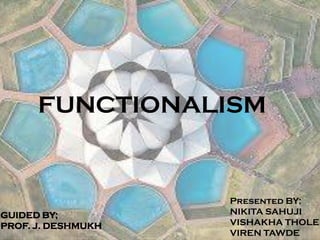
FUNCTIONALISM
GUIDED BY;
PROF. J. DESHMUKH
Presented BY;
NIKITA SAHUJI
VISHAKHA THOLE
VIREN TAWDE
WHAT IS FUNCTIONALISM ?
FUNCTIONALISM IS DESIGNING
ACCORDING TO FUNCTION OF
THE BUILDING
HOW DID IT COME TO PICTURE ?
Can be traced back to Vitruvian theory of Utilitarian
architecture.
Idea by Louis Sullvian and practisced by Le corbusier
widely.
 Associated with the modern style of architecture
LOUIS SULLIVAN LE CORBUSIERLE CORBUSIER
WHAT ARE FEATURES OF FUNCTIONALISM ?
Low levels of ornamentation and
extraneous decoration.
Prominent display of raw materials.
FORM FOLLOWS FUNCTION ie; function
comes first, The apperance and shape is of
secondary concern.
What is the function of an auditorium ?
Good acoustics
Proper line of vision
Comfortable seatings
What gives a form to an auditorium ?
Shape and volume
Elevational treatment
Form and use of material
the pioneers
“It is the pervading law of all things… that
form ever follows function”
-Louis Sullivan
(1896)
Louis Sullivan, Guaranty Building,
Buffalo, New York, 1896
Bauhaus functionalism
German Institution established for rational social housing
for the workers after world war 1 by WALTER GROUPIUS
Rejected Bourgeois details like eaves, cornices and
decorative elements.
Used principles of Classical Architecture in its purest form
without any ornamentation
The design includes three
wings divided by function
(workshops, school, and
administration) and features a
glass curtain wall accentuated
by a steel frame.
Walter Gropius New School building,
Weimar, 1926
the pioneers
“The house is a machine for living in”
-Le Corbusier
Le Corbusier, Unite d’Habitation,
Marseilles, France, 1947-53
 The separation and visual
distinctiveness of public spaces
from the private apartments
 Colour is the only ornament.
 The stacking and interlocking of
individual apartments (like
bottles in a rack)
 The modular design and
proportions
 The 27 varieties of apartments
 The ventilation, and grid
planning.
 The views out to trees, parkland,
sea, mountains
Le Corbusier’s Unite
d’Habitation, Marseilles,
France, 1947-53
Functionalist features
the pioneers
Mies van der Rohe, Seagram
Building, New York, 1956-9
Who ever regrets that the house of the future
can no longer be constructed by craftsmen
should bare in mind that the motorcar is no
longer built by the wheelwright”
-Mies van der Rohe
BARCELONA PAVILION,1929:
Aim was to develop a free flowing space and use
least components and that is done by using walls as
planes.
Function of an exhibition space is satisfied to
extreme level.
Properly managed the play of lightened and dark
spaces
Use of stone and glass.
Served as a exhibition space for a long time , now
considered as heritage space.
Lotus temple, delhi,1986:
 It is a Bahai House of Worship of an impression of
half open lotus.
Justifies concept of function of FORM FOLLOWS
FUNCTION.
Serves as a Mother Temple to indian subcontinent.
The building is composed of 27 free-standing
marble-clad "petals" arranged in clusters of three to
form nine sides,[2] with nine doors opening onto a
central hall .
Brutalism
Celebrating concrete
(1950’s to 1970’s)
What is brutalism ?
HOW DID IT COME TO PICTURE ?
Coined by British architects Peter Smithson and Alison
Brutalism probably came from the prominent Modernist
architect Le Corbusier and his project for Unité
d’Habitation in 1952.
Brutalism became popular with governmental and
institutional clients, with numerous examples in English-
speaking countries.
 Modern architecture came to Britain quite late, and it was
then soon “replaced by Brutalism”.
What are features of functionalism ?
 Strong and bold geometric shapes  Use of reinforced Concrete
 Diagonal ,sloping and strongly curved
elements with massive horizontal and
vertical members.
 Using purest form of brick, concrete,
glass, etc.
Ronchamp Chappel ,France
Concert Hall, Japan
National Theatre, London
UCSD Library, California
the pioneers:
Le Corbusier across the world.
 Louis kahn’s Asian office buildings.
Paul Rudolf in America.
Modern Architect Tadao Ando in
Brazil
Charles Correa in India.
Le Corbusier’s Boston city hall , 1969:
 Boston City Hall is consists of the offices
of the Mayor of Boston and the Boston City
Council.
Designed by the precedents of Le
Corbusier, Gerhard Kallmann, Michael
McKinnell.
brutalist features:
Sculptural use of raw
concrete.
Heavy massy structure.
Use of slender base support
Maintaining the geometry
formed by RCC members
Pure geometrical forms clad
with sleek curtain walls
Articulated structure
expressing the internal
functions in rugged,
cantilevered concrete forms.
Yale school of architecture,
USA,1958 to 1965:
Paul Rudolf’s Modern Brutal building.
A seven storeyed building consisting studios,
exhibitions, lab, halls, etc
Interesting combination of terraces on each
level.
 The great revelation is the way the
muscularity of the exterior is used to disguise
the lightness of the interiors.
Yale school of architecture,
USA,1958 to 1965:
Fortress like building giving a massy look.
Textured with Concrete and layered with steel framed
glazing glass.
Intersecting volume of bulky concrete.
Concrete and glass supported by series of columns giving
look of turrets.
Play of light and shadow.
Charles Correa’s Ramkrishna
House, 1962–1964
A large brick concrete residence in ahemdabad in
1962 made for a mill owner
Vernacular architecture consists of two asymmetric
brick “sails”, which are connected by a body of exposed
concrete.
 The simple profile of the front collides with the
complex back side which consists of a combination of
geometric brick and concrete volumes.

Functionalism & Brutalism

  • 1.
    FUNCTIONALISM GUIDED BY; PROF. J.DESHMUKH Presented BY; NIKITA SAHUJI VISHAKHA THOLE VIREN TAWDE
  • 2.
  • 4.
    FUNCTIONALISM IS DESIGNING ACCORDINGTO FUNCTION OF THE BUILDING
  • 5.
    HOW DID ITCOME TO PICTURE ? Can be traced back to Vitruvian theory of Utilitarian architecture. Idea by Louis Sullvian and practisced by Le corbusier widely.  Associated with the modern style of architecture LOUIS SULLIVAN LE CORBUSIERLE CORBUSIER
  • 6.
    WHAT ARE FEATURESOF FUNCTIONALISM ? Low levels of ornamentation and extraneous decoration. Prominent display of raw materials. FORM FOLLOWS FUNCTION ie; function comes first, The apperance and shape is of secondary concern.
  • 7.
    What is thefunction of an auditorium ? Good acoustics Proper line of vision Comfortable seatings What gives a form to an auditorium ? Shape and volume Elevational treatment Form and use of material
  • 8.
    the pioneers “It isthe pervading law of all things… that form ever follows function” -Louis Sullivan (1896) Louis Sullivan, Guaranty Building, Buffalo, New York, 1896
  • 9.
    Bauhaus functionalism German Institutionestablished for rational social housing for the workers after world war 1 by WALTER GROUPIUS Rejected Bourgeois details like eaves, cornices and decorative elements. Used principles of Classical Architecture in its purest form without any ornamentation The design includes three wings divided by function (workshops, school, and administration) and features a glass curtain wall accentuated by a steel frame. Walter Gropius New School building, Weimar, 1926
  • 10.
    the pioneers “The houseis a machine for living in” -Le Corbusier Le Corbusier, Unite d’Habitation, Marseilles, France, 1947-53
  • 11.
     The separationand visual distinctiveness of public spaces from the private apartments  Colour is the only ornament.  The stacking and interlocking of individual apartments (like bottles in a rack)  The modular design and proportions  The 27 varieties of apartments  The ventilation, and grid planning.  The views out to trees, parkland, sea, mountains Le Corbusier’s Unite d’Habitation, Marseilles, France, 1947-53 Functionalist features
  • 12.
    the pioneers Mies vander Rohe, Seagram Building, New York, 1956-9 Who ever regrets that the house of the future can no longer be constructed by craftsmen should bare in mind that the motorcar is no longer built by the wheelwright” -Mies van der Rohe
  • 13.
    BARCELONA PAVILION,1929: Aim wasto develop a free flowing space and use least components and that is done by using walls as planes. Function of an exhibition space is satisfied to extreme level. Properly managed the play of lightened and dark spaces Use of stone and glass. Served as a exhibition space for a long time , now considered as heritage space.
  • 15.
    Lotus temple, delhi,1986: It is a Bahai House of Worship of an impression of half open lotus. Justifies concept of function of FORM FOLLOWS FUNCTION. Serves as a Mother Temple to indian subcontinent. The building is composed of 27 free-standing marble-clad "petals" arranged in clusters of three to form nine sides,[2] with nine doors opening onto a central hall .
  • 17.
  • 18.
  • 19.
    HOW DID ITCOME TO PICTURE ? Coined by British architects Peter Smithson and Alison Brutalism probably came from the prominent Modernist architect Le Corbusier and his project for Unité d’Habitation in 1952. Brutalism became popular with governmental and institutional clients, with numerous examples in English- speaking countries.  Modern architecture came to Britain quite late, and it was then soon “replaced by Brutalism”.
  • 20.
    What are featuresof functionalism ?  Strong and bold geometric shapes  Use of reinforced Concrete  Diagonal ,sloping and strongly curved elements with massive horizontal and vertical members.  Using purest form of brick, concrete, glass, etc. Ronchamp Chappel ,France Concert Hall, Japan National Theatre, London UCSD Library, California
  • 21.
    the pioneers: Le Corbusieracross the world.  Louis kahn’s Asian office buildings. Paul Rudolf in America. Modern Architect Tadao Ando in Brazil Charles Correa in India.
  • 22.
    Le Corbusier’s Bostoncity hall , 1969:  Boston City Hall is consists of the offices of the Mayor of Boston and the Boston City Council. Designed by the precedents of Le Corbusier, Gerhard Kallmann, Michael McKinnell.
  • 23.
    brutalist features: Sculptural useof raw concrete. Heavy massy structure. Use of slender base support Maintaining the geometry formed by RCC members Pure geometrical forms clad with sleek curtain walls Articulated structure expressing the internal functions in rugged, cantilevered concrete forms.
  • 24.
    Yale school ofarchitecture, USA,1958 to 1965: Paul Rudolf’s Modern Brutal building. A seven storeyed building consisting studios, exhibitions, lab, halls, etc Interesting combination of terraces on each level.  The great revelation is the way the muscularity of the exterior is used to disguise the lightness of the interiors.
  • 25.
    Yale school ofarchitecture, USA,1958 to 1965: Fortress like building giving a massy look. Textured with Concrete and layered with steel framed glazing glass. Intersecting volume of bulky concrete. Concrete and glass supported by series of columns giving look of turrets. Play of light and shadow.
  • 26.
    Charles Correa’s Ramkrishna House,1962–1964 A large brick concrete residence in ahemdabad in 1962 made for a mill owner Vernacular architecture consists of two asymmetric brick “sails”, which are connected by a body of exposed concrete.  The simple profile of the front collides with the complex back side which consists of a combination of geometric brick and concrete volumes.