CONTEMPORARY ARCHITECTURE
1920s- 1930s Architectural style
PRESENTED BY-
SAMIYA MAHWISH
YUSRA YASMEEN
M.ARCH(HEALTHCARE) SEM-1
Socio economic conditions during 1920s
■ In North America, it is frequently referred to as the "Roaring Twenties" or the "Jazz Age“ because of the
economic boom following World War I.
■ This period of prosperity was the result of a paradigm shift in global affairs.
■ These shifts in the 1920s, occurred in part as the result of the conclusion of World War I and Spanish
flu.(1918)
■ The era saw the large-scale adoption of automobiles, telephones, motion pictures, radio and household
electricity, as well as unprecedented industrial growth, accelerated consumer demand and aspirations, and
significant changes in lifestyle and culture.
■ In some countries the 1920s saw the rise of radical political movements, especially in regions that were once
part of empires.
■ Communism spread as a consequence of the Russian Revolution in Russia which dismantled the Tsarist
autocracy and led to the rise of the Soviet Union.
■ But for the UK economy it was a period of depression, deflation and a steady decline in the UK’s former
economic pre-eminence.
■ After the post-war boom of 1919-20 ended, UK unemployment rose sharply to over 10%, and stayed high
until the Second World War.
SOCIETAL DYNAMICS DUE TO WORLD WAR I(1920s – 1930s)
Economical Aspects
•Economically, the war severely disrupted the European economies and allowed the United States to become the
world's leading creditor and industrial power. That is why, the architecture in Europe got shifted towards simple and
pure forms. And in America a new style was founded which is the combination of simpler forms with little
ornamentation.
Political Aspects
• The status of the aristocracy was diminished. The distribution of income shifted in favor of the poor.
Social Aspects
• Due to the downfall of aristocracy the focus got shifted on meeting the needs of the middle and working
classes.
Cultural Aspects
•After world war 1 there were global exchange of ideas and way of living that led the people got influenced by each
other.
CHANGES IN
ARCHITECTURE
AFTER WORLD
WAR I
After World War I, pioneering modernist architects sought to develop a completely new
style appropriate for a new post-war social and economic order, focused on meeting the
needs of the middle and working classes.
Rejected the architectural practice of the academic refinement of historical styles
The approach of the Modernist architects was to reduce buildings to pure forms.
The nineteen twenties brought a feeling of freedom and independence to millions of
Americans, especially young Americans who fought in the world war I. They come up with
new ideas of way of living.
Earlier modernism was only a national movement but after the world war it spreads
internationaly. This led to the establishment and rise of the extreme form of modernism
during early 1920s.
FACTORS THAT HELP
SHAPING MODERNISM
Technological advancement- In the period of the 1900, the world at the time was a bustling
place that was shaped new discoveries of the inventions and new technological advancement
that were thrust to the civilization.
Philosophical theoreticians changed the way that modern perceives the modern world. The
modernist were militant about distancing themselves from every traditional idea .
Economy -The science and the technology were the radical change means to the production
Growing tension and the social order
The diverse cultures in the world.
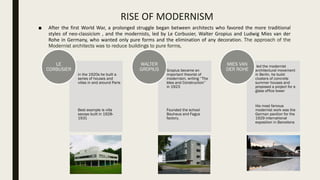
in the 1920s he built a
series of houses and
villas in and around Paris
Best example is villa
savoye built in 1928-
1931
LE
CORBUSIER Gropius became an
important theorist of
modernism, writing ‘’The
Idea and Construction’’
in 1923
Founded the school
Bauhaus and Fagus
factory.
WALTER
GROPIUS
led the modernist
architectural movement
in Berlin. he build
clusters of concrete
summer houses and
proposed a project for a
glass office tower
His most famous
modernist work was the
German pavilion for the
1929 international
exposition in Barcelona
MIES VAN
DER ROHE
RISE OF MODERNISM
■ After the first World War, a prolonged struggle began between architects who favored the more traditional
styles of neo-classicism , and the modernists, led by Le Corbusier, Walter Gropius and Ludwig Mies van der
Rohe in Germany, who wanted only pure forms and the elimination of any decoration. The approach of the
Modernist architects was to reduce buildings to pure forms,
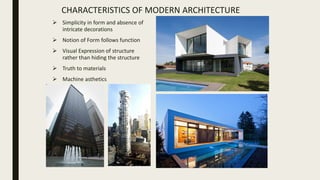
CHARACTERISTICS OF MODERN ARCHITECTURE
 Simplicity in form and absence of
intricate decorations
 Notion of Form follows function
 Visual Expression of structure
rather than hiding the structure
 Truth to materials
 Machine asthetics
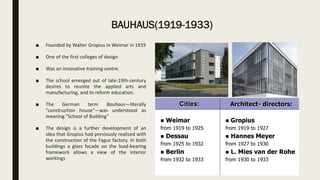
BAUHAUS(1919-1933)
■ Founded by Walter Gropius in Weimar in 1919
■ One of the first colleges of design
■ Was an innovative training centre.
■ The school emerged out of late-19th-century
desires to reunite the applied arts and
manufacturing, and to reform education.
■ The German term Bauhaus—literally
"construction house"—was understood as
meaning "School of Building"
■ The design is a further development of an
idea that Gropius had previously realised with
the construction of the Fagus factory. In both
buildings a glass facade on the load-bearing
framework allows a view of the interior
workings
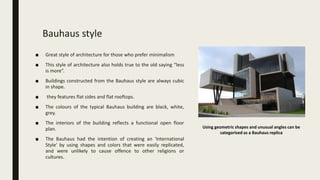
Bauhaus style
■ Great style of architecture for those who prefer minimalism
■ This style of architecture also holds true to the old saying “less
is more”.
■ Buildings constructed from the Bauhaus style are always cubic
in shape.
■ they features flat sides and flat rooftops.
■ The colours of the typical Bauhaus building are black, white,
grey.
■ The interiors of the building reflects a functional open floor
plan.
■ The Bauhaus had the intention of creating an 'International
Style' by using shapes and colors that were easily replicated,
and were unlikely to cause offence to other religions or
cultures.
Using geometric shapes and unusual angles can be
categorised as a Bauhaus replica
INTERNATIONAL STYLE
■ Developed in Europe and the United States in the 1920s and
’30s
■ Became the dominant tendency in Western
architecture during the middle decades of the 20th century.
■ The term International Style was first used in 1932
by Henry-Russell Hitchcock and Philip Johnson in an
architectural exhibition .
■ The International Style was thus formed under the dictates
that modern buildings’ form and appearance should
naturally grow out of and express the potentialities of their
materials and structural engineering.
■ Hitchcock and Johnson identified three principles: the
expression of volume rather than mass, the emphasis on
balance rather than preconceived symmetry, and the
expulsion of applied ornament.
■ The aim of Hitchcock and Johnson was to define a style that
would encapsulate this modern architecture.
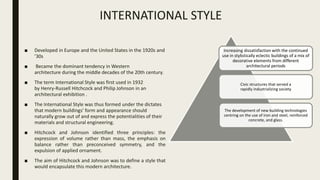
Increasing dissatisfaction with the continued
use in stylistically eclectic buildings of a mix of
decorative elements from different
architectural periods
Civic structures that served a
rapidly industrializing society
The development of new building technologies
centring on the use of iron and steel, reinforced
concrete, and glass.
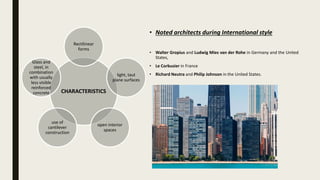
CHARACTERISTICS
Rectilinear
forms
light, taut
plane surfaces
open interior
spaces
use of
cantilever
construction
Glass and
steel, in
combination
with usually
less visible
reinforced
concrete
• Noted architects during International style
• Walter Gropius and Ludwig Mies van der Rohe in Germany and the United
States,
• Le Corbusier in France
• Richard Neutra and Philip Johnson in the United States.
EXPRESSIONISM(1919-1933)
■ Expressionism was a modernist movement, initially in poetry and painting, originating in Germany at the
beginning of 20th century.
■ Typical trait is to present the world solely from a subjective perspective distorting it radially for emotional
effects in order to evoke moods or ideas.
■ Expressionism was developed as an Avant Garde style before the first world war.
■ The style extended to a wide range of the arts including expressionist architecture, painting, literature,
theatre, dance, film and music.
WHAT IS EXPRESSIONIST ARCHITECTURE?
■ Expressionist architecture was an architectural movement that developed in Europe during the first decades
of the 20th century in parallel with the expressionist visual and performing arts that especially developed and
dominated in Germany.
■ Expressionism transforms reality rather than seeking to imitate it.
■ The genesis of expressionism lies in art nouveau.
■ Art nouveau, a decorative art convention turned to bionic and geomorphic forms.
EXPRESSIONIST ARCHITECTS :
Adolf Behne
Hermann Finsterlin
Hugo Häring
Fritz Höger
Michel de Klerk
Piet Kramer
Carl Krayl
Erich Mendelsohn
Hans Poelzig
Hans Scharoun
Rudolf Steiner
Bruno Taut
EXPRESSIONISMCHARACTERISTICS
■ Distortion of form for emotional effect.
■ Subordination of realism to symbolic or stylistic expression of inner
experience.
■ An underlying effort at achieving the new, original and visionary forms.
■ Abundance work on papers and models with discovery and
representation of concepts.
■ Tendency more towards gothic that the classical style.
■ BRICK EXPRESSIONISM. Expressionism that uses brick as main visible
building material.
■ ABSTRACT EXPRESSIONISM.
■ NEO EXPRESSIONISM
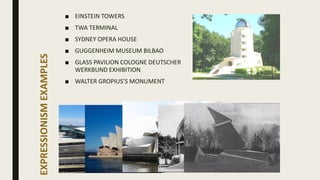
EXPRESSIONISMEXAMPLES
■ EINSTEIN TOWERS
■ TWA TERMINAL
■ SYDNEY OPERA HOUSE
■ GUGGENHEIM MUSEUM BILBAO
■ GLASS PAVILION COLOGNE DEUTSCHER
WERKBUND EXHIBITION
■ WALTER GROPIUS’S MONUMENT
ART DECO STYLE (1910-1939)
ORIGIN
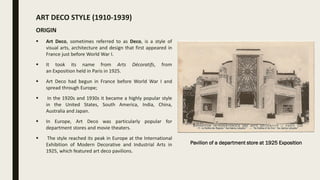
 Art Deco, sometimes referred to as Deco, is a style of
visual arts, architecture and design that first appeared in
France just before World War I.
 It took its name from Arts Décoratifs, from
an Exposition held in Paris in 1925.
 Art Deco had begun in France before World War I and
spread through Europe;
 In the 1920s and 1930s it became a highly popular style
in the United States, South America, India, China,
Australia and Japan.
 In Europe, Art Deco was particularly popular for
department stores and movie theaters.
 The style reached its peak in Europe at the International
Exhibition of Modern Decorative and Industrial Arts in
1925, which featured art deco pavilions.
Pavilion of a department store at 1925 Exposition
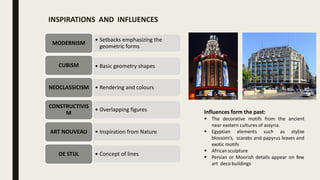
INSPIRATIONS AND INFLUENCES
Influences form the past:
 The decorative motifs from the ancient
near eastern cultures of assyria.
 Egyptian elements such as stylize
blossom’s, scarabs and papyrus leaves and
exotic motifs
 Africansculpture
 Persian or Moorish details appear on few
art deco buildings
• Setbacks emphasizing the
geometric forms
MODERNISM
• Basic geometry shapesCUBISM
• Rendering and coloursNEOCLASSICISM
• Overlapping figures
CONSTRUCTIVIS
M
• Inspiration from NatureART NOUVEAU
• Concept of linesDE STIJL
CHARACTERISTIC FEATURES:
■ It combined very expensive materials and exquisite
craftsmanship put into modernistic forms.
■ It had many features of modernism and it rejected traditional
historical models, such as the Beaux-Arts style and Neo-
classicism;
■ Ornamentation in the form of panels, cornices, parapets,
Window and door
■ Terra-cotta, colored glass, glass block, and various exposed
metals for ornamentation.
■ Materials include jade, linoleum, steel, plastics, chrome, and
Bakelite. Metal was a perfect representation of what Art Deco
strove to represent, which was strength and industrial might .
■ Notable architects of this movement were Raymond Hood,
William Van Allen(Chrysler building), Donald Deskey(Radio city
music hall),Victor Horta, Wirt C. Rowland, William F. Lamb,
Stepped forms and geometric curves
Flat roofs with parapets, spires, or
tower-like constructs
Decorative ornamentation on windows
and doors
Polychromatic decorative glass
Stylized sculptural, floral and sunrise
patterns
4
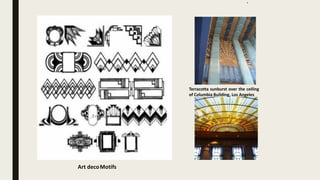
Art decoMotifs
Terracotta sunburst over the ceiling
of Columbia Building, Los Angeles
FACTORS
LEADING TO
THE
EMERGENCE OF
ART DECO
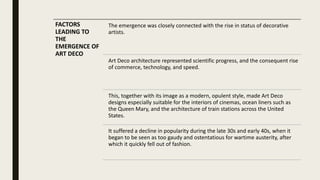
The emergence was closely connected with the rise in status of decorative
artists.
Art Deco architecture represented scientific progress, and the consequent rise
of commerce, technology, and speed.
This, together with its image as a modern, opulent style, made Art Deco
designs especially suitable for the interiors of cinemas, ocean liners such as
the Queen Mary, and the architecture of train stations across the United
States.
It suffered a decline in popularity during the late 30s and early 40s, when it
began to be seen as too gaudy and ostentatious for wartime austerity, after
which it quickly fell out of fashion.
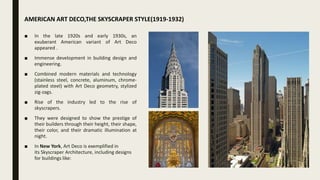
■ In the late 1920s and early 1930s, an
exuberant American variant of Art Deco
appeared .
■ Immense development in building design and
engineering.
■ Combined modern materials and technology
(stainless steel, concrete, aluminum, chrome-
plated steel) with Art Deco geometry, stylized
zig-zags.
■ Rise of the industry led to the rise of
skyscrapers.
■ They were designed to show the prestige of
their builders through their height, their shape,
their color, and their dramatic illumination at
night.
■ In New York, Art Deco is exemplified in
its Skyscraper Architecture, including designs
for buildings like:
AMERICAN ART DECO,THE SKYSCRAPER STYLE(1919-1932)
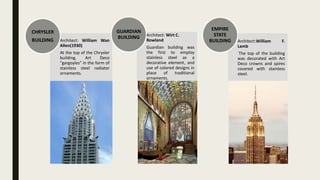
Architect: William Wan
Allen(1930)
At the top of the Chrysler
building, Art Deco
"gargoyles" in the form of
stainless steel radiator
ornaments.
CHRYSLER
BUILDING
Architect: Wirt C.
Rowland
Guardian building was
the first to employ
stainless steel as a
decorative element, and
use of colored designs in
place of traditional
ornaments.
GUARDIAN
BUILDING
Architect:William F.
Lamb
The top of the building
was decorated with Art
Deco crowns and spires
covered with stainless
steel.
EMPIRE
STATE
BUILDING
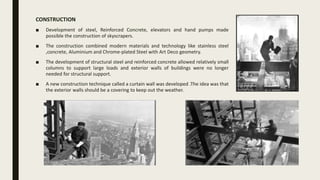
CONSTRUCTION
■ Development of steel, Reinforced Concrete, elevators and hand pumps made
possible the construction of skyscrapers.
■ The construction combined modern materials and technology like stainless steel
,concrete, Aluminium and Chrome-plated Steel with Art Deco geometry.
■ The development of structural steel and reinforced concrete allowed relatively small
columns to support large loads and exterior walls of buildings were no longer
needed for structural support.
■ A new construction technique called a curtain wall was developed .The idea was that
the exterior walls should be a covering to keep out the weather.
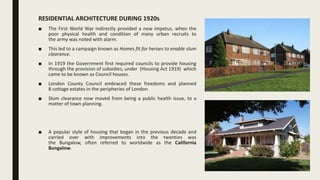
RESIDENTIAL ARCHITECTURE DURING 1920s
■ The First World War indirectly provided a new impetus, when the
poor physical health and condition of many urban recruits to
the army was noted with alarm.
■ This led to a campaign known as Homes fit for heroes to enable slum
clearance.
■ In 1919 the Government first required councils to provide housing
through the provision of subsidies, under (Housing Act 1919) which
came to be known as Council houses.
■ London County Council embraced these freedoms and planned
8 cottage estates in the peripheries of London
■ Slum clearance now moved from being a public health issue, to a
matter of town planning.
■ A popular style of housing that began in the previous decade and
carried over with improvements into the twenties was
the Bungalow, often referred to worldwide as the California
Bungalow.
OTHER ARCHITECTURAL MOVEMENTS:
DE STIJL
■ First conceived in 1917 and prevalent upto 1931 in the Netherlands, De Stijl was introduced as a total style centered
around the idea to fathom the purity of form and the reality of nature.
■ Having an awareness of a purified, universal form, De Stijl architecture was seminal for the development of what we
today know as Modern architecture.
■ Notable De Stijl architects were Gerrit Rietveld, J.J.P. Oud, Bart Van der Lack, Cornelis van Eesteren, Jan Wils,
and Robert van ‘t Hoff.
FRANK LLOYD WRIGHT MAYAN STYLE
■ Meanwhile, in the United States, Frank Lloyd Wright refused to associate himself with any architectural movements
considering his work to be entirely unique.
■ During the 1920s, he developed his “Mayan style”, houses decorated with textured blocks of cement.
■ He identified his architecture as “Usonian”, a combination of USA, “utopian” and “organic social order”.

Contemporary Architecture (1920 1930) globally

  • 1.
    CONTEMPORARY ARCHITECTURE 1920s- 1930sArchitectural style PRESENTED BY- SAMIYA MAHWISH YUSRA YASMEEN M.ARCH(HEALTHCARE) SEM-1
  • 2.
    Socio economic conditionsduring 1920s ■ In North America, it is frequently referred to as the "Roaring Twenties" or the "Jazz Age“ because of the economic boom following World War I. ■ This period of prosperity was the result of a paradigm shift in global affairs. ■ These shifts in the 1920s, occurred in part as the result of the conclusion of World War I and Spanish flu.(1918) ■ The era saw the large-scale adoption of automobiles, telephones, motion pictures, radio and household electricity, as well as unprecedented industrial growth, accelerated consumer demand and aspirations, and significant changes in lifestyle and culture. ■ In some countries the 1920s saw the rise of radical political movements, especially in regions that were once part of empires. ■ Communism spread as a consequence of the Russian Revolution in Russia which dismantled the Tsarist autocracy and led to the rise of the Soviet Union. ■ But for the UK economy it was a period of depression, deflation and a steady decline in the UK’s former economic pre-eminence. ■ After the post-war boom of 1919-20 ended, UK unemployment rose sharply to over 10%, and stayed high until the Second World War.
  • 3.
    SOCIETAL DYNAMICS DUETO WORLD WAR I(1920s – 1930s) Economical Aspects •Economically, the war severely disrupted the European economies and allowed the United States to become the world's leading creditor and industrial power. That is why, the architecture in Europe got shifted towards simple and pure forms. And in America a new style was founded which is the combination of simpler forms with little ornamentation. Political Aspects • The status of the aristocracy was diminished. The distribution of income shifted in favor of the poor. Social Aspects • Due to the downfall of aristocracy the focus got shifted on meeting the needs of the middle and working classes. Cultural Aspects •After world war 1 there were global exchange of ideas and way of living that led the people got influenced by each other.
  • 4.
    CHANGES IN ARCHITECTURE AFTER WORLD WARI After World War I, pioneering modernist architects sought to develop a completely new style appropriate for a new post-war social and economic order, focused on meeting the needs of the middle and working classes. Rejected the architectural practice of the academic refinement of historical styles The approach of the Modernist architects was to reduce buildings to pure forms. The nineteen twenties brought a feeling of freedom and independence to millions of Americans, especially young Americans who fought in the world war I. They come up with new ideas of way of living. Earlier modernism was only a national movement but after the world war it spreads internationaly. This led to the establishment and rise of the extreme form of modernism during early 1920s.
  • 5.
    FACTORS THAT HELP SHAPINGMODERNISM Technological advancement- In the period of the 1900, the world at the time was a bustling place that was shaped new discoveries of the inventions and new technological advancement that were thrust to the civilization. Philosophical theoreticians changed the way that modern perceives the modern world. The modernist were militant about distancing themselves from every traditional idea . Economy -The science and the technology were the radical change means to the production Growing tension and the social order The diverse cultures in the world.
  • 6.
    in the 1920she built a series of houses and villas in and around Paris Best example is villa savoye built in 1928- 1931 LE CORBUSIER Gropius became an important theorist of modernism, writing ‘’The Idea and Construction’’ in 1923 Founded the school Bauhaus and Fagus factory. WALTER GROPIUS led the modernist architectural movement in Berlin. he build clusters of concrete summer houses and proposed a project for a glass office tower His most famous modernist work was the German pavilion for the 1929 international exposition in Barcelona MIES VAN DER ROHE RISE OF MODERNISM ■ After the first World War, a prolonged struggle began between architects who favored the more traditional styles of neo-classicism , and the modernists, led by Le Corbusier, Walter Gropius and Ludwig Mies van der Rohe in Germany, who wanted only pure forms and the elimination of any decoration. The approach of the Modernist architects was to reduce buildings to pure forms,
  • 7.
    CHARACTERISTICS OF MODERNARCHITECTURE  Simplicity in form and absence of intricate decorations  Notion of Form follows function  Visual Expression of structure rather than hiding the structure  Truth to materials  Machine asthetics
  • 8.
    BAUHAUS(1919-1933) ■ Founded byWalter Gropius in Weimar in 1919 ■ One of the first colleges of design ■ Was an innovative training centre. ■ The school emerged out of late-19th-century desires to reunite the applied arts and manufacturing, and to reform education. ■ The German term Bauhaus—literally "construction house"—was understood as meaning "School of Building" ■ The design is a further development of an idea that Gropius had previously realised with the construction of the Fagus factory. In both buildings a glass facade on the load-bearing framework allows a view of the interior workings
  • 9.
    Bauhaus style ■ Greatstyle of architecture for those who prefer minimalism ■ This style of architecture also holds true to the old saying “less is more”. ■ Buildings constructed from the Bauhaus style are always cubic in shape. ■ they features flat sides and flat rooftops. ■ The colours of the typical Bauhaus building are black, white, grey. ■ The interiors of the building reflects a functional open floor plan. ■ The Bauhaus had the intention of creating an 'International Style' by using shapes and colors that were easily replicated, and were unlikely to cause offence to other religions or cultures. Using geometric shapes and unusual angles can be categorised as a Bauhaus replica
  • 10.
    INTERNATIONAL STYLE ■ Developedin Europe and the United States in the 1920s and ’30s ■ Became the dominant tendency in Western architecture during the middle decades of the 20th century. ■ The term International Style was first used in 1932 by Henry-Russell Hitchcock and Philip Johnson in an architectural exhibition . ■ The International Style was thus formed under the dictates that modern buildings’ form and appearance should naturally grow out of and express the potentialities of their materials and structural engineering. ■ Hitchcock and Johnson identified three principles: the expression of volume rather than mass, the emphasis on balance rather than preconceived symmetry, and the expulsion of applied ornament. ■ The aim of Hitchcock and Johnson was to define a style that would encapsulate this modern architecture. Increasing dissatisfaction with the continued use in stylistically eclectic buildings of a mix of decorative elements from different architectural periods Civic structures that served a rapidly industrializing society The development of new building technologies centring on the use of iron and steel, reinforced concrete, and glass.
  • 11.
    CHARACTERISTICS Rectilinear forms light, taut plane surfaces openinterior spaces use of cantilever construction Glass and steel, in combination with usually less visible reinforced concrete • Noted architects during International style • Walter Gropius and Ludwig Mies van der Rohe in Germany and the United States, • Le Corbusier in France • Richard Neutra and Philip Johnson in the United States.
  • 12.
    EXPRESSIONISM(1919-1933) ■ Expressionism wasa modernist movement, initially in poetry and painting, originating in Germany at the beginning of 20th century. ■ Typical trait is to present the world solely from a subjective perspective distorting it radially for emotional effects in order to evoke moods or ideas. ■ Expressionism was developed as an Avant Garde style before the first world war. ■ The style extended to a wide range of the arts including expressionist architecture, painting, literature, theatre, dance, film and music. WHAT IS EXPRESSIONIST ARCHITECTURE? ■ Expressionist architecture was an architectural movement that developed in Europe during the first decades of the 20th century in parallel with the expressionist visual and performing arts that especially developed and dominated in Germany. ■ Expressionism transforms reality rather than seeking to imitate it. ■ The genesis of expressionism lies in art nouveau. ■ Art nouveau, a decorative art convention turned to bionic and geomorphic forms.
  • 13.
    EXPRESSIONIST ARCHITECTS : AdolfBehne Hermann Finsterlin Hugo Häring Fritz Höger Michel de Klerk Piet Kramer Carl Krayl Erich Mendelsohn Hans Poelzig Hans Scharoun Rudolf Steiner Bruno Taut
  • 14.
    EXPRESSIONISMCHARACTERISTICS ■ Distortion ofform for emotional effect. ■ Subordination of realism to symbolic or stylistic expression of inner experience. ■ An underlying effort at achieving the new, original and visionary forms. ■ Abundance work on papers and models with discovery and representation of concepts. ■ Tendency more towards gothic that the classical style. ■ BRICK EXPRESSIONISM. Expressionism that uses brick as main visible building material. ■ ABSTRACT EXPRESSIONISM. ■ NEO EXPRESSIONISM
  • 15.
    EXPRESSIONISMEXAMPLES ■ EINSTEIN TOWERS ■TWA TERMINAL ■ SYDNEY OPERA HOUSE ■ GUGGENHEIM MUSEUM BILBAO ■ GLASS PAVILION COLOGNE DEUTSCHER WERKBUND EXHIBITION ■ WALTER GROPIUS’S MONUMENT
  • 16.
    ART DECO STYLE(1910-1939) ORIGIN  Art Deco, sometimes referred to as Deco, is a style of visual arts, architecture and design that first appeared in France just before World War I.  It took its name from Arts Décoratifs, from an Exposition held in Paris in 1925.  Art Deco had begun in France before World War I and spread through Europe;  In the 1920s and 1930s it became a highly popular style in the United States, South America, India, China, Australia and Japan.  In Europe, Art Deco was particularly popular for department stores and movie theaters.  The style reached its peak in Europe at the International Exhibition of Modern Decorative and Industrial Arts in 1925, which featured art deco pavilions. Pavilion of a department store at 1925 Exposition
  • 17.
    INSPIRATIONS AND INFLUENCES Influencesform the past:  The decorative motifs from the ancient near eastern cultures of assyria.  Egyptian elements such as stylize blossom’s, scarabs and papyrus leaves and exotic motifs  Africansculpture  Persian or Moorish details appear on few art deco buildings • Setbacks emphasizing the geometric forms MODERNISM • Basic geometry shapesCUBISM • Rendering and coloursNEOCLASSICISM • Overlapping figures CONSTRUCTIVIS M • Inspiration from NatureART NOUVEAU • Concept of linesDE STIJL
  • 18.
    CHARACTERISTIC FEATURES: ■ Itcombined very expensive materials and exquisite craftsmanship put into modernistic forms. ■ It had many features of modernism and it rejected traditional historical models, such as the Beaux-Arts style and Neo- classicism; ■ Ornamentation in the form of panels, cornices, parapets, Window and door ■ Terra-cotta, colored glass, glass block, and various exposed metals for ornamentation. ■ Materials include jade, linoleum, steel, plastics, chrome, and Bakelite. Metal was a perfect representation of what Art Deco strove to represent, which was strength and industrial might . ■ Notable architects of this movement were Raymond Hood, William Van Allen(Chrysler building), Donald Deskey(Radio city music hall),Victor Horta, Wirt C. Rowland, William F. Lamb, Stepped forms and geometric curves Flat roofs with parapets, spires, or tower-like constructs Decorative ornamentation on windows and doors Polychromatic decorative glass Stylized sculptural, floral and sunrise patterns
  • 19.
    4 Art decoMotifs Terracotta sunburstover the ceiling of Columbia Building, Los Angeles
  • 20.
    FACTORS LEADING TO THE EMERGENCE OF ARTDECO The emergence was closely connected with the rise in status of decorative artists. Art Deco architecture represented scientific progress, and the consequent rise of commerce, technology, and speed. This, together with its image as a modern, opulent style, made Art Deco designs especially suitable for the interiors of cinemas, ocean liners such as the Queen Mary, and the architecture of train stations across the United States. It suffered a decline in popularity during the late 30s and early 40s, when it began to be seen as too gaudy and ostentatious for wartime austerity, after which it quickly fell out of fashion.
  • 21.
    ■ In thelate 1920s and early 1930s, an exuberant American variant of Art Deco appeared . ■ Immense development in building design and engineering. ■ Combined modern materials and technology (stainless steel, concrete, aluminum, chrome- plated steel) with Art Deco geometry, stylized zig-zags. ■ Rise of the industry led to the rise of skyscrapers. ■ They were designed to show the prestige of their builders through their height, their shape, their color, and their dramatic illumination at night. ■ In New York, Art Deco is exemplified in its Skyscraper Architecture, including designs for buildings like: AMERICAN ART DECO,THE SKYSCRAPER STYLE(1919-1932)
  • 22.
    Architect: William Wan Allen(1930) Atthe top of the Chrysler building, Art Deco "gargoyles" in the form of stainless steel radiator ornaments. CHRYSLER BUILDING Architect: Wirt C. Rowland Guardian building was the first to employ stainless steel as a decorative element, and use of colored designs in place of traditional ornaments. GUARDIAN BUILDING Architect:William F. Lamb The top of the building was decorated with Art Deco crowns and spires covered with stainless steel. EMPIRE STATE BUILDING
  • 23.
    CONSTRUCTION ■ Development ofsteel, Reinforced Concrete, elevators and hand pumps made possible the construction of skyscrapers. ■ The construction combined modern materials and technology like stainless steel ,concrete, Aluminium and Chrome-plated Steel with Art Deco geometry. ■ The development of structural steel and reinforced concrete allowed relatively small columns to support large loads and exterior walls of buildings were no longer needed for structural support. ■ A new construction technique called a curtain wall was developed .The idea was that the exterior walls should be a covering to keep out the weather.
  • 24.
    RESIDENTIAL ARCHITECTURE DURING1920s ■ The First World War indirectly provided a new impetus, when the poor physical health and condition of many urban recruits to the army was noted with alarm. ■ This led to a campaign known as Homes fit for heroes to enable slum clearance. ■ In 1919 the Government first required councils to provide housing through the provision of subsidies, under (Housing Act 1919) which came to be known as Council houses. ■ London County Council embraced these freedoms and planned 8 cottage estates in the peripheries of London ■ Slum clearance now moved from being a public health issue, to a matter of town planning. ■ A popular style of housing that began in the previous decade and carried over with improvements into the twenties was the Bungalow, often referred to worldwide as the California Bungalow.
  • 25.
    OTHER ARCHITECTURAL MOVEMENTS: DESTIJL ■ First conceived in 1917 and prevalent upto 1931 in the Netherlands, De Stijl was introduced as a total style centered around the idea to fathom the purity of form and the reality of nature. ■ Having an awareness of a purified, universal form, De Stijl architecture was seminal for the development of what we today know as Modern architecture. ■ Notable De Stijl architects were Gerrit Rietveld, J.J.P. Oud, Bart Van der Lack, Cornelis van Eesteren, Jan Wils, and Robert van ‘t Hoff. FRANK LLOYD WRIGHT MAYAN STYLE ■ Meanwhile, in the United States, Frank Lloyd Wright refused to associate himself with any architectural movements considering his work to be entirely unique. ■ During the 1920s, he developed his “Mayan style”, houses decorated with textured blocks of cement. ■ He identified his architecture as “Usonian”, a combination of USA, “utopian” and “organic social order”.