Rebecca Ferguson
The Open University, UK
Learning analytics:
facing up to the challenges
slideshare.net/R3beccaF
@NYU_LEARN
Learning analytics
The measurement, collection,
analysis and reporting of data
about learners and their
contexts, for purposes of
understanding and optimizing
learning and the environments
in which it occurs.
Ethics
• What is worth
seeking — that is,
what ends or goals
of life are good?
• What are
individuals
responsible for —
that is, what
duties should they
recognize and
attempt to fulfill?
Willis, Pistilli & Campbell. (2013).
Ethics, big data, and analytics.
Educause Review Online
Learning analytics help us
to identify and make sense
of patterns in the data
to improve our teaching,
our learning and
our learning environments
Privacy
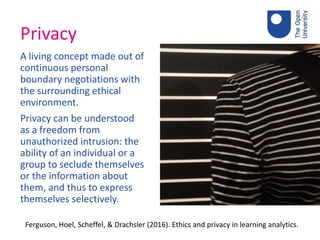
A living concept made out of
continuous personal
boundary negotiations with
the surrounding ethical
environment.
Privacy can be understood
as a freedom from
unauthorized intrusion: the
ability of an individual or a
group to seclude themselves
or the information about
them, and thus to express
themselves selectively.
Ferguson, Hoel, Scheffel, & Drachsler (2016). Ethics and privacy in learning analytics.
Privacy & data protection
Willis, Pistilli & Campbell. (2013).
Ethics, big data, and analytics.
Educause Review Online
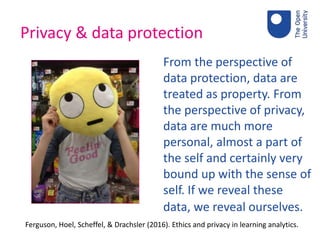
From the perspective of
data protection, data are
treated as property. From
the perspective of privacy,
data are much more
personal, almost a part of
the self and certainly very
bound up with the sense of
self. If we reveal these
data, we reveal ourselves.
Ferguson, Hoel, Scheffel, & Drachsler (2016). Ethics and privacy in learning analytics.
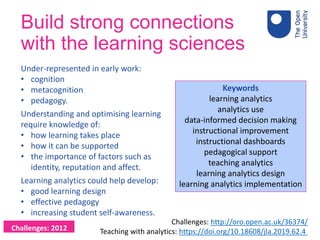
Build strong connections
with the learning sciences
Under-represented in early work:
• cognition
• metacognition
• pedagogy.
Understanding and optimising learning
require knowledge of:
• how learning takes place
• how it can be supported
• the importance of factors such as
identity, reputation and affect.
Learning analytics could help develop:
• good learning design
• effective pedagogy
• increasing student self-awareness.
Challenges: http://oro.open.ac.uk/36374/
Teaching with analytics: https://doi.org/10.18608/jla.2019.62.4
Keywords
learning analytics
analytics use
data-informed decision making
instructional improvement
instructional dashboards
pedagogical support
teaching analytics
learning analytics design
learning analytics implementation
Challenges: 2012
H
Reflection opportunity
How do you make
the links between
pedagogy and
learning analytics in
your work?
How could you make
them more clearly?
@NYU_LEARN
Develop
methods of
working with a
wide range of
datasets
in order to
optimise
learning
environments
Challenges: 2012
“…automated techniques are able to
extract information with an efficiency that
is beyond the capabilities of human-
coders, providing the means to deal
analytically with the multiple modalities
that characterize the classroom. Once
generated, the information provided by
the different modalities is used to explain
and predict high-level constructs such as
students’ attention and engagement.”
Chan, Ochoa, Clarke (2020): Multimodal Learning Analytics in a Laboratory Classroom
H
Reflection opportunity
Which problem does
your work solve for
learners?
How did they solve
that problem in the
past?
@NYU_LEARN
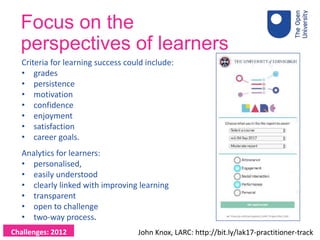
Focus on the
perspectives of learners
Criteria for learning success could include:
• grades
• persistence
• motivation
• confidence
• enjoyment
• satisfaction
• career goals.
Analytics for learners:
• personalised,
• easily understood
• clearly linked with improving learning
• transparent
• open to challenge
• two-way process.
John Knox, LARC: http://bit.ly/lak17-practitioner-trackChallenges: 2012
H
Reflection opportunity
What does success
look like from your
learners’ perspective?
How could your
analytics do more to
help your learners
achieve their goals?
@NYU_LEARN
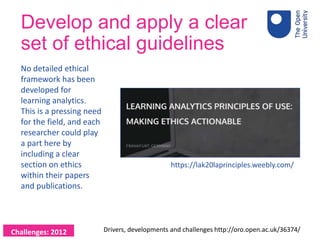
Develop and apply a clear
set of ethical guidelines
No detailed ethical
framework has been
developed for
learning analytics.
This is a pressing need
for the field, and each
researcher could play
a part here by
including a clear
section on ethics
within their papers
and publications.
Drivers, developments and challenges http://oro.open.ac.uk/36374/Challenges: 2012
https://lak20laprinciples.weebly.com/
H
Reflection opportunity
What are the most
important ethical
decisions you have
made about learning
analytics?
How could you share
these?
@NYU_LEARN
Full report
bit.ly/28X5tq7
Visions of
the future
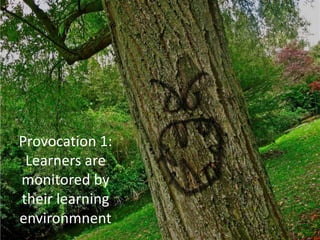
Provocation 1:
Learners are
monitored by
their learning
environmnent
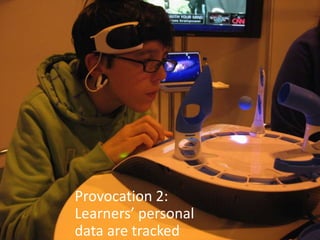
Provocation 2:
Learners’ personal
data are tracked
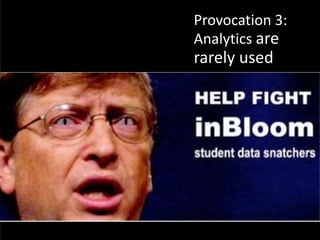
Provocation 3:
Analytics are
rarely used
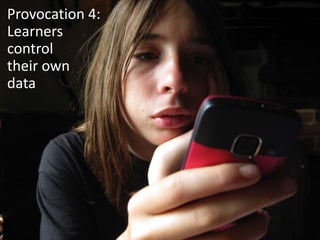
Provocation 4:
Learners
control
their own
data
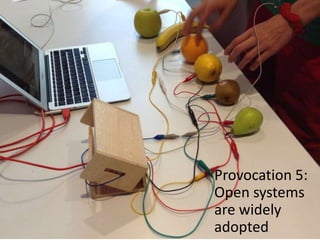
Provocation 5:
Open systems
are widely
adopted
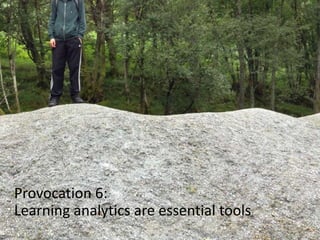
Provocation 6:
Learning analytics are essential tools
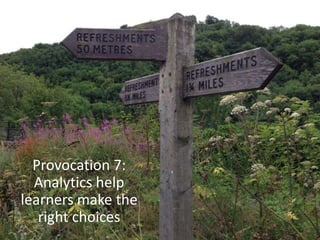
Provocation 7:
Analytics help
learners make the
right choices
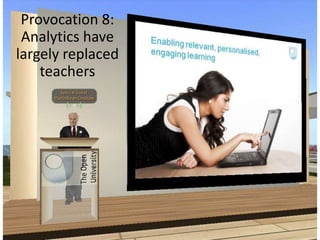
Provocation 8:
Analytics have
largely replaced
teachers
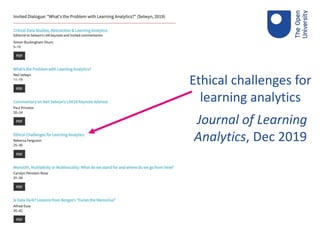
Ethical challenges for
learning analytics
Journal of Learning
Analytics, Dec 2019
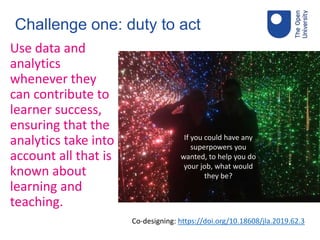
Challenge one: duty to act
Use data and
analytics
whenever they
can contribute to
learner success,
ensuring that the
analytics take into
account all that is
known about
learning and
teaching.
Co-designing: https://doi.org/10.18608/jla.2019.62.3
If you could have any
superpowers you
wanted, to help you do
your job, what would
they be?
H
Reflection opportunity
When do the learners
and educators you
work with really need
analytics and data?
What would happen
if they no longer had
access to analytics
and data?
@NYU_LEARN
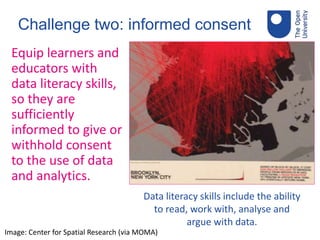
Challenge two: informed consent
Equip learners and
educators with
data literacy skills,
so they are
sufficiently
informed to give or
withhold consent
to the use of data
and analytics.
Data literacy skills include the ability
to read, work with, analyse and
argue with data.
Image: Center for Spatial Research (via MOMA)
Challenge two: informed consent
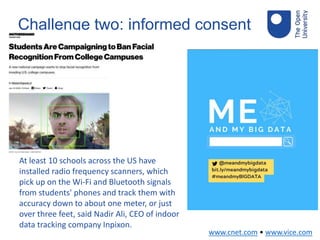
www.cnet.com • www.vice.com
At least 10 schools across the US have
installed radio frequency scanners, which
pick up on the Wi-Fi and Bluetooth signals
from students' phones and track them with
accuracy down to about one meter, or just
over three feet, said Nadir Ali, CEO of indoor
data tracking company Inpixon.
H
Reflection opportunity
What data is being
collected about you
right now?
Why is it being
collected?
@NYU_LEARN
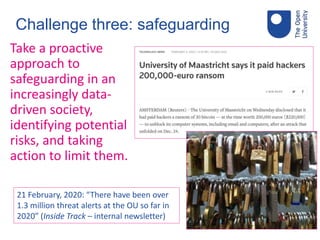
Challenge three: safeguarding
Take a proactive
approach to
safeguarding in an
increasingly data-
driven society,
identifying potential
risks, and taking
action to limit them.
21 February, 2020: “There have been over
1.3 million threat alerts at the OU so far in
2020” (Inside Track – internal newsletter)
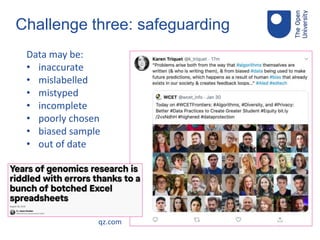
Challenge three: safeguarding
Data may be:
• inaccurate
• mislabelled
• mistyped
• incomplete
• poorly chosen
• biased sample
• out of date
qz.com
H
Reflection opportunity
When have you
provided inaccurate
or incomplete data
about yourself?
Why did you do that?
@NYU_LEARN
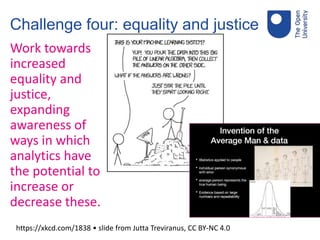
Challenge four: equality and justice
Work towards
increased
equality and
justice,
expanding
awareness of
ways in which
analytics have
the potential to
increase or
decrease these.
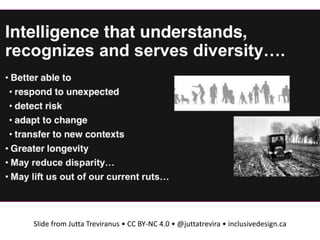
https://xkcd.com/1838 • slide from Jutta Treviranus, CC BY-NC 4.0
Challenge four: equality and justice
Slide from Jutta Treviranus • CC BY-NC 4.0 • @juttatrevira • inclusivedesign.ca
H
Reflection opportunity
What assumptions
does your work make
about learners,
their actions, their
priorities, their aims,
or their dreams?
@NYU_LEARN
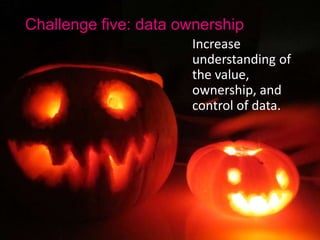
Challenge five: data ownership
Increase
understanding of
the value,
ownership, and
control of data.
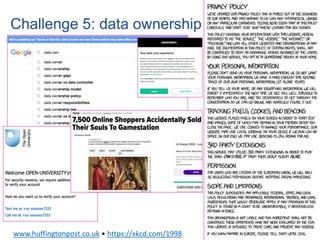
Challenge 5: data ownership
www.huffingtonpost.co.uk • https://xkcd.com/1998
H
Reflection opportunity
If your learners read at
250 words per minute,
how long does it take
to find and read your
data protection and
privacy policies?
Is that the ideal time?
@NYU_LEARN
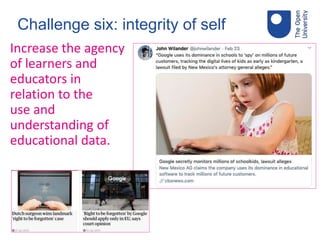
Challenge six: integrity of self
Increase the agency
of learners and
educators in
relation to the
use and
understanding of
educational data.
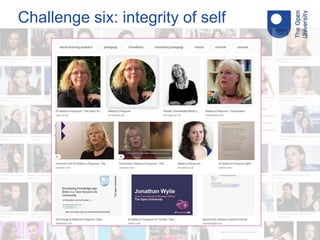
Challenge six: integrity of self
H
Reflection opportunity
What one change
might you make to
your work in response
to these challenges?
@NYU_LEARN
slideshare.net/R3beccaF
r3beccaf.wordpress.com
twitter.com/R3beccaF
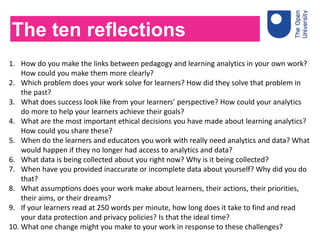
1. How do you make the links between pedagogy and learning analytics in your own work?
How could you make them more clearly?
2. Which problem does your work solve for learners? How did they solve that problem in
the past?
3. What does success look like from your learners’ perspective? How could your analytics
do more to help your learners achieve their goals?
4. What are the most important ethical decisions you have made about learning analytics?
How could you share these?
5. When do the learners and educators you work with really need analytics and data? What
would happen if they no longer had access to analytics and data?
6. What data is being collected about you right now? Why is it being collected?
7. When have you provided inaccurate or incomplete data about yourself? Why did you do
that?
8. What assumptions does your work make about learners, their actions, their priorities,
their aims, or their dreams?
9. If your learners read at 250 words per minute, how long does it take to find and read
your data protection and privacy policies? Is that the ideal time?
10. What one change might you make to your work in response to these challenges?
The ten reflections
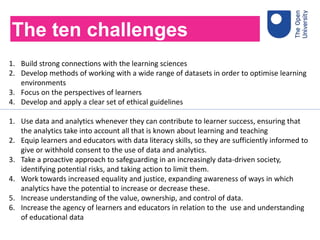
1. Build strong connections with the learning sciences
2. Develop methods of working with a wide range of datasets in order to optimise learning
environments
3. Focus on the perspectives of learners
4. Develop and apply a clear set of ethical guidelines
1. Use data and analytics whenever they can contribute to learner success, ensuring that
the analytics take into account all that is known about learning and teaching
2. Equip learners and educators with data literacy skills, so they are sufficiently informed to
give or withhold consent to the use of data and analytics.
3. Take a proactive approach to safeguarding in an increasingly data-driven society,
identifying potential risks, and taking action to limit them.
4. Work towards increased equality and justice, expanding awareness of ways in which
analytics have the potential to increase or decrease these.
5. Increase understanding of the value, ownership, and control of data.
6. Increase the agency of learners and educators in relation to the use and understanding
of educational data
The ten challenges

Ethical challenges for learning analytics

  • 1.
    Rebecca Ferguson The OpenUniversity, UK Learning analytics: facing up to the challenges slideshare.net/R3beccaF @NYU_LEARN
  • 2.
    Learning analytics The measurement,collection, analysis and reporting of data about learners and their contexts, for purposes of understanding and optimizing learning and the environments in which it occurs.
  • 3.
    Ethics • What isworth seeking — that is, what ends or goals of life are good? • What are individuals responsible for — that is, what duties should they recognize and attempt to fulfill? Willis, Pistilli & Campbell. (2013). Ethics, big data, and analytics. Educause Review Online
  • 4.
    Learning analytics helpus to identify and make sense of patterns in the data to improve our teaching, our learning and our learning environments
  • 5.
    Privacy A living conceptmade out of continuous personal boundary negotiations with the surrounding ethical environment. Privacy can be understood as a freedom from unauthorized intrusion: the ability of an individual or a group to seclude themselves or the information about them, and thus to express themselves selectively. Ferguson, Hoel, Scheffel, & Drachsler (2016). Ethics and privacy in learning analytics.
  • 6.
    Privacy & dataprotection Willis, Pistilli & Campbell. (2013). Ethics, big data, and analytics. Educause Review Online From the perspective of data protection, data are treated as property. From the perspective of privacy, data are much more personal, almost a part of the self and certainly very bound up with the sense of self. If we reveal these data, we reveal ourselves. Ferguson, Hoel, Scheffel, & Drachsler (2016). Ethics and privacy in learning analytics.
  • 7.
    Build strong connections withthe learning sciences Under-represented in early work: • cognition • metacognition • pedagogy. Understanding and optimising learning require knowledge of: • how learning takes place • how it can be supported • the importance of factors such as identity, reputation and affect. Learning analytics could help develop: • good learning design • effective pedagogy • increasing student self-awareness. Challenges: http://oro.open.ac.uk/36374/ Teaching with analytics: https://doi.org/10.18608/jla.2019.62.4 Keywords learning analytics analytics use data-informed decision making instructional improvement instructional dashboards pedagogical support teaching analytics learning analytics design learning analytics implementation Challenges: 2012
  • 8.
    H Reflection opportunity How doyou make the links between pedagogy and learning analytics in your work? How could you make them more clearly? @NYU_LEARN
  • 9.
    Develop methods of working witha wide range of datasets in order to optimise learning environments Challenges: 2012 “…automated techniques are able to extract information with an efficiency that is beyond the capabilities of human- coders, providing the means to deal analytically with the multiple modalities that characterize the classroom. Once generated, the information provided by the different modalities is used to explain and predict high-level constructs such as students’ attention and engagement.” Chan, Ochoa, Clarke (2020): Multimodal Learning Analytics in a Laboratory Classroom
  • 10.
    H Reflection opportunity Which problemdoes your work solve for learners? How did they solve that problem in the past? @NYU_LEARN
  • 11.
    Focus on the perspectivesof learners Criteria for learning success could include: • grades • persistence • motivation • confidence • enjoyment • satisfaction • career goals. Analytics for learners: • personalised, • easily understood • clearly linked with improving learning • transparent • open to challenge • two-way process. John Knox, LARC: http://bit.ly/lak17-practitioner-trackChallenges: 2012
  • 12.
    H Reflection opportunity What doessuccess look like from your learners’ perspective? How could your analytics do more to help your learners achieve their goals? @NYU_LEARN
  • 13.
    Develop and applya clear set of ethical guidelines No detailed ethical framework has been developed for learning analytics. This is a pressing need for the field, and each researcher could play a part here by including a clear section on ethics within their papers and publications. Drivers, developments and challenges http://oro.open.ac.uk/36374/Challenges: 2012 https://lak20laprinciples.weebly.com/
  • 14.
    H Reflection opportunity What arethe most important ethical decisions you have made about learning analytics? How could you share these? @NYU_LEARN
  • 15.
  • 16.
    Provocation 1: Learners are monitoredby their learning environmnent
  • 17.
  • 18.
  • 19.
  • 20.
  • 21.
  • 22.
  • 23.
  • 24.
    Ethical challenges for learninganalytics Journal of Learning Analytics, Dec 2019
  • 25.
    Challenge one: dutyto act Use data and analytics whenever they can contribute to learner success, ensuring that the analytics take into account all that is known about learning and teaching. Co-designing: https://doi.org/10.18608/jla.2019.62.3 If you could have any superpowers you wanted, to help you do your job, what would they be?
  • 26.
    H Reflection opportunity When dothe learners and educators you work with really need analytics and data? What would happen if they no longer had access to analytics and data? @NYU_LEARN
  • 27.
    Challenge two: informedconsent Equip learners and educators with data literacy skills, so they are sufficiently informed to give or withhold consent to the use of data and analytics. Data literacy skills include the ability to read, work with, analyse and argue with data. Image: Center for Spatial Research (via MOMA)
  • 28.
    Challenge two: informedconsent www.cnet.com • www.vice.com At least 10 schools across the US have installed radio frequency scanners, which pick up on the Wi-Fi and Bluetooth signals from students' phones and track them with accuracy down to about one meter, or just over three feet, said Nadir Ali, CEO of indoor data tracking company Inpixon.
  • 29.
    H Reflection opportunity What datais being collected about you right now? Why is it being collected? @NYU_LEARN
  • 30.
    Challenge three: safeguarding Takea proactive approach to safeguarding in an increasingly data- driven society, identifying potential risks, and taking action to limit them. 21 February, 2020: “There have been over 1.3 million threat alerts at the OU so far in 2020” (Inside Track – internal newsletter)
  • 31.
    Challenge three: safeguarding Datamay be: • inaccurate • mislabelled • mistyped • incomplete • poorly chosen • biased sample • out of date qz.com
  • 32.
    H Reflection opportunity When haveyou provided inaccurate or incomplete data about yourself? Why did you do that? @NYU_LEARN
  • 33.
    Challenge four: equalityand justice Work towards increased equality and justice, expanding awareness of ways in which analytics have the potential to increase or decrease these. https://xkcd.com/1838 • slide from Jutta Treviranus, CC BY-NC 4.0
  • 34.
    Challenge four: equalityand justice Slide from Jutta Treviranus • CC BY-NC 4.0 • @juttatrevira • inclusivedesign.ca
  • 35.
    H Reflection opportunity What assumptions doesyour work make about learners, their actions, their priorities, their aims, or their dreams? @NYU_LEARN
  • 36.
    Challenge five: dataownership Increase understanding of the value, ownership, and control of data.
  • 37.
    Challenge 5: dataownership www.huffingtonpost.co.uk • https://xkcd.com/1998
  • 38.
    H Reflection opportunity If yourlearners read at 250 words per minute, how long does it take to find and read your data protection and privacy policies? Is that the ideal time? @NYU_LEARN
  • 39.
    Challenge six: integrityof self Increase the agency of learners and educators in relation to the use and understanding of educational data.
  • 40.
  • 41.
    H Reflection opportunity What onechange might you make to your work in response to these challenges? @NYU_LEARN
  • 42.
  • 43.
    1. How doyou make the links between pedagogy and learning analytics in your own work? How could you make them more clearly? 2. Which problem does your work solve for learners? How did they solve that problem in the past? 3. What does success look like from your learners’ perspective? How could your analytics do more to help your learners achieve their goals? 4. What are the most important ethical decisions you have made about learning analytics? How could you share these? 5. When do the learners and educators you work with really need analytics and data? What would happen if they no longer had access to analytics and data? 6. What data is being collected about you right now? Why is it being collected? 7. When have you provided inaccurate or incomplete data about yourself? Why did you do that? 8. What assumptions does your work make about learners, their actions, their priorities, their aims, or their dreams? 9. If your learners read at 250 words per minute, how long does it take to find and read your data protection and privacy policies? Is that the ideal time? 10. What one change might you make to your work in response to these challenges? The ten reflections
  • 44.
    1. Build strongconnections with the learning sciences 2. Develop methods of working with a wide range of datasets in order to optimise learning environments 3. Focus on the perspectives of learners 4. Develop and apply a clear set of ethical guidelines 1. Use data and analytics whenever they can contribute to learner success, ensuring that the analytics take into account all that is known about learning and teaching 2. Equip learners and educators with data literacy skills, so they are sufficiently informed to give or withhold consent to the use of data and analytics. 3. Take a proactive approach to safeguarding in an increasingly data-driven society, identifying potential risks, and taking action to limit them. 4. Work towards increased equality and justice, expanding awareness of ways in which analytics have the potential to increase or decrease these. 5. Increase understanding of the value, ownership, and control of data. 6. Increase the agency of learners and educators in relation to the use and understanding of educational data The ten challenges

Editor's Notes

  • #16 The full report on this research is available online at this link. Here, I shall run briefly through the eight provocations to give you an idea of how learning analytics might develop during the next decade
  • #17 Provocation 1: Learners are monitored by their learning environments Provocation 1 relates to a world in which almost anything a learner uses can be used to collect data about their activities People saw how this vision could be connected with sensor technology and the Internet of Things. They also raised the issue of Big Brother watching over learners and controlling what they do
  • #18 Provocation 2: Learners’ personal data are tracked Provocation 2 deals not with external data but with internal data. Information about where students are looking, how they are reacting to stimuli, what their heart rate is. The picture shows the Mindlfex game in which the blue ball is controlled by the user’s brainwaves – which suggests we are moving towards being able to detect thought patterns Respondents linked this to the notion of the ‘quantified self’, and to activity in the field of medicine. They called for a reliable evidence base, which is an idea found in many of the responses to diffferent visions.
  • #19 Provocation 3: Analytics are rarely used Provocation 3 is a negative one from the point of view of learning analytics. It suggests that there will be so many problems and controversial stories that learning analytics are no longer used in ten years time. The image refers to the multi-million dollar inBloom project, funded by the Gates Foundation, which had to close due to srong opposition from parents. Issues here of ethics, and of WHY the analytics are being developed and applied
  • #20 Provocation 4: Learners control their own data Provocation 4 is concerned with who owns the data. Should it be owned and controlled by individual learners? Divergent opinions here. Some people think learners should control their data and that organisations should make this possible and desirable. Others think that this will make the data unusable and that it just adds needless extra responsibilities to the work of students
  • #21 Provocation 5: Open systems are widely adopted Provocation 5 is to do with getting learning analytics, and their related systems, to talk to each other and to understand each other. It also ties in with building a developer community. In order for this open approach to be possible, a lot of work needs to be done at local and national levels.
  • #22 Provocation 6: Learning analytics are essential tools Provocation 6 sees the role for learning analytics increasing, so that all learners are supported by a mound of data However, this requires thought about what it means to learn, how learning takes place, and how learning analytics support that process
  • #23 Provocation 7: Analytics help learners make the right choices Provocation 7 sees a positive role for analytics, with control remaining in the hands of the learners. Although this sounds a positive future, respondents could see potential problems.
  • #24 Provocation 8: Analytics have largely replaced teachers The final provocation sees analytics replacing teachers Any teacher that can be replaced by a computer deserves to be. This is a rewording by David Thornburg of the original Arthur C Clarke quote (“Teachers that can be replaced by a machine should be.”) Again, this prompts consideration of how learning takes place and how it can best be supported
  • #25 Provocation 8: Analytics have largely replaced teachers The final provocation sees analytics replacing teachers Any teacher that can be replaced by a computer deserves to be. This is a rewording by David Thornburg of the original Arthur C Clarke quote (“Teachers that can be replaced by a machine should be.”) Again, this prompts consideration of how learning takes place and how it can best be supported
  • #26 These provocations are from Neil Selwyn, Monash University
  • #28 These provocations are from Neil Selwyn, Monash University
  • #29 These provocations are from Neil Selwyn, Monash University
  • #31 These provocations are from Neil Selwyn, Monash University
  • #32 These provocations are from Neil Selwyn, Monash University
  • #34 These provocations are from Neil Selwyn, Monash University
  • #35 These provocations are from Neil Selwyn, Monash University
  • #37 These provocations are from Neil Selwyn, Monash University
  • #38 These provocations are from Neil Selwyn, Monash University
  • #40 These provocations are from Neil Selwyn, Monash University
  • #41 These provocations are from Neil Selwyn, Monash University