Informatie visualisatie:
Les 8
Joris Klerkx - Erik Duval
http://hci.cs.kuleuven.be
joris.klerkx@cs.kuleuven.be
Human-Computer Interaction
Dept. Computerwetenschappen
KU Leuven
1
Paper
Sessies - praktisch
• Week 15 - maandag 11 april 2016 - 16u-19u

• Week 16 - maandag 18 april 2016 - 16u-19u

• Week 17 - maandag 25 april 2016 - 16u-19u

• Week 18
• maandag 02 mei 2016 - 16u-19u
• Woensdag 04 mei 2016 - 10:30 - 12:30 in 200C-01.09 (01J)
• Sessie samen met studenten data visualisatie - Dig. Humanities -
prof. Verbert & prof. Vande Moere - topic: Data-driven storytelling

• Week 19
• Maandag 09 mei 2016 - 16u-19u - Eindpresentaties (met jury)
STAAT NIET IN HET UURROOSTER!
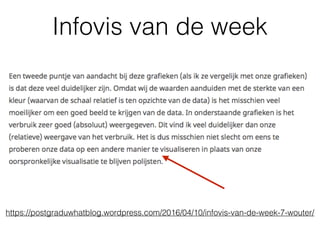
https://postgraduwhatblog.wordpress.com/2016/04/10/infovis-van-de-week-7-wouter/
Infovis van de week
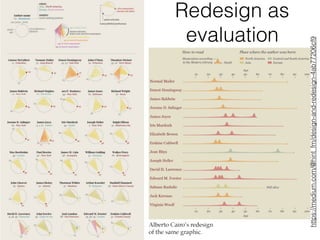
https://medium.com/@hint_fm/design-and-redesign-4ab77206cf9
Redesign as
evaluation
Vandaag
• (Data-ink) Design Principles (ik)
• Show-and-Tell (jullie)
• 5 mins + 5 mins ‘design-critique’
• Quick feedback per groep
• Opdracht tegen volgende keer (ik)
6
Data-Ink Design Principles
7
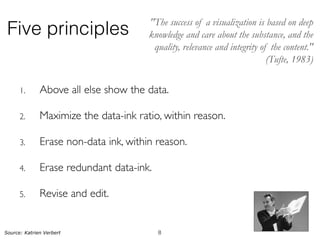
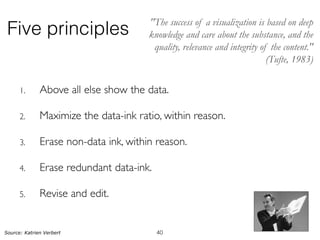
Five principles
1. Above all else show the data.
2. Maximize the data-ink ratio, within reason.
3. Erase non-data ink, within reason.
4. Erase redundant data-ink.
5. Revise and edit.
Source: Katrien Verbert
"The success of a visualization is based on deep
knowledge and care about the substance, and the
quality, relevance and integrity of the content."
(Tufte, 1983)
8
Data-ink
A large share of ink on a graphic should present data
Information, the ink changing as the data change.
Data-ink is the non-erasable core of a graphic...
(Tufte, 1983)
9
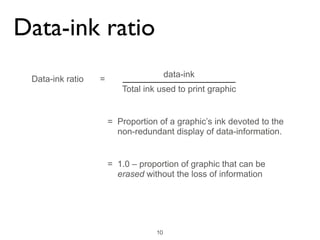
Data-ink ratio =
data-ink
Total ink used to print graphic
= Proportion of a graphic’s ink devoted to the
non-redundant display of data-information.
= 1.0 – proportion of graphic that can be
erased without the loss of information
Data-ink ratio
10
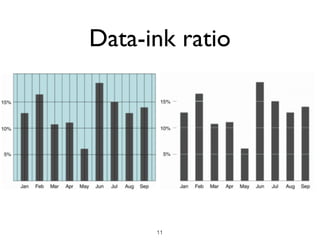
Data-ink ratio
11
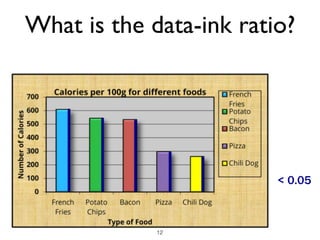
What is the data-ink ratio?
< 0.05
12
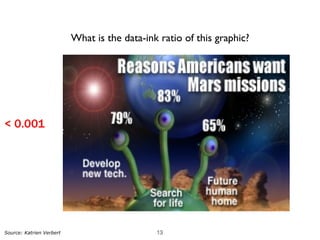
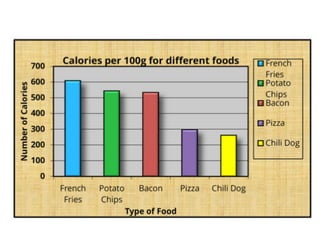
What is the data-ink ratio of this graphic?
< 0.001
Source: Katrien Verbert 13
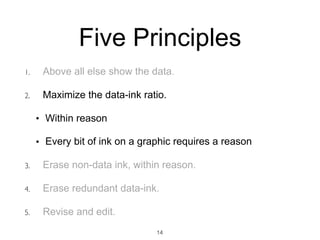
Five Principles
1. Above all else show the data.
2. Maximize the data-ink ratio.
• Within reason	
• Every bit of ink on a graphic requires a reason	
3. Erase non-data ink, within reason.
4. Erase redundant data-ink.
5. Revise and edit.
14
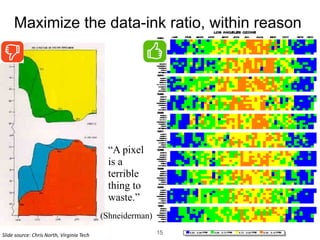
Maximize the data-ink ratio, within reason
“A pixel
is a
terrible
thing to
waste.”
(Shneiderman)
Slide	source:	Chris	North,	Virginia	Tech 15
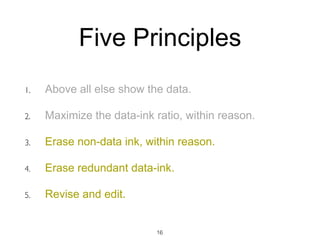
Five Principles
1. Above all else show the data.
2. Maximize the data-ink ratio, within reason.
3. Erase non-data ink, within reason.
4. Erase redundant data-ink.
5. Revise and edit.
16
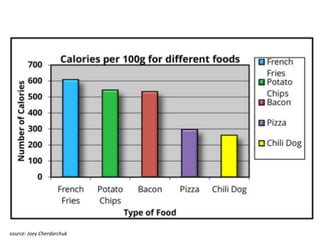
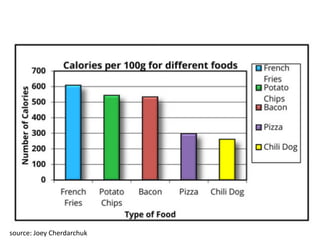
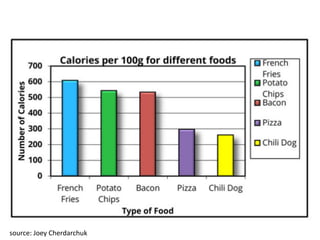
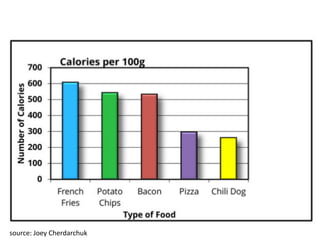
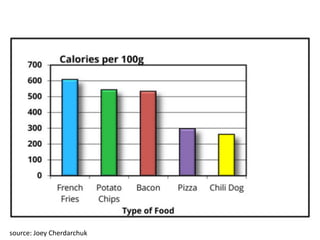
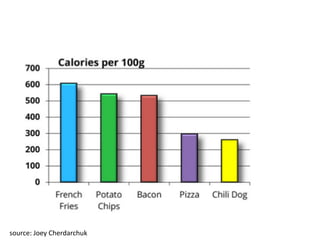
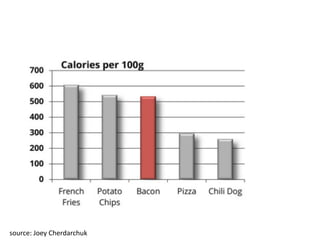
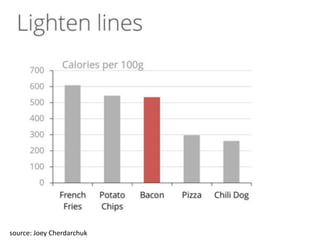
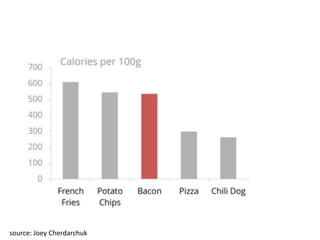
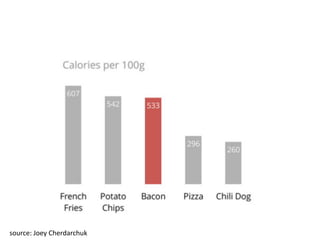
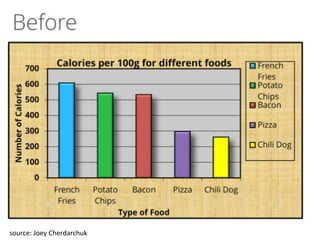
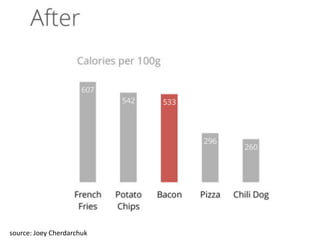
17	source:	Joey	Cherdarchuk
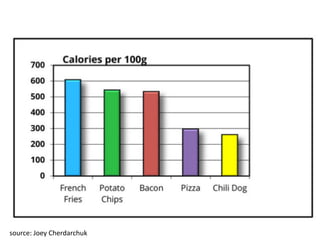
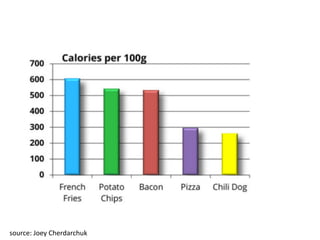
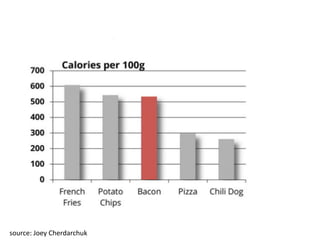
18	source:	Joey	Cherdarchuk
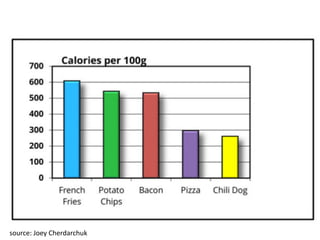
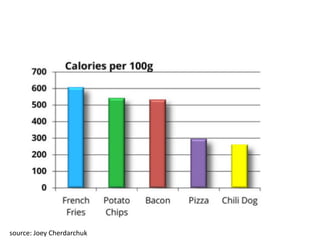
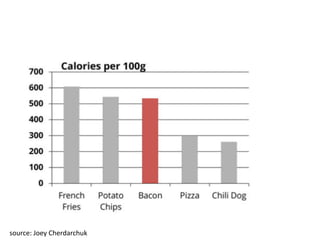
19	source:	Joey	Cherdarchuk
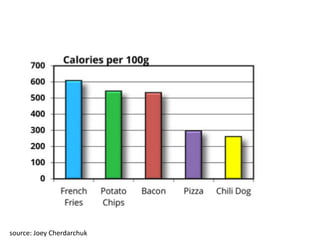
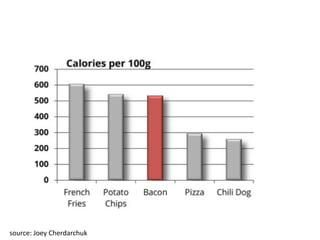
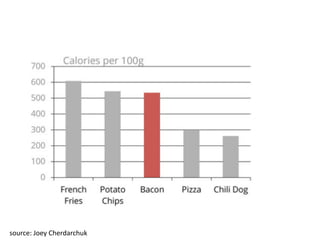
20	source:	Joey	Cherdarchuk
21	source:	Joey	Cherdarchuk
22	source:	Joey	Cherdarchuk
23	source:	Joey	Cherdarchuk
24	source:	Joey	Cherdarchuk
25	source:	Joey	Cherdarchuk
26	source:	Joey	Cherdarchuk
27	source:	Joey	Cherdarchuk
28	source:	Joey	Cherdarchuk
29	source:	Joey	Cherdarchuk
30	source:	Joey	Cherdarchuk
31	source:	Joey	Cherdarchuk
32	source:	Joey	Cherdarchuk
33	source:	Joey	Cherdarchuk
34	source:	Joey	Cherdarchuk
35	source:	Joey	Cherdarchuk
36	source:	Joey	Cherdarchuk
37	source:	Joey	Cherdarchuk
38	source:	Joey	Cherdarchuk
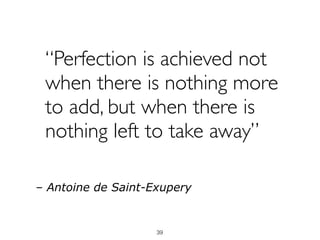
“Perfection is achieved not
when there is nothing more
to add, but when there is
nothing left to take away”

– Antoine de Saint-Exupery
39
Five principles
1. Above all else show the data.
2. Maximize the data-ink ratio, within reason.
3. Erase non-data ink, within reason.
4. Erase redundant data-ink.
5. Revise and edit.
Source: Katrien Verbert
"The success of a visualization is based on deep
knowledge and care about the substance, and the
quality, relevance and integrity of the content."
(Tufte, 1983)
40
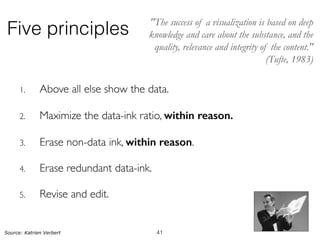
Five principles
1. Above all else show the data.
2. Maximize the data-ink ratio, within reason.
3. Erase non-data ink, within reason.
4. Erase redundant data-ink.
5. Revise and edit.
Source: Katrien Verbert
"The success of a visualization is based on deep
knowledge and care about the substance, and the
quality, relevance and integrity of the content."
(Tufte, 1983)
41
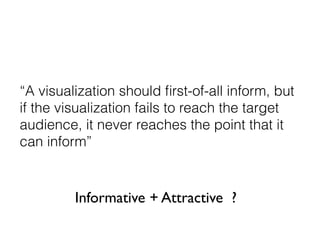
“A visualization should first-of-all inform, but
if the visualization fails to reach the target
audience, it never reaches the point that it
can inform”
Informative + Attractive ?
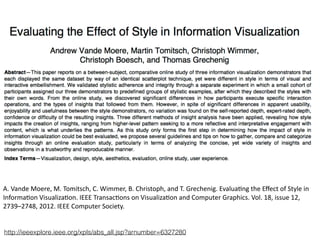
A.	Vande	Moere,	M.	Tomitsch,	C.	Wimmer,	B.	Christoph,	and	T.	Grechenig.	EvaluaCng	the	Effect	of	Style	in	
InformaCon	VisualizaCon.	IEEE	TransacCons	on	VisualizaCon	and	Computer	Graphics.	Vol.	18,	issue	12,	
2739–2748,	2012.	IEEE	Computer	Society.	
http://ieeexplore.ieee.org/xpls/abs_all.jsp?arnumber=6327280
?
44
Vandaag
• (Data-ink) Design Principles (ik)
• Show-and-Tell (jullie)
• 5 mins + 5 mins ‘design-critique’
• Quick feedback per groep
• Opdracht tegen volgende keer (ik)
45
Tegen volgende les
• Individueel: - Spreadsheet
• Team:
• Vervolg implementatie
• Draft Paper!
• Blog post
• Vooruitgang - wat geleerd vandaag
• Wat vond je van feedback sessie?
• Show-and-Tell - design critique 

(eventueel weerleggen wat je gehoord hebt vandaag)
46

Les 8 - informatie visualisatie