COMBINATORIAL
CHEMISTRY
Name of student : PUJA R. BHALERAO
Class : M.Pharm ( Sem-II)
CONTENT
• Definition
• Introduction
• Principle of Combinatorial Chemistry
• Approaches of Combinatorial Chemistry
• Combinatorial Library
• Types of Combinatorial Library
• Methods of Combinatorial Chemistry
• Techniques of Combinatorial Chemistry
• Advantages of Combinatorial Chemistry
Definition
combinatorial chemistry is a technique by which
large number of different but structurally similar
molecules are produced rapidly and submitted for
pharmacological assay.
INTRODUCTION
It is widely accepted that combinatorial chemistry was born in the early 1980s.
By accelerating the process of chemical synthesis, this method is having a profound
effect on all branches of chemistry, but especially on drug discovery.
Focused on the preparation of chemical libraries for the generation of new lead for
drug discovery.
To reduce the time and cost associated with producing effective and competitive new
drugs.
PRINCIPLE
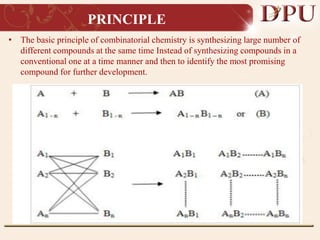
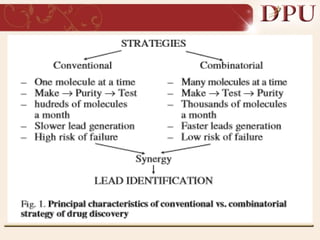
• The basic principle of combinatorial chemistry is synthesizing large number of
different compounds at the same time Instead of synthesizing compounds in a
conventional one at a time manner and then to identify the most promising
compound for further development.
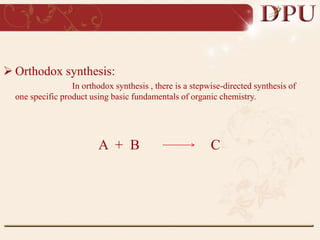
 Orthodox synthesis:
In orthodox synthesis , there is a stepwise-directed synthesis of
one specific product using basic fundamentals of organic chemistry.
A + B C
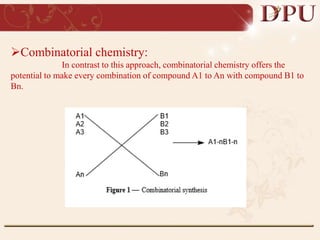
Combinatorial chemistry:
In contrast to this approach, combinatorial chemistry offers the
potential to make every combination of compound A1 to An with compound B1 to
Bn.
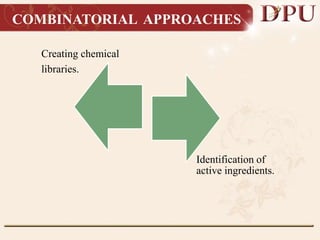
COMBINATORIAL APPROACHES
Creating chemical
libraries.
Identification of
active ingredients.
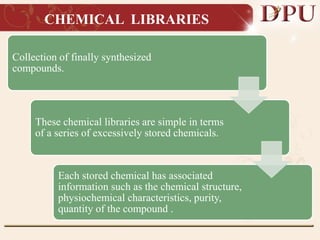
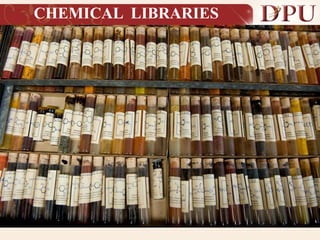
CHEMICAL LIBRARIES
Collection of finally synthesized
compounds.
These chemical libraries are simple in terms
of a series of excessively stored chemicals.
Each stored chemical has associated
information such as the chemical structure,
physiochemical characteristics, purity,
quantity of the compound .
CHEMICAL LIBRARIES
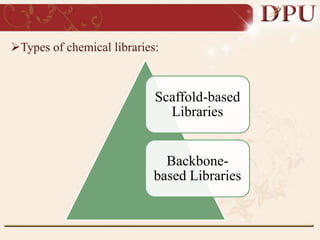
Scaffold-based
Libraries
Backbone-
based Libraries
Types of chemical libraries:
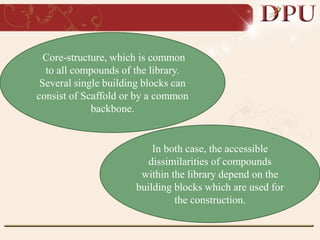
Core-structure, which is common
to all compounds of the library.
Several single building blocks can
consist of Scaffold or by a common
backbone.
In both case, the accessible
dissimilarities of compounds
within the library depend on the
building blocks which are used for
the construction.
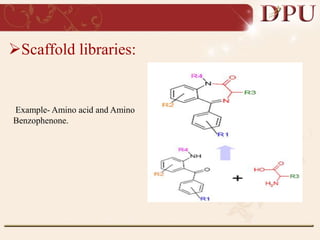
Scaffold libraries:
Example- Amino acid and Amino
Benzophenone.
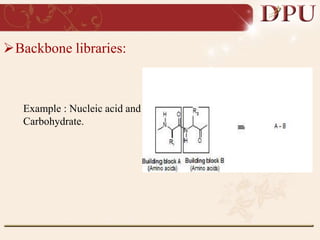
Backbone libraries:
Example : Nucleic acid and
Carbohydrate.
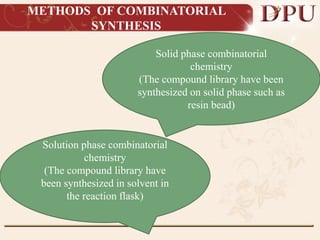
METHODS OF COMBINATORIAL
SYNTHESIS
Solid phase combinatorial
chemistry
(The compound library have been
synthesized on solid phase such as
resin bead)
Solution phase combinatorial
chemistry
(The compound library have
been synthesized in solvent in
the reaction flask)
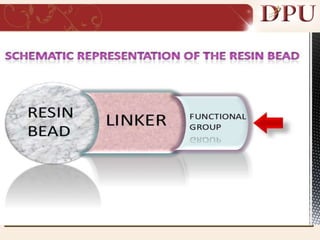
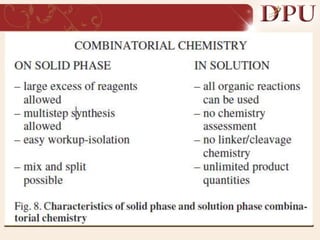
Solid phase combinatorial chemistry
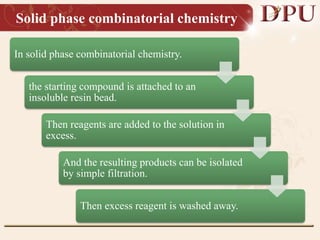
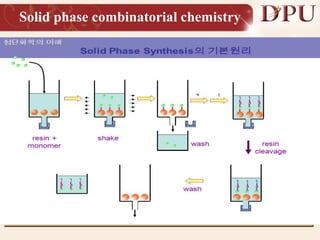
In solid phase combinatorial chemistry.
the starting compound is attached to an
insoluble resin bead.
Then reagents are added to the solution in
excess.
And the resulting products can be isolated
by simple filtration.
Then excess reagent is washed away.
Solid phase combinatorial chemistry
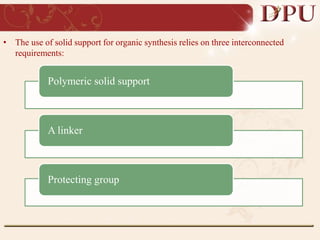
• The use of solid support for organic synthesis relies on three interconnected
requirements:
Polymeric solid support
A linker
Protecting group
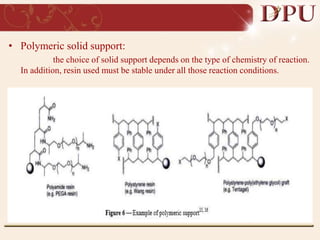
• Polymeric solid support:
the choice of solid support depends on the type of chemistry of reaction.
In addition, resin used must be stable under all those reaction conditions.
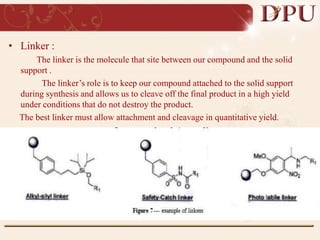
• Linker :
The linker is the molecule that site between our compound and the solid
support .
The linker’s role is to keep our compound attached to the solid support
during synthesis and allows us to cleave off the final product in a high yield
under conditions that do not destroy the product.
The best linker must allow attachment and cleavage in quantitative yield.
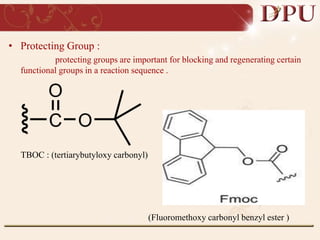
• Protecting Group :
protecting groups are important for blocking and regenerating certain
functional groups in a reaction sequence .
TBOC : (tertiarybutyloxy carbonyl)
(Fluoromethoxy carbonyl benzyl ester )
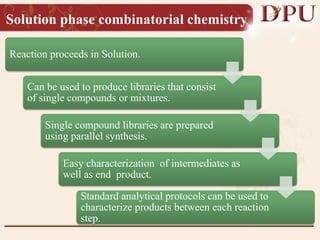
Solution phase combinatorial chemistry
Reaction proceeds in Solution.
Can be used to produce libraries that consist
of single compounds or mixtures.
Single compound libraries are prepared
using parallel synthesis.
Easy characterization of intermediates as
well as end product.
Standard analytical protocols can be used to
characterize products between each reaction
step.
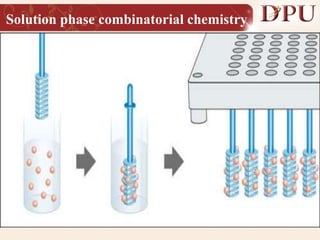
Solution phase combinatorial chemistry
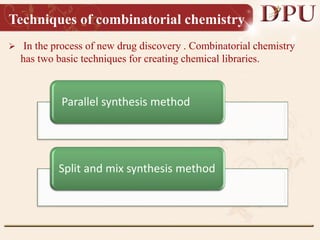
Techniques of combinatorial chemistry
 In the process of new drug discovery . Combinatorial chemistry
has two basic techniques for creating chemical libraries.
Parallel synthesis method
Split and mix synthesis method
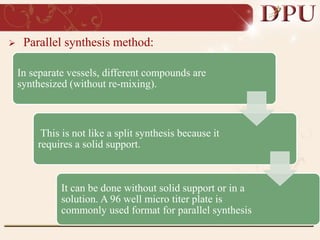
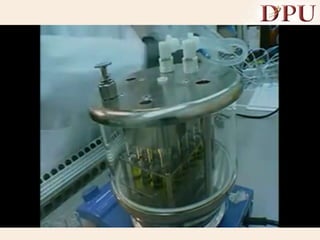
 Parallel synthesis method:
In separate vessels, different compounds are
synthesized (without re-mixing).
This is not like a split synthesis because it
requires a solid support.
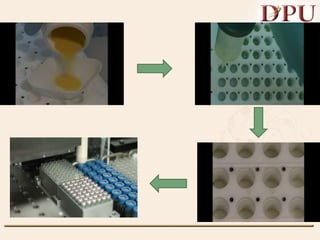
It can be done without solid support or in a
solution. A 96 well micro titer plate is
commonly used format for parallel synthesis
 Advantages:
•Each compound is substantially „pure“in its location
•Defined location provides the structure of a certain compound
•Easier biological evaluation
 Split and mix method:
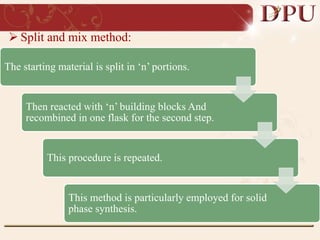
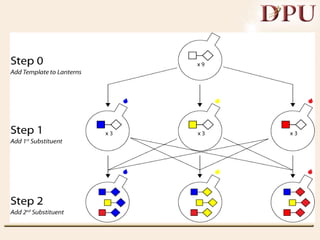
The starting material is split in ‘n’ portions.
Then reacted with ‘n’ building blocks And
recombined in one flask for the second step.
This procedure is repeated.
This method is particularly employed for solid
phase synthesis.
Advantages:
• Method of having choice for large libraries.
• Less reaction vessels required.
Advantages
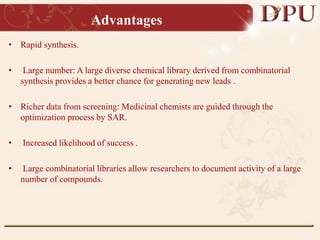
• Rapid synthesis.
• Large number: A large diverse chemical library derived from combinatorial
synthesis provides a better chance for generating new leads .
• Richer data from screening: Medicinal chemists are guided through the
optimization process by SAR.
• Increased likelihood of success .
• Large combinatorial libraries allow researchers to document activity of a large
number of compounds.
Combinatorial chemistry

Combinatorial chemistry

  • 1.
    COMBINATORIAL CHEMISTRY Name of student: PUJA R. BHALERAO Class : M.Pharm ( Sem-II)
  • 2.
    CONTENT • Definition • Introduction •Principle of Combinatorial Chemistry • Approaches of Combinatorial Chemistry • Combinatorial Library • Types of Combinatorial Library • Methods of Combinatorial Chemistry • Techniques of Combinatorial Chemistry • Advantages of Combinatorial Chemistry
  • 3.
    Definition combinatorial chemistry isa technique by which large number of different but structurally similar molecules are produced rapidly and submitted for pharmacological assay.
  • 4.
    INTRODUCTION It is widelyaccepted that combinatorial chemistry was born in the early 1980s. By accelerating the process of chemical synthesis, this method is having a profound effect on all branches of chemistry, but especially on drug discovery. Focused on the preparation of chemical libraries for the generation of new lead for drug discovery. To reduce the time and cost associated with producing effective and competitive new drugs.
  • 5.
    PRINCIPLE • The basicprinciple of combinatorial chemistry is synthesizing large number of different compounds at the same time Instead of synthesizing compounds in a conventional one at a time manner and then to identify the most promising compound for further development.
  • 7.
     Orthodox synthesis: Inorthodox synthesis , there is a stepwise-directed synthesis of one specific product using basic fundamentals of organic chemistry. A + B C
  • 9.
    Combinatorial chemistry: In contrastto this approach, combinatorial chemistry offers the potential to make every combination of compound A1 to An with compound B1 to Bn.
  • 11.
  • 12.
    CHEMICAL LIBRARIES Collection offinally synthesized compounds. These chemical libraries are simple in terms of a series of excessively stored chemicals. Each stored chemical has associated information such as the chemical structure, physiochemical characteristics, purity, quantity of the compound .
  • 13.
  • 14.
  • 15.
    Core-structure, which iscommon to all compounds of the library. Several single building blocks can consist of Scaffold or by a common backbone. In both case, the accessible dissimilarities of compounds within the library depend on the building blocks which are used for the construction.
  • 16.
    Scaffold libraries: Example- Aminoacid and Amino Benzophenone.
  • 17.
    Backbone libraries: Example :Nucleic acid and Carbohydrate.
  • 18.
    METHODS OF COMBINATORIAL SYNTHESIS Solidphase combinatorial chemistry (The compound library have been synthesized on solid phase such as resin bead) Solution phase combinatorial chemistry (The compound library have been synthesized in solvent in the reaction flask)
  • 19.
    Solid phase combinatorialchemistry In solid phase combinatorial chemistry. the starting compound is attached to an insoluble resin bead. Then reagents are added to the solution in excess. And the resulting products can be isolated by simple filtration. Then excess reagent is washed away.
  • 20.
  • 22.
    • The useof solid support for organic synthesis relies on three interconnected requirements: Polymeric solid support A linker Protecting group
  • 24.
    • Polymeric solidsupport: the choice of solid support depends on the type of chemistry of reaction. In addition, resin used must be stable under all those reaction conditions.
  • 25.
    • Linker : Thelinker is the molecule that site between our compound and the solid support . The linker’s role is to keep our compound attached to the solid support during synthesis and allows us to cleave off the final product in a high yield under conditions that do not destroy the product. The best linker must allow attachment and cleavage in quantitative yield.
  • 26.
    • Protecting Group: protecting groups are important for blocking and regenerating certain functional groups in a reaction sequence . TBOC : (tertiarybutyloxy carbonyl) (Fluoromethoxy carbonyl benzyl ester )
  • 27.
    Solution phase combinatorialchemistry Reaction proceeds in Solution. Can be used to produce libraries that consist of single compounds or mixtures. Single compound libraries are prepared using parallel synthesis. Easy characterization of intermediates as well as end product. Standard analytical protocols can be used to characterize products between each reaction step.
  • 28.
  • 30.
    Techniques of combinatorialchemistry  In the process of new drug discovery . Combinatorial chemistry has two basic techniques for creating chemical libraries. Parallel synthesis method Split and mix synthesis method
  • 31.
     Parallel synthesismethod: In separate vessels, different compounds are synthesized (without re-mixing). This is not like a split synthesis because it requires a solid support. It can be done without solid support or in a solution. A 96 well micro titer plate is commonly used format for parallel synthesis
  • 34.
     Advantages: •Each compoundis substantially „pure“in its location •Defined location provides the structure of a certain compound •Easier biological evaluation
  • 35.
     Split andmix method: The starting material is split in ‘n’ portions. Then reacted with ‘n’ building blocks And recombined in one flask for the second step. This procedure is repeated. This method is particularly employed for solid phase synthesis.
  • 37.
    Advantages: • Method ofhaving choice for large libraries. • Less reaction vessels required.
  • 38.
    Advantages • Rapid synthesis. •Large number: A large diverse chemical library derived from combinatorial synthesis provides a better chance for generating new leads . • Richer data from screening: Medicinal chemists are guided through the optimization process by SAR. • Increased likelihood of success . • Large combinatorial libraries allow researchers to document activity of a large number of compounds.