Contents
1.How bridge works
2.Functionsof a bridge
3.Components of bridge
4.Types of bridges :
5.Depending upon support
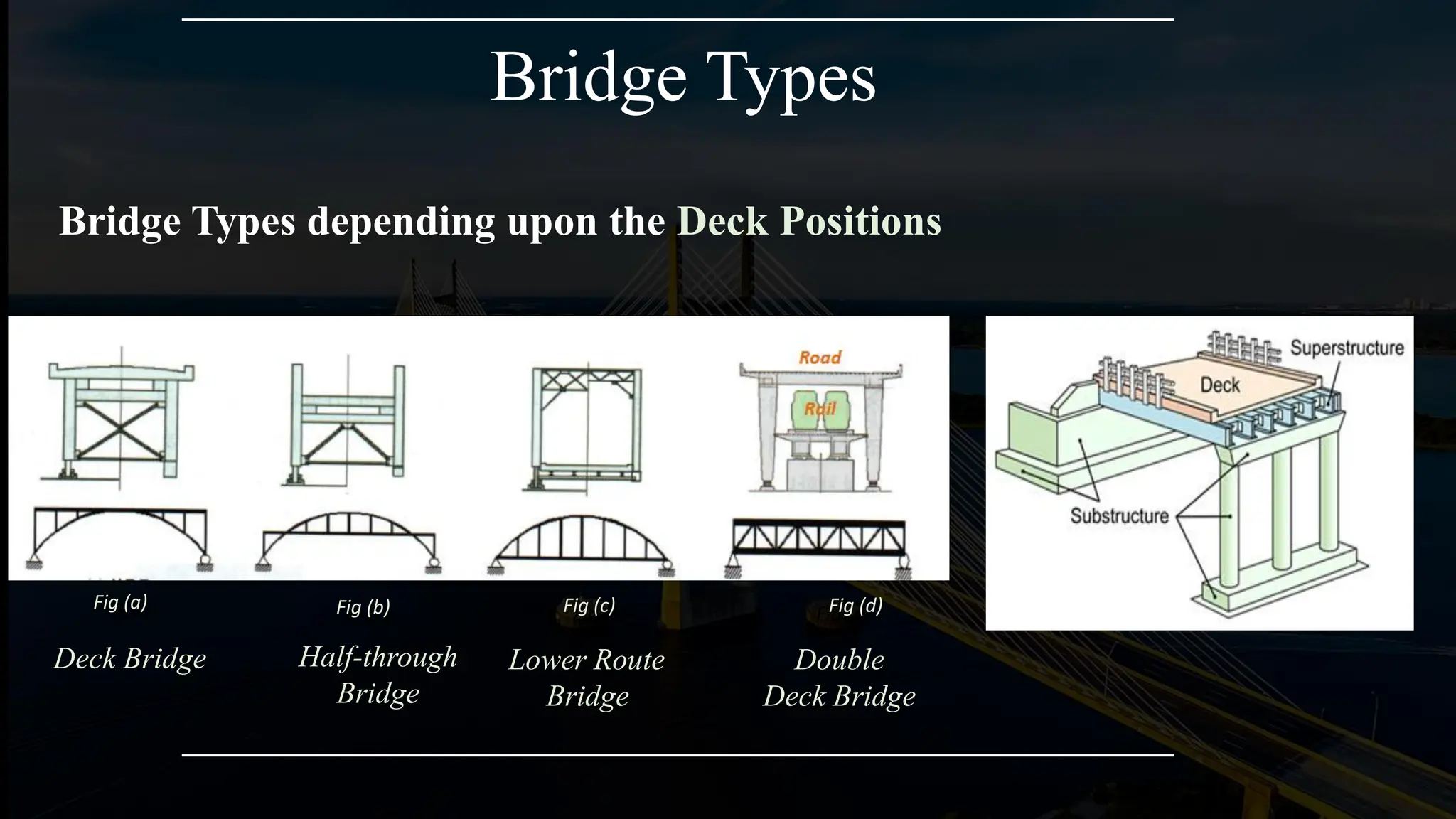
5.Depending upon deck positions
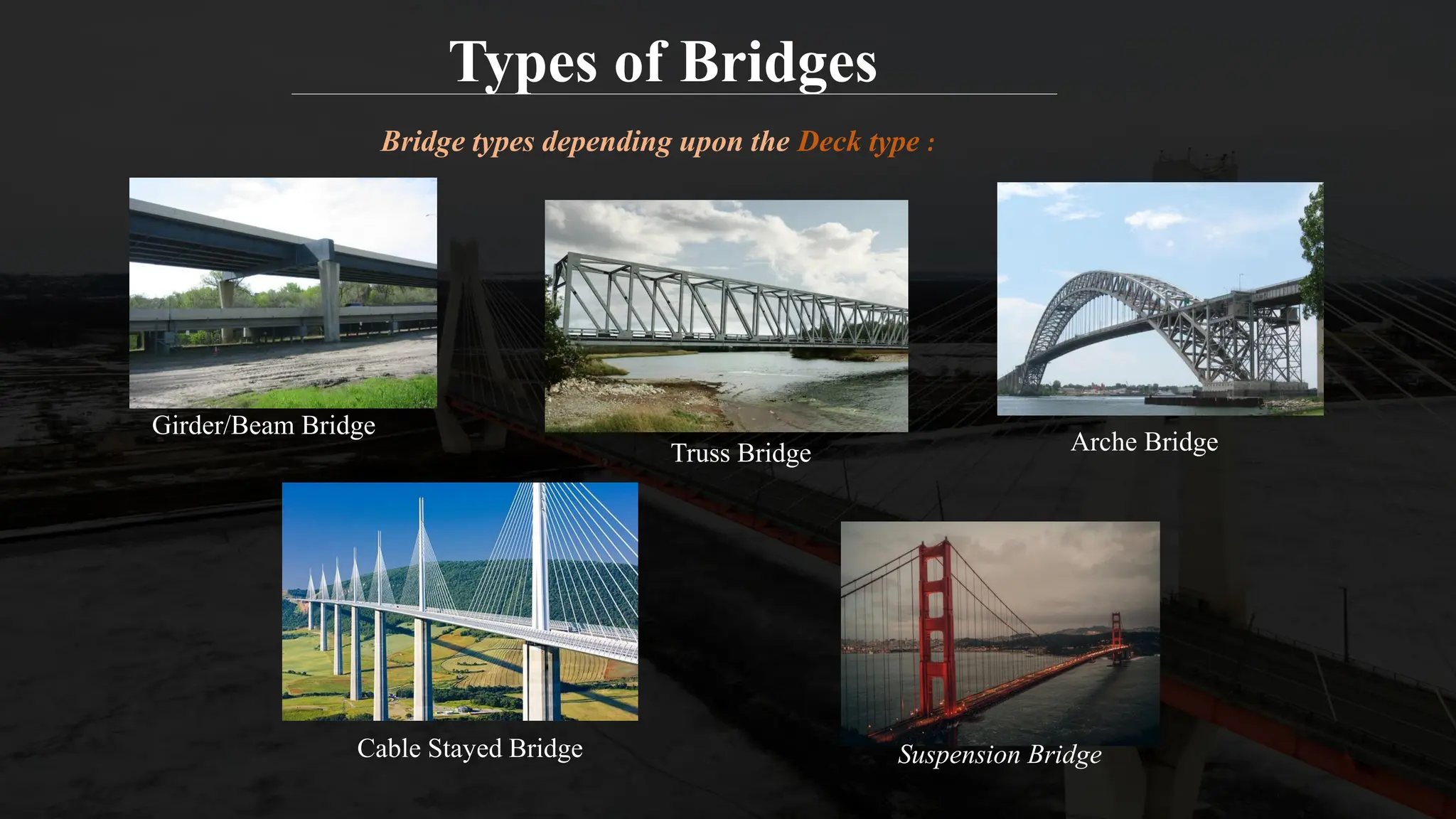
6.Depending upon deck types
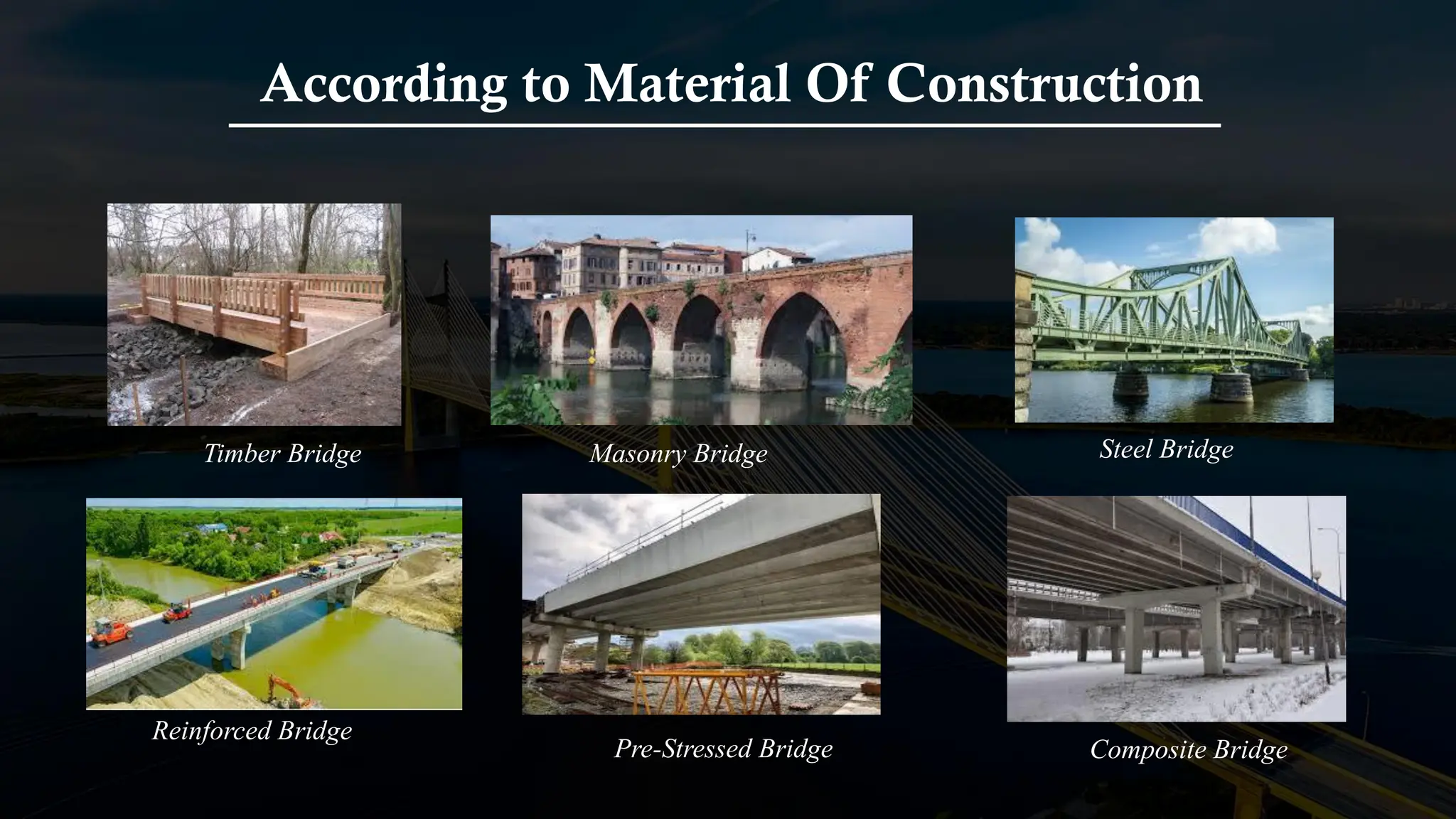
7.According to material of constructipn
10.Bridge types
4.
Every passing vehicleshakes the bridge
up and down, making waves that can
travel at hundreds of kilometers per
hour. Luckily the bridge is designed to
damp them out, just as it is designed to
ignore the efforts of the wind to turn it
into against harp. A bridge is not a
dead mass of metal and concrete:
it has a life of its own, and
understanding its movements is as
important as understanding the static
forces.
How Bridges Work ?
5.
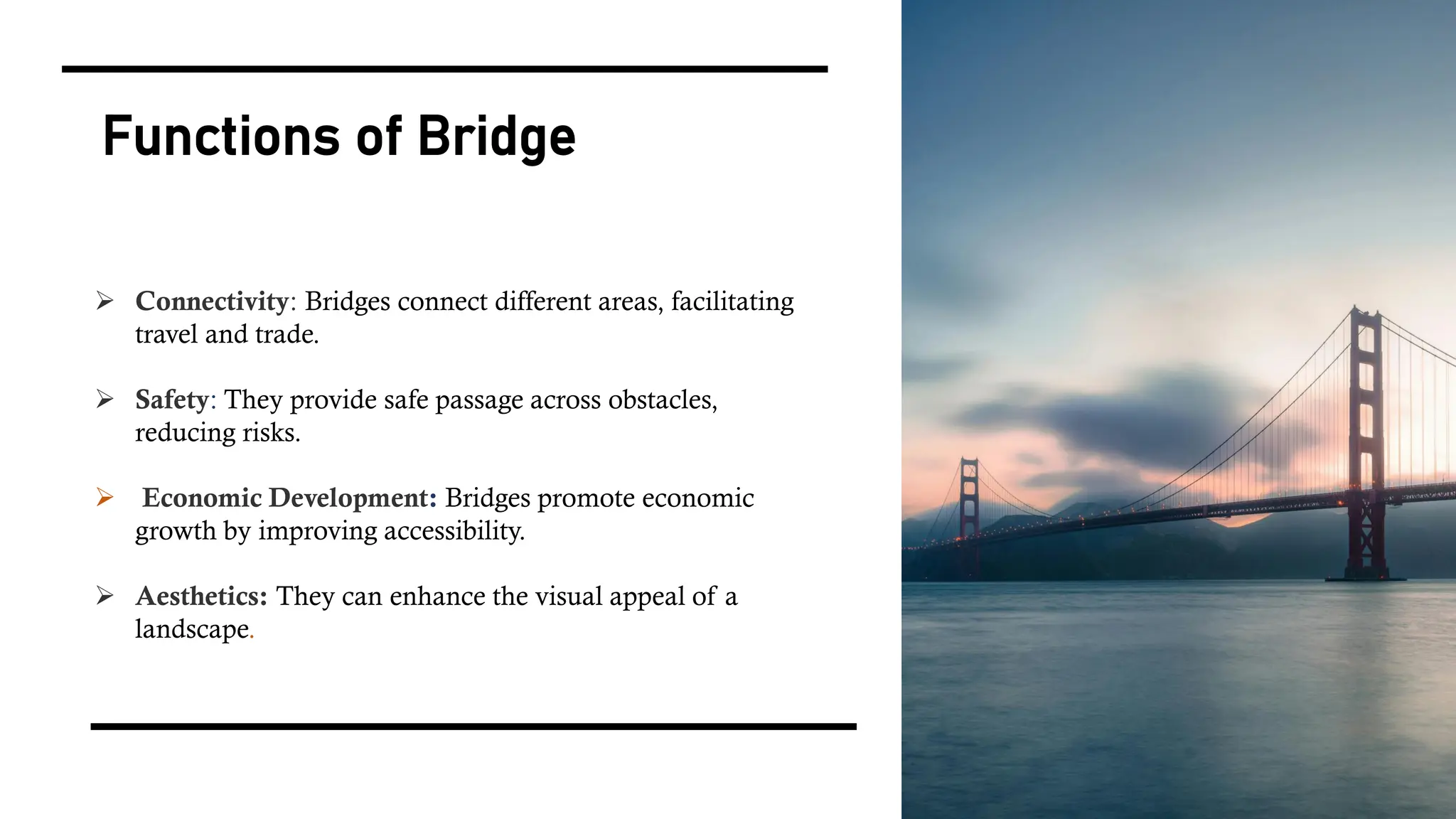
Functions of Bridge
➢Connectivity: Bridges connect different areas, facilitating
travel and trade.
➢ Safety: They provide safe passage across obstacles,
reducing risks.
➢ Economic Development: Bridges promote economic
growth by improving accessibility.
➢ Aesthetics: They can enhance the visual appeal of a
landscape.
6.
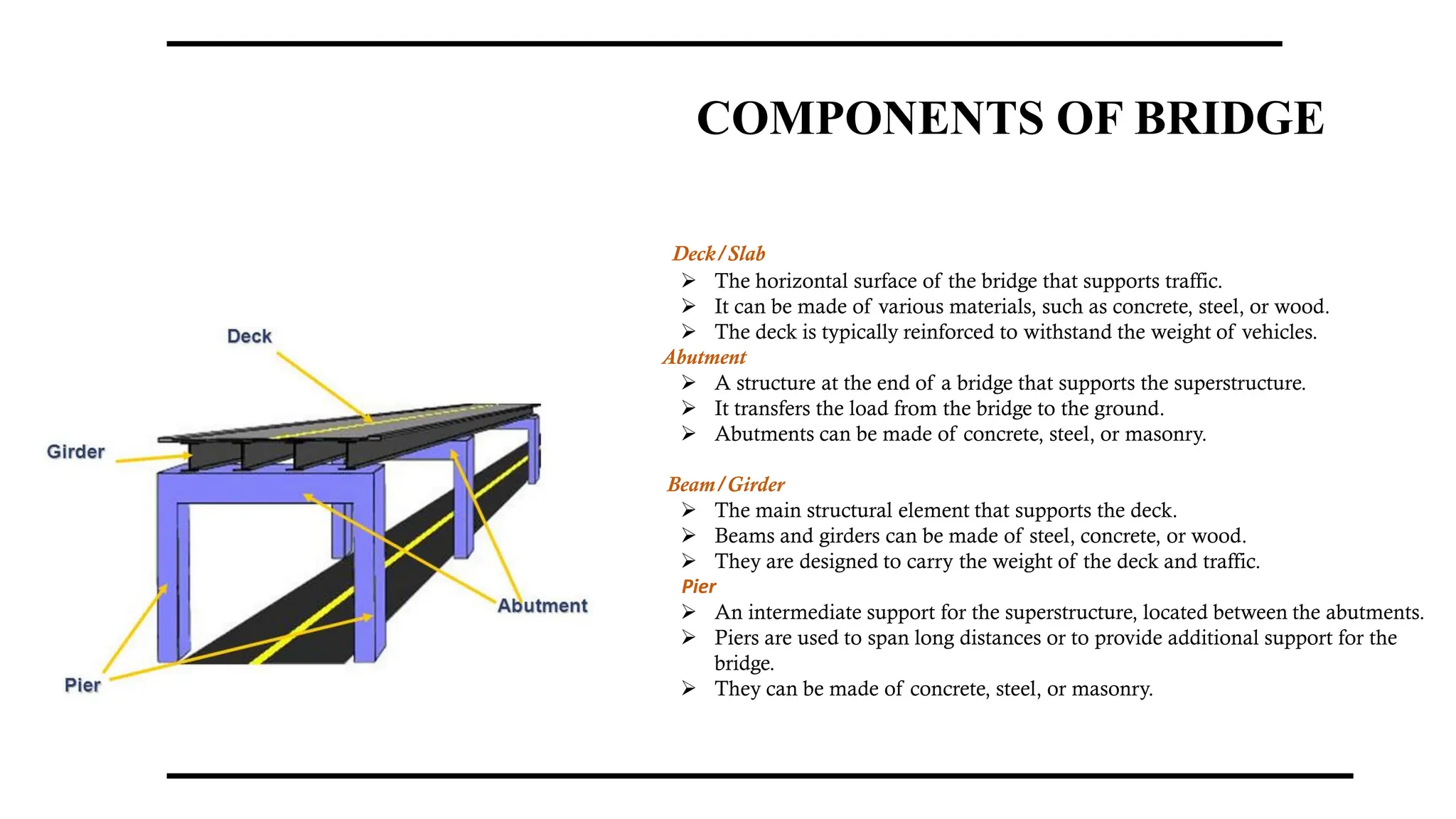
COMPONENTS OF BRIDGE
Deck/Slab
➢The horizontal surface of the bridge that supports traffic.
➢ It can be made of various materials, such as concrete, steel, or wood.
➢ The deck is typically reinforced to withstand the weight of vehicles.
Abutment
➢ A structure at the end of a bridge that supports the superstructure.
➢ It transfers the load from the bridge to the ground.
➢ Abutments can be made of concrete, steel, or masonry.
Beam/Girder
➢ The main structural element that supports the deck.
➢ Beams and girders can be made of steel, concrete, or wood.
➢ They are designed to carry the weight of the deck and traffic.
Pier
➢ An intermediate support for the superstructure, located between the abutments.
➢ Piers are used to span long distances or to provide additional support for the
bridge.
➢ They can be made of concrete, steel, or masonry.
7.
Bridge Types
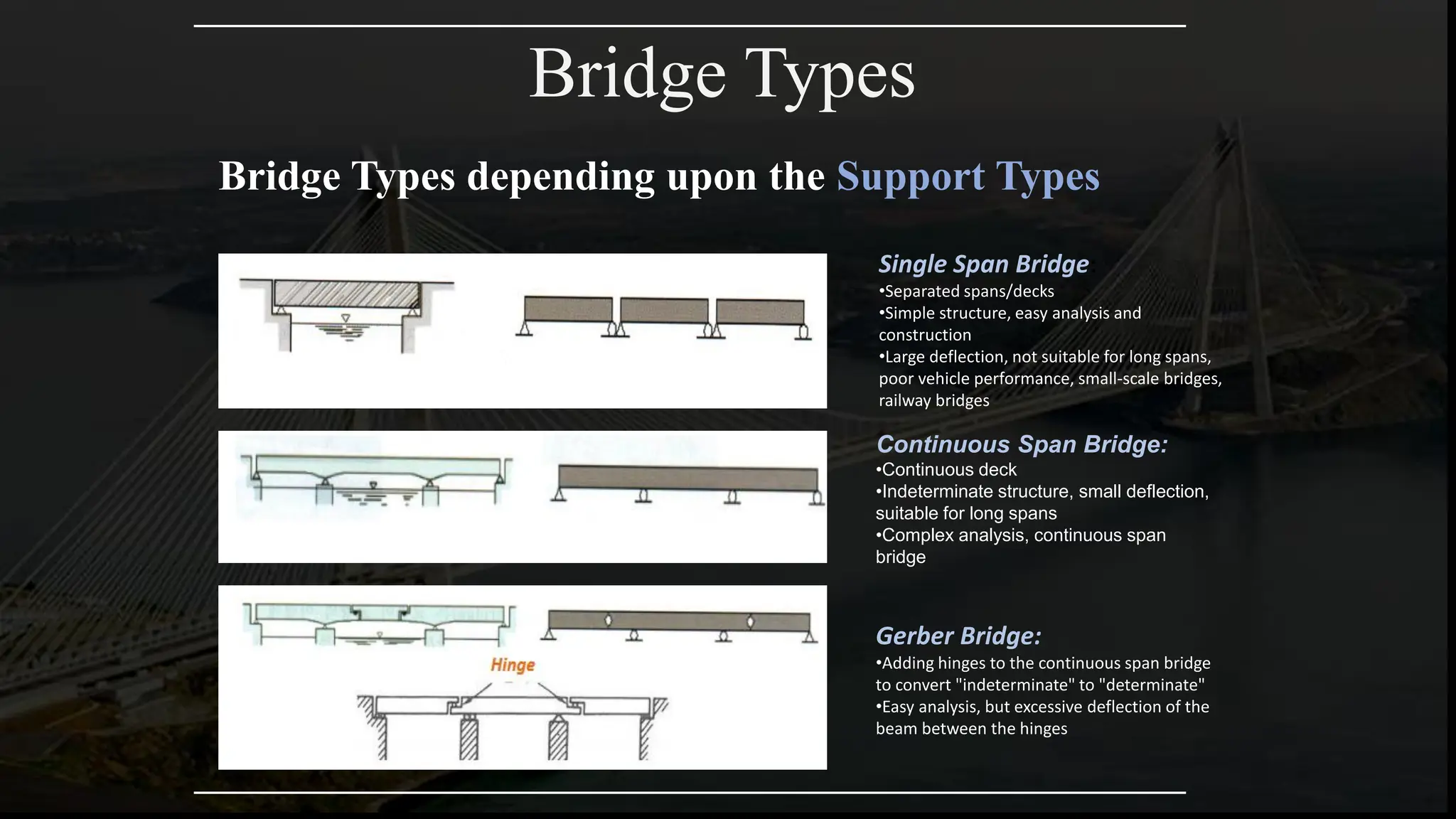
Bridge Typesdepending upon the Support Types
Single Span Bridge:
•Separated spans/decks
•Simple structure, easy analysis and
construction
•Large deflection, not suitable for long spans,
poor vehicle performance, small-scale bridges,
railway bridges
Continuous Span Bridge:
•Continuous deck
•Indeterminate structure, small deflection,
suitable for long spans
•Complex analysis, continuous span
bridge
Gerber Bridge:
•Adding hinges to the continuous span bridge
to convert "indeterminate" to "determinate"
•Easy analysis, but excessive deflection of the
beam between the hinges
Hollow Slab Bridge
Reduceself-load with
holes
Rigid-Frame Bridge
- Connected top and bottom Structures
- Economical with low-pier-height
and short-span bridges
- No need for expansion joints till 50m
-Spaces under the bridge for overpass
road or river crossing
- Easy maintenance, good Appearance
RC Slab Bridge
Should avoid long-length
due to increase self-load
Bridge Types
Bridge Types depending upon the Deck Types
10.
According to MaterialOf Construction
Timber Bridge Masonry Bridge Steel Bridge
Composite Bridge
Reinforced Bridge
Pre-Stressed Bridge
11.
Types of Bridges
ArcheBridge
Cable Stayed Bridge
Girder/Beam Bridge
Bridge types depending upon the Deck type :
Suspension Bridge
Truss Bridge
12.
Girder Bridge
A girderbridge (also known as simply supported
beam bridges) is perhaps the most common and
most basic bridge to carry loads across short to
medium spans.
Girder bridges are bridges that use longitudinal
beams(girders) as the primary structural element to
support the deck.
Made of various materials, such as steel, concrete,
or wood.
In modern steel girder bridges, the two most common
girders are I-beam girders and box-girders
13.
Forces on GirderBridge
The primary forces that act on a beam bridge are bending,
compression, and tension
14.
Types of GirderBridge
Plate Girder
- Use I-shape steel girder (50m)
- Require many steel members, complicated
- Low horizontal strength -> weak for
curved roads
T-Shape
- Usually used for short spans (30m)
- Less self-load than slab bridges
- Double T-shape: 50m span with prestress,
horizontal tendons due to a big gap b/w
girders
Plate Box Girder
- Widely used (50-60m)
- Good for curved and widened roads
- Steel box is prefabricated, bolted and
welded in the field ->fast, easy construction
15.
Truss Bridge
A trussbridge is a bridge where the load-bearing structure is a
framework of interconnected triangles. The triangular shape
distributes weight efficiently.
Working Principle or Function :
Trusses distribute forces using a triangular framework.
Compression acts on the top chords, while tension acts on the
bottom chords. Diagonal members handle mixed forces.
16.
Forces In TrussBridge
The forces that act on truss bridges include:
Tension: Forces that pull outward at the ends of the tension members. Compression:
Forces that push or compress the members together.
Torsion: A twisting force that bridge designers try to reduce as much as possible.
Arch Bridge
What isan Arch Bridge?
An arch bridge is a type of bridge where the main load-
bearing structure is a curved arch. The arch shape
provides natural strength, as it transfers the weight of the
load primarily into compression, pushing outward along
the curve and downward into the supports (abutments).
19.
Forces In ArchBridge
The forces that act on truss bridges include:
Compression: The arch is under compression, carrying the load.
Tension: Minimal tension exists; occurs under external forces like wind.
Thrust: The outward force of the arch is transferred to the abutments.
Gravity: The load is distributed along the arch.
.
20.
Types of ArchBridge :
Two-Hinge bridge-
Forces generated at the
hinged bearings, most
commonly used type,
generally the most
economical.
Three-Hinge bridge-
Contains Extra hinge at
the top of the arch,
suffers very little if
movement in the
foundation due to
earthquakes, sinking etc.,
Rarely used in Recent
times.
Hinge-less bridge-
Allows NO rotation at
foundation, only built at
very sturdy locations
because of force placed on
the foundation.
Tied Arches-
used in places where thr
ground is not strong
enough to support the
horizontal forces, to
alleviate the horizontal
pressure the girder “ties”
both ends of arch
together.
21.
Cable Stayed Bridge
Whatis an Cable Stayed ridge?
A cable-stayed bridge is a type of bridge in which the deck is supported
by cables directly connected to towers (pylons). Cables are arranged in a
fan-like or harp-like pattern.
Working Principle or Function
Tensioned cables support the deck, and the towers (pylons)
transfer the load into the ground through compression. Unlike
suspension bridges, no large anchorages are required.
22.
Forces In CableStayed Bridge
The forces that act on Cable Stayed bridges include:
Tension: Cables are under tension, holding the load.
Compression: Towers bear the load through compression.
Shear Forces: Forces affecting the deck from vehicle movement.
Wind and Seismic Forces: Must be managed for stability.
23.
Suspension Bridge
What isan Suspension Bridge?
A suspension bridge is a type of bridge in which the deck (the
load-bearing portion) is hung below suspension cables on vertical
suspenders. The cables are anchored at each end of the bridge,
and the weight of the deck and any load is transferred to the
anchors and then to the ground.
24.
Forces In SuspensionBridge
The forces that act on Cable Stayed bridges include:
Tension: Cables are under tension, supporting the bridge's weight and vehicle loads.
Compression: Towers bear the load by transferring the weight down to the ground through compression.
Shear Forces: Forces affect the deck from wind and vehicle movement, causing lateral stress.
Wind and Seismic Forces: Must be managed to prevent excessive oscillation or swaying for structural
stability.
25.
References :
Ech, H.(2017). Aerial view photography of bridge [Photograph]. Pexels.
https://www.pexels.com/photo/aerial-view-photography-of-bridge-220762/
Types of Bridges in Civil Engineering
Part one :https://www.thebridgehawk.com/post/types-of-bridges-in-civil-engineering
Wikipedia contributors. (2024). Burfordville Covered Bridge by Bollinger Mill near Jackson,
MO [Photograph]. In Wikipedia, The Free Encyclopedia. Retrieved October 12, 2024, from
https://en.wikipedia.org/wiki/File:Burfordville_Covered_Bridge_by_Bollinger_Mill_near_J
ackson_MO.jpg
Kang, K. H., & Lee, J. H. (n.d.). Bridge Design and Analysis. Retrieved October 12, 2024, from
https://ocw.snu.ac.kr/sites/default/files/NOTE/11116.pdf
Chi, S. (n.d.). 457.308 Construction Methods and Equipment: Week 12 - Bridge (1).
Department of Civil and Environmental Engineering, Seoul National University. Retrieved
October 12, 2024, from https://ocw.snu.ac.kr/sites/default/files/NOTE/11116.pdf







![References :
Ech, H. (2017). Aerial view photography of bridge [Photograph]. Pexels.
https://www.pexels.com/photo/aerial-view-photography-of-bridge-220762/
Types of Bridges in Civil Engineering
Part one :https://www.thebridgehawk.com/post/types-of-bridges-in-civil-engineering
Wikipedia contributors. (2024). Burfordville Covered Bridge by Bollinger Mill near Jackson,
MO [Photograph]. In Wikipedia, The Free Encyclopedia. Retrieved October 12, 2024, from
https://en.wikipedia.org/wiki/File:Burfordville_Covered_Bridge_by_Bollinger_Mill_near_J
ackson_MO.jpg
Kang, K. H., & Lee, J. H. (n.d.). Bridge Design and Analysis. Retrieved October 12, 2024, from
https://ocw.snu.ac.kr/sites/default/files/NOTE/11116.pdf
Chi, S. (n.d.). 457.308 Construction Methods and Equipment: Week 12 - Bridge (1).
Department of Civil and Environmental Engineering, Seoul National University. Retrieved
October 12, 2024, from https://ocw.snu.ac.kr/sites/default/files/NOTE/11116.pdf](https://image.slidesharecdn.com/bridgesmankaransingh2314095-250507134105-dbc94799/75/canals-s-25-2048.jpg)


![Computer Networks 01[1 using all terms].pptx](https://cdn.slidesharecdn.com/ss_thumbnails/computernetworks011-251214040533-327dd9f8-thumbnail.jpg?width=640&height=640&fit=bounds)


