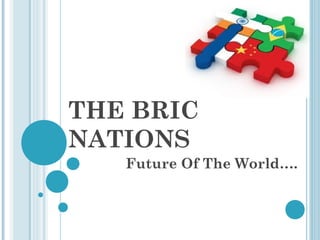
THE BRIC
NATIONS
Future Of The World….
CONTENT














The BRIC’s
Dreaming with BRIC’s: Path to 2050.
Painting BRIC by numbers.
INDIA: A rising growth potential.
RUSSIA: A smooth political transition.
CHINA: Unleashing the “Caged Tiger”.
The ‘B’ in BRIC’s: Unlocking Brazil’s growth potential.
Shared Challenges & opportunities.
BRIC & International Politics.
Influence
The BRIC summit
Criticism
Conclusion

2
THE BRIC










A grouping acronym referring to the countries of
Brazil, Russia, India, and China.
Term was first prominently used in a Goldman Sachs
report from 2003.
These countries aren’t a political alliance - but they
have the potential to form a powerful economic bloc
These four countries are among the biggest and
fastest growing emerging markets
Already BRIC accounts for:
o
o
o

40 per cent of the world's population,
25.9 per cent of its total geographic area,
40 per cent of global GDP

3
DREAMING WITH BRICS:
THE PATH TO 2050






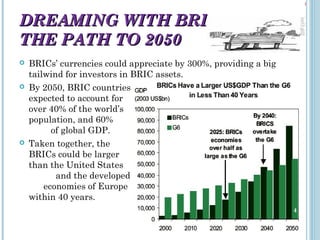
BRICs’ currencies could appreciate by 300%, providing a big
tailwind for investors in BRIC assets.
By 2050, BRIC countries
expected to account for
over 40% of the world’s
population, and 60%
of global GDP.
Taken together, the
BRICs could be larger
than the United States
and the developed
economies of Europe
within 40 years.
4
PAINTING BRIC BY
NUMBERS

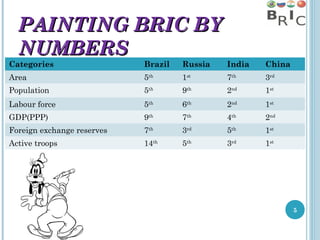
Categories

Brazil

Russia

India

China

Area

5th

1st

7th

3rd

Population

5th

9th

2nd

1st

Labour force

5th

6th

2nd

1st

GDP(PPP)

9th

7th

4th

2nd

Foreign exchange reserves

7th

3rd

5th

1st

Active troops

14th

5th

3rd

1st

5
INDIA:

A WISE ELEPHANT
Globalization


Forces of globalization set the stage for rapid rise of Indian
economy



Confluence of internal changes and external forces of
globalization allowed India to leverage the power of Englishspeaking technical talent to produce powerful software for the
global market.

Key Advantages


1.15 billion people



2nd largest labor force: 516.3m people



Approximately 2.5 million college graduates per year



Those with graduate degrees and above have risen from 20.5
million in 1991 to 48.7 million in 2004

6
INDIA:

A WISE ELEPHANT
Trends


Number of people in absolute poverty has declined sharply



Exports have boomed



Foreign exchange reserves are ample for the first time in
history



Newfound economic dynamism has shifted the balance of
leaders’ priorities from geopolitical goals to mutual
economic interests.

Challenges for the Future


Improving governance



Improving basic educational achievement



Improving infrastructure and electrical capacity in cities



Expanding technology industry

7
RUSSIA:

A SMOOTH POLITICAL TRANSITION
An “easy case” for globalization




Undue emphasis on economics over politics
Disregard of cultural values
Russia can still benefit from a globalized world without
undertaking painful reform.

Challenges for the Future





Labor shortages and poorly developed infrastructure
WTO membership and long-term growth of the
manufacturing sector
Reconciling ambitions as a major power with reality of
current situation
8
THE ‘B’ IN BRIC:

UNLOCKING BRAZIL’S GROWTH POTENTIAL
The uneasy emergence of an economic leader
in Latin America








One of the fastest growing economies in the last century
But over-reliance on agricultural commodity exports
resulted in a development marked by boom and bust
Focus on equitable development has resulted in significant
poverty reduction
Brazilian economy becoming less dependent on exports
A global leader in renewable fuels.

Challenges for the Future


Overburdened and ineffective judicial system
9
CHINA:
UNLEASHING THE ‘CAGED TIGER’
How did China do it?






China’s successes are associated with liberalization and
globalization.
China focused not only on opening economy, but also on
institutionalizing globalization
Assimilation of best practices from across the globe

A Painful Transition


State enterprise employment declined from 110 million in
1995 to 66 million in 2005



Urban-rural income gap is getting wider



Environmental cost of industrialization.
10
CHINA:
UNLEASHING THE ‘CAGED TIGER’
Key Advantages


Broad expansion of educational achievement



Rapid economic growth



Resilience to global economic downturn

Challenges for the Future


Recognition as a global power requires adherence to
international norms



Continued reform of state-run enterprises.



Demographic shifts threaten sustained growth.



Navigating a complex relationship with US and world.

11
SHARED CHALLENGES &
OPPORTUNITIES
Challenges




The face of poverty in 20th century was rural children. The
face of poverty in the 21st century will be the urban elderly.
Making the global system more accommodating to diverse
cultures and values

Opportunities


“Inclusive growth” critical for sustained globalization
(politically) in developing countries, because potential lies
in bringing up all
12
BRIC
AND INTERNATIONAL
POLITICS


Influence on “New world order”.
U.S troops has been deployed in Afghanistan for more than 8
years without any substantive outcome. Afghanistan is close
to China, India and Russia.
 The controversial question of Iran. Russia, China and India
could secure more proximity to the region.







BRIC cooperation is not solely an anti-U.S., or anti-western
phenomenon, but is based on deeper common interests.
Improve Bargaining Position with Western Countries.
Stabilize International Environment and Prevent
Encirclement

13
INFLUENCE








Account for 15% of the global economy and 42% of global
currency reserves.
Between 2000 and 2005, the BRICs contributed roughly
28% of global growth in US dollar terms and 55% in
purchasing power parity (PPP) terms.
Their share of global trade continues to climb at a rapid
rate. At close to 15% currently, it is now double its level in
2001.
The BRIC’s share of oil demand is moving steadily higher,
with an estimated 18% share in the current year

14
BRIC SUMMIT…
AFTERMATH








The BRIC countries met for their first official summit on
16 June 2009, in Yekaterinburg, Russia.
Discussed the current global financial crisis, global
development, and further strengthening of the BRIC
group.
Attacked the role of dollar as the primary international
currency & suggested new global reserve currency that is
'diversified, stable and predictable'.
Issued a joint statement on global food security, calling
for "action by all governments and the relevant
international agencies“

15
CRITICISM









Understatement of GDP growth in China which predicts
growth falling far below normal development.
The BRIC’s dream isn’t green.
Nothing more than a neat acronym for the four largest
emerging market economies.
BRICs doesn’t have a concrete and constructive agenda for
change or vision for a future world order.
It is not clear what BRIC would do even if they were given
the opportunity to remake the international order.

16
CONCLUSION





The Importance of the U.S.
The BRICs have come together in a political grouping in a
way that has far exceeded most expectations.
Although BRIC cooperation has been significant, intraBRIC competition and rivalry are important limits on how
much further BRIC cooperation can go.

17
GROUP IS OPEN
FOR
QUESTIONS……….

18

Brics nations

  • 1.
  • 2.
    CONTENT              The BRIC’s Dreaming withBRIC’s: Path to 2050. Painting BRIC by numbers. INDIA: A rising growth potential. RUSSIA: A smooth political transition. CHINA: Unleashing the “Caged Tiger”. The ‘B’ in BRIC’s: Unlocking Brazil’s growth potential. Shared Challenges & opportunities. BRIC & International Politics. Influence The BRIC summit Criticism Conclusion 2
  • 3.
    THE BRIC      A groupingacronym referring to the countries of Brazil, Russia, India, and China. Term was first prominently used in a Goldman Sachs report from 2003. These countries aren’t a political alliance - but they have the potential to form a powerful economic bloc These four countries are among the biggest and fastest growing emerging markets Already BRIC accounts for: o o o 40 per cent of the world's population, 25.9 per cent of its total geographic area, 40 per cent of global GDP 3
  • 4.
    DREAMING WITH BRICS: THEPATH TO 2050    BRICs’ currencies could appreciate by 300%, providing a big tailwind for investors in BRIC assets. By 2050, BRIC countries expected to account for over 40% of the world’s population, and 60% of global GDP. Taken together, the BRICs could be larger than the United States and the developed economies of Europe within 40 years. 4
  • 5.
    PAINTING BRIC BY NUMBERS Categories Brazil Russia India China Area 5th 1st 7th 3rd Population 5th 9th 2nd 1st Labourforce 5th 6th 2nd 1st GDP(PPP) 9th 7th 4th 2nd Foreign exchange reserves 7th 3rd 5th 1st Active troops 14th 5th 3rd 1st 5
  • 6.
    INDIA: A WISE ELEPHANT Globalization  Forcesof globalization set the stage for rapid rise of Indian economy  Confluence of internal changes and external forces of globalization allowed India to leverage the power of Englishspeaking technical talent to produce powerful software for the global market. Key Advantages  1.15 billion people  2nd largest labor force: 516.3m people  Approximately 2.5 million college graduates per year  Those with graduate degrees and above have risen from 20.5 million in 1991 to 48.7 million in 2004 6
  • 7.
    INDIA: A WISE ELEPHANT Trends  Numberof people in absolute poverty has declined sharply  Exports have boomed  Foreign exchange reserves are ample for the first time in history  Newfound economic dynamism has shifted the balance of leaders’ priorities from geopolitical goals to mutual economic interests. Challenges for the Future  Improving governance  Improving basic educational achievement  Improving infrastructure and electrical capacity in cities  Expanding technology industry 7
  • 8.
    RUSSIA: A SMOOTH POLITICALTRANSITION An “easy case” for globalization    Undue emphasis on economics over politics Disregard of cultural values Russia can still benefit from a globalized world without undertaking painful reform. Challenges for the Future    Labor shortages and poorly developed infrastructure WTO membership and long-term growth of the manufacturing sector Reconciling ambitions as a major power with reality of current situation 8
  • 9.
    THE ‘B’ INBRIC: UNLOCKING BRAZIL’S GROWTH POTENTIAL The uneasy emergence of an economic leader in Latin America      One of the fastest growing economies in the last century But over-reliance on agricultural commodity exports resulted in a development marked by boom and bust Focus on equitable development has resulted in significant poverty reduction Brazilian economy becoming less dependent on exports A global leader in renewable fuels. Challenges for the Future  Overburdened and ineffective judicial system 9
  • 10.
    CHINA: UNLEASHING THE ‘CAGEDTIGER’ How did China do it?    China’s successes are associated with liberalization and globalization. China focused not only on opening economy, but also on institutionalizing globalization Assimilation of best practices from across the globe A Painful Transition  State enterprise employment declined from 110 million in 1995 to 66 million in 2005  Urban-rural income gap is getting wider  Environmental cost of industrialization. 10
  • 11.
    CHINA: UNLEASHING THE ‘CAGEDTIGER’ Key Advantages  Broad expansion of educational achievement  Rapid economic growth  Resilience to global economic downturn Challenges for the Future  Recognition as a global power requires adherence to international norms  Continued reform of state-run enterprises.  Demographic shifts threaten sustained growth.  Navigating a complex relationship with US and world. 11
  • 12.
    SHARED CHALLENGES & OPPORTUNITIES Challenges   Theface of poverty in 20th century was rural children. The face of poverty in the 21st century will be the urban elderly. Making the global system more accommodating to diverse cultures and values Opportunities  “Inclusive growth” critical for sustained globalization (politically) in developing countries, because potential lies in bringing up all 12
  • 13.
    BRIC AND INTERNATIONAL POLITICS  Influence on“New world order”. U.S troops has been deployed in Afghanistan for more than 8 years without any substantive outcome. Afghanistan is close to China, India and Russia.  The controversial question of Iran. Russia, China and India could secure more proximity to the region.     BRIC cooperation is not solely an anti-U.S., or anti-western phenomenon, but is based on deeper common interests. Improve Bargaining Position with Western Countries. Stabilize International Environment and Prevent Encirclement 13
  • 14.
    INFLUENCE     Account for 15%of the global economy and 42% of global currency reserves. Between 2000 and 2005, the BRICs contributed roughly 28% of global growth in US dollar terms and 55% in purchasing power parity (PPP) terms. Their share of global trade continues to climb at a rapid rate. At close to 15% currently, it is now double its level in 2001. The BRIC’s share of oil demand is moving steadily higher, with an estimated 18% share in the current year 14
  • 15.
    BRIC SUMMIT… AFTERMATH     The BRICcountries met for their first official summit on 16 June 2009, in Yekaterinburg, Russia. Discussed the current global financial crisis, global development, and further strengthening of the BRIC group. Attacked the role of dollar as the primary international currency & suggested new global reserve currency that is 'diversified, stable and predictable'. Issued a joint statement on global food security, calling for "action by all governments and the relevant international agencies“ 15
  • 16.
    CRITICISM      Understatement of GDPgrowth in China which predicts growth falling far below normal development. The BRIC’s dream isn’t green. Nothing more than a neat acronym for the four largest emerging market economies. BRICs doesn’t have a concrete and constructive agenda for change or vision for a future world order. It is not clear what BRIC would do even if they were given the opportunity to remake the international order. 16
  • 17.
    CONCLUSION    The Importance ofthe U.S. The BRICs have come together in a political grouping in a way that has far exceeded most expectations. Although BRIC cooperation has been significant, intraBRIC competition and rivalry are important limits on how much further BRIC cooperation can go. 17
  • 18.