BRICS BANK
Presented by:
• Koushik Y
• Kirti Sharma
• Jimesh Mehta
• Jitendra Purohit
• Khyati Jain
• Rishikesh Jhella
What is BRICS?
 BRICS stands for BRAZIL, RUSSIA, INDIA, CHINA, SOUTH
AFRICA.
 It came into existence in the year 2001 and incorporated
in the year 2009.
 BRICS is the internal political organization of leading
emerging economics. Its members are leading
industrialized countries.
OBJECTIVES
 Its main objective are to corporate between the member
nations for development, provide financial assistance,
support various projects, infrastructure, etc.
 The BRICS group acts as a bridge between developed and
developing countries. They are attempting to promote the
liberalization of the international economic order.
 The BRICS group also plays an increasingly important role in
assisting developing countries in gaining an advantage in
trait and climate change negotiation.
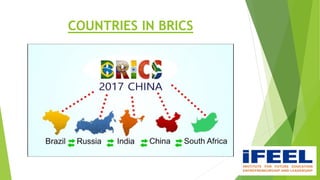
COUNTRIES IN BRICS
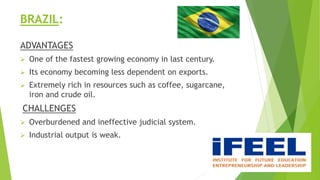
BRAZIL:
ADVANTAGES
 One of the fastest growing economy in last century.
 Its economy becoming less dependent on exports.
 Extremely rich in resources such as coffee, sugarcane,
iron and crude oil.
CHALLENGES
 Overburdened and ineffective judicial system.
 Industrial output is weak.
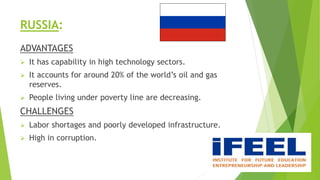
RUSSIA:
ADVANTAGES
 It has capability in high technology sectors.
 It accounts for around 20% of the world’s oil and gas
reserves.
 People living under poverty line are decreasing.
CHALLENGES
 Labor shortages and poorly developed infrastructure.
 High in corruption.
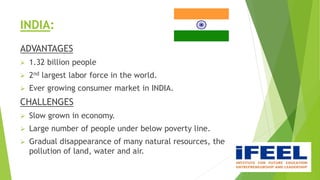
INDIA:
ADVANTAGES
 1.32 billion people
 2nd largest labor force in the world.
 Ever growing consumer market in INDIA.
CHALLENGES
 Slow grown in economy.
 Large number of people under below poverty line.
 Gradual disappearance of many natural resources, the
pollution of land, water and air.
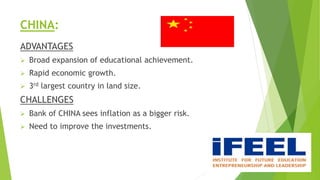
CHINA:
ADVANTAGES
 Broad expansion of educational achievement.
 Rapid economic growth.
 3rd largest country in land size.
CHALLENGES
 Bank of CHINA sees inflation as a bigger risk.
 Need to improve the investments.
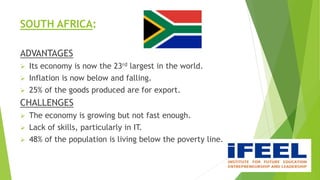
SOUTH AFRICA:
ADVANTAGES
 Its economy is now the 23rd largest in the world.
 Inflation is now below and falling.
 25% of the goods produced are for export.
CHALLENGES
 The economy is growing but not fast enough.
 Lack of skills, particularly in IT.
 48% of the population is living below the poverty line.
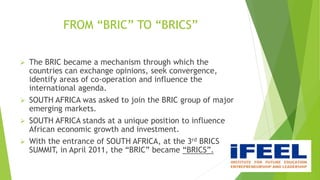
FROM “BRIC” TO “BRICS”
 The BRIC became a mechanism through which the
countries can exchange opinions, seek convergence,
identify areas of co-operation and influence the
international agenda.
 SOUTH AFRICA was asked to join the BRIC group of major
emerging markets.
 SOUTH AFRICA stands at a unique position to influence
African economic growth and investment.
 With the entrance of SOUTH AFRICA, at the 3rd BRICS
SUMMIT, in April 2011, the “BRIC” became “BRICS”.
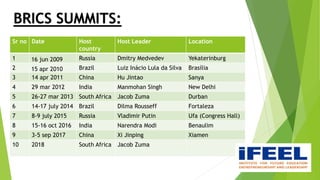
Sr no Date Host
country
Host Leader Location
1 16 jun 2009 Russia Dmitry Medvedev Yekaterinburg
2 15 apr 2010 Brazil Luiz Inácio Lula da Silva Brasília
3 14 apr 2011 China Hu Jintao Sanya
4 29 mar 2012 India Manmohan Singh New Delhi
5 26-27 mar 2013 South Africa Jacob Zuma Durban
6 14-17 july 2014 Brazil Dilma Rousseff Fortaleza
7 8-9 july 2015 Russia Vladimir Putin Ufa (Congress Hall)
8 15-16 oct 2016 India Narendra Modi Benaulim
9 3-5 sep 2017 China Xi Jinping Xiamen
10 2018 South Africa Jacob Zuma
BRICS SUMMITS:
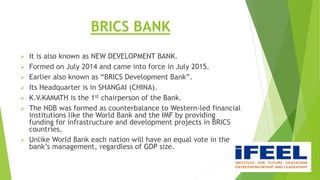
BRICS BANK
 It is also known as NEW DEVELOPMENT BANK.
 Formed on July 2014 and came into force in July 2015.
 Earlier also known as “BRICS Development Bank”.
 Its Headquarter is in SHANGAI (CHINA).
 K.V.KAMATH is the 1st chairperson of the Bank.
 The NDB was formed as counterbalance to Western-led financial
institutions like the World Bank and the IMF by providing
funding for infrastructure and development projects in BRICS
countries.
 Unlike World Bank each nation will have an equal vote in the
bank’s management, regardless of GDP size.
RECENT INFORMATION ABOUT BRICS BANK
 BRICS BANK approves 1st loans, $811 Million green energy.
 BRICS BANK agree on local currency lending.
 INDIA will guide the BRICS BANK with $50 Billion the
finance “inclusive and responsive” needs of particularly
emerging economies.
 NDB plans to reach the target $2.5 Billion of loan
commitments by the end of 2017.
FUTURE PROSPECTS OF BRICS BANK
 BRICS BANK plans to raise between $250 Million and $500
Million in masala bonds.
 BRICS BANK aims to make $4 Billion in loans in 2018.
 BRICS bank is trying to obtain an international credit
rating and expand its membership beyond BRICS countries.
 BRICS BANK plans to issue rupee, yuan bonds this year:
K.V.KAMATH
REFERENCE
 www.ndtv.com
 www.indianexpress.com
 www.moneycontrol.com
 www.youtube.com
 www.brics2017.org
 www.wikipeida.com
 www.slideshare.com
Questions
Brics bank

Brics bank

  • 1.
    BRICS BANK Presented by: •Koushik Y • Kirti Sharma • Jimesh Mehta • Jitendra Purohit • Khyati Jain • Rishikesh Jhella
  • 2.
    What is BRICS? BRICS stands for BRAZIL, RUSSIA, INDIA, CHINA, SOUTH AFRICA.  It came into existence in the year 2001 and incorporated in the year 2009.  BRICS is the internal political organization of leading emerging economics. Its members are leading industrialized countries.
  • 3.
    OBJECTIVES  Its mainobjective are to corporate between the member nations for development, provide financial assistance, support various projects, infrastructure, etc.  The BRICS group acts as a bridge between developed and developing countries. They are attempting to promote the liberalization of the international economic order.  The BRICS group also plays an increasingly important role in assisting developing countries in gaining an advantage in trait and climate change negotiation.
  • 4.
  • 5.
    BRAZIL: ADVANTAGES  One ofthe fastest growing economy in last century.  Its economy becoming less dependent on exports.  Extremely rich in resources such as coffee, sugarcane, iron and crude oil. CHALLENGES  Overburdened and ineffective judicial system.  Industrial output is weak.
  • 6.
    RUSSIA: ADVANTAGES  It hascapability in high technology sectors.  It accounts for around 20% of the world’s oil and gas reserves.  People living under poverty line are decreasing. CHALLENGES  Labor shortages and poorly developed infrastructure.  High in corruption.
  • 7.
    INDIA: ADVANTAGES  1.32 billionpeople  2nd largest labor force in the world.  Ever growing consumer market in INDIA. CHALLENGES  Slow grown in economy.  Large number of people under below poverty line.  Gradual disappearance of many natural resources, the pollution of land, water and air.
  • 8.
    CHINA: ADVANTAGES  Broad expansionof educational achievement.  Rapid economic growth.  3rd largest country in land size. CHALLENGES  Bank of CHINA sees inflation as a bigger risk.  Need to improve the investments.
  • 9.
    SOUTH AFRICA: ADVANTAGES  Itseconomy is now the 23rd largest in the world.  Inflation is now below and falling.  25% of the goods produced are for export. CHALLENGES  The economy is growing but not fast enough.  Lack of skills, particularly in IT.  48% of the population is living below the poverty line.
  • 10.
    FROM “BRIC” TO“BRICS”  The BRIC became a mechanism through which the countries can exchange opinions, seek convergence, identify areas of co-operation and influence the international agenda.  SOUTH AFRICA was asked to join the BRIC group of major emerging markets.  SOUTH AFRICA stands at a unique position to influence African economic growth and investment.  With the entrance of SOUTH AFRICA, at the 3rd BRICS SUMMIT, in April 2011, the “BRIC” became “BRICS”.
  • 11.
    Sr no DateHost country Host Leader Location 1 16 jun 2009 Russia Dmitry Medvedev Yekaterinburg 2 15 apr 2010 Brazil Luiz Inácio Lula da Silva Brasília 3 14 apr 2011 China Hu Jintao Sanya 4 29 mar 2012 India Manmohan Singh New Delhi 5 26-27 mar 2013 South Africa Jacob Zuma Durban 6 14-17 july 2014 Brazil Dilma Rousseff Fortaleza 7 8-9 july 2015 Russia Vladimir Putin Ufa (Congress Hall) 8 15-16 oct 2016 India Narendra Modi Benaulim 9 3-5 sep 2017 China Xi Jinping Xiamen 10 2018 South Africa Jacob Zuma BRICS SUMMITS:
  • 12.
    BRICS BANK  Itis also known as NEW DEVELOPMENT BANK.  Formed on July 2014 and came into force in July 2015.  Earlier also known as “BRICS Development Bank”.  Its Headquarter is in SHANGAI (CHINA).  K.V.KAMATH is the 1st chairperson of the Bank.  The NDB was formed as counterbalance to Western-led financial institutions like the World Bank and the IMF by providing funding for infrastructure and development projects in BRICS countries.  Unlike World Bank each nation will have an equal vote in the bank’s management, regardless of GDP size.
  • 13.
    RECENT INFORMATION ABOUTBRICS BANK  BRICS BANK approves 1st loans, $811 Million green energy.  BRICS BANK agree on local currency lending.  INDIA will guide the BRICS BANK with $50 Billion the finance “inclusive and responsive” needs of particularly emerging economies.  NDB plans to reach the target $2.5 Billion of loan commitments by the end of 2017.
  • 14.
    FUTURE PROSPECTS OFBRICS BANK  BRICS BANK plans to raise between $250 Million and $500 Million in masala bonds.  BRICS BANK aims to make $4 Billion in loans in 2018.  BRICS bank is trying to obtain an international credit rating and expand its membership beyond BRICS countries.  BRICS BANK plans to issue rupee, yuan bonds this year: K.V.KAMATH
  • 15.
    REFERENCE  www.ndtv.com  www.indianexpress.com www.moneycontrol.com  www.youtube.com  www.brics2017.org  www.wikipeida.com  www.slideshare.com
  • 16.