RURAL – URBAN MIGRATION
Presented by
SURAMYA T.K. (HS14D022)
and
VIPIN V (HS14D024)
INTRODUCTION
 How to interpret growth in the developing
countries?
 Structural change and development
 Arthur Lewis - two sector model – Theory of rural-
urban migration - ‘economic development with the
unlimited supplies of labour’ (Surplus Labour)
 Development – Industrial Modernization (structural
transformation)
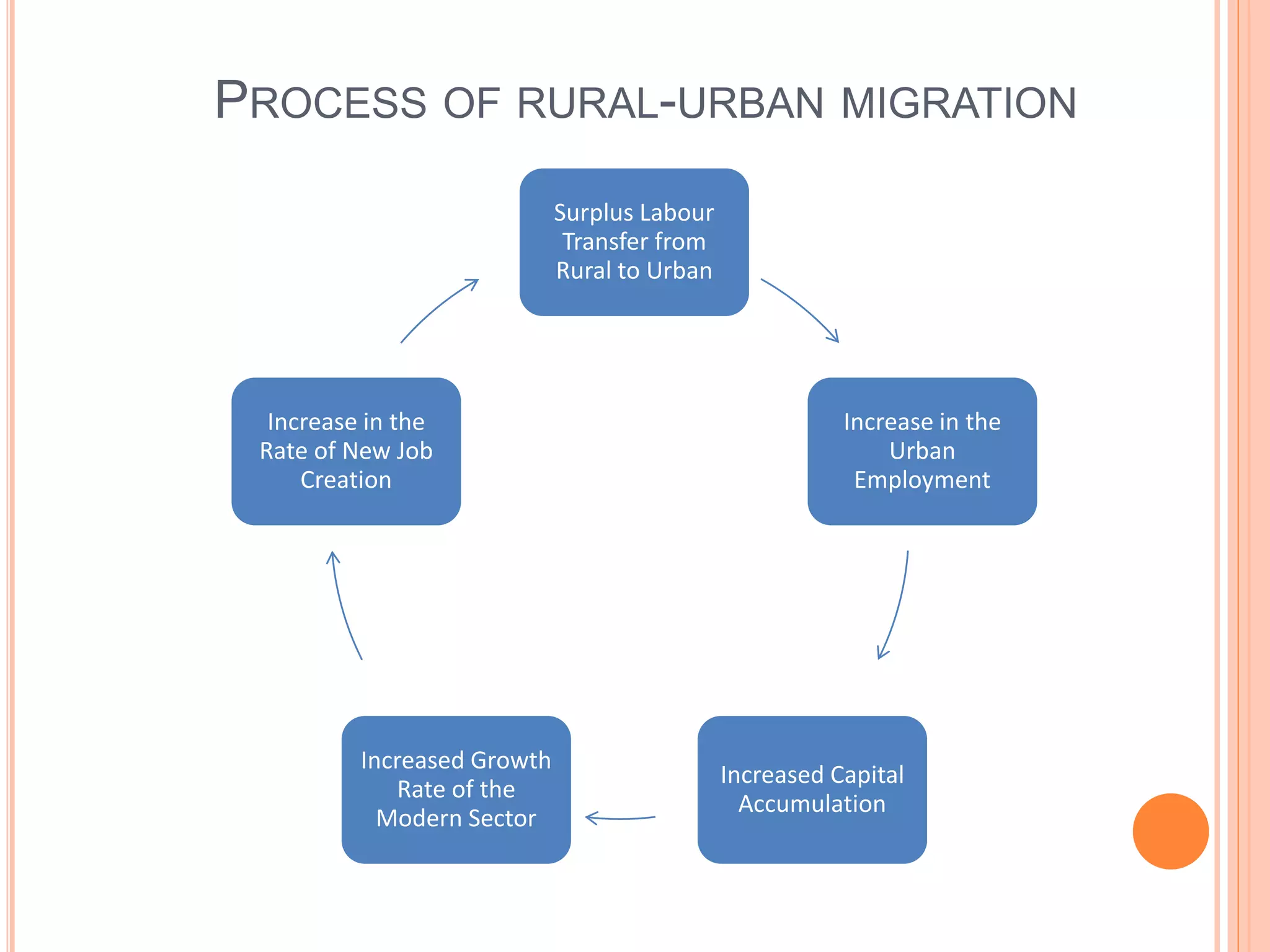
PROCESS OF RURAL-URBAN MIGRATION
Surplus Labour
Transfer from
Rural to Urban
Increase in the
Urban
Employment
Increased Capital
Accumulation
Increased Growth
Rate of the
Modern Sector
Increase in the
Rate of New Job
Creation
THE LEWIS MODEL(1954)
 Economic Development –Progressive
transformation of “Traditional” sector into “Modern”
Sector
 Dual Economy
Traditional: Agriculture-Older techniques which
are labour intensive
 Modern: Industrial - Use modern technology-
Production organized in Capitalist principle
SURPLUS LABOUR
 Traditional sector- supplier of labour
 The capital accumulation in modern sector- engine
of development
 Large surplus of labour in traditional sector-can be
removed at little or no potential cost(opportunity
cost)
 Opportunity cost: the loss of traditional sector
output as labour supply is reduced
 Rostenstein-Rodan(1943) and Nurkse (1953) also
held this view
PRODUCTION FUNCTION OF FAMILY FARM
o Land is fixed
o Diminishing Returns to
Scale
o After a point(B)
additional input of
labour not have effect
on Q
o It is not limited to
Agriculture(eg.Casual
jobs)
o At point A MPL=0
o
𝐴𝑄
𝐴
= 𝜔
Q
Will family
farm employ
beyond this
point??
EXTENSIONS OF SURPLUS LABOUR CONCEPT
 The inability of labour to add anything to output was
criticized(Viner 1957)
 The useful extensions of this concept are:
a) Disguised unemployment
o Amount of disguised unemployment=L−L(MP=Wage)
o Why doesn’t market switch labour efficiently?
Ans. Zero MP is characterised by payment system
b) Surplus labour Vs. Surplus labourers
o Maintaining Agri. Output is essential
o We remove labourers not labour
o Remaining labourers will adjust their labour once
some are removed(Sen,1966)
ECONOMIC DEVELOPMENT AND
THE AGRICULTURAL SURPLUS
 Lewis explained the interplay of rural and urban
sectors
 Later John Fei & Gustav Ranis(1961) extended it
 Development proceeds by the transfer of labour
from agriculture to industry and the surplus food
grain production which sustains the labour force
engaged in non-agricultural activity
CRITIQUE OF LEWISIAN MODEL
 Unrealistic assumption of a smooth structural
transformation of the economy
 Unable to explain urban unemployment and the
existence of a large unban informal sector
 Model couldn’t incorporate the possibility of surplus
capitalist profits getting reinvested in more sophisticated
labour-saving capital equipment
 Assumption of the continued existence of constant real
urban wages until the point where the supply of rural
surplus labour is exhausted is not real
 Limited analytical and policy guidance for solving the
third world employment and migration problems
HARRIS – TODARO MODEL OF RURAL –
URBAN MIGRATION
 Two-sector model of rural-urban migration
 Assumption:
1. migration is primarily an economic phenomenon
2. wage gap between the two sectors of the economy
 Migration proceeds in response to urban-rural differences
in expected earnings rather than actual earnings, and the
urban employment rate acting as an equilibrating force
on such migration
 Incorporation of the existence of urban unemployment
into the model and predicts that the probability of
obtaining an urban job is inversely related to the urban
unemployment rate
SCHEMATIC FRAMEWORK FOR THE ANALYSIS OF
THE MIGRATION DECISION
3 possibilities attached to a migrant:
 The urban formal sector with high wage rate
 The urban informal sector with a fixed wage rate and
abysmal conditions. The migrant will be absorbed in the
event that no formal job is forthcoming
 Openly Unemployed with a zero wage rate
the probability of getting a job in the formal sector will be:
𝐿 𝐹
𝐿 𝐹 + 𝐿𝐼
Where,
LF is the no of employed people in the formal sector
LI is the no of employed people in the informal sector
LF + LI is the total no of potential job seekers
HARRIS – TODARO EQUILIBRIUM CONDITION
𝐿 𝐹
𝐿 𝐹+𝐿 𝐼
𝑤 +
𝐿 𝐼
𝐿 𝐹+𝐿 𝐼
wI = wA
Where,
𝑤 is the formal sector wage rate
wI is the informal sector wage rate
wA is the agricultural wage rate
 “Informal sector is an outgrowth of the fact that the
formal sector has wages that are too high, so that not
everyone is capable of obtaining employment in this
sector. At the same time, not everyone else can stay in
agriculture as well, for that would make the formal sector
look too attractive and induce a great deal of migration.
Informal sector is a result of this migration”
(Development Economics, Debraj Ray, Chapter 10: Rural and Urban)
POLICY IMPLICATIONS – HARRIS-TODARO MODEL
 The need to reduce imbalances in urban-rural
employment opportunities
 Urban job creation is an insufficient solution for the
urban unemployment problem
 Indiscriminate educational expansion will lead to further
migration and unemployment
 Wage subsidies and Traditional scarcity factor pricing
can be counterproductive
 Programs of Integrated Rural Development should be
encouraged
POLICY PROPOSITIONS AND CONCLUSION
 Wage subsidies in the formal urban sector
 Migration restrictions
 Combination of both the above policies
Further improvements
 Profit Tax on firms
 Forcing manufacturers to employ all available labor
 Production subsidy to agriculture
Serious policy concerns
 political feasibility
 Problems such as; the administration costs and feasibility of
alternative policies
 Risk averse agent
 Role of social capital
 Existence of Urabn Informal sector
 Role of Micro Finance

Rural – urban migration

  • 1.
    RURAL – URBANMIGRATION Presented by SURAMYA T.K. (HS14D022) and VIPIN V (HS14D024)
  • 2.
    INTRODUCTION  How tointerpret growth in the developing countries?  Structural change and development  Arthur Lewis - two sector model – Theory of rural- urban migration - ‘economic development with the unlimited supplies of labour’ (Surplus Labour)  Development – Industrial Modernization (structural transformation)
  • 3.
    PROCESS OF RURAL-URBANMIGRATION Surplus Labour Transfer from Rural to Urban Increase in the Urban Employment Increased Capital Accumulation Increased Growth Rate of the Modern Sector Increase in the Rate of New Job Creation
  • 4.
    THE LEWIS MODEL(1954) Economic Development –Progressive transformation of “Traditional” sector into “Modern” Sector  Dual Economy Traditional: Agriculture-Older techniques which are labour intensive  Modern: Industrial - Use modern technology- Production organized in Capitalist principle
  • 5.
    SURPLUS LABOUR  Traditionalsector- supplier of labour  The capital accumulation in modern sector- engine of development  Large surplus of labour in traditional sector-can be removed at little or no potential cost(opportunity cost)  Opportunity cost: the loss of traditional sector output as labour supply is reduced  Rostenstein-Rodan(1943) and Nurkse (1953) also held this view
  • 6.
    PRODUCTION FUNCTION OFFAMILY FARM o Land is fixed o Diminishing Returns to Scale o After a point(B) additional input of labour not have effect on Q o It is not limited to Agriculture(eg.Casual jobs) o At point A MPL=0 o 𝐴𝑄 𝐴 = 𝜔 Q Will family farm employ beyond this point??
  • 7.
    EXTENSIONS OF SURPLUSLABOUR CONCEPT  The inability of labour to add anything to output was criticized(Viner 1957)  The useful extensions of this concept are: a) Disguised unemployment o Amount of disguised unemployment=L−L(MP=Wage) o Why doesn’t market switch labour efficiently? Ans. Zero MP is characterised by payment system b) Surplus labour Vs. Surplus labourers o Maintaining Agri. Output is essential o We remove labourers not labour o Remaining labourers will adjust their labour once some are removed(Sen,1966)
  • 8.
    ECONOMIC DEVELOPMENT AND THEAGRICULTURAL SURPLUS  Lewis explained the interplay of rural and urban sectors  Later John Fei & Gustav Ranis(1961) extended it  Development proceeds by the transfer of labour from agriculture to industry and the surplus food grain production which sustains the labour force engaged in non-agricultural activity
  • 10.
    CRITIQUE OF LEWISIANMODEL  Unrealistic assumption of a smooth structural transformation of the economy  Unable to explain urban unemployment and the existence of a large unban informal sector  Model couldn’t incorporate the possibility of surplus capitalist profits getting reinvested in more sophisticated labour-saving capital equipment  Assumption of the continued existence of constant real urban wages until the point where the supply of rural surplus labour is exhausted is not real  Limited analytical and policy guidance for solving the third world employment and migration problems
  • 11.
    HARRIS – TODAROMODEL OF RURAL – URBAN MIGRATION  Two-sector model of rural-urban migration  Assumption: 1. migration is primarily an economic phenomenon 2. wage gap between the two sectors of the economy  Migration proceeds in response to urban-rural differences in expected earnings rather than actual earnings, and the urban employment rate acting as an equilibrating force on such migration  Incorporation of the existence of urban unemployment into the model and predicts that the probability of obtaining an urban job is inversely related to the urban unemployment rate
  • 12.
    SCHEMATIC FRAMEWORK FORTHE ANALYSIS OF THE MIGRATION DECISION
  • 13.
    3 possibilities attachedto a migrant:  The urban formal sector with high wage rate  The urban informal sector with a fixed wage rate and abysmal conditions. The migrant will be absorbed in the event that no formal job is forthcoming  Openly Unemployed with a zero wage rate the probability of getting a job in the formal sector will be: 𝐿 𝐹 𝐿 𝐹 + 𝐿𝐼 Where, LF is the no of employed people in the formal sector LI is the no of employed people in the informal sector LF + LI is the total no of potential job seekers
  • 14.
    HARRIS – TODAROEQUILIBRIUM CONDITION 𝐿 𝐹 𝐿 𝐹+𝐿 𝐼 𝑤 + 𝐿 𝐼 𝐿 𝐹+𝐿 𝐼 wI = wA Where, 𝑤 is the formal sector wage rate wI is the informal sector wage rate wA is the agricultural wage rate  “Informal sector is an outgrowth of the fact that the formal sector has wages that are too high, so that not everyone is capable of obtaining employment in this sector. At the same time, not everyone else can stay in agriculture as well, for that would make the formal sector look too attractive and induce a great deal of migration. Informal sector is a result of this migration” (Development Economics, Debraj Ray, Chapter 10: Rural and Urban)
  • 15.
    POLICY IMPLICATIONS –HARRIS-TODARO MODEL  The need to reduce imbalances in urban-rural employment opportunities  Urban job creation is an insufficient solution for the urban unemployment problem  Indiscriminate educational expansion will lead to further migration and unemployment  Wage subsidies and Traditional scarcity factor pricing can be counterproductive  Programs of Integrated Rural Development should be encouraged
  • 16.
    POLICY PROPOSITIONS ANDCONCLUSION  Wage subsidies in the formal urban sector  Migration restrictions  Combination of both the above policies Further improvements  Profit Tax on firms  Forcing manufacturers to employ all available labor  Production subsidy to agriculture Serious policy concerns  political feasibility  Problems such as; the administration costs and feasibility of alternative policies  Risk averse agent  Role of social capital  Existence of Urabn Informal sector  Role of Micro Finance

Editor's Notes

  • #7 Profit maximising firms consider wage payment as a cost-Family farm consider income received by each of its members. Here the wage is the average output of the farm
  • #11 Agricultural taxing policy and Agricultural Pricing policy are the policies that can be adopted for the development