PRESENTED BY:
AKASH DEEP KAMAL
ATRI ROY
NEHA SINGH
NILESH SAHA
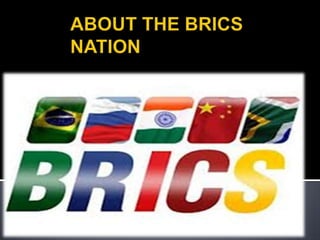
 BRICS stands for Brazil, Russia, China, and
South Africa.
 Came into existence in 2001 as BRICS nation
 It is the fastest growing and emerging economics
 BRICS is the international political organization
of leading emerging economies. Its five members
are all developing industrialized countries
 The term BRICS was used for the first time in the
Goldman Sachs report 2003
 The BRIC became a mechanism through which the
countries can exchange opinions, seek convergence,
identify areas of cooperation and influence the
international agenda.
 Officially it was admitted as a BRIC nation on 24
December 2010
 With the entrance of South Africa, at the 3rd BRICS
Summit, in April 2011, the BRIC became BRICS, with
capital "S".
3
 Vast Land Area
 Developing Economy Globally
 Friendly Trade Relations
 Challenges Related To Economic And Social Integration
 Desire To Make The International Order More Representative
 Possibility Of Cooperation In Many Areas
 To achieve regional development
 To remove trade barriers
 Economic development
 Optimum use of resources
 Building relationship
KEY ADVANTAGES :
 One of the fastest growing economies in the last centuries
 Brazilian economy becoming less dependent on imports
 Extremely rich in resources such as coffee, sugarcane, crude oil
and iron etc.
 Focus on equitable development has resulted in significant
poverty reduction.
CHALLENGES FOR THE FUTURE:
 Overburdened and ineffective judicial system.
 Industrial output is weak
KEY ADVANTAGES:
 Russia has capability in high-technology sectors
 Accounts for around 20% of the world’s oil and gas reserves
 fall in the number of people living below the poverty line
CHALLENGES FOR FUTURE
 Labour shortages and poorly developed infrastructure
 Corruption
KEY ADVANTAGES
 1.15 billion people
 2nd largest labour force
 Approximately 2.5 million college graduates per year
CHALLENGES FOR THE FUTURE
 Improving basic educational achievement
 Improving infrastructure and electrical capacity
 Expanding technology industry
KEY ADVANTAGES
 Broad expansion of educational achievement
 Rapid economic growth
 Third largest country in land size
CHALLENGES FOR THE FUTURE
 support to rural areas and less-developed regions
 Bank of China sees inflation as a bigger risk
 Need to improve the investment
KEYADVANTAGE
 The South African economy is now the 23rd largest in the
world
 Inflation is now below 5% and falling.
 25% of goods produced in South Africa are for export
CHALLENGES FOR THE FUTURE:
 The economy is growing but not fast enough
 Lack of skills, particularly in IT.
 48% of the population is living below the poverty line
12
CONTRIBUTION TO GDP
26 % of Earth's land area
42 % of world's population
46% of world’s work force
19 % of world s nominal GDP
13
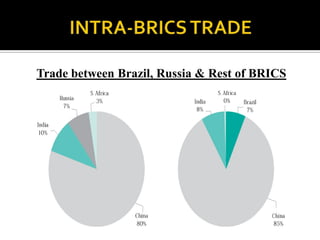
Trade between Brazil, Russia & Rest of BRICS
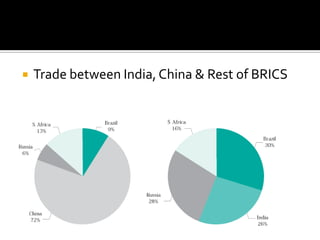
 Trade between India, China & Rest of BRICS
 Trade between South Africa & Rest of BRICS
 Source based on UN COMTRADE and http://wits.worldbank.org/wits/
 To support growth on the continent, notably during the recent
financial crisis
 South Africa’s financial market development and
sophistication
 The World Economic Forum’s 2011/12 Global
Competitiveness Index displayed a high level of confidence in
South Africa’s financial market development, ranking the
country in fourth place globally on this measure.
 Among BRICS members, South African exports to China
grew the most, at 46%, while exports to India grew by 20%, to
Brazil by 14% and by 7% to Russia.
 Manufacturing, services and
agriculture
 Energy, infrastructure, mining
beneficiation and healthcare
 Construction and water provision
 The green economy and tourism
 India is also expected to grow faster than China after
2020
 India- Characterized by a low share of consumption
and high savings.
 Rising incomes in the BRICs nations will create a
new middle consumer class
 Featured as- “Roadmap For Contribution”
 Important drivers for growth in the global economy.
 Expansion of their consumer markets and the rise of
multinational companies
 the establishment of a “positive multipolarity" in
international affairs
 The BRICS were seen by Brazilian diplomats and
scholars as a useful mechanism to project Brazil
internationally in a rapidly changing global
landscape.
 Lost speed and altitude over the past two years
 Chances of Intra Trade Disputes are high
 Difficulties of articulating their conflicting interests
in some sort of common vision became more evident.
 Different viewpoints and influence in the
international arena.
 BRICS will remain a useful mirror
 Brazilian comparisons with China and India in
regards to economic factors
 overcoming current obstacles to higher
sustainable growth
 drive productivity and competitiveness in an
increasingly integrated world economy
 a central role in dealing with global challenges
and threats.
Credit goes to:
AANN
http://www.unitedworld.edu.in/
Campus
Ahmedabad Campus: Karnavati KnowledgeVillage,
A/907,Uvarsad, S.G.Highway, Gandhinagar
Kolkata Campus: Infinity Benchmark Tower 10th Floor, Plot -
G1, Block - EP& GP, Sec -V, Salt Lake, Kolkata.
Reg. Office: 407, Zodiac Square, 4th Floor Opp. Gurudwara,
S.G. Road, Bodakdev, Ahmedabad.

PPT ON BRICS

  • 1.
    PRESENTED BY: AKASH DEEPKAMAL ATRI ROY NEHA SINGH NILESH SAHA
  • 2.
     BRICS standsfor Brazil, Russia, China, and South Africa.  Came into existence in 2001 as BRICS nation  It is the fastest growing and emerging economics  BRICS is the international political organization of leading emerging economies. Its five members are all developing industrialized countries  The term BRICS was used for the first time in the Goldman Sachs report 2003
  • 3.
     The BRICbecame a mechanism through which the countries can exchange opinions, seek convergence, identify areas of cooperation and influence the international agenda.  Officially it was admitted as a BRIC nation on 24 December 2010  With the entrance of South Africa, at the 3rd BRICS Summit, in April 2011, the BRIC became BRICS, with capital "S". 3
  • 4.
     Vast LandArea  Developing Economy Globally  Friendly Trade Relations  Challenges Related To Economic And Social Integration  Desire To Make The International Order More Representative  Possibility Of Cooperation In Many Areas
  • 5.
     To achieveregional development  To remove trade barriers  Economic development  Optimum use of resources  Building relationship
  • 7.
    KEY ADVANTAGES : One of the fastest growing economies in the last centuries  Brazilian economy becoming less dependent on imports  Extremely rich in resources such as coffee, sugarcane, crude oil and iron etc.  Focus on equitable development has resulted in significant poverty reduction. CHALLENGES FOR THE FUTURE:  Overburdened and ineffective judicial system.  Industrial output is weak
  • 8.
    KEY ADVANTAGES:  Russiahas capability in high-technology sectors  Accounts for around 20% of the world’s oil and gas reserves  fall in the number of people living below the poverty line CHALLENGES FOR FUTURE  Labour shortages and poorly developed infrastructure  Corruption
  • 9.
    KEY ADVANTAGES  1.15billion people  2nd largest labour force  Approximately 2.5 million college graduates per year CHALLENGES FOR THE FUTURE  Improving basic educational achievement  Improving infrastructure and electrical capacity  Expanding technology industry
  • 10.
    KEY ADVANTAGES  Broadexpansion of educational achievement  Rapid economic growth  Third largest country in land size CHALLENGES FOR THE FUTURE  support to rural areas and less-developed regions  Bank of China sees inflation as a bigger risk  Need to improve the investment
  • 11.
    KEYADVANTAGE  The SouthAfrican economy is now the 23rd largest in the world  Inflation is now below 5% and falling.  25% of goods produced in South Africa are for export CHALLENGES FOR THE FUTURE:  The economy is growing but not fast enough  Lack of skills, particularly in IT.  48% of the population is living below the poverty line
  • 12.
    12 CONTRIBUTION TO GDP 26% of Earth's land area 42 % of world's population 46% of world’s work force 19 % of world s nominal GDP
  • 13.
  • 15.
    Trade between Brazil,Russia & Rest of BRICS
  • 16.
     Trade betweenIndia, China & Rest of BRICS
  • 17.
     Trade betweenSouth Africa & Rest of BRICS  Source based on UN COMTRADE and http://wits.worldbank.org/wits/
  • 18.
     To supportgrowth on the continent, notably during the recent financial crisis  South Africa’s financial market development and sophistication  The World Economic Forum’s 2011/12 Global Competitiveness Index displayed a high level of confidence in South Africa’s financial market development, ranking the country in fourth place globally on this measure.  Among BRICS members, South African exports to China grew the most, at 46%, while exports to India grew by 20%, to Brazil by 14% and by 7% to Russia.
  • 19.
     Manufacturing, servicesand agriculture  Energy, infrastructure, mining beneficiation and healthcare  Construction and water provision  The green economy and tourism
  • 20.
     India isalso expected to grow faster than China after 2020  India- Characterized by a low share of consumption and high savings.  Rising incomes in the BRICs nations will create a new middle consumer class  Featured as- “Roadmap For Contribution”  Important drivers for growth in the global economy.  Expansion of their consumer markets and the rise of multinational companies  the establishment of a “positive multipolarity" in international affairs
  • 21.
     The BRICSwere seen by Brazilian diplomats and scholars as a useful mechanism to project Brazil internationally in a rapidly changing global landscape.  Lost speed and altitude over the past two years  Chances of Intra Trade Disputes are high  Difficulties of articulating their conflicting interests in some sort of common vision became more evident.  Different viewpoints and influence in the international arena.
  • 22.
     BRICS willremain a useful mirror  Brazilian comparisons with China and India in regards to economic factors  overcoming current obstacles to higher sustainable growth  drive productivity and competitiveness in an increasingly integrated world economy  a central role in dealing with global challenges and threats.
  • 23.
  • 24.
    http://www.unitedworld.edu.in/ Campus Ahmedabad Campus: KarnavatiKnowledgeVillage, A/907,Uvarsad, S.G.Highway, Gandhinagar Kolkata Campus: Infinity Benchmark Tower 10th Floor, Plot - G1, Block - EP& GP, Sec -V, Salt Lake, Kolkata. Reg. Office: 407, Zodiac Square, 4th Floor Opp. Gurudwara, S.G. Road, Bodakdev, Ahmedabad.