bushrazaman@sw.jnu.ac.bd
Social Policy & Planning
2022/11/08
AGENDA
•
•
•
•
•
•
•
•
•
•
•
•
•
•
20XX Presentation title 2
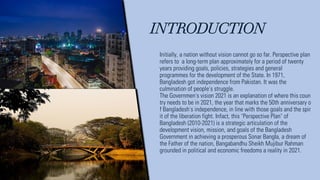
INTRODUCTION
Initially, a nation without vision cannot go so far. Perspective plan
refers to a long-term plan approximately for a period of twenty
years providing goals, policies, strategies and general
programmes for the development of the State. In 1971,
Bangladesh got independence from Pakistan. It was the
culmination of people's struggle.
The Governmen's vision 2021 is an explanation of where this coun
try needs to be in 2021, the year that marks the 50th anniversary o
f Bangladesh's independence, in line with those goals and the spir
it of the liberation fight. Infact, this "Perspective Plan" of
Bangladesh (2010-2021) is a strategic articulation of the
development vision, mission, and goals of the Bangladesh
Government in achieving a prosperous Sonar BangIa, a dream of
the Father of the nation, Bangabandhu Sheikh Mujibur Rahman
grounded in political and economic freedoms a reality in 2021.
The 8th Five Year plan represents the first phase of the country's
Perpective Plan of 2041. Vision 2041 seeks to eliminate extreme
poverty and reach upper Middle-Income country status by 2031;
and High Income country status by 2041 with poverty approaching
extinction.
Key Elements of PP2041:
• Rapid Transformational shifts in agriculture.
• Rapid growth of trade and industry.
• Development in education and health care.
Two principle Vision of 2041:
• Bangladesh will be developed country, with per capita
income of over USD 12,500 in today's price
• Poverty will be the thing of past in 'Sonar Bangla'.
1.Institutional matter: Historical evidence shows that rapid and
development of societies is by strong and effective institutions.
Especially the economic and
social institutions.
2.Macroeconomic management for accelerated inclusive growth
I. Approach to fiscal operations
II. Monetary management to Combat inflation And faster growth
III. Sustainable balance of payment
3.Zero poverty country: Consistent with the dream of Bangabandhu,
By 2031 extreme poverty will be eliminated and by 2041 the
incidence of poverty will be minimal (3% or less). By 2041 all citizens
will be guaranteed—
I. A minimum quality of life
II. Income for all who sick work
III. Social protection
IV. Enough income to buy minimum consumption
V. Strengthening human capital
VI. Reduction in income inequality
4.Human Development: Harnessing the demographic dividend: The
P2041
puts a strong emphasis on improving human development both to
supporting
GDP growth and to reduce poverty. The program compromises—
a. Knowledge based economy
b. 100% literacy rate
c. Free education for up to 12 years
d. Universal access to health insurance
e. 100% employment
The plan following to strategies —
• Strategy for population health and nutrition
• Strategy for education and training
5.Sustainable agriculture to ensure food security and nutrition: The
economic sectors with the most influence on poverty reduction are
agriculture and
rural non-firm activities. The key priorities for the future of
sustainable
agriculture include-strengthening local adaptive capacity by providing
public
goods and services. Such as-
• Better climate information
• Innovative research for the development of heat tolerant
• Salinity tolerant crop varieties and climate smart production
technologies
• Efficient water saving irrigation practices and early forecasting
systems
4
9.Building Transport and
Communications infrastructure for
sustained growth:
low cost and efficient transport
service is a major determinant of
sustained growth. The transport
strategy for PP2041 will build on
the lessons of experience of the
implementation of the P2021.
2 strategies are followed —
• The transport sector strategy
for PP2041;
• Communications development
strategy.
6. Accelerated growth with
industrialization and trades
I. Strengthening competitive
advantage ;
II. Trade resign for export
diversification;
III. Future trade policy;
IV. Challenges associated with the
graduation from LDC status;
V. The employment challenge and
Strategies.
10.Managing the urban
transition: Urbanization and
development are highly and
positively correlated. Urbanization
and economic growth will go
together in the future. Managing
factors—
• Urban governance reform;
• PP2041 Urban sector financing
requirements and options.
8.Creating an innovation economy:
Using the technologies with labor advantage,
It is time to reach upper middle income status
by 2031 and to reach the advanced economy
status by 2041. To create an innovative
economy following moves are essential—
• Digital opportunities and innovation
• Leveraging the fourth industrial; revolution
• Moving from factor-driven stage to
innovation based economy.
11.Managing environment and
climate change for sustainable
growth: Many laws and regulations
have been enacted over the years on
environment and climate change, like
6th FYP, 7th FYP. The main focus of the
P2041 environmental management
strategy would be to integrate
environment and climate change
consideration in the growth strategy.
Perspective Plan
Chepter-1
The legacy of Bangabandhu Sheikh Mujib is now being carried forward with able and farsighted leadership of Prime Minister Sheikh Hasina paving the way
to fulfillment of a long cherished dream of Sonar Bangla by Bangabandhu Sheikh Mujib. Under her able leadership, Bangladesh has moved forward to a
lower- middle income country and aspiring to achieve a status of a developed country by 2041.In this 21st century, there is one indisputable phenomenon.
That is the embedded and ultimate goal of designing the next twenty-year perspective plan for the period 2021-2041. Two principal visions underpin the
PP2041:
Strategic Goals and Milestones of the PP2041
• Bangladesh will be a developed country by 2041, with per capita
income of over USD 12,500 in today’s prices, and fully in tune with
the digital world.
• Poverty will become a thing of the past in Sonar Bangla.
The following strategic goals will be pursued as the essential
components of economic policy over the long-term:
• Eradication of Extreme Poverty by 2031; reducing Poverty to less
than 3 percent by 2041
• Towards Upper middle-income country by FY 2031; High-income
country by 2041
• Industrialization with export-oriented manufacturing will drive
structural transformation into the future
• Paradigm shifts in Agriculture will enhance productivity and ensure
nutrition and food security for the future
• A Service sector of the future will provide the bridge for the
transformation of the rural agrarian economy to a primarily
industrial and digital economy
• The Urban transition will be an essential part of the strategy to
move to a high-income economy
• Efficient Energy and Infrastructure will be essential components
of the enabling environment that facilitates rapid, efficient and
sustainable growth
• Building a Bangladesh resilient to climate change and other
environmental challenges
• Establishing Bangladesh as a knowledge hub country for
promoting a skill-based society The changing global and regional
scenarios also appear to be much more challenging.
• All these suggest that Bangladesh has to make some
extraordinary efforts in its economic and social development
process in the days to come.
7
ENSURING GOOD GOVERNANCE
INSTITUTIONAL FOUNDATIONS
OF A HIGH-INCOME COUNTRY
This is the conclusion of historians and economists alike. At the end
of the day, it is institutions of all types and forms that are the
determinants of prosperity or decline of societies . Overall, a variety
of research evidence points to the fact that broad institutional
differences across countries could explain the differences in their
income levels. Though Bangladesh has chosen the path of market-
oriented development, the state still has the primary responsibility to
nurture effective development institutions to support the long and
tedious march to high-income country status by 2041.
CHAPTER 02 8
The strategic thrust of PP2041 will be on strengthening institutions. Broadly
speaking, the major focus should be on
▪ planning institutions,
▪ governance institutions,
▪ financial institutions,
▪ democratic institutions -
institutions to promote pluralistic
democracy,
▪ decentralization institutions,
▪ capacity building institutions.
▪ gender empowerment institutions,
▪ legislative institutions,
▪ judicial institutions,
▪ public administration capacity -
Executive, the bureaucracy and the
rule of law,
▪ political institutions,
▪ social institutions,
▪ institutions for land management,
▪ institutions for human capital
development – basic education and
skill, institutions for technology,
market institutions.
A COUNTRY WITH ZERO POVERTY
Bangladesh can feel justifiably proud of its achievements in the fight against poverty. In the early
1970s following independence poverty was rampant with head-count poverty in the range of 80%.
In 2019 poverty declined to 20.5% while extreme poverty fell to 10.5% as of BBS’s projection. This
rapid progress in reducing poverty has emboldened policymakers to aim to secure the dream of
Bangabandhu Sheikh Mujibur Rahman to free Bangladesh of the incidence of poverty by 2041.
The target of Vision 2041 is to eliminate extreme poverty by 2030 and by 2041 Bangladesh will be
a high-income country with absolute poverty approaching extinction.
Chapter- 03 10
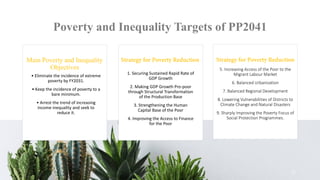
Poverty and Inequality Targets of PP2041
Main Poverty and Inequality
Objectives
• Eliminate the incidence of extreme
poverty by FY2031.
• Keep the incidence of poverty to a
bare minimum.
• Arrest the trend of increasing
income inequality and seek to
reduce it.
1. Securing Sustained Rapid Rate of
GDP Growth
2. Making GDP Growth Pro-poor
through Structural Transformation
of the Production Base
3. Strengthening the Human
Capital Base of the Poor
4. Improving the Access to Finance
for the Poor
11
5. Increasing Access of the Poor to the
Migrant Labour Market
6. Balanced Urbanization
7. Balanced Regional Development
8. Lowering Vulnerabilities of Districts to
Climate Change and Natural Disasters
9. Sharply Improving the Poverty Focus of
Social Protection Programmes.
A fundamental theme of Vision 2041 and the
associated Perspective Plan is the achievement
of a development outcome where citizens will
have a higher standard of living, will be better
educated, will face better social justice, and will
have a more equitable socio-economic
environment.
• Institution of a knowledge-based economy.
• Population with 100% literacy rate defined in terms of
demonstrated ability to read and
write in the national language.
• Universal free education for up to 12 years.
• Flexible supply of training institutions for all who seek
to acquire job-based skills.
• Universal access to health insurance schemes at
affordable prices.
• Mainstreaming of TVET for readiness for Industry 4.0.
• 100% coverage of employment-based accidental and
health insurance schemes for all
workers in the organized sector.
• Employment of 1000 youth (both male and female)
should be ensured every year from each upazilla
13
14
The targets for human
development that will help
realize this vision are indicated
below. These are ambitious
targets but consistent with the
situation prevailing in high-
income countries.
15
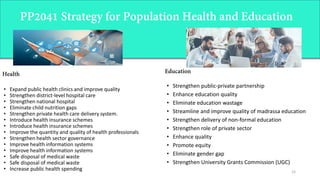
• Strengthen public-private partnership
• Enhance education quality
• Eliminate education wastage
• Streamline and improve quality of madrassa education
• Strengthen delivery of non-formal education
• Strengthen role of private sector
• Enhance quality
• Promote equity
• Eliminate gender gap
• Strengthen University Grants Commission (UGC)
• Expand public health clinics and improve quality
• Strengthen district-level hospital care
• Strengthen national hospital
• Eliminate child nutrition gaps
• Strengthen private health care delivery system.
• Introduce health insurance schemes
• Improve the quantity and quality of health professionals
• Strengthen health sector governance
• Improve health information systems
• Safe disposal of medical waste
• Increase public health spending
In 2009 Bangladesh faced a severe energy
crisis owing to sluggish growth in energy
supplies while the demand for energy was
growing owing to higher GDP growth. The
situation called for an urgent but well-crafted
sustainable long-term strategy to address the
energy crisis and increase the energy supply to
support achieve Bangladesh’s development
objectives as conceived in PP2021.
Chapter 05
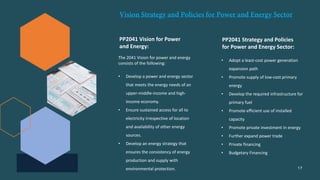
PP2041 Vision for Power
and Energy:
The 2041 Vision for power and energy
consists of the following:
• Develop a power and energy sector
that meets the energy needs of an
upper-middle-income and high-
income economy.
• Ensure sustained access for all to
electricity irrespective of location
and availability of other energy
sources.
• Develop an energy strategy that
ensures the consistency of energy
production and supply with
environmental protection.
PP2041 Strategy and Policies
for Power and Energy Sector:
• Adopt a least-cost power generation
expansion path
• Promote supply of low-cost primary
energy
• Develop the required infrastructure for
primary fuel
• Promote efficient use of installed
capacity
• Promote private investment in energy
• Further expand power trade
• Private financing
• Budgetary Financing
17
Sustainable Agriculture For
Food Security And Rural
development In a High
Income Country
Chapter 06
In keeping with the stylized facts of structural change during the
development phase of an economy the share agriculture inGDP has
been on a secular decline, from about 60% in the 1970s down to only
13.31% in FY2019.
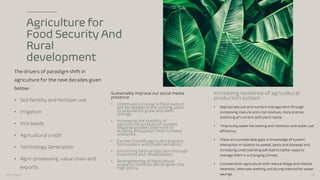
Agriculture for
Food Security And
Rural
development
The drivers of paradigm shift in
agriculture for the next decades given
below-
• Soil fertility and fertilizer use
• Irrigation
• HYV seeds
• Agricultural credit
• Technology Generation
• Agro-prosessing value chain and
exports.
Sustainably Improve our social media
presence
• Continued increase in food output
will be needed in the coming years
as population grow and diets
change.
• Increasing the stability of
agricultural production system
requires greater attention to
building ecosystem that increase
resilience.
• Farmer friendly agricultural policy
formulation and implementation.
• Enhancing farm production through
incentives and rehabilitation.
• Strengthening of Agricultural
research institute will be given the
high policy.
Increasing resilience of agricultural
production system -
• Appropriate soil and nutrient management through
composing manure and crop residues, more precise
matching of nutrient with plant needs.
• *Improving water harvesting and retention and water use
efficiency.
• There are considerable gaps in knowledge of system
interaction in relation to weeds, pests and diseases and
increasing understanding will lead to better ways to
manage them in a changing climate.
• Consideration agriculture with reduce tillage and residue
retention, alternate wetting and drying method for water
savings.
3/11/2023 19
THE FOLLOWING PRIORITY STRATEGIES HAVE BEEN IDENTIFIED FOR
AQUACULTURE DEVELOPMENT
• Aquaculture intensification and species diversification need to be promoted.
• Collaboration and coordination among ministries, Department and agencies should be strengthen.
• Developed skilled manpower to operate modern laboratory as well as processing plants.
• Private sector investment should be attracted for fish and fisheries product value chain.
• Farm mechanization and vertical expansion of aquaculture should be the major priority for sustaining and diversification
aquaculture production.
20
CREATING AN INNOV
ATION
ECONOMY FOR
BANGLADESH THROUGH
FOSTERING ICT AND
SCIENTIFIC RESEARCH
Chapter- 07
Government has taken many steps in various sectors for the purpose of
innovation economy. In education sector, the Ministry of Education has
undertaken a Higher Education Quality Enhancement Project (HEQEP) for the
purpose of improving the quality of teaching, learning and research
capabilities. Government is focusing on expanding technical universities at
the district level. Ministry of Science and Technology is working for
strengthening scientific progress and development of technology.. The
spread of ICT revolution has received particular emphasis based on the
personal attention provided by the Honorable Prime Minister under her
Digital Bangladesh Initiative. Bangladesh made important strides during the
Sixth Plan (2011-2015) and the on-going Seventh Five Year Plan (2016-2020)
in utilizing technology to bring a tangible transformation. Development
interventions have resulted in a number of citizen-centric e-initiatives and
services such as multimedia classroom and teacher-led education content
development in public schools, mobile phone-based health service from
Upazila Health Complex, mobile financial services, agricultural and other
livelihood information and services (e-Tathyakosh) online through grassroots
outlets. Recently, Bangladesh has installed her maiden communication
satellite, becoming the 57th nation in the world and fourth in South Asia to
own a satellite. Bangladesh has also succeeded in installing the 2nd
submarine cable connectivity. On top of it, the advent of international
terrestrial cable connectivity providers has significantly addressed the
quality, cost, and redundancy issues of the internet. These policies and
regulations have provided a first-round enabling environment for the
implementation of the Digital Bangladesh enterprise. The ICT Policy 2009 has
now been updated to ICT Policy 2015 to address Visions 2021 and 2041, ICT
Division has formulated ‘ICT Policy 2018’ focusing on digital security,
leveraging of emerging technologies like IoT, Big Data, Robotics, and AI, ICT in
education, skill development, employment, innovation, business promotion,
and SDG targets by 2030. The Government has also enacted ‘Digital Security
Act, 2018’.
Chapter 08
23
1) Strengthening long-term
planning and priority
setting.
2) Creating balanced inter-
modal transport facilities.
3) Strengthening
implementation capacity.
4) Ensuring sustainable
financing of transport
infrastructure.
5) Developing and
implementing key policies
for ensuring quality and
reliability of transport
services.
6) Strengthening management
capabilities and efficiency of
public transport authorities.
In today's globalized economy, low-cost
and efficient transport service is a major
determinant of the competitiveness of the
economy that influences trade and
investment flows both internally within a
country and externally. Efficient transport
system also impacts on the pattern of
regional development within a country
and the location of poverty. Development
of and efficient and low-cost transport
network is, therefore, a key determinant of
the ability to achieve the growth and
poverty targets of PP204.Consistent with
the PP2021 strategy, the transport sector
along with energy has received high
priority in budget allocation. The Sixth and
Seventh Plans have allocated resources for
all major projects in line with PP2021
strategy and priority. The transport
strategy for PP2041 will build on the
lessons of experience of the
implementation of the PP2021.
25
There has been impressive progress in
telecommunication as well as digital and print
media in recent years. The telecommunication
sector has progressed significantly with the
involvement of the private sector in the provision
of mobile phones in the early 1990s. Time to time,
digital print media, FM radio , courier services and
postal services has developed in Bangladesh. This
progress has continued during the PP2021 and the
strategy is broadly on track. The communications
outlets for Bangladesh are multi-faceted and
vibrant.PP2041 will build on this success and
continue to modernize communications in
Bangladesh. The PP2041 strategy will continue to
provide policy and institutional support to private
investment in expanding telecommunications
network and services, boost the expansion of
private print, audio and video media, and provide
an enabling environment for competitive and
healthy expansion of communication services and
knowledge and information sharing.
Managing The Urban
Transition To A High-Income
Economy Urbanization And
Development Economy
Urbanization And
Development
Chapter-09
Share of urban population in total population 30%in 2018 and
80%in 2041
Number of primary cities 2%in 2018 and 8% in 2041.
Share of Dhaka Metropolitan city in total urban population
33%in 2018 and 25% in 2041.
Share of 7 other primary cities in total urban population 23%in
2018 and 30%in 2041.
Percent of household with electricity 90%in2018 and 100% in
2041.
Percent of household with tap water connectivity 40% valus in
2018 and 100%valus in 2041.
Percent of household with water sealed sanitary 42%in 2018
and 100% valus in 2041.
Percentage of household with sewerage connection in 100%
values in 2041.
Incidence of urban poverty 15.7% valus in 2018 and 0% values
in 2041.
Percent of household living in slums(UN definition)55%in 2018
and 0% values in 2041.
Percent of urban centres with modern waste disposal facilities
N/A values in 2018 and 100 values in 2041.
Share of urban LGI spending in total government spending 5% in
2018 and 25% in 2041 values.
Specifically, the PP2041 Vision for the urban sector is to:-
• Have an economy where some 80 percent of the population lives in urban
enjoys a quality of life that is comparable to those found in the present -day
high-income economies of North America, Europe and Asia.
• An urban physical environment where there is a proper balance between
ecology, the natural environment and needs of the urban population. In
particular, all cities will be flood-free will proper drainage, modern sewerage
and proper waste management.
• An urban social structure where there is no incidence of absolute poverty,
there are no slums and every household has a basic minimum housing quality.
• An urban service industry that provides quality urban infrastructure and
urban services on demand and in good quality.
• An urban governmence structure that is elected by the residents,is responsive
to the needs of the residents and is largely self-financing with a healthy and
sustainable combination of urban betterment taxs, predictable national
government transfers,cost recovery from services provide and responsible
borrowings.
Bangladesh at around 1200 people per square kilometre
is the most densely populated country in the world,
excluding some small island economies with less than 2
million people. Tidal surge, salinity, flooding, river
erosion, and cyclones are regular features of
Bangladesh. These features pose a continuous challenge
to food security for the country and livelihood for a
large part of the rural population. The soil and water
combination of Bangladesh makes it a highly fertile land
with multiple cropping opportunities. Almost all districts
are connected with one another and with the growth
centres of Dhaka, Chattogram and Khulna through river
ways. The plentiful of rivers, fresh wetlands, and lakes
provide ample scope for fishery resources.
28
Chapter-10
Armed with these geographic facts, the PP2021 sought to initiate a comprehensive long-term
approach to address environmental degradation and climate change through a mixture of laws,
regulations, policies and programs. the PP2041 Vision for the environmental sector is to:
• Some 80 percent of the population lives in urban areas and enjoys a quality of life that is
comparable to those found in the present-day high-income economies.
• Cities are normally flood free with proper drainage, modern sewerage, proper waste
management and clean air.
• The country is equipped to respond fully and quickly to any incidence of natural disasters. The
PP2041 will seek to unlock the true potential of the Blue Economy in a sustainable manner
through appropriate policies and investments.
The Government started the development of the blue economy under the 7th FYP. The port
sector is being developed and improved with the construction of a new port in Patuakhali (Pyra
Port) that is expected to be fully operational by the end of 2020. The main elements of the
strategy include:
• Develop a sound policy framework for harnessing the potential of the blue economy. A task
force comprising of government officials and local and international experts will be constituted
to do this.
• PP2041 will place a strong emphasis on maintaining biodiversity to ensure long term fish
availability. Several steps will be taken including: establish marine protected areas (MPAs) – one
declared around ‘Swatch of No Ground’; enforce a ban on fishing during the breeding season;
participate in international fisheries management agreements; promote efficient waste
minimization measures and techniques, and strengthen research and study.
• Coastal tourism will be promoted through a number of actions including: launch of domestic
and international tourism campaign at frequent intervals; establish joint coastal tourism
programme with neighbours.
• Finally, steps will be taken to tap the potentials of the Blue Economy as a source of energy
through off-shore drilling and exploration.
Place of social welfare and services
in different plans
30
Place of social welfare and services in different plans
Specifically, Vision 2041 seeks to eliminate extreme poverty and reach Upper Middle-Income Country (UMIC)
status by 2031, and High-Income Country (HIC) status by 2041 with poverty approaching extinction. Two principal
visions underpin the PP2041Bangladesh will be a developed country by 2041, with per capita income of over USD 12,500
in today’s prices, and fully in tune with the digital world; Poverty will become a thing of the past in Sonar Bangla. Over the
next two decades, Bangladesh will experience an accelerated pace of change that will be rapid and transformational. It will
have to cope with rapid transformational shifts in agriculture, trade and industry, in education and healthcare, in
transportation and communication, and in the way we work and conduct business. Vision 2041 and the associated
PP2041 rely on four institutional pillars that will be harnessed by the people, who are the principal drivers of growth and
transformation. These are
• Governance;
• Democratization;
• Decentralization
• Capacity building
31
Bangladesh’s path to prosperity
as a developed nation.
1. By 2041, all citizens will be guaranteed a
minimum quality of life, based on
employment income for all who seek work
and social protection benefits for the
vulnerable population who cannot
participate in the labour market owing to
age and physical disabilities.
2. This will require additional funding to
ensure social safety-net like food, clothing,
shelter, health and education with an
emphasis on quality and on eliminating the
inequalities of access to relevant services
for the poor.
3. The microcredit revolution supported by
government policy has made this possible.
4. The government will escalate renewed
efforts to address the most vulnerable, the
most disadvantaged, the marginalized and
the socially excluded section of the society.
5. Ethnic minorities living in the CHT and the
plain districts will be given utmost
attention.
6. Efforts will be reinforced in taking care of
the persons with disabilities, dalits, Bede
people, people living in slum areas and
charland, street children, sex workers
through full implementation of the NSS.
7. Sustainable Agriculture to ensure Food
Security and Nutrition.
8.The Fisheries and livestock sector have
proven to be one of the most productive and
dynamic sectors in Bangladesh, experiencing a
revolution of sorts for the last few decades.
9. Accelerated growth with industrialization
and trade. 10. Sustainable power and energy
for a high-income country.
11. Building transport and communication
infrastructure for sustained rapid growth.
12. It’s help to develop agriculture sector in our
country.
At last,, The Perspective Plan 2021-2041 has
been prepared to translate the policies and
programmes enshrined in the Vision 2041 into
development strategies. This document is the
development vision of the government of a
prosperous Bangladesh, a strategic description
of the goals and objectives and a roadmap for
its implementation. The institutional basis of
this plan is fourfold, such as, good governance,
democratization, decentralization and capacity
building. The main beneficiary will be the
people of Bangladesh and they will be the key
driving force of growth and transformation of
social welfare are services
32
Summary
A nation cannot achieve inclusivity and sustainability by speeding economic growth in
isolation from these concepts, as the Perspective Plan emphasizes. Because of this,
the Plan aims to achieve pro-poor growth while giving social protection adequate
consideration, which supports participation of the excluded groups, such as low-
income women, people from certain ethnic groups, and people from socially excluded
groups in the development process. In conclusion, on the eve of its 50th anniversary
of independence, Bangladesh's Perspective Plan specifies the "means" and
"objectives" it wishes to pursue. It highlights a realistic, diversified strategy for
developing a creative, competitive economy and the opportunities it gives us to
create a socially responsible society. In addition to social safety, the government will
continue to ensure that everyone has equal access to opportunity. The most
vulnerable members of society were improved in previous initiatives primarily from
the standpoint of social security. The foundation of the vision 2041 will be the pursuit
of wealth while also fostering an inclusive society that meets the needs of the most
vulnerable. The government will keep improving the socioeconomic, political, and
cultural rights of ethnic minorities while preserving their language and traditions.
33
Meet our team
Ramisa Rifa Mayma
Leader
B190403051
Anamika Das
CO-Leader
B190403052
MD. Azizul Hakim
Mozumder
Designer/ Presentation
B190403055
Md. Ariful Islam
Presentation
B190403047
34
Phone:
+880-172-611-4538
Email:
mahimozumder001@gmail.com
MD. Azizul Hakim Mozumder
Designer

PERSPECTIVE Plan & Bangladesh.pdf

  • 1.
  • 2.
  • 3.
    INTRODUCTION Initially, a nationwithout vision cannot go so far. Perspective plan refers to a long-term plan approximately for a period of twenty years providing goals, policies, strategies and general programmes for the development of the State. In 1971, Bangladesh got independence from Pakistan. It was the culmination of people's struggle. The Governmen's vision 2021 is an explanation of where this coun try needs to be in 2021, the year that marks the 50th anniversary o f Bangladesh's independence, in line with those goals and the spir it of the liberation fight. Infact, this "Perspective Plan" of Bangladesh (2010-2021) is a strategic articulation of the development vision, mission, and goals of the Bangladesh Government in achieving a prosperous Sonar BangIa, a dream of the Father of the nation, Bangabandhu Sheikh Mujibur Rahman grounded in political and economic freedoms a reality in 2021.
  • 4.
    The 8th FiveYear plan represents the first phase of the country's Perpective Plan of 2041. Vision 2041 seeks to eliminate extreme poverty and reach upper Middle-Income country status by 2031; and High Income country status by 2041 with poverty approaching extinction. Key Elements of PP2041: • Rapid Transformational shifts in agriculture. • Rapid growth of trade and industry. • Development in education and health care. Two principle Vision of 2041: • Bangladesh will be developed country, with per capita income of over USD 12,500 in today's price • Poverty will be the thing of past in 'Sonar Bangla'. 1.Institutional matter: Historical evidence shows that rapid and development of societies is by strong and effective institutions. Especially the economic and social institutions. 2.Macroeconomic management for accelerated inclusive growth I. Approach to fiscal operations II. Monetary management to Combat inflation And faster growth III. Sustainable balance of payment 3.Zero poverty country: Consistent with the dream of Bangabandhu, By 2031 extreme poverty will be eliminated and by 2041 the incidence of poverty will be minimal (3% or less). By 2041 all citizens will be guaranteed— I. A minimum quality of life II. Income for all who sick work III. Social protection IV. Enough income to buy minimum consumption V. Strengthening human capital VI. Reduction in income inequality 4.Human Development: Harnessing the demographic dividend: The P2041 puts a strong emphasis on improving human development both to supporting GDP growth and to reduce poverty. The program compromises— a. Knowledge based economy b. 100% literacy rate c. Free education for up to 12 years d. Universal access to health insurance e. 100% employment The plan following to strategies — • Strategy for population health and nutrition • Strategy for education and training 5.Sustainable agriculture to ensure food security and nutrition: The economic sectors with the most influence on poverty reduction are agriculture and rural non-firm activities. The key priorities for the future of sustainable agriculture include-strengthening local adaptive capacity by providing public goods and services. Such as- • Better climate information • Innovative research for the development of heat tolerant • Salinity tolerant crop varieties and climate smart production technologies • Efficient water saving irrigation practices and early forecasting systems 4
  • 5.
    9.Building Transport and Communicationsinfrastructure for sustained growth: low cost and efficient transport service is a major determinant of sustained growth. The transport strategy for PP2041 will build on the lessons of experience of the implementation of the P2021. 2 strategies are followed — • The transport sector strategy for PP2041; • Communications development strategy. 6. Accelerated growth with industrialization and trades I. Strengthening competitive advantage ; II. Trade resign for export diversification; III. Future trade policy; IV. Challenges associated with the graduation from LDC status; V. The employment challenge and Strategies. 10.Managing the urban transition: Urbanization and development are highly and positively correlated. Urbanization and economic growth will go together in the future. Managing factors— • Urban governance reform; • PP2041 Urban sector financing requirements and options. 8.Creating an innovation economy: Using the technologies with labor advantage, It is time to reach upper middle income status by 2031 and to reach the advanced economy status by 2041. To create an innovative economy following moves are essential— • Digital opportunities and innovation • Leveraging the fourth industrial; revolution • Moving from factor-driven stage to innovation based economy. 11.Managing environment and climate change for sustainable growth: Many laws and regulations have been enacted over the years on environment and climate change, like 6th FYP, 7th FYP. The main focus of the P2041 environmental management strategy would be to integrate environment and climate change consideration in the growth strategy.
  • 6.
  • 7.
    The legacy ofBangabandhu Sheikh Mujib is now being carried forward with able and farsighted leadership of Prime Minister Sheikh Hasina paving the way to fulfillment of a long cherished dream of Sonar Bangla by Bangabandhu Sheikh Mujib. Under her able leadership, Bangladesh has moved forward to a lower- middle income country and aspiring to achieve a status of a developed country by 2041.In this 21st century, there is one indisputable phenomenon. That is the embedded and ultimate goal of designing the next twenty-year perspective plan for the period 2021-2041. Two principal visions underpin the PP2041: Strategic Goals and Milestones of the PP2041 • Bangladesh will be a developed country by 2041, with per capita income of over USD 12,500 in today’s prices, and fully in tune with the digital world. • Poverty will become a thing of the past in Sonar Bangla. The following strategic goals will be pursued as the essential components of economic policy over the long-term: • Eradication of Extreme Poverty by 2031; reducing Poverty to less than 3 percent by 2041 • Towards Upper middle-income country by FY 2031; High-income country by 2041 • Industrialization with export-oriented manufacturing will drive structural transformation into the future • Paradigm shifts in Agriculture will enhance productivity and ensure nutrition and food security for the future • A Service sector of the future will provide the bridge for the transformation of the rural agrarian economy to a primarily industrial and digital economy • The Urban transition will be an essential part of the strategy to move to a high-income economy • Efficient Energy and Infrastructure will be essential components of the enabling environment that facilitates rapid, efficient and sustainable growth • Building a Bangladesh resilient to climate change and other environmental challenges • Establishing Bangladesh as a knowledge hub country for promoting a skill-based society The changing global and regional scenarios also appear to be much more challenging. • All these suggest that Bangladesh has to make some extraordinary efforts in its economic and social development process in the days to come. 7
  • 8.
    ENSURING GOOD GOVERNANCE INSTITUTIONALFOUNDATIONS OF A HIGH-INCOME COUNTRY This is the conclusion of historians and economists alike. At the end of the day, it is institutions of all types and forms that are the determinants of prosperity or decline of societies . Overall, a variety of research evidence points to the fact that broad institutional differences across countries could explain the differences in their income levels. Though Bangladesh has chosen the path of market- oriented development, the state still has the primary responsibility to nurture effective development institutions to support the long and tedious march to high-income country status by 2041. CHAPTER 02 8
  • 9.
    The strategic thrustof PP2041 will be on strengthening institutions. Broadly speaking, the major focus should be on ▪ planning institutions, ▪ governance institutions, ▪ financial institutions, ▪ democratic institutions - institutions to promote pluralistic democracy, ▪ decentralization institutions, ▪ capacity building institutions. ▪ gender empowerment institutions, ▪ legislative institutions, ▪ judicial institutions, ▪ public administration capacity - Executive, the bureaucracy and the rule of law, ▪ political institutions, ▪ social institutions, ▪ institutions for land management, ▪ institutions for human capital development – basic education and skill, institutions for technology, market institutions.
  • 10.
    A COUNTRY WITHZERO POVERTY Bangladesh can feel justifiably proud of its achievements in the fight against poverty. In the early 1970s following independence poverty was rampant with head-count poverty in the range of 80%. In 2019 poverty declined to 20.5% while extreme poverty fell to 10.5% as of BBS’s projection. This rapid progress in reducing poverty has emboldened policymakers to aim to secure the dream of Bangabandhu Sheikh Mujibur Rahman to free Bangladesh of the incidence of poverty by 2041. The target of Vision 2041 is to eliminate extreme poverty by 2030 and by 2041 Bangladesh will be a high-income country with absolute poverty approaching extinction. Chapter- 03 10
  • 11.
    Poverty and InequalityTargets of PP2041 Main Poverty and Inequality Objectives • Eliminate the incidence of extreme poverty by FY2031. • Keep the incidence of poverty to a bare minimum. • Arrest the trend of increasing income inequality and seek to reduce it. 1. Securing Sustained Rapid Rate of GDP Growth 2. Making GDP Growth Pro-poor through Structural Transformation of the Production Base 3. Strengthening the Human Capital Base of the Poor 4. Improving the Access to Finance for the Poor 11 5. Increasing Access of the Poor to the Migrant Labour Market 6. Balanced Urbanization 7. Balanced Regional Development 8. Lowering Vulnerabilities of Districts to Climate Change and Natural Disasters 9. Sharply Improving the Poverty Focus of Social Protection Programmes.
  • 12.
    A fundamental themeof Vision 2041 and the associated Perspective Plan is the achievement of a development outcome where citizens will have a higher standard of living, will be better educated, will face better social justice, and will have a more equitable socio-economic environment.
  • 13.
    • Institution ofa knowledge-based economy. • Population with 100% literacy rate defined in terms of demonstrated ability to read and write in the national language. • Universal free education for up to 12 years. • Flexible supply of training institutions for all who seek to acquire job-based skills. • Universal access to health insurance schemes at affordable prices. • Mainstreaming of TVET for readiness for Industry 4.0. • 100% coverage of employment-based accidental and health insurance schemes for all workers in the organized sector. • Employment of 1000 youth (both male and female) should be ensured every year from each upazilla 13
  • 14.
    14 The targets forhuman development that will help realize this vision are indicated below. These are ambitious targets but consistent with the situation prevailing in high- income countries.
  • 15.
    15 • Strengthen public-privatepartnership • Enhance education quality • Eliminate education wastage • Streamline and improve quality of madrassa education • Strengthen delivery of non-formal education • Strengthen role of private sector • Enhance quality • Promote equity • Eliminate gender gap • Strengthen University Grants Commission (UGC) • Expand public health clinics and improve quality • Strengthen district-level hospital care • Strengthen national hospital • Eliminate child nutrition gaps • Strengthen private health care delivery system. • Introduce health insurance schemes • Introduce health insurance schemes • Improve the quantity and quality of health professionals • Strengthen health sector governance • Improve health information systems • Improve health information systems • Safe disposal of medical waste • Safe disposal of medical waste • Increase public health spending
  • 16.
    In 2009 Bangladeshfaced a severe energy crisis owing to sluggish growth in energy supplies while the demand for energy was growing owing to higher GDP growth. The situation called for an urgent but well-crafted sustainable long-term strategy to address the energy crisis and increase the energy supply to support achieve Bangladesh’s development objectives as conceived in PP2021. Chapter 05
  • 17.
    PP2041 Vision forPower and Energy: The 2041 Vision for power and energy consists of the following: • Develop a power and energy sector that meets the energy needs of an upper-middle-income and high- income economy. • Ensure sustained access for all to electricity irrespective of location and availability of other energy sources. • Develop an energy strategy that ensures the consistency of energy production and supply with environmental protection. PP2041 Strategy and Policies for Power and Energy Sector: • Adopt a least-cost power generation expansion path • Promote supply of low-cost primary energy • Develop the required infrastructure for primary fuel • Promote efficient use of installed capacity • Promote private investment in energy • Further expand power trade • Private financing • Budgetary Financing 17
  • 18.
    Sustainable Agriculture For FoodSecurity And Rural development In a High Income Country Chapter 06 In keeping with the stylized facts of structural change during the development phase of an economy the share agriculture inGDP has been on a secular decline, from about 60% in the 1970s down to only 13.31% in FY2019.
  • 19.
    Agriculture for Food SecurityAnd Rural development The drivers of paradigm shift in agriculture for the next decades given below- • Soil fertility and fertilizer use • Irrigation • HYV seeds • Agricultural credit • Technology Generation • Agro-prosessing value chain and exports. Sustainably Improve our social media presence • Continued increase in food output will be needed in the coming years as population grow and diets change. • Increasing the stability of agricultural production system requires greater attention to building ecosystem that increase resilience. • Farmer friendly agricultural policy formulation and implementation. • Enhancing farm production through incentives and rehabilitation. • Strengthening of Agricultural research institute will be given the high policy. Increasing resilience of agricultural production system - • Appropriate soil and nutrient management through composing manure and crop residues, more precise matching of nutrient with plant needs. • *Improving water harvesting and retention and water use efficiency. • There are considerable gaps in knowledge of system interaction in relation to weeds, pests and diseases and increasing understanding will lead to better ways to manage them in a changing climate. • Consideration agriculture with reduce tillage and residue retention, alternate wetting and drying method for water savings. 3/11/2023 19
  • 20.
    THE FOLLOWING PRIORITYSTRATEGIES HAVE BEEN IDENTIFIED FOR AQUACULTURE DEVELOPMENT • Aquaculture intensification and species diversification need to be promoted. • Collaboration and coordination among ministries, Department and agencies should be strengthen. • Developed skilled manpower to operate modern laboratory as well as processing plants. • Private sector investment should be attracted for fish and fisheries product value chain. • Farm mechanization and vertical expansion of aquaculture should be the major priority for sustaining and diversification aquaculture production. 20
  • 21.
    CREATING AN INNOV ATION ECONOMYFOR BANGLADESH THROUGH FOSTERING ICT AND SCIENTIFIC RESEARCH Chapter- 07
  • 22.
    Government has takenmany steps in various sectors for the purpose of innovation economy. In education sector, the Ministry of Education has undertaken a Higher Education Quality Enhancement Project (HEQEP) for the purpose of improving the quality of teaching, learning and research capabilities. Government is focusing on expanding technical universities at the district level. Ministry of Science and Technology is working for strengthening scientific progress and development of technology.. The spread of ICT revolution has received particular emphasis based on the personal attention provided by the Honorable Prime Minister under her Digital Bangladesh Initiative. Bangladesh made important strides during the Sixth Plan (2011-2015) and the on-going Seventh Five Year Plan (2016-2020) in utilizing technology to bring a tangible transformation. Development interventions have resulted in a number of citizen-centric e-initiatives and services such as multimedia classroom and teacher-led education content development in public schools, mobile phone-based health service from Upazila Health Complex, mobile financial services, agricultural and other livelihood information and services (e-Tathyakosh) online through grassroots outlets. Recently, Bangladesh has installed her maiden communication satellite, becoming the 57th nation in the world and fourth in South Asia to own a satellite. Bangladesh has also succeeded in installing the 2nd submarine cable connectivity. On top of it, the advent of international terrestrial cable connectivity providers has significantly addressed the quality, cost, and redundancy issues of the internet. These policies and regulations have provided a first-round enabling environment for the implementation of the Digital Bangladesh enterprise. The ICT Policy 2009 has now been updated to ICT Policy 2015 to address Visions 2021 and 2041, ICT Division has formulated ‘ICT Policy 2018’ focusing on digital security, leveraging of emerging technologies like IoT, Big Data, Robotics, and AI, ICT in education, skill development, employment, innovation, business promotion, and SDG targets by 2030. The Government has also enacted ‘Digital Security Act, 2018’.
  • 23.
  • 24.
    1) Strengthening long-term planningand priority setting. 2) Creating balanced inter- modal transport facilities. 3) Strengthening implementation capacity. 4) Ensuring sustainable financing of transport infrastructure. 5) Developing and implementing key policies for ensuring quality and reliability of transport services. 6) Strengthening management capabilities and efficiency of public transport authorities. In today's globalized economy, low-cost and efficient transport service is a major determinant of the competitiveness of the economy that influences trade and investment flows both internally within a country and externally. Efficient transport system also impacts on the pattern of regional development within a country and the location of poverty. Development of and efficient and low-cost transport network is, therefore, a key determinant of the ability to achieve the growth and poverty targets of PP204.Consistent with the PP2021 strategy, the transport sector along with energy has received high priority in budget allocation. The Sixth and Seventh Plans have allocated resources for all major projects in line with PP2021 strategy and priority. The transport strategy for PP2041 will build on the lessons of experience of the implementation of the PP2021.
  • 25.
    25 There has beenimpressive progress in telecommunication as well as digital and print media in recent years. The telecommunication sector has progressed significantly with the involvement of the private sector in the provision of mobile phones in the early 1990s. Time to time, digital print media, FM radio , courier services and postal services has developed in Bangladesh. This progress has continued during the PP2021 and the strategy is broadly on track. The communications outlets for Bangladesh are multi-faceted and vibrant.PP2041 will build on this success and continue to modernize communications in Bangladesh. The PP2041 strategy will continue to provide policy and institutional support to private investment in expanding telecommunications network and services, boost the expansion of private print, audio and video media, and provide an enabling environment for competitive and healthy expansion of communication services and knowledge and information sharing.
  • 26.
    Managing The Urban TransitionTo A High-Income Economy Urbanization And Development Economy Urbanization And Development Chapter-09
  • 27.
    Share of urbanpopulation in total population 30%in 2018 and 80%in 2041 Number of primary cities 2%in 2018 and 8% in 2041. Share of Dhaka Metropolitan city in total urban population 33%in 2018 and 25% in 2041. Share of 7 other primary cities in total urban population 23%in 2018 and 30%in 2041. Percent of household with electricity 90%in2018 and 100% in 2041. Percent of household with tap water connectivity 40% valus in 2018 and 100%valus in 2041. Percent of household with water sealed sanitary 42%in 2018 and 100% valus in 2041. Percentage of household with sewerage connection in 100% values in 2041. Incidence of urban poverty 15.7% valus in 2018 and 0% values in 2041. Percent of household living in slums(UN definition)55%in 2018 and 0% values in 2041. Percent of urban centres with modern waste disposal facilities N/A values in 2018 and 100 values in 2041. Share of urban LGI spending in total government spending 5% in 2018 and 25% in 2041 values. Specifically, the PP2041 Vision for the urban sector is to:- • Have an economy where some 80 percent of the population lives in urban enjoys a quality of life that is comparable to those found in the present -day high-income economies of North America, Europe and Asia. • An urban physical environment where there is a proper balance between ecology, the natural environment and needs of the urban population. In particular, all cities will be flood-free will proper drainage, modern sewerage and proper waste management. • An urban social structure where there is no incidence of absolute poverty, there are no slums and every household has a basic minimum housing quality. • An urban service industry that provides quality urban infrastructure and urban services on demand and in good quality. • An urban governmence structure that is elected by the residents,is responsive to the needs of the residents and is largely self-financing with a healthy and sustainable combination of urban betterment taxs, predictable national government transfers,cost recovery from services provide and responsible borrowings.
  • 28.
    Bangladesh at around1200 people per square kilometre is the most densely populated country in the world, excluding some small island economies with less than 2 million people. Tidal surge, salinity, flooding, river erosion, and cyclones are regular features of Bangladesh. These features pose a continuous challenge to food security for the country and livelihood for a large part of the rural population. The soil and water combination of Bangladesh makes it a highly fertile land with multiple cropping opportunities. Almost all districts are connected with one another and with the growth centres of Dhaka, Chattogram and Khulna through river ways. The plentiful of rivers, fresh wetlands, and lakes provide ample scope for fishery resources. 28 Chapter-10
  • 29.
    Armed with thesegeographic facts, the PP2021 sought to initiate a comprehensive long-term approach to address environmental degradation and climate change through a mixture of laws, regulations, policies and programs. the PP2041 Vision for the environmental sector is to: • Some 80 percent of the population lives in urban areas and enjoys a quality of life that is comparable to those found in the present-day high-income economies. • Cities are normally flood free with proper drainage, modern sewerage, proper waste management and clean air. • The country is equipped to respond fully and quickly to any incidence of natural disasters. The PP2041 will seek to unlock the true potential of the Blue Economy in a sustainable manner through appropriate policies and investments. The Government started the development of the blue economy under the 7th FYP. The port sector is being developed and improved with the construction of a new port in Patuakhali (Pyra Port) that is expected to be fully operational by the end of 2020. The main elements of the strategy include: • Develop a sound policy framework for harnessing the potential of the blue economy. A task force comprising of government officials and local and international experts will be constituted to do this. • PP2041 will place a strong emphasis on maintaining biodiversity to ensure long term fish availability. Several steps will be taken including: establish marine protected areas (MPAs) – one declared around ‘Swatch of No Ground’; enforce a ban on fishing during the breeding season; participate in international fisheries management agreements; promote efficient waste minimization measures and techniques, and strengthen research and study. • Coastal tourism will be promoted through a number of actions including: launch of domestic and international tourism campaign at frequent intervals; establish joint coastal tourism programme with neighbours. • Finally, steps will be taken to tap the potentials of the Blue Economy as a source of energy through off-shore drilling and exploration.
  • 30.
    Place of socialwelfare and services in different plans 30
  • 31.
    Place of socialwelfare and services in different plans Specifically, Vision 2041 seeks to eliminate extreme poverty and reach Upper Middle-Income Country (UMIC) status by 2031, and High-Income Country (HIC) status by 2041 with poverty approaching extinction. Two principal visions underpin the PP2041Bangladesh will be a developed country by 2041, with per capita income of over USD 12,500 in today’s prices, and fully in tune with the digital world; Poverty will become a thing of the past in Sonar Bangla. Over the next two decades, Bangladesh will experience an accelerated pace of change that will be rapid and transformational. It will have to cope with rapid transformational shifts in agriculture, trade and industry, in education and healthcare, in transportation and communication, and in the way we work and conduct business. Vision 2041 and the associated PP2041 rely on four institutional pillars that will be harnessed by the people, who are the principal drivers of growth and transformation. These are • Governance; • Democratization; • Decentralization • Capacity building 31
  • 32.
    Bangladesh’s path toprosperity as a developed nation. 1. By 2041, all citizens will be guaranteed a minimum quality of life, based on employment income for all who seek work and social protection benefits for the vulnerable population who cannot participate in the labour market owing to age and physical disabilities. 2. This will require additional funding to ensure social safety-net like food, clothing, shelter, health and education with an emphasis on quality and on eliminating the inequalities of access to relevant services for the poor. 3. The microcredit revolution supported by government policy has made this possible. 4. The government will escalate renewed efforts to address the most vulnerable, the most disadvantaged, the marginalized and the socially excluded section of the society. 5. Ethnic minorities living in the CHT and the plain districts will be given utmost attention. 6. Efforts will be reinforced in taking care of the persons with disabilities, dalits, Bede people, people living in slum areas and charland, street children, sex workers through full implementation of the NSS. 7. Sustainable Agriculture to ensure Food Security and Nutrition. 8.The Fisheries and livestock sector have proven to be one of the most productive and dynamic sectors in Bangladesh, experiencing a revolution of sorts for the last few decades. 9. Accelerated growth with industrialization and trade. 10. Sustainable power and energy for a high-income country. 11. Building transport and communication infrastructure for sustained rapid growth. 12. It’s help to develop agriculture sector in our country. At last,, The Perspective Plan 2021-2041 has been prepared to translate the policies and programmes enshrined in the Vision 2041 into development strategies. This document is the development vision of the government of a prosperous Bangladesh, a strategic description of the goals and objectives and a roadmap for its implementation. The institutional basis of this plan is fourfold, such as, good governance, democratization, decentralization and capacity building. The main beneficiary will be the people of Bangladesh and they will be the key driving force of growth and transformation of social welfare are services 32
  • 33.
    Summary A nation cannotachieve inclusivity and sustainability by speeding economic growth in isolation from these concepts, as the Perspective Plan emphasizes. Because of this, the Plan aims to achieve pro-poor growth while giving social protection adequate consideration, which supports participation of the excluded groups, such as low- income women, people from certain ethnic groups, and people from socially excluded groups in the development process. In conclusion, on the eve of its 50th anniversary of independence, Bangladesh's Perspective Plan specifies the "means" and "objectives" it wishes to pursue. It highlights a realistic, diversified strategy for developing a creative, competitive economy and the opportunities it gives us to create a socially responsible society. In addition to social safety, the government will continue to ensure that everyone has equal access to opportunity. The most vulnerable members of society were improved in previous initiatives primarily from the standpoint of social security. The foundation of the vision 2041 will be the pursuit of wealth while also fostering an inclusive society that meets the needs of the most vulnerable. The government will keep improving the socioeconomic, political, and cultural rights of ethnic minorities while preserving their language and traditions. 33
  • 34.
    Meet our team RamisaRifa Mayma Leader B190403051 Anamika Das CO-Leader B190403052 MD. Azizul Hakim Mozumder Designer/ Presentation B190403055 Md. Ariful Islam Presentation B190403047 34
  • 35.