By:-
Aparna Nair
Richa Shukla
Riya Bhardwaj
VishalTomar
Mukul Bhardwaj
PRESENTATIONFLOW
• INTRODUCTION
• FROMBRIC’SFROMBRICS
• WHY BRICS FORMED
• OBJECTIVE
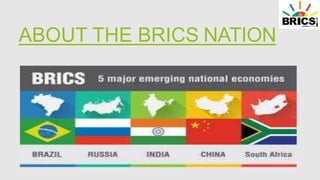
• ABOUT THE BRICS NATION
• BRICSUMMITS
• MAJORFOCUSOFBRICS FORUM
• SOME FACTSAND FIGURES
Introduction ofBRICS
• The term "BRIC" was coined in 2001 by then-chairman of Goldman Sachs Asset Management,Jim
O'Neill, in his publication Building Better Global Economic BRICs
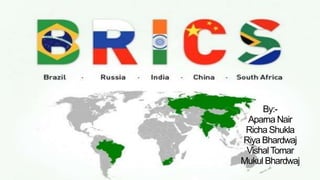
• BRICS is the acronym for an association of five major emerging national economies: Brazil, Russia,
India, China and SouthAfrica.
• The BRICS Forum, an independent international organisation encouraging commercial, political and
cultural cooperation between the BRICS nations, was formed in 2011.
• The BRICS members are all developing or newly industrialised countries, but they are distinguished by
their large, fast-growing economies and significant influence on regional and global affairs
• Russia currently holds the chair of the BRICS group, and hosted the group's seventh summit in July
2015.
• Bilateral relations among BRICS nations have mainly been conducted on the basis of non-interference,
equality, and mutual benefit
From‘BRIC’to ‘BRICS’
• The grouping was originally known as "BRIC" before the inclusion of South Africa in
2010
• The BRIC became a mechanism through which the countries can exchange opinions, seek
convergence, identify areas of cooperation and influence the international agenda.
• Officially it was admitted as a BRIC nation on 24 December 2010
• With the entrance of South Africa, at the 3rd BRICS Summit, in April 2011, the BRIC became
BRICS, with capital "S".
4
WhyBRICSformed?
BRICS is formed for following two majorreasons:
• Tobe an Alternative to World Bank and IMF to challenge USsupremacy.
• Toprovide Self owned and Self Managed Organisation to carry out
Developmental and Economical Plans in member nations withoutbeing
dependent on any foreign agency.Thispoint gets it strength on recent
development in BRICS with the inititative of BRICSBank.
OBJECTIVE OF BRICS
• To achieve regional development
• TheBRICSgroup also acts asabridge between developed and developing
countries. For example, in the WTO,the BRICScountries are trying topromote
afair order regarding agriculturalpolicies.
• TheBRICSgroup will also play an increasingly important role in assisting
developing countries in gaining an advantage in trade and climatechange
negotiations
• TheBRICSalso formed an information-sharing and exchange platform that
expands beyond economic cooperation to also involve educational,
cultural, and environmental engagement.
ABOUT THE BRICS NATION
BRAZIL
KEY ADVANTAGES :
One of the fastest growing economies in the last centuries
Brazilian economy becoming less dependent on imports
Extremely rich in resources such as coffee, sugarcane, crude oil and iron etc.
Focus on equitable development has resulted in significant poverty
reduction.
CHALLENGES FOR THE FUTURE:
• Overburdened and ineffective judicial system.
• Industrial output is weak
RUSSIA
KEYADVANTAGES:
Russia has capability in high-technology sectors
 Accounts for around 20% of the world’s oil and gas reserves
 fall in the number of people living below the poverty line
Third largest exporter of steel and aluminium
CHALLENGES FOR FUTURE
Labour shortages and poorly developed infrastructure
Corruption
INDIA
KEYADVANTAGES
• 1.15 billion people
• fastest growing economies
• 2nd largest labour force
• Natural Resources
CHALLENGES FOR THE FUTURE
• Improving basic educational achievement
• Improving infrastructure and electrical capacity
• Expanding technology industry
CHINA
KEYADVANTAGES
• Broad expansion of educational achievement
• Rapid economic growth
• Third largest country in land size
• Biggest of all BRIC nations GDPwise.
• Largest exporter/ importer for 32 and 34 countriesrespectively.
• Cheap labour work force
CHALLENGES FOR THE FUTURE
• support to rural areas and less-developedregions
• Bank of China sees inflation as a bigger risk
• Need to improve the investment
SOUTHAFRICA
KEYADVANTAGE
• The South African economy is now the 23rd largest in theworld
• Inflation is now below 5% and falling.
• 25% of goods produced in South Africa are forexport
• Richest in terms of its mineral reserves
CHALLENGES FOR THE FUTURE:
• The economy is growing but not fast enough
• Lack of skills, particularly in IT.
• 48% of the population is living below the poverty line
1. Yekaterinburg Summit (16th June 2009)
Consensus on improving the global economic situation and reforming financial institutions. BRIC nations
announced the need for a new global reserve currency, which would have to be "diversified, stable and
predictable"
2. Brasilia Summit (15th April 2010)
South Africa officially became a member nation. Iran and nuclear weapons, development, thefurtherance
of the BRIC as an international body, the global economic situation at the time, reform of financial
institutions, the financial G20, and cooperation and issues related to global governance.
3. Sanya Summit (14th April 2011)
Economics, anti-terror law under UN auspices,United Nations Security Council reform,decision to cease
mutual trade payments in U.S. dollars and instead henceforth give credits to one another in their national
currencies alone.
BRICS Summits
4. New Delhi summit (29th March 2012)
A proposal to create a joint BRICS development bank that would finance investments in developing
nations
5 Durban Summit (26th-27th March 2013)
Negotiations for setting up the bank.
6. Fortaleza Summit (14th to 16th July 2014)
Creation of two financial institutions: the New Development Bank (NDB) to finance
infrastructure and “sustainable development” projects, with $50 billion in capital to start with, and the
$100 billion Contingent Reserve Arrangement (CRA), to tide over members in financial difficulties.
7. Ufa Summit (8th-9th July 2015)
Thesummit coincided with the entry into force of constituting agreements of the New Development Bankand
the BRICSContingent ReserveArrangement and during the summit inaugural meetings of the NDBwere held, and
it wasannouncedit would be lending in local currency;and open up membershipto non-BRICScountries in the
comingmonths
8. Goa summit (15th-16th October 2016)
Joint Summit with BIMSTEC(Bay of Bengal Initiative for Multi-Sectoral Technical and Economic
Cooperation)
9 Xiamen Summit (3rd-5th Septmber 2017)
The theme of this summit was 'Stronger Partnership for brighter Future’.
This will help ease up the custom regulations(laws and regulations for the import and export of goods
into and out of a country) between countries.
10 Johannesburg Summit (25th-27th July 2018)
Partnership on New Industrial Revolution. It is a programme of partnership among BRICS nation that will
focus on Maximizing the opportunities arising from the fourth industrial revolution.
• To establish a development bank to balance the influence of the World Bank and IMF, as well
as creating a joint foreign exchange reserve.
• Governance & Leadership
• Science & Technology
• Poverty
• Private Sector & Prevention of Corruption
• Investment Landscape
• Innovation in building Infrastructure
• Trade
• Healthcare
Major FocusOf BRICS
SOME FACTSAND FIGURE
• Asof 2015, the five BRICScountries represent over 3 billion people, or 42%ofthe
world population; all five members are in the top 25 of the world by population,
and four are in the top10
• At their fifth summit, BRICSnations have decided to setup adevelopment bankto
overhaul the global financialsystem
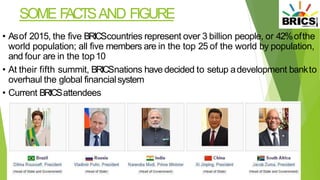
• Current BRICSattendees
• TheBRICScountries make up 21 percent of global GDP.Theyhave increased their
share of global GDPthreefold in the past 15years.
• TheBRICSare home to 43 percent of the world'spopulation.
• TheBRICScountries have combined foreign reserves of an estimated $4.4trillion.
• Intra-BRICStrade flows reached $282 billion in 2012 and are estimated to reach
$500 billion by 2015. In 2002, it was$27.3 billion.
• IMF estimates of GDPper member in 2012, China $8.25 trillion, Brazil $2.43trillion,
Russiaand India at $1.95 trillion each, SouthAfrica $390.9billion.
• Percapita GDPfor 2012 was estimated at, China $6,094, Brazil $12,340, Russia
$13,765, India $1,592, SouthAfrica$7,636
• BRICS is very special in following terms :
1. It represents 5 most Emerging Economies of World.
2. These countries represent about 40% of World's Total Population.
3. These countries are Developing and Recently Industrialised Nations.
Brics

Brics

  • 1.
    By:- Aparna Nair Richa Shukla RiyaBhardwaj VishalTomar Mukul Bhardwaj
  • 2.
    PRESENTATIONFLOW • INTRODUCTION • FROMBRIC’SFROMBRICS •WHY BRICS FORMED • OBJECTIVE • ABOUT THE BRICS NATION • BRICSUMMITS • MAJORFOCUSOFBRICS FORUM • SOME FACTSAND FIGURES
  • 3.
    Introduction ofBRICS • Theterm "BRIC" was coined in 2001 by then-chairman of Goldman Sachs Asset Management,Jim O'Neill, in his publication Building Better Global Economic BRICs • BRICS is the acronym for an association of five major emerging national economies: Brazil, Russia, India, China and SouthAfrica. • The BRICS Forum, an independent international organisation encouraging commercial, political and cultural cooperation between the BRICS nations, was formed in 2011. • The BRICS members are all developing or newly industrialised countries, but they are distinguished by their large, fast-growing economies and significant influence on regional and global affairs • Russia currently holds the chair of the BRICS group, and hosted the group's seventh summit in July 2015. • Bilateral relations among BRICS nations have mainly been conducted on the basis of non-interference, equality, and mutual benefit
  • 4.
    From‘BRIC’to ‘BRICS’ • Thegrouping was originally known as "BRIC" before the inclusion of South Africa in 2010 • The BRIC became a mechanism through which the countries can exchange opinions, seek convergence, identify areas of cooperation and influence the international agenda. • Officially it was admitted as a BRIC nation on 24 December 2010 • With the entrance of South Africa, at the 3rd BRICS Summit, in April 2011, the BRIC became BRICS, with capital "S". 4
  • 5.
    WhyBRICSformed? BRICS is formedfor following two majorreasons: • Tobe an Alternative to World Bank and IMF to challenge USsupremacy. • Toprovide Self owned and Self Managed Organisation to carry out Developmental and Economical Plans in member nations withoutbeing dependent on any foreign agency.Thispoint gets it strength on recent development in BRICS with the inititative of BRICSBank.
  • 6.
    OBJECTIVE OF BRICS •To achieve regional development • TheBRICSgroup also acts asabridge between developed and developing countries. For example, in the WTO,the BRICScountries are trying topromote afair order regarding agriculturalpolicies. • TheBRICSgroup will also play an increasingly important role in assisting developing countries in gaining an advantage in trade and climatechange negotiations • TheBRICSalso formed an information-sharing and exchange platform that expands beyond economic cooperation to also involve educational, cultural, and environmental engagement.
  • 7.
  • 8.
    BRAZIL KEY ADVANTAGES : Oneof the fastest growing economies in the last centuries Brazilian economy becoming less dependent on imports Extremely rich in resources such as coffee, sugarcane, crude oil and iron etc. Focus on equitable development has resulted in significant poverty reduction. CHALLENGES FOR THE FUTURE: • Overburdened and ineffective judicial system. • Industrial output is weak
  • 9.
    RUSSIA KEYADVANTAGES: Russia has capabilityin high-technology sectors  Accounts for around 20% of the world’s oil and gas reserves  fall in the number of people living below the poverty line Third largest exporter of steel and aluminium CHALLENGES FOR FUTURE Labour shortages and poorly developed infrastructure Corruption
  • 10.
    INDIA KEYADVANTAGES • 1.15 billionpeople • fastest growing economies • 2nd largest labour force • Natural Resources CHALLENGES FOR THE FUTURE • Improving basic educational achievement • Improving infrastructure and electrical capacity • Expanding technology industry
  • 11.
    CHINA KEYADVANTAGES • Broad expansionof educational achievement • Rapid economic growth • Third largest country in land size • Biggest of all BRIC nations GDPwise. • Largest exporter/ importer for 32 and 34 countriesrespectively. • Cheap labour work force CHALLENGES FOR THE FUTURE • support to rural areas and less-developedregions • Bank of China sees inflation as a bigger risk • Need to improve the investment
  • 12.
    SOUTHAFRICA KEYADVANTAGE • The SouthAfrican economy is now the 23rd largest in theworld • Inflation is now below 5% and falling. • 25% of goods produced in South Africa are forexport • Richest in terms of its mineral reserves CHALLENGES FOR THE FUTURE: • The economy is growing but not fast enough • Lack of skills, particularly in IT. • 48% of the population is living below the poverty line
  • 13.
    1. Yekaterinburg Summit(16th June 2009) Consensus on improving the global economic situation and reforming financial institutions. BRIC nations announced the need for a new global reserve currency, which would have to be "diversified, stable and predictable" 2. Brasilia Summit (15th April 2010) South Africa officially became a member nation. Iran and nuclear weapons, development, thefurtherance of the BRIC as an international body, the global economic situation at the time, reform of financial institutions, the financial G20, and cooperation and issues related to global governance. 3. Sanya Summit (14th April 2011) Economics, anti-terror law under UN auspices,United Nations Security Council reform,decision to cease mutual trade payments in U.S. dollars and instead henceforth give credits to one another in their national currencies alone. BRICS Summits
  • 14.
    4. New Delhisummit (29th March 2012) A proposal to create a joint BRICS development bank that would finance investments in developing nations 5 Durban Summit (26th-27th March 2013) Negotiations for setting up the bank. 6. Fortaleza Summit (14th to 16th July 2014) Creation of two financial institutions: the New Development Bank (NDB) to finance infrastructure and “sustainable development” projects, with $50 billion in capital to start with, and the $100 billion Contingent Reserve Arrangement (CRA), to tide over members in financial difficulties. 7. Ufa Summit (8th-9th July 2015) Thesummit coincided with the entry into force of constituting agreements of the New Development Bankand the BRICSContingent ReserveArrangement and during the summit inaugural meetings of the NDBwere held, and it wasannouncedit would be lending in local currency;and open up membershipto non-BRICScountries in the comingmonths
  • 15.
    8. Goa summit(15th-16th October 2016) Joint Summit with BIMSTEC(Bay of Bengal Initiative for Multi-Sectoral Technical and Economic Cooperation) 9 Xiamen Summit (3rd-5th Septmber 2017) The theme of this summit was 'Stronger Partnership for brighter Future’. This will help ease up the custom regulations(laws and regulations for the import and export of goods into and out of a country) between countries. 10 Johannesburg Summit (25th-27th July 2018) Partnership on New Industrial Revolution. It is a programme of partnership among BRICS nation that will focus on Maximizing the opportunities arising from the fourth industrial revolution.
  • 16.
    • To establisha development bank to balance the influence of the World Bank and IMF, as well as creating a joint foreign exchange reserve. • Governance & Leadership • Science & Technology • Poverty • Private Sector & Prevention of Corruption • Investment Landscape • Innovation in building Infrastructure • Trade • Healthcare Major FocusOf BRICS
  • 17.
    SOME FACTSAND FIGURE •Asof 2015, the five BRICScountries represent over 3 billion people, or 42%ofthe world population; all five members are in the top 25 of the world by population, and four are in the top10 • At their fifth summit, BRICSnations have decided to setup adevelopment bankto overhaul the global financialsystem • Current BRICSattendees
  • 18.
    • TheBRICScountries makeup 21 percent of global GDP.Theyhave increased their share of global GDPthreefold in the past 15years. • TheBRICSare home to 43 percent of the world'spopulation. • TheBRICScountries have combined foreign reserves of an estimated $4.4trillion. • Intra-BRICStrade flows reached $282 billion in 2012 and are estimated to reach $500 billion by 2015. In 2002, it was$27.3 billion. • IMF estimates of GDPper member in 2012, China $8.25 trillion, Brazil $2.43trillion, Russiaand India at $1.95 trillion each, SouthAfrica $390.9billion. • Percapita GDPfor 2012 was estimated at, China $6,094, Brazil $12,340, Russia $13,765, India $1,592, SouthAfrica$7,636
  • 19.
    • BRICS isvery special in following terms : 1. It represents 5 most Emerging Economies of World. 2. These countries represent about 40% of World's Total Population. 3. These countries are Developing and Recently Industrialised Nations.