
& 
IMPACT ON US AND INDIA.
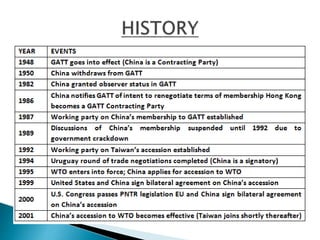
 HISTORY 
 IMPACTS OF WTO ACCESSION ON CHINA 
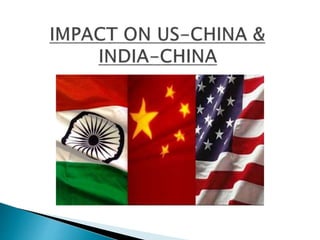
 IMPACT ON US-CHINA & INDIA-CHINA 
 IMPORT EXPORT RELATION (US, INDIA & 
CHINA) 
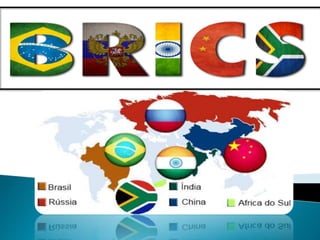
 BRICS- (BRAZIL, RUSSIA, INDIA, CHINA 
AND SOUTH AFRICA) REFERENCES 
 CONCLUSION 
 REFERENCES
 Tariff Reductions 
 Service Commitments 
 Systemic Reforms 
 Adherence to Existing WTO Agreements 
 China-Specific Trade-Liberalizing Provisions 
 Safeguard Special, Pre-existing Trade 
Agreements
 Impact on Economic Growth 
•Theoretical benefits and costs 
•Impact on foreign investments 
•Impact on trade 
•Impact on Institutional Reforms 
 Impact on legal institutions 
 Impact on political institutions 
 OPPORTUNITIES AND CHALLENGES
 In recent years the World Trade Organization has been the main venue for 
airing trade differences between the U.S. and China. 
 Growing tensions in U.S.-China trade relations generated by the rapid 
expansion of Chinese exports to the U.S. have led both countries to 
frequently resort to the World Trade Organization (WTO)’s dispute 
settlement mechanism (DSM). 
 Both Washington and Beijing seem to be more frequently using the DSM 
to target issues of critical concern to their respective domestic 
constituencies. 
 the U.S.’ WTO trade disputes against China tend to target Chinese 
industrial policy and challenge the dominance of state-owned enterprises 
(SOEs). 
 Since its WTO accession, China has been the target of 29 WTO disputes 
initiated by its trading partners, with the United States accounting for the 
lion’s share of these cases.
 The Chinese measures being challenged by the United 
States include semiconductors, auto parts, intellectual 
property rights, trading rights and distribution services for 
certain products, grants and loans and, more recently, wind 
power equipment, renewable energy, and access to 
resources. 
 The World Trade Organization sided with the U.S. in a 
dispute with China over duties on imported American 
automobiles, the latest in a series of victories that the 
Obama administration hopes will halt Beijing's use of 
questionable tariffs to settle political scores. 
 In 2009, the U.S. imposed anti-dumping tariffs of as much 
as 35% on Chinese tires that had flooded the American 
market. China challenged the move with the WTO, but lost.
 The Chinese government imposed duties ranging from 2% to 21.5% on 
imports of large American-made cars and sport utility vehicles. 
 The tariffs affected about two-thirds of the $8.5 billion worth of U.S. auto 
exports to China, administration officials said. 
 China is the second-largest foreign market for U.S. automakers after Canada, 
accounting for 13% of U.S. exports last year. 
 China enacted the anti-dumping and countervailing duties after it said that 
imported American vehicles had been sold at below fair-market value and 
had benefited from U.S. subsidies, such as the bailouts of General Motors 
Corp. and Chrysler. 
 U.S. officials said the Chinese duties affected vehicles manufactured in 
California and nine other states. The duties were applied to cars and SUVs 
with an engine capacity greater than 2.5 liters, including the Jeep Grand 
Cherokee and Cadillac Escalade.
 Lawmakers from some of those states, particularly Michigan and 
Ohio, praised the ruling and called on China to halt its use of 
discriminatory tariffs. 
 Examples of China exploiting divisions within the American 
business community include: China restricting poultry imported 
from the United States in the aftermath of U.S. tire tariffs against 
China, Beijing’s decision to launch investigations into U.S. clean-energy 
projects in response to U.S. trade restrictions on 
Chinese solar panels, and China's threats to impose tariffs against 
American automotive exports to China in the poultry case. 
 AND-All this suggests that the WTO DSM has become the primary 
means for handling politically salient issues for both countries. If 
this is the case, the growing utilization of the DSM in the past 
decade may have helped to channel the tensions surrounding the 
bilateral trade relationship and prevented intense interest group 
pressure from impairing overall U.S.-China trade relations.
 Both the countries are growing fast. They are home to the world’s largest 
pools of skilled work force and are expected to be the engines of global 
economic growth in the present century. 
 Both the countries are developing closer economic relations with each 
other and with the rest of the Asian countries through bilateral and 
Regional agreements. 
 China’s entry into the WTO has provided new opportunities and 
challenges for both the countries to establish cooperation in the areas of 
negotiations. 
 India and China could take a common stand in issues such as agriculture 
subsidies, trade related aspects of intellectual property rights, trade 
facilitation, trade in services and trade dispute settlement, to name but a 
few 
 They don't see eye to eye about relations with the U.S. China has been a 
longtime supporter of Pakistan, India's bitter rival 
 And Indians look enviously at China's manufacturing strength, while 
Chinese want to replicate India's IT services success. 
 China's entry into the WTO opens up both opportunities as well as threats to 
the Indian industry.
 Chinese entry shall increase the voice of developing nations in the 
WTO 
 enable them to have their demands of greater protection to 
domestic industries accepted. 
 INDIA and China globally compete in the same export markets. 
 Chinese entry shall make Indian exports uncompetitive . 
 Threaten traditional Indian strongholds such as textiles, tea and 
jewellery. 
 There is also the fear that Chinese goods may flood the Indian 
markets . 
 Causing domestic producers to go out of business.
 China is ahead of India both in terms of trade openness as well as its 
promised commitment to further trade liberalization. 
 China's Entry into the WTO shall force Indian industry to become more 
competitive . 
 Shall pave the way for second-generation market reforms in India. 
 Labour market reforms, interest term structure reforms and basic 
infrastructure reforms shall spur growth and competitiveness by cutting 
costs. 
 China's huge market also becomes a potential market for Indian goods 
and increasing domestic competitiveness can be leveraged by pushing 
exports. 
 The potential for Indian industry to take advantage of the opportunity is 
large, but needs to be backed up with forward-looking strategic policy 
initiatives form the government
US-CHINA 
 China was the fourth largest U.S. importer supplier 
in 2000. 
 U.S. imports from China almost doubled within five 
years from 51.5 billion dollars in 1996 to 102 
billion dollars in 2001. 
 China’s exports to the United States mainly 
composed of toys and games, clothing and 
apparel, footwear, telecommunications, electrical 
machinery etc. 
 Major categories of U.S. exports to China include 
chemical products (fertilizers), transport 
equipment (mainly aircraft and aircraft parts), 
cereals and cereal preparations, textile fibers etc.
INDIA- CHINA 
 Indo-China bilateral trade IN years (2000–2004), it 
grew by 25.5 per cent on an annual basis. 
 Indian exports to China increased by 26.3 % on an 
average per annum 
 Imports from China enhanced by 24 % on an 
average per annum 
 Indian products exported to China were ores, slag 
and ash, cotton, organic chemicals, plaster, lime 
and cement etc. 
 Chinese products exported to India were mineral 
fuels, oils, distillation products, etc. organic 
chemicals, nuclear reactors, boilers machinery, etc.
 2001, goldman sachs coined the term “BRIC” (brazil, 
russia, india, china) 
 South africa joined the group during the brics summit 
held in sanya, china in april 2011. 
 Trade between brics highly complementary brazil and 
russia -commodity and natural resources sectors 
China and india are net importers in these areas. India 
and china have cheap labour. 
 Intra-brics trade was to the tune of us$ 230 billion in 
2011
 BRICS to global value added in manufacturing has 
increased from 2.6 % in 1971 to 16.5% in 2008. 
 BRICS increasingly dependent on manufacturing for 
economic growth. 
 BRICS Development Bank is a case in point and an 
initiative whose time has come following the Delhi 
Summit in 2012.
 China also occupies 48th position in the World Economic Forum’s new 
Enabling Trade Index (which uses commercial infrastructure, market 
access and the business environment to measure a country’s 
encouragement of trade), South Africa (59th), India (71st), Brazil (80th) 
and Russia (103rd) 
 China’s world rankings for trade and foreign direct investment (FDI) above 
Japan, to become the world’s third largest trading nation. 
 7% of world trade by 2006 (7.7% of goods trade and 3.5% of services 
trade). 
 China’s trade-to-GDP ratio had reached 70%(ratio is extremely rare). 
 China has a 2.4% share of global inward FDI, second largest recipient of 
FDI in the world since 2000.
 China has moved ahead of most developing countries and the 
other BRICs in generating economic growth, and perhaps more 
importantly, large amounts of employment, poverty reduction 
and improvements in human welfare, especially in urban areas. 
 Phenomenal GDP growth in Brazil, Russia, India and China over 
the past decade. These four emerging economies, as a 
grouping, contributed 36.3% of the growth in world GDP in PPP 
terms during the first decade of the century (2000-2010) 
 Over the past two decades, the rate of growth of per capita GDP 
in the BRICS has outpaced the global trend. 
 In 1990, BRICS accounted for only 3% of global trade, In 2011, 
BRICS accounted for 19% of global exports and 16% of global 
imports of goods and services.
 China’s first Ten years after accession 
achieved win win outcome with the rest of the 
world 
 China will continues its integration into the 
World in an all-round way
 http://unpan1.un.org/intradoc/groups/public/documents/APCITY/ 
UNPAN013122.pdf 
 http://thediplomat.com/2013/02/china-america-and-the-wto/ 
 http://papers.ssrn.com/sol3/papers.cfm?abstract_id=303439 
 http://www.ustr.gov/about-us/press-office/press-releases/ 
2011/october/united-states-details-china-and-india-subsidy- 
prog 
 http://www.wto.org/english/thewto_e/countries_e/china_e.htm 
 http://www.bloomberg.com/news/2013-03-25/brics-nations-plan- 
new-bank-to-bypass-world-bank-imf.html 
 http://writepass.com/journal/2012/12/evaluate-the-likely-impact- 
of-chinas-accession-to-the-wto-on-the-world-economy/
WTO = INDIA, CHINA, USA & BRICS RELATION

WTO = INDIA, CHINA, USA & BRICS RELATION

  • 1.
    & IMPACT ONUS AND INDIA.
  • 2.
     HISTORY IMPACTS OF WTO ACCESSION ON CHINA  IMPACT ON US-CHINA & INDIA-CHINA  IMPORT EXPORT RELATION (US, INDIA & CHINA)  BRICS- (BRAZIL, RUSSIA, INDIA, CHINA AND SOUTH AFRICA) REFERENCES  CONCLUSION  REFERENCES
  • 4.
     Tariff Reductions  Service Commitments  Systemic Reforms  Adherence to Existing WTO Agreements  China-Specific Trade-Liberalizing Provisions  Safeguard Special, Pre-existing Trade Agreements
  • 5.
     Impact onEconomic Growth •Theoretical benefits and costs •Impact on foreign investments •Impact on trade •Impact on Institutional Reforms  Impact on legal institutions  Impact on political institutions  OPPORTUNITIES AND CHALLENGES
  • 7.
     In recentyears the World Trade Organization has been the main venue for airing trade differences between the U.S. and China.  Growing tensions in U.S.-China trade relations generated by the rapid expansion of Chinese exports to the U.S. have led both countries to frequently resort to the World Trade Organization (WTO)’s dispute settlement mechanism (DSM).  Both Washington and Beijing seem to be more frequently using the DSM to target issues of critical concern to their respective domestic constituencies.  the U.S.’ WTO trade disputes against China tend to target Chinese industrial policy and challenge the dominance of state-owned enterprises (SOEs).  Since its WTO accession, China has been the target of 29 WTO disputes initiated by its trading partners, with the United States accounting for the lion’s share of these cases.
  • 8.
     The Chinesemeasures being challenged by the United States include semiconductors, auto parts, intellectual property rights, trading rights and distribution services for certain products, grants and loans and, more recently, wind power equipment, renewable energy, and access to resources.  The World Trade Organization sided with the U.S. in a dispute with China over duties on imported American automobiles, the latest in a series of victories that the Obama administration hopes will halt Beijing's use of questionable tariffs to settle political scores.  In 2009, the U.S. imposed anti-dumping tariffs of as much as 35% on Chinese tires that had flooded the American market. China challenged the move with the WTO, but lost.
  • 9.
     The Chinesegovernment imposed duties ranging from 2% to 21.5% on imports of large American-made cars and sport utility vehicles.  The tariffs affected about two-thirds of the $8.5 billion worth of U.S. auto exports to China, administration officials said.  China is the second-largest foreign market for U.S. automakers after Canada, accounting for 13% of U.S. exports last year.  China enacted the anti-dumping and countervailing duties after it said that imported American vehicles had been sold at below fair-market value and had benefited from U.S. subsidies, such as the bailouts of General Motors Corp. and Chrysler.  U.S. officials said the Chinese duties affected vehicles manufactured in California and nine other states. The duties were applied to cars and SUVs with an engine capacity greater than 2.5 liters, including the Jeep Grand Cherokee and Cadillac Escalade.
  • 10.
     Lawmakers fromsome of those states, particularly Michigan and Ohio, praised the ruling and called on China to halt its use of discriminatory tariffs.  Examples of China exploiting divisions within the American business community include: China restricting poultry imported from the United States in the aftermath of U.S. tire tariffs against China, Beijing’s decision to launch investigations into U.S. clean-energy projects in response to U.S. trade restrictions on Chinese solar panels, and China's threats to impose tariffs against American automotive exports to China in the poultry case.  AND-All this suggests that the WTO DSM has become the primary means for handling politically salient issues for both countries. If this is the case, the growing utilization of the DSM in the past decade may have helped to channel the tensions surrounding the bilateral trade relationship and prevented intense interest group pressure from impairing overall U.S.-China trade relations.
  • 11.
     Both thecountries are growing fast. They are home to the world’s largest pools of skilled work force and are expected to be the engines of global economic growth in the present century.  Both the countries are developing closer economic relations with each other and with the rest of the Asian countries through bilateral and Regional agreements.  China’s entry into the WTO has provided new opportunities and challenges for both the countries to establish cooperation in the areas of negotiations.  India and China could take a common stand in issues such as agriculture subsidies, trade related aspects of intellectual property rights, trade facilitation, trade in services and trade dispute settlement, to name but a few  They don't see eye to eye about relations with the U.S. China has been a longtime supporter of Pakistan, India's bitter rival  And Indians look enviously at China's manufacturing strength, while Chinese want to replicate India's IT services success.  China's entry into the WTO opens up both opportunities as well as threats to the Indian industry.
  • 12.
     Chinese entryshall increase the voice of developing nations in the WTO  enable them to have their demands of greater protection to domestic industries accepted.  INDIA and China globally compete in the same export markets.  Chinese entry shall make Indian exports uncompetitive .  Threaten traditional Indian strongholds such as textiles, tea and jewellery.  There is also the fear that Chinese goods may flood the Indian markets .  Causing domestic producers to go out of business.
  • 13.
     China isahead of India both in terms of trade openness as well as its promised commitment to further trade liberalization.  China's Entry into the WTO shall force Indian industry to become more competitive .  Shall pave the way for second-generation market reforms in India.  Labour market reforms, interest term structure reforms and basic infrastructure reforms shall spur growth and competitiveness by cutting costs.  China's huge market also becomes a potential market for Indian goods and increasing domestic competitiveness can be leveraged by pushing exports.  The potential for Indian industry to take advantage of the opportunity is large, but needs to be backed up with forward-looking strategic policy initiatives form the government
  • 14.
    US-CHINA  Chinawas the fourth largest U.S. importer supplier in 2000.  U.S. imports from China almost doubled within five years from 51.5 billion dollars in 1996 to 102 billion dollars in 2001.  China’s exports to the United States mainly composed of toys and games, clothing and apparel, footwear, telecommunications, electrical machinery etc.  Major categories of U.S. exports to China include chemical products (fertilizers), transport equipment (mainly aircraft and aircraft parts), cereals and cereal preparations, textile fibers etc.
  • 15.
    INDIA- CHINA Indo-China bilateral trade IN years (2000–2004), it grew by 25.5 per cent on an annual basis.  Indian exports to China increased by 26.3 % on an average per annum  Imports from China enhanced by 24 % on an average per annum  Indian products exported to China were ores, slag and ash, cotton, organic chemicals, plaster, lime and cement etc.  Chinese products exported to India were mineral fuels, oils, distillation products, etc. organic chemicals, nuclear reactors, boilers machinery, etc.
  • 17.
     2001, goldmansachs coined the term “BRIC” (brazil, russia, india, china)  South africa joined the group during the brics summit held in sanya, china in april 2011.  Trade between brics highly complementary brazil and russia -commodity and natural resources sectors China and india are net importers in these areas. India and china have cheap labour.  Intra-brics trade was to the tune of us$ 230 billion in 2011
  • 18.
     BRICS toglobal value added in manufacturing has increased from 2.6 % in 1971 to 16.5% in 2008.  BRICS increasingly dependent on manufacturing for economic growth.  BRICS Development Bank is a case in point and an initiative whose time has come following the Delhi Summit in 2012.
  • 19.
     China alsooccupies 48th position in the World Economic Forum’s new Enabling Trade Index (which uses commercial infrastructure, market access and the business environment to measure a country’s encouragement of trade), South Africa (59th), India (71st), Brazil (80th) and Russia (103rd)  China’s world rankings for trade and foreign direct investment (FDI) above Japan, to become the world’s third largest trading nation.  7% of world trade by 2006 (7.7% of goods trade and 3.5% of services trade).  China’s trade-to-GDP ratio had reached 70%(ratio is extremely rare).  China has a 2.4% share of global inward FDI, second largest recipient of FDI in the world since 2000.
  • 20.
     China hasmoved ahead of most developing countries and the other BRICs in generating economic growth, and perhaps more importantly, large amounts of employment, poverty reduction and improvements in human welfare, especially in urban areas.  Phenomenal GDP growth in Brazil, Russia, India and China over the past decade. These four emerging economies, as a grouping, contributed 36.3% of the growth in world GDP in PPP terms during the first decade of the century (2000-2010)  Over the past two decades, the rate of growth of per capita GDP in the BRICS has outpaced the global trend.  In 1990, BRICS accounted for only 3% of global trade, In 2011, BRICS accounted for 19% of global exports and 16% of global imports of goods and services.
  • 21.
     China’s firstTen years after accession achieved win win outcome with the rest of the world  China will continues its integration into the World in an all-round way
  • 22.
     http://unpan1.un.org/intradoc/groups/public/documents/APCITY/ UNPAN013122.pdf  http://thediplomat.com/2013/02/china-america-and-the-wto/  http://papers.ssrn.com/sol3/papers.cfm?abstract_id=303439  http://www.ustr.gov/about-us/press-office/press-releases/ 2011/october/united-states-details-china-and-india-subsidy- prog  http://www.wto.org/english/thewto_e/countries_e/china_e.htm  http://www.bloomberg.com/news/2013-03-25/brics-nations-plan- new-bank-to-bypass-world-bank-imf.html  http://writepass.com/journal/2012/12/evaluate-the-likely-impact- of-chinas-accession-to-the-wto-on-the-world-economy/