Presented By :
Manohara H M
PALB 4090
Dept. Of Agricultural Economics
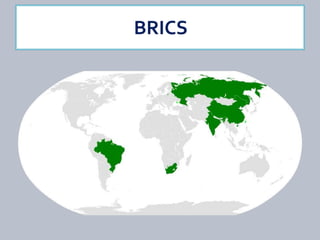
 BRICS stands for Brazil, Russia, India, China and
South Africa
 Came into existence in 2001 as BRIC nation
 BRICS is the international political organization of
leading emerging economies.
 BRICS as a group, accounts for 40% of labour force
 The BRIC became a mechanism through which the
countries can exchange opinions, seek convergence,
identify areas of cooperation and influence the
international agenda.
 Officially it was admitted as a BRIC nation on 24
December 2010
 With the entrance of South Africa, at the 3rd BRIC
Summit, in April 2011, the BRIC became BRICS.
4
 Vast Land Area
 Developing Economies
 Friendly Trade Relations
 Challenges Related To Economic And Social Integration
 Desire To Make The International Order More Representative
 Possibility Of Cooperation In Many Areas
 To achieve regional development
 To remove trade barriers
 Economic development
 Improve the professional development and education of countries.
 Making these countries getting closer to others to obtain the
comparative advantages of these countries.
 Optimum use of resources
 Building relationship
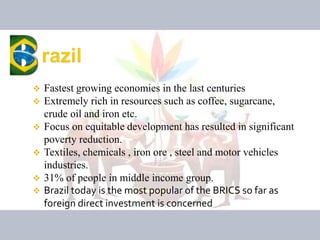
 Fastest growing economies in the last centuries
 Extremely rich in resources such as coffee, sugarcane,
crude oil and iron etc.
 Focus on equitable development has resulted in significant
poverty reduction.
 Textiles, chemicals , iron ore , steel and motor vehicles
industries.
 31% of people in middle income group.
 Brazil today is the most popular of the BRICS so far as
foreign direct investment is concerned
 Russia has capability in high-technology sectors
 Accounts for around 20% of the world’s oil and gas
reserves
 Consumer market of over 140 million people
 68% of people comes under middle income group
 Highly educated workforce
 Third largest exporter of steel and aluminium
 1.2 billion people
 2nd largest labour force
 Holds second place followed by China in BRICS
 Democratic country
 Fastest growing economy
 Third largest country in land size
 Biggest of all BRIC nations - GDP wise
 13% of people comes under middle income group
 Holds more than $3 trillion forex reserves.
 Largest exporter/ importer for 32 and 34 countries
respectively.
 Cheap labour work force
 The South African economy is now the 23rd largest in the
world
 Inflation is below 6.6% and falling.
 25% of goods produced in South Africa are for export
 Richest in terms of its mineral reserves.
0
1000
2000
3000
4000
5000
6000
7000
8000
1990 1991 1992 1993 1994 1995 1996 1997 1998 1999 2000 2001 2002 2003 2004 2005 2006 2007 2008 2009 2010 2011
GDPatCurrentPrices
Billions
Brazil China India Russian Federation South Africa
2.81
5.30
10.10
17.74
4.04 2.48
26.32
28.07
46.72
27.12
36.68
30.83
70.87
66.63
43.19
55.14
59.28
66.69
0.00
10.00
20.00
30.00
40.00
50.00
60.00
70.00
80.00
90.00
100.00
World Brazil China India Russian Federation South Africa
Agriculture (Value Added % of GDP) Industry (Value Added % of GDP) Services (Value Added % of GDP)
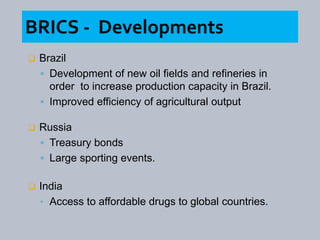
 Brazil
 Development of new oil fields and refineries in
order to increase production capacity in Brazil.
 Improved efficiency of agricultural output
 Russia
 Treasury bonds
 Large sporting events.
 India
• Access to affordable drugs to global countries.
 China
 Recent reforms by the China securities and regulatory
Commission (CSRC) has sought to bolster investor
confidence.
 600 million citizen have been lifted out of poverty in
China.
 China’s state owned enterprise produced over 50% of its
goods and services and employed over half of the
nation labour force.
 South Africa
 Invested Rs.300 bn in expanding Its Railway, Ports and
fuel pipelines.
 10% of the world’s oil reserves, 40 % of gold ore and
95% of platinum
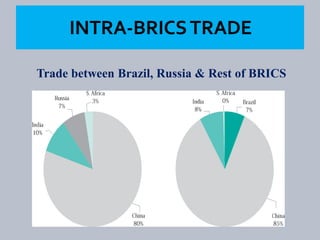
Trade between Brazil, Russia & Rest of BRICS
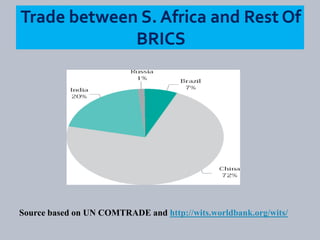
Source based on UN COMTRADE and http://wits.worldbank.org/wits/
 To support growth on the continent, notably during the
financial crisis
 South Africa’s financial market development and
sophistication
 The World Economic Forum’s 2011/12 Global
Competitiveness Index displayed a high level of
confidence in South Africa’s financial market
development, ranking the country in fourth place globally
on this measure.
 Headquarters : Shanghai, China
 President : K.V. Kamath
 The New Development Bank (NDB) is a multilateral
development bank operated by the BRICS states as an
alternative to the existing US-dominated World Bank
and International Monetary Fund
 The bank is set up to foster greater financial and
development cooperation among the five emerging markets
 The bank's primary focus is lending to infrastructure projects
 India is also expected to grow faster than China after
2020
 Rising incomes in the BRICS nations will create a
new middle consumer class
 Featured as- “Roadmap For Contribution”
 Important drivers for growth in the global economy.
 Expansion of their consumer markets and the rise of
multinational companies
 Sustainable solution for inclusive growth
 Broadening multi-dimensional co-operation
 Mutual Trade and Investment
Contingent Reserve Arrangement
Export Credit & Guarantee Agencies
Significant Role in International Affairs
Trade in local currency
 Dependenc
y on oil
 Corruption
 Industrial
output is weak
 Inefficient
Judicial System
 Illiteracy
 Lack of
Infrastructure
 High Inflation
 Economic
disparity
 48%
population
below poverty
line
 Lack of skill
sets,
particularly in
IT
 It is possible that China could become as big as the US by 2027
 India and Russia will individually be larger than Spain, Canada
or Italy by 2020
 By 2025 BRICS will be over half the size of the G7
 Long-term projections BRICS could account for almost 50% of
global equity markets by 2050

BRICS

  • 2.
    Presented By : ManoharaH M PALB 4090 Dept. Of Agricultural Economics
  • 3.
     BRICS standsfor Brazil, Russia, India, China and South Africa  Came into existence in 2001 as BRIC nation  BRICS is the international political organization of leading emerging economies.  BRICS as a group, accounts for 40% of labour force
  • 4.
     The BRICbecame a mechanism through which the countries can exchange opinions, seek convergence, identify areas of cooperation and influence the international agenda.  Officially it was admitted as a BRIC nation on 24 December 2010  With the entrance of South Africa, at the 3rd BRIC Summit, in April 2011, the BRIC became BRICS. 4
  • 5.
     Vast LandArea  Developing Economies  Friendly Trade Relations  Challenges Related To Economic And Social Integration  Desire To Make The International Order More Representative  Possibility Of Cooperation In Many Areas
  • 6.
     To achieveregional development  To remove trade barriers  Economic development  Improve the professional development and education of countries.  Making these countries getting closer to others to obtain the comparative advantages of these countries.  Optimum use of resources  Building relationship
  • 8.
     Fastest growingeconomies in the last centuries  Extremely rich in resources such as coffee, sugarcane, crude oil and iron etc.  Focus on equitable development has resulted in significant poverty reduction.  Textiles, chemicals , iron ore , steel and motor vehicles industries.  31% of people in middle income group.  Brazil today is the most popular of the BRICS so far as foreign direct investment is concerned
  • 9.
     Russia hascapability in high-technology sectors  Accounts for around 20% of the world’s oil and gas reserves  Consumer market of over 140 million people  68% of people comes under middle income group  Highly educated workforce  Third largest exporter of steel and aluminium
  • 10.
     1.2 billionpeople  2nd largest labour force  Holds second place followed by China in BRICS  Democratic country
  • 11.
     Fastest growingeconomy  Third largest country in land size  Biggest of all BRIC nations - GDP wise  13% of people comes under middle income group  Holds more than $3 trillion forex reserves.  Largest exporter/ importer for 32 and 34 countries respectively.  Cheap labour work force
  • 12.
     The SouthAfrican economy is now the 23rd largest in the world  Inflation is below 6.6% and falling.  25% of goods produced in South Africa are for export  Richest in terms of its mineral reserves.
  • 14.
    0 1000 2000 3000 4000 5000 6000 7000 8000 1990 1991 19921993 1994 1995 1996 1997 1998 1999 2000 2001 2002 2003 2004 2005 2006 2007 2008 2009 2010 2011 GDPatCurrentPrices Billions Brazil China India Russian Federation South Africa
  • 15.
    2.81 5.30 10.10 17.74 4.04 2.48 26.32 28.07 46.72 27.12 36.68 30.83 70.87 66.63 43.19 55.14 59.28 66.69 0.00 10.00 20.00 30.00 40.00 50.00 60.00 70.00 80.00 90.00 100.00 World BrazilChina India Russian Federation South Africa Agriculture (Value Added % of GDP) Industry (Value Added % of GDP) Services (Value Added % of GDP)
  • 16.
     Brazil  Developmentof new oil fields and refineries in order to increase production capacity in Brazil.  Improved efficiency of agricultural output  Russia  Treasury bonds  Large sporting events.  India • Access to affordable drugs to global countries.
  • 17.
     China  Recentreforms by the China securities and regulatory Commission (CSRC) has sought to bolster investor confidence.  600 million citizen have been lifted out of poverty in China.  China’s state owned enterprise produced over 50% of its goods and services and employed over half of the nation labour force.  South Africa  Invested Rs.300 bn in expanding Its Railway, Ports and fuel pipelines.  10% of the world’s oil reserves, 40 % of gold ore and 95% of platinum
  • 18.
    Trade between Brazil,Russia & Rest of BRICS
  • 20.
    Source based onUN COMTRADE and http://wits.worldbank.org/wits/
  • 22.
     To supportgrowth on the continent, notably during the financial crisis  South Africa’s financial market development and sophistication  The World Economic Forum’s 2011/12 Global Competitiveness Index displayed a high level of confidence in South Africa’s financial market development, ranking the country in fourth place globally on this measure.
  • 23.
     Headquarters :Shanghai, China  President : K.V. Kamath  The New Development Bank (NDB) is a multilateral development bank operated by the BRICS states as an alternative to the existing US-dominated World Bank and International Monetary Fund  The bank is set up to foster greater financial and development cooperation among the five emerging markets  The bank's primary focus is lending to infrastructure projects
  • 24.
     India isalso expected to grow faster than China after 2020  Rising incomes in the BRICS nations will create a new middle consumer class  Featured as- “Roadmap For Contribution”  Important drivers for growth in the global economy.  Expansion of their consumer markets and the rise of multinational companies
  • 25.
     Sustainable solutionfor inclusive growth  Broadening multi-dimensional co-operation  Mutual Trade and Investment Contingent Reserve Arrangement Export Credit & Guarantee Agencies Significant Role in International Affairs Trade in local currency
  • 26.
     Dependenc y onoil  Corruption  Industrial output is weak  Inefficient Judicial System  Illiteracy  Lack of Infrastructure  High Inflation  Economic disparity  48% population below poverty line  Lack of skill sets, particularly in IT
  • 27.
     It ispossible that China could become as big as the US by 2027  India and Russia will individually be larger than Spain, Canada or Italy by 2020  By 2025 BRICS will be over half the size of the G7  Long-term projections BRICS could account for almost 50% of global equity markets by 2050