PRESENTED BY:-
MUHAMMAD
TAHIR
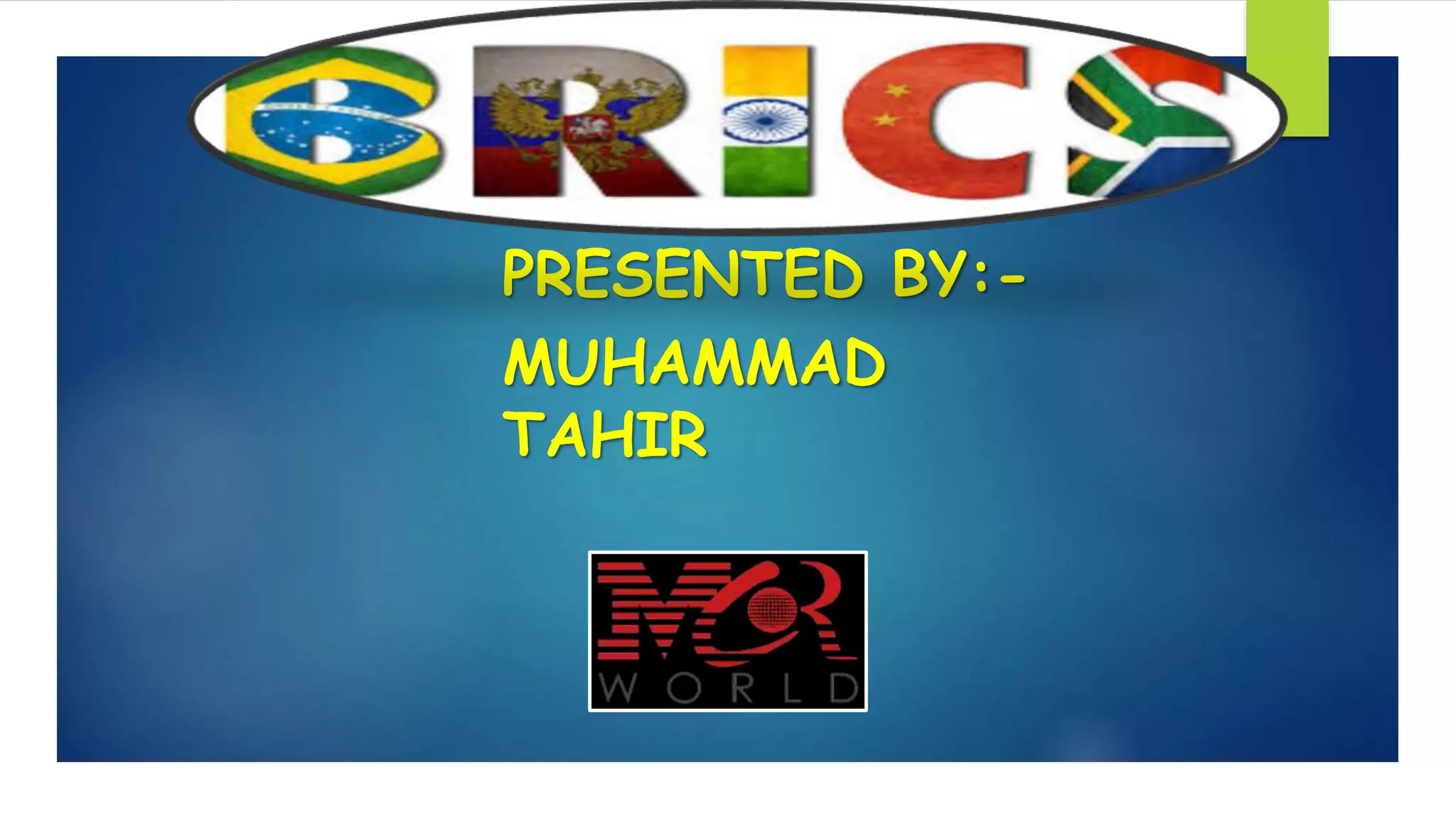
BRICS
The term BRICS was used for the first time in the Goldman
Sachs report 2003
BRICS is international political organization of leading
emerging economies.
BRICS became a new and promising political-diplomatic entity
ABOUT BRICS
 BRICS stands for Brazil, Russia, China, and South Africa.
 Basically Established on 16th June 2009
 It is the fastest growing and emerging economics
 BRICS is the international political organization of leading
emerging economies. Its five members are all developing
industrialized countries
Two main
Policies
coordination in multilateral fora,
with a focus on economic and
political governance
cooperation between members
From ‘BRICs’ to
‘BRICS’
 The BRIC became a mechanism through which the
countries can exchange opinions, seek convergence,
identify areas of cooperation and influence the
international agenda.
 Officially it was admitted as a BRIC nation on 24
December 2010
 With the entrance of South Africa, at the 3rd BRICS
Summit, in April 2011, the BRIC became BRICS,
with capital "S".
6
BRICS:
Characteristics
 BRICS represent 3 billion people or approximately 46%
of the world population & 25% of the world’s land
coverage
 Five Nations GDP of US 16.039 trillion, approximately
20% of the gross world product & US$4 trillion reserves
 China and India-Suppliers of manufactured goods and
services
 Brazil, Russia, South Africa- Suppliers of Raw Materials
 Challenges Related To Economic And Social Integration
 Desire To Make The International Order More
Representative
 Possibility Of Cooperation In Many Areas
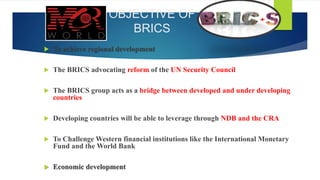
OBJECTIVE OF
BRICS
 To achieve regional development
 The BRICS advocating reform of the UN Security Council
 The BRICS group acts as a bridge between developed and under developing
countries
 Developing countries will be able to leverage through NDB and the CRA
 To Challenge Western financial institutions like the International Monetary
Fund and the World Bank
 Economic development
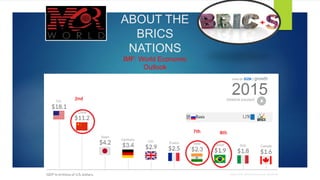
ABOUT THE
BRICS
NATIONS
IMF: World Economic
Outlook
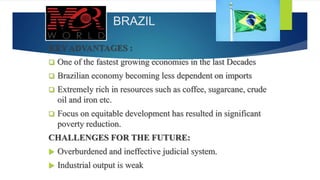
BRAZIL
KEY ADVANTAGES :
 One of the fastest growing economies in the last Decades
 Brazilian economy becoming less dependent on imports
 Extremely rich in resources such as coffee, sugarcane, crude
oil and iron etc.
 Focus on equitable development has resulted in significant
poverty reduction.
CHALLENGES FOR THE FUTURE:
 Overburdened and ineffective judicial system.
 Industrial output is weak
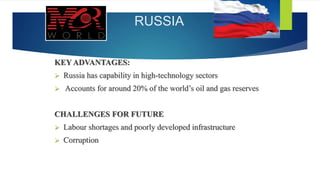
RUSSIA
KEY ADVANTAGES:
 Russia has capability in high-technology sectors
 Accounts for around 20% of the world’s oil and gas reserves
CHALLENGES FOR FUTURE
 Labour shortages and poorly developed infrastructure
 Corruption
INDIA
KEY ADVANTAGES
 1.15 billion people
 2nd largest labour force
 Approximately 2.5 million college graduates per year
CHALLENGES FOR THE FUTURE
 Improving basic educational achievement
 Improving infrastructure and electrical capacity
 Expanding technology industry
CHINA
KEY ADVANTAGES
 Broad expansion of educational achievement
 Rapid economic growth
 3rd largest country in land size
CHALLENGES FOR THE FUTURE
 support to rural areas and less-developed regions
 Bank of China sees inflation as a bigger risk
 Need to improve the investment
SOUTH AFRICA
KEY ADVANTAGE
 The South African economy is now the 23rd largest in the world
 Inflation is now below 5% and falling.
 25% of goods produced in South Africa for export
CHALLENGES FOR THE FUTURE:
 The economy is growing but not fast enough
 Lack of skills, particularly in IT.
 48% of the population is living below the poverty line
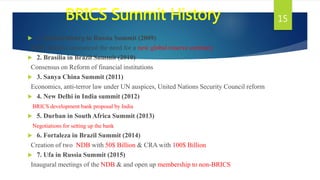
BRICS Summit History
 1. Yekaterinburg in Russia Summit (2009)
BRIC nations announced the need for a new global reserve currency
 2. Brasilia in Brazil Summit (2010)
Consensus on Reform of financial institutions
 3. Sanya China Summit (2011)
Economics, anti-terror law under UN auspices, United Nations Security Council reform
 4. New Delhi in India summit (2012)
BRICS development bank proposal by India
 5. Durban in South Africa Summit (2013)
Negotiations for setting up the bank
 6. Fortaleza in Brazil Summit (2014)
Creation of two NDB with 50$ Billion & CRA with 100$ Billion
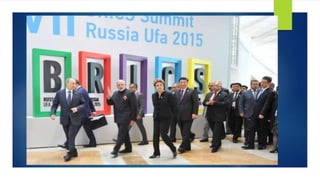
 7. Ufa in Russia Summit (2015)
Inaugural meetings of the NDB & and open up membership to non-BRICS
15
New Development Bank
 Formed on July 2014 and came into force in July 2015.
Earlier known as “BRICS Development Bank”.
 Headquartere in Shanghai
 Unlike the world bank which assigns vote based on capital share,
In the NDB each participant country will be assigned one vote
 1st president from India & Chairman of Board of Directors from
Brazil and Chairman of Board of Governors from Russia
 NDB is source of rising strength of BRICS & against the
domination of western countries through WORLD BANK & IMF
FINANCIAL STRUCTURE
 50$ billion (10$ billion from each country) as initial capital, this capital
base to be used for financial infrastructure & sustainable development
projects.
 100$ billion Contingency Reserve Arrangement(CRA) for liquidity
protection of brics countries during Balance of payment problem
(BOP). ( 41% china, 18% india,Russia,brazil and 5% south Africa).
 At the time of expansion the 55% share of the bank will be held by
BRICS countries only.
 Developing or less developing countries can also apply for financial
assistance.
 The Bank shall support public or private projects through
loans, guarantees, equity participation and other financial
instruments. It shall also cooperate with international
organizations and other financial entities
NDB and IMF
 1.IMF and World Bank are dominated by U.S and western countries
2. IMF and world bank follows different voting power based on
quota system. Though China is second largest economy after U.S it
has fewer voting rights in NDB.
3. The financial institution created by BRICS will reduce the
importance of US dollar as a global currency and eventually it will
increase importance of Yuan
4. IMF cash assistance program is conditional. If a country's
foreign policy clashes with US then it will be difficult to obtain a
loan.
TARGET SECTORS
FOR BRICS TRADE
 Manufacturing, services and agriculture
 Energy, infrastructure, mining beneficiation and
healthcare
 Construction and water provision
 The green economy and tourism
Although U.S is greatest economy now but BRICS is ready
to challenge the US and west economy and hegemony.
BRICS nations have the potential and resources to form a
powerful economy with greater opportunity’s than any other
nation.
A stronger BRICS can also have more influence in other
multilateral forums such as the WTO world bank etc.
In short, powerful BRICS will cause the world taking
towards multilateral system where balance of power will be
enough good for world peace.
CONCLUSION
THANK YOU

Brics and new development bank

  • 1.
  • 3.
    BRICS The term BRICSwas used for the first time in the Goldman Sachs report 2003 BRICS is international political organization of leading emerging economies. BRICS became a new and promising political-diplomatic entity
  • 4.
    ABOUT BRICS  BRICSstands for Brazil, Russia, China, and South Africa.  Basically Established on 16th June 2009  It is the fastest growing and emerging economics  BRICS is the international political organization of leading emerging economies. Its five members are all developing industrialized countries
  • 5.
    Two main Policies coordination inmultilateral fora, with a focus on economic and political governance cooperation between members
  • 6.
    From ‘BRICs’ to ‘BRICS’ The BRIC became a mechanism through which the countries can exchange opinions, seek convergence, identify areas of cooperation and influence the international agenda.  Officially it was admitted as a BRIC nation on 24 December 2010  With the entrance of South Africa, at the 3rd BRICS Summit, in April 2011, the BRIC became BRICS, with capital "S". 6
  • 7.
    BRICS: Characteristics  BRICS represent3 billion people or approximately 46% of the world population & 25% of the world’s land coverage  Five Nations GDP of US 16.039 trillion, approximately 20% of the gross world product & US$4 trillion reserves  China and India-Suppliers of manufactured goods and services  Brazil, Russia, South Africa- Suppliers of Raw Materials  Challenges Related To Economic And Social Integration  Desire To Make The International Order More Representative  Possibility Of Cooperation In Many Areas
  • 8.
    OBJECTIVE OF BRICS  Toachieve regional development  The BRICS advocating reform of the UN Security Council  The BRICS group acts as a bridge between developed and under developing countries  Developing countries will be able to leverage through NDB and the CRA  To Challenge Western financial institutions like the International Monetary Fund and the World Bank  Economic development
  • 9.
  • 10.
    BRAZIL KEY ADVANTAGES : One of the fastest growing economies in the last Decades  Brazilian economy becoming less dependent on imports  Extremely rich in resources such as coffee, sugarcane, crude oil and iron etc.  Focus on equitable development has resulted in significant poverty reduction. CHALLENGES FOR THE FUTURE:  Overburdened and ineffective judicial system.  Industrial output is weak
  • 11.
    RUSSIA KEY ADVANTAGES:  Russiahas capability in high-technology sectors  Accounts for around 20% of the world’s oil and gas reserves CHALLENGES FOR FUTURE  Labour shortages and poorly developed infrastructure  Corruption
  • 12.
    INDIA KEY ADVANTAGES  1.15billion people  2nd largest labour force  Approximately 2.5 million college graduates per year CHALLENGES FOR THE FUTURE  Improving basic educational achievement  Improving infrastructure and electrical capacity  Expanding technology industry
  • 13.
    CHINA KEY ADVANTAGES  Broadexpansion of educational achievement  Rapid economic growth  3rd largest country in land size CHALLENGES FOR THE FUTURE  support to rural areas and less-developed regions  Bank of China sees inflation as a bigger risk  Need to improve the investment
  • 14.
    SOUTH AFRICA KEY ADVANTAGE The South African economy is now the 23rd largest in the world  Inflation is now below 5% and falling.  25% of goods produced in South Africa for export CHALLENGES FOR THE FUTURE:  The economy is growing but not fast enough  Lack of skills, particularly in IT.  48% of the population is living below the poverty line
  • 15.
    BRICS Summit History 1. Yekaterinburg in Russia Summit (2009) BRIC nations announced the need for a new global reserve currency  2. Brasilia in Brazil Summit (2010) Consensus on Reform of financial institutions  3. Sanya China Summit (2011) Economics, anti-terror law under UN auspices, United Nations Security Council reform  4. New Delhi in India summit (2012) BRICS development bank proposal by India  5. Durban in South Africa Summit (2013) Negotiations for setting up the bank  6. Fortaleza in Brazil Summit (2014) Creation of two NDB with 50$ Billion & CRA with 100$ Billion  7. Ufa in Russia Summit (2015) Inaugural meetings of the NDB & and open up membership to non-BRICS 15
  • 16.
    New Development Bank Formed on July 2014 and came into force in July 2015. Earlier known as “BRICS Development Bank”.  Headquartere in Shanghai  Unlike the world bank which assigns vote based on capital share, In the NDB each participant country will be assigned one vote  1st president from India & Chairman of Board of Directors from Brazil and Chairman of Board of Governors from Russia  NDB is source of rising strength of BRICS & against the domination of western countries through WORLD BANK & IMF
  • 17.
    FINANCIAL STRUCTURE  50$billion (10$ billion from each country) as initial capital, this capital base to be used for financial infrastructure & sustainable development projects.  100$ billion Contingency Reserve Arrangement(CRA) for liquidity protection of brics countries during Balance of payment problem (BOP). ( 41% china, 18% india,Russia,brazil and 5% south Africa).  At the time of expansion the 55% share of the bank will be held by BRICS countries only.  Developing or less developing countries can also apply for financial assistance.  The Bank shall support public or private projects through loans, guarantees, equity participation and other financial instruments. It shall also cooperate with international organizations and other financial entities
  • 18.
    NDB and IMF 1.IMF and World Bank are dominated by U.S and western countries 2. IMF and world bank follows different voting power based on quota system. Though China is second largest economy after U.S it has fewer voting rights in NDB. 3. The financial institution created by BRICS will reduce the importance of US dollar as a global currency and eventually it will increase importance of Yuan 4. IMF cash assistance program is conditional. If a country's foreign policy clashes with US then it will be difficult to obtain a loan.
  • 19.
    TARGET SECTORS FOR BRICSTRADE  Manufacturing, services and agriculture  Energy, infrastructure, mining beneficiation and healthcare  Construction and water provision  The green economy and tourism
  • 21.
    Although U.S isgreatest economy now but BRICS is ready to challenge the US and west economy and hegemony. BRICS nations have the potential and resources to form a powerful economy with greater opportunity’s than any other nation. A stronger BRICS can also have more influence in other multilateral forums such as the WTO world bank etc. In short, powerful BRICS will cause the world taking towards multilateral system where balance of power will be enough good for world peace. CONCLUSION
  • 22.