PRESENTED BY:
J.SivaGupta
MECHANICAL
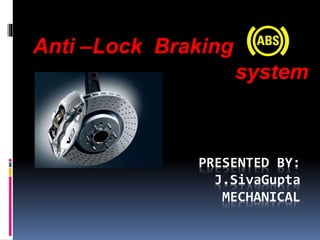
Anti –Lock Braking
system
Intoduction:
 In today’s world ,braking is the most
important system in an automobile.
 Brakes are energy conversion devices ,which
converts kinetic energy into thermal energy .
 The brakes transmits the force to the tires
using friction & the tires transmit that force
to the road using friction also
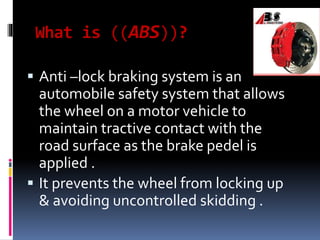
What is ((ABS))?
 Anti –lock braking system is an
automobile safety system that allows
the wheel on a motor vehicle to
maintain tractive contact with the
road surface as the brake pedel is
applied .
 It prevents the wheel from locking up
& avoiding uncontrolled skidding .
History of ABS:
 1929 :- ABS was first developed for aircraft by the French
automobile and aircraft pioneer Gabriel Voisin, as
threshold braking on airplanes is nearly impossible.
 1936: German company Bosch is awarded a patent an
“Apparatus for preventing lock-braking of wheels in a
motor vehicle”.
 1936: Bosch and Mercedes-Benz partner - R&D into ABS.
 1972: WABCO partners with Mercedes-Benz developing
first ABS for trucks.
 1978: First production-line installation of ABS into
Mercedes and BMW vehicles.
 1981: 100,000 Bosch ABS installed.
 1985: First ABS installed on US vehicles.
History of ABS:
 1986: 1M Bosch ABS installed.
 1987: Traction control - in conjunction with
ABS – used on passenger vehicles.
 1989: ABS hydraulic unit combined with
standard hydraulic brake unit
 1992: 10M Bosch ABS installed.
 1999: 50M Bosch ABS installed.
 2000: 6 of 10 new cars on the road are ABS
equipped.
 2003: 100M Bosch ABS installed.
 Nowadays:- Almost all new cars have ABS.
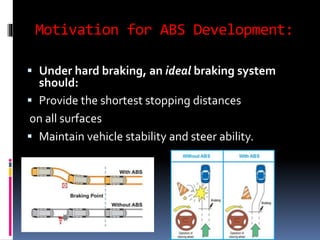
Motivation for ABS Development:
 Under hard braking, an ideal braking system
should:
 Provide the shortest stopping distances
on all surfaces
 Maintain vehicle stability and steer ability.
Principles for ABS operation :
 The anti-lock brake controller is also known
as the CAB (Controller Anti-lock Brake) The
non-correspondence between the wheel
speed and vehicle speed is called “slip”
and the magnitude of the slip is
expressed by the “slip ratio” which is
defined as follows:
 Slip ratio = (Vehicle speed – Wheel
speed)/Vehicle speed × 100%
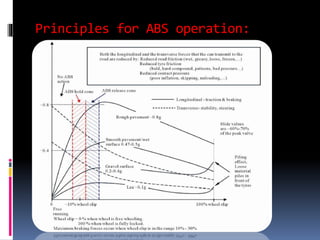
Principles for ABS operation:
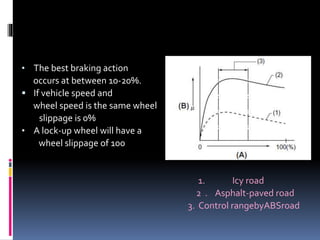
• The best braking action
occurs at between 10-20%.
 If vehicle speed and
wheel speed is the same wheel
slippage is 0%
• A lock-up wheel will have a
wheel slippage of 100
1. Icy road
2 . Asphalt-paved road
3. Control rangebyABSroad
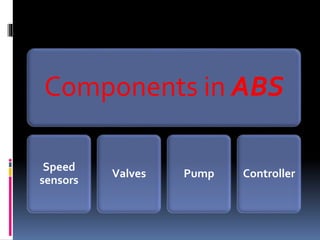
Components in ABS
Speed
sensors
Valves Pump Controller
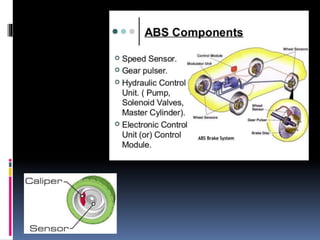
Speed sensors:A speed sensor is used
to determine the acceleration or deceleration of
the wheel. These sensors use a magnet and a Hall
effect sensor, or a toothed wheel and
an electromagnetic coil to generate a signal
 Valves: There is a valve in the brake line of each brake
controlled by the ABS. On some systems, the valve has three
positions : In position one, the valve is open; pressure from the
master cylinder is passed right through to the brake.
 Pump: The pump in the ABS is used to
restore the pressure to the hydraulic brakes
after the valves have released it. A signal
from the controller will release the valve at
the detection of wheel slip
Types of Anti-lock braking
system:
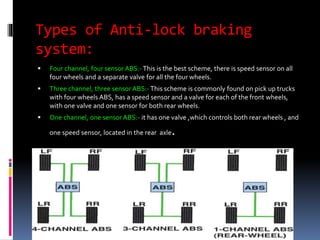
 Four channel, four sensor ABS:- This is the best scheme, there is speed sensor on all
four wheels and a separate valve for all the four wheels.
 Three channel, three sensor ABS:- This scheme is commonly found on pick up trucks
with four wheels ABS, has a speed sensor and a valve for each of the front wheels,
with one valve and one sensor for both rear wheels.
 One channel, one sensor ABS:- it has one valve ,which controls both rear wheels , and
one speed sensor, located in the rear axle.
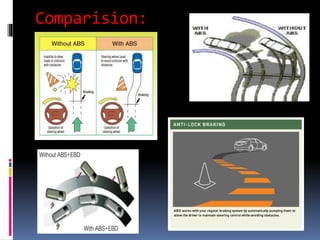
Comparision:
ADVANTAGES:
1.It allows the driver to maintain directional stability and
control over steering during braking
2.Safe and effective
3.Automatically changes the brake fluid pressure at each wheel to
maintain optimum brake performance.
4.ABS absorbs the unwanted turbulence shock waves and modulates the
pulses thus permitting the wheel to continue turning under maximum
braking pressure.
 DISADVANTAGES:
 It is very costly.
 Maintenance cost of a car equipped with
ABS is more
ANTI LOCK BRAKING SYSTEM

ANTI LOCK BRAKING SYSTEM

  • 1.
  • 2.
    Intoduction:  In today’sworld ,braking is the most important system in an automobile.  Brakes are energy conversion devices ,which converts kinetic energy into thermal energy .  The brakes transmits the force to the tires using friction & the tires transmit that force to the road using friction also
  • 3.
    What is ((ABS))? Anti –lock braking system is an automobile safety system that allows the wheel on a motor vehicle to maintain tractive contact with the road surface as the brake pedel is applied .  It prevents the wheel from locking up & avoiding uncontrolled skidding .
  • 4.
    History of ABS: 1929 :- ABS was first developed for aircraft by the French automobile and aircraft pioneer Gabriel Voisin, as threshold braking on airplanes is nearly impossible.  1936: German company Bosch is awarded a patent an “Apparatus for preventing lock-braking of wheels in a motor vehicle”.  1936: Bosch and Mercedes-Benz partner - R&D into ABS.  1972: WABCO partners with Mercedes-Benz developing first ABS for trucks.  1978: First production-line installation of ABS into Mercedes and BMW vehicles.  1981: 100,000 Bosch ABS installed.  1985: First ABS installed on US vehicles.
  • 5.
    History of ABS: 1986: 1M Bosch ABS installed.  1987: Traction control - in conjunction with ABS – used on passenger vehicles.  1989: ABS hydraulic unit combined with standard hydraulic brake unit  1992: 10M Bosch ABS installed.  1999: 50M Bosch ABS installed.  2000: 6 of 10 new cars on the road are ABS equipped.  2003: 100M Bosch ABS installed.  Nowadays:- Almost all new cars have ABS.
  • 6.
    Motivation for ABSDevelopment:  Under hard braking, an ideal braking system should:  Provide the shortest stopping distances on all surfaces  Maintain vehicle stability and steer ability.
  • 7.
    Principles for ABSoperation :  The anti-lock brake controller is also known as the CAB (Controller Anti-lock Brake) The non-correspondence between the wheel speed and vehicle speed is called “slip” and the magnitude of the slip is expressed by the “slip ratio” which is defined as follows:  Slip ratio = (Vehicle speed – Wheel speed)/Vehicle speed × 100%
  • 8.
  • 9.
    • The bestbraking action occurs at between 10-20%.  If vehicle speed and wheel speed is the same wheel slippage is 0% • A lock-up wheel will have a wheel slippage of 100 1. Icy road 2 . Asphalt-paved road 3. Control rangebyABSroad
  • 10.
  • 11.
    Speed sensors:A speedsensor is used to determine the acceleration or deceleration of the wheel. These sensors use a magnet and a Hall effect sensor, or a toothed wheel and an electromagnetic coil to generate a signal  Valves: There is a valve in the brake line of each brake controlled by the ABS. On some systems, the valve has three positions : In position one, the valve is open; pressure from the master cylinder is passed right through to the brake.  Pump: The pump in the ABS is used to restore the pressure to the hydraulic brakes after the valves have released it. A signal from the controller will release the valve at the detection of wheel slip
  • 13.
    Types of Anti-lockbraking system:  Four channel, four sensor ABS:- This is the best scheme, there is speed sensor on all four wheels and a separate valve for all the four wheels.  Three channel, three sensor ABS:- This scheme is commonly found on pick up trucks with four wheels ABS, has a speed sensor and a valve for each of the front wheels, with one valve and one sensor for both rear wheels.  One channel, one sensor ABS:- it has one valve ,which controls both rear wheels , and one speed sensor, located in the rear axle.
  • 14.
  • 15.
    ADVANTAGES: 1.It allows thedriver to maintain directional stability and control over steering during braking 2.Safe and effective 3.Automatically changes the brake fluid pressure at each wheel to maintain optimum brake performance. 4.ABS absorbs the unwanted turbulence shock waves and modulates the pulses thus permitting the wheel to continue turning under maximum braking pressure.  DISADVANTAGES:  It is very costly.  Maintenance cost of a car equipped with ABS is more