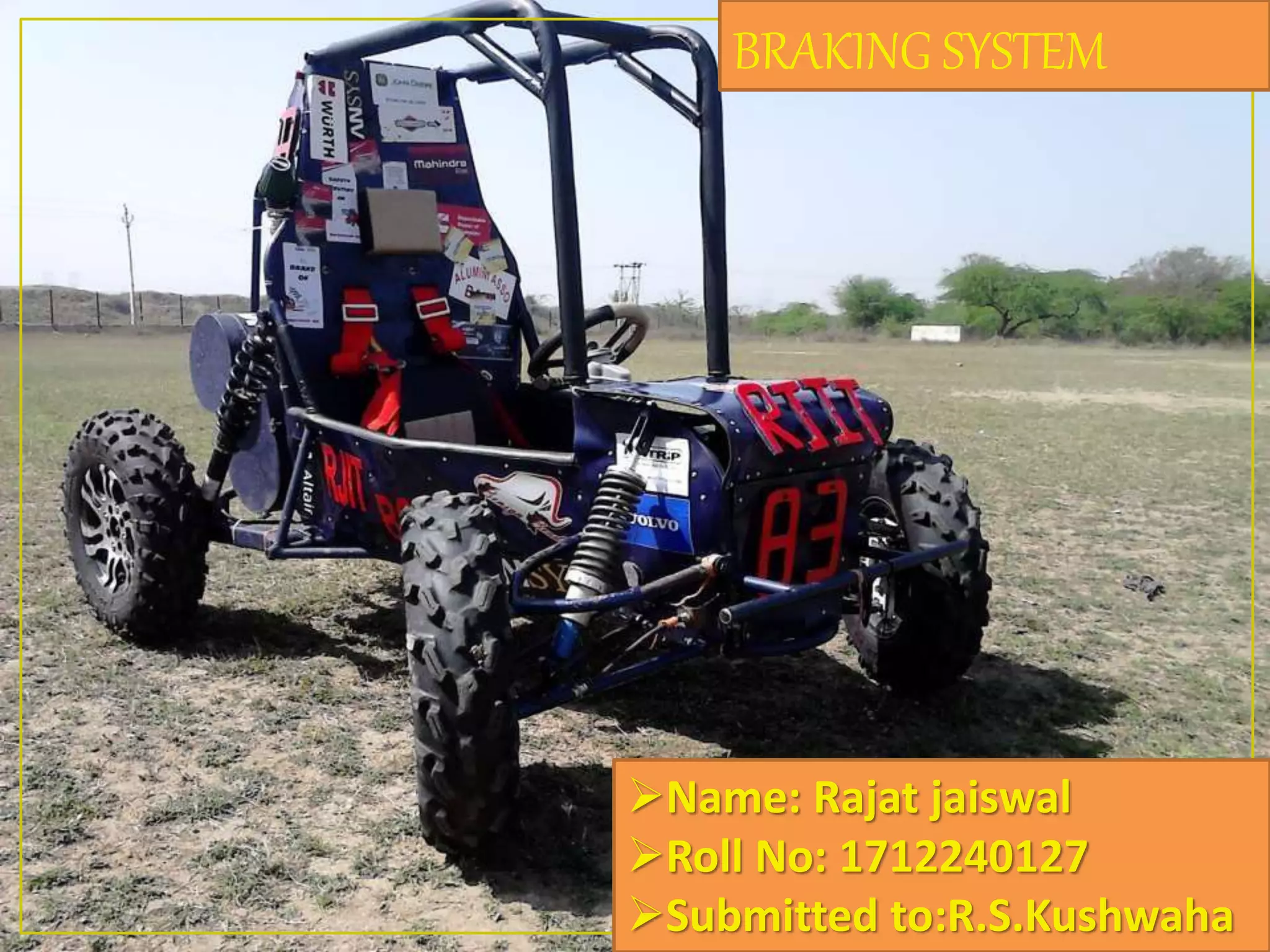
Name: Rajat jaiswal
Roll No: 1712240127
Submitted to:R.S.Kushwaha
BRAKING SYSTEM
 Stop the vehicle by converting kinetic energy to heat
energy.
 Heat energy is created in the brakes by friction.
Friction is created between a moving and non-
moving surface at each wheel to generate the heat.
Discs and drum brakes are the most common type of
braking system used.
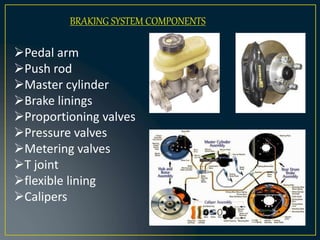
Pedal arm
Push rod
Master cylinder
Brake linings
Proportioning valves
Pressure valves
Metering valves
T joint
flexible lining
Calipers
BRAKING SYSTEM COMPONENTS
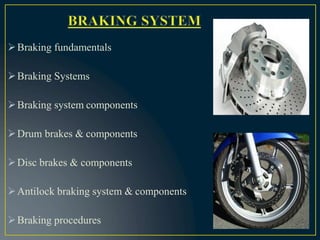
Braking fundamentals
Braking Systems
Braking system components
Drum brakes & components
Disc brakes & components
Antilock braking system & components
Braking procedures
BRAKING FUNDAMENTALS
 PRINCIPLE:
Friction between braking surfaces converts kinetic energy intoheat.
In drum brakes, wheel cylinders force brake linings against the inside of thedrum.
In disc brakes, pads are forced against a brakedisc.
Several factors can influence Vehicle Braking:
 Road surface
 Road conditions
 Weight of the vehicle
 Load on the wheels during stopping
 How the vehicle is being driven.
A basic Braking system has a:
 Brake pedal
 Master cylinder to provide hydraulic pressure
 Brake linings and hoses to connect the master cylinder to the brakeassemblies
 Brake assemblies – Drum or Disc that stop the wheels.
DRUM & DISC BRAKES:
Drum brakes have a brake shoe that expands against the inside of a drum.
Disc brakes clamp a flat disc between two pads.
COEFFICIENT OF FRICTION:
The coefficient of friction is the measurement of friction between pairsof
surfaces.
STOPPING DISTANCE:
The distance in which the vehicle stops by applying force.
BRAKE FADE:
It is the reduction in stopping power caused by a build up of heat in the braking surfaces.
WEIGHT TRANSFER:
In dynamic braking condition weight transfers from rear wheels to
front wheels
SKIDDING:
When force of braking exceeds force of adhesion between tires and road
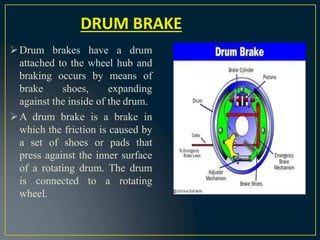
Drum brakes have a drum
attached to the wheel hub and
braking occurs by means of
brake shoes, expanding
against the inside of the drum.
A drum brake is a brake in
which the friction is caused by
a set of shoes or pads that
press against the inner surface
of a rotating drum. The drum
is connected to a rotating
wheel.
DRUM BRAKE
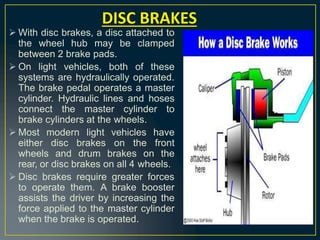
 With disc brakes, a disc attached to
the wheel hub may be clamped
between 2 brake pads.
 On light vehicles, both of these
systems are hydraulically operated.
The brake pedal operates a master
cylinder. Hydraulic lines and hoses
connect the master cylinder to
brake cylinders at the wheels.
 Most modern light vehicles have
either disc brakes on the front
wheels and drum brakes on the
rear, or disc brakes on all 4 wheels.
 Disc brakes require greater forces
to operate them. A brake booster
assists the driver by increasing the
force applied to the master cylinder
when the brake is operated.
DISC BRAKES
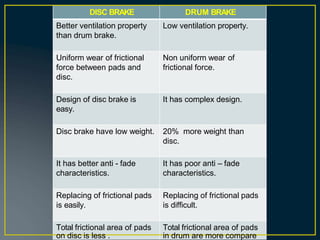
DISC BRAKE DRUM BRAKE
Better ventilation property
than drum brake.
Low ventilation property.
Uniform wear of frictional
force between pads and
disc.
Non uniform wear of
frictional force.
Design of disc brake is
easy.
It has complex design.
Disc brake have low weight. 20% more weight than
disc.
It has better anti - fade
characteristics.
It has poor anti – fade
characteristics.
Replacing of frictional pads
is easily.
Replacing of frictional pads
is difficult.
Total frictional area of pads Total frictional area of pads
on disc is less . in drum are more compare
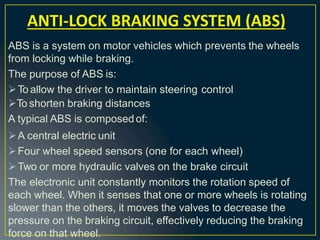
ABS is a system on motor vehicles which prevents the wheels
from locking while braking.
The purpose of ABS is:
To allow the driver to maintain steering control
To shorten braking distances
A typical ABS is composed of:
A central electric unit
Four wheel speed sensors (one for each wheel)
Two or more hydraulic valves on the brake circuit
The electronic unit constantly monitors the rotation speed of
each wheel. When it senses that one or more wheels is rotating
slower than the others, it moves the valves to decrease the
pressure on the braking circuit, effectively reducing the braking
force on that wheel.
ANTI-LOCK BRAKING SYSTEM (ABS)
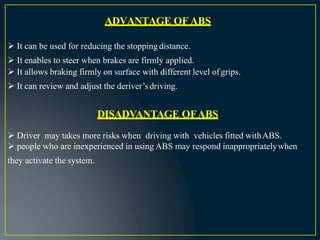
ADVANTAGE OF ABS
 It can be used for reducing the stopping distance.
 It enables to steer when brakes are firmly applied.
 It allows braking firmly on surface with different level ofgrips.
 It can review and adjust the deriver’sdriving.
DISADVANTAGE OFABS
 Driver may takes more risks when driving with vehicles fitted withABS.
 people who are inexperienced in using ABS may respond inappropriatelywhen
they activate the system.
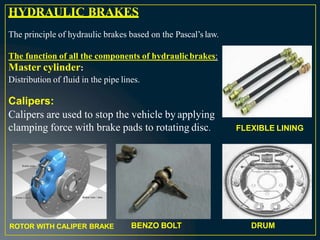
HYDRAULIC BRAKES
The principle of hydraulic brakes based on the Pascal’s law.
The function of all the components of hydraulicbrakes:
Master cylinder:
Distribution of fluid in the pipe lines.
Calipers:
Calipers are used to stop the vehicle by applying
clamping force with brake pads to rotating disc. FLEXIBLE LINING
BENZO BOLT DRUM
ROTOR WITH CALIPER BRAKE
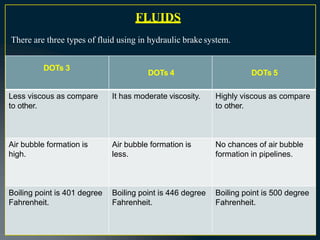
DOTs 3
DOTs 4 DOTs 5
Less viscous as compare
to other.
It has moderate viscosity. Highly viscous as compare
to other.
Air bubble formation is
high.
Air bubble formation is
less.
No chances of air bubble
formation in pipelines.
Boiling point is 401 degree
Fahrenheit.
Boiling point is 446 degree
Fahrenheit.
Boiling point is 500 degree
Fahrenheit.
FLUIDS
There are three types of fluid using in hydraulic brake system.
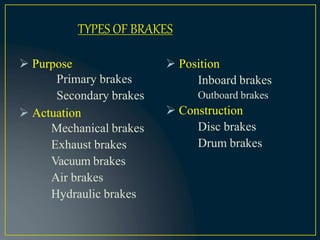
 Purpose
Primary brakes
Secondary brakes
 Actuation
Mechanical brakes
Exhaust brakes
Vacuum brakes
Air brakes
Hydraulic brakes
 Position
Inboard brakes
Outboard brakes
 Construction
Disc brakes
Drum brakes
TYPES OF BRAKES
The primary components of the park brake system are:
Parking brake cables
Disc brake caliper fitted with park brake
Park brake lever on drum brakes.
The mechanical park brake is normally hand operated by a brake
handle located on the wheels floor or under the dash. In either
position, it is in easy reach for the driver to apply.
On vehicles fitted with 4 wheel disc brakes, the park brake is
applied at the rear caliper by the cable-operated system.
PARKING BRAKE:-
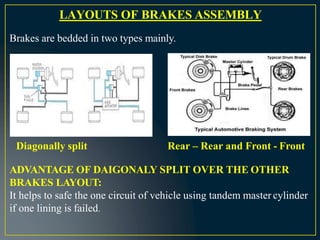
LAYOUTS OF BRAKES ASSEMBLY
Brakes are bedded in two types mainly.
Diagonally split Rear – Rear and Front - Front
ADVANTAGE OF DAIGONALY SPLIT OVER THE OTHER
BRAKES LAYOUT:
It helps to safe the one circuit of vehicle using tandem master cylinder
if one lining is failed.
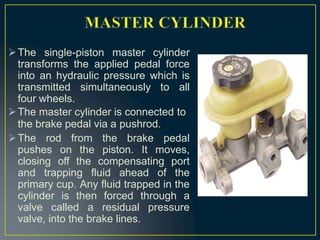
The single-piston master cylinder
transforms the applied pedal force
into an hydraulic pressure which is
transmitted simultaneously to all
four wheels.
The master cylinder is connected to
the brake pedal via a pushrod.
The rod from the brake pedal
pushes on the piston. It moves,
closing off the compensating port
and trapping fluid ahead of the
primary cup. Any fluid trapped in the
cylinder is then forced through a
valve called a residual pressure
valve, into the brake lines.
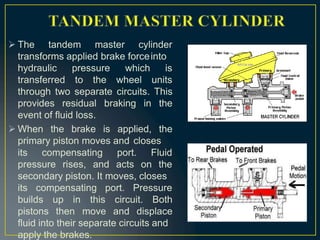
 The tandem master cylinder
transforms applied brake forceinto
hydraulic
transferred
pressure
to the
which is
wheel units
through two separate circuits. This
provides residual braking in the
event of fluid loss.
 When the brake is applied, the
primary piston moves and closes
its compensating
pressure rises, and
port. Fluid
acts on the
secondary piston. It moves, closes
its compensating port. Pressure
builds up in
pistons then
this circuit. Both
move and displace
fluid into their separate circuits and
apply the brakes.
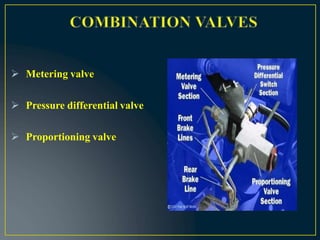
 Metering valve
 Pressure differential valve
 Proportioning valve
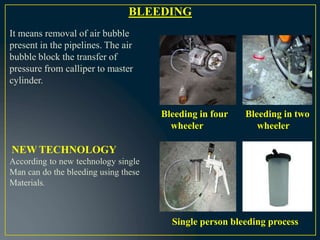
BLEEDING
It means removal of air bubble
present in the pipelines. The air
bubble block the transfer of
pressure from calliper to master
cylinder.
Bleeding in four
wheeler
Bleeding in two
wheeler
NEW TECHNOLOGY
According to new technology single
Man can do the bleeding using these
Materials.
Single person bleeding process

Breaking system converted

  • 1.
    Name: Rajat jaiswal RollNo: 1712240127 Submitted to:R.S.Kushwaha BRAKING SYSTEM
  • 2.
     Stop thevehicle by converting kinetic energy to heat energy.  Heat energy is created in the brakes by friction. Friction is created between a moving and non- moving surface at each wheel to generate the heat. Discs and drum brakes are the most common type of braking system used.
  • 3.
    Pedal arm Push rod Mastercylinder Brake linings Proportioning valves Pressure valves Metering valves T joint flexible lining Calipers BRAKING SYSTEM COMPONENTS
  • 4.
    Braking fundamentals Braking Systems Brakingsystem components Drum brakes & components Disc brakes & components Antilock braking system & components Braking procedures
  • 5.
    BRAKING FUNDAMENTALS  PRINCIPLE: Frictionbetween braking surfaces converts kinetic energy intoheat. In drum brakes, wheel cylinders force brake linings against the inside of thedrum. In disc brakes, pads are forced against a brakedisc. Several factors can influence Vehicle Braking:  Road surface  Road conditions  Weight of the vehicle  Load on the wheels during stopping  How the vehicle is being driven. A basic Braking system has a:  Brake pedal  Master cylinder to provide hydraulic pressure  Brake linings and hoses to connect the master cylinder to the brakeassemblies  Brake assemblies – Drum or Disc that stop the wheels.
  • 6.
    DRUM & DISCBRAKES: Drum brakes have a brake shoe that expands against the inside of a drum. Disc brakes clamp a flat disc between two pads. COEFFICIENT OF FRICTION: The coefficient of friction is the measurement of friction between pairsof surfaces. STOPPING DISTANCE: The distance in which the vehicle stops by applying force. BRAKE FADE: It is the reduction in stopping power caused by a build up of heat in the braking surfaces. WEIGHT TRANSFER: In dynamic braking condition weight transfers from rear wheels to front wheels SKIDDING: When force of braking exceeds force of adhesion between tires and road
  • 7.
    Drum brakes havea drum attached to the wheel hub and braking occurs by means of brake shoes, expanding against the inside of the drum. A drum brake is a brake in which the friction is caused by a set of shoes or pads that press against the inner surface of a rotating drum. The drum is connected to a rotating wheel. DRUM BRAKE
  • 8.
     With discbrakes, a disc attached to the wheel hub may be clamped between 2 brake pads.  On light vehicles, both of these systems are hydraulically operated. The brake pedal operates a master cylinder. Hydraulic lines and hoses connect the master cylinder to brake cylinders at the wheels.  Most modern light vehicles have either disc brakes on the front wheels and drum brakes on the rear, or disc brakes on all 4 wheels.  Disc brakes require greater forces to operate them. A brake booster assists the driver by increasing the force applied to the master cylinder when the brake is operated. DISC BRAKES
  • 9.
    DISC BRAKE DRUMBRAKE Better ventilation property than drum brake. Low ventilation property. Uniform wear of frictional force between pads and disc. Non uniform wear of frictional force. Design of disc brake is easy. It has complex design. Disc brake have low weight. 20% more weight than disc. It has better anti - fade characteristics. It has poor anti – fade characteristics. Replacing of frictional pads is easily. Replacing of frictional pads is difficult. Total frictional area of pads Total frictional area of pads on disc is less . in drum are more compare
  • 10.
    ABS is asystem on motor vehicles which prevents the wheels from locking while braking. The purpose of ABS is: To allow the driver to maintain steering control To shorten braking distances A typical ABS is composed of: A central electric unit Four wheel speed sensors (one for each wheel) Two or more hydraulic valves on the brake circuit The electronic unit constantly monitors the rotation speed of each wheel. When it senses that one or more wheels is rotating slower than the others, it moves the valves to decrease the pressure on the braking circuit, effectively reducing the braking force on that wheel. ANTI-LOCK BRAKING SYSTEM (ABS)
  • 11.
    ADVANTAGE OF ABS It can be used for reducing the stopping distance.  It enables to steer when brakes are firmly applied.  It allows braking firmly on surface with different level ofgrips.  It can review and adjust the deriver’sdriving. DISADVANTAGE OFABS  Driver may takes more risks when driving with vehicles fitted withABS.  people who are inexperienced in using ABS may respond inappropriatelywhen they activate the system.
  • 12.
    HYDRAULIC BRAKES The principleof hydraulic brakes based on the Pascal’s law. The function of all the components of hydraulicbrakes: Master cylinder: Distribution of fluid in the pipe lines. Calipers: Calipers are used to stop the vehicle by applying clamping force with brake pads to rotating disc. FLEXIBLE LINING BENZO BOLT DRUM ROTOR WITH CALIPER BRAKE
  • 13.
    DOTs 3 DOTs 4DOTs 5 Less viscous as compare to other. It has moderate viscosity. Highly viscous as compare to other. Air bubble formation is high. Air bubble formation is less. No chances of air bubble formation in pipelines. Boiling point is 401 degree Fahrenheit. Boiling point is 446 degree Fahrenheit. Boiling point is 500 degree Fahrenheit. FLUIDS There are three types of fluid using in hydraulic brake system.
  • 14.
     Purpose Primary brakes Secondarybrakes  Actuation Mechanical brakes Exhaust brakes Vacuum brakes Air brakes Hydraulic brakes  Position Inboard brakes Outboard brakes  Construction Disc brakes Drum brakes TYPES OF BRAKES
  • 15.
    The primary componentsof the park brake system are: Parking brake cables Disc brake caliper fitted with park brake Park brake lever on drum brakes. The mechanical park brake is normally hand operated by a brake handle located on the wheels floor or under the dash. In either position, it is in easy reach for the driver to apply. On vehicles fitted with 4 wheel disc brakes, the park brake is applied at the rear caliper by the cable-operated system. PARKING BRAKE:-
  • 16.
    LAYOUTS OF BRAKESASSEMBLY Brakes are bedded in two types mainly. Diagonally split Rear – Rear and Front - Front ADVANTAGE OF DAIGONALY SPLIT OVER THE OTHER BRAKES LAYOUT: It helps to safe the one circuit of vehicle using tandem master cylinder if one lining is failed.
  • 17.
    The single-piston mastercylinder transforms the applied pedal force into an hydraulic pressure which is transmitted simultaneously to all four wheels. The master cylinder is connected to the brake pedal via a pushrod. The rod from the brake pedal pushes on the piston. It moves, closing off the compensating port and trapping fluid ahead of the primary cup. Any fluid trapped in the cylinder is then forced through a valve called a residual pressure valve, into the brake lines.
  • 18.
     The tandemmaster cylinder transforms applied brake forceinto hydraulic transferred pressure to the which is wheel units through two separate circuits. This provides residual braking in the event of fluid loss.  When the brake is applied, the primary piston moves and closes its compensating pressure rises, and port. Fluid acts on the secondary piston. It moves, closes its compensating port. Pressure builds up in pistons then this circuit. Both move and displace fluid into their separate circuits and apply the brakes.
  • 19.
     Metering valve Pressure differential valve  Proportioning valve
  • 20.
    BLEEDING It means removalof air bubble present in the pipelines. The air bubble block the transfer of pressure from calliper to master cylinder. Bleeding in four wheeler Bleeding in two wheeler NEW TECHNOLOGY According to new technology single Man can do the bleeding using these Materials. Single person bleeding process