LOGO
PRESENTED BY:
Shubham Thakur
13BME8149
Mechanical Engineering
HYDRAULIC BRAKES
LOGO
AIM
TO ACQUAINT THE CLASS WITH THE CONSTRUTION
AND WORKING OF A HYDRAULIC BRAKE SYSTEM.
LOGO
CONTENTS
INTRODUCTION
CLASSIFICATION
PRINCIPLE
CONSTRUCTION
a) MASTER CYLINDER..
b) WHEEL CYLINDER.
c) BRAKE SHOES.
d) BRAKE DRUM.
e) BRAKE FLUID.
f) BRAKE LINES AND HOSES.
 SYSTEM OPERATION
 ADV AND DISADV OF HYD BRAKES
LOGO
INTRODUCTION
HYDRAULIC BRAKES:
The hydraulic brake is an arrangement
of braking mechanism which uses brake fluid, to
transfer pressure from the controlling unit, which is
usually near the operator of the vehicle, to the actual
brake mechanism, which is usually at or near the wheel
of the vehicle.
HISTORY:
In 1918 Malcolm Lockheed developed a hydraulic
brake system.
LOGO
CLASSIFICATION OF BRAKES
 On the Basis of Method of Actuation
(a) Foot brake (also called service brake) operated by foot pedal.
(b) Hand brake – it is also called parking brake operated by hand.
 On the Basis of Mode of Operation
(a) Mechanical brakes
(b) Hydraulic brakes
(c) Air brakes
(d) Vacuum brakes
(e) Electric brakes.
 On the Basis of Action on Front or Rear Wheels
(a) Front-wheel brakes
(b) Rear-wheel brakes.
 On the Basis of Method of Application of Braking Contact
(a) Internally – expanding brakes
(b) Externally – contracting brakes.
LOGO
PRINCIPLES OF
HYDRAULIC
BRAKING
Hydraulic brakes work on the principle
of Pascal’s law which states that
“pressure at a point in a fluid is equal in
all directions in space”.
According to this law when pressure is
applied on a fluid it travels equally in all
directions so that uniform braking action
is applied on all four wheels.
LOGO
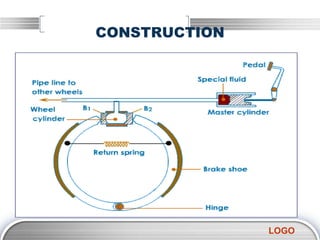
CONSTRUCTION
LOGO
CONTD..
Brake pedal or lever
A pushrod
A master cylinder assembly containing
a piston assembly
Reinforced hydraulic lines
Brake calliper assembly usually consisting of one
or two hollow aluminium or chrome-plated steel
pistons (called calliper pistons), a set of thermally
conductive brake pads and a rotor (also called a
brake disc) or drum attached to an axle.
The system is usually filled with a glycol-
ether based brake fluid
LOGO
a) MASTER
CYLINDER
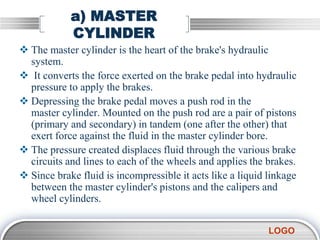
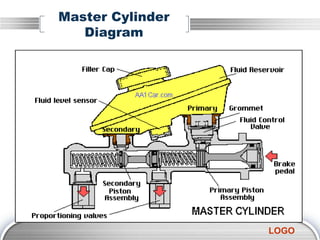
 The master cylinder is the heart of the brake's hydraulic
system.
 It converts the force exerted on the brake pedal into hydraulic
pressure to apply the brakes.
 Depressing the brake pedal moves a push rod in the
master cylinder. Mounted on the push rod are a pair of pistons
(primary and secondary) in tandem (one after the other) that
exert force against the fluid in the master cylinder bore.
 The pressure created displaces fluid through the various brake
circuits and lines to each of the wheels and applies the brakes.
 Since brake fluid is incompressible it acts like a liquid linkage
between the master cylinder's pistons and the calipers and
wheel cylinders.
LOGO
Master Cylinder
Diagram
LOGO
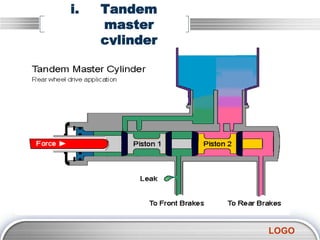
i. Tandem
master
cylinder
LOGO
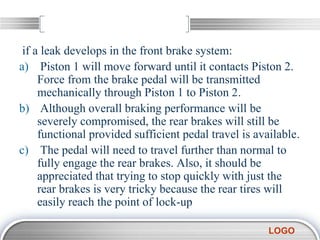
if a leak develops in the front brake system:
a) Piston 1 will move forward until it contacts Piston 2.
Force from the brake pedal will be transmitted
mechanically through Piston 1 to Piston 2.
b) Although overall braking performance will be
severely compromised, the rear brakes will still be
functional provided sufficient pedal travel is available.
c) The pedal will need to travel further than normal to
fully engage the rear brakes. Also, it should be
appreciated that trying to stop quickly with just the
rear brakes is very tricky because the rear tires will
easily reach the point of lock-up
LOGO
LOGO
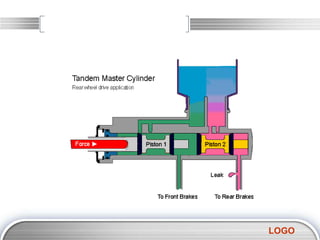
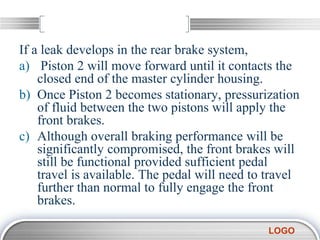
If a leak develops in the rear brake system,
a) Piston 2 will move forward until it contacts the
closed end of the master cylinder housing.
b) Once Piston 2 becomes stationary, pressurization
of fluid between the two pistons will apply the
front brakes.
c) Although overall braking performance will be
significantly compromised, the front brakes will
still be functional provided sufficient pedal
travel is available. The pedal will need to travel
further than normal to fully engage the front
brakes.
LOGO
b) WHEEL
CYLINDER
A wheel cylinder is a component in a drum
brake system. It is located in each wheel and is
usually at the top, above the shoes.
Its responsibility is to exert force onto the
shoes so they can contact the drum and stop
the vehicle with friction.
LOGO
•The wheel cylinder consists of a cylinder that has two
pistons, one on each side.
•Each piston has a rubber seal and a shaft that connects the
piston with a brake shoe.
• When brake pressure is applied, the pistons are forced out
pushing the shoes into contact with the drum
LOGO
c) BRAKE SHOES
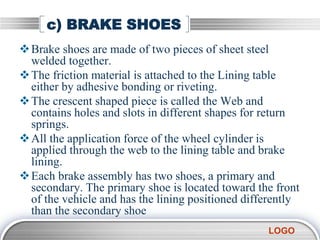
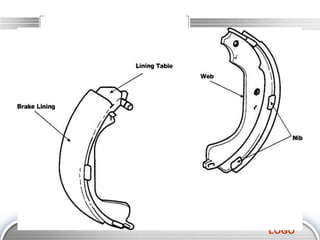
Brake shoes are made of two pieces of sheet steel
welded together.
The friction material is attached to the Lining table
either by adhesive bonding or riveting.
The crescent shaped piece is called the Web and
contains holes and slots in different shapes for return
springs.
All the application force of the wheel cylinder is
applied through the web to the lining table and brake
lining.
Each brake assembly has two shoes, a primary and
secondary. The primary shoe is located toward the front
of the vehicle and has the lining positioned differently
than the secondary shoe
LOGO
LOGO
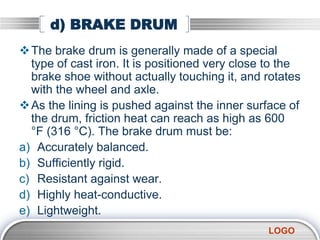
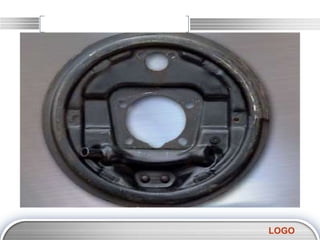
d) BRAKE DRUM
The brake drum is generally made of a special
type of cast iron. It is positioned very close to the
brake shoe without actually touching it, and rotates
with the wheel and axle.
As the lining is pushed against the inner surface of
the drum, friction heat can reach as high as 600
°F (316 °C). The brake drum must be:
a) Accurately balanced.
b) Sufficiently rigid.
c) Resistant against wear.
d) Highly heat-conductive.
e) Lightweight.
LOGO
LOGO
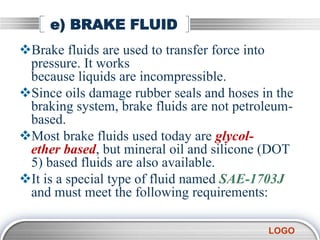
e) BRAKE FLUID
Brake fluids are used to transfer force into
pressure. It works
because liquids are incompressible.
Since oils damage rubber seals and hoses in the
braking system, brake fluids are not petroleum-
based.
Most brake fluids used today are glycol-
ether based, but mineral oil and silicone (DOT
5) based fluids are also available.
It is a special type of fluid named SAE-1703J
and must meet the following requirements:
LOGO
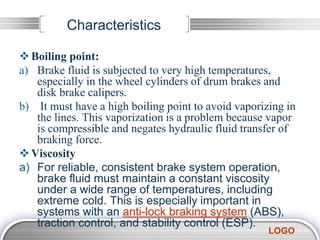
Characteristics
Boiling point:
a) Brake fluid is subjected to very high temperatures,
especially in the wheel cylinders of drum brakes and
disk brake calipers.
b) It must have a high boiling point to avoid vaporizing in
the lines. This vaporization is a problem because vapor
is compressible and negates hydraulic fluid transfer of
braking force.
Viscosity
a) For reliable, consistent brake system operation,
brake fluid must maintain a constant viscosity
under a wide range of temperatures, including
extreme cold. This is especially important in
systems with an anti-lock braking system (ABS),
traction control, and stability control (ESP).
LOGO
Corrosion
a) Brakes fluids must not corrode the metals used
inside components such as calipers, master
cylinders, etc.
Compressibility
a) Brake fluids must maintain a low level of
compressibility that remains low, even with varying
temperatures.
LOGO
f) BRAKE LINES
AND HOSES
The connections between the master cylinder
and wheel cylinders are made of copper
coated ,tin plated, annealed, steel tubings and
flexible hoses.
A flexible hose is made up of alternate layers
of rubber and fabric sheets wound over each
other. these are used to connect the steering
front wheels.
LOGO
OPERATION OF A
HYDRAULIC
BRAKE SYSTEM
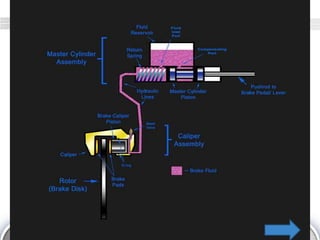
a) as the brake pedal is pressed,
i. a pushrod exerts force on the piston(s) in the
master cylinder causing fluid from the brake fluid
reservoir to flow into a pressure chamber which
results in an increase in the pressure
ii. This forces fluid through the hydraulic lines
toward calipers where it acts upon one or two
caliper pistons
iii. The brake caliper piston(s) then apply force to
the brake pads. This causes them to be pushed
against the spinning rotor, and the friction
between the pads and the rotor causes a
braking torque to be generated, slowing the
vehicle.
LOGO
LOGO
ADVANTAGES AND
DISADVANTAGES OF
HYDRAULIC BRAKES
Advantages
a) Equal braking action on all wheels.
b) Increased braking force.
c) Simple in construction.
d) Low wear rate of brake linings.
e) Flexibility of brake linings.
f) Increased mechanical advantage.
LOGO
Disadvantages
a) Whole braking system fails due to
leakage of fluid from brake linings.
b) Presence of air inside the tubings ruins
the whole system.
LOGO
QUESTIONS
LOGO
THANK YOU

Hydraulic Braking System

  • 1.
  • 2.
    LOGO AIM TO ACQUAINT THECLASS WITH THE CONSTRUTION AND WORKING OF A HYDRAULIC BRAKE SYSTEM.
  • 3.
    LOGO CONTENTS INTRODUCTION CLASSIFICATION PRINCIPLE CONSTRUCTION a) MASTER CYLINDER.. b)WHEEL CYLINDER. c) BRAKE SHOES. d) BRAKE DRUM. e) BRAKE FLUID. f) BRAKE LINES AND HOSES.  SYSTEM OPERATION  ADV AND DISADV OF HYD BRAKES
  • 4.
    LOGO INTRODUCTION HYDRAULIC BRAKES: The hydraulicbrake is an arrangement of braking mechanism which uses brake fluid, to transfer pressure from the controlling unit, which is usually near the operator of the vehicle, to the actual brake mechanism, which is usually at or near the wheel of the vehicle. HISTORY: In 1918 Malcolm Lockheed developed a hydraulic brake system.
  • 5.
    LOGO CLASSIFICATION OF BRAKES On the Basis of Method of Actuation (a) Foot brake (also called service brake) operated by foot pedal. (b) Hand brake – it is also called parking brake operated by hand.  On the Basis of Mode of Operation (a) Mechanical brakes (b) Hydraulic brakes (c) Air brakes (d) Vacuum brakes (e) Electric brakes.  On the Basis of Action on Front or Rear Wheels (a) Front-wheel brakes (b) Rear-wheel brakes.  On the Basis of Method of Application of Braking Contact (a) Internally – expanding brakes (b) Externally – contracting brakes.
  • 6.
    LOGO PRINCIPLES OF HYDRAULIC BRAKING Hydraulic brakeswork on the principle of Pascal’s law which states that “pressure at a point in a fluid is equal in all directions in space”. According to this law when pressure is applied on a fluid it travels equally in all directions so that uniform braking action is applied on all four wheels.
  • 7.
  • 8.
    LOGO CONTD.. Brake pedal orlever A pushrod A master cylinder assembly containing a piston assembly Reinforced hydraulic lines Brake calliper assembly usually consisting of one or two hollow aluminium or chrome-plated steel pistons (called calliper pistons), a set of thermally conductive brake pads and a rotor (also called a brake disc) or drum attached to an axle. The system is usually filled with a glycol- ether based brake fluid
  • 9.
    LOGO a) MASTER CYLINDER  Themaster cylinder is the heart of the brake's hydraulic system.  It converts the force exerted on the brake pedal into hydraulic pressure to apply the brakes.  Depressing the brake pedal moves a push rod in the master cylinder. Mounted on the push rod are a pair of pistons (primary and secondary) in tandem (one after the other) that exert force against the fluid in the master cylinder bore.  The pressure created displaces fluid through the various brake circuits and lines to each of the wheels and applies the brakes.  Since brake fluid is incompressible it acts like a liquid linkage between the master cylinder's pistons and the calipers and wheel cylinders.
  • 10.
  • 11.
  • 12.
    LOGO if a leakdevelops in the front brake system: a) Piston 1 will move forward until it contacts Piston 2. Force from the brake pedal will be transmitted mechanically through Piston 1 to Piston 2. b) Although overall braking performance will be severely compromised, the rear brakes will still be functional provided sufficient pedal travel is available. c) The pedal will need to travel further than normal to fully engage the rear brakes. Also, it should be appreciated that trying to stop quickly with just the rear brakes is very tricky because the rear tires will easily reach the point of lock-up
  • 13.
  • 14.
    LOGO If a leakdevelops in the rear brake system, a) Piston 2 will move forward until it contacts the closed end of the master cylinder housing. b) Once Piston 2 becomes stationary, pressurization of fluid between the two pistons will apply the front brakes. c) Although overall braking performance will be significantly compromised, the front brakes will still be functional provided sufficient pedal travel is available. The pedal will need to travel further than normal to fully engage the front brakes.
  • 15.
    LOGO b) WHEEL CYLINDER A wheelcylinder is a component in a drum brake system. It is located in each wheel and is usually at the top, above the shoes. Its responsibility is to exert force onto the shoes so they can contact the drum and stop the vehicle with friction.
  • 16.
    LOGO •The wheel cylinderconsists of a cylinder that has two pistons, one on each side. •Each piston has a rubber seal and a shaft that connects the piston with a brake shoe. • When brake pressure is applied, the pistons are forced out pushing the shoes into contact with the drum
  • 17.
    LOGO c) BRAKE SHOES Brakeshoes are made of two pieces of sheet steel welded together. The friction material is attached to the Lining table either by adhesive bonding or riveting. The crescent shaped piece is called the Web and contains holes and slots in different shapes for return springs. All the application force of the wheel cylinder is applied through the web to the lining table and brake lining. Each brake assembly has two shoes, a primary and secondary. The primary shoe is located toward the front of the vehicle and has the lining positioned differently than the secondary shoe
  • 18.
  • 19.
    LOGO d) BRAKE DRUM Thebrake drum is generally made of a special type of cast iron. It is positioned very close to the brake shoe without actually touching it, and rotates with the wheel and axle. As the lining is pushed against the inner surface of the drum, friction heat can reach as high as 600 °F (316 °C). The brake drum must be: a) Accurately balanced. b) Sufficiently rigid. c) Resistant against wear. d) Highly heat-conductive. e) Lightweight.
  • 20.
  • 21.
    LOGO e) BRAKE FLUID Brakefluids are used to transfer force into pressure. It works because liquids are incompressible. Since oils damage rubber seals and hoses in the braking system, brake fluids are not petroleum- based. Most brake fluids used today are glycol- ether based, but mineral oil and silicone (DOT 5) based fluids are also available. It is a special type of fluid named SAE-1703J and must meet the following requirements:
  • 22.
    LOGO Characteristics Boiling point: a) Brakefluid is subjected to very high temperatures, especially in the wheel cylinders of drum brakes and disk brake calipers. b) It must have a high boiling point to avoid vaporizing in the lines. This vaporization is a problem because vapor is compressible and negates hydraulic fluid transfer of braking force. Viscosity a) For reliable, consistent brake system operation, brake fluid must maintain a constant viscosity under a wide range of temperatures, including extreme cold. This is especially important in systems with an anti-lock braking system (ABS), traction control, and stability control (ESP).
  • 23.
    LOGO Corrosion a) Brakes fluidsmust not corrode the metals used inside components such as calipers, master cylinders, etc. Compressibility a) Brake fluids must maintain a low level of compressibility that remains low, even with varying temperatures.
  • 24.
    LOGO f) BRAKE LINES ANDHOSES The connections between the master cylinder and wheel cylinders are made of copper coated ,tin plated, annealed, steel tubings and flexible hoses. A flexible hose is made up of alternate layers of rubber and fabric sheets wound over each other. these are used to connect the steering front wheels.
  • 25.
    LOGO OPERATION OF A HYDRAULIC BRAKESYSTEM a) as the brake pedal is pressed, i. a pushrod exerts force on the piston(s) in the master cylinder causing fluid from the brake fluid reservoir to flow into a pressure chamber which results in an increase in the pressure ii. This forces fluid through the hydraulic lines toward calipers where it acts upon one or two caliper pistons iii. The brake caliper piston(s) then apply force to the brake pads. This causes them to be pushed against the spinning rotor, and the friction between the pads and the rotor causes a braking torque to be generated, slowing the vehicle.
  • 26.
  • 27.
    LOGO ADVANTAGES AND DISADVANTAGES OF HYDRAULICBRAKES Advantages a) Equal braking action on all wheels. b) Increased braking force. c) Simple in construction. d) Low wear rate of brake linings. e) Flexibility of brake linings. f) Increased mechanical advantage.
  • 28.
    LOGO Disadvantages a) Whole brakingsystem fails due to leakage of fluid from brake linings. b) Presence of air inside the tubings ruins the whole system.
  • 29.
  • 30.