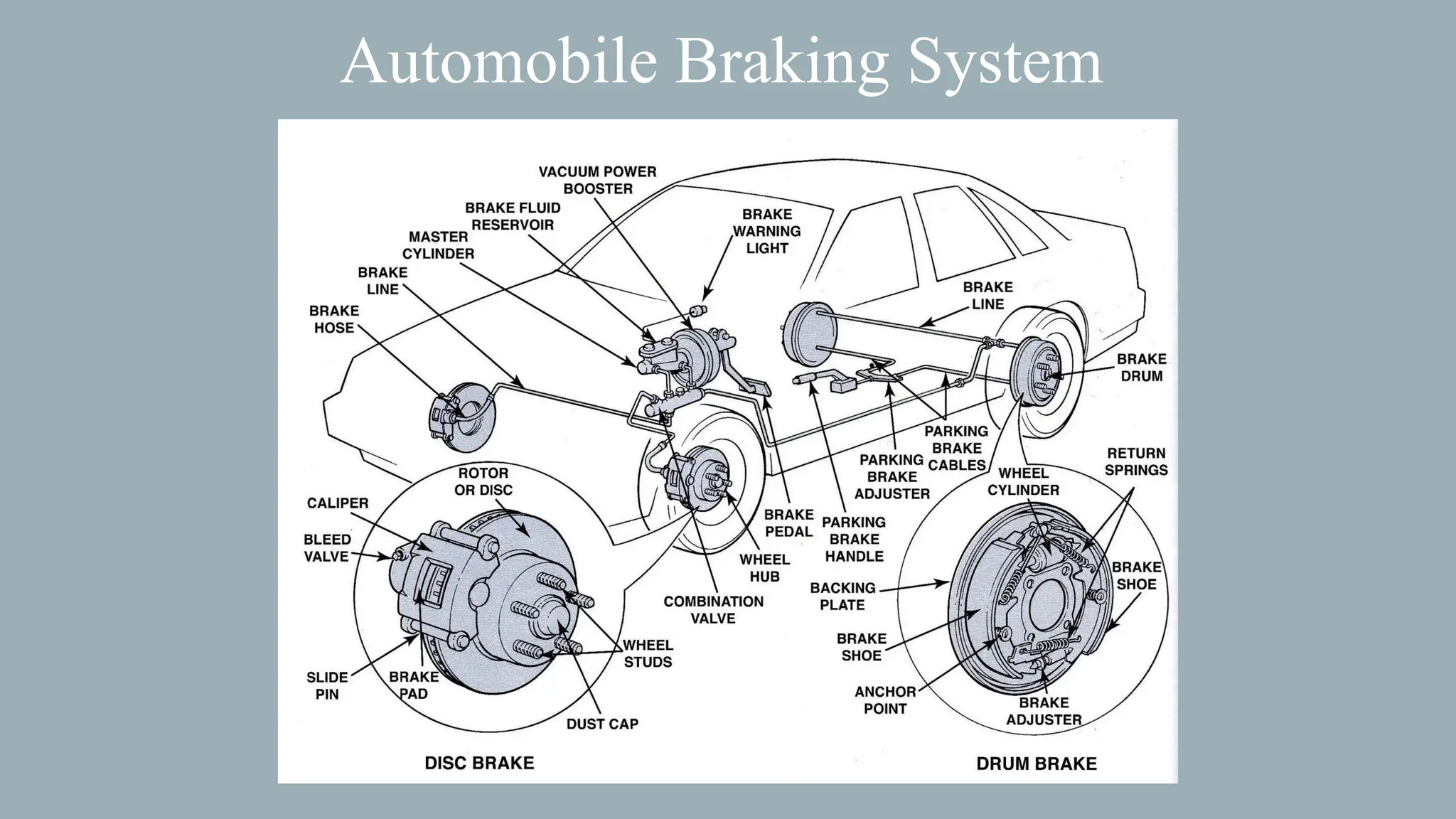
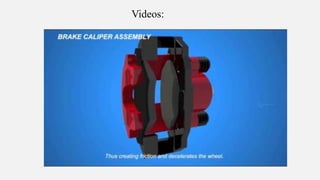
Brakes have thefollowing functions:
It is used to stop the vehicle.
It is used to control the speed where and when required.
It is used to control the vehicle while descending along the
slope.
To park the vehicle and held it in stationary position without
the presence of Driver.
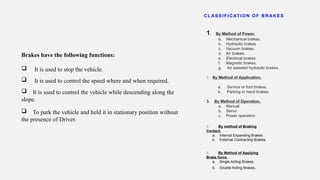
CL AS S I F I CAT I ON OF BRAKE S
1. By Method of Power.
a. Mechanical brakes.
b. Hydraulic brakes
c. Vacuum brakes.
d. Air brakes.
e. Electrical brakes.
f. Magnetic brakes.
g. Air assisted hydraulic brakes.
2. By Method of Application.
a. Service or foot brakes.
b. Parking or hand brakes.
3. By Method of Operation.
a. Manual
b. Servo
c. Power operation
4. By method of Braking
Contact.
a. Internal Expanding Brakes
b. External Contracting Brakes.
5. By Method of Applying
Brake force.
a. Single Acting Brakes.
b. Double Acting Brakes.
3.
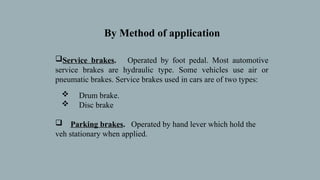
Service brakes. Operatedby foot pedal. Most automotive
service brakes are hydraulic type. Some vehicles use air or
pneumatic brakes. Service brakes used in cars are of two types:
Drum brake.
Disc brake
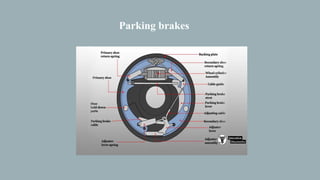
Parking brakes. Operated by hand lever which hold the
veh stationary when applied.
By Method of application
4.
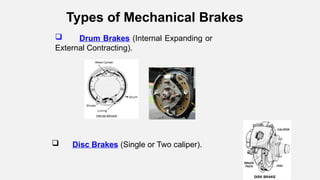
Drum Brakes(Internal Expanding or
External Contracting).
Types of Mechanical Brakes
Disc Brakes (Single or Two caliper).
5.
Drum Brakes
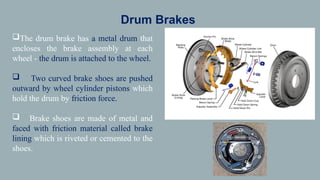
The drumbrake has a metal drum that
encloses the brake assembly at each
wheel - the drum is attached to the wheel.
Two curved brake shoes are pushed
outward by wheel cylinder pistons which
hold the drum by friction force.
Brake shoes are made of metal and
faced with friction material called brake
lining which is riveted or cemented to the
shoes.
6.
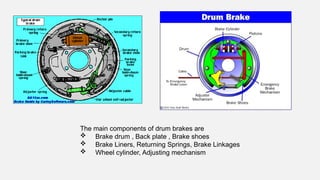
The main componentsof drum brakes are
Brake drum , Back plate , Brake shoes
Brake Liners, Returning Springs, Brake Linkages
Wheel cylinder, Adjusting mechanism
7.
ELECTRIC BRAKE
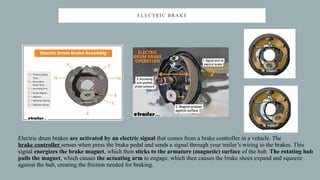
Electric drumbrakes are activated by an electric signal that comes from a brake controller in a vehicle. The
brake controller senses when press the brake pedal and sends a signal through your trailer’s wiring to the brakes. This
signal energizes the brake magnet, which then sticks to the armature (magnetic) surface of the hub. The rotating hub
pulls the magnet, which causes the actuating arm to engage, which then causes the brake shoes expand and squeeze
against the hub, creating the friction needed for braking.
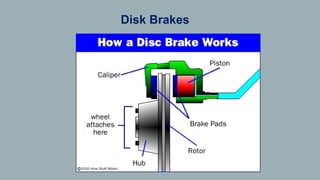
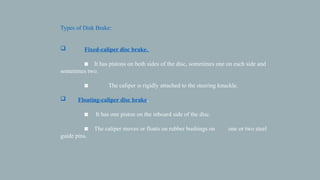
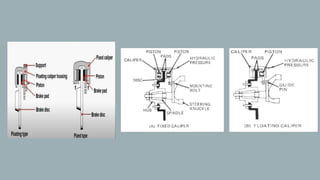
Types of DiskBrake:
Fixed-caliper disc brake.
◙ It has pistons on both sides of the disc, sometimes one on each side and
sometimes two.
◙ The caliper is rigidly attached to the steering knuckle.
Floating-caliper disc brake.
◙ It has one piston on the inboard side of the disc.
◙ The caliper moves or floats on rubber bushings on one or two steel
guide pins.
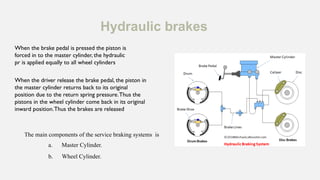
Hydraulic brakes
The maincomponents of the service braking systems is
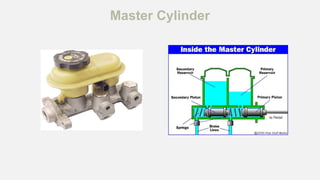
a. Master Cylinder.
b. Wheel Cylinder.
When the brake pedal is pressed the piston is
forced in to the master cylinder, the hydraulic
pr is applied equally to all wheel cylinders
When the driver release the brake pedal, the piston in
the master cylinder returns back to its original
position due to the return spring pressure.Thus the
pistons in the wheel cylinder come back in its original
inward position.Thus the brakes are released
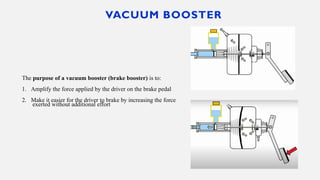
VACUUM BOOSTER
The purposeof a vacuum booster (brake booster) is to:
1. Amplify the force applied by the driver on the brake pedal
2. Make it easier for the driver to brake by increasing the force
exerted without additional effort
16.
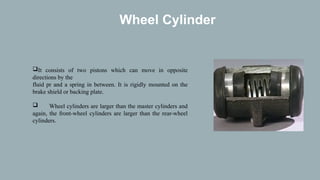
Wheel Cylinder
It consistsof two pistons which can move in opposite
directions by the
fluid pr and a spring in between. It is rigidly mounted on the
brake shield or backing plate.
Wheel cylinders are larger than the master cylinders and
again, the front-wheel cylinders are larger than the rear-wheel
cylinders.
17.
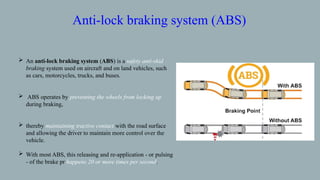
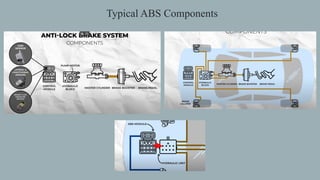
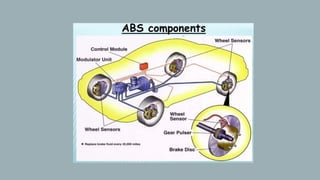
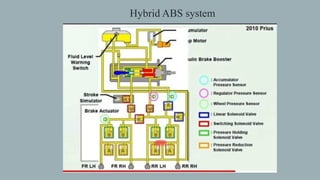
An anti-lockbraking system (ABS) is a safety anti-skid
braking system used on aircraft and on land vehicles, such
as cars, motorcycles, trucks, and buses.
ABS operates by preventing the wheels from locking up
during braking,
thereby maintaining tractive contact with the road surface
and allowing the driver to maintain more control over the
vehicle.
With most ABS, this releasing and re-application - or pulsing
- of the brake pr happens 20 or more times per second.
Anti-lock braking system (ABS)
18.
WORKING OF ANTI-LOCKBRAKING SYSTEM (ABS)
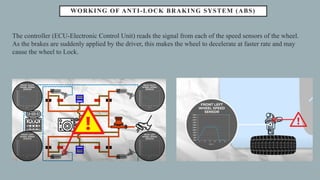
The controller (ECU-Electronic Control Unit) reads the signal from each of the speed sensors of the wheel.
As the brakes are suddenly applied by the driver, this makes the wheel to decelerate at faster rate and may
cause the wheel to Lock.
19.
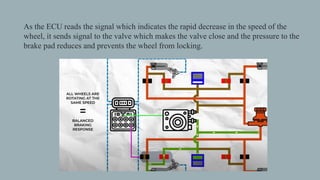
As the ECUreads the signal which indicates the rapid decrease in the speed of the
wheel, it sends signal to the valve which makes the valve close and the pressure to the
brake pad reduces and prevents the wheel from locking.
20.
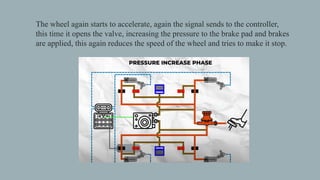
The wheel againstarts to accelerate, again the signal sends to the controller,
this time it opens the valve, increasing the pressure to the brake pad and brakes
are applied, this again reduces the speed of the wheel and tries to make it stop.