South Thames Regional Donor Transplant Coordinators
Brain stem testing
Shibu Chacko
Specialist Nurse Organ Donation
South Thames Regional Donor Transplant Coordinators
Objective of BSD Testing
• To diagnose and confirm the death of a
mechanically ventilated, severely brain
injured patient in coma, using neurological
criteria.
South Thames Regional Donor Transplant Coordinators
Definition of Death
• The definition of death should be regarded
as the irreversible loss of the capacity for
consciousness, combined with irreversible
loss of the capacity to breathe (Academy of
the Medical Royal Colleges Definition of Human Death
(2008).
South Thames Regional Donor Transplant Coordinators
BSD: Is this death?
• Death is a process not an event
• Usual course: stopping of heart and
breathing followed by stopping of brain
• Cardiac and respiratory arrest potentially
reversible
• Death declared when the process is
irreversible - when the brain function
ceases
South Thames Regional Donor Transplant Coordinators
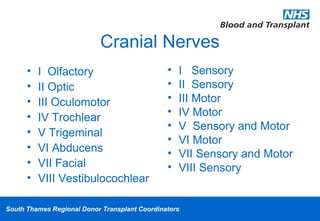
Cranial Nerves
• I Olfactory
• II Optic
• III Oculomotor
• IV Trochlear
• V Trigeminal
• VI Abducens
• VII Facial
• VIII Vestibulocochlear
• I Sensory
• II Sensory
• III Motor
• IV Motor
• V Sensory and Motor
• VI Motor
• VII Sensory and Motor
• VIII Sensory
South Thames Regional Donor Transplant Coordinators
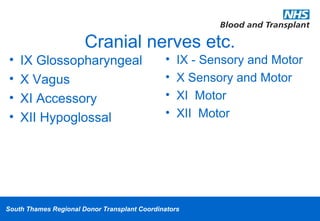
Cranial nerves etc.
• IX Glossopharyngeal
• X Vagus
• XI Accessory
• XII Hypoglossal
• IX - Sensory and Motor
• X Sensory and Motor
• XI Motor
• XII Motor
South Thames Regional Donor Transplant Coordinators
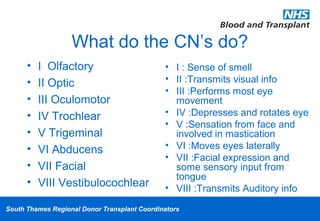
What do the CN’s do?
• I Olfactory
• II Optic
• III Oculomotor
• IV Trochlear
• V Trigeminal
• VI Abducens
• VII Facial
• VIII Vestibulocochlear
• I : Sense of smell
• II :Transmits visual info
• III :Performs most eye
movement
• IV :Depresses and rotates eye
• V :Sensation from face and
involved in mastication
• VI :Moves eyes laterally
• VII :Facial expression and
some sensory input from
tongue
• VIII :Transmits Auditory info
South Thames Regional Donor Transplant Coordinators
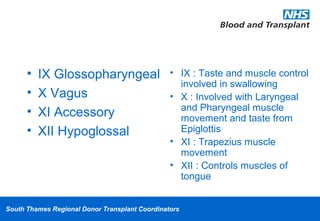
• IX Glossopharyngeal
• X Vagus
• XI Accessory
• XII Hypoglossal
• IX : Taste and muscle control
involved in swallowing
• X : Involved with Laryngeal
and Pharyngeal muscle
movement and taste from
Epiglottis
• XI : Trapezius muscle
movement
• XII : Controls muscles of
tongue
South Thames Regional Donor Transplant Coordinators
Functions of the Brain Stem
• All motor output from the brain
• Almost all sensory input to the brain (not
cranial nerves I and II)
• Total control of breathing
• Control of Heart Rate and BP
• Control of cerebro-vascular system
• Reticular Activating System - arousal
South Thames Regional Donor Transplant Coordinators
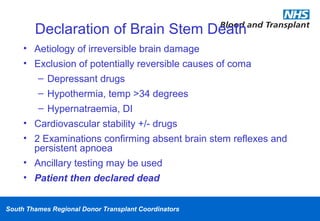
Tumour
Trauma
Intra-cerebral
Hemorrhage
Ischemia
Brain Stem
How does brain stem death occur?
• Not enough blood & oxygen reaching
the brain
• Most common causes → Raised ICP
• Absence of cranial nerve function, gag,
cough, response to painful stimuli,
pupils fixed/ dilated, breathing,
– May see spinal reflexes
• 2 x tests Brain stem death
• when clinically stable in ICU/ patient
on ventilator/ circulation
• Legal time of death - 1st
set of tests
according to UK law,
• (A Code for the Diagnosis and
Confirmation of Death ’08)
• Permanent & irreversible damagePermanent & irreversible damage
occursoccurs
South Thames Regional Donor Transplant Coordinators
Declaration of Brain Stem Death
• Aetiology of irreversible brain damage
• Exclusion of potentially reversible causes of coma
– Depressant drugs
– Hypothermia, temp >34 degrees
– Hypernatraemia, DI
• Cardiovascular stability +/- drugs
• 2 Examinations confirming absent brain stem reflexes and
persistent apnoea
• Ancillary testing may be used
• Patient then declared dead
South Thames Regional Donor Transplant Coordinators
Brain Steam Death
• No respiratory function
• No cerebral circulation - death of any
remaining brain tissue
• No possibility of consciousness
• If ventilated, heart may go on beating for a
limited time
• Inevitable asystole within minutes to days
South Thames Regional Donor Transplant Coordinators
Signs of coning
• GCS 3
• Fixed dilated pupils
• Cheyne-Stokes breathing (if not ventilated)
• Cushing’s triad -
– High Systolic BP (up to 300 or more)
– Widening Pulse Pressure
– Bradycardia
South Thames Regional Donor Transplant Coordinators
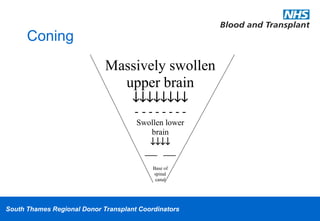
Coning
Massively swollen
upper brain
↓↓↓↓↓↓↓↓
- - - - - - - -
Swollen lower
brain
↓↓↓↓
___ ___
Base of
spinal
canal
South Thames Regional Donor Transplant Coordinators
Cushing’s Response
• Brain death is usually preceded by a variable
period of increasing intracranial pressure.
Classic-associated physiological responses
to this pressure increase were described by
Cushing.
• Main indicators: Increased BP, irregular
breathing and bradycardia – indicated
imminent brain herniation
South Thames Regional Donor Transplant Coordinators
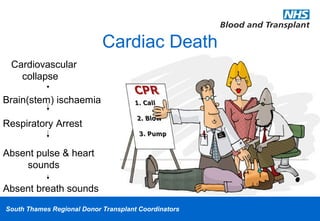
Cardiac Death
Cardiovascular
collapse
Brain(stem) ischaemia
Respiratory Arrest
Absent pulse & heart
sounds
Absent breath sounds
South Thames Regional Donor Transplant Coordinators
• If the patient is not ventilated, brain stem death is
followed promptly by cardiac arrest
• If the patient is ventilated, the heart may go on
beating for a limited time
• Death has reversed its usual order but the
irreversible point has been reached - the death of
the brain.
• Continued heart beat is an accident of technology
• If you cut off a man’s head, the heart will beat for
several minutes. Is this person alive?
South Thames Regional Donor Transplant Coordinators
Pre-conditions for testing
• Known diagnosis of irremediable structural
brain damage
• No possibility of sedation or paralysis
influencing results
• No pre-existing metabolic abnormalities
that may influence result - hypernatraemia,
acidosis, blood sugar, hypothermia
South Thames Regional Donor Transplant Coordinators
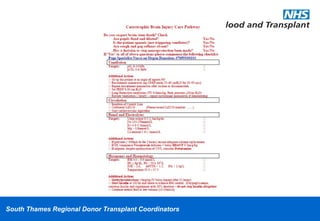
Tests
• 2 doctors - Consultant or senior SPR
• Must conduct the tests together
• Tests repeated (2 full sets of tests,
including apnoea test)
• Tests examine brain stem function by
testing cranial nerve reflexes and
respiratory drive
South Thames Regional Donor Transplant Coordinators
PUPILS FIXED AND DILATED, NOTPUPILS FIXED AND DILATED, NOT
RESPONDING TO LIGHTRESPONDING TO LIGHT
PUPILS FIXED AND DILATED, NOTPUPILS FIXED AND DILATED, NOT
RESPONDING TO LIGHTRESPONDING TO LIGHT
Cranial nerves 2,3 (Midbrain)Cranial nerves 2,3 (Midbrain)
South Thames Regional Donor Transplant Coordinators
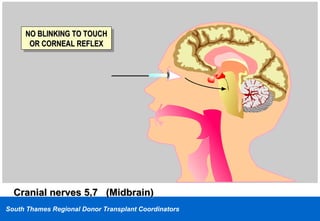
NO BLINKING TO TOUCHNO BLINKING TO TOUCH
OR CORNEAL REFLEXOR CORNEAL REFLEX
NO BLINKING TO TOUCHNO BLINKING TO TOUCH
OR CORNEAL REFLEXOR CORNEAL REFLEX
Cranial nerves 5,7 (Midbrain)Cranial nerves 5,7 (Midbrain)
South Thames Regional Donor Transplant Coordinators
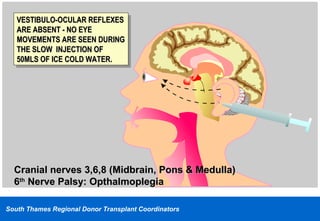
VESTIBULO-OCULAR REFLEXESVESTIBULO-OCULAR REFLEXES
ARE ABSENT - NO EYEARE ABSENT - NO EYE
MOVEMENTS ARE SEEN DURINGMOVEMENTS ARE SEEN DURING
THE SLOW INJECTION OFTHE SLOW INJECTION OF
50MLS OF ICE COLD WATER.50MLS OF ICE COLD WATER.
VESTIBULO-OCULAR REFLEXESVESTIBULO-OCULAR REFLEXES
ARE ABSENT - NO EYEARE ABSENT - NO EYE
MOVEMENTS ARE SEEN DURINGMOVEMENTS ARE SEEN DURING
THE SLOW INJECTION OFTHE SLOW INJECTION OF
50MLS OF ICE COLD WATER.50MLS OF ICE COLD WATER.
Cranial nerves 3,6,8 (Midbrain, Pons & Medulla)Cranial nerves 3,6,8 (Midbrain, Pons & Medulla)
66thth
Nerve Palsy: OpthalmoplegiaNerve Palsy: Opthalmoplegia
South Thames Regional Donor Transplant Coordinators
NO MOTOR RESPONSES TONO MOTOR RESPONSES TO
SUPRAORBITALSUPRAORBITAL PRESSUREPRESSURE
NO MOTOR RESPONSES TONO MOTOR RESPONSES TO
SUPRAORBITALSUPRAORBITAL PRESSUREPRESSURE
Cranial nerves 5,7 (Pons)Cranial nerves 5,7 (Pons)
South Thames Regional Donor Transplant Coordinators
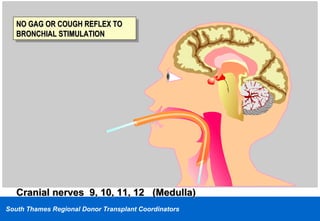
NO GAG OR COUGH REFLEX TONO GAG OR COUGH REFLEX TO
BRONCHIAL STIMULATIONBRONCHIAL STIMULATION
NO GAG OR COUGH REFLEX TONO GAG OR COUGH REFLEX TO
BRONCHIAL STIMULATIONBRONCHIAL STIMULATION
Cranial nerves 9, 10, 11, 12 (Medulla)Cranial nerves 9, 10, 11, 12 (Medulla)
South Thames Regional Donor Transplant Coordinators
APNOEA TEST -APNOEA TEST -
NO RESPIRATORYNO RESPIRATORY
MOVEMENT WHENMOVEMENT WHEN
THE PATIENT ISTHE PATIENT IS
DISCONNECTEDDISCONNECTED
FROM MECHANICALFROM MECHANICAL
VENTILATIONVENTILATION
(Medulla)(Medulla)
APNOEA TEST -APNOEA TEST -
NO RESPIRATORYNO RESPIRATORY
MOVEMENT WHENMOVEMENT WHEN
THE PATIENT ISTHE PATIENT IS
DISCONNECTEDDISCONNECTED
FROM MECHANICALFROM MECHANICAL
VENTILATIONVENTILATION
(Medulla)(Medulla)
South Thames Regional Donor Transplant Coordinators
Apnoea testing
• Preoxygenate 100%
• Increase EtCo2 to 6.0kPa or just above
• Disconnect from ventilator
• Maintain oxygenation by 6 l/min via
tracheal catheter or water circuit.
• ABGs must demonstrate rise in PaCO2 of
at least 0.5 kPa
• No respiratory movements ~ 5 mins
South Thames Regional Donor Transplant Coordinators
Incidence of common physiological derangements in brain-
dead donors
Derangement Cause Approx incidence
Hypothermia Hypothalamic damage, reduced metabolic
rate, vasodilation and heat loss.
Invariable if not
prevented
Hypotension Vasoplegia, hypovolaemia, reduced
coronary blood flow, myocardial dysfunction.
81-97%
DI Posterior pituitary damage 46-78%
DIC Tissue factor release, coagulopathy 29-55%
Arrhythmias Catecholamine storm, myocardial damage,
reduced coronary blood flow
25-32%
Pulmonary
Oedema
Acute blood flow diversion, capillary
damage
13-18%
McKeown, Bonser & Kellum 2012
South Thames Regional Donor Transplant Coordinators
Continuation of CBI following BSD
 Brain Stem Death is associated with marked
physiological instability
 The main factor limiting organ donation is the
availability of suitable organs and donors.
 If instability is not managed can lead to
deterioration in organ function before retrieval.
 In some cases the instability prevents organ
donation occurring (approx 10-20%)
South Thames Regional Donor Transplant Coordinators
CBI pathway objective
• To provide a structured
pathway for patient
optimisation following
confirmation of brain-stem
death (death confirmed by
neurological criteria).
Patient optimisation builds
on the stabilisation of the
patient prior to brain-stem
death testing.
Aim:
To undertake BDST
To eliminate all possible
doubt regarding
survivability
To confirm diagnosis for
families
In cases subject to
medico-legal scrutiny
To provide choice
regarding organ
donation
South Thames Regional Donor Transplant Coordinators
Key Points
• Catastrophic Brain Injury Pathway or CBI
• DBD donation
BSD is followed by a predictable pattern of
complex MOF
Support before and after brain death can improve
the number and quality of organs
Increasing numbers of marginal donors are being
accepted
• NICE guidelines and implications
South Thames Regional Donor Transplant Coordinators
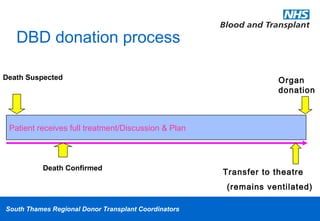
DBD donation process
Patient receives full treatment/Discussion & Plan
Death Confirmed
Organ
donation
Transfer to theatre
(remains ventilated)
Death Suspected
South Thames Regional Donor Transplant Coordinators
Time of Death
• Once tests are completed, patient is
declared dead
• Time of death is time first set of tests
completed
• Ventilation is continued until organ
donation ruled out
• If the patient is going to be a donor, all
care continues
South Thames Regional Donor Transplant Coordinators
Pitfalls to BSDT
• Respiratory movements
• Apparent respiratory effort in brainstem dead
patients
• Triggering on highly flow sensitive ventilator
• Drager Evita 2
• Decreased airway pressure with cardiac
contraction.
• If in doubt, change ventilator
• High cervical injury leading to apnoea
South Thames Regional Donor Transplant Coordinators
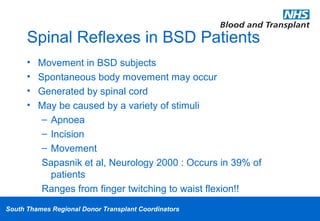
Spinal Reflexes in BSD Patients
• Movement in BSD subjects
• Spontaneous body movement may occur
• Generated by spinal cord
• May be caused by a variety of stimuli
– Apnoea
– Incision
– Movement
Sapasnik et al, Neurology 2000 : Occurs in 39% of
patients
Ranges from finger twitching to waist flexion!!
South Thames Regional Donor Transplant Coordinators
• Questions?

Brain Stem Death Testing

  • 1.
    South Thames RegionalDonor Transplant Coordinators Brain stem testing Shibu Chacko Specialist Nurse Organ Donation
  • 2.
    South Thames RegionalDonor Transplant Coordinators Objective of BSD Testing • To diagnose and confirm the death of a mechanically ventilated, severely brain injured patient in coma, using neurological criteria.
  • 3.
    South Thames RegionalDonor Transplant Coordinators Definition of Death • The definition of death should be regarded as the irreversible loss of the capacity for consciousness, combined with irreversible loss of the capacity to breathe (Academy of the Medical Royal Colleges Definition of Human Death (2008).
  • 4.
    South Thames RegionalDonor Transplant Coordinators BSD: Is this death? • Death is a process not an event • Usual course: stopping of heart and breathing followed by stopping of brain • Cardiac and respiratory arrest potentially reversible • Death declared when the process is irreversible - when the brain function ceases
  • 5.
    South Thames RegionalDonor Transplant Coordinators Cranial Nerves • I Olfactory • II Optic • III Oculomotor • IV Trochlear • V Trigeminal • VI Abducens • VII Facial • VIII Vestibulocochlear • I Sensory • II Sensory • III Motor • IV Motor • V Sensory and Motor • VI Motor • VII Sensory and Motor • VIII Sensory
  • 6.
    South Thames RegionalDonor Transplant Coordinators Cranial nerves etc. • IX Glossopharyngeal • X Vagus • XI Accessory • XII Hypoglossal • IX - Sensory and Motor • X Sensory and Motor • XI Motor • XII Motor
  • 7.
    South Thames RegionalDonor Transplant Coordinators What do the CN’s do? • I Olfactory • II Optic • III Oculomotor • IV Trochlear • V Trigeminal • VI Abducens • VII Facial • VIII Vestibulocochlear • I : Sense of smell • II :Transmits visual info • III :Performs most eye movement • IV :Depresses and rotates eye • V :Sensation from face and involved in mastication • VI :Moves eyes laterally • VII :Facial expression and some sensory input from tongue • VIII :Transmits Auditory info
  • 8.
    South Thames RegionalDonor Transplant Coordinators • IX Glossopharyngeal • X Vagus • XI Accessory • XII Hypoglossal • IX : Taste and muscle control involved in swallowing • X : Involved with Laryngeal and Pharyngeal muscle movement and taste from Epiglottis • XI : Trapezius muscle movement • XII : Controls muscles of tongue
  • 9.
    South Thames RegionalDonor Transplant Coordinators Functions of the Brain Stem • All motor output from the brain • Almost all sensory input to the brain (not cranial nerves I and II) • Total control of breathing • Control of Heart Rate and BP • Control of cerebro-vascular system • Reticular Activating System - arousal
  • 10.
    South Thames RegionalDonor Transplant Coordinators Tumour Trauma Intra-cerebral Hemorrhage Ischemia Brain Stem How does brain stem death occur? • Not enough blood & oxygen reaching the brain • Most common causes → Raised ICP • Absence of cranial nerve function, gag, cough, response to painful stimuli, pupils fixed/ dilated, breathing, – May see spinal reflexes • 2 x tests Brain stem death • when clinically stable in ICU/ patient on ventilator/ circulation • Legal time of death - 1st set of tests according to UK law, • (A Code for the Diagnosis and Confirmation of Death ’08) • Permanent & irreversible damagePermanent & irreversible damage occursoccurs
  • 11.
    South Thames RegionalDonor Transplant Coordinators Declaration of Brain Stem Death • Aetiology of irreversible brain damage • Exclusion of potentially reversible causes of coma – Depressant drugs – Hypothermia, temp >34 degrees – Hypernatraemia, DI • Cardiovascular stability +/- drugs • 2 Examinations confirming absent brain stem reflexes and persistent apnoea • Ancillary testing may be used • Patient then declared dead
  • 12.
    South Thames RegionalDonor Transplant Coordinators Brain Steam Death • No respiratory function • No cerebral circulation - death of any remaining brain tissue • No possibility of consciousness • If ventilated, heart may go on beating for a limited time • Inevitable asystole within minutes to days
  • 13.
    South Thames RegionalDonor Transplant Coordinators Signs of coning • GCS 3 • Fixed dilated pupils • Cheyne-Stokes breathing (if not ventilated) • Cushing’s triad - – High Systolic BP (up to 300 or more) – Widening Pulse Pressure – Bradycardia
  • 14.
    South Thames RegionalDonor Transplant Coordinators Coning Massively swollen upper brain ↓↓↓↓↓↓↓↓ - - - - - - - - Swollen lower brain ↓↓↓↓ ___ ___ Base of spinal canal
  • 15.
    South Thames RegionalDonor Transplant Coordinators Cushing’s Response • Brain death is usually preceded by a variable period of increasing intracranial pressure. Classic-associated physiological responses to this pressure increase were described by Cushing. • Main indicators: Increased BP, irregular breathing and bradycardia – indicated imminent brain herniation
  • 16.
    South Thames RegionalDonor Transplant Coordinators Cardiac Death Cardiovascular collapse Brain(stem) ischaemia Respiratory Arrest Absent pulse & heart sounds Absent breath sounds
  • 17.
    South Thames RegionalDonor Transplant Coordinators • If the patient is not ventilated, brain stem death is followed promptly by cardiac arrest • If the patient is ventilated, the heart may go on beating for a limited time • Death has reversed its usual order but the irreversible point has been reached - the death of the brain. • Continued heart beat is an accident of technology • If you cut off a man’s head, the heart will beat for several minutes. Is this person alive?
  • 18.
    South Thames RegionalDonor Transplant Coordinators Pre-conditions for testing • Known diagnosis of irremediable structural brain damage • No possibility of sedation or paralysis influencing results • No pre-existing metabolic abnormalities that may influence result - hypernatraemia, acidosis, blood sugar, hypothermia
  • 19.
    South Thames RegionalDonor Transplant Coordinators Tests • 2 doctors - Consultant or senior SPR • Must conduct the tests together • Tests repeated (2 full sets of tests, including apnoea test) • Tests examine brain stem function by testing cranial nerve reflexes and respiratory drive
  • 20.
    South Thames RegionalDonor Transplant Coordinators
  • 21.
    South Thames RegionalDonor Transplant Coordinators PUPILS FIXED AND DILATED, NOTPUPILS FIXED AND DILATED, NOT RESPONDING TO LIGHTRESPONDING TO LIGHT PUPILS FIXED AND DILATED, NOTPUPILS FIXED AND DILATED, NOT RESPONDING TO LIGHTRESPONDING TO LIGHT Cranial nerves 2,3 (Midbrain)Cranial nerves 2,3 (Midbrain)
  • 22.
    South Thames RegionalDonor Transplant Coordinators NO BLINKING TO TOUCHNO BLINKING TO TOUCH OR CORNEAL REFLEXOR CORNEAL REFLEX NO BLINKING TO TOUCHNO BLINKING TO TOUCH OR CORNEAL REFLEXOR CORNEAL REFLEX Cranial nerves 5,7 (Midbrain)Cranial nerves 5,7 (Midbrain)
  • 23.
    South Thames RegionalDonor Transplant Coordinators VESTIBULO-OCULAR REFLEXESVESTIBULO-OCULAR REFLEXES ARE ABSENT - NO EYEARE ABSENT - NO EYE MOVEMENTS ARE SEEN DURINGMOVEMENTS ARE SEEN DURING THE SLOW INJECTION OFTHE SLOW INJECTION OF 50MLS OF ICE COLD WATER.50MLS OF ICE COLD WATER. VESTIBULO-OCULAR REFLEXESVESTIBULO-OCULAR REFLEXES ARE ABSENT - NO EYEARE ABSENT - NO EYE MOVEMENTS ARE SEEN DURINGMOVEMENTS ARE SEEN DURING THE SLOW INJECTION OFTHE SLOW INJECTION OF 50MLS OF ICE COLD WATER.50MLS OF ICE COLD WATER. Cranial nerves 3,6,8 (Midbrain, Pons & Medulla)Cranial nerves 3,6,8 (Midbrain, Pons & Medulla) 66thth Nerve Palsy: OpthalmoplegiaNerve Palsy: Opthalmoplegia
  • 24.
    South Thames RegionalDonor Transplant Coordinators NO MOTOR RESPONSES TONO MOTOR RESPONSES TO SUPRAORBITALSUPRAORBITAL PRESSUREPRESSURE NO MOTOR RESPONSES TONO MOTOR RESPONSES TO SUPRAORBITALSUPRAORBITAL PRESSUREPRESSURE Cranial nerves 5,7 (Pons)Cranial nerves 5,7 (Pons)
  • 25.
    South Thames RegionalDonor Transplant Coordinators NO GAG OR COUGH REFLEX TONO GAG OR COUGH REFLEX TO BRONCHIAL STIMULATIONBRONCHIAL STIMULATION NO GAG OR COUGH REFLEX TONO GAG OR COUGH REFLEX TO BRONCHIAL STIMULATIONBRONCHIAL STIMULATION Cranial nerves 9, 10, 11, 12 (Medulla)Cranial nerves 9, 10, 11, 12 (Medulla)
  • 26.
    South Thames RegionalDonor Transplant Coordinators APNOEA TEST -APNOEA TEST - NO RESPIRATORYNO RESPIRATORY MOVEMENT WHENMOVEMENT WHEN THE PATIENT ISTHE PATIENT IS DISCONNECTEDDISCONNECTED FROM MECHANICALFROM MECHANICAL VENTILATIONVENTILATION (Medulla)(Medulla) APNOEA TEST -APNOEA TEST - NO RESPIRATORYNO RESPIRATORY MOVEMENT WHENMOVEMENT WHEN THE PATIENT ISTHE PATIENT IS DISCONNECTEDDISCONNECTED FROM MECHANICALFROM MECHANICAL VENTILATIONVENTILATION (Medulla)(Medulla)
  • 27.
    South Thames RegionalDonor Transplant Coordinators Apnoea testing • Preoxygenate 100% • Increase EtCo2 to 6.0kPa or just above • Disconnect from ventilator • Maintain oxygenation by 6 l/min via tracheal catheter or water circuit. • ABGs must demonstrate rise in PaCO2 of at least 0.5 kPa • No respiratory movements ~ 5 mins
  • 28.
    South Thames RegionalDonor Transplant Coordinators Incidence of common physiological derangements in brain- dead donors Derangement Cause Approx incidence Hypothermia Hypothalamic damage, reduced metabolic rate, vasodilation and heat loss. Invariable if not prevented Hypotension Vasoplegia, hypovolaemia, reduced coronary blood flow, myocardial dysfunction. 81-97% DI Posterior pituitary damage 46-78% DIC Tissue factor release, coagulopathy 29-55% Arrhythmias Catecholamine storm, myocardial damage, reduced coronary blood flow 25-32% Pulmonary Oedema Acute blood flow diversion, capillary damage 13-18% McKeown, Bonser & Kellum 2012
  • 29.
    South Thames RegionalDonor Transplant Coordinators Continuation of CBI following BSD  Brain Stem Death is associated with marked physiological instability  The main factor limiting organ donation is the availability of suitable organs and donors.  If instability is not managed can lead to deterioration in organ function before retrieval.  In some cases the instability prevents organ donation occurring (approx 10-20%)
  • 30.
    South Thames RegionalDonor Transplant Coordinators CBI pathway objective • To provide a structured pathway for patient optimisation following confirmation of brain-stem death (death confirmed by neurological criteria). Patient optimisation builds on the stabilisation of the patient prior to brain-stem death testing. Aim: To undertake BDST To eliminate all possible doubt regarding survivability To confirm diagnosis for families In cases subject to medico-legal scrutiny To provide choice regarding organ donation
  • 31.
    South Thames RegionalDonor Transplant Coordinators Key Points • Catastrophic Brain Injury Pathway or CBI • DBD donation BSD is followed by a predictable pattern of complex MOF Support before and after brain death can improve the number and quality of organs Increasing numbers of marginal donors are being accepted • NICE guidelines and implications
  • 32.
    South Thames RegionalDonor Transplant Coordinators DBD donation process Patient receives full treatment/Discussion & Plan Death Confirmed Organ donation Transfer to theatre (remains ventilated) Death Suspected
  • 33.
    South Thames RegionalDonor Transplant Coordinators Time of Death • Once tests are completed, patient is declared dead • Time of death is time first set of tests completed • Ventilation is continued until organ donation ruled out • If the patient is going to be a donor, all care continues
  • 34.
    South Thames RegionalDonor Transplant Coordinators Pitfalls to BSDT • Respiratory movements • Apparent respiratory effort in brainstem dead patients • Triggering on highly flow sensitive ventilator • Drager Evita 2 • Decreased airway pressure with cardiac contraction. • If in doubt, change ventilator • High cervical injury leading to apnoea
  • 35.
    South Thames RegionalDonor Transplant Coordinators Spinal Reflexes in BSD Patients • Movement in BSD subjects • Spontaneous body movement may occur • Generated by spinal cord • May be caused by a variety of stimuli – Apnoea – Incision – Movement Sapasnik et al, Neurology 2000 : Occurs in 39% of patients Ranges from finger twitching to waist flexion!!
  • 36.
    South Thames RegionalDonor Transplant Coordinators • Questions?

Editor's Notes

  • #22 (Optic & occulomotor) Dilated pupils may even occur in the presence of brain death, because sympathetic cervical pathways to the pupillary dilator muscle may still be intact. The light reflex is absent in brain death.
  • #23 3.5th & 7th cranial nerves (trigeminal, Facial) Care should be taken to avoid any damage to the cornea. Corneal reflexes are tested here by using a cotton swab across the eye Blinking would be absent.
  • #24 3rd, 6th, & 8th cranial nerves (caloric test, no eye movements “dolls eye”) (Occulomotor, abducens and auditory) Usually injected on to the tympanic membrane over 1 minute. No deviation of the eyes occurs Contraindication to testing is impaired integrity of the membrane. Ocular Movements can be tested Oculocephalic (dolls-eyes). No eye movements occur in response to head movements. Contraindication to testing is a suspected fracture or instability of the cervical spine
  • #25 No grimacing to pain from pressure to the supra orbital ridge or tempro- mandibular joint No limb response.
  • #26 4.9th & 10th cranial nerves (Glossopharygeal & vagus) Suction or move the tube back and forth to stimulate a cough or gag response
  • #27 Suction or move the tube back and forth to stimulate a cough or gag response
  • #33 Average 12 hours