Brain death
24 May 2016 brain death
Brain Death
Out line
 What is brain death?
 Causes of Brain Death
 Clinical evaluation of brain death
 Brain Death Diagnosis
24 May 2016 brain death
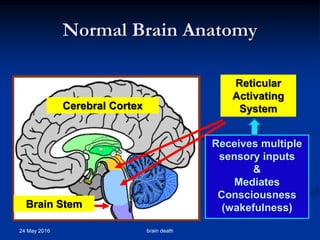
Normal Brain Anatomy
24 May 2016 brain death
Cerebral Cortex
Brain Stem
Reticular
Activating
System
Receives multiple
sensory inputs
&
Mediates
Consciousness
(wakefulness)
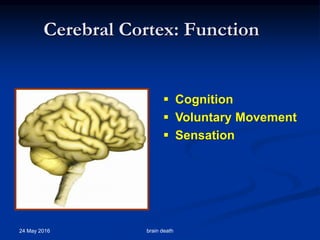
Cerebral Cortex: Function
24 May 2016 brain death
 Cognition
 Voluntary Movement
 Sensation
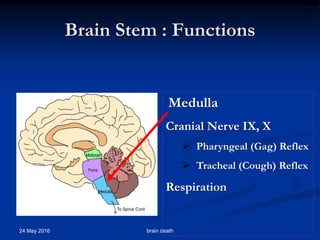
Brain Stem : Functions
24 May 2016 brain death
Medulla
Cranial Nerve IX, X
 Pharyngeal (Gag) Reflex
 Tracheal (Cough) Reflex
Respiration
Death : Definition
 Thanatology
 Branch of science dealing with study of death
 Death is the complete and irreversible stoppage of
 Circulation
 Respiration
 Brain function (Tripod of life)
 As long as oxygenated blood reaches brain stem, Life exists
….
 Mechanical Ventilator use in ICU
 Brought concept of “Brain Death”
24 May 2016 brain death
Brain Death
 Ireversible destruction of the brain,with the
resulting total absence of all cortical and
brainstem functions,although spinal cord
refleves may remain
24 May 2016 brain death
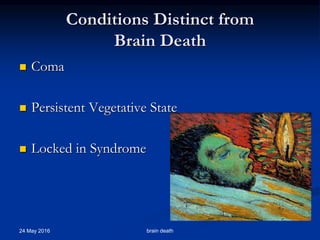
Conditions Distinct from
Brain Death
 Coma
 Persistent Vegetative State
 Locked in Syndrome
24 May 2016 brain death
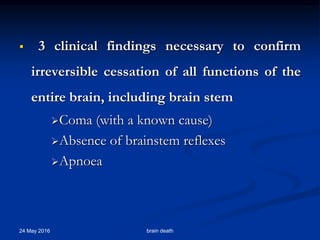
 3 clinical findings necessary to confirm
irreversible cessation of all functions of the
entire brain, including brain stem
Coma (with a known cause)
Absence of brainstem reflexes
Apnoea
24 May 2016 brain death
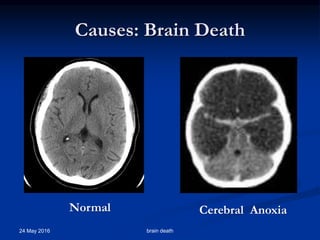
Causes: Brain Death
24 May 2016 brain death
Normal Cerebral Anoxia
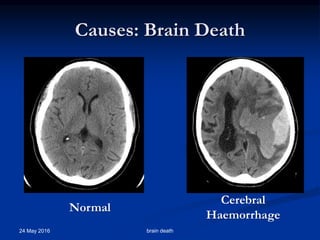
Causes: Brain Death
24 May 2016 brain death
Normal
Cerebral
Haemorrhage
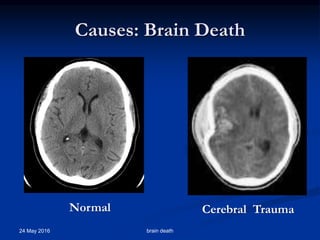
Causes: Brain Death
24 May 2016 brain death
Normal Cerebral Trauma
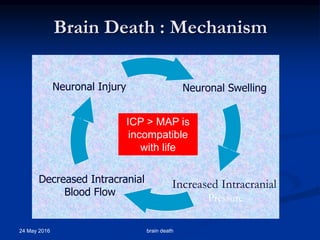
Brain Death : Mechanism
24 May 2016 brain death
Neuronal Injury
Decreased Intracranial
Blood Flow
Neuronal Swelling
Increased Intracranial
Pressure
ICP > MAP is
incompatible
with life
4 Steps in Determining
Brain Death
 The Clinical Evaluation
 The Neurologic Assessment
 Ancillary Test
 Documentation
Clinical evaluation of brain death
Irreversible coma
 Known etiology and or reversible causes ruled out
 Must have an absence of
 Hypothermia (>32.50C)
 Neuromuscular blockade and Shock
 Significant levels of sedatives
 Severe metabolic distrubance and Endocrine abnormalities
 Poisoning
24 May 2016 brain death
Absence of cortical functions
 No spontaneous movement, eye opening, or movement
or response after auditory, verbal, or visual commands
 Cerebral motor response to pain
 Supraorbital ridge, the nail beds, trapezius
 Motor responses may occur spontaneously during
apnea testing (spinal reflexes)
 Spinal arcs are intact!
24 May 2016 brain death
Absence of brain stem
function-1)Pupillary reflex
2)Corneal reflex
3)Gag reflex
4)Cough reflex
5)Oculocephalic reflex (doll’s eye reflex)
6)Oculovestibular reflex (caloric reflex)
7)No integrated motor response to pain
8)Apnea testing
24 May 2016 brain death
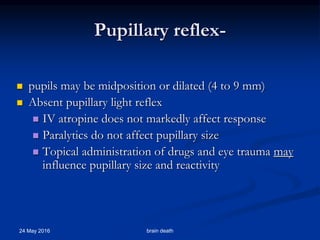
Pupillary reflex-
 pupils may be midposition or dilated (4 to 9 mm)
 Absent pupillary light reflex
 IV atropine does not markedly affect response
 Paralytics do not affect pupillary size
 Topical administration of drugs and eye trauma may
influence pupillary size and reactivity
24 May 2016 brain death
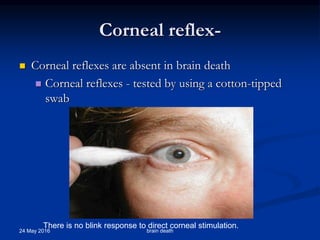
Corneal reflex-
 Corneal reflexes are absent in brain death
 Corneal reflexes - tested by using a cotton-tipped
swab
.
There is no blink response to direct corneal stimulation.
24 May 2016 brain death
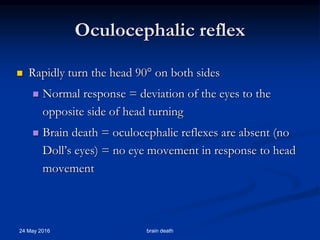
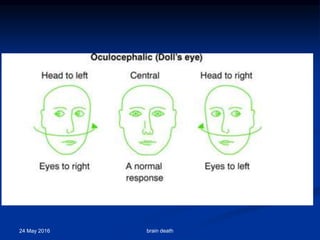
Oculocephalic reflex
 Rapidly turn the head 90° on both sides
 Normal response = deviation of the eyes to the
opposite side of head turning
 Brain death = oculocephalic reflexes are absent (no
Doll’s eyes) = no eye movement in response to head
movement
24 May 2016 brain death
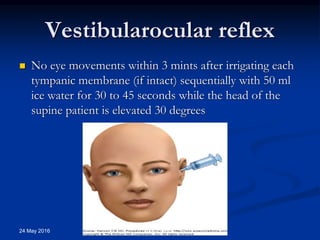
Vestibularocular reflex
 No eye movements within 3 mints after irrigating each
tympanic membrane (if intact) sequentially with 50 ml
ice water for 30 to 45 seconds while the head of the
supine patient is elevated 30 degrees
Retained vestibulocular reflex
24 May 2016 brain death
Cold calorics interpretation
 Not comatose
 Nystagmus; both eyes slow toward cold, fast to midline
 Coma with intact brainstem
 Both eyes tonically deviate away cold water
 No eye movement
 Brainstem injury / death
 Movement only of eye on side of stimulus
 Internuclear ophthalmoplegia
 Suggests brainstem structural lesion
24 May 2016 brain death
Brain Death : Apnoea Test
 Pre-requisites
 Body Temperature > 36° C
 Systolic Blood Pressure ≥ 100 mm Hg
 Normal Electrolytes profile
 Normal PaCO2 (35-45 mm Hg)
 Pre-Oxygenation
 100% Oxygen via Tracheal Cannula for 10 min
 Achieve PaO2 = 200 mm Hg
 Monitor PaO2 with pulse oximetry
24 May 2016 brain death
Brain Death : Apnoea Test
 Reduce Ventilation frequency to 10/min
 Reduce PEEP to 5 Cm H2O
 Take 1st Blood sample for Blood Gas analysis
 Disconnect Ventilator
 Deliver 100% O2 by catheter through ET tube
 @ 6 L/min
 Observe for Respiratory Movement
 Atleast for 8 – 10 min
24 May 2016 brain death
Interpreting the test
 The apnea test is POSITIVE (i.e., supports the
diagnosis of brain death) if:
 There are no respiratory efforts during the test AND
 Repeat ABG shows PCO2 > 60 mm Hg.
24 May 2016 brain death
Interpreting the test
 The apnea test is INDETERMINATE if:
 after 10 minutes, the patient demonstrates no
respiratory effort, but the PCO2 is < 60 mm Hg.
 The apnea test is NEGATIVE (i.e., does NOT
support the diagnosis of brain death) if:
 the patient demonstrates any respiratory effort at any
time during the test.
 Cease the test and reconnect the ventilator immediately
upon observing respiratory effort.
24 May 2016 brain death
The Apnea Test
 If the patient becomes unstable at any point
during the Apnea Test (i.e. SBP drops less than
90, significant desaturation on pulse-oximetry,
observance of cardiac arrhythmias, etc.), the test
should be aborted.
 The Apnea Test should not “induce a code!”
24 May 2016 brain death
Movements originating from the spinal cord
or peripheral nerve which occur in brain
death
 Spontaneous 'spinal' reflexes in the limbs
 Respiratory-like movements
 Sweating, blushing, tachycardia
 Normal BP
 Normal osmolar control mechanism
 Deep tendon reflexes, Babinski's reflex
 Facial myokymias
24 May 2016 brain death
Brain Death
Ancillary Confirmatory Testing
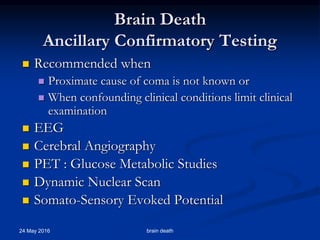
 Recommended when
 Proximate cause of coma is not known or
 When confounding clinical conditions limit clinical
examination
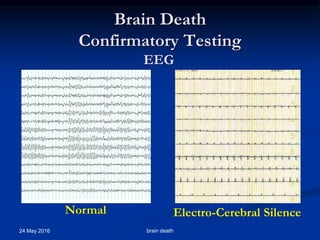
 EEG
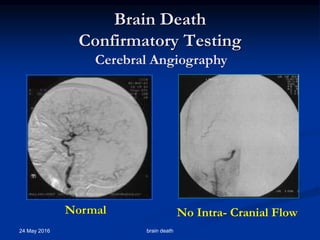
 Cerebral Angiography
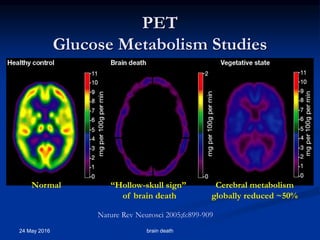
 PET : Glucose Metabolic Studies
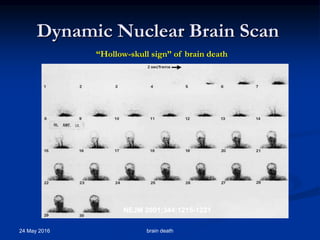
 Dynamic Nuclear Scan
 Somato-Sensory Evoked Potential
24 May 2016 brain death
Brain Death
Confirmatory Testing
24 May 2016 brain death
Electro-Cerebral SilenceNormal
EEG
Brain Death
Confirmatory Testing
24 May 2016 brain death
No Intra- Cranial FlowNormal
Cerebral Angiography
PET
Glucose Metabolism Studies
24 May 2016 brain death
“Hollow-skull sign”
of brain death
Cerebral metabolism
globally reduced ~50%
Normal
Nature Rev Neurosci 2005;6:899-909
Dynamic Nuclear Brain Scan
24 May 2016 brain death
“Hollow-skull sign” of brain death
NEJM 2001;344:1215-1221

Brain death presentation

  • 1.
    Brain death 24 May2016 brain death
  • 2.
    Brain Death Out line What is brain death?  Causes of Brain Death  Clinical evaluation of brain death  Brain Death Diagnosis 24 May 2016 brain death
  • 3.
    Normal Brain Anatomy 24May 2016 brain death Cerebral Cortex Brain Stem Reticular Activating System Receives multiple sensory inputs & Mediates Consciousness (wakefulness)
  • 4.
    Cerebral Cortex: Function 24May 2016 brain death  Cognition  Voluntary Movement  Sensation
  • 5.
    Brain Stem :Functions 24 May 2016 brain death Medulla Cranial Nerve IX, X  Pharyngeal (Gag) Reflex  Tracheal (Cough) Reflex Respiration
  • 6.
    Death : Definition Thanatology  Branch of science dealing with study of death  Death is the complete and irreversible stoppage of  Circulation  Respiration  Brain function (Tripod of life)  As long as oxygenated blood reaches brain stem, Life exists ….  Mechanical Ventilator use in ICU  Brought concept of “Brain Death” 24 May 2016 brain death
  • 7.
    Brain Death  Ireversibledestruction of the brain,with the resulting total absence of all cortical and brainstem functions,although spinal cord refleves may remain 24 May 2016 brain death
  • 8.
    Conditions Distinct from BrainDeath  Coma  Persistent Vegetative State  Locked in Syndrome 24 May 2016 brain death
  • 9.
     3 clinicalfindings necessary to confirm irreversible cessation of all functions of the entire brain, including brain stem Coma (with a known cause) Absence of brainstem reflexes Apnoea 24 May 2016 brain death
  • 10.
    Causes: Brain Death 24May 2016 brain death Normal Cerebral Anoxia
  • 11.
    Causes: Brain Death 24May 2016 brain death Normal Cerebral Haemorrhage
  • 12.
    Causes: Brain Death 24May 2016 brain death Normal Cerebral Trauma
  • 13.
    Brain Death :Mechanism 24 May 2016 brain death Neuronal Injury Decreased Intracranial Blood Flow Neuronal Swelling Increased Intracranial Pressure ICP > MAP is incompatible with life
  • 14.
    4 Steps inDetermining Brain Death  The Clinical Evaluation  The Neurologic Assessment  Ancillary Test  Documentation
  • 15.
    Clinical evaluation ofbrain death Irreversible coma  Known etiology and or reversible causes ruled out  Must have an absence of  Hypothermia (>32.50C)  Neuromuscular blockade and Shock  Significant levels of sedatives  Severe metabolic distrubance and Endocrine abnormalities  Poisoning 24 May 2016 brain death
  • 16.
    Absence of corticalfunctions  No spontaneous movement, eye opening, or movement or response after auditory, verbal, or visual commands  Cerebral motor response to pain  Supraorbital ridge, the nail beds, trapezius  Motor responses may occur spontaneously during apnea testing (spinal reflexes)  Spinal arcs are intact! 24 May 2016 brain death
  • 17.
    Absence of brainstem function-1)Pupillary reflex 2)Corneal reflex 3)Gag reflex 4)Cough reflex 5)Oculocephalic reflex (doll’s eye reflex) 6)Oculovestibular reflex (caloric reflex) 7)No integrated motor response to pain 8)Apnea testing 24 May 2016 brain death
  • 18.
    Pupillary reflex-  pupilsmay be midposition or dilated (4 to 9 mm)  Absent pupillary light reflex  IV atropine does not markedly affect response  Paralytics do not affect pupillary size  Topical administration of drugs and eye trauma may influence pupillary size and reactivity 24 May 2016 brain death
  • 19.
    Corneal reflex-  Cornealreflexes are absent in brain death  Corneal reflexes - tested by using a cotton-tipped swab . There is no blink response to direct corneal stimulation. 24 May 2016 brain death
  • 20.
    Oculocephalic reflex  Rapidlyturn the head 90° on both sides  Normal response = deviation of the eyes to the opposite side of head turning  Brain death = oculocephalic reflexes are absent (no Doll’s eyes) = no eye movement in response to head movement 24 May 2016 brain death
  • 21.
    24 May 2016brain death
  • 22.
    Vestibularocular reflex  Noeye movements within 3 mints after irrigating each tympanic membrane (if intact) sequentially with 50 ml ice water for 30 to 45 seconds while the head of the supine patient is elevated 30 degrees Retained vestibulocular reflex 24 May 2016 brain death
  • 23.
    Cold calorics interpretation Not comatose  Nystagmus; both eyes slow toward cold, fast to midline  Coma with intact brainstem  Both eyes tonically deviate away cold water  No eye movement  Brainstem injury / death  Movement only of eye on side of stimulus  Internuclear ophthalmoplegia  Suggests brainstem structural lesion 24 May 2016 brain death
  • 24.
    Brain Death :Apnoea Test  Pre-requisites  Body Temperature > 36° C  Systolic Blood Pressure ≥ 100 mm Hg  Normal Electrolytes profile  Normal PaCO2 (35-45 mm Hg)  Pre-Oxygenation  100% Oxygen via Tracheal Cannula for 10 min  Achieve PaO2 = 200 mm Hg  Monitor PaO2 with pulse oximetry 24 May 2016 brain death
  • 25.
    Brain Death :Apnoea Test  Reduce Ventilation frequency to 10/min  Reduce PEEP to 5 Cm H2O  Take 1st Blood sample for Blood Gas analysis  Disconnect Ventilator  Deliver 100% O2 by catheter through ET tube  @ 6 L/min  Observe for Respiratory Movement  Atleast for 8 – 10 min 24 May 2016 brain death
  • 26.
    Interpreting the test The apnea test is POSITIVE (i.e., supports the diagnosis of brain death) if:  There are no respiratory efforts during the test AND  Repeat ABG shows PCO2 > 60 mm Hg. 24 May 2016 brain death
  • 27.
    Interpreting the test The apnea test is INDETERMINATE if:  after 10 minutes, the patient demonstrates no respiratory effort, but the PCO2 is < 60 mm Hg.  The apnea test is NEGATIVE (i.e., does NOT support the diagnosis of brain death) if:  the patient demonstrates any respiratory effort at any time during the test.  Cease the test and reconnect the ventilator immediately upon observing respiratory effort. 24 May 2016 brain death
  • 28.
    The Apnea Test If the patient becomes unstable at any point during the Apnea Test (i.e. SBP drops less than 90, significant desaturation on pulse-oximetry, observance of cardiac arrhythmias, etc.), the test should be aborted.  The Apnea Test should not “induce a code!” 24 May 2016 brain death
  • 29.
    Movements originating fromthe spinal cord or peripheral nerve which occur in brain death  Spontaneous 'spinal' reflexes in the limbs  Respiratory-like movements  Sweating, blushing, tachycardia  Normal BP  Normal osmolar control mechanism  Deep tendon reflexes, Babinski's reflex  Facial myokymias 24 May 2016 brain death
  • 30.
    Brain Death Ancillary ConfirmatoryTesting  Recommended when  Proximate cause of coma is not known or  When confounding clinical conditions limit clinical examination  EEG  Cerebral Angiography  PET : Glucose Metabolic Studies  Dynamic Nuclear Scan  Somato-Sensory Evoked Potential 24 May 2016 brain death
  • 31.
    Brain Death Confirmatory Testing 24May 2016 brain death Electro-Cerebral SilenceNormal EEG
  • 32.
    Brain Death Confirmatory Testing 24May 2016 brain death No Intra- Cranial FlowNormal Cerebral Angiography
  • 33.
    PET Glucose Metabolism Studies 24May 2016 brain death “Hollow-skull sign” of brain death Cerebral metabolism globally reduced ~50% Normal Nature Rev Neurosci 2005;6:899-909
  • 34.
    Dynamic Nuclear BrainScan 24 May 2016 brain death “Hollow-skull sign” of brain death NEJM 2001;344:1215-1221