BRAIN DEATH
BRAIN DEATH
Dr. Norsham Khairati
Dept. of Anaesthesiology and ICU

Hospital Raja Permaisuri Bainun
Death of a person
Death of a person
 Cardiac death
Cardiac death
irreversible cessation of circulation of blood in
the body of the person
 Brain death
Brain death
irreversible cessation of all function of the
brain of the person
brain of the person
Brain Death – Historical Perspectives
1956
1956 – Lodstedt & Von Reis 1
– Lodstedt & Von Reis 1st
st
described
described
ventilated patients with absent brainstem
reflexes, absent cerebral blood flow and
cerebral necrosis
cerebral necrosis
1959
1959 – “ le coma de passe “
– “ le coma de passe “
by Mollaret & Goulon
defined death by neurologic criteria
1968 –Harvard Criteria
Defines death
Defines death
- irreversible loss of all brain function
 Unreceptivity
Unreceptivity
 No movements or breathing
No movements or breathing
 No reflexes
No reflexes
 Flat EEG
Flat EEG
All repeated at least 24 hrs with no change
Exclusion of hypothermia ( <32.2
Exclusion of hypothermia ( <32.20
0
C ) or central
C ) or central
nervous depressants
nervous depressants
1971
1971 Mohandas & Chou
Mohandas & Chou
- state of irreversible damage to brainstem
- irrelevance of EEG
Minnesota Criteria
Minnesota Criteria
Known irreparable intracranial lesion
Known irreparable intracranial lesion
Metabolic factors ruled out
Metabolic factors ruled out
No spontaneous movement
No spontaneous movement
Apnoea ( 4 mins )
Apnoea ( 4 mins )
Absent brainstem reflexes
Absent brainstem reflexes
All findings unchanged after 12 hours
All findings unchanged after 12 hours
Brain Death – Historical Perspectives
1976 – UK “ Diagnosis of Brain Death “
1995 – Concept of brain stem death in UK
1993 – Malaysian consensus on Brain Death
Dx of brain death now accepted throughout the
world
world
Brain death
Brain death
 Accounts for 2-4% of all hospital deaths
Accounts for 2-4% of all hospital deaths
 13-15 % of deaths in Neurosurgical ICU
13-15 % of deaths in Neurosurgical ICU
Definition
Definition
Death of the whole brain including the brain
stem
stem
Absence of brainstem function
 Deep coma ( GCS 3 )
Deep coma ( GCS 3 )
 Apnoeic , on ventilator
Apnoeic , on ventilator
 Known cause of irreversible brain injury /
Known cause of irreversible brain injury /
pathology
pathology
 Other reversible causes of coma excluded
Other reversible causes of coma excluded
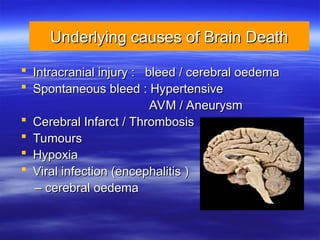
Underlying causes of Brain Death
 Intracranial injury : bleed / cerebral oedema
Intracranial injury : bleed / cerebral oedema
 Spontaneous bleed : Hypertensive
Spontaneous bleed : Hypertensive
AVM / Aneurysm
AVM / Aneurysm
 Cerebral Infarct / Thrombosis
Cerebral Infarct / Thrombosis
 Tumours
Tumours
 Hypoxia
Hypoxia
 Viral infection (encephalitis )
Viral infection (encephalitis )
–
– cerebral oedema
cerebral oedema
Brain Death
Brain Death
 Pathophysiological changes that follow
Pathophysiological changes that follow
brain death occur irrespective of the
cause of the brain death
 Added to that are the other changes
Added to that are the other changes
that were already present prior to brain
death which were associated with the
causal pathology
causal pathology
Brain Death
Brain Death
 Is inevitably followed by the death of the
Is inevitably followed by the death of the
rest of the person within a few days
 Progressive deterioration of all the
Progressive deterioration of all the
organs unless measures to maintain
and preserve the organ functions are
initiated as soon as brain death is
diagnosed.
diagnosed.
Brain Death
Brain Death
 Failure to maintain internal homeostasis
Failure to maintain internal homeostasis
following the loss of brain stem functions
 Loss of spontaneous respiration
Loss of spontaneous respiration
 Loss of cardiovascular control
Loss of cardiovascular control
 Loss of temperature control
Loss of temperature control
 Loss of control of fluid and electrolyte balance
Loss of control of fluid and electrolyte balance
 Loss of hormonal balance
Loss of hormonal balance
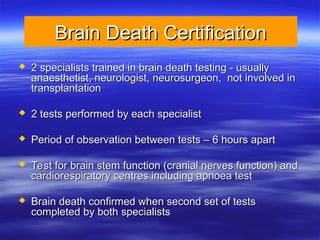
Brain Death Certification
 2 specialists trained in brain death testing - usually
2 specialists trained in brain death testing - usually
anaesthetist, neurologist, neurosurgeon, not involved in
transplantation
transplantation
 2 tests performed by each specialist
2 tests performed by each specialist
 Period of observation between tests – 6 hours apart
Period of observation between tests – 6 hours apart
 Test for brain stem function (cranial nerves function) and
Test for brain stem function (cranial nerves function) and
cardiorespiratory centres including apnoea test
 Brain death confirmed when second set of tests
Brain death confirmed when second set of tests
completed by both specialists
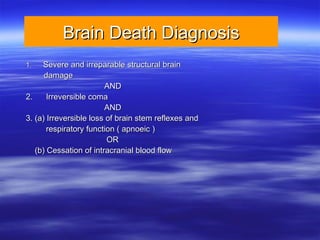
Brain Death Diagnosis
1.
1. Severe and irreparable structural brain
Severe and irreparable structural brain
damage
damage
AND
AND
2. Irreversible coma
AND
AND
3. (a) Irreversible loss of brain stem reflexes and
respiratory function ( apnoeic )
OR
OR
(b) Cessation of intracranial blood flow
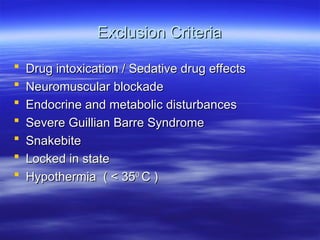
Exclusion Criteria
Exclusion Criteria
 Drug intoxication / Sedative drug effects
Drug intoxication / Sedative drug effects
 Neuromuscular blockade
Neuromuscular blockade
 Endocrine and metabolic disturbances
Endocrine and metabolic disturbances
 Severe Guillian Barre Syndrome
Severe Guillian Barre Syndrome
 Snakebite
Snakebite
 Locked in state
Locked in state
 Hypothermia ( < 35
Hypothermia ( < 350
0
C )
C )
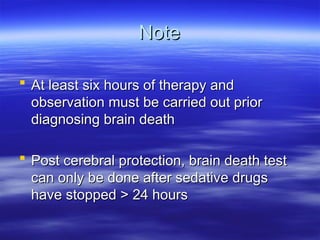
Note
Note
 At least six hours of therapy and
At least six hours of therapy and
observation must be carried out prior
diagnosing brain death
 Post cerebral protection, brain death test
Post cerebral protection, brain death test
can only be done after sedative drugs
have stopped > 24 hours
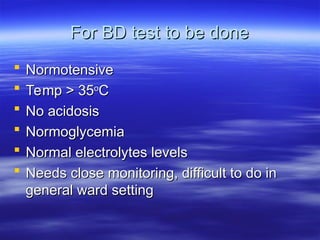
For BD test to be done
 Normotensive
Normotensive
 Temp > 35
Temp > 35o
o
C
C
 No acidosis
No acidosis
 Normoglycemia
Normoglycemia
 Normal electrolytes levels
Normal electrolytes levels
 Needs close monitoring, difficult to do in
Needs close monitoring, difficult to do in
general ward setting
Brain Death Test
Brain Death Test
Clinical
Clinical bedside testing of brainstem
bedside testing of brainstem
function
function
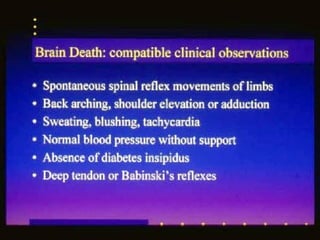
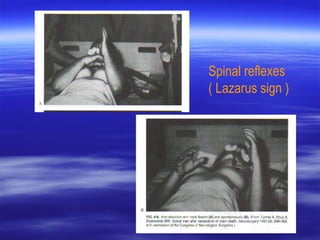
Spinal reflexes
( Lazarus sign )
Brain Death Test
Brain Death Test
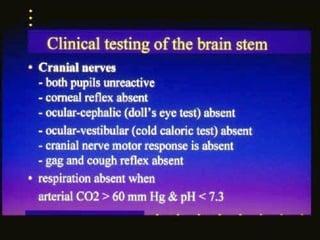
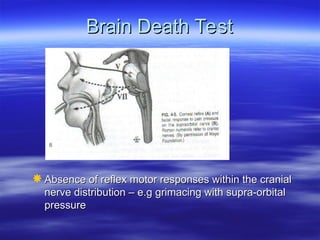
 Absence of reflex motor responses within the cranial
Absence of reflex motor responses within the cranial
nerve distribution – e.g grimacing with supra-orbital
pressure
pressure
Brain Death Test
Brain Death Test
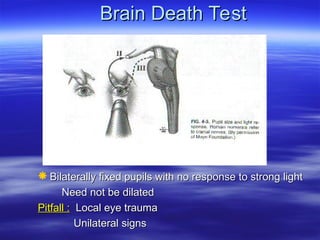
 Bilaterally fixed pupils with no response to strong light
Bilaterally fixed pupils with no response to strong light
Need not be dilated
Need not be dilated
Pitfall :
Pitfall : Local eye trauma
Local eye trauma
Unilateral signs
Unilateral signs
Absent oculo-cephalic (doll’s eyes) reflex
Absent oculo-cephalic (doll’s eyes) reflex
Pitfall :
Pitfall : suspected cervical spine #
suspected cervical spine #
Brain Death Test
Brain Death Test
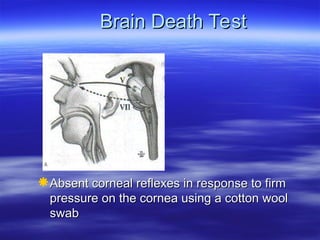
Absent corneal reflexes in response to firm
Absent corneal reflexes in response to firm
pressure on the cornea using a cotton wool
swab
swab
Brain Death Test
Brain Death Test
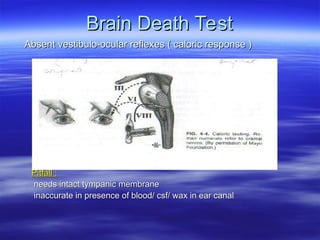
Absent vestibulo-ocular reflexes ( caloric response )
no nystagmus ( eye movements) in response to stimulation
of the ear drum with 50 mls of ice cold water
Pitfall :
Pitfall :
needs intact tympanic membrane
inaccurate in presence of blood/ csf/ wax in ear canal

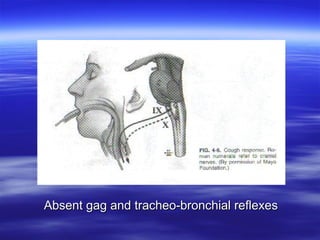
Absent gag and tracheo-bronchial reflexes
Brain Death Test
Brain Death Test
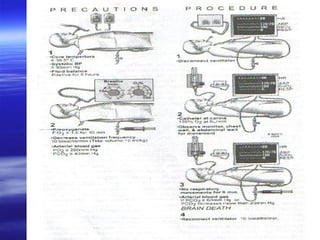
Apnoea Test
Apnoea Test
 to be done only after and if the other tests showed no
to be done only after and if the other tests showed no
response as the consequent hypercarbia and hypoxia
can worsen ICP
can worsen ICP
 involves disconnecting patient from ventilator, ensuring
involves disconnecting patient from ventilator, ensuring
that the PaCO
that the PaCO2
2 is raised above the threshold ( 60 mmHg
is raised above the threshold ( 60 mmHg
) required to stimulate the respiratory centre and
observing for respiratory movements
Pitfall
Pitfall :
: difficult to do in the presence of bad lungs
difficult to do in the presence of bad lungs
Brain Death Test
Brain Death Test
Apnoea Test
Apnoea Test
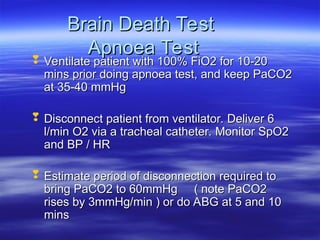
 Ventilate patient with 100% FiO2 for 10-20
Ventilate patient with 100% FiO2 for 10-20
mins prior doing apnoea test, and keep PaCO2
at 35-40 mmHg
at 35-40 mmHg
 Disconnect patient from ventilator. Deliver 6
Disconnect patient from ventilator. Deliver 6
l/min O2 via a tracheal catheter. Monitor SpO2
and BP / HR
and BP / HR
 Estimate period of disconnection required to
Estimate period of disconnection required to
bring PaCO2 to 60mmHg ( note PaCO2
rises by 3mmHg/min ) or do ABG at 5 and 10
mins
mins
Brain Death Test
Brain Death Test
Apnoea Test
Apnoea Test
No respiratory movements when PaCO2 is >
No respiratory movements when PaCO2 is >
60mmHg consistent with brain death
Reventilate when desaturation occurs or PaCO2
Reventilate when desaturation occurs or PaCO2
reaches 60mmHg
reaches 60mmHg
Test abandoned if any respiratory movements,
Test abandoned if any respiratory movements,
vital signs destabilise, cyanosis, ventricular
arrythmias or ECG ST depression occurs
Brain Death Test
Brain Death Test
Apnoea Test
Apnoea Test
 COAD patients with pre-existing hypercarbia
COAD patients with pre-existing hypercarbia
No respiratory effort when PaCO2
increases by > 20mmhg of baseline
Brain Death Assessment
Supportive Tests
Supportive Tests
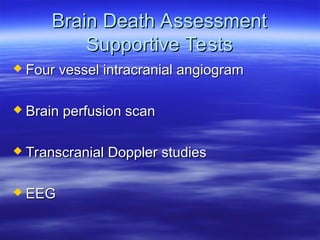
 Four vessel intracranial angiogram
Four vessel intracranial angiogram
 Brain perfusion scan
Brain perfusion scan
 Transcranial Doppler studies
Transcranial Doppler studies
 EEG
EEG
Brain death = death
Brain death = death
 On confirmation of brain death, death
On confirmation of brain death, death
certificicate is signed
 Time of death is the time of certification of
Time of death is the time of certification of
brain death not at time of asystole
 Ventilator switched off
Ventilator switched off
3rd International Conference of Islamic Jurists
( OIC ) held in Amman Oct 1986 ( 1407)
 A person is pronounced legally dead and consequently all
A person is pronounced legally dead and consequently all
 dispositions of the Islamic law in case of death apply if one of
dispositions of the Islamic law in case of death apply if one of
 the two following conditions has been established :
the two following conditions has been established :
 There is total cessation of cardiac and respiratory functions , and
There is total cessation of cardiac and respiratory functions , and
doctors have ruled that such cessation is irreversible
 There is total cessation of all cerebral functions and experienced
There is total cessation of all cerebral functions and experienced
specialised doctors have ruled that such cessation is irreversible
and the brain has started to disintegrate
 In this case , it is permissible to take the person off
In this case , it is permissible to take the person off
 resuscitation apparatus , even if the functions of some organs
resuscitation apparatus , even if the functions of some organs
 e.g heart, are still artificially maintained
e.g heart, are still artificially maintained
Majlis Fatwa Kebangsaan telah mengharuskan
penggunaan kaedah pemindahan organ pada
bulan Jun 1970
Dari sudut Islam, pemindahan organ diharuskan
dengan syarat:
dengan syarat:
(i) Tidak ada alternatif lain yang boleh
menyelamatkan nyawa pesakit
(ii) Tidak mendatangkan mudarat yang lebih
besar kepada penderma atau penerima organ
(iii) Pendermaan organ dilakukan dengan ikhlas
dengan niat untuk membantu kerana Allah s.w.t.
(iv) Organ tidak diperniagakan.
(v) Pendermaan organ mendapat keizinan
penderma dan ahli keluarganya atau warisnya.
Thank You
Thank You

Brain death presented by anaesthesiologist

  • 1.
    BRAIN DEATH BRAIN DEATH Dr.Norsham Khairati Dr. Norsham Khairati Dept. of Anaesthesiology and ICU Dept. of Anaesthesiology and ICU Hospital Raja Permaisuri Bainun Hospital Raja Permaisuri Bainun
  • 2.
    Death of aperson Death of a person  Cardiac death Cardiac death irreversible cessation of circulation of blood in irreversible cessation of circulation of blood in the body of the person the body of the person  Brain death Brain death irreversible cessation of all function of the irreversible cessation of all function of the brain of the person brain of the person
  • 3.
    Brain Death –Historical Perspectives Brain Death – Historical Perspectives 1956 1956 – Lodstedt & Von Reis 1 – Lodstedt & Von Reis 1st st described described ventilated patients with absent brainstem ventilated patients with absent brainstem reflexes, absent cerebral blood flow and reflexes, absent cerebral blood flow and cerebral necrosis cerebral necrosis 1959 1959 – “ le coma de passe “ – “ le coma de passe “ by Mollaret & Goulon by Mollaret & Goulon defined death by neurologic criteria defined death by neurologic criteria
  • 4.
    1968 –Harvard Criteria 1968–Harvard Criteria Defines death Defines death - irreversible loss of all brain function - irreversible loss of all brain function  Unreceptivity Unreceptivity  No movements or breathing No movements or breathing  No reflexes No reflexes  Flat EEG Flat EEG All repeated at least 24 hrs with no change All repeated at least 24 hrs with no change Exclusion of hypothermia ( <32.2 Exclusion of hypothermia ( <32.20 0 C ) or central C ) or central nervous depressants nervous depressants
  • 5.
    1971 1971 Mohandas &Chou Mohandas & Chou - state of irreversible damage to brainstem - state of irreversible damage to brainstem - irrelevance of EEG - irrelevance of EEG Minnesota Criteria Minnesota Criteria Known irreparable intracranial lesion Known irreparable intracranial lesion Metabolic factors ruled out Metabolic factors ruled out No spontaneous movement No spontaneous movement Apnoea ( 4 mins ) Apnoea ( 4 mins ) Absent brainstem reflexes Absent brainstem reflexes All findings unchanged after 12 hours All findings unchanged after 12 hours
  • 6.
    Brain Death –Historical Perspectives Brain Death – Historical Perspectives 1976 – UK “ Diagnosis of Brain Death “ 1976 – UK “ Diagnosis of Brain Death “ 1995 – Concept of brain stem death in UK 1995 – Concept of brain stem death in UK 1993 – Malaysian consensus on Brain Death 1993 – Malaysian consensus on Brain Death Dx of brain death now accepted throughout the Dx of brain death now accepted throughout the world world
  • 7.
    Brain death Brain death Accounts for 2-4% of all hospital deaths Accounts for 2-4% of all hospital deaths  13-15 % of deaths in Neurosurgical ICU 13-15 % of deaths in Neurosurgical ICU
  • 8.
    Definition Definition Death of thewhole brain including the brain Death of the whole brain including the brain stem stem Absence of brainstem function Absence of brainstem function  Deep coma ( GCS 3 ) Deep coma ( GCS 3 )  Apnoeic , on ventilator Apnoeic , on ventilator  Known cause of irreversible brain injury / Known cause of irreversible brain injury / pathology pathology  Other reversible causes of coma excluded Other reversible causes of coma excluded
  • 9.
    Underlying causes ofBrain Death Underlying causes of Brain Death  Intracranial injury : bleed / cerebral oedema Intracranial injury : bleed / cerebral oedema  Spontaneous bleed : Hypertensive Spontaneous bleed : Hypertensive AVM / Aneurysm AVM / Aneurysm  Cerebral Infarct / Thrombosis Cerebral Infarct / Thrombosis  Tumours Tumours  Hypoxia Hypoxia  Viral infection (encephalitis ) Viral infection (encephalitis ) – – cerebral oedema cerebral oedema
  • 10.
    Brain Death Brain Death Pathophysiological changes that follow Pathophysiological changes that follow brain death occur irrespective of the brain death occur irrespective of the cause of the brain death cause of the brain death  Added to that are the other changes Added to that are the other changes that were already present prior to brain that were already present prior to brain death which were associated with the death which were associated with the causal pathology causal pathology
  • 11.
    Brain Death Brain Death Is inevitably followed by the death of the Is inevitably followed by the death of the rest of the person within a few days rest of the person within a few days  Progressive deterioration of all the Progressive deterioration of all the organs unless measures to maintain organs unless measures to maintain and preserve the organ functions are and preserve the organ functions are initiated as soon as brain death is initiated as soon as brain death is diagnosed. diagnosed.
  • 12.
    Brain Death Brain Death Failure to maintain internal homeostasis Failure to maintain internal homeostasis following the loss of brain stem functions following the loss of brain stem functions  Loss of spontaneous respiration Loss of spontaneous respiration  Loss of cardiovascular control Loss of cardiovascular control  Loss of temperature control Loss of temperature control  Loss of control of fluid and electrolyte balance Loss of control of fluid and electrolyte balance  Loss of hormonal balance Loss of hormonal balance
  • 13.
    Brain Death Certification BrainDeath Certification  2 specialists trained in brain death testing - usually 2 specialists trained in brain death testing - usually anaesthetist, neurologist, neurosurgeon, not involved in anaesthetist, neurologist, neurosurgeon, not involved in transplantation transplantation  2 tests performed by each specialist 2 tests performed by each specialist  Period of observation between tests – 6 hours apart Period of observation between tests – 6 hours apart  Test for brain stem function (cranial nerves function) and Test for brain stem function (cranial nerves function) and cardiorespiratory centres including apnoea test cardiorespiratory centres including apnoea test  Brain death confirmed when second set of tests Brain death confirmed when second set of tests completed by both specialists completed by both specialists
  • 14.
    Brain Death Diagnosis BrainDeath Diagnosis 1. 1. Severe and irreparable structural brain Severe and irreparable structural brain damage damage AND AND 2. Irreversible coma 2. Irreversible coma AND AND 3. (a) Irreversible loss of brain stem reflexes and 3. (a) Irreversible loss of brain stem reflexes and respiratory function ( apnoeic ) respiratory function ( apnoeic ) OR OR (b) Cessation of intracranial blood flow (b) Cessation of intracranial blood flow
  • 15.
    Exclusion Criteria Exclusion Criteria Drug intoxication / Sedative drug effects Drug intoxication / Sedative drug effects  Neuromuscular blockade Neuromuscular blockade  Endocrine and metabolic disturbances Endocrine and metabolic disturbances  Severe Guillian Barre Syndrome Severe Guillian Barre Syndrome  Snakebite Snakebite  Locked in state Locked in state  Hypothermia ( < 35 Hypothermia ( < 350 0 C ) C )
  • 16.
    Note Note  At leastsix hours of therapy and At least six hours of therapy and observation must be carried out prior observation must be carried out prior diagnosing brain death diagnosing brain death  Post cerebral protection, brain death test Post cerebral protection, brain death test can only be done after sedative drugs can only be done after sedative drugs have stopped > 24 hours have stopped > 24 hours
  • 17.
    For BD testto be done For BD test to be done  Normotensive Normotensive  Temp > 35 Temp > 35o o C C  No acidosis No acidosis  Normoglycemia Normoglycemia  Normal electrolytes levels Normal electrolytes levels  Needs close monitoring, difficult to do in Needs close monitoring, difficult to do in general ward setting general ward setting
  • 18.
    Brain Death Test BrainDeath Test Clinical Clinical bedside testing of brainstem bedside testing of brainstem function function
  • 21.
  • 22.
    Brain Death Test BrainDeath Test  Absence of reflex motor responses within the cranial Absence of reflex motor responses within the cranial nerve distribution – e.g grimacing with supra-orbital nerve distribution – e.g grimacing with supra-orbital pressure pressure
  • 23.
    Brain Death Test BrainDeath Test  Bilaterally fixed pupils with no response to strong light Bilaterally fixed pupils with no response to strong light Need not be dilated Need not be dilated Pitfall : Pitfall : Local eye trauma Local eye trauma Unilateral signs Unilateral signs
  • 24.
    Absent oculo-cephalic (doll’seyes) reflex Absent oculo-cephalic (doll’s eyes) reflex Pitfall : Pitfall : suspected cervical spine # suspected cervical spine #
  • 25.
    Brain Death Test BrainDeath Test Absent corneal reflexes in response to firm Absent corneal reflexes in response to firm pressure on the cornea using a cotton wool pressure on the cornea using a cotton wool swab swab
  • 26.
    Brain Death Test BrainDeath Test Absent vestibulo-ocular reflexes ( caloric response ) Absent vestibulo-ocular reflexes ( caloric response ) no nystagmus ( eye movements) in response to stimulation no nystagmus ( eye movements) in response to stimulation of the ear drum with 50 mls of ice cold water of the ear drum with 50 mls of ice cold water Pitfall : Pitfall : needs intact tympanic membrane needs intact tympanic membrane inaccurate in presence of blood/ csf/ wax in ear canal inaccurate in presence of blood/ csf/ wax in ear canal
  • 27.
     Absent gag andtracheo-bronchial reflexes Absent gag and tracheo-bronchial reflexes
  • 28.
    Brain Death Test BrainDeath Test Apnoea Test Apnoea Test  to be done only after and if the other tests showed no to be done only after and if the other tests showed no response as the consequent hypercarbia and hypoxia response as the consequent hypercarbia and hypoxia can worsen ICP can worsen ICP  involves disconnecting patient from ventilator, ensuring involves disconnecting patient from ventilator, ensuring that the PaCO that the PaCO2 2 is raised above the threshold ( 60 mmHg is raised above the threshold ( 60 mmHg ) required to stimulate the respiratory centre and ) required to stimulate the respiratory centre and observing for respiratory movements observing for respiratory movements Pitfall Pitfall : : difficult to do in the presence of bad lungs difficult to do in the presence of bad lungs
  • 30.
    Brain Death Test BrainDeath Test Apnoea Test Apnoea Test  Ventilate patient with 100% FiO2 for 10-20 Ventilate patient with 100% FiO2 for 10-20 mins prior doing apnoea test, and keep PaCO2 mins prior doing apnoea test, and keep PaCO2 at 35-40 mmHg at 35-40 mmHg  Disconnect patient from ventilator. Deliver 6 Disconnect patient from ventilator. Deliver 6 l/min O2 via a tracheal catheter. Monitor SpO2 l/min O2 via a tracheal catheter. Monitor SpO2 and BP / HR and BP / HR  Estimate period of disconnection required to Estimate period of disconnection required to bring PaCO2 to 60mmHg ( note PaCO2 bring PaCO2 to 60mmHg ( note PaCO2 rises by 3mmHg/min ) or do ABG at 5 and 10 rises by 3mmHg/min ) or do ABG at 5 and 10 mins mins
  • 31.
    Brain Death Test BrainDeath Test Apnoea Test Apnoea Test No respiratory movements when PaCO2 is > No respiratory movements when PaCO2 is > 60mmHg consistent with brain death 60mmHg consistent with brain death Reventilate when desaturation occurs or PaCO2 Reventilate when desaturation occurs or PaCO2 reaches 60mmHg reaches 60mmHg Test abandoned if any respiratory movements, Test abandoned if any respiratory movements, vital signs destabilise, cyanosis, ventricular vital signs destabilise, cyanosis, ventricular arrythmias or ECG ST depression occurs arrythmias or ECG ST depression occurs
  • 32.
    Brain Death Test BrainDeath Test Apnoea Test Apnoea Test  COAD patients with pre-existing hypercarbia COAD patients with pre-existing hypercarbia No respiratory effort when PaCO2 No respiratory effort when PaCO2 increases by > 20mmhg of baseline increases by > 20mmhg of baseline
  • 33.
    Brain Death Assessment BrainDeath Assessment Supportive Tests Supportive Tests  Four vessel intracranial angiogram Four vessel intracranial angiogram  Brain perfusion scan Brain perfusion scan  Transcranial Doppler studies Transcranial Doppler studies  EEG EEG
  • 34.
    Brain death =death Brain death = death  On confirmation of brain death, death On confirmation of brain death, death certificicate is signed certificicate is signed  Time of death is the time of certification of Time of death is the time of certification of brain death not at time of asystole brain death not at time of asystole  Ventilator switched off Ventilator switched off
  • 35.
    3rd International Conferenceof Islamic Jurists 3rd International Conference of Islamic Jurists ( OIC ) held in Amman Oct 1986 ( 1407) ( OIC ) held in Amman Oct 1986 ( 1407)  A person is pronounced legally dead and consequently all A person is pronounced legally dead and consequently all  dispositions of the Islamic law in case of death apply if one of dispositions of the Islamic law in case of death apply if one of  the two following conditions has been established : the two following conditions has been established :  There is total cessation of cardiac and respiratory functions , and There is total cessation of cardiac and respiratory functions , and doctors have ruled that such cessation is irreversible doctors have ruled that such cessation is irreversible  There is total cessation of all cerebral functions and experienced There is total cessation of all cerebral functions and experienced specialised doctors have ruled that such cessation is irreversible specialised doctors have ruled that such cessation is irreversible and the brain has started to disintegrate and the brain has started to disintegrate  In this case , it is permissible to take the person off In this case , it is permissible to take the person off  resuscitation apparatus , even if the functions of some organs resuscitation apparatus , even if the functions of some organs  e.g heart, are still artificially maintained e.g heart, are still artificially maintained
  • 36.
    Majlis Fatwa Kebangsaantelah mengharuskan penggunaan kaedah pemindahan organ pada bulan Jun 1970 Dari sudut Islam, pemindahan organ diharuskan Dari sudut Islam, pemindahan organ diharuskan dengan syarat: dengan syarat: (i) Tidak ada alternatif lain yang boleh (i) Tidak ada alternatif lain yang boleh menyelamatkan nyawa pesakit menyelamatkan nyawa pesakit (ii) Tidak mendatangkan mudarat yang lebih (ii) Tidak mendatangkan mudarat yang lebih besar kepada penderma atau penerima organ besar kepada penderma atau penerima organ
  • 37.
    (iii) Pendermaan organdilakukan dengan ikhlas (iii) Pendermaan organ dilakukan dengan ikhlas dengan niat untuk membantu kerana Allah s.w.t. dengan niat untuk membantu kerana Allah s.w.t. (iv) Organ tidak diperniagakan. (iv) Organ tidak diperniagakan. (v) Pendermaan organ mendapat keizinan (v) Pendermaan organ mendapat keizinan penderma dan ahli keluarganya atau warisnya. penderma dan ahli keluarganya atau warisnya.
  • 38.