Brain Death 
DR NIRAV DHINOJA
Definition 
 It is a clinical diagnosis based on the absence of neurologic 
function with a known diagnosis that has resulted in irreversible 
coma. 
 Coma and apnea must coexist to diagnose brain death. 
 A complete neurologic examination is mandatory to determine 
brain death with all components appropriately documented.
Prerequisites for initiatiating a 
clinical brain death evaluation 
 Shock or persistent hypotension. 
 Hypothermia. – A core body temperature of 35°C(95°F) should be 
achieved and maintained during examination and testing to determine 
death. 
 Severe metabolic disturbances including electrolyte/glucose 
abnormalities. 
 Recent administration of neuromuscular blocking agents. - Testing for 
these drugs should be performed if there is concern regarding recent 
ingestion or administration.
Prerequisites for initiatiating a 
clinical brain death evaluation 
 Drug intoxications - including but not limited to barbiturates, 
opioids, sedative and anesthetic agents, antiepileptic agents, and 
alcohols. 
 Assessment of neurologic function may be unreliable immediately 
following resuscitation after cardiopulmonary arrest or other acute 
brain injuries and serial neurologic examinations are necessary to 
establish or refute the diagnosis of brain death.(defer for 24hrs)
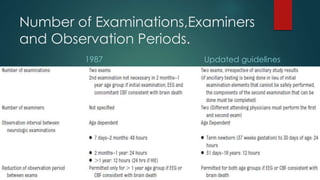
Number of Examinations,Examiners 
and Observation Periods. 
1987 Updated guidelines
Coma 
 Reversible conditions or conditions that can interfere with the 
neurologic examination must be excluded prior to brain death testing. 
 The patient must exhibit complete loss of consciousness, vocalization and 
volitional activity. 
 Patients must lack all evidence of responsiveness. 
 Eye opening or eye movement to noxious stimuli is absent. 
 Noxious stimuli should not produce a motor response other than spinally 
mediated reflexes.
Neurological examination 
 Loss of all brain stem reflexes including: 
 Mid-position or fully dilated pupils which do not respond to light. 
 Absence of movement of bulbar musculature including facial and 
oropharyngeal muscles. 
 Deep pressure on the condyles at the level of the temporomandibular joints 
and deep pressure at the supraorbital ridge should produce no grimacing or 
facial muscle movement. 
 Absent gag, cough, sucking, and rooting reflex. 
 Absent corneal reflexes. 
 Absent oculo-vestibular reflexes.
Apnea test 
 The patient must have the complete absence of documented 
respiratory effort (if feasible) by formal apnea testing demonstrating 
a PaCO2 > 60 mm Hg and > 20 mm Hg increase above baseline. 
 Normalization of the pH and PaCO2, measured by arterial blood 
gas analysis. 
 Maintenance of core temperature 35°C,. 
 Normalization of blood pressure appropriate for the age of the child. 
 Correcting for factors that could affect respiratory effort are a 
prerequisite to testing
 The patient should be pre-oxygenated using 100% oxygen for 5–10 
minutes prior to initiating this test. 
 Intermittent mandatory mechanical ventilation should be 
discontinued once the patient is well oxygenated and a normal 
PaCO2 has been achieved. 
 The patient’s heart rate, blood pressure, and oxygen saturation 
should be continuously monitored while observing for spontaneous 
respiratory effort throughout the entire procedure. 
 Follow up blood gases should be obtained to monitor the rise in 
PaCO2 while the patient remains disconnected from mechanical 
ventilation.
 If no respiratory effort is observed from the initiation of the apnea 
test to the time the measured PaCO2 60 mmHg and 20 mmHg 
above the baseline level, the apnea test is consistent with brain 
death. (POSITIVE) 
 The patient should be placed back on mechanical ventilator 
support and medical management should continue until the 
second neurologic examination and apnea test confirming brain 
death is completed.
 If oxygen saturations fall below 85%, hemodynamic instability limits 
completion of apnea testing, or a PaCO2 level of 60 mmHg cannot be 
achieved, the infant or child should be placed back on ventilator 
support with appropriate treatment to restore normal oxygen 
saturations, normocarbia, and hemodynamic parameters. 
(INDETERMINATE) 
 Another attempt to test for apnea may be performed at a later time or 
an ancillary study may be pursued to assist with determination of brain 
death. 
 Evidence of any respiratory effort is inconsistent with brain death and 
the apnea test should be terminated. (NEGATIVE)
Flaccid tone and absence of 
spontaneous or induced movements, 
 Excluding spinal cord events such as reflex withdrawal or spinal 
myoclonus. 
 The patient’s extremities should be examined to evaluate tone by 
passive range of motion. 
 the patient observed for any spontaneous or induced movements. 
 If abnormal movements are present, clinical assessment to 
determine whether or not these are spinal cord reflexes should be 
done.
Ancillary testing 
 These studies are not required to establish brain death and should 
not be viewed as a substitute for the neurologic examination. 
 It includes : 
 Electroencephalogram(EEG) 
 Electro-cerebral silence(ECS) – Absence of any electrical activity in brain for 
observation period of 30min. 
 Four vessel cerebral angiography. 
 Gold standard. 
 Absence of cerebral blood flow in any of four vessel shown by absence of 
radionuclide uptake.
Ancillary testing 
 Indication : 
 When components of the examination or apnea testing cannot be 
completed safely due to the underlying medical condition of the 
patient. 
 If there is uncertainty about the results of the neurologic examination. 
 If a medication effect may be present. 
 To reduce the inter-examination observation period.
 If the EEG study shows electrical activity or the CBF study shows 
evidence of flow or cellular uptake, the patient cannot be 
pronounced dead at 1st examination. 
 The patient should continue to be observed and medically treated 
until brain death can be declared solely on clinical examination 
criteria and apnea testing based on recommended observation 
periods, or a follow-up ancillary study can be performed to assist 
and is consistent with the determination of brain death. 
 A waiting period of 24 hours is recommended before further 
ancillary testing, using a radionuclide CBF study, is performed 
allowing adequate clearance of Tc-99m.
Shortening the Observation Period 
 If an ancillary study, used in conjunction with the first neurologic 
examination, supports the diagnosis of brain death, the inter-examination 
observation interval can be shortened and the second 
neurologic examination and apnea test(or all components that can 
be completed safely) can be performed and documented at any 
time there after for children of all ages.
Special consideration for term 
newborns 
 The newborn has patent sutures and an open fontanelle resulting in 
less dramatic increases in intracranial pressure (ICP) after acute 
brain injury when compared with older patients. 
 The cascade of events associated with increased ICP and reduced 
cerebral perfusion ultimately leading to herniation are less likely to 
occur in the neonate.
 Apnea testing in the term newborn may be complicated by the 
following: 
 Treatment with 100% oxygen may inhibit the potential recovery of respiratory 
effort. 
 Profound bradycardia may precede hypercarbia and limit this test in 
neonates. 
 EEG activity is of low voltage in newborns raising concerns about a 
greater chance of having reversible ECS in this age group. 
 CBF in viable newborns can be extremely low because of the 
decreased level of brain metabolic activity. 
 Ancillary studies in this age group are less sensitive in detecting the 
presence/absence of brain electrical activity or cerebral blood flow 
than in older children.
 This can pose an important clinical dilemma in this age group where 
clinicians may have a greater level of uncertainty about performing a 
valid neurologic examination. 
 There is a greater need to have more reliable and accurate ancillary 
studies in this age group. 
 Awareness of this limitation would suggest that longer periods of 
observation and repeated neurologic examinations are needed before 
making the diagnosis of brain death and also that as in older infants 
and children, the diagnosis should be made clinically and based on 
repeated examinations rather than relying exclusively on ancillary 
studies.
Special consideration for preterm 
newborns(<37week) 
 Recommendations for preterm infants less than 37 weeks gestational 
age were not included. 
 Some of the brainstem reflexes may not be completely developed 
and that it is also difficult to assess the level of consciousness in a 
critically ill, sedated and intubated neonate.
Declaration of death 
 Death is declared after the second neurologic examination and 
apnea test confirms an unchanged and irreversible condition. 
 All aspects of the clinical examination, including the apnea test, or 
ancillary studies must be appropriately documented.
Additional consideration 
 Diagnosing brain death must never be rushed. 
 Communication with families must be clear and concise using simple terminology 
so that parents and family members understand that their child has died. 
 Permitting families to be present during the brain death examination, apnea 
testing and performance of ancillary studies can assist families in understanding 
that their child has died. 
 The family must understand that once brain death has been declared, their child 
meets legal criteria for death. 
 It should be made clear that once death has occurred, continuation of medical 
therapies, including ventilator support, is no longer an option unless organ 
donation is planned.
References 
 Guidel ines for the Determinat ion of B rain Death in 
I nfant s and Chi ldren: An Update of t he 1 9 8 7 Tas k 
Force Recommendat ions . Societ y of Cr i t ical Care 
Medicine, Sect ion on Cr i t ical Care and Sect ion on 
Neu rology of t he Amer ican Academy of Pediat r ics , 
and t he Chi ld Neu rology Societ y Pediat r ics 
2 0 1 1 ;1 2 8 ;e7 2 0 ; or iginal l y publ i shed onl ine Augus t 2 8 , 
2011; DOI : 1 0 . 1 5 4 2 /peds . 2 0 1 1 -1511. 
 Nel son Tex tbook of Pediat r ics , 1 9 th Edi t ion.
Thank you

Brain death

  • 1.
    Brain Death DRNIRAV DHINOJA
  • 2.
    Definition  Itis a clinical diagnosis based on the absence of neurologic function with a known diagnosis that has resulted in irreversible coma.  Coma and apnea must coexist to diagnose brain death.  A complete neurologic examination is mandatory to determine brain death with all components appropriately documented.
  • 3.
    Prerequisites for initiatiatinga clinical brain death evaluation  Shock or persistent hypotension.  Hypothermia. – A core body temperature of 35°C(95°F) should be achieved and maintained during examination and testing to determine death.  Severe metabolic disturbances including electrolyte/glucose abnormalities.  Recent administration of neuromuscular blocking agents. - Testing for these drugs should be performed if there is concern regarding recent ingestion or administration.
  • 4.
    Prerequisites for initiatiatinga clinical brain death evaluation  Drug intoxications - including but not limited to barbiturates, opioids, sedative and anesthetic agents, antiepileptic agents, and alcohols.  Assessment of neurologic function may be unreliable immediately following resuscitation after cardiopulmonary arrest or other acute brain injuries and serial neurologic examinations are necessary to establish or refute the diagnosis of brain death.(defer for 24hrs)
  • 5.
    Number of Examinations,Examiners and Observation Periods. 1987 Updated guidelines
  • 6.
    Coma  Reversibleconditions or conditions that can interfere with the neurologic examination must be excluded prior to brain death testing.  The patient must exhibit complete loss of consciousness, vocalization and volitional activity.  Patients must lack all evidence of responsiveness.  Eye opening or eye movement to noxious stimuli is absent.  Noxious stimuli should not produce a motor response other than spinally mediated reflexes.
  • 7.
    Neurological examination Loss of all brain stem reflexes including:  Mid-position or fully dilated pupils which do not respond to light.  Absence of movement of bulbar musculature including facial and oropharyngeal muscles.  Deep pressure on the condyles at the level of the temporomandibular joints and deep pressure at the supraorbital ridge should produce no grimacing or facial muscle movement.  Absent gag, cough, sucking, and rooting reflex.  Absent corneal reflexes.  Absent oculo-vestibular reflexes.
  • 8.
    Apnea test The patient must have the complete absence of documented respiratory effort (if feasible) by formal apnea testing demonstrating a PaCO2 > 60 mm Hg and > 20 mm Hg increase above baseline.  Normalization of the pH and PaCO2, measured by arterial blood gas analysis.  Maintenance of core temperature 35°C,.  Normalization of blood pressure appropriate for the age of the child.  Correcting for factors that could affect respiratory effort are a prerequisite to testing
  • 9.
     The patientshould be pre-oxygenated using 100% oxygen for 5–10 minutes prior to initiating this test.  Intermittent mandatory mechanical ventilation should be discontinued once the patient is well oxygenated and a normal PaCO2 has been achieved.  The patient’s heart rate, blood pressure, and oxygen saturation should be continuously monitored while observing for spontaneous respiratory effort throughout the entire procedure.  Follow up blood gases should be obtained to monitor the rise in PaCO2 while the patient remains disconnected from mechanical ventilation.
  • 10.
     If norespiratory effort is observed from the initiation of the apnea test to the time the measured PaCO2 60 mmHg and 20 mmHg above the baseline level, the apnea test is consistent with brain death. (POSITIVE)  The patient should be placed back on mechanical ventilator support and medical management should continue until the second neurologic examination and apnea test confirming brain death is completed.
  • 11.
     If oxygensaturations fall below 85%, hemodynamic instability limits completion of apnea testing, or a PaCO2 level of 60 mmHg cannot be achieved, the infant or child should be placed back on ventilator support with appropriate treatment to restore normal oxygen saturations, normocarbia, and hemodynamic parameters. (INDETERMINATE)  Another attempt to test for apnea may be performed at a later time or an ancillary study may be pursued to assist with determination of brain death.  Evidence of any respiratory effort is inconsistent with brain death and the apnea test should be terminated. (NEGATIVE)
  • 12.
    Flaccid tone andabsence of spontaneous or induced movements,  Excluding spinal cord events such as reflex withdrawal or spinal myoclonus.  The patient’s extremities should be examined to evaluate tone by passive range of motion.  the patient observed for any spontaneous or induced movements.  If abnormal movements are present, clinical assessment to determine whether or not these are spinal cord reflexes should be done.
  • 13.
    Ancillary testing These studies are not required to establish brain death and should not be viewed as a substitute for the neurologic examination.  It includes :  Electroencephalogram(EEG)  Electro-cerebral silence(ECS) – Absence of any electrical activity in brain for observation period of 30min.  Four vessel cerebral angiography.  Gold standard.  Absence of cerebral blood flow in any of four vessel shown by absence of radionuclide uptake.
  • 14.
    Ancillary testing Indication :  When components of the examination or apnea testing cannot be completed safely due to the underlying medical condition of the patient.  If there is uncertainty about the results of the neurologic examination.  If a medication effect may be present.  To reduce the inter-examination observation period.
  • 15.
     If theEEG study shows electrical activity or the CBF study shows evidence of flow or cellular uptake, the patient cannot be pronounced dead at 1st examination.  The patient should continue to be observed and medically treated until brain death can be declared solely on clinical examination criteria and apnea testing based on recommended observation periods, or a follow-up ancillary study can be performed to assist and is consistent with the determination of brain death.  A waiting period of 24 hours is recommended before further ancillary testing, using a radionuclide CBF study, is performed allowing adequate clearance of Tc-99m.
  • 16.
    Shortening the ObservationPeriod  If an ancillary study, used in conjunction with the first neurologic examination, supports the diagnosis of brain death, the inter-examination observation interval can be shortened and the second neurologic examination and apnea test(or all components that can be completed safely) can be performed and documented at any time there after for children of all ages.
  • 17.
    Special consideration forterm newborns  The newborn has patent sutures and an open fontanelle resulting in less dramatic increases in intracranial pressure (ICP) after acute brain injury when compared with older patients.  The cascade of events associated with increased ICP and reduced cerebral perfusion ultimately leading to herniation are less likely to occur in the neonate.
  • 18.
     Apnea testingin the term newborn may be complicated by the following:  Treatment with 100% oxygen may inhibit the potential recovery of respiratory effort.  Profound bradycardia may precede hypercarbia and limit this test in neonates.  EEG activity is of low voltage in newborns raising concerns about a greater chance of having reversible ECS in this age group.  CBF in viable newborns can be extremely low because of the decreased level of brain metabolic activity.  Ancillary studies in this age group are less sensitive in detecting the presence/absence of brain electrical activity or cerebral blood flow than in older children.
  • 19.
     This canpose an important clinical dilemma in this age group where clinicians may have a greater level of uncertainty about performing a valid neurologic examination.  There is a greater need to have more reliable and accurate ancillary studies in this age group.  Awareness of this limitation would suggest that longer periods of observation and repeated neurologic examinations are needed before making the diagnosis of brain death and also that as in older infants and children, the diagnosis should be made clinically and based on repeated examinations rather than relying exclusively on ancillary studies.
  • 20.
    Special consideration forpreterm newborns(<37week)  Recommendations for preterm infants less than 37 weeks gestational age were not included.  Some of the brainstem reflexes may not be completely developed and that it is also difficult to assess the level of consciousness in a critically ill, sedated and intubated neonate.
  • 21.
    Declaration of death  Death is declared after the second neurologic examination and apnea test confirms an unchanged and irreversible condition.  All aspects of the clinical examination, including the apnea test, or ancillary studies must be appropriately documented.
  • 22.
    Additional consideration Diagnosing brain death must never be rushed.  Communication with families must be clear and concise using simple terminology so that parents and family members understand that their child has died.  Permitting families to be present during the brain death examination, apnea testing and performance of ancillary studies can assist families in understanding that their child has died.  The family must understand that once brain death has been declared, their child meets legal criteria for death.  It should be made clear that once death has occurred, continuation of medical therapies, including ventilator support, is no longer an option unless organ donation is planned.
  • 25.
    References  Guidelines for the Determinat ion of B rain Death in I nfant s and Chi ldren: An Update of t he 1 9 8 7 Tas k Force Recommendat ions . Societ y of Cr i t ical Care Medicine, Sect ion on Cr i t ical Care and Sect ion on Neu rology of t he Amer ican Academy of Pediat r ics , and t he Chi ld Neu rology Societ y Pediat r ics 2 0 1 1 ;1 2 8 ;e7 2 0 ; or iginal l y publ i shed onl ine Augus t 2 8 , 2011; DOI : 1 0 . 1 5 4 2 /peds . 2 0 1 1 -1511.  Nel son Tex tbook of Pediat r ics , 1 9 th Edi t ion.
  • 26.